





Highlights
-
• Introduces a comprehensive database of discrete emotion norms for 1,122 English words based on ratings from Chinese-English bilinguals.
-
• Shows reliability and validity evidence for the discrete emotion norms.
-
• Demonstrates the theoretical and empirical importance of discrete emotion models in L2.
1. Introduction
Emotion is a fundamental dimension of human cognition and plays a crucial role in language processing and communication. Accordingly, the interface between emotion and language has long been regarded as a central issue in psycholinguistics. A substantial body of empirical evidence demonstrates that emotional information permeates multiple levels of the language system (Citron, Reference Citron2012; Hinojosa et al., Reference Hinojosa, Moreno and Ferré2020) and exerts a sustained influence throughout language processing. In language comprehension, emotional effects unfold hierarchically, emerging during early word recognition and lexical access (Kuperman et al., Reference Kuperman, Estes, Brysbaert and Warriner2014; Zhang et al., Reference Zhang, Li and Gu2024), extending to sentence parsing and integration (Bermúdez-Margaretto et al., Reference Bermúdez-Margaretto, Beltrán, de Vega, Fernandez and Sánchez2025; Ding et al., Reference Ding, Wang and Yang2015) and further influencing discourse integration (Jiménez-Ortega et al., Reference Jiménez-Ortega, Martín-Loeches, Casado, Sel, Fondevila, de Tejada, Schacht and Sommer2012; León et al., Reference León, Díaz, de Vega and Hernández2010; Li et al., Reference Li, Sui and Li2024).
While emotional effects operate across various stages of language processing, the empirical investigation has focused predominantly on the lexical level. Words, as central semantic units of information, form the basis of language and serve as the primary locus for studying how emotion shapes cognitive processing. Empirical studies examining emotional word processing have mainly been guided by two competing theoretical frameworks: the dimensional model and the discrete emotion model. Previous research has been largely grounded in the dimensional (or circumplex) model (Russell, Reference Russell1980), which reduces complex affective experiences to continuous variations along two primary dimensions: valence (the hedonic tone ranging from highly negative to highly positive) and arousal (the degree of physiological activation or excitement) (Citron, Reference Citron2012; Hinojosa et al., Reference Hinojosa, Moreno and Ferré2020). Although this framework has provided a valuable basis for examining lexical recognition, empirical results are heterogeneous. Specifically, while a processing advantage for positive words over neutral ones has been reported (Kousta et al., Reference Kousta, Vinson and Vigliocco2009; Vinson et al., Reference Vinson, Ponari and Vigliocco2014), the effects of negative stimuli remain highly equivocal. Although some studies documented facilitative effects for negative relative to neutral words (Vinson et al., Reference Vinson, Ponari and Vigliocco2014; Yap & Seow, Reference Yap and Seow2014), others reported inhibitory (Estes & Adelman, Reference Estes and Adelman2008; Kuperman et al., Reference Kuperman, Estes, Brysbaert and Warriner2014) or null (Scott et al., Reference Scott, O’Donnell and Sereno2014) effects.
However, when emotions are reduced to a coarse positive–negative distinction, differences among discrete emotions that share the same valence are often overlooked. This phenomenon can be explained at the motivational level: the affective system is not organized as a unitary bipolar continuum, but is supported by partially separable appetitive and aversive motivational systems underlying approach and withdrawal tendencies (Cacioppo et al., Reference Cacioppo, Gardner and Berntson1999). Accordingly, valence-based representations primarily capture the overall direction of motivational activation, but may fail to fully reflect functional differences among discrete emotions arising from distinct motivational subsystems. Consistent with this view, different negative emotions, although similar in valence and arousal, may exhibit dissociable motivational and information-processing dynamics. Disgust-related stimuli are more likely to elicit sustained evaluative processing aimed at assessing contamination or potential risk, whereas fear-related stimuli tend to trigger rapid defensive responses such as fight or escape behaviors, thereby potentially limiting further elaborative processing (Ferré et al., Reference Ferré, Haro and Hinojosa2017b). Similarly, differences between anger- and fear-related words are primarily reflected in their distinct patterns on the approach–withdrawal dimension and associated action features, with anger-related words potentially eliciting a stronger action tendency than fear-related words (Huete-Pérez et al., Reference Huete-Pérez, Haro, Hinojosa and Ferré2019). In this sense, the dimensional model alone appears insufficient to account for the uneven and sometimes contradictory patterns observed in the processing of emotional words. This limitation has prompted increasing interest in the discrete emotion model as a potential theoretical alternative. The discrete emotion model posits that basic emotions such as happiness, sadness, anger, fear and disgust are characterized by distinct evolutionary origins and cognitive profiles (Ekman, Reference Ekman1992). Evidence from native-language (L1) research indicates that discrete categories exert explanatory power beyond valence and arousal. Even when these dimensional variables are controlled, systematic differences in processing speed persist across emotion words (Briesemeister et al., Reference Briesemeister, Kuchinke and Jacobs2011a).
To quantify and validate the effects proposed by these theoretical models, researchers rely on rigorously controlled and normed affective word lists. The construction of such databases provides standardized materials for emotional language processing and serves as a fundamental tool for advancing theoretical development. The dimensional framework, in particular, has yielded the most extensive and well-established affective norms to date. A seminal contribution is the Affective Norms for English Words developed by Bradley and Lang (Reference Bradley and Lang1999), which provided quantitative ratings of valence, arousal and dominance. This framework has since been extended to multiple languages, including Spanish (Redondo et al., Reference Redondo, Fraga, Padrón and Comesaña2007), German (Võ et al., Reference Võ, Conrad, Kuchinke, Urton, Hofmann and Jacobs2009) and increasingly extensive Chinese databases (Liu et al., Reference Liu, Fan, Zhang and Xu2026; Wang et al., Reference Wang, Zhou and Luo2008; Yao et al., Reference Yao, Wu, Zhang and Wang2017). These norms enable researchers to precisely control psycholinguistic variables, such as frequency, word length and familiarity, thereby isolating the unique influence of valence and arousal on cognitive processing and enhancing experimental replicability. However, the dimensional model has limitations in accounting for the processing differences of discrete emotion words with the same valence (e.g., fear- and anger-related words), which has motivated increasing interest in the discrete emotion framework. This shift has necessitated the development of discrete emotion norms to provide finer-grained measures that capture potential differences of specific emotions. Accordingly, such normative data have been established across multiple languages, including English (Stevenson et al., Reference Stevenson, Mikels and James2007; Strauss & Allen, Reference Strauss and Allen2008), German (Briesemeister et al., Reference Briesemeister, Kuchinke and Jacobs2011b), French (Ric et al., Reference Ric, Alexopoulos, Müller and Aubé2013), Turkish (Kapucu et al., Reference Kapucu, Kılıç, Özkılıç-Kartal and Sarıbaz2018), Croatian (Ćoso et al., Reference Ćoso, Guasch, Bogunović, Ferré and Hinojosa2023), Chinese (Song, Reference Song2026) and most extensively, Spanish (Ferré et al., Reference Ferré, Guasch, Martínez-García, Fraga and Hinojosa2017a; Hinojosa et al., Reference Hinojosa, Martínez-García, Villalba-García, Fernández-Folgueiras, Sánchez-Carmona, Pozo and Montoro2016; Pérez-Sánchez et al., Reference Pérez-Sánchez, Stadthagen-González, Guasch, Hinojosa, Fraga, Marín and Ferré2021). These databases equip researchers to rigorously control discrete categories (happiness, anger, fear, disgust and sadness) during stimulus selection. Consequently, studies can investigate L1 emotional word processing more granularly, thereby isolating the independent contributions of specific emotion categories while holding dimensional variables constant.
Recently, research on emotional word processing has expanded beyond monolingual paradigms to encompass the multifaceted domain of second language (L2) processing. A substantial body of evidence indicates that individuals exhibit a pattern of emotional detachment when processing affective information in an L2, characterized by a general attenuation of emotional responses (Pavlenko, Reference Pavlenko2012). This distinction between L1 and L2 is supported by converging evidence from subjective, physiological and neural measures, which consistently indicate that bilinguals experience significantly attenuated emotional reactivity when processing L2 emotional words (Chen et al., Reference Chen, Lin, Chen, Lu and Guo2015; Iacozza et al., Reference Iacozza, Costa and Duñabeitia2017; Imbault et al., Reference Imbault, Titone, Warriner and Kuperman2021; Vélez-Uribe & Rosselli, Reference Vélez-Uribe and Rosselli2019). Recent research has increasingly focused on L2-specific characteristics and has developed several normative databases covering variables such as word frequency, concreteness and affective dimensions (Ferré et al., Reference Ferré, Guasch, Stadthagen-González and Comesaña2022; Garrido & Prada, Reference Garrido and Prada2021; Imbault et al., Reference Imbault, Titone, Warriner and Kuperman2021; Wu et al., Reference Wu, Zhang and Meng2025; Xu et al., Reference Xu, Liu and Fan2025). However, there is a dearth of normative studies focusing on L2 discrete emotions, which hinders the advancement of the knowledge of the effects of discrete emotions on L2 emotional processing.
To bridge the aforementioned gaps, the present study extends existing L2 lexical database research by incorporating a discrete emotion perspective. Specifically, we report a comprehensive database of 1,122 English words, providing the first large-scale discrete emotion ratings generated by Chinese-English bilinguals. Building on established paradigms in L1 research (Briesemeister et al., Reference Briesemeister, Kuchinke and Jacobs2011b; Ćoso et al., Reference Ćoso, Guasch, Bogunović, Ferré and Hinojosa2023; Ferré et al., Reference Ferré, Guasch, Martínez-García, Fraga and Hinojosa2017a; Hinojosa et al., Reference Hinojosa, Martínez-García, Villalba-García, Fernández-Folgueiras, Sánchez-Carmona, Pozo and Montoro2016, Reference Hinojosa, Guasch, Montoro, Albert, Fraga and Ferré2024; Pérez-Sánchez et al., Reference Pérez-Sánchez, Stadthagen-González, Guasch, Hinojosa, Fraga, Marín and Ferré2021; Ric et al., Reference Ric, Alexopoulos, Müller and Aubé2013; Stadthagen-González et al., Reference Stadthagen-González, Ferré, Pérez-Sánchez, Imbault and Hinojosa2018; Stevenson et al., Reference Stevenson, Mikels and James2007), the study focuses on five basic emotions: happiness, anger, fear, disgust and sadness. The study pursues three primary objectives. First, by providing standardized ratings for a large set of L2 emotional words, this study aims to fill a critical gap in category-specific indices within the field of bilingualism. Second, it examines the interrelations among discrete emotion ratings and clarifies their associations with valence, arousal and emotion prototypicality. Third, it analyzes how discrete emotional properties relate to core lexical variables, including age of acquisition (AoA), word frequency, concreteness and semantic diversity. The resulting database is intended to serve as a foundational resource for psycholinguistic research, facilitate cross-linguistic comparisons and advance our understanding of lexical representation, emotional experience and embodied processing mechanisms in the L2.
2. Methods
2.1. Participants
A total of 525 Chinese-English bilinguals participated in the study (19.05% male; mean age = 22.08 years; range: 17–28 years). The sample comprised undergraduates (66.7%) and graduate students (33.3%). Most participants began L2 acquisition during primary school, with an average AoA around 9–10 years. Based on criteria proposed in previous research (Harris et al., Reference Harris, Gleason, Ayçiçegi and Pavlenko2006), these participants were defined as late bilinguals. All participants had passed the College English Test 6, a standardized English proficiency assessment administered nationwide in Chinese universities, which is generally considered to correspond to IELTS 6.0-6.5, suggesting a moderate level of L2 proficiency. Notably, participants acquired the L2 predominantly in formal classroom settings, with limited exposure to English outside the classroom.
2.2. Materials and procedure
Discrete emotion norms were collected for a total of 1,122 English emotion words. All selected words were derived from the study by Wu et al. (Reference Wu, Zhang and Meng2025), which, to our knowledge, represents the only existing dataset providing normative information on L2 emotion words among Chinese-English bilinguals, including variables such as emotion prototypicality, AoA, concreteness, valence and arousal. Collecting discrete emotion ratings for this same set of words allows for a systematic examination of the relationships between discrete emotions, dimensional affective variables and other psycholinguistic variables. Given the advantages of online surveys in terms of distribution efficiency and sample coverage (Hinojosa et al., Reference Hinojosa, Martínez-García, Villalba-García, Fernández-Folgueiras, Sánchez-Carmona, Pozo and Montoro2016), data were collected through an online questionnaire. The 1,122 words were randomly divided into five subsets (four containing 224 words and one containing 226 words). Each subset was subsequently rated across five discrete emotion categories (happiness, sadness, disgust, fear and anger), generating 25 distinct questionnaires. Each questionnaire was administered to an independent cohort of 20–22 participants (yielding the total sample of 525), with stimulus presentation order completely randomized per individual.
Prior to completing the questionnaires, participants read a brief instruction outlining the study’s purpose and assuring the confidentiality of their responses. The instructions indicated that each questionnaire would take approximately 10 minutes to complete and encouraged participants to rely on their initial intuition, as there were no correct or incorrect responses. No time limit was imposed on the rating process.
2.3. Questionnaires
The questionnaire consisted of two sections. The first section collected demographic information, including age, gender and educational background, and provided detailed instructions on how to rate the emotional content of the words. The second section contained the English words to be rated. The rating instructions were largely consistent with guidelines used in previous discrete emotion-word norming studies (e.g., Ferré et al., Reference Ferré, Guasch, Martínez-García, Fraga and Hinojosa2017a; Hinojosa et al., Reference Hinojosa, Martínez-García, Villalba-García, Fernández-Folgueiras, Sánchez-Carmona, Pozo and Montoro2016) and were as follows:
Thank you for participating in this study on English word emotion evaluation. Your task is to evaluate the extent to which each word elicits five distinct emotional categories: happiness, anger, sadness, fear and disgust. For each category, please provide a rating on a 5-point Likert scale (1 = not at all, 5 = extremely). A rating of 1 indicates that the word does not evoke the emotion at all, while a rating of 5 signifies that the word intensely provokes that specific emotion. After completing the demographic section, please provide your ratings based on your immediate intuition and feelings. There are no right or wrong answers; we are interested in your spontaneous emotional response to these English words. Please process each item carefully but do not overthink your choices. If you encounter a word you do not recognize, please select “I do not know this word.”
2.4. Data trimming and description of the dataset
A total of 25 questionnaire sets were distributed, yielding 525 initial responses, of which 25 responses (4.8%) were excluded for failing to meet established quality control criteria. Specific reasons for exclusion involved: (1) invariant ratings across all items, indicating potential fatigue or inattention (N = 10); (2) an individual rating standard deviation more than 2 SD below the sample mean, reflecting abnormally low response variability (N = 3) and (3) limited vocabulary knowledge, operationalized as selecting the “I do not know this word” option for more than 25% of the items (N = 12). The final sample comprised 500 valid responses retained for statistical analysis. After excluding the invalid participants, all 25 questionnaires coincidentally retained exactly 20 valid participants (M = 20.00, SD = 0.00, Min = 20, Max = 20). This consistency is attributable to our recruitment criterion, which set a minimum of 20 valid responses per questionnaire in accordance with previous research (e.g., Briesemeister et al., Reference Briesemeister, Kuchinke and Jacobs2011b; Ćoso et al., Reference Ćoso, Guasch, Bogunović, Ferré and Hinojosa2023; Pérez-Sánchez et al., Reference Pérez-Sánchez, Stadthagen-González, Guasch, Hinojosa, Fraga, Marín and Ferré2021; Stadthagen-González et al., Reference Stadthagen-González, Ferré, Pérez-Sánchez, Imbault and Hinojosa2018).
The final word set included ratings for 1,122 words, which is available in the Open Science Framework page (https://osf.io/f3kjv/overview?view_only=29e7d64ec9d445cc96c040ec7b74add2). Provided in spreadsheet format, the dataset includes mean ratings and standard deviations and the number of valid observations (N) for each of the five discrete emotions: happiness, sadness, anger, fear and disgust. N refers to the number of valid responses used for each item after excluding “I do not know the word” responses. Additionally, the database incorporates key psycholinguistic and affective variables from Wu et al. (Reference Wu, Zhang and Meng2025), including valence, arousal, semantic diversity, emotional prototypicality, AoA and concreteness. Given the gender imbalance within the sample (19.05% male), gender-specific norms are not reported.
3. Results and discussion
3.1. Reliability and validity
The reliability of the discrete emotion ratings in the database was estimated using a split-half procedure. For each version of the questionnaire, participants were randomly divided into two equally sized subgroups. Pearson correlation coefficients were then computed between the two subgroups’ ratings for each of the five discrete emotions (happiness, anger, sadness, fear and disgust). The resulting correlations were adjusted using the Spearman–Brown formula. This procedure was repeated 50 times using different random splits, and the final reliability estimates were obtained by averaging across iterations. All correlations were positive and highly significant. Analyses were conducted in R (version 4.3.3; R Core Team, 2024). The average split-half reliabilities were as follows: happiness, r = .994 (range: .987–.998); anger, r = .991 (range: .980–.997); sadness, r = .995 (range: .990–.998); fear, r = .992 (range: .987–.997) and disgust, r = .995 (range: .989–.998).
To further evaluate the validity of the emotion ratings, particularly given the absence of prior L2 discrete emotion norms, the ratings were compared with existing lexical databases selected by following prior validation studies, which typically include emotion norm datasets from multiple languages (i.e., English, Croatian, Spanish and French). A total of 296 words overlapped with Stevenson et al. (Reference Stevenson, Mikels and James2007), yielding Pearson correlations of r = .94 for happiness, r = .86 for anger, r = .89 for sadness, r = .85 for fear and r = .78 for disgust (all ps < .001). Additionally, 445 words overlapped with the corresponding English translations in Ćoso et al. (Reference Ćoso, Guasch, Bogunović, Ferré and Hinojosa2023), resulting in correlations of r = .86 for happiness, r = .76 for anger, r = .84 for sadness, r = .77 for fear and r = .70 for disgust. For the Spanish dataset (Hinojosa et al., Reference Hinojosa, Martínez-García, Villalba-García, Fernández-Folgueiras, Sánchez-Carmona, Pozo and Montoro2016), a total of 123 overlapping words were identified. The correlations were r = .90 for happiness, r = .83 for anger, r = .90 for sadness, r = .88 for fear and r = .75 for disgust (all ps < .001). For the French dataset (Syssau et al., Reference Syssau, Yakhloufi, Giudicelli, Monnier and Anders2021), 94 overlapping words were identified, with correlations of r = .82 for anger, r = .87 for sadness, r = .80 for fear and r = .80 for disgust (all ps < .001). Although validity could not be directly assessed through comparison with an L2-specific database, the relatively high correlations with established lexical datasets indicate that the ratings obtained in the present study exhibit good construct validity.
3.2. Descriptive statistics
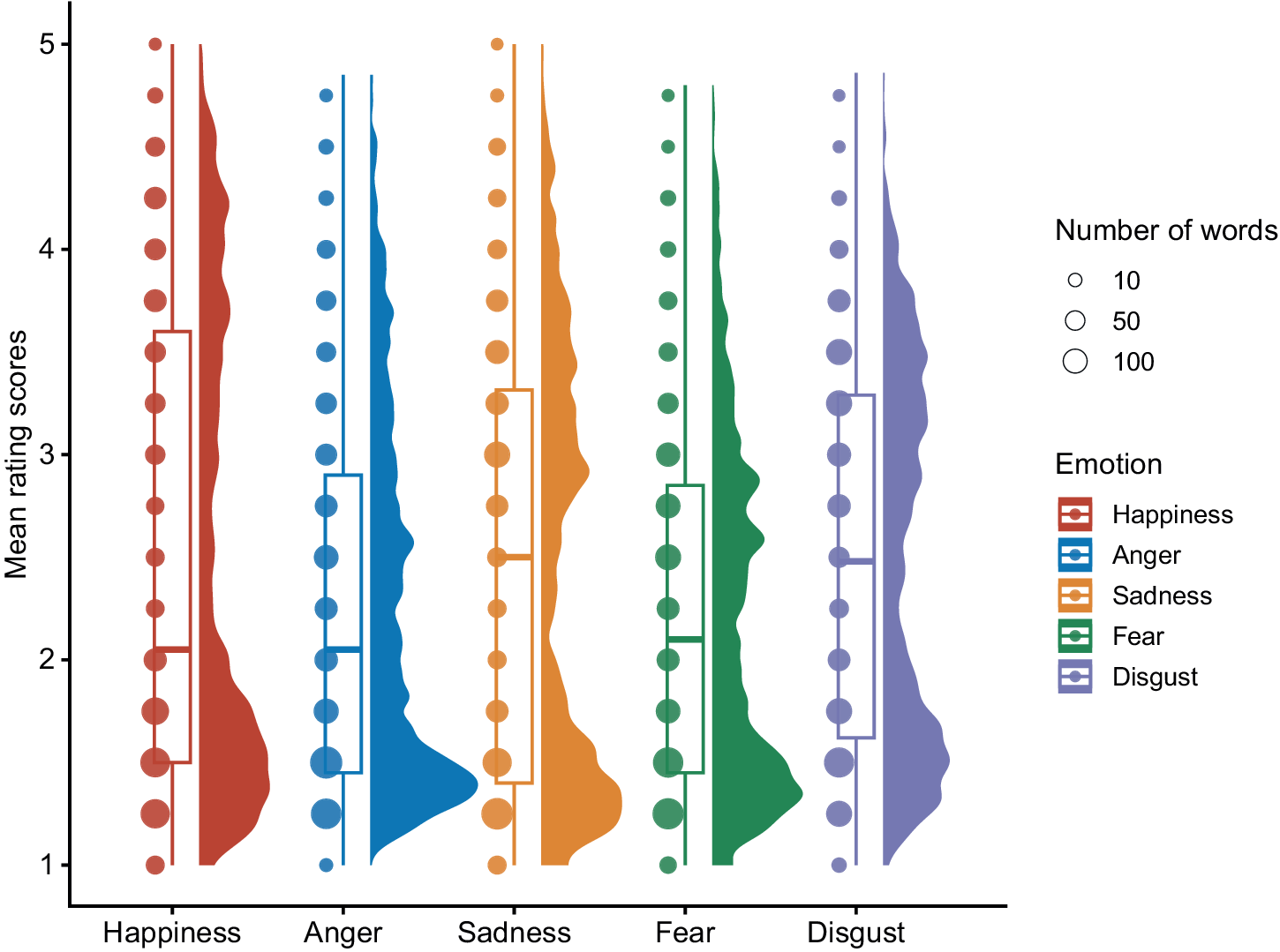
Descriptive statistics revealed that ratings across all five discrete emotions spanned nearly the entire scale (Min = 1, Max = 5), indicating a broad spectrum of emotional elicitation within the L2 lexicon. However, the underlying distributional patterns, as reflected in variance, skewness and kurtosis, differed substantially across emotional dimensions. Happiness displayed the widest dispersion (Interquartile Range, IQR = 2.10; Skewness = .45; Kurtosis = −1.27). The distribution was slightly positively skewed and mildly platykurtic, indicating that although most ratings clustered in the low-to-moderate range, a substantial proportion of words were nevertheless identified as strongly associated with happiness. Sadness (IQR = 1.91) and disgust (IQR = 1.86) showed moderate dispersion and largely symmetrical distributions with mildly platykurtic profiles, suggesting a relatively even distribution of lexical items receiving higher and lower ratings. By contrast, anger (Skewness = .69; Kurtosis = −0.55) and fear (Skewness = .60; Kurtosis = −0.50) exhibited more pronounced positive skewness and slightly platykurtic distributions. These patterns indicate that lexical items associated with these emotions tended to cluster at the lower end of the intensity scale, with relatively few words eliciting high levels of anger or fear. Overall, these distributional patterns are consistent with those reported in previous L1 research (Ferré et al., Reference Ferré, Guasch, Martínez-García, Fraga and Hinojosa2017a; Stadthagen-González et al., Reference Stadthagen-González, Ferré, Pérez-Sánchez, Imbault and Hinojosa2018), suggesting cross-linguistic regularity in discrete emotion word distributions (see Figure 1).
Distribution of mean emotion ratings across five discrete emotions.

Figure 1. Long description
The Y axis represents Mean rating scores from 1 to 5. The X axis lists five emotions: Happiness, Anger, Sadness, Fear, and Disgust. A legend on the right indicates that the size of the data points represents the Number of words (10, 50, or 100). Each emotion is presented as a vertical raincloud plot consisting of three parts:
* Happiness (red): Data points are concentrated between 1 and 3. The box plot shows a median around 2.0. The density curve peaks sharply near 1.5.
* Anger (blue): Data points are spread mostly between 1 and 3. The box plot shows a median around 2.0. The density curve has a primary peak at 1.2 and a secondary peak at 2.8.
* Sadness (orange): Data points are distributed between 1 and 4. The box plot shows a median around 2.5. The density curve is relatively broad with a peak at 1.3.
* Fear (green): Data points are concentrated between 1 and 3. The box plot shows a median around 2.1. The density curve peaks at 1.4.
* Disgust (purple): Data points are spread between 1 and 4. The box plot shows a median around 2.5. The density curve peaks at 1.5 and remains wide up to 3.5.
To map the categorical landscape of the L2 lexicon, each word was assigned to a primary discrete emotion based on established thresholds from prior research (Ćoso et al., Reference Ćoso, Guasch, Bogunović, Ferré and Hinojosa2023; Stadthagen-González et al., Reference Stadthagen-González, Ferré, Pérez-Sánchez, Imbault and Hinojosa2018; Syssau et al., Reference Syssau, Yakhloufi, Giudicelli, Monnier and Anders2021). Items with a mean rating of 3 or above were classified into their highest-rated emotion category, whereas words scoring below 3 across all dimensions were deemed neutral. Based on these criteria, 140 words (12.48%) were classified as neutral (e.g., lipstick). Notably, happiness-related words constituted the largest proportion of the lexicon (414 words, 36.90%; e.g., joy, fun). Negative emotions, by contrast, were markedly less prevalent and exhibited significant internal imbalance: sadness (224 words, 19.96%; e.g., sorrow) and disgust (157 words, 13.99%; e.g., nauseating) were relatively well-represented, whereas anger (118 words, 10.52%; e.g., anger) and fear (69 words, 6.15%; e.g., scared) accounted for the smallest segments.
Consistent with L1 research, word distribution across emotion categories in our L2 database remains notably uneven. Specifically, happiness dominates the positive spectrum, while sadness constitutes the largest category of negative words. Both findings corroborate established L1 trends (Ćoso et al., Reference Ćoso, Guasch, Bogunović, Ferré and Hinojosa2023; Kapucu et al., Reference Kapucu, Kılıç, Özkılıç-Kartal and Sarıbaz2018; Stadthagen-González et al., Reference Stadthagen-González, Ferré, Pérez-Sánchez, Imbault and Hinojosa2018). The high proportion of happiness-related words likely reflects that positive vocabulary establishes robust semantic foundations more easily. However, the distribution of negative emotion categories partially diverges from L1 patterns, where disgust is typically the least frequent category (e.g., Hinojosa et al., Reference Hinojosa, Martínez-García, Villalba-García, Fernández-Folgueiras, Sánchez-Carmona, Pozo and Montoro2016; Kapucu et al., Reference Kapucu, Kılıç, Özkılıç-Kartal and Sarıbaz2018; Pérez-Sánchez et al., Reference Pérez-Sánchez, Stadthagen-González, Guasch, Hinojosa, Fraga, Marín and Ferré2021; Stadthagen-González et al., Reference Stadthagen-González, Ferré, Pérez-Sánchez, Imbault and Hinojosa2018). In contrast, fear constitutes the least frequent category in the present L2 dataset.
3.3. Relationship between five discrete emotions
To examine the relationship between five discrete emotions, Pearson correlation coefficients were computed (see Figure 2). Results indicated that happiness was significantly negatively correlated with all negative discrete emotions (anger, sadness, fear and disgust). The strongest negative correlation was observed for disgust (r = −.88, p < .001), followed by sadness (r = −.85, p < .001) and fear (r = −.80, p < .001), while the correlation with anger was slightly weaker (r = −.77, p < .001) but remained strongly negative. Within the negative emotion cluster, all discrete categories intercorrelated positively and significantly (all ps < .001), demonstrating robust convergence. Specifically, anger exhibited its strongest association with disgust (r = .80), followed by moderate-to-strong links with sadness (r = .69) and fear (r = .65). Sadness demonstrated particularly pronounced covariation with both disgust (r = .83) and fear (r = .80), while the correlation between fear and disgust remained similarly robust (r = .80). Collectively, these results reveal a clear polarity pattern: happiness stands in strong opposition to the negative emotions, whereas the negative emotion cluster shows strong covariation.
Correlation matrix of all variables, including five discrete emotions, three affective variables (valence, arousal and prototypicality) and four psycholinguistic variables (concreteness, frequency, semantic diversity and AoA). Nonsignificant correlations (p ≥ .05) are marked with “×.”

Figure 2. Long description
A square correlation matrix with twelve variables on both the x and y axes. A color scale legend on the right indicates Pearson r values from negative 1.0 in dark blue to 1.0 in dark red, with white representing zero.
Variables from bottom to top and left to right are: Hap_Mean, Ang_Mean, Sad_Mean, Fear_Mean, Disg_Mean, Valence, Arousal, Concreteness, EmoProL2, Ao A, Word frequency, and Semantic diversity.
The diagonal from bottom-left to top-right shows perfect positive correlations of 1.0 as each variable correlates with itself.
A prominent dark red and dark blue cluster exists in the bottom-left quadrant (rows and columns 1 through 6). This indicates strong positive correlations between Ang_Mean, Sad_Mean, Fear_Mean, and Disg_Mean (r values 0.65 to 0.83), and strong negative correlations between these four emotions and Hap_Mean (r values negative 0.77 to negative 0.88). Valence shows a strong positive correlation with Hap_Mean (0.9) and strong negative correlations with the other four emotions (r values negative 0.8 to negative 0.9).
The top-right quadrant contains mostly light-colored cells with lower correlation coefficients and several black X marks indicating non-significant p-values greater than or equal to 0.05. Notable correlations in this area include a negative correlation between AoA and Word frequency (negative 0.62) and a negative correlation between Concreteness and EmoProL2 (negative 0.48).
Happiness was found to be significantly and strongly negatively correlated with all negative discrete emotions, including anger, sadness, fear and disgust. This finding is highly consistent with previous L1 normative studies (Ćoso et al., Reference Ćoso, Guasch, Bogunović, Ferré and Hinojosa2023; Ferré et al., Reference Ferré, Guasch, Martínez-García, Fraga and Hinojosa2017a; Pérez-Sánchez et al., Reference Pérez-Sánchez, Stadthagen-González, Guasch, Hinojosa, Fraga, Marín and Ferré2021; Song, Reference Song2026; Stadthagen-González et al., Reference Stadthagen-González, Ferré, Pérez-Sánchez, Imbault and Hinojosa2018; Syssau et al., Reference Syssau, Yakhloufi, Giudicelli, Monnier and Anders2021) and provides empirical support for the central role of emotional valence in lexical-semantic representation. It suggests a clear opposition between positive and negative emotion dimensions in learners’ mental lexicon, whereby stronger negative attributes of a word are associated with weaker positive representations.
Furthermore, regarding the relationships among negative discrete emotions, the present study found that negative discrete emotions were generally positively correlated with one another, a pattern that is consistent with the robust findings reported in prior L1 normative studies (Ćoso et al., Reference Ćoso, Guasch, Bogunović, Ferré and Hinojosa2023; Ferré et al., Reference Ferré, Guasch, Martínez-García, Fraga and Hinojosa2017a; Kapucu et al., Reference Kapucu, Kılıç, Özkılıç-Kartal and Sarıbaz2018; Pérez-Sánchez et al., Reference Pérez-Sánchez, Stadthagen-González, Guasch, Hinojosa, Fraga, Marín and Ferré2021; Song, Reference Song2026; Stadthagen-González et al., Reference Stadthagen-González, Ferré, Pérez-Sánchez, Imbault and Hinojosa2018; Syssau et al., Reference Syssau, Yakhloufi, Giudicelli, Monnier and Anders2021). Collectively, these studies suggest a stable clustering structure of negative emotions within semantic space. However, the present study also revealed a subtle but noteworthy deviation from this general pattern, specifically in the case of disgust. In previous studies, disgust has typically been found to exhibit the weakest associations with other negative emotions, suggesting a relatively more differentiated representational status within the negative emotion domain (Ferré et al., Reference Ferré, Guasch, Martínez-García, Fraga and Hinojosa2017a; Kapucu et al., Reference Kapucu, Kılıç, Özkılıç-Kartal and Sarıbaz2018; Stadthagen-González et al., Reference Stadthagen-González, Ferré, Pérez-Sánchez, Imbault and Hinojosa2018). In contrast, in the current L2 database provided by native Chinese speakers, disgust showed substantially stronger positive correlations with other negative emotions, particularly with anger (r = .80) and sadness (r = .83). It is conceivable that such a pattern observed in L2 could be partially attributable to L1 transfer. In Chinese contexts, disgust often extends beyond sensory rejection to include moral judgment and interpersonal disapproval, such as strong aversion to unethical behavior, which is different from some Indo-European languages in which disgust is primarily associated with physiological aversion. The broader semantic range in Chinese increases the conceptual overlap between disgust and other negative emotions, including anger and sadness, which in turn leads to higher correlations among these categories. Intriguingly, this postulation has been strengthened by one recent relevant normative study with Chinese native speakers (Song, Reference Song2026) where disgust consistently shows high correlations with other negative emotions (e.g., r = .93 for disgust and anger, r = .91 for disgust and fear and r = .88 for disgust and sadness).
3.4. Relationship between discrete emotions and affective variables
Pearson correlations were also conducted to investigate how the five discrete emotions relate to valence, arousal and emotion prototypicality (see Figure 2). Valence was strongly positively correlated with happiness (r = .90, p < .001) and significantly negatively correlated with all four negative discrete emotions: anger (r = −.80, p < .001), sadness (r = −.88, p < .001), fear (r = −.81, p < .001) and disgust (r = −.90, p < .001), indicating that valence effectively distinguishes between positive and negative emotions. As expected, happiness was strongly and positively correlated with valence, whereas the four negative emotions were negatively correlated with valence. Aligning with previous L1 normative findings (Briesemeister et al., Reference Briesemeister, Kuchinke and Jacobs2011b; Ćoso et al., Reference Ćoso, Guasch, Bogunović, Ferré and Hinojosa2023; Ferré et al., Reference Ferré, Guasch, Martínez-García, Fraga and Hinojosa2017a; Hinojosa et al., Reference Hinojosa, Martínez-García, Villalba-García, Fernández-Folgueiras, Sánchez-Carmona, Pozo and Montoro2016; Pérez-Sánchez et al., Reference Pérez-Sánchez, Stadthagen-González, Guasch, Hinojosa, Fraga, Marín and Ferré2021; Song, Reference Song2026; Speed & Brysbaert, Reference Speed and Brysbaert2024; Syssau et al., Reference Syssau, Yakhloufi, Giudicelli, Monnier and Anders2021), this pattern confirms that valence remains the most fundamental and stable dimension of the affective space, even in L2 lexical representation.
In contrast, the relationship between arousal and discrete emotions was more nuanced. Arousal showed generally lower but significant correlations with discrete emotions, and the pattern was largely opposite to that of valence: arousal correlated positively with all negative discrete emotions (anger: r = .22; sadness: r = .09; fear: r = .26; disgust: r = .17; all ps < .001) but negatively with happiness (r = −.08, p < .01). This trend aligns with L1 research, where negative emotions such as fear and anger typically exhibit stronger correlations with arousal, whereas the association between happiness and arousal is relatively weaker (Ćoso et al., Reference Ćoso, Guasch, Bogunović, Ferré and Hinojosa2023; Hinojosa et al., Reference Hinojosa, Martínez-García, Villalba-García, Fernández-Folgueiras, Sánchez-Carmona, Pozo and Montoro2016; Pérez-Sánchez et al., Reference Pérez-Sánchez, Stadthagen-González, Guasch, Hinojosa, Fraga, Marín and Ferré2021; Song, Reference Song2026; Speed & Brysbaert, Reference Speed and Brysbaert2024; Stadthagen-González et al., Reference Stadthagen-González, Ferré, Pérez-Sánchez, Imbault and Hinojosa2018). Notably, the overall correlation strength in our L2 database is substantially lower than previous L1 studies (Ćoso et al., Reference Ćoso, Guasch, Bogunović, Ferré and Hinojosa2023; Hinojosa et al., Reference Hinojosa, Martínez-García, Villalba-García, Fernández-Folgueiras, Sánchez-Carmona, Pozo and Montoro2016; Pérez-Sánchez et al., Reference Pérez-Sánchez, Stadthagen-González, Guasch, Hinojosa, Fraga, Marín and Ferré2021; Song, Reference Song2026; Speed & Brysbaert, Reference Speed and Brysbaert2024; Stadthagen-González et al., Reference Stadthagen-González, Ferré, Pérez-Sánchez, Imbault and Hinojosa2018). For instance, Ćoso et al. (Reference Ćoso, Guasch, Bogunović, Ferré and Hinojosa2023) reported consistently higher coefficients (happiness: r = −.33; fear: r = .66; anger: r = .65; sadness: r = .63; disgust: r = .57). Stadthagen-González et al. (Reference Stadthagen-González, Ferré, Pérez-Sánchez, Imbault and Hinojosa2018) observed similar patterns (happiness: r = −.26; fear: r = .65; anger: r = .61; sadness: r = .54; disgust: r = .49). The reduced correlation strength in our L2 database primarily arises from distinct data sources. Specifically, arousal ratings were extracted from an L1 lexical database (Warriner et al., Reference Warriner, Kuperman and Brysbaert2013), whereas discrete emotion ratings were exclusively provided by L2 learners. In other words, L1 arousal ratings correlate strongly with L1 discrete emotions but weakly with L2 emotions. This indicates that L1 arousal loses predictive power across languages. This loss of predictive power can be attributed to the language-specific nature of emotional embodiment. According to Embodied Emotion Theory (Niedenthal, Reference Niedenthal2007), L1 speakers strongly associate each emotion word with rich and contextualized bodily experiences. For instance, encountering words such as “fear” prompts L1 speakers to automatically simulate physiological responses like an accelerated heartbeat and sweaty palms. These embodied experiences underlie arousal ratings; thus, L1 arousal measures the intensity of bodily experiences elicited by these words. By contrast, L2 vocabulary is typically acquired in classroom settings through L1 translation equivalents. Consequently, L2 emotion words function more as declarative semantic knowledge rather than deeply embodied experiences (Harris et al., Reference Harris, Ayçiçeği and Gleason2003). Because L2 learners lack corresponding physical simulations, L1 bodily experience poorly predicts L2 affective properties. Furthermore, previous L1 studies collected both arousal and discrete emotion ratings from the same population. This data homogeneity introduces shared method variance, thereby inflating variable correlations. In the current study, involving distinct participant cohorts eliminates this shared method variance. Therefore, the observed attenuation reflects a more genuine cross-linguistic relationship.
The correlations between L2 emotional prototypicality and discrete emotions were generally low but still significant: happiness was positively associated with emotional prototypicality (r = .07, p < .05), whereas among the negative emotions, anger (r = .14, p < .001), sadness (r = .11, p < .001), fear (r = .09, p < .01) and disgust (r = .11, p < .01) showed small positive correlations. This pattern is broadly consistent with Pérez-Sánchez et al. (Reference Pérez-Sánchez, Stadthagen-González, Guasch, Hinojosa, Fraga, Marín and Ferré2021), which, to our knowledge, is the only previous study examining the relationship between emotional prototypicality and discrete emotions in an emotion-word norming dataset. Their study reported small but positive correlations between sadness, fear and anger and emotional prototypicality, but nonsignificant effects for disgust. Both the present study and Pérez-Sánchez et al. (Reference Pérez-Sánchez, Stadthagen-González, Guasch, Hinojosa, Fraga, Marín and Ferré2021) show generally low correlation magnitudes, indicating a similar pattern across L1 and L2 contexts. Notably, the present study additionally found a significant positive correlation between happiness and emotional prototypicality, which was not observed in Pérez-Sánchez et al. (Reference Pérez-Sánchez, Stadthagen-González, Guasch, Hinojosa, Fraga, Marín and Ferré2021), suggesting a stronger role of positive emotion in the L2 prototypicality structure. Our study is the first to systematically examine the relationship between emotional prototypicality and discrete emotions in the L2 context. Results suggest that they do not show a one-to-one mapping, but instead reflect a broader category-based representation. Therefore, emotional prototypicality alone may be insufficient to capture L2 emotion-word characteristics, and discrete emotional intensity should be more precisely measured and controlled in experimental designs.
3.5. Relationship between discrete emotions and psycholinguistic variables
Pearson correlations were also computed to examine the relationships between discrete emotions and multiple psycholinguistic variables (see also Figure 2). As these variables were obtained from Wu et al. (Reference Wu, Zhang and Meng2025), correlations between discrete emotions and AoA, concreteness and word frequency were based on all 1,122 lexical items.
The associations between AoA and discrete emotions revealed a clear contrast. Happiness demonstrated a significant inverse correlation with AoA (r = −.19, p < .001), indicating that earlier-acquired words typically elicit stronger happiness responses. Conversely, all negative emotions showed positive correlations with AoA (anger: r = .16; sadness: r = .13; fear: r = .08; disgust: r = .13; all ps < .01). This suggests that words learned later are more likely to evoke negative emotional reactions. This pattern mirrors findings from L1 studies that provide comparable measures of AoA and discrete emotion ratings (Ćoso et al., Reference Ćoso, Guasch, Bogunović, Ferré and Hinojosa2023; Pérez-Sánchez et al., Reference Pérez-Sánchez, Stadthagen-González, Guasch, Hinojosa, Fraga, Marín and Ferré2021; Song, Reference Song2026; Stadthagen-González et al., Reference Stadthagen-González, Ferré, Pérez-Sánchez, Imbault and Hinojosa2018; Syssau et al., Reference Syssau, Yakhloufi, Giudicelli, Monnier and Anders2021), confirming that the positivity bias observed in native lexical development extends to the L2 mental lexicon. The results are also consistent with dimensional models of emotion. As Ponari et al. (Reference Ponari, Norbury and Vigliocco2018) observed, positive words are generally acquired earlier than negative words, even when controlling for word frequency and concreteness. Together, these findings emphasize the regulatory role of affective information in lexical development across both discrete and dimensional emotion frameworks.
Correlations between concreteness and discrete emotions were generally low but significant: happiness showed a negative correlation with concreteness (r = −.09, p < .01), while among negative emotions, only fear yielded a positive correlation with concreteness (r = .09, p < .01). Correlations for anger, sadness and disgust with concreteness failed to reach significance, indicating that the influence of concreteness on discrete emotions is relatively weak. This pattern diverges from findings in L1 research, such as those reported by Ćoso et al. (Reference Ćoso, Guasch, Bogunović, Ferré and Hinojosa2023), Pérez-Sánchez et al. (Reference Pérez-Sánchez, Stadthagen-González, Guasch, Hinojosa, Fraga, Marín and Ferré2021) and Stadthagen-González et al. (Reference Stadthagen-González, Ferré, Pérez-Sánchez, Imbault and Hinojosa2018). In their study, negative emotions such as anger, fear and sadness were negatively correlated with concreteness, which suggests that the more concrete the word is, the less easily it evokes negative emotions. A plausible explanation for this discrepancy is that emotional grounding in L2 is comparatively weaker or less differentiated (see Pavlenko, Reference Pavlenko2012). This reduced emotional resonance could restrict the scope of associations between discrete emotions and concreteness. Given that only happiness and fear exhibited reliable links with concreteness in the current dataset, the discrete emotional grounding of abstract concepts appears to operate differently at the L2 level. Overall, these findings highlight the importance of examining discrete emotions in L2 and call for greater attention to concreteness as a key variable in understanding bilingual emotional representation.
Word frequency was positively correlated to happiness (r = .20, p < .001) and negatively associated with three negative emotions (anger: r = −.13; sadness: r = −.11; disgust: r = −.13; all ps < .01), suggesting that high-frequency words are more likely to elicit positive emotional responses, consistent with previous L1 research (Ćoso et al., Reference Ćoso, Guasch, Bogunović, Ferré and Hinojosa2023; Hinojosa et al., Reference Hinojosa, Martínez-García, Villalba-García, Fernández-Folgueiras, Sánchez-Carmona, Pozo and Montoro2016; Pérez-Sánchez et al., Reference Pérez-Sánchez, Stadthagen-González, Guasch, Hinojosa, Fraga, Marín and Ferré2021; Song, Reference Song2026; Stadthagen-González et al., Reference Stadthagen-González, Ferré, Pérez-Sánchez, Imbault and Hinojosa2018). El-Dakhs et al. (Reference El-Dakhs, Sonbul and Altarriba2023) recently observed that the processing advantage for positive words in L2 was exclusively manifested among high-frequency items. This aligns with our observation that higher word frequency strongly facilitates positive emotional resonance in the L2 lexicon. Consequently, this frequency-driven positivity advantage may partially explain why the negativity bias is often attenuated or absent in L2 studies (Lizarazo Pereira et al., Reference Lizarazo Pereira, Roberts and Tamayo2023; Harris et al., Reference Harris, Ayçiçeği and Gleason2003).
Finally, the correlations between semantic diversity and discrete emotions were relatively weak but statistically significant. Specifically, happiness scaled positively with semantic diversity (r = .11, p < .001), whereas negative emotions generally exhibited an inverse trend (anger: r = −.04, p > .05; sadness: r = −.06, p > .05; fear: r = −.07, p < .01; disgust: r = −.07, p < .01). This pattern may reflect an efficiency principle in language evolution, where positive vocabulary holds greater functional value for maintaining social cohesion in everyday interactions (Rozin et al., Reference Rozin, Berman and Royzman2010). To our knowledge, no existing normative research has specifically examined the relationship between semantic diversity and discrete emotions. The present study addresses this gap by demonstrating that semantic diversity is significantly associated with discrete emotions in L2 as well.
Taken together, within the framework of discrete emotions in L2, words conveying happiness are generally acquired earlier (lower AoA), exhibit higher frequency and possess greater semantic diversity. Conversely, lexical items conveying negative emotions (anger, sadness, fear and disgust) tend to be acquired later, appear less frequently and demonstrate reduced semantic diversity, thereby predisposing them to evoke negative affective reactions. Furthermore, in contrast to the L1 research, the present study reveals that the associations between concreteness and discrete emotions in L2 are relatively weak. This attenuated link may stem from the comparatively weaker emotional grounding inherent at the L2 level (Pavlenko, Reference Pavlenko2012). Altogether, although certain correlations remain modest in magnitude, these findings confirm a reliable association between discrete emotions and key psycholinguistic variables including AoA, frequency, concreteness and semantic diversity. Consequently, the present results, in conjunction with existing literature, necessitate that psycholinguistic variables be rigorously controlled or accounted for when designing experiments that involve affective linguistic stimuli.
4. Conclusion
The present study established a normative database of discrete emotion ratings for 1,122 English words within an L2 context, extending the initial norms reported by Wu et al. (Reference Wu, Zhang and Meng2025) from emotion prototypicality to intensity ratings across five discrete emotion categories (happiness, anger, fear, disgust and sadness). The findings indicate that discrete emotions in an L2 are systematically associated with a broad array of variables, encompassing valence, arousal, emotion prototypicality and key psycholinguistic factors such as AoA, word frequency, concreteness and semantic diversity. Overall, by illuminating the correlations between discrete emotions and psycholinguistic variables, this database not only provides a robust tool for stimuli selection and resolving heterogeneous findings, but also establishes a solid empirical foundation for advancing the theoretical understanding of the intrinsic relationship between language and emotion.
However, several limitations should be acknowledged. First, the gender distribution of the sample was somewhat uneven. Although similar sampling patterns are common in L2-focused psycholinguistic norming studies (see Wu et al., Reference Wu, Zhang and Meng2025; Zheng et al., Reference Zheng, Zhang, Guo, Guasch and Ferré2023), the present findings suggest that gender may modulate sensitivity to discrete emotions (Ćoso et al., Reference Ćoso, Guasch, Bogunović, Ferré and Hinojosa2023; Ferré et al., Reference Ferré, Guasch, Martínez-García, Fraga and Hinojosa2017a; Hinojosa et al., Reference Hinojosa, Martínez-García, Villalba-García, Fernández-Folgueiras, Sánchez-Carmona, Pozo and Montoro2016). Future norming efforts should therefore aim for more balanced sampling to rigorously examine gender-related variation in L2 emotional representation. Second, this study did not obtain L1 ratings of discrete emotions for the same word set and thus lacks a native-language baseline for these stimuli. This renders it impossible to directly compare the rating differences of discrete emotion between L1 and L2. Third, valence and arousal data were derived from a native-speaker normative database (Warriner et al., Reference Warriner, Kuperman and Brysbaert2013), whereas discrete emotion ratings were collected from L2 participants. Although this approach has been used in prior research (see Wu et al., Reference Wu, Zhang and Meng2025), evidence suggests that linguistic background may affect affective evaluations; therefore, this cross-language data integration may limit interpretability. Future work should develop large-scale L2-based affective norm databases, including valence, arousal, familiarity, concreteness and discrete emotion ratings, to enable systematic comparisons between L1 and L2 lexical affective norms. Additionally, given that the study followed the norming procedure of Wu et al. (Reference Wu, Zhang and Meng2025), subsequent research could incorporate objective and standardized proficiency measures, such as LexTALE (Lemhöfer & Broersma, Reference Lemhöfer and Broersma2012). Such measures would provide a more precise assessment of L2 proficiency and help determine how varying levels of linguistic competence shape the depth of discrete emotional representation.
Supplementary Material
The supplementary material for this article can be found at http://doi.org/10.1017/S1366728926101837.
Data availability statement
Data can be found here: https://osf.io/f3kjv/overview?view_only=29e7d64ec9d445cc96c040ec7b74add2.
Acknowledgements
We would like to thank all the participants who contributed data to this research.
Competing interests
The authors have no competing interests to declare that are relevant to the content of this article.
Ethical standards
The study was approved by the ethics committee of Nanjing Normal University. All procedures were conducted in accordance with the Declaration of Helsinki.
Code availability
Not applicable.


 Open access

