CLI: input quantity and language processing
One of the central questions in bilingual language development research over the last fifteen years has been the issue of cross-linguistic influence (CLI), i.e., the extent to which, and under what circumstances, the two languages of a bilingual child interact and give rise to linguistic behaviours that are quantitatively and/or qualitatively different from those of monolingual children. Hulk & Müller (Reference Hulk and Müller2000) were the first to formulate specific predictions about CLI, although Döpke (Reference Döpke1998) had already flagged the issue in a previous study of word order in English–German bilingual children. Hulk & Müller's (Reference Hulk and Müller2000) seminal hypothesis was that CLI occurs in bilingual children if (a) the structure in question is at the interface between two modules of grammar, and more specifically at the interface between discourse-pragmatics and syntax in the so-called C-domain, and if (b) there is a degree of overlap between the two language systems at the surface level (Hulk & Müller, Reference Hulk and Müller2000: 228–229). Since then, evidence of CLI occurring even after the instantiation of the C-domain has been reported for the realization of pronominal arguments especially in null-subject and non-null-subject language pairs (Paradis & Navarro, Reference Paradis and Navarro2003; Serratrice, Sorace & Paoli, Reference Serratrice, Sorace and Paoli2004; Sorace, Serratrice, Filiaci & Baldo, Reference Serratrice, Sorace, Filiaci and Baldo2009). Recently cross-linguistic effects have also been observed at the clause level for structures such as compound nouns in Persian and English (Foroodi-Nejad & Paradis, Reference Foroodi-Nejad and Paradis2009), Noun+Adj strings in French and English (Nicoladis, Reference Nicoladis2006) and passive structures in Spanish and English (Vasilyeva, Waterfall, Gámez, Gómez, Bowers & Shimpi, Reference Vasilyeva, Waterfall, Gamez, Gomez, Bowers and Shimpi2010). Capitalizing on Hulk & Müller's (Reference Hulk and Müller2000) early work, subsequent research started examining additional predictors of CLI including factors such as language dominance, processing mechanisms, input quality and age. The present study specifically focuses on whether CLI is affected by prior linguistic processing and amount of language exposure.
Input quantity
Input effects in bilingual acquisition have been observed on bilingual children's language development, particularly for the acquisition of morpho-syntax and the lexicon (Barnes & Garcia, Reference Barnes and Garcia2013; Hoff, Core, Place, Rumiche, Senor & Parra, Reference Hoff, Core, Place, Rumiche, Senor and Parra2012; Paradis, Reference Paradis2011; Thordardottir, Reference Thordardottir2011) but also phonology (Nicoladis & Paradis, Reference Nicoladis and Paradis2011; Sundara & Scutellaro, Reference Sundara and Scutellaro2011).
A growing body of research has started to investigate the impact of input quantity in CLI, although so far only very general measures of language exposure, such as the language of the environment, have been considered (Argyri & Sorace, Reference Argyri and Sorace2007; Serratrice et al., Reference Serratrice, Sorace, Filiaci and Baldo2009; Serratrice, Sorace, Filiaci & Baldo, Reference Serratrice, Sorace, Filiaci and Baldo2011; but see Kidd, Chan & Chiu, Reference Kidd, Chan and Chiu2014, for a recent exploration of language exposure at the level of the individual). In these studies, the role of input quantity on CLI was operationalised as the language of the community. The rationale behind this methodological choice was that bilingual children would have greater exposure to the language of the community than to the heritage minority language. The results did show a general effect of the language of the environment on CLI, among other variables. Argyri & Sorace (Reference Argyri and Sorace2007) reported different results while comparing two groups of 8-year-old Greek–English bilinguals growing up in Greece and in the UK. Only the children living in the UK, hence categorised as dominant in English, displayed CLI from English to Greek in the acceptance and use of non-target pre-verbal subjects in wide focus contexts (1) and non-target pre-verbal subjects in what-embedded interrogatives in Greek (2). Language of the community, as a proxy for language dominance, was one of the variables affecting the degree of CLI.
-
(1)

-
(2)


Similar results were observed by Serratrice et al.'s (Reference Serratrice, Sorace, Filiaci and Baldo2009) study on 6- to 10-year-old English–Italian and Spanish–Italian children's encoding of specificity and genericity in plural noun phrases. The English–Italian bilingual children accepted significantly more ungrammatical bare nouns in generic contexts in Italian, as in (3), than all the other groups. Crucially, the bilinguals living in the UK performed less accurately in Italian than the bilinguals in Italy. The children's limited exposure to Italian had an effect on their acceptance of ungrammatical bare nouns in generic context in this language.
-
(3)

Along the same lines, Serratrice et al. (Reference Serratrice, Sorace, Filiaci and Baldo2011) also observed an effect of the language of the environment on CLI in a study examining 6- to 10-year-old English–Italian and Spanish–Italian children's knowledge of pronominal objects. The English–Italian children in the UK accepted infelicitous postverbal object pronouns in [- focus] contexts as in (4) twice as often as the Italian monolingual children and more often than all other bilingual groups.
-
(4)

The common denominator of these studies investigating the role of language exposure is the assumption that the bilinguals would be predominantly exposed to the language of their living environment. This is not uncontroversial however; one of the reasons the studies reviewed here found an overall effect of the language of the community is because they were considering older school-age children for whom we can assume that the language of the community plays a more significant role in their daily interactions than the minority home language. In the case of pre-school children, who may be spending more time at home with a minority language-speaking parent or other minority language-speaking caregivers, making the same assumption is potentially more problematic as the role of the community in the child's daily language input would be considerably more restricted than for older children. Therefore, research investigating the role of input quantity on CLI should always include an independent measure of language exposure, especially in the case of younger children for whom relative exposure to the two languages cannot be straightforwardly inferred from their wider environment. A measure of language exposure could then be used as a quantitative predictor of the likelihood of CLI (see Unsworth, Reference Unsworth2013; Reference Unsworth, Silva-Corvalán and Treffers-Daller2014 for a recently developed tool assessing current and cumulative exposure, and De Cat, Berends & Serratrice, Reference De Cat, Berends and Serratrice2015 for the inclusion of a measure of cumulative output alongside cumulative input).
The role of individual language exposure as a predictor of CLI is yet under-investigated, but there is now a large and expanding body of literature on the role of input quantity and quality in bilingual development. A positive correlation has repeatedly been reported between amount of language exposure and language proficiency in lexical development (Marchman & Martínez-Sussman, Reference Marchman and Martinez-Sussmann2002; Patterson, Reference Patterson2002), onset of combinatorial speech (Hoff et al., Reference Hoff, Core, Place, Rumiche, Senor and Parra2012; Marchman, Martinez-Sussman & Dale, Reference Marchman, Martinez-Sussmann and Dale2004); and various aspects of grammatical development (Blom, Reference Blom2010; Gathercole & Hoff, Reference Gathercole, Hoff, Hoff and Shatz2007). At the same time some studies have shown that there is not always a straightforward relationship between input quantity and proficiency. Two recent vocabulary studies with French–English Canadian children (Smithson, Paradis & Nicoladis, Reference Smithson, Paradis and Nicoladis2014; Thordardottir, Reference Thordardottir2011) did not find the often reported differences with monolingual peers for some groups of bilinguals (pre-schoolers), and for some aspects of expressive vocabulary. With respect to morphological acquisition Paradis, Nicoladis, Crago & Genesee (Reference Paradis, Nicoladis, Crago and Genesee2011) showed that the acquisition rate of French regular past tense in French-dominant French–English bilingual four-year-olds was not significantly different from that of monolingual peers despite the bilinguals’ reduced amount of exposure to French.
Processing and shared syntactic representations
Research on bilingual development has also started to investigate whether the daily processing of two languages affects the rate of bilingual development (i.e., acceleration, delay) and the bilingual children's use of their languages (i.e., transfer) (Nicoladis, Rose & Foursha-Stevenson, Reference Nicoladis, Rose and Foursha-Stevenson2010; Sorace & Serratrice, Reference Sorace and Serratrice2009). Specifically, a growing body of evidence suggests that the additional processing demands caused by the simultaneous acquisition of two languages would be responsible for delays in the development of grammatical structures or cross-linguistic transfer (Nicoladis, Reference Nicoladis2006, Reference Nicoladis2012; Pirvulescu, Pérez-Leroux & Roberge, Reference Pirvulescu, Pérez-Leroux, Roberge, Braunmüller and Gabriel2012; Pirvulescu, Pérez-Leroux, Roberge, Strik & Thomas, Reference Pirvulescu, Pérez-Leroux, Roberge, Strik and Thomas2014; Serratrice et al., Reference Serratrice, Sorace, Filiaci and Baldo2011; Sorace et al., Reference Sorace, Serratrice, Filiaci and Baldo2009).
Recently, studies adopting the structural priming paradigm have contributed to the study of syntactic representations in bilingual adults and children. The structural, or syntactic, priming methodology is based on speakers’ tendency to repeat the syntactic structures they have recently been exposed to (Bock, Reference Bock1986). Observing speakers’ sensitivity to primed expressions provides information on the nature of their syntactic representations (Branigan, Reference Branigan2007: 1). While syntactic priming has been used extensively with monolingual adults and increasingly with children (Kidd, Reference Kidd2012; Savage, Lieven, Theakston & Tomasello, Reference Savage, Lieven, Theakston and Tomasello2003, 2006; Shimpi, Gámez, Huttenlocher & Vasilyeva, Reference Shimpi, Gámez, Huttenlocher and Vasilyeva2007; Thothathiri & Snedeker, Reference Thothathiri and Snedeker2008), relatively few studies have used this paradigm to examine the issue of shared syntactic representations in bilinguals and to explore a processing account of CLI. So far, these few studies have mainly focused on proficient adult speakers of an L2 (Hartsuiker, Pickering & Veltkamp, Reference Hartsuiker, Pickering and Veltkamp2004; Schoonbaert, Hartsuiker & Pickering, Reference Schoonbaert, Hartsuiker and Pickering2007). Experiments on advanced adult second language learners (Desmet & Declercq, Reference Desmet and Declercq2006; Hartsuiker et al., Reference Hartsuiker, Pickering and Veltkamp2004; Loebell & Bock, Reference Loebell and Bock2003; Schoonbaert et al., Reference Schoonbaert, Hartsuiker and Pickering2007) have provided evidence of structural priming across languages (from L1 to L2 or from L2 to L1) suggesting that bilingual adults share syntactic representations across languages for certain structures such as passive or ditransitive constructions that exist in both of their two languages.
Vasilyeva et al. (Reference Vasilyeva, Waterfall, Gamez, Gomez, Bowers and Shimpi2010) conducted the first structural priming experiment with Spanish–English bilingual 5-year-olds. Following Hartsuiker et al.'s (Reference Hartsuiker, Pickering and Veltkamp2004) design, the children were primed with passive or active structures across languages (i.e., Spanish to English or English to Spanish). The results did show a significant cross-linguistic priming effect, but this effect was unidirectional from Spanish to English. When primed with Spanish fue-passive sentences, the children increased their use of passive constructions in English. However, the reverse effect was not observed; exposure to English passives in the prime sentences did not lead to a significant increase of fue-passives in Spanish. The fact that priming from English to Spanish was not successful is somewhat problematic. Although the study did not include independent measures of language proficiency or of language exposure, the authors concluded, on the basis of an analysis of the level of syntactic mastery in the children's responses to the experiment, that there was not a substantial difference across their two languages to justify the asymmetry of the results. Instead they proposed that the relative infrequency of the fue-passive construction in Spanish was responsible for the lack of priming after exposure to English passives.
In another cross-linguistic syntactic priming experiment on bilingual children, Hsin, Legendre & Omaki (Reference Hsin, Legendre and Omaki2013) set out to test whether grammatical structures are represented in a language-independent format so that all syntactic structures are available in both languages regardless of their language-specific realization. Hsin et al. (Reference Hsin, Legendre and Omaki2013) showed that Spanish–English five-year-olds could be primed to use the (far less frequent) Adj-N word order in Spanish in a target picture description after hearing an English prime containing the canonical English Adj-N word order. They also included a baseline elicitation condition with no prime, and a neutral condition where the target picture description in Spanish was preceded by an English sentence containing an adjective embedded in a relative clause; in both of these conditions the proportion of Adj-N responses was significantly lower than in the priming condition. The authors also reported a marginal correlation between language dominance, as measured by standardized tests of receptive vocabulary, and the use of the Adj-N order in the elicitation condition; they also found a strong correlation between these variables in the neutral condition. However, the authors did not observe any significant correlation between language dominance and the use of Adj-N strings in the priming condition. Language dominance, as measured by the children's receptive vocabulary, did not account for their use of the pragmatically infelicitous Adj-N order in Spanish. Overall, this study suggests that bilingual children's mental representation of syntactic structures is shared across languages regardless of whether they present a case of structural overlap. It also indicates that language dominance measured in terms of receptive vocabulary alone is not a predictor of CLI.
In summary, syntactic priming has been successfully used to explore the issue of shared syntactic representations in bilingual adults. Vasilyeva et al.'s (Reference Vasilyeva, Waterfall, Gamez, Gomez, Bowers and Shimpi2010) and Hsin et al.'s (Reference Hsin, Legendre and Omaki2013) studies suggest that linguistic representations are shared across languages in bilingual children too, regardless of their availability across languages, i.e., presence vs. absence of overlap across the two languages. The findings of these studies also imply that CLI may be conceptualized in terms of cross-linguistic structural priming, on the assumption that bilingual speakers always have access to structures from their two languages. The routine processing of grammatical constructions in two languages may occasionally lead to interference between optimal and sub-optimal structures at the level of syntactic representation resulting in CLI. Which factors predict the likelihood and the magnitude of CLI remains unclear. Vasilyeva et al.'s (Reference Vasilyeva, Waterfall, Gamez, Gomez, Bowers and Shimpi2010) findings suggest that the frequency of a construction may affect the degree of activation of this structure at the level of syntactic representation and thus the likelihood of CLI; whether the amount of exposure has any role to play in predicting the likelihood of priming is yet to be seen.
To date, structural priming in bilingual children has exclusively been tested across languages. However, within-language experiments should also be considered, as bilingual children may occasionally be exposed to attrited or non-native input containing morpho-syntactic constructions that would be sub-optimal from a discourse-pragmatic point of view (e.g., Tsimpli, Sorace, Heycock & Filiaci, Reference Tsimpli, Sorace, Heycock and Filiaci2004). Caregivers’ prolonged contact with another language is likely to result in contact-modified input displaying sub-optimal form-function mappings (Paradis & Navarro, Reference Paradis and Navarro2003; Schmid, Reference Schmid2010); this would provide bilingual children with input containing constructions that are not discourse-pragmatically appropriate. The input availability of these constructions that are, on the one hand, completely appropriate in one language (e.g., the use of pronouns in topic maintenance contexts in non-null-subject languages), and, at the same time, sub-optimal in the other language (e.g., the use of overt pronouns in topic maintenance contexts in null-subject languages) would make it likely that children themselves would reproduce these sub-optimal form-function mappings in their own speech. The two syntactic priming studies reviewed above have provided some evidence for the possibility that hearing a construction in language A will prime its use in language B, regardless of its grammaticality and/or semantic/pragmatic appropriateness. Unlike those two priming experiments, the present elicitation studies consider the role of discourse-pragmatic appropriateness as well as input manipulation on the children's productions. Specifically, we ask whether bilingual children are more likely than monolingual children to use discourse-pragmatically inappropriate constructions when we consider input and output within one single language. Examining the role of potentially pragmatically sub-optimal structures in the input would shed some light on how attrited or non-native input may affect bilingual children's use of their languages. Eliciting the production of within-language target descriptions would also provide information on the extent to which children's linguistic representations are shared across languages; hearing the experimenter use a description that is sub-optimal in language A (e.g., an overt pronoun for topic-maintenance in a null-subject language like Italian), but perfectly acceptable in language B (i.e., a non-null-subject language like English), would boost the activation of the structure and make it more likely that children would re-use it themselves when describing a target scene in language A thus producing a pragmatically inappropriate structure.
CLI beyond pronominal realization: the expression of topicality at the sentence level in left dislocation
So far the bulk of research examining CLI at the interface between syntax and discourse-pragmatics has focused on the realization of pronominal expressions (Hacohen & Schaeffer, Reference Hacohen and Schaeffer2007; Hauser-Grüdl, Arencibia Guerra, Witzmann, Leray & Müller, Reference Hauser-Grüdl, Arencibia Guerra, Witzmann, Leray and Müller2010; Pinto, Reference Pinto, Torrens and Escobar2006; Serratrice, Reference Serratrice2007; see Serratrice, Reference Serratrice2013 for a recent review). The present studies take the investigation of CLI at the interface between syntax and discourse-pragmatics beyond single referential expressions to the sentence level. We focus on the expression of topicality in two elicited production studies involving French–English bilingual children; in particular we investigate how the use of Left Dislocations (LDs) is affected by prior discourse context and by amount of language exposure.
LDs typically include a constituent that appears to the left periphery of a main clause that is co-referential with a resumptive element as in (5) in which the noun phrase le lion and the strong pronoun lui are both co-indexed with the subject clitic il.
-
(5)

LDs are an interesting test case, as they appear to be strong candidates for CLI (Hervé, Reference Hervé2014; Notley, van der Linden & Hulk, Reference Notley, van der Linden, Hulk, Baauw, Drijkoningen and Pinto2007). There is partial overlap in the way in which topicality is encoded in French and in English. LDs mark topics in both languages; however, only French strongly relies on their use as about 20% of utterances in spoken French contain a dislocation (Barnes, Reference Barnes1985; De Cat, Reference De Cat2002; Lambrecht, Reference Lambrecht1981, Reference Lambrecht, Haspelmath, König, Oesterreicher and Raible2001). In English, topics are largely encoded by the canonical SV(O) word order and topic dislocation, though possible, is not at all frequent as only 1% of utterances contain one (Donaldson, Reference Donaldson2011; Geluykens, Reference Geluykens1992). LDs are syntactically and pragmatically less constrained in French than in English (i.e., nature of dislocated and resumptive elements, discourse functions). In both languages, about 70% of LDs are associated with the subject of the main clause (Blasco-Dulbecco, Reference Blasco-Dulbecco1999; Snider & Zaenen, Reference Snider and Zaenen2006). Although a variety of grammatical elements can be dislocated, LD elements typically correspond to full NPs or strong pronouns (Blasco-Dulbecco, Reference Blasco-Dulbecco1999; Geluykens, Reference Geluykens1992). The fundamental difference between French and English lies in the accessibility of the LD element. In Prince's (Reference Prince and Cole1981) terms, LD elements are predominantly discourse-old or inferable (i.e., extra-linguistic) referents in French (Barnes, Reference Barnes1985; Delais-Roussarie, Doetjes & Sleeman, Reference Delais-Roussarie, Doetjes, Sleeman, Corblin and de Swart2004; Lambrecht, Reference Lambrecht, Haspelmath, König, Oesterreicher and Raible2001). In contrast, LDs principally introduce discourse-new or inferable referents in English (Donaldson, Reference Donaldson2011; Gregory & Michaelis, Reference Gregory and Michaelis2001; Ochs-Keenan & Schieffelin, Reference Ochs-Keenan and Schieffelin1976). Finally, LDs are used for a greater variety of discourse functions in French than in English.
Aims of the present study and predictions
In the present elicitation studies, the aim was to explore children's sensitivity to the language-specific encoding of topical subjects in English and French at the sentence-level, and to investigate the role of language exposure on the likelihood of CLI. The relationship between the bilingual children's representation of topics was examined in two within-language elicited production experiments, one in French (study 1) and one in English (study 2) in order to answer the following questions:
-
1. What is the effect of input manipulation on the probability of producing a left dislocation in French (study 1) and in English (study 2)?
-
2. What is the role of language exposure on the probability of producing a left dislocation in French (1) and in English (2)?
Previous research has shown that topics are obligatorily dislocated to create a topical contrast in French when they are not expressed by a weak pronoun (De Cat, Reference De Cat2002; Lambrecht, Reference Lambrecht1994). English favours the subject-verb order to mark topicality (Donaldson, Reference Donaldson2011). By this rationale, high proportions of LD responses are expected in French regardless of elicitation condition. Conversely, low proportions of LDs are expected in English given their relative low frequency in the language as a whole. Nonetheless, it is anticipated that LD production will be significantly different as a function of input manipulation and context. In particular, the number of target LDs produced after the modelling of a LD in the elicitation condition should be higher than the number of those following a NP+VP (SV) description in the elicitation condition.
Following earlier research examining the effect of input quantity on CLI (Argyri & Sorace, Reference Argyri and Sorace2007; Kupisch, Reference Kupisch2007; Serratrice et al., Reference Serratrice, Sorace, Filiaci and Baldo2011; Sorace et al., Reference Sorace, Serratrice, Filiaci and Baldo2009), we anticipate that exposure to French will affect the magnitude of CLI since dislocations are high-frequency structures in this language. In both experiments, there should be a positive correlation between the children's exposure to French and the probability that they will produce a LD. In French, we expect all children regardless of language background to use a considerable number of LDs in the LD condition. We also assume that the monolingual children and the bilingual children the most exposed to French should be maximally likely to produce LDs while the bilinguals the least exposed to French should use fewer LDs. In English, the monolingual children should be the least likely to produce LDs while the bilinguals with the highest exposure to French should be the most likely to use LDs.
Finally, we do not expect to observe a significant interaction between elicitation condition and language exposure in French due to the pervasive use of LDs in this language. Conversely, the proportion of LDs should be significantly higher in the LD condition than in the NP+VP condition in English for children with the highest amount of French exposure.
Methods
Participants
A total of 78 children were recruited from six schools in the UK and in France (40 girls, 38 boys): 19 French–English children (mean age 5;5, age range 5;4–6;4) in two bilingual schools in London; 19 French–English children (mean age 5;9, age range 5;4–6;7) in two bilingual schools in the Paris area; 20 English monolingual children (mean age 6;00, age range 5;07–6;04) in a school in Manchester and 20 French monolingual children (mean age = 5;9, age range 5;4–6;4) in a school in Paris. There was no significant difference in age between the bilingual groups (M = 5.9, SD = 3.90) and the French monolingual group (M = 5.95, SD = 3.42); t(52) = −0.69, p = .49) nor between the bilingual groups (M = 5.90, SD = 3.90) and the English monolingual group (M = 6.05, SD = 2.37); t(54) = −1.04, p = .058). Ethical approval was obtained from the first two authors’ university research ethics committee; parents were asked to sign an informed consent form.
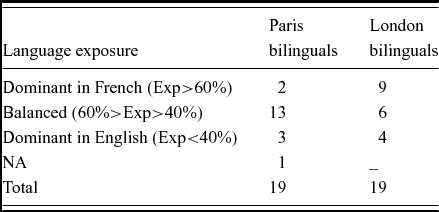
The two bilingual groups took part in both the French and the English experiments while the English-speaking and the French-speaking monolinguals only took part in their respective language. The monolingual children were recruited in schools situated in upper-middle class neighbourhoods in order to match the socio-economic status of the children attending the private bilingual schools. All our bilingual participants were exposed simultaneously to English and French from birth or soon after. They were either the offspring of mixed French–English couples (N = 29), or of French couples living in the UK (N = 5), or of English-speaking couples living in France (N = 4). The parents were asked to report about their child's language background using Cattani, Abbot-Smith, Farag, Krott, Arreckx, Dennis and Floccia's (Reference Cattani, Abbot-Smith, Farag, Krott, Arreckx, Dennis and Floccia2014) questionnaire which provides an estimate of the child's language exposure. The questionnaire requested information about (i) the average number of hours spent by the child in the bilingual school/with a childminder; (ii) the language(s) spoken by each parent in the home; (iii) the weekly number of hours spent by the child alone with each parent; (iv) whether the parents engaged equally with their child; and (v) an evaluation of the number of hours of the child's sleep in a typical day. Following Cattani et al. (Reference Cattani, Abbot-Smith, Farag, Krott, Arreckx, Dennis and Floccia2014), we defined 60% of exposure to a language as the cut-off point for establishing the majority input language. The questionnaire data revealed very different patterns of language exposure among the children in London and in Paris. Contrary to what had been assumed in previous research (e.g., Argyri & Sorace, Reference Argyri and Sorace2007, Sorace et al., Reference Sorace, Serratrice, Filiaci and Baldo2009), the children were not necessarily predominantly exposed to the language of the local environment (see Table 1).
Bilinguals’ exposure to French and English.

The bilingual group in Paris includes a larger number of balanced bilinguals (N = 13) compared to the London group (N = 6). Overall, it is in London that the bilinguals were the most dominant in French (N = 9). Across the two groups, there is nearly the same number of English-dominant children (Paris N = 3; London N = 4). Finally, the children recruited in the monolingual schools in Paris and in London were strictly monolinguals.
Materials and design
For each experiment, we had two elicitation conditions: LD and NP+VP in which the children heard a prompt that contained either a LD or a NP+VP (SV) to describe a scene. The materials consisted of 40 sets of pictures for the French experiment and 40 for the English experiment, 20 for each elicitation condition (LD; NP+VP). The picture sets were based on popular children's cartoons such as Rio, and Dora the Explorer for the French study, and on Madagascar and Toy Story 3 for the English study. Each elicitation condition contained pictures from only one of these cartoons. This enabled us to ensure we would have a sufficient number of pictures from a cartoon to cover all the picture sets needed in the testing conditions. The pictures consisted of screenshots of these films and were compiled into PowerPoint presentations. Each picture was only used once.
In order to create a target context in which the pragmatically appropriate form to identify a referent would be a LD, we followed De Cat's (Reference De Cat2009) experimental design. The first picture of each set created a discourse-pragmatic context in which two animate referents engaged in the same action were introduced and established as topics by the use of a LD (6.a). The description was followed by a prompt question containing a LD that maintained the topical status of the referents (6.b)Footnote 1 . The target picture to be described by the child re-introduced the two topical referents side by side engaged in two different actions (6.c). This set-up was designed to elicit a topical contrast requiring a LD in spoken French as the two previously mentioned referents needed to be distinguished from each other.
-
(6)

In the NP+VP condition, the picture sets differed slightly in order to de-emphasise the notion of establishing a topical contrast between the two referents. When the NP+VP construction was elicited, the prompt picture introduced two animals/characters involved in the same activity by using a NP+VP construction (7.a). The prompt description was followed by a prompt question in which the two subject NPs were repeated (7.b), the child was then presented with two successive target pictures in which the two referents were presented individually. The rationale for the separate presentation of the two referents was to set up a context that would optimally require the use of NP+VP in French.
-
(7)

The English materials followed the same pattern as the French materials in their use of LD and NP+VP prompt descriptions and in the pragmatic contexts of the target pictures, although the actual picture stimuli were different as they were taken from stories that were different from the French set. We used different materials to avoid a practice effect across languages as the bilingual children were tested over two consecutive days (see the Appendix for a full list of experimental sentences in French and in English, Supplementary Materials).
Crucially, LDs were used in the prompt descriptions to depict contrastive topics in English, a linguistic choice that was deliberately pragmatically sub-optimal. The rationale for this input manipulation was to test whether French–English bilingual children, who have both LDs and NP+VP structures available for topicality marking (i.e., LDs in French and NP+VP in English), would be more likely than monolingual English-speaking children to re-use LDs in their own description of contrastive topics.
Procedure
In both the French and the English experiment, elicitation condition (NP+VP; LD) was manipulated within subjects. Half of the bilingual children took part in the French experiment first; the language of the experiment (French, English) and elicitation condition presentation order (NP+VP; LD) were counterbalanced throughout the experiments in order to diminish possible carry-over effects. For each study, the children were tested on consecutive school days with a different elicitation condition on each day (e.g., day 1: NP+VP day 2: LD). Children were seen individually on school premises and verbal consent to take part was obtained by the experimenter; only children whose parents had previously given their consent in writing were asked to participate. The children were told that they would play a game with the computer where they would take turns with the computer at describing pictures. They would have to listen to a prompt description of a picture (i.e., PowerPoint slide) that was audio-recorded by native speakers of French and English before describing the second picture themselves. At the beginning of each testing session, the first author demonstrated the aim of the game in a practice item where she listened to the pre-recorded sentences and then proceeded to describe a target picture by way of example. Each testing-condition lasted no longer than 10 minutes; the sessions were audio-recorded for transcription and coding purposes.
Coding
Children's responses were transcribed and coded by the first author, a native speaker of French and advanced speaker of English. Target responses were coded as NP+VP (e.g., The zebra is dancing), LD (e.g., Velma, she is eating two biscuits), Pronoun+Verb (e.g., He is eating a cake) and Other (e.g., 0 calling somebody). Subject-less utterances and expletives (i.e., il y a/there is) were classified as Other and were included in the analyses. Utterances with missing participles or complements such as in Alex is (holding) an umbrella or Woody, he is looking in the (toy box) were included as valid responses.
In order to examine the effect of elicitation condition, we then categorized each response as either being an instance of LD (1) or not (0).
Results
Analyses were conducted using the lme4 package in R 3.0.2 (Bates, Maechler, Bolker & Walker, Reference Bates, Maechler, Bolker and Walker2013; R Core Team, Reference Team2013). For each experiment, we conducted a Generalized Linear Mixed Model (GLMM) fit by maximum likelihood in order to examine the probability of producing a LD as a function of elicitation condition and to investigate the role of language exposure on the probability of producing a LD. We treated LD production as the dependent variable; elicitation condition and exposure to English were treated as fixed factors; the intercept, the elicitation condition, and their correlation were allowed to vary randomly by participants. Elicitation conditions varied within participants. Exposure to English varied between participants and was treated as a continuous variable. We centred the exposure to English predictor around 50 to avoid collinearity and to get a better model fit; so -50 corresponded to 100% English exposure, i.e., English monolinguals, and +50 corresponded to 100% French exposure, i.e., French monolinguals. The model included both elicitation condition and exposure to English as fixed effects.
Experiment 1: French results
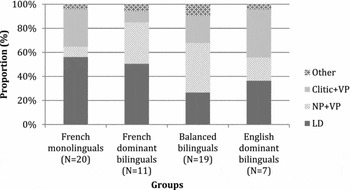
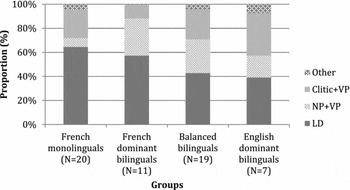
Figures 1 and 2 report the proportion of responses of LDs in the NP+VP and LD conditions respectively. The figures indicate that the French monolingual and bilingual children used a considerable number of LDs in both elicitation conditions. Bilingual children tended to produce fewer LDs than monolinguals. In the LD condition, the French monolinguals used LDs 64% (232/360) of the time while the French dominant children produced LDs 57% (126/220) of the time, balanced bilinguals 43% (154/360) and English dominant only 39% (55/140). A similar pattern is observed in the NP+VP condition. The French monolinguals used LDs 56% (202/360) of the time against 50% (111/220) for the French dominant bilinguals, 27% (96/360) for the balanced bilinguals and 36% (51/140) for the English dominant bilinguals. These findings suggest that French monolingual children are more likely to use LDs than bilinguals regardless of the elicitation condition. As for the bilinguals, LD production seems to be affected by the children's amount of exposure to their languages.
Proportion of responses in the NP+VP condition in French.

Proportion of responses in the LD condition in French.

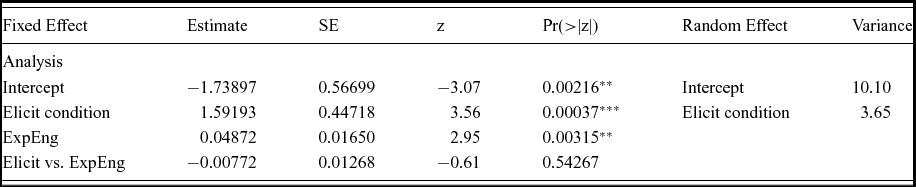
The GLMM indicated that all children were more likely to use a dislocation as a function of input manipulation in French (β = 1.59, SE(β) = 0.44, z = 3.56, p < .001). The children were 4.90 times (e1.59) more likely to produce a LD in the description of the target after hearing a LD in the prompt description. The analysis also showed a main effect of exposure to French on LD production (β = 0.05, SE(β) = 0.02, z = 2.95, p = .003) confirming that the use of LDs in French varies as a function of language exposure. For every percentage point increase in exposure to French, the likelihood of producing a LD rose by 1.05 (e0.05). This result implies that reduced input to LDs in French made the participants less likely to use this construction. Finally, there was no interaction between elicitation condition and exposure to English suggesting that participants with more exposure to French were simply more likely to produce LDs regardless of context.
Discussion
All children produced significantly more LDs in the LD condition than in the NP+VP condition regardless of their language background. Although LDs were also very frequent in the NP+VP condition, the analysis reported that LDs were significantly more frequent in the LD condition. LDs were successfully elicited as a function of discourse-context and input manipulation when topics were identified by a LD in the prompt description and question. More interestingly in terms of potential CLI, LD production varied as a function of language exposure. For every additional point of exposure to French, the likelihood of producing a LD increased. Hence, the routine processing of LDs in French affected the children's likelihood of producing this construction. Children exposed to reduced French input were less likely to use LDs in discourse-pragmatically optimal contexts. In fact, the bilingual children used a considerable percentage of NP+VP structures, which corresponds to the English preferred structure. These findings lend support to the role of input quantity on children's use of pragmatically optimal syntactic constructions. The data show that the choice of grammatical structures was directly related to the bilingual children's exposure to their two languages.
Model coefficients (in logits) for the likelihood of producing a LD in French.

Experiment 2: English results
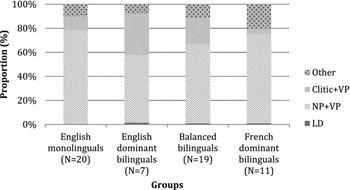
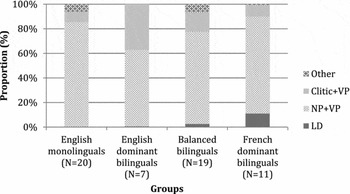
Figures 3 and 4 summarize the participants’ responses in the NP+VP and LD condition respectively. In the LD condition, the English monolingual children did not produce any LDs, unlike the bilingual children who did use some LDs in this condition. The English dominant group produced LDs only 1% (1/140) of the time against 3% of the time for the balanced bilinguals (9/340). The French dominant children appeared to be the most responsive to the LD condition as they produced LDs 11% (24/220) of the time. In the NP+VP condition, LDs were largely absent in the children's elicited descriptions; the English monolinguals used a trivial number of LDs (0% – 1/400) while the three groups of bilinguals produced LDs 1% of the time (i.e., English dominant: 1/140; balanced: 3/340; French dominant: 2/220). As in the French experiment, these findings indicate that the use of LDs is, at least partly, mediated by the bilinguals’ language experience and relative exposure to French.
Proportion of responses in the NP+VP condition in English.

Proportion of responses in the LD condition in English.

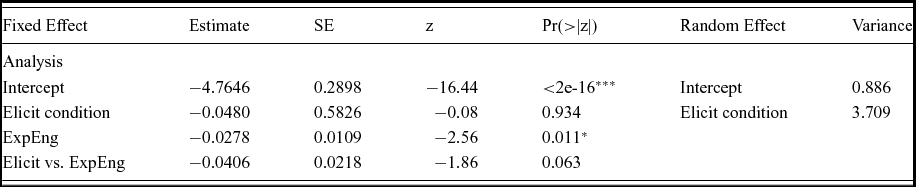
The GLMM showed no significant main effect on the likelihood of producing a LD as a function of elicitation condition (β = −0.05, SE(β) = 0.58, z = 0.08, p = .93) despite the fact that the balanced and French dominant bilinguals used a non-negligible number of LDs in the LD condition. The analysis also indicated a significant effect of exposure to English on LD production (β = −0.03, SE(β) = 0.01, z = −2.56, p = .011) across all participants. For every percentage point increase in exposure to English, the likelihood of producing a LD decreased by 0.97 (e−0.03). There was a marginal interaction between elicitation condition and exposure to English (β = −0.04, SE(β) = 0.02, z = −1.86, p = .063) suggesting that exposure to English made the participants less likely to use a LD in the LD condition, so the implication is that the greater the exposure to French the higher the likelihood that children would use a LD, as shown in Figure 4.
Discussion
In English, monolingual and bilingual children did not produce significantly more LDs after hearing a LD than a NP+VP. Despite the lack of a significant main effect of elicitation condition, language exposure affected the likelihood of producing LDs. Children with more exposure to English were less likely to produce LDs. This is unsurprising for English monolingual children, but has interesting implications for bilingual children. The less a French–English bilingual child is exposed to English, and hence the more she is exposed to French, the more likely she is to hear LDs in the input. The fact that the children with the largest exposure to French were marginally more likely to use LDs in English is consistent with the hypothesis that the likelihood and magnitude of CLI is affected, at least partly, by the input. Despite LDs being optimal to mark topicality in French only, French dominant children's use of LDs in English after hearing a pragmatically sub-optimal LD indicates that bilingual children's sensitivity to discourse-pragmatic appropriateness at the sentence level can be skewed by exposure to sub-optimal structures in the input.
Model coefficients (in logits) for the likelihood of producing a LD in English.

General discussion
The overall aim of the present studies was to make a contribution to the current understanding of the role of language exposure, processing mechanisms and discourse context on the phenomenon of CLI in sentential contexts. We investigated the expression of topicality in French and English in the wider framework of sentence-level constructions, thus taking the study of CLI beyond the level of individual referential expressions. We used an elicitation task to address the issue of syntactic choice in child bilingual speakers; specifically we explored the extent to which exposure to constructions where the mapping between syntax and discourse-pragmatics is sub-optimal, affects children's own uptake and production of these constructions. Finally, we considered the role of input in two different ways: firstly by conducting two within-language experiments where we included constructions that replicated instances of attrited/non-native input that bilingual children may be exposed to; secondly, by estimating children's relative exposure to their two languages and factoring in this proxy for language dominance to predict the likelihood of LD use.
The first main finding is that, in French, both monolingual and bilingual children predominantly produced LDs, while LDs were very infrequent overall and non-existent in the monolingual group in English. The obvious pattern emerging from these results is that the absolute frequency of the construction in the language matters. Although LDs are in principle available in both French and English, it is only in the former that they are used pervasively to mark topicality, therefore it does not come as a surprise that both monolingual and bilingual children should produce more LDs in French than in English. This finding is yet another confirmation that the actual frequency of a construction in the input matters when it comes to language use.
Although in French there was a significant effect of elicitation condition, a somewhat unexpected finding was the substantial proportion of LDs even when the prompt descriptions included a NP+VP construction and the experimental contexts did not explicitly call for a topical contrast requiring a LD. A potential explanation for the children's behaviour in this condition is that our stimulus presentation may not have been as pragmatically felicitous as we intended it to be. Although we did only use NP+VP structures in the prompt descriptions/questions and presented the two referents in separate and subsequent target pictures, it appears that the children did not view this context as sufficiently different from that of the LD elicitation condition in which the referents were presented side by side in one single target picture and were preceded by two LDs.
The second main finding is that, despite the non-trivial proportion of LDs after NP+VP primes, the effect of elicitation condition was significant in French. In English, we did not find such a main effect. Although there were some LDs produced after LD prompt descriptions and no LDs produced after NP+VP prompt descriptions, overall the number only led to a trend towards significance in the interaction between elicitation condition and language exposure. During the course of the experiment, 20 presentations of LD constructions alongside 20 presentations of NP+VP constructions were clearly not sufficient to skew the production of LDs in English. Taken at face value this suggests two things. Firstly, the children in our study were sensitive to the overall frequency of LDs in the English input, which we can assume to be very low, at least in the case of the English monolingual children. Secondly, and more interestingly, this result suggests that, aside from the low frequency of LD constructions, the fact that they are pragmatically sub-optimal in English is likely to have contributed to the English monolingual children's resistance to use LDs. Some studies that have used the syntactic priming paradigm rather than just an elicitation study, as was the case here, have indeed shown that the likelihood of priming can be modulated by the semantic appropriateness of the primed construction (Messenger, Branigan, McLean & Sorace, Reference Messenger, Branigan, McLean and Sorace2012; Skarabela & Serratrice, Reference Skarabela and Serratrice2009). Our finding in an elicitation task suggests that discourse-pragmatic appropriateness is also a mediator of the likelihood of syntactic choice.
The third result, and the one that is key to the argument being made here for the role of language exposure, language processing and discourse context on CLI, is that bilingual French–English children were sensitive to the elicitation condition and the likelihood of producing a LD after hearing a LD increased as a function of their language exposure. The more French the children were exposed to, the higher the chance that they would use a LD in English in contexts in which an English monolingual child would use a NP+VP construction. At the same time in the French experiment, exposure to English predicted the likelihood of LDs and, conversely, the use of NP+VP constructions. French–English bilingual children with more exposure to English were more likely to use a larger number of NP+VP constructions to mark topics rather than the LDs that were the preferred option by their French monolingual counterparts. We interpret the observed pattern as a reflection of the shared nature of syntactic representations in bilingual children and the probabilistic nature of the CLI phenomenon that is at least partly determined by the overall frequency of the construction in the input, and by the relative frequency of the input at the individual level. Although the analyses treated language exposure as a linear predictor, there is some reason to question the notion of a continuous linear relationship between input and performance in bilinguals (Paradis et al., Reference Paradis, Nicoladis, Crago and Genesee2011; Thordardottir, Reference Thordardottir2011; Hoff et al., Reference Hoff, Core, Place, Rumiche, Senor and Parra2012). Previous investigations suggest that input quantity may only matter up to a critical point where the behaviour of bilinguals begins to match that of monolinguals. While the present study provides clear evidence for the direction of the relationship between input and performance, it remains an important question for future research to explore in more detail the function that maps input to output.
With regard to language processing, a growing body of research has started to consider the role of this variable on CLI (Nicoladis, Reference Nicoladis2006; Nicoladis, Reference Nicoladis2012; Nicoladis et al., Reference Nicoladis, Rose and Foursha-Stevenson2010; Pirvulescu et al., Reference Pirvulescu, Pérez-Leroux, Roberge, Braunmüller and Gabriel2012; Serratrice et al., Reference Serratrice, Sorace, Filiaci and Baldo2009; Serratrice et al., Reference Serratrice, Sorace, Filiaci and Baldo2011; Sorace et al., Reference Sorace, Serratrice, Filiaci and Baldo2009). The theoretical motivation comes from research on bilingual adults showing that processing considerations have real implications for bilinguals’ language use (Bernolet, Hartsuiker & Pickering, Reference Bernolet, Hartsuiker and Pickering2007; Desmet & Declercq, Reference Desmet and Declercq2006; Hartsuiker & Pickering, Reference Hartsuiker and Pickering2008; Hartsuiker et al., Reference Hartsuiker, Pickering and Veltkamp2004; Schoonbaert et al., Reference Schoonbaert, Hartsuiker and Pickering2007). These studies suggested that bilingual adults share syntactic representations across languages, and recent experiments demonstrated that bilingual children would also have a shared syntax for structures that exist in their two languages as well as for those which are only present in one (Vasilyeva et al., Reference Vasilyeva, Waterfall, Gamez, Gomez, Bowers and Shimpi2010; Hsin et al., Reference Hsin, Legendre and Omaki2013). The present elicitation studies provide additional evidence that the mental representation of syntactic structures is affected by the simultaneous acquisition of two languages. The bilingual children's use of discourse-pragmatic sub-optimal LD constructions in English to mark topicality demonstrates that LDs were activated in these children's English to a significantly larger degree than for English monolinguals. Similarly the bilinguals’ use of NP+VP constructions in French shows that access to this syntactic form to mark discourse topics was highly active for the bilingual children in a way that it was not for their French monolingual counterparts. More interestingly, within the bilingual group, the amount of exposure to French was a significant factor determining the likelihood of CLI.
A within-language set up was used to present to the children both optimal (in French) and sub-optimal (in English) form-meaning pairings to mark topicality. The rationale for this choice was to replicate the kind of attrited/non-native input that bilingual children might be exposed to. The assumption that bilingual children's input is only quantitatively different from monolinguals’ is likely to be only partially correct; bilingual children are likely to have parents who are themselves non-native or attrited bilingual speakers which will make their input different from a qualitative point of view too. Research evidence on the role of non-native input or attrited input on bilingual children's discourse appropriate use of morpho-syntax is currently scarce (Paradis & Navarro, Reference Paradis and Navarro2003). There are, however, a number of studies showing that parents’ use of their non-native language does not correlate positively with children's development in that language. This has a detrimental effect on the maintenance of the heritage language (Hammer, Davidson, Lawrence & Miccio, Reference Hammer, Davison, Lawrence and Miccio2009; Hammer, Komaroff, Rodriguez, Lopez, Scarpino & Goldstein, Reference Hammer, Komaroff, Rodriguez, Lopez, Scarpino and Goldstein2012; Paradis, Reference Paradis2011; Place & Hoff, Reference Place and Hoff2011). In the absence of more fine-grained analyses of the linguistic features of child-directed non-native/attrited input, it is difficult to say what exactly makes it less than conducive to language development. For example, in the case of vocabulary development it might be lower lexical diversity, but for discourse-pragmatic appropriateness it may be parents’ own use of morpho-syntactic constructions. Although it was beyond the scope of the present study to conduct an analysis of the pragmatic use of LDs in the French–English bilingual children's input, we used an experimental manipulation that mimics what we expect to be a likely language scenario in French–English families. Further research using corpus data would be necessary to corroborate these findings and lend a robust empirical base to our working hypothesis. In essence, a French–English bilingual child whose parents are either L2 or attrited speakers of English with French as their other language is likely to hear LDs in English in contexts in which a monolingual English-speaking adult would use a NP+VP construction. So exposure to these pragmatically sub-optimal LDs in English, alongside the routine exposure to pragmatically appropriate LDs in French, would boost the activation of LDs as topicality markers and increase the chances that they would be used in English more than would be reasonable to expect in the case of an English monolingual child. The daily processing of high frequency structures such as LDs in French, and the shared syntactic representation of the form, strengthened by a potentially contact-modified English input exhibiting higher LD rates than in native English may reinforce the entrenchment of LDs across languages and thus lead to CLI. Conversely, the opposite effect may be observed with the potential entrenchment of NP+VP constructions in French to mark topicality when exposed to a contact-modified input resulting from prolonged exposure to English as a majority language. In the present studies, we used pragmatically sub-optimal LDs in English as a proxy for non-native/attrited input and found that the amount of language exposure was a significant predictor of the likelihood of producing pragmatically inappropriate LDs in English. These findings show that input manipulation does play a role in the activation of grammatical constructions and that it may directly affect the presence of potential CLI. The assumption that cross-linguistic activation is possible of course rests on the idea that bilinguals do share syntactic representation for isomorphic constructions (Serratrice et al., Reference Serratrice, Sorace, Filiaci and Baldo2011); an idea that has been proposed in the adult bilingual psycholinguistic literature and that is starting to gain traction in the child bilingual literature too.
Our finding of an effect of language exposure on CLI is in line with recent work showing that the magnitude of the phenomenon varies as a function of the bilingual children's exposure to their languages (Argyri & Sorace, Reference Argyri and Sorace2007; Serratrice et al., Reference Serratrice, Sorace, Filiaci and Baldo2009; Serratrice et al., Reference Serratrice, Sorace, Filiaci and Baldo2011). Unlike in previous studies where language exposure was not measured for individual children but language of the community was used as a proxy, our results provide a quantifiable measure of the probability to produce a LD as a function of language exposure at the individual level. These findings suggest that dislocations are more or less accessible in French–English bilingual children's mental representations as a function of language exposure.
In conclusion, the present elicitation studies provide new evidence supporting the role of processing mechanisms on CLI. The existence of shared syntax across languages implies that processing high frequency structures in one language can lead to their entrenchment in bilinguals’ other language, even when the discourse-context is not discourse-pragmatically optimal. Measuring language exposure at the level of the individual child we showed that the quantity of input matters for the likelihood of CLI; using a within-language experimental paradigm we showed that the quality of the input that is addressed to bilingual children also has a role to play and that non-native/attrited input may skew the activation of a syntactic structure even when it is not the best form-function fit.
Supplementary Material
For supplementary material accompanying this paper, visit http://dx.doi.org/10.1017/S1366728915000401