1. Introduction
Much research has shown that the bilingual first language (2L1) acquisition of morphosyntax displays the same developmental patterns as the monolingual L1 acquisition of each language for the most part, although differences in rate of acquisition between bilinguals and monolinguals can occur (de Houwer, Reference De Houwer2009; Gathercole & Hoff, Reference Gathercole, Hoff, Hoff and Shatz2007; Genesee & Nicoladis, Reference Genesee, Nicoladis, Hoff and Shatz2007; Granfeldt & Schlyter, Reference Granfeldt, Schlyter, Prévost and Paradis2004; Granfeldt, Schlyter & Kihlstedt, Reference Granfeldt, Schlyter, Kihlstedt and Granfeldt2007; Meisel, Reference Meisel and Meisel1990, Reference Meisel, Cenoz and Genesee2001; Paradis & Genesee, Reference Paradis and Genesee1996, Reference Paradis and Genesee1997; Paradis, Genesee & Crago, Reference Paradis, Genesee and Crago2011). In contrast, young successive bilinguals can exhibit some developmental patterns unique to second language (L2) acquisition, for example, clitic distribution and placement errors in French (Granfeldt et al., Reference Granfeldt, Schlyter, Kihlstedt and Granfeldt2007; Meisel, Reference Meisel, Gavruseva and Haznedar2008), or precocious acquisition of BE morphemes in English (Ionin & Wexler, Reference Ionin and Wexler2002; Paradis, Rice, Crago & Marquis, Reference Paradis, Rice, Crago and Marquis2008). While 2L1 acquisition is prototypically defined as exposure to two languages from birth, for many children, the onset of bilingual learning begins at different ages within the preschool years. Researchers do not agree on when the period of 2L1 acquisition transitions to the period of child L2 acquisition, with suggested approximate ages for this distinction including 1 month (de Houwer, Reference De Houwer, Fletcher and MacWhinney1995), 1;6 (de Houwer, Reference De Houwer2009), 3;0 (Paradis et al., Reference Paradis, Genesee and Crago2011; McLaughlin, Reference McLaughlin1978), between 3;0–4;0 or 4;0 (Genesee & Nicoladis, Reference Genesee, Nicoladis, Hoff and Shatz2007; Meisel, Reference Meisel, Gavruseva and Haznedar2008, Reference Meisel2009; Schwartz, Reference Schwartz2004; Unsworth, Reference Unsworth2013). Determining when the distinction between 2L1 and child L2 emerges in the early years is relevant to theoretical debates concerning critical/sensitive periods and native (L1, 2L1) versus nonnative (L2) acquisition patterns (e.g., Meisel, Reference Meisel2009). Determining this distinction is also relevant to methodological considerations for researchers because, if acquisition patterns are different for children who began bilingual learning at age 2;0 than for children who began bilingual learning at age 4;0, such differences could impact research findings if children are grouped together in a study.
Research examining differences in morphosyntactic acquisition patterns in successive bilinguals as a function of age of acquisition (AOA) has produced some conflicting findings. While some studies indicate that AOAs around 3;0–4;0 might be associated with a shift from 2L1 to child L2 patterns (Chilla, Reference Chilla2008; Grandfeldt et al., Reference Granfeldt, Schlyter, Kihlstedt and Granfeldt2007; Meisel, Reference Meisel, Gavruseva and Haznedar2008, Reference Meisel2009), others have found no clear relationship between AOA and error patterns in morphosyntax among successive bilinguals (Unsworth, Reference Unsworth2013; Unsworth, Argyri, Cornips, Hulk, Sorace & Tsimpli, Reference Unsworth, Argyri, Cornips, Hulk, Sorace and Tsimpli2014). Methodological limitations could underlie, in part, these conflicting findings. Some studies are based on small sample sizes of children varying in AOA and amount of L2 exposure (Chilla, Reference Chilla2008; Granfeldt et al., Reference Granfeldt, Schlyter, Kihlstedt and Granfeldt2007; Meisel, Reference Meisel, Gavruseva and Haznedar2008, Reference Meisel2009). Other studies have examined a morphosyntactic construction for which it is uncertain there are distinct error patterns between (2)L1 and L2 and have included participant groups where AOA was often confounded with amount of L2 exposure (Unsworth, Reference Unsworth2013; Unsworth et al., Reference Unsworth, Argyri, Cornips, Hulk, Sorace and Tsimpli2014). The present study was designed to contribute further to the research on this topic by addressing these methodological limitations.
This study focuses on the acquisition sequence of BE and inflectional morphemes in English. While L1 learners of English tend to acquire inflectional finite morphemes (third person singular -s and past -ed: INFL; this is a theory-neutral abbreviation) and unbound finite morphemes (BE copula and auxiliary) at roughly similar rates, English L2 learners exhibit what has been called ‘precocious’ BE acquisition, where accuracy with BE morphemes is significantly more advanced than with INFL morphemes (de Villiers & de Villiers, Reference De Villiers and de Villiers1973; Dulay & Burt, Reference Dulay and Burt1974; Haznedar, Reference Haznedar2001; Ionin & Wexler, Reference Ionin and Wexler2002; Jia & Fuse, Reference Jia and Fuse2007; Lakshmanan, Reference Lakshmanan1994; Paradis, Reference Paradis2005; Paradis, Reference Paradis, Gavruseva and Haznedar2008, Reference Paradis2010; Paradis et al., Reference Paradis, Rice, Crago and Marquis2008; Schwartz, Reference Schwartz2004; Zobl & Liceras, Reference Zobl and Liceras1994). Internationally adopted children who began to learn English around 1;0 show the L1 pattern of fairly equal rates of acquisition for BE and INFL morphemes (Pierce, Genesee & Paradis, Reference Pierce, Genesee and Paradis2013); however, no study to date has examined precocious BE acquisition in young successive bilinguals as a function of AOA. Precocious BE acquisition has been found in studies of English L2 children with diverse L1s, e.g., Cantonese, Mandarin, Russian, Spanish and Turkish L1s (Haznedar, Reference Haznedar2001; Ionin & Wexler, Reference Ionin and Wexler2002; Jia & Fuse, Reference Jia and Fuse2007; Lakshmanan, Reference Lakshmanan1994; Paradis, Reference Paradis, Gavruseva and Haznedar2008, Reference Paradis2010); however, because L1 background can influence the rate of morphological acquisition in L2 English (Blom, Paradis & Sorenson Duncan, Reference Blom, Paradis and Sorenson Duncan2012; Paradis, Reference Paradis2011), L1 background was considered in this study. Finally, since the research on precocious BE acquisition has largely been conducted using production tasks or spontaneous language sampling, both production and grammaticality judgement tasks were included to understand whether precocious BE is a production-only pattern.
The present study asked whether the precocious BE pattern would be evident in successive bilingual children with AOAs younger than 4;0 (Early Child L2). In order to do this, we compared them to bilingual children with AOAs older than 4;0 (Late Child L2), keeping amount of L2 exposure constant. The Late Child L2 group were expected to display the precocious BE pattern, thus differences between the two groups in acquisition patterns of BE and INFL morphemes would reveal whether the Early Child L2 group displayed more of a 2L1 or L2 profile. In addition to the influence of AOA, we also asked whether L1 background or task would influence acquisition patterns.
2. Method
2.1 Participants
Children (n = 79) from immigrant families residing in an English-majority city, Edmonton, Canada, participated in this study. Inclusion criteria were that both parents were foreign born and were L2 speakers of English and that the children were exposed primarily or exclusively to their L1 before beginning to learn English in a preschool or school program. Thus, all children were successive bilinguals/child L2 learners. These children were a subset of the participants in Paradis (Reference Paradis2011) and, following Paradis (Reference Paradis2011), the children's L1s were designated as either languages that mark tense grammatically, [+tns] languages, or languages that do not mark tense grammatically, [-tns] languages. The [+tns] L1s spoken by the children in this study were: Arabic, Farsi, Gujarati, Hindi, Punjabi, Spanish and Urdu (Bateson, Reference Bateson1967; Bhatia, Reference Bhatia1993; Dehghani, Reference Dehghani2002; Kachru, Reference Kachru2006; Mackenzie, Reference Mackenzie2001; Schmidt, Reference Schmidt1999). The [-tns] L1s were Cantonese, Mandarin and Vietnamese (Lin, Reference Lin2001; Matthews & Yip, Reference Matthews and Yip1994; Nguyen, Reference Nguyen1997).
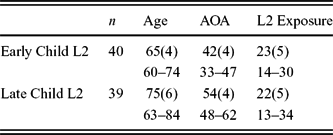
Children were divided into two groups with different AOAs for L2 English, but with equivalent exposure time to English, and balanced for [+tns] and [-tns] L1 backgrounds. The Early Child L2 group had a mean chronological age of 5;5, a mean AOA of 3;6, and a mean length of exposure to English of 23 months. The Late Child L2 group had a mean chronological age of 6;3, a mean AOA of 4;6 and a mean length of exposure to English of 22 months. The groups differed significantly in chronological age (t(65.4) = −9.4, p < .001; d = 2.1, large) and AOA (t(77) = −12.9, p < .001; d = 2.9, large), but there was no significant difference in their months of exposure to the L2. Full descriptives for the participant groups, in months, are in Table 1.
Participant Characteristics

Note. Mean (standard deviation). Ranges are below means. Age, AOA and L2 Exposure are given in months.
2.2 Procedure
Children were given both the production and grammaticality judgement (GJ) probes from the Test of Early Grammatical Impairment (TEGI: Rice & Wexler, Reference Rice and Wexler2001), which target both INFL and BE morphemes. All probes were administered according to the instructions in the TEGI Examiner's Manual. First, the third person singular -s and past tense probes comprising the TEGI screener were administered to obtain INFL production scores. Elicitation of [–s] and [-ed] was accomplished through asking children to describe pictures. For the third person singular -s probe, children were shown pictures of professionals engaged in work activities and given prompts like, “Here is a teacher. Tell me what a teacher does”. Expected answers included “A teacher writes on the board” or “A teacher teaches .” For the past tense probe, participants were shown pictures of children engaged in activities, followed by a picture showing the activity being completed, and given prompts like, “Here the boy is raking. Now he is done. Tell me what he did”. The expected answer would be “The boy/he raked .” Only responses to regular past tense items were included in this study. After the screener, children were given the TEGI BE probe where they are prompted to ask a puppet questions or make statements using BE copula and auxiliary morphemes. For instance, “I wonder if the bears are resting. Ask the puppet” was expected to prompt “Are the bears resting?” (BE auxiliary) and “I wonder about the Kitty. Ask the puppet if the Kitty is hungry” was expected to prompt “Is the Kitty hungry?” (BE copula). In the GJ probe, the experimenter acted out a scenario with toys that includes two robots who children were told are just learning to speak English and do not say everything correctly. During the scenario, the children were asked to determine if the robots’ statements were said correctly or incorrectly (“right” or “not so good”). Incorrect sentences contained either a dropped/omitted tense marker (BE or INFL), for example, “Bo says: ‘He running away’.” (dropped BE) or “Zee says: ‘Maybe he need a Band-Aid’.” (dropped INFL).
For the production probes, correct use of morphology was calculated as a proportion of the total number of scorable responses for items testing BE and INFL. All children produced at least 8 responses that could be included for the BE and INFL proportion correct scores. Incorrect responses were mainly omission of the morpheme; however, some is for are substitution errors occurred for BE. For INFL, a combined mean of children's proportion correct on the third person singular –s and regular past tense probes was calculated. Responses on these two probes showed a strong positive correlation (r(79) = .75, p < .001). For the GJ probe, test sentences were divided according to whether they tested presence versus omission of BE morphemes or presence versus omission of INFL with lexical verbs. For each target morpheme, the children's correct rejections, false alarms, misses and hits were calculated and transformed into a-prime scores (Rice & Wexler, Reference Rice and Wexler2001; Rice, Wexler & Redmond Reference Rice, Wexler and Redmond1999).
3. Results
Descriptive statistics for the production and GJ probes are given in Tables 2 and 3, divided by L1 background group. Three-way repeated measures ANOVAs were conducted for the production and GJ scores separately, followed by planned pairwise comparisons where significant interactions occurred. A MANOVA was not possible because one independent factor was a repeated measure (Pallant, Reference Pallant2010). Even though the production and GJ scores needed to be analysed separately, children's scores for the two modalities were found to be significantly correlated (production and GJ, r BE = .50, p < .001; r INFL = .49, p < .001), thus suggesting an underlying relationship between the source of performance on both probes. These data met the assumptions of homogeneity of variance and co-variance for all analyses, ascertained by Levene's test and Box's M at p > .05 (Pallant, Reference Pallant2010; Brace, Kemp & Snelgar, Reference Brace, Kemp and Snelgar2009). Additional regression analyses were also conducted with AOA as a continuous variable in order to further explore any age-based trends in the data.
Means and (Standard Deviations) for Production and Grammaticality Judgement Probes for the Early and Late Child L2 Groups with [+tns] L1s

Note. Production = proportion correct scores; Grammaticality Judgement = A-prime scores.
Means and (Standard Deviations) for Production and Grammaticality Judgement Probes for the Early and Late Child L2 Groups with [-tns] L1s

Note. Production = proportion correct scores; Grammaticality Judgement = a-prime scores.
3.1 TEGI production probes
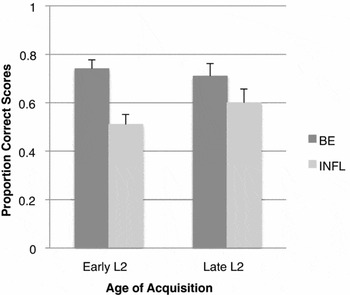
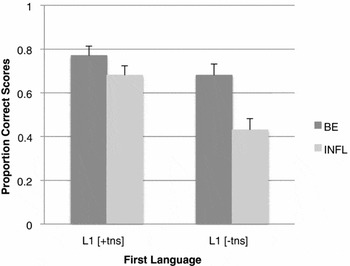
Production probe scores were analysed with a three-way repeated measures ANOVA with two between-subjects factors (AOA = Early Child L2, Late Child L2; L1 = [+tns], [-tns]) and one within-subjects factor (Morpheme = BE and INFL). Results yielded significant main effects for Morpheme (BE = .72 vs. INFL = .55, Wilks’ Lambda = .695, F(1, 74) = 32.4, p < .001, partial η2 = .31) and for L1 ([+tns] = .72 vs. [-tns] = .55, F(1,74) = 8.9, p = .004, partial η2 = .11), a significant interaction between Morpheme and L1 (Wilks’ Lambda = .905, F(1,74) = 7.8, p = .007, partial η2 = .10) and a marginally significant interaction between Morpheme and AOA (Wilks’ Lambda = .947, F(1, 74) = 4.1, p = .046, partial η2 = .05). The sources of the interaction effects were probed further with pairwise comparisons. First, children with L1 [+tns] were significantly more accurate with BE than INFL (BE = .77 vs. INFL = .68, t(39) = 2.16, p = .037), and children with L1 [-tns] were also significantly more accurate with BE than INFL (BE = .68 vs. INFL = .43, t(38) = 5.48, p < .001). Second, comparisons between BE and INFL across L1 groups showed the source of the interaction to be the lower scores for INFL in the L1 [-tns] than in the L1 [+tns] group (.43 vs. .68, t(77) = −3.5, p = .001). Regarding the marginal interaction between AOA and Morpheme, paired t-tests revealed that both the Early Child L2 and the Late Child L2 had higher scores for BE than INFL (Early: BE = .74 vs. INFL = .51, t(39) = 4.8, p < .001; Late: BE = .71 vs. INFL = .60, t(38) = 2.7, p = .01). Further between-group comparisons yielded no significant results, suggesting that the likely source of the marginal interaction was that the Early Child L2 group had lower INFL scores than the Late Child L2 group, .51 vs. .60, respectively, while the Late L2 group had slightly lower BE scores than the Early Child L2 group, .71 vs. .74, respectively. To summarize, the main effects showed that children were more accurate with BE than INFL overall and that children with [+tns] L1 backgrounds had higher scores than children with [-tns] L1 backgrounds overall. Regarding interactions, children with L1 [+tns] backgrounds had higher INFL scores than children with L1 [-tns] backgrounds, but importantly, the precocious BE pattern held across AOAs and L1 backgrounds (Figures 1 and 2).
Mean proportion correct scores for production of BE and INFL morphemes for the Early and Late Child L2 groups. Bars are standard errors.

Mean proportion correct scores for production of BE and INFL morphemes for the [+tns] and [-tns] L1 groups. Bars are standard errors.

We conducted additional multiple linear regression analyses to determine if there were any differences in children's performance on the TEGI probes as a function of AOA as a continuous variable. First, difference scores between the children's BE and INFL scores were calculated. Larger difference scores indicate a larger spread between BE and INFL scores. Difference scores were not absolute scores; therefore, if a child's INFL score was higher than her BE score, the difference score would be a negative number (this occurred in 7% of cases). The mean difference score was .16 (s.d. = .28). We also included L1 as a predictor variable in the regression model. The model was significant overall (F(2,75) = 4.85, p = .01; R2 = .115), and L1 was a significant factor (Standardized Beta = −.279, t = −2.54, p = .013) but AOA was not. Because the L1 [-tns] group was coded as “0”, the negative polarity shows that they had larger difference scores than the L1 [+tns] group, hence lower scores for INFL. In sum, the regression analyses are consistent with the ANOVA findings.
3.2 TEGI GJ probe
GJ probe scores were also analysed with a three-way repeated measures ANOVA with two between-subjects factors (AOA = Early Child L2, Late Child L2; L1 = [+tns], [-tns]) and one within-subjects factor (Morpheme = BE and INFL). Results showed a significant main effect for Morpheme (BE = .80 vs. INFL = .59, Wilks’ Lambda = .556, F(1,75) = 60, p < .001, partial η2 = .44). No other significant main effects or interactions emerged; consequently, no pairwise comparisons were conducted. Therefore, children were more accurate judging errors with BE than with INFL morphemes and this pattern held across L1 and AOA groups. A follow-up multiple regression analysis on difference scores (mean = .22, s.d. = .23) did not produce a significant model or significant factors for AOA and L1, consistent with the ANOVA findings.
4. Discussion
The objective of this study was to determine if successive bilingual children whose L2 AOAs were younger than 4;0 (Early Child L2) displayed the precocious BE pattern in morphosyntactic acquisition that is common in L2 but not (2)L1 English. The Early Child L2 group was compared to a Late Child L2 group who were expected to show this L2 pattern. Both groups of children were administered production and GJ probes targeting INFL and BE morphemes to see if their scores were relatively equal for BE and INFL (L1/native pattern) or whether BE scores would be higher (L2/nonnative pattern).
Results showed that the BE > INFL pattern was apparent for both the Early and Late L2 groups, for both the production and GJ probes, and across L1 backgrounds. Additional regression analyses with AOA as a continuous factor showed there was no sign of a trend toward the L2 pattern among the children. Indeed, a larger mean difference between BE and INFL in production was found for the Early L2 group (.74–.51 = .23) than the Late L2 group (.71–.60 = .11). Furthermore, the parallels between the production and GJ probe show that the precocious BE pattern is not limited to production but instead extends to L2 morphosyntactic knowledge. However, results revealed an L1 effect in production only such that children with L1 [-tns] were less accurate with INFL morphemes than children with L1 [+tns]. In addition to the lack of a tense feature to transfer from their L1, Chinese (Mandarin and Cantonese) L1–English L2 learners might also experience transfer of L1 phonological patterns that could impact their ability to produce word final, consonantal affixes in the L2 (Sorenson Duncan & Paradis, Reference Sorenson Duncan and Paradis2013), or have different attentional and processing routines that, if carried over into the L2, would put them at a disadvantage for acquiring L2 inflectional morphology (Blom et al., Reference Blom, Paradis and Sorenson Duncan2012).
In conclusion, successive bilingual children with AOAs of 3;0 and older appear to display the precocious BE profile in English; therefore, they are best characterized as child L2 and not 2L1 learners, at least for this aspect of morphosyntactic acquisition. These results are consistent with those of others who have found evidence for a relatively early transition from 2L1 to L2 (Chilla, Reference Chilla2008; Granfeldt et al., Reference Granfeldt, Schlyter, Kihlstedt and Granfeldt2007; Meisel, Reference Meisel, Gavruseva and Haznedar2008, Reference Meisel2009). One limitation is that this study did not include children with AOAs < 3;0. Findings in Unsworth et al. (Reference Unsworth, Argyri, Cornips, Hulk, Sorace and Tsimpli2014) and Granfeldt et al. (Reference Granfeldt, Schlyter, Kihlstedt and Granfeldt2007) suggest that contrasts between 2L1 children and very early successive bilinguals can occur, thus, a worthwhile focus for future research would be examining acquisition patterns in children with AOAs < 3;0.