In her acknowledgments Valian (Reference Valian2014) speculates that some of her colleagues may agree with at least some of her conclusions. I agree with most. These include that bilingualism is inconsistently correlated with superior executive function, that the overall benefits of bilingualism reported in some experiments may signify benefits unrelated to executive function (EF), that all speakers have non-linguistic ways of improving EF, and that tests for bilingual advantages should be aimed at specific mechanisms of bilingual experience and their corresponding components of EF. The remainder of my 1,000 words will be devoted to rather subtle points of disagreement.
Valian frames the debate around two logical possibilities: either there is a benefit of bilingualism for EF or there is not. This echoes the choices presented by Paap and Greenberg (Reference Paap and Greenberg2013) and Paap (Reference Paap2014) under the rubric that bilingual advantages are either “real” or “artifacts”. The least subtle of our disagreements is that Valian leans to the “real” side while I lean to the “artifacts” position. More important we both see this as a core issue and not one that is unimportant, requires reformulation, or is already decided.
Valian offers a line of argument that deserves consideration from skeptics: namely, if one believes that many cognitively challenging experiences enhance EF, why wouldn't this belief extend to the challenging task of coordinating multiple languages? A hard-line response might appeal to the view that language processing is modular and has specialized control mechanisms for handling problems like competition between lexical forms. The modular notion makes sense of the research described by Valian showing that language-switching performance does not correlate with performance on nonverbal switching tasks and that general switching abilities can be impaired while language switching is not. Note that this argument does not solely depend on innate modules, but rather can also include the experience-based shifts documented by Chein & Schneider (Reference Chein and Schneider2012) as controlled processing gives way to automatic processing in the development of any skill. If much of the control exercised by bilinguals is specialized and automatic then it would not transfer to nonverbal tasks that require general EF.
A position closer to Valian's concedes that managing two languages is challenging and recruits general EF but then suggests that bilingualism doesn't yield a just-noticeable-difference of EF enhancement when added to the challenges of producing and comprehending a single language (see Paap & Greenberg, Reference Paap and Greenberg2013, and Paap, Johnson & Sawi, Reference Paap, Johnson and Sawi2014 for an elaboration). This segues to a related argument that for most people the activities of everyday life will serve to drive their EF ability to their innately constrained maxima (Paap & Greenberg, Reference Paap and Greenberg2013).
Valian prefers a “slightly different” hypothesis to explain the many null results: namely, that the real benefits of bilingualism are often cancelled out by a disproportionate number of monolinguals who happen to have engaged in other EF enhancing activities: “. . .on my analysis, young adult monolinguals who perform on a par with bilinguals succeed not primarily because they are efficient processors, but because that have other experiences that are on a par with bilingualism in their ability to enrich cognitive functioning.” This may happen, but it isn't a sufficient explanation for the large number of null results. If bilinguals and monolinguals are equally likely to engage in activities that enhance EF then one would not expect a real bilingual advantage to be cancelled out very often. Of course, if monolinguals engage in substantially more EF enhancing activities than bilinguals more cancellations could occur. However, this is not likely if the web is as wide as Valian speculates, including not only well specialized activities like music training and video gaming, but also activities such as sports, dance, acting, cooking, etc.
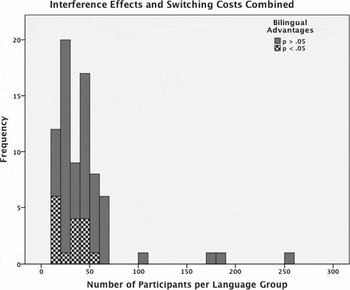
What is clear is that if one surveys the research using nonverbal interference and switching tasks since Hilchey and Klein's 2011 review, fewer tests yield significant advantages than those that do not (Paap, et al., Reference Paap, Johnson and Sawi2014). Furthermore, as Figure 1 shows, significant advantages are particularly scarce among the studies using large n’s. If bilingual advantages are real, but must surface from the maelstrom of other activities that promote EF, one might expect bilingual advantages to dominate the high n end.
Figure 1.
Number of significant (p < .05) and non-significant bilingual advantages reported as the number of participants per language group increases based on the analysis presented by Paap, Johnson, and Sawi (Reference Paap, Johnson and Sawi2014).
Valian argues that research on bilingualism and EF should be driven from hypotheses about the underlying mechanisms and how each mechanism should enhance some components of EF, but not others. This is essentially what has guided our research strategy as our studies include multiple measures of monitoring, shifting, and interference control. We agree that different types of bilingual experience might tune different components and these will be reflected in different measures. However, our cumulative work shows that: (1) measures assumed to index the same component of EF usually showed low levels of convergent validity (Paap & Sawi, Reference Paap and Sawi2014) and (2) isolating specific types of bilingualism showed no systematic effects of age-of-acquisition, the balance of L2 to L1 proficiency, or the number of languages spoken (Paap et al., Reference Paap, Johnson and Sawi2014).
If Valian is correct that there are multiple mechanisms for triggering superior EF, that those mechanisms are present in a wide array of everyday and specialized activities, and that they interact in complex ways then the field will need patience and endurance to build an understanding. That understanding will not simply be of the relationship between bilingualism and EF, but rather a theory of how EF abilities are honed and maintained.




 You have
Access
In her acknowledgments Valian (Reference Valian2014) speculates that some of her colleagues may agree with at least some of her conclusions. I agree with most. These include that bilingualism is inconsistently correlated with superior executive function, that the overall benefits of bilingualism reported in some experiments may signify benefits unrelated to executive function (EF), that all speakers have non-linguistic ways of improving EF, and that tests for bilingual advantages should be aimed at specific mechanisms of bilingual experience and their corresponding components of EF. The remainder of my 1,000 words will be devoted to rather subtle points of disagreement.
Valian frames the debate around two logical possibilities: either there is a benefit of bilingualism for EF or there is not. This echoes the choices presented by Paap and Greenberg (Reference Paap and Greenberg2013) and Paap (Reference Paap2014) under the rubric that bilingual advantages are either “real” or “artifacts”. The least subtle of our disagreements is that Valian leans to the “real” side while I lean to the “artifacts” position. More important we both see this as a core issue and not one that is unimportant, requires reformulation, or is already decided.
Valian offers a line of argument that deserves consideration from skeptics: namely, if one believes that many cognitively challenging experiences enhance EF, why wouldn't this belief extend to the challenging task of coordinating multiple languages? A hard-line response might appeal to the view that language processing is modular and has specialized control mechanisms for handling problems like competition between lexical forms. The modular notion makes sense of the research described by Valian showing that language-switching performance does not correlate with performance on nonverbal switching tasks and that general switching abilities can be impaired while language switching is not. Note that this argument does not solely depend on innate modules, but rather can also include the experience-based shifts documented by Chein & Schneider (Reference Chein and Schneider2012) as controlled processing gives way to automatic processing in the development of any skill. If much of the control exercised by bilinguals is specialized and automatic then it would not transfer to nonverbal tasks that require general EF.
A position closer to Valian's concedes that managing two languages is challenging and recruits general EF but then suggests that bilingualism doesn't yield a just-noticeable-difference of EF enhancement when added to the challenges of producing and comprehending a single language (see Paap & Greenberg, Reference Paap and Greenberg2013, and Paap, Johnson & Sawi, Reference Paap, Johnson and Sawi2014 for an elaboration). This segues to a related argument that for most people the activities of everyday life will serve to drive their EF ability to their innately constrained maxima (Paap & Greenberg, Reference Paap and Greenberg2013).
Valian prefers a “slightly different” hypothesis to explain the many null results: namely, that the real benefits of bilingualism are often cancelled out by a disproportionate number of monolinguals who happen to have engaged in other EF enhancing activities: “. . .on my analysis, young adult monolinguals who perform on a par with bilinguals succeed not primarily because they are efficient processors, but because that have other experiences that are on a par with bilingualism in their ability to enrich cognitive functioning.” This may happen, but it isn't a sufficient explanation for the large number of null results. If bilinguals and monolinguals are equally likely to engage in activities that enhance EF then one would not expect a real bilingual advantage to be cancelled out very often. Of course, if monolinguals engage in substantially more EF enhancing activities than bilinguals more cancellations could occur. However, this is not likely if the web is as wide as Valian speculates, including not only well specialized activities like music training and video gaming, but also activities such as sports, dance, acting, cooking, etc.
What is clear is that if one surveys the research using nonverbal interference and switching tasks since Hilchey and Klein's 2011 review, fewer tests yield significant advantages than those that do not (Paap, et al., Reference Paap, Johnson and Sawi2014). Furthermore, as Figure 1 shows, significant advantages are particularly scarce among the studies using large n’s. If bilingual advantages are real, but must surface from the maelstrom of other activities that promote EF, one might expect bilingual advantages to dominate the high n end.
Number of significant (p < .05) and non-significant bilingual advantages reported as the number of participants per language group increases based on the analysis presented by Paap, Johnson, and Sawi (Reference Paap, Johnson and Sawi2014).
Valian argues that research on bilingualism and EF should be driven from hypotheses about the underlying mechanisms and how each mechanism should enhance some components of EF, but not others. This is essentially what has guided our research strategy as our studies include multiple measures of monitoring, shifting, and interference control. We agree that different types of bilingual experience might tune different components and these will be reflected in different measures. However, our cumulative work shows that: (1) measures assumed to index the same component of EF usually showed low levels of convergent validity (Paap & Sawi, Reference Paap and Sawi2014) and (2) isolating specific types of bilingualism showed no systematic effects of age-of-acquisition, the balance of L2 to L1 proficiency, or the number of languages spoken (Paap et al., Reference Paap, Johnson and Sawi2014).
If Valian is correct that there are multiple mechanisms for triggering superior EF, that those mechanisms are present in a wide array of everyday and specialized activities, and that they interact in complex ways then the field will need patience and endurance to build an understanding. That understanding will not simply be of the relationship between bilingualism and EF, but rather a theory of how EF abilities are honed and maintained.