In professional translation from one language to another, regardless of whether the modality is spoken, written, or gestural, a message expressed in the source language (SL) must eventually be reformulated and produced in another language, the target language (TL). A central issue for scholars of translation/simultaneous interpretation is to what extent translation is primarily a linguistic phenomenon, involving the mapping of lexical and syntactic codes in the two languages and to what extent it involves a reformulation of ideas from the source language (Frauenfelder & Schriefers, Reference Frauenfelder and Schriefers1997). That is, whereas translation can be described in terms of the transfer of a message from one language to another, what is less clear is what exactly a translation should transfer, the form or its content? This issue has been debated throughout the literature on translation.
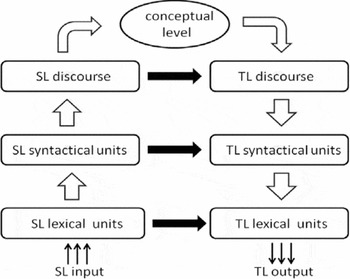
In addressing this issue researchers generally agree that translation involves linguistic analysis and comprehension of the SL in order to construct a mental representation of the message and planning and lexical selection processes in order to produce the target message. Where they disagree is in whether experience in translation affects the particular routes taken to a translation response, specifically, whether comprehension of the source message occurs before or after the reformulation process begins. Figure 1 provides a schematic depiction of two contrasting views on this issue (see also Paradis, Reference Paradis1994).
The vertical and horizontal approaches to translation.

According to the so-called ‘horizontal’ model of translation, translation involves establishing form-based links between lexical and syntactic units in the source and target languages before the meaning of the source input is fully grasped (de Groot, Reference De Groot, Danks, Shreve, Fountain and McBeath1997; Gerver, Reference Gerver and Brislin1976; Shreve, Schaeffer & Danks, Reference Shreve, Schaeffer and Danks1993). An alternative view, represented by the ‘vertical’ model, is that a meaning-based rendering of the input (and target) message must be achieved before the message is rendered into the target language (Seleskovitch, Reference Seleskovitch and Brislin1976, Reference Seleskovitch1999). In the vertical strategy view comprehension is thought to precede reformulation whereas in the horizontal view reformulation is thought to precede comprehension or else occur in parallel with it (Macizo & Bajo, Reference Macizo and Bajo2006). Moreover, given that in the vertical translation view the input message is to be processed for comprehension, this approach would lead to the prediction that the surface form of the message is likely to be lost, as reformulation of the message will be based on the conceptual (meaning) representation (see the deverbalization theory by Seleskovitch, Reference Seleskovitch and Brislin1976). In contrast, in the horizontal strategy view translation is thought to involve direct code-to-code connections at the lexical or syntactic level (see Ruiz, Paredes, Macizo & Bajo, Reference Ruiz, Paredes, Macizo and Bajo2008).
The horizontal and vertical approaches have also been described as form-based and meaning-based approaches to translation, respectively. In a form-based approach there is a direct mapping of source text structures to target language structures; that is, the target language text retains formal aspects of the source text, such as word order, voice, etc. In a meaning-based approach, the target language production is based on a conceptual representation of the meaning of the source text and thus does not necessarily retain formal aspects of the source text.
For scholars in the profession of translation and interpretation there is a prevailing view that form-based translation is less elegant than meaning-based translation and is perceived as evidence of some impairment or processing difficulty on the part of the translator when it occurs (Seleskovitch, Reference Seleskovitch and Brislin1976, p. 112; de Groot, Reference De Groot, Danks, Shreve, Fountain and McBeath1997). Professional translators are assumed to rely on meaning-based translation (Gile, Reference Gile1995). A meaning-focused approach may be reinforced among students of interpretation by virtue of an emphasis on meaning representation in formal training given to advanced students of translation/interpretation (Gerver, Reference Gerver and Brislin1976; Gile, Reference Gile1995; Lambert, Reference Lambert1988; see also Isham, Reference Isham, Lambert and Moser-Mercer1994).
Aside from the role of degree of experience in translation, translation strategy may also be affected by the particular conditions surrounding the translation. For example, under conditions of continuous presentation of source language input a horizontal, form-based, recoding approach may be simply easier since the source text is always present for review, whereas when the SL input is not continuously present a recoding approach may be less expeditious and a meaning-focused approach may be adopted.
Although the question of the relative use of a horizontal vs. vertical translation strategy has been discussed for some time in the translation literature (e.g., Gile, Reference Gile1995; Paradis, Reference Paradis1994; Seleskovitch, Reference Seleskovitch and Brislin1976), there has not been much direct investigation of it. The present study sought to determine whether, under conditions of visual, non-continuous, presentation of SL text to be translated, individuals with formal training in translation/interpretation will in fact be more inclined to use a meaning-focused, vertical strategy as compared to those with no prior formal training. Before turning to the study we provide a brief overview of relevant research.
A few previous studies have directly compared the performance of professional translators and/or students undergoing formal training in translation or interpretation with that of untrained bilinguals. These studies have tended to show that – compared to the performance of untrained bilinguals – that of bilinguals with training in translation differs on a range of cognitive and linguistic tasks, including translation itself (Bajo, Padilla & Padilla, Reference Bajo, Padilla, Padilla, Chesterman, Gallardo San Salvador and Gambier2000; Christoffels, De Groot & Kroll, Reference Christoffels, De Groot and Kroll2006; Green, Vaid, Schweda-Nicholson, White & Steiner, Reference Green, Vaid, Schweda-Nicholson, White, Steiner, Lambert and Moser-Mercer1994; Tzou, Eslami, Chen & Vaid, Reference Tzou, Eslami, Chen and Vaid2012). However, to date, the role of translation strategy has generally not been isolated for study.
Instead, in the psychological literature on translation and studies of bilingual word recognition at large, the unit of study has been single words presented out of context (Talamas, Kroll & Dufour, Reference Talamas, Kroll and Dufour1999; see also De Groot & Keijzer, Reference De Groot and Keijzer2000; De Groot & Poot, Reference De Groot and Poot1997; Frenck-Mestre & Prince, Reference Frenck-Mestre1997; but see Hatzidaki & Pothos, Reference Hatzidaki and Pothos2008; Schwartz & Kroll, Reference Schwartz and Kroll2006). Across numerous studies involving lexical decision or word naming, cognate status and orthographic relatedness of words across languages affects bilingual word recognition, suggesting that, even when the task does not require translation, translation equivalents are activated (e.g., Van Hell & Dijkstra, Reference Van Hell and Dijkstra2002). Indeed, there is evidence that presentation of specific lexical or syntactic structures in the SL can influence target language lexical and syntactic selection in production (de Bot, Reference De Bot, Dimitrova and Hyltentenstam2000). As such, one can say that there is prior empirical support for code-to-code activation from the source language to the target language, at least in untrained bilinguals. Whether the activation of TL equivalents varies by translation experience has not received much attention.
A further finding of relevance observed in studies of translation is an asymmetry in performance based on translation direction: that is, translating into the primary language is typically easier than into a secondary language, even among highly proficient bilinguals. One interpretation of this finding has been in terms of the revised hierarchical model of the bilingual mental lexicon (Kroll & Stewart, Reference Kroll and Stewart1994), according to which bilinguals translating an L1 word are thought to first consult the conceptual store to retrieve the L1 word form that shares the same conceptual meaning as the L2 word. By contrast, L2 to L1 translation is believed to proceed by first going through the L1 store before accessing the conceptual store. However, not all instances of translation direction asymmetries, e.g., masked priming, fit with the predictions of the revised hierarchical model (e.g., Dimitropoulou, Duñabeitia & Carreiras, Reference Dimitropoulou, Duñabeitia and Carreiras2011; see Basnight-Brown & Altarriba, Reference Basnight-Brown and Altarriba2007, for a review of translation priming). While translation direction asymmetries may be open to different interpretations, their pervasiveness means that it is important to control for them or examine them when studying translation.
An important study of particular relevance to the issue of translation strategy was that by Macizo and Bajo (Reference Macizo and Bajo2006). Following up on a question first posed by Shreve et al. (Reference Shreve, Schaeffer and Danks1993) about whether reading for the purpose of translating is cognitively different from reading for other purposes, Macizo and Bajo (Reference Macizo and Bajo2006) conducted a series of online (moving window) experiments with Spanish–English professional translators and untrained bilinguals who were asked to read sentences in Spanish for the purpose of subsequent translation or repetition. The authors reasoned that reading for translation presumably requires more working memory resources to access and maintain target language units for later retrieval; thus, when reading sentences for translation, the presence of an ambiguous word should slow down reading, particularly when the distance between the ambiguous word and the disambiguating context is large (high working memory load condition). They further reasoned that if the presence of cognate words in the source text facilitates sentence comprehension in the reading for translation condition that would suggest that form-equivalent words in the target language are activated. Both of these effects were obtained in both groups leading Macizo and Bajo (Reference Macizo and Bajo2006) to conclude that reading for the purpose of translation involves a real time, partial reformulation of the text into the target language, that is, reliance on a horizontal translation strategy. Studying professional translators only, a follow-up study by Ruiz et al. (Reference Ruiz, Paredes, Macizo and Bajo2008) replicated the findings of Macizo and Bajo (Reference Macizo and Bajo2006) using the same procedure but with different stimulus manipulations. Taken together, these two studies show that under online presentation conditions, reading sentences for the purpose of subsequent translation involves the activation of form-equivalents in the target language, consistent with a horizontal translation strategy. At the same time, Macizo and Bajo (Reference Macizo and Bajo2006) proposed that a horizontal strategy does not preclude a parallel meaning-based activation while activating TL structures.
Like the Macizo and Bajo study, the present study was interested in comparing trained and untrained bilinguals under different conditions to determine if translation experience affects translation strategy. However, our procedure and the choice of conditions was somewhat different from that of Macizo and Bajo (Reference Macizo and Bajo2006). Whereas they were interested in comparing processes involved in reading for repetition versus reading for translation, our study examined processes involved in reading idioms for subsequent translation. Use of an online measure such as a moving window task would make the task artificial since idioms are typically encountered and perceived as whole units; so, presenting them incrementally would have altered how they would normally be processed. Although our task was therefore not as online as that of Macizo and Bajo, it was nevertheless designed in such a way that it allowed us to examine separately the time it takes participants to read and comprehend the initial text in the source language and the time it takes them to read a subsequently presented text in the other language for the purpose of translation verification.
The present study: rationale
The aim of the present study was to explore the issue of translation strategy as a function of translation experience by studying idiom translation. Idioms, like other kinds of expressions whose meaning is not directly derivable from its constituents, are highly prevalent in everyday language use (Piasecka, Reference Piasecka and Arabski2006). The translation of such expressions poses a number of choices since the translator must decide whether to render the translation as an equivalent image, a paraphrase, or as a literal equivalent (Sjørup, Reference Sjørup and O'Brien2011). In the present study we compared the relative speed of verifying equivalent image (idiomatic) translations vs. source language form-retaining literal translations of idiomatic expressions presented in each language of the participants.
The specific procedure was as follows: Participants who were trained or untrained bilingual speakers of Mandarin and English read an initial phrase presented randomly in either of their languages with the expectation that they would have to determine if a subsequently presented phrase in the other language was or was not equivalent in meaning to the initial phrase. Their reading times of the initial phrase and their translation verification latencies and accuracy were analyzed. Importantly, the second phrase was either a form-based (literal) translation or a meaning-based (non-literal) translation (or was unrelated in both respects). We reasoned that faster translation judgments to literal form-based equivalents of the phrases would provide support for a horizontal strategy. By contrast, a meaning-based strategy would be supported by equal response latencies to literal and figurative translations.
By presenting the idioms and their paired equivalents sequentially we were able to separate out the time it takes to comprehend the first phrase from the time it takes to determine if its meaning is conveyed by the second phrase. Thus, we measured reading comprehension time and translation verification time on each trial. Based on prior work we expected participants to be faster at reading phrases in their first (more dominant) language and at verifying translations of phrases in the L2 to L1 direction. Our study also allowed us to examine if there is an overall ‘translation-training advantage’ in translation performance: that is, whether trainees would perform better and/or faster than untrained bilinguals in making translation judgments.
As already noted, the critical questions of interest motivating this research were whether translation verification latency (and/or accuracy) would be influenced by training in translation and by the nature of the translation equivalent (i.e., form-based vs. meaning-based). The study sought to determine whether a horizontal translation strategy is the default strategy used by bilinguals or whether a meaning-first or vertical strategy better characterizes their performance, particularly the performance of experienced translators.
Method
Participants
A total of 36 late bilinguals originally from Taiwan or mainland China with Mandarin Chinese as their first language (L1) and English as their second language (L2) were recruited for participation in the United States. At the time of testing, participants had been in the U.S. for a period ranging from two to three years. About half of the participants (n = 16) were bilinguals who were untrained in translation (mean age = 28.44 yrs); the remainder (n = 20) were students undergoing professional training at a graduate school of translation and interpretation. The bilingual group consisted of graduate students enrolled in different fields. The trainees in turn included 11 students who were approaching the end of their first year of training in the translation program (mean age = 25.73 yrs), and 9 students who were reaching the end of their second and final year of training (mean age = 30.22 yrs). Since the trainees were volunteers recruited from the translation institute, we had no control over how many participants we could get and were thus not able to match the sample sizes across groups.
The translation students in the first semester (Year 1) take translation (written) and consecutive interpretation courses in both directions (English-Chinese and Chinese-English). In the second semester of the first year simultaneous interpretation in both directions is introduced. In their second year, students continue to take translation, consecutive and simultaneous interpretation courses but the topics for the interpretation classes in the first semester are focused on economic and general issues. In the second and final semester of training, speeches and talks for the consecutive and simultaneous interpretation classes are introduced, mainly focused on political and technology related events and issues. Importantly, there is no explicit formal training in either year on how to translate idiomatic expressions as such, although some idiomatic phrases may come up occasionally in their interpretation or translation practices and assignments, and students find ways to search for and come up with the best translation of these phrases on their own.
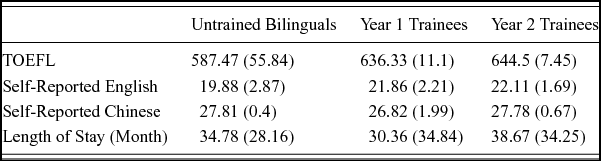
A language background questionnaire was administered to each participant, which included a composite measure of self-rated language proficiency in each language in speaking, reading, writing and general comprehension. Objective measures of English proficiency based on the TOEFL test were also obtained (these scores were not available for four of the participants). See Table 1 for a summary. Preliminary analyses indicated no significant differences among the three groups in length of stay in the U.S. (F(2, 33) = < 1, p = .87, ηp 2 =.008). The two trainee groups (M = 644.50 for 2nd Year trainees; M = 636.33 for 1st Year trainees) showed a higher TOEFL score as compared to the untrained bilinguals (M = 587.47), F(2, 29) = 7.22, p <.01, ηp 2 =.332. There was no group difference in self-reported proficiency in Chinese, F(2, 33) = 2.67, p = .08, ηp 2 =.139. A group difference in English self-ratings of proficiency was found, F(2, 33) = 3.33, p = .048, ηp 2 =.168; however, a Tukey post hoc test revealed no significant pair-wise differences between groups (see Table 1).
Language proficiency of participants

Note. The numbers in parentheses indicate standard deviations.
Although we have described the two trainee subgroups here separately, given that their sample sizes were rather small, for purposes of the present study we collapsed them into a single group characterized as ‘trained’ bilinguals, and compared their performance with that of the ‘untrained’ bilinguals.
Materials
A speeded translation judgment task involving verification of literal vs. figurative (meaning-based) translation was developed and presented using E-prime (Schneider, Eschman & Zuccolotto, Reference Schneider, Eschman and Zuccolotto2002). The test stimuliFootnote 1 consisted of 20 highly familiar idiomatic phrases in Chinese (5.7 words in mean length) and in English (mean length of 6.2 words) each paired with three different possible phrases: a phrase that was completely unrelated in meaning, a phrase corresponding to a non-idiomatic literal translation (word for word or paraphrased) and a figurative (idiomatic) translation.
The test phrases and their translations were selected from two books on Chinese idioms (Situ, Reference Situ2002). For example, for the Chinese idiom, 千載難逢, for which a verbatim translation would be “hard to meet in a thousand years” the paraphrased meaning, “a rare opportunity”, was chosen as the literal equivalent – because it is a phrase that one would use in normal speech or writing; the figurative equivalent selected was “once in a blue moon”. As another example, for the Chinese idiom, 人不可貌相, the figurative translation used was “all that glitters is not gold” and the literal was “do not judge a person based on appearance”. In this case the literal English translation is also a verbatim translation of the Chinese phrase. Moreover, pilot testing conducted with a separate sample of untrained bilinguals showed that the meaning of the idiomatic expressions in each language was familiar.
Procedure
Participants were tested individually in a laboratory setting. The translation judgment task began with ten practice trials. Participants were told to press down the space bar upon seeing a phrase presented on the computer screen and release it only after they finished reading the phrase and had fully grasped the meaning of the phrase. A second phrase would then appear on the screen and a timer would start at the onset of this phrase. Participants had to indicate by pressing one of two buttons on the keyboard (designated as ‘yes’ or ‘no’) whether this phrase was a translation of the first phrase. The first phrase of a stimulus pair was presented randomly in English or Mandarin an equal number of times. The second phrase was always presented in the other language of the first phrase. On half of the trials the second phrase was equivalent in meaning to the first phrase (either as a literal translation or as a figurative translation); on the remaining half the two phrases were unrelated in meaning. Separate stimulus lists were prepared such that the status of the second phrase (literal equivalent, figurative equivalent, or unrelated) was counterbalanced across trials and participants. That is, although each participant was administered literal equivalents and figurative equivalents of phrases, they did not see both types for a given initial phrase.
Each participant thus made judgments about ten cross-language phrase pairs that were equivalent in their literal meaning, ten phrase pairs that were equivalent in their figurative meaning, and twenty pairs that were not related in meaning.
Results
Three separate sets of analyses of variance were conducted on the translation judgment data. All analyses applied the General Linear Model, which was used to take care of the fact that there were uneven sample sizes. The first analysis examined reading times of the first presented phrase as a function of group (untrained bilinguals, trained bilinguals) and language of the presented phrase. This analysis served to indicate the time taken to process the source language for meaning and also provided a proxy measure of reading speed in each language.
The second set of analyses focused on translation judgments. Separate analyses of variance were conducted for ‘no’ responses (i.e., percent accuracy of judging that a phrase was not a translation when it was not a translation) and ‘yes’ responses (i.e., percent accuracy of verifying that a phrase was a translation when that was the case). Finally, a third analysis was conducted on translation judgment latencies for correct ‘yes’ responses as a function of group, translation direction and the nature of the translation.
Given that there were some cells that had very few data points (particularly after removal of outliers), there was an increased potential for violation of the assumption of homogeneity of variance; thus, the recommendation by Keppel and Wickens (Reference Keppel and Wickens2007) of adopting a more stringent confidence level (p<.025) was followed to reduce the likelihood of a Type 1 error.
First phrase reading time
Reading time of the first phrase of each stimulus pair (which was idiomatic) was analyzed in a 2(language) x 2(group) analysis of variance. The data were analyzed by subjects (F 1) and by items (F 2). In the by-subject analysis, the factor of group was treated as a between-subjects factor, and the factor of language was treated as a within-subjects factor. In the by-item analysis, both factors were treated as within-items factors.
Trials with reading times that were under 200 ms or longer than 2.5 SD of each participant's or item's reading times were considered outliers and were excluded from the analysis (these constituted 2.09% of responses). Three items were excluded in the by-item analysis due to missing data in any of the 2(languages) x 2(group) cells after trimming outliers.
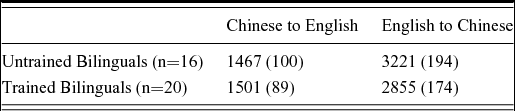
A main effect of language was found, F 1(1, 34) = 174.97, p <.001, ηp 2 =.837, F 2(1, 16) = 68.32, p <.001, ηp 2 =.810, indicating that reading times were shorter when the first phrase was in Chinese (M = 1484 ms) than when it was in English (M = 3038 ms). In other words, across both groups, participants were faster in reading idiomatic phrases in their native language.
There was no effect of group [F 1 (1, 34) < 1, ηp 2 =.027; F 2(1, 16) = 2.34, p =.146, ηp 2 =.128]. The interaction of group by language was not significant [F 1 (1,34)=2.89, p=.098, ηp 2 =.078; F 2 (1,16)=1.25, p=.281, ηp 2 =.072].
Thus, although both groups were faster in reading Chinese than English idioms the groups did not differ from each other, suggesting that training in translation does not affect the time it takes to read idioms for comprehension. See Table 2 for a summary.
Mean First Phrase Reading Time (ms).

Note. Standard errors are reported in parentheses.
Translation verification judgments
Accuracy of ‘No’ Responses
The percent accuracy of judging when the second phrase was not a translation when it was in fact not a translation was analyzed as a function of translation direction (from Chinese to English or from English to Chinese) and group (untrained bilingual, trained bilingual). In the by-subject analysis, the factor of group was treated as a between-subjects factor and the factor of translation direction was treated as a within-subjects factor. In the by-item analysis, group and translation direction were treated as within-items factors.
The effect of translation direction was not significant, [F 1(1, 34) = 1.71, p = .20, ηp 2 = .048, F 2(1, 19) = <1, ηp 2 =.038]; participants were 91.9% accurate at judging when phrases were not translations from English to Chinese and 89.8% accurate at judging them in the direction of Chinese to English.
There was a significant main effect of group, F 1(1, 34) = 14.63, p = .001, ηp 2 = .301, F 2(1, 19) = 16.69, p=.001, ηp 2 = .468. Post-hoc analysis suggested that untrained bilinguals (85.6%) were significantly less accurate than trainees (96.0%), p=.001. Thus, training in translation made participants more accurate in detecting when something was not a translation equivalent. There was no significant interaction of group by translation direction.
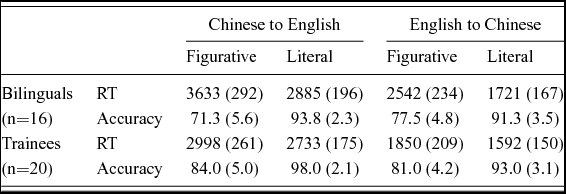
A summary of mean accuracy and reaction times for translation verification is provided in Table 3.
Mean Percent Accuracy and Reaction Time (ms) for Translation Verification.

Note. Standard errors are reported in parentheses.
Accuracy of ‘Yes’ Responses
The percentage correctly judging that the second phrase was a translation when it was in fact a translation was analyzed as a function of translation direction (from Chinese to English or English to Chinese), group (untrained bilingual or trainees), and the nature of the translation (literal vs. idiomatic). In the by-subject analysis, the factor of group was treated as a between-subjects factor and the factors of nature of the translation and translation direction were treated as within-subjects factors. In the by-item analysis, all three factors were treated as the within-items factors.
There was no main effect of translation direction, [F 1(1, 34) < 1, ηp 2 =.005; F 2(1, 19) < 1, ηp 2 =.004]; participants were 85.7% accurate at judging translations of phrases from English to Chinese and 86.8% accurate at judging translations from Chinese to English.
The main effect of group was not significant, F 1(1, 34) = 2.59, p =.117, ηp 2 =.071, F 2(1, 19) = 5.03, p =.037, ηp 2 =.209; the effect indicated that untrained bilinguals (M = 83.4%) did not significantly perform worse than trainees (M = 89.0%).
The effect of nature of the translation (literal vs. figurative) was found to be significant, F 1(1, 34) = 29.68, p <.001, ηp 2 =.466, F 2(1, 19) = 10.23, p =.005, ηp 2 =.350, indicating that although translation accuracy was generally high, it was especially higher for literal translations (M = 94.0%) than for idiomatic ones (M = 77.8%). There were no significant interaction effects of group with translation direction, group with nature of translation, or translation direction with nature of translation, nor was there a higher order interaction.
Speed of Translation Verification
Mean response times (RTs) to correct ‘yes’ judgments were entered into an analysis of variance as a function of translation direction, group, and translation type. Trials with RTs that were under 200 ms or longer than 2.5 SD of each participant's or item's RTs were excluded from the analysis (2.9% of responses).
The data were analyzed by subjects (F 1) and by items (F 2). In the by-subject analysis, the factor of group was treated as a between-subjects factor, and the factors of translation type and translation direction were treated as within-subjects factors. In the by-item analysis, all three factors were treated as the within-items factors. Three items were excluded from the by-item analysis due to missing data in certain cells after trimming outliers.
There was a main effect of translation direction, F 1(1, 34) = 66.65, p < .001, ηp 2 = .662, F 2(1, 16) = 51.22, p <.001, ηp 2 =.762, indicating that participants were significantly faster when translating into their first language (Chinese) than when translating into their second language (English) (mean scores were 1926 ms and 3062 ms, respectively).
The main effect of group was not significant in the by-subjects analysis but was significant in the by-items analysis, F 1(1, 34) = 3.05, p = .09, ηp 2 = .082, F 2(1, 16) = 6.50, p = .021, ηp 2 = .289, and showed that untrained bilinguals (M = 2695 ms) responded more slowly than trainees (M = 2293 ms).
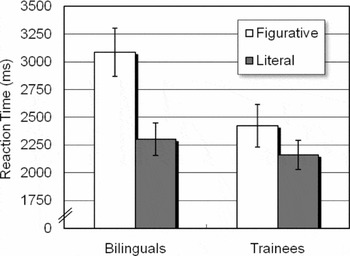
The effect of nature of translation was significant, both as a main effect in the by-subjects analysis [F 1(1, 34) = 33.49, p < .001, ηp 2 = .496, F 2(1, 16) = 2.94, p = .105, ηp 2 =.155, indicating faster responses in verifying literal (M = 2233 ms) than figurative equivalents (M = 2756 ms), and in interaction with group, in the by-subject analysis, F 1(1, 34) = 8.36, p = .007, ηp 2 =.197, F 2(1, 16) = 2.40, p=.141, ηp 2 = .130. Breakdown of the interaction using a simple main effect analysis indicated that the difference in response time to literal vs. figurative translations was significant (in the by-subjects analysis) only for the untrained bilinguals [Mean Difference = 784 ms, F 1(1, 34) = 16.95, p < .001, ηp 2 = .333, F 2(1, 32) = 2.22, p = .146, ηp 2 =.065]. The trainees showed equally fast responses to literal and figurative translations [Mean Difference = 262 ms, F 1(1, 34) = 2.36, p = .134, ηp 2 = .065, F 2(1, 32) < 1, ηp 2 = .009. Although this was not significant, there was a trend for trainees to be faster than untrained bilinguals in verifying non-literal, idiomatic equivalents, Mean Difference = 664 ms, F 1 (1,68) = 3.60, p=.062, ηp 2 =.050, F 2 (1,32)=2.30, p=.140, ηp 2 =.067; no group differences were evident in verifying literal equivalents [Mean Difference = 141 ms, F 1(1, 68) < 1, ηp 2 = .002, F 2(1, 32) < 1, ηp 2 =.000]. No other interactions were found, whether for group by translation direction, or translation direction by nature of translation, or a higher order interaction. See Figure 2.
Mean translation verification latencies (and standard errors) by translation type and group.

Discussion
By and large the findings we obtained had medium to large effect sizes, thereby underscoring that there was sufficient power in the design despite the modest number of stimuli and participants.
By separately obtaining measures of speed of reading the first presented phrase from the speed of verifying the translation of the second presented phrase our study allowed us to distinguish between the time needed to comprehend the message presented in the source text from that needed to comprehend the message presented in the target language. Importantly, both trained and untrained bilinguals were faster in comprehending the source message when it was presented in their first language (Mandarin). Thus, consistent with several similar findings in the translation literature, our study found that participants were generally faster in reading idiomatic expressions in their first language and that they were faster in verifying translations when these were to be made into their first language (English to Chinese direction).
We also found support for training effects in translation verification performance and translation strategy. Trainees were more accurate than untrained bilinguals in judging when something was not a translation. Furthermore, trainees were significantly faster than untrained bilinguals in their speed of judging translations (in the by-item analysis). Thus, formal experience in translation had an effect on both speed and accuracy of translation, as might be expected.
The primary theoretical question that our study sought to address was whether there would be training effects in the use of a vertical strategy in translation. Our study compared translation judgments of idiomatic expressions when the translations emphasized the formal characteristics of the source language text in conveying its meaning (literal translations) and when they did not (figurative translations).
If formal training in translation is associated with a greater use of a vertical or conceptually-mediated translation strategy, we would expect that bilinguals with training in translation would be equally fast in verifying semantic equivalents of idiomatic expressions regardless of whether the equivalence reflects a form plus meaning based mapping or just a meaning based mapping. We obtained support for this effect. Bilinguals trained in translation were equally fast at verifying literal and non-literal phrase translations, consistent with a reliance on a meaning-first strategy. The performance of untrained bilinguals, by contrast, was consistent with greater reliance on a form-first translation strategy as they were significantly faster in judging translations of literal than of figurative equivalents of the stimuli (but only in the by-subjects analysis).
Thus our findings provide qualified support for the notion that formal training in translation is associated with a certain type of translation strategy in which the input is first processed for meaning before it is reformulated into the target language (as proposed by proponents of the vertical strategy view).
There are some limitations of our study that need to be acknowledged and addressed in future work. One concerns the granularity of our response measurements. That is, unlike the more sensitive online procedure used by Macizo and Bajo our study presented the stimuli in their entirety, making it difficult to say anything about moment to moment processing. Moreover, our choice of translation verification latencies as a measure meant that some unspecified portion of the latencies will reflect decisional processes occurring after comprehension. We acknowledge that this may limit the claims we can make and that in further work it will be important to pursue this issue using multiple measures, including more clearly online ones, and seek convergence across tasks, recognizing that each measure will have certain advantages and certain limitations.
A second limitation of our work is that we did not manipulate idiom properties such as frequency or imageability or transparency. As such we cannot draw any conclusions about how these may affect translation speed or strategy. Furthermore, the idioms we used all had idiomatic counterparts in both languages. It would be interesting to vary this in future research to compare trained and untrained bilinguals’ processing of idioms that have idiomatic counterparts in the other language with their processing of idioms that do not have counterparts in the other language (e.g., Carrol & Conklin, Reference Carrol and Conklin2014).
A related issue is that our study design does not allow insights into underlying mechanisms, e.g., whether faster performance in verifying idiomatic translations reflects faster computation of figurative meaning or faster retrieval of lexicalized, stored entries. Prior research on idiom processing has shown that computation versus retrieval of stored lexicalized phrases may be affected by whether the phrases are decomposable (Cieslicka, Reference Cieslicka and Arabski2006; Tabossi, Fanari & Wolf, Reference Tabossi, Fanari and Wolf2008; Vaid & Lopez, Reference Vaid and Lopez2015).
These limitations notwithstanding, our study demonstrated an effect of formal training in translation/interpretation on the relative speed of judging different types of idiomatic expressions: whereas untrained bilinguals were faster at judging translations that preserve SL form than translations that do not preserve SL form, bilinguals with formal training in translation were equally fast at recognizing translations regardless of translation type. This finding lends support to the view that formal training in translation is associated with a meaning-focused, ‘vertical’ translation strategy, involving a strategy of computing or retrieving the meaning of the source message first before reformulating it into the target language. To some extent this finding is also consistent with the view that with greater practice in translation there is greater automatization of processing; what is important here is that the automatization that may be occurring seems to be in the direction of greater semantic processing. By contrast, the approach to translation in untrained bilinguals seems to be one in which a form-based analysis is attempted first, as they showed faster translation verification of phrases with literal (form-based) equivalents than verification of non-literal (meaning-based) equivalents.
Supplementary Material
For supplementary material accompanying this paper, visit http://dx.doi.org/10.1017/S1366728915000929