





1. General introduction
Both theoretical models and empirical research indicate a dynamic interplay between emotion, language, and culture, suggesting that affective experiences are constructed through the interaction of core affect and conceptual knowledge (Barrett et al., Reference Barrett, Mesquita, Ochsner and Gross2007; Wierzbicka, Reference Wierzbicka1999). Bilinguals represent a unique population for examining these relationships, as they regularly navigate between distinct linguistic and cultural frameworks, potentially experiencing emotions differently in each context (Pavlenko, Reference Pavlenko2012). Within this navigation, the extent to which specific concepts are anchored to a cultural context, referred as culture relatedness, becomes a pivotal factor. Culture is not merely a backdrop for communication but a primary source of emotional meaning. As suggested by theories of dynamic constructivism, culture functions as a network of accessible knowledge structures that shape an individual’s perception and judgement (Hong et al., Reference Hong, Morris, Chiu and Benet-Martinez2000). For the bilingual speaker, cultural identity is deeply intertwined with specific linguistic cues. Symbols and concepts associated with one’s heritage culture (e.g., festivals, historical figures) often elicit automatic affective responses that reflect the depth of an individual’s identification with that group (Devos & Banaji, Reference Devos and Banaji2005; Ogunnaike et al., Reference Ogunnaike, Dunham and Banaji2010). Consequently, culture relatedness, whether a concept belongs to the native (L1) or the second language (L2)’s culture, may serve as a critical prime for emotional processing.
However, the strength of these culture-emotion links often differs between a speaker’s two languages. A robust body of literature indicates that bilinguals tend to experience emotions more vividly in their L1 than in their L2 (e.g., Pavlenko, Reference Pavlenko2012; Wu & Thierry, Reference Wu and Thierry2012). Pavlenko (Reference Pavlenko2008) proposes that L1 concepts may acquire stronger affective associations through their connections with early autobiographical memories and socialisation experiences. In contrast, L2 concepts, particularly those learned later in life or primarily in instructional settings, are often reported to evoke reduced emotional resonance or more attenuated affective responses (Caldwell-Harris, Reference Caldwell-Harris2015). This emotional distance account suggests that L2 concepts may, under some conditions, be experienced with greater emotional neutrality than corresponding L1 concepts.
However, reduced emotional resonance in a second language (L2) is not consistently observed across studies. Instead, the literature shows a heterogeneous pattern in which L2 emotionality is influenced by task demands, language experience, proficiency, modality, and the type of emotional material processed. For instance, Winskel (Reference Winskel2013) reported that late Thai–English bilinguals did not exhibit the same automatic emotional Stroop effect in their L2 as in their L1, although their subjective ratings still reflected sensitivity to emotionality. Other studies indicate that highly proficient bilinguals may display emotional effects in both languages, particularly when tasks explicitly direct attention to emotional meaning or when participants possess substantial L2 experience (Ferré et al., Reference Ferré, Garcia, Fraga, Sanchez-Casas and Molero2010; Ferré et al., Reference Ferré, Anglada-Tort and Guasch2018). Lexical rating studies additionally demonstrate that L2 words are not universally experienced as emotionally diminished. Bilinguals’ ratings of valence, emotionality, and subjective familiarity may differ between the L1 and L2, with these differences varying according to word types, modalities, and language experience (Garrido & Prada, Reference Garrido and Prada2021; Vélez-Uribe & Rosselli, Reference Vélez-Uribe and Rosselli2019). Additionally, large-scale L2 norming studies show that L2 speakers’ valence and arousal ratings systematically vary with proficiency, length of immersion, and word characteristics (Imbault et al., Reference Imbault, Titone, Warriner and Kuperman2021). Collectively, these results indicate that emotional distance should be conceptualised as a graded and context-sensitive phenomenon, rather than an all-or-none property of the L2.
This variability illustrates a limitation in explanations that focus primarily on linguistic factors such as age of acquisition, proficiency, or frequency of use. While these variables influence L2 emotional processing, they do not fully account for why the same L2 word may be viewed as more or less emotionally intense depending on the situational and cultural context. Subjective lexical-rating studies are particularly relevant for addressing this issue, since they directly assess how speakers consciously evaluate the affective meaning of words, rather than inferring emotionality solely from native-speaker norms. Recent research on L2 affective lexicons indicates that affective connotations can be transferred, reshaped, or partially aligned across languages, depending on learners’ proficiency, exposure, cultural contact, and attitudes towards the L2 community (Blanco Canales & Pérez-García, Reference Blanco Canales and Pérez-García2024; Hernández Muñoz & Blanco Canales, Reference Hernández Muñoz and Blanco Canales2023; Imbault et al., Reference Imbault, Titone, Warriner and Kuperman2021).
Collectively, these mixed findings show that the central question is not simply whether the L2 is less emotional than the L1, but rather under which conditions L2 emotional meaning becomes intensified, attenuated, or recontextualised. Culture relatedness represents a conceptually important yet under-examined source of such variation. For late bilinguals residing in an L2 environment, emotional meaning may be influenced not only by the language of presentation but also by whether the context activates native-culture, host-culture, or culturally neutral frames. This perspective corresponds to research on bicultural identity integration, which demonstrates that bilinguals differ in their perceptions of compatibility or conflict between heritage and host cultural identities (Benet-Martínez & Haritatos, Reference Benet-Martínez and Haritatos2005), as well as with studies on cultural frame-switching, which show that bicultural bilinguals can activate different culture-specific mental frames in response to contextual cues (Luna et al., Reference Luna, Ringberg and Peracchio2008). Accordingly, the present study considers culture relatedness as a distinct contextual factor that may account for variability in L2 emotional processing among tasks and individuals. Theoretical frameworks of emotion construction emphasise that affective experiences are not merely biological reactions but are dynamically constructed through the interaction of core affect and conceptual knowledge, a process in which both language and culture play essential roles (Barrett et al., Reference Barrett, Mesquita, Ochsner and Gross2007; Lindquist et al., Reference Lindquist, MacCormack and Shablack2015). Cross-cultural research supports this view, demonstrating that, while basic emotions may be shared universally, the regulation, expression, and even the perception of these emotions are deeply shaped by the specific values and social norms of a culture (De Leersnyder et al., Reference De Leersnyder, Boiger and Mesquita2013; Shweder & Haidt, Reference Shweder, Haidt, Lewis and Haviland-Jones2000). For bilinguals, who navigate distinct linguistic frameworks, this implies that emotional processing is inherently tied to the cultural context in which a language is used (Pavlenko, Reference Pavlenko2012).
In literature, observed differences in processing of emotive content between the L1 and L2 are usually explained solely by linguistic proficiency factors, such as age of acquisition, L2 immersion, or frequency of use (Degner et al., Reference Degner, Doycheva and Wentura2012). Specifically, a contextual account suggests that emotional concepts are inextricably linked to the specific cultural and autobiographical milieus in which they are acquired. Altarriba (Reference Altarriba2003) provided support for this by comparing Spanish-English bilinguals’ ratings of Spanish words with English native speakers’ ratings of English words. They found that emotion words in Spanish (the bilinguals’ L1) were rated as having higher context-availability than corresponding English words rated by monolinguals, meaning that they were more readily linked to specific autobiographical episodes. Furthermore, culture provides the essential social framework for interpreting these emotions; as Hareli et al. (Reference Hareli, Kafetsios and Hess2015) indicated, cultural norms dictate the social signal value of emotional expressions (e.g., as markers of norm violation), thereby shaping how emotions are perceived and regulated within a community. Consequently, the reduced emotional resonance often reported in the L2 (Pavlenko, Reference Pavlenko2012) may reflect not only later language acquisition but also weaker or less frequent connections with the autobiographical contexts and culture-specific scripts through which affective meanings are learned and used.
Indirect empirical evidence further underscores the impact of cultural familiarity on the processing of affective content in L2. Recent studies involving L2 speakers (e.g., Chinese or Arabic learners of English) reported a lack of typical emotion processing advantages, such as faster reading times for emotive words compared to neutral words, when the experimental stimuli depicted culturally unfamiliar scenarios (e.g., US-centric contexts; El-Dakhs et al., Reference El-Dakhs, Sonbul and Altarriba2023; Tang & Ding, Reference Tang and Ding2024). These findings suggest that a “cultural mismatch” between the reader and the content can significantly dampen emotional resonance. Despite this, direct investigations into how culture relatedness specifically modulates lexical processing in bilinguals remain limited, highlighting the need to isolate cultural context as a distinct variable from general language proficiency.
To address this critical gap, the present research adopts a multi-methodological approach to examine how culture relatedness modulates processing of affective content in late Mandarin-English bilinguals. We conducted two complementary studies to capture both the implicit dynamics and the explicit evaluations of cultural concepts. Study 1 utilises the Implicit Association Test (IAT, e.g., Greenwald et al., Reference Greenwald, Brendl, Cai, Cvencek, Dovidio, Friese, Hahn, Hehman, Hofmann, Hughes, Hussey, Jordan, Kirby, Lai, Lang, Lindgren, Maison, Ostafin, Rae and Wiers2022) to probe the strength of automatic, non-conscious associative links between cultural contexts (Chinese vs. British) and emotional valence (positive/negative vs. neutral). Study 2 complements this by assessing explicit subjective ratings of L2 English words across the full valence spectrum (positive, negative, and neutral words). By integrating these measures, we aim to examine whether stronger affective associations with the native culture persist at an implicit level during acculturation and how cultural context interacts with the conscious emotional attenuation sometimes observed in the L2.
2. Study 1: the Implicit Association Test
2.1. Introduction
Recent work has demonstrated that the IAT can be successfully adapted beyond traditional social psychology (e.g., investigating implicit national identity; Devos & Banaji, Reference Devos and Banaji2005) to probe fine-grained sociolinguistic associations. For example, IAT studies have detected implicit links between phonological variants and social categories such as region, class, and speaker identity (Campbell-Kibler, Reference Campbell-Kibler2012). In studies of bilingual speakers specifically, the paradigm has shown that implicit evaluations can shift depending on the testing language itself, further suggesting that both language context and bias jointly shape IAT scores (Marín-Gutiérrez et al., Reference Marín-Gutiérrez, Álvarez-Mosquera and Iglesias Álvarez2025).
This implicit approach is particularly relevant for bilinguals immersed in an L2 environment, who experience an ongoing negotiation between competing cultural frames (Purpuri et al., Reference Purpuri, Mulatti, Filippi and Treccani2024). While previous research (e.g., Caldwell-Harris & Ayçiçeği-Dinn, Reference Caldwell-Harris and Ayçiçeği-Dinn2009; Pavlenko, Reference Pavlenko2008) has primarily focused on the language–emotion link, such as the distinct emotional resonance of L1 and L2 (Wu & Thierry, Reference Wu and Thierry2012), relatively few studies have examined the associations between culture-specific concepts and emotion. Theoretically, long-term immersion in an L2-speaking environment, such as living abroad, may lead to a gradual reallocation of emotional links from one’s native to the host culture. This potential reorganisation raises a fundamental question: do native cultural–emotional bonds remain dominant, or do they become attenuated as bilinguals acculturate?
Research to date has not used the IAT to examine this specific implicit connection between culture relatedness and emotional concepts. However, prior research has successfully used this paradigm to reveal implicit associations between ethnic or national identity and affective evaluations (e.g., Devos & Banaji, Reference Devos and Banaji2005; Ogunnaike et al., Reference Ogunnaike, Dunham and Banaji2010). For the study of culture relatedness, the IAT paradigm provides a promising means of uncovering the implicit emotional dimensions embedded in individuals’ cultural affiliations, shedding light on whether the “emotional advantage” of the L1 culture manifests implicitly even during ongoing L2 acculturation.
Subjective valence-rating tasks provide a well-established method for assessing the affective meaning of words. Large-scale affective norming studies have shown that participants can reliably evaluate lexical stimuli along dimensions such as valence, arousal, and dominance, and such ratings have become a central resource for research on emotional word processing (Bradley & Lang, Reference Bradley and Lang1999; Warriner et al., Reference Warriner, Kuperman and Brysbaert2013). In bilingual research, subjective ratings are particularly useful because they capture how emotional meaning is consciously appraised in each language, rather than assuming that affective values derived from native-speaker norms apply equally to L2 users. Previous studies have shown that bilinguals’ ratings of valence, emotionality, and familiarity can differ between the L1 and L2, and that these differences are shaped by factors such as proficiency, immersion, word type, and modality (Garrido & Prada, Reference Garrido and Prada2021; Imbault et al., Reference Imbault, Titone, Warriner and Kuperman2021; Vélez-Uribe & Rosselli, Reference Vélez-Uribe and Rosselli2019). Therefore, explicit valence ratings offer a theoretically appropriate way to examine whether L2 words are experienced as emotionally attenuated, intensified, or recontextualised.
Building on this tradition, Study 2 used a subjective valence-rating task to examine whether cultural context modulates the conscious evaluation of English emotional words in late Mandarin–English bilinguals. Rather than treating L2 word valence as fixed, we asked whether the same English words would receive different ratings when evaluated in a no-culture context, a British cultural context, or a Chinese cultural context. This design allowed us to test whether culture-related schemas alter the perceived emotional intensity of L2 words and whether such modulation differs for positive, negative, and neutral lexical items.
2.1.1. The current study
In the present study, the IAT was adapted to measure implicit links between cultural words (Chinese vs. British) and emotive words (positive/negative vs. neutral). Each IAT consisted of a series of speeded categorisation blocks in which participants sorted words into two cultural categories and two evaluative categories using only two response keys. The critical contrast compares blocks representing our hypothesised congruent pairings (i.e., Chinese + positive/negative sharing a key) against blocks where these pairings are reversed (i.e., Chinese + neutral sharing a key). Faster responses in the congruent pairings compared to the incongruent pairings reflect stronger implicit alignment between native culture and emotive words. Two separate IAT tasks will be conducted: task 1 will pair cultural categories with positive versus neutral words, and task 2 will pair them with negative versus neutral words. This separation allows us to independently assess the degree to which each culture is implicitly associated with positivity and negativity rather than treating emotional valence as a simple bipolar dimension. The relative strength of these implicit associations is reflected in response speeds, where faster performance indicates a stronger congruence between a cultural category and an emotional valence.
We examined whether Mandarin–English bilinguals who have lived in the United Kingdom for at least one year still maintain stronger implicit emotional associations with their native (Chinese) culture compared to their second (British) culture. Because emotional meanings acquired in the L1 are often closely connected with early autobiographical and socialisation experiences, associations between native culture and emotional valence may remain particularly accessible. By comparison, emotional meanings associated with the L2 cultural context may have been acquired later and across a narrower range of personally significant contexts, potentially resulting in weaker automatic culture–emotion associations. Long-term immersion in the host culture may attenuate this difference, but may not eliminate it entirely. Long-term immersion might attenuate this difference but is unlikely to erase it, suggesting that early-established affective associations with one’s native culture may remain relatively resilient. Based on this, the following hypotheses are formulated:
H1 (Positive emotion): Participants will show faster reaction times and higher D-scores when Chinese culture words are paired with positive (vs. neutral) emotion words than when British culture words are paired with positive words.
H2 (Negative emotion): Participants will show faster reaction times and higher D-scores when Chinese culture words are paired with negative (vs. neutral) emotion words than when British culture words are paired with negative words.
2.2. Method
Study 1 was pre-registered and their preregistrations are available at: https://osf.io/fj7he.
2.2.1. Participants
Participants were 32 native speakers of Mandarin Chinese (25 women, 9 men) aged 23 to 35 years (M = 27.25, SD = 3.78) who completed Study 1 and Study 2 sequentially. All had lived in China until at least 18 years of age. Each had resided in the United Kingdom for a minimum of 12 months and reported an English language proficiency of C1 or higher, according to the Common European Framework of Reference for Languages (CEFR) guidelines. This proficiency level reflects the ability to understand complex texts, interpret implicit meanings, and use language fluently and flexibly in diverse contexts (Cambridge Assessment English, 2025).
Sample size justification. The target sample size of 32 participants was specified a priori and was not determined after inspecting the present outcome data. This target was informed by a priori power analyses conducted for a closely related culture-by-emotion experiment in the same target population, using a 2 × 3 repeated-measures design and assuming α = .05, power = .80, and partial η 2 = .03. These analyses were conducted using G*Power 3.1.9.6 and were cross-checked using GLIMMPSE. The same target sample was adopted for the present studies because they involved the same restricted participant population: native Mandarin Chinese speakers who had mainly resided in Mainland China before adulthood, had lived in the United Kingdom for at least 12 months, and had advanced English proficiency. Recruitment feasibility was also a practical constraint, as this population was difficult to access and the IAT session was conducted in person.
Importantly, this sample-size rationale should not be interpreted as an IAT-specific or mixed-effects-model power analysis. The original power analysis was designed for a related repeated-measures culture–emotion paradigm, whereas the present studies involved IAT D-scores and trial-level mixed-effects models with crossed participant and item variability. We, therefore, treat the sample size as a preregistered, feasibility-constrained target supported by prior power considerations from a related paradigm, rather than as definitive evidence that the present studies were sufficiently powered to detect small effects. All eligible participants who met the inclusion criteria and passed the preregistered data-quality checks were included in the analyses.
2.2.2. Materials
Word stimuli. The Implicit Association Test (IAT) used visually presented single-word stimuli from two semantic domains: culture (Chinese vs. British) and emotional valence (positive or negative vs. neutral). Cultural stimuli were selected from an independent norming study conducted by our lab (full dataset and validation procedures are publicly available on the Open Science Framework: https://osf.io/tjbh6/). In this norming study, a matched cohort of Mandarin-English bilinguals evaluated a large corpus of words, rating the extent to which each concept was related to Chinese or British culture on a 7-point scale. Emotive and neutral words were sourced from the Warriner et al. (Reference Warriner, Kuperman and Brysbaert2013) database. Culture words were shown in green Courier font (to mark category membership); emotion words were shown in blue Arial font. In the first IAT segment, the culture set comprised four Chinese terms, such as Asia, Beijing, Dumpling, and Jasmine, and four British terms, such as Britain, Angel, Easter, and Sandwich. In the second IAT segment, two different sets of culture-related words were used to minimise repetition: Chinese – Bamboo, Confucius, Dragon, Mandarin; British – Christmas, Castle, English, London.
Emotion stimuli consisted of two 6-word lists each for positive (e.g., excited, lucky, grateful, creative, optimistic, sweet) and negative valence (e.g., angry, negative, stupid, useless, violent, painful) and two 6-word neutral lists (Set A: basic, general, plain, opposite, ordinary, unexpected; Set B: usual, existing, reverse, minimum, senior, primary). One IAT segment contrasted positive versus neutral; the other contrasted negative versus neutral. Within each block, stimuli were presented one at a time in the centre of the screen and were repeated in a randomised order to complete the fixed number of trials. To avoid reuse within participants, the neutral set paired with the first segment (Set A or Set B) was rotated, and the other neutral set was reserved for the second segment.
Design and counterbalancing. The task comprised two IAT segments: (a) positive/neutral–British/Chinese and (b) negative/neutral–British/Chinese. The order of emotion contrast (positive-first vs. negative-first) was counterbalanced between participants. Left/right key assignments were also counterbalanced independently for (a) culture categories and (b) emotion categories. Within each segment, participants completed seven blocks following a standard IAT progression: (1) culture practice (24 trials), in which words were categorised into British or Chinese-related; (2) emotion practice (24 trials), in which words were categorised as positive/negative or neutral; (3–4) mixed blocks combining culture and emotion (32 + 64 trials), in which the task was switched half way through; (5) culture-reversal practice (32 trials), in which the buttons were reversed; and (6–7) mixed blocks with the reversed culture mapping (32 + 64 trials). Mixed blocks displayed “D for [Left Category] or [Left Emotion]; K for [Right Category] or [Right Emotion]” at the top of the screen. Full details about these blocks are provided in the Procedure section.
Presentation and randomisation. Words appeared centrally on a light-grey background. To facilitate category discrimination during the IAT, stimulus words were distinguished by font and colour: cultural target words were presented in green Courier font, whereas emotion/neutral attribute words were presented in blue Arial font. Category labels were shown in the upper left/right corners; error feedback was a red “X.” Participants responded with the D (left) and K (right) keys. Trial lists were generated to achieve approximately equal sampling from each paired category and to prevent runs of three identical category types. In mixed blocks, independent culture and emotion sequences were interleaved to reduce streaks. Inter-trial intervals varied randomly between 250 and 350 ms.
2.2.3. Procedure
The task was programmed using PsychoPy (Peirce et al. Reference Peirce, Gray, Simpson, MacAskill, Hochenberger, Sogo, Kastman and Lindelov2019). Participants completed the task individually on a desktop computer using a standard keyboard in a quiet testing room. Instructions appeared on the screen in English, with category labels displayed continuously at the upper left and right corners. A brief welcome screen preceded each segment; participants advanced with the space bar.
Participants were explicitly instructed to use both hands for the task, placing a left finger on the “D” key and a right finger on the “K” key. Furthermore, to ensure consistent response readiness, they were required to keep their fingers resting on the keys throughout the experimental blocks, including inter-trial intervals, removing their hands only during scheduled breaks. Since all participants were right-handed, and the mapping of specific categories to the left or right keys was counterbalanced across participants, the potential confounding effect of handedness on reaction times was effectively controlled.
Each participant completed two IAT segments in a single session: (a) positive versus neutral paired with British versus Chinese culture and (b) negative versus neutral paired with British versus Chinese culture. The order of emotion contrasts (positive-first vs. negative-first) and the left–right assignment of culture categories were counterbalanced across participants using a predefined code. Within each segment, the seven-block sequence followed a standard IAT structure:
1) Culture practice (task with 24 trials): participants classified visually presented culture words as related to Chinese or British culture by pressing the designated left or right keys.
2) Emotion practice (task with 24 trials): participant classified emotive words as emotionally positive or negative (depending on segment) versus neutral.
3–4) Mixed classification (task with 32 + 64 trials): participants classified words from both domains with shared keys (e.g., D for Chinese or Positive/Negative; K for British or Neutral).
5) Culture reversal practice (task with 32 trials): same culture words as in 1 with reversed left–right mapping.
6–7) Mixed classification with reversed culture mapping (task with 32 + 64 trial): participants classified both domains using the new culture response mapping, while keeping the emotion response mapping constant within the segment.
Trials were presented on a light-grey background. Inter-trial intervals were jittered between 250 and 350 ms. Trial orders were randomised with constraints to avoid runs of three items from the same category. After the first IAT segment, participants took a brief break before beginning the second segment, which used the non-overlapping culture list and the alternate emotion–neutral pairing (see Materials).
2.2.4. Data analyses
Analyses were conducted separately for each IAT segment (positive–neutral and negative–neutral) using trial-level reaction times (RTs). We screened trials without a measurable RT, while no trials were detected and removed in this process. According to existing IAT study procedures (see Greenwald et al., Reference Greenwald, Nosek and Banaji2003; Greenwald et al., Reference Greenwald, Brendl, Cai, Cvencek, Dovidio, Friese, Hahn, Hehman, Hofmann, Hughes, Hussey, Jordan, Kirby, Lai, Lang, Lindgren, Maison, Ostafin, Rae and Wiers2022), RTs in milliseconds were trimmed at values greater than 10,000 ms. We also computed the proportion of very fast responses (<300 ms), and we followed a paradigm to exclude participants who have more than 10% of RTs < 300 ms. Under this condition, no participant was eventually excluded. For mixed blocks, compatibility was determined from each participant’s counterbalancing of response keys. Specifically, depending on counterbalancing, if British and Neutral shared the same response key, the early mixed blocks (Steps 3–4) were labelled compatibly and the later mixed blocks with the reversed culture mapping (Steps 6–7) were labelled incompatibly; if not, the labels were reversed. Thus, Blocks 3 versus 6 and 4 versus 7 formed the two comparison pairs. For correct trials, the latency of the keypress served as the RT. For trials on which the first response was an error, we replaced the latency with the mean correct latency of that block plus 600 ms, a standard penalty to account for errors while preserving block-level timing (Greenwald et al., Reference Greenwald, Nosek and Banaji2003; Greenwald et al., Reference Greenwald, Brendl, Cai, Cvencek, Dovidio, Friese, Hahn, Hehman, Hofmann, Hughes, Hussey, Jordan, Kirby, Lai, Lang, Lindgren, Maison, Ostafin, Rae and Wiers2022). We averaged the error-penalised latencies within each mixed block (Blocks 3, 4, 6, 7). For each comparison pair, we calculated a pooled standard deviation from the corresponding raw latency distributions (Block 3 with Block 6; Block 4 with Block 7). For each pair, we took the difference in mean adjusted latency (Incompatible − Compatible) and divided it by the pair’s pooled standard deviation, yielding two standardised effects: D1 (Blocks 3 vs. 6) and D2 (Blocks 4 vs. 7). The participant’s IAT effect indicated by the final D score for the segment was the average of D1 and D2.
In the present study, the IAT D-score was used as the primary index of the relative strength of implicit associations between cultural context and emotional valence. It reflects the standardised difference in response speed between the two critical pairing conditions, with larger values indicating stronger facilitation for the hypothesised culture–emotion pairing relative to the reversed pairing. Therefore, if native culture is more strongly linked to emotional valence than second culture, participants should show positive D-scores when Chinese culture words are paired with emotional words rather than neutral words. D-scores close to zero would indicate little evidence that either cultural context is more strongly associated with emotional valence at an implicit level.
2.3. Results
2.3.1. Data cleaning
Data were originally collected from 32 participants; however, six files were excluded due to incomplete data logging, leaving 26 valid datasets for analysis. Very fast responses (<300 ms) were rare in both segments (positive–neutral: mean ≈ 0.01%; negative–neutral: mean ≈ 0.06% of trials). No participant exceeded the 10% fast-trial flag.
2.3.2. Trail-level descriptive statistics
The descriptive statistics reported in this section were calculated by pooling all retained trials across participants. Consequently, participants contributed to these summaries in proportion to their number of retained trials. These trial-level summaries are presented to describe the overall RT distributions and are distinct from the participant-level means used in the inferential analyses reported below.
Trial-level latencies were similar across segments and conditions (i.e., compatible vs. incompatible trials). For the positive–neutral segment, the mean RT on compatible trials (n = 2,489) was 1,135.39 ms (SD = 837.80; median = 846.95; IQR = 552.54) and on incompatible trials (n = 2,492) was 1,151.08 ms (SD = 826.42; median = 871.23; IQR = 602.40), with a raw mean difference of 15.69 ms (incompatible > compatible).
For the negative–neutral segment, the mean RT on compatible trials (n = 2,491) was 1,163.31 ms (SD = 886.92; median = 869.83; IQR = 567.43) and on incompatible trials (n = 2,489) was 1,162.38 ms (SD = 840.90; median = 860.46; IQR = 632.07), with a raw mean difference of −0.93 ms (incompatible ≈ > compatible; essentially no difference between the two).
2.3.3. Participant-level D-score and RT analyses
For the inferential RT analyses, adjusted mean latencies were first calculated separately for each participant and condition, and these participant-level means were then averaged across the sample. Thus, unlike the pooled trial-level descriptive statistics above, each participant contributed equally to the following analyses. Because the two sets of summaries differ in both their unit of analysis and the use of raw versus adjusted latencies, their mean RTs were not expected to be identical.
For the positive–neutral IAT, the mean D-score was small and positive, M = 0.058, SD = 0.420, 95% CI [−0.112, 0.227] and did not differ significantly from zero, t(25) = 0.70, p = .491, dz = 0.14. Adjusted reaction times were numerically longer in the hypothesis-incompatible condition, M = 1,186.43 ms, SD = 220.58, than in the hypothesis-compatible condition, M = 1,168.30 ms, SD = 280.41. However, the mean difference of 18.13 ms was not statistically significant, 95% CI [−78.61, 114.87], t(25) = 0.39, p = .703, dz = 0.08. Thus, neither the D-score nor the reaction-time comparison provided evidence for a reliable positive–neutral IAT effect.
For the negative–neutral IAT, the mean D-score was also close to zero, M = −0.020, SD = 0.327, 95% CI [−0.152, 0.112], and did not differ significantly from zero, t(25) = −0.31, p = .760, dz = −0.06. Adjusted reaction times were similar in the hypothesis-compatible condition, M = 1,204.81 ms, SD = 337.73, and the incompatible condition, M = 1,197.47 ms, SD = 327.96. The mean difference between the incompatible and compatible conditions was −7.34 ms, 95% CI [−94.17, 79.49], and was not statistically significant, t(25) = −0.17, p = .863, dz = −0.03. Together, these analyses provided no evidence for a reliable implicit culture–emotion association in either IAT segment.
2.4. Discussion
The results from Study 1 reveal no evidence of any robust implicit associations between valence category and the culture of reference. Specifically, neither Chinese nor British culture was implicitly associated with affective (positive or negative) versus neutral emotional valence in our group of bilinguals. This outcome is at odds with our initial hypotheses, which predicted that the native (Chinese) culture would maintain a stronger affective grounding and thus elicit faster responses when paired with emotive words. Instead, the data indicate a balanced implicit landscape where, at an automatic level, participants did not differentiate between their native and second culture in terms of emotional connection; both cultural contexts appeared to be equally dissociated from specific positive or negative affective tags.
Regarding the directionality of the results, although the mean D score for the Positive–Neutral IAT was slightly positive (0.06), showing a potential trend towards an association between Chinese culture and positive valence, no significant effect was found. Had this trend reached significance, it would have suggested a lingering implicit positivity bias towards the home culture; however, the statistical evidence confirms that this is not the case here. This general lack of differentiation may be due to the fact that long-term immersion in the host culture has “levelled up” any differences in implicit associations between the native and host cultures. It is plausible that for these bilinguals, the ongoing negotiation of life in the United Kingdom has reallocated emotional links, attenuating the exclusive dominance of the native culture and resulting in a more equilibrated implicit emotional experience across both cultural contexts.
A limitation of the present work is the modest participant sample. Although the target sample size was preregistered and informed by a priori power analyses from a closely related culture–emotion repeated-measures experiment, this calculation was not tailored specifically to the IAT D-score analysis or to mixed-effects models with crossed participant and item effects. The repeated-measures design provided multiple observations per participant and item, but this does not fully compensate for limited participant-level power. Accordingly, the null findings in Study 1 and the absence of cultural modulation for positive words in Study 2 should be interpreted cautiously. The present results are best viewed as initial evidence for culture-sensitive modulation of explicit L2 affective ratings, particularly for negative words, rather than as a definitive estimate of the full range of culture-by-valence effects. Future studies should use larger samples and simulation-based power analyses tailored to IAT and crossed mixed-effects designs.
3. Study 2: rating emotional valence in native and second culture contexts
3.1. Introduction
Research on bilingual affective processing has frequently reported reduced emotional resonance in the L2, often described as an “emotional distance” effect, although the magnitude and occurrence of this effect vary across tasks, speakers, and types of emotional material (Pavlenko, Reference Pavlenko2012). In some studies, reduced subjective emotionality in the L2 has also been accompanied by attenuated physiological responses. While Study 1 investigated the implicit associations between cultural relatedness and emotive content, it was subject to a key constraint: the forced-choice binary paradigm lacked a culturally neutral baseline, making it impossible to determine whether a specific culture polarised or attenuated emotional responses relative to a state without cultural primings. Furthermore, implicit processing during a speeded judgement task may not fully capture the bilinguals’ conscious, subjective evaluation of emotional intensity in the L2.
In this study, we asked the same cohort of participants from Study 1 to rate the emotional valence of English words on a scale from negative to positive. By including a balanced set of positive, negative, and neutral words selected from standardised norms (Warriner et al., Reference Warriner, Kuperman and Brysbaert2013), we sought to verify whether these bilinguals perceive L2 emotional concepts in a manner consistent with native speaker norms or if they demonstrate a “flattened” emotional experience characteristic of the emotional distance effect. We predicted that, if emotional distance is prevalent, participants will rate emotional words (both positive and negative) as less intense (i.e., closer to neutral) compared to standard norms. Alternatively, if their high proficiency facilitates deep semantic access, their ratings should align closely with the established norms.
3.2. Method
The preregistration of Study 2 is available at https://osf.io/gmhuk.
3.2.1. Participants
The same cohort of 32 native Mandarin speakers described in Study 1 participated in this experiment. As participants completed both studies sequentially, the demographic characteristics and language proficiency profiles (CEFR C1 or higher) reported in the previous section apply unchanged to the present study (see Section 2.2.1).
3.2.2. Materials
Word stimuli. An online survey contained 110 English words presented in three separate blocks. The stimuli included 30 emotionally positive, 30 negative, and 30 neutral words, along with 20 filler items (10 Chinese culture–related and 10 British culture–related words). Emotionally valenced and neutral words were selected based on affective norms from Warriner et al. (Reference Warriner, Kuperman and Brysbaert2013), while the culture-related items were drawn from commonly recognised representations of Chinese and British cultural symbols (e.g., Confucius, panda, Beijing, London, Easter, sandwich). The stimuli were presented in randomised order within each block to minimise sequence and fatigue effects.
Rating task and scales. Participants rated the emotional valence of each word on a 9-point scale ranging from −4 (“extremely negative”) to +4 (“extremely positive”), with 0 indicating “absolutely neutral (neither positive nor negative).” An additional checkbox allowed participants to indicate “I don’t know the word.” There was no time limit for responses, but participants were encouraged to rely on intuition rather than deliberation when making judgements.
Cultural priming questions. To introduce contextual immersion prior to each culture-specific block, participants completed short open-ended questions designed to activate either British or Chinese cultural schemas. In the British culture context block, participants were asked to list words and phrases they associated with British culture and to describe aspects they liked, disliked, or personally related to in British life. Similarly, in the Chinese culture context block, participants completed parallel questions reflecting on their experiences and identification with Chinese culture. These open-ended responses were intended to solely establish a mental context and were not analysed quantitatively (the recorded responses can be accessed via the preregistration link above).
3.2.3. Procedure
The survey was administered online via Qualtrics. After reading the information sheet, participants confirmed their eligibility (native Mandarin speaker; C1 or higher English proficiency; at least 12 months of residence in the United Kingdom) and provided electronic informed consent. Demographic information was collected prior to the main task, including age, gender, ethnic group, region of origin in China, English test scores, and duration of residence in the United Kingdom.
Each participant completed the task in three blocks during a single session lasting approximately 45 minutes. The first block always involved baseline valence ratings in a no-culture context, where participants rated 110 words solely on their perceived emotional valence without reference to any cultural background.
After the baseline block, participants rated the same set of words twice more: once in a British cultural context and once in a Chinese cultural context. Before each cultural block, participants completed brief open-ended priming questions to activate the relevant cultural context. In the British context block, they reflected on their experiences in British life (e.g., food, customs, values) and described aspects they liked, disliked, or personally related to. In the Chinese context block, they responded to parallel prompts focusing on contemporary Chinese culture.
The order of the two cultural context blocks was counterbalanced across participants to control for order effects. Within each block, word presentation was randomised, and the rating interface displayed one word at a time, together with the nine-point scale. A progress indicator showed the number of items completed (e.g., 1/110, 2/110). Participants were encouraged to rely on their intuitive impressions and to take short breaks between blocks as prompted by the system.
3.2.4. Follow-up survey of cultural evaluations
To examine a post hoc interpretation that participants’ generally positive evaluations of both cultural contexts may have contributed to the stability of ratings of positive words, we conducted a follow-up survey with participants from the original Study 2 sample. All 24 participants whose data were retained as valid in the Study 2 analyses were invited to complete the survey. Eighteen participants responded and completed the follow-up survey, corresponding to a response rate of 75%.
Participants evaluated Chinese culture and British culture separately using five bipolar adjective pairs: negative–positive, unpleasant–pleasant, unfavourable–favourable, distant–close, and uncomfortable–comfortable. Each item was rated on a seven-point bipolar semantic-differential scale ranging from −3 to +3, with 0 representing the neutral midpoint. Higher scores indicated a more positive evaluation of the relevant cultural context.
For each culture, the five item ratings were averaged to create a composite cultural-evaluation score. Internal consistency was assessed using Cronbach’s alpha. Separate one-sample t-tests compared the Chinese-culture and British-culture composite scores against the neutral midpoint of zero. A paired-samples t-test was then used to compare participants’ evaluations of Chinese and British culture. Cohen’s dz and 95% confidence intervals were reported as effect-size estimates. This follow-up analysis was exploratory and was not part of the original preregistration.
3.2.5. Data analysis
Analyses were performed on trial-level valence ratings using linear mixed-effects models (LMMs). Prior to modelling, we screened the data for non-compliant response patterns following the data-trimming procedure described by Warriner et al. (Reference Warriner, Kuperman and Brysbaert2013). Specifically, we examined response invariance to identify participants who assigned identical ratings to all word stimuli across the task; any participant exhibiting this pattern was flagged for exclusion. For the remaining data, we fitted an LMM with Culture (Native, Second, No-culture), Valence (Positive, Negative, Neutral), and their two-way interaction as fixed effects. The model was initially specified with a maximal random-effects structure, including random intercepts for both participants and items (words), as well as by-participant and by-item random slopes for all fixed effects. In cases where the maximal model failed to converge or resulted in singular fits, we simplified the random-effects structure stepwise following the best-path reduction procedure recommended by Barr et al. (Reference Barr, Levy, Scheepers and Tily2013), prioritising the removal of higher-order random slopes with the least variance. Following the best-path reduction procedure, all random slopes were removed because they produced convergence problems or contributed negligible variance. The final converging model retained fixed effects of Culture, Valence, their interaction, and mean-centred Block Order, together with random intercepts for participants and items (words). In conventional mixed-model notation, the final model was:
ValenceRating ~ Culture * Valence + BlockOrder + (1 | Participant) + (1 | Word).
The model was fitted in Python using the statsmodels MixedLM implementation and was estimated using restricted maximum likelihood (REML). Fixed-effect inference was based on asymptotic Wald tests, with coefficients reported alongside standard errors, z statistics, and two-sided p values derived from the standard normal distribution. Consequently, finite-sample denominator degrees of freedom and approximations such as Satterthwaite or Kenward–Roger were not estimated and are not applicable to the present implementation. The reported 95% confidence intervals were also based on the asymptotic normal approximation. As model-level effect-size indices, marginal and conditional R 2 values were calculated following Nakagawa and Schielzeth (Reference Nakagawa and Schielzeth2013). Marginal R 2 represents the proportion of variance accounted for by the fixed effects, whereas conditional R 2 represents the proportion accounted for by the fixed and random effects combined. Statistical significance was evaluated to determine the main effect of Valence (to confirm stimulus validity) and the critical Culture × Valence interaction, assessing whether cultural priming modulated the polarisation of affective ratings relative to the no-culture baseline.
3.3. Results
3.3.1. Data cleaning
Usable data were available for 24 participants. In fact, from the 32 participants tested, 6 files were unavailable due to technical errors resulting in data loss; another 2 participants did not complete the questionnaire to the end. In addition, 22 responses in total across all participants were removed because of “I don’t know the words” responses.
3.3.2. Descriptive statistics
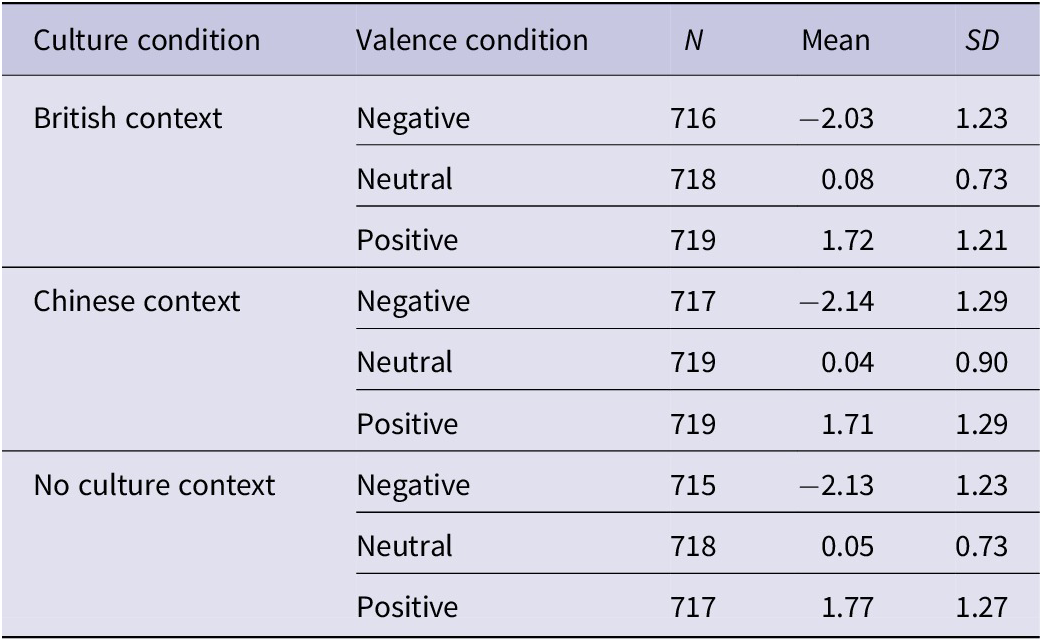
Figure 1 and Table 1 show the means of emotional valence ratings across the conditions of valence category and culture. The valence manipulation worked as intended. Regardless of culture context, negative words were rated clearly below the scale midpoint (i.e., 0), while positive words above the midpoint and neutral words very close to zero indicate an obvious separation between the three valence categories. The pattern of means was similar across British, Chinese, and no-culture contexts. However, positive words showed a slight tendency to receiving highest ratings in the no-culture context than both British and Chinese contexts. Negative words were rated marginally less negatively in the British context than in the Chinese or no-culture contexts. Still, these differences were very small compared with the larger separation between negative, neutral, and positive categories overall.
Means of emotional valence ratings across conditions.

Figure 1. Long description
A bar chart titled Valence ratings across cultural contexts. The y-axis is labeled Mean valence rating minus 3 to plus 3, with a horizontal baseline at 0. The x-axis is labeled Culture context with three categories: No Context, British Context, and Chinese Context. A legend in the bottom right identifies three Valence types: Negative (teal), Neutral (orange), and Positive (blue-gray).
* No Context: Negative bar at minus 2.13, Neutral bar at 0.05, and Positive bar at 1.77.
* British Context: Negative bar at minus 2.03, Neutral bar at 0.08, and Positive bar at 1.72.
* Chinese Context: Negative bar at minus 2.14, Neutral bar at 0.04, and Positive bar at 1.71.
Across all three cultural contexts, the ratings remain highly consistent, with negative stimuli consistently rated around minus 2, neutral stimuli near 0, and positive stimuli around 1.7.
Means and standard deviations of emotional valence ratings

Table 1. Long description
The table contains five columns: Culture condition, Valence condition, N, Mean, and S D.
British context group:
* Negative valence: N 716, Mean minus 2.03, S D 1.23.
* Neutral valence: N 718, Mean 0.08, S D 0.73.
* Positive valence: N 719, Mean 1.72, S D 1.21.
Chinese context group:
* Negative valence: N 717, Mean minus 2.14, S D 1.29.
* Neutral valence: N 719, Mean 0.04, S D 0.90.
* Positive valence: N 719, Mean 1.71, S D 1.29.
No culture context group:
* Negative valence: N 715, Mean minus 2.13, S D 1.23.
* Neutral valence: N 718, Mean 0.05, S D 0.73.
* Positive valence: N 717, Mean 1.77, S D 1.27.
3.4. LMM analyses
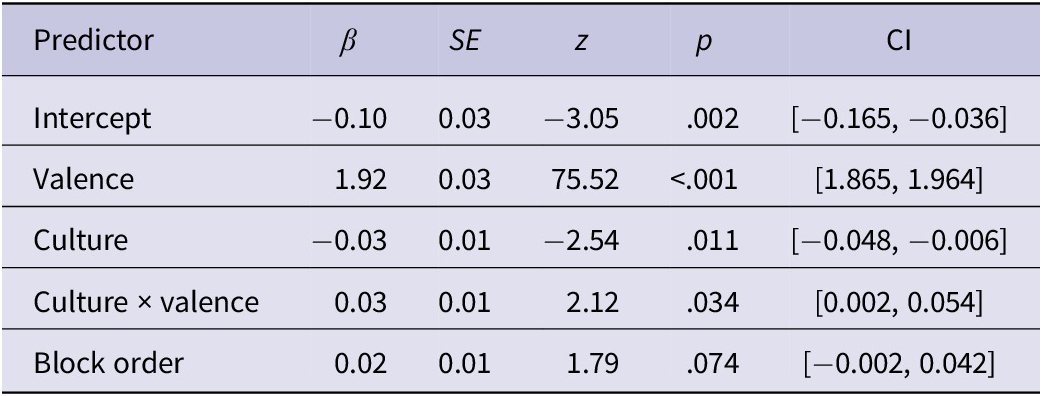
We fit a linear mixed effects model to examine any effects of Culture Context and Valence Condition on the Emotional Valence ratings. The model yielded a marginal R 2 of .658 and a conditional R 2 of .866. Thus, the fixed effects accounted for approximately 65.8% of the variance in valence ratings, whereas the combination of fixed and random effects accounted for approximately 86.6% of the variance. The fixed-effect estimates are reported in Table 2, and the planned cultural contrasts at each valence level are presented in Table 3. As shown in Table 2, the LMM results show a strong, significant effect of valence, with Emotional Valence ratings increasing systematically from negative to neutral to positive items. Most importantly, the interaction of the valence condition and culture context was significant, showing that the influence of culture context on emotional valence ratings varies across different valence categories. As confirmed by planned contrasts (Table 3), cultural differences were present only for negative and neutral words, that is, negative words were rated significantly less negatively in the British context than in the Chinese and no-culture contexts, and neutral words were rated significantly more positively in the British context than the Chinese and no-culture contexts. No cultural differences were observed for positive words.
Linear mixed effects model: predicting valence rating

Table 2. Long description
The table contains six columns: Predictor, beta (represented by the Greek letter), S E, z, p, and C I (95 percent confidence interval).
* Intercept: beta is minus 0.10, S E is 0.03, z is minus 3.05, p is .002, C I is [minus 0.165, minus 0.036].
* Valence: beta is 1.92, S E is 0.03, z is 75.52, p is less than .001, C I is [1.865, 1.964].
* Culture: beta is minus 0.03, S E is 0.01, z is minus 2.54, p is .011, C I is [minus 0.048, minus 0.006].
* Culture times valence: beta is 0.03, S E is 0.01, z is 2.12, p is .034, C I is [0.002, 0.054].
* Block order: beta is 0.02, S E is 0.01, z is 1.79, p is .074, C I is [minus 0.002, 0.042].
Note: Valence and culture were dummy coded and mean-centred. For valence, minus 1 is negative, 0 is neutral, and plus 1 is positive. For culture, minus 1 is British context, 0 is no context, and plus 1 is Chinese context.
Note: CI = 95% confidence interval. Valence and culture were dummy coded and mean-centred before analysis. For valence, −1 = negative, 0 = neutral, +1 = positive. For culture, −1 = British context, 0 = no context, +1 = Chinese context. Block order refers to the order in which participants completed the three cultural blocks (coded as 1, 2, 3 based on presentation sequence) and was also mean-centred.
Planned contrasts for cultural differences at each valence level

Table 3. Long description
A table with six columns: Valence condition, Contrast, beta, S E, z, and p.
* Negative Valence Condition:
- Chinese vs. British: beta minus 0.11, S E 0.03, z minus 3.25, p .001.
- Chinese vs. No context: beta minus 0.06, S E 0.02, z minus 3.25, p .001.
- British vs. No context: beta 0.06, S E 0.02, z 3.25, p .001.
* Neutral Valence Condition:
- Chinese vs. British: beta minus 0.06, S E 0.02, z minus 2.54, p .011.
- Chinese vs. No context: beta minus 0.03, S E 0.01, z minus 2.54, p .011.
- British vs. No context: beta 0.03, S E 0.01, z 2.54, p .011.
* Positive Valence Condition:
- Chinese vs. British: beta 0.00, S E 0.03, z 0.04, p .970.
- Chinese vs. No-culture: beta 0.00, S E 0.02, z 0.04, p .970.
- British vs. No context: beta minus 0.00, S E 0.02, z minus 0.04, p .970.
A note at the bottom states C I equals 95 percent confidence interval.
Note: CI = 95% confidence interval.
To examine participants’ evaluations of the two cultural contexts, we conducted a follow-up survey using five ranging from −3 to +3. The items assessed whether participants perceived each culture as negative–positive, unpleasant–pleasant, unfavourable–favourable, distant–close, and uncomfortable–comfortable. The five items showed good internal consistency for both British culture, Cronbach’s α = .90, and Chinese culture, Cronbach’s α = .84, and were, therefore, averaged to create separate composite scores.
Participants evaluated both cultures positively. The British-culture composite was significantly above the neutral midpoint of zero, M = 0.54, SD = 1.06, 95% CI [0.02, 1.07], t(17) = 2.17, p = .044, dz = 0.51. The Chinese-culture composite was also significantly above zero, M = 1.20, SD = 0.86, 95% CI [0.77, 1.63], t(17) = 5.94, p < .001, dz = 1.40. A paired-samples t-test further showed that participants evaluated Chinese culture more positively than British culture, mean difference = 0.66, 95% CI [0.10, 1.21], t(17) = 2.48, p = .024, dz = 0.58.
3.4.1. Follow-up survey results
Eighteen of the 24 participants with valid Study 2 data completed the follow-up survey. The five semantic-differential items showed good internal consistency for both British culture, Cronbach’s α = .90, and Chinese culture, Cronbach’s α = .84, and were therefore averaged to form separate composite scores.
Participants evaluated both cultural contexts positively. The British-culture composite was significantly above the neutral midpoint of zero, M = 0.54, SD = 1.06, 95% CI [0.02, 1.07], t(17) = 2.17, p = .044, dz = 0.51. The Chinese-culture composite was also significantly above zero, M = 1.20, SD = 0.86, 95% CI [0.77, 1.63], t(17) = 5.94, p < .001, dz = 1.40. A paired-samples t-test further showed that participants evaluated Chinese culture more positively than British culture, mean difference = 0.66, 95% CI [0.10, 1.21], t(17) = 2.48, p = .024, dz = 0.58.
3.5. Discussion
The present results confirm the validity of our experimental manipulation: participants successfully distinguished between emotional categories, rating positive words as significantly more positive than neutral words, and negative words as significantly more negative. This main effect of valence indicates that, despite their status as late bilinguals, participants accessed the fundamental semantic prosody of L2 emotive concepts. Unexpectedly, however, a main effect of culture was also observed. Specifically, priming with British (L2) culture led to generally higher (i.e., more positive) ratings. We, therefore, suggest that our participants may hold a slight positivity bias towards British (L2) culture, potentially viewing the L2 context through a more idealistic or optimistic lens.
Most importantly, the significant interaction between valence and culture only partially supports our initial hypotheses. We predicted that priming, particularly with the Chinese (L1) culture, would polarise ratings for all emotive words. However, the results reveal that this modulation was asymmetrical. For negative words, Chinese (native) context led to more negative ratings compared to the no-culture context baseline as well as compared to the British (L2) context, suggesting that native cultural cues can make L2 aversive concepts feel more intense. In contrast, positive words showed no significant modulation based on cultural context. This null result for positive items may be due to differences in arousal intensity; positive words often tend to be less distinct or lower in arousal than negative words (which signal threat). As such, the influence of cultural context may have been too subtle to significantly shift the explicit ratings for these positive L2 items, whereas the “survival value” of negative items made them more susceptible to cultural framing.
A limitation concerns the validation of the cultural activation procedure. The open-ended prompts were not independently validated in a pilot study, and no direct manipulation check of cultural-schema accessibility was included. The significant cultural-context effect observed for negative words provides indirect evidence against a complete failure of the manipulation because positive, negative, and neutral words were rated following the same cultural activation procedure. Nevertheless, this result does not establish the strength or consistency of cultural-schema activation. Consequently, the absence of cultural modulation for positive words cannot be attributed conclusively either to genuine valence-specific stability or to insufficient activation. Future studies should include an independently validated priming procedure and a direct manipulation check.
4. General discussion
The present research adopted a multi-methodological approach to investigating the interplay between culture relatedness and processing of emotive content in late Mandarin-English bilinguals. Grounded in theories of dynamic constructivism and the “emotional distance” hypothesis, we aimed to determine whether activating a native (Chinese) versus a second (British) cultural context would modulate affective responses to L2 English words. By employing both an implicit measure (IAT; Study 1) and an explicit measure (Subjective Ratings; Study 2), we sought to disentangle the automatic versus conscious layers of this relationship.
4.1. Implicit versus explicit cultural-emotional links
The results from Study 1 (IAT) revealed no significant implicit bias associating Chinese or British culture specifically with positive or negative valence. The distribution of D-scores was centred near zero, suggesting that, at an automatic level, these highly proficient bilinguals immersed in the United Kingdom did not harbour strong, accessible associations linking their native culture to “good” (positive valence) or their host culture to “bad” (negative valence), or vice versa. This null finding may reflect the ongoing negotiation between cultural frames experienced by bilinguals living in an L2 environment. Extended immersion might lead to a reallocation of implicit emotional links, resulting in a balanced implicit stance where neither culture is automatically tagged with a distinct valence.
In contrast, Study 2 (explicit valence ratings) demonstrated that, when participants consciously engaged with cultural contexts, clear patterns of emotional modulation emerged. This divergence suggests that, while implicit culture-emotion links may be attenuated by acculturation or require stronger primes to manifest, the network of accessible knowledge structures described by Hong et al. (Reference Hong, Morris, Chiu and Benet-Martinez2000) remains highly active during explicit processing. When bilinguals consciously contextualise L2 words within a specific culture, that context significantly alters their emotional perception, particularly for negative stimuli.
4.2. Cultural modulation of negative valence
The most critical finding of this research lies in the significant Culture × Valence interaction observed in Study 2. Specifically, cultural context modulated the intensity of negative words, confirming the hypothesis that native culture enhances emotional grounding.
When rated in a Chinese cultural context, negative English words received more negative ratings than in the British cultural context. This pattern is consistent with the proposal that native-culture cues can increase access to autobiographical, social, or affective knowledge associated with early cultural experience (Pavlenko, Reference Pavlenko2008). Importantly, however, the present rating task measured participants’ subjective evaluation of emotional valence and does not establish whether this contextual effect involved greater sensorimotor or bodily activation.
Conversely, when rated in a British (L2) culture context, negative words were perceived as less negative. This finding supports the “emotional distance” hypothesis, which posits that L2 concepts are often experienced as emotionally attenuated (Pavlenko, Reference Pavlenko2012). Literature on L2 emotional engagement suggests that speakers often feel less negative emotion in their L2, and our results extend this by suggesting that the cultural context of the L2 contributes actively to this buffering effect. In the British context, the emotional distance in the L2 appears to be reinforced, allowing bilinguals to process negative concepts with greater emotional neutrality. This aligns with findings by Wu and Thierry (Reference Wu and Thierry2012), who observed reduced negative emotionality in L2 processing. It is possible that for these bilinguals, the L2 cultural context acts as a psychological shield, dampening the impact of aversive concepts.
4.3. The stability of positive valence
Interestingly, and in contrast to the modulation observed for negative items, positive words showed no significant variation across cultural contexts. This stability may reflect differences in the conceptual organisation of positive and negative affect. Positive concepts tend to be more conceptually similar and densely clustered in semantic space (Unkelbach et al., Reference Unkelbach, Fiedler, Bayer, Stegmüller and Danner2008), and positive meanings may also be more consistently accessible across languages and cultures (Dodds et al., Reference Dodds, Clark, Desu, Frank, Reagan, Williams, Mitchell, Harris, Kloumann, Bagrow, Megerdoomian, McMahon, Tivnan and Danforth2015). Negative concepts, by contrast, are often more differentiated and contextually specific (Rozin & Royzman, Reference Rozin and Royzman2001), leaving greater scope for cultural knowledge, social norms, and autobiographical experience to shape their interpretation (see also Jackson et al., Reference Jackson, Watts, Henry, List, Forkel, Mucha, Greenhill, Gray and Lindquist2019). Cultural context may, therefore, have had less influence on positive words because their affective meanings were already relatively stable across the three rating conditions.
Our follow-up survey provides additional support for this interpretation. Participants evaluated both Chinese and British cultures positively, although their evaluations of Chinese culture were significantly more positive. At the same time, perceived closeness to British culture was relatively low, suggesting that favourable evaluation of the host culture did not necessarily imply an equally strong sense of cultural identification. This distinction is important: participants could hold generally positive attitudes towards both cultural contexts even when they felt more personally connected to their heritage culture. Such broadly positive cultural evaluations may have promoted a relatively consistent interpretation of positive lexical content across contexts, whereas the stronger identification and autobiographical relevance associated with Chinese culture may have had a greater impact on the processing of negative or aversive material.
This pattern is also compatible with the possibility that L2 speakers develop favourable evaluations of the host culture as part of adaptation to the L2 environment and the reduction of social distance (Schumann, Reference Schumann1986). However, the present findings suggest that such positive evaluations do not necessarily translate into equivalent cultural closeness or identical emotional responses across valence categories. Rather, positive lexical content appeared comparatively resistant to shifts in cultural context, while negative content remained more sensitive to culturally grounded meaning.
Although we initially hypothesised that native-cultural activation would intensify responses to emotional words more generally, the restriction of the effect to negative words suggests that affective grounding may be particularly important for threat-related or aversive content. Negative information is often more attentionally salient and consequential for behaviour than positive information (Baumeister et al., Reference Baumeister, Bratslavsky, Finkenauer and Vohs2001; Pratto & John, Reference Pratto and John1991; Taylor, Reference Taylor1991). Native-cultural cues may, therefore, exert their strongest influence when emotional meaning depends on culturally embedded experiences, norms, or memories, whereas positive meanings may remain more stable across contextual shifts.
4.4. Methodological considerations
We also observed a statistically significant, although small, cultural-context difference for neutral words that was in the same direction as the pattern observed for negative words. Neutral words were rated slightly more positively in the British context than in the Chinese context, β = −0.06, SE = 0.02, z = −2.54, p = .011. The magnitude of this unstandardised contrast estimate was numerically smaller than that observed for negative words, β = −0.11, SE = 0.03, z = −3.25, p = .001, although the difference between these two coefficients was not formally tested. One possible interpretation is that the British cultural context produced a modest upward shift in response calibration for stimuli located near the neutral midpoint. However, given the small magnitude of the difference, this interpretation should remain tentative.
Block position was not a statistically reliable predictor of valence ratings, β = 0.02, SE = 0.01, z = 1.79, p = .074. This result provides no clear evidence that the observed rating pattern was attributable to a simple linear block-position effect. Nevertheless, the non-significant result does not rule out all possible fatigue or sequence effects and should not be regarded as an independent validation of the cultural activation procedure.
4.5. Conclusions
In conclusion, this research highlights that culture is not a passive backdrop but an active modulator of emotional meaning for bilinguals. By isolating cultural context from linguistic proficiency, we demonstrated that the emotional distance often observed in the L2 is not fixed; rather, it is dynamic. The L1 cultural context has the power to restore emotional intensity to L2 words. Conversely, the L2 cultural context appears to enforce emotional distance, dampening the impact of negativity. These findings underscore the necessity of integrating cultural variables into psycholinguistic models of bilingual emotion.
Data availability statement
The data that support the findings will be available in OSF at https://osf.io/fj7he and https://osf.io/gmhuk following a 6-month embargo from the date of publication to allow for commercialisation of research findings.
Conflict of interest
The author reports no conflict of interest.



 Open access

