Recent studies on L1 attrition have shown that in a bilingual situation, properties of the dominant L2 that differ from the L1 can affect various aspects of the L1 in theoretically interesting ways (Major, Reference Major1992; Bouba Filiaci, Heycock, Sorace and Tsimpli, Reference Bouba, Filiaci, Heycock, Sorace and Tsimpli2002; Gürel, Reference Gürel2002, Reference Gürel2004; Köpke, Reference Köpke and Fabbro2002; Schmid, Reference Schmid2002; Tsimpli, Sorace, Heycock and Filiaci, Reference Tsimpli, Sorace, Heycock and Filiaci2004). For the purposes of this paper, we follow Silva-Corvalán's (Reference Silva-Corvalán1994) characterization of L1 attrition as loss of features of L1 after L1 has been acquired completely and remained stable for a while. Given this characterization, L1 attrition should best be investigated among adult speakers who have acquired and received schooling in L1 and subsequently go on to acquire a second language upon immigrating to an L2-speaking country. While such late bilingual speakers rarely become near-native speakers of L2, their L1 may nevertheless be affected in significant ways after a prolonged period of exposure to and extensive use of L2, showing signs of L2-induced attrition.
This is not to gainsay the value of investigations of early bilinguals in research on language attrition. Early bilinguals can also contribute to such research, though in a different way than late bilinguals. The linguistic profile of early bilinguals is similar to that of typical L1 attriters in that they are usually exposed to the family language as their L1 (perhaps simultaneously with the L2/community language). However, unlike adult L1 attriters, early bilingual children begin to acquire the community language before their family language is fully established. As a result, and depending on variations in the L1 input they receive as children, their knowledge of L1 may turn out to be incomplete when they become adults. Therefore, early bilinguals are usually treated as exhibiting incomplete L1 acquisition (Montrul, Reference Montrul2002) and are referred to as “incomplete L1 learners” (Polinsky, Reference Polinsky, Browne, Dornisch, Kondrashova and Zec1997). Nevertheless, just like studies of L1 attrition, studies of incomplete L1 learners have revealed that the grammar of the weaker language is influenced by properties of the dominant language (Silva-Corvalán, Reference Silva-Corvalán1994; Polinsky, Reference Polinsky, Browne, Dornisch, Kondrashova and Zec1997; Montrul, Reference Montrul2002, Reference Montrul, Köpke, Schmid, Keijzer and Weilemar2004; Kim and Montrul, Reference Kim and Montrul2004a).
The present article has two related goals. First, the magnitude of dominant language transfer and first language loss will be estimated in early and late bilinguals, who differ in terms of the onset of bilingualism and the extent of exposure to the majority language (attrition in late bilinguals vs. attrition or incomplete acquisition in early bilinguals). Second, we will investigate whether dominant language effects in incomplete L1 acquisition are similar to those typically observed in adult L2 acquisition. By its very nature, the developing L2 in bilinguals is also an incomplete grammatical system, which in many cases fossilizes. The question therefore is whether incomplete L1 and L2 acquisition look alike when the dominant language is the same.
In particular, we will investigate how knowledge of English influences interpretations of anaphor binding in Korean. To address this question, two groups of Korean–English bilinguals residing in an English-speaking environment who differ in their age of exposure to English will be compared. The main goal is to tease apart the effects of L1 attrition and incomplete acquisition of L1 by testing both early and late bilinguals. To investigate differences between incomplete L1 acquisition and incomplete L2 acquisition, a group of English-speaking learners of Korean as a second language is also included. All three groups are compared with a control group of monolingual Koreans residing in Korea. The linguistic focus of our study is the interpretation of the Korean anaphor caki, which is licensed in structural configurations that differ from English core binding.
1. Binding Theory
1.1 Binding Theory and Long-Distance Anaphors
Standard Binding Theory (Chomsky, Reference Chomsky1981, Reference Chomsky1986) hypothesizes that anaphors (reflexives like himself) and pronominals (pronouns like he/him) are in complementary distribution. That is, while anaphors must be bound within a local domain known as the Governing Category (GC) by Principle A of the Binding Theory (BT), as shown in (1a, b), pronominals are required to be free within the GC by Principle B, as shown in (1c, d).
- (1)
a. [GC Johni is in love with himselfi].
b. *Johni said that [GC himselfi was in love with Mary].
c. Johni said that [GC hei/j was in love with Mary].
d. *[GC Johni is in love with himi].
At least in the earliest incarnations, the GC for BT was assumed to be invariant across languages. However, this assumption is immediately counter-exemplified by languages like Korean (see (2b)) and Chinese (see (2c)), which have anaphors that take antecedents outside the constituent that functions as the GC in English.Footnote 1
(2)


An initial attempt to address this problem proposed to parameterize the size of GCs across languages (Yang, Reference Yang1983; Manzini and Wexler, Reference Manzini and Wexler1987). In this line of research, languages with Long-Distance Anaphors (LDAs) differ from those without LDAs in the size of the GC. For example, the GC in English is defined by the conjunction of the two Opacity Conditions proposed in Chomsky (Reference Chomsky1980) – the Tensed S Condition (TSC) and the Specified Subject Condition (SSC). By contrast, the GC in languages like Korean (and Chinese) with LDAs is the root clause (Yang, Reference Yang1983). A subsequent attempt tried to locate the differences between languages with and without LDAs not in the parameterized size of the GC, but in whether an anaphor satisfies the BT at S-structure or after LF Head Movement (Cole, Hermon and Sung, Reference Cole, Hermon and Sung1990).
1.2 Core versus Exempt Binding and Long-Distance Anaphors
A problem both of these approaches face is that while they predict the complete absence of long-distance bound anaphors in languages like English, there are in fact apparent cases of LD-bound anaphors (as well as unbound anaphors) in languages like English. The relevant data are shown in (3a, b).
- (3)
a. Bill remembered that the Times had printed [a picture of himself] in its Sunday edition.
b. Physicists like yourself are a godsend.
(Reuland and Everaert, Reference Reuland, Everaert, Baltin and Collins2001, pp. 642–643)
Responding to facts such as these, Pollard and Sag (Reference Pollard and Sag1992), Reinhart and Reuland (Reference Reinhart and Reuland1993) (see also Cole, Hermon and Huang, 2001a; Huang and Liu, Reference Huang and Liu2001) tried to account for apparent LD-binding of anaphors in languages deemed to possess only local anaphors by positing a distinction between core (or grammatical) anaphors and exempt anaphors (equivalently, logophors). According to this line of analysis, syntactic binding theory constrains only core anaphors, while exempt anaphors are licensed by extra-grammatical mechanisms. This is the theoretical approach to anaphor binding we adopt in this paper.
This approach raises an important question: how do we know that a given anaphor is exempt? This question is particularly pertinent since we know of no languages that have dedicated forms of exempt anaphors. The same item serves double duty as core and exempt anaphor in language after language. Pollard and Sag (Reference Pollard and Sag1992) answer this question by proposing that core and exempt anaphors are in complementary distribution. Specifically, in their analysis, an anaphor is exempt when it occurs in a context without a minimal Subject (or superior co-argument). Otherwise, it is a core anaphor. For instance, the anaphor himself in (3a) above is an exempt anaphor by this reasoning, since there is no potential antecedent within the minimal DP that contains the anaphor. By contrast, the anaphor in (4) below is a core anaphor, and behaves as such as seen by the impossibility of LD-binding.Footnote 2
(4) Bill remembered that The Times had printed Mary's picture of herself/*?himself in its Sunday edition.
More generally, exempt anaphors and core anaphors can be distinguished by the following properties:
- (5)
a. Exempt anaphors may be long-distance bound.
b. Exempt anaphors may be unbound (or discourse-bound).
c. Exempt anaphors do not need c-commanding antecedents.
d. Exempt anaphors do not show a preference for sloppy readings in VP ellipsis/VP proform contexts.
These properties can be illustrated with English exempt anaphors. First, as we saw in the contrast between (3a) and (4) above, English allows exempt anaphors to be bound long-distance. Exempt anaphors are also fine as unbound or discourse-bound anaphors, as shown in (3b) above. In addition, c-command, which is required in core binding, is not necessary between exempt anaphors and their antecedents. By contrast, anaphors that cannot be construed as exempt (in virtue of the presence of a locally commanding subject/specifier in the minimal CFC) cannot be licensed in similar contexts. This is seen in the contrast between (6a) and (6b) below.
- (6)
a. [Incriminating pictures of himselfi published in The Times] have all but eliminated Johni’s chances of being promoted.
b. *[Mary's pictures of himselfi published in The Times] have all but eliminated Johni’s chances of being promoted.
Finally, the preference for strict versus sloppy reading in contexts of VP ellipsis/VP proforms can also help to differentiate core from exempt anaphors (Cole et al., 2001a; Runner, Sussman and Tanenhaus, Reference Runner, Sussman, Tanenhaus, Mikkelsen and Potts2002; Ying Reference Ying2005). Unless an explicit context favoring the strict readingFootnote 3 is given (say, if the sentence is followed by Bill and John are best friends), the elliptical VP in (7) is interpreted sloppily, that is, as meaning that Bill too defended himself (= Bill) against the committee's accusations.
(7) John defended himself against the committee's accusations. Bill did so too.
However, even in the absence of a favoring context, speakers assign a strict interpretation to the missing VP in (8a). Similarly, in (8b), a strict reading is more likely than the sloppy reading. It is the sloppy reading that requires a specific context.
- (8)
a. Johni thinks that Susan and himselfi are to blame for the accident.
Billj does so too. (= Bill thinks that Susan and himselfi(strict)/j(sloppy) are to blame . . .)
b. Johni thinks that an article written by himselfi caused the uproar.
Billj does so too. (= Bill thinks that an article written by himselfi(strict)/j(sloppy) caused the uproar.)
Assuming this to reflect a general pattern, we can use the lack of preference for strict readings in VP ellipsis/VP proform contexts as another diagnostic for exempt anaphors.
While exempt anaphors escape the strictures of syntactic conditions that constrain core anaphors, their licensing is nevertheless subject to discourse-pragmatic conditions. Conditions that fall under the rubric of logophoricity (Sells, Reference Sells1987; Huang and Liu, Reference Huang and Liu2001) are relevant in the licensing of exempt anaphors. Thus, antecedents of exempt anaphors are optimal if they are logophoric centers.Footnote 4
The contrast shown below can be understood in this light. The structural distance between antecedent and anaphor as well as their relative configurations (lack of c-command) are identical in the sentences and yet there are subtle degrees of contrast.
- (9)
a. [Incriminating pictures of himself published in the Times] have been worrying John for some time.
b. [Incriminating pictures of himself published in the Times] have all but eliminated John's chances of being promoted.
c. *?[Incriminating pictures of himself published in the Times] accidentally fell on John's head.
The judgments reflect the ease with which John can be identified as a logophoric antecedent of the anaphor. In (9a), John is a SELF, in the terminology of Sells (Reference Sells1987).Footnote 5 As SELF, it is also a PIVOT.Footnote 6 In (9b) and (9c) it can only be a PIVOT. And (9b) is better than (9c) because it is easier to construe this sentence as being reported from the point of view of John.
1.3 Core versus Exempt Binding and the Parameterization of Governing Category across Languages
Since the ability to take long-distance antecedents is one of the properties of exempt anaphors, it is conceivable that LDAs are always exempt anaphors. If that were the case, there would be no need to parameterize the size of GC across different languages – if we understand GC as the domain where core, not exempt, anaphors are bound. In a careful empirical investigation of the Mandarin LDA ziji, Huang and Liu (Reference Huang and Liu2001) come to this conclusion. Ziji as a core anaphor is bound in the same GC as English core anaphors, while LD-bound ziji displays the hallmarks of exempt anaphors.
There are, however, reasons to revisit this conclusion. The first reason is that it is far from clear whether LDAs in all other languages display the signature properties of exempt anaphors/logophors. If some LDAs cannot be classified as exempt anaphors, then we must countenance the possibility that they are core anaphors with a larger GC than their counterparts in languages like English (or Chinese, according to the analysis of Huang and Liu, Reference Huang and Liu2001). Indeed, whether or not all instances of LD-bound ziji behave as exempt anaphors/logophors is a matter of debate. Pollard and Xue (Reference Pollard and Xue2001) claim that there are instances of LD-bound ziji that do not require logophoric conditions to be licensed. In other words, ziji as a core anaphor can occur in a GC that is larger than the English GC.
Secondly, even if we grant that LD-bound ziji and other LDAs are exempt anaphors, Huang and Liu's (Reference Huang and Liu2001) contention that the GC for core binding in all languages is invariant cannot be maintained. This is so for the following reason. As long noted in the literature, the GC for core anaphors in English is defined by the conjunction of two Opacity Conditions (Chomsky, Reference Chomsky, Anderson and Kiparsky1973) – the Specified Subject Condition (SSC) and the Tensed S Condition (TSC). However, in languages like Chinese, the TSC is ineffective in defining the GC for core anaphors, as we shall see below. Therefore, we cannot claim that there is no parameterization of GC for core anaphors across languages. GC size for core anaphors must still be parameterized, though to a lesser extent than suggested by approaches such as Yang's (Reference Yang1983).
To summarize, we adopt a theoretical distinction between core and exempt anaphors. Since one of the properties of exempt binding is LD-binding, this perspective opens up the possibility that most cases of LD-binding may involve exempt anaphors, which in turn leads to the possibility that the domain of core binding for anaphors (= GC) may not vary across languages. While being somewhat agnostic as to whether all LDAs can be viewed as exempt anaphors, we noted that even under such a scenario, a limited parameterization of the GC for core binding must be countenanced. With this background, we now turn to a detailed investigation of the differences in anaphor binding between English and Korean.
2. Differences in Binding Theory: English vs. Korean
2.1 Differences in Governing Category for Core Anaphors
As stated earlier, English and Korean differ in the size of GC for core anaphors. We will assume that all anaphors bound across an intervening subject (SSC violations) are exempt anaphors in Korean (and Chinese). SSC also defines the GC for core anaphors in English. However, we take anaphors bound outside the minimal finite clause (TSC violations) but not across an intervening subject to be core anaphors in Korean, unlike English, where TSC-violating anaphors behave as exempt anaphors. In other words, we propose the following differences in the size of GC for core binding in English and Korean:
(10) GC for Core Binding
a. English: defined by SSC and TSC
b. Korean: defined by SSC
We now proceed to show that the proposal in (10) is supported. We noted earlier, following Cole et al. (2001a) (see also Runner et al., Reference Runner, Sussman, Tanenhaus, Mikkelsen and Potts2002; Ying, Reference Ying2005), that core anaphors display a strong preference for sloppy readings in VP ellipsis/VP proform contexts, while exempt anaphors do not.
As noted earlier (cf. (8) above) and as we see below, when an anaphor is bound within the GC in English, the sloppy reading is predominant (cf. (11a)). By contrast, when the anaphor is bound outside the GC as an exempt anaphor, the strict reading seems to be preferred (cf. (11b)).Footnote 7
(11)
We made the claim in (10) that English core anaphors cannot violate TSC. However, TSC-violating anaphors in English can be licensed as exempt anaphors under appropriate discourse conditions, as shown in (12b). Anaphors cannot violate the TSC when they are Subjects, but when they are contained within a Subject, TSC-violating anaphors can become acceptable (Chomsky, Reference Chomsky1981). When we place such sentences in the context of VP ellipsis, the strict reading becomes more salient.
- (12)
a. *Johni thinks that himselfi is clever. (*TSC: core binding violation)
b. Johni thinks that no one but himselfi is to blame. (TSC violation licensed as exempt anaphor)
So does Billj.
(=Bill thinks that no one but John (>Bill) is to blame: strict reading)
However, as predicted, an anaphor bound in violation of SSC (and/or TSC) displays a preference for the strict reading, as shown in (13) below.
(13) John remembered that the Times had printed [a picture of himself] in its Sunday edition. (SSC violation)
So does Billj.
(=Bill remembered that the Times had printed a picture of John (>Bill): strict reading)
We take these results to support our hypothesis (cf. (10)) that in English anaphors that violate TSC and/or SSC are exempt anaphors.
When we turn to Korean, the results are different. An anaphor that violates only TSC does not display a preference for the strict reading in contexts of VP ellipsis,Footnote 8 as shown in (14).
(14)
By contrast, when an anaphor is bound in violation of SSC and TSC, the strict reading becomes much more salient, as shown below in (15).
(15)
We take these results to mean that TSC is ineffective in defining the GC for core anaphors in Korean. What defines the GC for core anaphors in Korean is only SSC.
In sum, the first difference between Korean and English with respect to core binding is related to the factors that determine the size of GC: TSC is ineffective in defining the GC for core binding in Korean while it is relevant in English. SSC is relevant in both languages.
2.2 Different structural conditions on antecedents
In addition to the difference in the size of GC for core binding, there is another difference between Korean and Chinese on the one hand and English on the other. In English, antecedents of core anaphors must strictly c-command the anaphors, as shown in (16a). However, in Korean and Chinese, in configurations called “sub-command” (Tang, Reference Tang1989), the antecedent, which is the possessor of an inanimate noun which c-commands the anaphor, can bind the anaphor that it does not c-command, as shown in (16b). The definition of sub-command is given in (17).Footnote 9
(16)
(17) A constituent A sub-commands B when a larger constituent that contains A c-commands B and features of the containing constituent are not identical to A.
When the c-commanding Noun is animate, binding fails, because sub-command does not obtain. This is shown in (18).
(18)
An anaphor with a locally accessible sub-commanding antecedent in Korean and Chinese behaves as a core anaphor under the VP Ellipsis test, as we see below (cf. Huang and Liu, Reference Huang and Liu2001):
(19)
In this section, we argued that there are two differences between English and Korean in anaphor binding. The first difference has to do with the determination of GC for core anaphors. While SSC defines the core GC for both, TSC is inoperative in defining the core GC in Korean. The second difference has to do with configurations of binding. Sub-commanding antecedents (of core anaphors) are possible in Korean while they are ruled out in English. In the next section, we turn to a review of the previous studies conducted on attrition and incomplete acquisition of binding.
3. Attrition and incomplete acquisition of binding
The acquisition of binding has received significant attention within generative approaches to L2 acquisition, but to date there are very few studies that have looked at L1 attrition and incomplete acquisition of anaphor binding from a generative perspective.
One of the main issues in L2 binding acquisition research addressed in several studies has been whether binding properties in L2 grammars are UG-constrained in the same way as L1 grammars are, or whether they are random or “wild” by contrast (Thomas, Reference Thomas1995, Reference Thomas, Flynn, Martohardjono and O'Neil1997; White, Hirakawa and Kawasaki, Reference White, Hirakawa and Kawasaki1996; Hamilton, Reference Hamilton1997; Christie and Lantolf, Reference Christie, Lantolf, Flynn, Martohardjono and O'Neil1998; Yuan, Reference Yuan1998). A related issue is whether parametric variations in L1 grammar can have an impact on L2 grammars (White, Reference White1989; Hirakawa, Reference Hirakawa1990; Thomas Reference Thomas1995, Reference Thomas, Flynn, Martohardjono and O'Neil1997; Kim and Montrul, Reference Kim and Montrul2004b; Kim, Montrul and Yoon, Reference Kim, Montrul and Yoon2004, Reference Kim, Montrul, Yoon, Brugos, Clark-Cotton and Ha2005). That is, when L2 binding properties are different from those of L1 grammars, transfer effects are usually shown in L2 acquisition. For example, L2 learners whose L1 has LDAs have been shown to accept ungrammatical sentences in English where the anaphor himself/herself is LD-bound (Hirakawa, Reference Hirakawa1990, and others). Similarly, studies testing the acquisition of L2s with LDAs have shown that learners whose L1 has only local anaphors have difficulty accepting LDAs in L2, preferring a local interpretation instead (Hirakawa, Reference Hirakawa1990; Thomas, Reference Thomas1995, Reference Thomas, Flynn, Martohardjono and O'Neil1997; White et al. Reference White, Hirakawa and Kawasaki1996; Yuan, Reference Yuan1998; Kim and Montrul, Reference Kim and Montrul2004b).
Binding interpretations that fall under Principle B are also affected in an L1 loss situation. Gürel (Reference Gürel2002, Reference Gürel2004) tested adult Turkish L1 speakers residing in an English-speaking country for an extended period of time, and found that there is cross-linguistic transfer in Principle B from English onto Turkish. She proposed that L1 attrition could affect the domain of syntax to some extent, under extensive L2 input and limited L1 input. Interestingly, a recent study testing the opposite – the potential attrition of binding in English speakers who have been living in Turkey for a long time – failed to show similar results (Gürel, Reference Gürel2007).
Along with cases of L1 attrition, the cross-linguistic transfer effect in the interpretations of Binding Principles has also been discovered in child attrition and incomplete L1 acquisition. Song, O'Grady, Cho and Lee (Reference Song, O'Grady, Cho, Lee and Kim1997) tested knowledge of the Korean reflexive pronouns caki and caki-casin in sixteen 6–14-year-old Korean bilingual children attending Korean community school in the United States.
Only three of the 16 children knew the meaning of the Korean reflexives. Studies by Kim and Montrul (Reference Kim and Montrul2004a) and Kim et al. (Reference Kim, Montrul and Yoon2004, Reference Kim, Montrul, Yoon, Brugos, Clark-Cotton and Ha2005) on adult early Korean–English bilinguals born in the U.S. and exposed to both languages since birth found that the binding interpretations of long-distance Korean anaphors were affected by the syntactic constraints on English binding, since their dominant language (English) is a language with only local anaphors. Similar transfer effects from English to Korean were observed in the Korean interlanguage grammars of English-speaking L2 learners of Korean (Kim et al., Reference Kim, Montrul and Yoon2004).
The purpose of this study is to further pursue our preliminary findings from Korean L1 and L2 incomplete acquisition, and to see whether similar transfer effects from English binding interpretations to Korean anaphors also occur in potential cases of L1 attrition of Korean, as Gürel (Reference Gürel2002, Reference Gürel2004) found for Turkish. Therefore, our study investigates the influence of English, the dominant language, on Korean, the weaker language, in different types of Korean–English bilinguals: Korean–English late bilinguals (L1 attrition group), Korean–English early bilinguals (incomplete L1 acquisition group) and English-speaking L2 learners of Korean (incomplete L2 acquisition group). In particular, we investigated the interpretation of the Korean anaphor caki in cases where English and Korean differ with respect to the size of the Governing Category and structural conditions on antecedent–anaphor relations.
The research questions which motivated the present study are the following:
1. How does English influence Korean in the domain of binding interpretations of anaphors? Specifically, how do (i) differences in the size of GC for core binding, and (ii) language-specific differences in the structural conditions on the antecedent–anaphor relation affect the acquisition, maintenance and attrition of Korean binding?
2. If transfer effects are found in these domains, how do they compare across the different bilingual populations tested (L1 attrition vs. L1 and L2 incomplete acquisition)?
We hypothesize that if the weaker language in bilinguals is affected by the knowledge of the dominant language, and if the properties of the L1 affect the acquisition of the L2, Korean–English bilinguals (L1 attriters and early Korean–English bilinguals) in an English-dominant context and late L2 learners of Korean (with English L1) would show a lower degree of acceptability than monolingual Korean native speakers with sentences where the Korean anaphor caki is (i) bound outside the core GC of English, and/or (ii) bound by sub-commanding antecedents.
4. Experiment
4.1 Participants
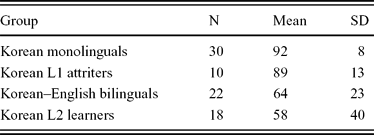
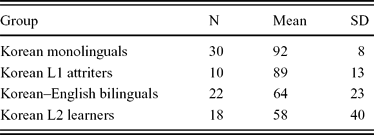
Four groups of subjects were tested – three experimental groups and one control group. The experimental groups were the Korean attrition group (late bilinguals), the incomplete L1 acquisition group (early bilinguals), and the incomplete L2 acquisition group (late bilinguals). The Korean attrition group consisted of 10 adult first generation Korean immigrants to the U.S. (mean age = 35, range: 20–38, mean age of English onset = 23.5, length of residence in the U.S.: 10+ years). The early bilingual group was composed of 22 second generation Korean–English bilinguals (mean age = 22.4, range: 20–25, mean age of Korean and English onset = since birth). The L2 group consisted of 18 adult English-speaking L2 learners of Korean residing in South Korea (mean age = 27.3, range: 20–43, mean age of Korean onset = 24.8, length of residence in Korea: 3+ years). There was a control group of 30 Korean monolinguals residing in Korea (mean age = 36, range: 25–42). All groups completed a Korean proficiency test, consisting of cloze test testing different grammatical areas such as case marking, coordination, verb forms, vocabulary, etc. The mean accuracy scores on the proficiency testFootnote 10 are displayed in Table 1.
Mean percentage accuracy on the Korean Proficiency Test.
4.2 Tasks
In (20), we present the sentence types we used to test Korean core binding. The sentences in (20a–c) involve no violation of TSC and thus are acceptable as core binding in both English and Korean, while those in (20d–e) are TSC violations where English and Korean are different.Footnote 11 A sentence with a sub-commanding antecedent is given in (20f).Footnote 12
(20)
Given the properties of the Korean anaphor caki and the binding differences between Korean and English, the predictions with the different groups of subjects regarding the six sentence types in (20) are as follows:
1. The three experimental groups (L1 attriters, L1 incomplete learners (Korean–English bilinguals), L2 incomplete learners) should show a lower degree of acceptability with sentence types 4 and 5, compared to the control group of Korean native speakers.
2. The three experimental groups should accept sentence type 6 to a lesser extent than the control group of Korean native speakers.
The main task used was a Truth Value Judgment TaskFootnote 13 with stories (Crain and Thornton, Reference Crain and Thornton1998), composed of 36 target items and 36 filler itemsFootnote 14 (six sentences for each typeFootnote 15), each of which contained a short English story followed by a Korean sentence.Footnote 16 Examples of the test items are shown in (21).
(21)
Scoring
If a participant chose a “True” response we considered the participant to have accepted the binding relation in the sentence exemplified by the story. We considered a “False” response as rejection of the binding relation in the sentence.
Subjects who did not score higher than 70% correct with the filler items were excluded from the analysis. We assumed that they did not understand the logic of the main task. (Filler items were included in the task to save time in the testing sessions and to divert attention from the main items in the task.) Using this criterion, five subjects from the incomplete Korean–English (incomplete L1 acquisition) group and four subjects from Korean L2 (incomplete L2 acquisition) group were removed from the analysis. To obtain numerical scores, “True” responses received a 1 and “False” responses were coded as 0.
Results
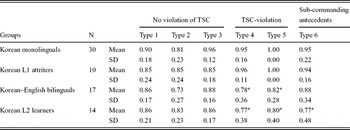
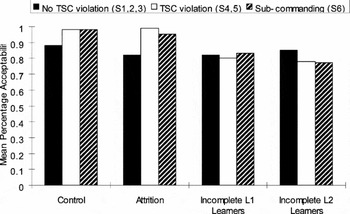
Mean scores on each sentence type (maximum six) were submitted to statistical analysis (one way ANOVA). To compare groups, a Repeated Measures ANOVA was run (alpha = .05), followed by the Scheffe post-hoc test to examine differences between groups. There was a significant main effect for sentence type (F(5, 31) = 4.024, p < .001), a significant effect by group: (F(3, 68) = 7.134, p < .000), and a sentence by group interaction (F(15, 87) = 2.235, p < .005). The between-subjects analysis indicated that there were no overall differences between the average performance of the Korean attrition group and Korean monolinguals. Table 2 shows results by each sentence type, while Figure 1 shows the sentence types averaged within the No violation of TSC and TSC-violations conditions.
Mean acceptability of the six sentence types with caki.

Note. An asterisk indicates that the numeric difference of the score of the given group compared to Korean monolinguals is statistically significant.
Mean acceptability of sentences with caki by condition.

One way ANOVAs were performed to see how groups differed from each other with each sentence type. Performance on sentence types 1, 2, and 3 (where caki is bound without violating TSC (English = Korean)) was no different between the experimental groups and the monolingual Korean group, as expected. There was a statistically significant difference between the performance of the experimental groups and the control group on S4 (sentence type 4) (F(3, 67) = 5.123, p < 0.003), S5 (F(3, 67) = 6.569, p < 0.001) and S6 (F(3, 67) = 3.027, p < 0.035). Specifically, with sentence types 4 and 5 (where caki is bound violating TSC), the early bilinguals and the L2 learners showed significantly less acceptability than the control group. Performance with S6 (where caki is bound by a sub-commanding antecedent) indicated that the late L2 group showed significantly less acceptability, compared with the monolingual controls. However, the performance of the simultaneous bilinguals (on S6) did not differ significantly from that of the control group.
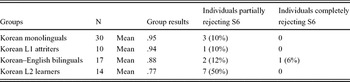
In particular, the results of a language-specific binding difference (c- vs. sub-commanding antecedents) revealed that the Korean attrition group had no problem overall with sentences with sub-commanding antecedents, accepting them just like Korean monolinguals, while differing significantly from the other two experimental groups. The L2 learners displayed a lower degree of acceptability with sentences containing sub-commanding antecedents compared to the Korean controls. Seven out of 14 subjects (50%) in this group showed indeterminate judgment with S6, by rejecting at least half of the sentences in this type, which implies the effect of L1 transfer. However, the early Korean–English bilinguals (incomplete L1 learners) did not show overall difficulty with sub-commanding antecedents, though there was some individual variation. While 14 out of 17 individuals in this group did not have problems with the sub-commanding condition for the Korean anaphor caki, the remaining three performed similarly to the incomplete L2 learners. This pattern of individual results is shown in Table 3.
Individual performance on sentence type 6 (S6; sub-commanding antecedents).

5. Discussion and conclusion
The results of our study investigating the size of the Governing Category (GC) in binding interpretations of the Korean anaphor caki showed that the Korean L1 attrition group did not have any problem with Korean core binding since these speakers were sensitive to SSC but not TSC, at least at the group level. On the other hand, early bilinguals (incomplete L1 learners) showed a lower degree of acceptability than Korean controls with Korean sentences where caki is bound outside the English GC but inside the Korean GC. This implies that the parametric property of the binding system (size of GC) of the weaker language (Korean) may be influenced by the dominant language (English) through transfer. However, along with Tsimpli et al. (Reference Tsimpli, Sorace, Heycock and Filiaci2004), we surmise that the parametric value of the weaker language is not “unset” completely, but simply affected in the aspects for which the dominant language assumes different values. Late L2 learners of Korean with English L1 also showed problems with GC size, which is also consistent with L1 transfer effects from English in the acquisition of an L2 parametric property. The results of the Korean proficiency test showed that the scores of the early Korean–English bilinguals (incomplete L1 learners) were similar to late L2 learners of Korean (incomplete L2 learners), whereas potential L1 attriters were similar to Korean monolinguals. The results of binding interpretations using a Truth Value Judgment Task showed the same pattern as the proficiency test.
An interesting question has to do with why the Korean L1 attrition group did not show the expected effect of L1 attrition.Footnote 17 We suspect that there are some sociolinguistic reasons, related to use of Korean and availability of Korean, for why this group does not exhibit a pronounced degree of L1 attrition. Korean first generation immigrants tend to live in closely knit communities (especially around churches) even in an L2-speaking environment and are willing to use their L1 if there is a choice between speaking L1 and L2. Most participants in this study lived in a Korean community where daily communication is in their L1.Footnote 18 Contact with Korean speakers was therefore not interrupted. It is possible that even after extended exposure to English, Korean is still the dominant language for this group. Therefore, the effect of L1 attrition may not be apparent in the selected population. A similar conclusion was reached by Gürel (Reference Gürel2007), who found no attrition in binding in English speakers living in Turkey. However, Schmid (Reference Schmid2007) found no correlation between L1 use and degree of attrition in German immigrants in Canada, so it is difficult to assess at this point where the role of L1 use stands in L1 attrition research. Testing more potential cases of L1 attrition, especially where there are few other Korean speakers and no Korean community, or with speakers whose command of English is close to native, might yield results that are different from the present study. This suggests that the likelihood of L1 attrition in first generation immigrants may vary with their sociolinguistic circumstances and their command of the L2. As far as second generation immigrants are concerned, on the other hand, the sociolinguistic circumstances in which they use the community language (English) much more than the family language (Korean), despite the existence of robust Korean-speaking community, are more likely lead to incomplete acquisition of their family language.
However, the pattern of results on sentences with sub-commanding antecedents showed that some of the incomplete L1 learners were like monolingual Korean speakers with that particular sentence type, whereas others were more like incomplete L2 learners. The question that arises is the source of linguistic variation in incomplete L1 learners, especially with sentences containing sub-commanding antecedents. We conjecture that sub-commanding antecedents require bilinguals’ access to the lexical property of caki (e.g. that is, caki must be bound by animate 3rd person antecedents). It is possible that once the lexical property of caki has been acquired, it is not vulnerable to loss. On the other hand, if the lexical property of caki has not been acquired by certain simultaneous bilinguals, they would face problems in sub-command cases, similar to late L2 learners. Recall that Song et al. (Reference Song, O'Grady, Cho, Lee and Kim1997) found that many Korean–English bilingual children did not know the lexical meaning of caki and caki-casin. This issue should be investigated further.
In conclusion, with respect to the first goal of this study, we were unable to show attrition effects in late bilinguals in the specific linguistic domain tested in this experiment. In addition to the particular sociolinguistic profiles of the speakers, there are two additional reasons that may explain this finding. One is that the particular type of grammatical knowledge tested (Korean core binding) is something that may not be vulnerable to attrition. The other reason is methodological, and has to do, perhaps, with the small sample size (N = 10) of our attrition group. However, despite the small number of subjects, there was little individual variation within this group. In future work we would like to include a larger sample of potential L1 attriters who are isolated from L1 input and community.
Our study showed that the magnitude of language loss as estimated from transfer from English is more severe in early bilinguals (incomplete L1 learners) than in late bilinguals (L1 attriters). This discrepancy in extent (and possibly in nature as well) between child and adult L1 loss may be indicative of different mechanisms responsible for attrition according to age of onset of bilingualism.
With respect to the second goal of our study, we were able to establish that incomplete L1 acquisition and incomplete L2 acquisition share similarities. We showed that incomplete L1 and L2 Korean grammars are affected by English, the dominant language in the bilinguals tested, in structural domains that differ between the two languages. This suggests that transfer effects can be bidirectional in bilingualism (Cook, Reference Cook2003).