Introduction
One of the most remarkable abilities of bilinguals is controlling the two languages they have acquired, which enables them to avoid interference from another language when using one language and flexibly switch between two languages (Abutalebi, Annoni, Zimine, Pegna, Seghier, Lee-Jahnke, Lazeyras, Cappa & Khateb, Reference Abutalebi, Annoni, Zimine, Pegna, Seghier, Lee-Jahnke, Lazeyras, Cappa and Khateb2008). There is an ongoing debate on whether language control involves domain-general cognitive control, a multidimensional construct of higher-level cognitive processes responsible for controlling and regulating thoughts and actions to achieve a goal (Miyake, Friedman, Emerson, Witzki, Howerter & Wager, Reference Miyake, Friedman, Emerson, Witzki, Howerter and Wager2000).
Though most production literature agrees that domain-general cognitive control, specifically domain-general inhibition, is involved in language control (Linck, Schwieter & Sunderman, Reference Linck, Schwieter and Sunderman2012; Liu, Dunlap, Wu, Liang, Lu & Chen, Reference Liu, Dunlap, Wu, Liang, Lu and Chen2017), findings from comprehension studies have largely been inconsistent. Some studies have shown that language control during comprehension recruited domain-general inhibition (Bosma & Pablos, Reference Bosma and Pablos2020), while others have observed that monitoring, instead of inhibition, was engaged during comprehension (Jylkkä, Lehtonen, Kuusakoski, Lindholm, Hut & Laine, Reference Jylkkä, Lehtonen, Kuusakoski, Lindholm, Hut and Laine2018a; Struys, Woumans, Nour, Kepinska & Van Den Noort, Reference Struys, Woumans, Nour, Kepinska and Van Den Noort2019). Meanwhile, some studies have demonstrated that the cognitive mechanism for comprehension is language-specific (Blanco-Elorrieta & Pylkkänen, Reference Blanco-Elorrieta and Pylkkänen2016). One critical challenge that has contributed to the inconsistency in findings concerns ignoring the disparate language processing contexts, which have recently been proposed to modulate the engagement of cognitive control in bilingual language control (Green & Abutalebi, Reference Green and Abutalebi2013; Green & Wei, Reference Green and Wei2014). Thus, to reconcile the mixed findings in the existing comprehension studies, it is necessary to take a flexible perspective, investigating how the relationship between cognitive control and bilingual language control varies as a function of contexts. For example, bilinguals tend to operate in different language modes, ranging from monolingual language modes to bilingual language modes involving code-switching (Grosjean, Reference Grosjean1998, Reference Grosjean and Nicol2001, Reference Grosjean2008). Importantly, it has been observed that different language modes induce different levels of linguistic co-activation and distinct control processes (Jiao, Liu, de Bruin & Chen, Reference Jiao, Liu, de Bruin and Chen2020a).
In the present study, we contributed to the current debate in comprehension literature by examining the modulating role of intra-sentential code-switching types, a contextual factor having been proposed to adaptively alter the processing demands on bilingual language control (Green & Wei, Reference Green and Wei2014; Hofweber, Marinis & Treffers-Daller, Reference Hofweber, Marinis and Treffers-Daller2020a, Reference Hofweber, Marinis and Treffers-Dallerb; Treffers-Daller, Reference Treffers-Daller, Bullock and Toribio2009)
Bilingual language control during production and comprehension
Most of the evidence about the role of domain-general cognitive control in language control comes from switching paradigms during language production (Declerck & Philipp, Reference Declerck and Philipp2015a; Gollan & Goldrick, Reference Gollan and Goldrick2016; Liu et al., Reference Liu, Dunlap, Wu, Liang, Lu and Chen2017; Meuter & Allport, Reference Meuter and Allport1999). Language switching has been repeatedly shown to incur costs in the form of longer naming latencies and higher error rates when switching into a different language compared to staying in the same language. Noteworthy, this switch cost was significantly larger when switching into the dominant L1 compared to switching into the weaker L2 (Jackson, Swainson, Cunnington & Jackson, Reference Jackson, Swainson, Cunnington and Jackson2001; Meuter & Allport, Reference Meuter and Allport1999; Schwieter & Sunderman, Reference Schwieter and Sunderman2008). The prominent explanation for such switch cost asymmetry is the Inhibitory Control (IC) model (Green, Reference Green1998), which posits that the non-target language has to be suppressed by the general cognitive control system during successful language control. When having to switch to the previously inhibited language, there will be a cost in overcoming this inhibition. Importantly, the amount of the inhibition increases proportionally to the language proficiency, and thus, the dominant L1 would be more strongly suppressed, and more time would be needed to release this inhibition when switching from the weaker second language(L2)to the dominant L1. In contrast, during the dominant L1 trials, the weaker L2 need not be strongly inhibited, leading to a less demanding switch from L1 into L2.
Moreover, an emerging body of behavioral correlational studies has found that bilinguals’ inhibitory control capacity predicted the language switch cost, and more specifically, the L1 switch cost, providing more direct evidence for the recruitment of domain-general inhibition in language production (Jylkkä, Laine & Lehtonen, Reference Jylkkä, Laine and Lehtonen2020; Li, Botezatu, Zhang & Guo, Reference Li, Botezatu, Zhang and Guo2021; Linck et al., Reference Linck, Schwieter and Sunderman2012; Liu, Rossi, Zhou & Chen, Reference Liu, Rossi, Zhou and Chen2014).
However, the comprehension literature is still inconsistent concerning whether domain-general inhibition is recruited in bilingual comprehension. According to the Bilingual Interactive Activation (BIA) model (Dijkstra & Van Heuven, Reference Dijkstra, Van Heuven, Grainger and Jacobs1998), bilingual word comprehension entails top-down control from language nodes within the language system to limit the damage by cross-language interference. Consistent with the BIA model, some studies found no role of domain-general inhibition in language control during the comprehension of single-word (Declerck, Eben & Grainger, Reference Declerck, Eben and Grainger2019; Jylkkä et al., Reference Jylkkä, Lehtonen, Kuusakoski, Lindholm, Hut and Laine2018a; Struys et al., Reference Struys, Woumans, Nour, Kepinska and Van Den Noort2019) or sentences (Blanco-Elorrieta & Pylkkänen, Reference Blanco-Elorrieta and Pylkkänen2017; Bultena, Dijkstra & van Hell, Reference Bultena, Dijkstra and van Hell2015a, Reference Bultena, Dijkstra and van Hellb; Gullifer, Kroll & Dussias, Reference Gullifer, Kroll and Dussias2013; Proverbio, Leoni & Zani, Reference Proverbio, Leoni and Zani2004; Van Der Meij, Cuetos, Carreiras & Barber, Reference Van Der Meij, Cuetos, Carreiras and Barber2011). Notably, several studies have reported that language control during comprehension involved monitoring instead of inhibition (Jiao et al., Reference Jiao, Liu, de Bruin and Chen2020a; Jylkkä et al., Reference Jylkkä, Lehtonen, Kuusakoski, Lindholm, Hut and Laine2018a; Struys et al., Reference Struys, Woumans, Nour, Kepinska and Van Den Noort2019). Yet, some other studies found that language control engaged domain-general inhibition, both during single-word (Wu & Thierry, Reference Wu and Thierry2013) and sentence comprehension (Abutalebi, Brambati, Annoni, Moro, Cappa & Perani, Reference Abutalebi, Brambati, Annoni, Moro, Cappa and Perani2007; Adler, Valdés Kroff & Novick, Reference Adler, Valdés Kroff and Novick2020; Bosma & Pablos, Reference Bosma and Pablos2020; Fernandez, Litcofsky & van Hell, Reference Fernandez, Litcofsky and van Hell2019; Gross, Lopez, Buac & Kaushanskaya, Reference Gross, Lopez, Buac and Kaushanskaya2019; Ibáñez, Macizo & Bajo, Reference Ibáñez, Macizo and Bajo2010; Litcofsky & van Hell, Reference Litcofsky and van Hell2017; Moreno, Federmeier & Kutas, Reference Moreno, Federmeier and Kutas2002; Pérez & Duñabeitia, Reference Pérez and Duñabeitia2019; Ratiu & Azuma, Reference Ratiu and Azuma2017; Wang, Reference Wang2015).
Amongst the comprehension studies, switch cost asymmetry has still been cited as important evidence for the role of domain-general inhibition in language control (Ibáñez et al., Reference Ibáñez, Macizo and Bajo2010). However, inferences about the role of domain-general inhibition based on switch cost asymmetries are not straight-forward since such asymmetries can stem from other mechanisms than persisting inhibition (Bobb & Wodniecka, Reference Bobb and Wodniecka2013; Declerck & Philipp, Reference Declerck and Philipp2015b). The persisting top-down activation mechanism, for example, could be another source of the asymmetrical switch cost (Philipp, Gade & Koch, Reference Philipp, Gade and Koch2007). The weaker L2 requires a higher degree of top-down activation than the dominant L1. When switching from the weaker L2 into the dominant L1, this top-down activation will persist into the incoming words, creating more interference and thus a larger cost than switching from L1 into L2 (Philipp et al., Reference Philipp, Gade and Koch2007). More direct evidence for the recruitment of domain-general inhibition in language switching during comprehension comes from behavioral studies exploring whether bilinguals’ cognitive control skills predict their language switching performance (Gross et al., Reference Gross, Lopez, Buac and Kaushanskaya2019) and whether comprehending a code-switch triggers cognitive control engagement and thus facilitates performance on a subsequent nonlinguistic cognitive control task (Adler et al., Reference Adler, Valdés Kroff and Novick2020; Wu & Thierry, Reference Wu and Thierry2013), as well as neurocognitive research looking at the neural correlates and cortical activity related to cognitive control during bilingual language comprehension (Abutalebi et al., Reference Abutalebi, Brambati, Annoni, Moro, Cappa and Perani2007; Blanco-Elorrieta & Pylkkänen, Reference Blanco-Elorrieta and Pylkkänen2017).
In light of the considerably mixed empirical results in comprehension literature, cognitive control may be dynamically engaged in bilingual comprehension. Put concretely, the degree to which bilingual comprehension recruits cognitive control and the aspects of cognitive control involved may vary as a function of a wide range of factors.
The role of context in bilingual language control
Given the different linguistic contexts in which a conversation occurs, bilinguals tend to manage their languages flexibly to avoid difficulties in communication (Timmer, Christoffels & Costa, Reference Timmer, Christoffels and Costa2019). Previous work has revealed that the bilingual language control system may adapt to immediate language context flexibly. Specifically, the relationship between the domain-general cognitive control and language control might depend on a multiplicity of factors in the experimental context, including the co-activation of the preceding word (Ibáñez et al., Reference Ibáñez, Macizo and Bajo2010; Kootstra, van Hell & Dijkstra, Reference Kootstra, van Hell and Dijkstra2012), the language mode (Jiao et al., Reference Jiao, Liu, de Bruin and Chen2020a; Olson, Reference Olson2017; Timmer et al., Reference Timmer, Christoffels and Costa2019; Wu & Thierry, Reference Wu and Thierry2013), the semantic constraints from the preceding context (Liao & Chan, Reference Liao and Chan2016; Pivneva, Mercier & Titone, Reference Pivneva, Mercier and Titone2014), as well as the syntactic equivalence in two languages (Declerck & Philipp, Reference Declerck and Philipp2015a; Kootstra, van Hell & Dijkstra, Reference Kootstra, van Hell and Dijkstra2010). Of interest to the present study is the potential effect of intra-sentential code-switching types.
Muysken (Reference Muysken2000) summarized from bilingual corpora three different patterns of intra-sentential code-switching dominating different bilingual communities: insertion, alternation and dense code-switching (CS) (Muysken, Reference Muysken2000). Insertion involves importing lexical items or entire constituents from one language into a grammatical structure from a matrix language, as in (1), where a Chinese constituent is inserted into an English sentence. Alternation engages a switch in both grammar and lexicon from one language to the other, as in (2), where a stretch of words of Chinese is replaced by English halfway through the sentence. Dense CS involves language mixing without clearly identifiable switch points, as in (3), where words from Chinese and English are so interwoven that it is hard to identify a clear switch point.
-
(1) My favorite time of the year is 新年.
-
“My favorite time of the year is Chinese New Year.” (Kang, Reference Kang2017, p. 9)
-
(2) 我觉得活不下去了if anything happened.
-
“I would never survive if anything happened.” (Liu, Reference Liu2018, p. 746)
-
(3) 她 make 那个 toys 给我玩。
-
“She made the toys for me to play.” (Goh, Reference Goh2016, p. 167)
It has been posited that the three code-switching types induced different aspects of cognitive control (Green & Wei, Reference Green and Wei2014; Hofweber et al., Reference Hofweber, Marinis and Treffers-Daller2020a, Reference Hofweber, Marinis and Treffers-Dallerb; Treffers-Daller, Reference Treffers-Daller, Bullock and Toribio2009). According to the Inhibitory Control Continuum hypothesis (Treffers-Daller, Reference Treffers-Daller, Bullock and Toribio2009), these three types of intra-sentential code-switching are different concerning the levels of inhibition recruited. The languages are kept most separate in alternation and least separate in dense code-switching, with insertional code-switching occupying the middle ground (Treffers-Daller, Reference Treffers-Daller, Bullock and Toribio2009). Language separation is achieved through inhibition. Thus, alternation engages a relatively high level of inhibition, insertion engages a lower level, and dense code-switching engages minimal levels of inhibition (Treffers-Daller, Reference Treffers-Daller, Bullock and Toribio2009).
Similarly, the Control Process Model of Code-switching (CPM) (Green & Wei, Reference Green and Wei2014) proposed the influences of different code-switching types on the domain-general inhibition involved in language control. However, the CPM grouped alternation and insertion into the same control mode, i.e., the coupled control mode where bilinguals managed co-activated varieties through inhibition and task schema switching. Dense CS, on the other hand, triggered an open control mode that involved no discrimination by language membership; thus, inhibition plays no role in this mode.
A more fine-grained approach incorporating dual mechanisms of control (Braver, Reference Braver2012) was adopted by Hofweber et al. (Reference Hofweber, Marinis and Treffers-Daller2020a, Reference Hofweber, Marinis and Treffers-Dallerb). Specifically, Hofweber et al. (Reference Hofweber, Marinis and Treffers-Daller2020a, Reference Hofweber, Marinis and Treffers-Dallerb) distinguished between reactive control and proactive control mechanisms for different code-switching types. On the one hand, alternation and insertion involve infrequent switching, resulting in infrequent use of local inhibition within co-activated grammatical and lexical networks (Hofweber, Marinis & Treffers-Daller, Reference Hofweber, Marinis and Treffers-Daller2016). Consequently, these two code-switching types trigger reactive control modes, where task-schema exerts inhibition on non-target language in reaction to cross-linguistic conflicts. On the other hand, as the reactive use of inhibition is cognitively effortful, in a dense code-switching context that requires frequent switching and frequent use of inhibition, bilinguals may operate in a proactive mode to resolve the cross-linguistic conflicts more efficiently. Under the proactive control mode, bilinguals carefully balance the relative activation of the languages to prevent the potential between-language interference through continuous goal maintenance and monitoring, thus limiting the need to control interference through reactive inhibition (Hofweber et al., Reference Hofweber, Marinis and Treffers-Daller2020a, Reference Hofweber, Marinis and Treffers-Dallerb).
Therefore, the discrepant findings in the previous comprehension literature might be attributed to the lack of differentiating between different intra-sentential code-switching types. Specifically, most of the studies that have observed the involvement of domain-general inhibition in language control during comprehension used stimuli involving alternation (Adler et al., Reference Adler, Valdés Kroff and Novick2020; Gross et al., Reference Gross, Lopez, Buac and Kaushanskaya2019; Litcofsky & van Hell, Reference Litcofsky and van Hell2017). However, some other studies that failed to find such a relationship used stimuli involving dense CS (Blanco-Elorrieta & Pylkkänen, Reference Blanco-Elorrieta and Pylkkänen2017).
Notably, recent studies that have taken into account different code-switching types have provided support that cognitive control system was sensitive to the intra-sentential code-switching types in interaction contexts (i.e., the recurrent patterns of conversational exchange that bilinguals primarily engage in) (Hofweber et al., Reference Hofweber, Marinis and Treffers-Daller2016; Hofweber, Marinis & Treffers-Daller, Reference Hofweber, Marinis, Treffers-Daller, Miller, Bayram, Rothman and Serratrice2018; Hofweber et al., Reference Hofweber, Marinis and Treffers-Daller2020a, Reference Hofweber, Marinis and Treffers-Dallerb). Hofweber et al. (Reference Hofweber, Marinis and Treffers-Daller2020a) explored whether bilinguals’ code-switching habits modulate their cognitive control systems by examining the executive performance in the flanker task of a group of German-English bilinguals. The code-switching frequency judgment task, accompanied by a code-switching type (alternation, insertion, dense code-switching) questionnaire, showed that the participants predominantly engaged in coupled control code-switching which involves reactive control (i.e., insertion and alternation). To tease apart different patterns of control processes in the flanker task, the researchers created three control mode conditions: (1) proactive control context (50% congruent and 50% incongruent trials) requiring proactive monitoring and exerting low load to reactive inhibition; (2) reactive control context (92% congruent and 8% incongruent trials) requiring reactive monitoring and exerting high load to reactive inhibition; (3) medium reactive control context (75% congruent and 25% incongruent trials) requiring medium monitoring and exerting a medium level of load to inhibition. The results showed that compared with monolinguals, these bilinguals performed better on incongruent flanker trials and showed reduced conflict effect (i.e., the performance difference between congruent and incongruent flanker trials) in the reactive control condition. Nevertheless, they showed no inhibitory advantage in the proactive control condition and medium reactive control condition. Moreover, regression analysis revealed that alternation frequency positively predicted inhibitory performance in the reactive control condition, whereas dense CS frequency positively predicted inhibitory performance in the proactive control condition.
Yet, it is still an open question whether bilinguals adapt their control processes to the intra-sentential code-switching types in the immediate language context during comprehension (Hofweber et al., Reference Hofweber, Marinis and Treffers-Daller2020b). According to CPM, bilinguals can adapt their control modes to the processing demands in an immediate language context regardless of their language control habits (Green & Wei, Reference Green and Wei2014, p. 8). However, Hofweber et al. (Reference Hofweber, Marinis and Treffers-Daller2020b) failed to find such an adaptation during comprehension. To explore whether experimentally induced language context influences bilinguals’ cognitive control patterns, Hofweber et al. (Reference Hofweber, Marinis and Treffers-Daller2020b) administered a group of German-English bilinguals to complete a Flanker task in different reading contexts. Different reading contexts were generated by the following types of sentences: monolingual English, alternation of English and German, insertion of English into German, insertion of German into English, and dense code-switching of English and German. Using a cross-task conflict-adaptation paradigm, the researchers interleaved the sentences with nonlinguistic Flanker trials. If the reading task activates cognitive control mechanisms, this effect would positively transfer to the simultaneously performed nonlinguistic Flanker task. Based on this rationale, the researchers hypothesized that code-switching types involving reactive control mode (i.e., alternation and insertion) would lead to a better inhibitory performance in the subsequent flanker trials (i.e., smaller conflict effect), whilst code-switching types activating proactive control modes (i.e., dense CS) should lead to better monitoring performance in the flanker trials (i.e., shorter overall RTs). The results revealed that bilinguals performed significantly better in the monolingual condition than the four bilingual conditions concerning overall RTs in the Flanker task and Accuracy in the incongruent flanker trials. However, there was no significant difference in flanker task behavioral performance across the different code-switching types.
Taken together, though previous studies have corroborated that the cognitive control system is sensitive to the intra-sentential code-switching types, they mainly focused on the influence of self-reported code-switching patterns on the performance in non-linguistic cognitive tasks (Hofweber et al., Reference Hofweber, Marinis and Treffers-Daller2016, Reference Hofweber, Marinis, Treffers-Daller, Miller, Bayram, Rothman and Serratrice2018, Reference Hofweber, Marinis and Treffers-Daller2020a). On the one hand, asking the participants to rate the frequency with which they would encounter utterances similar to the stimuli of different intra-sentential code-switching types (Hofweber et al., Reference Hofweber, Marinis and Treffers-Daller2016, Reference Hofweber, Marinis, Treffers-Daller, Miller, Bayram, Rothman and Serratrice2018, Reference Hofweber, Marinis and Treffers-Daller2020a), these studies did not differentiate between the frequency of use in language production and comprehension. Therefore, it remains unclear whether the intra-sentential code-switching types influence the cognitive mechanisms for comprehension. On the other hand, treating the code-switching type as a habitual factor, these studies did not experimentally manipulate the intra-sentential code-switching types. Thus, they did not test whether bilinguals adapt their control processes to the code-switching types in the language context at hand. Only Hofweber et al. (Reference Hofweber, Marinis and Treffers-Daller2020b) directly explored the influence of intra-sentential code-switching types in immediate language context during comprehension, but they failed to find any significant effects.
A possible reason for the null effect in Hofweber et al. (Reference Hofweber, Marinis and Treffers-Daller2020b) is that the subtle fast-modulation effects of language-processing contexts on cognitive control may be hard to detect by the behavioral experiment (Hofweber et al., Reference Hofweber, Marinis and Treffers-Daller2020b). Indeed, using the cross-task conflict-adaptation paradigm, some previous studies observed the influences of language contexts on the subsequent nonlinguistic cognitive control processes in the electrophysiological data but not in the behavioral data (Bosma & Pablos, Reference Bosma and Pablos2020; Jiao, Grundy, Liu & Chen, Reference Jiao, Grundy, Liu and Chen2020b; Jiao, Liu, Schwieter & Chen, Reference Jiao, Liu, Schwieter and Chen2021). Therefore, the impact of intra-sentential code-switching types on cognitive control processes may be masked by the insensitivity of the conflict-adaptation paradigm to behavioral effects.
Nevertheless, a large number of correlational studies have provided crucial behavioral evidence for the engagement of cognitive control in language control (Gross et al., Reference Gross, Lopez, Buac and Kaushanskaya2019; Jylkkä et al., Reference Jylkkä, Laine and Lehtonen2020; Jylkkä et al., Reference Jylkkä, Lehtonen, Kuusakoski, Lindholm, Hut and Laine2018a; Jylkkä, Lehtonen, Lindholm, Kuusakoski & Laine, Reference Jylkkä, Lehtonen, Lindholm, Kuusakoski and Laine2018b; Lai & O'Brien, Reference Lai and O'Brien2020; Li et al., Reference Li, Botezatu, Zhang and Guo2021; Linck et al., Reference Linck, Schwieter and Sunderman2012; Liu et al., Reference Liu, Dunlap, Wu, Liang, Lu and Chen2017, Reference Liu, Rossi, Zhou and Chen2014; Struys et al., Reference Struys, Woumans, Nour, Kepinska and Van Den Noort2019). These studies found that bilinguals’ cognitive control skills predicted their behavioral performance in the language switching task. Additionally, looking at the association between different cognitive control skills and language control measures, these studies differentiated the role of distinct cognitive control components in the language control process. Therefore, the present study will follow these studies, examining whether bilinguals’ cognitive control skills predict language control performance in different manners due to experimentally induced intra-sentential code-switching types during comprehension.
Another possible explanation for the absence of effect in Hofweber et al. (Reference Hofweber, Marinis and Treffers-Daller2020b) could relate to the sentence reading task they used. Specifically, in the reading task, participants passively read each sentence displayed in its entirety on the screen for 2200 ms. Since multiple words were visually available to the readers simultaneously, the upcoming word (e.g., language switches) may benefit from the preview (Angele, Tran & Rayner, Reference Angele, Tran and Rayner2013), making participants more prepared for the code-switches. Meanwhile, a presentation mode that limits the processing time might be detrimental to comprehension (Just, Carpenter & Woolley, Reference Just, Carpenter and Woolley1982). When readers speed up their reading processes, they sample more sparsely, spend less time fixing on each word, and show lower comprehension accuracy (Just et al., Reference Just, Carpenter and Woolley1982). In this case, the code-switches would involve only shallow processing, rarely engaging effortful cognitive processes. In the present study, we will use a self-paced reading task, where participants read sentences, broken into words or segments, at a pace they control by pressing keys/buttons (Just et al., Reference Just, Carpenter and Woolley1982). This task on the one hand would conceal any preview of a code-switch (Adler et al., Reference Adler, Valdés Kroff and Novick2020), and on the other hand, encourage a deeper and more active processing by leaving control over the exposure time to the readers as in natural reading.
Moreover, the absence of effect in Hofweber et al. (Reference Hofweber, Marinis and Treffers-Daller2020b) could also be due to the fact that the L1-dominant German-English bilinguals they tested were habitual code-switchers in L2-immersion settings. Specifically, the processing of experimentally induced code-switches should depend on bilinguals’ code-switching experience, as suggested by the Adaptive Control Hypothesis (ACH) (Green & Abutalebi, Reference Green and Abutalebi2013, p. 522) and CPM (Green & Wei, Reference Green and Wei2014, p. 8). There is growing evidence that habitual code-switchers find the processing of code-switches cognitively effortless, as the experimentally induced code-switches are congruent with their usual mode of language use. On the contrary, the non-habitual code-switchers find it challenging to process the code-switches, which contrast with their usual mode of language use (Beatty-Martínez & Dussias, Reference Beatty-Martínez and Dussias2017; Gosselin & Sabourin, Reference Gosselin and Sabourin2021; Litcofsky & van Hell, Reference Litcofsky and van Hell2017; Valdés Kroff, Guzzardo Tamargo & Dussias, Reference Valdés Kroff, Guzzardo Tamargo and Dussias2018; Valdés Kroff, Román & Dussias, Reference Valdés Kroff, Román and Dussias2020). Therefore, the bilinguals tested in Hofweber et al. (Reference Hofweber, Marinis and Treffers-Daller2020b) may find it effortless to process the code-switched sentences (Hofweber et al., Reference Hofweber, Marinis and Treffers-Daller2020b), thus minimizing the need for the recruitment of control processes during language comprehension and mitigating the possible effects of code-switching types on control processes. The influence of code-switching types on control processes, however, may be captured by testing non-habitual code-switchers, who may find the processing of code-switches challenging and thus activate higher levels of cognitive control during comprehension (Hofweber et al., Reference Hofweber, Marinis and Treffers-Daller2020b, p. 5). To this end, in the present study, we will test a group of L1-dominant Chinese–English bilinguals who are non-habitual code-switchers.
Hence, although both this study and Hofweber et al. (Reference Hofweber, Marinis and Treffers-Daller2020b) are interested in the influence of the experimentally induced code-switching types on control processes during comprehension, the present study has several unique contributions. First, we take a correlational approach that is more likely to provide behavioral evidence for the modulating role of the code-switching types than the conflict-adaptation paradigm used in Hofweber et al. (Reference Hofweber, Marinis and Treffers-Daller2020b). Second, we used a self-paced reading task rather than the passive reading task employed in Hofweber et al. (Reference Hofweber, Marinis and Treffers-Daller2020b). The self-paced reading task will induce more effortful cognitive processes during the comprehension of code-switches, thus allowing to capture the potential influence of code-switching types on cognitive control modes. Finally, this study extends the currently available evidence in the modulating role of code-switching types by studying non-habitual code-switchers, a population whose control processes may be different from the habitual code-switchers tested in Hofweber et al. (Reference Hofweber, Marinis and Treffers-Daller2020b).
The present study
The present study focuses on whether the engagement of domain-general inhibition and monitoring in bilingual language comprehension varies as a function of the experimentally induced intra-sentential code-switching types. Following previous correlational studies (Linck et al., Reference Linck, Schwieter and Sunderman2012; Liu et al., Reference Liu, Rossi, Zhou and Chen2014), we asked L1-dominant sequential Chinese–English bilinguals to execute a flanker task and a self-paced reading task. The flanker task was used to measure domain-general inhibitory (indexed by the conflict effect, i.e., the performance difference between incongruent and congruent trials) and monitoring (indexed by the global response times in the task) skills (Costa, Hernández, Costa-Faidella & Sebastián-Gallés, Reference Costa, Hernández, Costa-Faidella and Sebastián-Gallés2009; Jiao, Liu, Liang, Plummer, Perfetti & Chen, Reference Jiao, Liu, Liang, Plummer, Perfetti and Chen2019; Paap & Greenberg, Reference Paap and Greenberg2013; Struys et al., Reference Struys, Woumans, Nour, Kepinska and Van Den Noort2019). To tease apart different language control processes employed in different code-switching types during comprehension, we adopted two behavioral indices: switch cost and reversed language dominance effect. Switch cost (i.e., the difference between switch and non-switch trials in mixed language blocks) is an index of reactive control, as it reflects efforts to overcome reactive inhibition of the non-target language (Green, Reference Green1998; Ma, Li & Guo, Reference Ma, Li and Guo2016). In contrast, reversed language dominance effect has been regarded as one of the markers of proactive control, referring to worse L1 than L2 performance in mixed language blocks (Declerck, Reference Declerck2020). It can be explained by assuming that to improve overall performance in mixed language blocks, bilinguals tend to achieve similar activation levels of the two languages through de-activating L1 and/or promoting L2 activation (Declerck, Reference Declerck2020).
According to Hofweber et al.'s (Reference Hofweber, Marinis and Treffers-Daller2020a, Reference Hofweber, Marinis and Treffers-Dallerb) hypothesis about a dual control perspective, alternation and insertion contexts involving infrequent switching may draw upon reactive control, whilst dense CS context involving frequent switching may trigger proactive control. Alternation context should induce reactive monitoring and exercise high levels of load to reactive inhibition, while dense code-switching context should trigger proactive monitoring and exert low levels of load to reactive inhibition (Hofweber et al., Reference Hofweber, Marinis and Treffers-Daller2020a). Based on the difference in switching frequency across different code-switching types, we included two code-switching types – namely, alternation and dense CS – in the self-paced reading task to explore the effects of code-switching types on cognitive control processes. The insertion code-switching type was left out from the study since the control processes involved may be similar to those in alternation (Hofweber et al., Reference Hofweber, Marinis and Treffers-Daller2020a).
The design of the present study was thus guided by the following research questions and hypotheses:
Research question 1: Whether and how the two different code-switching types modulate language switching performance?
Hypothesis 1: On the basis of Hofweber et al.'s (Reference Hofweber, Marinis and Treffers-Daller2020a, Reference Hofweber, Marinis and Treffers-Dallerb) hypothesis about a dual control perspective, alternational code-switching should induce an asymmetrical switch cost (L1 switch cost > L2 switch cost), while dense CS should induce a reversed language dominance effect.
Research question 2: Whether and how the association between participants’ cognitive control skills and their language control performance is modulated by the two different code-switching types?
Hypothesis 2: According to the above dual control perspective, the inhibition and monitoring skills should be associated with the marker for reactive control (i.e., language switch cost) in alternation condition. In contrast, the monitoring skills should be related to the index for proactive control (i.e., reversed language dominance effect) in dense CS condition.
The results related to the first research question will shed light on the role of code-switching types in modulating language control processes. The language switch cost asymmetry and reversed language dominance effect have been considered markers for reactive control (Meuter & Allport, Reference Meuter and Allport1999) and proactive control (Declerck, Reference Declerck2020), respectively. Critically, the language switch cost asymmetry could result from the domain-general reactive inhibition (Meuter & Allport, Reference Meuter and Allport1999; Olson, Reference Olson2017). Thus, the difference in the language switch cost asymmetry across alternation and dense CS conditions could provide preliminary evidence for one of our main focuses, i.e., whether the engagement of domain-general inhibition in bilingual language comprehension is sensitive to code-switching types. However, the language switch cost asymmetry could stem from other sources than inhibition, such as top-down activation (Philipp et al., Reference Philipp, Gade and Koch2007). The results related to the second research question will provide more direct evidence for the relationship between cognitive control and language control.
Method
Participants
Thirty college students participated in the experiment for monetary compensation (23 females; average age: 21.0 years; SD = 1.93). All participants achieved accuracy rates above 70% on the comprehension questions during the self-paced reading task.
All participants were Chinese (L1)-English (L2) bilinguals recruited from Beijing Normal University in China and provided written informed consent. They were right-handed bilinguals with normal or corrected-to-normal vision. None of the participants had neurological or psychological impairments or had used psychoactive medication. Ethical approval was obtained from the Committee of Protection of Participants at Beijing Normal University.
All participants were born in China and had no immigration experience or overseas education. Moreover, they were exposed to L1 (Chinese) from birth and learned L2 (English) at the mean age of 8.37 years old (SD = 2.01) in a classroom setting. Language switching frequency was assessed using the Chinese version of the Bilingual Switching Questionnaire (BSWQ) (Rodriguez-Fornells, Krämer, Lorenzo-Seva, Festman & Münte, Reference Rodriguez-Fornells, Krämer, Lorenzo-Seva, Festman and Münte2012). The participants were required to give answers to 12 items in a 5-point scale quantifying the frequency of the behavior described on each question (1 = never, 2 = rarely, 3 = occasionally, 4 = frequently, 5 = always). The larger values on the scores indicate more frequent switching. With a full score of 60, the relatively low overall total score (M = 29.5; SD = 6.0) indicated that these bilinguals seldom engaged in code-switching in their daily lives.
Language proficiency was measured using the Oxford Placement Test (OPT) and a self-rating questionnaire. The OPT score is an objective indicator of L2 proficiency (Jiao et al., Reference Jiao, Liu, de Bruin and Chen2020a), consisting of 25 multiple-choice questions and a cloze test. The higher the score is, the higher the English proficiency of the participant (the highest total OPT score is 50). The mean score of OPT of all participants was 39.23 (SD = 3.91). The subjective indicator of language proficiency was obtained through a self-rating questionnaire, where the participants were asked to rate their L1 and L2 language proficiency in listening, speaking, reading, and writing skills on a 7-point scale (1 = not proficient at all; 7 = very proficient). The average proficiency ratings of L1 listening, speaking, reading, and writing of all participants were 6.70 (SD = .53), 6.43 (SD = .77), 6.50 (SD = .63), 6.01 (SD = .83), respectively, and of L2 were 3.83 (SD = 1.26), 3.53 (SD = 1.11), 4.90 (SD = 1.24), 3.90 (SD = 1.18), respectively. Self-reported language proficiency comparison was performed using Cumulative Link Mixed-effect Models. The analyses were conducted in R using the package ordinal (Christensen, Reference Christensen2019). The results revealed significant differences between the subjective proficiency scores of the first and second languages for all skills [listening, z=−4.14, p < .001, 95% CI = [.000, .020], d = 1.27; speaking, z=−4.68, p < .001, 95% CI = [.000, .016], d = 1.52; reading, z=−4.31, p < .001, 95% CI = [.001, .082], d = 1.34; writing, z=−4.68, p < .001, 95% CI = [.000, .039], d = 1.52]. The results indicated that the participants in the experiment were Chinese-dominant bilinguals.
Materials
Forty critical words were selected, comprising 20 Chinese words and 20 English words. All the critical words were nouns. Forty base sentences were constructed using the 40 critical words, comprising 20 English sentences and 20 Chinese sentences. All base sentences were in the structure of attaching a subordinate clause in front of the main clause. All the critical words acted as the subject of the main clause.
Each of these base sentences appeared in two code-switching type conditions – namely, alternation condition and dense CS condition – for a total of 80 sentences (40 sentences per code-switching type condition). In these sentences, critical words are preceded by a different language. Concerning the different code-switching types, sentences were created following the criteria in Hofweber et al. (Reference Hofweber, Marinis and Treffers-Daller2020a, Reference Hofweber, Marinis and Treffers-Dallerb). Specifically, the alternation sentences involve less frequent switching between longer stretches of languages. The dense CS sentence, however, involves a switch occurring at the noun in the subordinate clause in addition to a switch within the noun phrase in the main clause. Thus, the alternation sentences involve infrequent switching, while the dense CS sentences involve frequent switching.
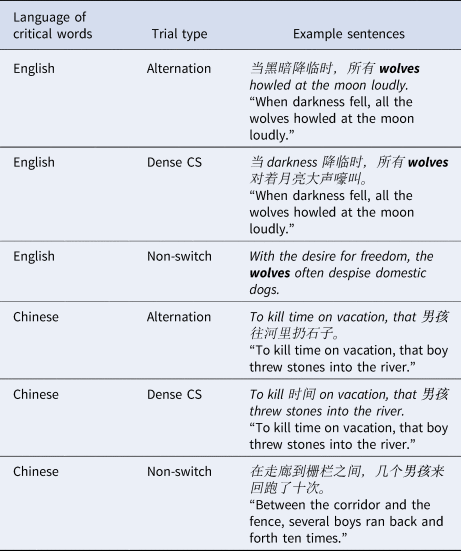
Besides, using the same set of 40 critical words, we constructed 40 non-switch sentences, comprised of 20 English and 20 Chinese sentences. In these sentences, critical words were preceded by the same language. The non-switch sentences were in the same structure as switch sentences. Non-switch sentences and switch sentences that contained the same critical words differed in terms of the sentence meaning. In this way, we could administer participants to read both switch and non-switch sentences that contained the same critical words. Comparing the behavioral data on critical words in switch and non-switch conditions from the same participants, we could control the potential confounding impacts of individual differences in critical word processing. It might be argued that the influence of code-switches (i.e., whether there is a code-switch or not) on critical word processing would be confounded by the difference in sentence meaning between the switch and non-switch sentences. However, what interests us more is whether the type of code-switching modulates the influence of code-switches. The potential confounding effect of sentence meaning exists when we examine the impact of code-switches in both alternation and dense CS conditions; thus, it would be offset when we look at the modulating role of code-switching types. Table 1 shows a set of example sentences.
A set of example sentences.

Note. Critical words were those in bold. In the formal experiment, the words were not bolded. English switched word: wolves; Chinese switched word: 男孩 “boy/boys”.
In total, each critical word appeared in three trial type conditions – namely, alternation condition, dense CS condition, and non-switch condition – for a total of 120 sentences (40 sentences per trial type condition). The switch cost was indexed by the difference between performance on the critical words preceded by Chinese and English (Olson, Reference Olson2017).
All sentences were semantically and grammatically correct, as checked by two Chinese–English bilinguals of English major. To reduce participants’ expectations for the upcoming switches, we added different determiners (including articles, demonstratives, possessive pronouns, and quantifiers) and adjectives in front of the switched words. In addition, ten students whose English proficiency is close to participants in the formal experiment rated the processing difficulty for the sentences on a 7-point scale (1 = extremely simple; 7 = extremely difficult). The data revealed difference between alternation sentences (M = 1.36, SD = .36) and dense CS sentences (M = 1.69, SD = .39) (t=−4.71, p < .001, 95% CI = [−.464, −.186], d = .75). However, the overall difficulty for sentences in both code-switching conditions was quite low, indicating that they were easy to comprehend.
To avoid participants reading sentences of the same meaning, we created two lists from the 80 switch sentences. The alternation sentences and the dense CS equivalent of the alternation ones appeared in different lists (20 alternation sentences and 20 dense CS sentences per list). Participants were randomly assigned to each list. In addition, we allocated all 40 non-switch sentences in both lists. Because the non-switch sentences' meaning differed from those of the switch sentences that contained the same critical words, participants would not read sentences of the same meaning.
In total, each participant read 80 sentences (20 alternation sentences, 20 dense CS sentences, and 40 non-switch sentences), half of which contained critical Chinese words, and the other half contained critical English words.
In each list, the alternation sentences and dense CS sentences were presented separately in two blocks. Code-switched sentences and non-switch sentences that share the same critical words were administered in the same block. Thus, there were 20 switch sentences and 20 non-switch sentences within each block. The sentences within each block were pseudo-randomized such that there were no more than three consecutive sentences of the same trial type. The alternation mixed block was always presented in front of the dense CS mixed block.
To ensure participants actively read the sentences, 10 “yes”/“no” comprehension questions were presented in Chinese randomly behind the sentences. For example, the comprehension question “Did the thieves escape punishment?” followed the sentence, “After the crime was exposed, no doubt that thieves were punished.” Half of the questions required a “yes” response, and half required a “no” response.
Procedure
Stimuli were presented using E-Prime 2.0. Participants completed the flanker task first and then completed the self-paced sentence reading task. After completing the formal experiment, participants were asked to fill in the background questionnaires, including the Oxford Placement Test (OPT), a self-rating questionnaire, and the Bilingual Switching Questionnaire.
Flanker task
There were two types of trials in the flanker task – that is, congruent and incongruent trials. In congruent trials, the central target arrow pointed in the same direction as the four flanking arrows (i.e., < < < < < or > > > > >). In incongruent trials, the target arrow pointed in the opposite direction of the flanking arrows (i.e., < < > < < or > > < > >). A trial started with a white fixation point “+” in the center of the black screen for 500 ms. Then a flanker trial appeared on the screen. Participants were asked to respond as quickly as possible to the pointing direction of the target arrow by pressing the left or right button (i.e., “F” or “J” button on the keyboard). Time spent on each trial (RTs) and accuracy for each response were recorded. The task consisted of 96 trials, half of which were consistent, and the other half were inconsistent. If participants did not respond within 1500 ms, the stimulus disappeared. After a blank screen with a duration of 500 ms, the next trial started.
Self-paced reading task
Before starting the task, participants received Chinese instructions on the computer screen, which encouraged them to read silently at normal pace that allowed them to answer comprehension questions. The instructor emphasized that the experimental materials were of three types: Chinese sentences, English sentences, and sentences that included both Chinese and English. The task started with 5 practice sentences, which were different from the experimental sentences, but were identical in structure to them.
In a self-paced reading task, participants read through a sentence one word at a time. Sentences were presented in the middle of the screen in a white 32 pts Courier New font on a black background. A trial started with a fixation point “+” in the center of the screen for 500 ms; and then the first word of the sentence appeared. Participants read at their own speed and indicated by button press when they are ready for the next word. Participants continued in this fashion until they reached the end of the sentence, which is denoted by a period. Time spent on each word (RTs) was recorded. A yes/no comprehension question followed some sentences, and participants were required to respond by pressing the “F” or “J” button on the keyboard (“F” for “yes” and “J” for “no”). Between two trials, a blank screen was presented for 2000 ms.
Results
All participants achieved accuracy rates above 70% on the comprehension questions during the self-paced reading task. Thus, no participant was excluded from the analysis.
For the RTs analysis of the flanker task, incorrect trials and the RT on a trial beyond Mean±3 standard deviations (SD) were removed (3.3%). For accuracy in the flanker task, all available data were analyzed. In the self-paced reading task, the RT on a critical word was removed if it deviated beyond Mean±3 SD. No RTs data were excluded in the reading task. The average accuracy (Mean = 92%, SD = .10) indicated that the participants understood the sentences and read the sentence carefully.
RTs and accuracy analyses were conducted in R using the package lme4 (Bates, Mächler, Bolker & Walker, Reference Bates, Mächler, Bolker and Walker2015) and lmerTest (Kuznetsova, Brockhoff & Christensen, Reference Kuznetsova, Brockhoff and Christensen2017). The effect sizes (Cohen's d statistic) were calculated using the lme.dscore function from the package EMAtools (Kleiman, Reference Kleiman2021). RTs data were submitted to linear mixed-effects model, and the accuracy data were submitted to logistic mixed-effects model. Reaction times were log-transformed to better approximate a normal distribution.
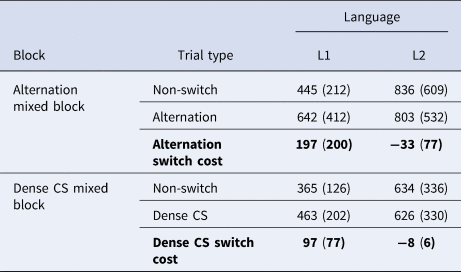
The results of the flanker task are reported in Table S1 in Supplementary Material (Supplementary Materials). The conflict effects of flanker task were significant and were in the expected direction both in reaction times (t = 11.85, p < .001, 95% CI = [.080, .113], d = 4.41) and in the accuracy rates (z=−4.50, p < .001, 95% CI = [−2.187, -.860], d = .18). Specifically, the incongruent trials (mean reaction times = 483 ms, SD = 75 ms; mean accuracy = 97%, SD = .18) yielded significantly slower reaction times and lower accuracy rates relative to congruent trials (mean reaction times = 438 ms, SD = 72 ms; mean accuracy = 99%, SD = .09). The results of the self-paced reading task are summarized in Table 2.
Mean reaction times (ms, standard deviations) in the self-paced reading task.

Switch cost and reversed language dominance effect
We first examined the first research question concerning whether the language switch cost and language dominance effect vary as a function of the code-switching types.
Trial type (non-switch, switch), language, block type (alternation mixed block, dense CS mixed block), and their interaction were included in the model as fixed factors. Trial type, language, and block type were contrast coded (non-switch=−.5, switch = .5; Chinese=−.5, English = .5; alternation mixed block=−.5, dense CS mixed block = .5). The age of learning English, frequency of code-switching, and the OPT score were included as covariates and were centered. We included participants and items as random effects and started with a full model including the maximal random effects structure (Barr, Levy, Scheepers & Tily, Reference Barr, Levy, Scheepers and Tily2013), i.e., random intercepts for both participants and items, and random slopes for block type, language, trial type, and their interaction. If the model failed to converge, we used a backwards-stepping procedure until the model could be fitted. Model comparisons were conducted to determine the best-fitting model. Specifically, we compared the models to a random-intercepts-only model that included random intercepts for participants and items only. If likelihood-ratio tests did not show a significant effect favoring the models with larger random effects structure, the random-intercepts-only model was preferred; otherwise, the models with larger random effects structures were preferred. The decision to include random slope effects was also based on Akaike Information Criterion (AIC) model comparisons on the models with and without these random slope effects. The model with the smallest AIC value (small indicates a better fit) was selected as the final model. The same selection procedures of the best-fitting model were applied to the subsequent analyses. R code used in all the analyses can be seen in Appendix S1 in Supplementary Material (Supplementary Materials).
Estimates from the best-fitting mixed-effects model are summarized in Table S2 in Supplementary Material (Supplementary Materials). The main effect of trial type was significant with faster latencies for non-switch than switch sentences (E=−.113, t=−3.20, p < .01, 95% CI = [−.185, .042], d = 1.04). The main effect of language was also significant with slower latencies for English than Chinese (E = .365, t = 7.71, p < .001, 95% CI = [.270, .460], d = 2.28), indicating an absence of reversed language dominance effect. Interestingly, the main effect of block type was significant with slower latencies for alternation mixed block than dense CS mixed block (E=−.214, t=−7.65, p < .001, 95% CI = [−.270, −.157], d = 2.41), which is in contradiction with a lower difficulty rating for alternation sentences than dense CS sentences. Of particular interest here, block type did not interact significantly with language, showing that the language dominance effect was comparable for both alternation and dense CS mixed blocks. In addition, the interaction between block type and trial type was marginally significant (E = .045, t = 1.69, p = .092, 95% CI = [−.007, .098], d = .07) with a larger switch cost in the alternation mixed block. Lastly, the three-way interaction between block type, language and trial type was significant (E=−.137, t=−2.54, p < .05, 95% CI = [−.243, −.031], d = .11), showing that the switch cost asymmetry differed across two block types.
To further explore the three-way interactions, we conducted simple effects models including block type, language, trial type, and their interaction as fixed effects. Treatment coding was performed for block type and language. In this way, the estimates were contrasted against a baseline which can be changed to attain estimates for the different effects. Contrast coding was performed for trial type (non-switch=−.5, switch = .5), so that the intercept estimated the mean log RT across both switch and non-switch conditions, and the Trial type parameter estimated the switch cost magnitude in log RT. When alternation mixed block L1 served as the baseline, for example, the L2 parameter indicated the size and direction of the difference in RT between L2 and L1 (i.e., the estimate is for reversed language dominance effect) in the alternation mixed block, the Trial type parameter estimated the L1 switch cost magnitude in alternation mixed block, the Dense mixed block × Trial type parameter estimated whether the L1 switch cost magnitude in dense mixed block differed from that in alternation mixed block, and the L2 × Trial type interaction parameter indicated whether there was a difference in switch cost between L1 and L2 (i.e., asymmetrical switch cost) in alternation mixed block. Again, the initial models included random intercepts for both participants and items, and random slopes for block type, language, trial type, and their interaction. The age of learning English, frequency of code-switching, and the OPT score were included as covariates and were centered.
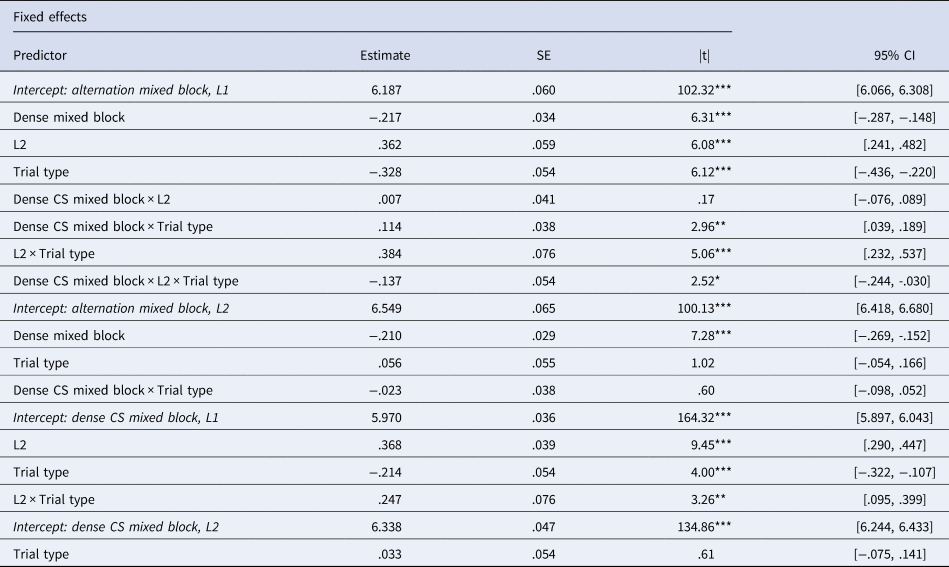
Estimates from the best-fitting models are summarized in Table 3. Under the baseline alternation mixed block L1, the significant positive estimate for L2 (E = .362, t = 6.08, p < .001, 95% CI = [.241, .482], d = 1.98) indicated a significant language dominance effect (i.e., participants read more slowly on L2 than on L1 trials) in alternation mixed block. The significant Trial type parameter suggested a reliable L1 switch cost (E=−.328, t=−6.12, p < .001, 95% CI = [−.436, −.220], d = 1.73) in alternation mixed block, and the significant L2 × Trial type interaction (E = .384, t = 5.06, p < .001, 95% CI = [.232, .537], d = 1.43) indicated that switch costs differed across the two languages in alternation mixed block, with significantly larger switch cost in L1 (M = 197 ms, SD = 200 ms) than in L2 (M=−33 ms, SD = 77 ms). The Dense CS mixed block × Trial type interaction was significant (E = .114, t = 2.96, p < .01, 95% CI = [.039, .189], d = .13), showing that the L1 switch cost in alternation mixed block (M = 197 ms, SD = 200 ms) was significantly larger than that in dense mixed block (M = 97 ms, SD = 77 ms).
Outcome of the linear mixed-effects models examining the switch costs and language dominance effect for the alternation and dense CS mixed blocks, and L1 and L2.

Note. ∗ p < .05; ∗∗ p < .01; ∗∗∗ p < .001.
Under the baseline alternation mixed block L2, the Trial type and Dense CS mixed block × Trial type parameters were not significant, suggesting that there was no significant L2 switch cost in alternation mixed block, and the L2 switch cost was comparable in alternation mixed block (M=−33 ms, SD = 77 ms) and dense mixed block (M=−8 ms, SD = 6 ms).
Under the baseline dense CS mixed block L1, the L2 parameter was significantly positive (E = .368, t = 9.45, p < .001, 95% CI = [.290, .447], d = 2.74), indicating no reversed language dominance effect in dense CS mixed block. Paralleling with the results in alternation mixed block, there was significant L1 switch cost (E=−.214, t=−4.00, p < .001, 95% CI = [−.322, −.107], d = 1.13), and L1 switch cost (M = 97 ms, SD = 77 ms) was significantly larger than L2 switch cost (M=−8 ms, SD = 6 ms) (E = .247, t = 3.26, p < .01, 95% CI = [.095, .399], d = .92) in dense CS mixed block. Under the baseline dense CS mixed block L2, the Trial type parameter was not significant, suggesting that there was no significant L2 switch cost in dense CS mixed block.
In sum, we observed that both alternation and dense CS mixed blocks showed an asymmetric switch cost (i.e., a reliable switch cost in L1 but not in L2). However, compared to the dense CS mixed block, the alternation mixed block induced a larger switch cost asymmetry, which was mainly attributed to a larger L1 switch cost. Moreover, there was no reversed language dominance effect in alternation or dense CS mixed block, and the language dominance effect was comparable for both alternation and dense CS mixed blocks.
Switch cost and reversed language dominance effect and the cognitive control measures
To address the second research question concerning whether bilinguals’ cognitive control skills predict their language control performance, each cognitive control measure (conflict effect, global RTs in the flanker task) was inserted into the mixed-effects models of switch cost and reversed language dominance effect separately. Separate models were conducted for alternation mixed block and dense CS mixed block, respectively. The models included trial type (non-switch, switch), language, cognitive control measure, and their interaction as fixed effects. The initial models included random intercepts for both participants and items, and random slopes for trial type, language, cognitive control measure, and their interaction. Treatment coding was performed for language, and contrast coding was performed for trial type (non-switch=−.5, switch = .5). Cognitive control measures (i.e., conflict effect and global RTs in the flanker task) were treated as continuous predictors and centered. The age of learning English, frequency of code-switching, and the OPT score were included as covariates and were centered.
Alternation mixed block
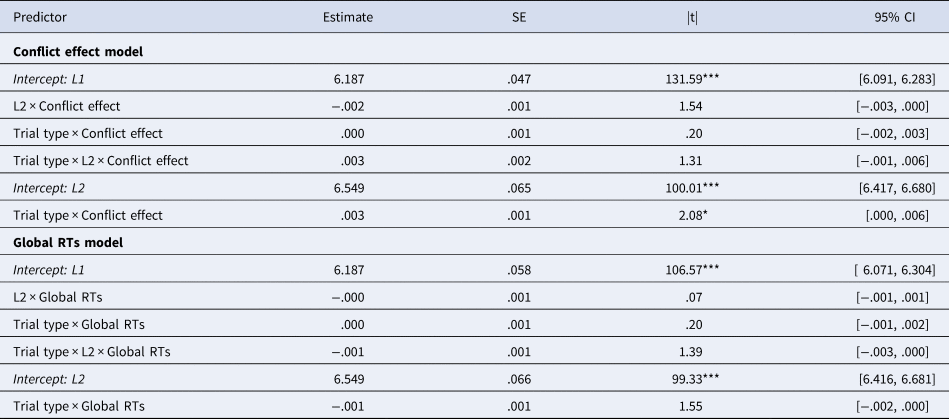
All the associations between the cognitive control measures and the language control measures in alternation mixed block are summarized in Table 4.
Estimated coefficients of the correlations between cognitive control measures and language control measures in alternation mixed block.

Note. ∗ p < .05; ∗∗∗ p < .001.
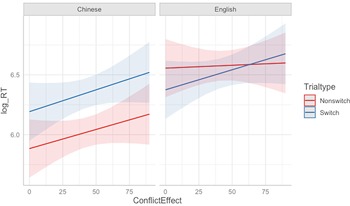
The significant Trial type × Conflict effect parameter under the L2 baseline suggested that conflict effect predicted the L2 switch cost in alternation condition (E = .003, t = 2.08, p < .05, 95% CI = [.000, .006], d = .12). From Figure 1 we see that this correlation was mainly attributed to the relationship between conflict effect and performance on L2 switch trials. Put concretely, participants with better inhibition capacity (i.e., smaller conflict effect) read faster on L2 switch trials, and participants with worse inhibition capacity reacted more slowly to L2 switch trials. No other interaction parameter was significant.
Estimated reaction times in the L1 (Chinese) and L2 (English) non-switch and switch trials (in logRT) in alternation mixed block, and the conflict effect. Shared areas represent standard errors.

Dense CS mixed block
All the correlations between the cognitive control measures and the language control measures in dense CS mixed block are summarized in Table 5.
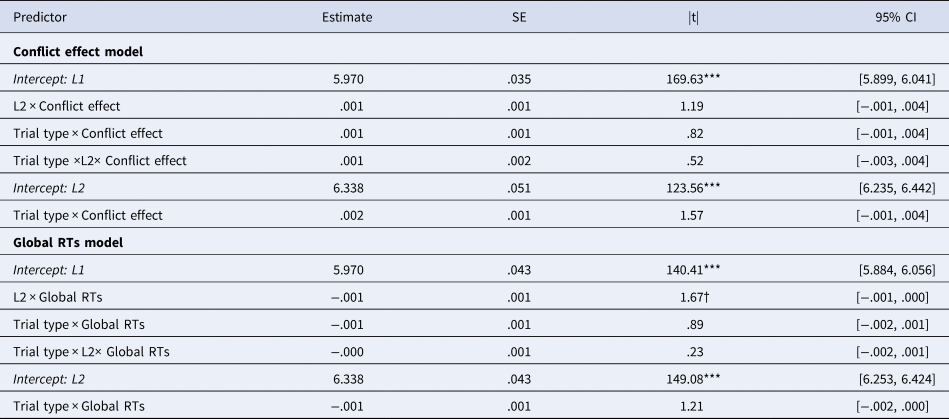
Estimated coefficients of the correlations between cognitive control measures and language control measures in dense CS mixed block.

Note. † p < .1; ∗∗∗ p < .001.
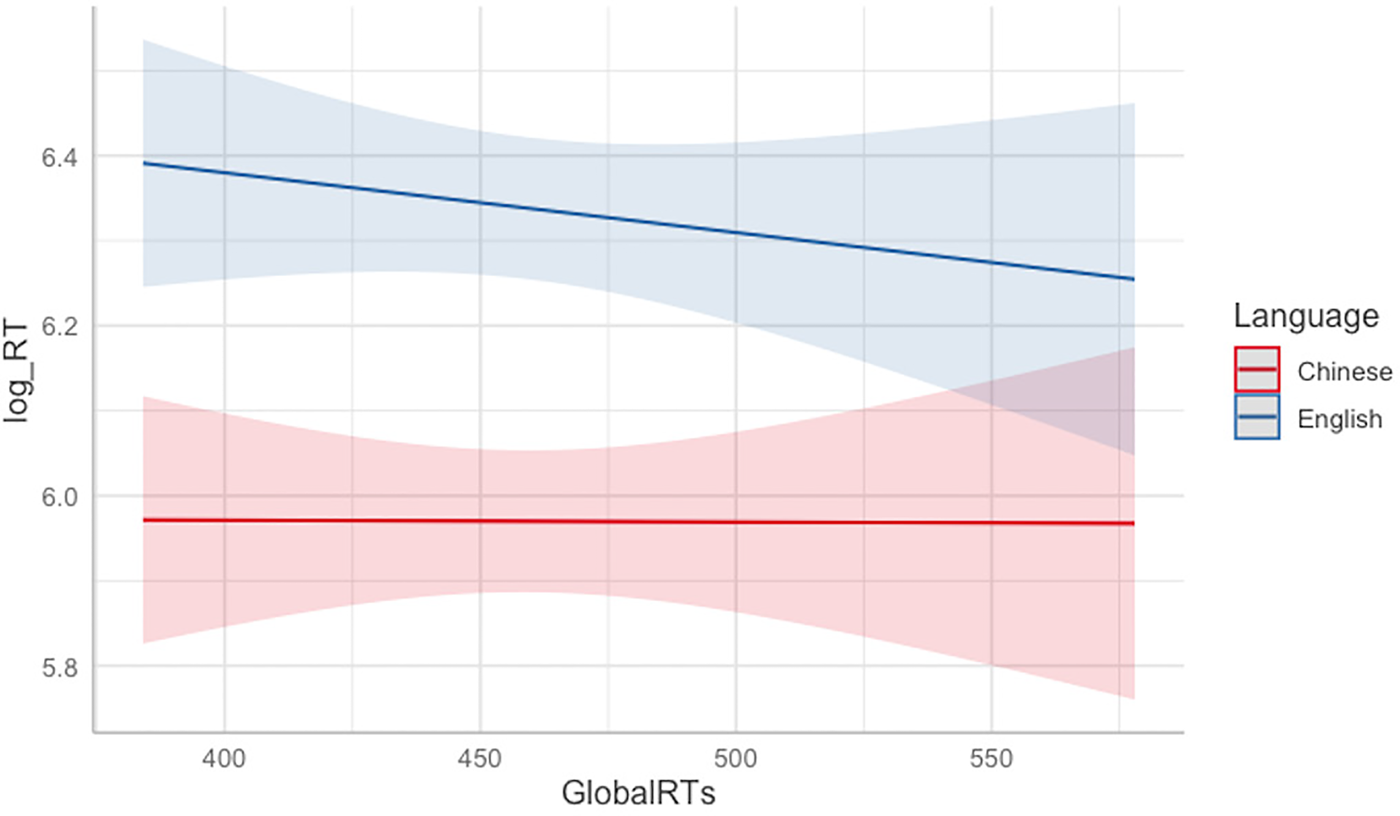
The conflict effect and global RTs did not predict the switch cost in either L1 or L2. However, the global RTs × L2 was marginally significant, indicating that the monitoring capacity tended to predict the activation levels of the two languages in dense CS condition (E=−.001, t=−1.67, p = .09, 95% CI = [-.001, .000], d = .10). As observed in Figure 2, the monitoring capacity mainly modulated the reaction times on English trials: the better the participants’ monitoring skills were, the slower they reacted on L2 trials.
Estimated reaction times in the L1 (Chinese) and L2 (English) trials (in logRT), and global RTs in dense CS mixed block. Shared areas represent standard errors.

Discussion
There has been considerable debate about whether bilingual language control during comprehension requires the engagement of cognitive control and what aspects of cognitive control are required. The present study aims to reconcile the mixed findings in the existing comprehension studies by exploring whether experimentally induced intra-sentential code-switching types modulate the engagement of cognitive control in language control during comprehension.
First, we will discuss the results concerning each research question presented in the introduction in the following paragraphs.
Our first research question concerned whether and how the two different code-switching types modulated language switching performance. Partially in line with our predictions, we found that the switch cost asymmetry differed across alternation and dense CS conditions, which was mainly attributed to the larger L1 switch cost in the alternation condition compared to the dense CS condition. One explanation for this finding is that alternation context exercises higher levels of load to the reactive inhibition (Mosca & de Bot, Reference Mosca and de Bot2017) than dense CS context. Thus, compared to the dense CS condition, the dominant L1 may be more strongly suppressed in the alternation condition, and more efforts may be needed to overcome this inhibition during L2-L1 switches.
Our second research question explored the influences of code-switching types on the association between cognitive control skills and language switching performance. In line with predictions, in the alternation condition, we observed a relationship between inhibition and the marker for reactive control (i.e., L2 switch cost), supporting the engagement of the inhibition on bilingual language control during comprehension. In dense CS condition, though we did not find a reversed language dominance effect, we found a marginal association between monitoring and the language dominance effect, indicating that bilinguals tended to apply proactive monitoring to adjust language activation levels.
The observed difference between the control processes for alternation and dense CS verifies Hofweber et al.'s (Reference Hofweber, Marinis and Treffers-Daller2020a, Reference Hofweber, Marinis and Treffers-Dallerb) hypothesis about a dual control perspective. Moreover, it is in line with previous work which has observed the influence of intra-sentential code-switching types in the interactional contexts on bilinguals’ control processes (Hofweber et al., Reference Hofweber, Marinis and Treffers-Daller2016, Reference Hofweber, Marinis, Treffers-Daller, Miller, Bayram, Rothman and Serratrice2018, Reference Hofweber, Marinis and Treffers-Daller2020a, Reference Hofweber, Marinis and Treffers-Dallerb). However, these previous studies did not distinguish code-switching experience in language comprehension from that in language production. Additionally, they did not experimentally induce different intra-sentential code-switching types. Thus, it remains largely unexplored whether the engagement of cognitive control in language control during comprehension is modulated by intra-sentential code-switching types, especially those in immediate language context. Though Hofweber et al. (Reference Hofweber, Marinis and Treffers-Daller2020b) tried to fill this gap, they failed to observe the effect of intra-sentential code-switching types. The discrepancy between Hofweber et al. (Reference Hofweber, Marinis and Treffers-Daller2020b) and this study may either be due to the differences in the nature of the experimental design (i.e., cross-task conflict-adaptation paradigm versus correlational approach; passive versus self-paced reading task) or in the bilingual samples’ code-switching experience (i.e., habitual versus non-habitual code-switchers). Our findings have important implications for bilingual language control during comprehension.
Specifically, the results indicate that bilinguals can adapt their control modes to the processing demands placed on them by alternation and dense CS in the immediate language context, though they seldom engaged in code-switching in their daily lives. This finding substantiates the hypothesis in CPM that bilinguals can adapt their control modes to the processing demands in an immediate language context (Green & Wei, Reference Green and Wei2014, p. 8), and converges with emerging evidence that bilinguals flexibly adapt their control systems to the language context at hand (Declerck & Philipp, Reference Declerck and Philipp2015a; Ibáñez et al., Reference Ibáñez, Macizo and Bajo2010; Jiao et al., Reference Jiao, Liu, de Bruin and Chen2020a; Kootstra et al., Reference Kootstra, van Hell and Dijkstra2010, Reference Kootstra, van Hell and Dijkstra2012; Liao & Chan, Reference Liao and Chan2016; Olson, Reference Olson2016, Reference Olson2017; Pivneva et al., Reference Pivneva, Mercier and Titone2014; Timmer et al., Reference Timmer, Christoffels and Costa2019; Wu & Thierry, Reference Wu and Thierry2013).
Most importantly, we found that the aspects of cognitive control involved in bilingual comprehension depend on the contexts (i.e., intra-sentential code-switching types). This finding helps to explain the inconsistencies in comprehension literature regarding the relationship between cognitive control and bilingual language control. Firstly, as mentioned in the introduction, amongst previous sentential studies, evidence for inhibition in bilingual comprehension mainly comes from those using stimuli of alternation (Adler et al., Reference Adler, Valdés Kroff and Novick2020; Gross et al., Reference Gross, Lopez, Buac and Kaushanskaya2019; Litcofsky & van Hell, Reference Litcofsky and van Hell2017), while several studies that failed to find such evidence used stimuli of dense CS (Blanco-Elorrieta & Pylkkänen, Reference Blanco-Elorrieta and Pylkkänen2017). Our results suggest that the mixed findings in these studies can be attributed to the distinct stimuli they used.
Furthermore, some single-word studies have observed that bilingual comprehension engaged monitoring instead of inhibition (Jylkkä et al., Reference Jylkkä, Lehtonen, Kuusakoski, Lindholm, Hut and Laine2018a; Struys et al., Reference Struys, Woumans, Nour, Kepinska and Van Den Noort2019). However, it is worth noting that these studies focused on the performance in the mixed language block, which contained frequent switches and might trigger similar control processes to those in the dense CS context. For instance, Jylkkä et al. (Reference Jylkkä, Lehtonen, Kuusakoski, Lindholm, Hut and Laine2018a) assessed the language control performance in a semantic categorization task among Finnish–English bilinguals and their cognitive control capacities with a set of non-linguistic tasks, including Simon, Flanker, and the number-letter tasks. The semantic categorization task included three blocks, Finnish and English single language blocks, and a mixed language block. In the mixed block, there were 60 switch trials and 119 non-switch trials. The results revealed that inhibition did not consistently predict the language switch and mixing costs (i.e., the performance difference between mixed block non-switch trials and single block trials). Nevertheless, better monitoring capacity correlated with lower language mixing costs. Jylkkä et al. (Reference Jylkkä, Lehtonen, Kuusakoski, Lindholm, Hut and Laine2018a) argued that the mixed language block in their experiment could be seen as a dense CS context, in which bilinguals might employ opportunistic planning and utilized the lexical routes of both languages to make a response. The non-target language was not suppressed; thus, inhibition was not required in such context. The general monitoring, on the contrary, was recruited in the mixed block because it is central to keeping track of the activation levels of two languages and determining which lexical route leads to the fastest response. Taking a dual control perspective, we further speculate that the mixed language block in their experiment might have incurred a proactive control mode so that bilinguals relied mainly on proactive monitoring instead of inhibition. Therefore, the existing single-word studies may only reveal the cognitive control patterns that specifically underlie bilingual comprehension in the dense CS context. Future studies should pay more attention to comprehension in different contexts to gain a comprehensive understanding of language control during comprehension.
In the following paragraphs, we would like to explain our findings in more detail.
The first finding that should be discussed is the association between inhibition and L2 switch cost in alternation mixed block, which suggests that integrating an alternational code-switching during sentence comprehension recruited inhibition. Notably, the association between inhibition and L2 switch cost converges with some neurocognitive studies (Abutalebi et al., Reference Abutalebi, Brambati, Annoni, Moro, Cappa and Perani2007; Bosma & Pablos, Reference Bosma and Pablos2020; Pérez & Duñabeitia, Reference Pérez and Duñabeitia2019) on language switching during comprehension. For example, Abutalebi et al. (Reference Abutalebi, Brambati, Annoni, Moro, Cappa and Perani2007) found that when switching from the dominant language into the non-dominant language, the areas related to cognitive control (i.e., caudate nucleus and ACC) were engaged in comprehending intra-sentential switches. An EEG study by Pérez and Duñabeitia (Reference Pérez and Duñabeitia2019) revealed an increased theta activity, a phenomenon linked to the word-level suppression, from inter-sentential switches from the dominant to the non-dominant language compared to switches from the non-dominant to the dominant language.
One explanation for the association between inhibition skills and L2 switch cost is that the language node receives strong bottom-up activation from L1 words and would cause interference for the incoming L2 words; thus, the switch cost may be related to the need to activate the non-dominant L2 and inhibit the dominant L1 when switching from the L1 to L2 (Abutalebi et al., Reference Abutalebi, Brambati, Annoni, Moro, Cappa and Perani2007; Bosma & Pablos, Reference Bosma and Pablos2020; Pérez & Duñabeitia, Reference Pérez and Duñabeitia2019).
The second finding to highlight is that there is a marginal association between monitoring skills and the language dominance effect in the dense CS mixed block, although there is no reversed language dominance effect. There are several possibilities as to why no reversed language dominance effect was observed in the current study. First, given that previous work with a high number of mixed language block trials per participant (>900 trials) tend to observe a reversed language dominance effect (Declerck, Reference Declerck2020), the limited number of 40 mixed language block trials per participant seems to be insufficient to induce the effect. Alternatively, the comprehension of language switches examined in the current study may not incur the reversed language dominance effect. Indeed, though the reversed language dominance effect extensively occurs during bilingual language production (Christoffels, Firk & Schiller, Reference Christoffels, Firk and Schiller2007; Christoffels, Ganushchak & La Heij, Reference Christoffels, Ganushchak, La Heij and Schwieter2016; Mosca & de Bot, Reference Mosca and de Bot2017; Tarlowski, Wodniecka & Marzecová, Reference Tarlowski, Wodniecka and Marzecová2013), it is absent in bilingual comprehension literature (Macizo, Bajo & Paolieri, Reference Macizo, Bajo and Paolieri2012; Mosca & de Bot, Reference Mosca and de Bot2017).
The absence of the reversed language dominance effect during bilingual language comprehension has been interpreted as evidence against the role of comprehension-based proactive language control in mixed language blocks (Declerck, Reference Declerck2020). However, the present study observes that participants with better monitoring skills de-activate L2 to a greater extent, although the modulating role of monitoring skills is only marginal. This novel finding indicates a possible role of proactive language control during comprehension. Importantly, it shows that the proactive language control may operate differently during comprehension than during production, thus creating no reversed language dominance effect.
Specifically, the reversed language dominance effect during production is most often explained in terms of sustained and global inhibition on the dominant L1. This unconscious strategy will result in a more balanced relative activation of L1 and L2, preventing the anticipated interferences on the weaker L2 and improving the overall performance in the mixed-language blocks (Christoffels et al., Reference Christoffels, Firk and Schiller2007, Reference Christoffels, Ganushchak, La Heij and Schwieter2016; Mosca & Clahsen, Reference Mosca and Clahsen2016; Mosca & de Bot, Reference Mosca and de Bot2017). In the present study, however, we speculate that the most efficient way for the proactive control mechanisms to prevent potential interference might be de-activating the weaker L2.
When L2 words are presented during comprehension, both relevant L2 and L1 words will be activated so that candidates from the dominant L1 will act as competitors (Mosca & de Bot, Reference Mosca and de Bot2017). In contrast, when a word from the dominant L1 is presented during comprehension, L1 words will be activated faster and more intensely than L2 candidates because the L1 words have a higher baseline activation level than L2 words. Thus, primarily words from the L1 will act as competitors, while the competition from the L2 words is relatively weak (Mosca & de Bot, Reference Mosca and de Bot2017). However, it is noteworthy that the dense CS mixed block in the present study involves high levels of linguistic co-activation (Hofweber et al., Reference Hofweber, Marinis and Treffers-Daller2016, Reference Hofweber, Marinis and Treffers-Daller2020a, Reference Hofweber, Marinis and Treffers-Dallerb), which may incur substantial interference from the non-target language on the target language (Chen, Zhao, Zhaxi & Liu, Reference Chen, Zhao, Zhaxi and Liu2020; Declerck, Koch, Duñabeitia, Grainger & Stephan, Reference Declerck, Koch, Duñabeitia, Grainger and Stephan2019). Then, in the dense CS mixed block, the words from the dominant L1 may act as competitors when words from the weaker L2 are presented, and the L2 words may be co-activated to a great extent and interfere to a large degree with the L1 words when words from the dominant L1 are presented. To reduce the potential competition between L1 words and L2 words in the mixed blocks, the proactive control mechanism may work to adjust the activation levels of the two languages, possibly by de-activating L1 or L2 in the mixed block. For the participants whose L1 is substantially more proficient than L2, we speculate that they tend to reduce the activation level of the L2 to facilitate the dominant L1 since it will improve overall performance more efficiently than giving an advantage to the weaker L2. Therefore, participants with higher monitoring skills may be more ready to proactively de-activate the L2.
The third finding that may be worth discussing is the slower latencies for alternation mixed block than dense CS mixed block. Similarly, in a single-word study, Jylkkä et al. (Reference Jylkkä, Lehtonen, Kuusakoski, Lindholm, Hut and Laine2018a) found that participants performed better in the L2 non-switch trials of the dense mixed block than in the single language block (i.e., L2 mixed block advantage). Considering that language switching would slow down performance, the single language block trials would have been expected to be processed more quickly than the mixed language block trials (Jylkkä et al., Reference Jylkkä, Lehtonen, Kuusakoski, Lindholm, Hut and Laine2018a). In line with Jylkkä et al. (Reference Jylkkä, Lehtonen, Kuusakoski, Lindholm, Hut and Laine2018a), we argue that the faster latencies for dense CS mixed block are mainly attributed to higher levels of linguistic co-activation. In this case, in dense CS mixed block, bilinguals are more likely to utilize the lexical routes of both languages (and more specifically, the fastest lexical route) to achieve a goal (Jylkkä et al., Reference Jylkkä, Lehtonen, Kuusakoski, Lindholm, Hut and Laine2018a).
Finally, it is noteworthy that our findings could be due to the code-switching habits and language dominance profiles (i.e., L1 dominant non-habitual code-switchers) of our bilingual group. Previous studies on L1 dominant bilinguals have found that inhibition was most involved when the suppression of a dominant L1 was required (Bosma & Pablos, Reference Bosma and Pablos2020; Hofweber et al., Reference Hofweber, Marinis and Treffers-Daller2020b). Hence, the dominance in L1 among our bilingual group may trigger heightened levels of inhibition when switching from the dominant L1 into the weaker L2, resulting in the association between inhibition and L2 switch cost we observed. Moreover, using code-switching infrequently, the bilinguals may find the code-switched sentences challenging, resulting in the activation of cognitive control during the comprehension of code-switches (Hofweber et al., Reference Hofweber, Marinis and Treffers-Daller2020b; Jiao et al., Reference Jiao, Liu, de Bruin and Chen2020a) and bringing about the influence of code-switching types on control processes. Future research should test bilingual groups who differed in the sociolinguistic background than our bilingual sample. For L2 dominant bilinguals, for example, there may be an association between inhibition and L1 switch cost during the comprehension of alternational code-switching, as switching into the weaker L1 may trigger heightened levels of inhibition. However, for balanced bilinguals, inhibition skills may predict both the L1 and L2 switch costs during the comprehension of alternational code-switching. For habitual code-switchers, the influence of intra-sentential code-switching types may not emerge, as they may find the code-switched sentences cognitively effortless (Beatty-Martínez & Dussias, Reference Beatty-Martínez and Dussias2017; Gosselin & Sabourin, Reference Gosselin and Sabourin2021; Litcofsky & van Hell, Reference Litcofsky and van Hell2017; Valdés Kroff et al., Reference Valdés Kroff, Guzzardo Tamargo and Dussias2018, Reference Valdés Kroff, Román and Dussias2020) and thus invest low levels of cognitive control during comprehension.
One limitation of the present study is that we only observe marginally significant effects of monitoring skills on language control performance. This limitation may be attributed to the relatively small sample size. Future studies should replicate the findings regarding the role of monitoring in comprehension within larger samples.
Conclusion
To conclude, the present study explores whether experimentally induced intra-sentential code-switching types influence the engagement of cognitive control in bilingual language control during comprehension. We found alternation context exerts high requirement to reactive inhibition while dense code-switching context tends to induce proactive monitoring during language control in comprehension. Our findings provide direct evidence for the modulating role of the intra-sentential code-switching types in the current processing context. These findings contribute new insights into the influence of code-switching types on cognitive control processes.
Supplementary Materials
For supplementary material accompanying this paper, visit https://doi.org/10.1017/S1366728922000323
Table S1. Mean reaction times (RT, ms, standard deviations) and accuracy (%) (standard deviations) in the flanker task.
Table S2. Outcome of the linear mixed-effects model examining the switching costs and language dominance effect in the self-paced reading task.
Appendix S1. The syntax of the R models.
Competing interests
The authors declare none.
Data availability
The data that support the findings of this study are openly available in the Mendeley repository, Jiang, Siyi (2022), “Dynamic engagement of cognitive control in intra-sentential code-switching during comprehension”, Mendeley Data, v1, http://dx.doi.org/10.17632/tt9m2y94nb.1.
Acknowledgements
This work was supported by funding of National Natural Science Foundation of China (31970976) for Baoguo Chen. The authors thank Fengjiao Cong for helpful discussions about data analysis, and the two anonymous reviewers for their valuable comments.