Introduction
Research that has been conducted in the past decade on the relationship between bilingualism and cognitive ability has focused on whether bilinguals possess superior non-linguistic cognitive control abilities compared to monolinguals (e.g., Abutalebi & Green, Reference Abutalebi and Green2007; Bialystok, Craik, Klein & Viswanathan, Reference Bialystok, Craik, Klein and Viswanathan2004; Costa, Hernández & Sebastián-Gallés, Reference Costa, Hernández and Sebastián-Gallés2008). This stems from the idea that the bilingual advantage originates from the bilingual's need to inhibit the non-target language which arises due to the parallel activation of all known languages in the lexicon (e.g., Green, Reference Green1998; Bialystok et al., Reference Bialystok, Craik, Klein and Viswanathan2004). Studies have suggested a bilingual advantage in a range of tasks. For example, bilinguals have been demonstrated to show superior performance in task switching (Prior & MacWhinney, Reference Prior and MacWhinney2010), working memory (Bialystok, Poarch, Luo & Craik, Reference Bialystok, Poarch, Luo and Craik2014), conflict monitoring (Costa, Hernández, Costa-Faidella & Sebastián-Gallés, Reference Costa, Hernández, Costa-Faidella and Sebastián-Gallés2009), conflict resolution and alerting (Costa et al., Reference Costa, Hernández and Sebastián-Gallés2008), and on non-verbal auditory executive function tasks (Foy & Mann, Reference Foy and Mann2014).
While there is a widespread interest in examining the specific mechanisms underlying the bilingual advantage, the extent to which bilingualism has been linked to superior cognitive ability has led to considerable criticism (e.g., Hilchey & Klein, Reference Hilchey and Klein2011). Indeed, recent research has produced conflicting reports with some studies indicating no differences between bilinguals and monolinguals for tasks measuring non-linguistic cognitive control (e.g., Paap & Greenberg, Reference Paap and Greenberg2013). In one of the most exhaustive reviews on the effects of bilingualism on cognition, Valian (Reference Valian2015) emphasised two possibilities for those reports which do not find a bilingual advantage: a) bilingualism does not exert any cognitive control benefits and/or b) bilingualism exerts certain cognitive control benefits, but these effects are similar to those resulting from other forms of expertise, such as being a professional musician, a juggler, or a long-term meditator. It is therefore often difficult to disentangle those skills experimentally, when Monolingual controls may have life experiences (e.g., musical training) which also positively affect cognitive abilities.
Although the debate on how different life experiences may influence cognitive abilities is largely unresolved, it has been also suggested that the apparent benefits of bilingualism may stem from other confounding factors, such as socio-economic status (SES). For example, Morton and Harper (Reference Morton and Harper2007) criticised past studies (e.g., Martin & Bialystok, Reference Martin and Bialystok2003) for inadequately controlling SES and suggested that the better performance of bilinguals may be due to their higher SES (relative to monolinguals) rather than their bilingualism. Engel de Abreu, Cruz-Santos, Tourinho, Martin and Bialystok (Reference Engel de Abreu, Cruz-Santos, Tourinho, Martin and Bialystok2012) suggest that the confounding effect of SES has two major implications. First, it would mean that the bilingual advantage emerged as a result of higher SES. Second, it would also indicate that only bilinguals from higher SES would be expected to outperform monolinguals. The research reported here sought to investigate this issue by examining whether a bilingual advantage in cognitive control was evident in individuals from lower SES backgrounds. Hence the present study examined cognitive control abilities in bilingual individuals of lower SES and compared their performance with monolingual individuals from a similarly low SES background.
Effects of SES on bilingual cognitive control
SES exerts a profound impact on specific cognitive control tasks such as those measuring alerting and executive attention (Mezzacappa, Reference Mezzacappa2004). The likelihood of a potential confound of SES in bilingual cognitive control measures was first reported by Morton and Harper (Reference Morton and Harper2007). Bialystok et al. (Reference Bialystok, Craik, Klein and Viswanathan2004) administered a Simon task with bilingual and monolingual adults and found an advantage for bilingual adults in conflict resolution. Martin and Bialystok (Reference Martin and Bialystok2003) had earlier reported a similar effect in children. In the Simon task participants are required to press appropriate computer keys to correspond to red or blue coloured boxes. The boxes are either presented on the same side of the computer screen as the appropriate colour response key (spatially congruent) or on the opposite side (spatially incongruent). Participants typically respond faster to congruent than to incongruent trials. The difference in response time between incongruent and congruent is considered to be an index of conflict resolution abilities (see below for more detail on this task). When Morton and Harper (Reference Morton and Harper2007) used the Simon task with children who were matched for SES, in contrast to Martin and Bialystok (Reference Martin and Bialystok2003), they found identical performance for bilingual and monolingual children. Moreover, they found an association between higher SES and better performance on the Simon task (SES was negatively correlated with a reduced Simon effect), regardless of language status. However, Bialystok (Reference Bialystok2009) suggested that the failure to obtain any significant differences between the two language groups may have been rooted in developmental differences as participants in Morton and Harper (Reference Morton and Harper2007) were 1.5 years older than the participants in Martin and Bialystok (Reference Martin and Bialystok2003). She hypothesised that by the age of 7 years monolingual children may have acquired similar executive function abilities to bilingual children. Although developmental differences offer a reasonable explanation, past studies have also suggested bilingual advantages for children at 8 years. Therefore, it is unclear why a bilingual advantage would not be present at 7 years and re-emerge for children at the age of 8 years (Hilchey & Klein, Reference Hilchey and Klein2011).
In their review, Mindt, Arentoft, Germano, D'Aquila, Scheiner, Pizzirusso and Gollan (Reference Mindt, Arentoft, Germano, D'Aquila, Scheiner, Pizzirusso and Gollan2008) suggested that bilingual advantages may be difficult to replicate with bilingual individuals from countries where bilingualism is not typically associated with higher SES. They also noted that in previous studies, that have reported a bilingual advantage with children from low SES, the advantage emerged only after effects of SES were controlled for. For example, Carlson and Meltzoff (Reference Carlson and Meltzoff2008) showed that bilingual children from comparatively lower SES backgrounds demonstrated advantages over monolingual children from privileged social background (higher SES) on a range of executive function tasks (e.g., advanced dimensional change card sort, simon says, visually cued recall) only after parental education was controlled (as a proxy for SES). Although it is true that the effects of bilingualism emerged only when SES was controlled, the composite raw scores of all executive function tasks indicated no significant group difference between children from lower and higher SES. Therefore, the fact that lower SES bilingual children showed similar performance on raw scores to higher SES monolingual children indicates that perhaps some of the cognitive disadvantages of lower SES may be compensated for by superior cognitive control mechanisms resulting from their bilingual experience (Carlson & Meltzoff, Reference Carlson and Meltzoff2008). This finding would therefore contradict the earlier claim that bilingual advantages may be absent in individuals from lower SES.
In a similar study, Engel de Abreu et al. (Reference Engel de Abreu, Cruz-Santos, Tourinho, Martin and Bialystok2012) specifically studied the ability to resolve cognitive conflict in lower SES monolingual and bilingual children from Luxembourg and Portugal. An assessment of poverty indicator found that the bilingual children were more disadvantaged than monolingual children. The authors predicted that bilingual experience specifically influences the ability to resolve conflict (a domain specific advantage) rather than providing facilitation of overall cognitive mechanisms (a domain general advantage). As predicted, the bilingual children showed a specific advantage on cognitive control tasks (selective attention – Sky Day Search task; interference suppression – Flanker task) and not on abstract reasoning (Ravens Coloured Progressive Matrices) and working memory measures (Odd-One-Out; Dot Matrix). This finding therefore also supports the position that bilingual advantages for conflict resolution in children cannot be accounted for solely by differences in SES.
In order to further dissociate the role of SES in bilingual cognitive control, Calvo and Bialystok (Reference Calvo and Bialystok2014) studied 6 to 7 year old bilingual and monolingual children using parental education as proxy for SES. A range of language (e.g., Peabody Picture Vocabulary Test) and cognitive tests (e.g., Nonverbal Visual Attention and Flanker task) were administered to assess language and executive functioning. Their results suggested that both SES and bilingualism had an overall effect on language and cognition; however this effect was not in the same direction. SES was associated with decreases in both language and executive functioning performance, whereas bilingualism was associated with a decrease in language but increase in executive functioning abilities. This evidence suggests that the effect of SES on cognitive ability may not override the effect of bilingualism.
While the role of SES on bilingual cognitive control in children has received some attention, its role has been under-researched in adults. The bilingual advantage on tasks measuring executive function has been replicated by some studies with middle aged and older adults (e.g., Bialystok, Craik & Luk, Reference Bialystok, Craik and Luk2008; Salvatierra & Rosselli, Reference Salvatierra and Rosselli2010). However, in these studies not only are bilingual adults often high SES, but SES is rarely explicitly controlled. Therefore not only is it unclear whether the bilingual advantage manifests only in higher SES populations, but also the extent to which it may be a confound of SES in adults (Hilchey & Klein, Reference Hilchey and Klein2011). However, it is often hard for factors such as cultural practices, differences in life experiences between language groups, immigrant status, SES and literacy to be controlled. Moreover, most bilingual studies tend to focus on bilinguals from an urban middle class background. In many parts of the world, bilingualism is not associated with immigrant status or classroom experience but is a part of the everyday living experience. For example, in rural southern India, where the current study was conducted, a significant number of people living in (interstate) border areas are bilinguals who belong to a lower SES population. In these areas, both bilinguals and monolinguals share similar social and cultural values and often both monolingualism and bilingualism co-occur with poverty and illiteracy. This linguistic and socio-economic background provides an ideal situation for studying the role of bilingualism in cognitive control with matched low SES groups. It also can provide evidence from cultures and individuals that have been less studied in the bilingual cognitive control literature (rural bilinguals and monolinguals).
Hence, the study reported here examined performance on cognitive control tasks in bilingual and monolingual individuals who were living in very difficult social conditions (from lower SES on the verge of poverty) and were from a non-literate background with no acquisition of literacy through formal academic education.
We administered two of the most commonly used tasks to assess executive function. Experiment 1 used the Simon task (Simon & Berbaum, Reference Simon and Berbaum1990; Simon & Small, Reference Simon and Small1969; Simon & Wolf, Reference Simon and Wolf1963) and Experiment 2 the Attentional Network task (Fan, McCandliss, Sommer, Raz & Posner, Reference Fan, McCandliss, Sommer, Raz and Posner2002; for use in bilingual research see Costa et al., Reference Costa, Hernández and Sebastián-Gallés2008). Both tasks are argued to measure conflict resolution abilities (e.g., Bialystok et al., Reference Bialystok, Craik, Klein and Viswanathan2004; Costa et al., Reference Costa, Hernández and Sebastián-Gallés2008).
As noted above, in the Simon task (Simon & Berbaum, Reference Simon and Berbaum1990; Simon & Small, Reference Simon and Small1969; Simon & Wolf, Reference Simon and Wolf1963), spatially congruent and incongruent stimuli (e.g., coloured boxes – red and blue) are presented to the participants with two response keys associated for each stimulus (e.g., right sided key for the red box and left sided key for the blue box). Responding to the incongruent stimuli while ignoring the spatial conflict is one of the key aspects of this task. Due to the conflicting responses present in the incongruent stimuli, this condition leads to a comparatively longer reaction time compared to the congruent condition (see also Lu & Proctor, Reference Lu and Proctor1995; Stürmer, Leuthold, Soetens, Schröter & Sommer, Reference Stürmer, Leuthold, Soetens, Schröter and Sommer2002 for more detail on this topic). The difference in response times between incongruent and congruent conditions is described as the Simon effect (e.g., Simon & Berbaum, Reference Simon and Berbaum1990).
The Attentional Network Task (Fan et al., Reference Fan, McCandliss, Sommer, Raz and Posner2002) is a combination of the Flanker task (Eriksen & Eriksen, Reference Eriksen and Eriksen1974) and the cue reaction time task (Posner, Reference Posner1980). It is argued that this is one of the best tasks for assessing inhibitory control abilities (e.g., Costa et al., Reference Costa, Hernández and Sebastián-Gallés2008). In this task, three types of spatial stimuli (congruent, incongruent and neutral) are presented above or below a fixation cross. The stimuli are usually presented as a set of five arrows either pointing right or left. Responses are based on the direction of the centre arrow. The centre arrow can either point in the same direction as the other (Flanker) arrows (congruent condition) or in a different direction (incongruent condition). Response times for the incongruent conditions, where there is conflicting information from Flanker tasks, is longer than for the congruent conditions, where there is no conflict. In addition to measuring conflict resolution/inhibitory control (as also assessed by the Simon task), the Attentional Network task also measures other critical cognitive control abilities such as the executive network, alerting and orienting mechanisms. The executive network is measured by calculating the difference between incongruent and congruent trials (conflict effect). Generally, participants respond faster for congruent than for incongruent trials. The alerting mechanism is studied by presenting a cue before the Flanker arrows are displayed, which indicates that the arrows are about to appear. The alerting effect is the difference in performance between trials without an alerting cue (no cue) and those with an alerting cue (double cue) (generally responses are faster for trials preceded by an alerting cue). Orienting mechanisms are studied by presenting a cue that directs the participants to the location (e.g., above or below the fixation cross) of the Flanker arrow. The orienting effect is the difference in the participants’ performance between trials preceded by a centre cue (without any cue to spatial orientation) and those with a spatial cue indicating a spatial orientation.
We predicted that if bilingualism improves cognitive control, and specifically confers an advantage for conflict resolution, then bilinguals may exhibit superior performance compared to monolinguals despite their shared lower SES. For the Simon task, this would be manifested by a specific advantage for trials with conflict (conflict resolution/interference suppression effect) or as an overall bilingual advantage for both trials with and without conflict (global effect). For the Attentional Network task, we expected the bilingual advantage to be manifested in a similar way to the Simon task: either a specific advantage for trials with conflict and/or an overall advantage. Additionally, we predicted that if bilingualism facilitates alerting networks (the difference in reaction time between trials preceded by no cue and double cue) and orienting networks (the difference in reaction time between trials preceded by centre cue and spatial cue), then, we expected larger differences for lower SES bilinguals for both networks compared to monolinguals.
Experiment 1
In Experiment 1, we administered the Simon task to bilingual and monolingual speaker groups to examine whether bilinguals from lower SES performed better than monolinguals from a similar social background.
Method
Participants and demographic details
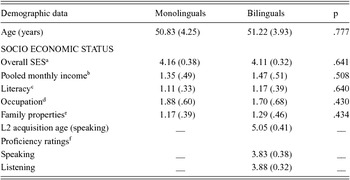
Thirty six individuals participated, 18 of them bilingual speakers and 18 of them monolingual speakers (see Table 1). Participants were bilingual and monolingual low SES, illiterate, middle-aged adults recruited from rural villages of the southern Indian state of Kerala. According to the “United Nations Department of Economic and Social affairs Statistics Division” (UNESCO, retrieved from http://unstats.un.org/unsd/demographic/sconcerns/education/ed3.htm, see concepts and definitions under standards and method section) an illiterate person is one who cannot, with understanding, both read and write a short, simple statement on his or her everyday life (see also Ashaie & Obler, Reference Ashaie and Obler2014). All the participants in the current study met this criterion (see below) not having had the opportunity to acquire literacy through schooling.
Demographic and background data of participants as means and standard deviations (in parentheses).

Notes
N = 18 for each group, p = significance of t-test (2 tailed).
a Scale from 0 (lowest SES) to 20 (highest SES).
b Scale from 1 (Rs. 5000 or below) to 5 (Rs. 20001 or above).
c Scale from 1 (illiterate) to 5 (Post Graduation or above).
d Scale from 1 (unskilled/daily wager) to 5 (Specialised/Class 1 services).
e Scale from 1 (below Rs.50,000) to 5 (above Rs 500,000)
f Rating from 0 = not proficient to 4 = highly proficient
The bilingual and monolingual participants were native speakers of Malayalam (L1). The bilingual participants spoke Tulu (L2) as their second language acquired before the age of 6. In this social and linguistic context, the Malayalam and Tulu speaking communities live closely together with a rich history of language harmony. Tulu (L2) is widely used especially for communicating with neighbours, friends and even family members (e.g., cross-linguistic marriages). It is therefore not difficult for a child growing up in this linguistic environment to acquire Malayalam (L1) in a family context and successively start learning Tulu (L2) at a very early age from a social context (e.g., neighbours, friends, family). Although the bilinguals and monolinguals were from the same province both these groups lived in different villages at a considerable distance from each other. It is common to have the linguistic landscape change within short distance in India (e.g., multilingualism tends to be higher around the inter-state borders) without much or little difference in people's cultural practises (however the reverse is also true). In this context, our participants shared similar cultural values and mother tongue (Malayalam) but varied in their second language acquisition. The monolingual participants were mostly farmers and did not acquire a second language passively (e.g., comprehension) or actively (e.g., speaking). Since both Malayalam and Tulu are cognate languages it is possible that the monolingual participants may identify certain vocabulary in Tulu, however, this is rather different to them having acquired Tulu as a second language. The monolingual participants in our study reported no basic understanding (comprehension) of Tulu even necessary to carry out a simple conversation.
The bilingual participants’ second language proficiencies (speaking and understanding) were assessed by administering oral questions based on a language proficiency rating scale (Chengappa, Shivashankar, Nair, Nayak & Arvind, Reference Chengappa, Shivashankar, Nair, Nayak and Arvind2011). Socio-economic status (SES) of the participants was assessed using four critical indicators (1. pooled monthly income, 2. highest level of education, 3. occupation, and 4. family property) by using the socio-economic status scale (Venkatesan, Reference Venkatesan2011). Demographic and background data of participants are given in Table 1.
Task & Procedure
In order to make the participants more comfortable and the testing environment less intimidating, all participants were familiarised with the computer by playing music videos in their native language (Malayalam) for five minutes.
A Simon task was administered to all participants using the DMDX display system (Forster & Forster, Reference Forster and Forster2003) on a laptop computer. The test included 20 practice trials and 112 experimental trials. These trials were presented in four blocks which consisted of 28 trials each, of which half of the trials were congruent (50%) and half incongruent (50%). The order of the presentation was randomised for each participant. Each trial consisted of a presentation of a fixation cross (+) in the centre of the computer monitor maintained on the screen for 250 milliseconds (ms), followed by a coloured (red or blue) square presented on the left or the right side of the screen for a duration of 2000 ms or until a response from the participant. Two keys were labelled with a red (m, on the right) or blue (z, on the left) sticker serving as response keys. In congruent conditions, the coloured square appeared on the same side as the response key (e.g., a red square appearing on the right side of the screen requiring a response from the red key on the right). In incongruent conditions the coloured square appeared on the opposite side to the response key (e.g., a red square appearing on the left side of the screen but still requiring a response from the red key on the right). Participants were asked to pay attention to the coloured squares regardless of their position and press the appropriate coloured button depending on the colour of the square. The entire task took about 20–25 minutes.
Analysis
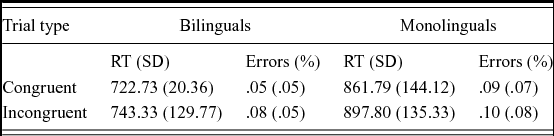
First, reaction times above and below 3.0 standard deviations from the mean of each subject for each condition were removed. We also eliminated reaction times longer than 1500 ms and shorter than 300 ms. In total less than 3% of responses were removed. The data from three bilingual participants and two monolingual participants were eliminated due to high error rates (> 40%). RT analysis was carried out only for trials with correct responses. The results are reported in Table 2. Response latencies were analysed with a 2 (trial type – congruent vs. incongruent; within subjects) by 2 (language group – bilinguals vs. monolinguals) Mixed Analysis of Variance.
Mean response times (RT), error rates and standard deviations (in parentheses) for bilinguals and monolinguals.

Results
The error analysis found no significant effect of group (bilinguals and monolinguals) (F (1, 34) = 7.06, p = .229) or trial type (congruent and incongruent) (F (1, 34) = 5.45, p = .258). As expected, there was a significant main effect of trial type (F (1, 34) = 4.54, p = .040, η2 p =.109) with congruent trials significantly faster than incongruent trials. There was also a significant main effect of group (F (1, 34) = 13.25, p = .001, η2 p = .264): bilinguals exhibited a global advantage for response times compared to monolinguals. Although bilinguals appeared to show a reduced interference effect (the difference between congruent and incongruent trials; bilinguals (20.60 ms) compared to monolinguals (36.01 ms)), the interaction between group and trial type was not significant (F (1, 34) = .337, p = .565).
In order to confirm the absence of a reduced Simon effect in bilinguals, RT and errors were further combined (mean RT for each participant divided by the percentage of correct responses) to obtain an inverse efficiency score (IES). The IES can be used as a measure to confirm results obtained from traditional RT analysis (Bruyer & Brysbaert, Reference Bruyer and Brysbaert2011). However, this can only be used in the absence of a speed-accuracy trade off and when error rates are low (< 10 %; Townsend & Ashby, Reference Townsend and Ashby1978). In order to identify whether there was a speed-accuracy tradeoff, the RT data for all participants was correlated with accuracy. This correlation was not significant indicating that a speed-accuracy tradeoff was unlikely (r = .10, p =.405). Our data fulfilled both these criteria. The results confirmed the previous findings from RT analysis revealing a main effect of trial type (congruent trials faster for both language groups) (F (1, 34) = 4.52, p = .041, η2 p =.117) and a main effect of group (F (1, 34) = 8.25, p = .007, η2 p =.195), and once again the interaction between group and trial type was not significant (F (1, 34) = .141, p = .710).
Discussion Experiment 1
There were two key findings from Experiment 1. First, bilinguals exhibited a significant advantage over monolinguals for both trials with conflict (incongruent) and those without conflict (congruent): a global bilingual advantage. Second, although there was an overall bilingual advantage, the group versus trial type interaction was not significant. In other words, bilinguals did not show reduced interference for incongruent trials relative to congruent trials – they were not superior in conflict resolution. A significant global response time advantage for bilinguals with no advantage for conflict resolution is not uncommon and has been an issue of controversy in the past (e.g., Hilchey & Klein, Reference Hilchey and Klein2011), we will return to this in the General Discussion.
Experiment 2
Method
The same participants, who completed a Simon task, were tested again with the Attentional Network task. The testing was carried out in a second session one hour gap between the first and second tasks on the same day.
Task and procedure
We administered the Attentional Network task using the DMDX display system (Foster & Foster, Reference Forster and Forster2003) on a laptop computer. We replicated the task used by Costa et al. (Reference Costa, Hernández and Sebastián-Gallés2008) which was developed by Fan et al. (Reference Fan, McCandliss, Sommer, Raz and Posner2002). The experimental conditions involving cue type consisted of trials with no cue, centre cue, double cue, or spatial cue.
The entire task consisted of 288 trials with 12 different experimental conditions presented in three different blocks. Each experimental condition was represented by 8 trials in one block leading to a total 96 trials per block. Before the testing began, the participants saw 24 practice trials. Following the presentation of practice trials the participants were presented with Flanker stimuli (arrows pointing either right or left) appearing on the computer screen for 1700 ms preceded by a fixation cross. The target stimulus always appeared as a set of five congruent, incongruent or neutral stimuli (33% of each trial type), including a central arrow pointing either towards the right or left. The participants were instructed to locate the direction of the centre arrow as quickly and as accurately as possible. Two keys (‘m’ on the right and ‘z’ on the left hand side of the keyboard) were assigned as response buttons. The response buttons were masked with a sticker depicting an arrow pointing to the right (m) or left (z). Participants were asked to press the right button if the centre arrow pointed right and left button if the centre arrow pointed left. The entire task lasted for about 20–25 minutes. The order of the stimuli was randomised for each participant.
In each condition there was one central arrow pointing left or right. In the neutral condition this arrow was flanked by lines without arrowheads. In the congruent condition the Flankers were arrows pointing in the same direction as the target and in the incongruent condition the Flankers were arrows pointing in the opposite direction.
There were four different cue conditions – (i) no cue, (ii) centre cue, (iii) spatial cue and (iv) double cue. In the no cue condition only the fixation cross was presented. In the centre cue condition, the cue (an asterisk) was presented centrally above the fixation cross (and hence did not cue location) before presentation of the Flanker stimulus. In the spatial cue condition the cue was presented to the left or right of the screen to cue the direction of the subsequent arrow. In the double (alerting) cue condition cues (asterisks) appeared above and below the fixation cross simultaneously in order to alert the participant to the presentation of the next Flanker arrows. All three cue types remained on the computer screen for a duration of 100 ms. The target Flanker arrows appeared on the screen after a duration of 400 ms. The Flanker arrows remained in the spatial location for 1700 ms or until the participant made a response (see also Costa et al., Reference Costa, Hernández and Sebastián-Gallés2008).
Analysis
The RT data was trimmed using a similar procedure to that of Experiment 1 resulting in the removal of less than 5% of the data. Three bilingual and two monolingual participants exhibited high error rates (> 40 %) and therefore their data were excluded from the analysis. The data were analysed using 2 (language groups: bilinguals vs. monolinguals)* 3 (trial type: congruent, incongruent, neutral)* 4 (cue type: no cue, centre cue, double cue, spatial cue) repeated measures of analysis of variance (ANOVA) with language groups as between subject factors and trial type and cue type as within subject factors.
Results
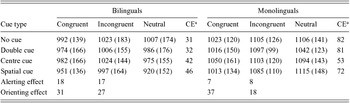
The results are reported in Table 3. The error analysis found no significant effect of group (bilinguals and monolinguals) (F (1, 34) = .156, p = .729), or cue type (F (3, 426) = .792, p = .499). The effect of trial type (congruent, incongruent and neutral) was close to significant (F (2, 284) = 2.32, p =.099, η2 p = .016). None of the two or three way interactions were significant (group and trial type (F (2, 284) = 2.30, p =.102); group and cue type (F (3, 426) = .164, p = .920); group, trial and cue type (F (6, 426) =.103, p =.749).
Mean response times (RT), and standard deviations (in parentheses) for flanker type and cue type in bilinguals and monolinguals.

Notes
NC-No cue, DC-Double cue, CC- Centre cue, SC-Spatial cue
a Conflict effect(CE) was calculated by measuring the reaction time difference between incongruent vs. congruent trials
Alerting effect was calculated by measuring the reaction time difference between no cue trials from double cue trials
Orienting effect was calculated by measuring the reaction time difference between centre cue trials from spatial cue trials
In the analysis of reaction time, there was a significant main effect of trial type (F (2, 68) = 5.37, p = .006, η2 p =.026), and of group: bilingual speakers were significantly faster (988 ms) than monolingual speakers (1085 ms) (F (1, 34) = 7.34, p = .010, η2 p =.080). However, the interaction between group and trial type was not significant (F (2, 68) = 1.38, p = .25). There was also no significant main effect of cue type (F (3, 102) = 1.31, p = .27) nor two way interactions between group and cue type (F (3, 102) = 1.31, p = .27), trial and cue type (F (6, 204) = 0.37, p = .89) or group, trial and cue type (F (6, 204) = .43, p = .85). Analysis for speed-accuracy trade-off once again indicated that this was unlikely (r = .08, p=.384). IES results replicated a main effect of trial type (congruent trials faster for both language groups) (F (2, 34) = 6.72, p = .001, η2 p =.154) and a main effect of group (F (1, 34) = 9.74, p = .001, η2 p =.175). The interaction between group and trial type was not significant (F (2, 88) = .083, p = .314) and group and cue type were not significant (F (3, 102) = .041, p = .517).
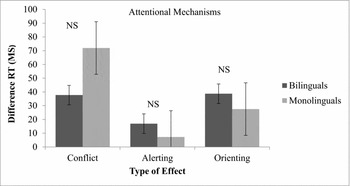
Figure 1 shows the three different attentional mechanisms tapped into in this experiment. Although the conflict effect (congruent vs incongruent trials) appeared reduced for bilinguals (see Figure 1), the lack of significant interaction between group and trial type indicated that this difference was not reliable. There were also no differences between groups for the alerting (no cue vs double cue) and orienting (centre vs spatial cue) effects indicated by the lack of a significant interaction between cue type and group.
Mean differences in reaction times across conditions for three attentional network effects for both bilinguals and monolinguals. Error bars indicate standard error (SE). NS: Non-significant.

Discussion Experiment 2
Experiment 2 assessed cognitive control mechanisms in bilinguals and monolinguals using the Attentional Network task. Critically, the results once again, confirmed a global bilingual advantage, as we found in the Simon Task. This is consistent with the findings of Costa et al. (Reference Costa, Hernández and Sebastián-Gallés2008) and supports the idea of a bilingual advantage even for trials without conflict (congruent trials). Costa et al. (Reference Costa, Hernández and Sebastián-Gallés2008) indicated that a bilingual advantage for congruent trials demonstrates the bilinguals’ ability to monitor conflict, in addition to interference suppression being important for incongruent trials, and therefore indicating an advantage for both conflict resolution and monitoring in bilinguals. However, the final analysis with the three attentional networks (executive, alerting and orienting) showed no significant difference between the language groups. Although there was a reduced conflict effect for bilinguals compared to monolinguals, the lack of statistical significance suggested that the advantage of bilingualism is not specifically constrained to inhibiting trials with conflict. Similarly, the non-significant difference between the alerting and orienting effect indicated that the benefit of a cue to orient/alert to the onset of the stimulus is not affected by bilingualism.
General discussion
This study assessed the effect of bilingualism on the performance of illiterate bilinguals and monolinguals from lower SES on the Simon and the Attentional Network (Flanker) task. The results were clear: For both the Simon task and the Attentional Network task, the low SES bilinguals responded more quickly than monolinguals for both congruent and incongruent trials, indicating a global bilingual advantage.
This global bilingual advantage is sometimes referred to as the bilingual executive processing advantage (BEPA) and may have emerged due to enhanced conflict monitoring mechanism in bilinguals. For example, Costa et al. (Reference Costa, Hernández, Costa-Faidella and Sebastián-Gallés2009) suggested that because tasks that measure cognitive control involve both trials with and without conflict, participants need to constantly monitor conflict regardless of the trial type. Therefore an overall advantage could reflect the bilinguals’ efficient monitoring mechanisms. It is also possible that such a monitoring mechanism may be activated when a bilingual's language context involves two cognate languages. Speaking in languages with close phonological familiarity may involve continuous activation of monitoring mechanisms to prevent interference. Indeed, our bilinguals spoke cognate languages (Malayalam and Tulu). However, this hypothesis needs to be further tested considering the language context of these bilinguals.
For the Attentional Network Task, Costa et al. (Reference Costa, Hernández, Costa-Faidella and Sebastián-Gallés2009) suggested that there is a more robust conflict effect when a lower percentage (33%) of congruent trials are used compared to the relatively high percentage (50%) of congruent trials in the Simon task. Although the Attentional Network Task in our study consisted of only 33% of congruent trials, which is much lower than the 50% congruent trials in the Simon task, this difference was not enough to elicit a significant conflict effect between bilinguals and monolinguals. Furthermore, our results also found no evidence for a relationship between bilingualism and other attentional networks such as the alerting and orienting networks. These results are in contrast with the findings of Costa et al. (Reference Costa, Hernández and Sebastián-Gallés2008), which suggested a bilingual advantage specifically for conflict and alerting effects. It is unclear why we obtained this contradictory pattern of results – however, one possible explanation for the lack of effects could be the difference in the number of participants between the current study (n=36) and Costa et al. (Reference Costa, Hernández and Sebastián-Gallés2008; n = 200). The reduced number of participants in the current study was due to the rare occurrence of the bilingual and monolingual illiterate participant groups. However, if this was the reason behind the null result for the attentional mechanisms task, it is not clear why this should not also have reduced the effects found for overall bilingual performance (global effects). Although the attentional mechanisms failed to elicit any significant difference between bilinguals and monolinguals, our findings from both the Simon and Attentional Network Task are in line with the previous literature indicating a more general effect of bilingualism (global effects) rather than a specialised conflict or alerting effect (Costa et al., Reference Costa, Hernández, Costa-Faidella and Sebastián-Gallés2009).
The major focus of this study was the fact that the participants were bilinguals and monolinguals who were both economically and socially disadvantaged and with no opportunity to acquire any formal literacy skills. There is evidence that suggests that living in adverse social conditions can affect performance on tasks measuring executive function (e.g., Noble, Norman & Farah, Reference Noble, Norman and Farah2005). Both our monolingual and bilingual participants would be expected to have suffered equally on tasks measuring cognitive control due to the influence of their social environment. Nonetheless, there was an advantage for bilinguals compared to monolinguals. This has two implications: first, the performance of these bilinguals from lower SES on cognitive control tasks benefitted from bilingualism indicating that bilingualism has independent effects on performance of such tasks. Second, it suggests that the bilingual effects found in previous studies were not a mere reflection of the benefits of high SES in bilingual groups as these benefits extend to individuals from lower SES. Importantly, the concerns regarding SES have previously been addressed mainly in studies conducted with children (e.g., Morton & Harper, Reference Morton and Harper2007). This study is the first to focus on middle aged adults and our results therefore further weaken support for the proposal that the bilingual advantage is no longer evident when SES is controlled in adults.
The lack of literacy in these participants is also important because literacy skills have been argued to affect language and cognitive abilities. For instance, neuroimaging studies have indicated that acquisition of literacy skills can result in significant cortical reorganisation positively affecting language processing (e.g., activation of spoken sentences doubled in right and left superior temporal regions) and visual areas associated with reading (e.g., ventral occipito-temporal cortex) (Dehaene, Pegado, Braga, Ventura, Nunes Filho, Jobert, Dehaene-Lambertz, Kolinsky, Morais & Cohen, Reference Dehaene, Pegado, Braga, Ventura, Nunes Filho, Jobert, Dehaene-Lambertz, Kolinsky, Morais and Cohen2010). Significant effects of literacy on visual attention, especially language mediated visual orientation, have been reported (e.g., Huettig & Mishra, Reference Huettig and Mishra2014; Mishra, Singh, Pandey & Huettig, Reference Mishra, Singh, Pandey and Huettig2012). Given such overarching effects of literacy on a wide spectrum of language and cognitive abilities, it is possible that there is an interaction between bilingualism and literacy, such that non-literate bilinguals do not show advantages on cognitive control tasks compared to monolinguals. However, we did not observe such a pattern: our bilingual participants showed an advantage in the absence of literacy skills. Similar results were found in Kavé, Eyal, Shorek and Cohen-Mansfield (Reference Kavé, Eyal, Shorek and Cohen-Mansfield2008) who in their study noted that, in illiterate multilinguals, language status may correlate with cognitive ability more than with literacy. However, our design does not allow us to determine whether the effects of literacy and bilingualism are additive, or whether the negative effects of illiteracy are fully compensated for by bilingualism. Similarly, although our results found an advantage for non-literate bilinguals compared to non-literate monolinguals, we also cannot tease apart the specific effect of literacy on cognitive ability as lower SES and illiteracy are confounded in our study (and indeed often will be). The confounds can be avoided in future by studying, for example, bilinguals who had acquired literacy skills but remain lower SES and also higher SES bilinguals with no formal literacy skills.
Although we measured SES using a culturally appropriate socio economic scale, it is possible that measuring SES in other ways may also influence the results. For example, Abutalebi, Guidi, Borsa, Canini, Della Rosa, Parris & Weekes (Reference Abutalebi, Guidi, Borsa, Canini, Della Rosa, Parris and Weekes2015) assessed the socio- economic status of their participants using a 10 point rating scale developed by the MacArthur Foundation (http://www.macses.ucsf.edu/research/socialenviron/sociodemographic.Php) that measures the participant's subjective perception about his/her socio-economic status, education and family income. It is possible that measuring these could have led to further sub grouping of participants. If possible, future studies should aim to compare participants based on a graded socio economic scale in order to better understand how bilingual participants across a range of SES perform on cognitive control tasks.
Although it is premature to consider that bilingualism may be a protective mechanism against the negative cognitive effects of SES in these individuals, evidence from developmental studies offers promise in this direction, suggesting protective effects of bilingualism against the cognitive effects of poverty (Engel de Abreu et al., Reference Engel de Abreu, Cruz-Santos, Tourinho, Martin and Bialystok2012). However, this needs to be further rigorously investigated in bilingual adults. The nature of the bilingual community and the interactional context of bilingualism (Adaptive Control Hypothesis) (Green & Abutalebi, Reference Green and Abutalebi2013) are significant in understanding the implications of the results for ‘cognitive reserve’. For the participants in the present study, a bilingual experience was not associated with a classroom or immigrant status but was part of everyday life. The societal practices of these bilingual communities had encouraged bilingualism for centuries and further promoted bilingualism through cross-cultural marriages. This aspect of bilingualism is relevant as increasingly researchers have treated bilingualism as a categorical variable (Luk & Bialystok, Reference Luk and Bialystok2013) and have ignored multiple dimensions (societal and cultural) with most emphasis placed on experimentally controlling daily language use, proficiency and dominance.
Our bilingual participants grew up in a linguistically diverse society that has a rich history of treating bilingualism as an asset. Interestingly, considering the bilingual participants’ social background, this may be one of their few life experiences of potential benefit to cognition, in contrast to urban bilinguals who often live in an environment with a host of potentially positive life experiences for cognition (e.g., video game playing, musical experience). Isolating the effects of bilingualism from a number of potentially beneficial life experiences is challenging (Abutalebi & Clahsen, Reference Abutalebi and Clahsen2015; Valian, Reference Valian2015) – however, our results give a preliminary indication of the independent effects of bilingualism in the absence of high income, educational qualifications, immigrant status, classroom bilingual experience and/or literacy. These results have implications when considering bilingualism as a lifestyle factor associated with increased cognitive reserve (Baum & Titone, Reference Baum and Titone2014; Bialystok, Reference Bialystok2014) as well as for shaping both educational and health policy in the context of bilingualism and poverty.