Introduction
The majority of research into first language (L1) attrition in adults has addressed linguistic levels such as the morphology, syntax, semantics and lexicon of the native language system (Bullock and Gerfen, Reference Bullock and Gerfen2004a, Reference Bullock and Gerfenb; Köpke, Reference Köpke2004), while phonetic and phonological aspects of L1 attrition in adults have only been investigated in isolated studies.
Previous investigations suggest that specific phonetic elements in a native language system can diverge from the native language norm when a second language is acquired in adulthood. For example, Flege (Reference Flege1987) found that a bi-directional effect occurred in the stop consonant /t/ both in American speakers who had been immersed in a French-speaking community in France and in French speakers who had been living in the United States for over a decade. In both cases, the characteristic voice onset time (VOT) of their native language became more like the VOT of their second language, decreasing for American English native speakers and increasing for native French speakers. Flege (Reference Flege1987, p. 62) concluded that phonetic properties of similar L1 and L2 phones were “merged”. Major (Reference Major1992) reported a similar phenomenon in his population of five American English native speakers in Brazil. Consistent with Flege's results, the VOT of these immigrants became shorter and more Portuguese-like in their native English speech. With regard to prosodic elements of speech, Mennen (Reference Mennen2004) found bi-directional interference in the intonation of Dutch native speakers living in the Netherlands who were at a near-native level in their acquisition of Greek as an L2. These speakers, who had learned Greek in early adulthood, were not only unable to realize Greek tonal alignment authentically, they also showed a change in their native Dutch tonal alignment patterns under the influence of Greek. More specifically, the differentiation in the alignment of pitch peaks across Dutch long and short vowels was greatly reduced in their L1 speech. Hence, previous studies suggest that specific phonetic elements in a native language system can diverge from a stable state even when an L2 is acquired after adolescence. Although these studies have been paramount in research investigating the phonetic influence of an L2 on an L1, whether in an attritional migrant setting or not, the overall focus on acoustically measurable characteristics of speech simultaneously reflects a lack of research regarding global foreign accent in native speech.
The question of whether or not such phonetic elements of speech are perceived in the form of global foreign accent was addressed by Sancier and Fowler (Reference Sancier and Fowler1997). Their study revealed that native Brazilian Portuguese listeners reported a stronger foreign accent in the L1 speech of a native Brazilian Portuguese speaker following her extended exposure to English in comparison to Brazilian Portuguese. Consistent with Flege's (Reference Flege1987) and Major's (Reference Major1992) results, Sancier and Fowler also observed that the VOT of the voiceless labial plosive ([p] in Brazilian Portuguese and [ph] in American English) and the voiceless alveolar plosive ([t] in Brazilian Portuguese and [th] in American English) were generally longer in the US sessions than in the Brazil session. According to the investigators, these phonetic divergences may have contributed to the reports of a stronger foreign accent after the extended stay in the United States.
The above studies indicate that phonetic elements may diverge from a native language norm after an L2 has been acquired, both in a migrant and non-migrant setting. The present study addresses the issue of global foreign accent in the native speech of two different L2 groups of consecutive bilinguals. Moreover, it is examined here which of the predictor variables of age of arrival (AOA), length of residence (LOR), C+M (contact with the native German L1 in which code-mixing is expected) and C−M (contact with the native German L1 in which code-mixing is not expected) are successful at predicting global foreign accent in native speech. The study builds on the results of a preliminary analysis of the data, which suggested that both AOA and amount of contact with one's native German language play a significant role in predicting global foreign accent in native speech (de Leeuw, Schmid and Mennen, Reference Leeuw, Schmid and Mennen2007). This initial analysis indicated that amount contact with the L1 becomes more significant when the immigrants’ AOA was greater 22 years of age. When AOA was between 14 and 22 years of age, only AOA was significant and amount of contact did not attain significance (de Leeuw et al., Reference Leeuw, Schmid and Mennen2007). Due to the fact that there are numerous ways for an immigrant to maintain or lose contact with his or her native language, two different types of contact are differentiated in the present study. Both frequency of contact with the German L1 in communication settings conducive to code-mixing and/or code-switching (C+M) and frequency of contact with the German L1 in settings in which mixing and/or switching are less likely to occur (C−M) are investigated in relation to their impact on foreign accented native speech.
Methods
Speech materials
The speech samples to be judged were extracted from previous recordings of a film retelling task (Perdue, Reference Perdue1993). In this test, experimental and control participants were asked to retell the Charlie Chaplin film Modern Times. Recordings were made in the participants’ homes in a quiet setting which ensured a suitable environment for the auditory analysis during the foreign accent assessment. The speech samples varied in duration from 12.6 to 17.7 seconds (average 15.2 seconds), depending on where the investigators cut the recording from a longer sound sample. The decision to edit at a certain point was based on the subjective interpretation that an utterance had come to an end, although in spontaneous speech this is difficult, if not impossible, to determine. Nevertheless, speakers were cut off during their train of speech. The speech samples had a similar normalized peak intensity, and silent pauses exceeding one second were reduced to one second.
These recordings were played back to the listeners in a sound-proof room in the Department of Phonetics at the University of Trier, Germany. The 15.2 second average duration of recordings was expected to be sufficient to allow monolingual listeners to judge level of foreign accent. Flege (Reference Flege1984), for example, found that short phrases, consonant–vowel sequences, and even 30 milliseconds from truncated ‘/t/-bursts’ (stimuli including the burst, frication, and a variable portion of the aspiration filled interval following stop release) can be sufficient for native speakers of American English to make a reasonably accurate decision as to whether a token is produced by a native or non-native speaker (when previously instrumentally measured).
To avoid the listener effect of judging “a set of non-native produced sentences to be more strongly accented after, as compared to before, they became familiar with those sentences” (Flege and Fletcher, Reference Flege and Fletcher1992, p. 370), speakers’ utterances focused on the same occurrence in the Charlie Chaplin film but were spontaneous. The German speakers therefore used similar vocabulary, since the same incident in the film was retold, but did not repeat a predefined utterance. Furthermore, it was ensured that the isolated segments contained no grammatical or lexical errors. This prevented listeners from being influenced in their assessment of foreign accent by the presence of non-target-like utterances. The classification of the speech segments as being grammatically and lexically correct was verified after the experiment, when listeners were asked, on an informal basis, to describe what they had based their judgements on and neither grammatical nor lexical errors were mentioned.
Although not considered ‘errors’, it is possible that lexical and grammatical diversity may have influenced the listeners’ ratings. At the end of the listening sessions, when listeners were asked what they had based their ratings on, one listener mentioned word choice. More specifically, he said that he knew that a certain speaker was a German native because she used the term grüne Minna “black Maria, paddy wagon”, which was only used once in all of the recordings, and that “only a native speaker knows a word like that”. Surprisingly, this speaker was not clearly classified as being a native speaker on average. All the same, it seems reasonable to assume that lexical and grammatical diversity may have influenced some listeners’ assessments.
Experimental procedure
The foreign accent assessment was adapted from Moyer's (Reference Moyer1999) global foreign accent assessment of German L2 learners. Judgements were invited from German monolingual listeners on each speech sample, as will be discussed shortly. For each recording, the listeners were invited to make two judgements. The first judgement consisted of determining native versus non-native speaker status, the second judgement reflected confidence level on a three-point scale. This resulted in an operative six-point Likert scale: 6 = certain of non-native speaker status, 5 = semi-certain of non-native speaker status, 4 = uncertain of non-native speaker status, 3 = uncertain of native speaker status, 2 = semi-certain of native speaker status, 1 = certain of native speaker status.Footnote 1 In other words, a low foreign accent rating (FAR) was indicative of a speaker who was assessed to have a low to non-existent foreign accent (i.e. a speaker who was perceived as native or near-native), whereas a high FAR was indicative of a speaker who was rated as having a noticeable foreign accent in his or her native German speech. For example, if a speaker received a rating of 6 on the operative six-point Likert scale (certain of non-native-speaker status), this was interpreted to be the highest FAR, or, in other words, the most foreign accented native speech. Similarly, a rating of 1 on the operative six-point Likert scale (certain of native-speaker status) represented the least, (or non-) foreign accented native speech.
A silent pause of seven seconds followed each recording and each speaker's recording was played only once. During the silent pause, German listeners assessed native- or non-native-speaker status of the speaker they had heard prior to the silent pause, as well as indicating how certain they were of this judgement. After the silent pause, the next recording was presented. The total duration of the sequence of recordings was 22.53 minutes.
Speakers
Speech samples from 34 German immigrants in Anglophone Canada, 23 German immigrants in the Dutch Netherlands, and five German monolingual controls in Germany were assessed. Some consecutive bilinguals had had knowledge of their L2 while living in Germany, but none had been in an immersion setting prior to immigration. Speakers were described on the basis of four variables: AOA (age of arrival to either Anglophone Canada or the Dutch Netherlands), LOR (length of residence in either Anglophone Canada or the Dutch Netherlands), and amount of contact with German in a setting in which language mixing was either likely or not likely (for more detail on the concept of language mode see Grosjean, Reference Grosjean1982; Schmid, Reference Schmid, Köpke, Schmid, Keijzer and Dostert2007).
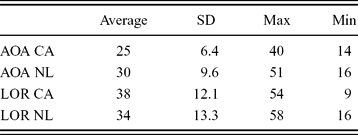
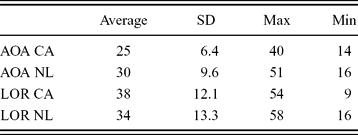
Averages for AOA and LOR for both L2 groups are displayed in Table 1. In independent t-tests, AOA proved to be significantly different between the Canadian and the Dutch groups. German immigrants in Canada immigrated at a significantly younger age than those who moved to the Netherlands (t(55) = 2.75; p < .05). There was no significant difference between the LOR of the German immigrants in Canada and those in the Netherlands.
Age of acquisition (AOA) and length of residence (LOR) for German immigrants to either Anglophone Canada (CA) or the Dutch Netherlands (NL). AOA and LOR are in years. AOA differs significantly between the CA and NL groups, LOR does not.
In order to assess the impact of type of contact with L1 on perceived foreign accent, a distinction was made between two different types of contact: L1 use in settings in which it is likely for code-mixing and/or code-switching to occur (C+M) and L1 use in settings in which little code-mixing and/or code-switching is likely to occur (C−M). The variable C–M represented communication in German either in a formal work setting or with individuals resident in Germany. The variable C+M represented communication in German in an informal setting with family and friends resident in either Canada or the Netherlands. A number of background variables pertaining to language use, habits and environment were collected during an interview with each informant. All questions were on a five-point Likert scale, which was later converted to an interval variable between 0 and 1. For each variable, 0 refers to no use or presence of the L1 in that particular type of situation, while 1 refers to extremely frequent use or presence of the L1.
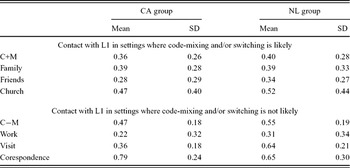
It should be specified that the bilingual participants were not asked directly in the interview whether they code-mixed or code-switched in the specified settings. Instead, the participants described the frequency of contact they had with their native language through particular predetermined communication settings, such as at work or with family. It was then postulated ex post facto that within these various communication settings or domains (Schmid, Reference Schmid, Köpke, Schmid, Keijzer and Dostert2007), code-mixing was more or less likely to occur (see Table 2). For example, it was possible for a bilingual immigrant to be exposed to German through his or her family in Canada or the Netherlands, but to have a circle of friends in which the L2 was predominantly used. For this example, the variable FAMILY would be at the higher end on the scale between 0 and 1; whereas the variable FRIENDS would be at the lower end. The contact variable in which code-mixing and/or code-switching was likely to occur (C+M) was an overall average of three variables:
• FAMILY (frequency of L1 use with all family members in Canada or the Netherlands, including children and grandchildren),
• FRIENDS (frequency of L1 use with friends, proportion of friends and acquaintances whose native language is German),
• CHURCH (frequency of L1 use at church in Canada or the Netherlands).
The contact variable in which code-mixing and/or code-switching was not likely to occur (C−M) was also an overall average of three variables:
• WORK (frequency of L1 use with native German speakers at work, for example, in the case of translators, German teachers and employees at consulates or embassies),
• VISIT (frequency of visits to Germany),
• CORRESPONDENCE (frequency of contact to L1 through telephone conversations and written correspondence, etc. with native German speakers in Germany).
L1 exposure and use among the experimental groups. Contact for both C+M (code-mixing expected) and C−M (code-mixing not expected) is based on a scale of 0–1, with 0 representing the least amount of contact and 1 the maximum. CA = Anglophone Canada, NL = the Dutch Netherlands.

In independent t-tests, only frequency of visits (VISIT) to Germany proved to differ significantly between the two groups (t(55) = −5.455, p < .001). Given the geographical proximity of the Netherlands to Germany on the one hand, and the distance of Canada from Germany on the other, this difference is not surprising. The fact that the averaged variables C+M and C−M were not significantly different for the two groups suggests that German immigrants to Canada compensated for a lack of visits through alternative means.
The speakers’ regional accent was also assessed in the questionnaire, due to the fact that this may have influenced the perception of foreign accented speech. Based on a yes–no self-assessment, two subcategories were created: speakers who assessed themselves to have a regional accent (n = 20) and those who did not (n = 37). An independent t-test with the dependent variable of FAR revealed no significant difference between the regionally accented and the non-regionally accented groups. For this reason, no further differentiation was made between potentially regionally accented and non-regionally accented speech, although the impact of this variable is approached in the discussion.
Control subjects
Five German monolinguals, who were habitants of Germany and had never lived in a foreign country, were chosen to represent the control group. Two of the controls were female and three were male. The youngest control subject was 53 years of age and the oldest was 65, with an average age at time of recording of 61 years. There was a similar level of education between the control and experimental groups. Some subjects in the control group had knowledge of foreign languages, but all described themselves as being monolingual German speakers. Amount of L1 exposure and use was therefore not measured, since German was the only or overwhelmingly predominant language used in daily life for all control subjects.
Listeners
Two groups of German listeners completed the foreign accent assessment in two separate sessions. Ten listeners took part in the first session and nine listeners took part in the second. These 19 German listeners were students in early adulthood at the Department of Phonetics at the University of Trier, Germany. They ranged in level of phonetic training from being at the beginning of their studies to the final stages. Some research suggests that phonetic training can improve an individual's ability to detect foreign accent (Flege and Fletcher, Reference Flege and Fletcher1992; Piske, MacKay and Flege, Reference Piske, MacKay and Flege2001). Due to this training, listeners were considered to be potentially more adept at detecting foreign accent than monolingual German native speakers with no phonetic training.
A minimal to non-existent knowledge of both English and Dutch was controlled for through the listeners’ self-assessment, since Flege and Fletcher (Reference Flege and Fletcher1992) show that increased exposure to a specific foreign accent reduces a listener's perception of the degree of accentedness for a speaker. Because English is taught at an early school age in Germany, contact with the English language in childhood could not be entirely prevented. Similarly, due to the geographical proximity of the Netherlands to the city of Trier, which is in the south west of Germany, exposure to the Dutch language could not be entirely prevented. Listeners who had been extensively exposed to either English or Dutch, for example through a school exchange to an Anglophone or Dutch-speaking country, were omitted. Listeners who described themselves as being bilingual with any language combination were also omitted from the analysis.
The listeners heard 34 German native speakers with English as an L2, 23 German native speakers with Dutch as an L2, and five German native speaker controls in random order. The order of presentation was the same for both the first and the second session. Inter-rater reliability was excellent, with a Cronbach alpha coefficient of 0.94, indicating homogeneity within the ratings.
Results
The main objective of this investigation was to determine whether native speakers of German living in either Anglophone Canada or the Dutch Netherlands are perceived to have a global foreign accent in their native German speech.
Due to the fact that the data were positively skewed, a Mann-Whitney test was conducted in order to investigate the primary aim of the study. Each averaged FAR for the experimental group (nEG = 57) was compared to each averaged FAR of the control group (nCG = 5). The consecutive bilinguals received a median FAR of 3.2, whereas the control group received a median FAR of 1.6. This difference was revealed to be significant at the 5% level (U = 57.00, p < .05, r = −.28), indicating that the German listeners were more likely to perceive consecutive bilinguals in Anglophone Canada and the Dutch Netherlands to have a global foreign accent than the monolingual German controls. A Mann-Whitney test between the averaged FARs of the English and Dutch L2 groups (median = 3.14 vs. 3.16, respectively) indicated that there was no significant difference between these two groups (U = 362.50, p = .643).
Not all bilinguals were evaluated to have a global foreign accent in their native German speech. Twenty bilinguals were rated clearly to be native speakers (2.5 ≥ FAR ≥ 1.0) (Group 1) and 23 had an unclear FAR (4.5 > FAR > 2.5) (Group 2). Fourteen bilinguals were rated clearly to be non-native speakers of German (6.0 ≥ FAR ≥ 4.5) (Group 3). Group 1 had an average FAR of 1.9 and comprised 11 English L2 speakers and 9 Dutch L2 speakers. Group 2 had an average FAR of 3.3 and comprised 14 English L1 speakers and 9 Dutch L2 speakers. Group 3 had an average FAR of 5.3 and comprised 9 English L2 speakers and 5 Dutch L2 speakers.
Multiple regression analyses were carried out in an attempt to determine the influence of various predictor variables in the German listeners’ evaluations of the consecutive bilinguals. For all of the regressions, mathematical assumptions, such as no perfect multicollinearity, were met, unless otherwise specified. The first regression tested the impact of the predictor variables AOA, LOR, C−M and C+M on the outcome variable FAR for both L2 groups (nEG = 57). This model was significant with a total adjusted R2 of .12 (p < .05). The variable C−M was the only significant predictor variable, with a standardized beta value of −.307 (p < .05); however, significant correlations were evident in this regression, with the most obvious being between AOA and LOR, (R = −0.616, p < .01) and between C−M and C+M (R = 0.558, p < .001), suggesting that, although differentiated here, there was a positive relationship between the different types of contact. To see whether the effect of C−M would be more clear for immigrants who had departed Germany at an older age, hence after the age of 22 (nEG>22 = 39) (de Leeuw et al., Reference Leeuw, Schmid and Mennen2007), AOA, C−M and C+M were entered into a further multiple regression. LOR was not entered because it had been the least successful at predicting FAR in the previous analysis. This model was highly significant with a total adjusted R2 of .316 (p < .001) and C−M was again the only significant predictor variable with a standardized beta value of −.471 (p < .01). Again, there was a significant correlation between C−M and C+M (R = 0.448, p < .05), as well as between C+M and AOA (R = 0.311, p < .05), although there was no correlation between C−M and AOA.
The averaged predictor variable C−M was then broken down and its subvariables were entered into a final multiple regression (nEG = 57). Here, the model was significant (Adjusted R2 = .187, p < .01) with CORRESPONDENCE being the only significant predictor variable (standardized beta value of −.317 (p < .05)), although WORK approached significance. In this model, none of the predictor variables correlated with one another. The question was then asked whether the subvariables of C−M would achieve greater significance in the subgroup of bilinguals who immigrated (to either Canada or the Netherlands) after the age of 22 (nEG>22 = 39). This was the case. Again, none of the predictor variables correlated with one another and the model was highly significant (adjusted R2 = .410 (p < .0001)). Both WORK with a standardized beta value of −.305 (p < .05) and CORRESPONDENCE with a standardized beta value of −.551 (p < .001) were significant.
Finally, when the subvariables of C+M were broken down and entered on their own in a multiple regression (nEG = 57, the model itself was significant (Adjusted R2 = .096, p < .05), but none of the subvariables on their own were significant. When this regression was repeated including only bilinguals who immigrated after the age of 22, the model was no longer significant.
Discussion
The fact that FAR was significantly higher in the experimental group is consistent with previous studies which suggest that specific phonetic elements of a native language system may be susceptible to L1 attrition, even in adult L2 learners. Furthermore, because only 14 consecutive bilinguals were clearly assessed to be non-native speakers of German (6.0 ≥ FAR ≥ 4.5), L1 attrition at the level of global foreign accent is not revealed to be an a priori consequence of immigration to an L2 environment.
The finding that some consecutive bilinguals had a foreign accent in their native speech is in line with Sancier and Fowler's (Reference Sancier and Fowler1997) study which found that native Brazilian Portuguese judges reported a foreign accent in the pronunciation of a native Brazilian Portuguese speaker after her extended sojourn in the United States. The findings were also consistent with previous studies which suggest that specific phonetic elements of a native language system may be susceptible to L1 attrition, even in adult L2 learners (Flege, Reference Flege1987; Major, Reference Major1992; Sancier and Fowler, Reference Sancier and Fowler1997; Mennen, Reference Mennen2004).
It has also been revealed that there was no significant difference between the FAR of English L2 and Dutch L2 speakers. Still, further research may indicate that different L2s do have different effects on the same native language. Moreover, future studies with larger sample groups may substantiate the speculation that it is more difficult for listeners to differentiate between regionally accented and foreign accented speech when languages are used whose dialect borders overlap, as is the case for the Netherlands and Germany. In other words, it may be that in the present study, potentially Dutch foreign accented speech was confused with German regionally accented speech. When German listeners were asked to describe what they had based their native- versus non-native-speaker judgements on at the end of the listening session, some responded that they had difficulties differentiating between regionally accented and foreign accented speech. One listener even specified that this was particularly with reference to speakers from Northern Germany, hence speakers of Low Germanic dialects which, like Standard Dutch, were not affected by the historical High German Consonant Shift. Of the bilinguals in the experimental group who described themselves to be representative speakers of a regional accent, only one subject noted his regional accent to be influenced by a Low Germanic dialect. Accordingly, the comments made by the listeners suggest that some potentially (Dutch) foreign accented speech may have been misinterpreted to be regionally accented (Low German) speech, or vice versa. However, although this is something to be aware of in future studies, no significant difference between speakers with English and those with Dutch as an L2 was found in the present study. Nevertheless, similar studies in the future may prefer to choose languages in which dialect borders do not overlap.
With regard to regional accent, there was also the possibility that German monolingual listeners, although they had some phonetic training, were less able to distinguish between foreign accented and non-foreign accented speech in regional accents varying from that of their own. This might have resulted in the overall tendency for German bilinguals with a strong regional accent which differed from the regional accent of the listeners to be less accurately assessed than German bilinguals who were representative speakers of either Standard German or of a regional accent familiar to the listeners. Although not direct evidence against the claim that such regionally accented speech may have been less accurately assessed, it is interesting to note that the difference in FAR between experimental speakers who described themselves as having a regional accent in their native German speech and those who did not was not significant. Still, in future studies it would be beneficial to control for regional accent by ensuring that the regional accents of the listeners overlapped with the regional accents of the speakers. This could be done by conducting the foreign accent assessment at different locations in Germany, thereby ensuring that listeners representing various regional accents were presented with a broad array of German regional accents. In such a way, it could be verified that the significantly higher FAR of the experimental group was not determined to some degree by a less accurate assessment of unfamiliar regionally accented speech.
A further objective of this study was to investigate the impact of AOA, LOR, and contact on the outcome variable of FAR. Two types of contact were differentiated. On the one hand, the variable C−M represented communicative settings in which little code-mixing between the L1 and L2 was expected to occur, for example in formal, professional settings or in telephone conversations with friends and family in Germany. On the other hand, the variable C+M represented communicative settings in which code-mixing was thought to be more likely to occur, such as with family or friends in Canada or the Netherlands. The categorization of specific subvariables to settings either characteristic or non-characteristic of code-mixing can be debated. One could argue, for example, that some immigrants actively prohibit language mixing in their family, or that in some professional settings, mixing may occur quite frequently. Nevertheless, for the purpose of this more exploratory investigation, generalizations were made and the results revealed that the predictor variable C−M was successful at predicting foreign accented native speech, whereas C+M was not. In other words, German native speakers with a high amount of L1 contact in settings in which code-mixing was not expected to occur were less likely to be perceived as non-native speakers in their L1 than those immigrants who had less L1 contact in such settings. Moreover, the effects of C−M were more substantial in immigrants who departed from Germany at a later age, after the age of 22.
It was furthermore assessed to what degree the individual variables that had gone into the calculation of C−M were responsible for the overall effect. It seemed that L1 use at work and contact with speakers in Germany (for example through telephone conversations) were significant, while the frequency of visits to Germany played no significant role. Again, these predictor variables were more significant in immigrants who had departed from Germany after the age of 22.
The fact that VISIT did not come up as a significant predictor variable for FAR is surprising, since this was the only factor among all variables which describe L1 exposure in everyday life where there was a significant difference between the two migrant groups. There are several possible explanations for this. Firstly, the variable includes only the number of visits, not the total duration of the visits. Given the expense associated with visits to Germany from Canada on the one hand, and the ease with which a visit from the Netherlands to Germany can be accomplished on the other (a car journey from the region where the interviews took place to the German border will take less than two hours on average), it is possible that the Canadians, while visiting less frequently, went for longer periods of time. This might indicate that a longer sojourn is necessary for the effect on pronunciation to become noticeable, which would be in line with the findings of Sancier and Fowler (Reference Sancier and Fowler1997), who report that the pronunciation of their subject became more native-like after a stay in Brazil of “several months” (p. 421). Furthermore, the reported amount of contact with L1 (for example through telephone conversations) is slightly, though not significantly, higher for the Canadian group, so it is possible that the lack of exposure through visits was compensated to some degree in this manner. On the other hand, it is possible that the effects achieved by each visit are temporary, and that after a certain time back in the recipient country, foreign accent sets in again. This would suggest that, in order to achieve a long-term effect, contact needs to be more frequent than even the several times per year that the Dutch group returns to Germany on average.
In summary, the results indicate that contact with one's native language through communicative settings in which code-mixing is inhibited may aid in maintaining the stability of native language pronunciation in consecutive bilinguals. Conversely, contact with one's native language through communicative settings in which code-mixing is allowed, or activated, does not contribute to maintaining the stability of native language pronunciation in consecutive bilinguals.
Lack of code-mixing in conversation can be compared to contact in a monolingual mode (Grosjean, Reference Grosjean1982), frequency of communication in this mode being more successful at predicting global foreign accent in native speech than contact with the native language in a bilingual mode, AOA, or LOR. The formality of a professional situation or the native language of an interlocutor who does not understand L2 items may prompt such a monolingual mode in which little code-mixing occurs. And yet a lack of code-mixing is not always equivalent to a monolingual mode. For example in the case of translators and foreign language teachers, code-mixing may be rare in the output, and yet communication might likely be situated in a bilingual mode. With a view towards language mode, the results of the present study suggest that exposure to the L1 as spoken by monolinguals, where language mixing is considered inappropriate, plays an important role in maintaining the stability of a pronunciation characteristic of native speakers.
What are the further consequences of these findings? On the one hand, there are social implications. The fact that consecutive bilingual immigrants may be interpreted as being non-native speakers has effects on whether they will be perceived as members of the linguistically and culturally dominant group in their country of origin, or not. This draws our attention to the term native speaker and all the cultural implications which are indirectly associated with this term (Cook, Reference Cook and Cook2003), although they may or may not coincide.
On the other hand, the results also have theoretical implications for the debate on the role of age in language acquisition. The participants in this study acquired their native language, and only their native language, in full during childhood: their process of L1 acquisition was unaffected by maturational constraints (Abrahamsson and Hyltenstam, Reference Abrahamsson and Hyltenstam2009). And yet the stability of the native language, at least for some individuals, wavered. The finding in no way fundamentally negates the possibility of a maturational constraint in language acquisition. Still, the results question the supposed stability of a language acquired within childhood and adolescence and, more directly, whether contact with the native language is more powerful in predicting this stability rather than the age at which the language was acquired per se.