Introduction
Evidence increasingly indicates that language input is linked to the vocabulary development of children who has consistent experience in a minority language (L1) at home from birth and start to learn a second language (L2) during childhood (Branum-Martin, Mehta, Carlson, Francis & Goldenberg, Reference Branum-Martin, Mehta, Carlson, Francis and Goldenberg2014; Dixon, Zhao, Quiroz & Shin, Reference Dixon, Zhao, Quiroz and Shin2012; Duursma, Romero-Contreras, Szuber, Proctor, Snow, August & Calderon, Reference Duursma, Romero-Contreras, Szuber, Proctor, Snow, August and Calderon2007; Hammer, Miccio & Wagstaff, Reference Hammer, Miccio and Wagstaff2003; Hoff, Core, Place, Rumiche, Senor & Parra, Reference Hoff, Core, Place, Rumiche, Senor and Parra2012; Jia, Chen, Kim, Chan & Jeung, Reference Jia, Chen, Kim, Chan and Jeung2014; Pearson, Reference Pearson2007; Thordardottir, Reference Thordardottir2011; Uchikoshi, Reference Uchikoshi2006). Language input is embedded within various socio-cultural contexts, ranging from play in unconstrained language environments (e.g., dinner or free play) to structured learning activities (e.g., book reading). Current language acquisition theories such as dynamic systems theories view language input as an essential element for language learning in developing children (De Bot, Lowie & Verspoor, Reference De Bot, Lowie and Verspoor2007), and research on statistical learning suggests that language input is rich in statistical regularities (Chemla, Mintz, Bernal & Christophe, Reference Chemla, Mintz, Bernal and Christophe2009; Estes, Gluck & Grimm, Reference Estes, Gluck and Grimm2016; Saffran, Aslin & Newport, Reference Saffran, Aslin and Newport1996). Thus, language input offers a valuable opportunity for children to develop the cognitive processing skills needed for vocabulary learning (Marchman, Fernald & Hurtado, Reference Marchman, Fernald and Hurtado2010). For sequential bilingual children who start to learn L2 in school settings, consistent input in each language is crucial to their vocabulary development (Kohnert, Reference Kohnert2010). Previous studies have shown that consistent L2 input in school leads to rapid growth of L2 in sequential bilingual children (Durrsma et al., Reference Duursma, Romero-Contreras, Szuber, Proctor, Snow, August and Calderon2007; Kan & Kohnert, Reference Kan and Kohnert2005; Kohnert, Reference Kohnert2010). And yet, some children experience L1 attrition (e.g., Kan & Kohnert, Reference Kan and Kohnert2005), which has been linked to the decrease of L1 use at home (Kohnert, Reference Kohnert2010; Luo & Wiseman, Reference Luo and Wiseman2000; Paradis, Emmerzael & Duncan, Reference Paradis, Emmerzael and Duncan2010). While progress has been made in understanding the link between language input and vocabulary development, little is known about the variability of L1 and L2 used in minority homes and the complex input-vocabulary relationships in sequential bilingual children.
This study examined the home language-learning environment of preschool children who were initially exposed to Cantonese input (L1) at home and began to formally learn English (L2) later as a second language in the classroom. By definition, sequential bilingual children receive L1 input from birth and have established their L1 skills before they start to learn L2 (Kohnert, Reference Kohnert2010; Paradis, Reference Paradis2010). The sequential L1-L2 learning experience in these children is different from that in simultaneous bilinguals, who receive consistent input from both languages at home before the age of 3 years (Genesee, Paradis & Crago, Reference Genesee, Paradis and Crago2004). In the U.S., many sequential bilingual children are immigrant children who are exposed to minority languages at home as L1 (e.g., Spanish, Hmong, Vietnamese) and begin learning English (L2) when they enter school (Branum-Martin et al., Reference Branum-Martin, Mehta, Carlson, Francis and Goldenberg2014). However, it would be unrealistic to expect that these immigrant children, who live in a community where English is the majority language, have not received any English exposure before starting school. In fact, studies have reported that sequential bilingual children living in the U.S. may have already been exposed to some L2 at home (e.g., from the media or interacting with siblings) before starting school (Branum-Martin et al., Reference Branum-Martin, Mehta, Carlson, Francis and Goldenberg2014; Duursma et al., Reference Duursma, Romero-Contreras, Szuber, Proctor, Snow, August and Calderon2007; Jia & Aaronson, Reference Jia and Aaronson2003; Luo & Wiseman, Reference Luo and Wiseman2000). In this study, sequential bilingual children were operationally defined as those whose parents were native speakers of Cantonese and that the overall use of Cantonese at home was over 80%. The amount of L2 used in minority households depends on factors such as family members’ language proficiency, socioeconomic background, cultural practices at home, or common beliefs about L1 interference with L2 learning and vice versa (Chan, Brandone & Tardif, Reference Chan, Brandone and Tardif2009; Hammer, Komaroff, Rodriguez, Lopez, Scarpino & Goldstein, Reference Hammer, Komaroff, Rodriguez, Lopez, Scarpino and Goldstein2012; Minami, Reference Minami2008; Wang, Leichtman & Davies, Reference Wang, Leichtman and Davies2000; Roberts, Reference Roberts2008). These factors suggest that there is great variability in the amount of L1 and L2 input across different culturally and linguistically diverse populations. Thus, the L1 and L2 input patterns in immigrant families who speak a minority language at home could be more difficult to follow than the patterns in homes where children learn two languages simultaneously (Paradis, Reference Paradis2010).
Previous studies have found heterogeneous patterns of language input in homes of Spanish–English sequential bilingual children (Branum-Martin et al., Reference Branum-Martin, Mehta, Carlson, Francis and Goldenberg2014). Yet, little is known about the unique interplay of L1 and L2 input patterns at home in families who speak other minority languages (e.g., Cantonese, Tagalog). Studying the variation of bilingual language input in children from linguistically diverse backgrounds would contribute to our understanding of the role of linguistic environments in language development. The current study focused on the complex relationships between bilingual language input and children's vocabulary development. Clinically, the results could be informative to speech-language pathologists and educators for developing intervention programs to enhance family involvement in their children's language learning at home. In what follows, key studies on L1 and L2 input across families where a minority language (Cantonese) is spoken as L1 at home are discussed and evidence is presented on the vocabulary skills of sequential bilingual children as a result of L1-L2 home exposure.
Sequential bilingual children's exposure to L1 and L2 at home
Parent reports, which have been frequently used in previous research to measure language input, are a feasible method to examine the dual language exposure of simultaneous and sequential bilinguals (Paradis, Reference Paradis2017) despite its limitations in measurement precision (Carroll, Reference Carroll2017). Studies that used parent reports have shown that there is variability in bilingual language use among Spanish-speaking families living in the United States. For example, Branum-Martin and colleagues (Reference Branum-Martin, Mehta, Carlson, Francis and Goldenberg2014) examined the language use in the homes of 1,115 Spanish-speaking children who learned English as L2. Nearly 70% of the parents reported that they spoke only Spanish (100%) or mainly Spanish to their children, while other parents spoke a more balanced proportion of both languages or only English at home. The amount of children's L1 and L2 exposure at home was influenced by many factors, such as family members’ language proficiency, language preference, the child's skills in each language, home language-learning activities, attitudes toward each language, and cultural backgrounds and upbringings (Branum-Martin et al., Reference Branum-Martin, Mehta, Carlson, Francis and Goldenberg2014; Buac, Gross & Kaushanskaya, Reference Buac, Gross and Kaushanskaya2014; Hoff & Core, Reference Hoff and Core2015; Jia & Aaronson, Reference Jia and Aaronson2003; Jia et al., Reference Jia, Chen, Kim, Chan and Jeung2014; Luo & Wiseman, Reference Luo and Wiseman2000; Quiroz, Snow & Zhao, Reference Quiroz, Snow and Zhao2010; Scheele, Leseman & Mayo, Reference Scheele, Leseman and Mayo2010). The current study focused on the unique patterns of L1 and L2 use in Cantonese-speaking homes. Cultural-specific factors that are associated with Chinese families such as parental involvement in children's academic performance, family dynamics, parents’ attitudes toward Cantonese and English, and the roles of extended family members (Han, Lee & Waldfogel, Reference Han, Lee and Waldfogel2012; Huntsinger & Jose, Reference Huntsinger and Jose2009; Luo & Wiseman, Reference Luo and Wiseman2000) might affect the patterns of L1 and L2 use among family members and across various activities at home.
There are noticeable differences among the family members of sequential bilingual children in their L1-L2 use at home (Arriagada, Reference Arriagada2005; Branum-Martin et al., Reference Branum-Martin, Mehta, Carlson, Francis and Goldenberg2014; De Houwer, Reference De Houwer2007; Hammer et al., Reference Hammer, Miccio and Wagstaff2003; Jia & Aaronson, Reference Jia and Aaronson2003; Jia et al., Reference Jia, Chen, Kim, Chan and Jeung2014; Pearson, Reference Pearson2007; Pérez-Leroux, Cuza & Thomas, Reference Pérez-Leroux, Cuza, Thomas, Potowski and Rothman2011; Quiroz et al., Reference Quiroz, Snow and Zhao2010). For example, Branum-Martin et al. (Reference Branum-Martin, Mehta, Carlson, Francis and Goldenberg2014) found that 70% of parents of the participants reported that they spoke only/mainly Spanish (L1) to their children, whereas 33% of the children's older siblings used only/mainly Spanish at home. It is possible that older siblings preferred to speak more English (L2) due to their increasing L2 proficiency as a result of being more frequently involved with teachers and peers at school (Jia et al., Reference Jia, Chen, Kim, Chan and Jeung2014). Chinese families often have live-in extended family members such as grandparents who take on the roles of caregivers at home (Luo & Wiseman, Reference Luo and Wiseman2000). Few studies have directly examined the language use of young L2 learners’ grandparents.
Another interesting aspect about bilingual children's language input is the preferential use of L1 and L2 across home activities. Many activities take place at home such as dining, playing, cooking, television-watching, and language-learning. L1 and L2 preferences for literacy-related activities appear to vary across families, individual family members, and the activity itself. For example, Hammer et al. (Reference Hammer, Miccio and Wagstaff2003) examined 15 Spanish–English sequential bilingual children's literacy activities at home. Results showed that 75% of the families used only Spanish, 17% used more Spanish than English, and 8% used equal amounts of both. Interestingly, Branum-Martin et al. (Reference Branum-Martin, Mehta, Carlson, Francis and Goldenberg2014) found that children's home literacy-related activities in L2 were associated with the amount of English spoken by parents. Their findings suggest that differences in the amount of L1 and L2 across home activities could be related to family members' language use. For instance, book reading at home might likely be a one-on-one parent-child activity: thus the use of L1 or L2 in those activities could be related to parents’ language preference and could vary across families (e.g., Quiroz et al., Reference Quiroz, Snow and Zhao2010). In contrast, L1 may generally be used during dining times as it is the home language, and especially when grandparents, whose main language is L1, are present.
In summary, previous studies highlight two crucial aspects in investigating the amount of L1 and L2 use at home when socioeconomic factors are controlled for. First, L1 and L2 use at home is likely to differ across family members due to the members’ experience and proficiency in each language, cultural beliefs, and interpersonal nature of communication. Second, the amount of L1 and L2 may vary across home activities (e.g., book reading and dining) because of various family-related factors such as participating members’ language proficiency or preference. Accordingly, it is essential for models that examine language use in bilingual homes to take into account these complex relationships among family members and activities.
Language input effects on single-language vs. conceptual vocabulary
Many studies have documented the relationships between bilingual language input and children's vocabulary development (Buac et al., Reference Buac, Gross and Kaushanskaya2014; Duursma et al., Reference Duursma, Romero-Contreras, Szuber, Proctor, Snow, August and Calderon2007; Hoff & Core, Reference Hoff and Core2013; Jia et al., Reference Jia, Chen, Kim, Chan and Jeung2014; Scheele et al., Reference Scheele, Leseman and Mayo2010; Thordardottir, Reference Thordardottir2011). Although such links suggest that language input and bilinguals’ vocabulary learning in each language are closely related, the nature of such relationships is not completely clear. For example, previous studies have focused on within-language relationships between input and vocabulary in either L1 or L2 (Branum-Martin et al., Reference Branum-Martin, Mehta, Carlson, Francis and Goldenberg2014; Jia & Aaronson, Reference Jia and Aaronson2003; Paradis, Reference Paradis2011). Yet, relatively little attention is paid to the cross-language relationships between input and vocabulary. Scheele et al. (Reference Scheele, Leseman and Mayo2010) found both within- and across- language relationships between vocabulary and the use of L1 and L2 across several home activities including reading, storytelling, conversations, singing, and educational television-watching in two groups of sequential bilingual preschool-aged children who learned Dutch as L2 (i.e., Moroccan–Dutch, and Turkish–Dutch). They found L1-use effects on L1 vocabulary for Turkish–Dutch and Moroccan–Dutch bilingual children. In particular, L1-use during storytelling and conversations was related to the L1 vocabulary in Moroccan–Dutch and Turkish–Dutch bilingual children, whereas L1-use for singing and educational TV-watching was not related to the L1 vocabulary in both groups. Regarding L2 vocabulary, there was a L2-use effect on L2 vocabulary for the Turkish–Dutch bilinguals. Interestingly, singing in L2 was also not related to the L2 vocabulary in both groups of children. Storytelling and conversations in L2 were associated with L2 vocabulary in Turkish–Dutch children, but not in Moroccan–Dutch children. In contrast, the input-vocabulary relationships across language were not as strong as the within-language relationships. The conversations in L1 appeared to be positively related to Turkish-Dutch children's L2 vocabulary while singing in L1 was negatively related to their L2 vocabulary. No such relationships were found in Moroccan–Dutch children.
One explanation for the strong within-language relationships between input and vocabulary in bilingual children is the language-specific information available in the input. Language input contains highly specific lexical information, and therefore, an increase in input may indicate more opportunities for young learners to encode language-specific information and develop the cognitive processing skills that are essential for learning new words (cf., Marchman et al., Reference Marchman, Fernald and Hurtado2010). On the other hand, input in either language provides opportunities for children to learn the general properties of the language such as phonology and semantics (Freeman, Blumenfeld & Marian, Reference Freeman, Blumenfeld and Marian2016). Yet, cross-language relationships between input and vocabulary might be more complicated than within-language relationships. While more input in one language could facilitate the learning of the other language, it is possible that language-specific knowledge in one language could also interfere with the ability to process the other language (Bialystok & Feng, Reference Bialystok and Feng2009).
A unique characteristic of bilingual children is that their vocabulary knowledge is distributed across two languages, and the knowledge can be measured via conceptual vocabulary scores (Bedore, Peña, Garcia & Cortez, Reference Bedore, Peña, Garcia and Cortez2005; Pearson & Fernandez, Reference Pearson and Fernández1994; Pearson, Fernandez & Oller, Reference Pearson, Fernández and Oller1993). Conceptual vocabulary scores are the total number of independent concepts that are distributed across two languages (Bedore et al., Reference Bedore, Peña, Garcia and Cortez2005; Kan & Kohnert, Reference Kan and Kohnert2005; Pearson et al., Reference Pearson, Fernández and Oller1993). Pearson et al. (Reference Pearson, Fernández and Oller1993) first introduced the method for measuring lexicalized concepts in bilingual children. In particular, conceptual knowledge scores were calculated based on the child's responses for each item on the vocabulary measure in each language. For example, the child receives one point if he or she was able to identify an item (dog and/or perro) in either language or in both languages. While previous studies showed that bilingual children have lower language scores in either language than their monolingual peers, other research has confirmed that simultaneous bilinguals have a conceptual knowledge comparable to their monolingual counterparts (Pearson et al., Reference Pearson, Fernández and Oller1993). Although bilinguals’ conceptual knowledge suggests a relationship with the language input in L1 and L2, few studies have examined such relationships. This research gap, perhaps, is related to the lack of measures for capturing the distributed lexical knowledge in bilingual children.
The present study
The current investigation focused on the elaborate relationships between Cantonese–English sequential bilingual children's dual language input at home and its effect on their overall vocabulary skills. This study specified language input as the amount of language used by family members across unstructured and planned activities at home. Previous studies revealed three critical issues about the relationships between home language input and sequential bilingual children's vocabulary development. First, a single index (e.g., 80% Cantonese) does not accurately represent the overall amount of L1 and L2 used at home. L1 and L2 input are likely to vary across family members (e.g., parents, older siblings, grandparents) due to differences in L1-L2 proficiency and their distinct roles in the family. Based on the grandparents’ roles in Chinese families (Luo & Wiseman, Reference Luo and Wiseman2000) and the negative relationships between L2 proficiency and age of immigration (Hakuta, Bialystok & Wiley, Reference Hakuta, Bialystok and Wiley2003), grandparents of immigrant children (or the children of immigrants) were expected to use mainly L1 at home. Second, language learning occurs during various daily activities (e.g., storytelling, playing with family, dining time), and it is possible that the amount of L1 and L2 use varies across these activities due to factors such as participating family members’ L1-L2 proficiency and preference. Third, the complexity of L1 and L2 input at home plays a role in bilingual children's vocabulary knowledge, which includes not only knowledge in each language but also in their conceptual knowledge. To quantify this knowledge, a culturally-appropriate vocabulary measure was developed to examine Cantonese–English bilingual children's vocabulary knowledge in both L1, L2, and their conceptual knowledge (see Method; cf. Kan & Kohnert, Reference Kan and Kohnert2005). For young children who learn Cantonese and English in different social settings, some concepts were expected to be lexicalized only in Cantonese, some in English, and some in both languages. Estimating the number of concepts across two languages can allow for the study of the collective system of semantic knowledge across the two languages. This permits the examination of the complex relationships between language use at home and how it uniquely contributes to children's distributed vocabulary knowledge as well as their knowledge in each language.
Built from the general findings on language input that bilingual children receive at home, the current study examined (1) the potential variations of L1-L2 use across family members and home activities and (2) how the amount of L1-L2 exposure is related to the vocabulary knowledge of children who grew up in homes that were predominately Cantonese-speaking. The focus was not only on the links between input and vocabulary within each language but also on how input in each language contributed to the children's distributed conceptual knowledge. The present study examined three main topics of interest:
1. What are the amounts of L1 and L2 use across family members? What are the patterns of L1 and L2 use across home activities?
2. Do L1 and L2 use across family members and home activities predict children's vocabulary knowledge in L1 and in L2?
3. Do L1 and L2 use across family members and home activities predict children's distributed conceptual knowledge (i.e., their conceptual scores)?
Method
Participants
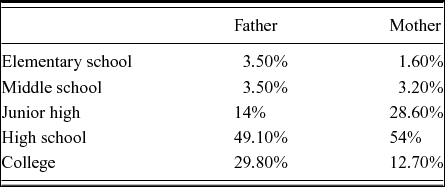
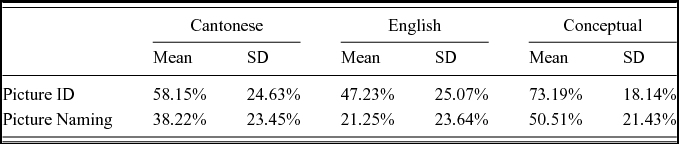
Participants were 92 children (46 girls and 46 boys; mean age = 49.87 months; SD = 6.62 months) who were exposed to Cantonese (L1) at home from birth and started to learn English (L2) in preschool. They were recruited from a Head Start program in San Francisco, California, where the majority of the children were from lower-SES households of Cantonese-speaking immigrants. The parents of the participants were native speakers of Cantonese and the families used more than 80% Cantonese in their overall activities at home. Consistent with previous studies that examined typically-developing bilingual children (Bialystok, Luk, Peets & Yang, Reference Bialystok, Luk, Peets and Yang2010; Duursma et al., Reference Duursma, Romero-Contreras, Szuber, Proctor, Snow, August and Calderon2007), the current study used parent and teacher reports to determine the eligibility for participation. Due to the lack of valid diagnostic assessments to identify Cantonese–English bilingual children who have language impairments, approaches used in earlier studies (e.g., Gutiérrez-Clellen & Kreiter, Reference Gutiérrez-Clellen and Kreiter2003) that utilized parent reports and teacher interviews to investigate Spanish–English bilingual children's language development were adapted for this study. Based on the reports, parents of the current participants did not have concerns about their children's language development. Additional interviews with teachers confirmed that these children's speech-language skills and school performance were within normal levels. Children who have an Individualized Education Plan were not eligible to participate. In order to provide more information about our participants in relation to other typically-developing Cantonese–English bilingual children, the current participants’ Cantonese and English vocabulary scores were compared to a database of 231 Cantonese–English bilingual preschoolers (Kai Ming Database, 2017). The dataset is an ongoing project at Kai Ming Head Start with the goal of examining the developmental language patterns of typically-developing Cantonese–English bilingual children. Our participants’ scores (see Table 2) were within 1.25 standard deviations of the means of the picture naming and picture identification tasks in L1 and in L2. The goal for the comparison between the current participants’ scores and the scores from the database was not to clinically identify their performance as typically-developing. Rather, the comparison was to provide information about the participants’ vocabulary skills in relation to other preschool-aged children from similar cultural and linguistic backgrounds. Parental reports indicated that 82.8% of the children participants were born in the United States and had stronger Cantonese skills than English skills at the time of testing. None of the participants had formal L2 instruction in school settings before they entered the Head Start program. On average, the children were enrolled in the preschool for 8.87 months (SD = 7.04; range = 1–26 months). More time in school indicates a more formal L2 experience. There was a strong correlation between participants’ age and their L2 experience in school (Months in preschool; r = .78, p < .001). The respondents of the questionnaires identified as mothers (n = 61), fathers (n = 15), both parents (n = 12), or other (n = 4). The respondents reported that they were native speakers of Cantonese, and none identified as native speakers of English. As shown in Table 1, most parents reported that high school was the highest level of education attained (Father: 49.1% and Mother: 54%). In addition, more fathers (29.8%) received a college education than mothers (12.7%). A related-samples Wilcoxon signed-rank test revealed that there was no significant difference between the education of fathers and mothers of the participants in the sample Test (Z = -1.49, p = .14).
Parents’ Highest Level of Education

All participants attended full-day classes, from 8 A.M. to 4 P.M. Both Cantonese and English were spoken in the classrooms, and each classroom was taught by a Cantonese–English bilingual teacher and a Cantonese–English bilingual teaching assistant, or by a monolingual English-speaking teacher and Cantonese–English bilingual teaching assistant. Although the focus of this study was on the amount of L1 and L2 used at home, classroom observations were conducted to qualitatively examine the amount of Cantonese and English used by bilingual teachers and assistants. In particular, classroom observations showed that both languages were used in all activities including breakfast, circle/group time, free play/small group activities, outdoor play, lunch, naptime, and snack. Formal language teaching took place during circle/group time, in which activities such as singing songs, book reading, and vocabulary learning were conducted once each in English and Cantonese. Circle/group time occurred several times per day for a total of 1.5 hours. During this time, the children received approximately the same amount of Cantonese and English input.
Parent questionnaires
Bilingual language use at home (L1 and L2) was measured using parent questionnaires that were available in Chinese (i.e., the written form of Cantonese) and in English. The first author was available in person to answer any questions. Each participating parent/caregiver was asked to take home or complete the questionnaire in the classroom. If the respondents took the questionnaire home, they were asked to return it within two days.
The format of the questionnaire was adapted from surveys and findings from previous studies (Duursma et al., Reference Duursma, Romero-Contreras, Szuber, Proctor, Snow, August and Calderon2007; Jia & Aaronson, Reference Jia and Aaronson2003; Pérez-Leroux et al., Reference Pérez-Leroux, Cuza, Thomas, Potowski and Rothman2011, and Stadthagen-González, Gathercole, Pérez-Tattam & Yavas, Reference Stadthagen-González, Mueller, Pérez-Tattam, Yavas and Gathercole2013). The questionnaire was composed of three main parts: (1) background/demographic information, (2) L1-L2 use by each family member, and (3) L1-L2 use during home activities. The background information section inquired about general language preference, language history, and parent education. Family member options included Mother, Father, Older sibling(s), Younger sibling(s), Grandmother, and Grandfather. Home language activities of interest were (Book) Reading out loud, Telling stories, Playing word games, Watching TV, Playing with family, Playing with friends, Breakfast, Lunch, and Dinner. Breakfast and lunch were excluded from the analysis because the children had breakfast and lunch in schools during the week and not at home. Additionally, language use patterns for breakfast and lunch were identical to the responses for dinner. Response options for the amount of L1-L2 use of family members and across activities were presented in 7 categories, which were coded from 1 to 7: (1) 100% English, (2) 20% Cantonese, 80% English, (3) 40% Cantonese, 60% English, (4) 50% Cantonese, 50% English, (5) 60% Cantonese, 40% English, (6) 80% Cantonese, 20% English, (7) 100% Cantonese. A lower number (1 or 2) represents higher amounts of L2, while a higher number (6 or 7) represents higher amounts of L1. The advantage of using a categorical system was that the rating provided perspectives for the respondents regarding the relative amount of L1 and L2 use without individual calculation of a percentage.
Receptive and expressive vocabulary in L1 and in L2
A picture identification task and a picture naming task in Cantonese and English were used to measure children's receptive and expressive vocabulary skills. The tasks were developed in collaboration with Kai Ming Head Start in San Francisco, CA. There were two main reasons for developing the vocabulary measures. First, bilingual children learn vocabulary across cultural and linguistic contexts (Peña & Halle, Reference Peña and Halle2011), and current measures that were developed for monolinguals (Peabody Picture Vocabulary Test) might fail to capture bilingual children's vocabulary knowledge (Pearson et al., Reference Pearson, Fernández and Oller1993; Restrepo & Silverman, Reference Restrepo and Silverman2001). Second, the tasks were able to measure the children's vocabulary skills in L1 and L2 as well as their distributed vocabulary knowledge (cf. Pearson et al., Reference Pearson, Fernández and Oller1993).
The tasks were developed in two phases for each language: (1) concept selection and (2) concept labeling. The first phase involved the selection of conceptual items for both picture identification and picture naming tasks across both languages. Target items included concepts that were consistent with children's cultural experience in Cantonese- and English-speaking settings. The concepts were selected from the item pools of the MacArthur-Bates Communicative Development Inventory (MCDI) (Fenson, Dale, Reznick, Bates, Thal, Pethick & Stiles, Reference Fenson, Dale, Reznick, Bates, Thal, Pethick and Stiles1994) and the Chinese Communicative Development Inventory – Cantonese version (CCDI-C; Tardif, Fletcher, Liang & Kaciroti, Reference Tardif, Fletcher, Liang and Kaciroti2009; Tardif, Fletcher, Liang, Zhang, Kaciroti & Marchman, Reference Tardif, Fletcher, Liang, Zhang, Kaciroti and Marchman2008). Concepts chosen from the MCDI were words that 98% of 30-month-old monolingual English-speaking children were able to recognize and produce. Concepts selected from the CCDI-C were words that were not already present in the MCDI. Additionally, from a name agreement study (Yoon, Feinberg, Hu, Gutchess, Hedden, Chen, Qicheng, Yao & Park, Reference Yoon, Feinberg, Hu, Gutchess, Hedden, Chen, Qicheng, Yao and Park2004), concepts that were common for both Chinese and American English speakers were also used as target items. After excluding concepts that were too difficult for the children to name or identify (i.e., kinship terms, classifiers, sound effects), a final total of 193 concepts comprised the target items for both vocabulary measures. One hundred and three target words were randomly selected for the picture naming task and 90 for the picture identification task. The target words were never repeated across tasks. Although early noun advantages have been proposed due to the concreteness of the noun concepts (McDonough, Song, Hirsh-Pasek, Golinkoff & Lannon, Reference McDonough, Song, Hirsh-Pasek, Golinkoff and Lannon2011), cross-linguistic research showed that young children acquiring Chinese languages did not have the advantage of learning nouns (Tardif, Reference Tardif1996; Tardif, Shatz & Naigles, Reference Tardif, Shatz and Naigles1997). Accordingly, the target items included a combination of nouns, verbs, and adjectives that were judged by 12 Cantonese–English bilingual adults to be culturally appropriate for Cantonese–English bilingual children growing up in the United States. The final list of items included 91 nouns, 6 adjectives, and 6 verbs for the picture naming task and 81 nouns, 3 adjectives, and 6 verbs for the picture identification task. Color photographs for each concept were selected by the PIs and teachers at Kai Ming Head Start from various sources such as Art Explosion Photo Objects (Nova Development, 2006), photographs from the second author, and Google Image.
For the picture naming task, each target item was presented on a white background on an iPad (9.5 inches x 7.31 inches) with a 1024 x 768 pixel resolution at 132 pixels per inch. For the picture identification task, each target item, along with the three foils from the same semantic category, were arranged in a quadrant and presented on the same iPad. All images were equal in size, and all target items for both tasks were identical in English and Cantonese. The order of the testing language was counterbalanced: half of the children were randomly assigned to be tested first in Cantonese. Trained research assistants, who were native speakers of the respective language, conducted testing with each child individually in a quiet area at the school center. The picture naming and picture identification tasks were administered to the child in Cantonese and English in two separate sessions. Practice items preceded each task. In the picture naming task, the question, “What is it?” was asked for pictures of nouns that were shown in the English session and, “呢個係乜野呀?” in the Cantonese session. For verbs, the questions, “What is he/she doing?” and “佢做緊乜野呀?” were asked. For adjectives, an object or individual from a pair of items was briefly described (e.g., “This man is tall,” for the English condition and its equivalent, “呢個男人好高” in Cantonese). Then the child was asked about the target item that depicted the opposite (i.e., short). The items that were named correctly in each language were recorded on scoring sheets. Alternative responses reflecting dialectical or acceptable variations of Cantonese were credited and marked as “correct”. If a participant took longer than 10 seconds to respond, the item was marked as “no response”. Ten percent of the picture naming test sessions were audio-recorded for offline analysis. A second trained research assistant scored the children's performance. The inter-rater reliability for picture naming was .98 for Cantonese and .97 for English. The maximum score for the picture naming task was 103.
During the picture identification task, four pictures were shown to the children at a time on an iPad screen. Instructions were to look at the pictures and point to the one that best matched the word requested by the examiner (e.g., “Show me _____,” for the English condition; “邊個係_____” for the Cantonese condition). Each picture that was correctly identified in each language was recorded. For the picture identification task, 10% of the participants were scored by two research assistants in the same room. The inter-rater reliability was .99 for Cantonese and .99 for English. The maximum score for the picture identification task was 90. The picture naming and picture identification scores for each language were converted into percent correct for statistical analyses.
In addition to the raw scores for each language condition, a conceptual score for the picture naming and picture identification tasks was calculated for each child based on his or her response for each item in Cantonese and in English. Using this method, one point was awarded when an item in English or its Cantonese equivalent was named or identified correctly, as well as when it was named or identified correctly in both languages. The conceptual scores were then converted into percent correct for statistical analyses.
Results
Expressive and receptive vocabulary
Table 2 summarizes the children's picture naming and picture identification performance (percent correct) in Cantonese and English. Repeated measures ANOVAs indicated that there was an effect of score type on their performance on both measures [Picture Naming: F(2, 182) = 54.18, p < .001, η2= .37; Picture Identification: F(1, 182) = 48.83, p < .001, η2= .34]. For picture naming, children's conceptual scores were significantly higher than their L1 and L2 scores (mean conceptual-L1 difference = 12.28; p < .001; mean conceptual-L2 difference = 29.25; p < .001), and their L1 scores were higher than their L2 scores (mean L1-L2 difference = 16.97, p < .001). For picture identification, children's conceptual scores were significantly higher than their L1 and L2 scores (mean conceptual-L1 difference = 15.04; p < .001; mean conceptual-L2 difference = 25.96; p < .001) and their L1 scores were higher than their L2 scores (mean L1-L2 difference = 10.92; p < .01). Correlational analyses indicated that children's expressive and receptive vocabulary in L2 was significantly correlated with Months in preschool (r = .83, p < .001, r = .79, p < .001, respectively). No significant relationships were found between Months in preschool and vocabulary in L1 (r = -.15, p >.05, r = .12, p > .05). In addition, their expressive and receptive conceptual vocabulary scores were also significantly correlated with Months in preschool (r = .43, p < .001, r = .38, p < .001, respectively).
Participants’ Vocabulary Skills: Cantonese (L1), English (L2), and Conceptual Scores (% Correct)

L1 and L2 use at home
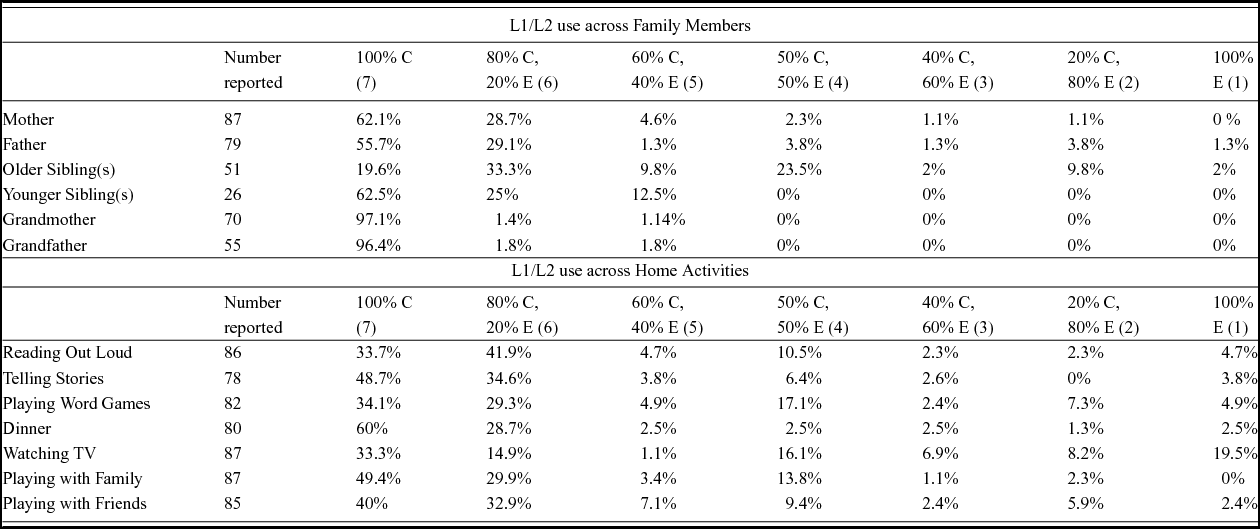
Percentages of bilingual language use across family members and home activities were calculated from parent questionnaires and shown in Table 3. Note that each household varied in the number of family members. Cantonese (L1) was reported as the primary language spoken at home by all members. Eighty-three percent of the participants were reported to be living with their grandfather and/or grandmother, where almost all grandparents (97.1% grandmothers, 96.4% grandfathers) spoke 100% Cantonese. While the majority of mothers and fathers spoke Cantonese on average, some parents also used some English. Older siblings incorporated the most L2 in their speech, whereas younger siblings spoke some L2 but never over half of their language production. As shown in Table 3, the participants engaged in a variety of activities at home. Note that the number of home activities reported varied across families. Although 84–94% of the respondents reported the language use during home activities, some left certain fields empty (e.g., watching TV, playing with family). According to the reports given, home activities were primarily carried out in L1. Some variability in the amount of L1 and L2 was found in activities such as Telling stories, (Book) Reading out loud, Playing word games, Playing with family and Playing with friends. Watching TV incorporated the highest amount of L2 by many families.
Distribution of Cantonese and English Use across Family Members and Activities

Note. C = Cantonese; E = English; Percentages are relative to the total amount of members and activities reported.
Relationships between language use at home and vocabulary knowledge
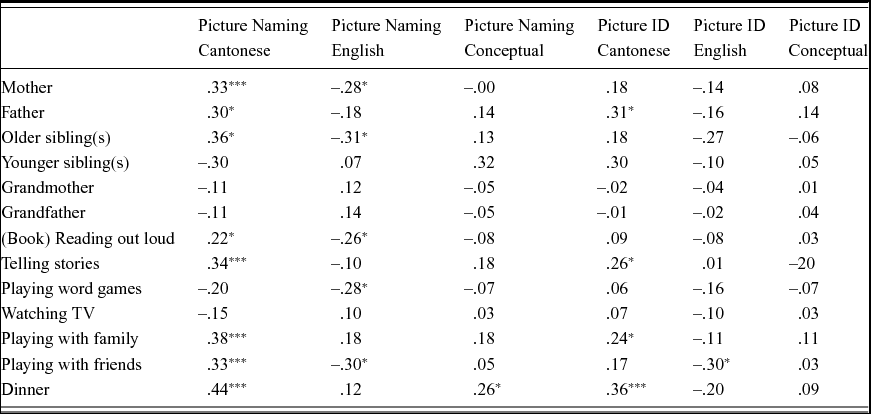
The correlations between home activities and children's vocabulary knowledge were examined. Table 4 summarizes the results of the correlation analysis. As previously mentioned, language use was categorized in a spectrum from 1 to 7, with 1 representing 100% English and 7 for 100% Cantonese. The overall results revealed negative relationships between high levels of English use and Cantonese vocabulary scores and positive relationships between high levels of English use and English vocabulary scores. In terms of language use by family member, results showed that Mother, Father, and Older siblings were associated with the variation of children's vocabulary scores (see specific results in Table 4). Further analyses indicated that the lack of correlations was likely related to the low variability of L1-L2 use by grandparents (i.e., almost all grandparents spoke 100% Cantonese). Regarding language use during home activities, (Book) Reading out loud, Telling stories, Playing with family, Playing with friends, and Dinner were related to L1 and L2 scores. In other words, children who received more L2 input from family members and/or across home activities had higher vocabulary scores in L2, and children who received more L1 had higher vocabulary scores in L1. Interestingly, children who received more L1 input during dinner were likely to have higher picture naming conceptual scores. An additional correlation analysis was done to examine the link between the amount of L1 and L2 used by parents and home literacy activities. The results indicated that mothers’ and fathers’ L1 use was related to the L1 use across all three home literacy activities, including (Book) Reading out loud, r = .46, p <.01; r = .28, p < .05; Telling stories, r = .55, p < .01; r = .3, p < .05, and Playing word games, r = 4, p < 0.01; r = .4, p < .01.
Correlations between Children's Vocabulary (% Correct) and L1/L2 Use at Home

Note. The amount of L1/L2 use was coded from 1 – 7, with 1 = 100% English and 7 = 100% Cantonese.
*p < .05. **p < .01. ***p < .001
Effects of L1 and L2 used by family members
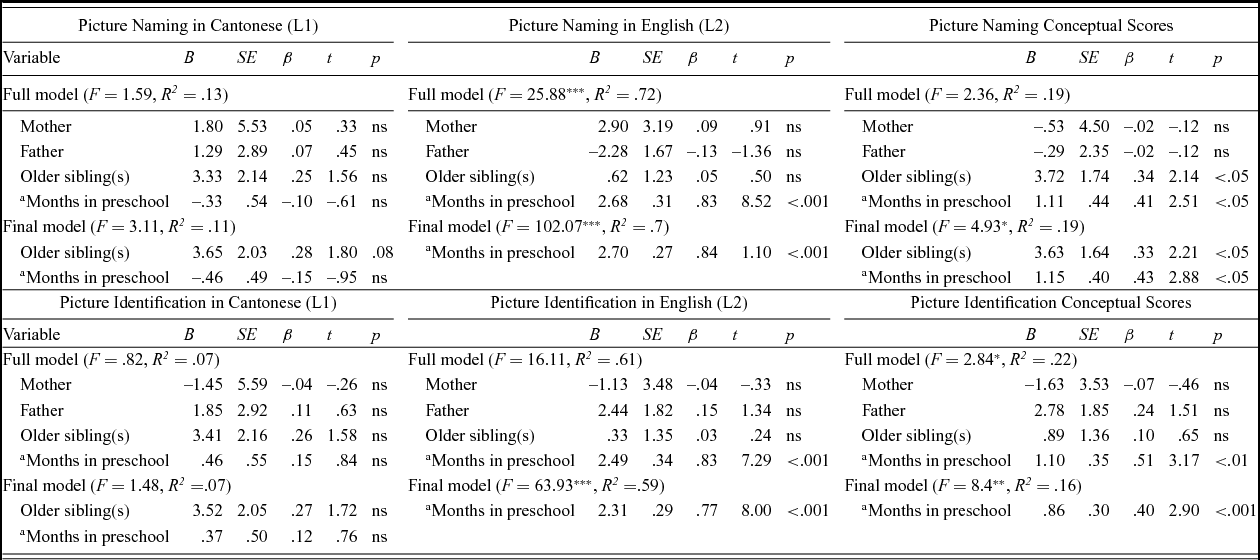
Backward regression analyses were used to examine the effect of the amount of L1 and L2 used by family members on children's receptive and expressive vocabulary scores. The outcome variables were picture naming and picture identification scores (% correct) in L1 and in L2. Based on the results of the correlation analyses between family members and vocabulary, Mother, Father, and Older siblings were used as predictors for the full regression. Months in preschool has been used in previous studies to indicate the time that children from minority homes receive consistent L2 input in school settings; and Months in preschool was significantly correlated with children's vocabulary in L2 (Jia, Kohnert, Collado & Aquino-Garcia, 2006; Kan & Kohnert, Reference Kan and Kohnert2005). Thus, Months in preschool was used as a covariate in the regression models. Non-significant predictors were removed from the full model to reach a final regression model. The results of the full and final regression models using family members as predictors are shown in Table 5. The results show that children's vocabulary in L1 or L2 was not affected by the amount of L1-L2 used by family members when their L2 experience (Months in preschool) was controlled for. In other words, the amount of L1-L2 used by family members in Cantonese-dominant households did not significantly contribute to children's vocabulary knowledge in L1 and L2.
Regression Models: Vocabulary Knowledge Predicted by L1/L2 Used by Family Members

Note. The predictors were the amount of L1/L2 used by Mother, Father, and Older sibling(s). The amount of L1/L2 use was coded from 1 – 7, with 1 = 100% English and 7 = 100% Cantonese. The conceptual scores are the total number of concepts, calculated from children's picture naming and picture identification scores in L1 and in L2.
*p < .05. **p < .01. ***p < .001
a Months in preschool was the covariate.
Effects of L1 and L2 used across home activities
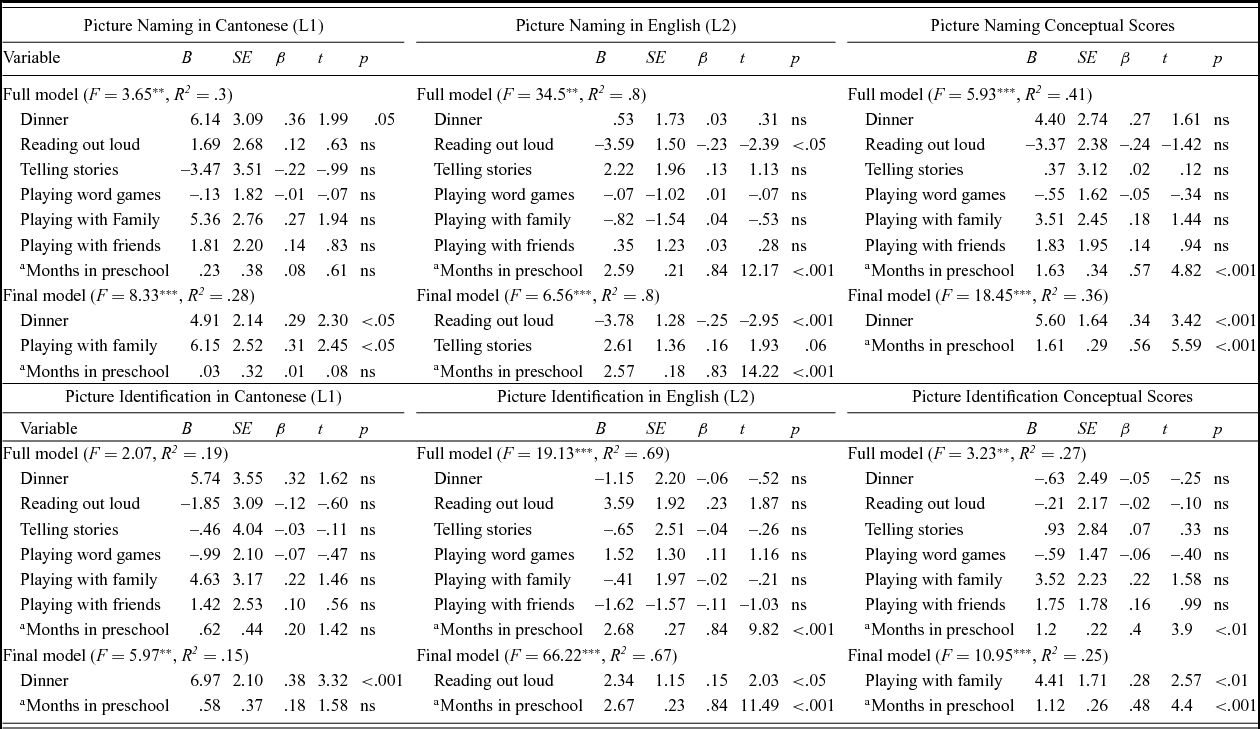
Backward regression analyses were used to examine the effect of the amount of L1 and L2 used across home activities on children's receptive and expressive vocabulary scores, with Months in preschool as a covariate. Based on the correlations between home activities and vocabulary, six variables were selected as predictors for the regression models: Dinner, (Book) Reading out loud, Telling stories, Playing word games, Playing with family, and Playing with friends. The results of the full and final regression models using home activities as predictors are shown in Table 6. When Months in preschool were controlled for, the results indicated that picture naming scores in L1 were predicted by the amount of L1 spoken during Dinner and Playing with family members; and picture identification scores in L1 were predicted by the amount of L1 spoken during Dinner. Table 6 also shows that picture naming scores in L2 were predicted by the amount of L2 used when Reading out loud and that picture identification scores in L2 were predicted by the amount of L2 use when Reading out loud in L1. The overall findings suggest that the amount of L1 used during some home activities plays a significant role in children's vocabulary in L1 and L2.
Regression Models: Vocabulary Knowledge Predicted by L1/L2 Used across Home Activities

Note. The predictors were the amount of L1/L2 used during Dinner, (Book) Reading out loud, Telling stories, Playing word games, Playing with family, and Playing with friends. The amount of L1/L2 use was coded from 1 – 7, with 1 = 100 English % and 7 = 100% Cantonese. The conceptual scores are the total number of concepts, calculated from children's picture naming and picture identification scores in L1 and in L2.
*p < .05. **p < .01. ***p < .001
a Months in preschool was the covariate.
Children's conceptual vocabulary scores and L1 use at home
Backward regression analyses were used to examine the effect of the amount of L1 and L2 used at home on conceptual vocabulary scores, with Months in preschool as a covariate. For the effect of family members, the same variables, Mother, Father, and Older siblings were used as predictors for the full regression models. The results of the full and final regression models (see Table 6) showed that conceptual picture naming scores were predicted by the amount of L1 and L2 used by Older siblings when Months in preschool were controlled for. For the home activities, the same six variables that were used for the regression models: Dinner, (Book) Reading out loud, Telling stories, Playing word games, Playing with family, and Playing with friends were also used as predictors for the final regression models. When Months in preschool were controlled for, results show that children's picture naming conceptual scores were predicted by the amount of L1 use when having dinner; and their picture identification conceptual scores were predicted by the amount of L1 spoken during play at home. L1 and L2 language use during dinner and play time at home contributed to the children's conceptual vocabulary that is distributed across two languages.
Discussion
The current study examined the intricate relationships between language input and the lexical knowledge of children from a minority background who learned Cantonese (L1) as a home language and English (L2) at a later age as a second language. This study operationally defined sequential bilingual children as those who received over 80% Cantonese input at home and started to learn English in a Head Start program. At the time of testing, the children had a stronger preference in using Cantonese (L1) as reported on the parent questionnaires. The analyses in this current study yielded information regarding the use of the home language (L1) and the community language (L2) in minority homes. The participants in this study attended the same preschool program in which both Cantonese and English were used during informal activities (e.g., breakfast, lunch, snack, free play) and formal teaching activities (e.g., singing songs, book reading). Although the participants in this study might have had some exposure to L2 at home, they started to receive formal English instruction in preschool settings. In the classroom, formal instruction in L2, along with L1, provides a unique context for children to learn and use L2 with their teachers and peers. The current study showed that sequential bilingual children's school experience was correlated with their vocabulary development in L2 and their conceptual vocabulary, consistent with the findings from previous studies (Kan & Kohnert, Reference Kan and Kohnert2005; Winsler, Diaz, Espinosa & Rodriguez, Reference Winsler, Díaz, Espinosa and Rodríguez1999). In contrast with L2 experience in schools, home language patterns could range from less structured environments (e.g., dinner, free play) to structured learning activities (e.g., book reading). Previous research has shown that there is great variability in children's L1 development. While some studies showed robust growth in L2 alongside a stabilization of L1 skills or a decrease of L1 skills (Kan & Kohnert, Reference Kan and Kohnert2005), others found growth in both languages (Winsler et al., Reference Winsler, Díaz, Espinosa and Rodríguez1999). Researchers have highlighted that the variability of L1 skills across bilingual children could be related to the amount of L1 input at home after beginning to learn L2 in school (Kohnert, Reference Kohnert2010).
The current study argues that children from minority families are likely to receive exposure to English (L2) from various sources such as older siblings and the media (Branum-Martin et al., Reference Branum-Martin, Mehta, Carlson, Francis and Goldenberg2014; Duursma et al., Reference Duursma, Romero-Contreras, Szuber, Proctor, Snow, August and Calderon2007; Jia & Aaronson, Reference Jia and Aaronson2003). Two main findings were obtained when investigating whether home language environments (e.g., L1 use during dinner) contribute to children's vocabulary growth in L1 and L2. First, in line with the current hypotheses, results indicated that the amount of L1 and L2 used at home varied across family members and home activities. Second, regression analyses suggested that, at home, older siblings’ language use in L1 and L2 significantly predicted the children's conceptual vocabulary knowledge when their L2 learning experience (i.e., Months in preschool) was controlled for. These findings were consistent with previous studies that have shown links between language input and vocabulary knowledge in sequential bilingual children (Branum-Martin et al., Reference Branum-Martin, Mehta, Carlson, Francis and Goldenberg2014; Duursma et al., Reference Duursma, Romero-Contreras, Szuber, Proctor, Snow, August and Calderon2007). Particularly, the amount of L1 and L2 used across some home activities (e.g., Dinner, Playing with family, Reading out loud) predicted children's vocabulary knowledge (see Table 6). However, in contrast with previous studies, the amount of L1 and L2 used by most family members, with the exception of older siblings, was not significantly linked to children's vocabulary knowledge (see Table 5). In the following, we discuss specific findings on the patterns of L1 and L2 use at home and its effect on sequential bilingual children's vocabulary knowledge.
Patterns of Cantonese and English use
The current research contributes to the understanding of language use in Cantonese-dominant homes in the U.S. These households interact with the English language (L2) and culture from surrounding communities and the greater public, rendering it likely for the current participants to receive some English exposure at home. In line with previous research that examined Spanish-speaking families (Duursma et al., Reference Duursma, Romero-Contreras, Szuber, Proctor, Snow, August and Calderon2007), the current study showed diverse patterns of L1 and L2 use among Cantonese-dominant families. In particular, grandparents used the highest amount of L1, whereas older siblings incorporated the most L2 in their speech. Previous studies have shown that various social and cultural factors (e.g., family members’ language proficiency in each language, attitudes toward each language, and cultural backgrounds and upbringings) could influence L1 and L2 use at home (Branum-Martin et al., Reference Branum-Martin, Mehta, Carlson, Francis and Goldenberg2014; Buac et al, Reference Buac, Gross and Kaushanskaya2014; Hoff & Core, Reference Hoff and Core2015; Jia & Aaronson, Reference Jia and Aaronson2003; Jia et al., Reference Jia, Chen, Kim, Chan and Jeung2014; Luo & Wiseman, Reference Luo and Wiseman2000). The current study took into account two important socio-cultural characteristics in Chinese families: (1) extended family members (e.g., grandparents) who take on the responsibility as caregivers and (2) the parental involvement in children's academic performance (Han et al., Reference Han, Lee and Waldfogel2012; Huntsinger & Jose, Reference Huntsinger and Jose2009; Luo & Wiseman, Reference Luo and Wiseman2000). However, much remains to be understood about language use in relation to other factors such as family attitudes toward the maintenance of L1 and the acquisition of L2.
Mixed patterns of L1 and L2 use were found across home activities (see Table 3). 88.7% of the respondents reported that they spoke mostly (80% or 100%) Cantonese at the dining table, but 63.4%–83.3% spoke mostly Cantonese for the three home literacy activities (i.e., Playing word games, Reading out loud, and Telling stories). Interestingly, fewer than half (48.2%) of the families watched TV programs in Cantonese even though Cantonese cable TV was available in the area. The current findings on L1 and L2 use during home activities were also in accordance with previous studies (Branum-Martin et al., Reference Branum-Martin, Mehta, Carlson, Francis and Goldenberg2014; Hammer et al., Reference Hammer, Miccio and Wagstaff2003). Many social and cultural influences may contribute to the variability of L1 and L2 use across home activities. One possibility is the language proficiency and preference of the participating family members (e.g., Quiroz et al., Reference Quiroz, Snow and Zhao2010). For example, Cantonese (L1) is likely spoken during dinner when family members who are less proficient in L2 (i.e., grandparents) are present. Another possibility could be due to the parental involvement in children's academic performance and the perception of the impact L2 has on academic achievement in the Chinese community (Chang, Sandhofer, Adelchanow & Rottman, Reference Chang, Sandhofer, Adelchanow and Rottman2011; Luo, Tamis-LeMonda & Song, Reference Luo, Tamis-LeMonda and Song2013). For example, book reading at home is usually a one-to-one parent-child activity, in which the parent could determine whether Cantonese or English is used. Correlation analyses indicated that L1 use across all three home literacy activities were related to mothers’ and fathers’ L1 use. Interestingly, parental involvement might interact with the language proficiency of the parents themselves. Results revealed that more families tended to use Cantonese to tell stories to their children (83.3% used 80–100% Cantonese). Telling stories is a form of narrative, which suggests that parents might have felt more comfortable using their dominant language doing so. On the other hand, only 63.4–75% of these families reported that they used mostly Cantonese when Playing word games and Reading out loud to their children. That is, about 25–36.6% of families prefer to use English when engaging in activities that require parents to produce words in isolation or to read aloud from books. Further research is needed to examine the potential interactions between parental involvement, participating family members, and language preference (L1 vs. L2) during home activities.
The effects of family members on vocabulary knowledge
The current study was conducted with the assumption that minority homes in the U.S. incorporate the language from the greater community. Clinically, it is important to ask whether L2 exposure has an effect on children's vocabulary development in L1 and L2. The results from the regression analyses indicated that the amount of L1 and L2 used by Father, Mother, and Older siblings did not significantly predict children's vocabulary in L1 and in L2, which diverged from the findings of previous studies on Spanish-speaking homes (Branum-Martin et al., Reference Branum-Martin, Mehta, Carlson, Francis and Goldenberg2014; Duursma et al., Reference Duursma, Romero-Contreras, Szuber, Proctor, Snow, August and Calderon2007). The reason for this discrepancy might be related to the differences in family interactions across cultures (Luo & Wiseman, Reference Luo and Wiseman2000) or to various contextual factors (e.g., input from teachers), which may be clarified in future studies. On the other hand, the null results may suggest that some English spoken by family members (e.g., older siblings) did not hinder children's L1 vocabulary or facilitate in L2 vocabulary development. It is important to note that the findings in this study do not suggest that an increased use of L2 at home will have no influence on children's L1-L2 development. Indeed, previous studies have shown that L2 input is linked to young children's L2 development (Vagh et al., 2009), and that the decrease of L1 use at home after the child starts learning L2 in school might contribute to L1 attrition (Kohnert, Reference Kohnert2010). It remains possible that surpassing a particular threshold of L2 use at home might have an impact on children's L1 and/or L2 development.
Although the amount of L1 and L2 used by family members did not directly affect children's vocabulary in Cantonese or English, the amount of L1 spoken by older siblings significantly contributed to children's conceptual picture naming scores – a score that indicates the vocabulary distributed across two languages. The findings are consistent with sibling effects from previous studies (Bridges & Hoff, Reference Bridges and Hoff2014; Duursma et al., Reference Duursma, Romero-Contreras, Szuber, Proctor, Snow, August and Calderon2007; Jia et al., Reference Jia, Chen, Kim, Chan and Jeung2014; Scheele et al., Reference Scheele, Leseman and Mayo2010). It has also been documented that older siblings have direct and indirect impacts on younger siblings’ cognitive and language development (Brody, Reference Brody2004; McGuire & Shanahan, Reference McGuire and Shanahan2010). In many cultures, older siblings play a significant role in caring for their younger brothers and sisters (Luo & Wiseman, Reference Luo and Wiseman2000; McGuire & Shanahan, Reference McGuire and Shanahan2010). The impact of siblings’ language use on sequential bilingual children's language development has gained some attention in recent years. For example, Duursma et al. (Reference Duursma, Romero-Contreras, Szuber, Proctor, Snow, August and Calderon2007) found that siblings’ preference for L2 negatively affects children's vocabulary in L1. More recently, Bridges and Hoff (Reference Bridges and Hoff2014) studied children who were exposed to two languages at home and found that young children who have older siblings were more advanced in their L2 (i.e., English) development. The results in the current study suggest that the amount of L1 used by older siblings at home contributed to the participants’ conceptual vocabulary development. It is possible that the amount of L1 used by older siblings affected the overall interactions among family members and thus contributed to the overall vocabulary development. Many factors such as family language practice and cultural practice can affect the amount of L1 and L2 used among family members at home. Some families might have stricter rules of speaking L1 at home and some might be more flexible. It is important to note that the questionnaires only inquired about the amount of L1 and L2 used by older siblings and no further information was obtained such as their age, their L2 experience in school, their L2 proficiency, or any changes to L1 or L2 proficiency after starting school. Follow-up studies are necessary to examine in detail the effects of language input by older siblings and the effects of family dynamics on bilingual children's language development.
The effects of language use across home activities on vocabulary knowledge
In contrast with the amount of L1 and L2 used by specific family members, the languages used across home activities yielded clearer results on the links between input and bilingual vocabulary development (see Table 5 and Table 6). In particular, the amount of L1 and L2 used during Dinner, Playing with family, and Reading out loud significantly predicted children's vocabulary knowledge. Interestingly, although the amount of L1 and L2 used by specific family members was not a significant predictor of children's vocabulary in either language, the amount of L1 used when Playing with family contributed to their L1 vocabulary. Language input is embedded in multiple social contexts and language learning in early childhood occurs during social play (Li, Reference Li2012; Pearson, Reference Pearson2007; Sung & Hsu, Reference Sung and Hsu2009). It is possible that various factors during social play, such as attention regulation, contribute to children's lexical learning (Sung & Hsu, Reference Sung and Hsu2009). However, the overall effects of L1 or L2 used by specific family members during this activity was not captured by our questionnaires. Future studies that examine the interactions between the use of L1 and L2 during playtime with different family members could precisely determine how language input during home socialization contexts contributes to bilingual children's vocabulary development.
Among all home activities, having dinner with family members is considered an important family activity in the Chinese culture (Wang, Koh & Song, Reference Wang, Koh and Song2015). One of the key findings in the current study was that the amount of L1 spoken during dinner significantly predicted children's L1 picture naming, picture identification, and conceptual picture naming scores. Additionally, the amount of L1 and L2 used when playing with family was also linked to children's picture naming in L1. These findings highlight that the amount of L1 used in unconstrained social contexts plays a crucial role in children's L1 development, especially when families are interacting with each other as a group. It may be that during home activities, participating family members might influence language choice. As Grosjean (1998) argued, bilinguals use two languages in a monolingual-bilingual mode continuum; the language choice between L1 and L2 depends on the language skills of the bilingual's conversation partners. Speaking only in Cantonese in some contexts might reflect young bilinguals’ awareness of the common language spoken by family members, including grandparents, at the dinner table. While most participating families spoke Cantonese during dinner, some families incorporated English at the dinner table (see Table 3). Speaking in Cantonese mode or English mode could be influenced by factors such as the number of older siblings, family members, or family language policy.
The current study also explored the links between the languages used during literacy activities and children's vocabulary skills in Cantonese-speaking homes. The activities Reading out loud, Telling stories, and Playing word games, were examined. Cantonese (L1) was reported to be spoken for over 50% of the home literacy activities, but there were differences in the amount of L1 and L2 used across these activities (Table 3). Although all three variables were correlated with children's vocabulary skills in either L1 or L2, only Reading out loud reached significance when children's experience in school (i.e., Months in preschool) was controlled for (Table 6). It is possible that the nature of these literacy activities, along with other factors such as L2 proficiency, helped determine which language was used during these activities. In the current study, more families used L1 when they told stories to their children than when they read to them. One possible explanation could be that telling stories requires organization, sequencing of events, and perspective taking. Thus, it is likely that family members would use their stronger language (L1) to tell stories at home. In contrast, more families used a combination of L1 and L2 when playing word games, suggesting that minority families might be more open to teach words in L2 to their children. However, it remains possible that the number of words in L2 used during Playing word games is limited by family members’ L2 proficiency. Unlike telling stories and playing word games, books provide family members who are also English language learners with contextual cues and a variety of new words. Thus, book reading can allow family members to incorporate and even learn more L2.
In this study, children's picture naming in L2 was predicted by the amount of L2 used when parents read to them, and picture identification scores in L2 were predicted by the amount of L1 used in the same activity. About 80% of the parents read to their children using 60–100% Cantonese, while 25% used mostly English. The results showed that those children who received more input in L2 during book reading had higher picture naming scores in L2. This suggests that although the L2 input in school settings plays a critical role in children's L2 development, L2 use at home could also contribute to children's L2 vocabulary skills. Additionally, our findings were consistent with previous studies that investigated the role of home literacy in Spanish–English bilingual children's language development (Hammer, Jia & Uchikoshi, Reference Hammer, Jia and Uchikoshi2011; Hammer et al., Reference Hammer, Miccio and Wagstaff2003; Hammer et al., Reference Hammer, Komaroff, Rodriguez, Lopez, Scarpino and Goldstein2012; Patterson, Reference Patterson2002).
In addition to the within-language relationships observed, results also revealed significant cross-language relationships between L1 input and picture identification in L2 – a finding that aligns with research showing that literacy-related skills can transfer across languages (Hammer, Farkas & Maczuga, Reference Hammer, Farkas and Maczuga2010). The results were in accordance with previous studies that have shown how reading in L1 at home might play a role in facilitating children's vocabulary development in L2 (Hammer et al., Reference Hammer, Farkas and Maczuga2010; Hammer et al., Reference Hammer, Komaroff, Rodriguez, Lopez, Scarpino and Goldstein2012; Hammer et al., Reference Hammer, Miccio and Wagstaff2003; Justice, Mashburn & Petscher, Reference Justice, Mashburn and Petscher2013). Some researchers have raised concerns about the challenges for bilingual children, because they have less time to learn and use each of their two languages (Gollan, Montoya, Cera & Sandoval, Reference Gollan, Montoya, Cera and Sandoval2008). In contrast to such concerns, the present study provides evidence supporting that home activities in L1 (e.g., dinner, book reading, social play) can potentially facilitate children's L1 vocabulary skills and their overall semantic knowledge in L1 and L2 (see Table 6). Importantly, using L1 at home does not imply that L2 should be discouraged. In the contexts where parents from minority backgrounds worry that using L1 would interfere with the acquisition of English (Lao, Reference Lao2004), these results highlight the importance to encourage family members to use L1, as well as L2, at home when speaking to children.
Limitations
The use of parental questionnaires to examine language input patterns at home limited the reliability of the results obtained for the current study. Although questionnaires have been used for the past few decades as a cost effective and reliable source of data for many studies (e.g., Gutiérrez-Clellen & Kreiter, Reference Gutiérrez-Clellen and Kreiter2003; Jia & Aaronson, Reference Jia and Aaronson2003; Paradis, Reference Paradis2017), questions have been raised about its measurement precision (Carroll, Reference Carroll2017). Parents’ subjective reports on their children's language exposure could be biased (e.g., altering or exaggerating their responses to fit the study's ‘expectations’). Utilizing auditory devices to record language use at home could increase the precision of the measurement, although transcribing auditory data from bilingual homes can require enormous resources. Another limitation was that there were many uncontrolled factors that could have contributed to the variability of the L1 or L2 used at home. The questionnaires did not inquire about detailed information from the parents (country of birth, immigration history, education history and location, occupation prior to immigration), the siblings (age, education, L1 attrition), the participating members for each home activity, and the family members whom the child was often under the care of. Such information would have been helpful to further reveal the L1-L2 patterns at home. Lastly, children's vocabulary skills were measured using picture naming and picture identification tasks in both languages. The two measures focused on children's vocabulary knowledge, which was dependent on their experience, and they were also conducted in a controlled environment. Additional measures regarding how children learn new words such as fast mapping or how they use words in unrestrained environments (telling stories) would be helpful in gaining a deeper understanding about bilingual children's lexical knowledge in both languages.
Conclusion
The current study provided insights into the influence of home language environments on the vocabulary development of sequential bilingual children. These children were learning Cantonese, a minority language in the U.S., at home (L1) and were in the early stages of learning English in preschool (L2). The results showed that language use was indeed varied among families, and the amount of L1 and L2 used by most family members, with the exception of older siblings, had no direct effects on children's vocabulary knowledge. Older siblings’ use of L1 contributed to the children's conceptual vocabulary. Additionally, the amount of L1 and L2 used during home activities played a significant role on their vocabulary development. In terms of L1, L1 used during less structured home activities such as Dinner and Playing with family members had a significant impact on children's vocabulary in L1 as well as in their conceptual vocabulary knowledge. These home language factors are important to include in further examinations regarding L1 attrition or the loss of the home language and family involvement in children's L1 learning at home. In contrast to L1, children's L2 experience played an important role in their L2 development. The results in this study suggest that, when Months in preschool was controlled for, children's vocabulary skills in L2 were predicted by the amount of L2 used during book reading at home, but not during other home activities (e.g., dinner, playtime). Importantly, their L2 vocabulary was also positively linked to L1 used during book reading at home. The findings suggest that input from either language provides opportunities for children to learn semantic representations that may be shared across the two languages (Kroll & Stewart, Reference Kroll and Stewart1994; Sheng, Bedore, Peña & Fiestas, Reference Sheng, Bedore, Peña and Fiestas2013). Taken together, the current study provided some preliminary evidence about the effects of language use at home on sequential bilingual children's vocabulary skills. The results of this study, along with previous research (e.g., Duursma et al., Reference Duursma, Romero-Contreras, Szuber, Proctor, Snow, August and Calderon2007), suggest that children simultaneously receive language input at home and in school settings, which contributes to their overall lexical knowledge. However, more research is needed in order to have a full understanding of the nature of input-vocabulary relationships in sequential bilingual children. In future investigations of early childhood education programs, it would be beneficial to consider the amount of L1 and L2 used at home as a source of variability, as well as the amount of L1 and L2 used in bilingual school centers.