Children tend to establish one-to-one mapping relations between basic level word forms and their referents (Markman, Reference Markman1990). This assumption, known as mutual exclusivity (ME), has been proposed to facilitate the process of lexical acquisition by guiding children to map novel words to unfamiliar rather than familiar referents, restrict a label to the members of a single category, and reject second basic-level labels for name-known referents (Merriman & Bowman, Reference Merriman and Bowman1989; Woodward & Markman, Reference Woodward and Markman1991). These effects have been reliably demonstrated in infants from 16 months of age (Halberda, Reference Halberda2003; Markman, Wasow & Hansen, Reference Markman, Wasow and Hansen2003; Mather & Plunkett, Reference Mather and Plunkett2010), preschool children (e.g. Au & Glusman, Reference Au and Glusman1990; Diesendruck & Markson, Reference Diesendruck and Markson2001; Markman & Wachtel, Reference Markman and Wachtel1988), and adults (Halberda, Reference Halberda2006; Kalashnikova, Mattock & Monaghan, Reference Kalashnikova, Mattock and Monaghan2014). However, at the same time that ME can be a reliable word learning strategy, children are often presented with instances of referential overlap such as in the case of labels that belong to different frames of reference, hierarchical levels, or even distinct languages (Au & Glusman, Reference Au and Glusman1990; Deák & Maratsos, Reference Deák and Maratsos1998; Diesendruck, Reference Diesendruck2005; Hall, Reference Hall1996; Haryu, Reference Haryu1998; Saylor, Sabbagh & Baldwin, Reference Saylor, Sabbagh and Baldwin2002). Thus, to achieve successful word learning, children are required to decide how to flexibly apply the ME assumption according to the contextual information and social-pragmatic cues present in each naming situation.
In this paper, we address the development of this flexible use of ME in word learning. We first review previous studies that have investigated the conditions under which children of different ages may accept lexical overlap. We then examine the special case of monolingual and bilingual children's use of ME, where the child's experience of one-to-one mappings in naming is qualitatively distinct. We then present our study, which addresses the developmental trajectory of monolingual and bilingual children's flexible application of ME. We suggest that understanding the effect of language experience on word learning requires simultaneous investigation of when children apply ME, and when they are able to accept more than one label for a referent.
Lexical overlap in early word learning
Children from the age of two years are able to accept lexical overlap if provided with clear ostensive cues (e.g. combination of gaze and pointing), overt pragmatic directions that contradict the ME assumption (e.g. a “collie” is a kind of “dog”; Clark & Grossman, Reference Clark and Grossman1998; Grassmann & Tomasello, Reference Grassmann and Tomasello2009; Jaswal, Reference Jaswal2010), or information that words belong to distinct languages (Au & Glusman, Reference Au and Glusman1990). However, research has been inconclusive about children's ability to accept overlapping labels in the absence of such explicit pragmatic information. Mervis, Golinkoff and Bertrand (Reference Mervis, Golinkoff and Bertrand1994) presented three-year-old children with two familiar objects that belonged to the same basic-level category (e.g. a slipper and a sneaker belong to the category “shoe”). After the first experimenter established that the child labelled both objects with the familiar label (i.e. shoe), a second experimenter introduced a second novel label for the same category (e.g. morba). Contrary to predictions based on ME, children were willing to accept the novel label as a second label for a familiar category. Liittschwager and Markman (Reference Liittschwager and Markman1994) found similar results by teaching two-year-olds a second label for a familiar object. They showed that children accepted the two overlapping labels. However, when the processing demands of the task increased (an additional label added to the paradigm), children's reliance on ME became stronger, suggesting that although children can accept lexical overlap, ME remains the default assumption. A study by Savage and Au (Reference Savage and Au1996) also demonstrated that preschool-aged children are not always successful at learning two labels for the same object. Children aged 3;6–5;11 (years;months) interacted with two adult speakers who each introduced a different novel label for the same object. Despite this training, approximately half of the children in the sample relied on ME and failed to learn the two labels for the target object (see Frank & Poulin-Dubois, Reference Frank and Poulin-Dubois2002; Merriman, Reference Merriman1986; Merriman & Kutlesic, Reference Merriman and Kutlesic1993, for a similar pattern of findings).
In a more recent study, however, Piccin & Blewitt (Reference Piccin and Blewitt2007) demonstrated that three-year-old children could successfully accept lexical overlap. Children were presented with two word-learning conditions where they interacted with two puppets. In the shared-label condition, the two puppets both understood two labels for the same object (i.e. both puppets called it wug and fam). In this case, children could use the labels interchangeably to refer to the target object. In the distinct-label condition, each puppet only understood one different label for the same object (i.e. Puppet 1 called it wug, and Puppet 2 called it fam). In this condition, children had to adhere to the one speaker to one label rule by only using one of the labels when interacting with each puppet. It was found that children behaved in line with ME in the shared-label condition (i.e. choosing only one of the labels to refer to the target when speaking to both puppets), but successfully abandoned this strategy to accept lexical overlap in the distinct-label condition (i.e. using a different label when interacting with each puppet). Piccin and Blewitt (Reference Piccin and Blewitt2007) concluded that young children can accept lexical overlap when there is a communicative benefit, but they tend to reason by exclusivity because storing and manipulating overlapping labels is cognitively demanding and comes at a greater processing cost.
Effects of linguistic experience on the development of mutual exclusivity
The ME assumption in lexical acquisition has also been shown to be modulated by individual linguistic experience. Specifically, children acquiring more than one language are an interesting test case for ME since they are constantly exposed to input that contradicts this assumption (Pearson, Fernandez & Oller, Reference Pearson, Fernandez and Oller1995). Early theoretical accounts of ME have proposed that its function within each language should not be affected by exposure to cross-linguistic overlapping terms (Markman & Wachtel, Reference Markman and Wachtel1988). However, more recent research involving 17–20-month-old monolingual and bilingual infants (Byers-Heinlein & Werker, Reference Byers-Heinlein and Werker2007, Reference Byers-Heinlein and Werker2013; Houston-Price, Caloghiris & Raviglione, Reference Houston-Price, Caloghiris and Raviglione2010) found that bilinguals exhibit lower rates of ME than monolinguals. In fact, Byers-Heinlein and Werker (Reference Byers-Heinlein and Werker2013) demonstrated that variability in the reliance on ME within a group of 18-month-old bilingual infants relates to the number of cross-language synonyms in their lexicon. That is, bilingual infants with more overlapping items in their vocabularies were less likely to use ME, while the infants who knew fewer overlapping terms used ME to a greater extent. This evidence suggests that exposure to one-to-one relationships between words and their referents as part of the infant's linguistic input is required for the maintenance of the ME assumption.
Given the findings that bilingual infants use ME to a lesser extent than monolinguals (Byers-Heinlein & Werker, Reference Byers-Heinlein and Werker2007, Reference Byers-Heinlein and Werker2013; Houston-Price et al., Reference Houston-Price, Caloghiris and Raviglione2010), does the ME assumption continue to be shaped by linguistic experience in older bilingual children who have more sustained experience of many-to-one mappings in the language environment? Davidson, Jergovic, Imami and Theodos (Reference Davidson, Jergovic, Imami and Theodos1997) showed that monolingual and bilingual preschool aged children differ in the extent to which they employ the ME assumption. They assessed the ME effect of assigning a novel label to a novel rather than a familiar object in three-to-six-year-old English-monolingual, English-Urdu and English-Greek bilingual children. They found that while children from all groups applied ME, bilinguals did so to a lesser extent than monolinguals. Interestingly, this difference was only evident in the older five-to-six-year-old children, while the three- to four-year-old monolingual and bilingual children showed comparable performance (see also Davidson & Tell, Reference Davidson and Tell2005). Bialystok, Barac, Blaye and Poulin-Dubois (Reference Bialystok, Barac, Blaye and Poulin-Dubois2010), using a similar task, did however report lower rates of ME in three-and-a-half- and four-and-a-half-year-old bilinguals compared to monolinguals.
Another question critical to understanding the effect of bilingual experience on preschool children's word learning ability is the extent to which linguistic experience assists children to accept lexical overlap and learn two labels for a single referent. Merriman and Kutlesic (Reference Merriman and Kutlesic1993) tested the effects of bilingualism on children's tendency to restrict basic level labels to the members of a single category and found no performance differences between five-to-eight-year-old monolingual English-speaking and bilingual Serbian–English-speaking children. Frank and Poulin-Dubois (Reference Frank and Poulin-Dubois2002) also concluded that bilingualism does not affect ability to accept lexical overlap by showing similar performance among two-to-three-year-old monolingual English-speaking and bilingual English–French-speaking children in a task that required them to accept two labels for a single object.
Hence, previous studies have yielded mixed results in terms of applying ME and accepting lexical overlap across different age groups and word learning situations. These previous results leave open the question as to whether bilingual children develop an overall weaker ME assumption, or if increasing exposure to two languages continues shaping the nature and usage patterns of ME. These possibilities can only be discriminated in a direct comparison of word learning situations of exclusivity and overlap. For this purpose, the present study tested two age groups of monolingual and simultaneous bilingual children (four- and five-year-olds) to evaluate the interaction of age and linguistic experience on flexible ME use. We included within-subjects conditions of a ME task, where successful word learning either depends on using the ME assumption (exclusivity condition), or accepting lexical overlap (overlap condition). The exclusivity condition included two speakers who shared knowledge of linguistic labels, and children were required to disambiguate the meaning of a novel word by using the ME assumption (i.e. assuming that the novel label refers to a referent that has not been named before). The overlap condition included two speakers who each used a different linguistic form for the same referent, and children were expected to accept these two overlapping forms, contrary to the ME assumption. Importantly, the paradigm included a direct instruction for the children to pay attention to the labels used by their interlocutors and a communicative goal, which could be only achieved by the correct use of these labels. However, it did not provide overt directions about the relation between the labels, allowing the children to make inferences about the meanings of the novel labels in response to the contextual information of the task.
In line with the previous research, we expected successful use of the ME assumption across all children, younger and older, in the exclusivity condition (e.g. Diesendruck & Markson, Reference Diesendruck and Markson2001; Markman & Wachtel, Reference Markman and Wachtel1988). In the overlap condition, we predicted that the inclusion of a communicative goal would allow all children, younger and older, to successfully accept lexical overlap (Piccin & Blewitt, Reference Piccin and Blewitt2007). However children might use the ME assumption in spite of the contradictory input due to the lack of overt pragmatic directions about the appropriate use of the two novel labels (Savage & Au, Reference Savage and Au1996).
In relation to linguistic experience, four alternative predictions were proposed, on the basis of previous research that compared ME use in monolingual and bilingual populations. First, if it is the case, that bilingual experience delays the emergence of ME and weakens the effect, then a weaker use of ME was predicted in bilingual younger and older children compared to their monolingual counterparts. This would be evidenced in a language by condition interaction with bilinguals at both ages showing lower scores in the exclusivity and higher scores in the overlap condition. A second possibility is that bilingual experience increases the ability to accept lexical overlap. In this case, we predicted that both language groups would maintain ME in the exclusivity condition, but bilinguals would be better able to adapt to the overlap condition. This would be manifested in a language by condition interaction with bilinguals at both ages outperforming monolinguals in the overlap but not the exclusivity condition. A third possibility was that individual linguistic experience (exposure to one language vs. two languages) shapes ME use, so a stronger ME effect in older monolinguals, but a weaker ME effect in older bilinguals, and no differences in the younger groups would be expected (Davidson et al., Reference Davidson, Jergovic, Imami and Theodos1997; Davidson & Tell, Reference Davidson and Tell2005). In this case, the predicted result would be a condition by language by age interaction with younger monolingual and bilingual children showing similar performance across conditions, but older monolingual children showing higher scores in the exclusivity condition, and older bilingual children showing higher scores in the overlap condition. Finally, a fourth possibility is that the bilingual experience is advantageous for the word learning process in general. In this case, a language effect would be observed, with bilingual participants outperforming monolinguals in both the exclusivity and overlap conditions in the younger and older groups.
Method
Participants
Seventy-six monolingual and simultaneous bilingual (henceforth bilingual) children between the ages of 3;6 and 5;7 were recruited from schools and nurseries in the United Kingdom or via a database containing information from parents who had expressed an interest in participating in infant and child research in the Department. The bilingual sample consisted of 27 children (M age = 4;5, age range: 3;6 to 5;7) who spoke English and were exposed to an additional language in their home. These languages were Arabic (16), Cantonese (2), Spanish (2), Urdu (1), Gujarati (1), French (1), Greek (1), German (2), and Italian (1). The Arabic–English bilinguals lived in the North of England, were exposed to Arabic at home through one or both parents, and attended a monolingual English nursery or school and an Arabic supplementary Saturday school where 100% of instruction was in Arabic. The remaining bilingual children lived in the North of England, attended a monolingual English nursery or school and were raised in a bilingual household. The monolingual group comprised 49 children (M age = 4;5, age range: 3;6–5;6) who lived in a primarily monolingual English-speaking region, came from monolingual families, and did not have exposure to a second language at school. All the participants came from similar middle-class populations. Children were recruited via the opt-out procedure from monolingual and bilingual schools and nurseries situated in a predominantly monolingual region of the United Kingdom. This led to discrepant numbers of participants in the two language groups since the number of pupils in the monolingual school was larger than in the bilingual school, and the number of bilingual pupils in monolingual classes was also very low (approximately two or three children per class). Thus, our sample is representative of the monolingual to bilingual ratio of the region where the children were recruited.
The sample was split by median age (4;5) into a younger and older group. The younger group included 25 monolinguals and 13 bilinguals (M age = 4;0), and the older group included 24 monolinguals and 12 bilinguals (M age = 4;11).
Language proficiency
All children completed the British Picture Vocabulary Scale III (BPVS; Dunn, Dunn, Sewell, Styles, Brzyska, Shamsan & Burge, Reference Dunn, Dunn, Sewell, Styles, Brzyska, Shamsan and Burge2009) as a measure of their English receptive vocabulary. In this test, the child is shown a card with four colored images and asked to select the image that corresponds to the target label stated by the experimenter. The test items are administered in sets of 12 until the child makes eight errors in a particular set. Raw scores are computed and standardized by age. Monolingual and bilingual children in the younger age group were not significantly different in their English proficiency (monolinguals: M = 99.46, SD = 13.59; bilinguals: M = 101.08, SD = 12.67), t(34) = –.346, p = .732, d = .119, but monolingual children in the older group (M = 105.75, SD = 7.76) obtained significantly higher scores than their bilingual counterparts (M = 95.41, SD = 13.84), t(34) = 2.883, p = .007, d = .989.
Since measures of receptive vocabulary for languages other than English were not available, it was not possible to compute a combined receptive or conceptual vocabulary score for the bilinguals, which could be comparable to the monolinguals’ total English receptive vocabulary score obtained through the BPVS (Pearson, Fernandez & Oller, Reference Pearson, Fernandez and Oller1993). Parental assessments were used to evaluate children's language exposure and use in the home environment. Parents reported that all children came from households where both parents used the two languages interchangeably or employed the one parent – one language strategy. Parents also rated their children's use of the two languages as high frequency (both languages used with similar frequency) or medium frequency (the child prefers one of the languages for communication, but can understand and form full sentences in the second language). However, we note that informal assessments may not provide precise results since parents do not always provide reliable measures of their children's linguistic or cognitive ability (Oliver, Dale, Saudino, Petrill, Pike & Plomin, Reference Oliver, Dale, Saudino, Petrill, Pike and Plomin2002).
The Mutual Exclusivity task
Materials
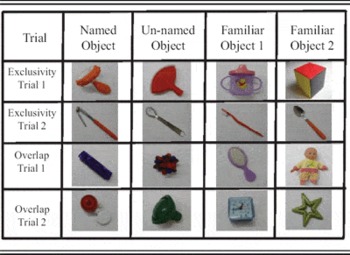
Sixteen objects of a similar size (approximately 10 cm in height) were used. Eight of them were familiar to children of preschool age, and eight were unfamiliar, i.e. objects for which children did not know a name (Appendix). On each trial, the child was presented with four objects: two familiar and two unfamiliar. The objects were placed on a wooden tray with four compartments. Two hand puppets named Mike and Sally, a puppet house, and a toy truck were used to introduce the game.
Procedure
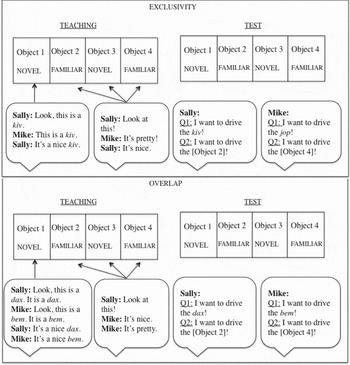
Each child completed two within-subjects conditions: exclusivity and overlap. The child sat across from the experimenter with the wooden tray positioned between them. The puppet house and toy truck were located near the tray. The experimenter manipulated the puppets, speaking with a slightly different voice for each of them. See Figure 1 for a graphical representation of the interaction.
Graphical representation of a sample trial in the exclusivity and overlap conditions.

Exclusivity condition
In this condition, both puppets introduced one novel label for an unfamiliar object in the teaching phase. In the test phase, children were asked to find the referent for the label that was introduced in the teaching phase, and for a different novel label that they have not heard before.
Teaching phase. The experimenter introduced the puppet house and the puppets to the child. The puppets were kept outside the house throughout this stage. The first four objects were positioned on the tray, and the child was allowed to handle them. Most children spontaneously named the familiar objects, but none of them knew the names of the unfamiliar objects.
The experimenter announced that the puppets were going to take a look at the objects. The child was asked to listen carefully in order to hear the objects’ names. Each puppet in turn picked up every object from the tray and made a comment, before returning the object to its position. One of the unfamiliar objects was designated as the named object, as it was the only object that was named during this phase. The puppets provided a novel label for the named object as follows:
-
(1) Sally: Look, this is a wug.
-
(2) Mike: This is a wug.
-
(3) Sally: It is a nice wug.
Generic, non-labelling comments were made for the rest of the objects on the tray, e.g. ‘Look, this is nice. It is cool. It is pretty’.
The four objects presented on each trial were handled identically to avoid the named object appearing more salient. Children heard every novel label repeated three times. Both puppets participated in this phase to make the exclusivity and overlap (see below) conditions as similar as possible and to show that both puppets shared knowledge of the novel labels.
At the completion of the teaching phase, the puppets announced that they were tired and were put inside the house. The experimenter demonstrated the “driving game” to the child by showing that they could take turns driving the objects in the toy truck. The experimenter and the child played the game for several minutes. All objects were returned to their original positions on the tray for the test phase.
Test phase. The puppets were brought out of the house one at a time in order to play the game (i.e. driving objects in the truck). The experimenter directed the test question to the puppet every time: “Which one are you going to drive?”. Then, the puppet requested one of the objects from the tray. Each puppet made two requests, one using a novel label (e.g. “I want to drive the wug”), and one using a familiar label (e.g. “I want to drive the cup”). Thus, one of the puppets asked for the referent of the label introduced in the teaching phase and for one of the familiar objects. The other puppet asked for the referent of a novel label that was not introduced before and for the other familiar object (Figure 1). Most children handed over the objects spontaneously in response to the puppets’ requests. If they failed to do so, the experimenter asked: “Can you please give Mike/Sally the [label]?”.
Overlap condition
In this condition, each puppet introduced a different label for the same unfamiliar referent. In the test phase, children were asked to find the referent for the two labels introduced in the teaching phase.
Teaching phase. The procedures were identical to the exclusivity condition except for the following manipulation. Before introducing the objects, the experimenter announced that the puppets would be speaking differently since they might use two different names for the same thing. The child was asked to listen carefully in order to learn both names. Next, each puppet provided a different label for the named object as follows:
-
(2) Sally: Look, this is a dax. It is a dax.
-
Mike: Look, this is a bem. It is a bem.
-
Sally: It is a nice dax.
-
Mike: It is a nice bem.
Generic, non-labelling comments were provided for the rest of the objects on the tray. As in the exclusivity condition, each novel label was repeated three times in this phase. The “driving game” was introduced at the end of this phase.
Test phase. The procedures of the driving game were identical to the exclusivity condition. Each puppet made two requests, one using a novel label (e.g. “I want to drive the wug”), and one using a familiar label (e.g. “I want to drive the cup”). That is, each puppet asked for the referent of the novel label that it introduced in the teaching phase, and for one of the familiar objects.
Even though the exclusivity and overlap conditions were not directly comparable in their response patterns, they both required children to successfully map the labels introduced by the puppets to the objects presented on the tray. In the exclusivity condition, children were taught the label for one of the novel labels and could infer the referent of the second novel label via ME. In the overlap condition, children were taught two labels for the same object, so they had to accept two words for the same referent in order to establish correct mappings. Children received a score of 1 for every correctly selected object in response to a puppet's request. Separate scores were assigned for the novel label and familiar label questions in each condition. Each condition consisted of two trials. Since each trial comprised two novel label questions and two familiar label questions, children could receive a novel label score of 0 to 4 and a familiar label score of 0 to 4 in each condition.
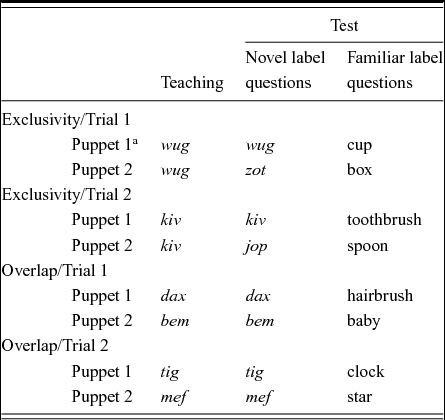
The four objects and their corresponding labels were blocked per trial (Table 1). However, the order of the trials within each condition was counterbalanced across participants, and the position of the objects on the tray was randomly assigned in each trial with the constraint that a child would not see the named object appearing in the same compartment on both trials of a condition. The order in which each puppet introduced the labels in the teaching phase and made requests in the test phase was counterbalanced within each condition across participants. Therefore, the order in which the labels were presented at test was independent of the order in which they were introduced and could not be predicted by the child.
Novel and familiar labels used in the ME task.

aIn each condition, Mike was used as Puppet 1 in one trial, and Sally was used as Puppet 1 in the other trial.
Children completed the two experimental sessions in a quiet room in their school or nursery or in the child development research laboratory. The children tested in school/nursery participated in the two sessions on different days approximately a week apart. Children tested in the laboratory completed both sessions on the same day interrupted by a free play session with their parent. Each condition of the ME task was completed in a different testing session, and the BPVS was always completed in Session 1. The order of administration of tasks was counterbalanced across participants. Children received a sticker at the end of each session.
Results
Children's responses to familiar label questions and novel label questions in each condition were assigned separate scores, with a maximum score of 4 for each type of question per condition (two questions of each type per trial, with a total of two trials per condition). These raw scores were converted into proportions for all the subsequent analyses. Initial Analyses of Variance with gender and task order as between-subjects variables yielded no significant effects of these variables. Therefore, these factors were excluded from all further analyses.
We ensured that the exclusivity and overlap conditions were administered at different times to minimize interference since they were designed to elicit contradictory response patterns. Interference would be demonstrated by a negative correlation between performance on the two conditions. However, children's performance was not significantly correlated, r(73) = .116, p = .332 (monolinguals: r(47) = .179, p = .229; bilinguals: r(26) = .013, p = .952) showing that children's performance in each condition could be assumed to be independent, and the tendency to apply ME or accept lexical overlap was not carrying over from one test session to the other.
Familiar label trials
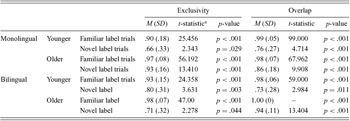
When required to find the referents of familiar labels, children in all the language and age groups were highly accurate in both the exclusivity and overlap conditions (Table 2). There were no differences in performance in the familiar label trials for the younger monolingual and younger bilingual children in the exclusivity (t(38) = –.612, p = .544, d = .198) and overlap conditions (t(38) = .366, p = .717, d = .119). Also, there were no differences in performance between the older monolingual and bilingual children in the two conditions (exclusivity: t(34) = –.365, p = .717, d = .125; overlap: t(34) = –1.015, p = .317, d = .348). This shows that all children were equally engaged and understanding the task. The trials in which children failed to answer one or more familiar questions correctly were excluded from the analyses since they indicated that the child did not know the labels for all the familiar objects presented in that trial or failed to attend to the experimental procedure.
Monolingual and bilingual children's performance in the familiar and novel label trials of the exclusivity and overlap conditions compared against chance performance.
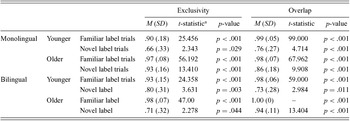
aOne sample t-test comparing each group's performance to chance level (.50).
ME use and acceptance of lexical overlap
The first question investigated in this study was whether children of preschool age are capable of interpreting the contextual information of the naming situation at hand in order to successfully accept lexical overlap. Children's responses to the novel label questions in the exclusivity and overlap conditions were compared to chance levels (0.5 accuracy). All children performed above chance in both conditions (Table 2).
What did children do for the trials where they had failed to learn two overlapping labels? An item-by-item analysis showed that out of the 152 trials that comprised the overlap condition, children successfully accepted overlap on 99 trials (65.1%). In the remaining trials, in 8 trials (5.3%) children failed to provide a response or selected a referent other than the target for both labels, and in 47 (30.9%) trials children selected a different novel object for each of the novel labels. If the ME assumption prevents children from accepting lexical overlap, then children will be more likely to select the target object in response to the first label requested in the test phase, and select the non-named unfamiliar object in response to the second label requested despite the fact that both labels were introduced for the same object in the teaching phase (Savage & Au, Reference Savage and Au1996). Consistent with this, in the 47 cases where children established one-to-one mappings, the target was chosen as the referent of the first label requested on 31 trials (66.0%; 20 trials for monolinguals, 11 trials for bilinguals), and as the referent of the second label requested on 16 trials (34.0%, 11 trials for monolinguals, five trials for bilinguals), which is significantly different from chance, χ2 (1, N = 47) = 4.787, p = .029. The order of presentation of the labels in the test phase was counterbalanced across trials and participants, so children did not know which labels would be used in the test phase first. Thus, this response pattern suggests that children were reasoning by exclusivity in the majority of the cases, restricting the first label re-encountered in the input to the target object, and assigning the second label to the only remaining nameless referent.
The effect of language experience on performance in the exclusivity and overlap conditions
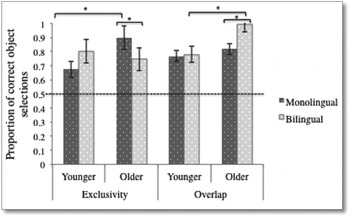
In order to test the contrasting predictions about the effects of language experience on monolingual and bilingual performance in the ME task, we conducted a mixed ANCOVA with exclusivity or overlap condition, monolingual or bilingual language, and younger or older age group as factors. BPVS scores were entered as a covariate in order to account for the differences in English receptive vocabulary knowledge between the monolingual and bilingual groups.Footnote 1 There were no significant main effects of condition, F < 1, and language, F < 1, but significant main effects of age group, F(1,65) = 6.852, p = .011, η2 = .095, and BPVS, F(1,65) = 23.642, p < .001, η2 = .267. That is, older children and children with larger English receptive vocabularies were in general more successful in the present word learning tasks. There were no significant condition by language, F(1,65) = 1.510, p = .224, η2 = .023, condition by age group, F < 1, condition by BPVS, F < 1, or language by age group interactions, F < 1, but there was a significant condition by language by age group interaction, F(1,65) = 6.251, p = .015, η2 = .088 (Figure 2).
Comparison of the monolingual and bilingual younger and older children's performance in the exclusivity and overlap conditions of the ME task. Error bars represent standard errors of the mean.

In order to investigate the source of this three-way interaction, we conducted planned comparisons of monolingual and bilingual children's performance separately for each age group and each condition. Since BPVS was shown to be significant in the main ANCOVA, it was also entered as a covariate in these analyses. A univariate ANCOVA with exclusivity condition scores as the dependent variable for the younger group showed no effects of language group, F < 1, but an effect of BPVS, F(1,32) = 8.655, p = .006, η2 = .213. However, for the exclusivity task for the older group, there was a significant effect of language, F(1,33) = 8.049, p = .008, η2 = .196, and BPVS, F(1,33) = 8.534, p = .006, η2 = .205. Analyses with overlap condition scores as the dependent variable for the younger children also showed no significant effects of language group, F < 1, but an effect of BPVS, F(1,32) = 16.684, p < .001, η2 = .343. For overlap condition scores with the older group, there were significant effects of both language group, F(1,33) = 5.808, p = .022, η2 = .150, and BPVS, F(1,33) = 6.964, p = .013, η2 = .174. Thus, the three-way interaction was due to equivalent performance of the younger monolingual and bilingual children in the exclusivity and overlap conditions, but significantly different performance of older monolingual and bilingual children across conditions. For older children, a monolingual advantage was observed in the exclusivity condition where successful word learning could be achieved by establishing and maintaining one-to-one relations between words and their referents, whereas bilinguals were more successful in the overlap condition where successful word learning could be achieved by accepting two words for a single referent.
In order to further investigate the effects of age on ME use and acceptance of lexical overlap, younger and older children's performance was compared for these tasks within each language group. In the monolingual group, older children outperformed younger children in the exclusivity condition, t(45) = –3.498, p = .001, d = 1.043, but no significant differences in performance were found in the overlap condition, t(46) = –1.569, p = .123, d = .463. The opposite pattern was found for bilinguals with no age group differences in the exclusivity condition, t(24) = .769, p = .449, d = .314, but higher performance in the older than younger children in the overlap condition, t(23) = –2.391, p = .025, d = .997. These results demonstrate that monolingual children showed higher levels of ME use with age. Bilingual children, on the other hand, showed a higher level of accepting lexical overlap with age. This was further evidenced by individual children's response patterns in the exclusivity and overlap conditions. All the older monolingual children exhibited ME in at least one of the two trials of the exclusivity condition. On the contrary, all the children in the older bilingual group accepted overlap in at least one of the two trials of the overlap condition. These response patterns suggest that with age, monolingual children relied more uniformly on the ME assumption, whereas the bilingual children were more successful at accepting referentially overlapping labels.
Discussion
The present study analysed the flexible use of the ME assumption in word learning in monolingual and bilingual preschool-aged children. A prevailing question concerning ME is that if it is an assumption that biases children to reject referential overlap, what do children do when presented with input that directly contradicts ME (Savage & Au, Reference Savage and Au1996)? Comparing children's performance against chance confirmed that both monolingual and bilingual three-to-five-year-old children use ME to identify the referents of novel words in the exclusivity condition (Markman & Wachtel, Reference Markman and Wachtel1988), but successfully accept two labels for an object in the overlap condition when provided with clear pragmatic directions about the use of the two labels (Clark & Grossman, Reference Clark and Grossman1998) and a communicative goal that requires acceptance of lexical overlap (Piccin & Blewitt, Reference Piccin and Blewitt2007). The present findings show that children as young as the age of 4;0 will successfully accept two novel overlapping labels when they receive a clear pragmatic direction about their use, and when lexical overlap is required to achieve successful communication. However, they will use mutual exclusivity in the absence of such information. This was further supported by the item-by-item analysis of the trials where the children who failed to accept lexical overlap established one-to-one mappings for every novel label instead. In the majority of these cases, consistent with the ME assumption, children selected the target object as the referent for the first label encountered in the test phase, and then mapped the second novel label to the only other nameless referent (Savage & Au, Reference Savage and Au1996).
But what of the effect of qualitatively different linguistic experience on use of ME? As discussed in the introduction, although it has been shown that ME emerges later in infants acquiring more than one language (Byers-Heinlein & Werker, Reference Byers-Heinlein and Werker2009; Houston-Price et al., Reference Houston-Price, Caloghiris and Raviglione2010), previous research has provided varied results about the effect of simultaneous bilingual exposure on ME use in children of preschool age (e.g. Davidson et al., Reference Davidson, Jergovic, Imami and Theodos1997; Merriman & Kutlesic, Reference Merriman and Kutlesic1993). Thus, by employing a design that combined two language and age groups and two word learning situations, we set out to investigate two possible effects of bilingualism on the ME assumption: (i) that bilingual children fail to develop a strong ME assumption, which would be manifested in lower exclusivity scores and higher overlap scores than monolinguals in both age groups, and (ii) that bilinguals develop a ME assumption, but become more willing to accept lexical overlap in light of their linguistic experience, which would be manifested in similar one-to-one mapping performance but higher overlap scores in the bilingual group.
Our results did not provide evidence for the first possible outcome. As discussed earlier, the monolingual and bilingual children in the younger and older groups successfully reasoned by exclusivity and accepted lexical overlap according to the pragmatic demands of each naming situation. However, in line with the second possibility, we observed that with increasing age, children's performance patterns were distinguished according to their individual experience with language use. That is, while no significant differences in performance were observed between the younger monolingual and bilingual children in the exclusivity and overlap conditions, in the older group, monolingual children obtained higher scores in the exclusivity condition, but bilingual children obtained higher scores in the overlap condition. Children exposed to one language observe that one-to-one relations tend to be established between words and their meanings, unless clear evidence is provided for the contrary (Merriman, Reference Merriman1991). This can lead them to maintain and strengthen the ME assumption as a strategy for word learning in non-ostensive situations (Merriman & Bowman, Reference Merriman and Bowman1989). Bilingual children, however, grow up exposed to multiple-to-one correspondences between word forms and their meanings (Pearson et al., Reference Pearson, Fernandez and Oller1995). Due to this experience, older bilingual children may develop the implicit understanding that it can be counterproductive to automatically assume that all word forms contrast in meaning since it is common to encounter two overlapping labels used interchangeably in communication (e.g. in cases of code-switching; Meisel, Reference Meisel, Hyltenstam and Obler1989).
Previous research on the effects of bilingualism on the ME assumption has yielded mixed results since some studies demonstrated no relationship between linguistic experience and ME use, while others have suggested that exposure to two languages leads to a more flexible application of mutual exclusivity. Simultaneous consideration of language group and age alongside communicatively distinct tasks enable us to reconcile some of these apparent inconsistencies in previous research on ME in bilinguals. We successfully confirmed the prediction that bilingual experience leads to a significant difference in older children's performance in the exclusivity task in replication of Davidson et al.'s (Reference Davidson, Jergovic, Imami and Theodos1997) findings. However, other studies that have not demonstrated an effect of monolingual versus bilingual language background (Frank & Poulin-Dubois, Reference Frank and Poulin-Dubois2002; Merriman & Kutlesic, Reference Merriman and Kutlesic1993) separately analysed different age groups of monolinguals and bilinguals. We found that when the complex interaction between the child's linguistic experience, age, and type of word-learning situation are considered in the analyses, as in the present study, the effect of bilingualism on performance is evident.
Although the present findings reveal an interesting interaction between increasing linguistic experience and word learning mechanisms among monolingual and bilingual children, an important limitation must be considered when interpreting these results. While the bilingual sample included here was representative of the population where this research was conducted, it was smaller than the monolingual sample, which could limit the generality of our results. Thus, replication of our findings in larger bilingual groups would be useful to confirm their reliability. On a related note, a formal measure of the level of bilingual exposure was not available for this study. Even though, the bilingual sample was carefully selected to ensure that all children were exposed to the language other than English to a similar extent, their bilingual proficiency was not assessed. This leaves open the question of precisely what aspects of increasing bilingual experience led to the greater ability to accept overlapping labels. In light of the recent findings by Byers-Heinlein and Werker (Reference Byers-Heinlein and Werker2013), it is possible that this difference lies not in the duration of exposure to two languages, but in the extent of overlap between the child's vocabularies in the two languages. Consistent with this view, the older bilingual children are likely to know more cross-language equivalents than younger bilinguals. However, the current study also demonstrated a significant effect of English vocabulary size on monolingual and bilingual children's performance suggesting that lexical knowledge in at least one language influences children's performance in word learning tasks. Our results go further than those of Byers-Heinlein and Werker (Reference Byers-Heinlein and Werker2013) by demonstrating that bilingual experience also results in greater ability to accept lexical overlap. Therefore, an intriguing issue for further investigation is to measure directly the relationship between lexical overlap in the child's vocabularies and development of this flexible application of ME.
Another potential explanation for the present results is that bilingual experience leads to an overall greater word-learning proficiency, which advantaged the most experienced bilinguals in the present study in the paradigm where they were required to learn more than one novel label. However, previous research in the domain of word learning has not provided evidence for a bilingual advantage in fast mapping (Byers-Heinlein, Fennel & Werker, Reference Byers-Heinlein, Fennell and Werker2013), and nor did we observe an overall advantage for bilingual children in task performance in the current study. However, greater detail of the precise aspects of bilingual experience that shape bilingual children's use of word learning strategies such as the ME assumption would be a useful extension to the results presented here.
The present findings suggest that in order to understand the nature of the ME assumption, it must be assessed in relation to the variety of communicative situations in which word learning takes place, as well as the individual linguistic experiences that the child brings to the task of lexical acquisition. In line with this view, we have demonstrated that the use of ME is of a dynamic nature, which is shaped according to the pragmatic information present in each communicative interaction and the child's expectations about the relations established between words and their meanings.
Mutual Exclusivity Task: Experimental stimuli