Adult bilinguals code-mix regularly, both inter-sententially and intra-sententially (e.g., Poplack, Reference Poplack1980). On a general level, most of the widely discussed explanations for both kinds of code-mixing involve sociolinguistic and/or rhetorical factors, with linguistic and processing factors sometimes also playing a role (Blom & Gumperz, Reference Blom, Gumperz, Gumperz and Hymes1972; Di Sciullo, Muysken & Singh, Reference Di Sciullo, Muysken and Singh1986; Grosjean, Reference Grosjean1998, Reference Grosjean2001; Myers-Scotton, Reference Myers-Scotton1997, Reference Myers-Scotton2002; Woolford, Reference Woolford1983). Presumably adults are metalinguistically aware, to at least some degree, of the appropriateness and effectiveness of their two languages in different social contexts, and so they mostly produce mixed utterances intentionally, for social or rhetorical effect, or else they are in a fully bilingual context.
Much data over the past few decades suggest that young bilingual children develop, from very early in the process, two distinct language systems (e.g., Genesee, Reference Genesee1989; Genesee, Nicoladis & Paradis, Reference Genesee, Nicoladis and Paradis1995; Lindholm & Padilla, Reference Lindholm and Padilla1978). Nevertheless, young bilingual children also produce code-mixed utterances, both inter-sententially and intra-sententially. The interpretive problem is that young children just beginning language acquisition (e.g., two-year-olds, when mixed utterances first begin to appear) would not appear to have the kind of sophisticated metalinguistic and sociolinguistic skills that underlie adult code-mixing. The status of these utterances, therefore, and what they imply about the interconnection between bilingual children's two linguistic systems, is unclear. Because of children's less sophisticated metalinguistic and sociolinguistic skills, approaches to children's mixed utterances and monolingual utterances displaying cross-linguistic influence have tended to focus on linguistic factors: various ways in which the two languages might interact with one another based on general linguistic principles (e.g., Bernardini & Schlyter, Reference Bernardini and Schlyter2004; MacSwan, Reference MacSwan1999; Myers-Scotton, Reference Myers-Scotton1997, Reference Myers-Scotton2002) and structural overlaps between the two languages (Döpke, Reference Döpke1998; Müller, Reference Müller1998; Müller & Hulk, Reference Müller and Hulk2001; Yip & Matthews, Reference Yip and Matthews2000). Some more usage-based approaches have focused on the language children hear and the way they use their own languages (Deuchar & Quay, Reference Deuchar and Quay1999; Vihman, Reference Vihman1985).
Of special interest for understanding children's code-mixing are intra-sentential mixes – single utterances with a single intonation contour containing elements from both languages – as they often involve a mixing of grammatical processes. These types of utterances have received some attention in the literature, with a focus mostly on the formal grammatical principles that might underlie them (Köppe & Meisel, Reference Köppe, Meisel, Milroy and Muysken1995; Meisel, Reference Meisel1994, Reference Meisel, Caunt-Nulton, Kulatilake and Woo2007) together with explanations involving language dominance and any directionality in mixing that may derive from it (Bernardini & Schlyter, Reference Bernardini and Schlyter2004; Kupisch, Reference Kupisch, Guijarro-Fuentes, Larrañaga and Clibbens2008; Petersen, Reference Petersen1988). One particular focus has been the mixed NPs produced by bilingual children who are learning at least one language that has agreement between the head noun and any accompanying determiners and modifiers – typically in terms of gender and number – since this agreement introduces tight grammatical organisation into the NP.
There have been a number of reports of bilingual children's production of mixed NPs in which gender/number agreement plays a role (e.g., Cantone & Müller, Reference Cantone and Müller2008; Liceras, Fernández Fuertes, Perales, Pérez-Tattam & Spradlin, Reference Liceras, Fernández Fuertes, Perales, Pérez-Tattam and Spradlin2008; Lindholm & Padilla, Reference Lindholm and Padilla1978; Radford, Kupisch, Köppe & Azzaro, Reference Radford, Kupisch, Köppe and Azzaro2007). Most interesting are mixed NPs containing a determiner from one language, marked for a particular gender/number, with a noun from the other language whose translation equivalent would agree with the gender/number of the determiner. We may call these “mixed NPs with correct agreement”. Examples include the following:
Spanish – English: La house
(Spanish word for “house”, casa, takes the feminine determiner la)
German – English: Der dog
(German word for “dog”, hund, takes the masculine determiner der)
The problem with current reports of this phenomenon is that children could use determiners from one of their languages with nouns from the other language basically randomly, by guessing (or else they could use an all-purpose default determiner), and end up producing mixed NPs with correct agreement reasonably often. Since, where figures are provided in the previous studies reporting this phenomenon, these have been of the different percentages of mixed NPs with correct agreement, rather than of the probability of these occurring by chance, this potential alternative explanation cannot be discounted. Specifically, no previous study has actually calculated the frequency of mixed NPs with correct agreement as compared with the frequency of mixed NPs with incorrect (or ambiguous) agreement and compared these using statistical tests. And so we do not know how systematic the phenomenon of mixed NPs with correct agreement actually is – or indeed if it is something other than a chance phenomenon.
In the current study, therefore, we looked at the early mixed NPs of three German–English bilingual children, two over a relatively short period in the middle of their third year and the other child for a longer period (2;03–3;10). We used each child's own language (from extensive corpora) to calculate the chance probabilities for agreement between determiners and nouns in their mixed NPs – and we took account of mixed NPs with incorrect agreement, or ambiguous agreement, as well. As additional baseline information, we also determined how often each child produced correct agreement between determiners and nouns in their monolingual German NPs, and we also established how often the children did and did not have translation equivalents for the various nouns involved to take account of a potential lexical-gap-filling strategy.
For purposes of the current study, the important linguistic facts are these. English noun classesFootnote 1 are not divided on the basis of grammatical gender and distinctions relevant for pronoun use are semantic in nature (Mathiot, Reference Mathiot and Mathiot1979). Agreement in English NPs is limited to some different determiner forms for singular and plural. In contrast, German nouns come in three genders and two numbers, as well as four cases. German definite and indefinite determiners each come in six possible suffixes (there are thus many syncretisms in the determiner declension systems), and agree with their head nouns based on gender, number, and case. Although there are phonological cues to agreement in German, there are many exceptions.
Method
Participants
Three German–English bilingual children, Tim, Silvie, and Lily, participated in the study. All three children lived with their parents in a mid-sized German city.
Tim is the first child of a university-educated couple. The mother's native language is English, and the father's native languages are Spanish and Catalan. Further, the father is also fluent in English, which is his second language. The mother speaks English to the child and uses very little German towards other people. The father speaks both English and Spanish with Tim and also uses very little German. The couple speak English to one another. During his first year, Tim stayed at home with his mother and, thus, was exposed mainly to English (and some Spanish). From eight months of age, he had a German-speaking caretaker for ten hours per week. At the age of 16 months, he began attending a German kindergarten for 30 hours per week, and from then, was exposed to German for most weekdays.
Tim's data consist of audio recordings of spontaneous speech in separate German and English language contexts. For the investigation of mixed noun phrases, only the data collected in the English context were used because in the German context the child was very shy resulting in very small amounts of data. The audio recordings in the German context were only used for the investigation of monolingual German determiner phrases. They were made in the Max Planck Institute for Evolutionary Anthropology, Leipzig, Germany, with a German-speaking research assistant during a play session (over a period of five weeks, two days a week for one hour each). The first recording was made at the age of 2;06.13 and the last at 2;07.28. The recordings in the English context were made at home mostly in mother–child interactions during playtime, meals, getting ready for bed or kindergarten. Sometimes the father and/or grandmother were also present. The data collection covers a period of six weeks. Recordings were made on a regular basis for one hour per day on five days per week leading to a total of 30 hours of recordings. The first recording was made at the age of 2;06.07 and the last at 2;07.16.
Silvie is the first child of a middle-class couple. She was exposed to both German and English from birth. The mother is a native speaker of English, and the father is a native speaker of German. The father speaks only German and knows very little English. The mother speaks English to the child but is relatively fluent in German. The couple speak German to one another. In all interactions with their daughter, the parents practice a one-person–one-language strategy. During visits of English relatives and friends to her home, as well as during vacations in Great Britain, Silvie is addressed only in English. On these (rare) occasions, the child sometimes hears her father speaking English or even mixing English and German. Until the age of one year and six months Silvie spent most of her time at home with her mother and, thus, heard English almost exclusively. She spent time with her father only in the evenings and on weekends. From 18 months on, Silvie attended a German kindergarten for 45 hours per week and, since then, has been exposed to German most of the day.
Silvie's data consist of audiotape recordings of spontaneous speech in family interactions at home, sometimes with just one, but mostly with both parents. Consequently, there are no separate language contexts; instead, the data come from a German-and-English context. The recordings were made during free play situations, while reading a book, cooking, and at mealtimes. The entire data collection covers a span of 18 months, beginning when Silvie was at the age of 2;04 and continuing regularly until she was 3;10. On average, there are 2.5 hours of recorded data per week and about 20 sessions per month. The data investigated for this paper are taken from the first five months of this corpus, namely the period beginning at 2;04.01 until 2;08.25. This selection constitutes 45.5 hours of recordings.
Lily is the second child of a middle-class family; her brother is two years older. The mother is a native speaker of English, and the father is a native speaker of German. The parents strictly follow a one-person–one-language strategy. Both parents speak their non-native language quite well, so they speak to one another in their own native language as well. During the first 18 months, Lily stayed at home with her mother as primary caretaker and predominantly heard English. Subsequently, she began attending a German kindergarten for most of the day. The father spends much time with the children, particularly in the mornings, evenings and weekends. In addition, Lily's older brother, also raised bilingually, represents another source of language input which is characterised by relatively frequent code-mixing. Regular visits to England and occasional visits from English-speaking relatives supplement Lily's exposure to English.
Lily's data consist of audiotape recordings of spontaneous speech in the home environment. The recordings were made during play situations, meal time, or bed time, sometimes with one but mostly with both parents. Hence, both German and English are spoken concurrently in most of the recording situations leading to a German-and-English context for most of the data. The corpus data cover a span of 19 months ranging from the age of 2;03.26 to 3;10.29. The recordings were made at rather irregular intervals, usually for about one hour in the mornings or evenings. This results in large differences in the amount of data per month. Due to deficient quality of some of the tape-recordings because of background noise and disadvantageous recording conditions, about 42% of all language material had to be eliminated as untranscribable. To assemble a comparable amount of data based on the number of mixed utterances per child, data from every second month of Lily's recordings were used for the current study. To check for potential development over the long period of data collection, we divided the relevant data into three phases for more detailed analyses: the first phase (2;03–2;06, 30 hours of recording), the second phase (2;08–3;02, 40 hours), and the third phase (3;05–3;10, 42 hours).
Recording, coding, and analysis
The recordings were transcribed in SONIC CHAT format (MacWhinney, Reference MacWhinney1995) by research assistants. All linguistic items that clearly came from a particular language were transcribed in the usual orthography of that language. Phonetic transcriptions were used when some part of the utterance deviated noticeably from the usual pronunciation. In these cases, the transcribers added suggestions as to the correct word. Unintelligible utterances as well as one-word utterances were excluded from all analyses.
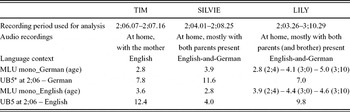
Table 1 provides information on the period and method of data collection as well as MLU values for each child. The mean length of utterance (MLU) was counted in words. It was computed separately for monolingual German and monolingual English utterances in order to create an indicator of the language development which was comparable between the children regardless of language context. We also measured the mean of the five longest monolingual utterances for each language (Upper Bound, UB5).Footnote 2
Overview of children and data.

*UB5 = the mean of the five longest utterances
Tim's MLU was 2.8 for the monolingual German utterances and 3.6 for the monolingual English utterances. He spoke predominantly English and showed a tendency to mix German function words, which was not due to lexical gaps. Silvie's MLU was 3.9 for the German utterances and 2.8 for the English utterances, almost the exact opposite of Tim. Silvie predominantly spoke German. That is to say, in a usual mother–child conversation when Silvie was addressed in English exclusively, she answered in German. For Lily, the German MLU (2.8) was lower than the English MLU (3.9) at the beginning of data collection. Over time the MLU values for both German and English increased and converged. Eventually, at the age of 3;10, Lily's MLU for the German utterances (5.0) was slightly higher than the English MLU (4.6). This development is also reflected in Lily's language proportions. The data suggest that, initially, she spoke more English than German but from 3;02 onwards German exceeded English. The UB5 figures at 2;06 support these conclusions: Tim seems to be English-dominant, Silvie, German-dominant and, at 2;06, Lily was also English-dominant though more evenly balanced than Tim and she became even more balanced as she developed.
The focus of the current analysis was on the mixed utterances of the children (identified individually, by hand),Footnote 3 and particularly on those including mixed noun phrases (NPs). NPs in which the noun was ambiguous between English and German (e.g. house/haus, mouse/maus, bear/bär) were excluded. ‘Correct agreement’ was counted where the gender and number of the German translation equivalent were assigned to the English noun as in der [“the”/masculine, singular] table (tisch is masculine, singular). This means that the grammatical categories of gender and number, marked on the determiner in German, seemed to have been used for English nouns. ‘Incorrect agreement’ was coded for utterances where the determiner and the gender of the translation equivalent did not agree (like der [“the”/masculine, singular] fork (gabel is feminine, singular).Footnote 4 NPs were coded as ‘ambiguous’ when the noun or the determiner was ambiguous or not clearly identifiable, like in das one and ‘n button. Case was ignored. In the nominative of the indefinite article, case is ambiguous between masculine (masc) and neuter (neut): here we gave the child ‘the benefit of the doubt’ since there was no way to determine if masculine or neuter was intended. In the accusative (acc), in spoken speech, it can be ambiguous (e.g. between ein'n [acc-masc] and ein [acc-neut]) and because our transcription was not phonological, we could not therefore distinguish neuter from masculine in certain accusative forms.
The same basic procedure was used with an evenly distributed sample of German monolingual NPs for each child, to provide a baseline of skills with agreement in the gendered language. We also noted the availability of the corresponding translation equivalents to the mixed English nouns in the corpora of each child, in the span covered by the data before the relevant mixed NP occurred. Of course, we cannot guarantee the availability of the corresponding German noun in the actual recording situation but, at least, we know that it was in the child's lexicon at an earlier point. For Lily's data, in addition, we measured the distance between the German translation equivalent, if it appeared, and the relevant mixed NP to take account of the long period of data collection and investigate the length of time between the use of the English noun and when its German translation equivalent had appeared in her speech.
Statistical procedure
The chance probability that a child might produce a mixed NP with correct agreement depends on that child's noun and determiner vocabularies, and the frequency with which she uses the various items in them. We therefore began by computing the chance probability of correct agreement for each mixed NP of each child separately (e.g., der dog). This was calculated as the product of the proportion of mixed NPs from that child's corpus containing the determiner in question and the proportion of mixed NPs from that corpus containing the noun in question. Thus, if der occurred in 30% of the utterances with mixed NPs and dog occurred in 5% of the utterances with mixed NPs, the probability of their occurring together by chance in the same mixed NP is 1.5% (e.g. 30 × 5 / 100 = 1.5%). These probabilities were then summed together for all of the mixed NPs for a given child, giving the overall probability of correctly agreeing mixed NPs based on chance for that child (chance ‘correct agreement’). Then we computed the proportion of mixed NPs (out of both correct and incorrect mixed NPs – ambiguous agreement was not counted) that actually had correct agreement in gender and number for that child (observed ‘correct agreement’). The two values (expected by chance and observed) were then compared using a binomial procedure, yielding a probability estimate that the observed frequency exceeded that expected by chance alone. For comparison, we also looked at the children's baseline skill level with gender/number agreement in their German monolingual NPs. Note that this procedure makes the usual statistical assumption that the events sampled are independent. Although obviously this is not true in language corpora in any absolute sense, it is arguably true that, exact repetitions aside, it is difficult to imagine how one mixed NP could influence another in the direction of correct or incorrect gender agreement.
Results
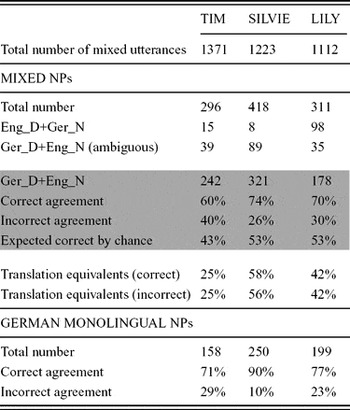
The overall results are presented, by child, in Table 2. Results are presented for all determiners together, but it is important to note that all three children were well beyond any stage of using a default or very small numbers of determiners and they had presumably moved beyond any early stage of item-based learning. All three used many different determiners (Tim = 13, Silvie = 19, Lily = 14), including, across children, four different forms of the definite article, two different forms of the indefinite article, three different forms of the negative determiner, three different forms of the demonstrative, and ten different possessive determiners.
Overview of children and results.

The determiners used most frequently by all of the children were the definite articles der and die (with singular and plural nouns), the indefinite articles ein and eine, and the possessive pronoun mein “my”. These determiners were not only used most often in mixed NPs showing correct agreement but they also occurred frequently in mixed NPs with incorrect agreement. For the monolingual German NPs, the children also used these determiners most frequently.
Tim
Tim produced 1371 mixed utterances (24% of all utterances), with most of the rest being monolingual English (in our English recording context). There were 296 mixed NPs (from 291 utterances) in these mixed utterances. Of these, 242 were of the type German Determiner (D) + English Noun (N) (15 were of the type English D + German N, and 39 were ‘ambiguous’). Of the 242 mixed NPs consisting of German D + English N, 146 (60%) had correct gender/number agreement and 96 (40%) had incorrect gender/number agreement. The number of correct agreements expected by chance was 104 (43%). The binomial test thus revealed that the number of correct agreements far exceeded what would be expected by chance (N = 242, p < .0001).
In the 158 monolingual German NPs, from the German recording context, 112 (71%) had correct gender/number agreement (with 46 (29%), having incorrect agreement) – about 10% higher than in the mixed NPs. We have evidence that Tim had previously used the German translation equivalents of the English nouns in his mixed NPs with correct gender agreement, in 25% (37 out of 146) of the cases. In the case of incorrect gender agreement we also found evidence that 25% (24 out of 96) of the translation equivalents had been used previously.
Silvie
Silvie produced 1223 mixed utterances (13% of all utterances), with most of the rest being monolingual German. There were 418 mixed NPs in these mixed utterances. Of these, 321 were of the type German D + English N (8 were of the type English D + German N, and 89 were ‘ambiguous’). Of the 321 mixed NPs consisting of German D + English N, 237 (74%) had correct gender/number agreement and 84 (26%) had incorrect gender/number agreement.Footnote 5 The number of correct agreements expected by chance was only 169 (53%). The binomial test thus revealed that the number of correct agreements far exceeded what would be expected by chance (N = 321, p < .0001).
In a randomly chosen sample of 250 monolingual German NPs (evenly distributed over the whole range of data), 224 (90%) had correct gender/number agreement (with 26 (10%), having incorrect agreement) – about 16% higher than in the mixed NPs. We have evidence that Silvie had previously used the German translation equivalents of the English nouns in her mixed NPs with correct gender agreement in 58% (137 out of 237) of the cases. In the case of incorrect gender agreement 56% (47 out of 84) of the translation equivalents were found.
Lily
Lily produced 1112 mixed utterances (8% of all utterances), with the rest being both monolingual English and monolingual German. There were 311 mixed NPs in these mixed utterances, which were quite evenly spread over the whole range of data collection. Of these, 178 were of the type German D + English N (98 were of the type English D + German N, and 35 were ‘ambiguous’). Of the 178 mixed NPs consisting of German D + English N, 125 (70%) had correct gender/number agreement and 53 (30%) had incorrect gender/number agreement.Footnote 6 The number of correct agreements expected by chance was only 94 (53%). The binomial test thus revealed that the number of correct agreements far exceeded what would be expected by chance (N = 178, p < .0001).
In a randomly chosen sample of 199 monolingual German NPs, 154 (77%) had correct gender/number agreement (with 45 (23%), having incorrect agreement) – about 7% higher than in the mixed NPs. We have evidence that in 42% (53 out of 125) of Lily's mixed NPs with correct gender agreement and in 42% (22 out of 53) of the cases with incorrect gender agreement, the child had produced the German translation equivalents of the English nouns before the relevant mixed NP occurred in the data. A deeper analysis revealed that 83% of these translation equivalents had been uttered by the child within the preceding three months, 64% within the previous month, and 37% within the previous week. In 23% of cases the translation equivalent occurred in the actual file right before the relevant mixed NP.
Is there a default?
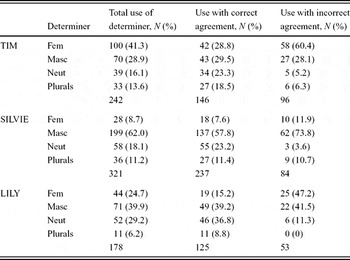
We have shown that these children's correct agreement in their mixed NPs with German determiners and English nouns is not occurring by chance. What are they doing when agreement is incorrect? Are they operating a default strategy? We should note that, at the same age, German monolingual children are also making gender agreement errors although these have reduced to below 10% by 3;0. Mills (Reference Mills1986) reports that errors were more frequent with the indefinite than with the definite article and that, where errors did occur, they were likely to be an overuse of feminine forms since the correlation between feminine gender and nouns ending in -e is very high but no exact figures are given (Mills, Reference Mills1986). Szagun's (Reference Szagun2004) results agreed with Mills on the higher rate of errors with the indefinite article but found equal rates of error with masculine and feminine nouns. In a more recent study with more children and more data per child, Szagun, Stumper, Sondag and Franik (Reference Szagun, Stumper, Sondag and Franik2007) show that there is a complex interplay between the frequency of particular phonological patterns in the noun lexicon and the predictability of their gender as well as considerable individual differences between children in their patterns of correct and incorrect marking. For monolingual German NPs our data show error rates of 10% (Silvie), 23% (Lily) and 29% (Tim). These are broadly in line with those of Szagun et al., who found overall error rates of between 13% and 25% in the period before children had achieved 90% correct marking. In mixed utterances with incorrect agreement, the feminine is the most frequent determiner for Tim (60.4%), the masculine for Silvie (73.8%) while Lily uses roughly the same percentage of masculine and feminine determiners in her incorrectly agreeing NPs (47.2% feminine determiners and 41.5% masculine determiners, see Table 3). Clearly there is no sense across the children of one gender operating as the default and even in the two cases of some bias, there are considerable examples of the other two genders.
Correct and incorrect agreement in mixed NPs.

Discussion
Previous studies have shown that children sometimes produce mixed NPs in which the determiner from one language agrees in gender/number with the translation equivalent of the noun from the other language. The current study is the first to test this phenomenon statistically in order to establish whether this is merely a chance occurrence or whether, alternatively, it represents something real and potentially important about bilingual children's grammatical organisation. In contrast to inter-sentential code-mixing, which is more discourse-based, and some types of intra-sentential code-mixing, which involve simple word substitutions, mixed noun phrases with gender ‘agreement’ represent an especially tight grammatical integration between the two languages – a single coherent grammatical constituent used for the single communicative function of reference.
In the current study, three important facts have been established, at least for German–English bilingual children. The first and most important fact is that when children produce a mixed NP with correct gender/number agreement (e.g., der dog), the ‘agreement’ is not due to chance alone; the children are doing something systematic that must be accounted for in a full model of their bilingual competence. In our study, statistical methods established with over 99.9% confidence that each of the three children was using gender/number agreement in their mixed NPs systematically. They were not doing so 100% of the time, of course, but they were not doing so 100% of the time in their monolingual German utterances either (see Table 2 above). On average, the children were only about 10% better with NP gender/number agreement in their German monolingual utterances. We should also note that the probability of chance agreement – given the specific noun and determiner vocabularies of German–English bilinguals in this age range and how frequently they use each of their words – is around 50%, and so in investigating mixed NPs of children using other languages, informal evidence is not sufficient to establish this ‘agreement’ phenomenon systematically; statistical methods are required.
The second important fact from this study is that all three children quite often had in their vocabulary the German noun they needed when they produced a mixed NP with a German determiner and an English noun. Precisely how often this was the case is difficult to determine quantitatively. The problem is that periodic sampling of children's spontaneous speech obviously misses many words that children actually know. This is especially true of low-frequency words, obviously, and it is a well-known fact that children produce each of their nouns relatively rarely as compared with their verbs and function words (one will only sample the word “elephant” if the recording takes place when an elephant, or some replica, is present in the situation; see Tomasello & Stahl, Reference Tomasello and Stahl2004, for analysis of this issue). And so the actual percentages reported here – we found in the children's corpora the appropriate translation equivalents over half the time for two of the children and around a quarter of the time for the third – are actually quite high. In any case, whatever the real figures, it is still the case that quite often the children produced a mixed NP when they could have produced a monolingual NP instead. This obviously subverts any account of intra-sentential or intra-phrasal mixing based on something like lexical gaps. It is also relevant that all three children had the basic English determiners solidly in their competence as well – and of course these are simpler than their German counterparts – so it would seem that they are not avoiding any determiner gaps either.
The third important result is that all three of the children used German determiners with English nouns much more often than the reverse, with two of the children doing so over 90% of the time. This could of course have had something to do with these particular children, for instance, the balance between the two languages. If all three children had German as the dominant language, many theories would propose that they were simply getting the determiners from the matrix language structuring each sentence. Different researchers take different approaches to defining the dominant language: measures such as relative MLUs in the two languages, the language of the interlocutor or general context (e.g., Bernardini & Schlyter, Reference Bernardini and Schlyter2004; Genesee, Nicoladis & Paradis, Reference Genesee, Nicoladis and Paradis1995; Lanza, Reference Lanza1992; Peterson, Reference Petersen1988). However with the present data, it is not at all clear how to define the dominant language for these three children. Tim mainly spoke English and was recorded in an English language context. Silvie spoke predominantly German in a mixed English–German context while Lily at the comparable age spoke more English than German but also in a mixed English–German context. From the point of view of language and context we might, then, consider Tim and Lily to be English-dominant but Tim more so than Lily while Silvie was German-dominant and this is what is suggested both by their monolingual MLUs and Upper Bound lengths for English and German in Table 1 and by the proportion of monolingual German NPs with incorrect agreement in Table 2 (Tim and Lily, 29% and 23%, respectively, Silvie 10%).
However, all three children also produced monolingual NPs in each of their two languages, as well as mixed NPs of both types (German determiner with English noun and the reverse). In addition in the case of Tim, many of his utterances with NPs containing German determiners and English nouns were mainly English (whereas the reverse was true for Silvie) and, for the other two children, there were at least some utterances of the relevant type that were seemingly structured by English as well. This would seem to undermine attempts to explain NP code-mixing in terms of any straightforward idea of an overall “matrix” language or by positing rigid rules or procedures for how children may go about mixing their more and less dominant languages, or in contexts dominated by one or the other of their languages (Bernardini & Schlyter, Reference Bernardini and Schlyter2004; Petersen, Reference Petersen1988). The fact that even the English-dominant children used so many more NPs with German as the determiner than vice versa conflicts with any view that sees the dominant language, defined as most spoken or with longer MLU, as predicting the use of more complex syntax. The move in the literature seems to be going in the direction, first, of analysing dominance utterance by utterance (Myers-Scotton & Jake, Reference Myers-Scotton and Jake2001; Peterson, Reference Petersen1988) and/or in a much more subtle analysis of moment-by-moment context (Grosjean, Reference Grosjean1998). Our results would seem to lead in the direction of an analysis in which it is the structural features of the language which predict which language will determine the syntax of the utterance.
This raises the possibility that children's use of the German determiner in their mixed NPs is based on some kind of linguistic or psycholinguistic preference. The most obvious fact about German as compared with English determiners is that German determiners have endings that differ systematically – based on gender, number, and case – whereas English determiners have no systematic variation in endings. It is thus possible that children are somehow forming an NP construction that can operate no matter which language they are speaking. For instance, in their “Accommodation Hypothesis”, Radford et al. (Reference Radford, Kupisch, Köppe and Azzaro2007, p. 244) suggest that, in cases when the child is faced either by a lexical gap or a lexical retrieval problem, Gender Concord with the determiner as the ‘phase head’ (p. 245) is achieved either by stripping a gendered noun of its gender or by assigning it an ‘honorary’ and (presumably, in the case of the noun having a gender that does not match that of the determiner) different, gender. This does not seem very satisfactory since it seems to allow all possibilities. Clearer predictions are made by the “grammatical features spell-out hypothesis” of Liceras, Spradlin and Fernández Fuertes (Reference Liceras, Spradlin and Fernández Fuertes2005). In the case of the NP, Liceras et al. argue, from within a minimalist theoretical perspective, that in mixed utterances the language with the most features to be checked will determine the choice of the head. Thus, since German has syntactic gender and English not, ‘spell-out’ at the level of lexical form will require German, with the most features to be checked, to form the head of the DP in order to avoid a ‘crash’. Thus the fact that, whatever their dominance, these children use far more mixed NPs with German determiners is in line with this prediction.
However we should be cautious in coming too firmly to this conclusion. First, we must note that all of these children also produced some NPs with English determiners and German nouns, and so whatever the process, it does not operate invariably. Second, there seem to be cases where this principle may not always be followed. Cantone and Müller (Reference Cantone and Müller2008) report cases of German–Italian mixing in which Italian determiners are used in mixed NPs despite the fact that Italian has only two genders and German has three. They also report many cases in which the gender of the determiner follows that of the noun in the other language rather than that of the translation equivalent (e.g. “A pot”: eine [German-fem] pentola [Italian-fem] while the translation equivalent in German, “topf”, is masculine). In Cantone and Müller's data there are relatively more examples of this type and fewer where the determiner matches the gender of the translation equivalent in the same language. Of course, here the children are dealing with two languages both of which have gender (two genders in the case of Italian and three in the case of German) and while Liceras et al.'s (Reference Liceras, Spradlin and Fernández Fuertes2005) analysis would suggest that in this case the DP should have a German head to avoid a crash, the facts seem more complex. Cantone and Müller (Reference Cantone and Müller2008), for instance, make a tentative suggestion that the patterns of mixing and gender marking may differ between ‘true’ and ‘unbalanced’ bilinguals and that the two groups may represent gender differently in their lexicons. This is an interesting idea but of course it leads straight back to the problem of defining dominance and ‘true bilingualism’.
At the level of production, the children are engaged in an act of reference – which provides the functional underpinning to the multiword phrase they are producing – and they can do this very flexibly. This suggests the possibility that the children have a single NP construction, or perhaps two NP constructions (one in each language) that somehow parallel one another in ways that either enable the child to mix them creatively or else confuse her into doing so. It could be that having already produced a German determiner, children choose English nouns because that noun is somehow more accessible from a processing point of view (it has been heard more frequently, it has just been used in the previous conversation, etc.). From the point of view of online production, the parallelism of the German and English NPs, with an initial determiner followed by the noun could be important. If this is playing a part then we would expect lower rates of mixing for bilingual children who are learning languages in which NPs are ‘less’ parallel, for instance languages which lack overt determiners (e.g. Russian has demonstratives but no articles) or in which the order of noun and determiner is the reverse of English (e.g. Lakhota).
Finally we should note that, in the middle of their third year, all three children are still in the process of working out the German gender system and, judging by Szagun et al.'s (Reference Szagun, Stumper, Sondag and Franik2007) data on monolingual German children's acquisition of gender, they may vary in the particular patterns of correct and incorrect marking that they follow, although it is also clear from Szagun et al., that phonological consistency is an important basis for these patterns. Our results show that in mixed NPs in which the determiner does not agree with the translation equivalent, two of the children show some, but an opposite, bias in their choice of determiner (towards feminine in the case of Tim and towards masculine in the case of Silvie). This could reflect either different developmental levels with respect to gender marking with Silvie in advance of Tim or different strategies, in Tim's case based on the greater consistency of feminine marking and in Silvie's on the greater number of masculine nouns. A more detailed analysis, of the type undertaken by Szagun et al., would require more data over a longer developmental period and is beyond the scope of the present paper.
Thus, the current findings may be restricted in their applicability in various ways. First, it may be that the particular children have bilingual histories and profiles that contribute to this behaviour in some special way – for example, they all live in a German-speaking country and attend German kindergartens – though it should be noted that their histories and profiles varied quite a bit as well and, indeed, individual differences between each bilingual child and the next make generalisations extremely difficult. Second, the children may be at different developmental levels in their acquisition of the German gender system. Finally, it may be that the German–English combination is special in some way. The structure of German and English noun phrases are quite similar, and so this may contribute to the phenomenon as well.
However, in the current study we have statistically confirmed some basic facts about German–English bilingual acquisition. We suggest that it is important to apply a similar statistical analysis to other bilingual acquisition situations to first establish that the phenomenon under consideration is indeed occurring at rates greater than chance. The data in this study show that this is the case and thus that in the same developmental period that children are clearly differentiating their two languages, the phenomenon of mixed NPs with correct agreement suggests that they are also integrating them, if not confusing them, in important ways as well.
Appendix A. Examples of mixed NPs with correct/incorrect agreement

Appendix B. Monthly distribution of mixed NPs with correct agreement (Silvie)
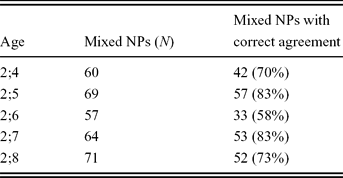
Appendix C. Monthly distribution of mixed NPs with correct agreement (Lily)