Words are fundamental building blocks in any language. The rapid and continued acquisition of shared, consistent phonetic forms that represent life experiences is a core feature of child language learning. On average, typically developing children produce a handful of words within a few months of their first birthday, several hundred words around their second birthday and several thousand words by the time they exit early childhood education programs at around five years of age (e.g., Bloom, Reference Bloom2000; Tomasello, Reference Tomasello2003). The understanding of words generally precedes and exceeds word production at all stages of development. Vocabulary size, the accumulated outcome of word learning, has been closely linked to syntactic development (e.g., Bates & Goodman, Reference Bates and Goodman1997) and to literacy skills (Justice, Meier & Walpole, Reference Justice, Meier and Walpole2005). Reduced vocabulary is an important clinical marker in young monolingual learners (e.g., McGregor, Newman, Reilly & Capone, Reference McGregor, Friedman, Reilly and Newman2002; Rescorla, Reference Rescorla2002). Traditional vocabulary measures, such as picture naming or picture identification of a predetermined item set, are dependent on children's experience with the words tested (e.g., Hammer, Farkas & Maczuga, Reference Hammer, Farkas and Maczuga2010). Bilingual children's performance on traditional vocabulary measures can be meaningfully interpreted only within the context of their previous experiences in each language.
In addition to measuring the product of previous language experience with tests of vocabulary knowledge, researchers have implemented experimental paradigms to investigate children's efficiency in learning new words, under controlled circumstances (see Kan & Windsor, Reference Kan and Windsor2010; Werker, Byers-Heinlein & Fennell, Reference Werker, Byers-Heinlein and Fennell2009, for reviews). A distinct advantage of novel word learning paradigms is that the type and nature of experience with new linguistic forms can be held constant across participants and, in the case of bilingual studies, across languages as well. This allows researchers to determine the efficiency with which a child acquires new words. Investigations of novel word learning in each language of bilingual children may also provide insight into the relative independence, or interdependence, of the two developing language systems. In this study we investigate the learning of new words by three-to-five-year-old children who were exposed to a single first language from birth (L1, Hmong) and a second language (L2, English) beginning with attendance in a bilingual preschool program.
Fast mapping and word learning paradigms: Equating for experience
In experimental paradigms, the cumulative process of word learning is conventionally separated into two phases. The first phase, fast mapping, refers to the child's response after minimal exposure to new words. The second phase is continuous word learning (sometimes called “slow mapping”, Capone & McGregor, Reference Capone and McGregor2005) and refers to the child's comprehension or production of novel forms following additional scripted learning opportunities (e.g., Gray, Reference Gray2005). In a typical fast mapping task, novel words are introduced to the child during brief play-based interactions with the examiner or within the context of computer-based activities (e.g., Alt & Plante, Reference Alt and Plante2006; Ellis Weismer & Evans, Reference Ellis Weismer and Evans2002; Gray, Reference Gray2003; Kan & Kohnert, Reference Kan and Kohnert2008). During this initial exposure phase, children need to extract, recall and replicate a novel phonological sequence and map this phonological form onto its presented referent, typically an unfamiliar object or action (Gathercole, Reference Gathercole2006; Smith, Reference Smith, Golinkoff, Hirsh-Pasek, Bloom, Smith, Woodward, Akhtar, Tomasello and Hollich2000; Storkel, Reference Storkel2001). This initial representation or “fast mapping” of form and meaning are considered incomplete and vulnerable to rapid loss unless reinforced with additional experience (e.g., Capone & McGregor, Reference Capone and McGregor2005).
The next, longer phase is considered true word learning (or slow mapping) and employs scripted interactive or computer-based procedures similar to those used in the fast mapping phase. In this learning phase, however, the child receives additional opportunities to interact with the new word forms over time, and the acquisition of new form–meaning associations is supported with feedback or prompts (e.g., Capone & McGregor, Reference Capone and McGregor2005; Kiernan & Gray, Reference Kiernan and Gray1998). This additional input serves as data for pattern extraction (Saffran & Thiessen, Reference Saffran and Thiessen2003) and also contains multiple linguistic cues (e.g., phonological, semantic, syntactic contexts), which contribute to the success of processing and categorizing relevant information in the input (Capone & McGregor, Reference Capone and McGregor2005; Oetting, Reference Oetting1999; Storkel, Reference Storkel2001). Thus, the link between a word form and its meaning is strengthened through carefully controlled experience (Gray, Reference Gray2003, Reference Gray2004; McGregor, Friedman, Reilly & Newman, Reference McGregor, Newman, Reilly and Capone2002; Smith, Reference Smith, Golinkoff, Hirsh-Pasek, Bloom, Smith, Woodward, Akhtar, Tomasello and Hollich2000). Inefficient fast mapping or word learning skills has been proposed as a potential clinical marker for primary language impairment (see e.g., Kan & Windsor, Reference Kan and Windsor2010, for meta-analysis).
In summary, fast mapping and novel word learning paradigms allow investigators to control for one fundamental source of variation in vocabulary acquisition – the quantity and quality of experience with specific items of interest. Researchers can then focus on children's efficiency in acquiring new form–meaning associations as well as on other factors, aside from experience, that may account for individual variation in word learning.
Word learning performance: Existing vocabulary as a predictor
Even though experience is held constant in fast mapping and word learning paradigms, researchers have consistently reported significant variation in typically developing monolingual children's responses to the same language-learning opportunities (e.g., Ellis Weismer & Hesketh, Reference Ellis Weismer and Hesketh1996; Gray, Reference Gray2003, Reference Gray2004). Gray (Reference Gray2003) found that, on average, typically developing English-speaking children needed about 23.62 trials to consistently identify a novel word. However, the number of trials needed for participants within one standard deviation of this mean (or 68% of participants) ranged from 8.01 to 39.23. Learner variability was even greater on the more demanding production probes.
Paradoxically, the factor that seems to be closely related to novel word learning on experimental paradigms is the amount of previously accumulated vocabulary knowledge, as measured using parental report or standardized vocabulary tests. Results from a number of studies show a strong, positive relationship between existing vocabulary knowledge and facility in learning new words by young monolingual children. Ellis Weismer and Evans (Reference Ellis Weismer and Evans2002) found significant correlations between fast mapping skills in young English-only-speaking children (mean age = 2;6) and scores on the MacArthur-Bates Communicative Development Inventories (CDIs). Gray (Reference Gray2004) also found a positive association between fast mapping performance and scores on the Peabody Picture Vocabulary Test – Third Edition (Dunn & Dunn, Reference Dunn and Dunn1997) in monolingual preschoolers (mean age = 4;10). Interestingly, this link between existing vocabulary and word learning appears to be more robust in younger learners than in older monolingual children (e.g., Ellis Weismer & Hesketh, Reference Ellis Weismer and Hesketh1996; Rice, Buhr & Oetting, Reference Rice, Buhr and Oetting1992).
One explanation for the association between existing vocabulary and novel word learning is that phonological knowledge is the key underlying factor in learning new lexical representations (Gupta & Tisdale, Reference Gupta and Tisdale2009; see Gathercole, Reference Gathercole2006, for review). The rationale is that children with greater vocabulary skills are likely to have more phonological knowledge and to be more efficient in processing phonological representations in speech (e.g., Marchman, Fernald & Hurtado, Reference Marchman, Fernald and Hurtado2009). Better phonological processing skills allow word learners to free up some resources for figuring out the semantic properties of the words and, thus, these skills lead to better form–meaning mapping skills (e.g., Gathercole, Reference Gathercole2006).
The role of existing vocabulary in word learning may also be related to the link between vocabulary size and semantic organization (Borovsky & Elman, Reference Borovsky and Elman2006). As children's language experience and vocabulary size increase, their strategies for categorizing words change (Peña, Bedore & Zlatic-Giunta, Reference Peña, Bedore and Zlatic-Giunta2002). Children who have better categorization skills and greater vocabulary skills are likely to have more robust skills at processing new words in continuous speech and better skills at managing newly-learned words in the system. By contrast, limited semantic representations of the words in the lexicon may lead to decreased skills in establishing form–meaning links (e.g., McGregor et al., Reference McGregor, Friedman, Reilly and Newman2002).
In summary, the general finding with monolingual children has been essentially that “more begets more” – the more words a child already has in his or her repertoire, the quicker he or she will learn new words. A solid lexical foundation allows for quicker and more robust additions, perhaps because of better-developed language templates and/or a more efficient cognitive-linguistic processing system. It may be that word learning under divergent circumstances (e.g., natural or experimental) is a result of children's internal cognitive-linguistic processing efficiency. For example, young monolingual children who are faster and more accurate in recognizing spoken words also demonstrate faster growth in expressive vocabulary (Fernald, Perfors & Marchman, Reference Fernald, Perfors and Marchman2006). For present purposes, the findings indicate the need to account for general cognitive skills. For bilingual children, important questions are whether relationships between existing vocabulary and skill in learning new words is present, as with monolinguals, pooled across languages (such that existing vocabulary in one language predicts new word learning in another) or separated for each language (with relationships between vocabulary and word learning found within but not between languages).
Novel word learning in two languages
To our knowledge, there is only a single previously published study investigating either fast mapping or novel word learning in both languages of bilingual children. Kan and Kohnert (Reference Kan and Kohnert2008) examined fast mapping in 19 sequential bilingual preschool children in both their L1 and L2. As with the current study, participants ranged in age from three to five years (mean age = 4;3, sd = 0;8), learned Hmong (L1) from birth and English (L2) in their bilingual preschool program (mean length of English learning experience = 2;7, sd = 0;6). Existing vocabulary knowledge was indexed by scores on picture identification and picture naming tests administered in the L1 and L2. Age was positively related to existing vocabulary scores in English (L2), but not Hmong (L1). For the fast mapping task, two novel objects were presented in play contexts in each language following procedures developed by Ellis Weismer and Evans (Reference Ellis Weismer and Evans2002). Each novel object was paired with two lexical forms that followed the phonological rules of Hmong, a monosyllabic tonal language, or English. In Hmong, each syllable contains an initial consonant, a vowel (or a diphthong) and a lexical tone (e.g., paj; 〈j〉 indicates a high falling tone) (Smalley, Vang &Yang, Reference Smalley, Vang and Yang1990). The two novel words in Hmong were ye (/je/ with a mid-level tone) and taiv (/taɪ/ with a rising tone); the two English novel words were coob /kʊb/ and tade /teɪd/.
Results from Kan and Kohnert (Reference Kan and Kohnert2008) showed that most children were able to fast map some novel forms in both languages; group performance was marginally better in Hmong than in English, and significantly better on the receptive versus expressive tasks in both languages. However, in contrast to previous studies with monolingual learners, there was little evidence of a relationship between existing vocabulary knowledge and the ability to fast map new words in either Hmong or English. At the same time, across the two languages there was a statistically significant negative association between existing vocabulary knowledge and fast mapping performance. That is, English expressive fast mapping was negatively correlated with Hmong vocabulary knowledge (rs = –.45), suggesting that stronger vocabulary skills in Hmong interfered with children's ability to make an initial representation of novel English forms. It is possible that with cognitive maturation, continued language development and/or additional experience with the novel forms the negative cross-linguistic relationship observed after a single exposure could disappear or change directions. Kan and Kohnert (Reference Kan and Kohnert2008) also found that English expressive fast mapping was positively associated with Hmong receptive fast mapping performance, perhaps indicating some common underlying cognitive-linguistic processing skills applied to quick online information extraction in both. The meaning of cross-language associations as well as the lack of within-language correspondences was open to interpretation as they were based on performance data at a single point in time following minimal exposure.
Word learning studies which investigate individual performance longitudinally using predictive versus correlational investigative tools are needed to further our understanding of potential intra- and inter-language relationships in early sequential bilinguals. In the current study, we examine individual growth curves of children's word learning performance in L1 and in L2 over time and corresponding cumulative experience with novel forms.
Study questions, predictions and general design features
We examine fast mapping and novel word learning by sequential bilingual preschool-age children learning two very different languages, Hmong and English. Our interests are in the rate and shape of change in each language as well as in the relative contribution of previously accumulated vocabulary knowledge on the acquisition of new words, after controlling for age, length of L2 experience, and nonverbal cognitive skills. An experimental training paradigm is used to control input of, and experience with, the novel words. The comprehension and production of novel words in L1 (Hmong) and L2 (English) is measured after one exposure (fast mapping, Time 1) and then again following each of three training sessions (Times 2, 3, 4). Picture identification and picture naming tasks are used to measure previously accumulated lexical-semantic knowledge. There are three research questions:
1. Are three-to-five-year-old children able to comprehend and/or produce novel words in both their L1 and L2 following minimal experience?
2. What is the rate and shape of change in the comprehension and production of novel words in the L1 and L2, given the same quality and quantity of input/training in each language?
3. Does existing vocabulary predict novel word learning in the L1 and L2, either within or across languages?
Consistent with previous findings with a similar group of learners, we expect that children will be successful in fast mapping, to some degree, in both L1 and L2 (Kan & Kohnert, Reference Kan and Kohnert2008). Based on studies of monolingual children we anticipate that, with additional mediated experience, participants will improve their production and understanding of novel words in both languages (Gershkoff-Stowe & Hahn, Reference Gershkoff-Stowe and Hahn2007; Rice, Oetting, Marquis, Bode & Pae, Reference Rice, Oetting, Marquis, Bode and Pae1994). It is unclear whether this anticipated growth will be linear (i.e., increase consistently at a certain rate over time) and comparable in L1 and L2. For example, previous studies investigating lexical skills in early sequential bilinguals indicate different growth trajectories in L1 and L2 (e.g., Kan & Kohnert, Reference Kan and Kohnert2005; Kohnert & Bates, Reference Kohnert and Bates2002; Kohnert, Bates & Hernandez, Reference Kohnert, Bates and Hernandez1999). However, in contrast to the current study, previous bilingual investigations did not control the quantity and quality of experience with lexical forms or use a longitudinal design. We also expect that existing vocabulary will be related to novel word learning within each language, although the strength of this relationship may differ in the L1 and L2. In addition cross-language correspondences may be evident (see Kan & Kohnert, Reference Kan and Kohnert2008).
We employ a two-level Hierarchical Linear Model (HLM; Bryk & Raudenbush, Reference Bryk and Raudenbush1992) to analyze individual participants’ patterns of change in word learning performance as well as to capture group performance. The analyses in previous word learning studies have been done using the ordinary least squares (OLS) regression that assumes independence of observations. One concern with the use of OLS regression is that word learning is an iterative process; a child's performance at one point in the word learning process is not independent from previous or subsequent points in the process. Although word learning is conventionally divided into fast mapping and word learning, these phases are continuous, not discrete. The inherent correlated nature of the within-subject data would lead to overestimation of the sampling variability and, thus, could result in misleading inferences (Fitzmaurice, Laird & Ware, Reference Fitzmaurice, Laird and Ware2004). As such, it is possible that the variability in children's word learning performance might have been inappropriately estimated in previous studies. HLM analyses, which allow us to account for the correlation of clustered data within participants, are conceptually consistent with the nature of word learning paradigms.
Methods
Participants
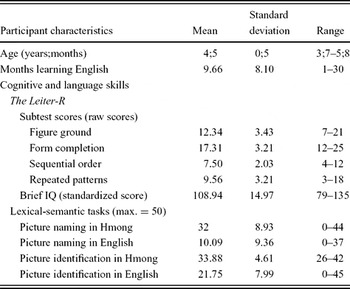
A total of 32 typically developing Hmong–English bilingual children (16 boys and 16 girls; mean age = 4;6; sd = 0;6; age range = 3;7–5;8) participated in this study. Participant characteristics are summarized in Table 1. All participants attended the same bilingual (Hmong–English) preschool program in a large Midwestern city in the U.S., learned White Hmong – one of the Hmong dialects – from birth (L1) and started to learn English (L2) between the ages of three and five years. Twenty-two participants had immigrated to the U.S. between the ages of four years and 34 months (mean age = 24 months; sd = 9.98); the remaining 10 participants were born in the U.S. On average, participants had attended the bilingual Hmong–English preschool for nine months (sd = 8 months; range = 1–30 months). As expected, there was a positive correlation between age and preschool attendance (r = .40, p = .03).
Participant characteristics (n = 32).

Parent/family interviews were conducted by a Hmong teacher. Interview results indicated that Hmong was the main language used in all participants’ homes. Children spoke Hmong with parents, grandparents, and younger siblings, and both Hmong and English with older siblings. In addition, all participants watched some English TV and videos at home; 84% of participants also watched some videos and local television programming in Hmong. Based on parent and teacher reports, there were no concerns with language, learning or development for any study participant.
Participants’ bilingual preschool program included group activities (e.g., story reading, circle time, music, art-and-crafts, snack, free play, lunch time) in both Hmong and English, facilitated by bilingual teachers. The program also had group activities in English, facilitated by English-speaking educational specialists (e.g., music therapists, occupation therapists, speech-language pathologists). Age and length of English experience in the bilingual preschool setting (along with nonverbal cognitive tests scores) were used as control variables in the predictive analysis to isolate the primary relationships of interest.
General procedures
All test and training procedures were administered individually in a separate, quiet room at the participants’ preschool. Test and training procedures were implemented by researchers who were native speakers of either Hmong or English. Baseline cognitive and vocabulary tests were administered in two or three one-hour sessions. Following baseline testing, the experimental word learning paradigms were administered in weekly sessions spanning an eight-week period. Each child participated in four consecutive sessions administered in Hmong and four consecutive sessions in English, with the language of administration counterbalanced across participants. In order to accommodate child absences and unforeseen class activities, the actual administration of the word learning tasks took place over 10 weeks for some participants. All four experimental sessions in each language (fast mapping followed by three novel word training sessions) were videotaped for scoring and reliability purposes.
Baseline testing: Vocabulary and non-verbal cognitive measures
In addition to age and length of English exposure, nonverbal cognitive skill was used as a control variable in the predictive analyses in order to more precisely determine the presence and nature of any relationship between existing vocabulary and novel word learning in L1 and L2. Nonverbal cognitive ability was measured using a standardized test, the Visualization and Reasoning Battery of The Leiter-R International Performance Scale-Revised (The Leiter-R; Roid & Miller, Reference Roid and Miller1997). The normative age range for The Leiter-R is from 2;0 to 20;11. Four subtests were administered in accordance with standardized procedures: Figure Ground, Form Completion, Sequential Order, and Repeated Patterns. Figure Ground requires the child to locate small objects (e.g., a toy car) in a big picture (e.g., a room with a child reading a book). In Form Completion, the child needs to match pieces of a pattern (e.g., star in two pieces) to a whole pattern (a star). In Sequential Order, the child is directed to put objects in a particular order (e.g., from small to big, or from big to small). Repeated Patterns requires the child to discern the patterns of object properties (e.g., color or shape). The mean standardized score of the brief IQ of The Leiter-R was 108.94 (sd = 14.97), indicating that participants’ scores were within 1.5 standard deviation of the published mean, even though the normative sample did not include Hmong–English children (see Kan & Kohnert, Reference Kan and Kohnert2008, for similar findings). The raw scores of the subtests and the standardized composite scores (Brief IQ) are shown in Table 1.
Participants’ vocabulary skills in Hmong and English were measured using picture identification and picture naming tasks developed by Kan and Kohnert (Reference Kan and Kohnert2005). Items for each measure were selected by Hmong–English bilingual and bicultural preschool teachers from the English version of the MacArthur-Bates Communicative Development Inventories (Fenson et al., Reference Fenson, Dale, Reznick, Thal, Bates, Hartung, Pethick and Reilly1993) and validated with preschool children learning Hmong and English (Kan & Kohnert, Reference Kan and Kohnert2005; Kohnert & Kan, Reference Kohnert, Kan, Centeno, Anderson and Obler2007; Kohnert, Kan & Conboy, Reference Kohnert, Kan and Conboy2010). In the picture naming task, pictured items were presented individually. Examiners asked, “What is it?” in the English session or “Yog dabtsi?” in the Hmong session. In picture identification, the picture of each target noun was presented with three different foils. The child was instructed, “Show me ___” for the English session, and “Muab ____ rau kuv” for the Hmong session. No classifier was given in the instruction. Children's responses were marked correct whenever the items were identified exactly. The maximum score on each of these four vocabulary measures was 50. Participants’ scores on these picture naming and picture identification tasks in Hmong and English are shown in Table 2. We investigated the predictive value of performance on these measures of existing vocabulary on novel word learning in the L1 and L2. A 2 × 2 (language × modality) repeated measure ANOVA revealed that there was a main effect of language [F(1,31) = 87, p < .001)]. A post hoc analysis indicated that Hmong scores were higher than English scores on both measures. The analysis was consistent with the parent and teacher reports that these children were Hmong-dominant at the time of testing.
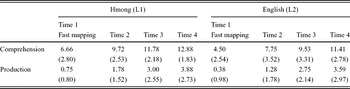
Participants’ novel word learning performance in L1 and in L2.

Note: Shown are the mean scores and standard deviations (in parentheses) on the comprehension and production probes on the word learning task at each of four consecutive weekly sessions in Hmong (L1) and English (L2).
Experimental tasks and procedures
A novel word learning paradigm was used to measure participants’ skill in acquiring new form–meaning mappings in both their L1 (Hmong) and L2 (English) over eight weekly sessions (i.e., 4 sessions × 2 languages). For each language the fast mapping task in the first session was followed by three novel word training sessions. All children participated in novel word learning in both languages, with the order (Hmong first followed by English or vice versa).
Stimuli
Stimuli were sixteen novel objects (shown in Appendix A). These objects were selected from a variety of toys, crafts, and hardware items, and were judged to be without names by 10 native adult speakers of English and by10 adult Hmong–English bilingual speakers. Each object was paired with one English label and one Hmong label. All novel words in both Hmong and English were one-syllable, and were developed in accordance with the phonological characteristics of each language (shown in Appendix B). The English novel words consisted of an initial consonant, a vowel or a diphthong, and a final consonant (CVC). Each Hmong novel word contained an initial consonant, a vowel or a diphthong, and/or a final consonant, [CV(C)], plus a lexical tone.
The relative degree of familiarity and the articulatory difficulty were considered when selecting phonemes and phoneme sequences to be used in the novel words. High frequency phonemes were used in constructing one syllable novel words in Hmong and English (see Kan & Kohnert, Reference Kan and Kohnert2004; Mines, Hanson & Shoup, Reference Mines, Hanson and Shoup1978). Hmong–English teachers also confirmed that the novel words should be relatively easy to produce for the preschool children in their care. The stimuli forms developed in L1 and L2 were judged to be both novel (no semantic value) and plausible (consistent with existing phonetic forms) by 10 Hmong–English bilingual speakers and by 10 native English speakers. The classifier lub preceded the Hmong novel words. The use of this classifier for all of the novel objects was judged to be adequate by 10 Hmong–English bilingual adult speakers. To further establish the developmental appropriateness of the Hmong novel word stimuli, pilot testing was conducted with five additional Hmong–English preschool children (mean age = 5;2, sd = 0;4). These children were able to repeat each novel word in both English and Hmong. An item analysis revealed no systematic difficulties in the recognition or production of novel word stimuli.
In order to provide a meaningful context for word learning as well as to control for the possible effect of semantic categories on word learning, half of the novel items were presented as food items and half as tools. Half of the participants were randomly assigned to learn half of the new objects as tools and half of the new objects as foods, while the other half of the participants were taught that the objects fall into the opposite categories throughout the entire study. No effect of contexts (i.e., food or tools) was found in the sample (p > .05).
Implementation
The 16 novel words in each language were presented in eight blocks to reduce the number of words participants needed to remember at any given time. Each block contained two novel words and two familiar words, with the order of word presentation randomized. Following Ellis Weismer and Evans (Reference Ellis Weismer and Evans2002), novel and real words were embedded in developmentally appropriate thematic stories (e.g., “Mr. Monster packs food for a picnic”; “Mr. Frog needs helps to put the tools into the tool box”). Scripts for the initial fast mapping session and the remaining novel word training sessions are shown in Appendix C. Procedures for implementing these scripts are as follows:
Fast mapping
During the fast mapping task (Session 1), the native Hmong or English-speaking examiner modeled each novel word and each familiar word (e.g., “This is X”) once. The probe phase was administered immediately after the exposure phase for each block in order to determine participants’ skill in comprehending or producing novel form–meaning correspondences after only one brief exposure. Probes for production preceded probes for comprehension. During the production probe, the examiner asked the participant to name each novel and each familiar object (e.g., “Let's see what is in the basket”, “What's this?”). To measure comprehension, the examiner asked the child to choose a named object from six items in a container (i.e., two trained novel objects, two familiar objects, and two additional novel objects as foils) (e.g., “Now Mr. Frog needs some tools. Give Mr. Frog X, please”). The child was given acknowledgement for his/her attempts to respond, but no direct feedback regarding accuracy was given during this probe phase. (See Appendix C.)
Novel word learning
Following the initial fast mapping session in which new words were introduced, three training sessions were conducted in each language. In these sessions the 16 novel objects and the 16 familiar objects were arranged in the same eight blocks and as parts of the same stories for each participant. In these sessions additional experience with the novel words was provided during structured interactive scripts with native speakers of either Hmong or English. Each of these novel word training sessions included a teaching phase and a probe phase (see Appendix C). Additional cues were given during the teaching phase. For example, the examiner first modeled the name of each target object and the child was required to repeat after the examiner (e.g., “This is a deeg. . . Say deeg”); the modeling was followed by semantic cues (e.g., “It's made of plastic. It is orange and green”) and by gestures (e.g., a hand configuration or motion to illustrate object shape or function). The comprehension probe was again administered before the production probe. In contrast to the fast mapping probe phase, immediate feedback regarding accuracy, additional cues, and models were given to children after each response in the novel word training sessions. The same procedures were followed in each language during each of the three novel word training session.
Scoring, reliability and statistical analysis
The dependent variables were the number of novel words each child comprehended or produced in each language following one exposure (fast mapping, Time 1) or following continued training (Time 2, 3, 4). All scoring was done online by the researcher administering the novel word learning protocol. For comprehension tasks, a point was awarded when the child identified the correct novel object in response to the examiner's probe. For production tasks, a point was awarded when the child correctly produced the novel word in the target language in response to the examiner's prompt. Children were not penalized for consistent speech sound errors (e.g., phoneme distortion or final consonant deletion in English) (see Ellis Weismer & Evans, Reference Ellis Weismer and Evans2002). At each of the four time points, the range of possible comprehension and production scores was from 0 to 16, both in Hmong (L1) and in English (L2).
All sessions were videotaped. At each time point 13% of these videotaped sessions were randomly selected to determine procedural and scoring reliability. A trained research assistant fluent in the training language (Hmong or English) independently viewed and scored each video-taped session. The average point-to-point agreement for delivery of instructional procedures was .98 for both Hmong and English. Point-to-point agreement for scoring of child responses was .97 for Hmong and .98 for English.
Two-level Hierarchical Linear Modeling was used to analyze the longitudinal novel word learning data in L1 and L2 (Raudenbush & Bryk, Reference Raudenbush and Bryk2002). The two-level HLM model allows examination of the shape and magnitude of change in the word learning scores for each participant (level 1) as well as the inter-individual differences in change (level 2). The simple linear model (level 1) for each child's change in word learning scores is formulated as:

where π 0i is the intercept, representing individual child i's fast mapping score (i.e., score at time 1); π 1i is the time slope representing individual child i's true slope (i.e., the growth rate of word learning performance).
The intercepts (π 0i individual fast mapping scores) and slopes (π 1i individual growth rates of word learning performance) among participants, then, become the outcomes in the between-person level-2 model:

In the level-2 models, γ 00 and γ 10 represent the average intercept (i.e., average fast mapping score) and average slope (i.e., average rate of word learning performance), respectively; Xqi represents variables including between-person predictors (e.g. existing vocabulary scores) and control variables (i.e., age; cognitive scores, L2 experience), γ 0q represents the effects of Xq on the intercepts (fast mapping) and γ 1q represents the effects of Xq on the slopes (word learning growth trajectories).
A sequence of predictors (Xqi) was systematically added into the level-2 equation. The predictors were (i) scores on picture naming in Hmong and in English; and (ii) scores on picture identification in Hmong and in English. The control variables were age, L2 experience, and non-verbal cognitive scores from four Leiter-R subtests. Only significant predictors were kept for the analysis.
Although the language of administration was counterbalanced across participants, we still examined the potential effect of language order (L1–L2 or L2–L1) on children's performance (e.g., Kiernan & Swisher, Reference Kiernan and Swisher1990). A separate preliminary set of HLM analyses in which the presentation order was used as a predictor was conducted for all measures in each language. Results showed that there was no order effect on novel word comprehension or production scores in either language (Hmong: γor = 0.01, p > .05; γor = –0.02, p > .05, respectively; English: γor = 0.01, p > .05; γor = 0.01, p > .05, respectively).
Results
Table 2 shows participants’ mean scores and standard deviations for the comprehension and production of novel words in Hmong (L1) and English (L2) at each of four time points (the initial fast mapping session followed by three training sessions). At each of the four time points, average group comprehension scores were greater in Hmong (L1) than in English (L2) (γ = –2.35, p < .001), whereas average production scores were similar in L1 and L2 (γ = 0.02, p > .05). It is also clear that, as a group, scores increased in each language and in each response domain (comprehension, production) with additional experience with the novel forms (Hmong: γ 10 = 2.07, p < .0001; γ 10 = 1.05, p < .001; English: γ 10 = 2.25, p < .0001; γ 10 = 1.11, p < .001, respectively).
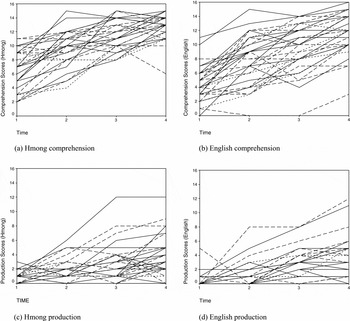
Of primary interest was the fast mapping performance (i.e., intercepts) and the rate of change across time (i.e., slopes) in novel word comprehension and production in each language. Figure 1 illustrates the growth trajectories in each participant's novel word scores in Hmong and in English on each measure. HLM was used to investigate growth rates separately in Hmong and English. The individual growth trajectories were linear. There were no missing data for any of the participants.
Individual growth trajectories on novel word comprehension and production scores in Hmong and in English.

Novel word learning in Hmong (L1)
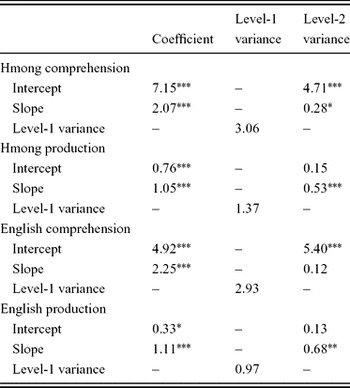
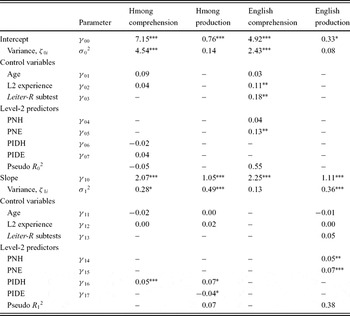
For novel word comprehension in Hmong, results of the unconditional (level-1) growth model showed that the intercepts (fast mapping; γ 00 = 7.15, p < .001) and slopes (rate of word learning; γ 10 = 2.07, p < .0001) were significant (see Table 3). The average participant had a fitted trajectory with an initial novel word comprehension score (fast mapping score) of 7.15 and a slope of 2.07, reflecting an increase of 2.07 words per each weekly session. The between-person (level-2) variance components were significant for the initial status (σ 02 = 4.71, χ2 = 99.10, p < .001) and for the rate of change (σ 12 = 0.28, χ2 = 45.14, p < .05). This substantial between-child variation in both the intercept (fast mapping) and word learning slopes motivated an examination of the heterogeneity in each parameter with level-2 predictors. Results from the level-2 models showed that there were no significant predictors for the intercepts (fast mapping) and the only significant predictor for the slope variation is Hmong picture identification scores (γ 16 = 0.06, p < .05), after controlling for age, L2 experience and non-verbal cognitive skills. However, further inspection showed that picture identification in Hmong did not alter the value of the residual variance of the slope (Pseudo-R2 = 0), which usually decreases with the addition of predictors. That is, Hmong receptive vocabulary scores did not provide any additional explanatory value regarding variation in the growth curves of novel word comprehension in Hmong.
Two-level Hierarchical Linear Models: Novel word learning performance (n = 32).

*p < .05; **p < .01; ***p < .001
Notes: Shown are the estimated parameters of the novel word comprehension and production scores in Hmong and in English in two-level Hierarchical Linear Models. The coefficients of the intercepts (γ 00) and slope (γ 10) show that the average participant had a fitted trajectory with an initial novel word score and slope (i.e., an increase of each time point). The level-1 variance (σɛ 2) represents the level-1 variation at the within-person level. The between-person (level-2) variance components indicate the variation of the intercept and the rate of change. For example, for Hmong comprehension measures, the intercept (γ 00 = 7.15, p < .001) and slope (γ 10 = 2.07; p < .001) showed that the average participant had a fitted trajectory with an initial novel word comprehension score of 7.15 and a slope of 2.07 (i.e., an increase of 2.07 words each week). The within-person (level-1) variance was 3.06. The between-person (level-2) variance components were significant for the initial status (σ 02 = 4.71, p < .001) and for the rate of change (σ 12 = 0.28, p < .05).
For novel word production in Hmong, the level-1 model results revealed significant intercepts and slopes (Table 2). The average bilingual participant had a fitted trajectory with an initial novel word production score of 0.76 (γ 00 = 0.76, p < .001) and a slope of 1.05 (γ 10 = 1.05, p < .001), reflecting an increase of 1.05 words for each weekly session. The between-person (level-2) variance components were not significantly different in the intercept (Hmong fast mapping production; σ 02 = 0.15, χ2 = 22.15, p > .05), indicating similar production performance across children after one exposure to the novel Hmong words. However, there was significant variation among children in the rate of change in producing new Hmong words across the training sessions (σ 12 = 0.53, χ2 = 80.60, p < .001). Therefore, level-2 predictors were used only to assess the heterogeneity of the slopes. Results showed that picture identification scores in both Hmong and English were significant predictors (γ 06 = 0.07, p < .05; γ 07 = –0.04; p < .05; Pseudo-R 22 = 0.07), although in opposite directions. That is, Hmong picture identification scores positively predicted the slopes of the Hmong novel word learning production scores, whereas English picture identification scores were negatively associated with the variation of the slopes. These two predictors together explained 7% of the slope variation in Hmong novel word production.
Novel word learning in English (L2)
For novel word comprehension in English, results of the unconditional growth model revealed significant intercepts and slopes (Table 2). The average participant had a fitted trajectory with a fast mapping novel word comprehension score of 4.92 (γ 00 = 4.92, p < .001) and a slope of 2.25 (γ 10 = 2.25, p < .0001), reflecting an increase of 2.25 words per weekly session. The between-person (level-2) variance components showed substantial variation among participants in English fast mapping comprehension scores (fast mapping; σ 02 = 5.40, χ2 = 112.78, p < .001). There was no significant variation in the rate of change in L2 (σ 12 = 0.12, χ2 = 37.88, p > .05). Thus, the sequence of level-2 predictors was added into the growth models to determine their role in the level-1 intercepts only. Results showed that picture naming in English was a significant predictor of fast mapping comprehension scores in English (Pseudo-R 02 = 0.42; γ 05 = 0.13, p < .001). In addition, two of the control variables – L2 experience (γ 01 = 0.11, p < .01) and scores on the Repeated Patterns subtest on The Leiter – were significant predictors of fast mapping performance (γ 03 = 0.18, p < .01; Pseudo-R 02 = 0.55, respectively). Combined, English picture naming scores, L2 experience and Repeated Patterns subtest scores predicted 55% of the variation in English fast mapping comprehension.
For novel word production in English, results of the unconditional growth model showed significant intercepts and slopes (Table 2). The average participant had a fitted trajectory with an initial novel word production score of 0.33 (γ 00 = 0.33, p < .05) and a slope of 1.11 (γ 10 = 1.11, p < .001), reflecting an increase of 1.11 words each week). The between-person (level-2) variance components were not significantly different in the intercept (English fast mapping production; σ 02 = 0.13, χ2 = 23.93, p > .05), indicating similar production scores across children after only a single exposure to novel English words. However, there was a significant difference in the rate of change (σ 12 = 0.68, χ2 = 130.11, p < .001) among participants. Thus, the sequence of level-2 predictors was systematically added into growth models to examine the source of the slope variation. Both Hmong and English picture naming scores were significant predictors of the variation in slopes (γ 14 = 0.05, p < .01; γ 15γ 15 = 0.07; p < .001) as was one of the non-verbal subtests, Form Completion (γ13 = 0.12, p < .05; Pseudo-R 12 = 0.38). The combination of these predictors explained 38% of the slope variation of the production scores.
Discussion
We investigated novel word learning by three-to-five-year-old children learning Hmong (L1) at home from birth and English (L2), the majority community language, in early childhood. On average, the 32 participants had just over eight months of L2 experience in a bilingual Hmong–English preschool setting. Participants had both more experience and greater proficiency in Hmong, relative to English. In the experimental task, children were introduced to unfamiliar objects which were paired with novel word forms during individual scripted training sessions conducted in Hmong or English by an investigator proficient in each language. We examined whether participants were able to comprehend and/or produce novel word forms in their L1 and L2 after minimal exposure, if the rate and direction of acquisition over subsequent training sessions were similar in the two languages. Furthermore, we examined the relationship between existing vocabulary and novel word learning, within and across languages. Results related to each of these study questions are discussed.
Level-2 predictors.

*p < .05; **p < .01; ***p < .001
Notes: Level-2 predictors were entered in the level-2 models in which there were significant variations in the intercepts (ζ 0i) and slopes (ζ 1i). These models were Hmong comprehension intercepts, English comprehension intercepts, Hmong production slopes, and English production slopes.
The control variables included in all models were L2 experience, age and The Leiter-R subtests. Level-2 predictors were entered the models in the following orders across all models: (i) picture naming in Hmong (PNH) and in English (PNE), and (ii) picture identification in Hmong (PIDH) and in English (PIDE). Significant predictors were kept in each model. Pseudo-R2 Statistics (R 02and R 12) indicate how much outcome variation that is explained by the level-2 predictors.
Children's responses in the L1 and L2 following minimal exposure to new word forms
Three-to-five year-old children in the current study were able to “fast map” new word forms to unfamiliar objects in both their L1 and L2 after only brief exposure. Not surprisingly, children's fast mapping scores were far better in both the L1 and L2 for comprehension than for production (see Gray, Reference Gray2003; Kan & Kohnert, Reference Kan and Kohnert2008). On average, participants identified 45% of the novel objects in Hmong and 30% in English; they named only 4% of the novel objects in Hmong and only 2% of the novel objects in English. Although participant comprehension of new forms in both Hmong and English was evident after only a single exposure session, performance was significantly better in Hmong, their first and relatively stronger language at this point in time. In production, the cross-language differences in performance again favored the L1; but these differences were small and not statistically significant, since scores were near the baseline in both languages.
In summary, fast mapping results demonstrate that children can and do learn new words quickly in their weaker as well as in their stronger language. This finding has educational significance as, in many cases, children who speak one language at home attend educational programs in a new and, at least temporarily, weaker language. At the same time, it is clear that performance after minimal experience is greater in the L1 (and more proficient language) and on receptive versus production measures. These results replicate findings from the single previously published study which investigated fast mapping in both languages of bilingual preschool children (Kan & Kohnert, Reference Kan and Kohnert2008).
Acquisition of novel words: Rate and shape of change in L1 and L2
For children who learn a minority language (L1) from birth and the majority community language (L2) during early childhood, there is a growing empirical literature that indicates L2 learning outpaces and overtakes the L1 (e.g., Jia, Kohnert, Collado & Aquino-Garcia, Reference Jia, Kohnert, Collado and Aquino-Garcia2006; Kan & Kohnert, Reference Kan and Kohnert2005; Kohnert, Reference Kohnert and Bates2002; Kohnert & Bates, Reference Kohnert and Bates2002). It was speculated that better L2 outcomes, largely inferred from cross-sectional versus longitudinal data, were a result of enriched opportunities and experiences in this language, as compared to those available in the L1. The advantage of novel word learning paradigms is that they allow investigators to move beyond speculation by controlling the experience that children receive with respect to target items. The design of this present study, which focuses not only on group performance but also on the growth of individual performance, allows taking individual differences of word learning into account. This method also makes possible the implementation of longitudinal (vs. cross-sectional) designs with a sizeable group of bilinguals. In the current longitudinal investigation of novel word learning, we were able to control the quality and quantity of children's experience with new words in each language. Thus, we were able to directly investigate the rate and shape of change in the comprehension and production of novel form–meaning associations in Hmong and English.
More items were identified or named in Hmong (L1) at each time point than in English (L2). However, we found comparable linear growth in novel word learning performance in both the L1 and L2, after children were given systematic and supportive input. On the comprehension probes, children's performance increased by 2.07 in Hmong and by 2.25 in English each week– a 13% and a 14% gain each session in L1 and L2, respectively. On the production probe the rate of growth was 1.05 in Hmong and 1.11 in English, representing a 7% increase in each weekly session, in each language.
These findings are consistent with studies showing that monolingual children's knowledge of novel words increases as a function of experience (e.g., Capone & McGregor, Reference Capone and McGregor2005; Gershkoff-Stowe & Hahn, Reference Gershkoff-Stowe and Hahn2007; Rice et al., Reference Rice, Oetting, Marquis, Bode and Pae1994). More importantly, our results clearly show that when the quantity and quality of young children's language experiences are comparable, both the rate and the shape of new word learning are similar in L1 and L2, despite somewhat different starting points in each language (see previous section describing fast mapping results). That is, at least at the group level, these findings show that the sequential acquisition of two typologically distinct languages by typical preschool age children need not be a “zero-sum” endeavor, with gains in one language coming at a cost to the other. Results underscore the need for consistent, rich opportunities to engage with both home and school languages if bilingual proficiency is the desired outcome for young children (see Duursma, Romero-Contreras, Proctor, Szuber & Snow, Reference Duursma, Romero-Contreras, Proctor, Szuber and Snow2007; Kohnert, Reference Kohnert2007; Pearson, Reference Pearson2007).
Relationships between existing vocabulary and new word learning
Investigations with young monolingual children show a strong positive relationship between previously accumulated word knowledge, as measured by scores on standardized vocabulary tests, and novel word learning performance. That is, the more words a child already has in his or her repertoire, the more quickly he will learn new words. For bilingual children, we were able to look at the relationship between existing vocabulary knowledge, operationally defined as scores on picture naming and picture identification tasks in Hmong and English, and novel word learning within and across children's L1 and L2.
Within-language associations
Within each language, we found some evidence of a positive, predictive relationship between existing vocabulary and word learning. These relationships were both within and between modalities (receptive vocabulary – receptive word learning probe; receptive vocabulary – expressive word learning probe). Consistent with results from studies with monolingual children, these results indicate that word learning in L1 and L2 is somehow fundamentally linked to previous learning within each language. For present purposes, this within-language link was above and beyond any general developmental effects (indexed by age), experience in L2 (operationalized as length of preschool attendance) or cognitive skills (determined by scores on The Leiter-R subtests).
Although evidence of positive associations between existing vocabulary and new word learning was present in each language, the strength of this relationship was not completely symmetrical. For our participants, the link between existing vocabulary and word learning was stronger and more consistent in L2 (the newer and relatively weaker language) than in L1. Specifically, scores on the English expressive vocabulary test were robust predictors of both English fast mapping comprehension and the rate of growth in English novel word production. For L1, Hmong picture identification scores were moderately associated with the rate of novel word production and weakly related to change in novel word comprehension. This finding is consistent with the monolingual literature. That is, in English-only learners, the association between existing vocabulary knowledge and facility in learning new words is more robust for younger children, at earlier stages of language acquisition (e.g., Ellis Weismer & Evans, Reference Ellis Weismer and Evans2002; Graham, Poulin-Dubois & Baker, Reference Graham, Poulin-Dubois and Baker1998) and more variable in older children with greater overall language ability (e.g., Kiernan & Gray, Reference Kiernan and Gray1998). Participants in our study were three-to-five-year-old children who had an average of eight months of L2 experience in the preschool setting. For producing a novel word in L2, children need to establish a robust phonological representation of the word and to form a link to its referent. The existing expressive vocabulary measure in L2 might serve as an index of these skills. This explanation is consistent with our dataset in which children with strong existing expressive vocabulary in L2 also had greater fast mapping skills in L2 and had a greater gain of novel word production performance in L2.
On the other hand, learning new words in the stronger language (L1) might be associated with a combination of factors (e.g., more linguistic and cultural experience in L1 context, stronger syntactic skills in L1) in addition to phonological and semantic knowledge in L1. Our data show that there was no within-modality relationship in L1 but that there was a cross-modality link between novel word production in L1 and existing receptive vocabulary in L1. This finding suggests that the combination of factors, somehow, might be more consistent with the existing receptive vocabulary in L1. In addition, the within- and cross-modality associations in L1 and in L2 might also be related to the existing vocabulary measures that were used in the current study. The vocabulary measure was developed using items that were consistent with Hmong and English experience (Kan & Kohnert, Reference Kan and Kohnert2005). Different measures of existing vocabulary that consider phonological and semantic properties of words, as well as key typological features of Hmong and of English, may provide additional explanatory power.
Cross-language associations
We also found cross-linguistic associations between bilingual children's existing vocabulary and their word learning performance. Importantly, there were differences in the direction of these L1–L2 links. A positive relationship was found between expressive vocabulary scores in L1 (Hmong) and the growth of word learning production in L2 (English). In contrast, children with larger English receptive vocabulary skills were slower in learning new Hmong (L1) words, at least on the production measures. It is important to note that the word learning performance for the cross-linguistic association was not a static measure at a single time point, but rather a dynamic measure involving the rate of change in novel word learning. Previous studies used cross-sectional designs documenting performance at single time points to investigate cross-language associations on various linguistic measures (e.g., word and grammar; vocabulary size and online speech processing) in young simultaneous bilingual learners (e.g., Marchman et al., Reference Marchman, Fernald and Hurtado2009; Marchman, Martínez-Sussmann & Dale, Reference Marchman, Martínez-Sussmann and Dale2004) as well as in sequential bilingual learners (e.g., Kohnert et al., Reference Kohnert2010). Evidence for cross-linguistic relationships in these studies were either absent (e.g., Marchman et al., Reference Marchman, Fernald and Hurtado2009) or weak (e.g., Kan & Kohnert, Reference Kan and Kohnert2008). It may be that within-speaker cross-language relationships are best captured by dynamic, longitudinal investigative methods. Cross-language correspondences may be the result of more general cognitive, versus linguistic, mediation (Kohnert et al., Reference Kohnert2010). For example, Marchman et al. (Reference Marchman, Fernald and Hurtado2009) attribute their findings of strong within-language associations between vocabulary knowledge and speed of lexical access found in a sample of young simultaneous Spanish–English bilinguals to cognitive skills (attention and memory) needed to process relevant information in the input. This explanation is also relevant for the current finding of cross-language associations.
Our data showed that there was a positive cross-language association between existing vocabulary in L1 and word learning in L2. For bilingual children who learn two languages at different times, the positive links between L1 and L2 suggest that early experience with L1 may serve as the foundation for learning new words in L2 contexts (e.g., Kan & Kohnert, Reference Kan and Kohnert2008). For instance, it is likely that children's L1 knowledge plays a facilitative role in directing their attention to the salient linguistic properties of L2 inputs (e.g., consonant-in-final-position in English words; word order in English), at least at the beginning stage of learning L2. It is also possible that children's semantic organization that was constructed on the basis of L1 vocabulary facilitates their processing novel words in a new language (L2). Our data from children who speak Hmong and English – two typologically different languages – provide even stronger evidence to support the continuity between L1 and L2 in bilingual children.
Another possible explanation is that existing vocabulary serves as a mediator variable that is linked to children's social resources for language learning. For example, it is well-documented that language input is positively linked to children's vocabulary (e.g., Huttenlocher, Haight, Bryk, Seltzer & Lyons, Reference Huttenlocher, Haight, Bryk, Seltzer and Lyons1991; Pearson, Fernandez, Lewedag & Oller, Reference Pearson, Fernandez, Lewedag and Oller1997). In our study, since social support for language learning in school was held constant (i.e., all children attended the same preschool), the sources of variation may come from children's social resources at home. It is likely that rich and supportive environment at home (e.g., positive attitude and support by family members) is the general condition that facilitates language learning in both languages (e.g., Leseman & van Tuijl, Reference Leseman and van Tuijl2001; Pearson, Reference Pearson2007). Conversely, strong social support at home, which leads to children's greater vocabulary in L1, may result in stronger skills for learning new words not only in L1 but also in L2. Further investigations are needed to directly test the cross-linguistic link between social contexts and word learning.
By contrast, children who have more existing vocabulary in L2 learn fewer new words in L1. The negative link suggests that there may be a competition between the new, and weak, language (L2) and the stronger language (L1) in developing children at the beginning of their learning L2 (e.g., Kan & Kohnert, Reference Kan and Kohnert2008; Kohnert, Reference Kohnert2007). When other factors are equal, children who have very limited existing vocabulary in L2 may rely on their existing L1 skills to process, and to build form–meaning associations of new words in L2, as described earlier. However, greater existing linguistic knowledge in L2 may compete with their skills in L1. It is likely that the competition between L1 and L2 somewhat weakens the ability to process and to manage L1 input, at least at the stage of learning L2. Another explanation to the cross-linguistic relationship is related to the social and academic status of L2. Our sample includes preschool children who learn L2 vocabulary in academic settings where most words are not only presented in spoken form but also in written form. It is well-documented that pre-literacy activities and vocabulary development are closely linked to each other (e.g., Hammer et al., Reference Hammer, Farkas and Maczuga2010). It is possible that the combination of the social-academic factors of L2 contribute to the strength of the L2 linguistic cues for the cross-linguistic competition. Further studies are needed to investigate the L1–L2 interactions in older children who have greater proficiency in both languages.
Conclusion
There are four main findings related to word learning by typically developing sequential bilingual preschool children. First, these dual-language learners are able to understand new form–meaning mappings in both their weaker and stronger languages, after limited experience. At the same time, the ability to “fast map” is relatively better in the child's more proficient language. Second, when language learning opportunities are the same in the L1 and L2, the shape and pace of new word learning is also comparable across languages. Third, as with monolingual learners, previously accumulated vocabulary in a given language positively predicts change in response to novel word learning training tasks. What is different with bilingual learners is that the strength of the relationships between past and present learning may differ in the L1 and L2. Fourth, there is clear evidence of language interdependence, with positive as well as negative associations between the L1 and L2 that are not related to similarities in formal features of the two languages. Predictive relationships within and across languages and modalities are consistent with highly interactive dynamic theories of sequential bilingual language learning (Kohnert, 2008, 2010). Future longitudinal investigations are needed to further address the effects of social and cultural aspects on organizing and retrieving newly-learned words within and across languages in bilingual children.
Appendix A. Novel objects

Appendix B. Novel words in Hmong and in English

Appendix C. Scripts in English (L2)