Introduction
Cognitive operations engaged in handwriting involve essential processes of retrieving linguistic information from the mental lexicon, activating orthographic codes in working memory, and transcribing parameters into motor programming. As posited by the psychomotor model of writing (Kandel et al., Reference Kandel, Peereman, Grosjacques and Fayol2011; Van Galen, Reference Van Galen1991), these conceptual, linguistic, and motor levels of processing can be characterized as either high-level central mechanisms by which orthographic forms are assembled and generated lexically and/or sublexically; or low-level peripheral processes dedicated to the allographic selection, stroke order planning and execution of the motor trace (Delattre et al., Reference Delattre, Bonin and Barry2006; Ellis, Reference Ellis1979; Planton et al., Reference Planton, Jucla, Roux and Démonet2013; Purcell et al., Reference Purcell, Turkeltaub, Eden and Rapp2011; Rumelhart & Norman, Reference Rumelhart and Norman1982; Weingarten, Reference Weingarten2005).
In the same vein, prior writing research has become increasingly grounded in the relationship between central and peripheral processes, with two main assumptions being posited. From a feedforward perspective, central and peripheral processes function in an encapsulated manner (Baxter & Warrington, Reference Baxter and Warrington1986; Meyer et al., Reference Meyer, Roelofs and Levelt2003; Planton et al., Reference Planton, Jucla, Roux and Démonet2013; Purcell et al., Reference Purcell, Turkeltaub, Eden and Rapp2011). The writing processing steps are sequentially and discretely coordinated; thus, processing at the spelling level has to be completed before the onset of the motor execution (Damian, Reference Damian2003; Damian & Stadthagen-Gonzalez, Reference Damian and Stadthagen-Gonzalez2009). A contrasting assumption against this hypothesis is that for handwriting in the proficient writer, strictly serial processing steps without overlap of different cognitive processes do not seem conceivable since skilled writing is rather automatized, and hence orthographic representations can be processed in tandem with movement execution (Olive, Reference Olive2014). Functional models therefore assume that levels of processing operate in a cascaded fashion (Van Galen, Reference Van Galen1991). Contrary to the discrete view, higher-order linguistic representations in the cascaded architecture continuously spread from central to peripheral levels, thus modulating lower levels of graphomotor production. This allows information to flow downwards to the next level before the preceding level of processing has finished, with feedback from graphomotor to spelling processes. Attempts to further solidify this claim come from studies that used different languages to examine the interaction between spelling processes and motor execution, including Spanish (Afonso et al., Reference Afonso, Álvarez and Kandel2015a; e.g., Alvarez et al., Reference Alvarez, Cottrell and Afonso2009; Suárez-Coalla et al., Reference Suárez-Coalla2018), French (e.g., Delattre et al., Reference Delattre, Bonin and Barry2006; Kandel & Perret, Reference Kandel and Perret2015; Roux et al., Reference Roux, McKeeff, Grosjacques, Afonso and Kandel2013), English (Kandel et al., Reference Kandel, Peereman and Ghimenton2013), Italian (Kandel et al., Reference Kandel, Peereman, Ghimenton and Perret2019) and Chinese (Lau, Reference Lau2021; R. Wang et al., Reference Wang, Huang, Zhou and Cai2020; Zhang & Feng, Reference Zhang and Feng2017). To date, previous lines of research exclusively focused on cascading levels of processing in the native language (L1). Moving along this direction, the current research is concerned with investigating cross-writing system variations in the establishment of central-peripheral interactions under the scenario of the second language (L2) handwritten production.
Concretely, we evaluated the impact of lexical and sublexical information on the spelling and graphomotor processes during L2 English word writing across Chinese–English versus Spanish–English bilinguals. We then asked whether the interaction of central and peripheral processes occurs in L2 handwritten production and if it does, to what extent central lexical and/or sublexical processing cascade over motor execution as a function of bilingual L1 (i.e., morpho-syllabic vs. alphabetic) backgrounds. Before presenting the details of the experiment reported below, we 1) briefly characterize the dual-route model in monolingual literature and its variations, 2) recapitulate the evidence for cross-writing systems transfer in L2 word reading procedures so far, and 3) propose hypotheses of L1-L2 transfer effects on L2 written production.
Monolingual writing: the theoretical account of the dual-route processes
In the monolingual spelling literature, neuropsychological models of spelling to dictation (Folk et al., Reference Folk, Rapp and Goldrick2002; Houghton & Zorzi, Reference Houghton and Zorzi2003; Tainturier & Rapp, Reference Tainturier and Rapp2001) and/or immediate copying (Bonin et al., Reference Bonin, Peereman and Fayol2001; Fernando, Reference Fernando2000) generally include two parallel routes to drive the spelling of words, which would be determined mainly by the linguistic properties of the target word. The lexical route retrieves known orthographic codes from long-term memory, and the relative strength of activating this route would increase with the rate of occurrence of orthographic forms (i.e., lexical frequency). In contrast, the sublexical route computes the spelling of unfamiliar or novel words by relying on the phonology-to-orthography (P-O) consistency system. The degree of P-O consistency is a function of the proportion of words with a similar orthographic representation of a given phonological unit and all other words in which the same unit is represented orthographically otherwise. This measure therefore commonly taps into central processes at a sublexical level. The output from lexical and/or sublexical sources is then stored in the graphemic buffer (i.e., orthographic working memory system) that acts as an interface between central and peripheral processes. Although lexical and sublexical procedures are demonstrated to interact at the graphemic stage and share a common graphemic buffer (Bosse et al., Reference Bosse, Valdois and Tainturier2003; Houghton & Zorzi, Reference Houghton and Zorzi2003; Roux & Bonin, Reference Roux and Bonin2012; Tainturier et al., Reference Tainturier, Bosse, Roberts, Valdois and Rapp2013), it is still an ongoing issue of which levels of linguistic information flow between central and peripheral processes, and the extent to which the working memory capacity is available for cascading coordination of the written production system. In this sense, accumulative empirical findings (see below) support the idea that the activation of lexical and sublexical representations cascades from spelling to graphomotor processes, but their strength can be quantified by various factors.
First, the functional involvement of two processing routes depends on the type of task used for spelling. Bonin et al. (Reference Bonin, Méot, Lagarrigue and Roux2015) demonstrated a reliable effect of P-O consistency at the central level (evidenced by writing latency) in the spelling-to-dictation but not in the immediate copying task. The peripheral manifestation of the consistency effect (marked by letter/inter-letter interval duration), however, has been documented in both tasks, indicating the application of sublexical information involved in the temporal execution of orthographic forms (e.g., Afonso et al., Reference Afonso, Álvarez and Kandel2015a, Reference Afonso, Suárez-Coalla and Cuetos2015b; Lambert et al., Reference Lambert, Alamargot, Larocque and Caporossi2011). In parallel, the influence of lexical frequency on the time taken to initiate a graphomotor response has been repeatedly detected across tasks (Bonin et al., Reference Bonin, Méot, Lagarrigue and Roux2015; Roux et al., Reference Roux, McKeeff, Grosjacques, Afonso and Kandel2013), while its influence on motor execution decreases among writers as they advance along the literacy/writing acquisition trajectory. This pattern has been confirmed by developmental studies (Afonso et al., Reference Afonso, Suárez-Coalla, González-Martín and Cuetos2018; Suárez-Coalla et al., Reference Suárez-Coalla2018) documenting a more apparent effect of lexical frequency in younger than older children (see also the different pattern in Kandel & Perret, Reference Kandel and Perret2015; Lau, Reference Lau2019), and by research on dyslexia where the magnitude of the frequency effect was larger for dyslexic than for typical readers (Afonso et al., Reference Afonso, Álvarez and Kandel2015a, Reference Afonso, Suárez-Coalla and Cuetos2020). Lastly, the locus of lexical and sublexical effects varies depending on the lexical status of the target word. Roux et al. (Reference Roux, McKeeff, Grosjacques, Afonso and Kandel2013) reported a salient lexical property (i.e., lexicality effect) in letter duration, but it was restricted to the first letters of the item. Sublexical P-O consistency, on the other hand, affected the writing execution for the initial letter when the irregular segment was placed in the beginning (e.g., MONSIEUR), while letter durations were lengthened when the irregularity was at the final position (e.g., INSTINCT). The authors thus concluded that central lexical and sublexical processes influence the kinematics of movement production but do not cascade to the same extent during handwritten production.
The aforementioned theoretical accounts and studies collectively provide essential proof of concept in favor of the interactive and cascaded functional architecture and its modulation by the input modality, age, or the target word's characteristics. Importantly, however, questions remain in regard to whether the involvement of lexical and sublexical processes varies as a function of orthographic systems and if it is true, how variation in L1 literacy backgrounds gives rise to variabilities in L2 handwritten production.
Bilingual reading: the underlying mechanism of cross-language transferring
In the context of reading, contemporary models of bilingual word recognition (BIA, BIA+, Dijkstra et al., Reference Dijkstra, Heuven and Grainger1998; Dijkstra & Van Heuven, Reference Dijkstra and Van Heuven2002) or production (RHM, Costa et al., Reference Costa, Miozzo and Caramazza1999; Kroll et al., Reference Kroll, Van Hell, Tokowicz and Green2010; Kroll & Stewart, Reference Kroll and Stewart1994; Kroll & Tokowicz, Reference Kroll and Tokowicz2005) have settled on a general assumption that lexical representations in bilingual language systems are accessed in a non-language-selective manner. Nonetheless, such co-activation does not necessarily guarantee that all linguistic components of L1 and L2 reading networks are always triggered simultaneously, which indeed, would be modulated by the type of reading strategy and the degree of proficiency in each language. Relatedly, the orthographic depth hypothesis (Frost et al., Reference Frost, Katz and Bentin1987) predicted that shallow orthographies (e.g., Spanish/German, de León Rodríguez et al., Reference de León Rodríguez, Buetler, Eggenberger, Laganaro, Nyffeler, Annoni and Müri2016; Perry & Ziegler, Reference Perry and Ziegler2002) tend to involve more sublexical decoding-like processing. In contrast, deeper orthographies (e.g., French/Dutch/Chinese, see Lallier & Carreiras, Reference Lallier and Carreiras2018 for review) are likely to activate a lexical reading-like pattern primarily, retrieving phonological information through access to the mental lexicon (see also the psycholinguistic grain size theory by Ziegler et al., Reference Ziegler, Perry, Jacobs and Braun2001; Ziegler & Goswami, Reference Ziegler and Goswami2005). Therefore, the varying depth of grapheme-to-phoneme correspondences across different orthographies may determine how words are processed based on sublexical grapheme-phoneme relation and contribute to the organization of orthographic representations at the lexical level as well.
Accordingly, the sensitivity to L1 orthographic-specific features would be transferred non-optimally to guide the employment of dual-route procedures in L2 scripts. The idea is partly supported by prior research with between-group designs of different L1 backgrounds. For instance, Hamada and Koda (Reference Hamada and Koda2008) measured the L2 English reading performance between Korean–English and Chinese–English bilinguals. They reported that compared to Korean–English bilinguals, whose L1 orthographic background is congruent with English as an L2 (i.e., both are alphabetic writing systems), Chinese–English bilinguals showed less sensitivity to the phonological properties of L2 English scripts and stronger sensitivity to lexical frequency. In their later work, Hamada and Koda (Reference Hamada and Koda2011) further explored similarities and differences in L2 visual word learning by comparing Korean and Chinese bilingual groups. The Korean group showed more sensitivity to phonological features of novel L2 words than the Chinese groups, as evidenced by a significant effect of the P-O regularity. These results illustrated that L2 readers with divergent L1 orthographic depths adopt systematically different processes towards the use of lexical versus sublexical reading strategies, in support of cross-linguistic transfer effects on the bilingual reading procedures (Akamatsu, Reference Akamatsu1999, Reference Akamatsu2002; Ben-Yehudah et al., Reference Ben-Yehudah, Hirshorn, Simcox, Perfetti and Fiez2019; Hamada & Koda, Reference Hamada and Koda2010; M. Wang & Koda, Reference Wang and Koda2005, among many others)
In parallel with those studies concerned with cross-writing systems transfer in reading, it is reasonable to expect that variation in the L1 alphabetic versus morpho-syllabic background should impact L2 handwritten production. However, to our knowledge, there is currently no direct evidence or specific data supporting this assumption. Still, no hypotheses or predictions are made on whether L1-specific orthographic knowledge modulates the central-peripheral interaction of L2 scripts, particularly those with varying degrees of orthographic depth, and the ensuing effect on the internal organization of the bilingual spelling system. As such, the proposed relationships among bilinguals’ L1 orthographic backgrounds, L2 input properties, and L2 handwritten production are argued for in the present study.
Bilingual writing: the putative influence of L1 orthographic-specific variations
We propose that the coordination of online L2 handwriting processes will be influenced by the characteristics of the L1 orthography. Although the distinction in orthographic depth does not hold up to direct scrutiny in peripheral writing mechanisms, potential issues regarding the mediating role of phonological information are implied in prior research on the Spanish and Chinese populations, respectively.
The writing models of alphabetic languages converge in representing two key cognitive processes in handwritten production (e.g., Bonin et al., Reference Bonin, Peereman and Fayol2001; Fernando, Reference Fernando2000). The semantic system is symmetrically connected to orthographic and phonological output lexicons, with entries in the graphemic buffer being selected either directly through semantic code activation (i.e., the orthographic autonomy route, Miceli & Miceli, Reference Miceli and Miceli1997; Rapp et al., Reference Rapp, Benzing and Caramazza1997) or indirectly via the phoneme-to-grapheme conversion (i.e., the phonological mediation route, Basso et al., Reference Basso, Taborelli and Vignolo1978; Geschwind, Reference Geschwind1974). Specifically, skilled Spanish writers are documented to exhibit more weights of the sublexical P-O consistency than lexical word frequency (Afonso et al., Reference Afonso, Álvarez and Kandel2015a, Reference Afonso, Suárez-Coalla and Cuetos2020; Kandel & Valdois, Reference Kandel and Valdois2006; Suárez-Coalla et al., Reference Suárez-Coalla, Villanueva, González-Pumariega and González-Nosti2016, Reference Suárez-Coalla2018, 2020) – even in the immediate copying task involving known words (e.g., Afonso et al., Reference Afonso, Álvarez and Kandel2015a) – implying the application of phonological mediation in the selection, activation, and execution of constitutive letters in a transparent orthography (see Kandel et al., Reference Kandel, Peereman, Ghimenton and Perret2019, for similar results in Italian). Furthermore, evidence for explaining the absence of lexical frequency effect in the peripheral processing of Spanish words was determined by Afonso et al. (Reference Afonso, Suárez-Coalla, González-Martín and Cuetos2018). The authors contended that due to the less conflict and interference between lexical and sublexical processing in Spanish, skilled writers could effectively assemble orthographic units at the sublexical level, thereby producing accurate spellings for the majority of words.
In contrast, Lau (Reference Lau2019) found opposite results compared to Afonso et al. (Reference Afonso, Suárez-Coalla, González-Martín and Cuetos2018): the effect of radical frequency elicited by Chinese characters was robust in Chinese children with developed writing skills. The data pointed to the evidence that skilled Chinese writers are able to take advantage of the combined graphomotor patterns of both small and large orthographic units. Indeed, Chinese is a morpho-syllabic language in which characters consist of interwoven strokes that are packed into a square-shaped form, and each graphic symbol corresponds with a morpheme. As Seidenberg (Reference Seidenberg1985) noted in Chinese, “more direct encoding of phonological information only provides an advantage for low-frequency, more slowly recognized lexical items” (p20). Thus, notwithstanding conflicting findings concerning the phonological effects on orthographic access (e.g., Qu et al., Reference Qu, Damian, Zhang and Zhu2011; Zhang & Wang, Reference Zhang and Wang2015), Chinese orthographic codes in general can be directly retrieved from semantic input without requiring phonological mediation. More recently, studies using writing-to-dictation paradigms have revealed that the P-O consistency effect on Chinese handwritten production is dominant in early writing preparation but has not emerged at the later stage of handwriting execution (Lau, Reference Lau2021; R. Wang et al., Reference Wang, Huang, Zhou and Cai2020). This evidence implies that Chinese writers may solve phonological conflicts before starting to write. Further, the effects of lexical frequency extend from the central processes of orthographic planning to the peripheral processes of motor execution. Therefore, a variety of findings make clear that handwritten production in Spanish orthography demonstrates significant P-O consistency effects on linguistic access and movement production, whereas the lexical-semantic procedure might be exceptionally critical in the identification of Chinese orthographic units in writing. We then expect these variabilities in the orthographic features of the L1 writing systems to modulate bilingual differences in the involvement of lexical and sublexical variables in L2 word written production.
The present study
To re-iterate, the current work focuses on the interaction of central and peripheral processes during L2 handwritten production. Importantly, we sought to examine whether the same cross-linguistic transferring effect can be found in writing when considering L1-L2 language pairs with relatively similar or entirely dissimilar orthographies. With this in mind, two orthographically distinct groups of Spanish–English and Chinese–English bilinguals were instructed to write English words as their shared L2. English, considered an “outlier orthography” (Share, Reference Share2008; Section 1.1), is a deeper alphabetic language with a high degree of inconsistency in its spelling-to-sound mappings. Hence, in English, the spelling system requires not only a route involving direct grapheme-phoneme mappings but a lexical-based mechanism to produce the word spelling. This feature of English orthography allows us to identify differences in the extent to which bilinguals with shallow and deep L1 orthographic backgrounds are biased toward sublexical versus lexical writing procedures.
In the experiments reported here, two groups of bilinguals participated in spelling-to-dictation and immediate copying tasks in which lexical frequency (as a genuine index of the mobilization of the lexical procedures) and P-O consistency (as a signature of the involvement of the sublexical procedures) were manipulated. We used Bayesian multilevel regression predicting a range of offline (i.e., accuracy) and online measures (see below) from population-level effects of lexical frequency and P-O consistency. Following the shared method (e.g., Bonin et al., Reference Bonin, Méot, Lagarrigue and Roux2015; Kandel et al., Reference Kandel, Peereman, Grosjacques and Fayol2011), writing latency (the time between the onset of the stimulus and the occurrence of the first contact of the pen with the paper) is applied as a central measure to capture the planning of handwritten responses. In terms of peripheral metrics, multiple options in the nature of selected stimuli and temporal measures were available, yet the current experiment can engender only one set of choices that we believe would prioritize our main research questions. As manifested by Roux et al. (Reference Roux, McKeeff, Grosjacques, Afonso and Kandel2013) and many others, lexical and sublexical variables affect peripheral processes specifically during the execution of the initial letters. We thus considered the writing duration of the first letters (i.e., critical segment) as an indicator of the peripheral processes. Additionally, we took the inter-letter interval located before the critical grapheme (which varied degrees of phonological consistency) into account, since it may reflect the accessibility of the intervening phoneme during the writing movement (Afonso et al., Reference Afonso, Álvarez and Kandel2015a).
The hypotheses of the current study stem from the theoretical accounts and collective implications provided by the research reviewed above. We predict that, in general, variations in the relative use of the lexical and sublexical routes associated with the characteristics of the bilinguals’ L1 spelling system would transfer to L2 handwritten production, with stronger effects of lexical frequency exhibited by the Chinese group and a greater sensitivity to P-O consistency shown in the Spanish group. We also expect that these biases would affect both the central levels of activation and real-time motor execution of target orthographic codes and thus be in consonance with the cascaded version of the model (Van Galen, Reference Van Galen1991). Further, since more reliable effects of P-O consistency have been reported in spelling-to-dictation than in immediate copying tasks (Bonin et al., Reference Bonin, Méot, Lagarrigue and Roux2015), we hypothesize that both Chinese and Spanish groups would be sensitive to the P-O consistency during the retrieval of orthographic codes in spelling-to-dictation task. As the immediate copying task is generally believed to be carried out via lexical access, we do not put forth a hypothesis involving the cascading activation of phonology from central to peripheral processes within this task, particularly for Chinese–English bilinguals.
Methods
Participants
One hundred ninety-six individuals (see Session 2 in the online supplementary materials S1 for the consideration of power estimation) completed a battery of preliminary online assessments where each participant took part in a Language History Questionnaire (LHQ 3.0, Li et al., Reference Li, Zhang, Yu and Zhao2020), the LexTALE test (Lemhöfer & Broersma, Reference Lemhöfer and Broersma2012), two custom-made tasks (Spoonerism, Brunswick et al., Reference Brunswick, McCrory, Price, Frith and Frith1999; Phoneme Deletion, M. Wang et al., Reference Wang, Koda and Perfetti2003), and a standardized test (Nonword Repetition, CTOPP; Wagner et al., Reference Wagner, Torgesen, Rashotte and Pearson1999). The procedure of preliminary assessments is detailed in Session 1 in the online supplementary materials S1. The pool of participants was filtered to ensure participants self-reported as being Spanish/Chinese–English sequential bilinguals with English as a second language and having a high-intermediate level of English proficiency with relatively developed phonological abilities. Therefore, we excluded any participants who responded that they were proficient in a second language other than English, or that score means for individuals did not fall within the expected ranges on all preliminary tests. The final sample comprised 64 Spanish–English bilinguals (21 males, M age = 21.3, Rangeage = 18-23) recruited from Universidad de La Laguna (Spain) and 68 Chinese–English bilinguals (28 males, M age = 21.8, Rangeage = 18-25) from Dalian University of Technology (China). All participants reported normal or corrected-to-normal vision and were non-English-major college students with no evidence of reading, motor, or perceptual disorders. Participants gave informed written consent prior to participation. Ethical approval for the study was provided by the Research Ethics Committee of Universidad de La Laguna (Comité de Ética de la Investigación y Bienestar Animal, Registration number: CEIBA2021-3104).
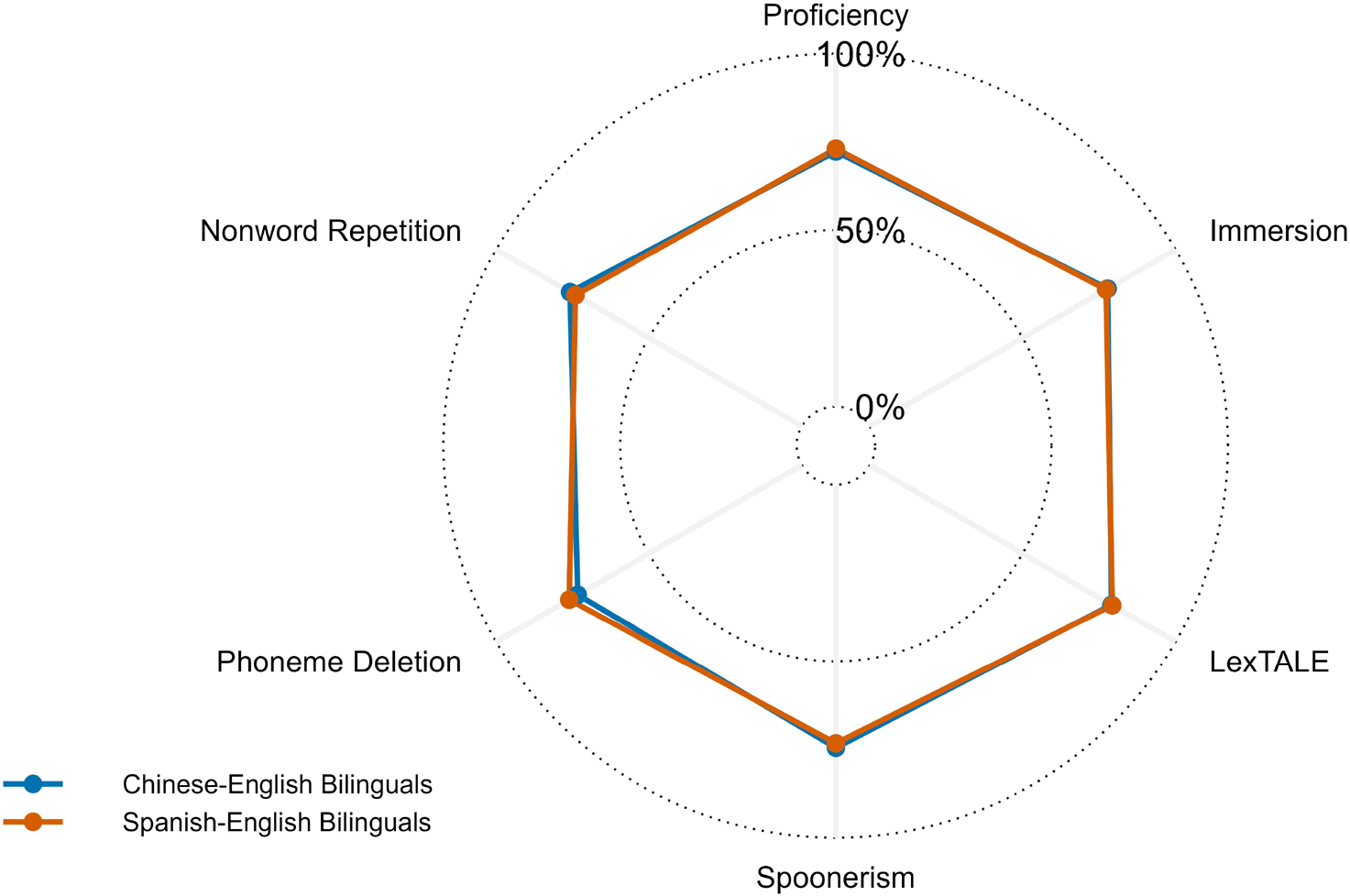
Figure 1 displays a radar plot summarizing the assessment data across two bilingual groups. A Bayesian two-sample t-test for responses on the LHQ 3.0 and the LexTALE test indicated that the bilingual groups did not differ significantly in their English proficiency or current use of English (Immersion experience). In addition, the two groups were matched in their scores on Spoonerism, Phoneme Deletion, and Nonword Repetition tasks. Please refer to Table S1 in the online supplementary materials S1 for mean by-participant accuracy levels, standard deviation, and t-test statistics for scores of each assessment. Thus, we controlled that the bilingual groups exhibited similar profiles of L2 linguistic proficiency and phonological abilities.
Radar plot of the preliminary assessment data.
Note. Each line represents a bilingual group. Each point represents an average score, scaled to range from 0 to 1, for a given metric of each test. Preliminary tests include: LHQ 3.0 (Proficiency + Immersion), LexTALE, Spoonerism, Phoneme Deletion and Nonword Repetition.

Materials
Thirty-two English words served as the experimental stimuli which were orthogonally varied in their initial P-O consistency and lexical frequency (e.g., consistent phoneme a→/æ/ in manage and malice; inconsistent phoneme a→/ə/ in machine and maroon). Regarding the P-O consistency manipulation, we computed consistency values across orthographic forms from the recent work by Chee et al. (Reference Chee, Chow, Yap and Goh2020), which quantifies spelling-to-sound relationships based on a corpus of 37,677 English monosyllabic and multisyllabic words. The consistency ratio was operationalized as weights of friends (i.e., words with similar orthographic forms shared the same pronunciation) and enemies (i.e., similarly spelled words with different pronunciations) for the given vowel grapheme (i.e., nucleus) within the first syllable. For instance, m(a→/æ/) in the stimulus manage has more friends than m(a→/ə/) in the machine. Here note that the decision to focus on consistency at the level of oncleus (i.e., the concatenation of the onset and the nucleus) differs from traditional investigations where consistency was generally manipulated in terms of the body-rime correspondences (the concatenation of the vowel and the coda, see Jared et al., Reference Jared, McRae and Seidenberg1990; Jared, Reference Jared1997; Lacruz & Folk, Reference Lacruz and Folk2004; Steacy et al., Reference Steacy, Compton, Petscher, Elliott, Smith, Rueckl, Sawi, Frost and Pugh2019; Treiman, Reference Treiman2018). Our choice of emphasizing small sub-syllabic grain-sizes was based on prior findings that bilinguals rely more on grapheme-phoneme correspondences than on other orthographic features (e.g., Koda, Reference Koda2007; Mokhtari & Reichard, Reference Mokhtari and Reichard2002). The resulting consistency ratio ranges from 0 (very inconsistent) to 1 (highly consistent).
In designing our stimuli, both type and token consistency were tapped into. To be specific, consistency based on type estimates was calculated by dividing a given word's number of friends by the total number of friends and enemies in the fixed position (i.e., initial or final).

Token consistency weights a given word's friends and enemies by the sum of the frequency of their occurrence. It is computed by dividing the logarithmic frequencies of friends by the combined logarithmic frequencies of friends and enemies.

In parallel, given the nature of the current experimental setting, a bidirectional activation of phonological representations would stem both from external spoken input in dictation-based spelling task and from inner speech during spontaneous copywriting. Thus, a reciprocal interaction between orthography and phonology was expected, with each influencing and being influenced by the other. By definition, we therefore considered two ratios: one in which a pattern of orthographic codes activates a series of phonological units (henceforth referred to as feedforward consistency), and the other where the phonological units feed activation back to the orthographic codes (henceforth referred to as feedback consistency). Thus, items were controlled in a balanced way with regard to token/type consistency and feedforward/feedback consistency. That is to say, words with high type/feedforward consistency were also consistent in terms of token/feedback consistency. Similarly, we chose words with low consistency in both dimensions.
For the lexical frequency manipulation, measures were taken from the SUBTLEXuk corpus (Van Heuven et al., Reference Van Heuven, Mandera, Keuleers and Brysbaert2014) and expressed as Zief values (log10 of per-million-word frequency). The threshold frequency is determined by words with a Zief value above 4.0 being categorized as high-frequency words and those below 3.0 as low-frequency words. For the purposes of quantifying the impacts of sublexical and lexical routes on writing production in terms of statistical power and sample sizes, we conceived of P-O consistency and lexical frequency as continuous variables in the following model structures (see Tabachnick & Fidell, Reference Tabachnick, Fidell and Ullman2013 for the advantages of using continuous variables to maximize the information obtained from data; see also Cohen, Reference Cohen2013; Maxwell et al., Reference Maxwell, Kelley and Rausch2008). The correlation between the two independent variables across items was small (rho = -0.10, 95% Crl [-0.44, 0.25]).
Since letters that vary in the number of strokes might obscure the writing duration (e.g., the absolute duration of the letter E with four strokes will be longer than the letter O with two strokes, see Kandel & Spinelli, Reference Kandel and Spinelli2010), stimuli were matched on the identity of the oncleus within the first syllable structure across conditions to allow for a direct comparison between letters at a given position. The majority of items were monomorphemic (96%), and they were controlled (F(3,28) = 0.104-1.867, ps > .16) for word length, number of syllables, number of phonemes, bigram frequency (taken from the British lexicon project, Keuleers et al., Reference Keuleers, Lacey, Rastle and Brysbaert2012), and orthographic neighborhood size (i.e., Coltheart's N, Coltheart et al., Reference Coltheart, Davelaar, Jonasson and Besner1977; OLD20, Yarkoni et al., Reference Yarkoni, Balota and Yap2008; taken from the vwr package, Keuleers, Reference Keuleers2013). Please refer to Table S2 in the online supplementary materials S1 for the full list of stimuli and their linguistic properties.
For each word, a visual stimulus and an auditory stimulus were created for use in the immediate copying and spelling-to-dictation tasks, respectively. The auditory stimuli were recorded by a male, English native speaker with a neutral accent and filtered from environmental sounds. The mean acoustic duration of all stimuli was controlled within a range of 796 to 803 ms. Also of note is that the stimuli selected were not cognate words across English and Spanish to avoid any confusion. Six extra words were selected as practice items.
Apparatus and procedure
Stimuli presentation and the recording of written responses were programmed by Ductus software (Guinet & Kandel, Reference Guinet and Kandel2010). A Wacom Intuos Pro graphics tablet (sampling frequency: 200 Hz) connected to the computer and a ProPen 2 pen (±60-level tilt recognition, ink removal) were used to register the executed movements of the participants. It is worth noting that the experimental procedure was carried out in two separate laboratories located in different countries. For the purpose of data quality control, the first author tested participants in Spain and China, ensuring the implementation of the experiment under a consistent (e.g., the same graphics tablet and verbal instructions) or similar (e.g., the use of similar screens, computer configurations, and soundproof rooms) experimental setting.
Participants first completed the spelling-to-dictation task in order to avoid the orthographic representations of the word being exposed before this task. Each trial began with a simultaneous presentation of an auditory signal and a fixation point in the center of the screen for 500 ms. The auditory stimulus was presented after the offset of the fixation point. In the immediate copying task, each trial started with a 500 ms fixation point, followed by a blank screen for 500 ms, and lastly the presentation of a centered stimulus (18-point lowercase in Times New Roman font) that disappeared after 800 ms. We opted for this procedure to ensure that any potential effect observed in writing duration is attributable to production processes and not confounded by reading, comprehension, or recall processes (see Afonso & Álvarez, Reference Afonso and Álvarez2019). In both tasks, stimuli were presented in a pseudo-random order across the participants.
Participants were instructed to keep the pen hovering in close proximity to a response line drawn on a sheet of paper placed over the graphic tablet, anticipating the required response in advance to minimize extraneous arm movement during each response. Then they had to initiate writing the word in uppercase on the line as quickly and accurately as possible. They were asked to tap the bottom right square of the response sheet with the pen tip to begin the next trial, followed by quickly positioning the pen over the response line again without making any contact with the paper. During the experiment, participants were not able to view their writing trajectory on the computer screen to avoid the influence of visual feedback from previously written outputs.
To verify the accuracy of participants’ pronunciation of the English stimuli, a reading-aloud task was administered immediately following the immediate copying task. During this task, participants were instructed to read each word aloud. Single trials in which naming errors were made by participants were correspondingly excluded from the copying task dataset (overall, n =31, 1.1%). This rigorous approach ensured that reading processes in handwritten production were controlled, as the correct pronunciation of the word is linked to the assessment of orthographic sensitivity and thus conducive to its accurate transcription.
Statistical modeling
Statistical analyses are divided into two subsections with 1) population-level effects in the omnibus model of spelling-to-dictation and immediate copying tasks, and 2) individual differences in L2 handwritten production. We refer readers to the online supplementary material S2 for an analysis of individual differences. Writing accuracy was coded as 1 (correct) or 0 (incorrect) in each trial. Writing latency refers to the time between the onset of the auditory/visual stimulus and the occurrence of the first contact of the pen with the graphics tablet. The kinematics of motor production was registered from the txt file using custom-designed Matlab code. The writing duration of the critical segment was defined as time elapsing between the first contact with the tablet when writing the onset and the moment the pen lifted after writing the nucleus within the first syllable. Inter-letter interval was measured as the time between the last pen lift in the onset and the first pen lowering in the following nucleus. Data and codes used to reproduce the present study are freely available on the Open Science Framework https://osf.io/2wmsq/.
We conducted all analyses using Bayesian multilevel regression fitted in the probabilistic programming language stan (Stan Development Team, 2018) via the package brms (Bürkner, Reference Bürkner2017, Reference Bürkner2018) in the R environment (R Core Team, 2022, v4.2.2). The model predicted outcome variables in the spelling-to-dictation and the immediate copying tasks for the population effects of Language Groups (Spanish–English vs. Chinese–English), P-O consistency (individual values), Lexical Frequency (individual values), and the higher order interactions. The hypr package (v0.2.3; Rabe et al., Reference Rabe, Vasishth, Hohenstein, Kliegl and Schad2020) was called to design sequential difference contrasts for categorical variables (2-level predictors Language Groups: 1/2, −1/2). Continuous variables (P-O consistency and Lexical Frequency) were standardized in the model with a mean of 0 and a standard deviation of 1. Thus, the estimated quantity of the intercept term represented the grand average across conditions. This allows us to estimate the regression coefficients associated with each contrast, and the resulting estimates can be interpreted as simple main effects based on the hypothesis matrix. The likelihood of the model fitted to the writing latency, inter-letter interval, and writing duration data was assumed to be distributed as lognormal. The corresponding logistic models were fitted to the accuracy data with Bernoulli likelihood distributed with a logit linking function. All models were specified with group-level factors for participants and items. A maximal random effect structure was included: the random slope for the P-O consistency by Lexical Frequency interaction varied for the participant level, as did the Language Group for the item level.
The above models included regularizing, weakly informative priors for the intercept and variance components (Gelman et al., Reference Gelman, Simpson and Betancourt2017), with brms default uninformative priors for the slope coefficients to estimate plausible posterior values. Markov Chain Monte Carlo sampling was implemented with four chains distributed between four processing cores to draw samples from the posterior probability distribution. To assess our a priori hypotheses, a region of practical equivalence (ROPE) around a point null value of 0 (Kruschke, Reference Kruschke2018) was established by using the following formula:

In general, we reported four statistics to describe the posterior distribution for each parameter of interest, including 1) median posterior point estimates, 2) the 95% highest density interval (HDI), 3) the proportion of the HDI contained within the ROPE, and 4) the maximum probability of effect (MPE). For statistical inferences, a posterior distribution for a parameter β in which 95% of the HDI does not contain 0 and falls outside the ROPE as well as a high MPE (i.e., values close to 1) are considered compelling evidence for a given effect.
Results
Word substitutions, missing responses, and disfluencies were coded as errors and were discarded in the spelling-to-dictation (overall, n = 1162; 31.6%) and immediate copying tasks (overall, n = 60; 2%). The inclusion criteria required a minimum individual writing accuracy of 60% in the spelling-to-dictation task, and as such, twelve participants (eight Chinese and four Spanish) who fell below this threshold were excluded from the dataset. Across temporal measures of interest, data points that fell outside a range of ± 2.5 standardized residual errors were removed (model criticism, see Baayen et al., Reference Baayen, Davidson and Bates2008; Baayen & Milin, Reference Baayen and Milin2010). The models were afterward re-fitted using the truncated dataset (see Oppenheim, Reference Oppenheim2018 for a similar procedure; see also Lorenz et al., Reference Lorenz, Zwitserlood, Bürki, Regel, Ouyang and Rahman2021). This trimming procedure resulted in the exclusion of 66 trials (2.6%) of writing latency, 34 trials (1.4%) of inter-letter interval, and 63 trials (2.5%) of writing duration in the spelling-to-dictation task; and 44 trials (1.2%) of writing latency, 85 trials (2.2%) of inter-letter interval, and 63 trials (1.7%) of writing duration in the immediate copying task. Note that only the interaction terms which are relevant to the research question will be interpreted.
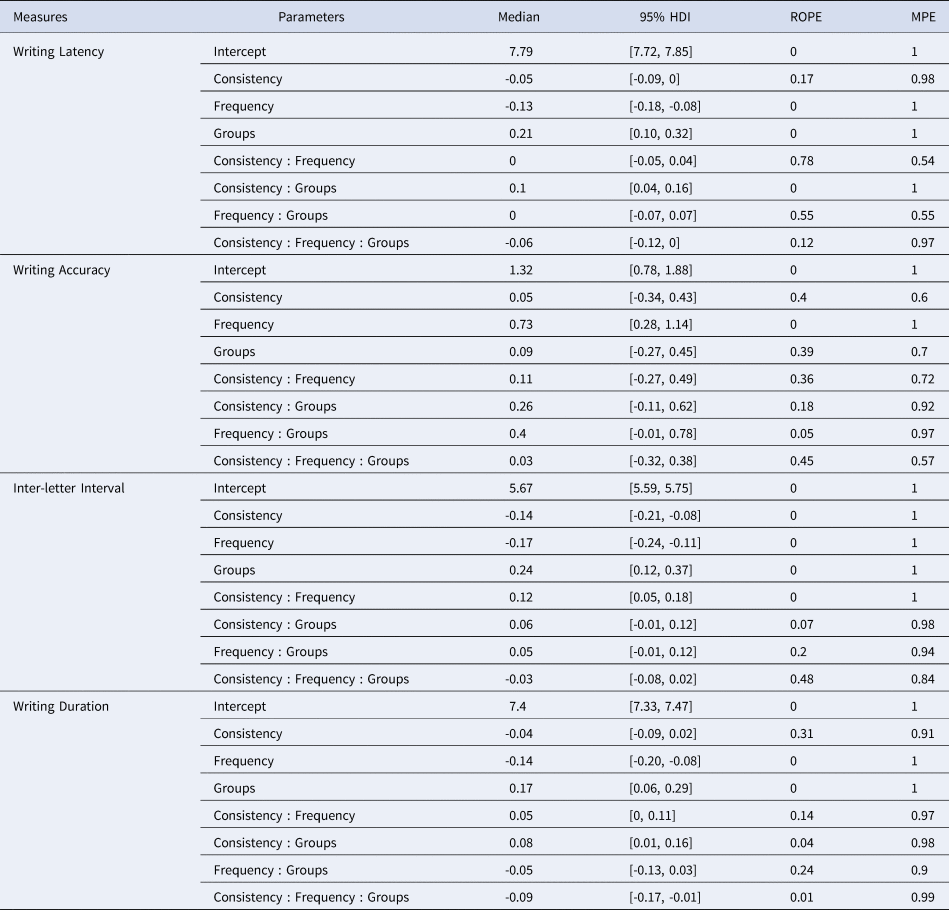
We begin with summarizing the results of the spelling-to-dictation task. Table 1 reports the posterior distribution of the outcome variables.
Spelling-to-dictation Task: Summary of the posterior distribution modeling writing latency, accuracy, inter-letter interval and writing duration of critical segments as a function of P-O feedforward consistency and lexical frequency. The table includes posterior medians, the 95% HDI, the percentage of the HDI within the ROPE, and the maximum probability of effect (MPE).

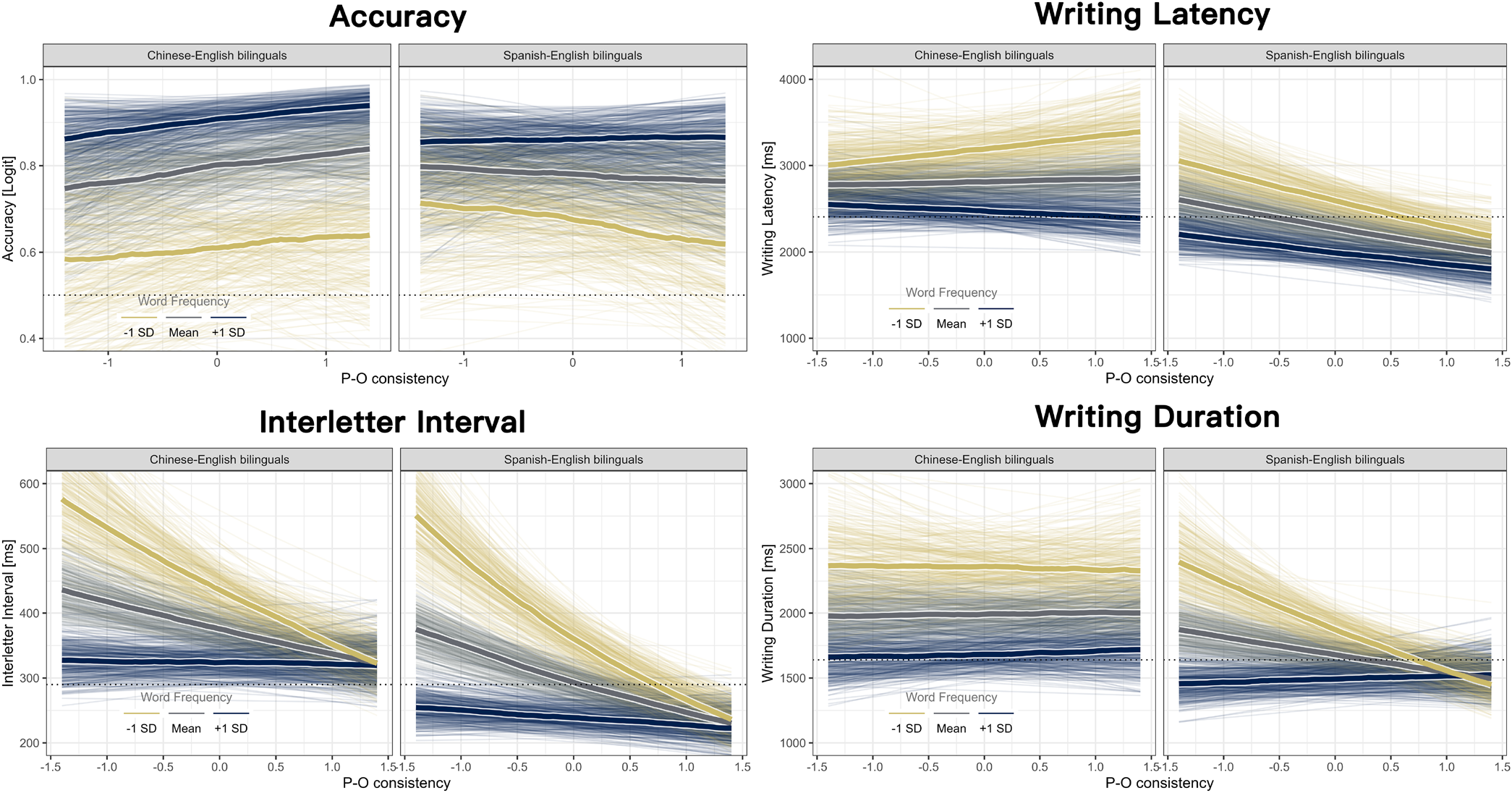
As illustrated in Figure 2, lexical frequency was associated with an increase in the log odds of responding correctly: words of higher frequency were written more accurately in both language groups. Similarly, writing latencies decreased as lexical frequency increased for both bilingual groups. We also found evidence that the consistency effect was modulated by language groups. Spanish–English bilinguals were faster when responding to words with higher P-O consistency, which was not the case for Chinese–English bilinguals. In terms of peripheral metrics, there was evidence of P-O consistency by frequency interaction on inter-letter intervals, with a stronger lexical frequency effect in words with lower consistency compared to consistent words shown in both groups. Additionally, evidence for the effects of frequency and a three-way interaction among P-O consistency, frequency, and groups on writing durations indicated that lexical frequency was modulated by P-O consistency in the Spanish group, though not for their Chinese counterparts. That is to say, response differences between frequent and infrequent words only appeared in words with lower P-O consistency for Spanish–English bilinguals, while Chinese bilinguals tended to respond faster with increasing lexical frequency.
Spelling-to-dictation Task: Probability of a correct response, writing latency, inter-letter interval and writing duration as a function of P-O consistency while holding lexical frequency constant at −1, 0 and +1 standard deviations from the mean.
Note. Thin lines represent 300 draws from the posterior distribution and indicate uncertainty (95% HDI) around the posterior medians (thick lines). The dotted lines indicate the model intercept.

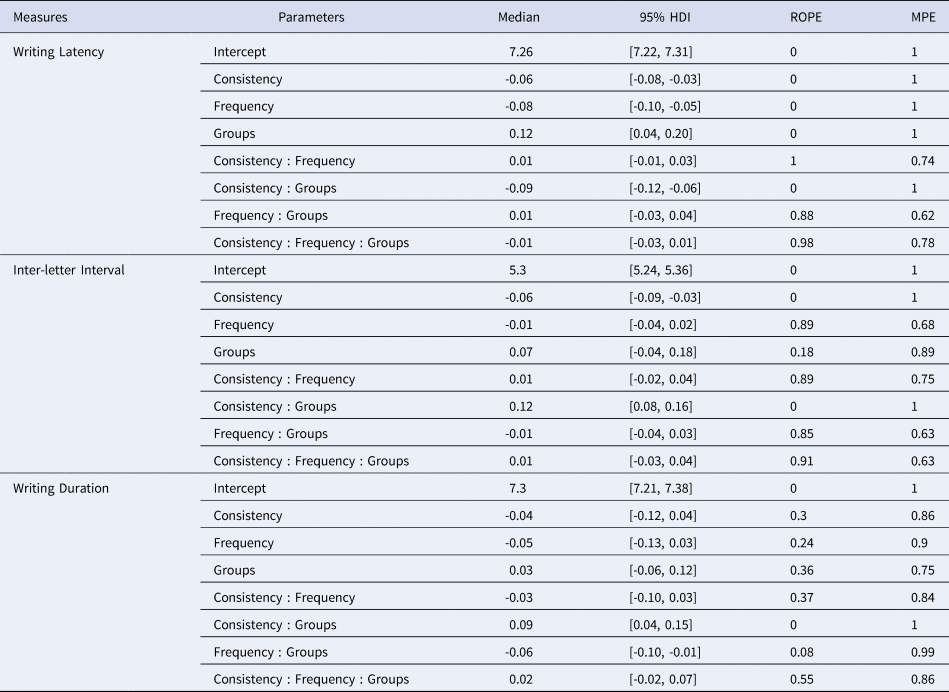
Regarding the immediate copying task, Table 2 summarizes the posterior distribution of the outcome variables. Writing accuracy in this task was not reported as none of the manipulated variables reached a significant effect.
Immediate Copying Task: Summary of the posterior distribution modeling writing latency, inter-letter interval, and writing duration of critical segments as a function of P-O feedforward consistency and lexical frequency. The table includes posterior medians, the 95% HDI, the percentage of the HDI within the ROPE, and the maximum probability of effect (MPE).

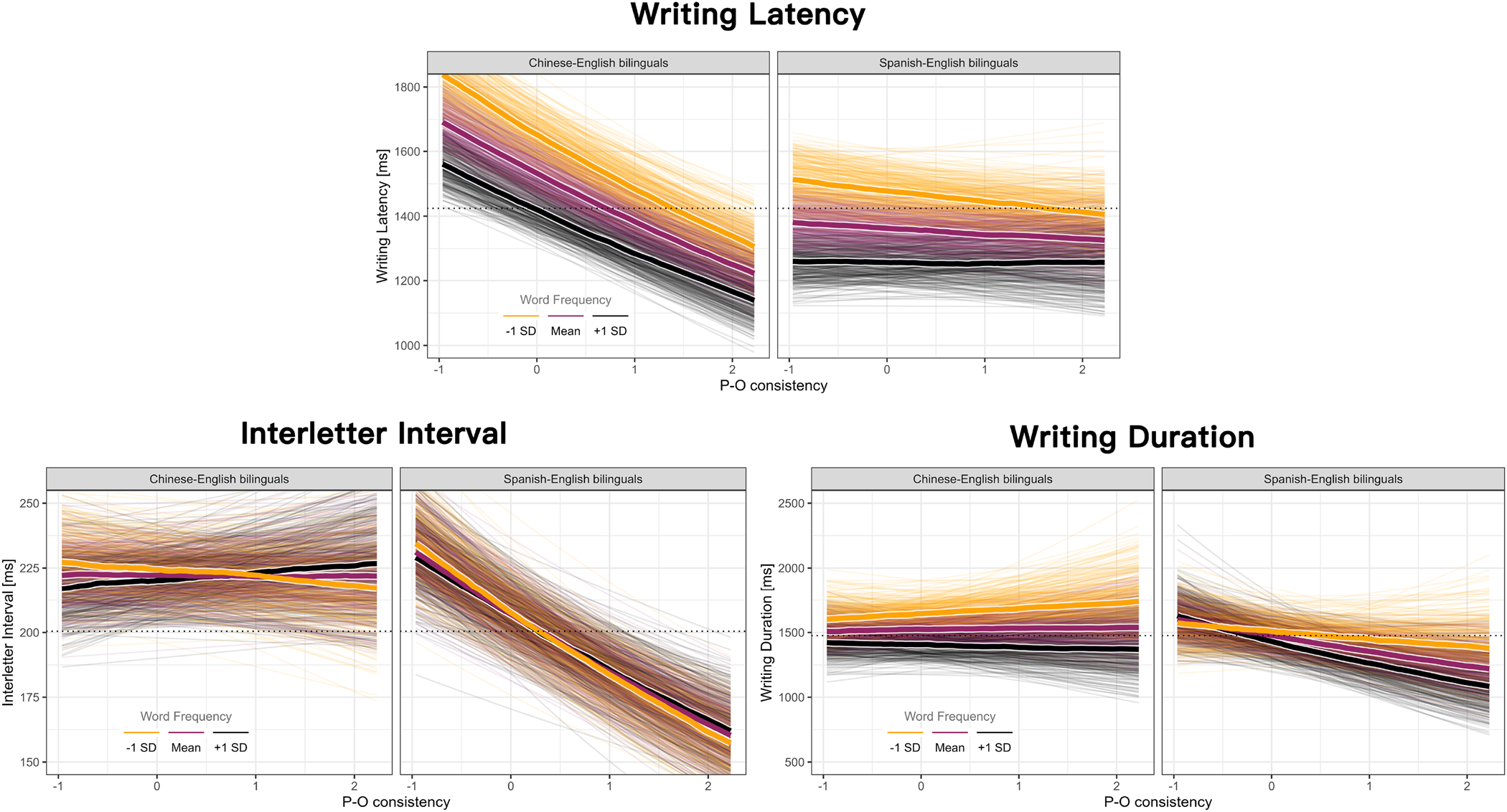
The diptych plots in Figure 3 illustrate three temporal measures as a function of P-O consistency and lexical frequency that remain constant at standardized values of −1, 0, and +1. We found evidence of frequency effect and a two-way interaction between consistency and groups on writing latencies. The main effect of frequency resembled that in the spelling-to-dictation task, with faster overall writing latencies to words with higher than lower frequency in both bilingual groups. In contrast to performance in the spelling task, higher P-O consistency associated with faster response was evident in the Chinese group, but no such effect was found among Spanish–English bilinguals. However, turning to motor execution, the consistency effect was only observed in the Spanish group, with much faster performance when responding to consistent than inconsistent words, as illustrated by a strong effect of a two-way interaction between P-O consistency and groups on both inter-letter intervals and writing durations. In addition, writing duration decreased as a function of lexical frequency, which was only observed in the Chinese group, as indicated by evidence of a two-way interaction of lexical frequency by groups.
Immediate Copying Task: Probability of writing latency, inter-letter interval and writing duration as a function of P-O consistency while holding lexical frequency constant at −1, 0 and +1 standard deviations from the mean.
Note. Thin lines represent 300 draws from the posterior distribution and indicate uncertainty (95% HDI) around the posterior medians (thick lines). The dotted lines indicate the model intercept.

Discussion
The current work revisits the proposed parallel and cascading architecture of handwritten production (Kandel et al., Reference Kandel, Peereman, Grosjacques and Fayol2011; Van Galen, Reference Van Galen1991). Writing latency, an indicator of central processing, was complemented by writing kinematics (i.e., inter-letter interval and writing duration) to elucidate the coordination of the online writing process under a second-language scenario. The functional involvement of sublexical (here, P-O consistency) and lexical (lexical frequency) activation was tapped into the real-time production of word spellings from auditory and visual input. Our results, from a cross-linguistic transferring perspective, provide compelling evidence for the theoretical claim that the flow of higher-ordered linguistic information cascades between central and peripheral levels of processing. Nevertheless, shaping the cognitive and motor program involved in bilingual written production is likely to interact with L1-specific orthographic features across varying task demands. In what follows, we discuss the influence of cross-linguistic variation on the selection and implementation of the handwriting trace in the framework of dual-route models.
Upon comparing the accuracy and/or writing latency data in both tasks, a similar pattern of lexical frequency effect was identified at the group-level performance. L2 words were written more accurately and with shorter latencies as their frequency increased, in line with L1 data (Kandel & Perret, Reference Kandel and Perret2015; Roux et al., Reference Roux, McKeeff, Grosjacques, Afonso and Kandel2013; R. Wang et al., Reference Wang, Huang, Zhou and Cai2020) that the accessibility of high-frequency words in an individual's mental lexicon leads to greater efficiency in word processing and reproduction. While the employment of the lexical route is comparable in bilingual groups with distinct L1 backgrounds, the sublexical P-O consistency effect exhibits a variation in latencies between the two groups. In the spelling-to-dictation task, full knowledge of phonological consistency was solely evident in writing latencies among Spanish–English bilinguals, inferring that more straightforward mapping between phoneme and grapheme in Spanish orthography fosters the activation of the sublexical route in L2 writing processes. Conversely, the lack of the P-O consistency effect in the Chinese group pointed to the possibility that sublexical processing may be too weak to contribute significantly to orthographic access. The failure in detecting this effect could be attributed to the inherent opaque nature of the Chinese orthography itself – for example, unstable phonological representation of Chinese characters resulting in its poor connection to corresponding orthographic representation. Given the matching of the two groups in language proficiency and other cognitive factors, these systematic differences in procedures may reflect the principles of computational models proposed for bilingual word recognition, which posit that differences in orthographic depth are associated with the conjoint activation of lexical constituents for word identification of both L1 (e.g., Perry & Ziegler, Reference Perry and Ziegler2002) and L2 (e.g., Koda, Reference Koda2008). In a parallel manner, our findings build upon and expand these computational works, demonstrating the impact of cross-linguistic transfer on L2 handwritten production.
It is noteworthy that the pattern of P-O consistency at the central level was reversed across groups in the immediate copying task as opposed to the dictation task, with this effect evident in the writing latencies of the Chinese group but absent in their Spanish counterparts. One explanation for this divergent pattern lies in the relationship between the attunement of the handwriting system to high-level linguistic information and the subsequent manifestation of these variables in writing behavior. Dual-route conceptions of spelling propose that writing production can be jointly determined by both lexical and sublexical processing; however, as previously stated, the influence of either depends on its reliability within a given task. In the context of copywriting, the behavioral manifestation of P-O consistency in writing latencies is indicative of the efficiency with which sublexical units guide spelling modules. Specifically, although phonological information was not consulted at the early stages of orthographic access in the Spanish group, the P-O consistency effect was the only proxy for assembling L2 sublexical units in motor execution. If the orthographic conflict at a sublexical level constituted a supplementary load for inconsistent words during writing preparation, this cognitive load would spread throughout the graphomotor programming. Thus, the sublexical route appears to sustain a considerable degree of activity in the copying task, not necessarily before the initiation of movement (see Roux et al., Reference Roux, McKeeff, Grosjacques, Afonso and Kandel2013 for similar results). In the case of Chinese bilinguals, they generally activate the orthographic representation of an inconsistent word stored in the orthographic lexicon. For instance, the output of machine reliance on lexical processing would yield m(a→/ə/). In contrast, a transcription mechanism generates this inconsistent output at a sublexical level that cannot be accurately pronounced by the frequency of sound-letter correspondence (e.g., a→/æ/). The ensuing mismatch between outputs of sublexical and lexical operations leads to conflicts that require additional processing time during writing preparation. Therefore, Chinese participants tend to address conflicts between routes before initiating motor response, while their Spanish counterparts opt for the sublexical route directly, resolving inconsistencies as they arise during real-time processes.
The current results fit with previous L1 studies (e.g., Afonso et al., Reference Afonso, Álvarez and Kandel2015a; Lau, Reference Lau2021; Roux & Bonin, Reference Roux and Bonin2012), identifying that high-level linguistic variables impact both the central processes of orthographic planning and the peripheral processes of handwritten execution, but that such influence varies with L1 background. Within the context of immediate copying, on the one hand, the P-O consistency effect for the Spanish–English group modulated the kinematics of the movements, as evidenced by shorter inter-letter intervals and writing durations with higher orthographic consistency. This is also true for the writing duration data collected from the spelling-to-dictation task. The persistence of P-O consistency during movement production aligns with findings from L1 Spanish adults (Afonso et al., Reference Afonso, Álvarez and Kandel2015a, EXP. 2; Afonso et al., Reference Afonso, Suárez-Coalla and Cuetos2015b) and children (Afonso et al., Reference Afonso, Suárez-Coalla and Cuetos2020; Suárez-Coalla et al., Reference Suárez-Coalla, Afonso, Martínez-García and Cuetos2020). As stated in the introduction, mapping at all lexical and sublexical levels in Spanish results in the strength of interconnection between phonological and orthographic sublexical units during motor execution. In this sense, Spanish bilinguals might transfer a bias towards phonological mediation in an attempt to activate the corresponding L2 graphemic representations through the application of phoneme-grapheme correspondence. As a result, they slowed the pace of low-level motor processes to accommodate high-order linguistic demands posed by orthographically inconsistent L2 words (e.g., a→/ə/ in the machine). On the other hand, writing durations for the Chinese–English bilinguals were exclusively sensitive to the lexical frequency in motor programming in both tasks. Still, these activation differences that spread into writing execution could be ascribed to the logographic nature of L1 Chinese orthography, leading to heavier processing demand during the storage of low-frequency units in the orthographic output buffer. These findings resulting from between-group comparisons confirm our prediction that the cascading coordination of L2 writing processes would change as a function of L1 orthographic features. Therefore, the processing of the conflicts arising from high-order linguistic variables varies across bilingual groups, in line with prior evidence that the interplay between central and peripheral processes cascades differently for lexical and sublexical levels (e.g., Afonso et al., Reference Afonso, Suárez-Coalla, González-Martín and Cuetos2018; Kandel & Perret, Reference Kandel and Perret2015; Roux & Bonin, Reference Roux and Bonin2012).
One issue pertains to the differing cascading mechanisms that give rise to flexibility in the cascading coordination among bilinguals (Olive, Reference Olive2014). As stated in the introduction, assuming simultaneous activation of central and peripheral processes is equivalent to assuming their concurrent demands on the limited capacity of the graphemic buffer (i.e., orthographic working memory). In a full-cascade framework, the automatic flows of information between central and peripheral modules occur instantaneously upon the activation of the concept (McClelland, Reference McClelland1979). Limited-cascading models instead posited that parallel processing is not an all-or-nothing occurrence, or that is to say, the amount of overlap is flexible and depends on the cognitive demands of the writing (Dell, Reference Dell1986; Humphreys et al., Reference Humphreys, Riddoch and Quinlan1988; see Olive, Reference Olive2014). As reviewed earlier, the quantity of linguistic information cascading onto handwritten production varies as a function of age (Afonso et al., Reference Afonso, Suárez-Coalla, González-Martín and Cuetos2018; Kandel & Perret, Reference Kandel and Perret2015), handwriting skills (Alves et al., Reference Alves, Branco, Castro and Olive2012; Olive & Kellogg, Reference Olive and Kellogg2002), developmental disabilities (Afonso et al., Reference Afonso, Suárez-Coalla and Cuetos2015b; Suárez-Coalla et al., 2020), and/or the linguistic properties of a target word (Bonin et al., Reference Bonin, Roux, Barry and Canell2012; Roux & Bonin, Reference Roux and Bonin2012). Joining these studies, the current results support the limited-cascading account and suggest that the cross-linguistic influence of L1 orthographic backgrounds serves as an additional index of the extent to which L2 high-level linguistic processes operate in parallel. Knowing that the pronunciations assigned to Spanish words can be assembled sublexically, the L2 processing demands associated with P-O conversion for Spanish–English bilinguals outweighed those of lexical frequency during transcription, signifying the simultaneous activation of central orthographic consistency and writing movement. On the contrary, handwriting for Chinese–English bilinguals was equally laborious when transcribing inconsistent L2 words as it was for consistent ones, resulting in the absence of concurrent activation at the sublexical level in both tasks. To avoid exceeding the limited capacity of working memory, Chinese–English bilinguals adopted a sequential strategy to resolve phonological conflicts before the onset of execution. Conversely, the processing difficulties related to spelling low-frequency words carried over to lengthen the writing duration taken on the peripheral processes. Thus, it is proposed that the parallel activation of central and peripheral levels of processing can be achieved when graphomotor output frees up sufficient working memory capacity to enable cascading coordination. Importantly, this dynamic could be influenced by the manner in which bilingual individuals adjust to the various demands of writing in accordance with their L1-specific orthographic characteristics.
Also of note is that the primary observation of cross-linguistic variations emerged predominantly in the immediate copying task. In contrast, the bilingual groups resembled the P-O consistency effect on inter-letter interval and the lexical frequency effect on writing durations in the spelling-to-dictation task. This suggests that the predicted pattern of L1-L2 transfer observed here is more likely a by-product of reading, rather than a direct reflection of the writing processes. We emphasize, however, that sensitivity to P-O consistency in the spelling-to-dictation task is prominent for writing durations only within the Spanish group. For this reason, the use of the sublexical procedure proves advantageous for Spanish bilinguals, leading to faster motor execution in comparison to the Chinese group.
In conclusion, the current study illustrates how L1-specific orthographic features affect the structure and functioning of the L2 written production system by modulating the degree of overlap between central and peripheral levels of processing. We propose that the unreliability of sublexical letter-sound conversions in Chinese characters results in the relative automatization of L2 cascading coordination at the lexical level. In contrast, as Spanish orthography presents fewer conflicts between sublexical and lexical routes, the L2 handwriting system for Spanish–English bilinguals tends to favor the assembly of sublexical units to program motor responses. Beyond these specific issues, differences in input modalities also influence the extent to which lexical and sublexical central processes cascade onto the peripheral level of processing. The findings presented here substantiate the emerging trend of bilingualism and advocate for the inclusion of handwritten production as a topic of investigation in bilingualism research. One limitation of this study, however, is the absence of an L1 control group of English writers, making it challenging to discern the implications of orthographic depth or linguistic similarities in our results. Future research is warranted to incorporate both bilingual and monolingual English writers to offer a more comprehensive understanding of L2 writing dynamics.
Acknowledgements
This research was supported by the Spanish Ministry of Science, Innovation PID2020-114246GB-100, “Plan General del Conocimiento”, through the project “Orthographic learning in a second language: cross-linguistic and sensorymotor factors” awarded to University of La Laguna. We appreciate the funding from Cajasiete for the first author's international co-supervision Ph.D. scholarship at the University of La Laguna, Spain.
Disclosure statement
No potential conflict of interest was reported by the author(s).
Data availability statement
The data that support the findings of this study are openly available in OSF (osf.io/2wmsq/).
Supplementary Material
For supplementary material accompanying this paper, visit http://doi.org/10.1017/S1366728924000087
For supplementary material accompanying this paper, online supplementary materials S1 include evaluations and scores of the English proficiency and phonological abilities (session 1 and table S1), power estimation considerations (session 2), the list of experimental stimuli and their linguistic properties (table S2). Online supplementary materials S2 provide supporting information for the influence of individual differences in L2 linguistic proficiency on L2 handwritten production.