“To possess another language is to possess another soul.”
Charlemagne (ad 742–814)Most bilinguals would probably agree with this quote attributed to Charles the Great, who is reported to have been fluent in at least three languages. However, most might add that this “other soul” is a somehow less emotional one. According to the subjective impressions of most bilinguals, speaking one's native language has special emotional qualities that a later acquired second language does not have. Even highly proficient bilinguals frequently report that they experience their second language (L2) to be less emotional as compared to their native language (L1) and that – although they perfectly know the emotional meaning of words in L2 – they do not sense it as with words in L1. For example, bilinguals report being less touched by hearing or expressing common endearments in their second language. Similarly, they report being at relative comfort and ease when uttering (or hearing) swear-words or taboo words in their L2 which would make them blush with shame or be inflamed with rage if uttered (or heard) in their native language.
Consistent with these subjective experiences, linguistic research using introspection, interviews or literary analysis has documented that emotional words in a second language are experienced differently as compared to their equivalents in the native language (Pavlenko, Reference Pavlenko2005). For example, bilinguals rate the emotional force of swear-words and taboo words as weaker in L2 than L1 (Dewaele, Reference Dewaele2004) and their physiological arousal as assessed by skin conductance reactions is weaker for taboo words, insults or reprimands (e.g., “Shut up!”) in L2 as compared to L1 (Harris, Reference Harris2004; Harris, Ayçiçeği & Gleason, Reference Harris, Ayçiçeği and Gleason2003; see Harris, Gleason & Ayçiçeği, Reference Harris, Gleason, Ayçiçeği and Pavlenko2005). Such experiences are not restricted to beginning learners or poor speakers of a second language but are frequently reported even by highly proficient bilinguals (Pavlenko, Reference Pavlenko2005). A subjective loss of emotionality in a second language might be highly relevant in cross-cultural communication or for acculturation processes. For example, perceiving the language of a host culture as reduced in emotionality might pose additional acculturation stress and reduce the chance for successful integration.
However, it remains an open question whether the aforementioned findings of differences in word ratings or skin responses between native and second language are actually related to differential emotional experiences in bilingualism. Most of the aforementioned research has focused on one specific language comparison, thereby often accepting confounds with specific cultural or national stereotypes. For example, participants in the studies by Harris (Reference Harris2004; Harris et al., Reference Harris, Ayçiçeği and Gleason2003) were US immigrants who were native speakers of Turkish or Spanish. Given that results were not replicated with control groups of native speakers of English with Turkish or Spanish as L2, the results might entirely originate in the cultural stereotypes of Turkish and Spanish being “warm” and “emotional” languages as compared to a “cold” and “rational” English and unrelated to different processing of L1 and L2. Motivational factors might pose a similar confound: bilinguals living in the country and culture of L2 might have a strong motive or desire to perceive their native language as more emotional because it is more strongly related to their language identity. This is even more of an issue when the measurement includes self-reports such as ratings of emotionality or pleasantness of words in L1 and L2 (Dewaele, Reference Dewaele2004; Harris, Reference Harris2004; Harris et al., Reference Harris, Ayçiçeği and Gleason2003). Thus, language stereotypes, migration backgrounds or other confounding variables make it difficult to figure out whether the experience of emotional differences between first and second language are actually related to bilingualism, and research to date does not provide sufficient evidence for the assumption that emotional content is actually processed differently in L1 and L2.
A recent study by Segalowitz and colleagues provides the first evidence of actual processing differences using an affective variant of an Implicit Association Test (IAT; Greenwald, McGhee & Schwarz, Reference Greenwald, McGhee and Schwartz1998) with unbalanced English−French bilinguals (Segalowitz, Trofimovich, Gatbonton & Sokolovskaya, Reference Segalowitz, Trofimovich, Gatbonton and Sokolovskaya2008). In this study, participants gave evaluative responses to pictures and target phrases in L1 and L2 in congruent and incongruent blocks, assuming that automatic affective processing of word phrases would lead to response facilitation and interference effects. The study documented significant effects of automatic affective processing of trait words in L1 and L2, indicating that affective meaning is processed automatically in both languages. However, automatic valence processing effects appeared to be smaller in L2 as compared to L1, providing first evidence that the subjectively reduced emotionality of L2 words might indeed be related to less automatic valence processing in a second language as compared to the first language. Contrary to this finding, two recent emotional Stroop studies did not find any evidence for differences in the emotional processing of L1 and L2 (Eilola, Havelka & Sharma, Reference Eilola, Havelka and Sharma2007; Sutton, Altarriba, Gianico & Basnight-Brown, Reference Sutton, Altarriba, Gianico and Basnight-Brown2007). In the emotional Stroop task, participants named the colour of various words. It is typically observed that these naming responses are slower for emotional as compared to neutral words, indicating selective attention to emotional stimuli (e.g., Frings, Englert, Wentura & Bermeitinger, Reference Frings, Englert, Wentura and Bermeitinger2010; Williams, Mathews & MacLeod, Reference Williams, Mathews and MacLeod1996). Thus, this paradigm allows testing for automatic access of emotion in L1 and L2 without asking the participants for a self-report (but see Phaf & Kan, Reference Phaf and Kan2007). Interestingly, both studies found not only the same pattern of results but even the same magnitude of emotional Stroop effects for words in L1 and L2 (Eilola et al., Reference Eilola, Havelka and Sharma2007; Sutton et al., Reference Sutton, Altarriba, Gianico and Basnight-Brown2007). According to these studies, an initial conclusion would be that, for proficient bilinguals, automaticity of emotional processing does not differ in L1 and L2. Thus, emotional words in L2 appear to be spontaneously, fast and efficiently processed – although the given Stroop tasks do not allow conclusions on the level of conscious awareness of this processing (see Moors & De Houwer, Reference Moors and De Houwer2006, for a recent review of the characteristics of automatic processes). This is intuitively plausible as high proficiency should lead to direct and strong associations between L2 words and corresponding semantic concepts (see Kroll & Stewart, Reference Kroll and Stewart1994) and thus to a higher accessibility of evaluative associations in L1 as well as L2 (see Fazio, Sanbonmatsu, Powell & Kardes, Reference Fazio, Sanbonmatsu, Powell and Kardes1986).
However, the accessibility of affective associations might be determined by other factors besides proficiency and associative strength, for example the frequency and recency of previous activations. Similarly, Kroll and Stewart (Reference Kroll and Stewart1994) suggest that language dominance plays an important role in second language processing, referring to a higher accessibility of one language compared to the other because of more frequent use in day-to-day life. For example, imagine two similarly proficient and fluent speakers of a second language, the one living in the country of their L1, the other in the country of their L2. In a test of language proficiency, these two hypothetical individuals might reach the same results. They differ, however, regarding the degree of language immersion and thus the frequency and intensity of L2 use in daily live. Because of these varying life situations, they might differ tremendously regarding the automaticity of word processing in their second language.
The current study aimed at exploring whether current language immersion influences the degree of automatic processing of first and second language in bilinguals − focusing on the spontaneity and efficiency of affective language processing. Profiting from the advantageous situation of a university offering several bilingual study programmes, we invited French−German and German−French bilingual students who differed in their degree of language immersion and the intensity and frequency of L2 use in daily life. To assess the degree of automatic affective processing of L1 and L2, participants took part in affective priming tasks (Fazio et al., Reference Fazio, Sanbonmatsu, Powell and Kardes1986) in both languages. In affective priming tasks, participants are presented with two successive stimuli, prime and target, and have to categorize the target as being either positive or negative (evaluation task). Typically, response facilitations are found when the prime's valence is compatible to the response that has to be given with regard to the target's valence. This effect presumably reflects automatic processing of the prime's valence – assuming that its processing occurs fast and efficiently with little or no intention or conscious control (see Klauer & Musch, Reference Klauer, Musch, Musch and Klauer2003, for a review). Employing the affective priming paradigm with bilinguals in L1 and L2, we expect to find a typical affective priming effect in L1 and the priming effect in L2 to be influenced by participants' degree of language immersion. However, it cannot be assumed that the reduced automatic affective processing of L2 as compared to L1 is related to generally slower or less automatic semantic language processing (see Segalowitz et al, Reference Segalowitz, Trofimovich, Gatbonton and Sokolovskaya2008). Bilinguals typically report that the semantic meaning of L2 words is perfectly clear to them, but despite knowing the meaning, they do not feel it (Pavlenko, Reference Pavlenko2005). We therefore needed to obtain further evidence that the semantic processing of L2 occurs to the same degree of automaticity as L1 processing. To provide such evidence for discriminant validity, we additionally needed to assess the automaticity of non-affective semantic word processing in L1 and L2. Therefore, we implemented a semantic priming paradigm (see McNamara, Reference McNamara2005; Neely, Reference Neely, Besner and Humphreys1991, for reviews) with a lexical decision task in L1 and L2. In this task, participants are again presented with two successive stimuli, prime and target, but have to categorize the target as being a correct word or not. With native speakers it is typically found that associatively related prime stimuli facilitate responding to the target compared to unrelated primes. Whatever account is used to explain semantic priming effects (e.g., spreading activation in a semantic network, Collins & Loftus, Reference Collins and Loftus1975, or by distributed network models, Masson, Reference Masson1995; see McNamara, Reference McNamara2005, for others), they reflect the efficient organization of semantic memory tapped by word cues (see Wentura & Degner, Reference Wentura, Degner, Gawronski and Payne2010, for a discussion of the differences of semantic and affective priming). Semantic priming effects have also been demonstrated with bilinguals (Grainger & Beauvillain, Reference Grainger and Beauvillain1988). We expect similar results for our samples, showing that the semantic meaning of L2 words is processed spontaneously, fast, and efficiently – independent of the participants' level of language immersion. Additionally, we see semantic priming as an indirect test of language fluency and proficiency. Thus, if we observe significant semantic priming effects in the second language in the same temporal conditions where affective priming effects are reduced or absent, the latter cannot be attributed to non-fluency or low proficiency.
Method
Participants
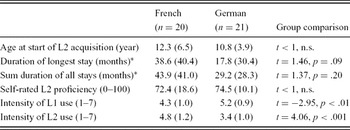
Forty-one bilingual students were recruited at a German University to take part in the study. Twenty-one of them were German−French bilinguals (14 men, 7 women; ages 20 to 31, Md = 24) and twenty were French−German bilinguals (10 men, 10 women; ages 19 to 29, Md = 23.5). A language history questionnaire was designed containing questions on age and context of L2 acquisition, as well as duration and purpose of stay(s) abroad. Participants rated their L2 proficiency referring to different aspects of language use (vocabulary, accent, comprehension, writing, reading, overall) using a 10 cm long line as a scale with the anchors zero (none) and 100 (native language-like). The five aspects were highly correlated (Cronbach's alpha = .88) and thus combined to a single variable self-rated proficiency. Furthermore, participants rated the present-day frequency of L2 use in daily life on a seven-point scale (1 = not at all, 7 = exclusively), separated for three domains: professional (study, job, textbooks), private−personal (family, friends, partner), and private−leisure (fiction, TV, movies, radio). The three items were again highly correlated (Cronbach's alpha = .88) and thus combined to one variable frequency of language use. According to the self-reports in the language history questionnaire, all participants can be regarded as sequential and unbalanced bilinguals with proficient knowledge of L2: the mean age at which they started learning their respective second language was 11.5 years (SD = 5.3), all had spent (a) at least one stay longer than three months and (b) altogether at least twelve month (M = 35, SD = 35) in a country of their L2 (see Table 1 for detailed descriptive statistics for both samples).
Mean values (standard deviations in parentheses) and group comparisons of language history responses for both samples.

* To adjust for skewed distribution, analyses were computed on log-transformed variables.
Design
For the affective priming task, a 2 (Stimulus language: French vs. German) by 2 (Prime−target relation: valence congruent vs. incongruent) repeated measures design was implemented. For the semantic priming task, a 2 (Stimulus language: French vs. German) by 2 (Prime−target relation: semantically related vs. non-related) repeated measures design was implemented. Additionally, the order of task language (French first vs. German first) and the assignment to one of two complementary stimulus sets (see ‘Materials’) were counterbalanced between subjects. Participants' native language (French vs. German) was treated as a quasi-experimental between-subjects factor. Because all participants were living in Germany when the study was conducted, this factor was used as an estimate of L2 immersion. Thus, whereas German−French bilinguals lived in their native language environment in which their L1 was dominantly spoken, the French−German bilinguals lived in a language environment of their L2.Footnote 1 Additionally, self-reports of frequency of L2 use in daily life were assessed and treated as continuous variables.
Materials
For both tasks, frequently used nouns were selected that were likely to be known by moderately proficient (non-native) speakers of either language (as confirmed by post-tests, see below). For the affective priming task, a large number of French nouns were pre-selected according to valence norm data (Leleu, Reference Leleu1987). To achieve comparable norm data for their German equivalents, we pre-tested these in an independent sample of German students (n = 44). From this pool, 250 French−German word pairs were selected such that they matched according to word length, valence and frequency of use (based on the databases LEXIQUE: New, Pallier, Brysbaert & Ferrand, Reference New, Pallier, Brysbaert and Ferrand2004; and CELEX, 1995, for French and German words, respectively). They were distributed between five lists of fifty stimulus pairs each: positive prime words (e.g., SOURIRE – LÄCHELN “smile”; MFrench = 59.82, MGerman = 57.10; on a scale from 10 [very negative] to 70 [very positive]); negative prime words (e.g., DOULEUR – QUAL “agony”; MFrench = 17.22, MGerman = 20.56), neutral prime words (e.g., CHAISE – STUHL “chair”; MFrench = 40.20, MGerman = 41.76), as well as positive target words (e.g., LOISIR – FREIZEIT “leisure”; MFrench = 58.00, MGerman = 57.15) and negative target words (e.g., ECHEC – MISSERFOLG “failure”; MFrench = 17.64, MGerman = 22.83).
For the semantic priming task, fifty semantically related word pairs (e.g., PLAGE – SABLE “beach – sand”) were selected from published studies on semantic priming in French (Ferrand & New, 2004; Grainger & Beauvillain, Reference Grainger and Beauvillain1988; Isel & Bacri, Reference Isel and Bacri1999) and translated into German (e.g., STRAND – SAND). Again, French and German equivalents matched according to word length and frequency of use. Semantically unrelated word pairs were formed by randomly reassigning the target words of the stimulus list to the prime words. Nonword targets were constructed by exchanging one letter in each target word (e.g., SABLE = > SUBLE, STRAND = > STRUND). To avoid presentation of translation equivalents within the French and the German version of each task, all stimulus lists were divided into two subsets that matched according to valence, frequency and word length. Thus, if participants received stimulus set A in the French version of the task, they received stimulus set B in the German version to ensure that repeated presentation of the stimuli and their translation equivalents would not bias results.
Procedure
The experiment was conducted in groups of up to eight participants at separate personal computers using the software INQUISIT 1.33 (2003). Introductions were presented in both languages, French and German, on the computer screen. Specific task instructions were given in the language of the respective experimental block. Participants first completed the affective priming tasks. They were informed that words with positive and negative meanings would be presented on the screen, always two words in short succession. Their task was to focus on the second word (the target) and to categorize it according to its valence by using one of two response keys ([5] on the number pad = positive, [A] = negative). The first word (the prime) was to be ignored. Participants completed the task twice, once in French and once in German, with counterbalanced order of language. At the beginning of each task, participants first worked through two brief practice blocks with ten trials each. The following experimental phases consisted of 150 trials separated into five blocks of trials, with an equal number of congruent and incongruent trials in a random sequence. Prime and target stimuli were randomly selected from the respective stimulus lists with the only restriction being that each prime was presented once paired with a positive and once with a negative target, respectively. Response key labels were presented in the left and right lower corners of the computer screen during task completion. Each trial started with the presentation of a fixation cross in the middle of the screen that was replaced by the prime word after 200 ms. The prime remained on screen for 150 ms and was directly overwritten by the target word (SOA = 150 ms) that remained on screen until a response was recorded. Participants were instructed to react as fast and accurately as possible. If they pressed the wrong key, an error message appeared on screen for 200 ms. The next trial started after an interval of 1000 ms.
After completion of the affective priming task, the semantic priming tasks were conducted. These were introduced as tasks on lexical processing. Participants were informed that again pairs of words would be presented in short succession on the screen, of which the first word (the prime) was again to be ignored and the second word (the target) had to be quickly classified as being a correct word or a nonword. The same response keys were used: [5] = word, [A] = non-word. The timing of the stimulus presentation was identical to the affective priming task. Each semantic priming task consisted of a random sequence of 100 trials, in which every prime word was presented four times; once with its related target, once with an unrelated target, once with the non-word derived from the related target, and once with a non-word derived from an unrelated target, respectively. For each participant, order of language was the same as for the affective priming task. After the priming tasks, participants completed the language history questionnaire. Finally, a post-test of word knowledge was conducted in which participants indicated those L2 words whose meaning they did not know or were unsure of. The percentage of unknown L2 stimuli was 3.1% for German words and 3.7% for French words and did not differ between the two groups.
Results
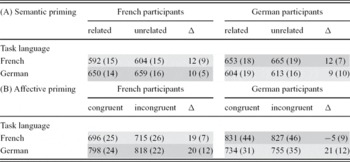
The dependent variables of interest were the mean response latency for correctly categorized targets in the affective and the semantic priming tasks. To correct for anticipatory responses and momentary inattention, trials with outlying response latencies above 1.5 inter-quartile ranges above the third quartile with respect to the individual RT distribution of the given task (see Tukey, Reference Tukey1977) or below 300 ms were considered invalid and excluded from further analyses (6.5% and 3.6% in the affective and semantic priming task, respectively), as were trials resulting in incorrect responses (0.5% and 1.2%).Footnote 2 To further adjust for skewed distribution, all analyses of response latencies were run with log-transformed latencies, yet for ease of interpretation RT scores are reported in milliseconds. Preliminary analyses indicated that neither order of task language nor stimulus set assignment yielded a significant effect on the crucial prime by target interactions (Fs ≤ 1.56, ps ≥ .22) and both were therefore discarded from analyses. Mean response times and standard errors for both priming tasks are given in Table 2.
Mean RT (and Standard Errors) of (A) the semantic priming task and (B) the affective priming task as a function of semantic relation or affective congruency between prime and target, stimulus language and participants’ L1.

note: L1 cells in light grey, L2 cells in dark grey.
All results reported as significant are associated with p values below .05. When testing directional hypotheses appropriate one-tailed tests were applied (marked with †).
Semantic priming
Due to computer malfunctions, the semantic priming data for three participants are missing. Mean reaction latencies of word trials were submitted to a 2 (Task language: French vs. German) by 2 (Prime−target relation: related vs. unrelated) by 2 (L1: French vs. German) ANOVA with repeated measures on the first two factors. Mean values are reported in Table 2. A significant interaction of task language by L1 was found (F(1,36) = 56.06, p < .001, η2 = .610), indicating that participants' responses were generally faster in their L1 (M = 604, SD = 68), as compared to their L2 (M = 657, SD = 74). More importantly, the analysis revealed a significant main effect of relatedness (F(1,36) = 7.83, p = .01, η2 = .179), that was not qualified by a higher order interaction (Fs < 1, n.s.). Thus, participants' responses were faster if targets were preceded by semantically related primes, (M = 625, SD = 67), as compared to unrelated primes (M = 636, SD = 69). Correspondingly, participants yielded significant semantic priming effects in L1 (M = 11 ms, SD = 43, t(37) = 2.40, p < .01†, d = .28), as well as in L2 (M = 11 ms, SD = 28, t(38) = 1.71, p < .05†, d = .38). There was no indication of differences in the semantic priming effects for L1 and L2 or for differences between the two groups of participants.
Affective priming
Mean response latencies were submitted to a 2 (Task language: French vs. German) by 2 (Prime−target relation: valence congruent vs. incongruent) by 2 (L1: French vs. German) ANOVA with repeated measures on the first two factors. Mean values are reported in Table 2. Again, there was a significant interaction of stimulus language and participants' L1 (F(1,39) = 69.77, p < .001, η2 = .641), as participants generally reacted faster to words in their first language as compared to their second language (ML1 = 725, SD = 21, ML2 = 819, SD = 25). More importantly, the analysis revealed a significant main effect of congruence (F(1,39) = 11.45, p = .002, η2 = .227), indicating that participants reacted faster on valence-congruent trials (M = 765, SD = 138) as compared to incongruent trials (M = 779, SD = 147). The valence congruency effect was qualified by a significant three-way interaction of all factors (F(1,39) = 5.08, p = .03, η2 = .115). Valence congruency effects (i.e., the difference scores of incongruent minus congruent trials) were significant in participants' L1 (t(19) = 3.15, p < .01†, d = .70, for the French participants and t(20) = 2.74, p < .01†, d = .60, for the German participants, respectively) (see Table 2). In L2, a comparable effect was found for the French participants (t(19) = 2.15, p = .02†, d = .48), whereas no significant congruency effect was found for the German participants (t(20) = −0.46, p = .65, d = .10). Thus, whereas for French participants, affective priming effects were comparable in size in the first and second language, German participants yielded affective priming effects only in their first language and did not show a significant effect of automatic valence activation in their second language.
Group differences and mediation analysis
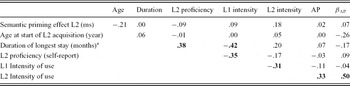
Further analyses were conducted to explore whether characteristics of the two different samples of German and French participants could account for the differentiation of affective priming effects in L2. We therefore compared the two groups regarding their statements in the language history questionnaire (see Table 1). No significant differences could be found regarding age of acquisition of L2 or self-rated language proficiency. The two groups of participants showed a numerical though non-significant difference according to duration of stays abroad. The only significant difference between the two groups of participants occurred for the frequency of language use in daily life. Correspondingly, affective priming effects in L2 were significantly related to intensity of language use, but to no other variable (see Table 3).
Bivariate correlations and multiple regression coefficients for interrelations of language history variables and affective priming scores.

note: AP: Affective priming effect; bold print indicates significance with p ≤ .05; R = .47, R2 = .22.
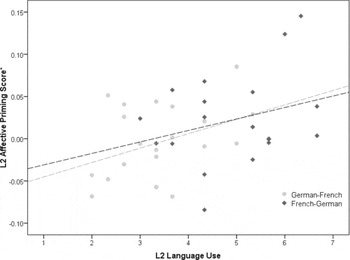
A multiple regression analysis with the affective priming score (L2) as dependent variable and L1 group (French vs. German), frequency of language use as well as semantic priming effect and all other variables of the language history questionnaire as predictors further demonstrated the independent predictive value of frequency of language use for the affective priming score in L2 (see last column in Table 3). Only participants with a frequent everyday usage of L2 showed positive affective priming effects (regardless of whether they were German or French native speakers), whereas participants with a low usage showed zero or negative effects. Furthermore, a mediation analysis (Sobel test) confirmed that frequency of language use mediated the group differences in the affective priming scores (z = 1.91, p = .05). Figure 1 further documents that the relation between affective priming effects and L2 immersions was observed within both groups of participants.
Scatter-plot depicting the correlation between affective priming effect (difference score of valence congruent and incongruent trials in log-transformed ms) separately for French−German and German−French bilinguals.

Discussion
The current study explored automatic emotional language processing in bilinguals. Proficient German−French and French−German bilinguals completed affective priming tasks in both languages. It was further tested whether the degree of language immersion and day-to-day use of participants' second language influence affective priming effects. We therefore treated the fact that all participants lived in Germany when the study was conducted as a quasi-experimental group difference between participants. To assure equal levels of the semantic word processing of the two groups, we also conducted semantic priming tasks in both languages.
Results indeed confirmed semantic priming effects in L1 and L2. Thus, automatic semantic processing occurred in both first and second language to the same degree, indicating comparable degrees of the spontaneous, fast and efficient processing of semantic word meaning and thus comparable levels of proficiency in L2. This pattern of results was confirmed by participants' self-assessment of second language proficiency.
The results of the affective priming task follow a different pattern. Whereas significant affective priming effects occurred for both groups of bilinguals in their native language, group differences emerged in L2. French−German participants were characterized by significant affective priming effects of the same effect size as their L1 effects. These findings concur with those of Emotional Stroop studies (Eilola at al., Reference Eilola, Havelka and Sharma2007; Sutton et al., Reference Sutton, Altarriba, Gianico and Basnight-Brown2007), which also found no significant differences in emotional processing between L1 and L2 with Finnish−English and Spanish−English bilinguals. However, German−French bilinguals in the current study did not show any significant affective priming effects in L2. One might speculate that this difference originates in differences in the German and French languages with regard to the ease of acquiring the affective connotations of the language as an L2. Although we cannot fully rule out this possibility, results of regression and mediation analyses indicate that the differences in affective priming effects were related to different degrees of second language use in daily life. Note that the relation between affective priming effects and frequency of language use is maintained when we control for other relevant factors, such as language proficiency and semantic priming effects. One can therefore conclude (with some reservation) that cultural and language immersion is an important factor in emotional language processing. Bilinguals immersed in the L2 culture use their second language frequently in daily life, that is, in action contexts that certainly lead to a higher weighting of affective connotations. When bilinguals are involved in social interactions in L2, perceiving and expressing subtle nuances of what is typically seen as positive and negative become highly relevant and well practised. It is one thing to learn that a given word is a taboo word in an L2, but quite another to experience the reaction of native speakers of L2 if one uses this word. Similar effects occur for bilinguals currently not immersed in an L2 culture but using L2 frequently in daily life. In contrast, participants who live in the culture of L2 but use it only infrequently do not show these effects. We acknowledge that this finding appears to be at odds with the findings of Eilola and colleagues (Reference Eilola, Havelka and Sharma2007). In their study, a sample of Finnish−English bilinguals demonstrated significant emotional Stroop effects in L2 although they were living in Finland at the time of data collection. Because the studies differ in stimuli and methodology, comparisons of results have to be drawn with caution. More importantly, we lack information about the actual level of language immersion of the bilinguals in the Finnish studies. Given that participants were recruited in Helsinki, a larger and more international city, participants might use their second language English more often in daily life because English is a more prominent language in Finland (as compared to French in Germany). Also it is possible that although the average Stroop effect was significant in this study, inter-individual variance of the effect might be related to varying levels of L2 immersion in this sample as well. Clearly, further comparative research would be needed to fully understand the relation between L2 immersion and the automaticity of affective processing of a second language.
These results hint at the possibility that the degree of automaticity in the affective and/or emotional processing of second language words is related to language immersion and frequency of language use. Thus, these results provide evidence for a dynamic interaction between cognitive and affective language processing and social factors in bilingualism. Such dynamics might help shed new light on practically relevant issues related to sequential bilingualism. For example, in cross-cultural interactions, misunderstandings might be partly explained in relation to language emotionality if one or both interaction partners are not frequently using their second language. Similarly, acculturation strategies and their success might be dependent on the interaction between language proficiency, frequency of previous language use and social interactions. For example, a feeling of strangeness and exclusion might result from the reduced emotionality of the second language processing being misattributed to a reduced emotionality of the host culture.
Further research is needed to fully understand the underlying mechanisms of automatic valence processing, its relation to the subjective emotionality of L2 and the dynamic interaction with frequency of language use. For example, it would be interesting to conduct longitudinal research following language learners during the process of language acquisition and find out about the antecedents and conditions of emotional language automatization. Also, the current studies do not allow any conclusions on the level of conscious awareness that might play a role in automatic emotional language processing – a topic that can be further explored using priming paradigms with shortened or subliminal prime presentation.