1. Introduction
This study explores the nature of interlanguage grammars in English and Arabic speakers learning Spanish as a non-native language. One of its main goals is to elucidate the process of acquiring second language (L2) grammatical knowledge and how this knowledge is used in real-time. Ultimately, we want to discover whether L2 grammatical knowledge and L2 processing differ from native grammatical knowledge and processing. If differences are found, we question whether they are due to possible grammatical deficits in second language learners, or reside in their processing resources.
This study focuses on Spanish prepositional relative clauses acquired by English and Arabic native speakers who are learning Spanish as a non-native language. Prepositional relative clauses (RCs) are a type of wh-structure that has different properties in Spanish, English, and Arabic. By comparing the processing, comprehension, and production of prepositional relative clauses in different types of non-native speakers, we try to determine the role of universal principles, processing strategies and previous language knowledge in acquiring a new language: in this case, Spanish.
2. The L2 Grammar and L2 Parser
2.1. Representational vs. computational accounts
One of the most debated topics in the field of SLA is whether grammatical knowledge in an L2 learner is different from that of a native speaker. A determinant factor in the acquisition of a second language within the generative framework has been the ability to resort to Universal Grammar throughout the process, depending on whether L2 learners have Full Access (Flynn & Martohardjono, Reference Flynn, Martohardjono, Lust, Suñer and Whitman1994; Schwartz & Sprouse, Reference Schwartz, Sprouse, Hoekstra and Schwartz1994, Reference Schwartz and Sprouse1996), Partial Access (Eubank, Reference Eubank, Hoekstra and Schwartz1994, Reference Eubank1996; Hawkins & Chan, Reference Hawkins and Chan1997), or No Access to UG (Bley-Vroman, Reference Bley-Vroman1990, Reference Bley-Vroman2009; Clahsen & Muysken, Reference Clahsen and Muysken1986; Meisel, Reference Meisel1997). The general assumption is that if UG is no longer available after a critical period, then the grammatical representation will present permanent deficits, resulting in quantitative and qualitative differences between L2 learners and native speakers. That is, L2 learners not only may fall short in producing certain structures, or have different accuracy rates, but they may also employ different mechanisms or different parts of their brain to comprehend and produce language.
Most of these established positions generally talk about grammatical representations; only more recently it has been discussed whether the apparent differences may reside in other components related to the actual use of that knowledge in real time, that is, in the parser or processing component. Recent positions of the Interface Hypothesis, (Sorace, Reference Sorace, Cornips and Corrigan2005; Reference Sorace2011) as well as Slabakova (Reference Slabakova2009), assume that the differences in linguistic achievement between children and adult language learners are not qualitative but only quantitative, “and may be fundamental only in processing” (Slabakova, Reference Slabakova2009, p. 170). These proposals, which Hopp (Reference Hopp2007, Reference Hopp2009) groups under the name of ‘computational approaches’, suggest that the L2 non-convergence may be due to computational difficulties when integrating grammatical information in real-time, even when the L2 speakers have native-like grammatical representations and employ the same processing mechanisms.
Another position is the one put forward by Clahsen and Felser (Reference Clahsen and Felser2006a, Reference Clahsen and Felser2006b) in the Shallow Structure Hypothesis, which predicts a shallower grammatical processing in the L2 compared to the L1, in the sense that L2 processing has less syntactic detail than L1 processing and relies more on lexical-semantic cues for interpretation. Therefore, the L2 parser employs different processing mechanisms from the L1, being not only quantitative (i.e., different RTs), but also qualitatively different.
How the parsing mechanisms access the mental grammar, and how the parser treats different grammars, have been the core questions of psycholinguistics in the last decades (Cuetos & Mitchell, Reference Cuetos and Mitchell1988; Fodor, Reference Fodor1998a, Reference Fodor1998b; Frazier & Fodor, Reference Frazier and Fodor1978; Gibson, Pearlmutter, Canseco-Gonzalez & Hickok, Reference Gibson, Pearlmutter, Canseco-Gonzalez and Hickok1996). According to Pritchett (Reference Pritchett1992), which assigns a very prominent role to the grammar, parsing is ‘the local application of global grammatical principles’, and the θ-criterion attempts to be satisfied at every point during processing. These actions require integrating previous grammatical knowledge with the appropriate processing strategy by the parser. Under Pritchett's approach, the parser is perceived as tailored by the L1 grammar, and both the L1 grammar and the L1 processing strategies can be transferred into the L2 (Juffs, Reference Juffs2005).
Fodor (Reference Fodor1998a), adopting a universal parser, proposes that the language learner does not need to acquire new language-specific routines, and that if we find differences, these are due to a divergent grammatical knowledge that feeds the parser. If this reasoning is extended to L2 grammars, then the prediction is that L2 learners will employ the same processing mechanisms that native speakers do, and if differences are found, these could be due to a grammar still in development (representational account), or problems integrating the types of knowledge; the latter previously defined as the ‘computational’ approach (Hopp, Reference Hopp2007; Reference Hopp2009).
Hopp (Reference Hopp2009, Reference Hopp2010) tested on-line and off-line performance in subject-verb agreement and scrambling in L2 German with different groups of advanced and near-native L2 speakers. Overall, he found L1 and proficiency effects, but he also demonstrated that convergence in on-line and off-line performance is possible in the highest proficiency levels, refuting the idea of the unavoidable representational deficits and/or different processing mechanisms. Hopp concluded that non-native and native grammars processing systems are fundamentally identical, and, if anything, the L2 systems can show a reduced processing efficiency as a result of L1 influence.
On the other hand, Jiang (Reference Jiang2004), after testing L1 Chinese–L2 English speakers with on-line and off-line tasks, found that even though proficient Chinese learners of English performed native-like in a written grammar task, providing the correct verbal form that agreed with the subject, they did not show any sensitivity in an on-line comprehension task testing subject-verb agreement; similar results were found in Jiang (Reference Jiang2007). These results showed convergence at the grammatical representation level, but divergence at the real-use of the grammatical knowledge.
To recapitulate, there are some studies that have found evidence of processing convergence between L2 learners and native speakers, whereas others have failed to provide such evidence, postulating a fundamentally different L2 processing system. In the present study, we contemplate a third option in which L2 processing is similar to that of a native speaker, providing evidence against a shallow or divergent processing, even when the L2 grammar is still in development. We believe this is possible with the application of universal processing mechanisms.
2.2. Relative Clauses: Processing filler-gap dependencies in language acquisition
According to several linguistic theories, empty categories have the same status as words (Chomsky, Reference Chomsky1981), so they need to be processed and incorporated into the structure. These dependencies present a challenge to the parser: we need to give an interpretation to an element that is displaced in the sentence, so the parser needs to retain the information in short-term memory until it reaches a point where it can be fully interpreted. Admittedly, this is a costly operation for the human computational system, and this is why the human parser tries to keep this filler-gap dependency as short as possible, as postulated by the Active Filler Hypothesis (Clifton & Frazier, Reference Clifton and Frazier1986; Frazier, Reference Frazier1987; Frazier & Clifton, Reference Frazier and Clifton1989; Frazier & Flores d’Arcais, Reference Frazier and Flores d’Arcais1989), and the Minimal Chain Principle (De Vincenzi, Reference De Vincenzi1991): ‘Postulate required chain members at the earliest point grammatically possible but postulate no potentially unnecessary chain members’.
The question of whether non-native speakers are able to posit empty categories is still under debate. Many psycholinguistic studies have documented differences between native and non-native speakers processing filler-gap dependencies (Clahsen & Felser, Reference Clahsen and Felser2006a; Felser & Roberts, Reference Felser and Roberts2007; Juffs & Harrington, Reference Juffs and Harrington1995; Marinis, Roberts, Felser & Clahsen, Reference Marinis, Roberts, Felser and Clahsen2005), and others have found that L2 speakers can indeed process this type of sentence in a native-like manner (Jackson & Dussias, Reference Jackson and Dussias2009; Williams, Reference Williams2006; Rodríguez, Reference Rodríguez2009). For Felser & Roberts (Reference Felser and Roberts2007), for instance, the fact that Greek-speaking learners of English did not show any reactivation effect in indirect object gaps led them to conclude that these non-native speakers did not posit traces in their linguistic representation, and argued that L2 comprehension does not involve structure-driven gap-filling but rather a reliance on lexically- or meaning-based comprehension. Nonetheless, some authors have contended that finding numerical differences in processing results between native and non-native speakers does not necessarily imply fundamental differences (Juffs & Harrington, Reference Juffs and Harrington1995, Reference Juffs and Harrington1996; Juffs, Reference Juffs2005; Dekydtspotter, Donaldson, Edmonds, Liljestrand Fultz & Petrush, Reference Dekydtspotter, Donaldson, Edmonds, Liljestrand Fultz and Petrush2008), since lexical access and retrieval (Segalowitz, Reference Segalowitz, Doughty and Long2003), L1 transfer (Juffs, Reference Juffs2005), a slowed-down processing, as well as memory demands (Havik, Roberts, van Hout, Schreuder & Haverkort, Reference Havik, Roberts, van Hout, Schreuder and Haverkort2009, but see Juffs, Reference Juffs2004, Reference Juffs2005, for different results), type of input (Pliatsikas & Marinis, Reference Pliatsikas and Marinis2013), or simply the lack of L2 relevant knowledge may explain some of the differences.
Most of the studies concerned with filler-gap dependencies explore the well-known asymmetry between processing subject and object relative clauses (Gibson, Desmet, Grodner, Watson & Ko, Reference Gibson, Desmet, Grodner, Watson and Ko2005; King & Just, Reference King and Just1991; Just, Carpenter, Keller, Reference Just, Carpenter and Keller1996; Levy, Fedorenko & Gibson, Reference Levy, Fedorenko and Gibson2013). The overall result of these studies is the observed difficulty of processing object-extracted RCs compared to subject-extracted RCs (but see Hsiao & Gibson, Reference Hsiao and Gibson2003, for Chinese; and Carreiras, Duñabeitia, Vergara, de la Cruz-Pavia & Laka, Reference Carreiras, Duñabeitia, Vergara, de la Cruz-Pavia and Laka2010, for Basque). Some studies have also shown that animacy can influence the processing of the RC (Betancort, Carreiras & Sturt, Reference Betancort, Carreiras and Sturt2009). However, none of these studies have investigated the processing of other syntactic positions in RCs, – except for Felser & Roberts (Reference Felser and Roberts2007), which investigated indirect object RC. Particularly scarce, if not inexistent, is the study of oblique RCs, the focus of this article. This investigation further diverges from these other studies because it will consider cross-linguistically different types of oblique RC formation, taking into account the L1s of the second language speakers.
3. The Linguistic Phenomenon: Prepositional Relative Clauses
English, Moroccan Arabic (MA)Footnote 1 , and Spanish oblique or prepositional relative clauses (RCs) can be formed through Pied-Piping, a strategy that consists of moving the obligatory preposition along with the relative pronoun, as in the examples in (1).
-
(1)


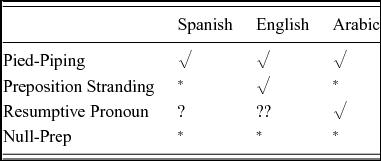
Pied-Piping (PiP) is the only grammatical option in Spanish for constructing oblique relative clauses, unlike in English and ArabicFootnote 2 , which can employ other strategies. English uses the Preposition Stranding (PS) construction most of the time, especially in colloquial speech, a strategy that consists of leaving the preposition dangling in its original position once the displaced constituent has moved, as in (2a). This option is ungrammatical in Arabic (2b) and Spanish (2c), independently of the appearance of a relative pronoun or a complementizer.
-
(2)

Notice that these two movement constructions, PiP and PS, posit a trace in different positions, which results in PS having a longer filler-gap dependency than PiP. The third option for constructing an oblique relative clause is by means of inserting a resumptive pronoun, a construction that does not suppose wh-movement. This is the most common strategy in Arabic, but ungrammatical or non-standard in English and Spanish. This structure is only available with complementizers and not with relative pronouns.
-
(3)

According to Suñer (Reference Suñer1998), Spanish is a language that optionally allows resumptive pronouns in all types of relative clauses. However, they are condemned by prescriptive grammars and never taught in a classroom setting. This option does not constitute a case of wh-movement, but it is an empirical question whether these sentences are also processed as filler-gap dependencies. These crosslinguistic differences are summarized in Table 1.
Strategies for Prepositional Relative Clauses across languages

Table 1 introduces the Null-Prep structure, which is a non-standard (or almost ungrammatical) option that does without prepositions or pronouns, e.g., “The book that you talked was very interesting e.” This configuration has been studied in L2 English (Klein, Reference Klein1993, Reference Klein1995, Reference Klein2001), L2 French (Bouchard, Reference Bouchard, Cressey and Napoli1981; Jourdain, Reference Jourdain1996), and L2 Spanish (Perpiñán, Reference Perpiñán, Bruhn de Garavito and Valenzuela2008, Reference Perpiñán2010).
4. The Acquisition of Relative Clauses
One of the central issues addressed in the studies dealing with the acquisition of relative clauses has been the availability of deriving this structure by movement. This debate has been especially relevant in the investigation of the development of children's grammar (Guasti, Reference Guasti2002; Labelle, Reference Labelle1990, Reference Labelle1996; Pérez-Leroux, Reference Pérez-Leroux1993, Reference Pérez-Leroux1995) and it has also motivated some studies in L2 acquisition, particularly dealing with learners whose mother tongue presents wh-in situ (Hawkins and Chan, Reference Hawkins and Chan1997). For this study, we are going to assume that the L2 learners under investigation already have the rudiments to derive the construction through movement since their native languages present wh-movement.
The acquisition of relative clauses has been largely studied to assess the appropriateness of Keenan and Comrie's (Reference Keenan and Comrie1977) famous Noun Phrase Accessibility Hierarchy (NPAH) in language development, which predicts that Subject relative clauses are the least difficult and most frequent, followed by Direct Object RCs, Indirect Object RCs, Oblique RCs, and finally Genitive RCs. The low position of oblique RC in this hierarchy means that this structure is not very common in the languages of the world, and relatively hard to process. Overall, Keenan & Comrie's proposal was strongly corroborated by the L2 data (Gass, Reference Gass1979, Reference Gass1983, Reference Gass1984; Hamilton, Reference Hamilton1994; Hawkins, Reference Hawkins1989; Hyltenstam, Reference Hyltenstam and Andersen1984; Pavesi, Reference Pavesi1986), since higher positions in the hierarchy are acquired earlier, and the knowledge of a relative clause structure lower in the scale implies the knowledge of a higher structure in the hierarchy.
Regarding oblique relative clauses, the main discussion in the literature has been about the markedness between the two forms of constructing prepositional RCs in English, that is, Pied-Piping or Preposition Stranding (Bardovi-Harlig, Reference Bardovi-Harlig1987; Mazurkewich, Reference Mazurkewich, Eckman, Bell and Nelson1984). These authors found that English L2 learners with different L1 backgrounds acquired PS before Pied-Piping; only the French native speakers produced more PiP than PS (Liceras, Reference Liceras1981). Bardovi-Harlig also reported that the L2 learners, before mastering PiP or PS, go through a stage in which they do not produce the preposition. This phenomenon was later explored by Klein (Reference Klein1993, Reference Klein1995), termed Null-Prep, and explained as the result of the creation of an interlanguage grammar outside UG, a ‘wild’ grammar. Dekydtspotter et al. (Reference Dekydtspotter, Sprouse and Anderson1998) reevaluated Klein's data and explained it within UG constraints. They proposed that Null-Prep is the result of computational economy: learners use A-bar binding instead of movement because the former is more economical. Klein (Reference Klein2001) later interpreted Null-Prep as a way for the L2 learner to avoid the marked English Preposition Stranding together with incomplete acquisition of wh-movement.
As for L2 Spanish, Adjemian and Liceras (Reference Adjemian, Liceras, Eckman, Bell and Nelson1984) also tested the markedness theory with an experiment involving native speakers of English learning L2 French or L2 Spanish, and native speakers of French learning L2 English or L2 Spanish. They found that English speakers corrected ungrammatical preposition stranding in L2 French and in L2 Spanish 75% of the time, so they argued that it was hardly transferred. Liceras (Reference Liceras1986) found transfer of PS only at the beginning levels of proficiency, a characteristic that disappears completely in intermediate learners.
5. Research Questions and Hypotheses
This study aims to explore the L2 acquisition of prepositional relative clauses taking into account the learners’ linguistic knowledge and how this knowledge is put into practice during processing. Given the differences described above between English, Moroccan Arabic and Spanish oblique relative clauses, L2 learners of Spanish need to realize that Spanish only accepts Pied-Piping. This structure is available in the formal L1 grammar of the learners, but English and Arabic allow, and actually prefer, other strategies to form prepositional RCs: thus, Spanish is a subset of these two languages. The acquisition of Spanish prepositional relative clauses for these speakers consists of an unlearning process. Having this learnability task in mind, we wonder whether these L2 learners will be able to reduce the options of their grammars, and if so, what is the role of the learners’ native language. In the case at hand, the L1 can be both a facilitator and an impediment for the acquisition of the target construction. Crucially, by looking at two different populations, and two L1s with different properties, we can tease apart what comes directly from their L1 grammar and L1 processing routines, and what may come from universal tendencies. If differences in the results are found, we need to localize their source: the differences can be the result of divergent linguistic representations; or, if the grammar is in place (convergent grammatical knowledge), the differences can be the result of a deficient (i.e., shallower, non-automatic) L2 processing.
If L2 learners grammatically converge with native speakers, we expect them to produce mostly PiP when forming prepositional RCs, accept this structure in the Grammaticality Judgment Task (GJT) and reject the ungrammatical ones. If they also converge in processing, and assuming that the grammar feeds the parser, it is predicted that L2 learners will process PiP in a native-like manner. That is, L2 learners will analyze appropriately the preposition at the beginning of the RC as part of the displaced element, and subsequently will resolve the filler-gap dependency as soon as they reach the verb, postulating a gap right after the verb region (La chica de la quei hablaste ti). Additionally, they will recognize and process PS, Null-Prep and Resumptive structures as ungrammatical, resulting in longer reading times (RT) in the verb region (where the ungrammaticality can be first detected), as well as in the last region (where the grammatical judgment is made); PiP will present shorter RTs in these critical regions if recognized as grammatical. If the L2 learners do not converge in processing but they do in grammar, then we will predict we will find differences primarily in the reading times. On the other hand, if the L2 learners do not have a complete grammatical representation of Spanish prepositional RCs, we will expect to find differences across the board, in production, acceptability judgments, and processing.
Two experimental tests will be analyzed, an oral elicited production task and a self-paced grammaticality judgement task. The grammatical intuitions collected through the GJT, together with the results from the production task, will serve as a baseline to establish the learners’ linguistic representations. The reading times in the critical regions will inform us regarding the real-time use of that linguistic knowledge. The comparison of these results will help us determine the relationship between the grammar and the parser in second language acquisition.
6. Methodology
6.1. Participants
An initial pool of 116 Spanish learners of intermediate proficiency (L1 English or L1 Arabic) participated in this study. The screening test, explained below, discarded the participants that did not meet the necessary criteria for the study. At the end, the data of 21 English-speaking learners (mean age at testing = 21.9), and 21 Arabic speakers (mean age = 25.6) were used for this study. The control group consisted of native speakers of Spanish, tested in Spain (n = 20, mean age = 32.25).
6.2. Materials and Procedures
6.2.1. Proficiency Test and Screening Test
The proficiency test consisted of a slightly modified version of the standardized grammar section of the superior level of the DELE, created by the Instituto Cervantes, and part of the Wisconsin vocabulary test. The multiple choice grammar section was modified so that it also included the experimental prepositional verbs (k = 6), which served as the screening test. These eliminating items checked the subcategorization framework for the following verbs that require a prepositional argument: hablar de ‘to talk about’, depender de ‘to depend on’, pensar en ‘to think about’, confiar en ‘to rely on’, soñar con ‘to dream about’, and contar con ‘to count on’. All the experimental verbs also require a prepositional object in English and Arabic; however, it was difficult to find learners with the proper knowledge of the subcategorization frame of these verbsFootnote 3 .
Participants’ proficiency scores (out of 40, 21 for the grammar section and 19 for the vocabulary section) were submitted to a one-way ANOVA, and as expected, the results of the ANOVA indicated a significant effect by group F(2,59) = 28.74, p < .001. A post-hoc Tukey HSD test revealed that the only different group was the control group (p < .001, M = 39.6, SD .681), with a 99% rate of accuracy. The Arabic (M = 25.67, SD = 8.79, 64% accuracy) and English learners of Spanish (M = 26.05, SD = 7.32, 65% accuracy) did not differ significantly (p = .98).
6.2.2. Oral Production Task
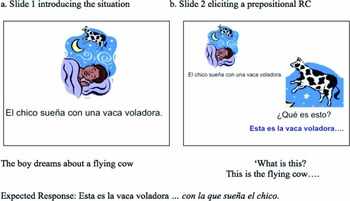
The purpose of this task was to elicit prepositional relative clauses. Participants were presented with a series of images along with some description for each on a computer screen (a total of 12 experimental situations, 6 eliciting the target prepositional relative clauses and 6 eliciting direct object relative clauses used as fillers). The relevant information was written on the slide and read out loud by the experimenter. After watching and listening to the information from the first image, participants were presented with a second related slide with a selection of the previous image, together with a question that they needed to answer orally. Figure 1 exemplifies a scenario targeting prepositional relative clauses, with the expected response.
Scenario targeting prepositional relative clauses.

In order to ensure that relative clauses were produced, the beginning of the response was given to prime the target construction. Participants were tested individually and audio recorded.
6.2.3. Self-Paced Grammaticality Judgment Task
The on-line grammaticality judgment task (GJT) included grammatical and ungrammatical sentences (counterbalanced); the target sentences for this experiment were the constructions produced by other L2 learners in a previous pilot study about prepositional clauses. Namely, the GJT included four different syntactic conditions targeting prepositional relative clauses constructed through: Pied-Piping (4.1), Resumptive Pronoun (4.2), Null-Preposition (4.3) and Preposition Stranding (4.4). The main purpose of this task was to assess the learners’ knowledge of prepositional RC during online processing. For each syntactic variable, there was one token with each of the six experimental prepositional verbs examined in the screening test (6 tokens per condition), which makes a total of 24 target sentences for this study, in a GJT of 84 items. The sentences were pseudo-randomized so that no sentence from the same condition would appear consecutively. All subjects read the same items in different orders.
-
(4) Grammaticality Judgment Task Stimuli
-
4.1. Pied-Piping
El profesor / conoció / a la mujer / de / la / que / la niña / dependía / de/ verdad/económicamente.
The professor nom met the woman acc on the QUE the girl nom depended in true economically
‘The Professor met the woman on whom the girl really depended economically’
-
4.2. Resumption
?La turista / observó/ a la chica/ que/ la pianista/ dependía/ de/ ella / económicamente.
The tourist nom observed the girl acc QUE the pianist depended of her economically
-
4.3. Null-Prep
*El vendedor/ engañó/ a la chica/ que/ la clienta/ dependía/ de/ verdad/ económicamente.
The seller nom lied the girl acc QUE the client nom depended of true economically
-
4.4. Preposition Stranding
*La vendedora/ miró/ a la mujer/ que/ el hombre/ dependía/ de/ económicamente.
The seller nom looked the woman acc QUE the man nom depended of economically
The sentences were presented on a computer monitor, mostly word by word (DPs were presented in one region), in a self-paced non-cumulative display. Each sentence fit in one line, ended in an adverb with the suffix -mente (-ly), followed by a period. Crucially, these ‘mente’ adverbs never form prepositional collocations, so the preposition could not be interpreted as part of the adverb. All arguments referred to human beings, to avoid biases with animacy (Betancort et al., Reference Betancort, Carreiras and Sturt2009). (See Appendix A for the complete list of target stimuli.)
Since two of the syntactic conditions needed to include the argumental preposition after the verb (Preposition Stranding and Resumption), adverbial collocations formed with those same prepositions were included in the other two conditions so the number of words would be more equal across conditions. By observing the four syntactic constructions (in 4.1–4.4), it can be perceived that at the verb region there is only one different construction (Pied-Piping): the other three structures are structurally identical at this point. All sentences were followed by the question ‘Esta frase, ¿está bien? (‘This sentence, is it ok?’), following the methodology employed in Juffs and Harrington (Reference Juffs and Harrington1995, Reference Juffs and Harrington1996).
Participants had to answer according to their intuitions by pressing either the Yes or No keys on the keyboard. They were instructed to respond as quickly as possible without compromising their understanding of the sentence. Sentences in the task were counterbalanced for expected ‘Yes’ or ‘No’ answers. As soon as participants finished reading the last word of the sentence (signaled by a period), they were prompted in a new window with a question regarding the grammaticality of the structure they just read. Upon answering, participants received feedback (‘lo siento’ I’m sorry!) if their response differed from the target answer. This feedback was mainly to ensure focus on the task, and participants were instructed to still follow their own intuitions when judging the sentences; as we will see below, there was no actual learning as a result of this feedback. Null-Prep and Preposition Stranding were coded as ungrammatical, and Pied-Piping and Resumption, following Suñer (Reference Suñer1998), were coded as grammatical.
7. Results
7.1. Results of Oral Production Task
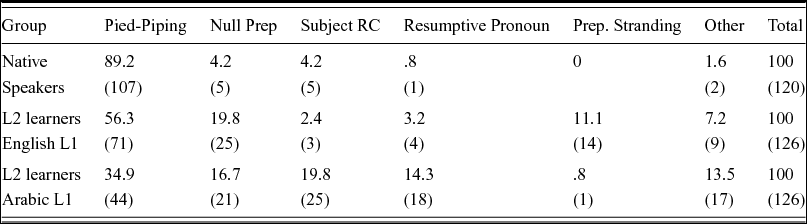
The sentences produced by the participants were transcribed and coded according to the syntactic structure produced, and later recoded as target or non-target in order to calculate accuracy percentages. I report the correct percentages for the direct object context as a control structure, to show that participants understood the task. The native speakers produced 94% of expected responses in this condition; the English-speaking learners responded with the expected structure 82% of the time, and the Arabic group produced 68% of the sentences according to the expected responseFootnote 4 . However, these percentages of target responses dropped significantly in the prepositional context, in which out of the 372 sentences elicited by the participants, only 222 were target-like. The control group formed 89.2% of the sentences in this context through Pied-Piping, the expected response. The English L1 group used Pied-Piping 56.3% of the time, and the Arabic group was target-like only 35% of the time. Still, Pied-Piping was the preferred construction in all three groups. The statistical analysis showed a strong association between accuracy (PiP) and group (L1 English, L1 Arabic, Native) in the prepositional context (χ2(2) = 76.04, p < .001); this significant difference holds within the two L2 learners groups, (χ2(1) = 115, p < .001), since the English group produced more PiP than the Arabic group.
The Arabic speakers tended to avoid prepositional relative clauses and instead increased the production of subject relative clauses (20% of their production), changing the intended meaning, as in (5), which is a less marked construction according to the Accessibility Hierarchy. Table 2 illustrates the types of constructions produced and their distribution.
Distribution of types of constructions produced in prepositional RC, % and (tokens)

-
(5)

Nevertheless, the construction most used by all groups was the target construction, Pied-Piping, and its use increased as proficiency in the L2 learners increased (Kendalls’ τ correlations L2 learners English group, τ = .528, p(one-tailed) = .001; L2 Arabic group: τ = .419, p(one-tailed) = .008). The next structure in frequency was the Null-Prep structure (6), used around 20% of the times by the English-speaking L2 learners, and around 17% of times by the Arabic group; this structure not only decreased in the English group as proficiency increased (τ = −.383, p(one-tailed) = .015), but it also significantly decreased as PiP increased (τ = −754, p(two-tailed) < .001). These correlations are not significant in the Arabic speakers. Null-Prep was available in two native speakers (4.2% of native production).
-
(6)

The next most frequent structures in the L2 learners were Resumption in the Arabic group as in (7), which counted for 14% of their production, and PS in the English group, exemplified in (8), which appeared 11% of the time. Interestingly, neither resumption in the Arabic group, or PS in the English group are correlated with proficiency (p > .05), but both are significantly correlated with PiP: as PiP increased, resumption decreased in the Arabic group (τ = −.480, p(two-tailed) = .013) and PS decreased in the English group (τ = −.443, p(two-tailed) = .023.
-
(7)
-
(8) Esta es la secretaria que los compañeros de oficina piensan en constantemente.
This is the secretary QUE the officemates think about constantly
(L1 English # 1)

7.2. Results of Self-Paced Grammaticality Judgment Task
7.2.1. Accuracy
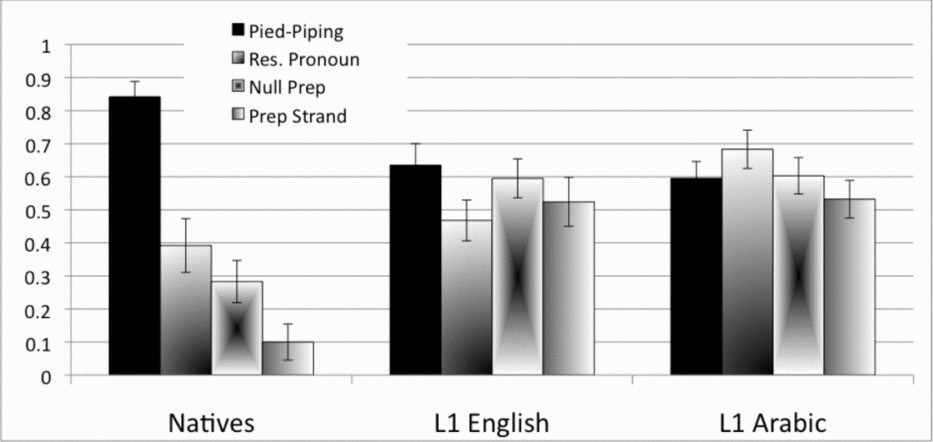
Grammaticality results are presented in proportions, where 1 means that they accepted the sentence as good, and 0 means they considered the sentence to be bad. Mean results are displayed in Figure 2. Native speakers have clear intuitions regarding the structures, with Pied-Piping as the most accepted option (M = .84), followed by Resumption (M = .39), the Null Prep construction (M = .28), and finally the totally ungrammatical Preposition Stranding (M = .10).
Mean acceptability rates for self-paced GJT (1 = ‘grammatical’; 0 = ‘ungrammatical’).

In the L1 English group, on the other hand, the means are closer to each other, showing weaker intuitions on the constructions. Still, the Pied-Piping structure was their preferred one (M = .63), followed by the Null-Prep construction (M = .60), Preposition Stranding (M = .52), and finally the construction with Resumption (M = .47), which was the preferred structure in the Arabic group (M = .68), followed by the Null Preposition (M = .60), the target Pied Piping (M = .60) and finally Preposition Stranding (M = .53).
In order to assure that providing negative feedback regarding the participants’ responses did not have an impact on how participants judged subsequent sentences, we ran a statistical correlation between mean accuracy results and order of presentation of tokens by structure in the L2 learners’ results, and found two weak positive correlations (Null-Prep, r(79) = .220, p = .051; Preposition Stranding, r(82) = .264, p = .016); one negative correlation (Pied-Piping (r(83) = −.266, p = .015); and no correlation (Resumption, r(76) = .015, p > .1). Given these weak or negligible correlations – the PiP correlation goes in the opposite direction – we can safely infer that the two experimental groups are not learning as the experiment goes along. Thus, the variable ‘order of presentation’ was not treated as a covariate in the overall statistical analysis.
The mean proportions were Arcsine transformed and submitted to a Repeated Measures ANOVA. Overall, there was a main effect of structure (F(3,177) = 18.44, p < .001), and a significant interaction of structure * group (F(6, 177) = 11.67, p < .001). The between subjects variable ‘group’ was also significant (F(2, 59) = 6.75, p = .002); the post-hoc Bonferroni test tells us that the two experimental groups did not differ between themselves (p = .1), but both experimental groups differed from the native control group (p < .05). By groups, we can observe that the main effect of structure holds in the native group (F(3, 57) = 34.24, p <. 001), but not in the Arabic group, or the English group (p >.1), indicating that the main effect of structure was produced by the native speakers. All correlations between accuracy and proficiency by L2 group and structure were non-significant (p > .05), the only significant correlation was between Null-Prep and PS in the L2 English group (r(21) = .699, p(two-tailed) < .001).
The within-subjects contrasts which compared the target Pied-Piping against the rest of structures further clarify that Pied-Piping is only treated differently from all other structures in the native group (p <.001), but not in the Arabic group (all contrasts were p > .1); in the English group, PiP differed from the Resumptive Pronoun condition (p < .05), but not from the other ungrammatical structures (p > .1).
The mean raw reaction times per structure and group that the participants took to give their grammaticality judgment, that is, how fast they responded, were also submitted to a repeated measures ANOVA; no significant main effect was found for structure or group, and all contrasts among structures and groups were not significant (p > .1).
7.2.2. Reading Times
Mean raw and residual RTs were calculated for each participant, region and structure. Analyses were conducted with both data, with identical results across structures and interactions per group; the only difference between raw and residual RTs were found regarding the main effect for the variable group, which we interpret as the overall slower RTs in the Arabic group. Given these similarities, I decided to present the residual data given its advantages for comparison among different types of speakers and word length differences. Residual times adjust for differences in participant's reading rates and in word length across conditions. These were calculated for each participant by means of a regression equation between the word length and the reading time, using all distracters and target items except practice items (Ferreira & Clifton, Reference Ferreira and Clifton1986). Z-scores from the raw data were separately calculated for each pairing of experiment, condition and region, and were used to trim the data: data points above 3 and under -1 z-scores (2.943% of the total) were discarded.
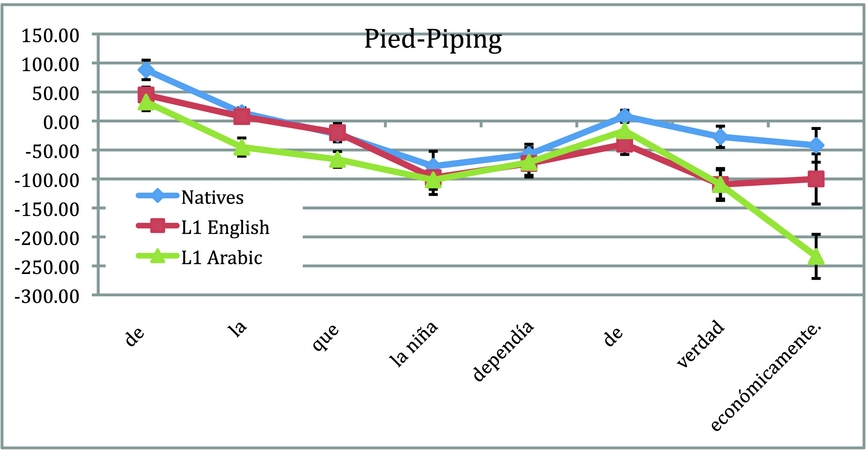
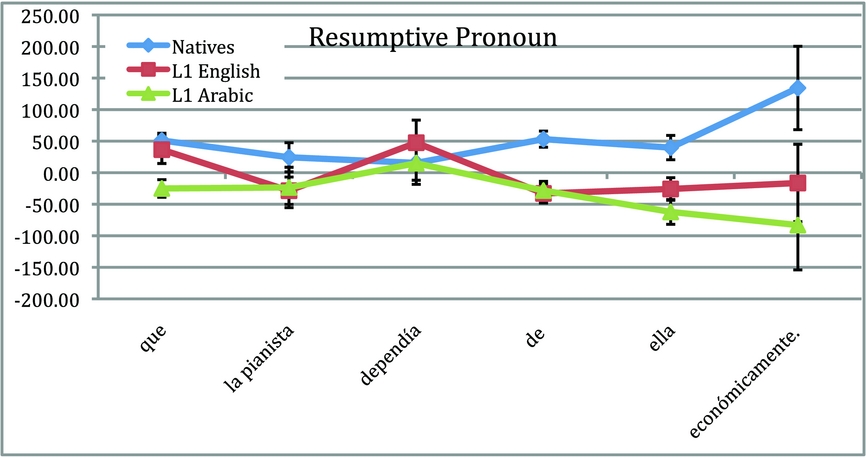
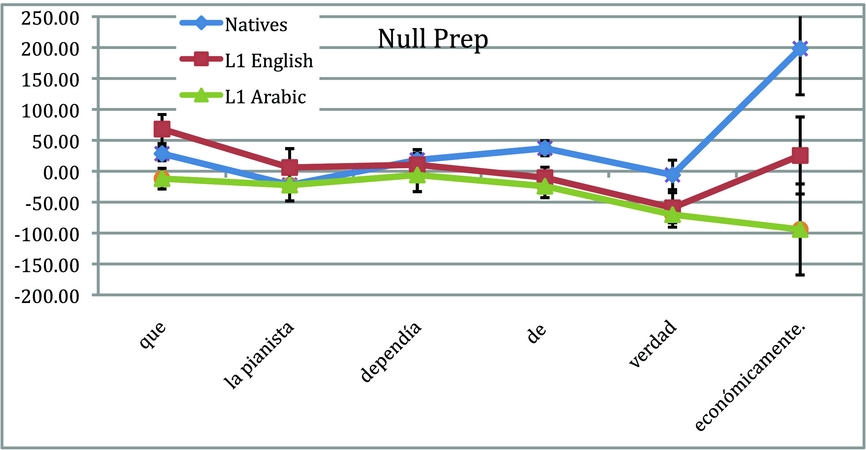
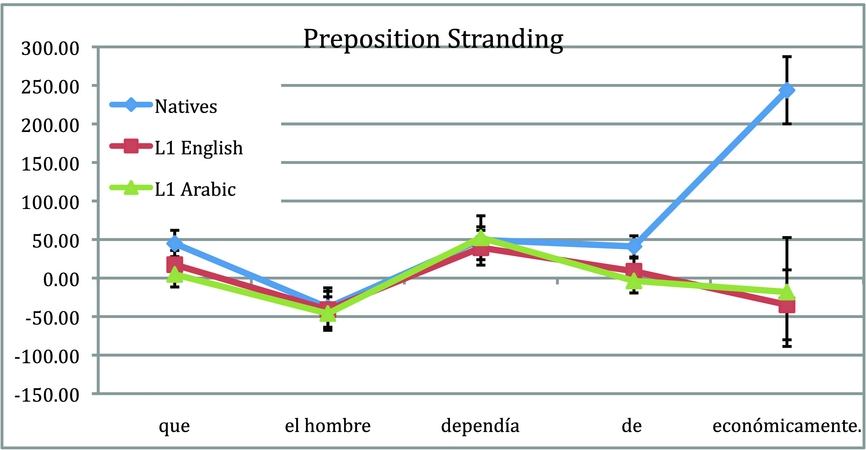
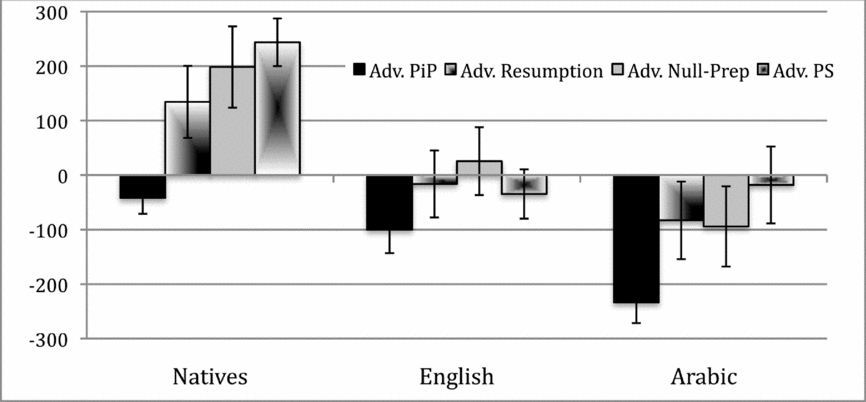
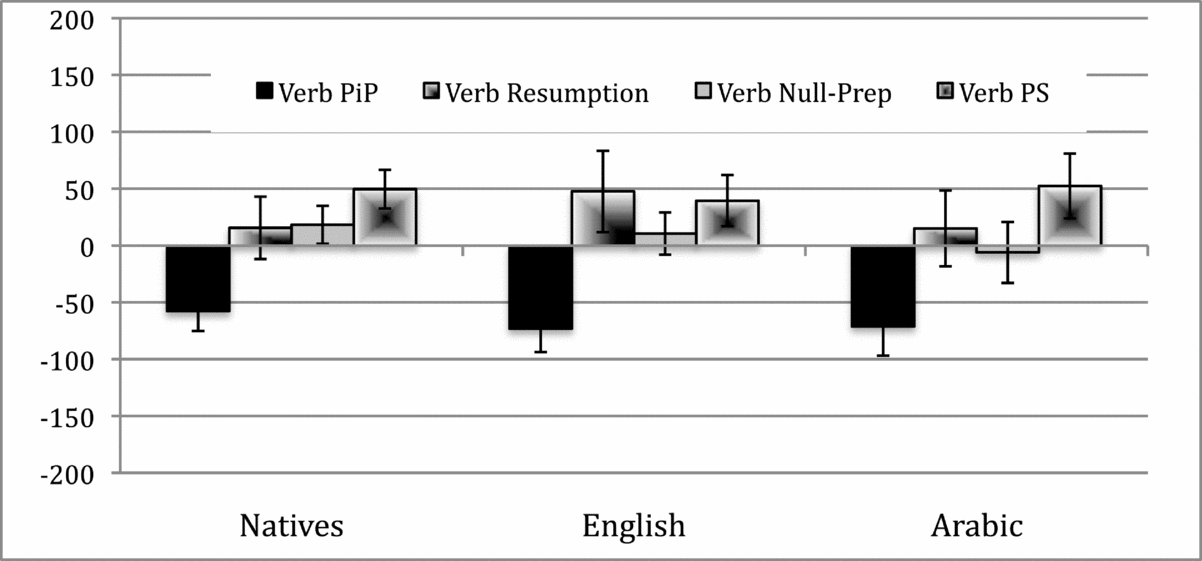
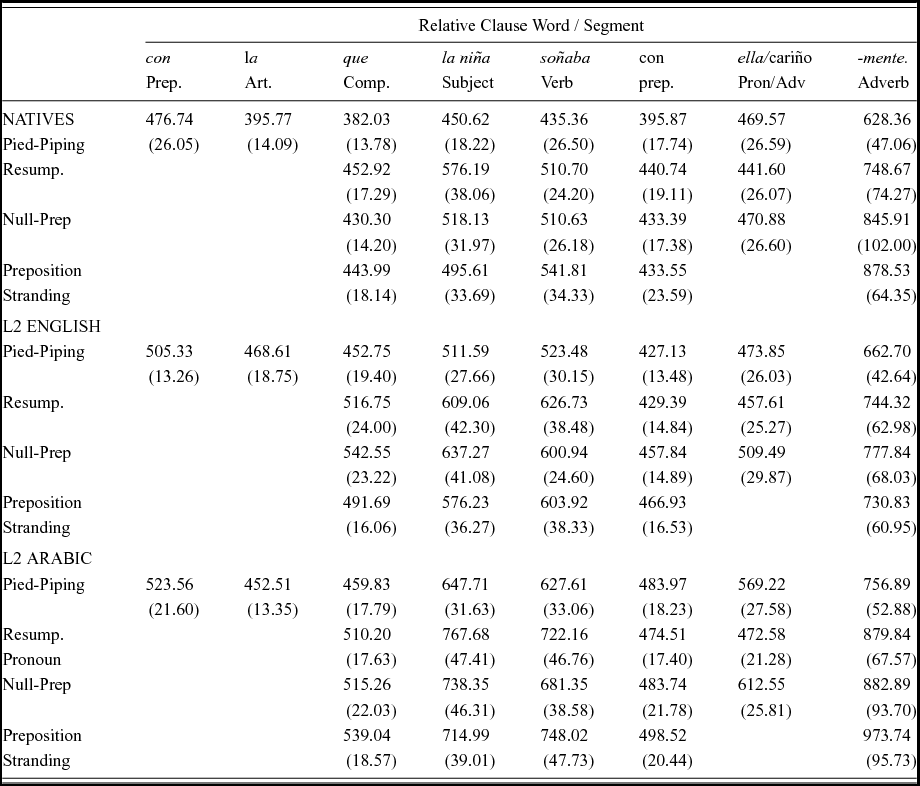
For the statistical analysis, the trimmed residual data of all target sentences were used, regardless of how the final question was answered, as in Gibson et al. (Reference Gibson, Desmet, Grodner, Watson and Ko2005). This was done to avoid discarding almost half of the data, particularly in the L2 learners’ results. For easy reference, the mean residual RTs and standard errors per group and regions are graphed in figures 3–6. The mean raw reading times values for each region are displayed in Appendix B. The extracted element and the main verb in which the relative clause was embedded, which are identical across conditions, will not be considered.
Mean residual reaction times and SE per group and region in Pied-Piping condition.

Mean residual reaction times and SE per group and region in Resumptive condition.

Mean residual reaction times and SE per group and region in Null Prep condition

Mean residual reaction times and SE per group and region in Preposition Stranding condition

Figure 3 displays mean residual times for sentences with Pied-Piping. Notice that this type of sentence has two extra words before the complementizer, the pied-piped preposition and the article, which in Spanish is part of the relative operator. Figure 4 represents the mean reading times and SE per group and structure for Resumption. The main difference here compared to the rest of constructions is the appearance of the pronoun in the penultimate region. Figure 5 represents the condition in which there is no preposition, and finally, figure 6 displays the mean RTs for Preposition Stranding, the condition in which after the verb there is a preposition dangling, with no possibility to be integrated into the next word. In this condition, there is one fewer word compared to Null-Prep or Resumption.
Provided that the question is always the same, and that readers give an overall interpretation to the sentence when they finish reading the sentence, then we will assume that the decision-making took place when participants read the last word of the sentence, in the sentence-final wrap-up region, rather than when they actually read the question. Thus, we will interpret the RTs at last word of the sentence as a correlate of the grammaticality judgment given. Recall that all last words were the same type of –mente adverbs, so the last region was equivalent across all four target conditions, and as such, we would not expect significant differences in RT in this word, unless the overall structure of the sentence affected the final integration of the sentence meaning.
The trimmed residual data corresponding to the last word of the sentence were submitted to a repeated measures ANOVA with structure as the within-subjects variable, and group as the in-between variable. Results indicated a main effect for structure (F(2.63, 155)Footnote 5 = 10.53, p < .001) and a main effect for group variable (F(2, 59) = 7.88, p = .001). No interaction of structure * group was found. The post-hoc Bonferroni test further indicated that the two experimental groups did not differ between themselves (p >.1), but they did differ from the native group (p <.05). Per groups, the repeated measures ANOVA showed that the native group distinguished among structures (F(1.6, 30.75) = 6.24, p = .008), and considered different all structures compared to the grammatical Pied-Piping (all contrasts were p < .05). So did the Arabic group (F(3, 60) = 3.88, p = .013), for whom all structures were different from Pied-Piping (p < .05), except for Null Prep (p > .05). The English group, on the other hand, did not have different RTs across structures (F(3, 60) = 1.71, p > .01); they only distinguished between Pied-Piping and Null (p < .05). Overall, the grammatical Pied-Piping had the shortest RTs in all groups, and the ungrammatical structures had longer RTs, as expected if the participants appropriately interpreted the sentences. This effect can be seen in Figure 7.
Last Region Residual Reading Times and SE per group and structure

Furthermore, by comparing the native speakers’ responses in Fig. 7 to their mean acceptability rates from Fig. 2, we can observe that these two figures are perfect mirror images, and that the native speakers’ RTs match seamlessly their grammatical judgments: the more acceptable the native speakers judged the construction in the GJT, the faster they processed the final adverb. This is strong evidence for our assumption that considers this final region a reliable correlate of the grammatical judgment given. However, these trends are not found in the case of the L2 learners.
Next, we will explore the processing of the embedded verb. If we assume that non-native speakers also attempt to integrate a displaced constituent as early as possible with a potential subcategorizing verb, as found in Juffs (Reference Juffs1998, Reference Juffs2005) and Williams, Möbius & Kim, (Reference Williams, Möbius and Kim2001) then, this is a critical region because the thematic roles are assigned at reaching this point. Here, all three ungrammatical conditions are identical, Pied-Piping being the only different structure at this point of the sentence. Thus, if speakers detect the ungrammaticality of the missing preposition at this point in the three non-standard conditions (Resumption, Null-Prep and PS), then we will expect to find differences on those conditions in comparison with Pied-Piping, but not among them.
The repeated measures ANOVA for the verb region indicated a main effect of structure (F(3,177) = 13.11, p < .001); no effect of group, or interaction of structure * group was found (p > .1). All within-subject contrasts against the grammatical structure were significant (Pied-Piping vs. Resumption (F(1, 59) = 26.47, p < .001); PiP vs. Null-Prep (F(1, 59) = 18.09, p < .001); PiP vs. PS (F(1, 59) = 36.11, p < .001). All contrasts among Null-Prep, Resumption and PS were non-significant (p > .05). Interestingly, all these effects and significant differences held across the three groups, except for Pied-Piping vs. Null-Prep in the Arabic group (p > .05). These data are represented in Figure 8. These results clearly indicated the different status of the Pied-Piping structure, with significantly shorter RTs in the verb region in comparison to the other structures across participants.
Verb Region Residual Reading Times and SE per group and structure

8. Discussion
The aim of this study was twofold: on the one hand, it investigated the role of the L1 and Universal Grammar in the acquisition of L2 Spanish prepositional relative clauses by English and Arabic-speaking learners; moreover, it explored the relationship between the grammar and the parser in non-native linguistic systems. The production task and the self-paced GJT failed to demonstrate complete target knowledge of the structures tested, suggesting a representational problem. We argue that the L2 learners’ grammars are still in development, displaying proficiency and L1 effects in the production task (cf. Hopp, Reference Hopp2009, Reference Hopp2010), as well as developmental structures (e.g. the Null-Prep phenomenon), available to the L2 learners due to Universal Grammar. In this sense, these results are compatible with the Full Transfer/Full Access Hypothesis (Schwartz & Sprouse, Reference Schwartz, Sprouse, Hoekstra and Schwartz1994, Reference Schwartz and Sprouse1996) since the L2 learners still transfer some structures only available in their L1 grammars, at the same time that they are able to reconstruct their grammars as proficiency advances. Paradoxically, the L2 learners presented native-like processing results, showing faster RTs in the critical regions of the grammatical Pied-Piping syntactic structure and slower RTs in the ungrammatical structures, even when they failed to judge these structures as ungrammatical. All together, these results indicate asymmetries in the L2 grammars, with target processing but non-target production and intuition, contradicting some of the tenants of the Shallow Structure Hypothesis (Clahsen & Felser, Reference Clahsen and Felser2006a), which proposes that L2 learners are not able to employ the same processing mechanisms that native speakers do, particularly if their grammar is not fully completed. These results imply unbalanced development of different linguistic processes (sentence production vs. sentence processing vs. grammatical intuition) in non-native grammars, with complete access to a universal parser, which provides the L2 learners with the appropriate strategies to fully process these sentences. Nevertheless, these L2 learners seem to have not yet acquired native-like ability in their production, and lack clear intuitions about the grammaticality of these structures, probably because producing and judging sentences are more demanding tasks than just reading a sentence. The following sections, organized by tasks, discuss in more detail these findings.
8.1. Oral Production Task
In the oral production task we have seen that L2 learners were far from native-like, with a little more than 50% of accurate responses (Pied-Piping) in the English group, and 35% in the Arabic group. The correlations between the number of Pied-Piping structures produced and the proficiency level were positive and significant, meaning that as the proficiency increased, the number of correct responses also did; Pied-Piping was also significantly correlated with the other structures investigated, and as PiP increased, Null-Prep, PS, and Resumption decreased. These results point towards a developmental effect: the grammar of these L2 learners is still in development, and as such, it presents some negative L1 transfer in the form of Resumptive constructions in the Arabic group, and PS in the English group that disappears as the target construction is acquired. This task also showed that the difficulties in constructing RCs is unique to Prepositional RCs, since results with DO RCs were significantly more target-like, proving that wh-movement per se is not a problem for these learners (see Perpiñán, Reference Perpiñán and Schwieter2013, for related results).
Interestingly, the grammar of these learners also presents other unmarked structures available through UG, such as subject relative clauses – most of the clauses included in the ‘other’ category – and the Null-Prep phenomenon. According to the NPAH (Keenan & Comrie, Reference Keenan and Comrie1977), the subject RC is the most common and less complex to process; as a consequence, it is not at odds to suppose that the L2 learners employ this strategy to ease their work, even at the cost of the intended meaning. Regarding the Null-Prep structure, which accounts for 17%-20% of the data and significantly decreases as PiP increases, we understand it as a developmental feature. We believe this developmental stage, a typical interlanguage property found also in L2 English (Klein, Reference Klein1993, Reference Klein1995) and in L2 French (Jourdain, Reference Jourdain1996), is a trait of natural languages since even native speakers produced some instances.
We also observed transfer of a marked construction such as Preposition Stranding, and whereas it might be marginal, these results suggest that it can be more difficult to eradicate than previously assumed (Liceras, Reference Liceras1986); even more persistent is Resumption in the Arabic-speaking group. Neither of these L1 transferred structures were correlated with proficiency. To summarize the production results, we can conclude that the language of these learners is still in development. These results are compatible with the two sides of the FT/FAH: transfer from the L1 on the one hand, and full UG access that allows them to go beyond what their L1 provides.
8.2. Self-Paced Grammaticality Judgment Task
With respect to the data from the self-paced grammaticality judgment task, we can conclude that the L2 learners do not have robust intuitions about the different structures and are not able to distinguish among constructions, even when they were provided with feedback after their responses. As the large standard deviations indicate, there is a considerable amount of variability in the data, supporting the idea of indeterminate knowledge and weak intuitions in the L2 learners. However, we also find large SDs in the native speakers, which indicates a general task effect, highlighting the overall complexity in distinguishing among these structures, a difficulty increased by the time constraint pressure and possibly the word fragmentation that this task supposes. Still, there are significant differences between the native speakers and the learners, and it could be argued that these differences do not seem to be only at the performance level since they are found in production as well as in their grammatical intuitions. Unfortunately, we do not have off-line grammatical intuitions to tease apart the time-pressure effect and the computational problems that the on-line task may produce.
One of the main differences found between production and judgment results is the lack of significant correlations between accuracy and proficiency in the GJT, which further indicates the difficulty of this task, even at higher proficiency levels. These data suggest that these learners have not finished acquiring the morphosyntactic complexity of prepositional relative clauses, maybe because they still lack some type of specific L2 knowledge, particularly related to the appearance of the preposition, or because they have not finished unlearning some of the L1 options. It is possible that while they are still figuring out the obligatory nature of the Pied-Piping mechanisms in Spanish oblique relative clauses, and while they are getting rid of Preposition Stranding or Resumption, they go through a stage in which they can optionally drop the preposition considering this is a valid alternative in Spanish grammar. We consider this optionality natural in interlanguage grammars and, if this is the case, then these L2 learners are just acting according to their L2 grammar, still in development. Nothing indicates that further development is not possible, and as the proficiency correlations showed in the oral data, this seems to be the case: as proficiency advances, so does accuracy and the knowledge of Pied-Piping; in the case of the GJT, this correlation was not significant, a fact that we interpret as proof of the demanding nature of the task, perhaps increased by the fragmented presentation of the stimuli.
8.3. Reading Times Results
We turn now to the psycholinguistic data and the analysis of the reading times from the self-paced GJT, which can help to describe the situation from a different angle. On the one hand, we have the real-time data from processing the last word of the sentence. We take these data, and not the time they took to respond to the actual question, to be the optimal implicit measurement of the grammatical judgment. One of the advantages of considering these data as a reliable correlate of grammatical judgments is because reading times are usually independent from more explicit metalinguistic judgments, which can be influenced by external considerations, such as normativity or explicit grammar rules. By looking at Fig. 7, we can observe that the last word corresponding to the Pied-Piping construction is read faster in all three groups, which generally speaking indicates that no ungrammaticality has been found at this point; the opposite results were found in the other conditions. The paradox that remains unsolved is why these readers, who showed certain sensitivity to the ungrammaticalities in on-line processing, are not able to judge the sentences accordingly.
Finally, moving into the verb region, in which the readers need to integrate the head of the relative clause, the data displayed a significant effect of structure for all participants, indicating that it is easier, i.e., faster, to integrate the displaced element with the verb if the preposition has been pied-piped. The tendency is noticeable and can be clearly seen in Fig. 8, with significantly shorter reading times in the PiP condition, and longer RTs in the rest of the conditions. This contrast indicates the special status of PiP compared to the other structures; crucially, all speakers, natives and L2 learners alike, perceived the special status of Pied-Piping at the verbal region, precisely where the grammaticality difference can be first noticed. We believe that the pied-piped preposition facilitates the integration of the extracted element, creating a facilitator or match effect by which the speakers can predict the potential elements that can come next.
Assuming that when processing language, the reader plans ahead the next coming words, then the presence of the preposition seems to reduce the potential upcoming subcategorizers. As a result, the displaced element gets incorporated faster when it reaches a somehow expected verb. The crucial point is that, even though the verbal items employed in the remaining conditions were exactly the same, this match effect was not found when the preposition was not pied-piped, that is, the parser cannot look ahead when it did not have a decisive clue of what to expect next. We wonder whether this effect is the result of the preposition providing some sort of morphosyntactic information that the readers can draw upon in order to process the sentences, even when the L2 learners do not fully recognize that this is the sole syntactic option that Spanish allows; recall that these prepositions contribute little to the semantics of the verb, although they are an integral part of the verbal phrase. If this were the case, these results would indicate that L2 learners are able to parse morphosyntactically a structure, and do not rely solely on lexical-semantics cues, against what Clahsen & Felser (Reference Clahsen and Felser2006a) proposed.
Finally, these results show that non-native speakers also attempt to integrate a displaced constituent as early as possible with a potential subcategorizing verb, obeying universal processing principles such as Minimal Chain Principle (De Vincenzi, Reference De Vincenzi1991) or the Active Filler Hypothesis (Clifton and Frazier, Reference Clifton and Frazier1986; Frazier, Reference Frazier1987; Frazier & Clifton, Reference Frazier and Clifton1989). This was already attested in other L2 studies such as Frenck-Mestre and Pynte (Reference Frenck-Mestre and Pynte1997), Juffs (Reference Juffs1998, Reference Juffs2005), Williams, et al. (Reference Williams, Möbius and Kim2001). Therefore, there can be full convergence at the processing level, and the differences between native and non-native speakers with respect to oblique relative clauses do not always reside in processing deficits. Furthermore, these data go against the Shallow Structure Hypothesis claim that argues “the L2 parser will be unable to successfully apply even universal processing mechanisms (such as minimal attachment) if the L2 grammar fails to provide sufficient grammatical information.” (Clahsen & Felser, Reference Clahsen and Felser2006b, p. 120). Convergent processing, though, does not automatically imply that the L2 learners’ grammatical representations are entirely complete and target-like. In fact, the results from the other measurements indicated otherwise.
8.4. General Discussion
We could hypothesize that since Pied-Piping exists in the learners’ native grammars, they already have the ability to process this construction in a native manner and may have helped build the native-like processing. This is an empirical question that the present study cannot directly address. There are several authors who have proposed that L1 processing strategies can be transferred into the L2 (Carroll, Reference Carroll1999; Juffs, Reference Juffs2005) and vice versa (Dussias & Sagarra, Reference Dussias and Sagarra2007), so in principle this could be an explanation. However, Pied-Piping in English and Arabic is quite formal, and there have been authors who proposed that English Pied-Piping is a prescriptive artifact that does not belong to the actual grammar of the speakers (McDaniel & McKee, Reference McDaniel and McKee1996; McDaniel, McKee & Bernstein, Reference McDaniel, McKee and Bernstein1998; Ohba, Reference Ohba and Wakabayashi2003). In fact, if L1 transfer were responsible for native-like processing, we need to wonder why L1 transfer does not apply across the board. Therefore, although L1 transfer is a possibility that we need to entertain, it cannot explain the complexity of the results, and it does not seem to affect equally all linguistic domains, given that some modules are more permeable than others.
Another question that remains unexplained is how these learners can have a divergent grammatical representation but convergent sentence processing. Assuming that the grammar feeds the parser (Pritchett, Reference Pritchett1992), we would not expect the syntactic parser to assign different structures from the ones postulated by the grammatical competence. One possible explanation is to think that production is delayed with respect to processing in certain constructions, in the same way that production appears later than comprehension in language acquisition. For instance, it is generally assumed that production, by definition, implies learned material. In our data, production is less target-like than on-line processing. Ferreira and Swets (Reference Ferreira, Swets and Cutler2005) found dissociation between the production system and the comprehension system with respect to resumptive pronouns in relative clause island constructions. They found that participants (native speakers) judged sentences as unacceptable but at the same time, they produced those sentences. These authors concluded that the two systems did not consult the exact same database of grammatical rules. In the present study we found a similar situation in which different linguistic systems seem to be accessing different information. In particular, the processing domain accessed information that it is not yet available to the production component.
Similarly to Hopp (Reference Hopp2009), we believe that some of the differences found between the tasks’ results reflect differences in the demands of the task. Processing data (RTs) came from just reading a sentence, which did not necessarily require the active evaluation of the well-formedness of the sentence. On the other hand, the final question in the GJT and the production task required the speaker to actively choose or construct a sentence, a more challenging undertaking. Another possible explanation is a task effect resulting in accessing different types of knowledge. It has been observed that the secondary task (comprehension question vs. grammatical judgment) during on-line processing affects the L2 learners’ sensitivity to perceive grammatical violations. Leeser, Brandl and Weissglass (Reference Leeser, Brandl, Weissglass, Trofimovich and McDonough2011) found that intermediate L2 learners of Spanish were able to identify ungrammaticalities while on-line reading only when a grammatical judgment was required at the end of the sentence (reading for form), but not when a comprehension question was prompted (reading for meaning). In the present study, participants did not detect the ungrammaticalities, even when they had to answer a grammatical question. This points towards a general lack of metalinguistic or explicit knowledge. In any case, there could be some task effects that we should not overlook, particularly with respect to the difficulty of the task. It remains for further research to determine if other tasks or different modalities (written vs. oral, off-line vs. on-line) will obtain similar results.
9. Conclusions
This study investigated the acquisition of prepositional relative clauses in L2 Spanish by English and Arabic-speaking learners and found that overall, this is a difficult area for non-native speakers, even when their native language shares some of the properties with the target grammar. This particular syntactic structure poses serious learnability issues for non-native speakers, and we believe that these are aggravated by the fact that L2 learners need to combine wh-movement with the acquisition of prepositions, which are hard-to-learn lexical pieces with a strong functional component. Moreover, these L2 learners need to unlearn some of their L1 syntactic structures, i.e., reduce their grammar's options, a task that has been proved to be harder than increasing an L2 grammar (Ionin & Montrul, Reference Ionin and Montrul2010). The results of this study further showed that the problems with the acquisition of prepositional RCs are not necessarily linked to processing, and that the L2 parser can have a faster or more advanced development than other linguistic components such as production or grammatical comprehension measured in grammatical intuitions. We believe this processing advantage is due to accessibility to universal sentence processing mechanisms. The results of this study also demonstrated that convergence is possible for L2 learners, supporting the Fundamentally Identical proposal (Hopp, Reference Hopp2009), at least for some linguistic domains – processing, in this particular case, even when the L2 grammars are still in development. Finally, these results show that non-native speakers also attempt to integrate a displaced constituent as early as possible with a potential subcategorizing verb, obeying universal processing principles such as Minimal Chain Principle (De Vincenzi, Reference De Vincenzi1991) or the Active Filler Hypothesis (Frazier, Reference Frazier1987; Frazier & Clifton, Reference Frazier and Clifton1989), and contradicting some of the proposals of the Shallow Structure Hypothesis (Clahsen & Felser, Reference Clahsen and Felser2006a, Reference Clahsen and Felser2006b).
Appendix A: Target stimuli
Pied-Piping
El profesor estudió a la mujer de la que la niña dependía de verdad económicamente.
Esta frase, ¿está bien? Y
El director conoció a la actriz de la que la chica hablaba de corazón constantemente.
Esta frase, ¿está bien? Y
La profesora escribió al escritor en el que el chico pensaba en serio continuamente.
Esta frase, ¿está bien? Y
La policía escuchó a la abuela con la que la madre contaba con cariño frecuentemente.
Esta frase, ¿está bien? Y
El dentista escribió al hombre con el que el médico soñaba con frecuencia repetidamente.
Esta frase, ¿está bien? Y
La peluquera peinó al actor en el que el director confiaba en secreto indudablemente.
Esta frase, ¿está bien? Y
Resumptive Pronoun
La turista observó a la chica que la pianista dependía de ella económicamente.
Esta frase, ¿está bien? Y
El escritor invitó al ganador que el editor hablaba de él constantemente.
Esta frase, ¿está bien? Y
El jugador conoció a la mujer que la actriz pensaba en ella continuamente.
Esta frase, ¿está bien? Y
El médico saludó al abuelo que el maestro contaba con él repetidamente.
Esta frase, ¿está bien? Y
El senador recibió a la actriz que la modelo soñaba con ella frecuentemente.
Esta frase, ¿está bien? Y
La doctora visitó al muchacho que el director confiaba en él indudablemente.
Esta frase, ¿está bien? Y
Null-Prep
El vendedor engañó a la chica que la clienta dependía de verdad económicamente.
Esta frase, ¿está bien? N
El escritor premió al profesor que el muchacho hablaba de verdad constantemente.
Esta frase, ¿está bien? N
El jugador conoció a la actriz que la cantante pensaba en realidad continuamente.
Esta frase, ¿suena bien? N
La médica observó a la maestra que la madre contaba con frecuencia repetidamente.
Esta frase, ¿suena bien? N
El fotógrafo fotografió al muchacho que el actor soñaba con cariño frecuentemente.
Esta frase, ¿suena bien? N
La secretaria observó al novio que el amigo confiaba en serio secretamente.
Esta frase, ¿suena bien? N
Preposition Stranding
La vendedora miró a la mujer que el hombre dependía de económicamente.
Esta frase, ¿suena bien? N
El escritor premió al profesor que la chica hablaba de constantemente.
Esta frase, ¿suena bien? N
El jugador conoció a la actriz que el chico pensaba en continuamente.
Esta frase, ¿está bien? N
La médica diagnosticó al maestro que el padre contaba con repetidamente.
Esta frase, ¿está bien? N
El fotógrafo observó a la hermana que la actriz soñaba con frecuentemente.
Esta frase, ¿está bien? N
El director visitó al muchacho que el vendedor confiaba en indudablemente.
Esta frase, ¿está bien? N
Mean raw reading times in milliseconds (standard errors in parentheses)