1. Introduction
The left periphery of the sentence has attracted a lot of attention in the syntax–semantics literature in the last three decades (Benincà & Munaro, Reference Benincà and Munaro2010; Büring, Reference Büring, Bosch and van der Sand1999; Chomsky, Reference Chomsky and Chomsky1972; Horn, Reference Horn1986; Jackendoff, Reference Jackendoff1972; Prince, Reference Prince, White and Teller1984, Reinhart, Reference Reinhart1981; Vallduví, Reference Vallduví1992). It has been rightfully recognized as the link between a sentence and the discourse that constructs the sentence's true acceptability. In this article, we look at the acquisition of three English syntax–discourse interface constructions par excellence: Topicalization, Focus Fronting (FF) and Left Dislocation (LD), illustrated in (1)–(3) below, where the preposed constituents are underlined and the resumptive elements are in bold.1
-
(1) Topicalization
-
a. Brains you're born with. A great body you have to work for.
(Brooke Shields, in health club commercial, Ward and Prince corpus).
-
b. A: Do you watch football?
B: Yeah. Baseball I like a lot BETTER.
(G. McKenna to E. Perkins in conversation, cited in Ward & Birner, Reference Ward, Birner, Horn and Ward2005, p. 161, capitals signal emphatic stress)
-
c. A: Did Janice like the wine?
-
B. Oh, the wine she didn't drink. She stuck to lemon ices.
-
-
(2) Focus Fronting (FF)
-
a. I made a lot of sweetbreads. A couple of pounds I think I made for her.
(from natural conversation, collected by G. Ward)
-
b. “Colonel Gadafy, you said you were planning on sending planes—M-16s I believe they were—to Sudan . . .”
(ABC's World News Tonight, collected by G. Ward)
-
c. M: Did I take my jacket to be cleaned? I think I need to wear it today.
-
N: The SHIRTS you took to the cleaner's, not the jacket. Here it is in the closet.
-
-
(3) Left Dislocation (LD)
-
a. One of the guys I work with, he said he bought over $100 in Powerball tickets.
(JM to WL, in conversation, collected by G. Ward)
-
b. My wonderful Felix, everyone likes him.
-
c. (As for) Felix, everyone adores the idiot.
-
We start by discussing meaning-based descriptions in order to examine the functional aspects of the constructions, following Birner and Ward (Reference Birner and Ward1998), Ward (Reference Ward1988), Ward and Birner (Reference Ward, Birner, Horn and Ward2005). “Felicitous preposing in English requires that the information conveyed by the preposed constituent constitutes a discourse-old anaphoric link to the preceding discourse” (Ward & Birner, Reference Ward, Birner, Horn and Ward2005, p. 159). Preposing is not restricted to any specific category, but most often it involves DPs and PPs. The information reflected in the preposed phrase may be related in many different ways to some discourse-available information: it can be type/subtype, part/whole, entity/attribute, member of the same presupposed set, identity, etc. As example (1a) demonstrates, the connection to the discourse may be rather tenuous. In (1b) the preposed phrase (baseball) and the previously mentioned football stand in a relationship of members of the inferred set {team sports}, where one is assumed to be a possible alternative to the other. In (1c), the dislocated constituent (the wine) and the discourse antecedent are identical. In most cases, the preposed phrase serves as a link to the previous discourse.
The same anaphoric relation to discourse is true of FF (see the examples in (2)) but with a twist: the preposed constituent contains the focus of the utterance and bears nuclear accent. Rooth (Reference Rooth1985) associates focus with a semantic operation that produces a set out of the entity in focus plus any number of comparable entities. The interpretation can be informally paraphrased as follows: X is a member of a set, and note that it is X and not some other element of that set that has been picked out as noteworthy. Furthermore, Neeleman, Titov, van de Koot and Vermeulen (Reference Neeleman, Titov, van de Koot, Vermeulen and Van Craenbroeck2009), and Vallduví and Vilkuna (Reference Vallduví and Vilkuna1998) have noted that both topics and foci can be contrastive. These authors argue that constituents that are contrastive are understood to open a contextually demarcated set of entities, out of which they are selected and highlighted, to the exclusion of other members of the set.Footnote 2 As the reader can ascertain, Rooth's (Reference Rooth1985) definition of focus and Vallduví and Vilkuna's (Reference Vallduví and Vilkuna1998) definition of contrast are very similar. It is contrastive topics and foci that we use in the experiment to be reported on below. It should be clear from the functional and semantic definitions given above that there is no superficial (word order) difference between English Topicalization and FF, in that both involve a constituent, moved from its underlying argument position, which has anaphoric relations with the previous discourse.
On the other hand, the LD construction, similar to what has been described as Hanging Topic Left Dislocation for Romance languages (Cinque, Reference Cinque, Ehlich and van Riemsdijk1983, Reference Cinque1990), is functionally different from Topicalization and FF (Ward & Birner, Reference Ward, Birner, Horn and Ward2005, pp. 162–163). Most importantly, the dislocated element does not have to represent discourse-old information, as examples (3a, b) above attest. A personal pronoun coreferential with the sentence-initial constituent appears in the canonical subject or object position of the sentence, in other words, the sentence displays no gap. Finally, an epithet as in (3c) can also be in the argument position normally filled by a pronoun.
In this article, we use data from Basque–Spanish bilinguals learning English as a third or subsequent language (L3/Ln) as a test case for the Interface Hypothesis (IH, Sorace, Reference Sorace2011, Reference Sorace2012; Sorace & Serratrice, Reference Serratrice, Sorace, Filiaci and Baldo2009). A recent version of the IH proposes a principled distinction between internal interfaces (e.g. between narrow syntax and phonology, morphology, semantics) and external interfaces. We will not be concerned here with comparisons between types of interface properties and their acquisition but will focus on constructions at an external interface: the syntax–discourse interface. It has been argued that properties involving the syntax–discourse interface are a major source of difficulty even for near-native second language (L2) speakers (Belleti, Bennati & Sorace, Reference Belletti, Bennati and Sorace2007). While there is a general consensus for developmental delays in the L2 development of such properties, findings to date are inconclusive (Donaldson, Reference Donaldson2011, Reference Donaldson2012; Ivanov, Reference Ivanov2012; Rothman, Reference Rothman2009; Slabakova, Kempchinsky & Rothman, Reference Slabakova, Kempchinsky and Rothman2012; Valenzuela, Reference Valenzuela2005, Reference Valenzuela, Slabakova, Montrul and Prévost2006). To the best of our knowledge, interface properties have not received much attention in L3 acquisition yet.
The IH has made explicit predictions about near-native L2 acquisition (Belletti et al., Reference Belletti, Bennati and Sorace2007) and processing (Sorace & Filiaci, Reference Sorace and Filiaci2006); L1 attrition (Tsimpli, Sorace, Heycock & Filiaci, Reference Tsimpli, Sorace, Heycock and Filiaci2004); and child bilingualism (Serratrice, Sorace, Filiaci & Baldo, Reference Serratrice, Sorace, Filiaci and Baldo2009). We submit that such predictions can be extrapolated to L3 acquisition on the basis of the interface delay explanations. Sorace and colleagues argue persuasively that speakers experience difficulties when they have to integrate and rapidly coordinate syntactic and pragmatic/contextual information. Research points to interface property delays in bilingual child development, stronger language attrition with such properties, and even near-native L2 residual optionality, defined as retaining two parametric choices active in the interlanguage grammar when natives have only one. The underlying reason for all these effects in different populations is processing abilities: integration of context and grammar taxes the language processor. This is especially true with speakers that have to inhibit one language while processing another, that is, the bilingual populations mentioned above. We conjectured that such integration would be even harder in trilingual speakers. Thus, this experimental study expands the scope of L3 studies, at the same time adding a new population to the syntax–discourse interface research.
The rest of this article is structured as follows: In the next section, we expand on the IH and explain the principal research questions of the L3/Ln acquisition inquiry as they interact with that hypothesis. Section 3 presents the syntactic analyses proposed for the target structures, Section 4 features the predictions made by the IH and some of the L3 models we discuss in Section 2. Section 4 presents the study itself, a discussion (Section 5) and conclusions (Section 6) follow.
2. L3/Ln acquisition and the Interface Hypothesis
In recent research on language acquisition, there have been different proposals trying to provide a principled explanation for the attested difficulty in the acquisition of several target language structures such as the ones just presented. On the basis of work in linguistic theory (Chomsky Reference Chomsky and Kenstowicz2001; Jackendoff, Reference Jackendoff2002; Rizzi, Reference Rizzi and Haegeman1997), the concept of interface has gained importance as a construct that could help explain discrepancy in difficulty levels. Interfaces are understood as spaces where mapping occurs between the various components of grammar or between grammar and other cognitive domains. The term interface has been used in work on child language acquisition (Reinhart, Reference Reinhart2006) but it is probably work by Sorace and colleagues that has made it more prominent within the realm of L2 acquisition (Sorace & Filiaci, Reference Sorace and Filiaci2006; Tsimpli & Sorace, Reference Tsimpli, Sorace, Bamman, Magnitskaia and Zaller2006). When analyzing overt pronoun use by highly proficient L2 Italian learners and by monolingual native speakers of Italian, Sorace and Filiaci (Reference Sorace and Filiaci2006) discovered that the former provided significantly different answers from the latter regarding their interpretation of overt subject pronouns (no contrast was found in their interpretation of null subject pronouns). As mentioned in the introduction, similar asymmetries were uncovered in near-native L2 performance (Belletti et al., Reference Belletti, Bennati and Sorace2007), in first language (L1) attrition (Tsimpli et al., Reference Tsimpli, Sorace, Heycock and Filiaci2004) and in bilingual L1 acquisition (Sorace, Seratrice, Filiaci & Baldo, Reference Sorace and Seratrice2009). Thus, a strong version of the IH (Sorace & Filiaci, Reference Sorace and Filiaci2006) proposed to account for similar findings in the three bilingual domains predicts that “structures involving an interface between syntax and other cognitive domains present residual optionality (in L2 acquisition), emerging optionality (in L1 attrition) and protracted indeterminacy (in bilingual L1 acquisition) but structures that require only syntactic computations are completely acquired in L2, remain stable in L1 and are acquired early in bilingual L1 acquisition.” (Sorace, Reference Sorace2011, p. 5). In other words, structures that appear at the syntax–discourse/pragmatics for example, are predicted to be difficult to acquire even for near-native speakers of the language.
However, the dichotomy between purely syntactic domains and those interfacing with other cognitive domains was subject to criticism as research showed that not all interfaces were equally vulnerable (see Slabakova, Reference Slabakova2006, Reference Slabakova2008, arguing for successful acquisition of syntax–semantic interface properties). More recently, Sorace (Reference Sorace2011) established a distinction between internal interfaces, those between narrow syntax and the other linguistic modules (phonology, morphology, semantics) and external interfaces, those between syntax and other cognitive modules. As mentioned above, her explanation for property delays rests on processing reasons: integrating context and grammar taxes the language processor. One reason why bilingual speakers may be less efficient at processing structures at the syntax–pragmatics interface could be that syntactic processing is less automatic for them (as argued by, for example, Clahsen & Felser, Reference Clahsen and Felser2006). This effect may either be due to less developed knowledge representations or to less efficient access to these representations, or both (Sorace, Reference Sorace2011).
Sorace (Reference Sorace2012, p. 213) states that the IH is only an account of patterns of optionality found in very advanced L2 attainment but not a developmental account of L2 acquisition. However, we agree with Lardiere (Reference Lardiere2011) and White (Reference White2011) that learners who are in the process of acquiring an L2 could also experience problems with structures at the interfaces. White (Reference White2011) comments on the need to extend and test the IH in domains where it was not originally intended to apply. To the best of our knowledge, interface properties have not received much attention in L3 acquisition. However, in the spirit of the IH, we would argue that L3 learners constitute another vulnerable population with respect to acquisition of discourse-related properties, as the effects of bilingualism can be expected to be even stronger in this population.
As reported in García Mayo and Rothman (Reference García Mayo, Rothman, Cabrelli Amparo, Flynn and Rothman2012) and in Rothman, Cabrelli Amaro and de Bot (Reference Rothman, Cabrelli Amaro, de Bot, Herschensohn and Young-Scholten2013), most work within the domain of L3 syntax has focused attention on the initial state of learner interlanguage and the extent to which previous learning experiences might influence the corresponding L3. As in the case of L2 acquisition, a logical position one may take regarding L3 acquisition is that absolute transfer from the native language would obtain, and consequently that the L1 would act as a filter that would block access to acquired L2 properties. This possibility, called the L1 Transfer Factor (shortened to L1 factor in the tables below), was advanced by Na Ranong and Leung (Reference Na Ranong, Leung and Leung2009) in their study of the acquisition and interpretation of null objects by L1 Thai/L2 English/L3 Mandarin Chinese participants. However, the authors themselves warned against considering their findings as definitive, due to different shortcomings in the methodology used and the small-scale nature of their study. Other models have received more attention lately: the L2 Status Factor (Bardel & Falk, Reference Bardel and Falk2007; Falk & Bardel, Reference Falk and Bardel2011), the Cumulative Enhancement Model (CEM) (Flynn, Foley & Vinnitskaya, Reference Flynn, Foley and Vinnitskaya2004) and the Typological Primacy Model (TPM) (Rothman, Reference Rothman2010, Reference Rothman2011). As the name itself indicates, the L2 Status Factor model maintains that the L2 takes on a significantly stronger role than the L1 in the initial stages of L3 morphosyntax. On the basis of data focusing on the placement of negation in Swedish or Dutch as an L3, Bardel and Falk (Reference Bardel and Falk2007) concluded that their data could only be explained if the L2 had a privileged role.
The other two models, the CEM and the TPM, hypothesize that all previously acquired languages might be a source of transfer. The CEM is a model both of the initial state as well as a theory of developmental sequence and ultimate attainment. It states that multilingualism is conditioned by a cumulative effect of previous linguistic acquisition. That is, any other previously acquired properties are potentially available to the L3 learner to use in parsing, comprehending and producing language. What is important in this model is that these prior language experiences can either enhance subsequent language acquisition or remain neutral. The TPM is similar to the CEM in that neither of them predicts categorical transfer but the TPM views transfer as being conditioned by factors related to either actual typological similarities or perceived proximity (known as psycho-typological proximity) between the grammars of the languages involved. Thus, non-facilitative transfer is a possibility under this model, but only if based on psycho-typological proximity.
Against this backdrop, the aim of the present article is to test the IH against data from Basque–Spanish bilinguals learning English as an L3. Below, we first present the learning tasks and then spell out the concrete predictions of the IH and the three currently available L3 acquisition models as to the acquisition of these properties.
3. Syntactic analyses of Topicalization, Focus Fronting and Left Dislocation
In this experimental study, we investigate the acquisition of discourse-related dislocation constructions (Topicalization, FF and LD) in the L3 English of Basque and Spanish bilinguals. In this section, we summarize the linguistic facts and analyses in the three languages.
The left-periphery phrases exemplified in (1)–(3) above display different “connectivity” effects with their respective host sentences. Such effects include case-matching and syntactic-category–matching between dislocated constituent (henceforth dislocate) and resumptive element, variable binding, island effects, and others. These effects have been taken to signal how much the phrases are dependent on some element within the sentence. We adopt the widely held view that the dislocate in English Topicalization and FF form an A-bar dependency with an argument position inside the Tense Phrase (TP).Footnote 3 The literature explains this syntactic dependency by either postulating movement of the dislocated element from an argument to a left-peripheral position, or by proposing base-generation of the dislocated phrase and chain formation with the argument position.
Dislocate movement involves an operation that copies the original element in a left-peripheral position and deletes the lower copy, or pronounces parts of it (e.g., Boeckx, Reference Boeckx2003; Grewendorf, Reference Grewendorf, Mauck and Mittelstaedt2002; Grohmann, Reference Grohmann2003). On the other hand, according to the base-generation analysis, (e.g., Anagnostopoulou, Reference Anagnostopoulou1997a; Cinque, Reference Cinque1990; Frey, Reference Frey, Lohnstein and Trissler2004), the dislocate is merged in the Compelementizer Phrase (CP) domain, an empty operator is merged in the argument position, the latter has to move at Logical Form (LF) for interpretation. Thus, the relation between the dislocate and the operator with its copy is created by chain formation at LF. The connectivity effects of Topicalization (namely the fact that though the fronted phrase is in a non-canonical position, it still retains close relations with the core TP and its arguments) are adequately explained by both movement and base-generation approaches.
In the case of English LD, the phrase in the left periphery does not show connectivity with the rest of the sentence. This is because the pronoun or epithet coindexed with the dislocated phrase is in an argument position, thus the theta-requirements of the predicate are resolved without movement. An indication of this non-integration is the non-observance of syntactic islands (Cinque, Reference Cinque, Ehlich and van Riemsdijk1983; Vat, Reference Vat1981).Footnote 4 Therefore LD has mostly been analyzed as base-generation of the left-peripheral phrase and a discourse semantic connection with the sentence-internal argument. As Cinque (Reference Cinque, Ehlich and van Riemsdijk1983) points out, the connection between the hanging topic and the pronoun is the same as the relationship between any other NP and a pronoun/epithet referring to it, in adjacent sentences.Footnote 5
Both the movement and base-generation analyses of Topicalization handle information structure notions with syntactic means, that is, feature-assignment and movement to a functional projection for checking purposes. This forceful syntactocentricity can be considered a weakness of such approaches (see López, Reference López2009). A qualitatively different approach to (dislocated) focus and topic was proposed in Reinhart (Reference Reinhart1981) and developed by Zubizarreta (Reference Zubizarreta1998), Reinhart (Reference Reinhart2006), Neeleman and van de Koot (Reference Neeleman and van de Koot2008), and Horvath (Reference Horvath2010), among others. This approach places discourse rules and acceptability at the heart of linguistic explanation. It argues that topic and focus do not instantiate formal syntactic features and do not correspond to functional projections. Instead, topic and focus are involved exclusively in what is called “discourse grammar” by the mapping of syntactic structures to information structure representations. While topic and focus play no role in the syntactic-semantic computations, they interact with syntax phenomena indirectly, via the syntax–discourse interface.
Finally, López (Reference López2009) is a recent proposal that maintains elements from both feature-based treatments and interface-based treatments by arguing for a pragmatics module of computation. The pragmatics module yields an intermediate level of representation between the syntactic structure and the discourse structure where the features [±antecedent] and [±contrast] are assigned. The derivation proceeds as proposed in Chomsky (Reference Chomsky and Kenstowicz2001). First, individual lexical items enter the syntactic derivation by merging into phrase markers. At the end of each phase – verb Phrase (vP) and CP – a syntactic object Σ is formed. This syntactic object is then inspected by the pragmatics module, which assigns the relevant discourse features to constituents located in syntactic positions at the phase edge, yielding the information structure Σ[p]. These pragmatically enriched structures are subsequently assembled into longer units of text to form discourse representation structures.Footnote 6 Note that López's discourse feature [±contrast] captures the idea that the fronting operation itself (Topicalization, Clitic Left Dislocation (CLLD) or Focus Fronting) simultaneously opens up a variable position and resolves it, unlike the variable position in a wh-question, which is resolved only by the following sentence.
Spanish and English FF, Spanish Hanging Topic Left Dislocation (HTLD) and English LD have been analyzed as fundamentally parallel constructions (Kempchinsky, Reference Kempchinsky2008; Zagona, Reference Zagona2002). On the other hand, English Topicalization and Spanish CLLD as in (4) have received contrasting analyses.Footnote 7
-
(4)


Various syntactic differences between these constructions have been pointed out (Cinque, Reference Cinque, Ehlich and van Riemsdijk1983): a specificity restriction on the moved constituent in Spanish but not in English, multiple possible dislocates in Spanish versus only one in English, occurrence in root and embedded clauses in Spanish while root only in English (excepting bridge verbs), and sensitivity to strong islands only in Spanish but all islands in English. We will review here Anagnostopoulou's (Reference Anagnostopoulou1997a) analysis, which follows Demirdache (Reference Demirdache1991) and Vat (Reference Vat1981). In trying to account for syntactic differences, Anagnostopoulou compares what she calls English Contrastive Left Dislocation (CLD, the same as our Topicalization) to Romance CLLD. She proposes that both constructions involve an adjoined left-dislocated phrase coupled with an operator–variable chain. Apart from the obvious morpho-phonological difference, clitics and null operators share operator properties. The syntactic differences between the two constructions fall out of the different adjunction sites of the left dislocated constituent: CP-adjunction for CLD, TP-adjunction for CLLD. Not all analyses consider Spanish and English Topicalizations to be syntactically divergent. For example, Rizzi's (Reference Rizzi and Haegeman1997) feature-based account treats both English and Spanish fronted topics as targeting the same functional projection, Top(ic)P(hrase). The Romance–English parametric difference rests simply in the presence of a null anaphoric operator versus a clitic establishing the topic–comment connection.
Let us now turn to Basque. This is an SOV ergative-case language. The structure of finite verb forms in Basque is rather complex. Finite forms, besides being marked for tense and mood, carry agreement features with up to three arguments: subject, direct object and indirect object. All of this results in very rich verbal morphology (see (5) below). Furthermore, traditionally, Basque is also described as a three-way pro-drop language (see Goenaga, Reference Goenaga1980; Laka, Reference Laka1988; Ortiz de Urbina, Reference Ortiz de Urbina1989; Salaburu, Reference Salaburu and Salaburu1987): as illustrated in (6), the subject, direct object and indirect object (marked ergative, absolutive and dative, respectively) can be phonologically empty. Like English, this language does not allow clitic pronouns of the Romance type (Hualde & Ortiz de Urbina, Reference Hualde and Ortiz de Urbina2003).
-
(5)

-
(6)

In Basque, a focus constituent has two obligatory properties (Elordieta, Reference Elordieta2001, pp. 111ff.). It has to be identified prosodically with the focalized phrase receiving the most prominent stress of the sentence. Additionally, the focus phrase must appear in immediate preverbal position (the so-called focus–verb adjacency), a characteristic also found in other languages, such as Hungarian (Horvath, Reference Horvath1995), Italian (Rizzi, Reference Rizzi and Haegeman1997) and Greek (Tsimpli, Reference Tsimpli1995). Both the prosodic and the syntactic conditions must be met in order to identify a constituent as focus in Basque. Consider the following examples from Elordieta (Reference Elordieta2001, p.113) illustrating possible and impossible answers to a question like “Who has bought a new car?” (focused material in capitals):
-
(7)

Both (7a) and (7b) are well-formed answers because the focused constituent (nire nebak “my brother”) appears in an immediately preverbal position. The answer in (7c) would be ruled out as an answer to the question mentioned above precisely because it does not meet the focus–verb adjacency requirement as the object phrase intervenes between the focus and the verb.
Topic constructions in Basque resemble English ones superficially; they do not feature any clitic as Spanish CLLD does. A topicalized answer to the question in (8a), would be as in (8b):
-
(8)

The LD construction in Basque, unlike the English one, does not have to employ a pronoun in the main clause. Basque object agreement licences and identifies the null object pronoun. Consider the Basque sentence in (9b), corresponding to the English LD sentence illustrated in (9a):
-
(9)

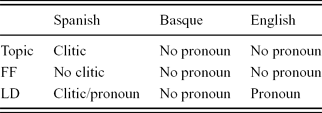
Thus, it becomes very difficult to formally distinguish Topicalization from LD in Basque, in a marked contrast with English. Table 1 summarizes the surface differences between the three languages involved in this experimental study.
Comparison between the morpho-phonological reflexes of the investigated constructions in Spanish, Basque and English.

FF = Focus Fronting, LD = Left Dislocation
We can speculate on the perceived superficial differences between the L1s and the L3 from the point of view of the learners. In principle, a language can require the use of a pronoun, allow it optionally, or not allow a pronoun in a certain construction, or in the grammar. When we say “no pronoun” in Table 1, we mean that Basque does not allow third person pronouns at all, while English does not allow a personal pronoun in that particular construction. Both languages do not allow clitic pronouns. On the surface, Topicalization and FF seem to work similarly in Basque and English. While LD relies on null object pro in Basque, it needs an overt pronoun in the English main clause. Although Basque and English (lack of) pronoun stem from different underlying reasons, this is still a regular difference working across all constructions in the two grammars. If we assume that Romance clitics can be perceived by learners as roughly the equivalent of English strong pronouns (as suggested in Parodi & Tsimpli, Reference Parodi and Tsimpli2005), then Topicalization and CLLD are the only constructions different in Spanish and English morpho-phonetically (null operator versus clitic).Footnote 8
4. Predictions for second and third language acquisition
In this experimental study, we set out to test the Interface Hypothesis in L3 acquisition. This hypothesis would predict that learners will have difficulty incorporating discourse information in calculating the acceptability of three left dislocated constructions in English, even at very advanced proficiency levels. However, there are other factors that could have an effect on L2/L3 acquisition.
Adding to the difficulty of the syntax–discourse interface is the fact that all English dislocations are rare in the input to learners. Generally speaking, left dislocations in English are rare even in spoken corpora. Gregory and Michaelis (Reference Gregory and Michaelis2001), working with the Switchboard Telephone Speech Corpus, uncovered 44 Topicalizations (that is, 0.00134% of all sentences) and 187 LDs (0.0057% of all sentences). Postolache (Reference Postolache2005), examining the Wall Street Journal Corpus of 1.1 million words, reported only 24 left dislocations, including focus and topic. In comparison, the NOCANDO corpus of spontaneous Spanish speech production (Brunetti, Bott, Costa & Vallduví, Reference Brunetti, Bott, Costa, Vallduví, Konopka, Kubczak, Mair, Sticha and Wassner2011) contained 39 CLLDs and left dislocations (together) in roughly 3800 segments, which amounted to 1.35% of all finite clauses. Furthermore, there were 61 clitic doubling constructions, 2.1% of all finite clauses. Although the English and Spanish corpora are difficult to compare directly, these two frequencies differ by a factor of roughly 1000, which certainly amounts to a significant difference in frequency. To sum up, CLLD may be 1000 times more frequent in Spanish than Topicalization is in English.
Nevertheless, native speaker judgments (including the ones in this study) confirm that English dislocations are not at all marginal but completely acceptable. Augmenting the difficulty of learning these constructions is the fact that they tend to be options rather than absolutes, in the sense that there are other ways of encoding a truth-semantically identical message. Keeping this situation in mind, we will explore predictions of the IH and the effect of frequency in the input on L2/L3 acquisition. In concord with the IH, we predict that these constructions will be difficult for learners, but for different reasons (lack of enough evidence in the input).
In addition to the two factors conspiring to make acquisition difficult (discourse interface, rarity in the input), there are unique differences between the L1–L3 language pairs that are further complicated by the L2. Looking at the facts in Table 1 in another way, one can say that there are no unambiguous syntactic diagnostics in English for Topicalization vs. FF, while in Spanish the presence vs. lack of the clitic clearly distinguishes the two. On the other hand, all three left-dislocation constructions in Basque may employ null object pro, which may blur the line between Topicalization and LD in the L3 English of Basque native speakers. We submit that these inter-linguistic differences will also present learning challenges because they necessitate morpho-syntactic restructuring of the grammar.
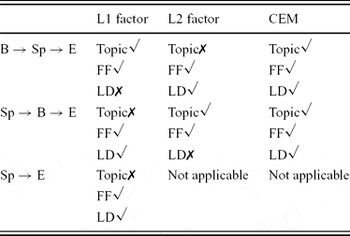
In this article, we also endeavor to test the predictions of three L3 acquisition models discussed in Section 2: L1 transfer, L2 Status Factor (L2 factor for short in tables) and CEM. Table 2 presents the three experimental groups and outlines the predictions each of the models makes for them.Footnote 9
Predictions of the L3 acquisition models.

B = Basque, Sp = Spanish, E = English, CEM = Cumulative Enhancement Model, FF = Focus Fronting, LD = Left Dislocation, √ = easy to acquire because of transfer, ✗ = hard to acquire
The criteria for the predictions in Table 2 are the (surface) morpho-syntactic differences in the resumptive elements in the three languages (see Table 1). Complete L1 transfer would predict that neither the L1 Spanish – L2 Basque – L3 English (Sp → B → E) nor the L1 Spanish – L2 English (Sp → E) groups would have problems with L3 FF and LD, since Spanish and English work (superficially) similarly: FF has no resumptive element while LD has a resumptive prounoun or clitic. However, this model predicts that learners would find Topicalization constructions more difficult because morpho-syntactic restructuring is necessary. The participants in the L1 Basque – L2 Spanish – L3 English (B → Sp → E) group will have problems only with LD but not with the other two constructions, again due to superficial similarity, hence no need for restructuring. Along the same lines, the L2 Status model predicts that the Sp → B → E participants will have problems only with the LD construction, which is the only one that differs between Basque and English. Recall that for that model it is the second language that will have a decisive influence over the third. The B → Sp → E group is expected to have difficulties with dislocated topics. As for the CEM, this model predicts that none of the constructions will present a challenge to the Sp → B → E and the B → Sp → E groups, since either the L1 or the L2 will freely provide beneficial transfer for successful L3 acquisition.
5. The experiment
5.1 Test design and materials
We tested three English dislocated constructions: Topicalization, FF, and LD, in root clauses embedded under appropriate context. We constructed six contexts for each construction, each construction making its own condition, drawing heavily on naturally occurring dislocations from the Ward and Birner corpus. We piloted the stories and test sentences on three native speakers of American and Canadian English, and adjusted the tests accordingly. Twelve fillers were also included.
Each test item consisted of a story presenting a context, and two test sentences underneath the story. In two of the conditions (Topicalization, FF), there was also immediate context since the test items contained a question and an answer. Both stories and test sentences were presented in written and aural form on a computer screen. The independent web surveyor service SurveyGizmo was utilized to make testing convenient for our participants and to keep the data anonymous. They had to rate the test sentences (by clicking on a radio button) from “Not natural in the context” (numerical value of 1) to “Perfectly natural” (a value of 7), with a separate option for “I don't know”. After carefully considering possible Likert scales (1–4, 1–5, etc.), we chose the 1–7 scale because it gave test-takers the opportunity to give more nuanced evaluations. A screenshot of a test item appears in Figure 1. The participants were asked to take the test at one sitting, and not to go back and change their answers. Participation was voluntary but participants could ask for a token remuneration of 5 Euros for their time.
Screenshot of experimental material.

The context stories were recorded by a competent L2 speaker of English. The test sentences were recorded by a female and a male native speaker of American English. The two test sentences for each story differed only in the presence or absence of (resumptive) pronoun in the main clause (see Figure 1). The presence of an empty category or pronoun was counterbalanced across conditions. Pronouns were acceptable in LDs, but unacceptable in FF and Topicalization. We will give an example of each test condition as we discuss the results.
The test design also included a test of English proficiency with forty multiple-choice answers, as well as a background questionnaire on the learners’ exposure to and use of Basque and Spanish.
5.2 Participants
A total of 110 subjects participated in this study, divided across a control group of 24 native speakers and three experimental groups. The experimental groups were specifically chosen in order to compare the effect of the native and the second language on the acquisition of the third language. All participants had to fill in a background questionnaire that we devised with the specific aim of obtaining the ages when they started learning the L3, the type of exposure to the L2 and the L3, times in a typical week spent communication in the languages, study and/or visits to English-speaking countries, other languages spoken, etc.
The B → Sp → E group comprised 23 individuals, who identified themselves as Basque native speakers. They were exposed to Spanish and English through the school system. These learners were exposed to Basque since birth and at school they followed model D in the Basque school system. This is a total immersion programme for those students whose L1 is Spanish and a maintenance programme for those with Basque as L1. Spanish is taught as a compulsory subject for between four and five hours per week (Lasagabaster, Reference Lasagabaster2001). The majority of this group (21 out of 23) reported spending more time speaking Basque than Spanish in a normal week. A small number of participants (n = 4) from this group had spent extended time in an English-speaking country.
The Sp → B → E comprised 24 individuals who identified themselves as native speakers of Spanish and who were educated in the Basque school system. Eight of these participants were enrolled in model D, the rest mostly followed model B in the Basque school system. This model is an early partial immersion programme in which both Basque and Spanish are used as means of instruction. The students enrolled in this model usually have Spanish as their L1 (Lasagabaster, Reference Lasagabaster2001). Some of the participants in this group (n = 5) spoke French in addition to Basque and English.Footnote 10 All of the participants in this group reported spending more time speaking Spanish than Basque, or equal amount of time, in an ordinary week. They had been exposed to English exclusively in a school setting, and roughly half of them (n = 11) had spent more than a year in an English-speaking country (the UK, Ireland, the USA). All participants from both trilingual groups resided in the Basque Autonomous Community and were consecutive child bilinguals of Basque and Spanish. Finally, there was a group of 39 Spanish learners of L2 English (Sp → E), who neither grew up nor resided in the Basque Country but who grew up and resided elsewhere in Spain.
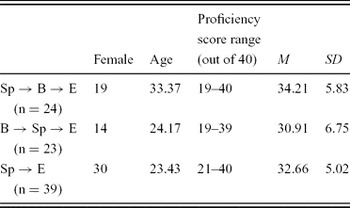
We used a 40-item grammar-oriented subset of the Oxford Test of English Proficiency, a multiple choice written test that we adapted slightly for our purposes. Twenty of the items were individual sentences where one word or phrase was missing and the participants had four possible answers to choose from. Twenty additional items had the same format but comprised a continuous story, so correct choices relied on context as well as grammar. The three groups were of largely similar, though by no means equal proficiency, as Table 3 shows. The Sp → B → E group was the most proficient and the B → Sp → E group the least proficient. We used the cut-off point of 30 (out of 40) in the proficiency test to divide intermediate from advanced learners of English. Thus, 15 learners in the B → Sp → E group, 22 in the Sp → B → E group, and 27 in the Sp → E group fell into these more advanced groups. The statistical analyses (to be discussed in the next sections) were performed keeping only the most proficient learners in the groups, and the results remained essentially the same. Therefore we continue to report whole groups, keeping in mind that most of the participants in them are advanced speakers, but that proficiency does not seem to matter for the acceptance or rejection ratings of these constructions.
Participant gender, average age, and performance on the English proficiency test.

B = Basque, Sp = Spanish, E = English
5.3 Results
We start with FF, where morpho-syntactic restructuring of the resumptive element was not necessary, based on the predictions of transfer as seen in Table 2. An example of a FF test item is given in (10).
-
(10) Context: Mark works in a bakery in San Francisco. Their bagels are so famous that they often run out of them by the middle of the morning. It has happened again today.
-
Dialog 1
-
Customer: Can I get something for breakfast? Maybe a bagel?
-
Mark: No, sorry. We're out of bagels. A bran muffin I can give you.
-
Dialog 2
-
Customer: Can I get something for breakfast? Maybe a bagel?
-
Mark: No, sorry. We're out of bagels. A bran muffin I can give it to you.
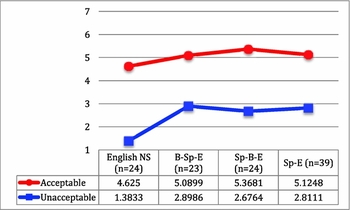
As all three languages involved in this experiment work the same way with respect to FF (see Table 1 above), we expected that all learner groups would be accurate in rejecting the test sentences with pronouns and accepting the sentences with the null operator. The mean ratings are plotted in Figure 2. As can be seen, all groups display a contrast between acceptable and unacceptable sentences (see statistical analyses in the next section). It is interesting to note that the native English speakers do not rate the acceptable FF sentences very highly (M = 4.625 out of 7), but they do make a clear distinction between them and unacceptable ones (M = 1.3833).
Mean ratings of acceptable and unacceptable test sentences: Fronted Focus.

Example (11) below is from the LD condition. In this condition, the LD constituents were loosely related with the previous context, and not “connected” with the main clause. As a result, there was a co-referent pronoun in argument position. The expected correct answer was to rank highly the test sentence with the pronoun, and to reject the one without a pronoun. This condition was expected to present difficulties to the Basque native speakers (see Table 2), but only to those speakers who had not acquired that object pro is not licenced in English and an overt pronoun is obligatory.
-
(11) Context: Marina and Joe are talking about their father. He has been selling their family's possessions after their mother died. They are wondering how to stop him.
-
Test sentence 1
-
Joe: The portrait of our mom, I hope he hasn't sold yet.
-
Test sentence 2
-
Joe: The portrait of our mom, I hope he hasn't sold that yet.
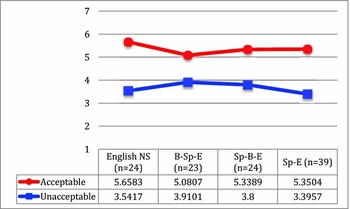
The overall impression is that all participant groups rate highly the sentences with the pronouns, but, with ratings of roughly from 3.4 to 3.9 (out of 7), they are also rather tolerant of the equivalent sentences without pronouns. At least for the English native speakers, this behavior could be an indication that they treat LD as similar to Topicalization. Since the appropriate contexts for these constructions are very close and even overlapping, this is hardly surprising. However, as we will document in the next section, all the groups have established a significant contrast between acceptable and unacceptable sentences.
An example of Topicalization is provided in (12). The test sentence with the null operator in Dialog 1 was expected to be rated higher than the one with the pronoun in Dialog 2.
-
(12) Context: Annette has just outlined some possible policies for the local school board. Her neighbor Bob says:
-
Dialog 1
-
Bob: You've been a pretty good proponent for some of those ideas we've been talking about in our neighborhood. Maybe you should run for a local school board position?
-
Annette: That I'm not so sure about. I've got a lot of things to keep me busy.
-
Dialog 2
-
Bob: You've been a pretty good proponent for some of those ideas we've been talking about in our neighborhood. Maybe you should run for a local school board position?
-
Annette: That I'm not so sure about it. I've got a lot of things to keep me busy.
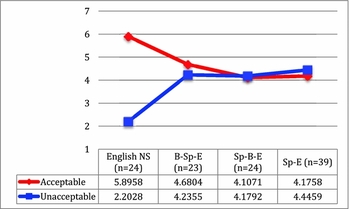
The plotted mean ratings in Figure 4, show that the behavior of the English native speakers and all the English learners is very different with respect to this construction. While the native speakers are clearly distinguishing acceptable from unacceptable sentences, none of the learner groups do so, and in the case of the Sp → E and the Sp → B → E groups, they even rate the unacceptable sentences higher than the acceptable ones. Furthermore, all the learner ratings fall in the mid-range of the seven-point scale (between 4.1 and 4.7). Recall that Topicalization is a construction that differs morpho-phonologically in English/Basque versus Spanish (see Table 1). This response pattern seems to be a result of this discrepancy.
5.4 Statistical analyses
The experimental design had one between-subjects variable (linguistic profile, which we will call Group), with four levels of variation (English native speaker controls, Spanish bilinguals, Basque-dominant and Spanish-dominant trilinguals) and two within-subjects variables, Condition (with values Topicalization, FF, and LD) and Acceptability (acceptable, unacceptable). The dependent variable was labelled as Response.
A repeated-measures ANOVA performed on the whole data set revealed a significant main interaction of all three variables, Condition × Acceptability × Group (F(3,107) = 8.834, p < .0001). There was a significant effect of Condition (F(1,107) = 50.661, p < .0001), a significant effect of Acceptability (F(1,107) = 327.4, p < .0001), and a significant between-subjects effect of Group F(3,107) = 3540.215, p < .0001. All other interactions with these variables (Condition × Acceptability: F(1,107) = 35.724, p < .0001; Group × Acceptability: F(3,107) = 18.42, p < .0001, and Condition × Group: F(3,107) = 7.377, p < .0001) were highly significant. When such interaction effects are significant, this means that the impact of one factor depends on the level of the other factor.
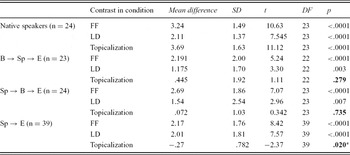
A number of t-tests were run among the mean rates of each Group × Condition × Acceptability interaction, in order to detect which pairs of cell means are significantly different. We were mainly interested in finding whether each group of participants had established a significant contrast between acceptable and unacceptable sentences within their grammar. Table 4 presents the results of the paired samples t-tests. The p-values in bold are the ones that do not reach significance (in the expected direction).
Paired samples t-tests between acceptable and unacceptable sentences in each group and for each condition. Bold marks notable p-values discussed in the text.

B = Basque, Sp = Spanish, E = English, FF = Focus Fronting, LD = Left Dislocation
*Note that this is a significant difference in the wrong direction.
As anticipated by our superficial examination of means in the previous section, the t-tests confirmed that Topicalization is the only condition in which the learner groups failed to establish the appropriate contrast. The only three non-significant results of the t-tests were for all the learner groups in the Topicalization condition. In all other conditions, learners’ behavior patterns with that of the native speaker controls.
5.5 Individual results
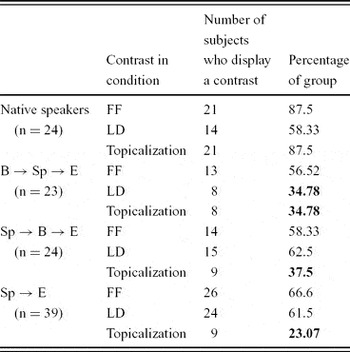
Since the groups whose ratings we are reporting here included some learners of differing proficiency, it is important to look at individual results. In assessing individual performance, we used a combined cut-off point. First, we performed paired t-tests on the raw scores of each individual participant in each condition (12 scores per condition, 6 for acceptable and 6 for unacceptable sentences). This test proved to be overly conservative since many of the English native speakers failed to show the expected contrasts. This is probably due to the low number of sentences per condition (n = 6). In order to relax the t-test criterion, we then added another criterion: there must be a significant difference by t-test or at least a numerical difference of 2 (out of 6 possible, 7 minus 1) between acceptable and unacceptable answer ratings, in the expected direction. We will illustrate with the performance of native speaker #166. Her mean ratings on FF were 1 versus 1.667, not significantly different by t-test and not displaying a numerical difference of 2. Her mean ratings on LD were 2 versus 4, the t-value was 0.1597, but since there was a numerical difference of 2 between the mean ratings, we accepted she displayed a contrast in this construction. Her mean ratings on Topicalization were 1 versus 5.889, t = 0.0001. So for this participant, we posited that she does not like FF enough to show a significant contrast, but demonstrates expected behavior on the other two constructions. We went through the same procedure with all participants, and the results are summarized in Table 5.
Individual results: number and percentage of individuals per group who have established a significant contrast between acceptable and unacceptable sentences in left-dislocation constructions. Bold marks notable percentages discussed in the text.

B = Basque, Sp = Spanish, E = English, FF = Focus Fronting, LD = Left Dislocation
In Table 5, the conditions in which less than half of participants in a group display lack of contrast are given in bold. Again, we notice that a minority of participants in all learner groups rate Topicalization as expected. It is clearly the most vulnerable construction of the ones we have examined in this experiment. In addition, a majority of the Basque-dominant trilingual group does not distinguish reliably between LD test sentences with and without a pronoun. This is very likely a result of native transfer from Basque, since the language does not utilize pronouns in such contexts. Finally, the “successful” learners in all groups are not necessarily the learners with the highest proficiency scores; “unsuccessful” learners come from the whole spectrum of proficiency.Footnote 11
6. Discussion
In this experiment, we tested three experimental and a control groups’ reception of Topicalization, LD and FF in English in appropriate contexts (taken from the current literature and English-language corpora). Participants included English native speakers, Basque-dominant trilinguals (B → Sp → E), Spanish-dominant trilinguals (Sp → B → E), and Spanish bilinguals (Sp → E). They had to accept appropriate sentences with a left-dislocated phrase and either a pronoun, in the case of LD, or a null operator, in the case of FF and Topicalization, in the main clause. They were also expected to rate low the same sentences with or without the pronoun. Spanish was either the first or the second language of our learners; Basque was either the second or the first language in the trilingual groups. Since Basque, Spanish and English work similarly and differently in unique combinations, we chose this combination of languages and constructions in our experimental design in order to examine acquisition at the syntax–discourse interface, but also possible transfer from the L1 or the L2. For example, we posited that there is a possibility of learners being adversely influenced by the presence of a clitic in one of the Spanish constructions equivalent to those we tested, namely CLLD. This supposition was based on the assumption that learners may relate clitics in their L1/L2 Spanish to strong pronouns in English (see Cardinaletti & Starke, Reference Cardinaletti, Starke and van Riemsdijk1999, for the distinction between clitics and pronouns). On this assumption, we follow Parodi and Tsimpli (Reference Parodi and Tsimpli2005), who propose that when the L1 differs from the L2 in the choices available in the pronominal system, strong pronouns can be morphologically “misanalyzed” as clitics or vice versa, based on similarities in interpretation. Our supposition was upheld by the experimental results we obtained.
English native speakers, both as a group and as individuals, demonstrated significant contrasts in rating acceptable and unacceptable sentences. We remind the reader that when we say “acceptable sentences”, we mean those context-sentence combinations that are deemed acceptable in the literature (see e.g., Ward & Birner, Reference Ward, Birner, Horn and Ward2005 and the examples in the introduction). Experimental results of the English native speakers’ judgments confirmed those expectations and demonstrated the validity of our test. One interesting implication emanating from the native judgments is the relationship of LD and Topicalization in English. The literature maintains that these two constructions are difficult to distinguish on purely discourse-pragmatic grounds, and the formal difference between the two is the absence or presence of a pronoun in the argument position (as well as a host of syntactic differences related to their different underlying structure). In other words, faced with a Topicalization context, it is often (though not always) the case that speakers have a choice whether to use LD or Topicalization. This situation was confirmed by our English native speakers, both in the group and in the individual choices findings. We did not test the host of syntactic differences between these constructions but focused on their acceptability at the syntax–discourse interface and the morphophonology of the resumptive element.
The behavior of the English native speakers is informative for another reason: it gives us an idea of the linguistic input available to learners of English. How did our bilingual group perform, faced with this complex and subtle linguistic input? The bilinguals behaved similarly to the controls on the two constructions that are the same morpho-phonologically in English and Spanish (FF and LD). However, their Topicalization judgments were strongly affected by the presence of CLLD in their native grammar. Recall that some linguistic analyses, such as Anagnostopoulou (Reference Anagnostopoulou1997a), propose different syntactic structures for topic marking in English and Spanish; Anagnostopoulou calls them CLD and CLLD, respectively. Other analyses, such as Rizzi (Reference Rizzi and Haegeman1997) and López (Reference López2009), although they are very different in their nature, propose that topic marking in English and Spanish use essentially the same fronting syntactic mechanism, modulo the presence of the clitic versus the null operator. Whichever analysis is on the right track, the morpho-phonological difference between English and Spanish seems to have created a barrier for Spanish learners of English, beyond which they have been unable to advance. Only 23% of the bilingual individuals, the great majority of whom were very advanced learners, distinguished reliably among test sentences. The group results demonstrate a significant contrast, but in the opposite direction. The implication of these results is that it is very difficult to switch off one of the surface reflexes of the construction, namely the clitic versus null operator, when the other surface effect, fronting, is available and visible. Only further syntactic tests can show the exact syntactic analysis the L2 learners attribute to English Topicalization.
The trilingual groups’ performance is very similar to the one we described above for the bilingual learners. No matter whether Spanish is their L1 or their L2, it has the same drastic effect on their ability to acquire Topicalization in English. Although the group results are dramatic, still about 35–37% of trilingual individuals have been successful with this construction. This fact leads us to suggest that the effect of the dissimilar language is harsh but not definitive, and it is possible to recover from L1 or L2 transfer. Trilingual learners are not permanently constrained by the native grammar in this domain. Furthermore, we note that even as an L2 spoken from childhood, Spanish has this adverse effect on the L3 grammar. However, due to the linguistic realities on the ground in the Basque Country, it is possible that the B → Sp → E group's second language (Spanish) is stronger than the Sp → B → E group's second language (Basque).
Finally, let us look at the LD construction in L3 English. English and Spanish work superficially similarly for this construction, and they are distinct from Basque, which lacks an overt pronoun in the main clause although it features null object pro. Although the B → Sp → E learners as a group have overcome superficial transfer from the native language, a smaller percentage of individual learners, less than 35%, indicate they make a statistical distinction between acceptable and unacceptable sentences. However, note also the low score of the native speakers on this construction: only 58% rate LDs with a pronoun 2 scale units higher than ones without a pronoun, thereby suggesting that in native speaker competence, Topicalizations and LDs may be difficult to distinguish based only on context. The other two learner groups, with about 60% of successful learners, are largely in line with the native speakers. In order to detect an effect of Basque on English LD, we examined the multiple comparisons between groups. The B → Sp → E group and the Sp → B → E group were indistinguishable from each other both on the acceptable and on the unacceptable LD test sentences (p = .83 and p = .64, respectively). We might say that in overcoming superficial transfer from the native language, the Basque-dominant trilinguals show that they treat English overt pronouns as the equivalent of their native null object pro. However, it is dangerous to read too much into these results when the native judgments are so variable.
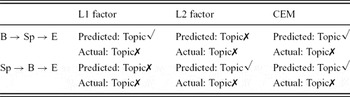
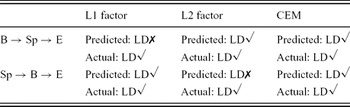
What are the implications of all these findings for the L3 acquisition models whose predictions we outlined in Table 2 above? On the basis of all the data, we can say that Spanish, whether as an L1 or an L2, has a clear negative influence (maybe even a blocking effect) on the trilinguals’ judgments of topicalized structures. This finding would constitute evidence against all three models, since none of them predicts impossible acquisition across the two trilingual groups. Neither the L1 nor the L2 on their own are capable of overcoming the adverse effects of a conflicting value in the L2 or the L1, respectively. We repeat the relevant parts of Table 2 in Table 6 for the reader to appreciate this claim. On the other hand, the CEM makes the right predictions with respect to the LD construction. We repeat the relevant parts of Table 2 in Table 7.
Predictions and actual findings on the L3 acquisition of Topicalization (group results).

B = Basque, Sp = Spanish, E = English, CEM = Cumulative Enhancement Model, √ = successful acquisition, ✗ = unsuccessful acquisition
Predictions and actual findings on the L3 acquisition of LD (group results).

B = Basque, Sp = Spanish, E = English, CEM = Cumulative Enhancement Model, √ = successful acquisition, ✗ = unsuccessful acquisition
We draw the attention of the reader to the fact that in the case of English Topicalization, the learner has to retreat from the use of a clitic (in CLLD), which constitutes a restructuring of the L1 or L2 grammar that necessitates negative evidence. On the other hand, in order to accept English LD, a learner has to map the Basque null pro in their L1 or L2 onto overt English pronouns. The latter is a much simpler process that does not depend on negative evidence, since there is copious positive evidence for overt object pronouns in English. This difference between the two acquisition tasks in the L3 is relevant for explaining the differential findings. Furthermore, as we discussed above, the realities on the ground suggest that the L2 Spanish may be a stronger influence than the L2 Basque, for our trilingual groups. In addition, we believe that we have to be cautious with respect to the LD findings, and that the Topicalization findings are more significant than the LD findings. To emphasize our main point, none of the models currently available in the literature has fully predicted our Topicalization findings.
What do we propose instead? It seems to us that one needs to take into account the relative frequency of the various constructions in the input. Basque word order is quite flexible, as expected for a language with morphologically marked subject and object agreement, although it exhibits a strong head-final preference (Hualde & Ortiz de Urbina, Reference Hualde and Ortiz de Urbina2003). Thus, it is likely that objects dislocated for reasons of topic marking would not be rare (see e.g. example (7b) above). CLLD is much more common in Spanish than Topicalization is in English, as demonstrated in Section 4 (see Slabakova, in press, for more discussion). We believe all three factors listed below conspire to block the successful acquisition of English Topicalization:
-
(i) the dominance of Spanish as a strong L2 (or an L1) of our trilingual learners
-
(ii) the ubiquity of CLLD in Spanish
-
(iii) the necessity of negative evidence for successful acquisition
In this respect, the CEM is too optimistic in its reliance on the grammatical features from the L1 and the L2 being able to conspire for successfully informing L3 acquisition. We propose that cumulative enhancement as well as cumulative inhibition are possible processes in L3 acquisition, depending on the learnability of the construction and the ample positive evidence in the linguistic input. However, we emphasize that successful acquisition is possible for individuals in all three learner groups, as our results in Table 5 demonstrate.
How did the Interface Hypothesis fare in explaining our results? Since Topicalization, LD and FF are constructions at the syntax–discourse interface, the IH predicts that the processing costs of bilingualism may take its toll and even near-native participants might not perform similarly to the native speakers. Residual optionality in both similar and dissimilar constructions could be anticipated due to processing difficulties at the syntax–discourse interface. This, however, was not the case in the second and third language grammars our findings point to. Our bilingual and trilingual learners performed perfectly on the similar construction (FF). On the construction where transfer was misleading, Topicalization, the majority of our participants were not able to overcome native or second language transfer. On the LD construction, where Spanish and English were similar, the L1 or L2 of the English learners seems to have given them significant advantage. Taken together, these results challenge the Interface Hypothesis and suggest that, in L3 acquisition, native and L2 pressures cannot be ignored.
We will be remiss if we do not point out the limitations of our dataset, given that our experiment uses behavioral measures in an offline format. As discussed in Section 2 above, the latest version of the IH (e.g., Sorace Reference Sorace2011) relates the residual comprehension difficulties of near-native speakers to the processing limitations of bilingualism. Thus, such difficulties are more directly testable using online measures. Future research that tests the same structures using processing methodologies is certainly warranted. However, it seems reasonable to expect that, if processing these complex constructions were subject to an intractable bilingualism effect, we would see some evidence of this in offline methodologies as well. This logic is even truer of L3 acquisition, where the bilingualism effects should multiply by definition. The fact that we do not see an increase of problematic judgments in the trilingual groups compared to the bilingual group, at least for the FF and LD, suggests that such effects may be overcome. We expect that the deleterious effect of Spanish CLLD on L3 and L2 English Topicalization will be confirmed by online behavioral measures, and we leave this issue for further research.
An anonymous reviewer suggests that we examine our results in the light of Hulk and Müller's (Reference Hulk and Müller2000) proposal, a precursor of the IH in the sense that it identifies the C-domain as vulnerable in bilingual acquisition from birth. Hulk and Müller propose that cross-linguistic influence in this type of acquisition can occur at the interface between discourse-pragmatics and syntax. In addition, they identify another necessary condition for cross-linguistic influence to obtain:
[This can happen only if] language A has a syntactic construction which may seem to allow more than one syntactic analysis [emphasis ours] and, at the same time, language B contains evidence for one of these two possible analyses. In other words, there has to be a certain overlap of the two systems at the surface level. (Hulk & Müller, Reference Hulk and Müller2000, pp. 228–229)
The construction these authors examine is object-drop, which is analyzed as topic-drop in Germanic but as Topicalization of the overt object (or implied object) in Romance. While topic-drop is a universal discourse strategy, the morpho-syntactic licensing of the empty category in argument position in the case of topicalized object is language-specific. Even though the bilingual child may get limited input supporting the language-specific analysis from French/Italian, the same child will get more input supporting the discourse strategy from German/Dutch and as a result, she will drop objects more than monolingual French/Italian children.
It is possible to extend Hulk and Müller's model of cross-linguistic influence to L3 acquisition for the same reasons we extended the IH predictions: vulnerability of the C-domain. However, we will have to contend with cross-linguistic influence from three languages. In our own data, the two constructions that “may seem to allow two syntactic analyses” are English Topicalization and LD. As we mentioned before, the contexts in which these constructions appear may seem overlapping to learners, as a comparison of examples (1a) and (3a) in Section 1 above illustrates. What is more, the English native speakers rated the LD sentences without a pronoun at the middle of the range, suggesting that these sentences are somewhat acceptable to them. The discourse function of topic marking may seem to the learner to be satisfied by two possible analyses: one with an A-bar dependency between operator and dislocate (Topicalization) and the other with a base-generated hanging topic (LD). If this were indeed the case, then Spanish CLLD in the second or first language of the learners would provide ample and frequent evidence to skew the balance towards the former analysis in the third language. This line of reasoning would predict that our trilingual and bilingual learners should rate very highly both the LD and the Topicalization test items when they have a pronoun in argument position. However, this is not what we found, as a cursory glance at Figures 3 and 4 would ascertain. Learners distinguished acceptable from unacceptable LD sentences reliably, but rated acceptable and unacceptable Topicalizations in the middle of the scale, making no significant distinctions. We have to conclude that Hulk and Müller's model of cross-linguistic influence has not made the right predictions for our data, similarly to the IH model.
Mean ratings of acceptable and unacceptable test sentences: Left Dislocation.

Mean ratings of acceptable and unacceptable test sentences: Topicalization.

Finally, a methodological note is in order. The use of a larger than usual scale (from 1 to 7 with a separate answer “I don't know”) allowed us to see subtler nuances in the participants’ ratings. For example, the native speakers rated the “acceptable” FF sentences with only 4.6 out of 7, indicating that the speakers were sensitive to the marked word order of this construction. In comparison, the native speakers accepted Topicalizations and LDs with a full-point higher ratings, but they did not reject the unacceptable LD sentences with very low ratings. As we discussed earlier, without a pronoun, LDs look superficially like Topicalizations. The contextual support required for the acceptability of these two constructions may overlap. The native speakers, as well as some learners, rated LDs with pronouns very highly, but they also accepted with a mean rating of 3.5 (4 being the middle of the scale) the same sentences without a pronoun. Speakers who rated highly LDs without a pronoun were treating the left-dislocated phrase as an outcome of movement. At the same time, the English native speakers rated unacceptable Topicalizations with a resumptive pronoun with a mean of 2.2, effectively rejecting them categorically. Thus, our scale allowed us to demonstrate that English LDs may sometimes be substituted for Topicalizations, but not the other way around. This differential behavior of all three left dislocations in English provides evidence for a nuanced acceptability that poses a challenge to linguistic theory. We would recommend the use of a seven-point scale with a separate option for “I don't know” in experimental work on subtle context-dependent judgments.
7. Conclusions
The findings of this experimental study have a number of important implications. We set out to test the Interface Hypothesis in L3 acquisition. The prediction was that the more languages an individual commands, the more processing effort she should expend on suppressing the languages not used at the moment, to benefit the language being used. In this sense, trilinguals were expected to be even more vulnerable at the syntax–discourse interface than bilinguals. We did not find that our two trilingual groups behaved any worse than the bilingual group; in fact, the three learner groups’ behavior was quite comparable. We also discovered that native language transfer helps learners enormously at the syntax–discourse interface, a finding that is not at odds with the IH. Furthermore, our finding that Topicalization is highly vulnerable in interlanguage lends support to the IH.
One issue that remains for further research is to compare similar constructions at the syntax–discourse interface that are of dissimilar frequency in the input. We have not been able to assess the effect of construction frequency in the L3 because all English constructions we tested appear to be equally rare and optional. However, we have argued that a frequent construction such as CLLD is very difficult to preempt in a third language, and that both cumulative enhancement and cumulative inhibition can play an important role in third language acquisition.