Introduction
Two findings from neuroimaging studies implicate that multilinguals engage cognitive control mechanisms during language processing. These mechanisms are: language switching during picture naming (i.e., participants change the response language according to a given variable or regular pattern when naming stimulus pictures) involves activation in the dorsolateral prefrontal cortex and supplementary motor area (Hernandez, Dapretto, Mazziotta & Bookheimer, Reference Hernandez, Dapretto, Mazziotta and Bookheimer2001; Hernandez, Martinez & Kohnert, Reference Hernandez, Martinez and Kohnert2000), and language choice (i.e., speakers use a certain language at a certain point in time) relies on a network comprising prefrontal cortex, anterior cingulate gyrus and the basal ganglia (in particular the caudate nucleus) (Abutalebi & Green, Reference Abutalebi and Green2007, Reference Abutalebi and Green2008; Crinion, Turner, Grogan, Hanakawa, Noppeney, Devlin, Aso, Urayama, Fukuyama, Stockton, Usui, Green & Price, Reference Crinion, Turner, Grogan, Hanakawa, Noppeney, Devlin, Aso, Urayama, Fukuyama, Stockton, Usui, Green and Price2006). The cortical–subcortical interplay is suggested to resolve lexical competition through inhibitory control (Abutalebi & Green, Reference Abutalebi and Green2007). Furthermore, the brain areas found active have also been reported in tasks taxing other psychological domains requiring control. This suggests that language control should not be conceptualized as part of the language system proper (e.g., Costa, Reference Costa2005) but rather as being the result of generic executive control processes (as is Green's (Reference Green1998) theoretical position; see also Abutalebi & Green, Reference Abutalebi and Green2008).
Failure of cognitive control in multilingual language production can be revealed by errors of cross-language interference (CLI; Green, Reference Green1986), considered as accidental, involuntary deviation from the currently intended/spoken language, whereas borrowing and codeswitching are assumed to show the intentional, more or less conscious use of the currently unselected language (Grosjean, Reference Grosjean1982). Multilingual language processing is prone to CLI due to parallel activation of at least two languages (for a review, see Kroll, Bobb & Wodniecka, Reference Kroll, Bobb and Wodniecka2006). In a recent study by Colomé and Miozzo (Reference Colomé and Miozzo2010), parallel extensive activation including the phonology of the unused language was demonstrated for highly proficient Spanish–Catalan bilinguals even when no lexical material from the non-target language was presented (picture–picture interference paradigm). Evidence for CLI has been provided for verbal production as well as for reading and listening (Christoffels, De Groot & Kroll, Reference Christoffels, De Groot and Kroll2006; Colomé, Reference Colomé2001; Guo & Peng, Reference Guo and Peng2006; Hermans, Bongaerts, De Bot & Schreuder, Reference Hermans, Bongaerts, Bot and Schreuder1998; Marian, Spivey & Hirsch, Reference Marian, Spivey and Hirsch2003; Rodriguez-Fornells, van der Lugt, Rotte, Britti, Heinze & Münte, Reference Rodriguez-Fornells, van der Lugt, Rotte, Britti, Heinze and Münte2005; Smits, Sandra, Martensen & Dijkstra, Reference Smits, Sandra, Martensen and Dijkstra2009; Spivey & Marian, Reference Spivey and Marian1999; Van Heuven, Dijkstra & Grainger, Reference Van Heuven, Dijkstra and Grainger1998). However, some studies claim that parallel activation of two languages does not always lead to interference between languages (Costa, Miozzo & Caramazza, Reference Costa, Miozzo and Caramazza1999; Gollan & Acenas, Reference Gollan and Acenas2004).
At the word-level, CLI occurs when lemmas from both languages compete for selection; a lemma from the non-target language (often a translation equivalent) is more highly activated and finally produced instead of the target lemma (Festman, Rodriguez-Fornells & Münte, Reference Festman, Rodriguez-Fornells, Münte, Van Daele, Kuiken, Pierrard and Vedder2007). One could assume that language control failed to monitor the activation level of the non-target lemma, allowing it to exceed that of the target lemma (a failure of inhibitory control, Green, Reference Green1998; Meuter & Allport, Reference Meuter and Allport1999) and to let it pass through to phonological assembly, where again it is not inhibited. Its production could not be prevented in time apparently due to insufficient or impaired control mechanisms. Imaging as well as behavioral data suggest that the need to prevent interference from a competing language requires additional executive control processes (Meuter, Reference Meuter and Pavlenko2009; Rodriguez-Fornells et al., Reference Rodriguez-Fornells, van der Lugt, Rotte, Britti, Heinze and Münte2005).
Little is known about factors which modulate a speaker's susceptibility to produce or prevent CLI. In the present study, we will present three alternative accounts.
(i) We have suggested that speakers may differ in their susceptibility to CLI because of individual differences in executive control functions which go hand in hand with language control. In particular, we demonstrated a strong link between language control abilities and a number of executive functions in a group of late balanced bilinguals (Russian, L1; German, L2; Festman, Rodriguez-Fornells & Münte, Reference Festman, Rodriguez-Fornells and Münte2010). Several executive functions were tested, including inhibition of irrelevant information, problem solving, planning efficiency, generative fluency and self-monitoring. Those bilinguals (termed switchers) producing a higher number of CLI errors in a bilingual picture naming task performed worse on all executive function tests compared to a group producing less errors in the naming task (non-switchers).
If non-switchers have indeed a generally reduced susceptibility to CLI compared to switchers, this characteristic should be replicable in other bilingual language production tasks, and not be a certain linguistic effect in one production task (e.g., the bilingual picture naming test). In the present paper, we report in detail about the language production abilities of the same group of late balanced bilinguals (Russian L1 and German L2) as that in Festman et al. (Reference Festman, Rodriguez-Fornells and Münte2010), the latter being a study in which we focused on the cognitive control abilities of the same subjects. In the additional bilingual language production tasks, each task required speakers to use only the pre-defined or cued target language, such that any use of the current non-target language could be identified as CLI error. If switchers have weaker language control abilities, they should produce more CLI errors in both languages on both tasks in this study.
(ii) LANGUAGE PROFICIENCY was found to determine the directionality of CLI errors: the stronger language caused more errors of interference with the weaker language, often resulting in delayed speech production (Otomo, Reference Otomo1991). When UNBALANCED trilinguals (L1 German, L2 English, L3 French, reflecting order of acquisition and of decreasing proficiency) performed on a trilingual picture naming task, Festman (Reference Festman2009) found that the condition of frequent switching between three languages caused CLI effects relative to the strength of the interfering language: L2-interference errors were observed in L1 production (strongest language). The weakest language (L3) was not strong enough for L3 interference errors to be produced aloud during target language production in L1. When L3 was required as target language both other stronger non-target languages (L1/L2) caused CLI effects. Balanced bilinguals, in contrast, were found to experience CLI effects bidirectionally (see e.g., Isurin, Reference Isurin2000; Kiran & Roberts, Reference Kiran and Roberts2010). In this study, we measured language proficiency in two additional language tasks, an interview and a verbal fluency task. If language proficiency is the main group difference that explains the degree of CLI in language production tasks, non-switchers should demonstrate much higher language proficiency on both tasks than switchers.
(iii) An alternative account that may explain the behavioral differences of the two groups is the notion of LANGUAGE MODE proposed by Grosjean (Reference Grosjean1982). It is defined as the state of activation of the bilingual's languages and language processing mechanisms at a given point in time. By and large depending on the communication partner, Grosjean (Reference Grosjean1982, Reference Grosjean and Nicol2001) distinguished between the bilingual's language behavior when speaking to a monolingual (MONOLINGUAL MODE) and when speaking to a bilingual (BILINGUAL MODE). In the monolingual speech mode, the bilingual deactivates one language (but never totally) whereas in the bilingual mode, the bilingual speaker chooses a base language, activates the other language and produces codeswitches and borrowings. Grosjean related CLI to the monolingual mode and defined them as those deviations from the language being spoken due to the involuntary influence of the other deactivated language. He further suggested that the language modes are strongly influenced by a number of factors such as the person(s) being spoken or listened to (in particular language mixing habits and attitudes, usual mode of interaction, etc.), the situation, the form and content of the message, the function of the language act and specific research factors. He reported that some bilinguals feel comfortable mixing languages, but others do not, and that they differ among themselves as to the extent they change between language modes; some rarely find themselves in the bilingual mode (e.g., those who seldom codeswitch, sometimes on principle, or who do not hear mixed language very much) whereas others rarely leave this mode (e.g., bilinguals who live in communities where mixed language is the norm).
The observed difference in CLI could rely on a different use of language modes influenced by attitudes and language environment and result in different group-specific language use patterns and switch habits. In this paper we will assess possible group differences with regard to language modes by exploring language use patterns, language environment, attitudes to languages, to switching, as well as switching habits, suggesting that they might shape cognitive control development and in particular the speakers’ attention to cognitive control during their language production. If language mode distinguishes both groups, then switchers should more often be in the bilingual mode while non-switchers should strongly prefer and use only the monolingual mode. To investigate this hypothesis, a detailed questionnaire was used to gather complex information on the participants’ language modes.
Methods
Participants
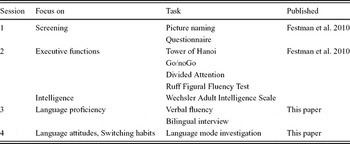
We screened 49 Russian–German participants, but 20 were either not sufficiently proficient in both languages or older and not used to computer-based presentation to perform well enough on the picture naming task. The remaining 29 subjects constituted two participant groups: switchers (n = 13, 11 women) and non-switchers (n = 16, 10 women) defined by their picture naming performance, namely the number of CLI errors. Participants gave their informed consent prior to participating in every session of the study and were paid for their participation (see Table 1 for an overview of the study).
Overview of sessions and tasks constituting our longitudinal design.

As regards speakers’ general background variables, both groups did not differ significantly (see Festman et al., Reference Festman, Rodriguez-Fornells and Münte2010, Table 2): switchers were on average 26 years old, had started to learn German as their L2 when they were 13 years old, currently used on average three languages and had lived in Germany for about 8 years. Non-switchers were 23 years old, had lived in Germany for about 10 years, were about 10 years old when starting to learn German (L2) and used on average three languages.
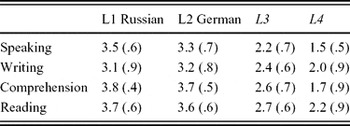
Self-ratings of language proficiency.

Notes: Ratings for all languages learned by our participants are presented as means and standard deviations (in brackets). L3 was for most participants English (n = 17), for some Spanish (n = 2), French (n = 1), Ukrainian (n = 1), Bulgarian (n = 1), Uzbek (n = 1) or Sign Language (n = 1). Five participants did not report speaking an L3. L4 was for most participants French (n = 5), English (n = 3), Spanish (n = 3), Polish (n = 1) or Tajik (n = 1). Sixteen participants did not have an L4. Ratings for the active language production skills reflect the typically slightly lower ratings than for passive language skills (comprehension and reading).
Note also that the rating scores for L1 and L2 were presented separately for switchers and non-switchers in Festman et al.'s (Reference Festman, Rodriguez-Fornells and Münte2010) Table 1, and yielded between-group differences for reading and writing German with better scores for non-switchers. However, these differences were considered less relevant, since the language tasks were limited to spoken verbal production only.
Participants rated their four language skills for each acquired language separately on a four-point scale (How well do you speak/write/understand/read RUSSIAN? 1 = not very well; 2 = average level; 3 = quite well; 4 = perfect knowledge; see Table 2 for self-rated language proficiency for up to four languages). Most participants had acquired 3–4 languages. Importantly all participants in both groups rated their proficiency in Russian and German higher than for any later acquired additional language (L3, L4). Within each group, higher ratings were found for comprehension and reading than for speaking and writing both for both languages. The proficiency ratings for each language skill in Russian and German according to the group distinctions revealed no significant differences for speaking and comprehension in both languages and for reading and writing in Russian, but a slight advantage for the non-switchers in reading and writing German (relevant statistics can be found in Festman et al., Reference Festman, Rodriguez-Fornells and Münte2010).
Grouping of participants: Bilingual picture naming task
The picture naming task as well as the procedure to create the two participant groups, switchers and non-switchers, have been described in detail elsewhere (Festman et al., Reference Festman, Rodriguez-Fornells and Münte2010). Briefly, in the first session (lasting about an hour, see Table 1 above) each participant was tested individually in one 30-minute experimental session (picture naming task) and filled in a questionnaire (30 minutes) on general background variables and language proficiency ratings, adapted from Festman (Reference Festman2009). For the experiment, 240 common objects (e.g., a dog, a sun) had to be named in a predefined, regularly changing language, Russian or German, requiring object identification and bare noun production in the target language.
The test assessed lexical accessibility in the target language, composed of the ability to (a) retrieve the target word defined by language norms on the correct level of specificity and in the correct language, and (b) inhibit CLI, which we used as a measure of language control abilities.
The grouping of our two participant groups was based on the difference in the number of CLI. We used a single-linkage procedure (cluster analysis) to cluster the participants’ information regarding their switch habits. The two groups were non-switchers who produced very few CLI errors (less than five), whereas switchers made more than ten CLI errors in the picture naming task. This result was in line with our theoretical assumption that those who have difficulties in controlling language choice should have more CLI errors than those with little language control problems.
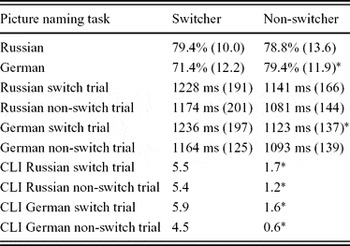
As regards accuracy of responses, both groups performed equally well on Russian, but switchers scored worse on German trials (see Table 3). Response latencies in non-switch trials indicate balanced language proficiency across languages and groups. On switch trials, both participant groups were typically slower than on non-switch trials (see Meuter, Reference Meuter and Pavlenko2009), and on German switch trials, non-switchers were significantly faster than switchers (see Table 3). Switching costs in each participant group indicate rather equal costs in Russian (switchers about 50 ms, non-switchers about 60 ms), but higher switch costs for switchers in German (70 ms) than for non-switchers (30 ms). In both languages and on both trial types, switchers produced significantly more errors of CLI than non-switchers.
Picture naming task.

Notes: For both groups, non-switchers and switchers, means and standard deviations (in brackets) are presented for correct responses per language, response latencies according to trial types and the average number of CLI errors per language and per trial type. Significant differences between groups are indicated by an asterisk, * = p < .05.
One might argue that switchers have a lower language proficiency in German than non-switchers (lower accuracy, longer reaction time latencies on switch trials). However, on non-switch trials, which are usually a much better indication of proficiency, reaction time latencies were not significantly different. We conducted two language tasks in order to further investigate the groups’ language proficiencies on different language tasks, and also because the design of high frequency language switching is rather artificial. The first language task was therefore used to assess retrieval and language control abilities in the bilingual mental lexicon using a typical verbal fluency task with single word retrieval, but longer production time in one language.
Language Task 1: Verbal fluency
In a verbal fluency test, a speaker is typically asked to name as many words as possible in a given time period (e.g., one minute) belonging to a certain taxonomic category (semantic fluency) or starting with a particular letter (lexical fluency; Lezak, Howieson & Loring, Reference Lezak, Howieson and Loring2004). Both subtests require searching the mental lexicon but differ in their specificity and search strategy (Aschenbrenner, Tucha & Lange, Reference Aschenbrenner, Tucha and Lange2000).
Fluency measures have been used as an index of proficiency in bilinguals (e.g., Bialystok, Craik & Luk, Reference Bialystok, Craik and Luk2008; Luo, Luk & Bialystok, Reference Luo, Luk and Bialystok2010; Roberts & Le Dorze, Reference Roberts and Dorze1997). Response production is subject to predefined rules, such as avoidance of repetition of responses, proper names, numbers, and dialect or slang words. In the bilingual version here, words belonging to the non-target language (i.e., CLI) had to be avoided as well.
Procedure
Following a longitudinal design, in a third session, participants were tested individually in a silent laboratory room (second session = cognitive control tasks, first session = screening and picture naming task, see Table 1). The two language tasks were administered in a single session lasting about 45 minutes, about eight weeks after the second session. After written consent, half the participants started with Language Task 1, the others with Language Task 2, and this division was not confounded with group membership. Participants were asked to name as many words within a minute that belong to a certain category (food, clothing, animals, plants & flowers) or start with a certain letter (s, h, p and r). For each language, two categories and two letters were used as stimuli, and languages were alternated after every test. Half of the participants started in German, the other in Russian. Instructions were provided by a native German and a native Russian experimenter in the target language. Participants were tested overall for eight minutes.
Responses were recorded, transcribed and analyzed by a native speaker of each language, and subsequently verified by two independent judges. The following responses were classified as errors (due to rule violation): CLI, repetition of the same word, fragment, lexical invention, proper name, not a category member/does not start with target letter, word starting with same root, slang. The two subtests were analyzed separately according to the target language.
To determine whether the specific behavioral group differences observed so far hold under more natural conditions, we conducted a second language task, requiring complete sentence production five minutes per language before changing the response language.
Language Task 2: Bilingual interview
In order to examine more specifically the participants’ language control abilities during spontaneous speech (sentence production), we designed a bilingual interview schedule (this schedule is made available as supplementary material accompanying the online version of this paper at journals.cambridge.org/BIL). We provided exactly the same verbal input for every participant by using predefined topics (three per language) and a number of related questions (about eight per topic). Since we attempted to assess language control abilities, we set up the experiment by engaging the same two native speakers (as in the verbal fluency task) to act as interviewers, who were told to use only their native language when asking the questions. Each interviewer had five minutes to elicit spontaneous verbal speech from the interviewee. After introducing the topic, the interviewers were instructed to use the related questions in order to keep the interviewee talking about the same topic for five minutes. Interviewers alternated during the interview task after every topic. Since the participant had to respond according to the language used by the interviewer, they changed the response language every five minutes. This means that interviewees were required to use both languages in different sections of the interview, but only one was the current target language at a time. Due to these clearly defined language time frames, any use of the current non-target language was considered a CLI.
Generally speaking, in this guided interview, preverbal messages had to be formulated and verbalized, and verbal output had to be coherent, adequate to the relevant topic and appropriate in style and register. Syntactic structures and articulation had to be unique to the target language and produced fluently. Topics were life in Germany, work/education, family (background, migration, children), experiences in other countries (Russia, etc.), leisure time (hobbies, TV), and the term home country. Half the participants started with German, the other half with Russian. The interview lasted for 30 minutes and was recorded.
Data analysis
The interviews were transcribed, checked by two native speakers of each language and analyzed for CLI (data from three five-minute sections per language were collapsed). For an indicator of language proficiency we used the Aachener Aphasie Test (AAT; Huber, Poeck, Weniger & Willmes, Reference Huber, Poeck, Weniger and Willmes1983), which offers a qualitative assessment of spontaneous speech. This test was developed for neuropsychological assessment. On a five-point scale the following subcategories had to be evaluated: (a) communicative behavior, (b) automated language, (c) phonemic structure, (d) syntax, (e) semantic structure, and (f) articulation. Ratings were checked by two additional independent raters. Since we had four judges in total, we used the average measure intraclass correlation (applying a Spearman-Brown correction) to determine the reliability of all the judges averaged together. This intraclass correlation coefficient is .957.
Language Task 3: Language mode
In order to obtain a more detailed picture of our speakers and thus the two groups, we invited them for a fourth session (see Table 1). Following written consent, participants were asked to fill in three parts of a paper-and-pencil questionnaire, which elicited details of their (i) language environment and attitudes towards the two languages, (ii) current language use, and (iii) personal switching habits and switching per se. This part of the study took place in a silent laboratory room in individual sessions and lasted about 50 minutes. The experimenter was present at all times in case of questions for clarification.
In the last section of the questionnaire, we attempted to determine speakers’ switching habits, hypothesizing that language switching (including both intentional codeswitch and unintentional CLI) might be more acceptable for switchers than for non-switchers or employed more frequently by the switcher than by the non-switcher group. We speculated that such differences could trigger attention to language control mechanism, e.g., by consciously avoiding CLI if possible. This might result in a stronger development and application of cognitive control in everyday language use and be reflected in the behavioral data.
Results
Language Task 1: Verbal fluency
Correct language production
Both groups produced a similar number of correct responses for category as well as letter stimuli in both languages (see Table 4 in Festman et al., Reference Festman, Rodriguez-Fornells and Münte2010) indicating equal fluency for their two languages. No significant difference between switchers and non-switchers or between German and Russian was found for any of the eight subtests.
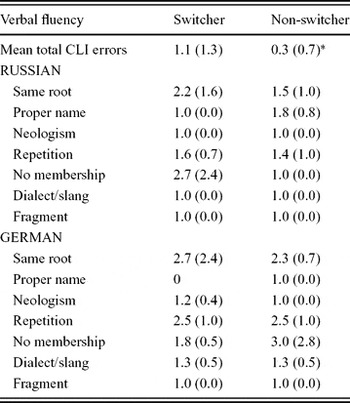
Language Task 1: Verbal fluency.

Notes: Error categories collapsed for both subtests (category and letter naming) are reported per language and per group as means and standard deviations (in brackets). Significant differences between groups are indicated by an asterisk, * = p < .05.
Error production
In this paper, we want to focus on the error production of both groups (see Table 4 above). They produced very few errors in this task, thus were following the rules very cautiously. The largest error categories among the total of 261 errors in both languages were same root (e.g., Haut, Hautzelle, Hautkrebs, German for “skin”, “skin cell”, “skin cancer”) (n = 96, German n = 51 and Russian n = 45, respectively), and repetition (n = 57). We would suggest that these error categories rely mainly on working memory demands of the task and are not subject to the language production abilities per se. In all other error categories only few errors were observed: membership error (n = 27), neologism (n = 22), dialect/slang (n = 16), proper names (n = 12), and fragments (n = 10).
Although CLI was infrequent (overall n = 21; n = 13 in German and n = 8 in Russian), the number produced on this task revealed the only significant difference between switchers and non-switchers (see Festman et al., Reference Festman, Rodriguez-Fornells and Münte2010, and Table 4 above). The error categories indicate that both groups did not differ with regard to error production in both languages other than on rates of CLI.
Language Task 2: Bilingual interview
Errors of CLI
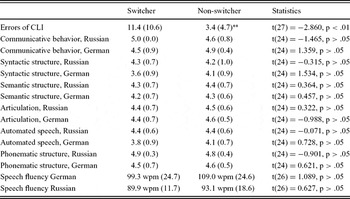
Overall, switchers produced significantly more errors of CLI in both languages than non-switchers (see Table 5). Group differences were significant for both languages, with a tendency of both groups producing more CLI in the Russian parts of the interview (see Festman et al., Reference Festman, Rodriguez-Fornells and Münte2010, and Table 3 above).
Language Task 2: Bilingual interview.
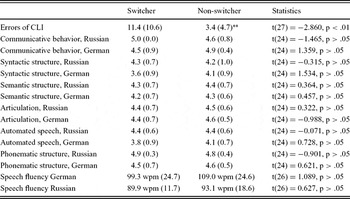
Notes: CLI (reported as means and standard deviations (in brackets)) and Aachener Aphasia Test (AAT) scores are reported per subtest and language on a five-point-scale (1 = strong impairment and 5 = no impairment at all). Speech fluency is indicated in words per minute (wpm) and standard deviations (in brackets). Significant differences between groups are indicated by a double asterisk, ** = p < .01.
Evaluation of spontaneous speech
The speech production characteristics of both groups were very similar (see Table 5 for a detailed listing of evaluation criteria per language and per group). Speech fluency analysis indicated that non-switchers produced on average more words than switchers in both languages, but the differences were not significant.
Language Task 3: Language modes
The results of the different questionnaire parts assessing language modes will be presented according to subsections of the questionnaire. Statistical analyses did not reveal any significant differences.
Part I: Language environment and language attitudes
Language speaking environment
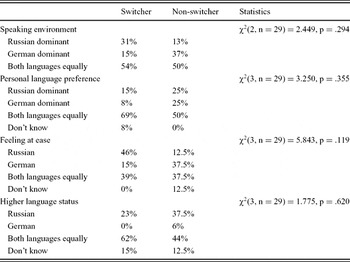
Within each group, half of the participants described their language environment as being distributed equally between German and Russian. Moreover, some switchers reported on a more Russian-dominant environment, some non-switchers on a more German-dominant environment (see Table 6).
Language Task 3: Language environment and language attitudes.

Notes: Language-related group-specific information is provided for four aspects: speaking environment, language preference, feeling well in one or both languages to an equal extent, and a higher status attributed to one or both languages equally. Responses are provided in terms of frequency of response per response option (in percent). Response distributions in any of the four aspects did not differ by group, as measured by a chi-square test. For the first question, participants had three options: 1 = Russian speaking, 2 = both languages to the same extent, 3 = German speaking; for the other three questions: 1 = German, 2 = Russian, 3 = both languages equally, 4 = don't know.
Preference for language
The majority of participants in each group indicated an equal preference for both languages.
Feeling at ease
Most switchers reported feeling more at ease in Russian or in both languages. For non-switchers it was German or both languages.
Higher language status
While most participants in both groups indicated an equal language status for both languages, some non-switchers also attributed a higher language status to Russian.
Part II: Language use
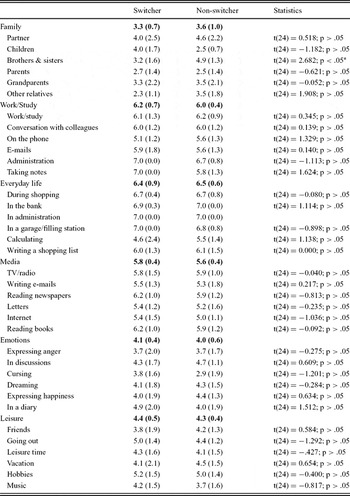
In the questionnaire, we presented six sections: family, work/study, everyday life, media, emotional expression, and leisure time. We used t-tests to determine whether the two groups differed on any of the six sections indicating group-specific language use patterns. Table 7 shows that none of the sections yielded such effects (only the item “language use with brothers and sisters” showed a significant difference). For describing the results of the questionnaire more clearly per section, we will use the frequency and range of responses per group and per section.
Language use patterns.

Notes: Means and standard deviations (in brackets) are presented for each group on every item and the overall category (in bold). Participants had seven response options: 1 = Russian only, 2 = mainly Russian/much German, 3 = more Russian/some German, 4 = both languages equally, 5 = more German/much Russian, 6 = mainly German/some Russian, and 7 = German only.). Significant differences between groups are indicated by an asterisk, * = p < .05.
Family
When asking about language use with partners, children, siblings, parents, grandparents and other relatives, the overall picture we obtained was that both groups mainly used both languages.
Work/study
Language use of both groups for work, study, conversation with colleagues and students, on the phone and in e-mails, for mail and when dealing with administration as well as when taking notes was predominantly in German but ranged from Russian only to German only (for e-mails and note-taking).
Everyday life
During shopping, in the bank, in administration in general, and in a garage or filling station, both groups used German only. When writing a shopping list or when calculating, both groups involved some Russian as well.
Media
In the media domain, language use of both groups involved Russian but was still slightly dominated by German for watching TV and listening to the radio, writing e-mails and letters, reading newspapers and using the Internet. Stronger use of Russian was reported for reading books by some informants.
Emotions
For the expression of emotions, our groups used both languages most of the time when dreaming, in discussions, and for expressing happiness. Some speakers of the switcher group would rely more only on Russian for expressing anger or writing their diary, while some non-switchers would use more Russian for cursing.
Leisure time
In their leisure time, most participants reported that they used both languages equally in their communication with their friends, when going out, in leisure time, on vacation, for hobbies and when listening to music.
Part III: Language switching habits
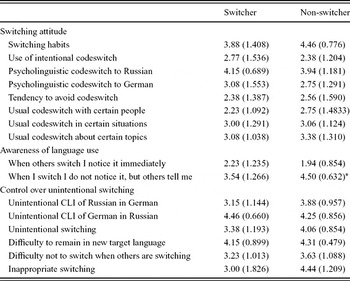
The questionnaire data concerning the language switching habits are summarized in Table 8.
Personal language switching habits.

Notes: On a five-point rating scale participants indicated how frequently they found the presented statements true for them: 1 = always, 2 = frequently, 3 = sometimes, 4 = seldom, 5 = never. Means and standard deviation (in brackets) are presented for each group, and significant differences are indicated by an asterisk, * = p < .05.
Attitude towards switching in general
Both groups indicated that they were not bothered by other speakers switching between languages all the time in a conversation.
Switching habits
Both groups stated an equally occasional tendency to codeswitch in a conversation, including situations in which a word in the target language is currently not known, and the other language is immediately used instead (psycholinguistic codeswitch). Our groups did not differ in their tendency to consciously avoid codeswitches and informed us that they usually codeswitch with certain people, in certain situations, and when talking about certain topics.
In sum, both groups did not differ in their switching habits, but were equal producers of codeswitches for different purposes and in different occasions.
Switch awareness of self and others
Both groups reported that they notice immediately (always or at least frequently) when another person switches during a conversation. While our groups did not differ with respect to switch awareness of others, we found a significant difference in their awareness regarding their own switch behavior. Non-switchers stated that they (rarely or never) failed to notice that they switched languages, whereas switchers seem to be less aware of their own language switches (t(27) = 2.664, p < .05).
Control over unintentional switching
Both groups did not differ with regard to their frequency of unintentional CLI in either language nor in their general frequency of unintentional switching. Both groups also reported rare difficulty to remain in a new target language following a language switch, and occasional difficulty not to switch when others are switching. However, in a situation when a communicative partner was not familiar with German or Russian, our groups differed in that switchers would switch to the language unknown to the communicative partner more often than non-switchers who reported on doing so only occasionally (t(27) = 2.542, p < .05).
Discussion
Language Task 1: Verbal fluency
To summarize, switchers and non-switchers were equally productive in the two languages on both tasks. Previous research on verbal fluency in unbalanced bilinguals (e.g., Sandoval, Gollan, Ferreira & Salmon, Reference Sandoval, Gollan, Ferreira and Salmon2010) showed that CLI in word retrieval leads to fewer words produced in a bilinguals’ non-dominant compared to the dominant language (no CLI). Our data suggest a similar proficiency level for both languages and both groups, comparable to the behavioral results in Grogan, Green, Ali, Crinion and Price (Reference Grogan, Green, Ali, Crinion and Price2009). Interestingly, the groups did not differ in their abilities to follow the rules of the experiment as reflected by the similar error distribution. In spite of these similarities, the ability to control the non-target language differentiates switchers from non-switchers, as indicated by the significantly higher number of CLI errors produced by switchers.
Inspection of the response patterns suggests further similarities between the groups. Both groups used a subcategory or semantic cluster strategy, evident in the data when for the category food, for example, different types of fruits, vegetables and beverages were generated in subsequent responses. Similarly, in the letter task both groups used phonetic similarity (same initial consonant–vowel syllable, e.g., German hoch – homogen “high” – “homogenous”), same initial consonant–consonant cluster (e.g., German Stuhl – Stift “chair” – “pen”), or minimal pairs (e.g., German Hase – Hose “hare” – “trousers”) to organize retrieval. There was no indication of a group-related difference in CLI from habitual semantic search strategies (Luo et al., Reference Luo, Luk and Bialystok2010).
Language Task 2: Bilingual interview
Language Task 2 corroborates the participant assignment to the two groups in that non-switchers produced fewer errors of CLI in both languages during the interview. As the scores from the AAT show, more errors of CLI in the switcher group were not accompanied by an overall worse level of language proficiency.
As a result of our careful examination of the speakers’ language proficiencies in both languages, we are certain that we can exclude language proficiency as the determining difference between our two bilingual groups. In a next step, we investigated possible language mode differences hypothesizing that language performance reported in this study and the effect on cognitive control could maybe be explained in terms of the contrast between non-switchers’ tendency to use and prefer only one language (monolingual mode) and switchers’ tendency to use and prefer both (bilingual mode).
Language Task 3: Language modes
Language environment and language attitudes
In sum, the information on language environment and language attitudes shows no differences between both groups. Roughly speaking, the majority in each group lives in a bilingual environment, the majority does not favor one language over the other, does not exclude any of the languages for their personal feeling at ease and reports more frequently on equal language status for both languages.
Since these data did not reveal a more monolingual orientation of non-switchers and a bilingual orientation of switchers in terms of attitudes and speech environment, we further investigated the speakers’ language use patterns in order to determine whether performance differences relied on the fact that non-switchers always used only one language, but switchers usually both.
Language use
We observed from this second part of the questionnaire that there were no group-specific language use patterns in any of the investigated domains. We conclude that language mode is not an explanation for group-specific language control differences, since non-switchers were not more frequently in a monolingual mode than switchers, switchers were not mainly in a bilingual mode, and reported as well on use of only one language. We conclude that we could not find any evidence for the language mode-distinction related to the groups’ language use patterns. What could be observed in both groups, however, is the more domain-specific language use pattern: German-dominant sections were work/study and everyday life outside their home, whereas family communication, media, emotional expression and leisure time were handled in both languages.
Language switching habits
We observed only few differences in switching habits: Both groups did not reveal the hypothesized difference in language switching being more acceptable to switchers than to non-switchers. Thus, it is not likely that attention to language control mechanisms had been triggered differently in the two groups. Members of both qroups reported avoiding codeswitches to a similar degree. Additionally, while both groups did not differ with regard to awareness of switching by other speakers, they differed in respect to self-awareness of switching. Group differences could be observed in terms of the ability to consider the communication partner's language knowledge. Non-switchers took into account when a speaker is not able to understand a certain language, and the consequence of that is that they would not use that language. Switchers, however, would sometimes make use of that language unknown to the communication partner although they are aware of the fact that this language will not be understood. Based on our observations and findings so far, it becomes clear that such behavior is by no means intentional, but rather unintentional, since it stems from language control difficulties.
To sum up, with the help of a three-part questionnaire, we gathered very informative data on language environment and attitudes towards the languages, on language use, on personal switching habits and switching between languages in order to determine whether the key to the behavioral differences observed with regard to language control and cognitive control might be found in a difference with respect to language modes. We conclude that both groups showed very few differences in switching in general: non-switchers showed more self-awareness regarding switching as well as a better consideration of and adaptation to the communication partner's language knowledge.
General discussion
Non-switchers have stronger language control abilities than switchers
In this paper we assessed and described language control abilities, language proficiencies, and language modes in two languages, Russian and German, in two groups of late bilinguals (switchers and non-switchers). The two groups had been previously established according to differences in CLI error rates in a bilingual picture naming task with regular language switches. By clearly defining the response language on every trial, errors of CLI could be identified in contrast to intentional codeswitches or borrowings. In general, the picture naming task showed that switchers were more susceptible than non-switchers to producing errors of CLI on both trial types, switch and non-switch trials, and in both languages.
We have replicated this behavioral pattern in both experimental tasks requiring (a) production of single words, such as members of a specific category, or words starting with a specific letter (Language Task 1), and (b) free narration about a specific topic (Language Task 2). We conclude that the group-specific language behavior was not limited to one particular task but persisted and could be observed in single word as well as sentence production. The frequency of required language switching altered the frequency of occurrence of CLI, but CLI could be observed even in a stretch of five-minute continuous production in one language.
Failure to switch or inadvertent switch?
We consider two types of language control problems: (i) a failure to switch on command to a new target language, and (ii) a failure to keep the target language unchanged for as long as required. The first case shows that the speaker is currently unable to change the response language according to language control demands. In the second case, involuntary switches to the non-target language are the outcome of the speaker's current inability to remain in the required target language. Instead s/he switches unintentionally to the non-target language and demonstrates a weakness in avoiding unintended switches. We suggest that results from Language Task 1 and 2 provide evidence for difficulties with language control of the second type, since in both tasks speakers had to remain in the same target language for four-to-five minutes, but switched unintentionally during this time period.
In sum, we conclude that the main difference between our two bilingual groups with regard to language control abilities was not the failure to switch in rather unnatural switch trials in an experimental setting (which motivated our choice of paradigms for the language tasks used here), but to remain in the target language when no language alternation was required. To disregard the influence of the non-target language seems to be the most difficult task for switchers. One should not overlook that the performance of both groups is not comparable to two ends of a continuum of very good and very bad performance. Rather based on the error rates in the initial picture naming task, both groups were separated on a fine line between 0 and 6 and more than 10 errors of CLI. This adjacency makes the observed group differences, despite the small sample size, even more striking.
Language proficiency was measured in a number of ways including self-ratings, performance measures for the language tasks, Aachener Aphasia Test criteria and speech rate in the interview, productivity and fluency in the verbal fluency task. None of these measures revealed any consistent proficiency differences between groups. Language mode was broadly described (attitudes, switch habits, language use patterns, etc.) but could not reveal any group differences either.
CLI errors occurred in both languages, i.e., both languages caused CLI effects to a similar degree (a higher CLI error rate was, however, observed in the bilingual interview task for Russian, see Festman et al., Reference Festman, Rodriguez-Fornells and Münte2010). This bidirectionality of CLI production provides evidence for the balanced level of proficiency in both groups. We suggest that the performance patterns regarding CLI are an indicator of how the participants control their language production rather than an indicator of their language abilities or habits and attitudes per se.
Performance differences probably reflect differences in executive functions
On the basis of the assumption that CLI reflects failure of control, we suggest that the most likely factor to explain the performance of both groups is a difference in executive functions. In a previous paper we demonstrated differences between both groups on measures which involved cognitive control in a variety of executive tasks (Tower of Hanoi, Divided Attention, Ruff Figural Fluency Test, Go/noGo). Because of their better control abilities, non-switchers are able to reduce response conflict (between stimuli or tasks) and facilitate response selection and response execution, e.g., on Go trials. Non-switchers also showed better abilities to inhibit motor responses to irrelevant information (as indicated by false alarms in Go/noGo) and to monitor their performance in all tasks. Moreover, our results suggest improved problem-solving skills as well as better planning efficiency in non-switchers.
We speculate that inhibition is the fundamental mechanism from among the executive functions that comes to play in our data set. Non-switchers do not seem to prevent the occurrence of CLI during lexical retrieval per se, since they also experience CLI. But non-switchers might be more efficient in dealing with CLI than switchers, because of superior conflict resolution (e.g., better discrimination between relevant and irrelevant information) and better monitoring abilities (as observed in the executive function tasks). The present data are in line with the Inhibitory Control model (Green, Reference Green1998), which holds that lemmas are tagged for language, and that these tags are either inhibited or activated by language task schemas, which are thought to control language actions (e.g., the task requirement in the picture naming task: name the picture in Russian and not in German). Lemmas are selected according to their task appropriateness and the language tag. The Supervisory Attentional System activates the relevant language task schema and inhibits all lemmas with inappropriate language tags. Our suggestion would imply that switchers and non-switchers differ in their operationalization of inhibitory control. We could show already in our previous paper that this group-difference in executive functions also extended to the verbal tasks of a commonly used intelligence test (Wechsler Adult Intelligence Scale, WAIS). The better abilities of non-switchers to inhibit irrelevant and conflicting information facilitated and speeded up response retrieval of the most appropriate responses on the Information subtest (part of the WAIS) and helped to establish the most fitting mental connection between two verbal stimulus items faster than for switchers (Similarity subtest, part of the WAIS). Inhibition helps non-switchers to more structured, efficient and controlled information processing, and as a consequence of that to enhanced attention to task requirements and control over behavior which are reflected in a generally more correct and fluent performance.
Speculations about the source of differences in executive brain functions
To explain performance differences between bilingual children and their monolingual peers in non-language tasks, training effects for bilinguals have been proposed to involve inhibitory control mechanisms (Bialystok, Reference Bialystok2005). Kovács (Reference Kovács, Kecskes and Albertazzi2007) suggested that the bilingual advantage is specifically due to training in selecting and inhibiting competing responses for language output. Bialystok (Reference Bialystok2005) claimed that inhibitory control is constantly involved in early bilinguals’ acquisition process of both languages. Bialystok further proposed a transfer of the training of inhibition in language processing to that in other cognitive domains. The maturational account holds well for studies reporting on advantages of bilingual children compared to monolingual peers in tasks which require the inhibition of irrelevant information (Bialystok, Reference Bialystok1999).
Because our participants were late bilinguals, an early boosting of inhibitory control (as has been suggested by Bialystok for early bilinguals) cannot be assumed. As both groups reported using both languages regularly after their migration to Germany, the question arises if a late boosting of executive functions by L2 acquisition is possible. Two other groups of L2 immersed learners (Linck, Hoshino & Kroll, Reference Linck, Hoshino and Kroll2008) did not show a general improvement of inhibitory abilities (measured with the Simon task), however.
Alternatively, it may also be the case that the differential susceptibility to CLI of non-switchers and switchers is due to preexisting (innate) differences in executive functions. In fact, recent studies have demonstrated a considerable contribution of genetic factors to interindividual variations in executive functions (e.g. Cirulli, Kasperavičiūtė, Attix, Need, Ge, Gibson & Goldstein, Reference Cirulli, Kasperavičiūtė, Attix, Need, Ge, Gibson and Goldstein2010). Future studies have to address the direction of the interdependency between executive functions and bilingual language performance.
Conclusion
We attempted to show that the difficulties the switcher group had with controlling the target language, in particular with remaining in the target language, cannot be explained by differences in language proficiency or language mode. It seems more likely that group-specific language control abilities are probably related to executive functions, in particular to inhibition.