Introduction
Studies across the lifespan of bilingual populations have outlined monolingual-bilingual differences across realms of processing, both linguistic (e.g., Kaushanskaya, Gross & Buac, Reference Kaushanskaya, Gross and Buac2014; Kaushanskaya & Marian, Reference Kaushanskaya and Marian2009a, Reference Kaushanskaya and Marian2009b) and nonlinguistic (e.g., Bialystok, Craik, Klein & Viswanathan, Reference Bialystok, Craik, Klein and Viswanathan2004; Blumenfeld & Marian, Reference Blumenfeld and Marian2014; Poulin-Dubois, Blaye, Coutya & Bialystok, Reference Poulin-Dubois, Blaye, Coutya and Bialystok2011; Yoshida, Tran, Benitez & Kuwabara, Reference Yoshida, Tran, Benitez and Kuwabara2011). However, determining bilingual status has been complicated by varying interpretations of what it means to be bilingual (e.g., Hakuta & Garcia, Reference Hakuta and Garcia1989). Language dominance, a commonly-used measure of bilingual status, has been defined as the relative proficiency across languages in comprehension and usage (e.g., Gathercole & Thomas, Reference Gathercole and Thomas2009). Though not always the case, the primary or native language is frequently considered the dominant language. Yet for some bilinguals, the second language may be the dominant language (e.g., Miller & Kroll, Reference Miller and Kroll2002). Bilinguals’ language dominance may also switch over time (e.g., Jia & Aaronson, Reference Jia and Aaronson1999).
In addition to defining language dominance, how the bilingual experience is quantified has varied across studies, including the use of categorical versus continuous variables (Luk & Bialystok, Reference Luk and Bialystok2013). Thus, the nuances that make up the bilingual experience are not always reflected in research, and further investigations of language dominance may offer novel perspectives of bilingual differences. Here, we investigate the extent to which various definitions of language dominance are predictive of linguistic and cognitive processing.
Measuring language dominance
Approaches to categorizing participants according to language dominance have widely varied across studies. For example, in early childhood populations, one of the most common measures of bilingual status is parent-report of language exposure (e.g., Bedore, Peña, Griffin & Hixon, Reference Bedore, Peña, Griffin and Hixon2016; Bialystok & Feng, Reference Bialystok and Feng2009; Carlson & Meltzoff, Reference Carlson and Meltzoff2008; Fenson, Dale, Reznick, Thal, Bates, Hartung, Pethick & Reilly, Reference Fenson, Dale, Reznick, Thal, Bates, Hartung, Pethick and Reilly1993; Poulin-Dubois et al., Reference Poulin-Dubois, Blaye, Coutya and Bialystok2011). Research in adult populations also relies on self-report as a tool to establish language proficiency. Questionnaires such as the Language Experience and Proficiency Questionnaire (LEAP-Q, Marian, Blumenfeld & Kaushanskaya, Reference Marian, Blumenfeld and Kaushanskaya2007) and the Language History Questionnaire (LHQ, Li, Sepanski & Zhao, Reference Li, Sepanski and Zhao2006; LHQ 2.0, Li, Zhang, Tsai & Puls, Reference Li, Zhang, Tsai and Puls2014) have been employed to determine bilinguals’ relative proficiency across languages (e.g., Blumenfeld & Marian, Reference Blumenfeld and Marian2014; Grant & Dennis, Reference Grant and Dennis2017; Jończyk, Boutonnet, Musiał, Hoemann & Thierry, Reference Jończyk, Boutonnet, Musiał, Hoemann and Thierry2016; Mercier, Pivneva & Titone, Reference Mercier, Pivneva and Titone2014; Titone, Libben, Mercier, Whitford & Pivneva, Reference Titone, Libben, Mercier, Whitford and Pivneva2011). In fact, adult studies frequently rely exclusively on self-reports to determine dominance (e.g., Amengual, Reference Amengual2016; Gollan, Fennema-Notestine, Montoya & Jernigan, Reference Gollan, Fennema-Notestine, Montoya and Jernigan2007; Lemhöfer, Dijkstra & Michel, Reference Lemhöfer, Dijkstra and Michel2004; Paap & Greenberg, Reference Paap and Greenberg2013).
Another common method for quantifying bilingual status has been the use of objective measures. Objective performance correlates of self-reported dominance have been identified in adult studies (translation speed: Bilingual Dominance Scale, Dunn & Tree, Reference Dunn and Tree2009; naming: MINT, Gollan, Weissberger, Runnqvist, Montoya & Cera, Reference Gollan, Weissberger, Runnqvist, Montoya and Cera2012; various measures: LEAP-Q, Marian et al., Reference Marian, Blumenfeld and Kaushanskaya2007; grammar: Yudes, Macizo & Bajo, Reference Yudes, Macizo and Bajo2010). On the other hand, in child populations, reliance on objective measures to determine dominance has been more common, including language sample analysis (e.g., Paradis, Crago, Genesee & Rice, Reference Paradis, Crago, Genesee and Rice2003), mean length of utterance (e.g., Yip & Matthews, Reference Yip and Matthews2006), vocabulary knowledge (e.g., Cromdal, Reference Cromdal1999), grammar (e.g., Lemmon & Goggin, Reference Lemmon and Goggin1989), and picture naming (e.g., Mägiste, Reference Mägiste1992), to name a few. Typically, as with questionnaire data, research using objective measures to determine language dominance has designated the language with a higher score as the dominant language (e.g., Bahrick, Hall, Goggin, Bahrick & Berger, Reference Bahrick, Hall, Goggin, Bahrick and Berger1994; Bedore, Peña, Summers, Boerger, Resendiz, Greene, Bohman & Gillam, Reference Bedore, Peña, Summers, Boerger, Resendiz, Greene, Bohman and Gillam2012).
While studies have primarily focused on delineating definitions of language dominance, a relatively novel approach of treating bilingualism as a continuous variable has been emerging in recent literature (e.g., De Cat, Gusnanto & Serratrice, Reference De Cat, Gusnanto and Serratrice2018; Dunn & Tree, Reference Dunn and Tree2009; Incera & McLennan, Reference Incera and McLennan2018; Gollan et al., Reference Gollan, Weissberger, Runnqvist, Montoya and Cera2012). In 2009, Dunn and Tree recognized that inconsistencies in determining language dominance negatively impacted comparisons between studies, and therefore sought to develop a practical language dominance scale. They recruited young Spanish–English adults to participate in a questionnaire that focused on language acquisition, use, and shifting due to changes in environment. Using factor analyses, they extracted items from their questionnaire that uniquely captured English and Spanish dominance and used difference scores to determine language dominance as a scaled (continuous) variable. The researchers found a relation between language dominance and translation speed in a separate group of bilinguals.
Moreover, as previously mentioned, many researchers have determined language dominance based on self-reported proficiency, and Dunn and Tree (Reference Dunn and Tree2009) questioned the validity of such measures. This approach was further challenged in 2012 when Gollan et al. investigated the relation between subjective and objective operational definitions of language proficiency (dominance) in young and older bilingual adults. The researchers administered a language history questionnaire for self-reported proficiency and an English vocabulary test, as well as language proficiency interviews and picture naming tasks. They conducted a variety of analyses, including correlations between difference scores (subtracting Spanish from English across measures), contrasts between measures as categorical variables (Spanish-dominant, English-dominant, balanced), and contrasts between measures as continuous variables. The researchers concluded that self-reports were generally good predictors of language dominance indexed by objective definitions, though the relation between subjective and objective definitions of language dominance was not strong enough to solely rely on any single definition in establishing language dominance. These findings were supported by Luk and Bialystok (Reference Luk and Bialystok2013), who investigated the relation between language proficiency and use. They recruited a heterogeneous group of adult bilinguals and administered a language and social background questionnaire, a picture vocabulary task, and an expressive vocabulary task. Using exploratory/confirmatory factor analyses, they found that the bilingual experience was characterized by multiple factors across questionnaire responses and standardized tests. They found strong correlations between self-reported proficiency in English and performance on receptive and expressive language tasks and briefly discussed the value of using a “composite score” to assess bilingual proficiency (also see Bedore et al., Reference Bedore, Peña, Summers, Boerger, Resendiz, Greene, Bohman and Gillam2012). In sum, various language dominance measures have been employed and linked to bilinguals’ linguistic performance, but it remains unclear whether continuous and hybrid measures of dominance can provide additional nuance in indexing bilinguals’ profiles and predicting their cognitive-linguistic performance. Here, we examine multiple measures of language ability, including subjective, objective, and hybrid ones, in defining dominance. Further, we use previously-employed methods to determine difference scores across languages in deriving language dominance measures (e.g., Dunn & Tree, Reference Dunn and Tree2009, Gollan et al., Reference Gollan, Weissberger, Runnqvist, Montoya and Cera2012).
Language dominance and linguistic performance
Language dominance has emerged as a useful predictor of various speech and language skills in bilinguals, including expressive language (Bahrick et al., Reference Bahrick, Hall, Goggin, Bahrick and Berger1994; Dickinson, McCabe, Clark-Chiarelli & Wolf, Reference Dickinson, McCabe, Clark-Chiarelli and Wolf2004), receptive language (Bahrick et al., Reference Bahrick, Hall, Goggin, Bahrick and Berger1994), semantics and morphosyntax (Basnight-Brown & Altarriba, Reference Basnight-Brown and Altarriba2007; Bedore et al., Reference Bedore, Peña, Summers, Boerger, Resendiz, Greene, Bohman and Gillam2012), verbal fluency (e.g., Blumenfeld, Bobb & Marian, Reference Blumenfeld, Bobb and Marian2016) and stuttering (Flege, MacKay & Piske, Reference Flege, MacKay and Piske2002; Lim, Lincoln, Chan & Onslow, Reference Lim, Lincoln, Chan and Onslow2008), as well as voice-onset-timing sensitivity (Bullock, Toribio, González & Dalola, Reference Bullock, Toribio, González and Dalola2006). In addition to examining how language dominance relates to language-specific performance across modalities, researchers have examined how language dominance may relate to cross-linguistically shared knowledge. For example, a well-researched phenomenon, the cognate effect, has been linked to language dominance (e.g., Pérez, Peña & Bedore, Reference Pérez, Peña and Bedore2010; Rosselli, Ardila, Jurado & Salvatierra, Reference Rosselli, Ardila, Jurado and Salvatierra2014). As bilinguals may house overlapping representations for words across their languages (Dijkstra & van Heuven, Reference Dijkstra and van Heuven2002; Kroll & Stewart, Reference Kroll and Stewart1994), cognate words that share similar orthographic or phonological form have been shown to have facilitatory effects in processing (e.g., Gollan et al., Reference Gollan, Fennema-Notestine, Montoya and Jernigan2007; Kelley & Kohnert, Reference Kelley and Kohnert2012; for review see Costa, Santesteban & Caño, Reference Costa, Santesteban and Caño2005). Cognate effects have been found to be robust across bilinguals’ different languages and language profiles (e.g., de Groot & Keijzer, Reference de Groot and Keijzer2000; Costa, Caramazza & Sebastián-Gallés, Reference Costa, Caramazza and Sebastián-Gallés2000; Dijkstra, van Hell & Brenders, Reference Dijkstra, van Hell and Brenders2015; Gollan et al., Reference Gollan, Fennema-Notestine, Montoya and Jernigan2007; Hoshino & Kroll, Reference Hoshino and Kroll2008; Lemhöfer et al., Reference Lemhöfer, Dijkstra and Michel2004; Rosselli et al., Reference Rosselli, Ardila, Jurado and Salvatierra2014).
Pérez et al. (Reference Pérez, Peña and Bedore2010) aimed to investigate whether there was a relation between cognate facilitation and language proficiency during naming. Results indicated that Spanish–English balanced bilinguals had similar cognate facilitation effects in both languages, while unbalanced bilinguals presented with greater cognate facilitation in their less dominant language. Similarly, Rosselli et al. (Reference Rosselli, Ardila, Jurado and Salvatierra2014) found a link between language dominance (indexed by vocabulary knowledge) and cognate effects, with smaller cognate facilitation in the dominant language. Thus, we explore which language dominance measures predict cognate facilitation and whether similar patterns emerge across dominance profiles.
Language dominance and cognitive control
Beyond predicting linguistic performance, it is also possible that language dominance profiles may predict aspects of cognitive processing in bilinguals. One of the most researched areas of executive function in bilingual populations has been inhibitory control. Bilinguals have at times been shown to outperform their monolingual counterparts in specific inhibition tasks (e.g., Bialystok et al., Reference Bialystok, Craik, Klein and Viswanathan2004; Blumenfeld & Marian, Reference Blumenfeld and Marian2014; Hernández, Costa, Fuentes, Vivas & Sebastián-Gallés, Reference Hernández, Costa, Fuentes, Vivas and Sebastián-Gallés2010; Martin-Rhee & Bialystok, Reference Martin-Rhee and Bialystok2008; but see, for example, Paap & Greenberg, Reference Paap and Greenberg2013). Where bilingual-monolingual differences in inhibitory control have been found, researchers have reasoned that, since bilinguals must juggle two language systems, they require some mechanism to manage the activation/suppression of the target/non-target language. Accordingly, models have posited involvement of executive function skills in language processing (Dijkstra, van Heuven & Grainger, Reference Dijkstra, van Heuven and Grainger1998; Green, Reference Green1986, Reference Green1998), and it is implicit in such accounts that the relative strength of bilinguals’ two languages influences the extent to which such cognitive control processes are engaged.
Recent studies have suggested that cognitive control mechanisms engaged for bilingual processing may be domain-general because of links between linguistic processes and nonlinguistic inhibitory control tasks (e.g., de Bruin, Roelofs, Dijkstra & FitzPatrick, Reference de Bruin, Roelofs, Dijkstra and FitzPatrick2014; Liu, Rossi, Zhou & Chen, Reference Liu, Rossi, Zhou and Chen2014; Hervais-Adelman, Moser-Mercer & Golestani, Reference Hervais-Adelman, Moser-Mercer and Golestani2011). Accordingly, neural correlates of linguistic and nonlinguistic inhibitory control have been found to overlap (e.g., Weissberger, Gollan, Bondi, Clark & Wierenga, Reference Weissberger, Gollan, Bondi, Clark and Wierenga2015). Though there are relatively few studies that have examined the specific relation between nonlinguistic inhibitory control and language dominance, links have been found in children (Prior, Goldwasser, Ravet-Hirsh & Schwartz, Reference Prior, Goldwasser, Ravet-Hirsh, Schwartz and Schwieter2016; Thomas-Sunesson, Hakuta & Bialystok, Reference Thomas-Sunesson, Hakuta and Bialystok2018) and older adults (Goral, Campanelli & Spiro, Reference Goral, Campanelli and Spiro2015). In child populations, balanced bilinguals demonstrate better nonlinguistic inhibition skills than their unbalanced peers (dominance defined by expressive/receptive vocabulary, Prior et al., Reference Prior, Goldwasser, Ravet-Hirsh, Schwartz and Schwieter2016; dominance defined by receptive vocabulary, Thomas-Sunesson et al., Reference Thomas-Sunesson, Hakuta and Bialystok2018). However, in older adults, unbalanced bilinguals fare better on nonlinguistic executive function tasks than balanced bilinguals (dominance defined by self-reported proficiency, Goral et al., Reference Goral, Campanelli and Spiro2015). Other adult studies report null findings (e.g., dominance defined by receptive/expressive language skills, Rosselli, Ardila, Lalwani & Vélez-Uribe, Reference Rosselli, Ardila, Lalwani and Vélez-Uribe2016; dominance defined by self-reported proficiency, Yow & Li, Reference Yow and Li2015), and further investigation is required to clarify which measures of language dominance predict nonlinguistic inhibition and to document variation across the lifespan. Here we aim to investigate the relation between nonlinguistic inhibitory control and language dominance in young adult bilinguals.
Current study
We examined the relation between language dominance as a continuous and categorical variable and linguistic and nonlinguistic ability. Previous studies have not directly examined how different operational definitions of dominance predict interaction of bilinguals’ languages, or how dominance predicts performance on nonlinguistic inhibitory control tasks. Based on previous studies, we indexed language dominance by multiple measures: self-reported proficiency, current exposure, receptive language, expressive language, and a hybrid index. We then investigated how these definitions of language dominance varied in predicting dominance profiles, and whether language dominance as a continuous or categorical variable would predict cognate effects (indexing lexical knowledge across languages) and nonlinguistic Stroop effects (indexing inhibitory control skills).
Here, we chose to employ a nonlinguistic spatial Stroop task to index inhibitory control, given previous literature revealing a link between nonlinguistic Stroop performance and bilingual processing (Blumenfeld & Marian, Reference Blumenfeld and Marian2013; Giezen, Blumenfeld, Shook, Marian & Emmorey, Reference Giezen, Blumenfeld, Shook, Marian and Emmorey2015; Mercier et al., Reference Mercier, Pivneva and Titone2014). We will refer to the inhibitory control effect (incongruent minus congruent trials) on our nonverbal spatial Stroop task as “nonlinguistic Stroop effect”. In the framework of Kornblum's Dimensional Overlap Model (Kornblum, Hasbroucq & Osman, Reference Kornblum, Hasbroucq and Osman1990), Stroop effects are considered to be a class of effects indexing inhibitory control where two dimensions of the same stimulus interfere with each other. The current spatial nonlinguistic Stroop task shares these characteristics with the well-known classic Stroop effect (i.e., interference of stimulus dimensions on incongruent trials is between ink color and text on the classic Stroop task and between arrow direction and location on the current nonlinguistic Stroop task). Use of a nonlinguistic cognitive control task avoids confounds with automaticity in language processing due to proficiency (e.g., Tzelgov, Henik & Leiser, Reference Tzelgov, Henik and Leiser1990).
The purpose of the present study was threefold. First, we aimed to investigate whether multiple language exposure and proficiency variables differed in how they predicted language dominance in Spanish–English bilinguals. Based on previous findings, we expected that subjective and objective measures would differ in predicting language profiles (Bedore et al., Reference Bedore, Peña, Summers, Boerger, Resendiz, Greene, Bohman and Gillam2012; Luk & Bialystok, Reference Luk and Bialystok2013; Sheng, Lu & Gollan, Reference Sheng, Lu and Gollan2014). Second, we examined whether language dominance measures differed in how they predicted cross-linguistic lexical knowledge, as indexed by cognate effects. We predicted that language dominance as a continuous variable would best capture linguistic ability (Dunn & Tree, Reference Dunn and Tree2009; Luk & Bialystok, Reference Luk and Bialystok2013), and that both subjective and objective measures of dominance would be good predictors of cognate effects (Pérez et al., Reference Pérez, Peña and Bedore2010; Rosselli et al., Reference Rosselli, Ardila, Jurado and Salvatierra2014). Third, we examined whether language dominance measures differed in how they predicted bilingual participants’ inhibitory control skills. We predicted that language dominance as a continuous variable would also relate to cognitive ability (De Cat et al., Reference De Cat, Gusnanto and Serratrice2018; Incera & McLennan, Reference Incera and McLennan2018), but that nonlinguistic inhibitory control performance might not be predicted equally by all dominance measures, given variability in previous findings (Rosselli et al., Reference Rosselli, Ardila, Lalwani and Vélez-Uribe2016; Goral et al., Reference Goral, Campanelli and Spiro2015; Yow & Li, Reference Yow and Li2015).
Method
Participants
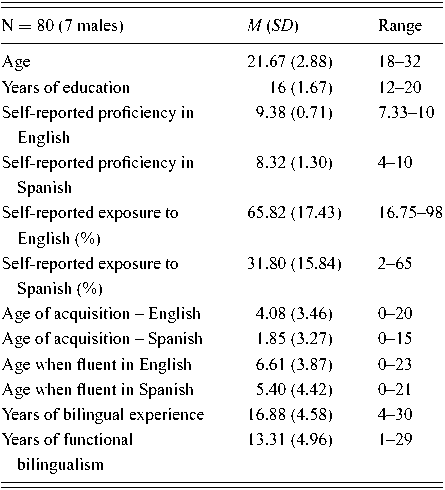
Eighty Spanish–English bilingual young adults were recruited from San Diego State University's undergraduate and graduate student population, provided informed consent, and participated for class credit or monetary compensation. All participants reported normal to corrected-to-normal vision, absence of learning disabilities, and proficiency in both English and Spanish. Formal testing revealed normal hearing across participants (ASHA, 1996). See Table 1 for participants’ current ages, years of education, self-reported proficiencies and exposures, ages of language acquisition and fluency, as well as bilingual experience, and functional bilingualism. Participation for this study was contingent upon proficiency in, exposure to, and knowledge of only the targeted languages (Spanish–English), excluding those who reported scores less than four across the 10-point proficiency scales of the Language Experience and Proficiency Questionnaire (LEAP-Q, Marian et al., Reference Marian, Blumenfeld and Kaushanskaya2007), or who reported multilingual skills (i.e., more than three languages with scores of four or higher across the 10-point LEAP-Q scales). A wide range of self-reported proficiencies (i.e., 4–10 on the LEAP-Q) in each language was allowed for the current study to achieve variability in language dominance profiles.
Language Experience and Proficiency Questionnaire Group Data.

Materials and procedures
Language Experience and Proficiency Questionnaire (LEAP-Q)
The LEAP-Q (Marian et al., Reference Marian, Blumenfeld and Kaushanskaya2007) is a questionnaire used in multilingual adult populations to measure relative exposure and proficiency across languages. We administered the LEAP-Q to gather demographic information, as well as self-reported proficiency and exposure ratings in both English and Spanish.
Peabody Picture Vocabulary Test-Third Edition (PPVT-III) and Test de Vocabulario en Imágenes Peabody (TVIP)
The PPVT-III (Dunn & Dunn, Reference Dunn and Dunn1997) and TVIP (Dunn, Lugo, Padilla & Dunn, Reference Dunn and Dunn1997) are equivalent picture identification tasks designed to measure English and Spanish receptive vocabulary, respectively. Participants were read a stimulus word and were instructed to choose one of four pictures that best represented each word. The PPVT-III consists of 17 sets, with each set containing 12 trials, for a total of 204 trials. In accordance with administration rules of the test, participants started the PPVT-III at set 13. A basal was established when participants correctly identified ten items in a set. Participants continued until set 17 or until they missed eight or more items within a completed set. Only data sets 13 to 16 of the PPVT-III were analyzed, as these sets were consistently administered to each participant. The TVIP consists of 125 trials. Participants started at the first item and continued until they missed six within eight consecutive items.
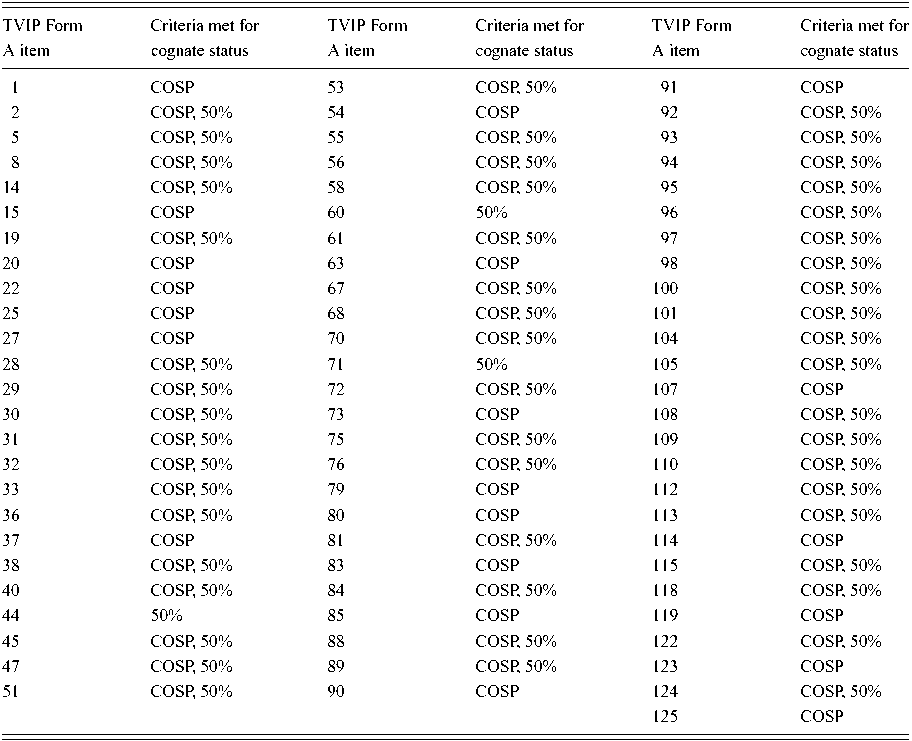
Words on the PPVT-III and TVIP were divided into cognate and noncognate items by objective and subjective criteria (Potapova, Blumenfeld & Pruitt-Lord, Reference Potapova, Blumenfeld and Pruitt-Lord2015)Footnote 1. The Crosslinguistic Overlap Scale for Phonology (COSP) was used as an objective measure of cognate identification (Kohnert, Windsor & Miller, Reference Kohnert, Windsor and Miller2004; Potapova et al., Reference Potapova, Blumenfeld and Pruitt-Lord2015). English words and their Spanish translations were compared on initial sounds, number of syllables, overlap in consonants, and overlap in vowels. Consistent with Kelley and Kohnert (Reference Kelley and Kohnert2012), words on the PPVT-III and TVIP with COSP ratings ≥6 were considered objective cognates. In contrast, the subjective measure of cognate status followed a 50% translation criterion by monolingual speakers (Friel & Kennison, Reference Friel and Kennison2001; Potapova et al., Reference Potapova, Blumenfeld and Pruitt-Lord2015), where English monolinguals completed a translation task to guess the meaning of Spanish translation equivalents. Words that were successfully translated back into English by 50% of the participants were considered subjective cognates. Potapova et al.’s (Reference Potapova, Blumenfeld and Pruitt-Lord2015) PPVT-III groupings were used for the current study. To create similar subjective cognate/noncognate groupings for the TVIP, we divided the 125 items of the TVIP into two sets, balanced for the increasing level of word difficulty, and English monolingual undergraduate students were asked to guess the English translation of each Spanish word. The students were additionally given a brief questionnaire adapted from the LEAP-Q to determine languages spoken and proficiencies. Of the 65 students who participated, 22 were identified as effectively monolingual English speakers (MAge = 21.57, SD = 3.65; one participant did not report her age) as indexed by self-reported proficiency scores averaged across speaking, understanding, and reading on a 10-point Likert scale (MEnglish = 9.86, SD = 0.37; MSpanish = 0.84, SD = 1.03). Words on the TVIP were catalogued as cognates if 50% of participants successfully translated the Spanish target either to its exact match, root match (e.g., “lubricant” for lubricate from Spanish lubricar), or a synonym (e.g., “disillusioned” for disappointed from Spanish desilusiόn) in English (see Table 2).
TVIP Items Identified as Cognates by COSP and Translation.

Note: COSP = Crosslinguistic Overlap Scale for Phonology (Kohnert et al., Reference Kohnert, Windsor and Miller2004), 50% = 50% translation criterion. TVIP = Test de Vocabulario en Imágenes Peabody.
Woodcock-Johnson Tests of Cognitive Abilities III-Picture Vocabulary subtest (WJ III) and Batería III Woodcock-Muñoz-Vocabulario Sobre Dibujos subtest (Batería III)
The WJ III Picture Vocabulary subtest (Woodcock, McGrew & Mather, Reference Woodcock, McGrew and Mather2001) and the corresponding Batería III Vocabulario Sobre Dibujos subtest (Muñoz-Sandoval, Woodcock, McGrew & Mather, Reference Muñoz-Sandoval, Woodcock, McGrew and Mather2005) are picture naming tasks with 23 trials designed to measure English and Spanish expressive vocabulary, respectively. Participants were shown a picture and were asked to name it. The full subtest was administered to each participant.
Nonlinguistic spatial Stroop task
The nonlinguistic spatial Stroop task (e.g., Blumenfeld & Marian, Reference Blumenfeld and Marian2011, Reference Blumenfeld and Marian2014; Giezen et al., Reference Giezen, Blumenfeld, Shook, Marian and Emmorey2015) is a test of inhibitory control. Participants were instructed to click buttons corresponding to the direction in which arrows pointed on a screen in 210 trials. The arrows varied in direction (left or right facing) and location (left, middle, or right of screen). Congruent trials were characterized by matched arrow direction and arrow location (e.g., a right-facing arrow appeared on the right side of the screen) and incongruent trials were characterized by a mismatch between arrow direction and arrow location (e.g., a right-facing arrow appeared on the left side of the screen). Arrows that appeared in the center of the screen, regardless of direction, were considered neutral. The task was split into two blocks, each containing 105 trials. All participants completed both blocks.
Data coding and analyses
Language dominance
Language dominance was established using five different operational definitions. Two subjective definitions of language dominance were established using ratings of (1) self-reported proficiency and (2) self-reported current exposure to each language. Two objective definitions were established using scores from (3) receptive language and (4) expressive language tasks. Finally, a hybrid definition was established as (5) an averaged composite score of all subjective and objective measures. All measures, except for the receptive language definition, were included as predictors of cognate effects; all five measures were included as predictors of inhibitory control (see footnote 1). For the first four definitions of language dominance, English and Spanish responses and scores were transformed into proportions (e.g., items correct divided by total items), and a difference score was calculated by subtracting the Spanish from the English proportions. For example, one participant reported an average of nine (across speaking, understanding, and reading) out of ten, or .9, in English proficiency and an average of eight out of ten, or .8, in Spanish. This participant's language dominance score was therefore .1. Positive dominance scores indexed English language dominance, negative scores indexed Spanish language dominance, and 0 indicated balanced dominance. For the fifth definition, the difference scores from the subjective and objective definitions were averaged to index language dominance.
Logistic regressions were used to investigate whether differences existed in how the five language measures determined dominance classifications. Each of the five measures was converted into a categorical variable (English-dominant, Spanish-dominant). Language dominance scores >0 were converted to a 1, indexing English dominance, and scores <0 were converted to 0, indexing Spanish dominance. Balanced dominance was not included in these analyses to maintain a binomial distribution in line with logistic regressions (Maxwell & Delaney, Reference Maxwell and Delaney2004): eight data points from balanced participants were omitted for the receptive language measure, five were omitted for expressive language, and 12 were omitted for self-reported proficiency. After running the omnibus model mapping the five measures onto dominance profiles, ten pairwise comparisons of these definitions were further investigated. A Bonferroni adjustment for multiple (10) comparisons was employed (with α corrected to .005).
Cross-linguistic interaction: cognate effects
Cognate effects were calculated based on participants’ PPVT-III and TVIP scores. The percentage correct of noncognate words was subtracted from the percentage correct of cognates. For both the English and Spanish cognate effects, the subjective and objective criteria (50% back translation criteria, COSP criteria) were collapsed within each language due to high correlation (i.e., subjective and objective cognate effects were averaged for each participant in both English and Spanish). This yielded one English and one Spanish cognate effect score for each participant.
Simple linear regressions were used to investigate whether the language dominance measures predicted the magnitude of cognate effects. Only four of the five language dominance definitions were included as explanatory variables because cognate effects were derived from receptive language tasks. The hybrid definition of language dominance was also adjusted to exclude receptive language (i.e., only scores for self-reported proficiency, self-reported exposure, and expressive language were averaged in creating the hybrid index of language dominance). A Bonferroni adjustment for multiple (4) comparisons was employed (with α corrected to .0125).
Inhibitory control
Nonlinguistic Stroop effects were derived for each participant to index their inhibitory control skills. Bin scoring was used to measure these effects, as this method has been shown to reliably and robustly capture cognitive control (Hughes, Linck, Bowles, Koeth & Bunting, Reference Hughes, Linck, Bowles, Koeth and Bunting2014; Prior, Degani, Awawdy, Yassin & Korem, Reference Prior, Degani, Awawdy, Yassin and Korem2017). Outliers more than three standard deviations from the mean, incorrect trials, and trials with response times less than 200ms were removed, and each participant's average response time on congruent trials was calculated. For each participant, mean congruent response times were then subtracted from responses on each incongruent trial, creating difference scores. Difference scores were assigned to one of ten bins, where the smallest tenth of all data fell into the 1st bin (valued at 1) and the largest tenth fell into the 10th bin (valued at 10). Each incorrect trial was assigned to a bin valued at 20. Bin scores were calculated by summing the bin values for each participant, where smaller values indexed better inhibitory control (see Hughes et al., Reference Hughes, Linck, Bowles, Koeth and Bunting2014 for a description of this method).
To investigate whether language dominance measures predicted inhibitory control skills, the five definitions of language dominance were transformed to absolute values similar to transformations in Dunn and Tree (Reference Dunn and Tree2009) and Prior et al. (Reference Prior, Goldwasser, Ravet-Hirsh, Schwartz and Schwieter2016). In transforming definitions of language dominance to absolute values, 0 indexed balanced bilingualism and positive scores indexed unbalanced bilingualism regardless of language (either English or Spanish dominance). A Bonferroni adjustment for multiple (5) comparisons was employed (with α corrected to .01)
Language dominance as a categorical variable
To examine the effectiveness of using a categorical versus continuous language dominance variable when predicting cognate effects, each of the four dominance measures (excluding receptive language knowledge) was recoded into a categorical variable. For each definition, participants were sorted based on dominance profiles and medially split.Footnote 2 These groupings represented the “more English dominant” and “less English dominant” participants, and a Bonferroni adjustment for multiple (4) comparisons was employed (with α corrected to .0125).
To analyze the relation between dominance categories and nonlinguistic Stroop effects, all five transformed (absolute values) dominance profiles were medially split. These groupings represented participants with the “most balanced dominance” and “most unbalanced dominance” and a Bonferroni adjustment for multiple (5) comparisons was employed (with α corrected to .01).
Results
Comparing definitions of language dominance
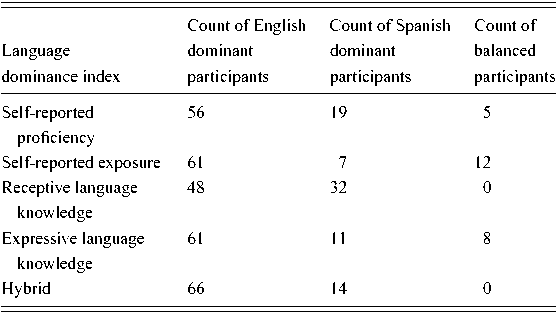
Results of logistic regressions revealed that language dominance definitions varied in the count of English-dominant participants and Spanish-dominant participants they yielded (see Table 3). The hybrid definition of self-reported exposure, proficiency, and objective receptive/expressive vocabulary yielded the most English-dominant classifications (n = 66). Instead, determining dominance by receptive knowledge alone yielded the most Spanish-dominant classifications (n = 32), and grouping participants by self-reported language exposure alone yielded the most balanced classifications (n = 12).
Count of English Dominant and Spanish Dominant Participants by Language Dominance Index.

Note: Hybrid = average of self-reported proficiency, self-reported exposure, receptive language knowledge, and expressive language knowledge.
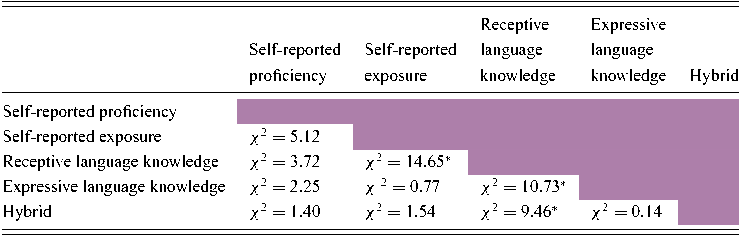
Of the ten pairwise comparisons between language dominance definitions, three showed significant differences in dominance classifications (see Table 4). Dominance classifications based on receptive language knowledge differed significantly from classifications based on self-reported exposure (χ2 = 14.65, p < .001), classifications based on expressive language knowledge (χ2 = 10.73, p = .001), and classifications based on the hybrid index (χ2 = 9.46, p = .002). The difference between dominance classifications based on self-reported proficiency and based on self-reported exposure did not reach the Bonferroni-adjusted significance threshold of α = .005 (χ2 = 5.12, p = .02).
Pairwise Comparisons of Language Dominance Measures in Predicting English and Spanish Dominance.

Note: *Bonferroni-adjusted p < .005. Hybrid = average of self-reported proficiency, self-reported exposure, receptive language knowledge, and expressive language knowledge.
Language dominance and cognate effects
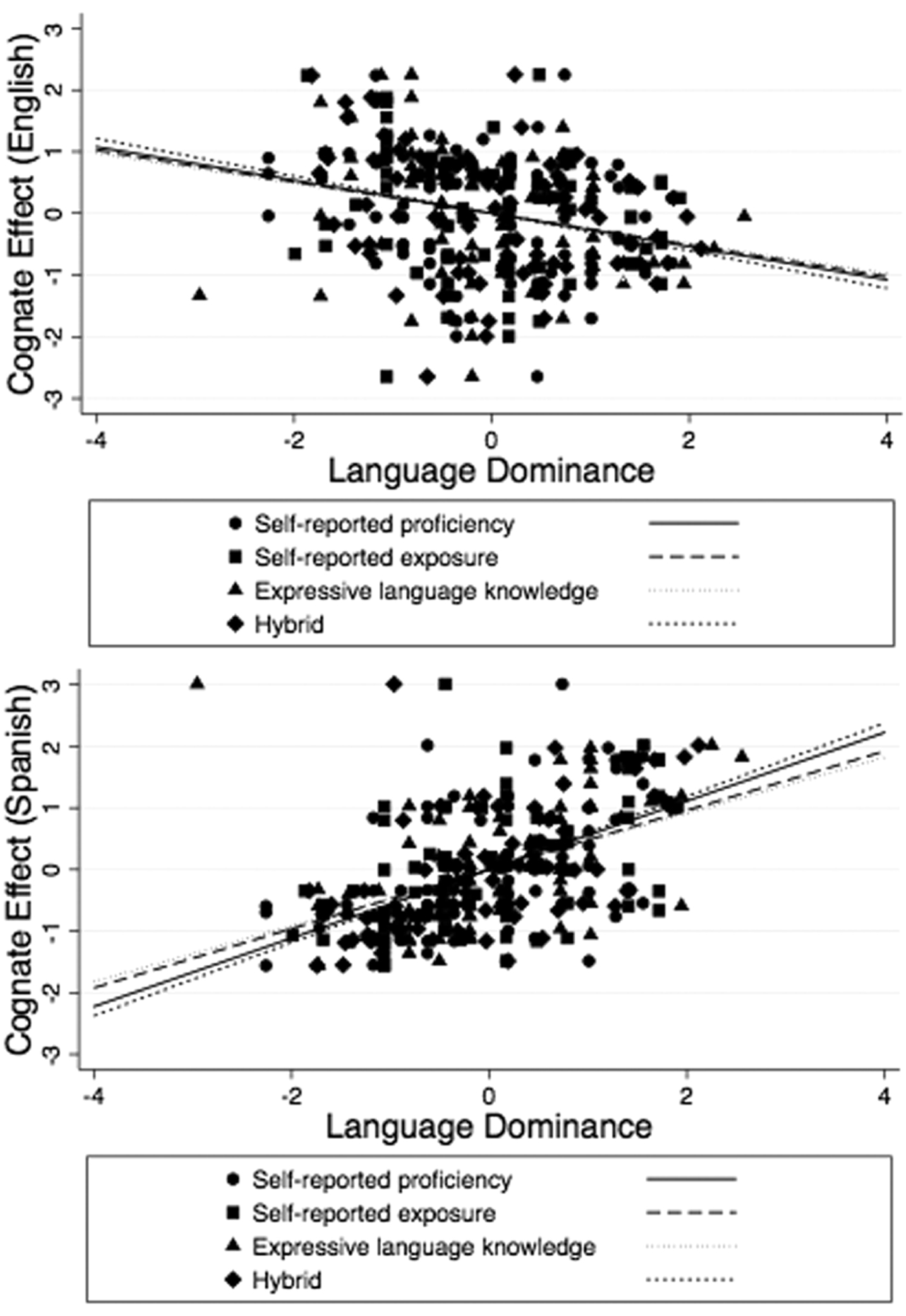
Simple linear regressions revealed that our continuous measures of language dominance varied in significantly predicting the magnitude of cognate effects (see Figure 1). After Bonferroni corrections (α = .0125), the magnitude of cognate effects in both English and Spanish was significantly predicted by language dominance as defined by the hybrid index (English: β = −0.30, t1,78 = −2.81, p = .006; Spanish: β = 0.59, t1,78 = 6.52, p < .001). Instead, after Bonferroni corrections, only cognate effects on the Spanish task were significantly predicted by language dominance defined by self-reported proficiency (English: β = −0.27, t1,78 = −2.47, p = .02; Spanish: β = 0.56, t1,78 = 5.91, p < .001), self-reported exposure (English: β = −0.26, t1,78 = −2.34, p = .02; Spanish: β = 0.48, t1,78 = 4.84, p < .001), and expressive language knowledge (English: β = −0.24, t1,78 = −2.21, p = .03; Spanish: β = 0.45, t1,78 = 4.52, p < .001). As language dominance values increased, indexing more English dominance, cognate effects decreased in English and increased in Spanish. Correspondingly, as language dominance values decreased, indexing less English dominance, English cognate effects increased, and Spanish cognate effects decreased.
Relation between cognate effects and language dominance indices as continuous variables in English (top) and Spanish (bottom). Both cognate effects and dominance scores were converted to z-scores to adjust scales across English and Spanish. More positive values along the x-axis index more English dominance and less positive values index less English dominance.

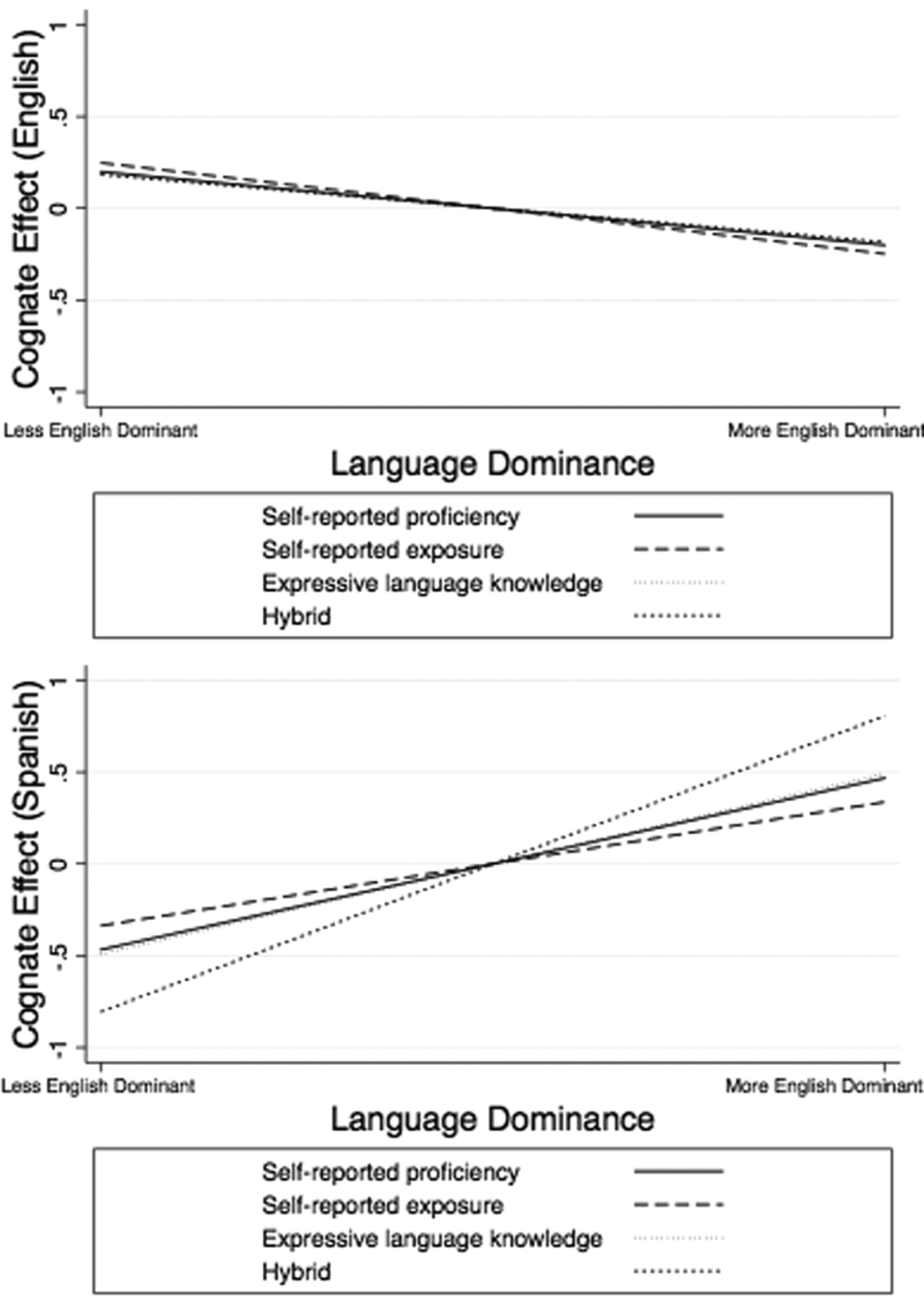
Regressions for categorical language dominance variables were similarly found to vary across languages (see Figure 2). For English, the cognate effect was not significantly predicted by language dominance categories among self-reported proficiency (β = −0.05, t1,78 = −1.82, p = .07), self-reported exposure (β = −0.06, t1,78 = −2.28, p = .03), expressive language knowledge (β = −0.05, t1,78 = −1.73, p = .09), or the hybrid index (β = −0.04, t1,78 = −1.66, p = .10) after Bonferroni corrections (α = .0125). For Spanish, the magnitude of cognate effects, however, was significantly predicted by language dominance as determined by all definitions (self-reported proficiency: β = 0.08, t1,78 = 4.70, p < .001; self-reported exposure: β = 0.06, t1,78 = 3.18, p = .002; expressive language knowledge: β = 0.08, t1,78 = 5.02, p < .001; hybrid: β = 0.14, t1,78 = 12.26, p < .001). For each categorical definition of language dominance, smaller cognate effects on the Spanish task were associated with less English dominance.
Relation between cognate effects and language dominance indices as categorical variables in English (top) and Spanish (bottom). Cognate effects were converted to z-scores to adjust scales across English and Spanish. Participants were medially split into “more English dominant” and “less English dominant” and coded as 1 and 0, respectively.

Language dominance and nonlinguistic Stroop effects
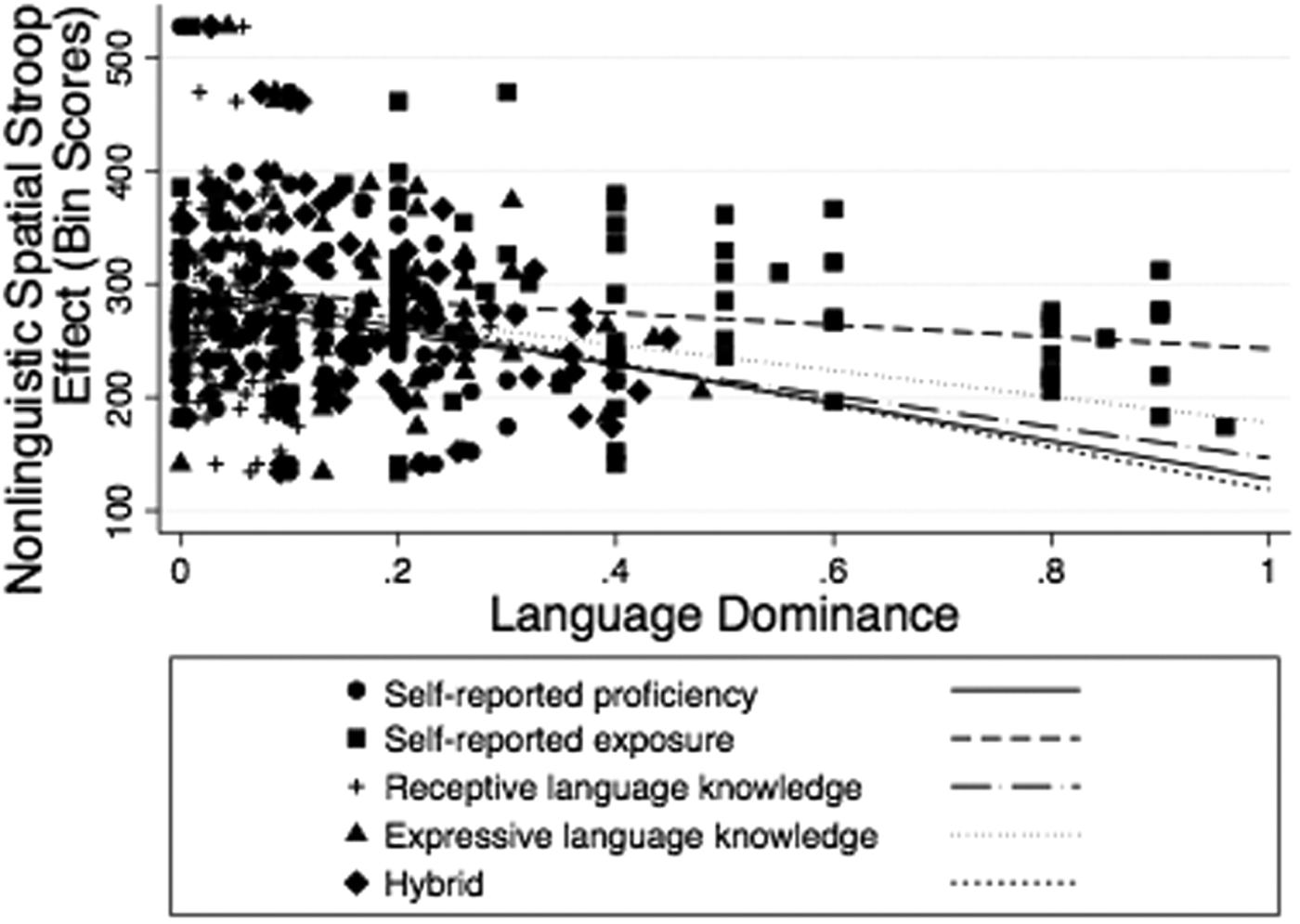
Simple linear regressions of continuous dominance measures revealed that only the hybrid index of language dominance significantly predicted the magnitude of nonlinguistic Stroop effects after Bonferroni corrections (α = .0125, β = −186.88, t1,78 = −2.68, p = .009), while self-reported proficiency (β = −167.15, t1,78 = −1.68, p = .10), self-reported exposure (β = −52.50, t1,78 = −1.81, p = .07), receptive language knowledge (β = −136.73, t1,78 = −0.78, p = .44), and expressive language knowledge (β = −114.41, t1,78 = −1.51, p = .14) by themselves did not significantly predict nonlinguistic Stroop effects (see Figure 3). Specifically, the more unbalanced bilinguals were in their hybrid language profiles, the smaller their nonlinguistic Stroop effects were, suggesting more efficient inhibitory control in more unbalanced bilinguals.
Relation between nonlinguistic spatial Stroop performance, measured by bin scores, and language dominance indices as continuous variables. Language dominance scores were converted into absolute values, indexing a change in language balance, where 0 indexed balanced bilingualism and positive scores indexed unbalanced bilingualism.

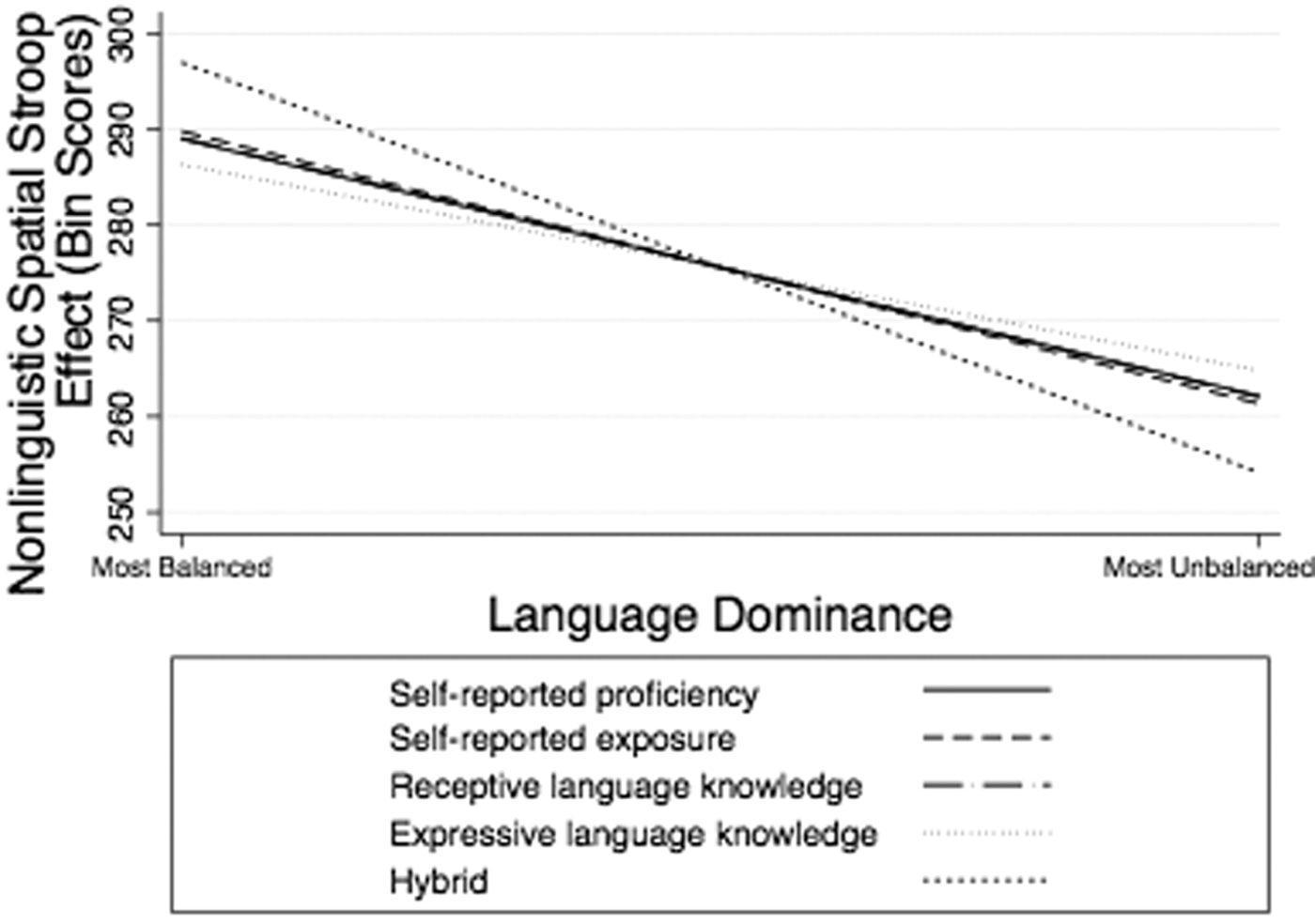
Regressions for categorical dominance definitions similarly revealed that only the hybrid index significantly predicted the magnitude of the nonlinguistic Stroop effect after Bonferroni corrections (α = .0125, β = −42.85, t1,78 = −2.66, p = .009). Self-reported proficiency (β = −26.85, t1,78 = −1.62, p = .11), self-reported exposure (β = −28.45, t1,78 = −1.72, p = .09), receptive language knowledge (β = −27.05, t1,78 = −1.64, p = .11), and expressive language knowledge (β = −21.5, t1,78 = −1.29, p = .2) did not significantly predict nonlinguistic Stroop effects (see Figure 4). Consistent with the continuous hybrid definition of dominance, the categorical hybrid definition revealed that more unbalanced bilinguals showed smaller nonlinguistic Stroop effects.
Relation between nonlinguistic spatial Stroop performance, measured by bin scores, and language dominance indices as categorical variables. Participants were medially split into “most unbalanced” and “most balanced” and coded as 1 and 0, respectively.

Discussion
The purpose of the present study was threefold. First, we aimed to investigate whether multiple language proficiency and exposure variables differed in how they predicted language dominance in Spanish–English bilinguals. Second, we examined whether language dominance measures differed in how they predicted cross-linguistic lexical knowledge, as indexed by cognate effects. Third, we examined whether language dominance measures differed in how they predicted bilingual participants’ inhibitory control skills.
Comparing definitions of language dominance
We found that self-reported proficiency, self-reported exposure, expressive language knowledge, and our hybrid index were the most similar in predicting language dominance, identifying 70% (self-reported proficiency) to 83% (hybrid) of our participants as English-dominant. Instead, receptive language knowledge differed the most from other definitions and was statistically only similar to self-reported proficiency. Notably, based on the receptive language definition, only 60% of our participants were identified as English-dominant, with a substantial percentage of individuals identified as Spanish-dominant (40%). It is unclear why language dominance operationalized by receptive language knowledge only aligns with dominance operationalized by self-reported proficiency. It is possible that bilinguals’ self-judgment of language proficiency is particularly closely related to their understanding of languages. For example, Marian et al. (Reference Marian, Blumenfeld and Kaushanskaya2007) found that receptive language knowledge was significantly correlated with self-reported proficiency in participants’ second language. For many Spanish–English bilingual heritage speakers in the United States, it is the case that Spanish is the primary or only language heard at home for the first few years of development. It is only when the child reaches formal education that English becomes the dominant language in relation to exposure rates and opportunities for receptive/expressive language. However, bilinguals may have awareness of their receptive language skills in the non-dominant, heritage language as it is common for bilinguals to report “I understand more than I can speak.” As such, language dominance measured by self-reported proficiency and receptive language may be metalinguistically similar, as evidenced by our current findings, as well as the findings of Marian et al. (Reference Marian, Blumenfeld and Kaushanskaya2007).
The results of our present study converge with previous findings that operational definitions of language dominance differ in classifying participants (Bedore et al., Reference Bedore, Peña, Summers, Boerger, Resendiz, Greene, Bohman and Gillam2012). Bedore et al. found that their objective measures (morphosyntax, semantics) differed in predicting language dominance profiles in children. Similarly, we found a statistically significant difference after Bonferroni corrections between the two objective measures of language dominance (receptive language knowledge, expressive language knowledge). We additionally found that objective (receptive language knowledge) and subjective (self-reported exposure) measures differ in predicting dominance profiles. Though Sheng et al. (Reference Sheng, Lu and Gollan2014) compared a subjective definition of language dominance (self-reported proficiency) to three objective expressive definitions in adults and found that the subjective definition of dominance did not differ from the objective definitions, we contribute a possible new distinction with the addition of a receptive language measure. There are few studies that have compared definitions of language dominance but, together with Bedore et al., we can suggest caution when comparing bilinguals across studies; as different definitions of language dominance might yield distinct bilingual groupings.
Language dominance and cognate effects
While different operational definitions of linguistic skills were shown to yield somewhat different classifications into English-dominant and Spanish-dominant groupings, it is ultimately of interest to establish which language dominance profiles are most closely associated with linguistic and cognitive behaviors. In doing so, the predictive value of specific language dominance metrics can be identified. Here, we examined how dominance measures would predict cognate effects, a well-documented linguistic phenomenon that has been linked to proficiency.
Language dominance defined by a continuous hybrid definition significantly predicted cognate effects in both English and Spanish. Yet only in the less dominant language (Spanish) were all continuous and categorical variables significant predictors of cognate effects. Specifically, a continuous pattern of increased cognate effects was revealed as proficiency in the target language decreased relative to the non-target language. These findings are consistent with studies that have looked at the relation between language dominance as a categorical variable and cognate effects (e.g., Costa et al., Reference Costa, Caramazza and Sebastián-Gallés2000; Gollan et al., Reference Gollan, Fennema-Notestine, Montoya and Jernigan2007; Pérez et al., Reference Pérez, Peña and Bedore2010; Rosselli et al., Reference Rosselli, Ardila, Jurado and Salvatierra2014). For example, Costa et al. (Reference Costa, Caramazza and Sebastián-Gallés2000) investigated the facilitatory effects of cognate word recognition in young adult Catalan–Spanish bilinguals. They found patterns of greater cognate facilitation in the less dominant language than the more dominant language on a picture naming task. While others have linked language dominance as a continuous measure to linguistic knowledge (Bedore et al., Reference Bedore, Peña, Summers, Boerger, Resendiz, Greene, Bohman and Gillam2012; Bedore et al., Reference Bedore, Peña, Griffin and Hixon2016; Dunn & Tree, Reference Dunn and Tree2009; Gollan et al., Reference Gollan, Weissberger, Runnqvist, Montoya and Cera2012), to our knowledge we link cognate processing to continuous dominance for the first time here.
The degree of language dominance is relevant in both of bilinguals’ languages when investigating the magnitude of cognate effects. However, the magnitude of cognate effects in the less dominant language might not be critically attached to any one operational definition, either subjective, objective, or a hybrid of the two. This may be the case because cognate effects have been found to be most robust in non-dominant languages (Pérez et al., Reference Pérez, Peña and Bedore2010; Rosselli et al., Reference Rosselli, Ardila, Jurado and Salvatierra2014) and participants were more variable along all experiential dimensions of their less dominant language, thus allowing each single predictor to capture variability in cognate effects.
Operationalizing language dominance categorically may not produce equivalent relations to language processing as found with continuous dominance variables. We did not find that categorical variables mapped onto the magnitude of cognate effects on our English language task, though all categorical definitions of dominance significantly predicted effects on the Spanish language task. Since our participants were all highly proficient English users, it is possible that our categorical measures of dominance were not powerful enough to adequately capture cognate effects. As a categorical variable with a small range and standard deviation of scores, for example, self-reported proficiency in English may not have accounted for English cognate effects in the same way that a wider range of self-reported Spanish proficiency scores could account for cognate effects in Spanish. However, we do demonstrate that a continuous and hybrid measure of dominance includes enough variability to capture cognate effects in dominant and non-dominant languages, even when variation in proficiency is limited. Taken together, the current findings make the novel contribution that predicting the magnitude of cognate effects in a less dominant language does not seem to rely on specific definitions of language dominance; instead, in a more dominant language, predicting cognate effects may require a more nuanced measure of bilinguals’ overall skills and exposure to capture less robust and less variable effects.
Language dominance and nonlinguistic Stroop effects
Though language dominance and cognate effect results demonstrated differences between the predictability of dominance measures as categorical versus continuous, as well as objective versus subjective versus hybrid, only the hybrid index of language dominance predicted inhibitory control skills as both a continuous and categorical variable; the participants with more unbalanced language dominance profiles showed more efficient inhibitory control (smaller nonlinguistic Stroop effects) than participants with more balanced language dominance.
Our findings are consistent with a previous study in older adults where unbalanced bilinguals outperformed balanced bilinguals on nonlinguistic executive function (Goral et al., Reference Goral, Campanelli and Spiro2015). Our results stand in apparent contrast to previous studies that balanced bilinguals demonstrate better inhibitory control than unbalanced bilinguals (albeit in children: Prior et al., Reference Prior, Goldwasser, Ravet-Hirsh, Schwartz and Schwieter2016; Thomas-Sunesson et al., Reference Thomas-Sunesson, Hakuta and Bialystok2018) or that language dominance is not significantly related to nonlinguistic inhibitory control (Yow & Li, Reference Yow and Li2015).
We believe there to be at least two explanations for our contrasting results. First, since linguistic and cognitive systems may change across development (e.g., Prior et al., Reference Prior, Goldwasser, Ravet-Hirsh, Schwartz and Schwieter2016; Diamond, Reference Diamond2013), language-cognition links may differ between children and adults. For example, Crivello, Kuzyk, Rodrigues, Friend, Zesiger, and Poulin-Dubois (Reference Crivello, Kuzyk, Rodrigues, Friend, Zesiger and Poulin-Dubois2016) show that cognitive and bilingual skills in children develop in tandem. Second, the competition between languages is assumed to drive engagement of cognitive control mechanisms (e.g., Green, Reference Green1998). It is possible that unbalanced bilingual children are not yet proficient enough in their two languages to trigger cross-linguistic competition, while cross-linguistic competition is known to be strong in the less dominant language of adult bilinguals.
The relative inhibitory advantage that more unbalanced bilinguals were found to have in the current study may be related to more effort in language juggling in adult bilinguals with two established language systems. For example, unbalanced bilingual adults have been shown to work harder at inhibiting their dominant language from intruding into their less dominant language (e.g., Sandoval, Gollan, Ferreira & Salmon, Reference Sandoval, Gollan, Ferreira and Salmon2010), and switching from their less dominant language to their more dominant language (e.g., Costa & Santesteban, Reference Costa and Santesteban2004). It is possible that, while balanced bilingualism confers an ability to better insulate linguistic processes from cross-linguistic interference (e.g., MacWhinney, Reference MacWhinney, Gass and Mackey2012), by doing so it establishes a context where fewer cognitive resources must be routinely recruited for language processing, thus potentially limiting engagement of cognitive resources that are recruited for nonlinguistic conflict resolution tasks. Yet we do note that there have been studies linking language dominance to linguistic inhibitory control (Yow & Li, Reference Yow and Li2015; Zied, Phillipe, Karine, Valerie, Ghislaine & Arnaud, Reference Zied, Phillipe, Karine, Valerie, Ghislaine and Arnaud2004), with balanced bilinguals outperforming unbalanced bilinguals, likely due to group differences in proficiency and extent of cross-linguistic interference. Separately from language dominance, there are also studies that have linked bilinguals’ proficiency in their less dominant language to performance on inhibitory control (Blumenfeld & Marian, Reference Blumenfeld and Marian2013; Singh & Mishra, Reference Singh and Mishra2013), and higher proficiency in the non-dominant language predicted better inhibition in these cases. Post-hoc analyses suggest that, in the current study, neither English (p > .1) nor Spanish proficiency (p = .09) was linked to performance on the inhibitory control task. Language dominance and proficiency are related but not identical, and future studies should investigate them in tandem to delineate their unique influences on cognitive control.
Our current findings may provide one explanation for the variability that we see between studies investigating the relation between bilingual experience and cognitive control. In many studies, language profiles were operationalized by a single definition of language dominance, or by a singular aspect of the language experience (e.g., self-reported proficiency, parent-reported exposure). For example, in Paap and Greenberg (Reference Paap and Greenberg2013), where no link was identified between bilingualism and cognitive control, participants were categorized as bilinguals if they reported spoken proficiency in English and another language as a four or greater on a 7-point Likert scale, and were categorized as monolingual if they reported a three or less on the same scale in a language other than English. Self-reported proficiency, even on a larger 10-point Likert scale and averaged across reading, writing, and understanding, was not a significant predictor of nonlinguistic inhibitory control in our current findings. Overall, our findings suggest that nuanced cognitive effects might only reveal themselves when characterizing language profiles by a multifactorial definition of dominance, which is evident in both continuous and categorical variables. Simple operational definitions of language profiles may not give weight to the everyday factors that make the language experience, and therefore do not adequately measure linguistic profiles (see reviews by Costa, Hernández, Costa-Faidella & Sebastián-Gallés, Reference Costa, Hernández, Costa-Faidella and Sebastián-Gallés2009, and Hilchey & Klein, Reference Hilchey and Klein2011).
Composite scores may thus be overall more reliable indices than single scores. This increased reliability stems from a more precise measure of underlying language profiles, conceivably yielding a better predictor of linguistic-cognitive skills. This may especially be the case since it remains unknown which aspects of bilingualism influence cognitive processes. Here, the language dominance composite score equally represents multiple areas of bilingual experience, as well as receptive and expressive language, all of which are strongly implicated in language ability (e.g., Gollan et al., Reference Gollan, Weissberger, Runnqvist, Montoya and Cera2012; Marian et al., Reference Marian, Blumenfeld and Kaushanskaya2007). Further, the language dominance composite score considers both subjective and objective assessments. It has been noted that subjective self-reports of language proficiency capture bilinguals’ overall linguistic skills, as perceived over time and settings (e.g., Marian et al., Reference Marian, Blumenfeld and Kaushanskaya2007; Kaushanskaya, Blumenfeld & Marian, under review). On the other hand, objective testing captures bilinguals’ specific skills at one point in time. Our composite score gives weight to both receptive/expressive and subjective/objective measures, considering how language dominance can be determined through both internal and external assessments. We therefore argue that the confluence of these aspects of bilingual experience and proficiency may best account for individual differences in linguistic and cognitive domains. Based on our findings, and results from other studies (e.g., De Cat et al., Reference De Cat, Gusnanto and Serratrice2018; Bedore et al., Reference Bedore, Peña, Summers, Boerger, Resendiz, Greene, Bohman and Gillam2012; Kaushanskaya et al., under review; Luk & Bialystok, Reference Luk and Bialystok2013), we believe that bilinguals’ language dominance is best determined if a variety of measures are taken into consideration. Here, we recommend that both receptive/expressive and subjective/objective language proficiency data be collected across participants’ languages in creating nuanced language dominance profiles.
Limitations and future directions
The current findings are from a sociolinguistic context with a clear majority language where unbalanced language dominance profiles are common. Future research can examine whether the identified patterns can also be seen in environments where balanced bilingual use and proficiency is more frequent. In such an environment, more balanced bilinguals, as well as bilinguals dominant in either one of two languages, may be found. It must be noted that, given our current participants, our categorical variables for the cognate analyses do not delineate English dominance versus Spanish dominance since they were derived from a median split in a mostly English-dominant sample. Instead the categorical variables arbitrarily capture greater and lesser English dominance. We expect that given the linear trends identified here with continuous variables, similar patterns will be found in future studies that have clear English- and Spanish-dominant categories.
Further, there were notably more female than male participants in the current study. Effects of sex are not commonly cited in the literature regarding our particular population of young adults. However, Upadhayay and Guragain (Reference Upadhayay and Guragain2014) found no significant sex differences on an Eriksen Flanker inhibitory control task and Shokri, Akbarfahimi, Zarei, Hosseini, and Farhadian (Reference Shokri, Akbarfahimi, Zarei, Hosseini and Farhadian2016) found no significant sex differences on a linguistic Stroop task. Nevertheless, a more well-balanced female-male distribution should be considered in future studies for better generalizability.
We believe that the current literature is trending toward suggesting multiple measurements of proficiency in determining language status for clinical and research purposes. However, there is still much work that needs to be done to determine the exact components of a language dominance composite score that would best account for individual variability. Here, we used measurements of self-reported proficiency and exposure, as well as receptive and expressive single word vocabularies. Measurements of proficiency, such as morphosyntax, phonology, translation speed, mean lengths of utterances, and narrative skills are all meaningful in defining language dominance patterns, though more research is required to determine which are the most accurate and most parsimonious predictors of language dominance. Future studies concerning bilingualism can build on and benefit from our findings in selecting meaningful ways to characterize participants in analyses and a priori designs.
Conclusions
In summary, definitions of language dominance have varied between studies of language and cognition in bilinguals (e.g., Gollan et al., Reference Gollan, Weissberger, Runnqvist, Montoya and Cera2012; Paap & Greenberg, Reference Paap and Greenberg2013; Yow & Li, Reference Yow and Li2015; Yudes et al., Reference Yudes, Macizo and Bajo2010). These definitions differ somewhat in predicting individual language dominance patterns. We show here that only a well-rounded hybrid definition of language dominance seems to account for cognate effects in the dominant language, as well as cognitive performance across participants. Instead, the very robust cognate effects observed in participants’ less dominant language can be accounted for by a variety of language dominance measures. The current findings suggest that detailed hybrid descriptions of linguistic dominance profiles across studies may bring greater cohesion to the bilingualism literature, particularly when phenomena that are less robust or rely on specific linguistic experiences are examined.