Bilingual adults have a word learning advantage (Kaushanskaya & Marian, Reference Kaushanskaya and Marian2009a; Reference Kaushanskaya and Marian2009b), but the evidence from infants is mixed. Some studies report no difference between monolinguals and bilinguals (Byers-Heinlein, Fennell & Werker, Reference Byers-Heinlein, Fennell and Werker2013), some a bilingual disadvantage (Fennell, Byers-Heinlein & Werker, Reference Fennell, Byers-Heinlein and Werker2007), and some a bilingual advantage (Kovacs & Mehler, Reference Kovacs and Mehler2009). Bilingual infants (Kandhadai, Hall & Werker, Reference Kandhadai, Hall and Werker2016) and preschoolers (Davidson & Tell, Reference Davidson and Tell2005) are more likely than monolinguals to accept multiple words for the same object and learning a second translation equivalent takes less time than learning the first (Montanari, Reference Montanari2010). The current experiment investigated whether preschoolers’ experience with more than one language is associated with enhanced learning of words explicitly marked as foreignFootnote 1 .
Two studies have directly compared monolingual and bilingual preschoolers’ abilities to learn foreign words. In one (Akhtar, Menjivar, Hoicka & Sabbagh, Reference Akhtar, Menjivar, Hoicka and Sabbagh2012), three- and four-year-old children watched an English speaker and a speaker of a made-up language label familiar and novel objects. Both monolingual and bilingual children tended to incorrectly choose the label provided by the English speaker when asked “What is this called in Nordish?” Because of the forced-choice procedure, a native language bias (Kinzler, Corriveau & Harris, Reference Kinzler, Corriveau and Harris2010; Kinzler, Dupoux & Spelke, Reference Kinzler, Dupoux and Spelke2007; Souza, Byers-Heinlein & Poulin-Dubois, Reference Souza, Byers-Heinlein and Poulin-Dubois2013) may have influenced them to choose the English label. The question remains whether bilingual preschoolers might demonstrate an advantage when the task does not force a choice between two speakers.
In the other study (Byers-Heinlein, Chen & Xu, Reference Byers-Heinlein, Chen and Xu2014), two-year-old monolinguals and bilinguals were taught a novel English word (fep) for a novel object. Both groups chose the novel object over a familiar object as its referent. They were then taught a Mandarin word with the fep and a new novel object present. Only the monolinguals systematically chose the new novel object as the referent of the foreign word. Thus, the bilinguals understood that the original object would have another name in another language, suggesting that “growing up bilingual promotes the understanding of the nature of foreign language words” (p. 97).
In the present study, four-year-olds were taught foreign labels for familiar objects and novel objects and were tested on their comprehension of those labels. We included children from three distinct groups: monolingual, bilingual, and those regularly exposed to a second language that they did not speak (exposed children).
Few studies have included ‘exposed’ children, but research suggests that exposure to a second language in childhood can lead to benefits in learning that language in adulthood (Oh, Jun, Knightly & Au, Reference Oh, Jun, Knightly and Au2003). Akhtar et al. (Reference Akhtar, Menjivar, Hoicka and Sabbagh2012) also included a group of exposed children and found that they were better able to learn foreign words than monolingual and bilingual children. The authors argued that metalinguistic benefits fostered by limited second language exposure may have played a role in exposed children's foreign word-learning advantage. In another study, Bialystok (Reference Bialystok1988) gave monolingual, bilingual, and ‘partially bilingual’ children metalinguistic tasks that required executive function skills. She found that the fully bilingual children outperformed monolinguals, and that the partially bilingual children performed intermediate to the other two groups, suggesting that higher levels of bilingualism result in larger advantages.
We predicted that both bilingual and exposed children would outperform monolingual preschoolers. However, due to the inconsistent research findings regarding exposed children, we were not confident that bilingual children would outperform exposed children.
The task in the present study was somewhat difficult in that children learned a total of 12 novel labels. Task demands were higher in the second half of test trials, because these trials included more plausibly correct response options as distractors. Past research has found that bilingual children tend to be better than monolinguals at filtering out distractions (Bialystok & Viswanathan, Reference Bialystok and Viswanathan2009; Carlson & Meltzoff, Reference Carlson and Meltzoff2008). We therefore hypothesized that any word learning advantage should show up under these more difficult conditions. Because learning a foreign word for a familiar object is comparable to learning a translation equivalent, we predicted that the advantage would be greater for familiar objects. Finally, because previous studies have found a positive relationship between vocabulary and foreign word learning (Koenig & Woodward, Reference Koenig and Woodward2012), we also assessed vocabulary. Children who are good word learners in their native language(s) may also have an easier time learning new words in a novel language. We therefore hypothesized that vocabulary size would predict foreign word learning.
Method
Participants
Participants were 16 four-year-olds in each of three groups: monolingual, bilingual, and ‘exposed’. We defined the three groups as follows: 1) Monolinguals had no regular exposure to any language other than English; exposed were fluent in English, regularly exposed to a second language (at minimum weekly) but not fluent in it; and bilinguals were fluent in English and one other language. Parents were given these descriptions and asked which of the three groups their child belonged to; participants were categorized based on parent response to this question. We also asked parents to rate their child's proficiency in each language to verify that there were systematic differences between the bilingual and exposed children (see Appendix A for mean ratings, associated analyses, and further details of the sample).
Materials
Images of six familiar objects and six novel objects (shown on a 15-inch laptop) consisted of colored photographs of real objects, each measuring approximately 3.5 × 4 inches on the monitor. Familiar objects included a balloon, a shoe, a horse, a spoon, a dog, and an airplane. Novel objects were unusual objects for which children had no existing label (see Appendix B for photos and labels used). The familiar and novel objects were each divided into two sets for counterbalancing. The novel words that accompanied each object were designed to be phonotactically legal in both English and Spanish to ensure that the words were equally unfamiliar to monolingual children (who only had experience with English), and the exposed and bilingual children (most of whom were exposed to Spanish).
Design & procedure
Eight Powerpoint presentations were created such that 1) half of the children were taught labels for the familiar objects first, and half labels for the novel objects first, and 2) within the familiar and novel objects, half were taught Set 1 first and half Set 2 first. The versions also determined the order in which each object's label was taught and tested within each set, and its position on the screen during training and test (in a fixed random order). Two participants in each language group were tested in each order.
The experimenter introduced the child to the task by saying that there was a country called Nordivia in which Nordish was spoken, and that she was going to teach them what some things were called in Nordish. Nordish or Nordivia was mentioned six times to emphasize to children that they were learning words in a foreign language.
There were four training and four testing blocks (two for familiar objects, two for novel objects). During each training block, children were taught the foreign label for three items consecutively. Each training block was directly followed by a testing block, which assessed children's comprehension by asking them to point to one object within a group of all six objects.
Each training block began with one object appearing centered on the screen. The experimenter labeled each object six times (i.e., “In Nordish, this is called a Kia . Can you say Kia? Look at the Kia. . . .”), and the child was asked to repeat each label once. After teaching the labels for three objects, three comprehension test trials followed. On each of these comprehension trials, children were shown all six (familiar or novel) objects, arranged on a grid with three on the top half of the screen, and three on the bottom. Children were asked to point to the target (e.g., “Can you point to the taiva?”). After the child pointed, the position of each object on the screen was rearranged for the next trial. After three test trials, the next training block began. Training and testing alternated until all 12 labels (six for familiar objects and six for novel) were taught and tested. This resulted in two scores for each participant (familiar and novel), each ranging from 0 to 6. Finally, children's English vocabulary was assessed by the Peabody Picture Vocabulary Test, Fourth Edition (PPVT-4; Dunn & Dunn, Reference Dunn and Dunn2007). Two children's vocabulary could not be assessed due to non-compliance (one bilingual child) and experimenter error (one exposed child).
Results
The main dependent variable was the number of correct responses on the six familiar object and six novel object trials. Test block (first versus second) was included in the analyses because in the first test block of each trial type, children had only seen three out of the six objects during the training trials, and would be unlikely to select one of the other three as their response. In contrast, in the second block children had seen all six objects. Thus, Block 1 was ‘easier’ than Block 2 in that the probability of choosing the correct object by chance was higher in the first block.
To test whether performance was above chance, we conducted t-tests comparing the mean score for each trial type to the mean value of the binomial distribution (a = np), with n = the number trials, and p = the probability of selecting a correct response for each trial. For the first block, the number of trials was 6 (the first 3 novel trials plus the first 3 familiar trials), and the probability of a correct response on each trial was 1/3, because of the 6 objects depicted there were only 3 that children had seen up to that point. Thus, np = 2. For the second block, the number of trials was also 6, but the probability of a correct response was 1/6, so np = 1. All three groups performed above chance in both the first block (monolingual: t (15) = 3.09, p = .007, d = 1.60; bilingual: t (15) = 3.24, p = .006, d = 1.67; exposed: t (15) = 4.76, p = .000, d = 2.46) and the second block (monolingual: t (15) = 2.45, p = .027, d = 1.27; bilingual: t (15) = 8.52, p < .001, d = 4.40; exposed: t (15) = 6.56, p < .001, d = 3.39).
Initial analyses revealed no effects of order or gender. A mixed 3 (language group: monolingual, bilingual, exposed) X 2 (object type: familiar vs. novel) X 2 (block: first vs. second) ANOVA revealed a reliable effect of language group, F (2, 45) = 3.38, p = .043, ηp 2 = .13, block, F (1, 45) = 4.26, p = .045, ηp 2 = .09, and an interaction between block and language group, F (2, 45) = 3.26, p = .047, ηp 2 = .13. There was no effect of object type, F (1,45) = .72, p = .40, ηp 2 = .02, and no other interaction; we therefore collapsed the data across the two object types in subsequent analyses.
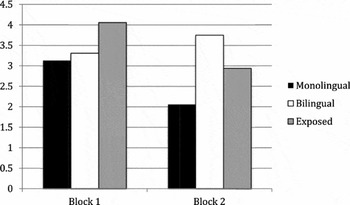
To explore the interaction, separate one-way ANOVAs for each block were conducted with language group as the independent variable (see Figure 1). There was no effect of language group in the first (easier) block, F (2, 45) = 1.53, p = .23, ηp 2 = .06, but there was in the second block, F (2, 45) = 5.64, p = .007, ηp 2 = .20. Tukey tests revealed that monolinguals (M = 2.06, SD = 1.73) performed worse than bilinguals (M = 3.75, SD = 1.29), p = .004 in the second block. Exposed children's performance (M = 2.94, SD = 1.18) fell between the two, but did not reliably differ from the monolinguals, p = .20, or bilinguals, p = .25. Paired t-tests were also conducted comparing performance in Blocks 1 and 2 for children in each language group. Bilingual children performed equally well in Block 1 (M = 3.31, SD =1.62) and Block 2 (M = 3.75, SD = 1.29), t (15) = 1.05, p = .31, d = .27. Exposed children performed marginally better in Block 1 (M = 4.06, SD = 1.73) than Block 2 (M = 2.94, SD = 1.18), t (15) = 2.06, p = .057, d = .572. Monolingual children performed significantly better in Block 1 (M = 3.13, SD = 1.45) than Block 2 (M = 2.06, SD = 1.73), t (15) = 2.14, p = .049, d = .54.
Mean comprehension scores for each language group by testing block.

Finally, a one-way ANOVA revealed a significant difference in vocabulary scores across the three groups, F (2, 43) = 3.41 p = .04, ηp 2 = .14. Post-hoc Tukey HSD tests revealed that bilingual children had significantly lower scores (M = 114.67, SD = 11.01) than exposed children (M = 125.53, SD = 9.66), p = .03; no other contrasts were significant (monolingual M = 119.00, SD = 13.30). Bivariate correlations testing the relationship between vocabulary size and performance on the word learning tasks were conducted separately for each language group; no correlations were statistically reliable (all ps >.10).
Discussion
In the current study, we asked whether bilingualism is associated with a foreign word learning advantage in preschoolers. As predicted, bilingual four-year-olds learned more foreign words than monolinguals, but only in the second (more difficult) block of trials; these findings suggest that a bilingual foreign word learning advantage may begin as early as preschool. To our knowledge, no other study has demonstrated such an advantage with this age group in the absence of a competing familiar language.
The bilingual advantage seen in the present study may be due, not to enhanced word learning abilities per se, but rather to the advanced executive function skills of bilingual children (Bialystok & Viswanathan, Reference Bialystok and Viswanathan2009). Specifically, Carlson and Meltzoff (Reference Carlson and Meltzoff2008) found that bilingual kindergarteners demonstrated an advantage in tasks that require attentional control and managing competing demands. In the present study, the bilingual advantage was found only in the second block of test trials, in which there was a greater potential for distraction and a heightened need for attentional control.
Another potential mechanism for the bilingual advantage may involve bilingual children's enhanced metalinguistic awareness. In particular, bilingual children may have an explicit understanding of the arbitrary relation between words and their meanings (Bialystok, Reference Bialystok1988) and an explicit understanding that objects can have multiple names. In support of this hypothesis, Akhtar et al. (Reference Akhtar, Menjivar, Hoicka and Sabbagh2012) found that children who were able to name the language(s) they speak (arguably one aspect of metalinguistic awareness) were better able to learn foreign words. It is important to note that it is challenging to test children's metalinguistic skills without also engaging executive functioning. Several researchers have found advantages for bilingual children on tasks that require substituting one known word for another (Ben-Zeev, Reference Ben-Zeev1977; Ianco-Worrall, Reference Ianco-Worrall1972); these tasks require metalinguistic awareness but also some degree of inhibitory control. In sum, the bilingual word-learning advantage seen in the present study may be due to a combination of metalinguistic awareness and inhibitory/attentional control.
Enhanced metalinguistic understanding may also explain why we did not find an interaction between object type (familiar versus novel) and language group. Given the findings on translation equivalents, we had expected a greater bilingual advantage on the familiar object trials. The fact that the advantage was equivalent on novel and familiar trials suggests that bilingual children have learned that different communication systems exist (that there are different arbitrary labels for the same thing in different languages) and that this understanding helps them to acquire foreign labels in a challenging context (Akhtar et al., Reference Akhtar, Menjivar, Hoicka and Sabbagh2012; Byers-Heinlein et al., Reference Byers-Heinlein, Chen and Xu2014).
We also tested a third group of children, those with regular exposure to a second language who are not bilingual. We predicted that both bilingual and exposed children would outperform monolinguals. Exposed children's performance fell between that of the monolingual and bilingual children, but did not reliably differ from either, similar to Bialystok's (Reference Bialystok1988) finding with ‘partially bilingual’ children's performance on metalinguistic tasks, suggesting that exposure to a second language without proficiency in it may confer some advantages. Given exposed children's superior performance in at least one study (Akhtar et al., Reference Akhtar, Menjivar, Hoicka and Sabbagh2012), we believe that these results warrant further examination of children with limited exposure to a second language.
Finally, in contrast to a study with younger monolingual children (Koenig & Woodward, Reference Koenig and Woodward2012), we found no relationship between vocabulary size and foreign word learning. One reason for this may be that all three groups had relatively high mean vocabulary scores (one standard deviation above the norm for their age) and there was not enough variability to detect relations with vocabulary. We do not have a clear explanation for the finding that bilingual children had lower vocabulary scores than the exposed children; however, there are inconsistent findings regarding vocabulary size differences between monolingual and bilingual children (Bialystok, Luk, Peets & Yang, 2009; Pearson, Fernandez & Oller, Reference Pearson, Fernandez and Oller1993). Only one other study, to our knowledge, has examined the vocabulary of ‘exposed’ children, and it found no differences between monolingual and exposed infants (Liberman, Woodward, Keysar & Kinzler, Reference Liberman, Woodward, Keysar and Kinzler2016). However, Liberman et al. did not distinguish between exposed and bilingual children; thus, it is possible that some of the infants in their exposed group were, in fact, bilingual.
In concluding, it is important to note that in our bilingual sample the majority was dominant in English, and most were Spanish–English bilinguals. Our findings therefore may or may not generalize to other types of bilinguals; e.g., those who are bilingual in different language pairs, those who are more balanced in their two languages, or those who are dominant in a minority language. Future research will need to examine different types of bilinguals and to determine what amount and type of experience with a second language is associated with an advantage in foreign word learning.
Appendix A Sample Characteristics
General Demographics
There was no group difference in age, F (2, 45) = .65, p = .53, η 2 = .03, (Monolinguals = 4;0 to 4;11, M = 4;5 SD = 3.90; Bilinguals = 4;0 to 4;10, M = 4;5 SD = 3.1; Exposed = 4;0 to 4;11, M= 4;4 SD = 3.30), and gender composition was roughly equal across the three groups. All children were English speakers. The other languages of the bilingual children were: Spanish (10), Mandarin (2), and Portuguese, Kannada, Russian, and Hungarian (1 of each); the other languages of exposed children were: Spanish (14), Mandarin (1), and American Sign Language (1).
There was no difference across the three groups in parental education (parent self-report of highest grade completed, with “12” = high school, “16” = college, and “18” = advanced degree) for mothers, F (2, 44) = .77, p = .47, η2 = .03 (Monolingual: M = 16.25, SD = 1.73; Bilingual M = 17.00, SD = 1.79; Exposed M = 16.60, SD = 1.60) or fathers, F (2, 41) = .67, p = .52, η2= .03 (Monolingual: M = 15.87, SD = 1.25; Bilingual: M = 16.33, SD = 1.60; Exposed: M =16.5, SD = 1.74). We also examined the median income for the participating families’ neighborhoods using an online database of zipcode information from the 2000 U.S. Census data (Zipskinny.com, n.d.), as have other studies of bilingual children (Akhtar et al., Reference Akhtar, Menjivar, Hoicka and Sabbagh2012; Byers-Heinlein et al., Reference Byers-Heinlein, Fennell and Werker2013). There was no difference in mean neighborhood income across the three groups, F (2, 44) = 1.90, p = .16, η2 = .08.
Language Experience: Bilingual Group
The majority of bilingual children (88%) heard their non-English daily; the remaining heard it on a weekly basis. Most (69%) were reported to speak the other language daily, 12% spoke it weekly, and 19% used it only occasionally. The majority of children in this group (63%) were simultaneous bilinguals (exposed to both languages from birth); the rest were sequential bilinguals, exposed to one language from birth and, on average, the other language starting at 18 months of age. Of the sequential bilinguals, the majority (66%) were exposed to the non-English language first.
Most children in the bilingual group were spoken to in English by their parents, but two (12%) were not. The majority (88%) were also spoken to in the non-English language by their parents; of these children, three (20%) were spoken to in the non-English language by only one parent, and four (29%) also attended a school in which some instruction occurred in the non-English language. Two children were exposed to the non-English language by a person outside of the family: one attended a language immersion school, and one was exposed to the non-English language by a nanny
Language Experience: Exposed Group
The majority (75%) of the exposed children were reported to hear the non-English language on a weekly basis (i.e., at least once a week but not daily); the remaining heard it on a daily basis. The majority (69%) were reported to speak the other language weekly, 12% used it daily, and 19% spoke it only occasionally. All were exposed to English from birth, and 43% were also exposed to the non-English language from birth. The remaining children in the exposed group had been exposed to the non-English language for an average of two years.
The majority of exposed children were exposed to the non-English language by a single person (75%): either only one parent (42%), a teacher (25%), a nanny/babysitter (25%), or a relative (8%). Only two (13%) were spoken to in the non-English language by both parents, one was spoken to in the non-English language by one parent and a babysitter, and one was spoken to in the non-English language by a teacher and a family friend. In sum, parent reports of language proficiency, exposure, and use suggest significant differences between the bilingual and exposed children.
Language Proficiency Ratings
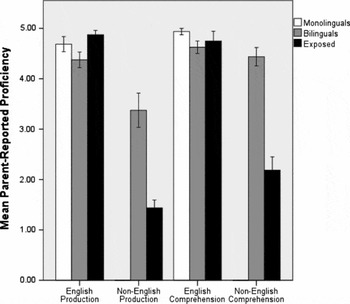
Parents rated participants’ language proficiency from 1 (poor) to 5 (excellent; see Appendix A, Figure 1). English production varied across the three language groups, F (2, 45) = 3.55, p = 0.04, η 2 = .14. Bilingual children scored lower in English production (M = 4.38, SD = .62) than exposed children (M = 4.88, SD = .34), p =.03. Bilingual children's English production was rated significantly higher than their non-English production (M = 3.38, SD = 1.36), t (15) = 2.74, p = .02, d = 0.95. Exposed children's English production was rated higher than their non-English production (M = 1.43, SD = .63), t (15) = 18.90, p < .001, d = 6.79, and their English comprehension (M = 4.75, SD = .77) was rated significantly higher than comprehension of the other language (M = 2.19, SD =1.05), t (15) = 7.03, p < .001, d = 2.78. Bilingual children's non-English language production was rated higher than that of exposed children (M = 1.43, SD = .63), t (30) = 5.17, p < .001, d = 1.83. Similarly, bilingual children's non-English comprehension (M = 4.44, SD = .73) was higher than that of exposed children, t (30) = 7.06, p < .001, d = 2.57. There was no difference across the three groups in English comprehension, F (2, 45) = 1.30, p = .28, η 2 = .05.
Parent proficiency ratings for production and comprehension of English and a second language.

Appendix B Familiar and Novel objects