Introduction
Bilingualism is speaking two languages and being able to flip between them as a function of topic, listener and psycholinguistic and sociopragmatic motivations (Walters, Reference Walters2005). Bilingual children can be balanced or dominant; that is, they can show high or low linguistic proficiency in both languages or only in one but not the other. Abutalebi and Green (Reference Abutalebi and Green2007) suggest that brain activation in bilinguals varies as a function of proficiency level in the second language (L2). This was found not only in regions of the cortex traditionally involved in first language (L1) processing, but also in regions known to sustain generic executive control. They attribute this variation to the constant activation of monitoring processes associated with the need to filter out irrelevant information and to inhibit inappropriate responses. Others (e.g., Im-Bolter, Johnson & Pascual-Leone, Reference Im-Bolter, Johnson and Pascual-Leone2006; Montgomery, Reference Montgomery2000, Reference Montgomery2002) argue that language proficiency in monolinguals echoes the ability to perform on tasks which involve generic executive functions, such as inhibition, concept generation, and shifting. These researchers reported differences in generic executive functions between monolinguals with typical language development (TLD) and monolinguals with low language proficiency, diagnosed with Specific Language Impairment (SLI).
The present study examines whether the relationship between language proficiency and performance on tasks which involve generic executive functions, observed among monolinguals (e.g., Bishop & Norbury, Reference Bishop and Norbury2005; Kohnert & Windsor, Reference Kohnert and Windsor2004), is also apparent among bilingual children. The investigation of this relationship is expected to shed light on the role of generic executive function abilities in language acquisition, thus contributing to an understanding of the relation between language proficiency and executive control in impaired populations as well. Hypothetically, the bilingual experience could override possible differences in general executive functions and lead to flattening the potential gap in the performance on generic executive functions among bilingual children.
There is currently no consensus about how to define operationally the language proficiency construct in bilingualism for classifying bilingual children (see Kohnert, Reference Kohnert2010). One possible division of bilingual children was implemented by Walters (Reference Walters1979) in a study of 32 Spanish–English bilingual children, who were assessed by the Peabody Picture Vocabulary Test (PPVT) (Dunn & Dunn, Reference Dunn and Dunn1981) prior to performing a pragmatic task involving making requests. In analyzing the data, the author distinguishes three groups of bilinguals: (1) highly balanced bilinguals, (2) unbalanced bilinguals (the L1-dominant and the L2-dominant groups), and (3) bilinguals who exhibited low proficiency in both languages (an LLP group).
The current study proposes that the non-balanced bilinguals in the two groups who display dominant bilingualism are qualitatively different from each other in terms of language acquisition. The L1-dominant group includes those who have difficulty in acquiring a second language despite being highly proficient in L1, while the L2-dominant group includes those who became highly proficient in L2 but show language attrition in L1 (e.g., Bahrick, Reference Bahrick1984; Cohen, Reference Cohen, Weltens, de Bot and van Els1986). When both groups have the same length and amount of exposure to L2, the ability to acquire a second language suggests that the linguistic proficiency of the L2-dominant group is higher than that of the L1-dominant group.
Thus, we propose that the high language proficiency group includes three sub-groups: a group with balanced high language proficiency and two groups with intermediate level language proficiency. Bilingual children who score within the monolingual norm on standardized measures in both languages are considered to have “balanced high language proficiency” (BHLP); bilingual children who score within the norm in L1/English, but score below norm in L2/Hebrew, are considered L1-dominant with intermediate level language proficiency; and bilingual children who score within the norm in L2/Hebrew, but below norm in L1/English are considered L2-dominant with intermediate level language proficiency. With this division, we test a continuum in which the bilingual population is divided into the following four groups ranging from a high to a low level of language proficiency: BHLP > L2-dominant > L1-dominant > LLP.
While language proficiency can be measured by standardized language tests, general cognitive executive control is measured by performance on tasks that measure generic (non-linguistic) executive functions, such as inhibition, updating working memory, attention, sorting, planning, and shifting (e.g., Andeson, Reference Anderson2002; Miyake, Friedman, Emerson, Witzki, Howerter & Wager, Reference Miyake, Friedman, Emerson, Witzki, Howerter and Wager2000). These generic executive functions are believed to be the building blocks of abilities to direct, organize, and mediate problem solving activities, and are used to monitor and plan behavior and to help focus on targets (Lezak, Howieson & Loring, Reference Lezak, Howieson and Loring2004). Miyake et al. (Reference Miyake, Friedman, Emerson, Witzki, Howerter and Wager2000) found that working memory, inhibition, and shifting are generic (non-linguistic) executive functions which are separable constructs, though moderately correlated. The main generic executive function abilities which are examined in the present study are: inhibition – the ability to ignore and filter distracting irrelevant information held in working memory, sorting (concept generation) – the ability to abstract information from non-identical items, and shifting (mental flexibility) – the ability to switch attention back and forth between mental sets (e.g., Baddeley, Reference Baddeley1996). The following sections will focus on the executive functions tested in the present study: inhibition, sorting and shifting.
Generic executive functions have a protracted course of development, beginning in early childhood and continuing into adolescence (e.g., Gathercole, Pickering, Knight & Stegmann, Reference Gathercole, Pickering, Knight and Stegmann2004). This has been shown to be related to the slow maturation of the prefrontal cortex (Diamond, Reference Diamond, Stuss and Knight2002). Studies testing inhibitory control found an increase throughout childhood, reaching an adult level of performance in late childhood, around the age of 12 (e.g., Van den Wildenberg & Van der Molen, Reference Van den Wildenberg and Van der Molen2004). Similarly, studies investigating task shifting show that switching costs between tasks decrease as children grow older, with adult levels of performance being attained around the age of 12 (e.g., Kray, Eber & Lindenberger, Reference Kray, Eber and Lindenberger2004). Smidts, Jacobs and Anderson (Reference Smidts, Jacobs and Anderson2004) found, however, that a developmental spurt in mental flexibility (shifting) appears from the age of four, with refinement occurring after the age of five.
Executive control and language proficiency in monolinguals
The relation between generic executive functions and language proficiency in monolingual children usually builds on a comparison between children with typical language development (TLD) and children with Specific Language Impairment (SLI). Children with SLI, exhibit typical social-emotional development, hearing and motor-speech abilities, and have IQs within the normal range, but have receptive and/or expressive language abilities below age expectations (e.g., Im-Bolter et al., Reference Im-Bolter, Johnson and Pascual-Leone2006; Leonard, Reference Leonard1998). That is, children with SLI have low language proficiency as indicated by performance on standardized measures, e.g., the Clinical Evaluation of Language Fundamentals (CELF; Wiig, Secord & Semel, Reference Wiig, Secord and Semel1992) or the Test of Language Development (TOLD; Newcomer & Hammill, Reference Newcomer and Hammill1997). While bilingual children have been shown to outperform monolingual children on tasks that involve generic executive functions, monolingual children with typical language development outperform children with SLI on tasks which involve executive control. This latter observation suggests a correlation between linguistic proficiency and generic executive functions.
Studies testing general executive function abilities in children with SLI show deficits in basic general cognitive and perceptual processing mechanisms as well as short-term memory and working memory (Kohnert & Windsor, Reference Kohnert and Windsor2004). For example, Finneran, Francis and Leonard (Reference Finneran, Francis and Leonard2009) examined inhibition skills by measuring sustained attention in 4–6-year-old children with and without SLI using a visual continuous performance task (CPT). In this task participants monitor for target stimuli (e.g., a red circle) while inhibiting distractor stimuli (red square). Finneran et al. (Reference Finneran, Francis and Leonard2009) report that children with SLI were less accurate than children with TLD, concluding that children with SLI have reduced capacity for sustained attention, i.e., they demonstrate lower inhibition (see also Spaulding, Plante & Vance, Reference Spaulding, Plante and Vance2008). Marton (Reference Marton2008) further shows that children with SLI have a weakness in attention switching, inhibition, non-verbal problem solving and task switching. More specifically, Kiernan, Snow, Swisher and Vance (Reference Kiernan, Snow, Swisher and Vance1997) suggest that children with SLI are impaired in their ability to inhibit prepotent responses (see also Bishop & Norbury, Reference Bishop and Norbury2005), and they may be unable to make efficient use of their capacity due to deficits in general executive function. Im-Bolter et al. (Reference Im-Bolter, Johnson and Pascual-Leone2006) propose that children with SLI have a limited processing capacity that is domain-general rather than domain-specific, and that they perform more poorly than children with TLD on tasks of updating and inhibition.
Leonard, Ellis Weismer, Miller, Francis, Tomblin and Kail (Reference Leonard, Ellis Weismer, Miller, Francis, Tomblin and Kail2007) suggest that the limited language skills children with SLI have could be the result of a lifetime of functioning with limited non-linguistic processing skills. For example, if general, non-linguistic working memory capacity is limited, it will be more difficult to keep active non-syntactic information during syntactic computation. Thus, general non-linguistic processing limitations may exacerbate children's language difficulties and, possibly, serve as one of its chief causes. Supporting this view, Miller, Kail, Leonard and Tomblin (Reference Miller, Kail, Leonard and Tomblin2001) suggest that the limitations children with SLI have in general non-linguistic processing slows down their processing of linguistic information and their linguistic development.
In the same vein, Im-Bolter et al. (Reference Im-Bolter, Johnson and Pascual-Leone2006) propose that the deficits of children with SLI in general non-linguistic updating and inhibition abilities affect their efficient use of resources for deactivating irrelevant information in language tasks. Moreover, their limited general non-linguistic processing capacity may explain their linguistic difficulties, since effective use of language requires coordination of one's linguistic, general cognitive and social skills, and availability of general cognitive resources (memory capacity, inhibition, etc.). Finneran et al. (Reference Finneran, Francis and Leonard2009) further suggest that the reduced capacity for non-linguistic sustained attention among children with SLI could contribute to the language learning difficulties they encounter. However, Kohnert, Windsor and Ebert (Reference Kohnert, Windsor and Ebert2009) point out that the question whether non-linguistic and linguistic deficits in SLI are related due to a common underlying neurological deficit or a general motor, perceptual and cognitive weakness resulting in language deficits is still unresolved.
Bilingualism and generic executive functions: Is bilingualism an advantage?
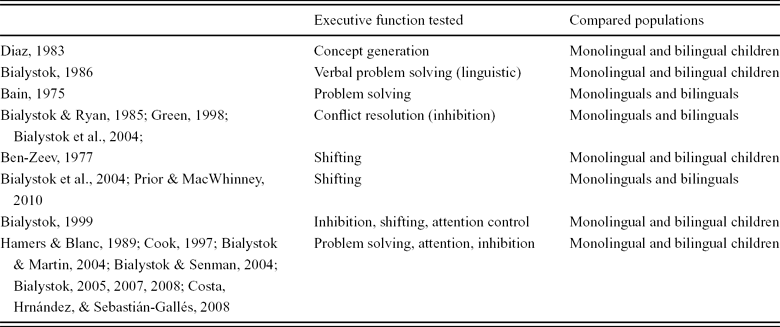
While studies of monolinguals show a disadvantage for children with SLI in generic executive control abilities, studies investigating general cognitive control and generic executive control abilities in bilinguals show advantages among bilinguals throughout the lifespan in comparison to monolinguals, with these processes developing earlier in bilingual children (e.g., Ben-Zeev, Reference Ben-Zeev1977; Bialystok, Reference Bialystok1999, Reference Bialystok, Tremblay, Barr and Peters2008; Goetz, Reference Goetz2003; Kovács & Mehler, Reference Kovács and Mehler2009). Table 1 presents a list of studies which show this bilingual advantage over monolinguals for generic executive functions.
Bilinguals compared to monolinguals on executive functions – major findings.

Most of these studies do not take into account that there are different types of bilinguals in terms of their language proficiency in the two languages, and that these differences might influence the bilinguals’ performance on tasks that measure generic executive function abilities. The current study attempts to address this issue by comparing bilinguals with different levels of proficiency in the two languages. That is, it attempts to explore whether these differences in language proficiency correlate with the bilinguals’ abilities to perform on tasks that measure generic executive functions.
Bialystok, Craik, Klein and Viswanathan (Reference Bialystok, Craik, Klein and Viswanathan2004), among others, suggest that the bilingual advantage over monolinguals in generic executive functions can be attributed to the bilingual need to deal constantly with two languages. This is suggested to be the case, since cortical regions underlying generic executive function have been found to be involved and trained in resolving conflicts in language processing resulting from interference of a non-target language in target-language production (e.g., Rodriguez-Fornells, De Diego Balaguer & Münte, Reference Rodriguez-Fornells, De Diego Balaguer and Münte2006). Hence, it appears that bilinguals have more resources and more efficient resources for performing on tasks which involve non-linguistic conflicts (Bialystok, Reference Bialystok, Tremblay, Barr and Peters2008). Imaging studies confirm these findings showing that the brain areas which play a major role in different aspects of generic executive functioning (the dorso-lateral prefrontal cortex, the anterior cingulated cortex, and the supplementary motor area) are also activated in dual language processing (e.g., Rodriguez-Fornells et al., Reference Rodriguez-Fornells, De Diego Balaguer and Münte2006).
Hypothetically, this kind of training of generic executive function brain regions in bilingual situations has the potential of narrowing the gap in generic executive function between less proficient and more proficient speakers. In bilingual situations, general cognitive abilities are recruited to control dual language use (e.g., Rodriguez-Fornells et al., Reference Rodriguez-Fornells, De Diego Balaguer and Münte2006), and the use of more than one language may improve control and self-regulation of general cognitive processes. Alternatively, it could be the case that the participants tested in the current study (all of whom are sequential bilinguals with at least two years of L2 exposure) will all benefit from their dual language exposure to the same extent, and the gap found in monolinguals may be preserved in bilinguals as well. Finally, a third alternative is that less proficient speakers will benefit less from bilingual exposure than more proficient speakers and the gap between more proficient and less proficient speakers will remain. In this case, bilinguals who differ in their ability to acquire a second language may show different levels of performance on tasks that involve generic executive functions as well. More specifically, highly balanced bilinguals are anticipated to perform best on generic (non-linguistic) executive functions compared to other bilingual groups. This, as mentioned above, is what the present paper attempts to test.
Research questions and predictions
The present study addresses the question whether bilingual children with low language proficiency (LLP) show a lower degree of general cognitive control compared to bilingual children with high language proficiency; alternatively, is it the case that the bilingual language experience has a remedial power, narrowing or even closing the gap between more proficient and less proficient speakers? This will be explored by testing whether bilingual children with different levels of language proficiency in L1 and in L2 perform differently on tasks that involve generic executive functions (a subset of general cognitive control).
We hypothesize that the higher the language proficiency of a bilingual in one or both languages is, the better the bilingual will perform on tasks which involve generic executive functions. Using both the dichotomous division between high and low language proficiency bilingual children (HLP > LLP) and a division into four groups (BHLP > L2-dominant > L1-dominant > LLP), this hypothesis yields four predictions regarding performance on tasks which involve generic executive control, such as inhibition, sorting, and shifting:
1. Children with HLP will perform better than children with LLP.
2. Balanced bilingual children with high language proficiency (BHLP) will perform better than all other groups of bilingual children.
3. L2-dominant children will perform better than L1-dominant and LLP children.
4. L1-dominant children will perform better than LLP children.
Previous studies compared bilinguals with TLD to monolinguals with TLD or monolinguals with TLD to monolinguals with SLI and their performance on tasks that involve generic executive functions. The current study focuses exclusively on bilingual children, comparing different types of bilingual children in terms of language proficiency and their performance on tasks that involve generic executive functions.
Method
Participants
The participants were 43 sequential bilingual English–Hebrew-speaking children, who have been exposed to L1 English from birth and to L2 Hebrew from approximately age three in the framework of public education (preschool). Twenty-two boys and 21 girls aged 4;1–7;1 (mean: 5;7) were tested. The relatively large age range resulted from the inclusion of three participants from language preschool who were all approximately seven years old. In language preschools, many children remain one more year before they go on to first grade. However, as reported in the results section, no correlation was found between age and performance on sorting or shifting, with a weak correlation for inhibition.
Twenty-five of the 43 participants were recruited from three regular preschools for children with no special needs (regular preschool), located in a middle class town in the center of Israel. Eighteen children were recruited from five language preschools for children who were previously diagnosed with language impairment, located in the same middle class town. All participants in the present study conformed to the conventional exclusionary criteria for SLI. (e.g., no evidence of ADHD, PDD, hearing deficits, or neurological impairment), and all had performance IQs within the normal range. In the regular preschools, only children with performance IQ within the normal range are enrolled; in the language preschools, reports of the preschool speech and language therapist with access to the children's personal files were used to determine eligibility. Parental consent was received for all children, and the study was approved by the university review board for studies involving human subjects as well as by the Israeli Ministry of Education. All children participated willingly.
Baseline language measures
All children were screened in both English and Hebrew using standardized instruments to establish their language proficiency in the two languages. Monolingual norms were used in both languages to evaluate age appropriate language proficiency. The decision to use monolingual norms reflected the wide age range of the present study which made it impossible to generate age appropriate scores otherwise. In no way were these norms used to determine whether the children were linguistically impaired or not. The Goralnik Diagnostic Test for Hebrew (Goralnik, Reference Goralnik1995) was used to evaluate language proficiency in Hebrew. This screening tool includes six parts, each assessing a different linguistic ability: vocabulary, pronunciation, comprehension (of simple and complex directions), imitation (of simple and complex sentences), expressive abilities, and narrative abilities (in response to picture stimuli). The CELF-2 Preschool (Wiig, Secord & Semel, Reference Wiig, Secord and Semel2004) was used to evaluate language proficiency in English. This diagnostic tool includes seven sub-tests: sentence structure, word structure, expressive vocabulary, concepts and following directions, sentence recall, basic concepts, and word classes (receptive and expressive). For inclusion in the different groups, the cut-off score used for L1/English was 1 SD below the normal monolingual mean. The cut-off score used for L2/Hebrew was 1.5 SD below the normal monolingual mean. The latter cut-off point was used to make the present study comparable to previous studies of Hebrew monolingual and bilingual children which also used 1.5 SD (rather than 1 SD as a cut-off point). Scores from these two standardized tests yielded four groups of bilingual children:
1. Children with balanced high language proficiency (BHLP) who scored within or above norm in both languages.
2. Children with a dominant L2 (L2-dominant) who scored within or above norm in L2, Hebrew, but below norm in L1/English.
3. Children with a dominant L1 (L1-dominant) who scored within or above norm in L1/English, but below norm in L2/Hebrew.
4. Children with low language proficiency (LLP) who scored below norm in both languages.
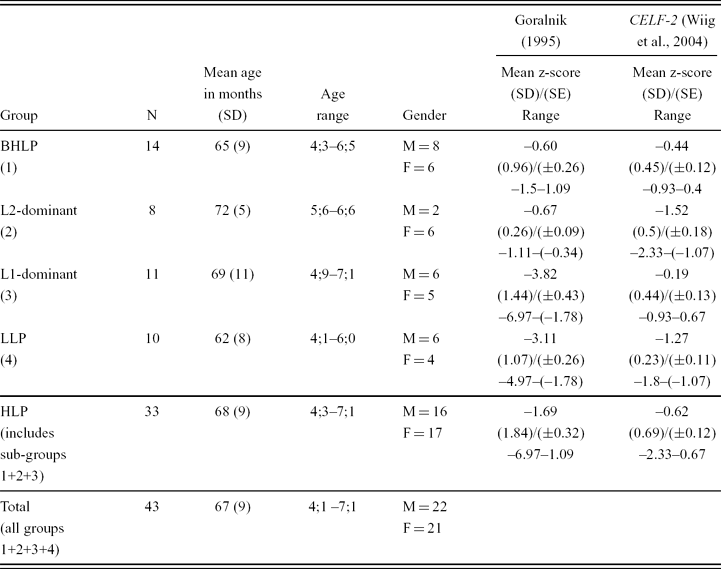
Many of the children in the language preschools (10 of 18) showed within-norm proficiency in at least one of their two languages, and were therefore not classified as LLP. In addition, two of the 25 children recruited from the regular preschools scored below norm on the standardized tests in both languages, and were thus included in the LLP group. These numbers reflect a tendency to over-diagnose and under-diagnose language impairment in the bilingual population. Table 2 presents the distribution of the participants in the four groups, and their linguistic profile as reflected in their scores on the language tests in both languages. All groups showed average scores below the monolingual mean in both English and Hebrew.
Distribution of participants in the groups tested in the current study (of the dichotomy HLP–LLP and of the continuum BHLP, L1-dominant, L2-dominant, LLP) and their linguistic profile as reflected in their scores on the screening tests (z-scores calculated relying on the expected mean and SD accounting for age) in both languages (Goralnik, Reference Goralnik1995, for Hebrew, and CELF-2 Preschool (Wiig et al., Reference Wiig, Secord and Semel2004) for English).
N = number of participants, M = male, F = female, SD = standard deviation, SE = standard error
Experimental tasks
Two tasks were administered to measure the degree of generic executive control ability. The first task, the Embedded Figures task (adapted from De Avila & Duncan, Reference De Avila, Duncan and Alatis1980; Pascual-Leone, Reference Pascual-Leone, Globerson and Zelniker1989; Piaget & Inhelder, Reference Piaget and Inhelder1967) tested inhibition. The child was presented with 10 pictures (Kor, Reference Kor1992), each of which included an embedded mouse, which he/she was asked to detect as fast as possible. The pictures were presented in a gradually increasing level of difficulty, as a function of the amount of information in the picture, referred to as noise in the signal detection literature (Green & Swets, Reference Green and Swets1966). Errors, non-responses and successful turns were documented. The degree of inhibition ability is measured by the number of correct embedded figures identified, ranging from 0 to 10.
The second task was the Classification task (adapted from Ben-Zeev, Reference Ben-Zeev1977; Jacobs, Anderson & Harvey, Reference Jacobs, Anderson and Harvey2001; Smidts et al., Reference Smidts, Jacobs and Anderson2004), used to test both sorting (concept generation) and shifting. The child was presented with 18 cards which included three different shapes (circle, triangle, square), and three different patterns for each shape (no color, partially-colored-shape, fully-colored-shape). Nine of the cards (out of the 18) included three representations of each shape (to represent “many”), and nine cards included one item of each shape (to represent “one”; see Appendix). The child was asked to classify the cards into groups (first classification: sorting – concept generation). Then, after the experimenter had reordered the cards exactly as they were presented the first time, the child was asked to reclassify them in a different way (first shift) and in another way (second shift). When a child persisted with the same classification twice and did not switch, the experimenter added a hint or two to help switching. Successful, unsuccessful, and aided trials were recorded.
Three measures where used for analyzing sorting and shifting abilities. The first measure evaluated the degree of sorting and shifting abilities as an average degree of success across the three trials. In each trial, the child received a score which reflected performance on that trial: a score of 3 when the child succeeded, 2 points when the child needed one hint, 1 point when the child needed two hints, or no points when the child was unable to perform the task.
The second measure addressed each classification separately in a way which reflected its different cognitive demands. The first classification tested concept generation (sorting) – the ability to abstract information from non-identical items. The second and third classifications tested the ability to shift once and twice (Jacobs et al., Reference Jacobs, Anderson and Harvey2001; Smidts et al., Reference Smidts, Jacobs and Anderson2004). The second measure focused only on the second and third classifications, which involved shifting.
Finally, the third measure focused on the number of participants who were able to classify the cards independently, with no explicit directions, under the assumption that once hints are provided, shifting is no longer being tested.
Procedure
Data were collected from each child separately in a quiet room in the preschool. The experimenter was a Hebrew–English bilingual, and all instructions were provided in both languages to ensure that the children understood. Before administering each task, practice trials were conducted. The order of tasks was counterbalanced.
Scoring and data analysis
The dependent variable for the Embedded Figures task was accuracy measured by the number of correct responses (maximum 10). This task was intended to measure the level of inhibition abilities. Reaction time was also measured in this task, but since time was recorded manually, it was decided to exclude this from the analysis. The dependent variable for the Classification task was also accuracy. The task was timed, but it too was excluded for the reasons mentioned above.
All the results were converted to z-scores for the entire group of 43 participants to permit comparison of the means for each group relative to the general average, and to allow comparability between the tasks which were scored on different scales. A z-score indicates the number of standard deviations above or below the mean. It is calculated by subtracting the population mean from the individual raw scores and then dividing the difference by the standard deviation for the entire group.
For each group we calculated the mean z-score, standard deviation (SD), standard error (SE), and range. ANOVAs were conducted, followed by post-hoc tests to evaluate significant relationships among the independent and the dependent variables investigated. For comparisons approaching significance, effect sizes were calculated. For possible correlations with gender or age, a Pearson correlation coefficient was conducted for all the participants in this study.
Results
Pearson correlation coefficient calculated for all participants in the study (N = 43) yielded a weak, yet significant correlation between age and inhibition (r = .33, p < .05); but no significant correlations were found between age and sorting and shifting (r = .01), between gender and inhibition (r = .27), and between gender and sorting and shifting (r = .27). The correlation between age and inhibition disappears when the three seven-year-old children were removed from the calculation. Detailed results (in z-scores) for the relationship between language proficiency and inhibition on the one hand and sorting and shifting on the other are presented below, first for the HLP–LLP dichotomy, and then for the BHLP – L2-dominant – L1-dominant – LLP continuum.
Language proficiency and executive control in the HLP–LLP dichotomy
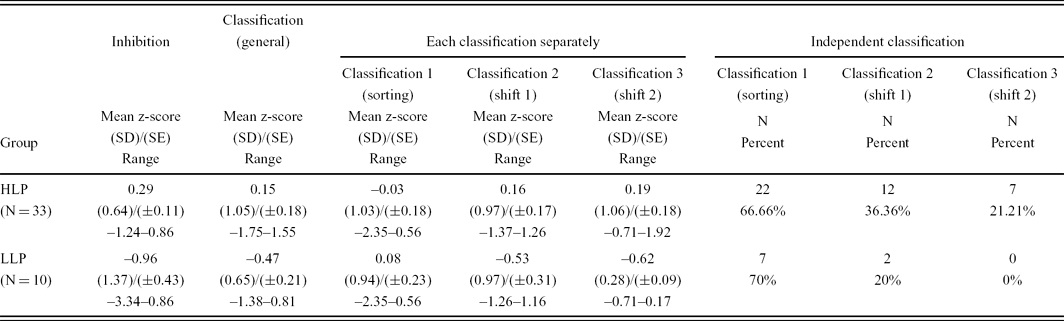
Table 3 compares the HLP and the LLP groups on inhibition, sorting and shifting. A two-way ANOVA examining effects of group and task shows a significant main effect for group, F(1,41) = 15.86, p < .0003, with HLP outperforming LLP children, no effect for task (p > .05), and no significant group × task interaction (p = .19). Since each task was selected to test a different generic executive function, the following analyses address each task separately.
Comparison between the HLP and the LLP groups on inhibition (tested via the Embedded Figures task), on classification (tested via the Card Classification task), on each of the three classifications separately, and on the percentage and the number of participants out of the total number in each group who were able to classify the cards independently in the three classifications.
Column 2 in Table 3 presents the mean z-score, SD and SE for correct responses on the Embedded Figures task, which tested inhibition. A significant difference was found between the HLP group (N = 33) and the LLP group (N = 10) on inhibition, with the HLP group outperforming the LLP group t(41) = 4.04, p < .0001 (r = .37).
Column 3 in Table 3 presents the mean z-score, SD and SE for correct responses for all three trials of the Classification task, which tested sorting and shifting abilities. The mean score for the entire task (all three classifications) is a combined score for sorting and shifting together, rather than a score on shifting only. In terms of sorting and shifting together (the Classification task), the HLP group (N = 33) significantly outperformed the LLP group (N = 10), t(41) = 1.75, p < .04 (r = .45).
Column 4 in Table 3 presents the mean z-scores for a more detailed analysis of the Classification task for each classification. The score for the first classification reflects sorting and concept generation abilities; the scores for the second and third classifications are for shifting abilities. A two-way ANOVA investigating effects of group and classification trial yielded a significant group × trial interaction (F(2,82) = 3.65, p < .03), but no main effects for group (p = .1) or task (p = 1). Post-hoc t-tests showed that for the first classification (sorting), which tested concept generation, there was no significant difference between the HLP group and the LLP group, t(41) = (−0.28), p = .39. However, the HLP group significantly outperformed the LLP group both on the second classification, where the first shift occurs, t(41) = 1.98, p < .03 (r = .37), and on the third classification when the second shift occurs t(41) = 2.39, p < .01 (r = .61). These results remained following a Bonferroni correction.
Column 5 in Table 3 presents the number and percentage of participants who were able to classify the cards independently – with no explicit directions, for the three classifications. Most bilingual children were able to sort the cards for the first time regardless of their language proficiency (22 out of 33 children with HLP, i.e., 67%, and seven out of 10 children with LLP, i.e., 70%). However most bilingual children with LLP found it difficult to sort the cards for the second time and required explicit directions. All children with LLP found it difficult and required explicit directions to sort the cards for the third time. That is, they could hardly shift once and were not able to shift twice at all. On the other hand, more than a third of the bilingual children with HLP were able to sort without instructions for the second time (12 out of 33, 36.36%), and some for the third time (seven out of 33, 21.21%).
Summing up, the findings show that HLP children perform better than LLP children on shifting and inhibition, but not on sorting. Moreover, some LLP children find it difficult to sort independently and none can shift independently more than once, whereas many HLP children can sort independently and shift independently once or even twice.
Language proficiency and executive control across the BHLP – L2-dominant – L1-dominant – LLP continuum
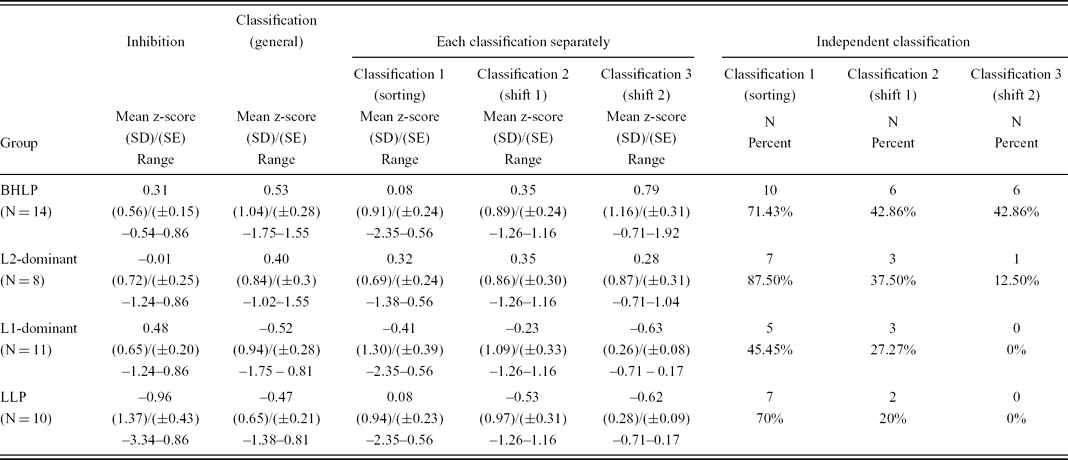
Table 4 compares the BHLP, L2-dominant, L1-dominant, and the LLP groups on inhibition, sorting and shifting. A two-way ANOVA examining effects of group and task yielded a group × task interaction (F(3,39) = 3.49, p < .03) with a significant main effect for group, F(3,39) = 6.38, p < .001, but no effect for task (p = 1). Since each task tests a different generic executive function, the following analyses address each task separately.
Comparison among the BHLP, L2-dominant, L1-dominant, and the LLP groups on inhibition (tested via the Embedded Figures task), on classification (tested via the Card Classification task), on each of the three classifications separately, and on the percentage and the number of participants out of the total number in each group who were able to classify the cards independently in the three classifications.
Column 2 in Table 4 presents the mean z-scores for the number of correct answers on the Embedded Figures task which tested inhibition. A one-way ANOVA examining effects of group on inhibition (Embedded Figures test) resulted in a significant difference between groups, F(3,39) = 5.88, p < .003, with all HLP groups (BHLP, L2-dominant, L1-dominant) outperforming the LLP group (p > .01 with a Tukey post-hoc test for the difference between LLP and both BHLP and L1-dominant, and near significant for the difference between LLP and L2-dominant) and no significant differences among the HLP groups. The difference between the HLP groups and the LLP group was further confirmed by t-tests, as follows: BHLP and LLP, t(22) = 3.14, p < .002 (r = .56); L2-dominant and LLP, t(17) = 1.87, p < .04 (r = .40); and L1 dominant and LLP, t(19) = 3.12, p < .003 (r = .58).
Column 3 in Table 4 presents the mean z-score for the three trials in the Classification task, which tested sorting and shifting. A one-way ANOVA examining effects of group on sorting and shifting yielded a significant main effect for group, F(3, 39) = 4.23, p < .01. Post-hoc comparisons showed that when sorting and shifting were combined, the two more proficient groups – BHLP (N = 14) and L2-dominant (N = 8) – significantly outperformed the two less proficient groups – L1-dominant (N = 11) and LLP (N = 10): BHLP vs. L1-dominant, t(23) = 2.6, p < .008 (r = .48); BHLP vs. LLP, t(22) = 2.67, p < .007 (r = .49); L2-dominant vs. L1 dominant, t(17) = 2.19, p < .02 (r = .41); and L2-dominant vs. LLP, t(16) = 2.48, p < .01 (r = .53). However, no significant difference was found between the two more proficient groups – BHLP and L2-dominant, t(20) = 0.29, p = .39) – and between the two less proficient groups – L1-dominant and LLP, t(19) = −0.14, p = .45).
Column 4 in Table 4 presents the mean z-scores for a more detailed analysis of the Classification task per classification. A two-way ANOVA for the effects of group and classification trial resulted in a significant group × trial interaction, F(6,78) = 2.52, p < .03), with a significant main effect for group (F(3,39) = 4.12, p < .01), but no effect for trial (p = 1). Post-hoc t-tests show that in the first classification trial (sorting), which tested concept generation, no significant difference was found among the four groups: BHLP vs. L2-dominant, t(20) = (−0.65), p = .26; BHLP vs. L1-dominant, t(23) = 1.1, p = .14; BHLP vs. LLP, t(22) = 0, p = .5; L2-dominant vs. L1-dominant, t(17) = 1.44, p = .08; L2-dominant vs. LLP, t(16) = 0.61, p = .28; and L1-dominant vs. LLP, t(19) = (−0.97), p = .17. However, in the second classification trial, where the first shift occurs, the two more proficient groups (BHLP, L2-dominant), which did not differ significantly in their performance (t(20) = 0, p = .5), significantly outperformed the LLP group: BHLP and LLP, t(22) = 2.31, p < .02 (r = .44); and L2-dominant and LLP, t(16) = 2.03, p < .03 (r = .45). No significant differences were found among the other groups: BHLP vs. L1-dominant, t(23) = 1.48, p = .08; L2-dominant vs. L1-dominant, t(17) = 1.26, p = .11; L1-dominant vs. LLP, t(19) = 0.66, p = .26). Furthermore, in the third classification trial, where the second shift occurs, the two more proficient groups (BHLP, L2-dominant), which still did not differ significantly in their performance (BHLP vs. L2-dominant, t(20) = 1.09, p = .14), nevertheless significantly outperformed the two less proficient groups (L1-dominant and LLP): BHLP vs. L1-dominant, t(23) = 3.96, p < .0003 (r = .64); BHLP vs. LLP, t(22) = 3.75, p < .0006 (r = .62); L2 dominant vs. L1 dominant, t(17) = 3.29, p < .002 (r = .62); and L2 dominant vs. LLP, t(16) = 3.1, p < .003 (r = .61). The two less proficient groups also did not differ significantly in their performance (L1-dominant vs. LLP, t(19) = −0.07, p = .47).
Column 5 in Table 4 presents the number and percentage of participants who were able to classify the cards independently – with no explicit directions – in the three classifications. Most children in the BHLP group were able to sort the cards independently for the first time (10/14; 71.43%), and almost half of them for the second time (6/14; 42.86%), and for the third time (6/14; 42.86%). Likewise, most children in the L2-dominant group were able to sort the cards independently for the first time (7/8; 87.50%), approximately a third of them for the second time (3/8; 37.50%), and only one for the third time (1/8; 12.50%). By contrast, less than half of the children in the L1-dominant group were able to sort the cards independently for the first time (5/11; 45.45%), only a few of them for the second time (3/11; 27%), and none of them for the third time. That is, children with L1-dominance were not able to shift twice. Finally, many of those in the LLP group were able to sort the cards independently on the first trial (7/10; 70%), but only two of the children (20%) in the LLP group were able to shift on the second trial, and none of them on the third trial. Thus, they too were scarcely able to shift once and were not able to shift twice.
Summing up, the predictions that bilingual children with higher language proficiency would perform better than bilingual children with lower language proficiency on tasks involving generic executive control, such as the inhibition task, and the sorting and shifting task, are supported in terms of inhibition and shifting. Children with higher language proficiency outperform children with LLP on inhibition. Furthermore, the two more proficient groups (BHLP, L2-dominant) outperform the two less proficient groups (L1-dominant, LLP) on shifting and sorting. No significant difference was found between the BHLP and the L2-dominant groups, nor between the L1-dominant and the LLP groups. While no significant difference was found among the groups in sorting (concept generation), the current study found that the two more proficient groups showed significantly better shifting abilities than the LLP groups.
Discussion
The question addressed in the present study was whether there is a relationship between language proficiency and the abilities to control and self-regulate general cognitive processes in bilingual children. That is, whether bilingual children with different degrees of language proficiency perform differently on tasks which involve generic, non-linguistic executive functions (inhibition, sorting and shifting). We hypothesized that the higher the language proficiency of a bilingual child in one or both languages is, the better the bilingual child will perform on tasks involving generic executive functions. Our findings support this hypothesis, showing that bilingual children with high language proficiency (HLP) significantly outperform bilingual children with low language proficiency (LLP) on inhibition and shifting, but not on sorting. That is, our study shows no difference between high and low proficiency bilingual children in concept generation which is acquired earlier, but do show a significant difference in later acquired general executive functions, i.e., inhibition and shifting. When dividing the HLP group into sub-groups reflecting their graded linguistic proficiency (balanced-HLP, L2-dominant, L1-dominant) and comparing them with the LLP group, significant differences in inhibition emerge, with all sub-groups performing better than the LLP group. However, for shifting, the two more proficient groups (balanced-HLP, L2-dominant) significantly outperformed the two less proficient groups (L1-dominant, LLP), but no such difference was found for sorting.
The current study confirmed the first prediction that the higher the language proficiency of a bilingual in one or both languages is, the better that bilingual will perform on tasks involving generic executive functions, i.e., inhibition and shifting. This prediction was not borne out for sorting. This finding replicates the finding observed among monolinguals showing that the relationship between language proficiency and performance on tasks involving generic executive functions is also evident among bilingual children and distinguishes children with HLP from children with LLP. Furthermore, in the Classification task which tests sorting and shifting, the results show that the two groups do not differ in terms of concept generation (sorting – first classification trial), but that the HLP group did outperform the LLP group on shifting. The findings also show that most bilingual children were able to abstract information from non-identical items (sorting – concept generation) as expected at this age. However, most bilingual children with LLP require explicit instructions to shift (in which case they may not be shifting, but rather, following directions). Thus, low language proficiency is apparently an obstacle to shifting independently. By contrast, more than a third of the bilingual children with HLP are able to shift independently at least once, and some are able to shift independently even twice. The difficulty of the bilingual children with LLP in this study is reminiscent of the difficulty reported by Im-Bolter et al. (Reference Im-Bolter, Johnson and Pascual-Leone2006) for inhibition in children with SLI. Similarly, the findings in the current study that children with LLP have difficulties in shifting resonate with previous studies showing that children with SLI, who by definition have low language proficiency, exhibit general cognitive deficits even when no language is involved (e.g., Bishop, Reference Bishop1992; Bishop & Edmundson, Reference Bishop and Edmundson1987; Bishop & Norbury, Reference Bishop and Norbury2005; Connell & Stone, Reference Connell and Stone1994; Craig, Reference Craig, Fletcher and MacWhinney1995; Hoffman & Gillam, Reference Hoffman and Gillam2004; Im-Bolter et al., Reference Im-Bolter, Johnson and Pascual-Leone2006; Johnston, Reference Johnston, Watkins and Rice1994; Kiernan et al., Reference Kiernan, Snow, Swisher and Vance1997; Kohnert & Windsor, Reference Kohnert and Windsor2004; Lahey, Edwards & Munson, Reference Lahey, Edwards and Munson2001; Marton, Reference Marton2008; Miller et al., Reference Miller, Kail, Leonard and Tomblin2001; Montgomery, Reference Montgomery2000, Reference Montgomery2002; Sininger, Klatzky & Kirchner, Reference Sininger, Klatzky and Kirchner1989; Swisher & Snow, Reference Swisher and Snow1994; Ullman & Pierpont, Reference Ullman and Pierpont2005; Windsor & Hwang, Reference Windsor and Hwang1999). However, these findings are not comparable with those of Im-Bolter et al.'s (Reference Im-Bolter, Johnson and Pascual-Leone2006) and Kiernan et al.'s (Reference Kiernan, Snow, Swisher and Vance1997), which maintain that children with SLI do not have specific deficits in shifting.
The difference between the present findings and those of Im-Bolter et al.'s (Reference Im-Bolter, Johnson and Pascual-Leone2006) can be explained by differences in age: the participants in the present study are much younger (mean age 5;7) than those in Im-Bolter et al.'s study (mean age 10;1), and thus are still developing their general executive function abilities. The different results suggest that the gap narrows or even disappears with age, just as the magnitude of the bilingual influence on generic executive functions changes across the lifespan being most apparent in changes from early childhood (between four and seven years of age) to adulthood (Bialystok, Reference Bialystok2007; Craik & Bialystok, Reference Craik and Bialystok2005). Jacobs et al. (Reference Jacobs, Anderson and Harvey2001) also found marked improvements in shifting abilities between ages six and ten, with maturation of adult level of shifting abilities being attained by age 10.
Im-Bolter et al. (Reference Im-Bolter, Johnson and Pascual-Leone2006) and Kiernan et al. (Reference Kiernan, Snow, Swisher and Vance1997) tested monolingual children, while the participants in the present study were bilingual children. Thus, it could also be that the difference between monolingualism and bilingualism played a role in the current study as bilinguals are naturally trained in shifting, and the highly balanced bilinguals might benefit from this exposure even more than bilinguals with LLP or less balanced bilinguals. This speculation is strengthened by the finding that no difference emerged for sorting between the groups as sorting is not trained in the bilingual situation more than in the monolingual situation.
Finally, this difference between the findings here and those of Im-Bolter et al.'s (Reference Im-Bolter, Johnson and Pascual-Leone2006) can also be ascribed to a difference in tasks. Im-Bolter et al. (Reference Im-Bolter, Johnson and Pascual-Leone2006) used tasks which required the participants to read written language (letters and numbers), produce language and count. Shifting, in this case, is mediated by written symbols and/or numbers that must be decoded by the participants using language, so shifting is not tested directly. The Classification task used in the present study taps directly into cognitive shifting without the mediation or intervention of language. Thus, task differences might have also contributed to the differences in the findings. This is further supported by Prior and MacWhinney (Reference Prior and MacWhinney2009), who compared shifting abilities in bilinguals and monolinguals. They found that a shifting task which included number reading was unsuitable (less pure and less appropriate) for testing general non-linguistic shifting abilities. On the other hand, when they used a task in which there was more control and isolation of the general cognitive non-linguistic shifting construct, with no language reading (shape and color identification), they found a difference in shifting abilities in bilinguals compared to monolinguals.
The other three predictions related to the distinctions within the HLP group between balanced HLP and unbalanced bilinguals (L1-dominant and L2-dominant). The results of the present study show that all three more proficient groups outperformed the LLP group on inhibition, with no significant differences among the three HLP groups. The similarity across the HLP groups distinguishes them from the LLP group but not from each other.
In terms of shifting, the results reveal that the two more proficient groups (BHLP, L2-dominant) show no significant difference in performance, but outperform the two less proficient groups (L1-dominant, LLP) that also do not differ significantly. Furthermore, the two more proficient groups do not differ significantly on the first shifting, but outperform the less proficient group. Similarly, the two more proficient groups do not differ significantly on the second shifting, but outperform the two less proficient groups (L1-dominant, LLP), who also do not differ significantly in their performance. In terms of shifting, more children with BHLP than children in any of the other groups were able to shift independently once or twice. More L2-dominant children were able to shift independently once or twice than L1-dominant children, and more L1-dominant children were able to shift independently once (but not twice) than children with LLP. None of the children with LLP was able to shift twice.
As noted above, these findings are compatible with previous studies of children with SLI who exhibit cognitive deficits even when no language is involved (see relevant references above). These findings, again, do not support Im-Bolter et al.'s (Reference Im-Bolter, Johnson and Pascual-Leone2006) and Kiernan et al.'s (Reference Kiernan, Snow, Swisher and Vance1997) findings that children with SLI do not have specific deficits in shifting, for the same reasons as those discussed above.
A comparison of the findings of the HLP–LLP dichotomy and the BHLP – L2-dominant – L1-dominant – LLP continuum in terms of inhibition shows that the results overlap, since there is no significant difference among the HLP groups. In terms of shifting, the continuum provides important data on the difference between bilinguals who have already acquired the L2 and those who have not, and on the similarity between bilinguals who have not mastered the L2 and the LLP groups. The two latter groups find it difficult to acquire the second language and to shift compared to the BHLP and the L2-dominant groups.
Under the assumption that bilingualism exposes and trains general executive functions, the difference in shifting between the two highly proficient groups and the two low proficiency groups suggests that more proficient bilinguals practice control of intentional shifting between the two languages and hence are less likely to shift unintentionally. This seems to increase their ability to control non-linguistic, cognitive shifting as well, which provides them with an advantage in general switching, as Bialystok (Reference Bialystok2001) also suggested (see also Costa & Santesteban, Reference Costa and Santesteban2004; Luk, Reference Luk2008). The findings for shifting may also suggest that a deficit in non-linguistic, cognitive shifting in the L1-dominant and LLP groups might lead to the relatively low linguistic profile of these two groups, supporting the hypothesis that language proficiency is related to general executive control. These findings suggest that the L1-dominant and the LLP groups may share something in common in terms of language and in terms of shifting. Both these two groups encounter difficulty in cognitive shifting and also encounter difficulty in acquiring the second language, although they may have been exposed to L2 for as long as the two more proficient groups. Furthermore, the two more proficient groups, who were able to acquire the second language to a level of high proficiency, seem to be more efficient at recruiting generic executive functions to cope with interference from the non-target language to the target language during language production (Iluz-Cohen, Reference Iluz-Cohen2009; Iluz-Cohen & Walters, Reference Iluz-Cohen and Walters2012).
Our findings further show that the HLP group performs above average and the LLP group performs much below average on both inhibition and shifting. In the BHLP – L2-dominant – L1-dominant – LLP continuum, the BHLP group performs above the mean of the bilingual group on both inhibition and shifting, while the L2-dominant group performs around the mean on inhibition but above the mean on shifting, and the L1-dominant group performs above the mean on inhibition but below the mean on shifting.
These finding contribute to the debate on the directionality of the relationship between the variables: language proficiency and generic executive function abilities. In comparisons between bilinguals and monolinguals, it was claimed that bilingualism influences generic executive function abilities (e.g., Bain, Reference Bain1975; Ben-Zeev, Reference Ben-Zeev1977; Bialystok, Reference Bialystok1986, Reference Bialystok1999, Reference Bialystok2001, Reference Bialystok, Kroll and de Groot2005, Reference Bialystok2007, Reference Bialystok, Tremblay, Barr and Peters2008; Bialystok et al., Reference Bialystok, Craik, Klein and Viswanathan2004; Bialystok & Martin, Reference Bialystok and Martin2004; Bialystok & Ryan, Reference Bialystok and Ryan1985; Bialystok & Senman, Reference Bialystok and Senman2004; Costa, Hrnández & Sebastián-Gallés, Reference Costa, Hrnández and Sebastián-Gallés2008; Diaz, Reference Diaz1983; Green, Reference Green1998; Hamers & Blanc, Reference Hamers and Blanc1989; Prior & MacWhinney, Reference Prior and MacWhinney2010). However, in the present study among different types of bilinguals, the question is whether the findings above also support causal relations in this same direction. Can the findings here be interpreted as showing that language proficiency influences generic executive function abilities, or perhaps it is the case that generic executive function abilities influence language proficiency? Or alternatively, perhaps there is no causal relationship between these two variables? Phrased differently, is it the case that bilinguals who do worse on generic executive functions are less successful in the transition to balanced bilingualism, or do bilinguals who are successful in the transition to balanced bilingualism do better on generic executive functions? That is, do generic executive function abilities of a bilingual influence the bilingual's ability to become a balanced bilingual or vice versa? The findings in the present study expose the possibility that generic executive function abilities might lead to a certain profile of language proficiency in bilingual children. A larger samples and a longitudinal follow up using bilingual norms in evaluating language proficiency could aid in confirming this proposal and applying it to bilingual children with SLI.
Conclusions and implications
The aim of this study was to ascertain whether bilingual children with different degrees of language proficiency perform differently on tasks which involve generic executive functions (inhibition, sorting and shifting) and to shed light on the relationship between language proficiency and general executive control. The study shows that the positive relationship between language proficiency and performance on tasks which involve generic executive functions, observed among monolinguals is also found among bilingual children for inhibition and shifting. The findings point to lower performance on inhibition and shifting abilities among children with LLP, with a cut-off point between children with LLP and all other bilingual children, whether highly balanced or not. This suggests that the LLP group who scored below the monolingual norms on standardized tests might well be at risk for having SLI, giving empirical support to the notion that a bilingual child can be diagnosed with SLI only if he/she is impaired in both languages. The findings also point to a distinction between bilingual children who already mastered their L2 and those who are still in the process of L2 acquisition, in terms of their shifting abilities. In this light, we suggest that the better one is at shifting, the easier it is to master the second language. No relationship was found between language attrition and the generic executive functions tested, suggesting that attrition is not necessarily related to internal cognitive abilities, but perhaps to external sociolinguistic factors.
The findings in the current study also provide us with some clue for possible directionality in the relationship between language proficiency and general executive function abilities. It might be the case that the general degree of executive function abilities influences or leads to a certain profile of language proficiency in bilinguals. That is, the underlying limitations of bilingual children with LLP as in monolingual children with SLI might be in generic executive function abilities which influence their language proficiency. This is supported by a few studies which indicate that general cognitive treatments result in somewhat improved language performance in adults with aphasia, an acquired language impairment (e.g., Kohnert, Reference Kohnert2004). Future developmental studies could aid in determining the direction of causality. Clearly, since the number of participants in the present study was small, a replication of this study with a larger number of participants would give further support to the results and the conclusions. A larger sample would also make it possible to avoid the use of American monolingual norms in the L1 of the children, and generate bilingual norms for this population, which the present study was unable to do due to the wide age range. Such norms should make it possible to determine whether the LLP children have SLI. Finally, the present research was limited to the bilingual population only, and can therefore present only the relationship between language abilities and some general executive function abilities in this population. It does not explore the well-studied influence of the bilingual situation on the generic executive function abilities. This can only be tested in a study which, in addition to the bilingual population, includes monolingual children with TLD and monolingual children with SLI to create a more complete picture regarding the relationships between bilingualism, language proficiency and general executive control.
Appendix. Cards used in the Classification task