Introduction
Reading is an important task in everyday life as well as at work – and a task that you are doing at the moment. As many readers of this article might not be native speakers of English, the chance is high that you have to switch to reading in a different language afterwards. The aim of the present study was to explore the influence of language switching in reading simple sentences to assess the underlying cognitive processes reflected in both sentence comprehension and eye movements.
Previous research on language switching
Switching from one language to another usually results in costs. This observation was found in a large number of language switching studies (for an overview see Bobb & Wodniecka, Reference Bobb and Wodniecka2013) that compared language switch trials, in which the currently relevant language differs from the relevant language in the previous trial, and language repetition trials, in which the relevant language in the current and the previous trial is the same. Worse performance in switch than in repetition trials – in terms of reaction time (RT) and error rate – is then termed language switch costs.
In previous studies, language switch costs were mainly examined in language production tasks involving the processing of isolated stimuli, like word naming (Filippi, Karaminis & Thomas, Reference Filippi, Karaminis and Thomas2014), picture naming (e.g., Costa & Santesteban, Reference Costa and Santesteban2004; Verhoef, Roelofs & Chwilla, Reference Verhoef, Roelofs and Chwilla2009) or digit naming (e.g., Meuter & Allport, Reference Meuter and Allport1999; Philipp, Gade & Koch, Reference Philipp, Gade and Koch2007; see also Declerck, Koch & Philipp, Reference Declerck, Koch and Philipp2012, for a comparison of digit and picture naming). Although the occurrence of language switch costs appears to be a robust phenomenon in such naming tasks, considerably less is known about influences of language switching on more complex and naturalistic tasks. There is only a limited number of studies that did, for example, look at language switching when participants had to produce phrases or sentences (Tarlowski, Wodniecka & Marzecová, Reference Tarlowski, Wodniecka and Marzecová2013; Vanhoutte, De Letter, Corthals, Van Borsel & Santens, Reference Vanhoutte, De Letter, Corthals, Van Borsel and Santens2012).
Further, there is even considerably less research on language comprehension than on language production (in the context of language switching). From a theoretical viewpoint, the study of language switching in comprehension tasks is interesting since corresponding cognitive processing is less bound to the immediate production of verbal output, but rather to earlier processes involving, for example, lexical access. Most of the studies on language comprehension also focused on relatively easy tasks like visual word recognition (Alvarez, Holcomb & Grainger, Reference Alvarez, Holcomb and Grainger2003; Grainger & Beauvillain, Reference Grainger and Beauvillain1987; Orfanidou & Sumner, Reference Orfanidou and Sumner2005; Thomas & Allport, Reference Thomas and Allport2000) or parity judgment on written words (Jackson, Swainson, Mullin, Cunnington & Jackson, Reference Jackson, Swainson, Mullin, Cunnington and Jackson2004). Yet, there are also studies that explored language switching in sentence processing. Typically, participants are exposed to aurally or visually presented sentences involving either intra-sentential code-switching (language switch within the sentence; Altarriba, Kroll, Sholl & Rayner, Reference Altarriba, Kroll, Sholl and Rayner1996; Abutalebi, Brambati, Annoni, Moro, Cappa & Perani, Reference Abutalebi, Brambati, Annoni, Moro, Cappa and Perani2007; Bultena, Dijkstra & van Hell, in press; Gullifer, Kroll & Dussias, Reference Gullifer, Kroll and Dussias2013; Moreno, Federmeier & Kutas, Reference Moreno, Federmeier and Kutas2002; Proverbio, Leoni & Zani, Reference Proverbio, Leoni and Zani2004; van der Meij, Cuetos, Carreiras & Barber, Reference Van der Meij, Cuetos, Carreiras and Barber2011) or inter-sentential code-switching (language switch between sentences; Gullifer et al., Reference Gullifer, Kroll and Dussias2013; Ibáñez, Macizo & Bajo, Reference Ibáñez, Macizo and Bajo2010; for a review on code-switching see van Hell, Litcofsky & Ting, in press). These sentence reading studies analyzed language switch costs in a variety of dependent variables, such as reading/naming times, event-related potentials in EEG (e.g., Moreno et al., Reference Moreno, Federmeier and Kutas2002; Proverbio et al., Reference Proverbio, Leoni and Zani2004; van der Meij et al., Reference Van der Meij, Cuetos, Carreiras and Barber2011), and brain activations as reflected in functional magnetic resonance imaging (Abutalebi et al., Reference Abutalebi, Brambati, Annoni, Moro, Cappa and Perani2007). Taken together, these studies indicate that language switches affect linguistic processing in sentence reading on various levels of word processing, and that different brain networks are recruited when switching between languages.
However, none of these previous studies tested the influence of language switching on the actual comprehension of sentences, which typically represents the ultimate goal of reading. Consequently, it remained unclear whether language switching affects both elementary levels of individual word processing and such higher-level processes of sentence comprehension in a qualitatively similar way. Thus, the aim of the present study was to examine language switching in a situation in which participants read simple sentences in either their native or a foreign language (i.e., inter-sentential code-switching). To distinguish between the elementary word-level and higher-level processes, effects of language switching on both eye movements and sentence comprehension were measured.
A bilingual language control account based on short-term exogenous and long-term endogenous processing
A recent theoretical framework that covers mechanisms of bilingual language control on both a rather short-lived elementary word-level and on a more long-lasting timescale involving higher-level processes such as text integration and sentence comprehension is the bilingual interactive-activation model (BIA-d, Grainger, Midgley & Holcomb, Reference Grainger, Midgley and Holcomb2010), which has evolved from an earlier version (BIA, Grainger & Dijkstra, Reference Grainger and Dijkstra1992; Dijkstra & van Heuven, Reference Dijkstra and van Heuven2002). Specifically, this model involves a distinction between short-term effects on online text processing and more long-term (higher-level) processes and, thus, allows us to derive specific predictions regarding the effects of language switching on both eye movements regarding the word level and sentence comprehension (see below).
In the BIA-d, Grainger and colleagues (Reference Grainger, Midgley and Holcomb2010) assume that language switching is guided by language nodes which in turn are influenced by both exogenous bottom-up, activation-based processes and endogenous top-down, inhibition-based processes. Exogenous effects are conceptualized as being stimulus-driven (i.e., activation based on words in one or the other language) and rather short-lived. Thus, in the context of sentence reading, they should mainly affect the first words after a language switch. This exogenous activation of the language node is supposed to be larger for the native language (L1) than for the second language (L2) due to a higher base activation of words in L1 (because they have been encountered more often). These bottom-up, activation-based processes thus imply a relative disadvantage of L2 processing. Therefore, corresponding switch costs should be larger for switching from L1 to L2 in language comprehension (because of the associated switch to the language with lower base activation) than for switching from L2 to L1 (see, e.g., Grainger & Beauvillain, Reference Grainger and Beauvillain1987). Moreover, since L1 words are supposed to generate more input to the L1 language node than L2 words for the L2 language node, L1 words should generate more interference than L2 words in case of a language switch (from L1 to L2).
In contrast, endogenous effects are conceptualized as being more long-lasting and supposed to influence language nodes via the inhibition of the irrelevant language. For example, endogenous effects are supposed to affect language switching in language production tasks when a cue indicates the upcoming language. In sentence reading, these endogenous effects should mainly be reflected in global (relatively late) measures of sentence comprehension or text integration. Given that inhibition of the irrelevant language is assumed to be larger for L1 than for L2 (assuming that the strong base activation of L1 requires particularly strong inhibition, cf. Green, Reference Green1998), language switch costs caused by endogenous effects should be larger for switching from L2 to L1 than for switching from L1 to L2, since a switch to L1 needs to overcome the strong (previous) inhibition of L1 (see, e.g., Meuter & Allport, Reference Meuter and Allport1999; Peeters, Runnqvist, Bertrand & Grainger, Reference Peeters, Runnqvist, Bertrand and Grainger2014).
Measuring long-term endogenous and short-term exogenous processing: Sentence comprehension and eye movement registration
As stated above, the BIA-d (Grainger et al., Reference Grainger, Midgley and Holcomb2010) assumes that endogenous processes should mainly exert their influence on a rather long-term timescale, eventually affecting higher-level text integration and sentence comprehension. Therefore, our present study of language switching in sentence reading included a procedure to assess sentence comprehension by means of a picture-sentence matching task, in which participants indicated whether a picture matched the just read sentence or not.
In contrast, we reasoned that the more transient, exogenous processes elicited by the word stimuli should be assessed by measuring eye movements during sentence reading. The measurement of eye movements in reading is known to be highly informative regarding underlying cognitive processes that ultimately result in sentence and text comprehension. More critical, oculomotor control can be considered a highly automated process in skilled readers involving both bottom-up and top-down processing of visual information, but without much need for explicit voluntary decisions (e.g., Rayner, Reference Rayner1998, Reference Rayner2009). At first sight, one might thus assume that such routine behaviour is not affected by language switching. However, research on eye movements in reading has established that eye movements are quite sensitive to manipulations on various levels of word/text processing, including orthography, phonology, morphology, lexicality, semantics, and syntax (e.g., Kliegl, Nuthmann & Engbert, Reference Kliegl, Nuthmann and Engbert2006; Schotter, Angele & Rayner, Reference Schotter, Angele and Rayner2012). Although most of these influences are manifest in gaze behaviour while the eyes focus on the individual words in a sentence, some higher-level text integration processes can also occur when fixating the last word of a sentence or even after a sentence has been scanned by the reader (e.g., sentence wrap up effects, see Warren, White & Reichle, Reference Warren, White and Reichle2009).
There is also more specific evidence that bilingual control processes can affect eye movements in reading. For example, bilinguals were reported to exhibit longer gaze durations in sentence reading than monolinguals (Gollan, Slattery, Goldenberg, van Assche, Duyck & Rayner, Reference Gollan, Slattery, Goldenberg, van Assche, Duyck and Rayner2011). Further, participants showed larger effects of word frequency on oculomotor parameters when reading in their second language than when reading in the native language (Gollan et al., Reference Gollan, Slattery, Goldenberg, van Assche, Duyck and Rayner2011; Whitford & Titone, Reference Whitford and Titone2012). Finally, and most important for the present study, fixation durations increased when a target word was presented in a different as compared to the same language in a sentence (Altarriba et al., Reference Altarriba, Kroll, Sholl and Rayner1996).
By recording eye movements in the present study, we may thus be able to dissociate several potential sources of language switching effects. For example, it is possible that language switching may affect processing of individual words in a sentence after a language switch (cf. exogenous, bottom-up processes in the BIA-d; Grainger et al., Reference Grainger, Midgley and Holcomb2010). This should be evident in the corresponding eye movement record, especially in the first words of a sentence. Alternatively, it also appears conceivable that online text processing (as reflected in transient oculomotor control parameters) is largely unaffected by language switches, and that only higher-level text integration processes (that may extend after the actual visual scanning of the sentence) are prone to errors.
The present study
In the present study, we asked participants to read simple, visually presented sentences in either their native language (German, L1) or a foreign language (English, L2) for comprehension. To induce language switching, the sequence of sentences included both language switches (i.e., two subsequent sentences in different languages) and language repetitions (i.e., two subsequent sentences in the same language). That is, a language switch was always realized from one sentence to the next (inter-sentential code-switching), and never within a sentence. To maximize experimental control over the stimulus material, we utilized highly restricted (and repetitive) sentence material to rigorously control for variables that otherwise might be confounded with the critical language switch manipulation, such as syntax, semantics, word class, and orthographic features of the text prior to a language switch/repetition. While studying language switches within longer, semantically coherent text passages would certainly represent an option that is closer to real-life reading behavior, such a procedure inevitably results in lower experimental control associated with the language transition manipulation, eventually hampering strong causal conclusions.
As empirical measures, we analyzed both eye movements and performance in a sentence comprehension task. As outlined above, we reasoned that such a design represents an ideal backdrop to study the complex dynamics of bilingual language activation and inhibition as envisioned in BIA-d (Grainger et al., Reference Grainger, Midgley and Holcomb2010). Word-based eye movements measures should be affected by exogenous bottom-up activation whereas sentence comprehension should be influenced more by endogenous top-down inhibition. Overall, BIA-d predicts a dissociation between short-term exogenous effects and long-term endogenous effects. More specifically, one would expect larger activation-based switch costs in L2 than L1 (represented in eye movements on the first words of a sentence after a language switch) but larger inhibition-based switch costs in L1 than L2 for sentence comprehension.
Method
Participants
Twenty students (18 female, 2 male) with a mean age of 22.5 years participated in the experiment. German was the native language of all participants, English was learned for at least seven years (mean = 8.8 years, standard deviation (SD) = 1.2). The self-rated scores of English proficiency on a 7-point scale (1 equivalent to “very poor”, 7 equivalent to “very good”) resulted in a mean of 5.1 (SD = 1.1) for speaking abilities and 5.85 (SD = 0.8) for reading abilities. Participants were used to reading study literature in English, so it may be safe to assume that they switch between reading German and English on a somewhat regular basis. All participants had normal or corrected-to-normal vision.
Stimuli
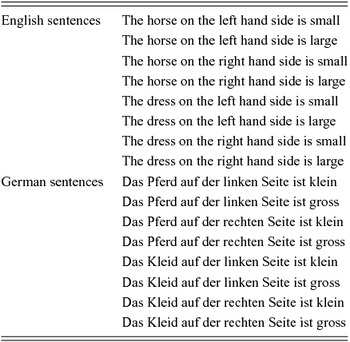
Participants had to read German or English sentences which always had the same syntactical structure and wording (e.g., “THE HORSE ON THE RIGHT HAND SIDE IS LARGE” in English and “DAS PFERD AUF DER RECHTEN SEITE IST GROSS” in German). However, three critical words were changed between sentences: Horse (Pferd) vs. dress (Kleid); right (rechten) vs. left (linken); large (gross) vs. small (klein). Thus, in total, 8 different sentences were repeatedly presented for each language (see Table 1). The sentences were presented in upper case letters (Courier New, 20 pt). As noted in the introduction, we deliberately utilized these highly controlled (and repetitive) sentences to rigorously control for the influence of potentially confounding variables like syntax, semantics, word class, and orthographic features. These variables can vary substantially even when sentences are literally translated, making comparisons between language switches and repetitions difficult to interpret.
List of sentences used in the experiment

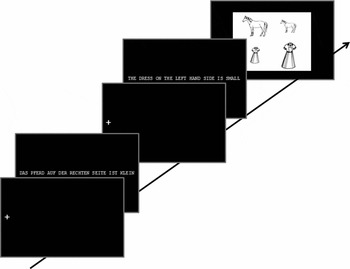
To test for sentence comprehension, we implemented a picture-sentence matching task in which participants decided whether a picture matched the just read sentence or not. Each picture displayed four objects: that is, one horse and one dress on each the right and the left side. The size of the objects varied in a way that on each side one object was small and one was large. In total, four different pictures were used (see Figure 1 for an example).
Example of two sentence reading trials (involving a language switch from German to English) including a picture-sentence matching requirement at the end of the second trial. Picture-sentence matching always referred to the previously read sentence (i.e., in this example to the English sentence).

Apparatus, Task & Procedure
Participants were seated in front of a 21” CRT monitor (100 Hz, 1240 × 1068 pixels) at a viewing distance of 67 cm. We utilized a 500 Hz EyeLink II head-mounted eye tracker (SR Research, Canada) with a chin rest. Nine-point calibration routines were conducted before the experiment started and after each picture-sentence matching requirement (i.e., after every fifth trial on average, see below). The experiment was run in a single session and consisted of a visual instruction followed by four practice trials (i.e., four of the sentences used in the actual experiment, two in German, two in English, each followed by a picture-sentence matching requirement).
For the sentence reading task, 320 sentences were presented centrally on the screen (that is, each sentence was presented 20 times in each language). No filler sentences were included. Each sentence trial started with the presentation of a fixation cross (height & width ½°) for 300 ms on the left side of the screen at the first letter position of the following sentence. Afterwards, a sentence was displayed and participants ended viewing time by a key press (space bar of a standard computer keyboard). Thus, trial-duration was self-paced. This was followed by either the fixation cross of the next sentence trial or by a picture for the picture-sentence matching requirement.
The picture-sentence matching task (to assess sentence comprehension) involved the display of the (centrally presented) picture after a sentence. Since the implementation of this task after each individual sentence would have counteracted our crucial language switch/repetition manipulation, the task was presented after 20% of the sentences only: that is, randomly after every fifth trial on average. Participants decided via key press (right index and middle finger on “arrow up” and “arrow down” keys) as quickly and accurately as possible whether the picture corresponded to the just read sentence. Meaning of the response keys (match vs. mismatch) was counterbalanced across participants. No feedback was provided. Each of the 16 different sentences was combined once with each of the four pictures, so that 64 trials (32 for each language) included the picture-sentence matching task. For each language, half of the picture-sentence matching trials followed a language switch trial and the other half followed a language repetition trial.
Design
For the sentence comprehension analyses, language transition (language repetition vs. language switch) and language of the just read sentence (German vs. English) were within-subject independent variables. For example, a trial involving a German sentence that was preceded by an English sentence (in the previous trial) would qualify as a German language switch trial. Manual response times (RTs of correct responses) and error rates (with respect to the matching decision) were dependent variables.
For the analyses of reading and eye movements, language transition (language repetition vs. language switch) and language (German vs. English) were within-subject independent variables. As dependent variables, we measured sentence reading times (i.e., the interval between sentence onset and the key press ending sentence presentation). With respect to global eye movement measures, we analysed the total number of fixations on the sentence and the percentage of regressions (i.e., eye movements against the reading direction) during sentence reading. With respect to word-based eye movement measures, we analysed the word skipping probability as well as the initial fixation duration (i.e., the duration of the first fixation on the word), gaze duration (i.e., the sum of fixation durations until the eyes leave the word for the first time), and total reading time (i.e., the sum of all fixation durations on the word) for the first, second, and last word of the sentence, respectively. We restricted the analyses to those words because the intermediate part of the sentence (i.e., the sentence passages “AUF DER RECHTEN SEITE” vs. “ON THE RIGHT HAND SIDE”) differed slightly with respect to the number of letters and words.
Results
Sentence comprehension
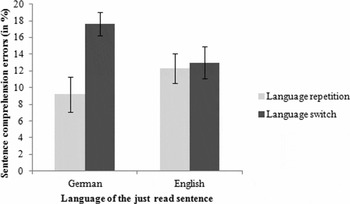
The analysis of errors in the picture-sentence matching task revealed no significant main effect of language (F < 1). However, both the main effect of language transition (F(1,19) = 5.1, p < .05, ηp 2 = .21) and the interaction of language and language transition (F(1,19) = 7.4, p < .05, ηp 2 = .28) were significant. The pattern of results indicates a large language switch cost for comprehension of German sentences (9.2% comprehension errors in German repetition trials vs. 17.6% comprehension errors in German switch trials; see Figure 2) and nearly no language switch cost for comprehension of English sentences (12.3% vs. 13.0%). The analysis of response times yielded no significant main effects or interactions (language: F(1,19) = 2.9, p = .103, ηp 2 = .134; language transition: F < 1; language x language transition: F < 1).
Sentence comprehension errors (in %) as a function of Language Transition (language repetition vs. language switch) and Language (German vs. English). Vertical lines represent standard errors.

Sentence reading times and global eye movement parameters
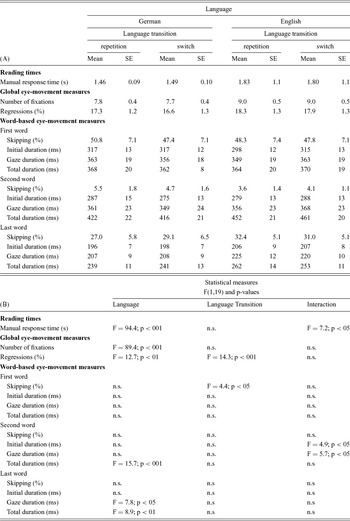
All sentences following a picture-sentence matching requirement were discarded from analyses. The analysis of sentence reading times revealed a significant main effect of language (F(1,19) = 94.4, p < .001, ηp 2 = .83), with faster reading times in German (M = 1.48 s) than in English (M = 1.82 s; see Table 2). The main effect of language transition was not significant, but there was a significant interaction of language and language transition (F(1,19) = 7.2, p < .05, ηp 2 = .28) indicating a small language switch cost for German sentences (1.46 s in repetitions vs. 1.49 s in switches) as opposed to a reversed pattern for English sentences (small language repetition cost: 1.83 s in repetitions vs. 1.80 s in switches).
(A) Sentence reading times, global eye-movement measures (total number of fixations on sentence, percentage of regressions), and word-based eye-movement measures (skipping probability, initial fixation duration, gaze duration and total reading time for the first, second, and last word, respectively) as a function of Language (German vs. English) and Language Transition (language repetition vs. language switch). (B) Statistical measures for each of these dependent variables.

As regards the global eye movement measures, the main effect of language was significant for both the number of fixations (F(1,19) = 89.4, p < .001, ηp 2 = .83), indicating fewer fixations in German sentences (M = 7.7 fixations) than in English sentences (M = 9.0 fixations), and the percentage of regressions (F(1,19) = 12.7, p < .01, ηp 2 = .40) demonstrating fewer regressions in German than in English (17.0% vs. 18.1%). These results correspond to the main effect of language for sentence reading times reported above. Additionally, the main effect of language transition was significant for the analysis of the percentage of regressions (F(1,19) = 14.3, p < .001, ηp 2 = .43), indicating slightly more regressions in repeat than in switch trials (17.8% vs. 17.3%). No further main effect or interaction was significant.
Word-based eye movements
As regards word-based eye movements, a series of analyses of variance was conducted. In the following, we restrict our reports to statistically significant effects for the sake of readability (please refer to Table 2 for a detailed report).
We observed a significant main effect of language for total reading times on the second word (F(1,19) = 15.7, p < .001, ηp 2 = .45) as well as for gaze durations and total reading times on the last word (gaze duration: F(1,19) = 7.8, p < .05, ηp 2 = .29; total reading time: F(1,19) = 8.9, p < .01, ηp 2 = .32). The data pattern shows that these temporal measures were always shorter for German sentences than for English sentences.
A significant effect of language transition was observed only for the skipping probability of the first word (F(1,19) = 4.4, p < .05, ηp 2 = .19), indicating that in language repetition trials the first word was skipped more often than in language switch trials (49.6% vs. 47.6%). Although the effect was numerically more pronounced in German (50.8% for repetitions vs. 47.4% for switches) than in English (48.3% vs. 47.8%), the interaction of language and language transition was not significant (F(1,19) = 1.2, p = .285, ηp 2 = .06).
Finally, and theoretically important, there was a significant interaction of language and language transition for both initial fixation durations (F(1,19) = 4.9, p < .05, ηp 2 = .20) and gaze durations (F(1,19) = 5.7, p < .05, ηp 2 = .23) on the second word. The data pattern demonstrates a higher switch cost in English (9 ms for initial fixation durations and 12 ms for gaze durations) than in German (for which fixation durations were actually larger in language repetition trials than in language switch trials, resulting in switch benefits of 12 ms for both initial and gaze durations).
Discussion
In the present study, we explored the influence of language switching on higher-level language processing (sentence comprehension) and more transient local processing (reflected in eye movements) in reading simple sentences. To summarize the most important findings of the present study, we observed a substantial performance deficit (i.e., reduced accuracy) in the sentence comprehension task when participants switched the language, especially when switching to L1 (German). In contrast, there were relatively minor transient effects of language switching reflected in word-based eye movement parameters. Both findings will be discussed in turn.
Language switch costs for written sentence comprehension
In language switching research, there is broad evidence that switch costs emerge in simple language production tasks like digit or picture naming (for a review, see Bobb & Wodniecka, Reference Bobb and Wodniecka2013). Yet, less is known about the effect of language switching in language comprehension. A few studies observed language switch costs in comprehension tasks but these tasks were also restricted to single word processing (Alvarez et al., Reference Alvarez, Holcomb and Grainger2003; Jackson et al., Reference Jackson, Swainson, Mullin, Cunnington and Jackson2004; Grainger & Beauvillain, Reference Grainger and Beauvillain1987; Orfanidou & Sumner, Reference Orfanidou and Sumner2005; Thomas & Allport, Reference Thomas and Allport2000). Only a limited number of studies focussed on auditory or visual sentence processing (for a review, see Hell et al., in press) but none of these studies actually compared sentence comprehension in language switch vs. language repetition trials.
In the present study, we presented written sentences in L1 or L2 and tested for sentence comprehension by utilizing a picture-sentence matching task. Participants had to judge whether a picture presented in the course of the experiment did match the just read sentence. With this novel design, we observed a substantial increase of errors in the picture-sentence matching task after language switches as compared to language repetitions. Thus, the present study nicely demonstrates that language switch costs also occur in a setting involving written sentence comprehension and adds to the emerging evidence that language switches also affect performance in more complex tasks involving sentences instead of isolated words only (cf. studies on sentence production, Tarlowski et al., Reference Tarlowski, Wodniecka and Marzecová2013). In a broader context, these findings are also in line with studies of, for example, auditory comprehension (cf. Lagrou, Hartsuiker & Duyck, Reference Lagrou, Hartsuiker and Duyck2013 using the visual world paradigm) or word production (Starreveld, de Groot, Rossmark & van Hell, Reference Starreveld, de Groot, Rossmark and van Hell2014 using a picture-naming task) that demonstrate the influence and the importance of a sentence context in language processing.
Interestingly, RTs in the picture-sentence matching task were not affected by our manipulations. This finding indicates that the actual speed of the comprehension process did not differ as a function of language switching. Instead, it is possible that confusability with respect to the re-occurring objects (horse, dress) and attributes (small, large) in our sentence material may have contributed to the effects. While on the one hand this interpretation suggests that our present effects may overestimate comprehension issues in real-life scenarios (with less potential for confusability issues), it also shows that our present task may be especially sensitive to detect sentence comprehension differences as a function of language switching.
Switch-cost asymmetry in sentence comprehension and sentence reading times
A further observation with respect to sentence comprehension was that the accuracy decrease due to language switches was greater when switching from L2 (English) to L1 (German) as compared to switching from L1 to L2. The larger switch cost for the more dominant language is in line with previous language switching studies on language production (e.g., Meuter & Allport, Reference Meuter and Allport1999; Philipp et al., Reference Philipp, Gade and Koch2007; Verhoef et al., Reference Verhoef, Roelofs and Chwilla2009). Although this switch-cost asymmetry has not been observed universally (see e.g. Costa & Santestaben, Reference Costa and Santesteban2004; also see Bobb & Wodniecka, Reference Bobb and Wodniecka2013, for an overview), it is usually interpreted as demonstrating a larger inhibition of the more dominant language (cf. Green, Reference Green1998). More specifically, it is assumed that in a language switching situation, the currently irrelevant language has to be inhibited in order to allow for processing in the relevant language. Because the dominant language (L1) has a higher a priori activation than the less dominant L2, a higher reactive inhibition of L1 than of L2 is necessary. As a consequence, overcoming persisting inhibition of L1 (when switching from L2 to L1) may be more demanding than overcoming persisting inhibition of L2 (when switching from L1 to L2).
While our present results do not directly allow us to conclude that inhibitory processes play a major role, they nevertheless support the notion that similar inhibitory mechanisms not only hold for lexical selection in language production but also for global, higher-level language processing in language comprehension. In the BIA-d model (Grainger et al., Reference Grainger, Midgley and Holcomb2010), this type of language switch cost is attributed to top-down, endogenous mechanisms involving the inhibition of the currently irrelevant language node.
Moreover, this interpretation is also in line with the data pattern found with respect to sentence reading times in the present study as they showed a larger language switch cost for the dominant language than for the non-dominant language. Taken together, our experiment provides evidence for the claim that global aspects of sentence comprehension and text integration are affected by language switching, and that this effect is larger for L1 than L2.
Transient language switching effects on word-based eye movement parameters
Next to the global measures of sentence comprehension, we also analyzed more transient word-based processes as reflected in the eye movement record. According to the BIA-d model (Grainger et al., Reference Grainger, Midgley and Holcomb2010), exogenous (i.e., stimulus-driven) activation effects should mainly influence processing of the first words in a sentence. Thus, it is interesting to note that we indeed observed a (small) influence of language switching on word-based eye movement control especially for the first words in a sentence. More specifically, we found that participants skipped the first function word at the beginning of a sentence more often in language repetition trials than in language switch trials. Word skipping usually results from several factors including processing ease and visual factors such as word length (e.g., see Drieghe, Brysbaert, Desmet & De Baecke, Reference Drieghe, Brysbaert, Desmet and De Baecke2004). However, it is important to note that in our design, the skipping of the first word differs from typical skipping effects reported in the literature, where skipping is usually analysed for words within a sentence that had the chance to be processed parafoveally during the previous fixation.
Instead, the greater tendency towards skipping the first word in language repetition sentences in our present study may represent a strategic decision based on anticipated processing ease. Put differently, when the language switched, participants may have tended to skip the first word less often because of the perceived language switch, reflecting a more “careful” reading strategy (see, O’Regan, Reference O’Regan and Rayner1992; Radach, Huestegge & Reilly, Reference Radach, Huestegge and Reilly2008, Radach, Schmitten, Glover & Huestegge, Reference Radach, Schmitten, Glover, Huestegge, Wagner, Schatschneider and Phythian-Sence2009; Rayner, Sereno & Raney, Reference Rayner, Sereno and Raney1996, for influences of reading strategies on oculomotor control). This careful strategy may also explain why we observed a slightly lower regression rate for language switch trials (see Booth & Weger, Reference Booth and Weger2013, for typical factors influencing regression rates in sentence reading), since careful reading has been reported to be associated with lower regression rates (e.g., Huestegge, Radach, Corbic & Huestegge, Reference Huestegge, Radach, Corbic and Huestegge2009).
Further, we observed that both initial fixation durations and gaze durations on the second word (i.e., the first content word in the sentence) showed an asymmetric switch cost, which was larger for English than for German (i.e., reversed to the switch cost pattern in comprehension). This effect could, on the one hand, partly be a consequence of the higher skipping rate for the first word in language switch vs. language repetition trials (i.e., slightly increased fixation times in order to additionally process the skipped word). On the other hand, this finding might well reflect transient exogenous effects related to language switches (cf. Grainger et al., Reference Grainger, Midgley and Holcomb2010). Note that exogenous effects are assumed to be based on activation (instead of inhibition) processes affecting the language nodes, and should therefore lead to a larger processing benefit for L1 than L2 (thus corresponding to the observed larger switch cost for L2 than L1). This interpretation is further supported by the fact that the numeric data pattern for the initial fixation duration on the first word also shows a tendency towards a larger switch costs for L2 (17 ms) than for L1 (0 ms), although this interaction was not statistically significant (F(1,19) = 1.6, p = .223, ηp 2 = .08). Thus, we cautiously conclude that the observed larger switch costs for L2 than L1 in the temporal measures at the sentence beginning are in line with the assumption of short-lived exogenous effects that influence the processing of the first words in a sentence when switching from one language to another (for similar findings in intra-sentential code-switching see the review by van Hell et al., in press).
Long-term endogenous vs. short-term exogenous effects
As predicted by BIA-d (Grainger et al., Reference Grainger, Midgley and Holcomb2010), we observed opposing patterns of asymmetrical switch costs for short-term, local processing (reflected in eye movements on the first words in a sentence) and more long-term, global processing variables (sentence comprehension and overall sentence reading time). That is, whereas short-term exogenous effects resulted in a (numerically) larger switch cost for L2 than L1 in eye movement measures, long-term endogenous effects led to larger switch cost in L1 than L2 with respect to sentence comprehension. The results of the present study, thus, demonstrate a clear distinction between online measures of word processing and higher-level text integration processes. However, one should also note that despite the statistical significance of some of the eye movement measures reported above, the actual effect sizes (as opposed to those in the comprehension scores) appear to be relatively small. Thus, even though these small effects are theoretically informative regarding theories such as BIA-d, they do not appear to represent substantial obstacles experienced by readers in real-life scenarios, where comprehension usually matters more than gaining or losing a few milliseconds during text decoding. Our conclusion that (at least in skilled readers) eye movement routines are not substantially influenced by language switching is additionally supported by the finding that there was no significant difference in the number of fixations across language switch and repetition trails.
Based on these considerations, we conclude that the adverse language switch effect on comprehension is not likely due to impaired online processing of the first words after a language switch, but rather due to more error-prone high-level text integration processes that may even extend after the actual visual scanning of the sentence. Specifically, it appears conceivable to assume that sentence processing after a language switch tends to be more resource demanding. However, these resource limitations may not directly disrupt the speed or quality of online word processing in a substantial way (which is possibly based on relatively automated processing routines), but only become evident in the very final steps of the comprehension process that primarily takes place after visual sentence scanning, eventually generating a more error-prone outcome of overall sentence comprehension.
General L1 processing advantage
Finally, it is interesting to note that the eye movement measures in the present study are clearly sensitive enough to show that L1 processing is easier than L2 processing. Specifically, we observed that participants showed overall faster reading times and fewer fixations for the native language (German) than for the foreign language (English). This effect was also observed in the total reading times of the second and last word of the sentence, indicating that these effects may represent a generally increased processing difficulty for L2 throughout the whole sentence due to the different degree of L1 vs. L2 proficiency (cf. Moreno, Rodríguez-Fornells & Laine, Reference Moreno, Rodríguez-Fornells and Laine2008). Additionally, these findings may partly be explained by the different sentence characteristics (e.g., number of words/letters) across languages (see Pynte & Kennedy, Reference Pynte and Kennedy2006, for research on reading in different languages).
Limitations of the present study
One major limitation of the present study has already been discussed in the Introduction and Methods sections: namely, our choice to utilize quite restricted, repetitive, and non-coherent sentence material in order to allow for rigorous experimental control. This may have caused two distinct (but related) problems. First, it is possible that participants in our study did not really read the text but simply searched for the critical words to successfully master the picture-sentence matching requirements. Second, our choice to use restricted sentence material substantially constrains any generalization to natural reading in real-life contexts.
Regarding the first issue, a number of observations appear to speak against the objection that our participants turned the reading task into a search task. First, the skipping data for the first word indicate that at least in half of the trials this function word was actually fixated. If participants only searched for the relevant target words, such a high rate of fixations on the initial (non-target) word in each sentence would not be plausible. Second, the regression rates indicate that most eye movements moved from left to right, indicating typical reading behavior. Finally, the mean number of fixations appears to be typical for reading sentences of the length used in our study. Thus, there is at least no strong empirical evidence to assume that specifics of our task demands impeded the occurrence of typical reading behavior, so that we suppose that participants indeed read the sentence instead of searching for isolated key words only.
Regarding the second issue (generalization to natural reading), we already mentioned the advantage of more rigorous experimental control over potentially confounding variables. Second, it is important to note that from the viewpoint of previous single-word studies on language switching, our present sentence reading approach actually represents a first step towards more natural reading behavior. Third, our results suggest that our task appeared to be quite sensitive to reveal comprehension differences, probably precisely because of the repetitive sentence material that may have boosted the potential for confusability. Nevertheless, we clearly acknowledge the associated disadvantage regarding the generalization to naturalistic reading situations, and suggest that further, converging evidence based on studies involving more realistic reading material would represent a worthwhile addition to the present approach.
Finally, another limitation regards our choice of languages involved in this study (English and German, sharing similar roots). For example, it is unclear to what extent our conclusions apply to languages which differ in script or in writing direction. Specifically, our transient effects on word-based eye movement control may no longer hold in these contexts, and further research is clearly needed to shed some light on these issues.
Conclusion
The present study demonstrates that language switches can have substantial negative effects on the processing of written sentences. Yet these issues appear to occur only to a relatively small extent on the level of word processing immediately following a language switch (as reflected by corresponding eye movements), but mainly when the final outcome of overall sentence comprehension is generated.