The need to systematically describe and quantify the language skills of bilinguals participating in language research has long been recognized (Fishman & Cooper, Reference Fishman and Cooper1969; Grosjean, Reference Grosjean1998). In recent years studies are more likely to include some descriptors of bilingual participants' language but to date there is not yet consistent reporting of participant descriptors in line with Grosjean's recommendations. Measures of language proficiency and dominance help us decide who is eligible to participate in our studies but there are no commonly accepted ways to establish bilingual development. Quantifying level of bilingualism is a critical step towards being able to reliably compare findings across studies of bilingualism and building our knowledge of bilingual language development and related areas such as cognitive development and educational outcomes. Here we explore if different ways of operationalizing language proficiency and dominance result in the same classifications of pre-kindergarten and kindergarten age bilingual children. This will help researchers determine what combinations of measures will permit comparison across studies and are most relevant for their own work. We begin by discussing how theoretical perspectives on bilingual development might influence questions about dominance and proficiency, and by defining language dominance and proficiency. Then we review how dominance and proficiency are measured in current work on bilingual language development.
Theoretical perspectives on bilingual development
Theoretical frameworks influence the questions researchers ask about bilingual language proficiency and dominance as they classify participants. Studies of bilingual development rooted in theories of universal grammar often focus on documenting the learner's exposure to the language(s) of interest (Ionin, Zubizarreta & Philippov, Reference Ionin, Zubizarreta and Philippov2009; Serratrice, Sorace, Filiaci & Baldo, Reference Serratrice, Sorace, Filiaci and Baldo2009). From this perspective exposure to the language(s) is what is required for the learner to access their innate ability to acquire the language. Other theoretical perspectives emphasize the possibility of a critical period for native-like acquisition of language. From this theoretical perspective, questions about bilingual development are likely to focus on the age of first exposure to the language (Montrul, Reference Montrul2009). Neither of these theoretical frameworks proposes a strong role related to the amount of use of each of these languages. As a result, work informed by these theories has not had a strong focus on the amount of experience that children have with the languages that they are exposed to.
Recently much attention has been given to usage-based theories of language acquisition and the role of competition between the two languages in acquisition (Jorshchick, Quick, Glässer, Lieven & Tomasello, Reference Jorshchick, Quick, Glässer, Lieven and Tomasello2011; Li, Reference Li2009; Paradis, Reference Paradis2010). Both the nature of input (e.g., the similarities and differences in the structures to be learned in the language) and the amount of input available in the language influence language learning. In classifying participants as bilingual from this perspective it would be important to consider the learner's opportunities to hear and use the languages of interest.
Who is bilingual? Defining proficiency and dominance
Language proficiency describes the extent to which a bilingual's skills in one or both of their languages meet age-based native speaker or monolingual expectations. Proficiency has been defined relative to a monolingual speaker's vocabulary size (Bialystok, Luk, Peets & Yang, Reference Bialystok, Luk, Peets and Yang2010) or grammatical skills (Windsor, Kohnert, Loxtercamp & Kan, Reference Windsor, Kohnert, Loxtercamp and Kan2008). Language dominance, on the other hand, describes the relative proficiency (Gathercole & Thomas, Reference Gathercole and Thomas2009), or the language to which the child has had the most exposure (Grosjean, Reference Grosjean2010).
Because there are multiple paths to bilingualism, several metrics have been used to determine children's language proficiency and dominance. Bilingual language learning is influenced by age of first exposure, opportunities to use each language, context of learning, social value of the languages, and education among other factors. Given the multidimensional nature of bilingual language acquisition, it is important to consider how the measures employed impact the determination of dominance and proficiency.
Documenting language history
Documenting history of dual language exposure is the most common way to establish bilingual status, but researchers do this differently. Some researchers ask if two languages are used at home (Carlson & Meltzoff, Reference Carlson and Meltzoff2008; Gathercole & Thomas, Reference Gathercole and Thomas2009; Pérez-Leroux, Pirvulescu & Roberge, Reference Pérez-Leroux, Pirvulescu and Roberge2009; Yan & Nicoladis, Reference Yan and Nicoladis2009) or school (Hakansson, Salameh & Nettelbladt, Reference Hakansson, Salameh and Nettelbladt2003; Hammer, Lawrence & Miccio, Reference Hammer, Lawrence and Miccio2008; Ionin et al., Reference Ionin, Zubizarreta and Philippov2009; Kan & Kohnert, Reference Kan and Kohnert2005, Reference Kan and Kohnert2008; Kohnert & Danahy, Reference Kohnert and Danahy2007; Martin-Rhee & Bialystok, Reference Martin-Rhee and Bialystok2008; Oller & Eilers, Reference Oller and Eilers2002; Paradis, Crago, Genesee & Rice, Reference Paradis, Crago, Genesee and Rice2003; Simón-Cereijido & Gutiérrez-Clellen, Reference Simón-Cereijido and Gutiérrez-Clellen2009; Veii & Everatt, Reference Veii and Everatt2005). In contrast other researchers quantify home and or school use on the basis of total years of L2 exposure (Roseberry & Connell, Reference Roseberry and Connell1991; Windsor & Kohnert, Reference Windsor and Kohnert2004; Windsor et al., Reference Windsor, Kohnert, Loxtercamp and Kan2008), or age of first exposure to the L2 (Jia, Kohnert, Collado & Aquino-Garcia, Reference Jia, Kohnert, Collado and Aquino-Garcia2006; Kan & Kohnert, Reference Kan and Kohnert2008). Researchers have matched simultaneous bilinguals by age (Serratrice, Reference Serratrice2007) or by length of residency in the country where L2 is spoken (Jia, Aaronson & Wu, Reference Jia, Aaronson and Wu2002). Approaches that quantify bilingual input or output as well as history of bilingual exposure are potentially informative since they provide a means of comparison of direct performance. Given the face validity of age of first exposure as an indicator of bilingual development and its predominance as a selection criterion in the literature, we would expect age of first exposure to be informative. However, we still need to evaluate if age of first exposure is a good predictor of language proficiency or dominance.
An alternative to classifying children as bilingual based on age of first exposure is to focus on current patterns of L1 and L2 exposure. This approach has been incorporated into language questionnaires for children (Gutiérrez-Clellen & Kreiter, Reference Gutiérrez-Clellen and Kreiter2003; Restrepo, Reference Restrepo1998) and adults (Dunn & Fox Tree, Reference Dunn and Fox Tree2009; Li, Sepanski & Zhao, Reference Li, Sepanski and Zhao2006). Questionnaires often elicit information about patterns of input and output, age of first exposure to the L1 and L2, as well as, proficiency ratings (Grosjean, Reference Grosjean1998; Patterson, Reference Patterson1999). For children, however, parents and teachers provide more reliable ratings of current behavior than of global characteristics such as whether or not children meet the age-based expectations for language development (Marchman & Martinez-Sussman, Reference Marchman and Martinez-Sussman2002). Parents and teachers can provide information about both languages but are more accurate in providing an account of the language in which they interact with the child (Bedore, Peña, Joyner & Macken, Reference Bedore, Peña, Joyner and Macken2011; Gutiérrez-Clellen & Kreiter, Reference Gutiérrez-Clellen and Kreiter2003). Based on data from these types of questionnaires, children have been described based on their percentage of input (Simón-Cereijido & Gutiérrez-Clellen, Reference Simón-Cereijido and Gutiérrez-Clellen2009), output (Jacobson & Schwartz, Reference Jacobson and Schwartz2002; Peña, Bedore & Zlatic-Guinta, Reference Peña, Bedore and Zlatic-Guinta2002) or input and output combined (Bunta, Fabiano-Smith, Goldstein & Ingram, Reference Bunta, Fabiano-Smith, Goldstein and Ingram2009; Sheng, McGregor & Marian, Reference Sheng, McGregor and Marian2006). These values then would provide a means for comparing bilinguals across studies, but as with indicators of age of first exposure we need to understand how estimates of current use relate to language dominance and proficiency.
Tests of language proficiency and dominance
For adults, self-ratings of proficiency seem to serve as reliable indictors of language proficiency (Gollan, Weissberger, Runnqvist, Montoya & Cera, in press). In contrast, it appears that adults can more accurately describe current skills than rate children's language knowledge (García, Pérez & Ortiz, Reference García, Pérez and Ortiz2000; Jackson-Maldonado, Thal, Marchman, Newton, Fenson & Conboy, Reference Jackson-Maldonado, Thal, Marchman, Newton, Fenson and Conboy2003; Thal, Jackson-Maldonado & Acosta, Reference Thal, Jackson-Maldonado and Acosta2000). This may be because bilingual children's language knowledge is distributed across two languages. Additionally, because children's proficiency is a frequently changing target, parents and teachers may be challenged to accurately judge each of the child's languages especially if they do not interact with the child in that language (Jia et al., Reference Jia, Kohnert, Collado and Aquino-Garcia2006; Paradis et al., Reference Paradis, Crago, Genesee and Rice2003; Uccelli & Páez, Reference Uccelli and Páez2007). Direct measures of language knowledge and of bilingual proficiency and dominance would appear to be more objective alternatives but in fact introduce other complications into the determination of proficiency and dominance as discussed below.
Proficiency can be established through performance on test batteries designed specifically for that purpose such as the Woodcock–Muñoz Language Survey – Revised (Woodcock, Muñoz-Sandoval, Ruef & Alvarado, Reference Woodcock, Muñoz-Sandoval, Ruef and Alvarado2005) or tests of general language ability like the Peabody Picture Vocabulary Test (Dunn & Dunn, Reference Dunn and Dunn1997; e.g., Bialystok & Viswanathan, Reference Bialystok and Viswanathan2009; Reyes & Hernández, Reference Reyes and Hernández2006; Vagh, Pan & Mancilla-Martinez, Reference Vagh, Pan and Mancilla-Martinez2009). Researcher-designed proficiency batteries (Dunn, Padilla, Lugo & Dunn, Reference Dunn, Padilla, Lugo and Dunn1986) are also sometimes used to establish proficiency in particular domains such as grammar (Jia et al., Reference Jia, Aaronson and Wu2002) or word learning (Kan & Kohnert, Reference Kan and Kohnert2005) where tests are unavailable in the target language or unsuitable for the desired task. An advantage of standardized measures such as the Peabody Picture Vocabulary Test or the Woodcock–Muñoz Language Survey is that they have large normative samples and as a group these tests have been shown to be reliable and valid for their designed purposes (Alvarado, Ruef & Schrank, Reference Alvarado, Ruef and Schrank2005; Dunn & Dunn, Reference Dunn and Dunn1997).
Dual language measures assign language proficiency levels in each of two languages ranging from non-proficient to proficient. They differ somewhat with respect to test content. Tests such as the IDEA Oral Language Proficiency Test (IPT–II; Dalton, Amori, Ballard & Tighe, Reference Dalton, Amori, Ballard and Tighe1991) or the Language Assessment System Links (LAS Links; DeAvila & Duncan, Reference DeAvila and Duncan1990) focus on oral language development; others systematically combine language and academic language assessment (ACCESS for ELLs; World-Class Instructional Design and Assessment Consortium, 2007), and/or focus on a combination of oral and written language, as is the case with the Woodcock–Muñoz Language Survey – Revised (Woodcock et al., Reference Woodcock, Muñoz-Sandoval, Ruef and Alvarado2005). A challenge in selecting proficiency tests for measuring oral language is that they conflate academic content and language proficiency. If children are lacking the targeted academic knowledge the test may underestimate their language proficiency.
Another way to evaluate the validity of language proficiency measures is to test them against the performance of monolingual speakers of the target language who should score in the “fluent” range. But, the results of such evaluations suggest that proficiency tests may exact too high a standard. For example, Pray (Reference Pray2005) administered the Language Assessment System, the IDEA Oral Proficiency Test, and the Woodcock–Muñoz Language Survey to a group of native English-speaking Hispanic children. While all of the children were classified as fluent English speakers on the Language Assessment System, 85% of the children scored as fluent on the Idea Oral Proficiency Test, and none was identified as fluent English on the Woodcock–Muñoz Language Survey. MacSwan and Rolstad (Reference MacSwan and Rolstad2006) and Fey (Reference Fey2001, cited in Pray, Reference Pray2005) documented the same pattern of classification in Spanish with the Spanish versions of these tests. These findings suggest that some tests may set too high a bar thus potentially underestimating the language skills of bilingual children.
Dominance is a measure of relative performance that is evaluated in different ways. In some research dominance is determined by relative performance on the two language versions of language proficiency tests. In other cases researchers have compared performance on different language versions of language ability tests to evaluate dominance. It is important to keep in mind that parallel versions of these tests were not developed and validated for the intent of comparing performance across languages. For example, the Test de Vocabulario en Imagenes Peabody (Dunn et al., Reference Dunn, Padilla, Lugo and Dunn1986), the Spanish version of the Peabody Picture Vocabulary Test available in the U.S.A., does not meet standards of test translation and validation (Prewitt Diaz, Reference Prewitt Diaz1988). As a group these findings suggest that, while direct testing of language ability might appear to be the more objective measure of bilingualism, proficiency testing is not as straightforward a solution as it seems.
Patterns of language dominance and proficiency
Growth patterns across linguistic domains further complicate decisions about proficiency and dominance. Bilingual children, like monolingual children, demonstrate growth in vocabulary without marked increases in grammatical skills until they reach a certain threshold of vocabulary knowledge (Caselli, Casadio & Bates, Reference Caselli, Casadio and Bates1999; Marchman & Martinez-Sussman, Reference Marchman and Martinez-Sussman2002; Thal, Bates, Goodman & Jahn-Samilo, Reference Thal, Bates, Goodman and Jahn-Samilo1997). At this early stage of bilingual language development, children's dominance may be driven by their semantic knowledge, and estimates based on grammatical knowledge may not be accurate.
Beyond the emerging language stage bilingual children may demonstrate cross-domain dominance differences. For example, Paradis et al. (Reference Paradis, Crago, Genesee and Rice2003) classified French–English bilinguals as dominant in the language in which they demonstrated higher performance on three out of five measures including mean length of utterance (MLU), the length of the longest utterance in words, number of unique words, number of unique verb types, and total number of utterances. Children classified as French dominant or English dominant demonstrated idiosyncratic patterns of dominance across these measures.
Dominance patterns fluctuated longitudinally by domain. Children followed over time and tested at regular intervals showed changes in the degree of difference between their two languages in MLU (Yip & Matthews, Reference Yip and Matthews2006) as well as phonology, semantics, and syntax (Verhoeven, Reference Verhoeven2007). Thus judgments about proficiency made at one time point may not be stable over time.
Children's dominance patterns can shift as they move from using the home language to using the community or school language. In a cross-sectional study of school age children, Kohnert and Bates (Reference Kohnert and Bates2002) found that, for Spanish–English bilinguals who started to learn English at school entry, English overtook Spanish receptive knowledge by 11–13 years of age. However, English production did not surpass Spanish expressive knowledge until children were between 14 and 16 years old (Kohnert, Bates & Hernández, Reference Kohnert, Bates and Hernández1999). What is most relevant is that the shift in dominance is gradual and occurs in different domains at different time points.
In sum, researchers have used a number of measures to determine participant's level of bilingualism in studies of bilingual language development. It is difficult to compare findings across studies for at least two reasons: measures based on language history may not include sufficient data upon which to make a comparison (e.g., a sequential bilingual who regularly uses both of their languages may not have comparable skills to a bilingual who has been exposed to two languages from birth but uses one language more than the other); and we do not know which language measures are most stable for predicting bilingual performance.
With these concerns about the comparability of language dominance and proficiency measures in mind, we analyzed data from parent questionnaires that included age of first exposure via questions about history of English and Spanish use on a year by year basis, current use patterns, as well as direct measures of child language ability. We compared direct measures of performance in semantics and morphosyntax domains as a function of language experience. We were interested in how functional definitions of proficiency and dominance affect such classifications in a group of pre-kindergarten and kindergarten age bilingual children. Our questions included:
(i) What is the relationship between experience (as measured by input, output, and year of first English exposure) and measures of ability in semantics and morphosyntax in pre-kindergarten and kindergarten age children?
(ii) To what extent are children classified in the same dominance group across experience- and performance-based measures?
(iii) What language experience variables best predict semantics and syntax dominance at pre-kindergarten and kindergarten age?
Method
Participants
Data for the current study were collected as part of a larger research program on the rate of risk for language impairment in Spanish English bilinguals (see Peña, Gillam, Bedore & Bohman (Reference Peña, Gillam, Bedore and Bohman2011) for more information about risk outcomes). The participants were Latino children who spoke Spanish, English or both and who were enrolled in pre-kindergarten programs, attending pre-kindergarten screening events, or starting kindergarten in one of three school districts serving large numbers of Hispanic children (three school districts in Texas, U.S.A. and Utah, U.S.A.). Children had a mean age of 5;3 years (63.39 months; SD 4.71 months) at the time of screening. Of the 1192 students who completed language screening, there were 948 from the Texas districts and 250 from the Utah school district. Most of the children received free (56.92%) or reduced (12.18%) lunch. Six hundred and forty-nine (54.17%) of the children were female. One hundred and sixty-one (13.5%) students were excluded from this analysis due to missing parent questionnaire data, missing race or ethnicity indicators. Two additional children were excluded because of incomplete testing or incomplete data on daily language use. In total 1029 children were included in the analysis. Children represented the full range of bilingual experience: 50.3% of the children started to acquire English at or before the age of two years, and 49.7% started to acquire English at the age of three years or later.
Measures
Participants' parents completed an interview by phone or in person in their preferred language (Gutiérrez-Clellen & Kreiter, Reference Gutiérrez-Clellen and Kreiter2003). The interview is part of the Bilingual English Spanish Oral Language Screening (BESOS, being developed by Elizabeth Peña, Lisa Bedore, Vera Gutiérrez-Clellen, Aquiles Iglesias and Brian Goldstein) protocol administered to the children. In the interview, parents classified their child's home and school language use as English, Spanish or both for each year of their child's life. For example, the parents were asked “From the ages of 0 to 1 year, did you speak English, Spanish or both to your child at home?” and “Did your child attend school or day care?” If so, they were asked if the day care provider spoke English, Spanish, or both. The year of first exposure to English was counted at the first year in which “English” or “both” was reported at home or at school.
Parents were also asked about their child's input and output on an hour-by-hour basis for each of the child's waking hours. For example, a parent was asked the following series of questions for each of the child's waking hours, “From 7 to 8 am who is your child with?”, “What language do you/they speak to the child in?”, and “What language does the child respond in?” until the whole day was systematically addressed. The purpose of the first question was to help the parent think about the child's schedule. The second and third questions were used to calculate input and output respectively. Parents described a typical weekday and a typical weekend day. For each day the Spanish and English hours were summed (input and output separately). Hours that were reported as “both” were divided equally between Spanish and English regardless of the number of interlocutors reported for each hour. The weekday and weekend day data were totaled with the weekday total weighted by five and the weekend total weighted by two. These were divided by the child's waking hours and converted into a single percentage reflecting input and output. This information was used to explore ways to group children by language experience.
The questionnaire also included information about the family's socio-economic status. Parents provided information about their education and occupation. They also were asked if their children participated in the free and reduced lunch status. Data on free and reduced lunch status is included as the primary indicator of socio economic status. In U.S. schools children qualify for free or reduced lunch status if their family is at or below 185% of the federal guideline for poverty status based on family size (USDA, http://www.fns.usda.gov/cnd/Lunch/ retrieved 8/17/11).
Children completed the BESOS in English and Spanish. The BESOS subtest items were drawn from the experimental item pool of the Bilingual English Spanish Assessment (BESA; currently being developed by Elizabeth Peña, Vera Gutierrez-Clellen, Aquiles Iglesias, Brian Goldstein and Lisa Bedore). The BESA is an assessment instrument for four-to-six-year-old bilingual children and is designed to identify speech and language learning impairments in this population. Items for the BESOS were selected to show growth in the morphosyntax and semantics and to identify children with possible language learning impairments. Thus, increased scores on the BESOS are indicative of increased proficiency in the target language and domain. Children's scores on the BESOS correlate between .83 and .89 with the corresponding subtest on the experimental version of the BESA (Bohman, Bedore, Peña, Méndez-Pérez & Gillam, Reference Bohman, Bedore, Peña, Méndez-Pérez and Gillam2010). Test retest reliability ranges from .64 to .89 by subtest (Summers, Bohman, Gillam, Peña & Bedore, Reference Summers, Bohman, Gillam, Peña and Bedore2010). We report percentage scores for each scale.
The BESOS included semantics and morphosyntax subtests. The semantics subtests contained items that assessed knowledge of categories or concepts (e.g., “Tell me all the foods you can think of.” and “Red, blue, yellow and green are all . . .”). In Spanish there were 12 four-year-old items and 12 five-year-old items. In English there were 10 four-year-old items and 11 five-year-old items. Responses to the BESOS semantics items were permitted in either language but for this analysis scores were based on the target language responses only. The morphosyntax subtests included cloze and sentence repetition items that targeted challenging forms in each language (e.g., past tense -ed, third person present tense –s, and copulas in English; and articles, direct object clitics, and subjunctive in Spanish). In Spanish the morphosyntax subtest included 11 cloze and five sentences repetition items for four-year-olds and 12 cloze and four sentence repetition items for -year-olds. In English the morphosyntax subtest included 11 cloze and six sentence repetition items for four-year-olds and 10 cloze and seven sentence repetition items for five-year-olds. All children were administered the English and Spanish language versions of the semantics and morphosyntax BESOS subtests in one, 20-minute session. To minimize frustration, subtests were discontinued when children failed to respond to five consecutive questions. Bilingual testers (certified speech language pathologists and speech language pathology students) administered and scored all tests.
Results
Relationships between experience and language dominance and proficiency
The first question examined the relationship between the relative proportion of English and Spanish that children hear and use during a typical week. The correlation between input and output within languages was .95. Thus, input and output within each language were averaged for subsequent analyses. We call this variable English use. It was inversely related to Spanish use.
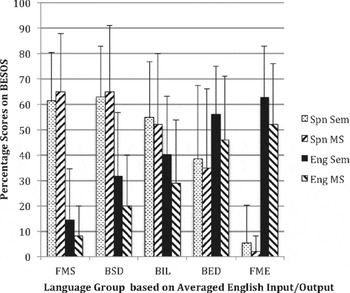
With the use data combined, we present data in Figure 1 on the distribution of test scores to illustrate how the children performed across the full range of bilingualism. We divided the children into five groups (Functional Monolingual English, Bilingual English Dominant, Balanced Bilingual, Bilingual Spanish Dominant and Functional Monolingual Spanish) based on their combined input and output. Children were classified as functionally monolingual if their input or output in the target language was between 80% and 100% or between 0% and 20% in the other language. Children were considered Bilingual Dominant if their use was between 80% and 60% in their dominant language and between 20% and 40% in their other language. Finally, if children used 40% and 60% English and Spanish, they were classified as Balanced Bilingual. An examination of the data shows that children in the Functionally Monolingual Spanish group were very limited in English while the Functionally Monolingual English children were very limited in their knowledge of Spanish. The bilingual groups all demonstrated knowledge of the other language.
Mean BESOS scores by language group based on averaged input and output.

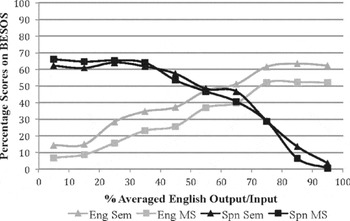
The next analysis examined the relationship between percentage of English use and morphosyntax and semantics performance in both languages. English use was divided into 10 intervals in 10% increments. Figure 2 shows the average English and Spanish language performance for each 10% increment of English use.
Mean BESOS scores by decile categories of averaged English use.

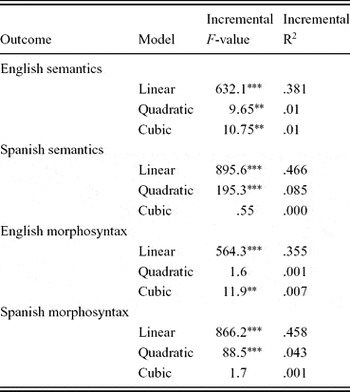
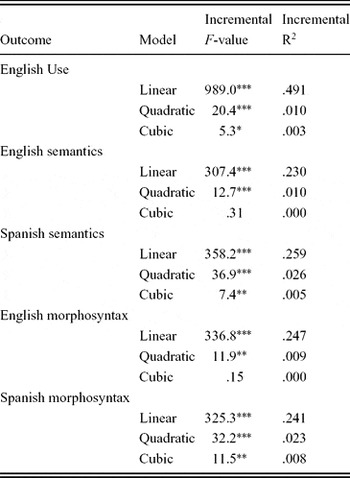
To test the nature of relationship between English use and language performance, linear (y = b0+b1x), quadratic (y = b0+b1x+b2x2) and cubic (y = b0+b1x+b2x2+b3x3) relationships were estimated (see Table 1). Performance was treated as a continuous variable in the analyses. For each of the subtests the non-linear models yielded statistically significant changes in R2 over the linear models. For three out of the four domains the quadratic model provided the best fit for the data. For English semantics the R2 associated with the quadratic model was .382 (incremental R2 = .01); for Spanish semantics it was .551 (incremental R2 = .085); and for Spanish morphosyntax it was .501 (incremental R2 = .04). For the English morphosyntax the cubic model provided the best fit with an R2 of .363 and (incremental R2 = .008). Note that the R2 values reported here correspond to the incremental R2 value for the linear model plus the incremental R2 values associated with best fitting models (i.e., the quadratic model in most cases).
Model summary of regression analyses using different estimation methods.

*p < .05, **p < .01, ***p < .001
Note: English Use was the independent variable.
The non-linear nature of change in performance patterns is evident for each of the subtests. For English, there was a steady rise in performance related to increase in English use. For English semantics and morphosyntax, performance started to flatten out at about the 75% level of English use. The gap between English semantics and morphosyntax was consistent across the full range of use. For Spanish, there was a higher but flat level of performance from 0% to 40% English use (corresponding to 60%–100% Spanish use). Performance in Spanish started to fall sharply between 40% to 100% English use (0%–60% Spanish use). The drop in Spanish semantics was more pronounced than in Spanish morphosyntax.
Comparing across the children's two languages, English semantics scores were higher than Spanish semantics scores for children who had from 80% to 100% English usage with performance on the Spanish semantics test being higher than scores on the English semantics test for children who had between 0% and 80% English usage. In contrast, English morphosyntax performance was higher than Spanish morphosyntax performance for children who had 50% and 100% English usage. Performance on the Spanish morphosyntax test was higher than the English morphosyntax test when English usage was between 0% and 50%. Finally, note that children with 50% and 80% English usage demonstrated mixed dominance. For example, if tested at 60% usage of English, children would appear to be English dominant if given a semantics test but Spanish dominant if given a morphosyntax test. This pattern of results is consistent with the best performance corresponding to the language in which the child had the most experience. However, because the crossover from better performance in Spanish to English differs by domain, the content of the dominance or proficiency measure (i.e., more emphasis on semantics or morphosyntax) will influence the child's classification.
Language proficiency as a function of age of first exposure to English
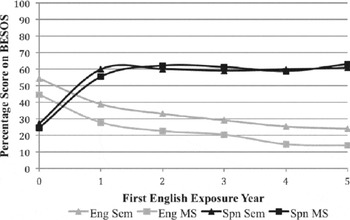
The next set of analyses explored the relationship between first year of English exposure and performance on the semantics and morphosyntax measures in Spanish and English as indicators of proficiency. In these analyses, year of first exposure to English ranged from birth to six years (0–5 on the x-axis of Figure 3). We plotted the mean percentage of correct responses for each screener subtest (semantics and morphosyntax in Spanish and English) as a function of each year of first exposure to English (Figure 3). Table 2 shows the summaries of the regression analyses. Here, the R2 is .231 for English semantics, .247 for English morphosyntax, .290 for Spanish semantics, and .272 for Spanish morphosyntax. As for the current use, variable there was a significant non-linear component that represented a better data fit than did the linear component.
Mean correct responses for each screener subtest (morphosyntax and semantics in Spanish and English) calculated for each first English exposure year.

Model summary of regression analyses using different estimation methods.

*p < .05, **p < .01, ***p < .001
Note: First English Exposure Year was the independent variable.
In English, regardless of the age of first exposure, children scored higher on the semantics test than on the morphosyntax test. In Spanish, semantic and morphosyntactic performance was consistently quite close across the board. The non-linear nature of this data is most evident in the differences in performance patterns related to early exposure to English. For children whose first English exposure was at age two, three or four years, Spanish scores followed a flat trajectory. While there was a gap between semantics and morphosyntax in English, performance was also relatively flat. This suggests that knowing the age of first exposure to English has less predictive value than knowing current use.
Convergence in dominance using interview and performance measures
The next question focused on how different types of measures (e.g., input and output derived from questionnaires and differences in semantics and morphosyntax scores in each language) could be used to classify children by language dominance. The question of the “best” measure is not at stake. Rather, we sought to understand and illustrate how different measures might lead to different decisions about individual children's language dominance. We compared groupings based on single measures because these were typical of the measures employed in the literature.
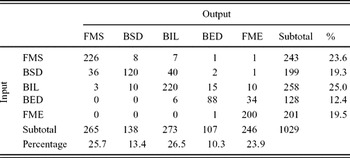
Table 3 displays the concordance of classification on the basis of input vs. output into the same five groups: Functional Monolingual English, Bilingual English Dominant, Balanced Bilingual, Bilingual Spanish Dominant and Functional Monolingual Spanish as discussed above. In this analysis 82.9% of the children were classified into the same groups based on input and output. More children were classified as Balanced Bilingual or English Dominant on the basis of input, but more were classified as Spanish Dominant on the basis of output. These findings are consistent with a non-linear relationship between input and output because most children fell into the Functionally Monolingual or Balanced Bilingual group (rather than the Spanish or English dominant groups).
Cross tabulation of dominance scores based on input and output.

FMS = Functionally Monolingual Spanish; BSD = Bilingual Spanish Dominant; BIL = Balanced Bilingual; BED = Bilingual English Dominant; FME = Functionally Monolingual English
The next comparison examined morphosyntax and semantic dominance scores based on the difference between Spanish and English scores. For this analysis we calculated difference scores by subtracting Spanish percent correct from English percent correct in order to index dominance in each domain (semantics and morphosyntax). Difference scores ranged from –100 to 100. Here too we divided the children into five groups: Functionally Monolingual Spanish (from –100 to –61), Bilingual Spanish Dominant (from –60 to –21); Bilingual (from –20 to 20); Bilingual English Dominant group (from 60 to 21) and Functionally Monolingual English if the difference between their scores was between (from 100 to 61).
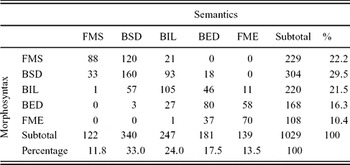
Table 4 shows the cross tabulation of the children's dominance according to performance on the semantics versus the morphosyntax tests. The use of measures that sampled two different but related language domains demonstrated different patterns of dominance in Spanish and English. For semantics, more children obtained higher scores in Spanish compared to English. However, for morphosyntax, more children performed similarly on the Spanish and English tests. The dominance classification was congruent in 48.8% of the cases. Thus, profiles of dominance were based on current use were more consistent than direct measures of performance. In comparison to the input and output groupings, there was a greater spread in performance on semantics and morphosyntax subtests across the five groups. Fewer children were classified as functionally monolingual based on test performance than on input and output.
Cross tabulation of dominance scores based on semantic vs. morphosyntactic performance on the BESOS.

FMS = Functionally Monolingual Spanish; BSD = Bilingual Spanish Dominant; BIL = Balanced Bilingual; BED = Bilingual English Dominant; FME = Functionally Monolingual English
Predictors of dominance
The final set of analyses was designed to determine which language experience variables best predicted dominance as measured by performance on the semantics and morphosyntax subtests on the BESOS. We used the same dominance scores based on performance on the semantics and morphosyntax subtests as described above, but they were treated as continuous variables. We explored the utility of “First English Exposure Year” and “Percentage of English Use” as predictors in a linear regression. Each of the variables was entered singly and then in combination in the regression equation. The results are summarized in Tables 5 and 6. For semantics as well as morphosyntax, year of first exposure accounted for less of the variance in dominance scores than did current usage (for semantics R2 = .367 for age of first exposure versus .644 for current usage; and for morphosyntax R2 = .366 for age of first exposure versus .619 for current usage). The combined model yielded virtually no increase in the explanatory value of the model over current usage (R2 = .648 for semantics and .625 for morphosyntax). This shows that current use was the most parsimonious predictor of dominance scores for this group of children.
Regression model to predict semantic dominance.

Regression model to predict morphosyntax dominance.

Discussion and conclusions
We were interested in determining whether different ways of operationalizing language proficiency and dominance would result in comparable classifications of a group of pre-kindergarten and kindergarten age bilingual children. The participants spanned a full range of bilingual experience both in regard to patterns of exposure and current use of the two languages. We explored the relationship between three common measures of language experience and measures of language ability. We also asked whether different measures of language experience and ability yielded the same language dominance classifications. By systematically exploring changes in classification via those factors that are typically controlled in studies of bilingual children, it became clear that the measure did matter for classifying children's language proficiency and dominance because variations in measures resulted in different classifications. These findings have implications for the kinds of measures researchers select to describe bilingual children and how results across tests of bilingual language proficiency are used to compare children.
Language theory and measures of dominance and proficiency
In this study current use was the most informative indicator of bilingual language proficiency and dominance. These findings fit well within the framework of usage-based theories of language development that highlight the role of frequency of use in acquisition. Scores on the language tests were not however the same across the board at different levels of exposure (see Figure 1 and the results summarized in Table 3). Differences in the patterns of semantics and morphosyntax performance in English and Spanish point to the need to consider how language experience interacts with the characteristics of the language forms being learned. Past work on language impairment in English- and Spanish-speaking children has shown that the differences in MLU and rates of grammatical errors are greater in English than in Spanish (Bedore & Leonard, Reference Bedore and Leonard2001). Given that these differences are evident across levels of exposure, work focusing on these accounts should consider how language-specific characteristics such as the frequency of constructions and or the phonetic salience of forms might interact with use to yield differences in the rate and order of acquisition within bilingual development.
Age of first exposure has less predictive value than current use. Within a framework of usage-based theories of language acquisition age of first exposure may be related to the depth of experience that children have with a language. Repeated exposure to language constructions will help children increase depth of knowledge. For example, Umbel, Pearson, Fernández and Oller (Reference Umbel, Pearson, Fernández and Oller1992) observed that children who speak English and Spanish at home have vocabulary scores in the average range for their age in Spanish but scores in the low average range in English. Hammer, Komaroff, Rodriguez, Lopez, Scarpino and Goldstein (in press) show that factors such the language children speak with their mother, father, and teacher have an influence on single word picture vocabulary scores beyond the children's age of first exposure to English.
Experience and language outcomes
Current input, current output, and age of first exposure are the three experiential factors that are most commonly considered in studies of bilingual language experience. These factors were used to explore the distributions of dominance and proficiency classifications. For this group of children, input and output were highly correlated (.95). On one hand high correlation between input and output is to be expected because children often respond in the language in which they are spoken. However, in early stages of language experience we might expect less alignment while children are still learning. One way to refine this estimate (via improvements to the parent questionnaire itself or via recording systems that sample input) would be to also account for times in which the child is engaged in activities that do not require linguistic interactions such as playing computer games or physical activities; or when children hear language but not respond such as when they are watching TV or movies.
We chose to combine input and output to maximize the stability of the ratings for the current work. It is however important to continue to collect data on both of these values. Even though input and output were highly correlated, Table 4 shows that about 15% of the children were classified into different groups based on input and output. A focus on the individual role of input and output in studying the difference between children who have not acquired a second language (as indicated by a zero on the screening test) and children who have started to acquire the second language (as indicated by a score of 1 or higher) shows that each plays a different role in children's cumulative knowledge (Bohman et al., Reference Bohman, Bedore, Peña, Méndez-Pérez and Gillam2010). Input is particularly critical to vocabulary development. Output on the other hand is critical to the increase in syntactic knowledge. Thus, the particular measure selected by a researcher might depend on the outcome variables of interest.
Plots of children's performances as a function of current English use and age of first exposure (see Figures 2 and 3) were created to illustrate how performance in semantics and morphosyntax changed in relation to the children's bilingual experience as characterized by current experience and by age of first exposure. In both cases, the quadratic model accounted for most of the variance across all levels of experience. This result suggests that children's language dominance and proficiency varies as a function of the time point at which they are assessed and the way experience is quantified. In general, children performed better in the language they had the most experience in. In English they performed better on the semantics test than the morphosyntax test regardless of experience. In Spanish, semantics and morphosyntax scores were consistently close. Children with less than 60% exposure to Spanish demonstrated a pattern of lower performance. Figure 2 highlights that at some points in time mixed dominance is possible. This is not only a characteristic of early language acquisition. Patterns of mixed dominance have been reported for school-age children speaking French–English (Paradis et al., Reference Paradis, Crago, Genesee and Rice2003) and for Spanish–English kindergarten age children (Bedore, Peña, Gillam & Ho, Reference Bedore, Peña, Gillam and Ho2010). On a practical note, these findings speak to the importance of children's using (not just hearing) each of their languages so that they may demonstrate continued development of each of their languages.
Differences in Spanish and English semantic and morphosyntactic performance were apparent when they were tracked relative to age of first exposure to English, the most commonly used indicator of bilingual development. As seen in Figure 3, the rate of change associated with very early (i.e., before age two) second language exposure was greater than the rate of change associated with introduction to a second language between two and four years of age, where growth was relatively flat. As for current use, the best fit for this curve was the quadratic model reflecting a non-linear growth rate. This pattern of early change was in line with the expected pattern of growth in linguistic skills in simultaneous bilinguals. At the same time, observed flat growth between two and five years of age suggested that the common expectation that the earlier English is introduced, the more English children are likely to know has more explanatory power when children are exposed to English before age two.
The final set of analyses tested the extent to which the experience-based predictors of English usage and age of first exposure accounted for variance in dominance classifications. This analysis shows that percentage of English usage adds significantly to our ability to predict language dominance. For both semantics and morphosyntactic performance, children's pattern of later development is not predetermined by their pattern of early exposure. This is an interesting finding because this group represents a relatively heterogeneous group of bilinguals in regard to their language exposure patterns and their current use of the two languages. As a matching variable, current use is potentially more informative than age of first exposure in ensuring that children have comparable levels of knowledge of their languages. Even when researchers select specific measures to classify participants for inclusion in studies or focus on simultaneous bilinguals, including a measure of current use would be a useful measure for comparing children from bilingual environments.
Selecting measures of dominance and proficiency
The results of these analyses suggest that tests that more heavily weight semantics or morphosyntax will result in differing patterns of classification of proficiency or dominance. Whether language experience is characterized by current exposure or by age of first exposure to English, semantic development appears to lead morphosyntactic development. This finding occurred even though the test items had been chosen to reflect developmental trends in both languages. Similar patterns were seen for children who acquired English and Spanish before the age of two. As a result children's dominance or proficiency is determined by tests that load on semantically-based items, they will appear to have switched dominance to English earlier and morphosyntax may appear to be weak by comparison. If the test loads on morphosyntax, children might appear to gain proficiency somewhat later than children tested with a measure based on semantic development. This may help explain some differences in measured proficiency identified across tests of language in the work of MacSwan and Rostad (Reference MacSwan and Rolstad2006) and others who have found that native speakers do not score in the “proficient range” on language proficiency measures. Most tests of language proficiency and dominance load heavily on semantically-based items and vary in their coverage of items requiring knowledge of the morphosyntax of each language.
Interpreting dominance and proficiency measures
When researchers attempt to draw conclusions about the role of dominance and proficiency in bilingual language development, they need to consider the way dominance and proficiency were determined. These findings suggest, at least for young children who are starting to make regular use of a second language, estimates of current use are an important predictor of performance. One question related to classifying children as bilingual concerns the use of current performance on language measures versus age of first exposure. Our findings suggest that age of first exposure to English accounts for about 35% of the variance in language dominance patterns at this young age. However, about 60% of the variance is explained if current use patterns are considered. For young children it appears that the most effective solution to grouping children based on language experience should include an estimate of current usage. This would not serve as a substitute for those specific measures investigators use to select participants for their study, but it would provide data to facilitate comparisons across studies as suggested by Grosjean (Reference Grosjean1998).
When bilingual children earn low scores on language tests in their second language or on tests designed for monolingual English speakers, researchers and clinicians should interpret these results cautiously. Bilingual children's linguistic knowledge is spread across two languages and as result they are often likely to know less about each language individually then their monolingual peers (e.g., Kohnert et al., Reference Kohnert, Bates and Hernández1999). Low test scores relative to monolingual English speakers cannot appropriately be interpreted to indicate the potential for language learning difficulties. Most tests that are used to evaluate language proficiency and dominance were not designed to test for language learning problems. Conversely, tests that were designed to identify language-learning difficulties were not developed or standardized to quantify proficiency.
A strength and limitation of this study is that it was based on a large group of four-to-five-year-old children who covered the full range of bilingualism. This work represents a unique look at children from a full range of bilingual language learning experiences. However, this work needs to be extended to a wider age range in order to understand how the factors of age of first exposure and current use play out over time. Bilingual language development depends on opportunities to hear and use both languages and on the practical demand for both languages. It is possible that proficiency and dominance patterns may come to depend less on daily patterns of use than was observed in the young school age population studied here. Following older children will help us see if the points at which language scores increased or decreased relative to exposure patterns are the same at different ages. For example, some bilingual adults maintain proficient production of a language even when they do not use it on a daily basis. Thus it is important to continue to explore this issue with older children, adolescents and adults to better understand the relationships between cumulative language experience, proficiency and dominance.
Other limitations of the study relate to the instruments selected. In this study we relied on parent report and screening tests of language development. On one hand the use of parent interviews and short tests is what made it possible to test large numbers of children. Although we know that parents can more reliably report on what their children do than make qualitative judgments about how they compare to age- and grade-based peers, future work should compare parent report to what actually happens in the home and school environment. Understanding how parents interpret what they see will help us refine these instruments that are relatively efficient. As we extend this work to older children, it is also important to include teacher report data since children spend more of their day in school and parents and teachers are each more accurate in the language (and by extension the context) in which they interact with the children (Bedore et al., Reference Bedore, Peña, Joyner and Macken2011; Gutiérrez-Clellen & Kreiter, Reference Gutiérrez-Clellen and Kreiter2003). Testing literature has shown that there are differences in classification based on the measures selected (e.g., Mac Swan & Rolstad, Reference MacSwan and Rolstad2006; Pray, Reference Pray2005). We know that the current version of our test corresponds well to longer and more comprehensive versions (Summers et al., Reference Summers, Bohman, Gillam, Peña and Bedore2010). It is important as these issues are explored with older children that we employ instruments that offer a balance of testing in the domains of interest (semantics and morphosyntax) that are appropriately challenging given the children's ages and grade levels.