Introduction
This study investigates whether L1-Mandarin learners of L2-English are able to learn verb bias and complementizer cues, and deploy them fast enough to guide online processing of temporarily ambiguous sentences. Many verbs can take different types of arguments, such as direct objects (DO) or sentential complements (SC), as shown in (1):
(1) The scientist read the article. . .
(a) . . . . . . . . . . . . . . . . . . . . . . . .on the plane.
(b) . . . . . . . . . . . . . . . . . . . . . . . .would be published very soon.
In (1), the syntactic role of the noun phrase (the article) immediately following the main clause verb (read) is temporarily ambiguous. The sentence proceeds in (1a) with the article having the direct object role, but in (1b) it has the role of subject of an embedded clause instead. In (1a), the scientist did read the article, while in (1b) the scientist read something about the article, but not the article itself. This type of structural ambiguity arises because English allows the complementizer that to be dropped before an embedded sentential complement clause. In what follows, this type of structural ambiguity will be referred to as direct object/sentential complement (DO/SC) ambiguity, as the noun phrase, the article, is temporarily ambiguous between the direct object of the main clause or the subject of an embedded sentential complement clause.
Readers typically slow down at the disambiguating verb in the embedded clause (would) in sentences like (1b), presumably because they have initially interpreted the article as the direct object of the main clause verb read under the guidance of the minimal attachment principle parsing heuristic (Frazier & Fodor, Reference Frazier and Fodor1978), which posits that the parser favors simpler structures. When would is encountered, the initial direct object analysis must be revised because it seems that would lacks a subject and that is not allowed in English, so the preceding noun article must be removed from the direct object role of read and attached as the subject of would. Such slowing down in reading is called a garden-path effect and it has been taken in the psycholinguistic literature to reflect reanalysis processes.
Sentence (1b) can be disambiguated by including the complementizer that after the main clause verb read, as shown in (2). In English, that has many other usages such as determiner or pronoun, but it is still a fairly reliable cue signaling an upcoming embedded clause when it immediately follows a verb that can take such clauses (Juliano & Tanenhaus, Reference Juliano and Tanenhaus1993).
(2) The scientist read that the article would be published very soon.
It is now well established that verb bias, which is the frequency with which a particular verb takes different kinds of argument, modulates the garden-path effect in ambiguous sentences (Ferreira & Henderson, Reference Ferreira and Henderson1990; Garnsey, Pearlmutter, Myers & Lotocky, Reference Garnsey, Pearlmutter, Myers and Lotocky1997; Kennison, Reference Kennison2001; Osterhout, Holcomb & Swinney, Reference Osterhout, Holcomb and Swinney1994; Pickering & Traxler, Reference Pickering and Traxler1998, Reference Pickering and Traxler2003; Pickering, Traxler & Crocker, Reference Pickering, Traxler and Crocker2000; Sturt, Pickering & Crocker, Reference Sturt, Pickering and Crocker1999; Traxler, Reference Traxler2005; Trueswell & Kim, Reference Trueswell and Kim1998; Trueswell, Tanenhaus & Kello, Reference Trueswell, Tanenhaus and Kello1993). Compare (3), in which the verb understand more frequently takes direct objects (i.e., DO-bias) and (4), in which the verb admit more frequently takes sentential complements (i.e., SC-bias).
(3) The club members understood the bylaws would be applied to everyone. (DO-bias)
(4) The ticket agent admitted the mistake might be hard to correct. (SC-bias)
People read disambiguating verbs like might faster in (4) than would in (3), probably because verbs’ subcategorization frequencies constrain the type of sentence structures likely to follow them. In (3), the parser anticipates a direct object after encountering understood, and thus experiences a garden-path at would, which is the earliest point in the sentence signaling that the direct object analysis of the bylaws is incorrect. In contrast, the parser expects an embedded clause when encountering admitted in (4) and thus is less committed to the analysis of the mistake as the direct object of admitted. As a result, there is less difficulty at the subordinate clause verb might.
One influential hypothesis about L2 sentence parsing (Clahsen & Felser, Reference Clahsen and Felser2006) posits that L2 learners use syntactic information qualitatively differently from native speakers. Because the claim is that L2 learners underuse syntactic information and as a consequence build syntactic structures that are shallower and less detailed than those built by native speakers, it is called the Shallow Structure Hypothesis. To compensate, L2 learners are claimed to rely more heavily on lexical-semantic cues than native speakers do. It is not clear how verb biases, in particular, fit into this framework. On the one hand, verb bias is lexically-associated information that is retrieved when verbs are recognized, and thus might be considered part of what the Shallow Structure Hypothesis claims is the lexical information L2 learners rely on. On the other hand, verb bias is about structure, and it requires enough successful instances – of parsing L2 sentences containing a particular verb – for structural biases to accumulate for that verb. Thus, it may not be the kind of cue that L2 learners can quickly develop and deploy, enough to guide their online interpretation of sentences. We will return to this in the discussion section.
Verbs’ subcategorization frequencies are implicit knowledge that is not (and probably cannot be) explicitly taught in the language classroom. It must instead be acquired through cumulative exposure to L2 sentences containing the verbs. A small number of studies have specifically examined the acquisition and usage of verb biases in L2 learning. Most of these studies thus far have shown that L2 learners do learn and make use of verb biases rapidly enough to influence online L2 parsing (Dussias & Cramer Scaltz, Reference Dussias and Cramer Scaltz2008; Dussias, Marful, Gerfen & Bajo Molina, Reference Dussias, Marful, Gerfen and Bajo Molina2010; Frenck-Mestre & Pynte, Reference Frenck-Mestre and Pynte1997; cf. Anible, Twitchell, Waters, Dussias, Pinar & Morford, Reference Anible, Twitchell, Waters, Dussias, Pinar and Morford2015).
Dussias and Cramer Scaltz (Reference Dussias and Cramer Scaltz2008) started by measuring whether the Spanish translation equivalents of the English verbs used in Garnsey et al. (Reference Garnsey, Pearlmutter, Myers and Lotocky1997) had the same biases as their English counterparts. Meaning partially determines whether a verb works better with simple direct objects or more complex embedded clauses (Hare, McRae & Elman, Reference Hare, McRae and Elman2003; Wiechmann, Reference Wiechmann2008), so L2 verbs might be expected to simply inherit the biases of their L1 equivalents. Dussias and Cramer Scaltz (Reference Dussias and Cramer Scaltz2008) tested native speakers of Spanish who were and were not learning English as a second language. When monolingual Spanish speakers completed Spanish sentence fragments containing translation equivalents of the verbs used by Garnsey et al. (Reference Garnsey, Pearlmutter, Myers and Lotocky1997), it turned out that fewer than half of the translated verbs had the same bias in Spanish as their English equivalents. Thus, meaning is clearly not the only determinant of verb bias, since, if it were, verbs with approximately equivalent meanings in two languages should also have similar structural biases. Advanced L1-Spanish learners of L2-English who completed the norming task in English, however, produced bias estimates similar to those from native English speakers. Thus, they had learned the biases for English verbs even when they conflicted with the biases of Spanish verbs with similar meanings.
Consistent with Dussias and Cramer Scaltz's (Reference Dussias and Cramer Scaltz2008) results for L1-Spanish learners of L2-English, Frenck-Mestre and Pynte (Reference Frenck-Mestre and Pynte1997) found that L1-English learners of L2-French could learn and retrieve verb biases rapidly enough to allow them to anticipate upcoming sentence structure. They used French sentences with prepositional phrase attachment ambiguity, as in They accused the ambassador of {espionage/Indonesia} but nothing came of it, and manipulated the bias of the main clause verb, which could be used either transitively or ditransitively. L1-English learners of L2-French behaved like native French speakers in preferring VP attachment following ditransitive verbs and NP attachment following transitive verbs, indicating that they anticipated two arguments after ditransitive verbs but only one argument after transitive verbs, just as native speakers did.
Spanish and French both have the same default SVO word order as English, so L1-speakers of both languages have experience with verbs preceding most of their arguments in sentences and thus providing information about the kinds of arguments that are most likely to follow them. Languages with SOV word order, however, do not afford predictive use of verb bias, since the verb's arguments all precede it. A recent study by Lee, Lu, and Garnsey (Reference Lee, Lu and Garnsey2013), which is the previous work most closely related to the study reported here, investigated whether L2 learners whose L1 has SOV word order were able to learn and use L2-specific verb bias predictively. Korean is an SOV language that places verbs at the ends of clauses, so verb-based information cannot be used to generate expectations about likely upcoming sentence structure. In addition, unlike English, where the complementizer that is optional, a clause-final complementizer particle ko is obligatory in Korean. Thus, L1-Korean speakers do not have experience with anticipating upcoming structure based on either verb bias or the complementizer in their L1, but they do have experience with an end-of-clause complementizer that is a perfect cue to the embedded clause structure. Since the complementizer is a perfect cue on its own, it seems likely that it would be learned first, which might then block Korean speakers from learning to associate structural biases with verbs, since they are much less reliable than the complementizer (Ellis, Reference Ellis2006b). In Lee et al.’s study, higher proficiency L1-Korean speakers of L2-English were compared with lower proficiency learners and native English speakers in their use of verb bias and complementizer cues. The results showed that lower proficiency L1-Korean learners of L2-English needed both cues to be present to derive any benefit during sentence reading, while higher proficiency learners were able to derive benefit from each of the cues separately. In addition, the higher proficiency learners combined the cues to some extent, since they gained more benefit from the presence of the complementizer when the verb was DO-biased than when it was SC-biased. However, they did not achieve the optimally efficient interactive pattern seen in the native English speakers, for whom either cue alone was sufficient.
The fact that the higher proficiency L1-Korean learners did not achieve the optimal native pattern might well be true for any L2 learners, regardless of the properties of their L1, simply because they have not accumulated as much experience as native English speakers. Alternatively, however, it is possible that the fact (that verb bias is not available early enough in the sentence to be useful in Korean) is responsible for the failure to achieve the native pattern, which makes it important to test L2 learners of English at similar proficiency levels whose first language word order supports the usefulness of verb bias in anticipating upcoming sentence structure. Mandarin differs from Korean and is similar to English in two important respects. First, Mandarin has the same default SVO order as English, making verbs available early enough in Mandarin sentences to provide useful cues. Second, Mandarin has no word or particle functioning as a complementizer in sentences like the ones used here, although the DO/SC ambiguity in Mandarin can be disambiguated by adding an optional comma after the main clause verb, as shown in (5).
(5) 那个 售票员 承认(,) 错误 本来
That ticket agent admit(,) the mistake at first
是可以避免的。
can avoid.
“The ticket agent admitted (that) the mistake could have been avoided.”
The optional comma is used much less often, however, than the optional that is in English. Thus, DO/SC sentences are similar in Mandarin and English in both the availability of verb bias early in sentences and the optionality of a disambiguating cue, though the kind of disambiguating cue is different and much less often present in Mandarin.
The differences between Korean and Mandarin suggest that L1-Mandarin learners of L2-English might use verb bias and complementizer cues differently from L1-Korean learners. L1-Mandarin learners may find it easier to learn and use the biases of English verbs, with the possible result that lower proficiency L1-Mandarin learners might show more robust effects of verb bias than lower proficiency L1-Korean learners, who only benefited from verb bias when the complementizer was also present.
It is hard to predict whether L1-Mandarin learners of L2-English are able to learn and use the complementizer cue predictively. The presence of the complementizer that, immediately following a sentential-complement-taking verb, would seem to provide an extremely strong cue in an English sentence that such a clause is coming. It is not, however, a perfect cue, since that can also be a determiner (e.g., The referees warned that spectator not to get too rowdy) or a pronoun (e.g., The referees expected that to be a huge problem), although neither is very likely immediately following a complement-taking verb (Juliano & Tanenhaus, Reference Juliano and Tanenhaus1993). Another possible factor – that would make the complementizer a less robust cue than it might seem – is that it is typically quite reduced in speech, so L2 learners might sometimes miss it. Both L1-Spanish and L1-Korean learners of L2-English have been shown to make good use of the complementizer cue, but their first languages have a similar cue. L1-Mandarin learners of L2-English whose first language has no word functioning as a complementizer might have more difficulty learning the English complementizer, given that it is only sometimes present, and even when it is present might not be noticed or might be serving a different function.
An account of learning different types of cues and how they combine during both first and second language learning has been developed in the framework of the Competition Model (Bates & MacWhinney, Reference Bates, MacWhinney and MacWhinney1987, Reference Bates, MacWhinney, MacWhinney and Bates1989; MacWhinney, Bates & Kliegl, Reference MacWhinney, Bates and Kliegl1984; McDonald, Reference McDonald1987), incorporating various general learning principles. For a review of the applicability of general learning principles to language acquisition, see Ellis, Reference Ellis2006a, Reference Ellis2006b. Studies testing predictions of the Competition Model (Matessa & Anderson, Reference Matessa and Anderson2000; McDonald, Reference McDonald1987; McDonald & MacWhinney, Reference McDonald and MacWhinney1991) have shown that learners tend to focus initially on individual cues. The learning of individual cues is driven largely by their overall cue validity, which reflect a combination of 1) whether the cue is present when it should be (e.g., whether a sentential complement is preceded by that, or by a SC-bias verb), and 2) whether when it is present, it signals what it should (e.g., what follows either that or an SC-bias verb is a sentential complement). Early stages of learning are affected by how much cumulative experience learners have with the cues and how valid they are across that experience. Later, however, as learners progress to being able to combine cues, learning is driven more by conflict validity, which is about how well a cue signals the correct interpretation when it conflicts with other cues (e.g., a DO-bias verb followed by that followed by a sentential complement, where that overrides the verb's DO bias). For the two English cues under discussion here, complementizer presence has higher conflict validity than verb bias. It is also likely that L2 learners have more experience with that when it correctly signals embedded sentential complements than they have with particular verbs doing so, simply because they have had less exposure to individual verbs. However, the fact that Mandarin has no complementizer might make it hard for L1-Mandarin learners of L2-English to figure out the complexities of the word that in English. Previous work has shown that the verb bias and complementizer cues are in a trading relationship for native English speakers, who find either a strongly SC-biased verb or a complementizer sufficient to signal an embedded sentential complement, with no added benefit from having both cues (e.g., Garnsey et al., Reference Garnsey, Pearlmutter, Myers and Lotocky1997; Lee et al., Reference Lee, Lu and Garnsey2013). Lee et al. (Reference Lee, Lu and Garnsey2013) found that higher proficiency L1-Korean learners of L2-English had not fully achieved the native pattern but were approaching it. Dussias and Cramer Scaltz (Reference Dussias and Cramer Scaltz2008) found that L1-Spanish learners of L2-English have learned both cues, but were unable to combine them. We report a similar study with L1-Mandarin learners of L2-English to further investigate how L2 learners learn multiple cues.
Finally, we seek to investigate whether L2 learners show finer grained sensitivity to biases of individual verbs just as native speakers do. The studies described above (Dussias & Cramer Scaltz, Reference Dussias and Cramer Scaltz2008; Frenck-Mestre & Pynte, Reference Frenck-Mestre and Pynte1997; Lee et al., Reference Lee, Lu and Garnsey2013) have shown that L2-learners acquire verb bias information specific to the L2 and deploy it rapidly enough to anticipate upcoming structure even when the biases of particular verbs conflict in the L1 and L2 (Dussias & Cramer Scaltz, Reference Dussias and Cramer Scaltz2008; Frenck-Mestre & Pynte, Reference Frenck-Mestre and Pynte1997) and when verbs do not appear early enough in sentences in their L1 to allow such usage (Lee et al., Reference Lee, Lu and Garnsey2013). In all these studies, differences in bias strength between DO-bias and SC-bias verbs were generally made as large as possible. Native English speakers have been found to be sensitive to smaller differences, showing reliable correlations between graded bias estimates for individual verbs and the size of the ambiguity effect at the disambiguating region in DO/SC sentences. The existing studies of L2 learners’ use of verb bias have not reported correlational analyses so it is unknown whether they would show similar graded effects. They may not because they haven't yet amassed sufficient experience to develop stable bias estimates for individual verbs.
In sum, the present study examines whether L1-Mandarin learners of L2-English are able to learn and use verb bias and complementizer cues predictively, whether that is affected by properties of their L1, whether they learn to use individual cues before combining them based on relative conflict validities as predicted by the Competition Model, and whether they show native-like sensitivity to biases of individual verbs. These issues will be addressed in the study to which we now turn.
Methods
Participants
32 native English speakers (22 males, mean age: 20) and 78 L1-Mandarin L2-English learners (26 males, mean age: 20) participated in the experiment. All were undergraduate or graduate students at the University of Illinois at Urbana-Champaign, had normal or corrected-to-normal vision, gave written informed consent, and received payment or course credit for taking part. The native speaker group was the same control group reported in Lee et al. (Reference Lee, Lu and Garnsey2013)Footnote 1. These data were included here so that L1-Mandarin learners could be compared to native English speakers.
All of the L2 learners completed at least their high school education in Mainland China or Taiwan, have lived in English-speaking countries for less than 5 years, and did not start to live in an English-speaking country before the age of 15. Additional language background information is summarized in Table 1. All learners completed a cloze test following the main self-paced reading experiment, which asked them to fill in 40 blanks in a passage (adopted from Dussias at Pennsylvania State University, personal communication; see Tremblay, Reference Tremblay2011, for validity and reliability of using cloze tests to assess L2 proficiency). L2 learners were divided into higher and lower proficiency groups based on a median split on proficiency scores (lower proficiency group<32; higher proficiency group > 31). Since proficiency level was evaluated relative only to the rest of the participants, the groups are labelled as higher and lower proficiency, rather than as high and low. There was a marginally significant difference in the daily use of English between the two groups (F(1,76) = 3.3, p = .07), suggesting that the higher proficiency group may have used more English in daily life than the lower proficiency group (54% vs. 47%).
Language background information for L2 learners. Ranges are shown in parentheses.

Materials and design
Ten DO-bias and ten SC-bias verbs were each used four times to construct 80 pairs of sentences, with each pair containing ambiguous and unambiguous versions of the same sentence, as shown in (6) (see Lee et al., Reference Lee, Lu and Garnsey2013, for a full list of experimental sentences). Unambiguous sentences were disambiguated by adding the complementizer that after the main clause verb. All sentences started with a subject noun phrase that contained three words (e.g., the club manager), followed by a main clause verb that was either biased towards taking direct objects or embedded clause complements. The ambiguous noun following the main clause verb contained two words (e.g., the bylaws), which were then followed by the disambiguating region that contained the subordinate clause verb and the word immediately following it. Care was taken when selecting the two words for the disambiguating region in each sentence. All disambiguating verbs and the words immediately following them were auxiliary verbs such as were, could, would and had, so that the properties of the disambiguating words did not differ between items with DO bias and SC bias verbs. All critical sentences turned out to have the embedded clause structures.
(6) DO-bias verb
Ambiguous: The club members understood the bylaws would be applied to everyone.
Unambiguous: The club members understood that the bylaws would be applied to everyone.
SC-bias verb
Ambiguous: The ticket agent admitted the mistake might be hard to correct.
Unambiguous: The ticket agent admitted that the mistake might be hard to correct.
Verbs used in the experiment all met the following criteria: DO-bias verbs were followed at least twice as often by direct object completions as by sentential complement completions in the sentence completion norming task reported in Garnsey et al. (Reference Garnsey, Pearlmutter, Myers and Lotocky1997), which asked 108 native English speakers to complete one hundred sentence fragments that began with a proper name and a verb that could take both direct objects and embedded clauses (e.g., Bill believed. . .). The reverse was true for SC-bias verbs: there were at least twice as many sentential complement completions as direct object completions generated by participants in the norming task. The ten DO-bias verbs and ten SC-bias verbs used in the present study were matched on the number of letters, F<1, and frequency of occurrence (Francis & Kucera, Reference Francis and Kucera1982), F<1. Verb properties are summarized in Table 2. That-preference is the proportion of the sentences produced in the norming study that had the SC structure for a verb that included the complementizer.
Properties of the verbs used in the experiment.

To ensure that any effect found at the disambiguating region was caused only by the biases of the verbs, two plausibility norming tasks were conducted to examine whether the ambiguous nouns were equally plausible as the direct object of the preceding verb and as the subject of the embedded clause between DO-bias and SC-bias items. The plausibility of the ambiguous noun as the direct object was rated by asking a separate group of 56 native speakers of English to judge the plausibility of the subject, verb and ambiguous noun combinations on a scale from 1 (very implausible) to 7 (very plausible), as shown below in (7). Results showed that the ambiguous nouns following DO-bias verbs were rated as slightly more plausible than those following SC-bias verbs (6.5 vs. 6.2, F(1,78) = 5.4, p < .05). This replicated previous findings that plausibility ratings of the ambiguous noun as the direct object were affected by biases of the verbs. Participants tended to rate the nouns as more plausible when they followed verbs that preferred direct object completions (Garnsey et al., Reference Garnsey, Pearlmutter, Myers and Lotocky1997). This raises the possibility that any effects found at the disambiguating region would reflect a combination of effects from verb bias and plausibility, but it is unlikely that the small difference in rated plausibility here would have a detectable effect in sentences with strongly biased verbs, given previous findings from studies specifically manipulating plausibility (Garnsey et al., Reference Garnsey, Pearlmutter, Myers and Lotocky1997).
A separate norming study assessing the plausibility of the ambiguous noun as the subject of the embedded clause was conducted with twelve native English speakers, who rated the plausibility of sentence fragments such as (8) on a scale from 1 (very implausible) to 7 (very plausible) as the beginning of a sentence. The ambiguous nouns for both DO- and SC-items were both rated as highly plausible (mean DO: 6.1; mean SC: 6.1) and did not differ between verb types, F < 1. The properties of the ambiguous noun are summarized in Table 3.
(7) The club members understood the bylaws.
The ticket agent admitted the mistake.
(8) The club members understood that the bylaws. . .
The ticket agent admitted that the mistake. . .
Properties of the ambiguous nouns used in experiment.

Some properties of the critical verbs were intercorrelated. For example, DO-bias strength and SC-bias strength are necessarily negatively correlated (r = -.80), but not perfectly so since most of the verbs can also participate in other structures.
Critical sentences were distributed over two lists according to a Latin Square design, so that all participants saw an equal number of trials of each condition and no one saw both versions from the same sentence pair. A total of eighty distractors was added to each list for a total of 160 trials per list. In twenty distractors, the noun phrase immediately following the main clause verb was the direct object, so that, across the experiment, it was not always the case that the noun following the main clause verb must be reanalyzed as the subject of the embedded clause (e.g., The incumbent politician made dozens of personal calls while at work.). Thirty-five distractors contained direct objects that appeared at various parts of the sentences (e.g., The builder who builds the nice houses will make a hefty profit) and the remaining twenty-five distractors were passives or sentences with intransitive verbs that did not contain direct objects (e.g., The old porcelain bathtub drained too slowly). The twenty DO- and SC-biased verbs used to create critical sentences did not appear in any of the distractors. All sentences, including critical items and distractors, were followed by a comprehension question that targeted the content of various parts of the sentence (e.g., Were the bylaws applied fairly?). All sentences were pseudo-randomized once so that no two critical sentences from the same condition appeared consecutively and were presented to all participants in the same order in all lists.
Procedure
Participants sat in a dimly lit and sound-attenuated booth in front of a 23-inch LCD monitor. A total of 160 sentences were presented word by word in white 26-point Arial font on a black background in a non-cumulative moving window self-paced reading paradigm, controlled by the Presentation software package. The participants pressed a button on a Cedrus-830 response box to read each word successively at their own speed. Following each sentence, a comprehension question was presented all at once and participants pressed yes or no buttons to indicate their answers. Feedback about question response accuracy was given after each trial. A “Too Slow” message was presented when participants did not make a response within four seconds. Sentences were divided into four blocks with forty sentences each, and participants took a break after each block. A practice block of five trials was added at the beginning. The entire experiment took 30– 45 minutes to complete.
Results
Comprehension accuracy
On average, the accuracy rate for all sentences (including both experimental items and distractors) for native English speakers was 92%Footnote 2 (range 87%-96%) and for L1-Mandarin learners of L2-English 86% (74%-95%). Comprehension accuracy for the experimental sentences was analyzed using a logit mixed-effect model (Jaeger, Reference Jaeger2008). Results showed main effects of language group, with native speakers answering the comprehension questions to experimental sentences more accurately than non-native speakers (90% vs. 87%, p < .001) and higher proficiency L2 learners answering more accurately than lower proficiency L2 learners (88% vs. 85%, p < .01).
Reading times
Prior to data analysis, word-by-word reading times faster than 100 milliseconds (ms) or slower than 2000 ms were excluded, leading to a loss of 0.4% of the native speakers’ data and 1.7% of the L1-Mandarin speakers’ data. Reading times above or below 2.5 standard deviations (SD) from a participant's mean were replaced by the 2.5 SD cut-off value for each participant, affecting 2.7% of native speakers’ data and 3.3% of L2 learners’ data. Reading times were also excluded from further analysis when participants pressed the yes or no button before the comprehension questions were displayed or failed to respond to the questions within the four second limit, affecting 2.3% of the native speakers’ data and 6.1% of the L2 learners’ data. Length-corrected reading times were computed separately for each participant by entering their reading time for each word in all sentences (including distractors) into a regression equation that took reading time as the dependent variable and word length as the independent variable, and then subtracted the predicted reading times from the actual reading times (Ferreira & Clifton, Reference Ferreira and Clifton1986; Trueswell, Tanenhaus & Garnsey, Reference Trueswell, Tanenhaus and Garnsey1994). Statistical analyses were performed on length-corrected residual reading times, but the figures show trimmed uncorrected reading times so that differences in overall reading time between native and non-native speakers, which are largely eliminated by the length correction procedure, are more readily apparent.
Statistical analyses were performed on residual reading times for the complementizer that: in the unambiguous conditions, the temporarily ambiguous noun phrase region, and the disambiguating region. The disambiguating region contained the disambiguating verb (e.g., would) and the spill-over region (e.g., be), which was the word immediately following the disambiguating verb. In the type of sentences we tested here, the verbs immediately following the ambiguous nouns were the disambiguating verbs, as these were the earliest points in the sentences where the parser realized that the initial direct object analysis was incorrect. Slowing down at the disambiguating verbs would indicate the amount of effect the parser needed to revise the initial misinterpretation. However, in self-paced reading studies, the slow-down, or the garden-path effect, is often not captured at the disambiguating word itself, but instead is spilled over to the next word or two (typically known as the spill-over region), or is captured at both the disambiguating word and the spill-over region. Hence, in the present study, the disambiguating verb is the critical region, the word following it is the spill-over region, and we refer to the combination of the critical and the spill-over regions as the disambiguating region. The disambiguating region reading times were obtained by averaging across the reading times at the disambiguating verb (i.e., the critical region) and the word immediately following it (i.e., the spill-over region). Reading times at the ambiguous noun region were calculated by averaging across the reading times of the determiner and the head noun (e.g., the bylaws). Reading times in each region were then analyzed using linear mixed-effect models in R (R Development Core Team, 2008). For all analyses, the initial model included the maximal random effects structure that included all fixed effects and interactions among them, random intercepts and random slopes for all fixed effects and their interactions for both subjects and items (Barr, Levy, Scheepers & Tily, Reference Barr, Levy, Scheepers and Tily2013). Categorical fixed effects were coded using contrast coding and continuous fixed effects were centered to avoid colinearity. The final models reported here were the most complex that converged. Estimates, standard errors, and t-values are reported, with t > 2 interpreted as reliable.
Complementizer region
In the unambiguous sentences, the complementizer that was read 88 ms slower by non-native than by native (433 vs 345 ms) speakers, and 18 ms slower by lower proficiency than by higher proficiency (442 vs 424 ms) non-native speakers.
Temporarily ambiguous noun region
Reading times for the native and non-native groups are plotted separately in Figures 1a and 1b below. A linear mixed-effects analysis conducted on the residual reading times at the ambiguous noun region included verb bias, ambiguity, native language, list, block and the interactions among verb bias, ambiguity and native language as fixed effects, random intercepts for subjects and items, random slopes for verb bias and ambiguity for subjects, and random slopes for ambiguity for items. On average, non-native speakers read the noun phrase 139 ms slower than natives (480 vs 341 ms), and lower proficiency non-native speakers read it 52 ms slower than those with higher proficiency (504 vs 456 ms). Reading times decreased over the course of the experiment, as shown by main effects of the blocks (t's > 7). In addition, the noun phrase was read 20 ms slower overall in the temporarily ambiguous conditions, as shown by a main effect of ambiguity (448 vs 428 ms; β = 21.22, SE = 3.85, t > 5). Finally, there was a significant interaction between verb bias and ambiguity (β = 12.77, SE = 6.34, t > 2), which was caused by a bigger effect of ambiguity after SC-bias verbs (28 ms) than after DO-bias verbs (11 ms). Separate analyses within each verb type showed, however, that the ambiguity effect was significant in both DO-bias and SC-bias items (DO-bias: t > 2; SC-bias: t > 6).
Reading times at the temporarily ambiguous noun phrase for native and non-native English speakers.

Although the three-way interaction among ambiguity, verb bias, and native language was not reliable (t < 2), examining reading times separately for native and non-native speakers revealed a potentially interesting pattern. As Figure 1 shows, the interaction between ambiguity and verb bias in the analysis across all participants for this region came mostly from the non-native group (Native: t < 1; Non-native: β = 22.07, SE = 7.50, t = 3). Both native and non-native speakers read the nouns faster overall when they were preceded by that (Native: β = .84, SE = 3.96, t > 6; Non-native: β = 18.47, SE = 4.62, t > 4), but for the non-native group that difference was reliable only following SC-bias verbs (SC-bias: t > 5; DO-bias: t < 2), while for native speakers it was reliable following both kinds of verbs (t’s > 4). The noun phrase in sentences like these is typically read faster by native speakers when that precedes it, in part because the ease of recognizing the high frequency word that spills over to subsequent words, and in part because that makes the role of the noun unambiguous. For native speakers, both of those factors probably contributed to the faster times on the noun phrase when that was present, regardless of the bias of the verb. Figure 1b shows a different pattern for the non-native speakers, who did not benefit from that following DO-bias verbs. The condition with DO-bias verbs together with that was the only condition where the verb bias and complementizer cues were both present and conflicted with one another. Non-native speakers may have had difficulty with this conflict while native speakers did not. Perhaps this is because native speakers had learned that the complementizer cue has higher conflict validity than verb bias, while the non-native speakers were still in the process of learning how to combine the cues. However, the absence of a three-way interaction involving language group means that the different pattern of cue combination for the native and non-native speakers remains suggestive only.
The disambiguating region
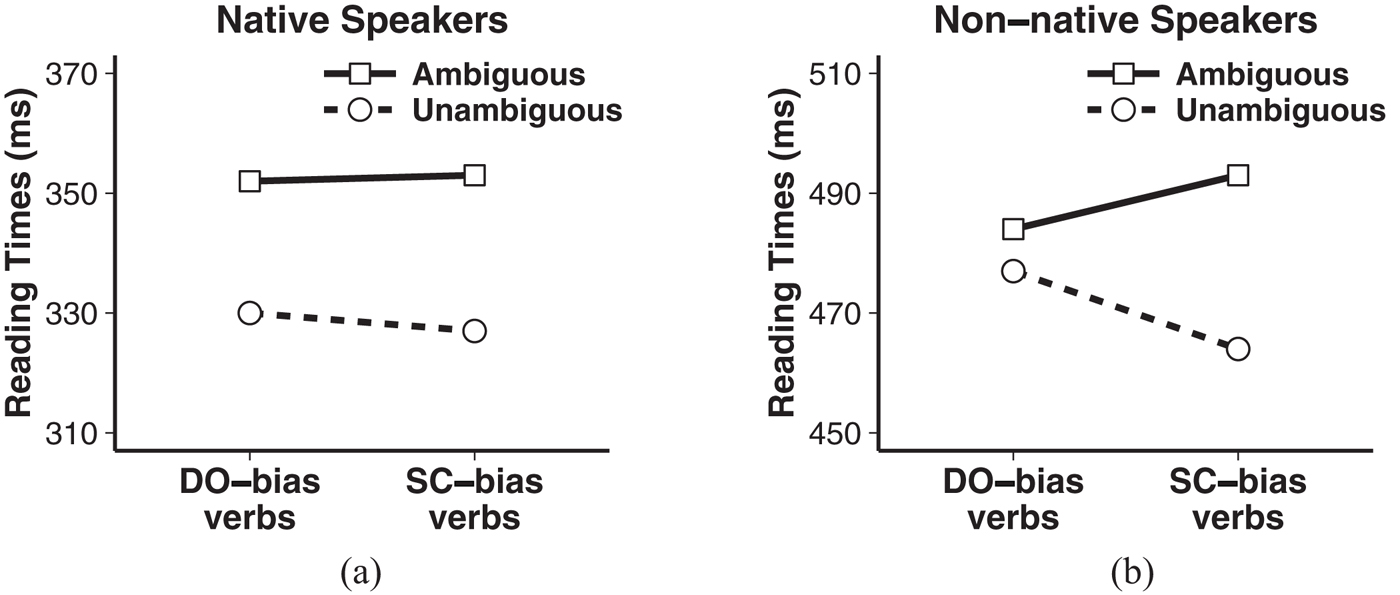
Reading times at the disambiguating region are summarized in Table 4 and plotted separately for native and non-native groups in Figures 2a and 2b. A linear mixed-effects analysis conducted on the residual reading times at this region (see Table 5) included verb bias, ambiguity, native language, list, block and the interactions of verb bias, ambiguity and native language as fixed effects, random slopes for ambiguity and verb bias for subjects, random slopes for ambiguity for items, and random intercepts for both subjects and items. The model revealed an overall main effect of ambiguity, with the disambiguating region read 11 ms slower in ambiguous than in unambiguous sentences (425 vs 414 ms; β = 9.74, SE = 3.09, t = 3.15), an overall main effect of verb bias, with DO-bias items read 19 ms slower than SC-bias items (429 vs 410 ms; β = 17.20, SE = 7.24, t = 2.38). The overall interaction between verb bias and ambiguity was significant (β = 12.33, SE = 5.74, t = 2.15) because the effect of ambiguity was larger in items with DO-bias verbs than in those with SC-bias verbs (15 vs 5 ms). There was also an interaction between verb bias and native language, with a bigger effect of verb bias in the non-native than the native group (21 vs 10 ms; β = 11.36, SE = 5.70, t = 2.00). As Figure 2 shows, the reason the overall effect of verb bias was bigger for the non-native speakers was because they showed verb bias effects in both the ambiguous and unambiguous conditions, while, for the native speakers, the effect of verb bias was limited to the ambiguous condition.
Trimmed and residual reading times at the disambiguating region.

Reading times at the disambiguating region for native and non-native English speakers.

Fixed effects of the mixed-effect model on residual reading times at the disambiguating region. The model compared native speakers to non-native speakers.

Additional analyses were conducted within each language group separately (see Figure 2 and Tables 6 and 7). The model for native speakers included verb bias, ambiguity, list, block and the interactions between verb bias and ambiguity as fixed effects, random slopes for ambiguity, verb bias and their interactions for subjects, random slopes for ambiguity for items, and random intercepts for both subjects and items. The model for non-native speakers included verb bias, ambiguity, proficiency, list, block and the interactions of verb bias, ambiguity and proficiency as fixed effects, random slopes for ambiguity and verb bias for subjects, random slopes for ambiguity for items, and random intercepts for both subjects and items. As indicated by the main effect of ambiguity in the analysis combining the groups, both groups read the disambiguating region more slowly in ambiguous than in unambiguous sentences (Native: 352 vs. 342 ms; β = 9.00, SE = 3.62, t = 2.49; Non-native: 456 vs. 445 ms; β = 10.62, SE = 3.71, t = 2.87). The groups differed, however, in the effect of verb bias. Consistent with previous studies (Garnsey et al., Reference Garnsey, Pearlmutter, Myers and Lotocky1997; Trueswell et al., Reference Trueswell, Tanenhaus and Garnsey1994; Wilson & Garnsey, Reference Wilson and Garnsey2009), the native speakers benefited from an SC-bias verb only when the sentence was ambiguous, resulting in an interaction between verb bias and ambiguity (β = 19.01, SE = 6.96, t = 2.73) and no main effect of verb bias (t < 2). In contrast, the non-native speakers benefited from an SC-bias verb regardless of whether the sentence was ambiguous, resulting in a main effect of verb bias (β = 22.69, SE = 8.31, t = 2.73) and no interaction between the two cues (t < 1).
Fixed effects of the mixed-effect model on the residual reading times at the disambiguating region in native English speakers.

Fixed effects of the mixed-effect model on the residual reading times at the disambiguating region for the non-native speakers.

Native speakers did not show the main effect of verb bias, but showed the interaction between verb bias and ambiguity, while non-native speakers showed the main effect of verb bias in addition to the main effect of ambiguity. The verb bias effect in the ambiguous condition was averaged out by the unambiguous condition in the native speakers, because the verb bias effect was only shown in the ambiguous condition but not in the unambiguous condition and thus did not show a main effect of verb bias. However, in the ambiguous condition, the verb bias effect was about 20 ms (19 ms as measured by trimmed reading times and 18 ms as measured by residual reading times), which was about the same size as the non-native speakers (15 ms by trimmed reading times and 14 ms by residual reading times). The overall effect of verb bias was bigger for the non-natives because they showed verb bias effects in both the ambiguous and unambiguous conditions. Thus the pattern (that non-native speakers showed a main effect of verb bias while native speakers did not) did not mean that non-natives were more sensitive to verb bias, but instead indicated that non-natives have not learned that the presence of the complementizer almost always overrides the verb bias cue.
Given the way the patterns of cue combination differed between the native and non-native groups, the higher proficiency non-natives might be expected to perform more similarly to the native group than the lower proficiency non-natives. However, there were no reliable effects of proficiency (t's < = 1). Additional analysis that included proficiency as a continuous variable revealed the same results: There were no main effect of proficiency or any interaction involving the proficiency factor (t's < 1).
Correlational analyses
To further explore finer grained effects of verb bias, correlations were calculated item-by-item between the verb bias measures and the size of the ambiguity effect at the disambiguating region. Item condition means were created by averaging across all participants who saw an item in a particular condition. Proportions were arcsine transformed in these analyses. The scatterplots in Figure 3 below show the relationship between verb bias and the ambiguity effect at the disambiguating region. Consistent with previous studies (Garnsey et al., Reference Garnsey, Pearlmutter, Myers and Lotocky1997; Juliano & Tanenhaus, Reference Juliano and Tanenhaus1993; Trueswell et al., Reference Trueswell, Tanenhaus and Kello1993), for native speakers the ambiguity effect at the disambiguating region increased as the verb's DO-bias increased (r = .34, t(78) = 3.23, p < .01; see Figure 3a) and also as its that-preference increased (r = .36, t(78) = 3.36, p < .01), and decreased as its SC-bias increased (r = -.32, t(78) = 3.34, p < .01; see Figure 3b). The three measures each explained approximately the same amount of variance in ambiguity effect size (10%-13%), and very little additional variance was explained by adding another because they were strongly correlated with one another. The size of these correlations is comparable to those reported in Garnsey et al. (Reference Garnsey, Pearlmutter, Myers and Lotocky1997). Native speakers’ graded sensitivity to the verb biases suggests that they keep track of the structures within which they experience each verb, and that their cumulative experience shapes how they process new sentences containing those verbs.
DO-bias and SC-bias verbs plotted against the ambiguity effect at the disambiguating region for native English speakers and non-native English learners.

In contrast with native speakers, the non-native speakers showed no graded sensitivity to any of these three verb bias measures. As shown in Figures 3c and 3d, for non-native speakers there were no reliable correlations between the verb bias measures and the size of the ambiguity effect at the disambiguation, and the same was true for that-preference (p’s > .1). The absence of graded effects of verb bias might seem surprising, since the non-native speakers did show reliable effects of the binary verb bias variable. The absence of graded effects suggests that the L2 learners had not yet amassed sufficient experience with each verb in its different possible sentence structures to have stable verb-specific knowledge about the relative likelihood of different structures following it.
Interestingly, the non-native speakers did show graded effects of a different property of the verbs, i.e., their overall frequency, which indexes how much experience people are likely to have had with each verb. There was a reliable correlation between overall frequency of occurrence and the size of the ambiguity effect at the disambiguation for the non-native speakers, such that the more frequent the verb, the smaller the ambiguity effect at the disambiguation (r = -.30, t(78) = -2.73, p < .05). There was also a reliable correlation for the non-native speakers between frequency and reading time for the complementizer itself, such that the more familiar the verb, the faster that was read after it (r = -.30, t(78) = -2.18, p < .05). These effects probably arose because more exposure to the verbs means they are more likely to be encountered in their multiple possible sentence structures, which is required for stable estimates of verb bias to develop. In contrast, native speakers showed no similar relationship between verbs’ frequency of occurrence and either degree of difficulty at the disambiguation (r = -.17, p > .1) or reading time for the complementizer (r = -.18, p > .1), presumably because they had enough experience with each verb to firmly establish its individual biases.
Separating the verbs into binary categories (see Figure 4) revealed that the frequency effect for the non-native speakers came almost entirely from the verbs categorized as DO-bias (r = -.49, t(38) = -3.36, p < .01; SC-bias verbs: r = -.10, t < 1), which makes sense: since it would take more encounters with those verbs in particular to experience them often enough in SC structures to develop stable estimates of their biases.
Log frequency of verbs plotted against the ambiguity effect at the disambiguating region for non-native English learners.

Breaking the non-native speakers down by proficiency revealed two interesting findings. First, the effect of the verb's frequency of occurrence came primarily from those with lower proficiency (r = -.28, t(78) = -2.62, p < .05; higher proficiency: r = -.11, p > .1). Second, the higher proficiency group may have been starting to show graded effects of verb bias instead of overall verb frequency. Although the item-by-item correlations between the size of their ambiguity effect at the disambiguation and the DO-bias or SC-bias measures were not reliable, they did show a reliable correlation with a ratio measure of verb bias (DO-bias/SC-bias: r = -.23, t(78) = -2.13, p < .05). What may matter most, especially at early stages of bias acquisition, is how much more likely one structure is than the other for a particular verb, and that is what is captured by the ratio measure. However, it would be premature to make too much of this finding because there was one verb that was an outlier on the ratio measure and when that verb was dropped from the analysis, the correlation with the ratio measure was no longer reliable for the higher proficiency non-natives.
Results of Lee et al. (Reference Lee, Lu and Garnsey2013)
48 L1-Korean learners of L2-English were tested in Lee et al. (Reference Lee, Lu and Garnsey2013) using the same materials as those used in the present study and participants were divided into the higher and lower proficiency groups following the same criterion (higher proficiency group > 31 and lower proficiency group < 32 on the cloze test). Their results (see Figure 2 in Lee et al., Reference Lee, Lu and Garnsey2013; reproduced here as Figure 5) are presented here so that the two L1 non-native groups can be compared. At the disambiguating region, both the higher and the lower proficiency L1-Korean groups showed a significant interaction between verb bias and ambiguity, but the pattern of this interaction differed between the two groups. The lower proficiency group needed both cues to be present and to agree, i.e., they benefited only when a SC-bias verb was followed by a confirmatory complementizer. The higher proficiency group was able to combine the cues to some extent: i.e., the complementizer was less helpful when it confirmed a SC-bias verb than when it contradicted a DO-bias verb, which approached but did not reach the native speaker pattern that either cue alone was sufficient for disambiguation.
Residual reading times at the disambiguating region for higher proficiency (a) and lower proficiency (b) L1-Korean learners of L2-English, adapted from Figure 2 in Lee et al. (Reference Lee, Lu and Garnsey2013).

Discussion
The present study manipulated verb bias and the presence of the complementizer that to compare the use of these two cues by native English speakers and L1-Mandarin learners of L2-English. The results for the native speakers replicated previous findings (Garnsey et al., Reference Garnsey, Pearlmutter, Myers and Lotocky1997; Trueswell et al., Reference Trueswell, Tanenhaus and Garnsey1994) showing an interaction between the two cues and no main effect of verb bias at the disambiguation, together with a main effect of complementizer presence and no interaction with verb bias at the noun phrase preceding the disambiguation. The L1-Mandarin speakers of L2-English, in contrast, showed almost the opposite pattern: main effects of both cues and no interaction between them at the disambiguation, together with an interaction between verb bias and complementizer presence at the noun phrase preceding it.
At the disambiguating region, the native speakers showed an interaction between verb bias and complementizer presence, such that either cue alone was sufficient to prevent difficulty. The non-native speakers instead showed additive main effects of both cues at the disambiguation, deriving the most benefit when verb bias and complementizer-presence agreed in predicting a sentential complement structure. It seems that the non-native speakers were captured at a point in their L2 acquisition when they had not yet learned enough about the two cues and their relative conflict validities to effectively combine them, as predicted by the Competition Model for earlier stages of cue learning (MacWhinney et al., Reference MacWhinney, Bates and Kliegl1984; McDonald, Reference McDonald1987). They also had difficulty at the noun phrase when the two cues conflicted, again suggesting that they had not yet learned that the complementizer cue almost always overrides verb bias and thus has higher conflict validity. These results are consistent with previous results of L1-Spanish and L1-Korean learners of L2-English. Neither groups showed the optimally efficient interaction pattern between verb bias and complementizer presence seen in native speakers. The L1-Spanish group showed main effects of both kinds of cues but no interaction between them (Dussias & Cramer Scaltz, Reference Dussias and Cramer Scaltz2008). The higher proficiency L1-Korean learners showed interactive use of the two cues, but have not yet achieved the native-like pattern.
The pattern of correlational results provides further support for this interpretation. The native speakers replicated previous findings of reliable correlations between measures of verb bias strength and the size of the ambiguity effect at the disambiguating region, while the non-native speakers instead showed correlations with overall verb frequency. This pattern is consistent with the Competition Model's claim that what matters most at earlier stages of L2 acquisition is how much exposure learners have to individual cues and their validities in signaling particular structure. Later, the cues’ relative conflict validities come to dominate processing instead. Additional support for this interpretation comes from the fact that the non-native speakers’ correlation with overall verb frequency came primarily from the lower proficiency learners, while those with higher proficiency seem to have begun showing correlations with a ratio measure of verb bias instead. However, this latter piece of evidence can only be suggestive, since the correlation with the ratio measure was not reliable when an outlier verb was dropped.
Our study did not directly test the claims of the Shallow Structure Hypothesis, given that the SSH did not make specific predictions about L2 learning of lexically-embedded structural cues such as verb bias. Our results suggested that in addition to being sensitive to lexical-semantics, L2 learners are also sensitive to syntactic cues that are associated with lexical items. It is possible that L2 learners are sensitive to lexical items in general, and, since lexically-embedded structural information is activated every time a word is encountered, L2 learners are able to learn such structural cues after sufficient exposure to them. Thus the results reported here are not incompatible with the Shallow Structure Hypothesis.
We suggested earlier that there might be transfer effects such that the availability and usefulness of particular kinds of cues in an L2 learner's L1 might influence the learning of similar cues in the L2 (Ellis, Reference Ellis2006b; Gass & Selinker, 1983; Yu & Odlin, 2015). Comparing Lee et al.’s (Reference Lee, Lu and Garnsey2013) L1-Korean and our L1-Mandarin learners of L2 English would seem to provide a good test of this hypothesis for the verb bias cue, given the different position of verbs in sentences in the two languages. In Mandarin, verbs come early enough to provide useful predictive cues about upcoming sentence structure, just as in English, while the clause-final position of verbs means that the same is not true for Korean. Comparing learners from these two L1 groups should also be informative about the acquisition of the English complementizer cue, since Mandarin has no complementizer while Korean does, though its clause-final position in Korean means it cannot be used predictively.
A comparison of the results reported here for L1-Mandarin learners with the previously published results for L1-Korean learners of L2-English provides mixed evidence about L1 transfer effects. Both L1 groups showed effects of both verb bias and complementizer presence, and the overall sizes of both effects were similar in the non-native speakers (compare Figure 2 with Figure 5, collapsing over proficiency level), which is not consistent with strong transfer effects, given the differences between the two first languages. However, there are a couple of pieces of evidence suggesting that it may have been easier for the L1-Mandarin learners than for L1-Korean learners to learn and use verb bias cues in English. First, in the mixed-effect model analyses reported in Lee et al. (Reference Lee, Lu and Garnsey2013), L1-Korean speakers’ proficiency level affected their use of verb bias, with higher-proficiency learners getting closer to the native speaker pattern. Lower-proficiency learners, in contrast, must rely on complementizer-presence to use the verb bias cue. There was no similar effect of proficiency on verb bias usage for the L1-Mandarin learners. Lower proficiency learners were able to use the verb bias cue independently just like higher proficiency learners. Second, the L1-Mandarin learners showed some signs of acquiring detailed verb-specific knowledge, as indicated by a reliable correlation between the size of the ambiguity effect at the disambiguation and overall verb frequency for the lower-proficiency group and a ratio measure of verb bias in the higher proficiency group. Lee et al. (Reference Lee, Lu and Garnsey2013) did not report correlational analyses, but, when the same analyses were conducted on their data, there were no reliable correlations between any of the verbs’ properties and the size of the ambiguity effect at the disambiguationFootnote 3. These two pieces of evidence could indicate that L1-Mandarin learners found it easier from the start to learn and use English verb bias cues, perhaps because their L1 word order makes the same cue available. If that is the case, differences between the two L1 groups would be expected to be more apparent if learners with lower English proficiency levels were tested. (However, given our non-native participants’ complaints about how difficult they found it to understand the sentences, it seems likely that those with even lower proficiency might often fail to reach the correct interpretation, which would make reading times on the disambiguating region much less informative.) These results suggest that properties of the first language may affect the learning of similar cues in the second language, but such effect of transfer is likely to be limited.
It is of course possible that the observed differences in the pattern of results for Lee et al.’s L1-Korean group and our L1-Mandarin group cannot be attributed entirely to properties of their L1. Our L1-Mandarin participants were matched as closely as possible with Lee et al.’s L1-Korean participants (compare Table 1 here and Table 1 in Lee et al., Reference Lee, Lu and Garnsey2013), with the same cloze test used to measure English proficiency level and the same criterion for dividing participants into proficiency groups (lower < 32; higher > 31). The average mean proficiency score was the same for the two L1 groups (77.5%). However, the L1-Korean group was slightly older on average (27 vs 24) and had been residing in English-speaking countries longer on average (56 vs 30 months) than the L1-Mandarin group. It is possible those differences matter, although they would seem to favor the L1-Korean group. There could also be other relevant differences between the two L1 groups that we did not measure, possibly including aspects of proficiency that are not sufficiently captured by the cloze measure of proficiency.
In sum, the results of a self-paced reading experiment reported in the present study showed that L1-Mandarin learners of L2-English made use of both verb bias and complementizer cues to understand English DO/SC sentences. However, unlike native English speakers, who showed an optimally efficient pattern of interaction between the cues, the L1-Mandarin learners showed additive effects. Together with patterns of correlation between properties of the verbs and degree of difficulty at the disambiguating region, the results suggest that the lower proficiency learners were still at early stages of learning how to use verb bias cues in general, while the higher proficiency group may have been starting to show the kind of item-by-item verb-specific effects seen in native English speakers. Comparing the results with those from previously published work on L1-Korean learners of L2-English (Lee et al., Reference Lee, Lu and Garnsey2013) provided hints that the SVO word order shared by English and Mandarin may make it easier for L1-Mandarin learners to learn how to understand English DO/SC sentences than it is for L1-Korean learners, whose L1 SOV word order does not allow the development of verb bias as a predictive cue. However, the fact that both groups did make use of the verb bias and complementizer cues and showed similar effect sizes for both suggests that transfer effects from their L1 were limited, at least for the proficiency levels tested here.