Introduction
One of the areas of interest of Psycholinguistics consists of the analysis of the mechanisms underlying the categorization of reality. With the aim of studying how human beings structure reality through language, several studies have focused on how individuals' mental lexicon is organized. Thus, the analysis of how human cognition is classified through words or lexical units, studied as a proxy of how we know and categorize the surrounding reality, is an area of current scientific interest.
Different semantic hypotheses have tried to explain how reality (and knowledge) is structured and understood through language. The first hypothesis that was postulated was the Hierarchical Network Theory (Collins & Quillian, Reference Collins and Quillian1969), which suggested that words present a hierarchical structure (where specific concepts receive direct information from their more general concept (Collins & Loftus, Reference Collins and Loftus1975)); and the Spreading Activation Theory, which proposes that memory search consists of a spread of activation from two (or more) nodes in a semantic network until an intersection is found (Kumar et al., Reference Kumar, Balota and Steyvers2020). Different studies also showed that the meaning of a word would be disseminated across various dimensions (auditory, visual, tactile, and motor information; Osgood, Reference Osgood1952). Subsequently, the Distributional Hypothesis (Harris, Reference Harris1970) suggested that meaning is acquired by inferring how words co-occur in natural language (see Kumar et al., Reference Kumar, Balota and Steyvers2020). In this sense, two words that regularly co-occur in discourse may become related.
As a consequence, three different types of semantic models appeared: Associative Network Models, which proposed that words that are meaning related are connected to each other through edges in the network (Collins & Quillian, Reference Collins and Quillian1969); Distributional Semantic Models, which inspired by the distributional hypothesis showed that the meaning of a word is learned by extracting co-occurrence patterns from natural language, so that the meaning of a word could be deducted from the context where it appeared (Mikolov et al., Reference Mikolov, Chen, Corrado and Dean2013); and Feature Models, which showed that words are organized in a collection of binary features and their overlap defines the extent to which two words have similar meanings (Smith et al., Reference Smith, Shoben and Rips1974).
Accordingly, different specific elements have been claimed to cause words to be associated in semantic memory. Different theoretical approaches have underlined the relevance of sublexical variables, such as phonological (Arbesman et al., Reference Arbesman, Strogatz and Vitevitch2010; Vitevitch et al., Reference Vitevitch, Goldstein, Siew and Castro2015) or orthographic similarity (Siew, Reference Siew2018; Trautwein & Schroeder, Reference Trautwein and Schroeder2018), and lexical variables, such as the grammatical class of words (Deutsch et al., Reference Deutsch, Frost and Forster1998), or their frequency of use (Nusbaum et al., Reference Nusbaum, Pisoni and Davis1984). Another explanation that is commonly referred to is co-occurrence (as contemplated in the Distributional Semantic Models), which suggests that when two words tend to appear together in discourse, they may end up developing an associative relationship (De Deyne et al., Reference De Deyne, Navarro, Perfors, Brysbaert and Storms2019). In fact, different studies have shown that co-occurrence can be used as a measure of word association (Chaudhari et al., Reference Chaudhari, Damani and Laxman2010).
Word association has proven to be a useful paradigm to see how the meanings are articulated in the mental lexicon, which would be in connection with the way in which individuals remember and interconnect their ideas and memories (Ladueña et al., Reference Ladueña, Behzad and Gros2014; Steyvers et al., Reference Steyvers, Shiffrin, Nelson and Healy2005). In typical word association tasks, the procedure is as follows: a target or cue word is provided to participants, and they must respond individually with the first word(s) that come to mind, which will be the lexical associates of the cue word (De Deyne et al., Reference De Deyne, Navarro and Storms2013, Reference De Deyne, Navarro, Perfors, Brysbaert and Storms2019; De Deyne & Storms, Reference De Deyne, Storms and Taylor2015; Fernández et al., Reference Fernández, Díez and Alonso2018; Nelson et al., Reference Nelson, McEvoy and Schreiber2004). Despite the existence of word association databases (De Deyne et al., Reference De Deyne, Navarro and Storms2013, Reference De Deyne, Navarro, Perfors, Brysbaert and Storms2019; Fernández et al., Reference Fernández, Díez and Alonso2018), there is still no consensus on how exactly the words would be associated in the mental lexicon.
In the present study, we have focused on three variables that have been largely associated with lexical-semantic organization: valence, arousal and concreteness. Some studies point to a crucial role of emotion features and concreteness in the structure of lexical associations in the mental lexicon (Buades-Sitjar et al., Reference Buades-Sitjar, Planchuelo and Duñabeitia2021; Planchuelo et al., Reference Planchuelo, Buades-Sitjar, Hinojosa and Duñabeitia2022; Van Rensbergen et al., Reference Van Rensbergen, De Deyne and Storms2016). Also, emotional features such as valence (i.e., how unpleasant/negative or pleasant/positive the word's referent is) and arousal (how relaxing or activating the word's referent is) have been shown to play a role in the processing of words (Hinojosa et al., Reference Hinojosa, Moreno and Ferré2020; Kuperman et al., Reference Kuperman, Estes, Brysbaert and Warriner2014; Vinson et al., Reference Vinson, Ponari and Vigliocco2014). On top of emotional variables, also concreteness has been suggested to have an effect in conceptual representation and, consequently, in word association (Auguštin, Reference Auguštin2020; Duñabeitia et al., Reference Duñabeitia, Avilés, Afonso, Scheepers and Carreiras2009; Van Hell & de Groot, Reference Van Hell and de Groot1998). It has been shown that concrete and abstract words are organized separately at the neural level, revealing that abstract words would be organized following primarily word association networks, whereas concrete words would be structured in semantic networks based on feature overlap (Crutch, Reference Crutch2006; Crutch & Warrington, Reference Crutch and Warrington2005). These data highlight the importance that concreteness may have on lexical-semantic association. In addition, prior studies on word processing have shown that concreteness modulates word recognition (Barber et al., Reference Barber, Otten, Kousta and Vigliocco2013; Kanske & Kotz, Reference Kanske and Kotz2007; Yao et al., Reference Yao, Yu, Wang, Zhu, Guo and Wang2016).
In this context, word databases that collected subjective ratings of the emotional dimensions and concreteness represent the most relevant tool to study the influence of these factors on other processes, such as word association. Typically, these databases have been compiled from a large number of words and participants in different languages. The first database that collected emotional ratings for words of most widespread use in English language was Bradley and Lang's set (Bradley & Lang, Reference Bradley and Lang1999), and since then much larger datasets have been obtained in different languages (e.g., Moors et al., Reference Moors, De Houwer, Hermans, Wanmaker, Van Schie, Van Harmelen, De Schryver, De Winne and Brysbaert2013; Stadthagen-Gonzalez et al., Reference Stadthagen-Gonzalez, Imbault, Sánchez and Brysbaert2017; Warriner et al., Reference Warriner, Kuperman and Brysbaert2013). A similar approach has been followed for the creation of databases collecting concreteness ratings (e.g., Brysbaert et al., Reference Brysbaert, Stevens, De Deyne, Voorspoels and Storms2014a, Reference Brysbaert, Warriner and Kuperman2014b; Duchon et al., Reference Duchon, Perea, Sebastián-Gallés, Martí and Carreiras2013). Importantly, considering that collecting word ratings from participants is a time-consuming process, Van Rensbergen et al. (Reference Van Rensbergen, De Deyne and Storms2016) showed that emotional scores that were not yet known could be extrapolated from words whose values were already known. This process, accomplished through computational analysis of the relative position of words in text corpora, revealed that there was a relationship in the emotional values associated with some words and their associates.
In this line, previous research on word associations has analyzed the relationships of valence, arousal and concreteness of cue words and their lexical associates (one associate per cue word) in three different languages (Spanish, Dutch and English). These studies aimed to reach conclusions on whether scores of the cue words taken from datasets generated in normative studies (Brysbaert et al., Reference Brysbaert, Stevens, De Deyne, Voorspoels and Storms2014a, Reference Brysbaert, Warriner and Kuperman2014b; Duchon et al., Reference Duchon, Perea, Sebastián-Gallés, Martí and Carreiras2013; Moors et al., Reference Moors, De Houwer, Hermans, Wanmaker, Van Schie, Van Harmelen, De Schryver, De Winne and Brysbaert2013; Stadthagen-Gonzalez et al., Reference Stadthagen-Gonzalez, Imbault, Sánchez and Brysbaert2017; Warriner et al., Reference Warriner, Kuperman and Brysbaert2013) correlated with the ratings of their lexical associates (Buades-Sitjar et al., Reference Buades-Sitjar, Planchuelo and Duñabeitia2021). The results revealed that both, emotional features and concreteness, mediated word association in all these three languages. In particular, the characteristics of the cue words served as predictors of the emotional and concreteness characteristics of their associates. Moreover, the strength of association was analyzed (the frequency with which people provide the same lexical associate to a certain cue word), showing that the words that were more strongly associated also presented more similar scores in these three dimensions. Similar findings have been observed in the study by Planchuelo et al. (Reference Planchuelo, Buades-Sitjar, Hinojosa and Duñabeitia2022), who extended these findings to supra-lexical (sentence) contexts. Their results revealed that the emotional features and concreteness served also to predict word associations when sentences were used as cues. Again, these findings highlight the importance of the congruousness of emotional factors and concreteness as crucial vehicular mechanisms in word association in the mental lexicon. In agreement with this view, it has been shown that the emotional content of short texts can be predicted from the emotional characteristics of their component words (Hsu et al., Reference Hsu, Jacobs, Citron and Conrad2015).
Considering the importance of emotion-related factors in the lexical connections of the mental lexicon in native languages, it is worth asking whether a similar driving force would be observed in non-native foreign languages. This issue is particularly relevant in light of studies suggesting differences in the representation of emotional features in foreign languages. Different research revealed that emotion is an important characteristic of the bilingual lexicon, since the native language is considered more emotional than those learnt later in life (Altarriba, Reference Altarriba2008; Dewaele, Reference Dewaele2004). Several studies on foreign language acquisition or processing postulate that language and emotional dimensions would be linked in a stronger or weaker way depending on the context in which that language was acquired (the native language in a family-affective/natural context, and the foreign language in an institutional/formal context), revealing a deeper emotional processing in the native language (Costa et al., Reference Costa, Corey, Hayakawa, Aparici, Vives and Keysar2019a, Reference Costa, Duñabeitia and Keysar2019b; Hayakawa et al., Reference Hayakawa, Costa, Foucart and Keysar2016; Iacozza et al., Reference Iacozza, Costa and Duñabeitia2017). Thus, the foreign language is experienced as more neutral because its words are not filled with painful memories, taboos and anxieties (Pavlenko, Reference Pavlenko2005). Accordingly, in a foreign language, individuals’ behavior would be more pragmatical and deliberated (with less influence of emotions), possibly due to the combination of emotional detachment, psychological distance, and cognitive dysfluency (Hayakawa et al., Reference Hayakawa, Costa, Foucart and Keysar2016; Ivaz et al., Reference Ivaz, Costa and Duñabeitia2016, Reference Ivaz, Griffin and Duñabeitia2019). Furthermore, in late bilinguals, valence is suggested to be disembodied (or less embodied), since foreign language words would be processed semantically but not emotionally (Norman & Peleg, Reference Norman and Peleg2021; Pavlenko, Reference Pavlenko2012). In fact, individuals report knowing the emotional meaning of L2 words but not feeling them, irrespective of proficiency in the foreign language (Pavlenko, Reference Pavlenko2005). Moreover, this could also relate to the effect that affective valence of a foreign language is processed in a less immediate way due to delayed lexical access (Opitz & Degner, Reference Opitz and Degner2012). It is also worth considering that emotion concepts could vary across languages, and bilinguals’ concepts may, in some cases, be distinct from those of monolingual speakers (de Groot, Reference de Groot1992; Pavlenko, Reference Pavlenko2008).
However, there are other proposals that questioned the existence of an emotional detachment in foreign languages, since some results regarding affective activation in bilinguals showed no difference between the native and the foreign language (Lowe et al., Reference Lowe, Cho, Goldsmith and Morton2021; Ponari et al., Reference Ponari, Rodríguez-Cuadrado, Vinson, Fox, Costa and Vigliocco2015). In this line, several studies have shown that a semantic priming effect can occur between languages (de Groot & Nas, Reference de Groot and Nas1991; Jin, Reference Jin1990), showing that the interlingual effect is as large as the intralingual effect, especially in highly proficient bilinguals (Perea et al., Reference Perea, Dunabeitia and Carreiras2008). It was revealed that valenced words, both positive and negative, were processed faster than neutral ones in both native and foreign language speakers, regardless of age of acquisition, linguistic similarity and degree of immersion (Ponari et al., Reference Ponari, Rodríguez-Cuadrado, Vinson, Fox, Costa and Vigliocco2015). Other studies, on the other hand, pointed to a greater emotionality of the mother tongue (Białek et al., Reference Białek, Muda, Stewart, Niszczota and Pieńkosz2020; Dehaene-Lambertz et al., Reference Dehaene-Lambertz, Montavont, Jobert, Allirol, Dubois, Hertz-Pannier and Dehaene2010).
Lastly, concreteness is mentioned to be a determinant of bilingual task execution. The meanings of concrete words are more similar across languages than those of abstract words, since the entities referred to by concrete words will, in general, be the same in different language communities (de Groot, Reference de Groot1992). On the contrary, abstract words have no external/physical characteristics that could be looked at, developing different representations in the different communities (de Groot, Reference de Groot1992). Moreover, a semantic priming effect across languages has been observed for concrete words but not for abstract words (Jin, Reference Jin1990). Other research also showed that concrete meanings are revealed to be richer than abstract ones due to their extra sensorimotor information (Chaouch-Orozco et al., Reference Chaouch-Orozco, González Alonso, Duñabeitia and Rothman2023).
In general, the work done so far exploring word association in foreign languages has centered on analyzing whether cue words and their associates were interrelated by means of phonological relationships, syntagmatic associations (relationships between words that can appear in the same sentence position) and paradigmatic associations (relationships between words of the same grammatical category), respectively, depending on linguistic competence (Fitzpatrick & Izura, Reference Fitzpatrick and Izura2011; Meara, Reference Meara1978; Riegel & Zivian, Reference Riegel and Zivian1972). In addition, the degree of commonality and native likeliness (homogeneity) of native and foreign language responses in foreign language learners have been analyzed (Fitzpatrick, Reference Fitzpatrick2006; Meara, Reference Meara1978, Reference Meara1982; Read, Reference Read2013; Schmitt, Reference Schmitt1998). Recent research has demonstrated that proficient learners activate a larger number of syntagmatically associated responses, as it occurred with native languages (Auguštin, Reference Auguštin2020). Moreover, it has been proposed that concreteness influences the type of response in the native and the foreign language, since words with lower concreteness levels elicit a larger proportion of paradigmatic responses in both the native and the foreign language.
One relevant aspect shown in preceding studies is that foreign language learners as well as native children present greater response variability (interindividual variability for the same cue word) in their lexical associations (Fitzpatrick, Reference Fitzpatrick2006; Meara, Reference Meara1982; Riegel & Zivian, Reference Riegel and Zivian1972; Zareva, Reference Zareva2007). This may be occurring because they provide less predictable, stable and homogeneous associates than proficient or native adult speakers. In this regard, beginner learners would have a more limited vocabulary with tenuous semantic links, which would lead to a limited range of possible responses, generating more idiosyncratic replies (Auguštin, Reference Auguštin2020; Meara, Reference Meara1982, Reference Meara2009; Riegel & Zivian, Reference Riegel and Zivian1972; Zortea et al., Reference Zortea, Menegola, Villavicencio and Salles2014).
Due to the existence of evidence regarding the differentiated emotional processing of words in foreign languages and considering the findings from previous native language research regarding the predictive power of valence, arousal and concreteness in word association tasks (Buades-Sitjar et al., Reference Buades-Sitjar, Planchuelo and Duñabeitia2021; Planchuelo et al., Reference Planchuelo, Buades-Sitjar, Hinojosa and Duñabeitia2022; Vankrunkelsven et al., Reference Vankrunkelsven, Verheyen, Storms and De Deyne2018), in the current study we investigated the role of these factors in foreign language word association. Alongside the critical trio of factors previously discussed, and incorporating insights from previous research (Buades-Sitjar et al., Reference Buades-Sitjar, Planchuelo and Duñabeitia2021; Planchuelo et al., Reference Planchuelo, Buades-Sitjar, Hinojosa and Duñabeitia2022) that highlight lexical frequency as a significant modulating factor in associate elicitation tasks, we expanded our analysis to include this factor also recognizing potential variations in word frequency across languages. Thus, the purpose of this study consisted of the analysis of the lexical associations in native (in this case, Spanish) and foreign language (English) through a task of free written production of three lexical associates given a certain cue word (an analogous procedure to the one used in Buades-Sitjar et al. (Reference Buades-Sitjar, Planchuelo and Duñabeitia2021) but introducing the language factor as an additional key element). Data from native Spanish speakers with an intermediate-advanced level in English as a foreign language were gathered and analyzed to reveal whether the linguistic context (native versus foreign) modulated word association. It was hypothesized that, given the relevance of emotional features in word association in native languages (Buades-Sitjar et al., Reference Buades-Sitjar, Planchuelo and Duñabeitia2021), and due to the proposed existence of the emotional detachment effect in foreign languages (Iacozza et al., Reference Iacozza, Costa and Duñabeitia2017), the way words are interrelated would be influenced by the language used. In sum, if emotion and concreteness are represented in word association in native languages, as it was previously shown, it would be crucial to explore the way in which they would be mediating lexical associations in foreign languages in the human lexicon.
Methods
Participants
145 native Spanish speakers from Universidad Complutense de Madrid and Universidad Nebrija voluntarily participated in this research (112 females; average age of 22.4 years; SD = 6.70). In order to make sure that their level of English as a foreign language was adequate to participate in the experiment, all participants completed the English version of the LexTALE test (Lemhöfer & Broersma, Reference Lemhöfer and Broersma2012), and their mean score was 71.36 (SD = 9.93). Such a mean score corresponds with that of upper-intermediate users according to Lemhöfer and Broersma. The average age of the participants when they started learning English was 5.48 years old (SD = 2.76). They reported using English 41.03% (SD = 27.29; range = 0–100) of the time in a week. Participants were also asked to self-assess their perceived English written and auditory comprehension levels in a scale from 1 to 10. The mean self-perceived English reading level was 7.34 (SD = 1.68), and the mean auditory comprehension level was 6.79 (SD = 1.98). 61 out of the 145 participants had an English level certificate of a B2 level (according to the CEFR) or equivalent, and 37 participants had a C1-level certificate. Volunteers were rewarded with course credits or a monetary incentive.
Materials
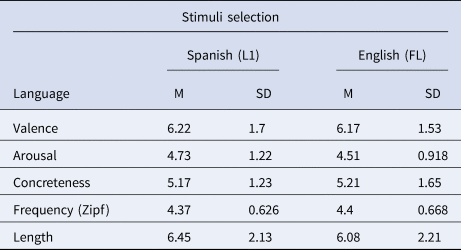
A pool of 180 words was obtained, 90 in Spanish and 90 in English, which were translation equivalents. Both sets were homogeneous (see Table 1), since there were no significant differences in valence, arousal, concreteness, frequency and length scores between the lists in both languages (all ts<1.8).
Stimuli selection in the native and the foreign language (L1 and FL)

Each of the lists of words (namely, the 90 Spanish words and their 90 English translations) was split into two subsets. Each participant was presented with 45 Spanish and 45 English words that were not translation equivalents, and the subsets were counterbalanced across participants, as well as the order in which word items were presented for each participant. The full set of materials is accessible via https://doi.org/10.6084/m9.figshare.23295092.v1
The experimental material was extracted from different sources. In the case of the Spanish materials, the emotional values of words were taken from Stadthagen-Gonzalez et al. (Reference Stadthagen-Gonzalez, Imbault, Sánchez and Brysbaert2017), while concreteness and frequency values were taken from Duchon et al. (Reference Duchon, Perea, Sebastián-Gallés, Martí and Carreiras2013). In the case of the English materials, the emotional values were taken from Warriner et al. (Reference Warriner, Kuperman and Brysbaert2013), those for concreteness from Brysbaert et al. (Reference Brysbaert, Warriner and Kuperman2014b), and frequency values from Brysbaert et al. (Reference Brysbaert, Mandera, McCormick and Keuleers2019). Valence, arousal and concreteness ratings for the responses generated in the word elicitation task were gathered from the same databases that were used to validate the cue words. Thus, to create the experimental material (the list of Spanish and English words that was presented to participants), the complete Spanish word list was taken from Stadthagen-Gonzalez et al. (Reference Stadthagen-Gonzalez, Imbault, Sánchez and Brysbaert2017) (14,000 items) and translated into English. Non-direct Spanish-English and English-Spanish translations as well as cognate translations (pairs of words with a similarity score higher than 0.5 according to the Levenshtein distance algorithm; see Casaponsa et al., Reference Casaponsa, Antón, Pérez and Duñabeitia2015) were eliminated (due to the processing facilitating effect of cognates; Odlin, Reference Odlin1989). Only nouns were preserved. In addition, words in disuse or units that were difficult to understand were also eliminated. The last step consisted of eliminating specific words to ensure that there were no significant differences between the valence, arousal, concreteness and frequency values in the native and foreign language (it was considered that the selected items varied across the scales, also keeping units with extreme scores). Then, the concreteness scores of the English words were recalibrated on a scale of 1 to 7 (originally, they were from 1 to 5), to equalize the scale of scores in both languages. The valence scale ranges from 1 to 9 points (from greater negativity to greater positivity), the arousal scale from 1 to 9 (from less activation to greater activation), the concreteness scale ranges from 1 to 7 (from greater abstraction to greater concreteness), and frequency values scale from 1 to 7.
Procedure
Each participant completed 90 trials, corresponding to 45 Spanish and 45 English words. Items were presented in a blocked fashion. The order of the languages was also counterbalanced across participants. The experiment was conducted online and was performed individually by each participant in a session of approximately 30 minutes. For either of the languages, each trial consisted of the centered presentation of a fixation point for 250 ms preceded and followed by a 100 ms blank, immediately followed by a cue word randomly selected from the pool of items. The cue word remained on the screen during the participants' writing of the three lexical associates that first came to their mind. Participants were instructed to rapidly type the first three words that came to mind after reading the word cue, spending only a few seconds for each word. The language of the cue word was the same as that of the responses that were to be given (an English cue word prompted English responses). The task was self-paced, and they had to click on a button labelled as “Finished! Next word” after finishing writing the three lexical associates of each cue word to move to the next trial. In addition, there was an on-screen button called “I don't know the word”, that served to indicate lack of knowledge of the cue word. The lexical associates written by the participants were produced in Spanish and English, respectively. Stimulus presentation and data collection were performed using Gorilla Experiment Builder (Anwyl-Irvine et al., Reference Anwyl-Irvine, Massonnié, Flitton, Kirkham and Evershed2020).
Data analysis
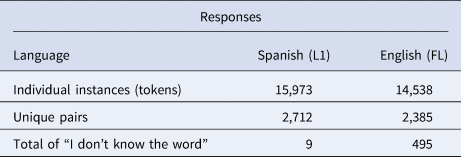
Prearranged that the estimated duration of the test was 30 minutes, a 60-minute time limit was included, so participants who exceeded this time limit were automatically eliminated from further analysis. This way, as a preliminary step, 12 participants were identified and eliminated from the test, so the pool of accepted participants whose data were obtained was 145. Then, the cue words and their associates per participant were extracted. Subsequently, 5 subjects that had not completed the test correctly – that is, not respecting differentiation by language within each block – were eliminated. In addition, answers of more than one-word, proper nouns or nonexistent lexical units were eliminated. Misspelled words in the case of a clear typing error (e.g., a transposition of a specific letter) were manually corrected and accepted. Then, subjects with more than 60% of blank spaces were eliminated (19 participants). Thus, the final dataset included the cue words and their three corresponding associates from a total of 121 participants (30,511 lexical associates in total). The whole dataset is provided at https://doi.org/10.6084/m9.figshare.23295092.v1 . Jamovi (The jamovi project, 2021) and RStudio (RStudio Team, 2020) were used for the analysis. Mean responses per type and language condition are reported in Table 2.
Responses in the native and the foreign language

Results
First, the variability in individual instances (tokens) in the native (Spanish) and the foreign language (English) was analyzed. While individual instances (tokens) are the individual responses that can be repeated, regardless of cue words (e.g., each individual encounter of the word big generated in response to any cue, such as brother, airplane or whale), a unique pair is the combination of the same pair ‘cue + associate’ given by subjects (e.g., the 6 instances of the brother-big combination represent a unique pair). Since the Shapiro-Wilk Test showed that the distribution of the responses departed significantly from normality (W = 0.927, p < .001), the non-parametric Friedman test was conducted to check for differences in the number of individual instances. After the data pre-processing, we ended up with 15,973 individual instances (tokens) in Spanish and 14,538 in English. The results revealed that there were no differences in the number of individual instances between languages (χ2(1) = 0.976, p = 0.323), meaning that participants gave a similar number of tokens in both languages (2,712 were unique pairs in Spanish, which was 16.9% of the total; and 2,385 were unique pairs in English, 16.4% of the total). The total number of times in the experiment that the on-screen button “I don't know the word” was pressed was only 504 (1.651% of the total number of answers).
Subsequently, we analyzed whether the predictive power of the cue was different for the native versus the foreign language, regarding emotional variables, concreteness and frequency. Piecewise mixed model regressions were performed to examine whether the emotional concreteness and frequency values of the cue words could predict those of the native and the foreign language associates, analyzing whether the language (native versus foreign) would be modulating word associations. To this end, a series of models including the cue words’ target property (i.e., valence, arousal, concreteness or frequency), Language and their interaction as fixed effects were generatedFootnote 1. Participants and Cue Words were included as random effects. The independent variables were the valence, arousal, concreteness and frequency values of the words given to participants, whilst the dependent variables were the valence, arousal, concreteness and frequency ratings of the responses given by participants in both languages. The models were fitted using the lmer function of the lme4 package for R (Bates et al., Reference Bates, Mächler, Bolker and Walker2015), while the R2 of the Models were calculated using the r.squared function of the MuMIn package of R (Bartoń, Reference Bartoń2013)Footnote 2.
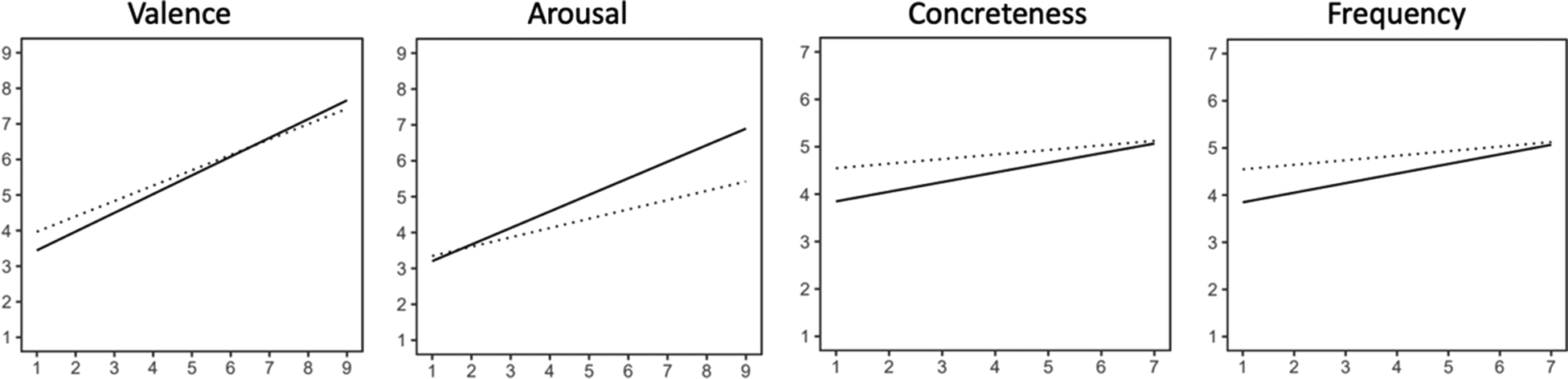
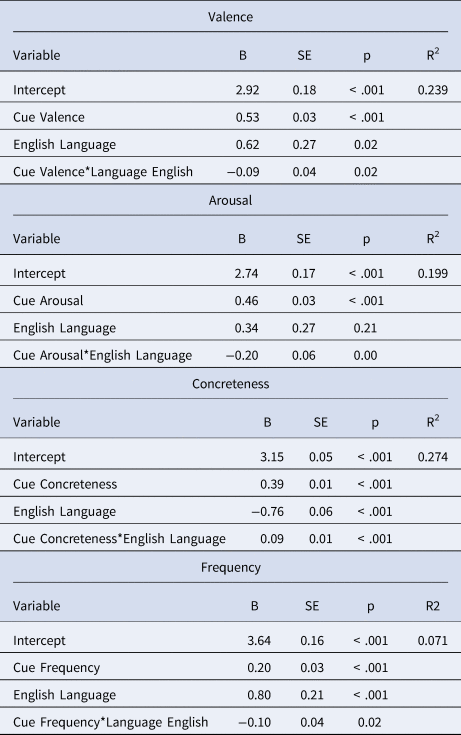
Regarding valence, the model resulted in an R2 of 0.239; Intercept (p < .001), Cue Valence (p < .001), Language (p = 0.02), interaction between Cue Valence and Language (p = 0.02). Specifically, the interaction showed that, in the native language, as the values of the cue words decreased (namely, as cues were more negative), the associates were more negative than in the foreign language. In other words, in the foreign language, the lexical associates tended to correspond to more neutral words, especially when the cue words were more negative (see Figure 1). In addition, it is observed that the valence values of the associates were more neutral than those of the cue words when the cue word was emotional, even in the L1 (less positive associates for positive cue words, and less negative associates for negative cue words).
Cue-associate regressions. The x-axes represent the value of the cue, while the y-axes represent the predicted value of the associate. The solid line represents the regression using the native language, while the dotted lines represent the regression using the foreign language.

Concerning arousal, the model resulted in an R2 of 0.199; Intercept (p < .001), Cue Arousal (p < .001), Language (p = 0.21), interaction between Cue Arousal and Language (p = 0.00). The relationship between cue words and their associates was different depending on the language context (the native versus the foreign one). As it is shown in Figure 1, the interaction was driven by a larger difference in higher arousal values that progressively got smaller as arousal values decreased. These data revealed that, in the native language, as the arousal values of the cues increased, the associates showed also higher arousal ratings, while this was less the case in the foreign language.
Regarding concreteness, the analysis model resulted in an R2 of 0.274; Intercept (p < .001), Cue Concreteness (p < .001), Language (p = < .001), interaction between Cue Concreteness and Language (p = < .001). Thus, the relationship between cue words and their associates differed depending on the language context. As can be seen in Figure 1, the interaction revealed a larger difference in lower concreteness values that gradually got smaller as concreteness values increased. Specifically, the interaction showed that, in the foreign language, as the values of the cue words decreased (namely, more abstract words), the associates had also lower concreteness ratings. In other words, in the native language, the associates tended to be more concrete than in the foreign language, especially for more abstract words.
Lastly, concerning lexical frequency, the analysis model resulted in an R2 of 0.071; Intercept (p < .001), Cue Concreteness (p < .001), Language (p = < .001), interaction between Cue Concreteness and Language (p = < .001). Interestingly, the results suggested that lexical frequency is modulated by the language used. As can be seen in Figure 1, the interaction revealed a larger difference in lower frequency values that progressively got smaller as frequency values increased. Specifically, the interaction showed that, in the foreign language, as the ratings of the cue words decreased (less frequent words), the associates presented higher frequency values. In other words, in the foreign language, the associates tended to be more frequent than in the native language, especially for less frequent cue words.
Table 3 displays the data of the analysis model with reference to the four dimensions, and Figure 1 displays the cue-associate regressions in the native and the foreign language.
Analysis model regarding valence, arousal and concreteness

Discussion
Word association paradigms have proven to be a very efficient tool to study the interrelation of words in the human mind, and analyzing which are the first words that come to individuals’ minds upon presentation of a specific cue word provides valuable knowledge about how units are structured in the mental lexicon (De Deyne et al., Reference De Deyne, Navarro and Storms2013, Reference De Deyne, Navarro, Perfors, Brysbaert and Storms2019; De Deyne & Storms, Reference De Deyne, Storms and Taylor2015; Fernández et al., Reference Fernández, Díez and Alonso2018; Nelson et al., Reference Nelson, McEvoy and Schreiber2004). However, the factors that would be operating in and mediating such lexical associations are still not entirely clear.
Recent studies that analyzed lexical associations in native languages have pointed to emotional dimensions (valence and arousal) and concreteness as some of the vehicular mechanisms that would underlie word association and co-occurrence in discourse (Buades-Sitjar et al., Reference Buades-Sitjar, Planchuelo and Duñabeitia2021; Planchuelo et al., Reference Planchuelo, Buades-Sitjar, Hinojosa and Duñabeitia2022; Van Rensbergen et al., Reference Van Rensbergen, De Deyne and Storms2016). This phenomenon may be occurring due to phylogenetic or adaptative reasons, since a specific affective and concreteness framework would produce the joint activation of certain lexical units characterized with parallel features, constituting themselves as more accessible for future similar occasions.
Having suggested the relevance of emotion and concreteness in lexical association in different native languages, the next logical step was to extend these findings to non-native languages. The current study was set up to explore whether the emotional and concreteness dimensions of words would also be performing as the main mechanisms underlying word association in a foreign language. In addition, this study explored the organization of the mental lexicon in foreign languages, considering the emotional detachment that has been suggested to govern foreign language contexts (Costa et al., Reference Costa, Duñabeitia and Keysar2019b; Iacozza et al., Reference Iacozza, Costa and Duñabeitia2017; Ivaz et al., Reference Ivaz, Griffin and Duñabeitia2019). According to these studies, producing language in a foreign language increases psychological distance and reduces emotional resonance.
The present research, through the paradigm of generation of three lexical associates given a specific cue word, studied whether the language (native versus foreign) could be performing as a modulator of the way words are interrelated in the mental lexicon. As a preliminary step to the analysis of the role of the linguistic context, the first analysis focused on whether there was variability in the number of unique pairs between the native and the foreign language – that is, if there were differences in response variability between the native and the foreign language. The results revealed that there were no significative differences in the number of unique pairs between languages, which would mean that participants gave a similar number of individual instances (tokens) in both languages. This may be occurring due to the intermediate-advanced level of the participants, that could have led to more native-likeness and homogeneous responses, less idiosyncratic (Meara, Reference Meara1982, Reference Meara2009; Riegel & Zivian, Reference Riegel and Zivian1972; Zortea et al., Reference Zortea, Menegola, Villavicencio and Salles2014).
Secondly, the main aim of this study consisted of the analysis of whether language context (native versus foreign) might be influencing the relations between the cue words and their associates. Results showed that the language modulates the relationship between words regarding arousal, valence, concreteness, and lexical frequency. These insights would mean that the same cue word in both languages does not elicit the same lexical associates (in the native and the foreign language), which would be caused by the differential representation of emotional and concreteness features of words depending on the language context.
Particularly, regarding the dimension of valence, it is shown that, as the values of the cue words decreased (as they were more negative), the lexical associates showed more negative values in the native language, as opposed to the associates in the foreign language, which showed more neutral ratings, especially when the cue words were more negative. The fact that, in relation to valence, foreign language associates are more neutral than in the native language, especially when cues are more negative, may find a parallel with the processes that take place in the early stages of native language learning, where a priority in acquisition of positive words over negative ones can be observed (Sabater et al., Reference Sabater, Ponari, Haro, Fernández-Folgueiras, Moreno, Pozo and Hinojosa2022). Other research revealed that children show a clear positivity advantage in word processing while, over the course of development, the initial positivity advantage gradually disappears (Kauschke et al., Reference Kauschke, Bahn, Vesker and Schwarzer2019). These data may also connect with the results of bilingual studies that showed that speakers of a foreign language suppress negative valence content (also presenting a lower associated electrodermal reactivity; Jończyk et al., Reference Jończyk, Boutonnet, Musiał, Hoemann and Thierry2016; Pavlenko, Reference Pavlenko2012). In fact, in late bilinguals, valence is suggested to be disembodied (or presents a reduced embodiment), since foreign languages are revealed to be processed semantically but not emotionally (Norman & Peleg, Reference Norman and Peleg2021; Pavlenko, Reference Pavlenko2012).
In addition to the main results, it is shown that the valence values of the associates were more neutral than those of the cue words when the cue word was emotional, even in the L1. One possible explanation to this effect may be the current frequent use of emotional attenuation/regulation strategies carried out by individuals at present in relation to highly emotional content (Hopp et al., Reference Hopp, Troy and Mauss2011). Moreover, it is worth mentioning that, in this research, the most emotionally salient stimuli (with higher and lower valence values) were pretended to be very frequent and representative, so it might not be surprising that participants did not reach the same levels of affective salience when providing their associates.
Concerning arousal, the interaction between the native and the foreign language showed that as arousal values increased (as words were more arousing), a greater difference could be seen between the native and the foreign language, as the associates produced by individuals were less arousing in the foreign language. That is, in the native language, as the arousal ratings of the cue words increased, the associates were also more arousing, while this was less the case regarding the foreign language. These findings regarding the emotional dimensions (arousal and valence) are in connection with the insights suggested by emotional detachment theories in foreign languages, which showed the existence of a reduced emotional reactivity in foreign language contexts, contrary to the deeper emotional processing that takes place in native languages (Costa et al., Reference Costa, Duñabeitia and Keysar2019b; Iacozza et al., Reference Iacozza, Costa and Duñabeitia2017; Ivaz et al., Reference Ivaz, Costa and Duñabeitia2016). In this sense, it has been proposed that the different context in which the two languages were acquired (the native language in a familiar/affective context, and the foreign language in an institutional context) is what produced the difference in the affective resonance, leading to less emotional (more pragmatic) decision making in the foreign language (Ivaz et al., Reference Ivaz, Costa and Duñabeitia2016). Our findings extend that view by showing that this emotional detachment might be grounded in the structure of the relationships between words in the lexical-semantic organization of a foreign language, based not only in valence but also in arousal features.
Different research revealed that emotion is an important feature of the bilingual lexicon, since the mother tongue is considered more emotional than those acquired subsequently in life (Altarriba, Reference Altarriba2008; Dewaele, Reference Dewaele2004). The foreign language would be experienced as more neutral and less activating because words are not infused with anxious or painful memories (Pavlenko, Reference Pavlenko2005). Other results also showed that significant affective priming effects were found in the mother tongue, but not in the foreign language (it only occurred in the case of participants with high levels of language immersion and frequency of use; Degner et al., Reference Degner, Doycheva and Wentura2012). However, other studies stated that emotional detachment is not due to the level of language proficiency, but to the different environments in which the language is used (Miozzo et al., Reference Miozzo, Navarrete, Ongis, Mello, Girotto and Peressotti2020).
Concerning concreteness, the language context would also be modulating the way in which words are interrelated. Results showed an interaction between the native and the foreign language that revealed that, as the concreteness ratings of the cues increased (as cues were more concrete), the lexical associates in the native and foreign language showed more similar values. Nevertheless, and interestingly, as the concreteness values of the cues decreased (as words were more abstract), the associates offered in the foreign language were more abstract than in the native language. We can tentatively suggest that words in the native language would be connected to specific and concrete memories from representations in the episodic memory, characterized by eliciting more concrete associates linked to one's own experience (Ladueña et al., Reference Ladueña, Behzad and Gros2014; Steyvers et al., Reference Steyvers, Shiffrin, Nelson and Healy2005). Furthermore, concreteness is revealed to be a key element of bilingual processing. The meanings of concrete words are suggested to be more similar across languages than those of abstract words since they refer to observable/physical entities (de Groot, Reference de Groot1992). Moreover, a semantic-priming effect across languages was detected for concrete words but not for abstract words (Jin, Reference Jin1990).
Concerning frequency, the interaction between the native and the foreign language showed that, as frequency decreased, the associates produced were more frequent in the foreign language. These findings connect with the results of different studies that highlighted the relevant role of this variable in language acquisition and, therefore, in the organization of the mental lexicon in combination with the emotional values (Sianipar et al., Reference Sianipar, Van Groenestijn and Dijkstra2016). The effect showed in the present research may be due to the fact that individuals tend to provide more frequent/repeated lexical associates in their foreign language, since they do not have a proficient knowledge in this context.
It would be enriching, for future lines of study, to collect data from participants with different levels of competence in the foreign language (from beginners to proficient users), and not only considering intermediate-advanced speakers, to show whether emotion and concreteness would be operating behind word association depending on language proficiency. Another related aspect that could also be taken into consideration can be the effect of language status (the order of acquisition and degree of use) in the nature of the lexical interrelations in foreign languages.
Furthermore, it would be very effective to collect the average completion times in both linguistic contexts, in order to examine whether the average completion time differed between the native and foreign language. In addition, it should be noted that the scores used in the study were based on data from native speakers. This is certainly a limitation that exists not only in this research, but in this field of study (see Ponari et al., Reference Ponari, Rodríguez-Cuadrado, Vinson, Fox, Costa and Vigliocco2015, which explored similar objectives using native databases). It would be functional for future research to have databases whose scores reflect accurately foreigners' experience of the language.
On a different note, it would be enriching to analyze whether the mother tongue activation can be playing a role during the associations that took place in the foreign language. When adults learn a foreign language, they usually establish translation equivalents between the native and the foreign language, particularly in early stages (MacWhinney, Reference MacWhinney, Ellis and Robinson2008). In the case of our study, all individuals had an intermediate-advanced level of English, but it would be enriching to see what happens in this respect with bilinguals of different proficiency levels. In addition, different studies have suggested the existence of a division between semantic and pure associative lexical interrelations (Roelke et al., Reference Roelke, Franke, Biemann, Radach, Jacobs and Hofmann2018). Thus, it would be crucial for future research to analyze the nature of such differences in the native and the foreign language.
Finally, continuing with the research itinerary that was followed with native languages, the present research could be extended to the analysis of the lexical associations in the sentence level, and not only by using the paradigm of isolated lexical associates. As a last remark, it is worth mentioning that it is possible that a different affective and concreteness baseline activation of the cue word and their associates is taking place regarding the foreign language, but it could be useful to analyze whether language proficiency and its degree of use are modulating this process.
To conclude, this research is pioneering in highlighting the effects of the linguistic context, native versus foreign, as a modulator of the interrelations of words in the mental lexicon. This research revealed that emotional and concreteness relationships between words would be a function of the language used, suggesting a valuable role of the linguistic framework in the manner that words, and their underlying notions, are interrelated in the human lexicon. In sum, the organization of words, as a proxy to know and organize reality through language and emotion, would be modulated by the linguistic context.
Acknowledgments
This research has been partially funded by grant PID2021-126884NB-I00 from the Spanish Government.