1. Introduction
Grammatical convergence, or the achievement of structural similarity among languages, is widely considered to be a natural outcome of language contact, and much recent work implicates code-switching (CS) as its major catalyst. Code-switching, in the sense of alternating between distinct languages during a single discourse event, is an online process whose diachronic precursors cannot be reconstructed, so, in contrast to other potential triggers of contact-induced change, its effects must be measured synchronically. To our knowledge, however, convincing demonstrations of this kind of change in progress are few and far between, and, with the notable exception of Torres Cacoullos and Travis (Reference Torres Cacoullos, Travis, Rivera-Mills and Villa2010), empirical reports of the role of CS in the process, nonexistent.
To be sure, a scientific test of convergence in progress requires an enormous amount of infrastructure. A first requirement is a study site in which languages have been in long and intense enough contact to even render grammatical transfer feasible, and whose socio-linguistic makeup is conducive and appropriate to CS. A second is a sample of speakers who can be observed to switch between the languages unreflectingly in discourse, as well, for purposes of comparison, as others who do not. From a linguistic perspective, there must be a likely candidate for the contact-induced change, a corpus of data furnished by members of the bilingual community containing sufficient occurrences to enable the analyst to detect patterns of use and contextualize them with respect to the linguistic system hosting it, and a real- or apparent-time component against which to assess whether anything has in fact changed. Now, until it goes to completion, change manifests itself synchronically in competition among variant forms for the same linguistic work. The method employed must therefore be capable of accounting for such alternation, distinguishing stable variability from change, and differentiating contact-induced change from internal evolution. Abandonment, or at least suspension, of the widespread belief that variability is change (e.g. Montrul, Reference Montrul2004, p. 130; Sorace, Reference Sorace2004, p.144; Toribio, Reference Toribio2004, p. 167) will also be required.
With this foundation, and the methodology of variationist sociolinguistics, we propose in this paper to determine whether a stereotypical and stigmatized grammatical feature of Quebec French can be shown to have developed as a result of intense long-term contact with English, as is widely believed, and if so, whether copious code-switchers are its instigators. The candidate for convergent change is variable preposition placement in relative clauses, as illustrated in (1), where speakers alternate between the Standard French option of placing the preposition in clause-initial position along with the remainder of the prepositional phrase, as in (1a), or leaving it bare: in phrase-final position with no adjacent complement, as in (1b).
- (1)
a. Clause-initial preposition
Les anglaises avec qui je parlais, ils le croyaient pas. (OH.082.1695)Footnote 1
“The anglophones to whom I was talking, they didn't believe it.”
b. Phrase-final preposition
J'avais pas personne à parler avec. (OH.013.1964)
“I had no one to talk to.”
Phrase-final prepositions are prescriptively unacceptable in French, but they are the norm in English, the language with which it has been in intense contact in Canada for centuries. One of the goals of this paper will be to determine whether the placement of avec in (1b) is a result of this contact, or – despite the surface similarity with English stranded prepositions – something altogether different. Poplack and Levey (Reference Poplack, Levey, Auer and Schmidt2010) outline a number of hard tests, or criteria, of convergence, most of which involve comparisons with relevant benchmark varieties. A conclusion in favor of contact-induced change should rest on the demonstrations that the candidate feature
(i) is in fact a change,
(ii) was not present in the pre-contact variety,
(iii) is not present in a contemporaneous non-contact variety,
(iv) behaves in the same way as its putatively borrowed counterpart in the source variety, and
(v) differs in non-trivial ways from superficially similar constructions in the host language, if any.Footnote 2
In this paper we address each of these criteria, focusing especially on (iv) and (v). By means of systematic quantitative comparisons, we situate phrase-final prepositions with respect to their apparent counterparts in the presumed source variety on the one hand, and to co-existing native (i.e. not borrowed) French options for preposition placement on the other.
1.1 Code-switching and convergence: The received wisdom
At least since Gumperz and Wilson famously implicated CS in the convergence of Kupwar Urdu, Marathi and Kannada into a “single syntactic surface structure” (Reference Gumperz, Wilson and Hymes1971, p. 256), CS has been identified as a key mechanism for contact-induced change in general, and structural convergence in particular (e.g. Backus, Reference Backus2004, Reference Backus2005; Fuller, Reference Fuller1996; Heath, Reference Heath1989; Muysken, Reference Muysken2000; Thomason, Reference Thomason2001; Toribio, Reference Toribio2004; Winford, Reference Winford2005). The evidence underlying Gumperz and Wilson's sweeping claim was thin,Footnote 3 and current accounts of exactly how such a mechanism might operate to bring about language change remain vague. Winford's (Reference Winford2005, p. 90) explanation of the Kupwar situation is that CS weakens language boundaries and makes them more permeable to external influence. For Backus (Reference Backus2005, p. 334), CS “function[s] to model syntactic patterns which are then subsequently imitated in the base language”. Silva-Corvalan (Reference Silva-Corvalán, Schwegler, Tranel and Uribe-Extebarria1998) and Toribio (Reference Toribio2004) implicate the processing demands of CS as motivations for convergence. Heath (Reference Heath1989, p. 35) suggests that CS and “vanguard” borrowings set up “routines” for future borrowing. Such accounts could be multiplied. But the literature offers more in the way of assertions than explanations: CS is a “powerful vehicle for diffusion of structural and other features across languages” (Winford, Reference Winford2005, p. 86), CS brings about structural borrowing (Backus, Reference Backus2005, p. 309), structural elements introduced by CS progress to permanence in the same way as internal innovations (Thomason, Reference Thomason2001, p. 136), CS “promulgates the striving towards convergence” (Toribio, Reference Toribio2004, p. 172), among many others. Indeed, the candidate for contact-induced change under investigation here was reported by Winford (Reference Winford2005, p. 69) to have been initiated in Prince Edward Island French by “fluent bilinguals who practiced frequent CS” (despite the pains taken by King (Reference King2000, p. 176), the author of the study, to rule out CS as a cause).
It is in this context that we situate the present study of preposition placement in Quebec French, and the role of code-switchers in introducing the bare variant and propagating it across the bilingual speech community. The research we report here was specifically designed to instantiate the social and linguistic conditions considered to be propitious to convergence (Poplack, Reference Poplack, Fasold and Shiffrin1989), while bringing rigorous methodology to bear on the evidence. In keeping with Thomason's (Reference Thomason2001, p. 94) requirements for making a “solid case for contact-induced change”, we (i) identify the presumed source of the change; here, English, (ii) determine the existence of shared structure by means of detailed comparative analyses of the factors affecting preposition placement in source and host varieties, (iii) situate the candidate for convergence with respect to the host linguistic system of preposition placement, and (iv) assess whether the phrase-final variant represents a change by investigating its presence in an earlier, pre-contact variety of French. The specific contribution of code-switching, if any, to initiating and propagating contact-induced change emerges from detailed comparison of the linguistic behavior of copious vs. sparse code-switchers in the community. Consideration of all of these lines of evidence will enable us to rule out contact as a determining factor, and confirm that phrase-final prepositions are the product of internal evolution via analogical extension to a novel context of a similar native strategy.
1.2 Preposition placement in the source: English relative clauses
We begin with a brief overview of the relevant properties of the candidate for convergence in the putative source. We cannot do justice here to the vast literature, synchronic and diachronic, on preposition placement in English; since convergence arises out of usage, we limit this discussion to key patterns that have emerged from corpus-based studies. In deciding where to place the preposition, English speakers may also choose between placing the preposition at the head of the phrase, to which, following Ross (Reference Ross1967), we refer as pied-piping (PP), as in (2), and leaving it in phrase-final position with no adjacent complement, commonly known as stranding (S; (3a–c)).
(2) Pied-piping (with wh-relative)
I think that- that the direction in (PP) which Canadians want to go today is getting better. (QEC.317.746)
(3) Stranding
a. wh-relative
I don't know which place they're from (S) just by looking at them. (QEC.308.1019)
b. that-relative
This is something that I could probably get interested in (S). (QEC.192.66)
c. zero relative
And this is the guy Ø I've always had a crush on (S). (QEC.301.1372)
These options are available in three major contexts: relative clauses, wh-questions and prepositional passives. In the French data we examine here, however, phrase-final prepositions occur only in the first, so for purposes of comparison, we focus on English relative clauses. Here, the choice between pied-piping and stranding is not free, but is said to be constrained by a complex set of rules, mediated in the first instance by choice of relative pronoun. With that (3b) and zero (3c) relatives, stranding is categorical; only wh-relativizers admit variation ((2) and (3a)). Where variant choice is an option, contextual factors like syntactic function of the prepositional phrase, type of phrase into which the prepositional phrase is embedded, and most important, speech style (pied-piping being associated with formal registers), have been found to play a role in the British component of the International Corpus of English (ICE-GB) studied by Hoffmann (Reference Hoffmann2005, p. 259). Idiosyncratic lexical effects have also been cited: some prepositions (e.g. beyond, under) are said to require pied-piping, some phrasal verbs (e.g. put up with, get rid of, look out for) strand obligatorily, and some types of antecedent trigger pied-piping (e.g. Culicover, Reference Culicover1999; Pullum & Huddleston, Reference Pullum, Huddleston, Huddleston and Pullum2002). Still, Hoffmann (Reference Hoffmann2005, p. 263) reports that few prepositions in contexts admitting variability were stranded in ICE-GB; pied-piping accounted for 92% of the wh-relative clauses. Studies of other corpora of contemporary educated spoken British English (Johansson & Geisler, Reference Johansson, Geisler and Renouf1998; Quirk, Reference Quirk1957, cited in Bergh & Seppänen, Reference Bergh and Seppänen2000) likewise found stranding to be relatively rare (under 21%), albeit more frequent, if not the norm (Herrmann, Reference Herrmann2003) in the “dialects”. Such inter-dialectal differences in stranding rates raise the question of the strength of the target model, a key, though understudied, predictor of convergent change. We return to this issue in Section 5.1 below.
1.3 Preposition placement in French relative clauses
In contrast to the complexity of the English patterns described above, the Standard French prescriptive rule is quite straightforward: the preposition must be followed by its complement, as exemplified by the citation from Le bon usage in (4).
(4) L'usage ordinaire demande que la préposition soit suivie immédiatement de son régime.
(Grevisse & Goosse, Reference Grevisse and Goosse2008, p. 1330)
“Normal usage requires that the preposition be followed immediately by its complement.”
Vernacular French offers other options, however, one of which, as in (1b) above, is leaving the preposition bare, with no adjacent complement. These are variously referred to in the literature as intransitive (Vinet, Reference Vinet1979, Reference Vinet1984), stranded (King, Reference King2000; King & Roberge, Reference King and Roberge1990; Roberge & Rosen, Reference Roberge and Rosen1999) or orphan (Barbaud, Reference Barbaud1998; King, Reference King and Filppula2005; Roberge, Reference Roberge and Brasseur1998) prepositions. Although, as detailed in Section 7 below, Standard French occasionally admits prepositions with no overt complement as well, relative clauses do not figure among the contexts in which this is sanctioned. In this paper, for ease of exposition, we provisionally retain the term stranding for bare French prepositions in relative clause contexts (i.e. contexts admitting this process in English), reserving the term orphaning (Zribi-Hertz, Reference Zribi-Hertz1984) for phrase-final prepositions in other indicative sentence constructions (Zentz, Reference Zentz2006; and Section 7 below). After establishing the properties of the two classes of context and the prepositions that occur within them, we return in Section 9 to the question of whether prepositions in examples like (1b) are more appropriately characterized as stranded or orphaned.
Phrase-final prepositions are a well-documented feature of North American French (Flikeid, Reference Flikeid1989, for Nova Scotian French; King, Reference King2000; King & Roberge, Reference King and Roberge1990, for Prince Edward Island French; Roy, Lefebvre & Régimbald, Reference Roy, Lefebvre, Régimbald and Lefebvre1982; Vinet, Reference Vinet1984, for Montreal French; and Roberge & Rosen, Reference Roberge and Rosen1999, for a comparison of Louisiana, Alberta, Quebec, Ontario and Prince Edward Island French), though its varieties are reported to differ somewhat in terms of the number and type of strandable prepositions, as well as the contexts where stranding is admissible.Footnote 4 The general consensus, as emerges from syntactic analysis of the underlying structure of the null complements, is that both Vernacular French relative clauses and bare prepositions differ in crucial ways from their English counterparts. The conclusion is that bare prepositions in Quebec French relative clauses cannot be equated with English stranded prepositions; the surface similarities between them are apparent only (Barbaud, Reference Barbaud1998; Bouchard, Reference Bouchard and Lefebvre1982; Roberge Reference Roberge and Brasseur1998; Roberge & Rosen, Reference Roberge and Rosen1999; Vinet, Reference Vinet1979, Reference Vinet1984; Zribi-Hertz, Reference Zribi-Hertz1984). We return to this issue in Section 9.
Still, the rarity of bare prepositions in the languages of the world (van Riemsdijk, Reference Riemsdijk1978; Vinet, Reference Vinet1984), and the purported absence of this construction in other Romance languages and other varieties of French (Vinet, Reference Vinet1979, p. 117; Reference Vinet1984, p. 234), coupled with the intense contact with English in North America, would support the inference that this state of affairs is somehow attributable to contact with English. Indeed, Roberge (Reference Roberge and Brasseur1998, p. 57) observes that no one would doubt it. Few linguists would endorse direct syntactic influence, however, though whether it is mediated by lexical borrowing (King, Reference King2000; Vinet, Reference Vinet1984) or is a consequence of reanalysis elsewhere in the grammar triggered by the contact with English (Barbaud Reference Barbaud1998; Roberge, Reference Roberge and Brasseur1998; Roberge & Rosen, Reference Roberge and Rosen1999) is unclear.
While this work has gone a long way towards clarifying the syntactic structure of prototypical prepositional complements in the two languages, none of it (with the possible exception of King, Reference King2000, Reference King and Filppula2005, for Prince Edward Island French) has examined speech. Whether speakers’ actual use of these constructions follows English-like or French-like patterns thus remains an open question. The answer to this question is key, since, as we noted earlier, convergence can only arise from usage. This is the focus of the research reported here. In addition, we test the further hypothesis that French-speaking individuals who regularly code-switch to English (where preposition stranding is the norm), may also, presumably by virtue of frequent activation of English grammar, come to draw on it in deciding where to place their French prepositions while speaking French.
Moreover, the foregoing examples show that preposition placement is a variable process. Previous studies have not explicitly contextualized the phrase-final variant with respect to the other options for preposition placement with which it competes in the relevant (relative clause) context. These include the (standard) pied-piping, described in (4) above and exemplified in (1a) and (5), and elimination of the preposition altogether, in a process known as absorption (A; Barbaud, Reference Barbaud1998; see also Bouchard, Reference Bouchard and Lefebvre1982; Frei, Reference Frei1929; Gadet, Reference Gadet and Kriegel2003; Roberge & Rosen, Reference Roberge and Rosen1999; Vinet, Reference Vinet1984), as in (6). In (6) and subsequent examples of absorption, “[ ]” indicates an absorbed preposition, with no stand taken as to position.
(5) Pied-piping
Oui, ça dépend avec (PP) qui je parle. (OH.40.3020)
“Yes, that depends on with whom I'm speaking.”
(6) Absorption
Il y avait un gars que je parlais [ ] (A) une journée, puis j'étais bien chum avec. (OH. 013.1645)
“There was a guy that I talked [ ] one day, that I was real friendly with.”
An accurate account of preposition stranding in French cannot be achieved without ascertaining how the putatively borrowed structure interacts with these native options for preposition placement, as well as the motivations for selecting one over another. These are questions we will address in ensuing sections.
2. Data and method
2.1 The contact situation
The linguistic materials we report on here were gathered along the Quebec–Ontario border in the national capital region of Canada. This is the site of intense and long-term contact between French, the official and majority language of Quebec, and English, its counterpart in the province of Ontario. A computerized corpus was constructed from data provided by a random sample of 120 bilingual francophones resident in the region, stratified according to age and intensity of contact. Crucially for this study, their individual bilingual proficiency and propensity to code-switch were also controlled.Footnote 5 The Ottawa-Hull French Corpus (Poplack, Reference Poplack, Fasold and Shiffrin1989) is a massive compendium of informal speech, containing many spontaneous manifestations of French and English alone and in a variety of combinations. The one which interests us here is code-switching, operationally defined as the “alternation, within a single discourse, between sentences or multiword sentence fragments, each of which is internally consistent with the morphological and syntactic (and optionally, phonological) rules of the language of its provenance” (Poplack, Reference Poplack and Preston1993, p. 256). This is illustrated in (7).
(7) Code-switching
Vois-tu? Puis ça c'est toute bien pas trop de sa faute à lui, he just can't do it, vois-tu? Tu sais, il est pas capable. Fait que you have to. (OH.007.1426)
“See? And that's not all his fault, he just can't do it, see? So you have to.”
Although the issue of just what should count as “code-switching” remains controversial, it stands to reason that the larger the chunks of the donor language involved, the more grammatical structure available for transfer (e.g. Backus, Reference Backus2005; Winford, Reference Winford2005). For the purposes of this study, then, informants were selected on the basis of their ability to engage in such alternation between multiword fragments in the two languages, rather than on their rates of lexical borrowing.
The 19 participants whose preposition placement we study here display different levels of bilingual ability and propensities to code-switch, classified as “copious” (20 or more switches per recording), or “sparse” (under 20; see Zentz [2006] for details of sample constitution). Needless to say, these labels are only relative: absolute rates of code-switching cannot be established given that it is unclear what would constitute the denominator. Nonetheless, if the claims of Backus (Reference Backus2005), Thomason (Reference Thomason2001), Toribio (Reference Toribio2004) and others are correct, individuals who code-switch more should also lead contact-induced changes. In Section 4, we test this prediction empirically.
2.2 Applying the comparative variationist framework to the investigation of grammatical convergence
The variationist approach to language seeks to account for the fact that in normal discourse, speakers, bilingual as well as monolingual, continually engage in choices amongst alternatives which have the same referential meaning or function in specific linguistic contexts. These choices are not free, but are subject to constraints imposed by the features of the linguistic (and extra-linguistic) environments in which they occur. The features are operationalized as factors, which themselves are hypotheses about what motivates variant choice. Among the hypotheses regarding preposition placement examined here, some involve aspects of the preposition (function, semantic weight, lexical identity), others relate to the verb it complements (necessity of the prepositional phrase to interpret the verb semantics, lexical identity), still others involve the complement (type, humanness, adjacency to the verb). As described in the next section, each of these has been invoked in the literature in connection with choice of one or another preposition placement strategy.
2.3 Factors relating to the preposition
Lexical identity
A number of scholars stress the idiosyncratic lexical properties of the preposition as contributors to placement strategies. Togeby (Reference Togeby1984) notes that “conjoined” prepositions (de, à, en, par, sur, sous, dès hors, dans, chez, vers, parmi) are always followed by a complement. Likewise, Kayne (Reference Kayne1975) asserts that the prepositions de, à and en cannot stand alone, echoing Grevisse and Goosse (Reference Grevisse and Goosse2008) in (8). Accordingly, each preposition was coded according to its individual lexical identity.Footnote 6
(8) Avec les prépositions à et de, l'omission du régime est impossible. (Grevisse & Goosse, Reference Grevisse and Goosse2008, p. 1509)
“With the prepositions à and de, omission of the complement is impossible.”
Semantic weight
Another factor widely considered (Ambrose, Reference Ambrose1987; Bouchard Reference Bouchard and Lefebvre1982; Koster, Reference Koster1978; Takami, Reference Takami1992; Vinet, Reference Vinet1984; Zribi-Hertz, Reference Zribi-Hertz1984) to affect preposition placement is semantic weight. Semantically rich prepositions are considered more prone to stranding, while “weak” (semantically empty) prepositions would be more likely to be absorbed (Bouchard, Reference Bouchard and Lefebvre1982). To operationalize this notion, we distinguished prepositions in environments where their meaning could only be decoded in conjunction with the context or the verb they co-occur with (e.g. parler de “talk about”, venir de “come from” in (9)), which we coded as weak, from those whose semantic reading is context-independent These were coded as strong (10).Footnote 7
(9) Semantically weak
a. C'est du (PP) passé je parle là, je déterre les morts là. (OH.082.1191)
“It's about the past I'm talking, I'm digging up skeletons.”
b. Je lui ai demandé le lieu d’où (PP) il venait. (OH.082.1334)
“I asked him the place from which he came.”
(10) Semantically strong
a. Ça c'est le nom de celui que je reste avec (S). (OH.090.1080)
“That's the name of the one that I'm living with.”
b. Ça dépend avec (PP) qui-ce tu te tiens. (OH.105.1176)
“That depends on with whom you hang out.”
c. Puis il y a bien des affaires j'avais de la misère avec (S). (OH.052.1216)
“And there are lots of things I had trouble with.”
2.4 Factors relating to the complement
Construction type
Another factor cited in connection with variant choice is construction type. In ordinary relative clauses (on subject NPs; (11a)), pied-piping is said to be favored (Grevisse & Goosse, Reference Grevisse and Goosse2008), as is absorption. Absorption is also said to be particularly promoted in pseudo-clefts (phrases headed by ce + preposition + quoi, which according to Barbaud (Reference Barbaud1998, p. 11) become relexicalized as [skə], as in (11b), or [kɛsk], as in (15a) below, absorbing the preposition). Bare prepositions, on the other hand, are categorically disallowed in Standard French ordinary relatives on subject NPs (Vinet, Reference Vinet1984), while cleft constructions (11c) are said to favor stranding (at least for interrogative structures (ibid.), not included in this analysis), an effect we also test on the indicative structures of interest here.
- (11)
a. Ordinary relative (on subject NP)
Je protégeais le monde avec (PP) qui je traitais. (OH.082.2947)
“I protected the people with whom I dealt.”
b. Pseudo-cleft
Ils m'ont donné là, disons le nécessaire là, ce que j'avais besoin [ ] (A). (OH.111.421)
“They gave me, let's say the essentials, that I needed [ ].”
c. Cleft
C'est toute du monde de leur âge là-dedans qu'ils peuvent se- s'arranger avec (S). (OH.052.781)
“It's all people their age in there that they can get along with.”
Based on the claims in the literature, we hypothesize that stranding will be favored in the same contexts as absorption, with the exception of pseudo-clefts, which should favor only absorption.
Humanness of the complement
Animacy or humanness of the NP complement of the prepositional phrase in question has also been invoked to explain preposition placement. Porquier (Reference Porquier2001), for instance, claims that certain prepositions only occur with animate complements (also Zribi-Hertz, Reference Zribi-Hertz1984, but see Vinet, Reference Vinet1984, for a contrary view). Here we distinguish human (12a) from non-human (12b) complements.
- (12)
a. Human complement
Mais celui je travaillais pour (S), . . . ses enfants ils parlaient anglais. (OH.060.1426)
“But the one I worked for, his kids they spoke English.”
b. Non-human complement
Définiment [sic], oui. Il y a- les fêtes qu'on allait [ ] (A), ça durait plus longtemps. (OH.002.976)
“Absolutely, yes. There are- the parties that we went [ ], they lasted longer.”
Proximity and place of preposition with respect to verb complement
Proximity of the preposition to the verb it complements is also considered to affect preposition placement (Vinet, Reference Vinet1984): the greater the distance, the more likely an overt complement. Proximity is difficult to measure directly, however, since French complements may either intervene between verb and preposition or be cliticized. Our operationalization distinguishes verbal complexes that, in addition to a prepositional phrase complement, contained a cliticized (13a) or post-verbal (13b) complement, from no additional complement to the VP at all (13c).
- (13)
a. Clitic complement present (other than the prepositional phrase analyzed)
Mon amie de femme, c'est ça qu'elle me parlait [ ] (A). (OH.22.1188)
“My girlfriend, that's what she talked to me [ ].”
b. Post-verbal complement present (other than the prepositional phrase analyzed)
D'autres gens de ton âge là, avec (PP) qui tu peux parler de différentes choses. (OH.111.583)
“Other people your age, with whom you can talk about different things.”
c. No other verbal complement present (other than the prepositional phrase analyzed)
Et puis j'aimais ça la manière qu'ils Ø parlaient [ ] (A) Ø. (OH.116.2003)
“And I liked the way that they talked.”
As separating the preposition from the verb could arguably affect interpretability, we hypothesize that pied-piping would be favored under such conditions, while stranding would be preferred when no other complement intervenes.
2.5 Factors relating to the verb
Obligatoriness of the prepositional complement
Another question concerns the necessity of the prepositional complement for the correct interpretation of the verb semantics.Footnote 8 “Intransitive” prepositions, which in formalist accounts are base-generated with the verb (Hornstein & Weinberg, Reference Hornstein and Weinberg1981; Kayne, Reference Kayne1975) are essential to the verb's meaning. These are the prepositions that tend to be stranded in English. We coded verbal events that require a complement to complete their meaning as obligatory, as in (14a), hypothesizing that these will favor stranding and (following Vinet, Reference Vinet1984) disfavor absorption. Cases where the complement is not required to interpret the meaning of the verb were coded as non-obligatory, as in (14b).
- (14)
a. Obligatory prepositional complement
Ça va faire sept ans je reste avec (S). (OH.90.1170)
“It's going on seven years I'm living with.”
b. Non-obligatory prepositional complement
Puis ils s'attendaient que les grosses familles étaient pour le faire nourrir. Lui assis dans son-. . . dans son domaine là, où-ce-qu'il (PP) avait quasiment absolument rien à faire. (OH.003.420)
“And they expected that the big families would feed him. Him ensconced in his manor there, where he had almost absolutely nothing to do.”
Lexical identity
According to some accounts (e.g. Koster, Reference Koster1978; McBriarty, Reference McBriarty1935; Porquier, Reference Porquier2001; Zribi-Hertz, Reference Zribi-Hertz1984), idiosyncratic lexical properties of the verb which the preposition complements may also affect preposition placement. As with the prepositions, we distinguished every verb employed in a context in which one of the variants under study is admissible.
2.6 Multivariate analysis of the contribution of factors to preposition placement strategy
From the recorded conversations of the copious and sparse code-switchers constituting our speaker sample, we extracted every preposition occurring in a restrictive relative clause with an overt or null prepositional complement (the “variable context” for stranding), and coded them for each of the factors listed above. Independent multivariate, or variable rule analyses (Rand & Sankoff, Reference Rand and Sankoff1990) allow us to determine which ones contribute significant effects to choice of preposition placement strategy, as well as the magnitude and direction of the effect. We construe the constraint hierarchies yielded by variable rule analysis as the structure of the choice mechanism, and we use this information – in ways we demonstrate below – to determine the provenance of phrase-final prepositions in relative clause constructions. By comparing this variable structure across cohorts, we assess whether change has occurred and if so, whether, and to what extent, CS can be implicated.
3. Results
3.1 Stranding
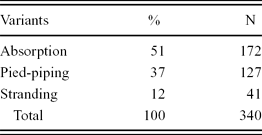
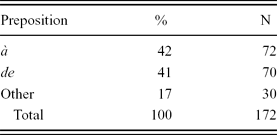
Table 1 displays the distribution of preposition placement strategies in the data.
Overall distribution of preposition placement strategies in stranding contexts.

A first surprising finding, in view of the amount of attention bare prepositions have garnered, is that contexts where they are even an option in French are themselves very rare – of the thousands of (subject and object) noun phrases in the data that could have been relativized, only 340 were – and within those contexts, prepositions occur phrase-finally no more than 12% of the time.Footnote 9 This is a very minor phenomenon in French.
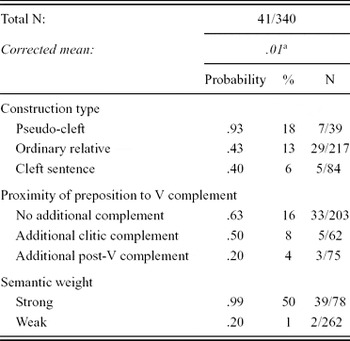
What motivates a speaker to choose to leave a preposition bare rather than to absorb or pied-pipe it? Variable rule analysis of the factors hypothesized to contribute to the choice of stranding (Table 2) shows that two syntactic factors play a role: construction type – stranding is favored with pseudo-clefts, as in (11b) above – and proximity of the preposition to the verb complement – stranding is favored when there is no additional complement.Footnote 10 We return to these effects below. But by far the strongest predictor of stranding is semantic weight.Footnote 11 With a probability of .99, strong prepositions are extremely likely to be stranded. On the other hand, weak prepositions never appear bare. The only two exceptions, shown in (15), are flagged with discourse markers like tu sais “you know” and hein “eh”, further evidence of their anomalous status.Footnote 12
- (15)
a. C'est pas croyable qu'est-ce qu'ils peuvent sortir, tout ce qu'on peut se servir de- (S) tu sais? (OH.116.146)
“It's unbelievable, what they can come up with, everything we can use, you know?”
b. Beaucoup de choses qu'on parle de (S), hein, que. . . disons c'est confidentiel ces choses-là. (OH.040.2074)
“A lot of things that we talk about, eh, that. . . let's say those things are confidential.”
Variable rule analysis of the factors selected as significant to preposition stranding.

aWhereas in general the corrected mean closely reflects the overall rate of variant selection in the community, because of the asymmetrical distribution of stranded tokens across weak and strong prepositions discussed below, this relationship appears distorted.
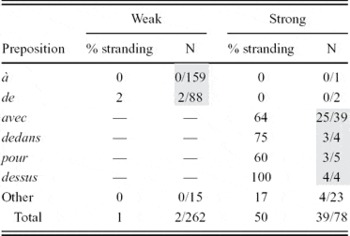
But closer inspection (Table 3) shows that the labels strong and weak are masking an idiosyncratic lexical effect: 94% (247/262) of all prepositions labeled as weak are actually instances of à and de, both of which virtually never appear phrase-finally, while avec makes up exactly half (39/78) of the strong category, and by itself accounts for nearly 2/3 (25/41) of the stranded prepositions. In fact, so lexically restricted is stranding that 85% (35/41) involves just four prepositions (all strong): avec “with”, pour “for”, dedans “in” and dessus “on”.
Rate of preposition stranding by lexical identity and semantic weight of the preposition. (The shading highlights the discrepancies in the behavior of weak and strong prepositions.)

3.2 Other strategies for preposition placement in relative clauses
Absorption
We noted above that prepositions are stranded in only 12% of eligible contexts. How are they treated in the remaining 88% of the materials? One solution is to eliminate them altogether, in the process we have referred to as absorption, exemplified in (6) above and (16).
(16) Absorption
(Pourquoi tu as changé [d'école]?) Pour faire quelque chose de différent, du nouveau monde à parler [ ] (A). (OH.002.040)
“(Why did you change [schools]?) To do something different, new people to speak [ ].”
Barbaud analyzes absorption as a bid to avoid stranding, resulting from a “growing tendency” towards fronting arguments (via clefting, pseudo-clefting, left dislocation, relativization, etc.), leading to weakening of verbal subcategorization constraints, and facilitating in turn omission of the preposition. From a somewhat different angle, Roberge and Rosen (Reference Roberge and Rosen1999) invoke the ongoing replacement in spoken French of relative pronouns which embody the semantic content of prepositions (e.g. dont “of whom/which”, duquel “of which”) by que “that”, which does not. The presence of que, then, makes post-verbal position the only available site for the preposition, which speakers would (presumably) rather eliminate than strand.
Table 1, which charts the distribution of preposition placement strategies in stranding contexts, reveals that more than half of all prepositions are absorbed, making this the majority variant. Note that absorption has no real counterpart in English, as can be seen from the glosses to examples (6) and (16).
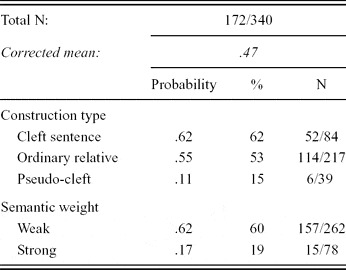
Multivariate analysis (Table 4) reveals that two factors contribute equally (as assessed by the range) to the choice of absorption: construction type, with pseudo-clefts disfavoring this time, and semantic weight of the preposition. Here weak prepositions promote absorption, the opposite of what we found for stranding. In fact, 91% (157/172) of the absorbed prepositions are weak. The lexical effect is overwhelming here too (Table 5): by far the majority turn out to be à and de. These most frequently absorbed prepositions are exactly the ones which, as we have seen, are virtually never stranded).Footnote 13
Variable rule analysis of the factors selected as significant to preposition absorption.

Lexical distribution of absorbed prepositions.

Pied-piping
The final option for preposition placement is the standard pied-piping, exemplified in (17) (as well as (1a), (5), (9), (10b), (11a), (13b) and (14b) above).
(17) Pied-piping
Ça fait que tout partout où (PP) ce que je sais je pouvais me faire une cenne. . . je travaillais. (OH.105.3573)
“So everywhere where I knew I could make a buck, I worked.”
Though this variant has not attracted nearly as much attention as the other two, we note that it too is quite robust, accounting for almost 40% of the data (Table 1). Table 6 displays the factors conditioning its selection.
Variable rule analysis of the factors selected as significant to preposition pied-piping.

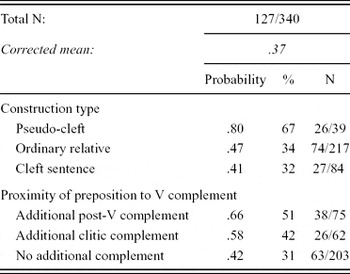
Here again, construction type exerts a significant effect, this time with pseudo-clefts highly favoring pied-piping, the opposite of what we found for absorption. It is also promoted where the preposition is separated from the verb by an additional post-verbal complement, as in (13b) above, or a clitic, as in (13a), thus ensuring that both preposition and complement are explicit in the phrase. It is disfavored when there is no other complement; this is a more favorable context for stranding. Most interesting for these purposes is the fact that semantic weight of the preposition has no effect on pied-piping, the first process we have examined in which this factor does not play a role.
3.3 Comparing preposition placement strategies in French relative clauses
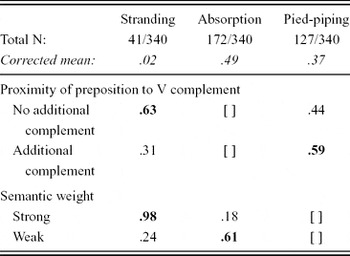
The preceding analyses suggest that the three strategies – stranding, absorption and pied-piping – work in concert to divide up the labor of preposition placement. To determine how they fit together in relative clause contexts, we re-analyzed the data (Table 7), taking account only of the factors selected as significant in Tables 2, 4 and 6 above.
Comparison of factors selected as significant to preposition placement strategy in relative clauses. (Favoring effects are given in bold.)

As construction type is no longer significant, we focus on the remaining two.Footnote 14 We now observe a remarkable pattern of near-complementary distribution, revealing that each variant has a dedicated role in the system. Absorption works to eliminate weak prepositions from the surface. This solves the issue of what to do with them, since they cannot be stranded. Pied-piping ensures that the preposition and the relativizer are correctly analyzed as a single constituent with an interpretable syntactic function. This explains the preference for this strategy when additional verbal complements are present in the phrase.Footnote 15 Situated with respect to the entire system of preposition placement, the role of stranding becomes clear: it is selected most often in contexts where no intervening element might hinder the interpretation of the discontinuous prepositional phrase as a single constituent. But this strategy is reserved for strong prepositions.
We have seen that the distribution of prepositions in relative clauses is highly skewed. Over three-quarters of them were classified as “weak”, but this class consists almost uniquely of à and de, with which, we have found, stranding is eschewed. Such asymmetry could affect the contributions of the other factors if any of them are disproportionately associated with these two prepositions. To determine whether the factors affecting stranding in fact apply equally to all prepositions, as suggested by Table 7 and our interpretation thereof, we redid the analysis excluding the tokens of à and de. The results are basically the same (see the table in fn. 16).Footnote 16 This confirms that the factors affecting variant choice operate on all prepositions, and not just the quantitatively preponderant weak ones.
4. Code-switchers as agents of convergence
We may now return to the question raised earlier regarding the role of code-switching in promoting convergence. Accordingly, we compare the grammars of preposition placement in the speech of copious and sparse code-switchers, as inferred from the hierarchy of constraints conditioning variant selection. If the former were in fact agents of change, we would expect the conditions governing the choice of the candidate for convergence, phrase-final prepositions, to differ from those of bilinguals who avoid switching to English while speaking French.
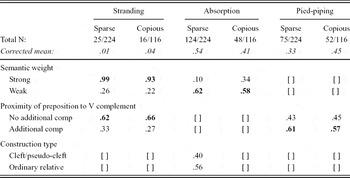
Table 8, which displays the effect of code-switching on the incidence and conditioning of preposition placement strategy, lends no support to this scenario.
Variable rule analysis of the factors selected as significant to preposition placement strategy among sparse and copious code-switchers. (Favoring effects are given in bold.)

We note first, from the corrected means, that while copious code-switchers employ the standard pied-piping somewhat more than their sparse counterparts, who in turn show a somewhat greater tendency to absorb, there is no difference between cohorts in terms of overall rate of stranding. Far more striking, in terms of relative magnitude and ranking of constraints for all factors selected as significant but one, is the fact that both cohorts behave identically. Thus not only is the propensity to use English independent of the propensity to place prepositions phrase-finally, it has no effect on the remainder of the prepositional system either. If anything, copious code-switchers strand fewer prepositions (40%) in the most favorable (strong) environment than those who tend to eschew English while speaking French (60%). These findings constitute compelling counter-evidence to claims that code-switchers are agents of structural change.
5. Comparison with the putative source
Thus far we have demonstrated that (i) stranding forms part of a tight-knit system of preposition placement in French relative clauses, and (ii) the constraints governing preposition placement hold regardless of a speaker's propensity to code-switch to English while speaking French. But we have not yet ruled out the possibility that preposition placement is subject to these constraints in English as well, and that both cohorts display the same convergent change.
In keeping with the requirement that a candidate for convergence should behave, in a non-trivial way, like its counterpart in the putative source (Poplack & Levey, Reference Poplack, Levey, Auer and Schmidt2010; Thomason, Reference Thomason2001), we now examine patterns of preposition placement in a non-contact variety of English likely to constitute a target model for the bilingual francophones whose behavior we have studied here. Spoken in the largely monolingual adjacent cities of Oshawa and Whitby in Southern Ontario, this variety is representative of mainstream Canadian English (Poplack et al., Reference Poplack, Jones, Lealess, Leroux, Smith, Yoshizumi, Zentz and Dion2006). As such, it constitutes a more appropriate benchmark for comparison.
5.1 Preposition placement in mainstream Canadian English
We noted earlier that English has two options for preposition placement, pied-piping, as in (2), and stranding, as in (3), repeated here as (18) and (19).
(18) Pied-piping (with wh-relative)
I think that- that the direction in (PP) which Canadians want to go today is getting better. (QEC.317.746)
(19) Stranding
a. wh -relative
I don't know which place they're from (S) just by looking at them. (QEC.308.1019)
b. that-relative
This is something that I could probably get interested in (S). (QEC.192.66)
c. zero relative
And this is the guy Ø I've always had a crush on (S). (QEC.301.1372)
Table 9 displays the overall distribution of these variants in mainstream Canadian English.
Distribution of data by variant and relativizer in mainstream Canadian English.

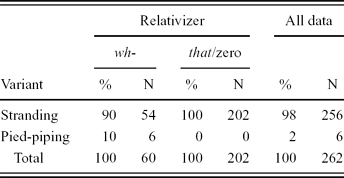
Note that over three-quarters (202/262) of the relative clauses are headed by that or zero, and in these contexts, as in other dialects of English, prepositions are categorically stranded, as in (19b, c). Pied-piping occurs only with wh-relativizers, as in (18), which themselves account for less than a quarter (60/262) of the relative clauses. Even in this context, it occurs no more than 10% of time. In actuality, pied-piping is still more constrained: five out of the six tokens co-occur with which, the rarest by far of the wh-relativizers. With regard to the strength of the target model, then, we can confirm that stranding, selected in 98% of all relative clauses, is the default option; it is the “standard” pied-piping that is the marked choice here. Thus, while stranding may not be particularly salient, there is no doubt that it is quantitatively robust enough in Canadian English (in contrast to the reports of scant usage in British English cited in Section 1.2) to constitute a model of preposition placement for bilingual francophones.
6. Comparing preposition placement in source and host: English vs. French
To support a claim that French bare prepositions are not the product of convergence with English, we must demonstrate that despite the surface similarity, the system of preposition placement in English differs from that operating in French. It is to this that we turn in this section.
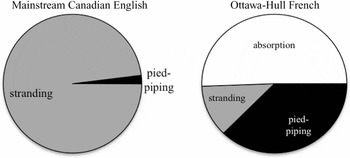
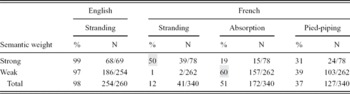
A first point of comparison involves the overall distribution of preposition placement strategies in the languages in contact. The results presented in Figure 1 display striking cross-linguistic differences not only in variant repertoires, but also in variant distributions: whereas English prepositions are almost categorically stranded, this is the least frequent option in French (12% overall). Pied-piping accounts for more than a third (37%) of the French data; it is selected only 2% of the time in English. And the major French strategy, absorption (51%), is not attested in English at all.
Comparison of variant distribution in the contact languages.

Distributionally, then, there is little compelling evidence to support a convergence analysis. But the overwhelming dominance of stranding in English could arguably have triggered its still incipient infiltration into French. A better gauge is the conditioning of variant choice, which as noted above, we construe as the grammar underlying variant selection. We now compare the constraints governing variable preposition placement in French with those operating in English. Although the massive disproportion of stranding in the latter necessarily dilutes its linguistic conditioning, we can nonetheless bring whatever patterning there is to bear on the comparison.
6.1 Lexico-semantic conditioning of variant choice
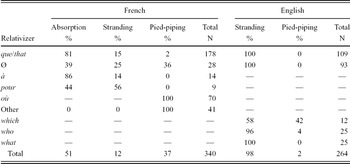
Turning first to the lexical identity of the relativizer (Table 10), we note that while in English pied-piping is virtually restricted to which, in French it occurs with an array of relativizers (albeit to varying degrees; où “where” makes up more than half of them (70/127)). Stranding, on the other hand, occurs at least once with every English relative pronoun in the English data; in French it is restricted to que, Ø, à and pour.Footnote 17
(20) Stranded weak preposition
So- that's- pretty much all I could think of (S). (QEC.046.806)
Distribution of relativizers by preposition placement strategy in the contact languages.

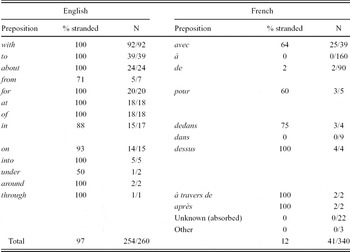
Lexical identity of the preposition also plays a role in variant choice (Table 11). In both English and French, the data are dominated by a few prepositions. Four of them (with, to, about and for) account for 2/3 (175/260) of the English data. All are extremely propitious to stranding, but so are the less frequent prepositions. In French, a full 85% of the prepositions are made up of avec, à and de. But in stark contrast to the situation in English, only avec participates freely in stranding, the others hardly ever do. In fact, all the other French prepositions, regardless of their frequency, break up along similar lines: Table 11 shows that either they always or rarely (if ever) appear without an overt complement. Those that are always stranded are among the cohort we had labeled strong (Tables 3 and 5 above), while the two prepositions making up most of the weak class are overwhelmingly absorbed, as is shown in Table 12. No such distinction operates in English, where, despite disproportionately high frequencies of certain prepositions, stranding is equally probable with all of them, weak ones, as in (20), included.
Rate of preposition STRANDING by lexical identity of the preposition in the contact languages.

Distribution of preposition placement strategies by semantic weight of preposition in the contact languages. (The shading highlights the effects described in the text.)

6.2 Preposition placement in the English of bilingual francophones
Having examined the preposition placement strategies in the French of bilingual francophones, it will now be instructive to examine how they and the other members of their speech community use them when they are speaking English. A systematic search of the 2.5 million word Ottawa-Hull French Corpus turned up 1504 English prepositions, either embedded in otherwise French discourse, as in (21a), or within code-switches to English, as in (21b) and (21c).
(21) English prepositions
a. embedded in French discourse
Là le pressure était off moi pour un petit boutte, tu sais? (OH.053.1061)
“Then the pressure was off me for a little while, you know?”
b. in (intra-sentential) code-switch to English Sont pas mal up to date. (OH.056.1673)
“They're pretty much up to date.”
c. in (sentential) code-switch to English
“I had to cut the fat off and give it to the dog.” (OH.71.1543)
Unsurprisingly, in view of the general paucity of relative clauses noted earlier, very few of these occurred in this context. In all, we could locate only six eligible tokens, two of which are reproduced in (22):
- (22)
a. That's something given by God that you shouldn't fool with (S), as far as I'm concerned. (OH.053.1402)
b. He says to me, that- that little girl he's going out with (S), that her father caught a fish. (OH.071.1601)
This is of course too sparse to admit meaningful quantitative analysis, but it is nonetheless noteworthy that all of them were stranded, paralleling exactly the distribution displayed by monolingual anglophone speakers of mainstream Canadian English (Table 9 above). None were pied-piped or absorbed, in stark contrast to the way these very same individuals treat their prepositions while speaking French. In that language they strand rarely, only certain prepositions, and only under very specific conditions. We conclude that the bilingual speakers studied here have different grammars for preposition placement, one for French and another for English. This constitutes the strongest evidence that their phrase-final prepositions in French are not the product of their use of this strategy in English.Footnote 18
Summarizing, we have demonstrated that (i) French patterns of preposition placement differ from those of mainstream Canadian English, the putative source, (ii) the factors governing preposition stranding for copious code-switchers are the same as those for sparse code-switchers, and perhaps most convincing, (iii) bilingual francophones themselves display one pattern of placing prepositions in French discourse, and quite another when they are speaking English. These facts taken together effectively rule out convergence with English as the explanation for phrase-final prepositions in French. What then is their source? The fact that this variant is so well integrated into the host-language grammar of preposition placement (Table 7 above) rather than being superimposed upon it (as might be expected of transfer of a non-native construction) suggests a possible internal motivation. Accordingly, in keeping with Poplack & Levey's (Reference Poplack, Levey, Auer and Schmidt2010) criterion (iv) (Section 1), in the next section we investigate the possibility of a native French model for stranding.
7. Comparison with a native French model: Preposition orphaning
In situating bare prepositions within host-language patterns of preposition placement, we confront a superficially similar native process, which also results in phrase-final prepositions with no overt complement in surface structure, exemplified in (23). As with bare prepositions in relative clauses, these too are sometimes called intransitive prepositions (Vinet, Reference Vinet1979, Reference Vinet1984) or Standard French-type stranded prepositions (Roberge & Rosen, Reference Roberge and Rosen1999). Here, following Bouchard (Reference Bouchard and Lefebvre1982), Roberge (Reference Roberge and Brasseur1998), Zribi-Hertz (Reference Zribi-Hertz1984) and others, we will refer to them as orphans (o). In this and subsequent orphaning examples, square brackets indicate a missing complement.
(23) Orphaning
Oui mais, il veut pas payer pour [ ] (O). (OH.013.260)Footnote 19
“Yes but, he doesn't want to pay for [ ].”
Orphaning is perfectly acceptable in standard French,Footnote 20 as illustrated in the excerpt from Le bon usage in (24).
(24) Avec les prépositions après, avant, contre, depuis, derrière, devant, l'omission du régime appartient à l'usage le plus général.
(Grevisse & Goosse, Reference Grevisse and Goosse2008, p. 1327)
“With the prepositions after, before, against, since, behind, in front of, omission of the complement [orphaning] is in general use.”
Orphaning does not occur in relative clauses, but is (theoretically) eligible to occur in any indicative transitive verb complex containing a prepositional complement (including indirect object and adjunct prepositional phrases modifying the verb), where the complement has already been introduced. For most prepositions, the orphaned variant competes with a pronominal clitic variant (C), as in (25a), and a preposition + pronominal NP complement (N), as in (25b).Footnote 21 A subset of prepositions (e.g. contre, pour, avec, à part de, après, sans and avant, to which we refer in Table 14 as cohort A) co-varies only with the latter. As previously, these were analyzed separately.
- (25)
a. Pronominal clitic
Ouais, mais même ça . . . j’y (C) penserais avant tu sais. (OH.002.1331)
“Yeah, but even that. . . I'd think about it beforehand, you know.”
b. Preposition + pronominal NP complement
Non, on chantait pas avec ça (N). (OH.013.792)
“No, we didn't sing with that.”
Orphaning thus differs from what we have been calling stranding not only in terms of the contexts in which it appears, but also in terms of the variants with which it competes. It is therefore not interchangeable with (i.e. a variant expression of) the prepositions with no complement in relative clauses. Nonetheless, because non-contact French provides this model for bare prepositions, determination of the trajectory by which stranding emerged in relative clauses – via borrowing from English or analogical extension – must consider this structure as well. In what follows, we will first ascertain the grammar that gives rise to orphaning, as instantiated by the quantitative conditioning of variant choice, and then compare it to that of stranding. If the two phenomena obey the same linguistic constraints, this will support the analysis that phrase-final placement of prepositions in relative clauses is an internally-motivated extension of orphaning to a new context, and not borrowed. Although some English prepositions also orphan (e.g. in, on, inside, [temporal] before, and with a few verbs, with), we note that orphaning is generally not admissible in English with the translations of the relevant French prepositions, as can be seen from the glosses to (23) above and (26)–(28) below. This qualifies the orphaned preposition as a conflict site (Poplack & Meechan, Reference Poplack, Meechan, Poplack and Meechan1998), which, together with the relevant cross-variety comparisons, is a powerful tool for detecting change and identifying its source.
7.1 Factors conditioning the selection of orphaning
To facilitate comparison of orphaning and stranding, we replicate our analysis of the factors contributing to choice of preposition placement strategy in relative clauses (Section 2.3 above), altering only the factor of construction type. French generally allows orphaned prepositions in topicalized sentence structures. Assuming, as previously, that the nearer the topic is to its pronominal referent, the less need to state it explicitly, we distinguish topics according to whether they are intra-sentential, as in (26a), or retrievable from the wider discourse, as in (26b).
- (26)
a. Intra-sentential topic
Lui avait trouvé ce charbon là, puis il se chauffait avec [ ] (O). (OH.082.1431)
“He had found that coal there, and he was warming himself with [ ].”
b. Discourse-retrievable topic
Puis j'aurais dû la mettre dans l'école anglaise. . . . Mais j'ai fait la bêtise. . . . Il faut pâtir pour [ ] (O). (OH.071.1644)
“And I should have put her in English school. . . . But I made the mistake. . . . You have to suffer for [ ].”
Basing ourselves on the claims in the literature, we predict that orphaning will be favored with intra-sentential topics (Grevisse & Goosse, Reference Grevisse and Goosse2008; Kayne, Reference Kayne1975; King, Reference King2000; Vinet, Reference Vinet1984; Zribi-Hertz, Reference Zribi-Hertz1984), strong prepositions (Barbaud, Reference Barbaud1998; Vinet, Reference Vinet1979, Reference Vinet1984; Zribi-Hertz, Reference Zribi-Hertz1984), nonhuman complements (Kayne, Reference Kayne1975; Zribi-Hertz, Reference Zribi-Hertz1984; and the examples in Vinet, Reference Vinet1984), and when the prepositional phrase is not essential to the meaning of the verb (i.e. non-obligatory) (Vinet, Reference Vinet1984).
7.2 Analysis of orphaning
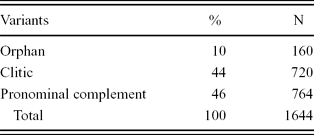
In keeping with the principle of accountability (Labov, Reference Labov1972), all indicative transitive verb complexes containing a prepositional complement were extracted from the data (N = 1644). Table 13, which displays the distribution of the three main variants in the variable context for orphaning, shows that despite its prescriptive acceptability exemplified in (24) above, orphaning is certainly not a common option, occurring in only 10% of eligible tokens.
Overall distribution of preposition placement strategies in orphaning contexts.

Recall that this is the same low rate observed for bare prepositions in relative clauses (Table 1 above). The phrase-final preposition, whether in orphaning or stranding contexts, is clearly the minority variant.
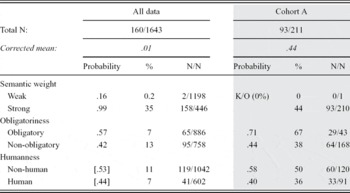
Variable rule analysis (Table 14) reveals that, of all the factors we had hypothesized to affect the choice of orphaning (over one of its more frequent competitors), three appear to play a role, and as can be observed from comparing the constraint rankings in Table 14, these apply to both classes of preposition in parallel fashion. First, in keeping with the observations of Kayne (Reference Kayne1975) and Zribi-Hertz (Reference Zribi-Hertz1984), orphaning is in fact favored with [−human] complements, although it is quite robust with [+human] complements as well, as illustrated in (27).
(27) Si elle a quelque chose à dire, qu'elle vienne me le dire, puis que je vas m'asseoir avec [ ] (O), puis je vas essayer de la comprendre. (OH.040.1003)
“If she has something to say, let her come tell me, and I'll sit down with [ ], and I'll try to understand.”
Variable rule analysis of the factors selected as significant to preposition oprhaning. (The shading highlights the effects described in the text.)

K/O = knockout. In the presence of a knockout factor the variable is invariant.
Obligatoriness of the complement also appears to play a role. Here, however, the effect is the opposite of what was predicted by Vinet (Reference Vinet1984) and Zribi-Hertz (Reference Zribi-Hertz1984): prepositional phrases which are required to complete the meaning of the verb favor orphaning. We have no explanation for this result at this time. But the greatest effect by far is contributed by semantic weight of the preposition: with only two exceptions, one of which we reproduce in (28), weak prepositions are never orphaned, a result that is consistent with sanctioned usage (24) and previous observations (Barbaud, Reference Barbaud1998; Roberge, Reference Roberge and Brasseur1998; Zribi-Hertz, Reference Zribi-Hertz1984). Only their semantically rich counterparts, which we have labeled strong, are orphaned regularly.
(28) Orphaned weak preposition
Là ils prenaient la poche le lendemain matin travailler, ils charriaient pas un outil à [ ] (O) seulement. (OH.082.1219)
“So they took the bag the next morning to work, they didn't even bring one tool to [ ].”
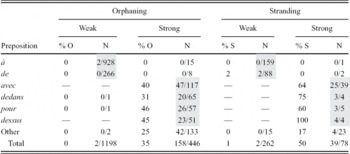
Such explanations as have been offered for this semantic effect tend to revolve around the interpretability of the preposition in the absence of its complement, or the strength of the link between preposition and complement (Vinet, Reference Vinet1984). But closer inspection (Table 15) suggests that here too, the label semantic weight is masking an idiosyncratic lexical effect: 99.7% of the prepositions coded as “weak” are in fact à and de, and these, consonant with their behavior in relative clauses, are never orphaned. Likewise, nearly two-thirds of those coded as “strong” are made up of four prepositions: dedans, pour, dessus, and especially avec (which itself represents nearly a third (47/160) of all the orphaned tokens), and these are quite conducive to orphaning. These of course are the very same prepositions that account for the bulk (67%) of the preposition stranding in relative clause contexts! To be sure, prepositions themselves constitute a small closed class. But most are considered eligible to be orphaned (Zribi-Hertz, Reference Zribi-Hertz1984). In this context, what is particularly noteworthy is that of the 52 prepositions listed in Zribi-Hertz (Reference Zribi-Hertz1984, p. 33, fn. 6), only a few are actually orphaned in usage data, the same few that tend to appear bare in relative clause contexts (Table 2 above). We conclude that the strongest predictor of a preposition's propensity to appear without a complement in the two contexts we have studied is lexical identity. As far as establishing convergent change is concerned, however, this determination is irrelevant: French differs from English in terms of the effects of both lexical preposition and semantic weight.
Rates of preposition orphaning (O) and stranding (S) by lexical identity and semantic weight of the preposition. (The shading highlights the effects described in the text.)

Because orphaning is a purely native process, there is no a priori reason to expect bilingual proficiency to distinguish speaker cohorts. But copious code-switchers are not only considered to lead the way in introducing contact-induced change, they are also frequently assumed to use their native language less natively. If they were in fact agents of change, the conditions governing their orphaning behavior should differ from those of bilinguals who avoid switching to English while speaking French. As with the relative clauses (Section 4 above), however, analysis shows no such effect. Instead, regardless of cohort, by far the most important effect – for copious code-switchers, the only effect – is contributed by the lexical identity of the preposition, in the by now familiar direction (Zentz, Reference Zentz2006).
Summarizing, we have examined a native French process that results in phrase-final prepositions, and have found it to be overwhelmingly lexically constrained, admissible for the most part with a small set of frequently occurring strong prepositions. When we compare the candidate for convergence, we find remarkable parallels: it occurs at the same low rate as orphaning, and applies above all to the same lexical prepositions. These parallels would be uninterpretable if what we have been calling stranding were not an extension of the native French process of orphaning.
8. Preposition placement in a pre-contact stage
In keeping with Poplack and Levey's (Reference Poplack, Levey, Auer and Schmidt2010) criteria (i) and (ii) (Section 1), it now remains to establish whether stranding is the result of change. If it had been transferred from English, we should not expect to find it in a pre-contact stage of French. Such a stage is represented by the data contained in the Récits du français québécois d'autrefois (Poplack & St-Amand, Reference Poplack and St-Amand2007), the informal speech of insular rural québécois born in the second half of the 19th century, prior to (and in isolation from) the current intense contact with English. We searched this corpus systematically for phrase-final occurrences of the 15 prepositions found to be most frequent in the contemporary Ottawa-Hull French Corpus. After winnowing down an initial harvest of over 30,000 data points, almost all of the 102 eligible bare tokens remaining turned out to be orphans. Eighty-two percent of them were avec, as in (29a, b), mirroring the disproportion observed in 20th-century Ottawa-Hull French. The other current major players were represented as well, albeit to a much lesser extent, as exemplified in (29c). Orphaning was clearly already robust in 19th-century French.
(29) 19th-century orphaning
a. with avec
Prends cet âne là, puis va-t-en chez vous avec [ ] (O)! (RFQ.014.30)
“Take that donkey over there, and go back home with [ ]!”
b. Puis elle le pogne puis elle s'en va dans la forêt avec [ ] (O). (RFQ.023.1879)
“And she grabs it and she goes into the forest with [ ].”
c. with pour
Il dit: “M'en vas te donner mille piasses pour [ ] (O).” (RFQ.028.286)
“He says, ‘I'm gonna give you a thousand bucks for [ ]’.”
But the candidate for convergence, although relatively rare in these materials (N = 5),Footnote 22 was definitely attested as well, as illustrated in (30). The fact that it only occurs with avec (the most frequent bare preposition in 20th-century French (Table 3 above), as well as the most frequently orphaned) is further testimony to the synergetic relationship between what we have been calling stranding and orphaning.Footnote 23
(30) 19th-century stranding
a. Elle se nourrit aux crabes. Une quantité de crabes que la morue mange, qu'elle-qu'elle se nourrit avec (S). (RFQ.043.1057)
“It only eats crabs. A quantity of crabs that the cod eats, that it nourishes itself with.”
b. Elle leur a emporté trois plombs qu'ils pêchent avec (S). (RFQ.043.1420)
“She brought them three weights that they fish with.”
Finally, we would be remiss if we did not mention that phrase-final prepositions also appear in relative clauses in a contemporaneous non-contact variety, albeit (judging from the dearth of relevant examples) to a far lesser extent. This is Metropolitan French, which is not generally considered prone to convergence with English. They were already attested in Frei's Grammaire des fautes (Reference Frei1929, p. 187), which despite its title (“grammar of mistakes”), identifies itself as a linguistic description of spontaneous popular (Metropolitan) French; some examples are given in (31).Footnote 24
(31) La jeune fille qu’il doit se marier avec; Le pont qu’il est passé dessus; La caisse que c'est mis dedans; Je n'ai pas reçu le colis qu’elles étaient dedans
“The young girl that he's supposed to get married to; The bridge that he passed over; The crate that it is put in; I have not received the package that they were in”
9. Stranding or orphaning?
We mentioned earlier that phrase-final prepositions have become a shibboleth of North American, and especially Canadian, varieties of French, because they have been attested in (at least some of) these varieties in (at least some) contexts which are inadmissible in Standard French, but coincidentally sanctioned in English, the majority and dominant language in the region. As such they have long attracted the attention of syntacticians, who have sought first to unravel the structure of these constructions and then to compare it with that of English on the one hand and of Standard French on the other. This research has culminated in a general consensus that the prepositions in examples like (1b), (10a, c), (11c), (12a), (14a), (15) and (30) above are not English-type stranded prepositions. This conclusion emerges, on the one hand, from analyses of the underlying structure of the relative clause (in English they are analyzed as involving movement of the wh-form, while in Vernacular French relative clauses there is no movement), and on the other, the structure of the null arguments of the phrase-final prepositions (in English they consist of the trace left behind by wh-movement; in Vernacular French they represent a null pronominal element pro (Bouchard, Reference Bouchard and Lefebvre1982; Roberge, Reference Roberge and Brasseur1998; Vinet Reference Vinet1979, Reference Vinet1984)).Footnote 25 Because Standard French orphan prepositions have also been analyzed as governing a null pronominal element rather than the trace of a moved antecedent (Bouchard, Reference Bouchard and Lefebvre1982; Zribi-Hertz, Reference Zribi-Hertz1984), scholars have suggested that these phrase-final prepositions in indicative transitive verb complexes and those in Vernacular French relative clauses are one and the same (although only King, Reference King2000; King & Roberge, Reference King and Roberge1990; and Roberge, Reference Roberge and Brasseur1998 have explicitly suggested, as we do here, that the latter are an extension to a new context of the former).
Evidence for these claims comes from standard syntactic tests (e.g. the absence in Vernacular French of intransitive prepositions in interrogatives and (pseudo-) passives, subjacency violations, etc.), and these in turn are based on native speaker intuitions, coupled in some cases with the judgments of an informant (King & Roberge, Reference King and Roberge1990; Roberge & Rosen, Reference Roberge and Rosen1999). As such, with the possible exception of King (Reference King2000, Reference King and Filppula2005), they shed little light on actual usage. We stated earlier, and we stress again, that convergence arises from usage, and its agents must be bilingual speakers.
It is in this context that we set out to study this phenomenon. We combed a very large corpus of French speech, produced by speakers of varying bilingual abilities, for examples of phrase-final prepositions in contexts where stranding is an option in English. A first important finding was that only one of them – relative clauses – featured such prepositions, echoing earlier descriptions of this phenomenon in Quebec French, and explaining why this portion of our study of variable preposition placement is necessarily limited to relative clauses. We then returned to the corpus to examine the contexts in which phrase-final prepositions are admissible in French. In addition, because in each construction the option of placing prepositions phrase-finally co-exists with other options (i.e. they are variable), we also took account of all of the cases in which phrase-final prepositions were not selected, in keeping with the principle of accountability that underlies the variationist approach to language use (e.g. Labov, Reference Labov1972). Rather than rely on reports or inferences of what is admissible in the putative target language, we analyzed patterns of preposition placement in a variety of mainstream Canadian English towards which the bilingual speakers in our sample would likely have converged, had convergence occurred.
This approach has enabled us to contribute crucial elements to the discussion. For example, prior to the present research, there was no indication of the incidence or extent of these phenomena. Our analysis shows that the bare variant, in relative clauses as elsewhere, represents only a small minority of prepositions in the relevant contexts. Likewise, while the majority of French relative clauses differs from the prescribed standard (as instantiated in the Grevisse & Goosse quote in (4) above), this is not due to stranding or orphaning, but rather to the prevalence of a purely native variant, preposition absorption, which is not generally admissible in English.
Because the tests used by theoretical linguists are often simply not pertinent to speech (e.g. the all-important criterion of whether subjacency is violated is moot, since even in a very large corpus we find no examples like la fille que je connais très bien le gars qui sort avec “the girl that I know very well the guy that goes out with” (King, Reference King and Filppula2005; Roberge, Reference Roberge and Brasseur1998; Vinet Reference Vinet1979, Reference Vinet1984), we replicated a variety of other claims about preposition placement culled from the literature. Only a very few were found to play a role in either of the two contexts studied. However, the factor that accounts for the overwhelming majority of the variance in the data – lexical identity of the preposition – was shown to operate in exactly the same way in the native French orphan prepositions and the bare prepositions in relative clauses we had initially labeled stranded. Thus, remarkably, we arrive at the exact same major conclusions as the syntacticians, using an entirely different approach and actual usage data. We conclude, as did they, that the French phrase-final prepositions in relative clauses that look like English stranded prepositions can in fact be analyzed as French orphan prepositions extended to the relative clause context. Our evidence for this is that they pattern with French orphan prepositions, while simultaneously differing from English stranded prepositions, which occur with different lexical prepositions and different relativizers. This leads us to stress once again (see King, Reference King2000, Reference King and Filppula2005; Poplack & Tagliamonte, Reference Poplack and Tagliamonte2001) that surface similarity may be masking underlying structural difference, a problem which must be faced head-on in any study of contact linguistics.
10. Discussion
The research we have reported here has sought to address the questions of whether bare prepositions, a stereotypical non-standard feature of North American French, could be shown empirically to result from convergence with English, and whether bilingual code-switchers play any role in its adoption and diffusion. A partial motivation was curiosity over why so many reported contact-induced changes appear to be so radical and abrupt in nature (see Poplack & Levey, Reference Poplack, Levey, Auer and Schmidt2010, for detailed discussion), especially as compared to language-internal evolution, which is almost always gradual, moderate and more conservative. To address these issues, we made use of a highly ramified methodology to operationalize and test hypotheses about preposition placement, complying with each of the prerequisites enunciated by Thomason (Reference Thomason2001) and others for the establishment of contact-induced change. Rather than attempting to replicate the conditions propitious to convergence in a laboratory setting (e.g. Toribio, Reference Toribio2004), we went straight to the source, privileging a thriving bilingual community as a research site, and the spontaneous interaction of its members as data. It is only through such regular interactions that change, convergent or otherwise, arises and spreads.
This work is informed by the recognition that detecting change requires going beyond the standard identification of apparently deviant forms with superficially similar surface counterparts in a contact language, and even beyond calculation of their rates of occurrence (though even these are rarely provided in the existing literature). It involves recognizing, first and foremost, that change in progress is inexorably linked to linguistic variability, and that variability entails competition among variant forms. This fact forces us to situate the form of interest in the larger linguistic system in which it operates, as opposed to restricting the focus to the candidate for convergence only. We have shown that variant choice is subject to a set of discoverable conditions; these make up the structure of the variability. Once ascertained, this structure becomes diagnostic of stability or change. Making use of the comparative variationist framework (Poplack & Meechan, Reference Poplack, Meechan, Poplack and Meechan1998; Tagliamonte, Reference Tagliamonte, Chambers, Trudgill and Schilling-Estes2002), we confronted the variable constraints on preposition placement across source and host languages, contact and pre-contact stages of the host language, mainstream and “bilingual” varieties of the source language, copious and sparse code-switchers, and most telling, with the variants with which it coexists in the host language system. Detailed comparison with a superficially similar pre-existing native language construction enabled us to assess the possibility of a language-internal model for phrase-final prepositions.
These analyses turned up several lines of evidence militating against an interpretation of convergence. A first important element is the discovery that the conditions giving rise to bare prepositions in French relative clauses are none other than those operating to produce the native strategy of orphaning in other contexts. Second, by situating phrase-final prepositions with respect to other options for preposition placement in the variable context of relative clauses, we learned that rather than intruding into this tight-knit system, as might be expected of an externally-motivated change, bare prepositions play a dedicated role in it. Third, comparison with a pre-contact stage of the language reveals that orphan prepositions were not only already present in the crucial relative clause context, but followed the same patterning observed in the contemporary materials. Fourth, comparison with the presumed source shows that none of the constraints on orphaning in French is operative in English, which instead strands prepositions freely – indeed, quasi-categorically! – in all eligible contexts, and these in turn differ from those admitting orphan prepositions in French. Finally, explicit comparison of the preposition placement strategies of individuals who code-switch frequently and those who rarely use English revealed no difference between them, constituting a rare empirical test – and refutation – of the claims that the former are agents of contact-induced change.
This comes as no surprise to us; indeed those who claim that CS causes convergence have not yet elucidated the mechanism by which a structure from one language passes into another with which it happens to coexist in a given geographical territory (especially, as is so often the case, when they may not even be spoken by the same cohorts of people). Community-based research has consistently shown that copious code-switchers (in the sense defined in Section 2.1 in this paper) tend to be those with the greatest command of both languages, most convincingly demonstrated by the fact that their CS behavior is overwhelmingly constrained by linguistic conditions that respect the grammaticality requirements of both languages simultaneously. In this context, it is unclear how they could act as agents of change, as suggested by e.g. Backus (Reference Backus2005), Thomason (Reference Thomason2001), Toribio (Reference Toribio2004) and Winford (Reference Winford2005), among others. Indeed, our comparison of the same speakers’ preposition placement strategies in both languages (Section 6.2 above) shows that despite intense contact on the community level, bilingual individuals can maintain two separate grammars, one for English and another for French. Interestingly, the only other systematic study of the role of CS in bilingual convergence employing accountable methodology that we know of (Torres Cacoullos & Travis, Reference Torres Cacoullos, Travis, Rivera-Mills and Villa2010) arrived independently at exactly the same result, despite its focus on a different linguistic variable, language pair and contact situation. As those authors observed, if bilinguals are alternating between languages rather than mixing them, as per the definition of CS given in Section 1 above, it stands to reason that the grammatical patterns of each language are maintained and, by extension, that copious code-switchers do not differ from those who engage in CS more rarely.
In view of the findings presented here, we cannot help but be struck by the disconnect between the amount of (negative!) attention stranding has garnered, especially among laypeople, as emblematic of contact-induced change in Canadian French, when in fact, this is a very minor phenomenon, both in terms of contexts in which it can occur and in terms of contexts in which it does occur. The apparently widespread belief that surface similarity can (or should) simply be equated with structural similarity makes contact-induced change a logical inference. But when we study the conditions constraining variable selection of the candidate for convergence, we learn that the surface parallels often mask underlying structural divergence.
The primacy of the spoken language in the origin and spread of change is an incontrovertible fact. The hallmark of speech is inherent variability, which is constrained by factors that can only be uncovered by systematic quantitative analysis, such as the one we have implemented here. Once we use it to situate the candidate for change with respect to all the relevant contexts in which it evolves, its role becomes clear, as does the trajectory by which it developed. That would be in conjunction with native orphaning and not via borrowed stranding.