In 2006, the National Literacy Panel report on language minority children and youth (August & Shanahan, Reference August and Shanahan2006), issued a call to scholars to continue to empirically validate the theoretical models proposed about the relationships between oral language proficiency and literacy development in a second language. In a separate review of the research, Riches and Genesee (Reference Riches, Genesee, Genesee, Lindholm-Leary, Saunders and Christian2006) also highlighted this need, noting that scholars should consider the roles of L1 and L2 oral proficiency in second language literacy development. They argued that empirical work is needed to “define more clearly a number of important constructs that are often used when investigating these issues; specifically the constructs of developmental interdependence, common underlying proficiency, and the thresholds of oral proficiency necessary to promote L2 literacy development” (p.70).
This paper is a response to this call to research, with a focus on the Linguistic Threshold Hypothesis, which has remain under-investigated and underspecified in the empirical literature (Hulstijn, Reference Hulstijn2011; Yamashita, Reference Yamashita2001). In viewing the current literature, we see a need to examine new ways of modeling the Linguistic Threshold Hypothesis that better match the theoretical assumptions underpinning the proposed existence of a linguistic threshold in the transfer of literacy skills from the first to the second language. Specifically, this study seeks to investigate the utility of statistical models with non-constant slope in testing the Linguistic Threshold Hypothesis among young bilingual learners.
Linguistic Threshold Hypothesis
The Linguistic Threshold Hypothesis proposes that a threshold level of second language ability is required in order for first language literacy skills to transfer to the second language (Alderson, Reference Alderson, Alderson and Urquhart1984; Clarke, Reference Clarke1979; Yamashita, Reference Yamashita2001). Clarke (Reference Clarke1979, Reference Clarke1980) initially proposed this idea as the Short-Circuit Hypothesis. He hypothesized a type of second language linguistic threshold that comes into play when reading in a second language, even if the learner was a competent reader in the first language. In other words, if a student had low levels of proficiency in a second language, his or her efforts to read in the second language would be ‘short-circuited’ and the reader would not be expected to make substantial progress in reading in the second language, despite evidence of reading abilities in the first language. Alderson (Reference Alderson, Alderson and Urquhart1984) reached a similar conclusion in his review of the research, suggesting that second language proficiency was more directly implicated than first language literacy skills, in predicting second language reading comprehension, for students at lower levels of second language proficiency (Hulstijn, Reference Hulstijn2011). Furthering Clarke's work, Alderson argued that first language reading skills could be used in second language reading, only after a threshold level of second language proficiency was reached (Alderson, Reference Alderson, Alderson and Urquhart1984; Hulstijn, Reference Hulstijn2011).
The Linguistic Threshold Hypothesis, as proposed, thus specifically suggests that the ability to draw on first language literacy skills for use in second language reading varies depending on the level of linguistic knowledge attained in the second language (Alderson, Reference Alderson, Alderson and Urquhart1984; Clarke, Reference Clarke1979; Yamashita, Reference Yamashita2001). Stated differently, the theoretical assumptions of the Linguistic Threshold Hypothesis maintain that cross-linguistic transfer from the first to the second language is not constant across levels of second language proficiency. Rather, the rate of transfer of skills from the first to the second language is expected to vary or change as one approaches and surpasses a threshold level of L2 language proficiency needed to facilitate transfer (Alderson, Reference Alderson, Alderson and Urquhart1984; Kern, Reference Kern2000, Yamashita, Reference Yamashita2001, Reference Yamashita2002b).
Prior empirical work in this area has been largely conducted with adult second language learners in foreign language contexts (Hulstijn, Reference Hulstijn2011). These studies have most often focused on investigating the predictive power of the L1 literacy skills on the L2 literacy skills for different groups of participants at varying levels of L2 language proficiency (Yamashita, Reference Yamashita2001). As noted by Yamashita (Reference Yamashita2002a), the relationship among L1 literacy, L2 literacy, and L2 language proficiency has largely been examined using correlational and multiple regression analyses. Evidence of a linguistic threshold effect has been considered present when results of analyses reveal increased contributions of the first language literacy to second language literacy for participant groups at higher levels of second language proficiency (Bernhardt & Kamil, Reference Bernhardt and Kamil1995; Bosser, Reference Bossers1991; Brisbois Reference Brisbois1995; Carrell, Reference Carrell1991; Lee & Shallert, Reference Lee and Schallert1997; Taillefer, Reference Taillefer1996).
For example, Carrell (Reference Carrell1991) carried out a study with adult Spanish speakers and adult English speakers in the United States. Reading comprehension was tested in both languages and L2 proficiency was assessed by level of enrollment. Linear models were fitted for each language group that suggested that, for the English L1 group, second language proficiency was a stronger predictor of reading in the L2 while for the Spanish L1 group L1 reading was the stronger predictor of L2 reading. As the English dominant group had lower levels of proficiency in their second language (Spanish) than the Spanish dominant group had in their second language (English), Carrell suggested that her study supported the idea that the role of L1 literacy in predicting L2 reading was higher for those who had a higher level of proficiency in their second language, fitting “with the views of the language threshold” (p. 168). However, a second language threshold was not directly measured in this study, leaving unaddressed the nature of the relationship between L2 language ability and the transfer of literacy skills from the first to the second language.
Similarly, Bribois (Reference Brisbois1995) studied adult students at the U.S. Air Force Academy who were learning French as a second language. She demonstrated that literacy skills (comprehension) in the first language explained twice as much of the variation in second language reading skills for students who were enrolled in advanced French language courses, when compared with students enrolled in the beginning course. In this study, level of course enrolment characterized levels of second language proficiency and a threshold was inferred based on these categorizations. Lee and Shallert (Reference Lee and Schallert1997) also investigated the existence of a linguistic threshold. These researchers divided their sample of Korean high school students into five groups according to their levels of ability in English, their second language. Results from their study showed a significant relationship between L1 and L2 reading ability for the students in the top three English language groups. By contrast, the students in the bottom two English language groups showed no significant relationship between L1 and L2 reading. These data led the authors to conclude that “a threshold level of language proficiency appears to exist for these Korean students” (p. 735).
More recently, Yamashita's (Reference Yamashita2002b) work has looked at Japanese university students learning English. She conceptualized second language proficiency as both grammar and vocabulary knowledge, and measured these skills using both the TOEFL and Nation's Vocabulary Level Test (Nation, Reference Nation1990). Using regression analyses and ANOVA, she identified a ‘compensatory facilitation’ effect such that higher abilities in first language reading skills compensate for lower abilities in second language knowledge when reading in a second language. Similarly, high levels of competency in the second language compensate for lower first language literacy skill when reading in a second language. However, Yamashita also found that language proficiency in the second language was the primary factor for achieving high levels of reading in the second language and suggested that “without a firm basis of L2 language proficiency achieving high levels of L2 reading comprehension is very difficult” (p. 91).
These above cited studies, and others (Bossers, Reference Bossers1991; Taiilefer, Reference Taillefer1996), provide important evidence that L2 language proficiency moderates the relationship between L1 and L2 literacy, and show that higher levels of proficiency in the second language contribute to better outcomes in L2 literacy. However, these studies – seminal and important in beginning the conversation about the Linguistic Threshold Hypothesis – do not provide clear evidence of a linguistic threshold; that is a L2 language proficiency level beyond which there is a significant change in the relationship between first and second language literacy skills. In essence, these studies have been carried out in research designs that have modeled the transfer of L1 to L2 literacy skills as consistently dependent on L2 language proficiency, based on an assumption that the rate of cross-linguistic transfer is consistently related to different levels of second language proficiency.
However, we believe that these approaches have not modeled the Linguistic Threshold Hypothesis in a way that is consistent with the theoretical underpinnings of the hypothesis (Alderson, Reference Alderson, Alderson and Urquhart1984; Clarke, Reference Clarke1979; Yamashita, Reference Yamashita2001). Rather, we assert that the Linguistic Threshold Hypothesis proposes a relationship between second language proficiency and the rate of transfer of literacy skills from the first to the second language wherein the rate of transfer would jump or accelerate at some threshold level of L2 language knowledge. This proposed relationship is inherently non-constant, yet the empirical work to date has employed statistical techniques grounded in regression and correlation, which assume continuous linearity (constant slope).
Empirical studies are needed that explicitly model potential language thresholds effects in order to more fully describe the complex role of second language proficiency in the cross-linguistic transfer of literacy skills from the L1 to the L2. We assert that statistical modeling techniques are required that better match the theoretical underpinnings of the Linguistic Threshold Hypothesis in order to truly test this hypothesis and begin a tradition of empirical work in this area. The current study investigates one type of statistical model that closely matches the current conceptualizations of the Linguistic Threshold Hypothesis as represented in the scholarly literature.
Current conceptualization of the Linguistic Threshold Hypothesis
In 2001, Yamashita reviewed the empirical work on the Linguistic Threshold Hypothesis in order to formulate a holistic model that would account for all the studies that had been carried out to that point. She outlined this task as modeling the contributions of L2 language knowledge to L2 reading changes at different levels of second language proficiency. Based on her review of the research, she proposed three levels of the linguistic threshold: the fundamental level, the minimum level, and the maximum level. She hypothesized that when readers reach the minimum level of L2 language proficiency, reading skills begin to transfer (there is no transfer at the fundamental level) and as they approach the maximum level of second language proficiency, the contribution of second language knowledge loses its predictive power on second language reading outcomes.
Yamashita (Reference Yamashita2001), in essence, proposes a varying relationship between second language proficiency and the transfer of literacy skills from the first to the second language. Her conceptualization of the Linguistic Threshold Hypothesis suggests that cross-linguistic transfer is not constant, invariable or absolute across levels of second language proficiency. She proposes that there may, in fact, be two threshold values (or intervals) in which the rate of transfer from L1 to L2 changes dramatically. However, Yamashita (Reference Yamashita2001) notes that a level of linguistic threshold for transfer is dependent on reading tasks and on the level of reading skills in the first language. She further cautions that the “linguistic threshold still remains a vague notion” (p. 197) and calls for further empirical work to illuminate the role of a second language threshold in the transfer of first language reading skills to the second language. To date we have found no studies that have specifically responded to her call to model this varying relationship in a way that accurately matches a statistical model to the assumptions underlying the Linguistic Threshold Hypothesis.
Young bilinguals
Another gap in the empirical work supporting the Linguistic Threshold Hypothesis is the lack of studies with young bilingual language learners. Young bilinguals present an interesting opportunity to explore questions about the role of a second language proficiency threshold in moderating the transfer of literacy skills, as they are developing in the learner. Empirical work can provide a developmental perspective on the complex relationships between language proficiency and the transfer of literacy skills. This work can speak to Alderson's original intent which was to “to help us define more closely the nature and level of the language competence ceiling or threshold for particular purposes." (Alderson, Reference Alderson, Alderson and Urquhart1984, p. 24). Further, a better understanding of the role of a linguistic threshold in the transfer of literacy skills from the first to the second language would have important pedagogical and instructional implications for young second language learners across a variety of contexts.
As noted and outlined above, most of the existing empirical work on the Linguistic Threshold Hypothesis has been carried out with adolescent or adult language learners, mostly in a foreign language context (Hulstijn, Reference Hulstijn2011). Though few studies specifically investigate the linguistic threshold among young bilinguals, there is a large body of work looking at the transfer of literacy skills from the first to the second language among young learners. Such studies have established patterns of cross-linguistic relationships among young bilinguals across a variety of literacy sub skills and strategies (e.g., Dickinson, MacCabe, Clark-Chiarelli & Wolf, Reference Dickinson, McCabe, Clark-Chiarelli and Wolf2004; Dressler & Kamil, Reference Dressler, Kamil, August and Shanahan2006; Genesee, Geva, Dressler & Kamil, Reference Genesee, Geva, Dressler, Kamil, August and Shanahan2006; Mancilla-Martinez & Lesaux, Reference Mancilla-Martinez and Lesaux2010; Melby-Lervag & Lervag, Reference Melby-Lervag and Lervag2011; Nakamoto, Lindsey & Manis, Reference Nakamoto, Lindsey and Manis2008; Ordonez, Carlo, Snow & McLaughlin, Reference Ordóñez, Carlo, Snow and McLaughlin2002; Proctor, August, Carlo & Snow, Reference Proctor, August, Carlo and Snow2006; Proctor, August, Snow & Barr, Reference Proctor, August, Snow and Barr2010; Riches & Genesee, Reference Riches, Genesee, Genesee, Lindholm-Leary, Saunders and Christian2006; Royer & Carlo, Reference Royer and Carlo1991). While these studies have been helpful for identifying the transfer of literacy skills across languages, few, if any, have tried specifically to empirically validate the Linguistic Threshold Hypothesis. Thus, much of what we suppose about the Linguistic Threshold Hypothesis among young bilinguals has been inferred from studies designed more specifically to investigate the transfer of literacy skills across languages, and from work carried out with adult learners (Hulstijn, Reference Hulstijn2011; Yamashita, Reference Yamashita2001).
Cummins’ Linguistic Interdependence Hypothesis (Reference Cummins1979, Reference Cummins1981, Reference Cummins1993), which undergirds his Threshold Hypothesis (Cummins, Reference Cummins1979, Reference Cummins1981) was developed specifically with and for young bilingual learners. Although Cummins’ work has received some criticism for promoting a deficit view of young language minority students (Cummins, Reference Cummins1994; MacSwan, Reference MacSwan2000), it has had an enormous influence on the thinking and scholarly work carried out with young bilingual learners. We acknowledge the importance of Cummins’ work but, for the purposes of this study, we believe it is important to distinguish the fundamental differences between Cummins’ Threshold Hypothesis and the Linguistic Threshold Hypothesis proposed by Alderson (Reference Alderson, Alderson and Urquhart1984), Clarke (Reference Clarke1979), Yamashita (Reference Yamashita2001) and others, which inform the current study. Cummins proposes a level of proficiency in the primary language that is related to academic success among language minority students, as well as two general thresholds of bilingual competency necessary for cognitive development (Cummins, Reference Cummins1979; Hulstijn, Reference Hulstijn2011). However, to date, there has been scant empirical work carried out to validate Cummins’ Threshold Hypothesis, thus it remains largely a theoretical assertion. In contrast to Cummins’ work, Alderson, Clarke and Yamashita all specifically have focused their investigation on the role of second language proficiency in supporting the transfer of literacy skills from the first to the second language for foreign language learners (Hulstijn, Reference Hulstijn2011). As we look more closely at the theoretical underpinnings of the Linguistic Threshold hypothesis, considering the conditions under which a linguistic threshold might exist, it is useful to extend the empirical work carried out with adult learners to young learners in order to better understand these processes. The current study builds on this latter body of work to test the assumptions of the Linguistic Threshold Hypothesis among younger learners, adding in important ways to the empirical work in this area.
The current study
The purpose of this study is to test the Linguistic Threshold Hypothesis (LTH) using one statistical model with a non-constant slope that better matches the theoretical assumptions underpinning the LTH than do the simpler linear models, which have historically been employed. We draw on the theoretical and empirical work carried out on the Linguistic Threshold Hypothesis thus far (Alderson, Reference Alderson, Alderson and Urquhart1984; Clarke, Reference Clarke1979; Yamashita, Reference Yamashita2001) to investigate the role of second language proficiency in the transfer of literacy skills from the first to the second language for kindergarten and first-grade students in a dual language educational setting. Specifically, we employ a discontinuous linear statistical approach to test for a second language linguistic threshold implicated in the transfer of literacy skills from the first to the second language.
Conceptualizing second language proficiency
One challenge of carrying out empirical work on the Linguistic Threshold Hypothesis is that second language proficiency, as a construct, has been operationalized in various and rather non-specific ways across studies. As Yamashita (Reference Yamashita2002b) has noted “various models of L2 language proficiency have been proposed, but we have not yet reached a clear agreement on its construct. L2 researchers have used different terms to refer to various aspects of L2 language proficiency” (p. 83). The above-cited studies carried out with adult leaners used a variety of approaches to measure or approximate second language proficiency in their research designs. This included using instructional level or class placement, scores on a language proficiency test (such as the Test of English as a Foreign Language or TOEFL), vocabulary and grammatical knowledge, as well as second language reading or writing abilities (Yamashita, Reference Yamashita2002b). The lack of agreement in conceptualizing and operationalizing language proficiency has led to a lack of specificity in being able to clearly identify a Linguistic Threshold.
In this study with young bilinguals, we are operationalizing second language proficiency as oral vocabulary knowledge, as measured by a productive vocabulary measure – the Woodcock-Johnson Picture Vocabulary subtest. We made this choice for several reasons. In Yamashita's 2002 (Reference Yamashita2002b) study, she found that vocabulary made a larger contribution to L2 reading than grammar knowledge to second language reading. Further, reading researchers have long been aware of the connection between vocabulary knowledge and reading comprehension among young learners (Anderson & Freebody, Reference Anderson, Freebody and Guthrie1981; Nation & Coady, Reference Nation, Coady, Carter and McCarthy1988). Finally, given the age of children in kindergarten and first grade, using oral language tasks is a logical choice as young learners have not yet mastered the reading and writing skills required to measure language proficiency through written performance. Thus, in the current study, we use second language oral vocabulary as a way to operationalize the construct of second language proficiency among our young bilingual learners.
Modeling the Linguistic Threshold Hypothesis
The theoretical assumptions underpinning the threshold hypothesis suggest that the rate of transfer from L1-L2 would vary as a function of L2 oral language proficiency for the students in our study. This relationship between the rate of transfer and L2 oral proficiency, moreover, is likely not to be strictly linear. As L2 oral proficiency increases, the rate of transfer from L1-L2 literacy is likely to accelerate or suddenly step to a higher level rather than increase at a constant rate. It is also possible that some ceiling may be reached beyond which the rate of transfer might level off or decrease. A model might be framed as follows:
 $$\begin{eqnarray}
L2\ Skil{l_{ij}} = \ {\alpha _i} + \ {\beta _i}\left( {L1\ Skil{l_{ij}}} \right) + {\bm{w}_j}^{\prime}{\bm{\gamma }_i} + \ {\varepsilon _{ij}}\nonumber\\
{\beta _i} = {f_i}\left( {L2\ Oral\ Language} \right)
\end{eqnarray}$$
where w j represents a vector of control variables for student j. In this model, β i , a coefficient representing L1 to L2 transfer for literacy skill i, is a non-constant function of second language oral ability. Under various theories, the function representing a given β might be modeled in different ways. Two possible models follow:
Model A: Continuous linear function:
 $$\begin{equation}
\beta {\rm{ }} = a{\rm{ }} + {\rm{ }}b\left( {{\rm{L2\, Oral\, Language}}} \right)
\end{equation}$$
Model B: Discontinuous linear function:
 $$\begin{equation}
\begin{array}{l} \beta = {\beta _k}\,{\rm{if}}\,{\tau _{k - 1}} < {\rm{L}}2\,{\rm{ Oral\, Language}} < {\tau _k}\\ {\rm{for\, a\, set\, of}}\,k + 1\,{\rm{ }}steps\,{\rm{ }}\left( {{\rm{thresholds}}} \right) \end{array}
\end{equation}$$
Model A represents an approach in which β, the rate of L1-L2 transfer for a literacy skill, gradually increases at a consistent rate as L2 oral language increases. This model does not reflect a threshold hypothesis but an alternative conception in which more L2 oral language ability is consistently more helpful. Model B, however, represents a very simple ‘threshold’, suggestive of theory developed by Yamashita (Reference Yamashita2001). We suggest that a threshold or sudden increase in the strength of the relationship between L1 and L2 can most simply be represented through a discontinuous step model, as in Model B (Equation 3). If Model B fits better than Model A, that provides evidence of a threshold point. With a larger sample size it would be desirable to test more complex models as well, to determine whether they improve on the fit provided by Model B, but a first step is to test for a discontinuous linear relationship with the data currently available.
Study purpose and research hypotheses
The purpose of this study is to offer empirical evidence to test the linguistic threshold effect of L2 oral language in the transfer of L1 to L2 across various literacy skills by using a statistical model that more accurately represent varying (rather than constant) change in the rate of transfer at different levels of L2 oral language proficiency. In this study, we investigated the following specific hypotheses:
-
1. The rate of transfer of literacy skills from L1 to L2 is a function of L2 oral language ability.
-
2. The rate of transfer from L1 to L2 jumps or accelerates when students cross a specified threshold(s) of L2 language oral ability.
-
3. Discontinuous linear change-point regression models will fit the data better than linear regression interaction models
We examine these processes in the context of kindergarten and first grade students attending a Spanish–English two-way immersion elementary school in an urban city in the intermountain west.
Method
Setting
The study was conducted in an elementary charter school that implements a school-wide Spanish–English two-way immersion bilingual education program. Two-way immersion (TWI) programs are a type of bilingual education program that provide literacy and content instruction in both first and second languages and have as stated goals bilingualism, bi-literacy, and academic achievement in both languages. Instruction is generally designed around the premise that literacy skills acquired in a first language will transfer and promote the acquisition of literacy and academic skills in a second language (Cummins, Reference Cummins1981,Reference Cummins1993; Howard & Sugarman, Reference Howard and Sugarman2003). Further, these programs seek to promote the development of positive cross-cultural attitudes for both language majority and language minority students (Christian, Reference Christian1996; Cloud, Genesee & Hamayan, Reference Cloud, Genesee and Hamayan2000; Howard & Sugarman, Reference Howard and Sugarman2007; Lindholm-Leary, Reference Lindholm-Leary2001).
At the time of this study, the school implemented what they called a modified 50/50 dual immersion model. In this model, the students in grades K-2 received all of their literacy instruction in their first language and also received about 35 minutes a day of oral language instruction in their second language. Oral language instruction included typical instructional activities such as questioning, elaborating on conversations in small groups, listening and responding to oral readings, story retelling, and word study with an emphasis on vocabulary knowledge. The rest of the instructional day was split between learning content material equally through English and Spanish. Although the leadership of the school designated their model as 50/50, they readily acknowledged that until the 3rd grade, the model was more accurately described as a 75/25, where 75% of the instruction was in the students’ first language.
Participants
The study included 174 kindergarten and first-grade students attending the elementary charter school described above. As noted, all of the literacy instruction was provided in the student's dominant language, with oral language support provided in the second language. For this study, 78 students participated from the Spanish dominant student group at the school (receiving Spanish literacy instruction), and 96 students participated from the English dominant student group (receiving English literacy instruction).
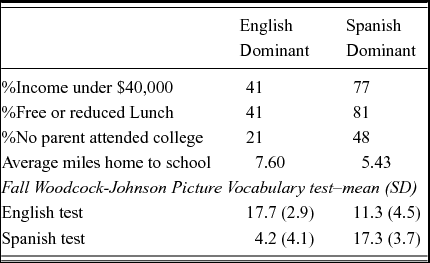
The English and Spanish dominant groups differed from each other in language ability and in measures of socio-economic status (Table 1). Overall, Spanish dominant students had higher levels of proficiency in their second language (English) at point of entry into the program, as measured by a picture vocabulary task, while English dominant students had much lower mean vocabulary scores in Spanish vocabulary. Histograms revealed more variability across language abilities for the Spanish dominant students as well, contrasting with the English dominant students who represented a more monolingual and linguistically homogeneous group. It is also important to note that in some cases, the Spanish dominant students had very high levels of English proficiency; however, this entire group of students was receiving their literary instruction in Spanish and were thus were considered part of the Spanish dominant group. The students in the Spanish dominant group also reported lower means scores on measures of socio-economic status than did students in the English dominant group.
Demographics and language proficiency by language group

Instrumentation and data collection procedures
In both the fall and the spring of the school year, students were administered subtests of the Woodcock-Johnson III (Woodcock, McGrew & Mather, Reference Woodcock, McGrew and Mather2001) achievement battery in English and the Woodcock-Muñoz Battería III (Muñoz-Sandoval, Woodcock, McGrew & Mather, Reference Muñoz-Sandoval, Woodcock, McGrew and Mather2005) in Spanish. Assessments were administered during the school day at the elementary school. Students were first assessed in their dominant language and assessments in their second language were administered on a separate day. Sample fall and spring mean student scores are included in Appendix A for each component by language group.
The six subtests administered from the Woodcock-Johnson III (and their correlating Spanish version from the Woodcock-Muñoz Battería III) (Muñoz-Sandoval et al., Reference Muñoz-Sandoval, Woodcock, McGrew and Mather2005) include Sound Awareness, Letter-Word Identification, Word Attack, Reading Fluency, Reading Vocabulary, and Passage Comprehension. Oral language was measured using the Picture Vocabulary subtest in both Spanish and English. These subtests are described in more detail in the Woodcock-Johnson III Tests of Achievement Examiner's Manual (Mather & Woodcock, Reference Mather and Woodcock2001) and are summarized below.
Sound Awareness (Discernimiento de sonidos)
This subtest assesses children's phonological awareness abilities including rhyming, deletion, substitution and reversal. For rhyming, students must provide a word that rhymes with a spoken word. Students are asked to remove part of a compound word or letter sound from a word in the deletion task. Similarly, for the substitution task, students must substitute a word, word ending or sound to create a new word from the word provided. Finally, students must reverse parts of compound words and sounds in the reversal task. Each item stimulus is presented orally and this task measures a students phonological awareness abilities. The median reliability reported for this task is .81 (Mather & Woodcock, Reference Mather and Woodcock2001).
Letter-word Identification (Identificacion de letras y palabras)
In this task, students are required to identify letters and then pronounce words correctly in increasing difficulty. This task measures students overall word identification skills. The median reliability for this task was reported to be .91 (Mather & Woodcock, Reference Mather and Woodcock2001).
Word Attack (Analisis de palabras)
Students initially are required to produce a correct sound for each corresponding letter. As the items increase in difficulty, the student must correctly sound out a series of pseudo words that are phonically consistent with English spelling rules. This task measures student's decoding ability. The median reliability reported for this task is .87 (Mather & Woodcock, Reference Mather and Woodcock2001).
Reading Fluency (Fluidez en la lectura)
Students are required to read simple sentences and decide if they are true or false. The student must complete as many items as possible in 3 minutes. This task measures student reading and comprehension fluency and has a median reliability reported at .90 (Mather & Woodcock, Reference Mather and Woodcock2001).
Reading Vocabulary (Vocabulario de lectura)
Students must provide either a synonym and antonym or an analogy (depending on the task) for each item, where they are required to read the stimulus word. This task measures student ability to read words and supply appropriate meanings and has a reported median reliability of .87 (Mather & Woodcock, Reference Mather and Woodcock2001).
Passage Comprehension (Comprension de textos)
Student must first match a pictographic representation of a word to the correct picture. As the items increase in difficulty, the task changes to matching a correct word or phrase with the correct picture. Finally, the student must insert a keyword, in a cloze fashion, that makes sense in the short passage provided. This task measures student comprehension skills, including vocabulary, and use of syntactic and semantic clues. The reported median reliability is .83 (Mather & Woodcock, Reference Mather and Woodcock2001).
Picture Vocabulary (Vocabulario sobre dibujos)
Oral Language was measured by this picture naming task. Students must produce the correct label for each picture provided. This is a productive vocabulary task (word retrieval) that increases in difficulty with each item. This task measures oral language abilities and word knowledge. The reported median reliability is .77 (Mather & Woodcock, Reference Mather and Woodcock2001).
Data analysis
This study looks at the relationship between L2 oral proficiency and the rate of transfer of literacy skills from the first to the second language. Specifically, we seek to empirically test the linguistic threshold hypothesis, and identify the existence of a threshold level in L2 oral language above which the rates of transfer of literacy skills from the first language to the second language accelerate or jump. We tested the linguistic threshold hypothesis across various literacy skills using statistical models that more accurately represent a sudden (rather than constant) change in the rate of transfer at specific levels of L2 oral language proficiency. Our research design was made possible due to the instructional model employed at the school, where all students were given initial literacy instruction in their first language while receiving oral language instruction in their second language. Thus, our sample more closely follows the language profiles of sequential bilinguals in other studies, where sample participants had acquired at least some first language literacy skills (Hulstjin, Reference Hulstijn2011; Yamashita, Reference Yamashita2001).
As outlined in the previous section, we estimated a model that assumes the rate of transfer (the slope coefficient that predicts L2 literacy from L1 literacy) to be a discontinuous linear function of L2 oral language (Model B) using change-point regression, (Hall, Lipton, Sliwinski & Stewart, Reference Hall, Lipton, Sliwinski and Stewart2000; Hall, Ying, Kuo, Sliwinski, Buschke, Katz & Lipton, Reference Hall, Ying, Kuo, Sliwinski, Buschke, Katz and Lipton2001; McArdle & Wang, Reference McArdle, Wang and Cohen2008). We compared fit statistics from Model B to the fit statistics for results from Model A, which assumes the rate of transfer to be a continuous linear function of L2 oral ability. Our intent was to empirically test whether a model allowing a very simple discontinuity in the relationship between L2 oral language and transfer fits the data better than a model suggesting a continuous (linear) increase in the rate of transfer.
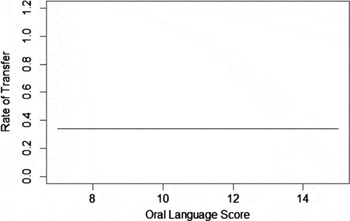
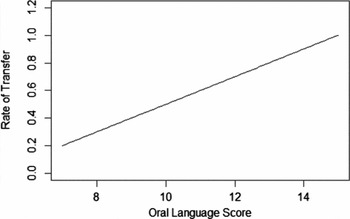
Figures 1 and 2 visually represent linear relationships between the rate of transfer and L2 oral language where there is no relationship (Figure 1) and where there is a continuous linear relationship between L2 oral language proficiency level and the rate of transfer as in Model A (Figure 2).
L1 to L2 transfer is not dependent on oral language.

Linear Interaction Model. L1 to L2 transfer increases at a constant rate (slope) as oral language increases.

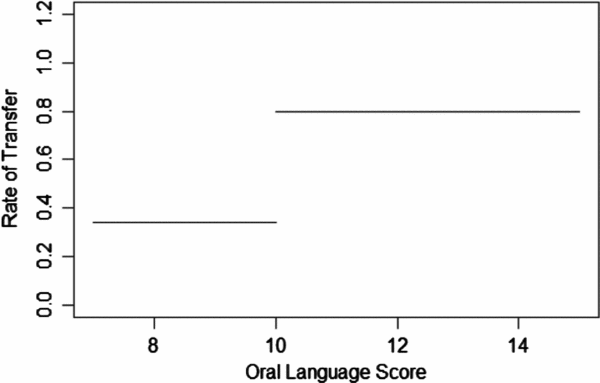
Figure 3 visually represents a simple discontinuous linear relationship (specifically, a piecewise or step function) between L2 oral language proficiency and the rate of transfer between L1 and L2 literacy skills, Model B. This model presents a linguistic threshold where the rate of transfer from L1 to L2 changes at some level of L2 oral proficiency, a threshold. This simple discontinuous-linear relationship can be constructed using a spline, or change-point regression model as represented by Figure 3.
Discontinuous Change-Point Regression Model. Rate of transfer jumps at some critical level of oral language proficiency (threshold).

We acknowledge that this discontinuous step function is likely a simplistic representation of the complex relationship between L2 oral language and the rate of transfer. Other more complex, non-linear representations between variables may provide a better model fit than the simple discontinuous linear step function model indicated by Model B. For example, a piecewise linear function allowing for two lines with non-zero slopes on each side of a threshold may be more suitable. Or perhaps β represents a more complex discontinuous function that creates a unique linear, or even curvilinear, function on each side of a threshold. However, when fitting a general piecewise linear function approach, the parameter estimates were too imprecise (large standard errors) and, thus, unstable, for meaningful conclusions to be drawn. Similarly, a curvilinear (e.g., logistic) relationship between L2 oral language and the rate of transfer was attempted, but required too many parameters for good model fit using our sample. Unfortunately, testing each possible non-linear relationship between oral language proficiency and slope of transfer is beyond the scope of the current study.
However, we reason that, if this extremely simple, parsimonious threshold model (Model B) fits the data better than linear models (Model A), then a more complex non-linear model that more closely reflects reality, if estimable with an adequate sample, will provide an even better fit. We further note that it is beyond the scope of this study to establish a specific threshold level for transfer in our analyses. Nor are we seeking to definitely determine the specific form of the relationship between L2 oral language and the rate of transfer on either side of this proposed threshold. Rather, this study seeks to test the theoretical proposals of the linguistic threshold hypothesis that there is a sudden change in the relationship between L2 oral language and the rate of transfer (an increase or step at a threshold) of literacy skills from the first to the second language, and that this rate of transfer does not simply increase in a linear fashion as L2 oral language increases. In essence, the fit of our simple discontinuous model represents a sort of lower bound on the fit of all possible threshold models that do not assume constant slope.
In this study, regression models representing Models A and B were specified for each language group (Spanish or English dominant), for each of the six literacy components separately. Picture vocabulary was used in each model as a predictor variable representing oral language. For both Model A and Model B we examined plots of relationships among variables as well as residual plots in order to assess whether a transformation of a variable would improve fit. We found that when letter-word was the variable of interest, there were problems with both linearity and heteroscedasticity for both the English and Spanish groups. A natural logarithm transformation of the spring (end of year) Spanish letter-word score solved the problem for both groups. Thus, all analyses carried out for the letter-word variable are conducted with the transformed variables. For the remaining literacy components, all relationships were linear and no transformations were employed.
All models were estimated using maximum-likelihood estimation (rather than ordinary least squares). Maximum-likelihood estimations generate the Akaike Information Criterion statistic, corrected for finite sample size and number of parameters (AICc; Hurvich & Tsai, Reference Hurvich and Tsai1989), which is useful for comparing non-nested models. In this study the AICc was used in order to slightly penalize the change-point models when comparing them to the linear interaction models, as the change-point models include the extra parameter of an estimated change-point. The AICc, interpreted similar to the more commonly used AIC, gives us information about how well the data fits each model. A lower AIC represents a better model fit and the model with the lowest AIC is generally chosen as the best-fitting model (Singer & Willett, Reference Singer and Willett2003). When fitting general linear models, two other statistics that are sometimes used are the BIC and Mallow's Cp statistic (Fox & Weisberg, Reference Fox and Weisberg2011). However, both statistics would be essentially equivalent to the AICc for the models used in this study. For example, the BIC only differs from the AICc in that it weights the sample size and number of parameters differently. Because the models that are directly compared in this study have identical sample sizes and numbers of parameters, the AICc and BIC would always be perfectly correlated. Thus, only the AICc is presented in this paper. Other popular fit statistics (e.g., CFI, TLI, RMSEA) are generally used in latent variable models based on covariance matrices, and, thus, are not appropriate, or even estimable, in this analysis.
Choosing the best fitting model for this study involved an iterative process whereby a series of models were compared with each other using the AICc statistics for best fit. The model with the lowest AICc was considered to be the best-fitting model. Models whose AICc statistic were three to seven points higher were considered to fit the data less well than the best-fitting model, and those with ten or more points higher were considered very unlikely to be better fitting models than the best-fitting model (Burnham & Anderson, Reference Burnham and Anderson2002).
Regression model specifications
For each linear regression model, L2 spring literacy components were regressed on the L1 spring literacy component variables, controlling for fall literacy scores in each language, L2 spring oral language ability, and grade level. For each literacy component, the regression model was formulated as follows:
 $$\begin{eqnarray}
L2\ Skil{l_{ij}} = {\alpha _i} + \ {\beta _i}\left( {L1\ Skil{l_{ij}}} \right) + {\bm{w}_j}^{\prime}{\bm{\gamma }_i} + \ {\varepsilon _{ij}}\nonumber\\
{\beta _i} = {f_i}\left( {L2\ Oral\ Language} \right)
\end{eqnarray}$$
L1 skill represented a specific literacy component at the end of the year in the first language and L2 skill represented the same literacy component at the end of the year but in the second language. β i therefore represented the rate of transfer from L1 to L2 for literacy component i. In these models, w is a vector that includes the following control variables: L1 beginning of year ability in the literacy component being modeled, L2 beginning of year ability in the same component, and a dummy variable indicating whether the student was in kindergarten or grade 1. Linear regression models were constructed for each literacy skill (Sound Awareness, Letter-Word Identification, Word Attack, Reading Fluency, Reading Vocabulary, and Passage Comprehension) that we examined in this study.
If β i is a linear function of L2 oral language, then adding an interaction term between L2 oral language and ‘L1 Skill’ (the literacy component of interest) to the model is algebraically equivalent to Model A (Equation 2). Thus, the Model A can be specified as:
 $$\begin{eqnarray}
L2\ Skil{l_{ij}} = \ {\alpha _i} + \ {\beta _i}\left( {L1\ Skil{l_{ij}}} \right) + {\beta _2}\left( {L2O{L_j}} \right)\nonumber\\
&& + {\beta _{12}}(L1\ Skil{l_{ij}})\left( {L2O{L_j}} \right)\ + {\bm{w}_j}^{\prime}{\bm{\gamma }_i} + \ {\varepsilon _{ij}}\nonumber\\
\end{eqnarray}$$
Similarly, if β is framed as a discontinuous linear step function, then adding an interaction term between a dichotomous dummy variable, X, representing that step and ‘L1 Skill’ to the model is equivalent to Model B. Thus, Model B can be specified as:
 $$\begin{eqnarray}
L2\ Skil{l_{ij}} = \ {\alpha _i} + \ {\beta _i}\left( {L1\ Skil{l_{ij}}} \right) + {\beta _2}\left( {{x_j}} \right) \nonumber\\
&&+ {\beta _{12}}(L1\ Skil{l_{ij}})\left( {{x_j}} \right)\ + {\bm{w}_j}^{\prime}{\bm{\gamma }_i} + \ {\varepsilon _{ij}}\nonumber\\
\end{eqnarray}$$
where:
 $$\begin{equation*}
{x_j} = \ \left\{ {\begin{array}{*{20}{c}} {0\ if\ L2O{L_j} < \ \tau }\\ {1\ if\ L20{L_j}\ \ge \ \tau } \end{array}} \right.
\end{equation*}$$
In this model τ represents the value of L2 oral language at which the threshold occurs. Though in both Models A and B the rate of transfer is predicted by L2 oral skills, the nature of the relationship being modeled differs; Model A specifies a linear increasing function, while Model B specifies a linear discontinuous relationship. It might also possible to generalize Model B to allow for more than one discontinuity (or threshold); however, for this project only one was allowed. The discontinuous models were estimated using a change-point regression approach, and the goal was to identify the best fitting model. This approach allowed us to determine whether the rate of transfer changed in an accelerated, or sudden, manner at some threshold value of L2 oral language.
Change point regression methodology
In order to estimate each discontinuous model (Model B), we used change-point regression to identify where a potential L2 language threshold might fall. Because we anticipated that any threshold found would vary by literacy skill, as well as by student language group, we needed an approach that would let us vary the hypothesized linguistic thresholds across the various literacy skills examined in this study. This methodology is further explained below.
A simple approach to estimating a change-point, or a threshold, change-point regression analysis is an adaptation of the profile likelihood method (Hall et al., Reference Hall, Lipton, Sliwinski and Stewart2000; Hall et al., Reference Hall, Ying, Kuo, Sliwinski, Buschke, Katz and Lipton2001; McArdle & Wang, Reference McArdle, Wang and Cohen2008). Assuming that a linguistic threshold would fall at approximately the same value for individuals within the same language dominant group, a spline term is added to a regression model that represents this threshold, as shown in Model B above. Essentially, this spline term is allowed to shift at various points, τ, as the model is fit repeatedly for various values of τ. The models at various values of τ are then examined for best fit, using the AICc goodness-of-fit statistics.
The value of the spline term representing a hypothetical L2 oral language threshold, triggering the values of the indicator value, τ, was iteratively increased and the model re-estimated until a τ was found which optimized model fit. In other words, we looked for an L2 oral language threshold value best supported by the data (a discontinuity or step as illustrated in figure 3). An optimal L2 oral language threshold was identified if it minimized the AICc for the model, and a large ‘drop’ in the AICc was considered particularly strong evidence that the threshold (τ) was optimal. In addition, the effect size and p-value of the spline term at the minimum AICc was examined. In most cases, the AICc and the p-value were minimized at the same location and the effect size of the change point was also largest at this point. In addition, the AICc at this threshold was compared with the AICc found in the corresponding linear-regression model found previously, in order to determine which model resulted in better model-data fit (research hypothesis 3).
Hall et al. (Reference Hall, Ying, Kuo, Sliwinski, Buschke, Katz and Lipton2001) previously used a profile likelihood method (an inversion of a likelihood-ratio test) to estimate the best value for τ; however, estimating best values for τ – in essence trying to identify the best values for the L2 oral language threshold – was beyond the scope of our project. Given our small samples, and the unique context of our study within a specific instructional model at a school, our main goal in this analysis was to test whether this change-point regression approach was supported in our sample. Thus, as noted above we used the more straightforward AICc comparisons, which was sufficient for our analyses.
Results
Research Hypothesis 1: We hypothesize that the rate of transfer of literacy skills from L1 to L2 is a function of L2 oral language ability
In the current study, the rate of transfer from L1 to L2 was specified across all literacy components, and attention was paid to whether these relationships were dependent on oral language proficiency. This hypothesis was supported in the results from fitting both Model A and Model B. In other words, results from fitting both the continuous linear and the discontinuous linear models supported the hypothesis that the rate of transfer from L1 to L2 is a function of L2 oral language ability. However, as the results from fitting the discontinuous Model B also explicitly address our research hypothesis 2, we will only discuss the results from fitting the continuous linear Model A in this section.
Across most literacy skills, the effect for transfer was significant in the linear models (Model A), even when an interaction effect was not, confirming previous work (Feinauer, Hall-Kenyon & Davison, Reference Feinauer, Hall-Kenyon and Davison2013), and pointing to the existence of the transfer of literacy skills from the first to the second language. Specifically, a statistically significant linear interaction between L2 oral language and rate of transfer (L1 Spring literacy to L2 Spring literacy) was found on two of the six components for the Spanish group and five of the six components for the English group (Table 2). In these linear regression models, where a statistically significant interaction effect was found, the rate of transfer from the L1 literacy component to the L2 literacy component changes in a constant fashion, as a linear function of L2 oral language proficiency.
Linear Regression Models

*Natural logarithm of the spring (end of year) letter-word Spanish score used for both the English and Spanish groups.
Research Hypothesis 2: We hypothesize that the rate of transfer from L1 to L2 jumps or accelerates when students cross a specified threshold(s) of L2 language oral ability
To investigate research hypothesis 2, we specified change-point regression models where the rate of transfer is a discontinuous linear, function of L2 oral language proficiency. This is represented in Model B.
Across most literacy skills, the change-point regression models revealed specific levels of L2 oral language at which the rate of transfer from L1 literacy to L2 literacy increased significantly. These findings build on our previous work (Feinauer, Hall-Kenyon & Davison, Reference Feinauer, Hall-Kenyon and Davison2013) that showed transfer from L1 to L2 across component literacy skills. However, these results also clearly suggest the existence of a threshold level of L2 oral language proficiency, for many component literacy skills, above which the rate of transfer from L1 to L2 changes suddenly and significantly. These findings specifically support our second research hypothesis presented above.
Table 3 presents an illustrative example of our modeling process for one literacy component, reading fluency, for the English language student group. Here an optimal L2 threshold for this group of students was found at a Spanish picture vocabulary test score of 11. The AICc reaches a minimum of 394.17 at this threshold. As can be seen, the AICc is much lower at 11, than at 10 or 12. Guidelines in interpreting AICc differences suggest that a difference of 10 or more indicate very little chance that the higher AICc model is a better fitting model (Burnham & Anderson, Reference Burnham and Anderson2002). Thus, the model with the lower AICc was determined to be the best fitting model, and the step illustrated in figure 3 was believed to occur most convincingly at that level of oral language.
Iterative Change-Point Regression Procedure: Reading Fluency, English Group

In addition, the change point effect with the spline term is highly significant (p=.00000) and largest at this point (b = 0.33). The change point effect of 0.33 suggests that, if a threshold exists at 11, then students at or above that threshold can be expected to have, on average, a 0.33 point increase in Spanish reading vocabulary for every one point increase in English reading vocabulary. Students below that threshold have a 0.00 point increase (main effect of transfer) in Spanish for a one point increase in English. The coefficient on the spline term, therefore, represents the addition to the rate of transfer that occurs once the requisite L2 oral language proficiency threshold is achieved. Tables similar to Table 3 can be found in Appendix B for each of the other component literacy skills investigated in this study, across both language groups.
On all components, except letter-word for both groups and sound awareness for the Spanish group, evidence of a ‘threshold’ was found by identifying a minimized AICc for students above (and below) a particular value for picture vocabulary. In each case, the change point p-value at the L2 oral proficiency threshold was small and the minimum p-value occurred either at that threshold or very close to it (Appendix B). For each change-point regression procedure, generally, the AICc and p-values both decreased as the L2 oral language proficiency threshold was approached through the iterative process. As the optimum threshold level was specified, both the AICc and the p-values hit a minimum, and increased again as the spline terms moved away from the optimum threshold level. Results from these analyses specifically support our research hypothesis 2 that proposes that the rate of transfer from L1 to L2 increases as students cross a specific threshold of L2 oral language proficiency.
Research Hypothesis 3: We hypothesize that discontinuous linear change-point regression models will fit the data better than linear interaction models
The purpose of this study is to test whether discontinuous linear models better represent the threshold hypothesis, as outlined in the theoretical literature (Alderson, Reference Alderson, Alderson and Urquhart1984; Clarke, Reference Clarke1979; Yamashita, Reference Yamashita2001). In order to speak to this question, we examined the goodness of fit between the fitted linear models and the fitted discontinuous change-point regression models. This comparison provides empirical evidence that the discontinuous models do in fact fit our data better than do the linear models, and provide better representations of the relationship between L2 oral language proficiency and the transfer of literacy skills from the first to the second language.
Table 4 reports the optimal threshold, effect sizes, p-values, and AICcs across all regression models for all components on both languages. It's important to note that the AICcs are nearly always lower for the change-point regression models than for linear regression interaction models (except for letter-word and sound awareness). In general, the observed differences between the AICcs for each comparable model (Δ AICc) are large enough that the linear regression model would be considered either not well supported or highly unlikely in comparison (Burnham & Anderson, Reference Burnham and Anderson2002). In other words, the discontinuous change-point regression models appear to be better supported by the data than the continuous linear regression models. The data supports the existence of a second language threshold for most literacy skills, where a ‘jump’ in the rate of transfer occurs once some critical level of L2 oral proficiency is reached, rather than a more gradual constant increase in transfer with increasing oral language ability.
Comparison of Linear Regression and Change-Point Regression Models for all Components

*AICc from linear interaction model for comparison.
** Δ AICc <2: Both models likely; 3–7; Little support for higher model; 10+: Higher model very unlikely
†Sound Awareness had two local minimums for the Spanish group.
††Natural logarithm of the spring (end of year) letter-word Spanish score used for both the English and Spanish groups.
The results from models estimated under both the continuous linear regression and change-point regression models suggest that higher L2 oral language ability predicts a greater rate of L1 to L2 transfer. The continuous linear regression model suggests transfer occurs at gradually increasing rates of L2 oral language ability. However, the change-point regression models further suggest that there may be an optimal level of L2 oral language proficiency (change-point) above which L1 to L2 transfer of literacy skills is, on average, higher. The consistently lower AICcs across language groups and literacy components generally suggests a better fit of these change-point regression models, than the linear interaction models. The biggest exception to our findings is with the letter-word variable after transformation (natural logarithm) of the Spring Spanish score. In these cases, however, the logarithmic transformation of the Spanish score already defines a non-linear relationship between Spanish and English letter-word. Thus, the model suggests a sudden speeding up of the transfer between languages as is reflected by exponential-logarithmic relationships. This relationship is in harmony with a threshold hypothesis. Clearly, it is a different relationship than was modeled for the other constructs using either the linear interaction model or the discontinuous step model. The violation of regression assumptions, however, made the adjustment necessary.
Discussion
As Yamashita noted (Reference Yamashita2002a), the relationship between L2 linguistic proficiency and first and second language reading outcomes has largely been examined using linear methodologies, such as correlation or regression modeling. However, current conceptualizations of the Linguistic Threshold Hypothesis (Yamashita, Reference Yamashita2001) suggest a non-constant relationship between L2 language proficiency and the transfer of literacy skills across languages, and thus require statistical models with non-constant slope to fully and empirically test the hypothesis. Indeed, findings from this study demonstrate cross-linguistic transfer across component literacy skills, and revealed the rate of transfer to be a function of oral proficiency in the second language for both English dominant and Spanish dominant students. Further, the main findings from this study confirm that the rate of transfer from the first to the second language for many literacy variables was more appropriately related to second language oral proficiency in a discontinuous linear way, rather than in a constant linear fashion, which is the way it has most often been modeled in the empirical work thus far. Thus, these findings empirically support the theoretical underpinnings of the Linguistic Threshold Hypothesis, and point to new ways of thinking about and empirically validating the nature of potential threshold effects of language proficiency on the L1-L2 transfer of literacy skills.
Despite these important findings, this study raises more empirical questions than it answers. For example, for the English group, the continuous and the discontinuous models were nearly identical in their goodness-of-fit to the data (in terms of the change in AICc) for the Letter-Word Identification subcomponent. However, the Letter-Word relationship was modeled differently for statistical reasons, as noted above. This is likely related to the relationship between the L1 and L2 Letter-Word Identification variables, as these were the only variables that required transformation to meet the assumptions of linearity required for these analyses. We also noted that for each of the components, except Sound Awareness, the L2 oral language thresholds noted for the Spanish literacy instructed students was higher, and typically more variable, than the L2 oral language threshold for the English literacy instructed students. This raises additional questions about possible differences in language thresholds for the different literacy components and further suggests that thresholds may not function in the exact same way for all L2 learners (e.g., Spanish v. English second language learners).
Thus, the findings from the current study highlight two important considerations. First, the importance of examining how differences in thresholds might be related to the growth patterns and trajectories of the different language and literacy skills under investigation (Melby-Lervag & Lervag, Reference Melby-Lervag and Lervag2011; Paris, Reference Paris2005) and second, the consideration for potential variation in thresholds for different kinds of second language learners.
Differences among literacy skills
Naturally, all literacy skills do not have the same growth patterns, although they are often assessed and studied as if they do. For example, English-speaking students typically acquire sound awareness in the early grades and hit a ceiling level for being able to acquire new skills in this area by the end of first grade. Paris (Reference Paris2005) defines sound awareness, and other types of literacy skills with limited growth curves, as a ‘constrained skill’, as it is mastered early and learned quickly by learners of the English language and thus has a different developmental trajectory than an ‘unconstrained skill’ such as comprehension or vocabulary, which don't normally have ceiling effects. Second language threshold effects on the transfer of such skills from the first to the second language might also be constrained and observable only at low levels of sound awareness in either language. On the other hand, it is possible that unconstrained skills may have higher thresholds of L2 language proficiency, or perhaps multiple thresholds that could be modeled. Traditionally, studies of cross-linguistic transfer have utilized continuous linear models and often look at select literacy skills. However, the data from the current study suggest that models allowing for a discontinuity or more complex growth pattern may be more helpful in understanding the relationship between L1 and L2 language and literacy skills and that there may be differences in the results depending upon the growth trajectory of the targeted literacy skill. Still, the data from this study are not conclusive as not all of the ‘constrained skills’ included in this study are measured or functioned in the same way (e.g., sound awareness, word attack, letter-word id). More research in this area is needed.
Differences among L2 learners
In his 1991 study, Carrell also showed that L2 oral language predicted L2 reading differently for Spanish and English second language learners in the U.S. She raised several possible reasons for this, including the differences in the learning environment and the levels of L2 proficiency of the subjects. Similar to this, we find that, in general (across literacy components) the ‘L2 threshold’ seemed be at a higher level for the Spanish dominant students in our sample. This points to future research that might explore factors that lead to the development of varying thresholds across various language and literacy skills for different kinds of second language learners.
In this particular case, it is likely that the higher threshold for the Spanish dominant students may be related to various contextual factors specific to the demographics or family experiences of Spanish speaking families in the United States. Spanish dominant students in this study are second language learners, living in an English dominant context. Therefore, it is perhaps not surprising that, in general, Spanish dominant students had overall greater L2 (English) oral language skills and L2 (English) literacy skills at the beginning of the year (see Appendix A). These students frequently encounter English outside of school, as it is the dominant language in their neighborhood environments. Overall, the analysis with the English students was more straightforward, due to the lower levels of proficiency and less variability in L2 language and literacy skills (usually close to none). These students are more similar to foreign language students in a foreign language classroom, where their language of instruction (English) is also the dominant language in their homes and classrooms. Exposure to their second language (Spanish) occurs largely in an instructional setting, and there is very little incidental learning in Spanish taking place outside the classroom. These factors must be taken into consideration when thinking about the conditions under which transfer occurs and the factors that lead to threshold effect of second language proficiency on transfer. In future studies, it would be worthwhile to include a measure of linguistic input as a factor in future analyses, given that the amount of language exposure a learner has is directly implicated in language development.
Relatedly, researchers must also consider the similarities and differences between the languages being learned. If the languages are markedly different in their structures, then the strategies required to read and write in those languages will vary and the role of L2 oral language proficiency might either come into question or be vastly different for different language learners. For example, L2 grammatical or morphological knowledge may be as, or more important, than L2 vocabulary for an English speaker learning Chinese. Empirical questions such as these should be pursued using larger data sets and more sophisticated non-linear modeling techniques.
Implications
Validating the Linguistic Threshold Hypothesis, and coming to a better understanding of the conditions under which L2 oral language contributes to transfer, is an important empirical question that has pedagogical and instructional implications. Teachers in second language, foreign language, and bilingual educational settings will be empowered to better understand the relationships between oral language and literacy outcomes for students in their classrooms as we come to better understand the role of L2 proficiency in supporting transfer processes. Understanding the Linguistic Threshold Hypotheses might lead teachers to understand the priority of helping their students acquire language skills in order to read in their second language. However, they also need to understand that second language readers and writers also draw on their first language skills to read in their second languages. Thus, a more thorough and precise understanding of how these processes are related have the potential to directly inform the teaching decisions of teachers working with young bilinguals.
One important aspect of teaching that may be impacted by this work is around assessment. As teachers come to better understand the relationships between L2 oral language on the transfer of reading skills from the first to the second language, they will be better prepared to effectively utilize language and literacy assessments in their instructional decision making. This is especially true as they seek to help their students use their L1 reading skills to benefit them in their second language. For example, if an assessment reveals that a students is below a ‘threshold’ level of L2 oral language known to exist for a specific literacy skill or strategy, then that teacher would know to focus instruction on developing linguistic proficiency in the second language. Alternatively, if the second language oral proficiency is well developed, teachers can then know to focus on helping students take advantage of the literacy skills and strategies they have in their first language to benefit their second language literacy skills. Teachers can more directly ‘teach to transfer’, with confidence that they are reaching their student at the proper instructional level. However, appropriate assessments are needed, which cannot be created until we better understand the complex relationships between L2 oral language and literacy among bilingual learners (Riches & Genesee, Reference Riches, Genesee, Genesee, Lindholm-Leary, Saunders and Christian2006).
Obviously, teachers need to be prepared to work with language learners who come to their classrooms from a variety of backgrounds. Thus, our empirical work should attend to the many linguistic and contextual factors that might impact threshold effects on the transfer of literacy skills. Further, teachers and teaching approaches differ across second language, foreign language, and bilingual classrooms. Our study is just a beginning in thinking about new ways to model the Linguistic Threshold Hypothesis in order to illuminate the potentially varying levels of language proficiency implicated in transfer, as well as contribute to a better understanding about the conditions under which transfer occurs. We are cautious in our implications as this study is exploratory and preliminary, and because much more work needs to be done empirically to fully understand the impact of our work on the instructional and pedagogical implications. In this paper we are, above all, challenging the field to look more specifically at the assumptions underlying the LTH and better match the methods of inquiry to the theoretical underpinnings. This papers presents just one simple way of modeling a second language threshold, by using discontinuous models as a way to better fit the assumptions of the theory (Yamashita, Reference Yamashita2001).
Limitations
There are several limitations of this study. One of the limitations is the reliance on a single vocabulary test in the students’ second language as a measure of oral language proficiency in that language. Ideally, oral language would be represented by a composite variable that also included other measures of oral language. For example, a composite for oral language could be constructed for measures of both vocabulary and grammar knowledge. This type of oral language variable might speak to the question posed by Yamashita (Reference Yamashita2001) when she noted that it would be “interesting to know whether the contributions of different L2 language ability components do indeed change depending on the task” (p. 198). Thus, more complex constructs of oral language might yield more information about the ways that oral language may or may not act as a threshold for the transfer of literacy skills.
Another limitation, common to other research on literacy development, is the difficulty in representing literacy skills in a holistic way. In this study, we defined literacy skills as measured by our main assessment tool – the Woodcock Johnson III Battery – which limited the ways in which we could talk about the transfer of literacy skills. We acknowledge this limitation, especially in light of the passage comprehension subtest, as there are many different measurement methods for assessing reading comprehension that are not included in this particular literacy battery. For example, we would suggest a careful examination of types of reading strategies that might transfer, or become accessible to students when reading in a second language. It might be particularly interesting to know how cross-linguistic transfer of reading strategies is facilitated by an increase in the language abilities in the second language, as it seems reasonable to assume that strategic thinking may also dependent on the level of language skills available to a person in the target language.
Finally, due to the limitations of our sample size, this study explores only one approach beyond a continuous linear model to modeling the threshold hypothesis – a change-point regression model. There are a myriad of other types of discontinuous, piecewise or curvilinear models that could be considered when thinking about the complex relationships between second language oral language proficiency and the transfer of literacy skills.
Directions for future research
Our purpose in this study was not the specific investigation of an absolute threshold, but rather an exploration of one way to think about, and model, a threshold-type relationship between second language oral skills and transfer. Moving forward, it is our hope that the empirical questions can shift toward an investigation of the relationships between oral language proficiency and the transfer of literacy skills, in terms of under what condition and in what context transfer is made possible. As Lee and Shallert (Reference Lee and Schallert1997) note, even if a threshold effect is in play, there is likely great variation in the minimum level of oral language proficiency necessary to support transfer, and this threshold is likely to vary from task to task and across learners.
There are many possible directions for future research in empirically validating the Linguistic Threshold Hypothesis and more specific investigations should be undertaken. Based on our findings, we are particularly encouraged by the possibilities of further exploring various discontinuous and non-linear models to represent the complex relationships between oral language proficiency and the transfer of literacy skills across languages. For example, there are diverse curvilinear models that could be constructed and fit to larger datasets. One such model might allow the rate of transfer to be a logistic function of L2 oral language. In this case, a threshold effect should be considered to be more gradual than discontinuous, as was represented in this study. Additional studies, with larger samples that allow for greater model complexity, are needed to further investigate these possibilities. These questions were outside the scope of this study, but should be explored in future research as scholars seek to better understand and describe the threshold effect of second language oral proficiency on the transfer of literacy skills for bilingual learners.
Similarly, other threshold skills might be explored. For example, Cummins’ Threshold Hypothesis suggests threshold levels of language proficiency in the first language, as well as threshold levels of bilingualism – across two languages (Reference Cummins1979, Reference Cummins1981). However, there is very little empirical work to validate his assertions. Similarly, threshold effects of first language literacy might be explored when predicting second language literacy from second language oral language proficiency. All of these relationships require further explication (Alderson, Reference Alderson, Alderson and Urquhart1984; Riches & Genesee, Reference Riches, Genesee, Genesee, Lindholm-Leary, Saunders and Christian2006) and have important pedagogical and programmatic implications for emergent bilinguals in school settings. Above all, this study highlights the importance of rethinking the way that threshold effects are conceptualized and modeled. In the future, scholars should take up a more careful and considered application of statistical models that better fit the theoretical underpinnings of the complex relationships under investigation.