1. Introduction
Humans use language in ways that meet the needs of various communicative situations in which they find themselves. Economic and trade internationalization and the global dissemination of science, technology, and culture necessitate that bilingual individuals toggle between different languages, demonstrating the common practice of language switching. But as is well known, not all languages are structurally the same. Among their many differences are the word formation rules to which they systematically adhere. These inter-linguistic morphological properties (i.e., within the word) may inevitably interfere with language comprehension and production. Morphemes are meaningful units that make up words. They are the basic building blocks that can be as small as a single sound, as the /-s/ in the word “cats,” or longer as in cases of unbound morphemes like “coffee” and “elephant.” The rule that verbs in the present tense can be marked as third person singular by adding the morpheme /-s/, with the exception of irregular verbs, is an example of the many word formation rules that are used to construct words and to express morphological changes (Göpel & Richter, Reference Göpel and Richter2016). When bilinguals speak in either of their languages, they apply word formation rules as appropriate. However, there are times when the rules in the two languages do not align. For instance, the morpheme that generates the present tense of the third personal singular in English is unlikely to work the same in other languages, as can clearly be seen when comparing the English plural /-s/ to one of Italian's plural markers, /-i/, as in ragazzi ‘boys’). Moreover, in one language, compound words (e.g., “bottle-opener”), which consist of two or more words of the same or different category (i.e., “bottle-opener” is a noun-verb), may not have compound translations consisting of the same categories (e.g., apri bottiglia and abrebotellas ‘open-bottles’ in Italian and Spanish, respectively, are verb-noun combinations). What role, if any, does the incongruency in word formation processes between two languages play in bilingual language switching? In the next section, we will provide further background to this question.
1.1 Morphological configuration and language control
To our knowledge, only a few behavioral studies have examined the role of morphological configuration in language control (Contreras-Saavedra et al., Reference Contreras-Saavedra, Willmes, Koch, Schuch, Benini and Philipp2020, Reference Contreras-Saavedra, Willmes, Koch, Schuch and Philipp2021). In the study by Contreras-Saavedra et al. (Reference Contreras-Saavedra, Willmes, Koch, Schuch, Benini and Philipp2020), German–English–Spanish trilinguals participated in a digit-naming task with cued language switches. The authors specifically focused on two-digit number words that, depending on the language, had either inverted rules, non-inverted rules, or both. In German, there is only an inverted composition rule (e.g., “sixteen”), while in Spanish, there is only a non-inverted composition rule (e.g., “twenty-three”), and in English, there are both. The analyses included trial sequences with English in trial n (and either German, English, or Spanish in the preceding trial n-1) as English was the only language that included both non-inverted and inverted composition rule trials. The findings revealed larger switch costs in morphological configuration-repetition trials than in morphological configuration-switch trials. Similarly, in the study by Contreras-Saavedra et al. (Reference Contreras-Saavedra, Willmes, Koch, Schuch and Philipp2021), these findings were generalized to language comprehension using non-numerical words. Although these findings suggest that language switching is affected by morphological configuration, these configurations were only analyses on the second language (L2), English. As such, it is not clear as to whether there are specific processing modes arising from cross-language switching of morphological configurations that are independent of language.
Models of bilingual word processing suggest that compound word processing is different from distributed networks models and serial processing of meaning to pronunciation. Distributed models explain the rapid and parallel use of semantic and morphological features during speech planning (Miozzo et al., Reference Miozzo, Pulvermüller and Hauk2015; Strijkers et al., Reference Strijkers, Costa and Thierry2010, Reference Strijkers, Costa and Pulvermüller2017). However, different morphological configuration between languages may lead bilinguals to adopt sequential processing (Caramazza et al., Reference Caramazza, Laudanna and Romani1988; Levelt et al., Reference Levelt, Roelofs and Meyer1999; Li et al., Reference Li, Jiang and Gor2017; Taft & Forster, Reference Taft and Forster1975; Uygun & Gürel, Reference Uygun and Gürel2017). Sequential processing models hold that compounds are not stored and accessed as whole units, but rather, are able to be decomposed and separately accessed (Libben et al., Reference Libben, Derwing and de Almeida1999). Using highly sensitive time-resolution EEG technology, the present study aims to explore how morphological configuration affects control mechanisms involved in bilingual production and comprehension by simulating simple dialogues in a language switching task.
1.2 Language switching and ERP evidence
The Bilingual Interactive-Activation Model from a developmental perspective (BIA-d; Grainger et al., Reference Grainger, Midgley and Holcomb2010) argues that both bilingual production and comprehension require activation of the target language node and inhibition of the non-target language. However, the control processes for production and comprehension are distinct. In production, the target language is proactively activated according to situational/communicative demands, and the non-target language is suppressed using top-down control (Declerck & Philipp, Reference Declerck and Philipp2018; Peeters et al., Reference Peeters, Runnqvist, Bertrand and Grainger2014). In contrast, in language comprehension, the target language is passively activated and non-target language words are suppressed using bottom-up control (Declerck & Philipp, Reference Declerck and Philipp2018; Declerck et al., Reference Declerck, Koch, Duñabeitia, Grainger and Stephan2019).
Numerous event-related potential (ERP) studies on language switching in production have used the N2 effect and the late positive component (LPC) as indicators of language control. The N2 effect has been associated with inhibition of cross-language schema or language tags. The LPC reflects target language lemma selection (Martin et al., Reference Martin, Strijkers, Santesteban, Escera, Hartsuiker and Costa2013) and the release of a previously suppressed lemma (Jackson et al., Reference Jackson, Swainson, Cunnington and Jackson2001). For example, Liu et al. (Reference Liu, Zhang, Blanco-Elorrieta, He and Chen2020) reported that when trilinguals where cued to switch away from a language and into one of their other languages of their choosing (switch-away trials), there were more negative N2 amplitudes and smaller LPC activity compared to staying in the same language (repeat trials) or when cued to switch into a specific language (switch-to trials). Kang et al. (Reference Kang, Ma, Li, Kroll and Guo2020) investigated the predictive effect of cognitive control on language control and found that switch trials induced a stronger N2 effect than repeat trials and smaller flanker effect. Timmer et al. (Reference Timmer, Christoffels and Costa2019) examined inhibitory control in different contexts and found that L2 switch trials induced greater LPCs than L2 non-switch trials. Similarly, Liu et al. (Reference Liu, Liang, Dunlap, Fan and Chen2016, Reference Liu, Xie, Zhang, Gao, Dunlap and Chen2018) found that switching into the L2 elicited a larger LPC effect than switching into the first language (L1). This switching effect quantified by LPC indicates that bilinguals alternate between their two languages by suppressing the interference of non-target lemmas. Moreover, the LPC is associated with context updating, target selection, and allocation of attention resources (Donchin, Reference Donchin1981; Polich, Reference Polich2007) and its amplitude may be regulated by the semantic nature of language stimuli. For instance, words containing the same semantic category trigger greater LPC amplitude than words with different semantic categories (Sanquist et al., Reference Sanquist, Rohrbaugh, Syndulko and Lindsley1980).
In addition to the typical N2 and LPC effects, early positive P2 activity is often examined during overt picture naming. Costa et al. (Reference Costa, Strijkers, Martin and Thierry2009) revealed a strong positive correlation between response times (RTs) and mean amplitudes of P2 peaks. These correlations support the view that the P2 component is sensitive to the competitive nature of lexical selection. In a study by Branzi et al. (Reference Branzi, Martin, Abutalebi and Costa2014), the researchers offered evidence for the P2 effect as an index of difficulty in lexical access. Highly-proficient bilinguals named pictures in their L1, in their L2, and then in their L1 again, or in the opposite order (i.e., L2, L1, L2). The results showed that L1 recovery induced a behavioral cost and an enhanced P2 effect which had an after-effect on the N2 component (reduced negativity). However, L2 recovery neither exhibited significant costs nor enhanced P2 effects. The authors argued that the P2 effect reflects language-specific selection mechanisms that are applied during the early stage of lexical access. Given that morphological configuration might be implicated in early word retrieval, the present study includes analyses on P2 amplitude, along with N2 and LPC, as indicators in assessing the impact of morphological configuration on language control during production and comprehension.
1.3 The present study
It is unclear whether it is morphological configuration independent of language that influences bilingual production and comprehension of simple words in a language switching context. In the present study, we focus on the configuration of compound words whose combinations can be of various types: noun-noun, noun-verb, adjective-noun, adjective-adjective, etc. English and Chinese are additional examples of languages that can have different morphological formation rules in creating compound words. Accordingly, we specifically examine compounds in Chinese and English that are created by the same concepts (i.e., translation equivalents) but either have an incongruent morphological configuration (e.g., “handshake” is a noun-verb compound, while its translation “握手” (‘shake hand’) is a verb-noun compound) or a congruent configuration (e.g., “sunrise” and its translation日出 (‘day come-out’) are both noun-verb compounds). Given that the congruency of morphological configuration between languages may implicate sequential processing (Caramazza et al., Reference Caramazza, Laudanna and Romani1988; Levelt et al., Reference Levelt, Roelofs and Meyer1999; Taft & Forster, Reference Taft and Forster1975), we use the congruent Chinese–English morphological configuration as a baseline to compare it with incongruent morphological configuration during a language switching task. In our experiment, bilingual speakers (Participant A) named pictures in Chinese and English according to language cues, while bilingual listeners (Participant B) heard these utterances and then judged whether they included certain sounds. In this dyad scenario, a closer approximation to dialogue can be achieved while carefully examining the control mechanisms involved in both production and comprehension.
We hypothesize that morphological configuration will exert a significant impact on the lexical access stage during language switching as reflected by behavioral performance and relevant ERP components. We expect this to occur because bilinguals may detect incongruent morphological configurations in early processing stages and make processing adjustments to implement language switching. Moreover, if bilingual production and comprehension share a similar control mechanism, we should expect to observe effects of morphological configuration on production and comprehension on shared ERP components. If morphological configuration involves parallel processing, the influence of morphological configuration on language switching should be relatively small. Therefore, this study will reveal the role of language control in production and comprehension from the perspective of cross-linguistic morphological configuration.
2. Method
2.1 Participants
The calculated sample size was 28 using G.power 3.1.9.7 (Faul et al., Reference Faul, Erdfelder, Lang and Buchner2007) according to the following settings: F-tests > ANOVA: Repeated measures, within factors, Effect size f = .25, α error probability = .05, correlation among repeat measures = .5, Power (1-β error probability) = .8, Number of groups = 1, Number of measurements = 3, and nonsphericity correct ∈ = 1. To avoid the reduction of effect size due to invalid subject data, thirty-seven dyads of unbalanced Chinese–English bilinguals studying at Liaoning Normal University participated in this study. The participants were paired arbitrarily. The participants were native Chinese speakers and had learned English in a classroom setting since primary school. All participants were right-handed with normal or corrected-to-normal vision and had no history of neurological, psychiatric, or major somatic disorders. Five dyads were excluded from the study because of excessive EEG data artifacts during the preprocessing stage. Thus, the final sample included 32 dyads (N = 48 females, 16 males; M age = 22 years, SD age = 3 year). The research protocol was approved by the Research Center of Brain and Cognitive Neuroscience at Liaoning Normal University and all participants provided their written informed consent prior to participating in the study.
Supplementary Materials Table 1 shows the participants’ objective and subjective language proficiency characteristics. The objective proficiency level of English was tested by the Oxford Quick Placement Test [QPT] (Syndicate, Reference Syndicate2001). The QPT is scored out of 60 points and is a valid placement test published by Oxford University Press (see Supplementary Materials Table 2 and Table 3). The average scores among the participants in the present study was 33 points, indicating a lower intermediate L2 proficiency.
The participants also completed a questionnaire in which they provided subjective self-ratings of their own L1 and L2 abilities in listening, speaking, reading, and writing. The ratings were based on a seven-point scale in which “7” indicated “perfect knowledge” and “1” indicated “no knowledge.” Both the QPT and the language questionnaire were completed before the formal experiment.
2.2 Materials
Sixteen compound words (see Supplementary Materials Table 4) in Chinese and their sixteen compound word translations were selected and presented as stimuli in white-and-black line drawings (see Supplementary Materials Figure 1). Half of these stimuli had congruent morphological configurations in Chinese and English and the other half had incongruent morphological configurations between the two languages. We define congruent morphological configuration as compound words which are constructed using the same concepts that belong to the same lexical category (e.g., the noun-verb compound 日出 (‘sun come-out’) and the noun-verb compound “sunrise”). We refer to incongruent morphological configuration as compound words, also constructed using the same concepts in the two languages, but the order of the lexical categories of the morphemes is incongruent between the two languages (e.g., the verb-noun compound 握手 (‘shake hand’) and the noun-verb compound “handshake”). An additional eight compound words (4 congruent and 4 incongruent) were used in a practice experiment.
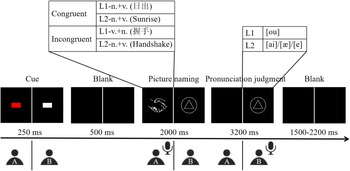
Procedure of an Example Trial from the Joint Naming (Participant A) and Listening (Participant B) Task

A separate group of participants (N = 20) who did not take part in the formal experiment, but who were from the same research population, rated their familiarity with the experimental words. The familiarity ratings were based on a 9-point scale on which “1” meant “least familiar” and “9” meant “most familiar.” A two-factor within-subject ANOVA was performed on the familiarity ratings with language (L1, L2) × morphological configuration (congruent, incongruent) as factors. There was no main effect of language (L1: M = 8.31 ± .18, L2: M = 8.29 ± .19, F(1,7) = .80, p = .402, η2 = .10) or of morphological configuration (congruent: M = 8.28 ± .20, incongruent: M = 8.32 ± .16, F(1,7) = .19, p = .68, η2 = .03). Moreover, the interaction between language and morphological configuration was not significant, F(1,7) = 2.33, p = .170, η2 = .25, suggesting that there were no differences in familiarity of morphological configuration between the languages.
2.3 Design and procedure
The study is a language (L1, L2) × switching (non-switch, switch) × morphological configuration (congruent, incongruent) within-subject design and was administered using E-Prime 2.0 Software. To create a simple interactive response for each dyad, we asked participants to perform a joint naming-listening task in which one participant (Participant A) named pictures while another (Participant B) listened and made decisions about whether these utterances contained certain sounds. Each dyad wore an EEG cap and sat in the same room to perform the task. An opaque foam board (1.5 m × 1.1 m) separated Participants A and B and divided the computer screen into two equal parts.
Prior to the formal experiment, participants familiarized themselves with each picture which appeared on a computer screen along with their L1 and L2 names. The experimenter ensured that the participants knew the name of each picture by asking them to name each one aloud. Following this, the participants started a practice experiment including 64 trials. The procedure was the same as that of the formal experiment. During the experiment, Participant A named pictures into a microphone in the L1 or L2 based on a color cue (e.g., pictures in red boxes were named in the L1 and pictures in blue boxes were named in the L2). The language-color association was counterbalanced across dyads.
Participant B performed a sound decision after hearing each word uttered by Participant A, such that they judged whether the utterances included an [ou] sound if in the L1, or [ai]/[æ]/[e] sounds if in the L2. Although the specific syllables of the two languages are different, they both reflect sound judgments. These judgments were uttered into a microphone as “是/否” (‘yes/no’) in the L1 and “yes/no” in the L2. The comprehension portion of the task did not require language non-specific categorization (i.e., animacy judgment). Because our word materials were not suitable for semantic judgment, sound judgments were used to highlight morphological configuration. The rationale for asking Participant B to provide oral responses was to eliminate potential effects caused by different response modalities (oral response vs. key response) and to elicit an interactive response that could be heard by Participant A. The response language of Participant B follows that of Participant A, and Participant B performed a language repeat or switch trial as determined by Participant B's previous trial.
The experiment consisted of 4 experimental blocks with 80 trials per block. Two of the blocks included L1 and L2 compound words with congruent morphological configuration and two blocks included L1 and L2 compounds with incongruent configuration. Each condition (L1-congruent, L1-incongruent, L2-congruent, L2-incongruent) appeared in 20 trials per block. The presentation order of the four blocks was Congruent-Congruent-Incongruent-Incongruent for half of the dyads and Incongruent-Incongruent-Congruent-Congruent for the other half. Figure 1 illustrates an example of the procedure for a single trial. Each trial started with a 250-ms-presentation of a red or blue square visible only to Participant A and a white square visible only to Participant B. After a blank screen of 500 ms, a target picture appeared for Participant A and a triangle within a circle appeared for Participant B. The geographic shape was meaningless and was included only to draw Participant B's attention to visual information and to eliminate differences in input modality between the two participants. Upon seeing the target picture, Participant A overtly named it into a microphone in the L1 or L2 according to the predetermined color cue. The picture disappeared when Participant A responded or after 2000 ms. Then Participant B made a sound judgment based on what Participant A had just uttered. The screen disappeared when Participant B responded or after 3200 ms. Finally, a blank screen randomly appeared between 1500–2200 ms before the next trial began.
2.4 Behavioral data and analyses
Behavioral data were obtained from and analyzed on naming and listening RTs and accuracy performance. We excluded from the data analyses incorrect responses (e.g., wrong target word, disfluent responses, no responses, or self-corrected responses), the first two trials of each block, and responses that were < 200 ms or beyond M ± 3 SD. The excluded data totaled 6.31% of the naming data and 12.29% of the listening task. We used R software (version 3.6) (lme4 and lmerTest package, Bates et al., Reference Bates, Maechler, Bolker and Walker2014; Kuznetsova et al., Reference Kuznetsova, Brockhoff and Christensen2017) to perform a linear mixed model for RTs and generalized linear mixed model for accuracy. We used language (L1, L2), switching (non-switch, switch), and morphological configuration (congruent, incongruent) as fixed effects and participants were added as random effects. Apart from the fixed effects, the models included participants and items as random effects (random intercepts and slopes). When the models did not converge, we removed the slope that explained the least variance until they converged. Results from the best-fitting model justified by the data are reported. We used Akaike information criteria, an indicator for the optimal model, to determine retention or omission factors. We started with a model of language switching using log naming latencies as the dependent variable and language, switching, and morphological configuration as fixed effects. The best-fitting model structure included random intercepts for participants. All fixed effect factors were two-level categorical predictors and were coded as −0.5 and 0.5. For language, L1 was coded as −0.5 and L2 as 0.5; for switching, non-switches were coded as −0.5 and switches as 0.5; for morphological configuration, the congruent condition was coded as −0.5 and the incongruent condition as 0.5. All models converged and the reported p values were corrected with Bonferroni correction.
2.5 Electrophysiological data and analyses
Electrophysiological data were recorded using a set of 64 electrodes placed according to the extended 10–20 positioning system. The signal was recorded from eemagine (ANT Neuro) at a rate of 500 Hz in reference to CPz electrode. The electrodes M1 and M2 were separately placed on the left and right mastoids. Impedances were kept below 5 kΩ. Offline processing was referenced to the average of M1 and M2. Electroencephalographic activity was filtered online within a bandpass between .1 and 100 Hz and refiltered offline with a highpass filter of .01Hz and a lowpass filter of 30Hz. The signals recorded by the peripheral electrodes were poor and were thus removed so that subsequent data analyses would not be affected by these electrodes. Finally, 40 electrodes were left after removing the peripheral electrode with more artifacts (FPz, FP1, FP2, AF3, AF4, AF7, AF8, F7, F8, FT7, FT8, T7, T8, TP7, TP8, P7, P8, PO7, PO8, Oz, O1, O2) (Liu et al., Reference Liu, Liang, Dunlap, Fan and Chen2016, Reference Liu, Xie, Zhang, Gao, Dunlap and Chen2018, Reference Liu, Zhang, Blanco-Elorrieta, He and Chen2020, Reference Liu, Li, Wang and He2021). Ocular artifact reduction was performed through Independent Component Analysis using EEGLAB (Makeig et al., Reference Makeig, Bell, Jung and Sejnowski1995). The mean number of independent components rejected was 1.55 ± 1.07 per participant. In both tasks, continuous recordings were analyzed in picture-locked −100 to 1000 ms epochs. Correspondingly, the epochs were referenced to a 100 ms pre-stimulus baseline. Signals exceeding ± 90 mV in any given epoch were automatically discarded. The mean (and SD) number of accepted epochs per condition across participants are shown in Supplementary Materials Table 5. All preprocesses were performed by EEGLAB (Brunner et al., Reference Brunner, Delorme and Makeig2013; Delorme & Makeig, Reference Delorme and Makeig2004).
ERP components were defined based on grand means and analyzed in time windows that are typically used in picture naming: locked P2 (170–220 ms), N2 (240–290 ms), LPC (450–600 ms) (Branzi et al., Reference Branzi, Martin, Abutalebi and Costa2014; Liu et al., Reference Liu, Liang, Dunlap, Fan and Chen2016; Misra et al., Reference Misra, Guo, Bobb and Kroll2012), and in sound judgments in listening tasks: locked LPC (760–950 ms) (Davis & Jerger, Reference Davis and Jerger2014). Spatially, we pre-defined frontal-parietal (sensors: F3, F1, Fz, F2, F4, FC3, FC1, FCz, FC2, FC4, C3, C1, Cz, C2, C4) regions of interest. Topographical analyses were based on mean amplitudes measured over 40 electrodes distributed over the entire scalp.
In the preprocessing stage, the time series of each dyad were aligned, and the number of trials retained between each condition was the same for each dyad. For each time window, we conducted a generalized linear mixed model using language, switching, and morphological configuration as fixed effects and participants as the random effect. We conducted simple effects follow-up analyses when main fixed effects or interaction reached significance at p < .05. In the results below, we report findings from follow-up analyses that are most relevant to our objectives. To see the results of other analyses testing all possible directions, consult in Supplementary Materials Table 6–10.
3. Results
3.1 Behavioral results
3.1.1 Reaction times: Naming
The results of the language (L1, L2) × switching (non-switch, switch) × morphological configuration (congruent, incongruent) mixed-effects models showed significant main fixed effects of the three variables. For language, there were faster RTs in the L1 (M = 865 ms ± 250) compared to the L2 (M = 999 ms ± 265), faster RTs in non-switch trials (M = 922 ms ± 261) than switch trials (M = 942 ms ± 271), and faster RTs for congruent morphological configuration (M = 908 ms ± 255) compared to incongruent morphological configuration (M = 955 ms ± 274 > congruent) (see Supplementary Materials Table 11 for full statistics).
There was a significant interaction between language and switching. Follow-up analyses revealed that in the L1, there were faster RTs in non-switch trials (M = 850 ± 238 ms) compared to switch trials (M = 880 ± 260 ms), b = −.03, SE = .007, z = −4.69, p < .001, while in the L2, this difference was not significant (switch: M = 1005 ± 267 ms; non-switch: M = 993 ± 263 ms, b = −.01, SE = .007, z = −1.91, p = .06). There was also a significant interaction between language and morphological configuration. Further analyses showed that while the difference between incongruent and congruent trials was significant in both the L1 (incongruent: M = 879 ± 259 ms > congruent: M = 851 ± 239 ms, b = −.03, SE = .006, z = −4.20, p < .001) and L2 (incongruent: M = 1032 ± 269 ms > congruent: M = 966 ± 258 ms, b = −.07, SE = .007, z = −9.77, p < .001), the congruency effect was larger in the L2 (M = −66 ms ± 79) compared to the L1 (M = −27 ms ± 75), t = 2.25, p = .032.
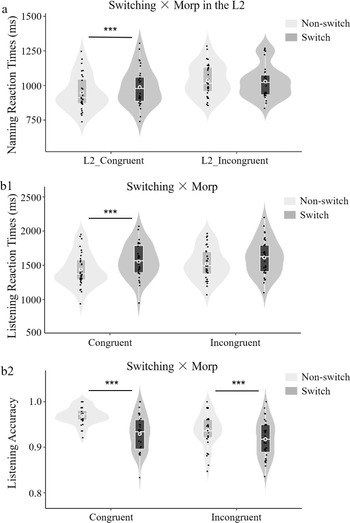
A three-way interaction of language, switching, and morphological configuration reached significance (see Figure 2a). Follow-up analyses for this three-way interaction were split by language. In the L1, we found a significant main fixed effect of switching in which non-switch trials (850 ± 238 ms) were significantly faster than switch trials (M = 880 ± 260 ms), b = .03, SE = .007, t = 4.75, p < .001, and a significant effect of morphological configuration such that congruent trials (M = 851 ± 239 ms) were faster than incongruent trials (M = 879 ± 259 ms), b = .03, SE = .007, t = 4.18, p < .001. In the L2, there was a significant effect of morphological configuration in which congruent trials (M = 966 ± 258 ms) were faster than incongruent trials (M = 1032 ± 269 ms), b = .07, SE = .006, t = 10.15, p < .001. In addition, in the L2, the interaction between switching and morphological configuration was significant, demonstrating that in congruent morphological configurations, non-switch trials (947 ± 245 ms) were faster than switch trials (M = 985 ± 269 ms), b = −.04, SE = .009, z = −3.92, p < .001, but in incongruent morphological configurations, a significant switch cost effect did not emerge (switch: M = 1025 ± 264 ms; non-switch: M = 1039 ± 273 ms, b = .01, SE = .009, z = 1.23, p = .217).
RTs (a) of Naming Split by Switch × Morphological Configuration in the L2 and RTs (b) and Accuracy (c) of Listening Split by Switch × Morphological Configuration.
Notes: White circles indicate mean values; white lines indicate medians. Box plots indicate 75% and 25% quartiles; black dots represent data distribution.
*** p < .001.

3.1.2 Reaction times: Listening
The results of the language (L1, L2) × switching (non-switch, switch) × morphological configuration (congruent, incongruent) mixed-effects models on listening RTs showed significant main fixed effects of the three variables. For language, there were faster RTs in the L1 (M = 1452 ms ± 483) compared to the L2 (M = 1617 ms ± 483), faster RTs for non-switch trials (M = 1479 ms ± 482) compared to the switch trials (M = 1587 ms ± 497), and faster RTs for congruent morphological configuration (M = 1498 ms ± 482) compared to incongruent morphological configuration (M = 1568 ms ± 480) (see Supplementary Materials Table 11 for full statistics).
There was a significant interaction between language and switching (see Figure 2b). Follow-up analyses revealed that while non-switch trials were faster than switch trials in both the L1 (non-switch trials: M = 1390 ± 446 ms; switch trials: M = 1513 ± 480 ms; b = −.13, SE = .008, z = −16.30, p < .001) and L2 (non-switch trials: M = 1571 ± 458 ms; switch trials: M = 1665 ± 503 ms, b = −.10, SE = .008, z = −12.85, p < .001), this difference was larger in the L1 (M = 116 ms ± 91) compared to the L2 (M = 94 ms ± 70). There was also a significant interaction between switching and morphological configuration. Further analyses showed that although the difference between non-switch and switch trials was significant for both congruent (switch: M = 1558 ± 501 ms > non-switch: M = 1438 ± 455 ms, b = −.08, SE = .008, z = −10.09, p < .001) and incongruent morphological configuration (switch: M = 1656 ± 481 ms > non-switch: M = 1580 ± 483 ms, b = −.05, SE = .007, z = −6.83, p < .001), this difference was larger for congruent trials (M = 117 ms ± 81) than for incongruent trials (M = 90 ms ± 76).
3.1.3 Accuracy: Naming
A similar mixed-effects model was conducted on the accuracy rates of the naming data. We found a main fixed effect of switching, such that non-switch trials were more accurate (M = .98 ± .13) than switch trials (M = .97 ± .16) (see Supplementary Materials Table 12 for full statistics). There were no other significant effects or interactions in the naming data.
3.1.4 Reaction times: Listening
For listening accuracy, the main fixed effects of language, switching, and morphological configuration were significant, such that responses in the L1 (M = .95 ± .21) were more accurate than in the L2 (M = .92 ± .27), non-switch trials (M = .95 ± .21) were more accurate than switch trials (M = .92 ± .27), and congruent morphological configuration (M = .95 ± .22) was more accurate than incongruent morphological configuration (M = .93 ± .26) (see Supplementary Materials Table 12 for full statistics). There was also an interaction between language and morphological configuration, demonstrating higher accuracy of congruent (M = .94 ± .23) compared to incongruent morphological configuration (M = .90 ± .30) in the L2, b = .69, SE = .102, z = 6.80, p < .001, but no different morphological configuration in the L1 (congruent: M = .95 ± .22, incongruent: M = .95 ± .21, b = −.04, SE = .121, z = −.31, p = .760). The interaction between switching and morphological configuration was also significant (see Figure 2c). Further analyses revealed that although accuracy was higher in non-switch trials compared to switch trials for both the congruent (non-switch: M = .97 ± .18 > switch: M = .93 ± .26, b = .83, SE = .119, z = 6.99, p < .001) and incongruent morphological configuration (non-switch: M = .94 ± .24, switch: M = .92 ± .28, b = .39, SE = .103, z = 3.79, p < .001), this effect was larger for congruent trials (Congruent-Switch cost: M = .03 ± .04 > Incongruent-Switch cost: M = .01 ± .05).
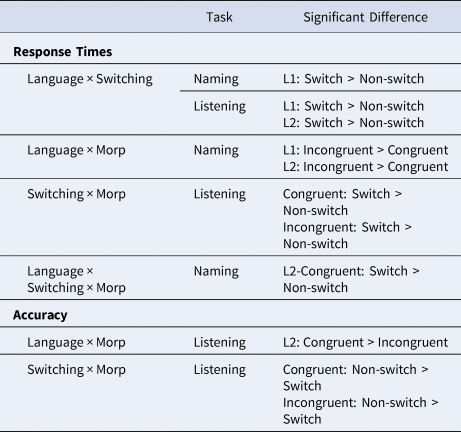
Table 1 summarizes the results of the significant interactions in the RTs and accuracy analyses from the naming and listening data.
Significant Interactions in RTs and Accuracy for Naming and Listening

3.2 Electrophysiological results
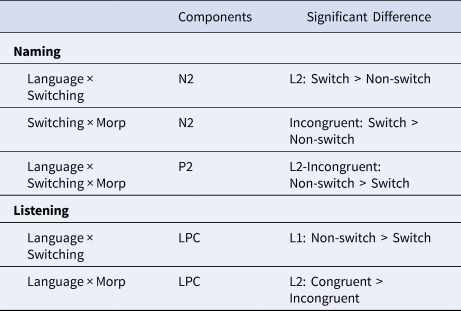
The results of the ERP analyses in the naming and listening task can be seen in Supplementary Materials Table 13 and the significant interactions can be found in Table 2.
Significant Interactions on P2, N2, and LPC Components for Naming and Listening

3.2.1 Naming
A language (L1, L2) × switching (non-switch, switch) × morphological configuration (congruent, incongruent) mixed-effects model on locked ERP components showed a significant main fixed effect of morphological configuration on P2 (incongruent: M = 4.27 ± 8.95 μV > congruent: M = 3.56 ± 8.92 μV) and on LPC (incongruent: M = 4.39 ± 12.81 μV > congruent: M = 3.62 ± 13.55 μV), but a reversed congruency effect on N2 (congruent: M = −.93 ± 10.38 μV > incongruent: M = .83 ± 10.22 μV) (see Supplementary Materials Table 13). The main fixed effect of language only occurred on N2 (L1: M = -.19 ± 10.31 μV > L2: M = .07 ± 10.38 μV) and the main fixed effect of switching only occurred on LPC as reflected by a reversed switch cost effect (non-switch: M = 4.25 ± 13.33 μV > switch: M = 3.75 ± 13.06 μV).
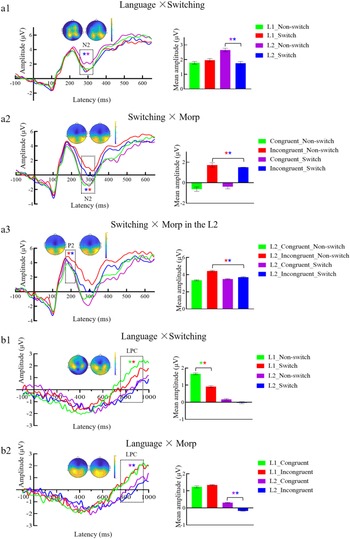
There was a significant interaction between language and switching on N2 (see Figure 3-a1) which revealed switch costs in the L2 (switch: M = −.33 ± 10.69 μV > non-switch: M = .47 ± 10.04 μV, b = .92, SE = .276, z = 3.31, p < .001), but not in the L1 (switch: M = −.04 ± 10.17 μV, non-switch: M = −.34 ± 10.44 μV, b = −.23, SE = .271, z = −.85, p = .393). Furthermore, the interaction between switching and morphological configuration also reached significance on N2 (see Figure 3-a2) reflected by switch costs in incongruent morphological configuration (switch: M = .47 ± 10.28 μV > non-switch: M = 1.18 ± 10.16 μV, b = .83, SE = .275, z = 3.03, p = .003), but not in congruent morphological configuration (switch: M = −.82 ± 10.53 μV, non-switch: M = −1.04 ± 10.23 μV, b = -.15, SE = .272, z = −.55, p = .586).
Mean Waveforms Time-Locked to the Onset of Naming (a1-a3) and Listening (b1-b2) and Topographic Distributions of Mean Amplitude for Significant Interactions.
Notes: Panels a1-a3 represent naming data; panels b1-b2 show listening data. (a1) Switching × Morp in the L2 during the 180–220 ms time frame (P2); (a2) Language × Switching and (a3) Switching × Morp during the 240–290 ms time frame (N2); (b1) Language × Switching and (b2) Language × Morp during the 640–850 ms time frame (LPC). Double asterisks that appear in the dotted boxes indicate a significant difference between the colored variables listed in the legend (e.g., the two asterisks ** in panel a1 indicate a significant difference between L2-incongruent non-switch trials and L2-incongruent switch trials). The bar graphs display mean voltages for P2, N2, and LPC in the corresponding conditions averaged across sites. Error bars show the standard error of means.

More importantly, the three-way interaction of language, switching, and morphological configuration was significant on P2 (see Figure 3-a3). Follow-up analyses for this three-way interaction were split by language. In both the L1 and L2, there was a significant main fixed effect of morphological configuration as seen in the typical congruency effect (L1-incongruent: M = 4.31 ± 9.05 μV > L1-congruent: M = 3.45 ± 9.00 μV, b = .82, SE = .260, t = 3.14, p = .002; L2-incongruent: M = 4.23 μV ± 8.84 > L2-congruent: M = 3.68 ± 8.85 μV, b = .55, SE = .256, t = 2.14, p = .033). This effect was significantly larger in the L2 (M = −.8.5 ± 4.46) compared to the L1 (M = −.38 ± 1.09), t = 9.39, p < .001. However, the P2 effect showed a significant interaction between switching and morphological configuration only in the L2 as demonstrated by reversed switch costs in incongruent morphological configuration (non-switch: M = 4.65 ± 8.44 μV > switch: M = 3.80 ± 9.21 μV, b = −1.18, SE = .512, z = −2.30, p = .022), but not in congruent morphological configuration (non-switch: M = 3.46 ± 8.96 μV, switch: M = 3.90 ± 8.74 μV, b = −.33, SE = .520, z = −.635, p = .526).
3.2.2 Listening
A similar mixed-effects model was used to analyze the listening data on locked ERP components. We found a main fixed effect of language on LPC such that the L1 elicited greater amplitude than the L2 (L1: M = 1.29 ± 6.90 μV > L2: M = .05 ± 6.44 μV), and a main fixed effect of switching in which non-switch trials (M = .91 ± 6.79 μV) elicited greater amplitude than switch trials (M = .44 ± 6.60 μV) (see Supplementary Materials Table 13). The two-way interaction between language and switching on LPC (see Figure 3-b1) indicated reversed switch costs in the L1 (non-switch: M = 1.65 ± 6.90 μV > switch: M = .92 ± 6.88 μV, b = .75, SE = .186, z = 4.03, p < .001), but not in the L2 (non-switch: M = −.15 ± 6.59 μV, switch: M = −.06 ± 6.27 μV, b = −.21, SE = .189, z = 1.11 p = .265). There was also a significant two-way interaction between language and morphological configuration on LPC (see Figure 3-b2), demonstrating a reversed congruency effect in the L2 (congruent: M = .26 ± 6.61 μV > incongruent: M = −.17 ± 6.25 μV, b = .45, SE = .189, z = 2.37, p = .018), but not in the L1 (congruent: M = 1.21 ± 6.89 μV, incongruent: M = 1.36 ± 6.90 μV, b = −.12, SE = .186, z = −.67, p = .506).
4. Discussion
To investigate the influence of morphological configuration on language switching, pairs of bilinguals performed a joint naming and listening task. The behavioral performance and electrophysiological activity revealed several significant effects and interactions. First, the effect of morphological configuration on language switching during production occurs in early (P2) and mid-stages (N2), but morphological configuration has a limited impact on language switching during comprehension. Second, control mechanisms underlying language production might suppress interference of morphological configuration via sequential processing, while bottom-up control in comprehension may mask the effect of morphological configuration in language switching contexts. Below we elaborate further on these differential effects and discuss the role of inhibition and language organization in bilingual language control.
4.1 Influence of morphological configuration on language switching during production
The P2 component has been argued to reflect effort involved in lexical retrieval (Branzi et al., Reference Branzi, Martin, Abutalebi and Costa2014; Costa et al., Reference Costa, Strijkers, Martin and Thierry2009). Our results showed that in production, the P2 effect, localized in the frontal central region, revealed a reversed switch cost in the L2 for incongruent morphological configurations. This finding suggests that bilinguals can distinguish morphological configuration across languages as early as 180 ms after stimulus onset. Models of sequential processing hold that compound words are not represented as whole words, but rather as separate morphemes that can be processing and accessed independently (Caramazza et al., Reference Caramazza, Laudanna and Romani1988; Levelt et al., Reference Levelt, Roelofs and Meyer1999; Taft & Forster, Reference Taft and Forster1975). To produce an incongruent morphological compound in the weaker L2, more cognitive resources are recruited. Consequently, such effort reduces differences between non-switch and switch trials, resulting in fairly symmetrical switch costs. Given that the P2 component may reflect detection of morphological configuration across languages, it is plausible that it emerged in incongruent, but not in congruent morphological configurations. This result is consistent with a previous study on compound word processing by Uygun and Gürel (Reference Uygun and Gürel2017) in which the researchers conducted a masked priming task to explore English noun-noun compound processing by L1-Turkish-speaking learners of English (advanced and intermediate-level learners) and by L1 speakers of English. The results showed that both constituents (i.e., the first and second words that make up a compound) acted as primes for the English speakers and advanced-level learners, while in intermediate learners, only the first constituent promoted lexical access. These findings suggest that compound words are decomposed and affected by proficiency, such that the higher the proficiency, the more obvious the decomposition. In addition, some researchers have explored morphological decomposition effects by manipulating the transparency of morphemes. Semantic transparency refers to the extent to which the semantics of compound words are predicted by their combined meanings (Badecker, Reference Badecker2001; Lorenz et al., Reference Lorenz, Zwitserlood, Bürki, Regel, Ouyang and Rahman2021). Research shows that morphemes are more likely to be decomposed and integrated when processing transparent compound words (Isel et al., Reference Isel, Gunter and Friederici2003; MacGregor et al., Reference MacGregor, Pulvermüller, Van Casteren and Shtyrov2012; MacGregor & Shtyrov, Reference MacGregor and Shtyrov2013). It appears that compound words are not stored and accessed as whole units, but instead, can be decomposed and accessed separately. This said, other factors such as L2 proficiency and the relative transparency of compound words may affect these processes.
In contrast, in L2 congruent morphological configuration, our results showed typical switch costs, which is consistent with previous findings that switch trials elicit slower and less accurate responses compared to non-switch trials. (Costa & Santesteban, Reference Costa and Santesteban2004; Declerck et al., Reference Declerck, Koch and Philipp2015; Finkbeiner et al., Reference Finkbeiner, Almeida, Janssen and Caramazza2006; Kang et al., Reference Kang, Ma, Li, Kroll and Guo2020; Liu et al., Reference Liu, Liang, Dunlap, Fan and Chen2016, Reference Liu, Xie, Zhang, Gao, Dunlap and Chen2018; Ma et al., Reference Ma, Li and Guo2016; Meuter & Allport, Reference Meuter and Allport1999; Rogers & Monsell, Reference Rogers and Monsell1995; Schwieter & Sunderman, Reference Schwieter and Sunderman2008). These switch costs reflect cross-language interference when switching from one language to the other (see the Inhibitory Control Model [ICM], Green, Reference Green1998). Moreover, these results align with previous results reported by Contreras-Saavedra et al. (Reference Contreras-Saavedra, Willmes, Koch, Schuch, Benini and Philipp2020, Reference Contreras-Saavedra, Willmes, Koch, Schuch and Philipp2021), who found that switch costs occurred with composition-rule repetitions, but not with composition-rule switches. The researchers argued that this finding reflects an interaction between morpheme morphology and language schema. The results of the three-way interaction can distinguish language factors, underscoring the interaction between morphological configuration and language control. At the same time the particularly noteworthy things are that they manipulate congruency on a trial-by-trial basis, but the consistency effect also appears in our block design, which indicates the robustness of the influence of morphological configuration on language switching. However, the behavioral results demonstrated that there were asymmetric switch costs in the L1 but not in the L2. Interestingly, as mentioned above, with the addition of morphological configuration, switch costs appear in L2 congruent morphological configuration trials. This may be because the sequential processing of morphological configuration makes it more difficult for weaker languages to process compound words, while processing compound words in an L2 may reflect automatic parallel processing. Another issue to consider is that we did not find a reversed language dominance effect (sometimes also called L1 slowing) in which proactive L1 inhibition led to less interference in the L2 under mixed language conditions (Declerck & Koch, Reference Declerck and Koch2022; Gade et al., Reference Gade, Declerck, Philipp, Rey-Mermet and Koch2021a, Reference Gade, Declerck, Philipp, Rey-Mermet and Koch2021b). This may be because unbalanced Chinese–English bilinguals process L1 compounds faster, which is inconsistent with the results of language switching found in studies using simple (i.e., non-compound) words.
In the mid-time course of naming pictures, the N2 effect revealed typical switch costs in the L2, but not in L1, during the language selection stage. According to the ICM (Green, Reference Green1998), this reflects the fact that switching into a weaker L2 implicates the need to suppress the stronger L1. In addition, the N2 component has been associated with inhibitory control during production tasks involving language switching (Jackson et al., Reference Jackson, Swainson, Cunnington and Jackson2001; Jiao et al., Reference Jiao, Liu, de Bruin and Chen2020; Kang et al., Reference Kang, Ma, Li, Kroll and Guo2020; Liu et al., Reference Liu, Liang, Dunlap, Fan and Chen2016; Martin et al., Reference Martin, Strijkers, Santesteban, Escera, Hartsuiker and Costa2013; Verhoef et al., Reference Verhoef, Roelofs and Chwilla2009, Reference Verhoef, Roelofs and Chwilla2010). Our results reinforced this cognitive function of the N2 effect which revealed stronger interference suppression of the non-target language in switch trials compared to non-switch trials. Crucially, the N2 effect showed typical switch costs in incongruent but not congruent morphological configurations. This again might indicate that due to sequential processing of morphological configuration, competition from cross-language incongruent morphological configuration may influence language switching. In addition, the adaptive control model (Green & Abutalebi, Reference Green and Abutalebi2013) proposes that dual language contexts require more resources including goal maintenance and inhibitory control. The P2 component may reflect the process of goal maintenance, which may be at the level of the language task schema itself, or at the level of specific lexical or syntactic competitors. Goal maintenance requires processes that suppress interference through inhibitory control, an effect that can be observed in the N2 component.
4.2 Influence of morphological configuration on language switching during comprehension
The findings from the comprehension data showed more pronounced LPC effects and a reversed congruency effect in the L2. Previous evidence indicates that the LPC may reflect semantic processing (Sanquist et al., Reference Sanquist, Rohrbaugh, Syndulko and Lindsley1980), and more positive LPCs for words with many senses likely indicate an easier retrieval process of word meaning (Huang & Lee, Reference Huang and Lee2018). In a similar vein, with respect to morphological configuration, when the two morphemes in a compound word are congruent between the two languages, it will be easier to retrieve compared to incongruent ones. Moreover, the behavioral results showed higher accuracy rates in L2 congruent morphological configurations than incongruent morphological configurations. This further suggests that incongruent morphological configuration is processed sequentially which appears to be different from congruent morphological configurations. The results also showed reversed L1 switch costs on the LPC, which might reflect easier lexical access in non-switch trials relative to switch trials. We found switch costs in RTs for both the L1 and L2. Furthermore, we observed switch costs in RTs and accuracy in congruent and incongruent morphological configurations, although this effect was not supported in the ERP results.
Why does morphological configuration appear to be sensitive to modality (i.e., production versus comprehension)? The answer may lie in the distinct control pathways between comprehension and production. According to the BIA-d (Grainger et al., Reference Grainger, Midgley and Holcomb2010), language control in bilingual production endogenously activates corresponding language nodes of the target language and inhibits nontarget language representations. Contrarily, comprehension exhibits exogenous control driven by stimuli, which automatically activates the target language node and inhibits nontarget language representations. And the Bilingual Language Interaction Network for Comprehension of Speech (BLINCS) model suggests that cross-language activation during comprehension tasks results from bottom-up, sub-lexical perceptual competition in phonological input between the two languages (Shook & Marian, Reference Shook and Marian2013). In our results, language control in production recruited inhibitory control, as indicated by the N2 effect, while in comprehension, language control was less pronounced as implied by the lack of significant ERP switch costs. Thus, we believe that the sequential processing of morphological configuration does not play a role in comprehension due to the bottom-up, automatic activation of language as triggered by stimuli.
4.3. The roles of inhibition and language organization in language control among bilinguals
Some researchers have suggested that language organization may play an important role in language control. Blanco-Elorrieta and Caramazza (Reference Blanco-Elorrieta and Caramazza2022) put forward a theory of bilingual language organization, which holds that monolingual and bilingual language systems operate under identical principles. The theory assumes a common principle for selection of elements across all linguistic levels (e.g., phonology, morphology, syntax, lexical, and semantics). This selection mechanism is responsible for identifying the element with the highest level of activation, monitoring it during retrieval, and filtering out information that does not align with situational needs. Language switching brings the additional challenge of (re)activating elements that have recently been used, which can result in language switch costs.
In our study, when naming pictures in the L2, we found a significant interaction between switching and morphological configuration which demonstrated a switch cost for congruent but not for incongruent trials. It appears that our results cannot be explained by a language organization account which holds that semantic features with corresponding grammatical expressions will receive activation directly from the conceptual level. While morphosyntactic networks (and subnetworks within) are shared across languages, purely intrinsic grammatical features will automatically receive activation from the lexical level. From the initial stages of language production, as shown by the P2 effect, bilinguals detected morphological configuration between the two languages, which required quickly extracting the opposing morphological configuration. Since the P2 component reflects more effort devoted to continuously retrieving words with specific grammatical features, the reversed switch cost in the L2 incongruent morphological configuration on P2 indicates that bilinguals fail to immediately retrieve the grammatical form of the target word to use in production. These P2 results do not align with a theory of language organization mentioned above, but rather demonstrates evidence of parallel activation at each level and that shared semantic features across languages can enable bilinguals to quickly identify morphological features across languages.
We found switch costs in the incongruent morphological configuration on the N2 component, a classic index of inhibitory control (Jackson et al., Reference Jackson, Swainson, Cunnington and Jackson2001; Jiao et al., Reference Jiao, Liu, de Bruin and Chen2020; Kang et al., Reference Kang, Ma, Li, Kroll and Guo2020; Liu et al., Reference Liu, Liang, Dunlap, Fan and Chen2016; Martin et al., Reference Martin, Strijkers, Santesteban, Escera, Hartsuiker and Costa2013; Verhoef et al., Reference Verhoef, Roelofs and Chwilla2009, Reference Verhoef, Roelofs and Chwilla2010). Sequential processing of morphological configuration resulted in suppression of cross-language interference. This finding implies that in speech production, bilinguals may first detect the target morphological configuration in which sequential processing of morphological configuration on language switching recruits inhibitory control to suppress the non-target language.
5. Conclusion
The results from our study demonstrate that morphological configuration has differential effects on language production and comprehension which may be due to nature of the use of language control in the two domains. Particularly for speech production, we found support for a combination of sequential processing and inhibition of morphological levels to control cross- language interference. To our knowledge, this is the first study to offer novel and important electrophysiological evidence demonstrating that morphological configuration affects language control processes in a language switching context. Overall, these findings are useful in understanding the relationship between words in different languages and how bilinguals are able to smoothly switch between their two language systems. The findings also underscore the independent and interdependent nature of languages as systems of various modules.
Supplementary Material
The supplementary material for this article can be found at https://doi.org/10.1017/S1366728923000330
Availability of Data and Materials
The datasets generated and analyzed in this study are available in the OSF repository: Liu, H. (2022, April 29). “The influence of morphological configuration on language switching.” Retrieved from https://accounts.osf.io/login(osf.io/469cb).
Acknowledgements
This research was supported by Grants from Youth Foundation of Social Science and Humanity, China Ministry of Education (21YJC190009), Youth Project of Liaoning Provincial Department of Education (LJKQZ2021089), Dalian Science and Technology Star Fund of China (2020RQ055), Liaoning Social Science Planning Fund of China (L20AYY001), Research Project on Economic and Social Development of Liaoning Province (2023lslqnkt-054), and Liaoning Educational Science Planning Project (JG21DB306).
Conflict of Interest
We have no known conflict of interest to disclose.