1. Introduction
Communicating in a second language requires the acquisition and use of linguistic structures that differ from one's native language. The degree to which a bilingual's two languages share commonalities along various linguistic dimensions (e.g., phonotactic, lexical, syntactic, etc.) impacts their ability to learn, produce, and comprehend a second language. While it is widely accepted that knowledge of one language inevitably influences the other, the underlying functional organization of bilingualism and the mechanisms underlying crosslinguistic effects are still largely unknown. The current study focuses on how auditory word recognition in a second language (in early and highly proficient Spanish–Basque (L1-L2) bilinguals) is influenced by crosslinguistic phonological-lexical overlap of words that share meaning (translation equivalents). In addition, we test whether semantic priming modulates these effects.
The potential crosstalk between languages has been examined using various theoretical, computational, and experimental approaches that test how different factors affect bilingual lexical access. One common experimental manipulation – cognate status – probes crosslinguistic lexical interactions by exploiting the orthographic-phonological form overlap of a word and its translation equivalent. Words that overlap in orthographic-phonological form across two languages and that share meaning, (such as the Spanish-English cognate pair Tren-Train), often produce facilitatory effects on the speed of visual word recognition, translation, naming, and word retrieval, when compared to Non-Cognates such as Mesa-Table (Caramazza & Brones, Reference Caramazza and Brones1979; Costa, Caramazza & Sebastian-Galles, Reference Costa, Caramazza and Sebastian-Galles2000; Lemhöfer & Dijkstra, Reference Lemhöfer and Dijkstra2004; Perea, Duñabeitia & Carreiras, Reference Perea, Duñabeitia and Carreiras2008; Sheng, Lam, Cruz & Fulton, Reference Sheng, Lam, Cruz and Fulton2016; van Hell & de Groot, Reference van Hell and de Groot2008; van Hell & Dijkstra, Reference van Hell and Dijkstra2002). Effects of cognate status based on purely phonological overlap have also been observed, revealing facilitation of visual word recognition in language pairs with different scripts (Gollan, Forster & Frost, Reference Gollan, Forster and Frost1997).
Interestingly, in addition to facilitation effects, null or even inhibitory cognate effects can emerge when cognate type (identical vs. semi/partial, see Dijkstra & van Heuven, Reference Dijkstra and van Heuven2002; Duyck, Van Assche, Drieghe & Hartsuiker, Reference Duyck, Van Assche, Drieghe and Hartsuiker2007), list composition (Poort & Rodd, Reference Poort and Rodd2017), language context and semantic context (Dijkstra, van Hell & Brenders, Reference Dijkstra, van Hell and Brenders2015), task (lexical decision vs. language decision, see Bultena, Dijkstra & van Hell, Reference Bultena, Dijkstra and van Hell2014), proficiency (Bultena et al., Reference Bultena, Dijkstra and van Hell2014, Blumenfeld, Bobb & Marian, Reference Blumenfeld, Bobb and Marian2016), and other linguistic characteristics (e.g., frequency, Peeters, Dijkstra & Grainger, Reference Peeters, Dijkstra and Grainger2013) are manipulated. The cognate facilitation effect itself has played a pivotal role in shaping models of bilingualism, but it is the factors modulating its effect (and the effect of other crosslinguistic manipulations) on lexical access that can clarify the more nuanced architectural differences among models.
The extensive literature examining the dynamics of bilingual and second language lexical access using cognate manipulations has mostly been focused on visual word recognition. In contrast, crosslinguistic effects on the lexical dynamics of bilingual and second language auditory word recognition are relatively understudied, despite the fact that language is primarily auditory in nature. Auditory word recognition depends on information that is 1) delivered over time, 2) inherently variable, and 3) susceptible to many common natural listening situations that degrade the quality of the signal, such as environmental noise. Native language comprehension is flexible enough to be relatively resilient to such signal degradations. Notably, second language auditory word recognition is impaired to a greater degree by noise as compared to native language word recognition, despite comparable performance in quiet listening conditions (Shi, Reference Shi2012; Reference Shi2014; Tabri, Chacra & Pring, Reference Tabri, Chacra and Pring2015; Scharenborg and van Os, Reference Scharenborg and van Os2019). Nevertheless, bilinguals with high levels of L2 language proficiency (Schmidtke, Reference Schmidtke2016; Scharenborg and van Os, Reference Scharenborg and van Os2019; Shi, Reference Shi2014, Reference Shi2015) and early age of acquisition (Kousaie, Baum, Phillips, Gracco, Titone, Chen & Chai, Reference Kousaie, Baum, Phillips, Gracco, Titone, Chen, Chai and Klein2019; Reetzke, Lam, Xie, Sheng & Chandrasekaran, Reference Reetzke, Lam, Xie, Sheng and Chandrasekaran2016) do not seem to be hindered by noise (although see Tabri et al., Reference Tabri, Chacra and Pring2015, who show noise-induced impairments even for highly proficient bi- and trilinguals).
Detrimental effects of noise during native word recognition are mitigated by the availability of contextually predictive sources of information that constrain lexical selection (e.g., semantic context, visual-articulatory context; Kalikow, Stevens & Elliott, Reference Kalikow, Stevens and Elliott1977; Sumby & Pollack, Reference Sumby and Pollack1954). In contrast, second language processing does not seem to benefit as much from such perceptual flexibility (Golestani, Rosen & Scott, Reference Golestani, Rosen and Scott2009; Hervais-Adelman, Pefkou & Golestani, Reference Hervais-Adelman, Pefkou and Golestani2014), unless the listeners are proficient bilinguals (e.g., Kousaie et al., Reference Kousaie, Baum, Phillips, Gracco, Titone, Chen, Chai and Klein2019). Based on a study that found similar phoneme identification drops in performance for L2 compared to L1 listeners across increasing levels of noise (Cutler, Weber, Smits & Cooper, Reference Cutler, Weber, Smits and Cooper2004), Cutler (Reference Cutler2005) suggested that the L2 challenge in noise is due to inflexibility of the L2 system due to an inability to make use of contextual information (e.g., transitional probabilities, vocabulary, etc.). Individual differences in the strength of the interactions among distinct hierarchically organized levels of processing (Kroll, van Hell, Tokowicz & Green, Reference Kroll, van Hell, Tokowicz and Green2010) may affect the ability to integrate across information sources, impacting the perceptual mapping of the speech signal onto a lexical target. Indeed, the non-native listening deficit in noise does seem to be restricted to linguistic stimuli (Krizman, Bradlow, Lam & Kraus, Reference Krizman, Bradlow, Lam and Kraus2017), which supports an impairment in the facilitatory interactions among different levels of linguistic processing rather than a general perceptual deficit. Whether these hierarchical interactions in perception that seem to be critical for facilitating comprehension under adverse listening conditions are affected by crosslinguistic phonological interactions is not known.
Taken together, the existing research on second language word recognition (both auditory and visual), in combination with research on speech perception/word recognition in noise (for both native and second language), suggests that accurate auditory word recognition in proficient bilinguals will be subject to effects of crosslinguistic phonological-lexical (“lateral”) interactions, as well as cross-level lexical-semantic (“hierarchical”) interactions. The goal of the current study is to further elucidate the functional organization of spoken language processing of a second language. Specifically, we examine how the interplay between crosslinguistic phono-lexical lateral and lexical-semantic hierarchical interactions may impact auditory word recognition, under different listening conditions. To this end, two lexical decision experiments investigate effects of semantic priming, crosslinguistic phonological-lexical overlap, and their interplay in noisy (speech in speech babble, Experiment 1) and clear (Experiment 2) listening conditions, in a population of early/proficient balanced Spanish–Basque bilinguals. Listeners heard either a noisy or clear target and were asked to press one button if it was a word and another button if it was not a word. In both experiments, each target was preceded by a within-language prime, which was either semantically related or unrelated to the target word.
Because noisy targets (Experiment 1) entail high phonological uncertainty that negatively impacts lexical access, word recognition accuracy may be impaired. Accordingly, the conditions of Experiment 1 should produce robust semantic priming effects on second language word recognition accuracy (and processing speed). The conditions should also promote crosslinguistic interactions grounded in the phonological relationship between L2 word targets and their translation equivalents, which may be magnified by the uncertainty introduced by a noisy signal (as has been found for other within-language phonological manipulations), affecting word recognition accuracy.
To our knowledge, only one auditory word recognition study has manipulated the cognate status (phonological-lexical overlap) of a target together with semantic priming (Temnikova & Nagel, Reference Temnikova and Nagel2015). The subjects were Russian–English bilinguals with either intermediate (Experiment 1) or high levels (Experiment 2) of L2 proficiency. The study employed a cross-language semantic priming paradigm conducted in quiet listening conditions, and found inhibitory effects (slower response times) for phonological cognates. There was also a significant facilitation effect of semantic priming on word recognition (faster response times). No interaction between semantic priming and cognate status was found, regardless of the listeners’ proficiency level.
Based on those results, we expect to find effects of semantic priming and phonological cognate status in both experiments of the current study. The noisy conditions in Experiment 1 should impair word recognition accuracy, and semantic priming effects should therefore boost accuracy. In the clear listening conditions of Experiment 2, word recognition accuracy should be high, but processing speed may still be affected by semantic priming, producing faster response times. We also expect effects of phonological cognate status in both experiments. However, whether this crosslinguistic manipulation will result in inhibition or facilitation is not obvious: The one previous auditory study – which also manipulated semantic priming (Temnikova & Nagel, Reference Temnikova and Nagel2015) – showed a cost for cognates, whereas most other (visual) studies found facilitation. Of particular interest in the current study is whether noisy listening conditions will induce an interaction between the two factors during auditory word recognition: Will cascading effects of noise, reliance on semantic context, and crosslinguistic interactions have an interdependent influence on the dynamics of lexical access?
The two languages spoken by our subjects – Spanish and Basque – have highly overlapping phonologies but belong to different language families (Indo-European and Pre-IndoEuropean, respectively). As a result, many words and their translation equivalents are phonologically distinct (e.g., silla, aulki (chair); Non-Cognates), but there are also many words that overlap in their phonological-lexical form (e.g., flor, lore (flower); Cognates). The Spanish–Basque language pair thus provides an ideal bilingual (L1-L2) system for revealing potential crosslinguistic effects of phonological-lexical interaction via semantics because it minimizes any influence of language-specific acoustic properties of speech sounds (that may be more common in other language pairs). According to some models (see Thomas & van Heuven, Reference Thomas and van Heuven2005; van Heuven, Reference van Heuven2005), these could introduce a potentially conflating factor that distinguishes the lexical items in one language vs. those in the other, biasing the activation of the target language. The degree to which acoustic-phonetic information is shared across languages has been shown to affect parallel language activation (Ju and Luce, 2004). In noise, such confounds could be exacerbated due to the degraded speech input.
Beyond recognition (long-term repetition effects)
In addition to assessing immediate semantic and phonological effects on word recognition, each experiment also includes a final lexical decision test to probe long-term repetition priming of target stimuli. This test is intended to provide insight into the information that was activated during the initial presentation under the assumption that it will be re-activated more easily upon second presentation (e.g., Bowers, Reference Bowers2000). In this final test, listeners hear items that were previously presented in the first lexical decision task, as well as new items. Higher accuracy for the previously heard items is thought to reflect the item's level of activation during the initial lexical decision task. If phonological cognates activate the lexical form of the non-target language (either directly or indirectly through semantics), and if activation can be enhanced through crosslinguistic lexical (or phonological-semantic) resonance (Dijkstra, Reference Dijkstra2007; Dijkstra & van Heuven, Reference Dijkstra and van Heuven2002; Dijkstra, Wahl, Buytenhuijs, Van Halem, Al-Jibouri, De Korte & Rekké, Reference Dijkstra, Wahl, Buytenhuijs, Van Halem, Al-Jibouri, De Korte and Rekké2018; Shook & Marian, Reference Shook and Marian2013), we should find a word recognition repetition effect that is greater for cognate items on the final lexical decision test.
2. Experiment 1
Noisy listening conditions challenge word recognition, especially when listening in a non-native language. Contextual information, such as a semantic prime, can help to resolve ambiguities in mapping the acoustic signal onto lexical representations, particularly under adverse listening conditions. Experiment 1 investigates the effect of semantic priming on recognition of L2 word targets that are presented in noise (speech-babble). Importantly, the L2 targets presented differ in the degree to which they share phonological-lexical overlap with (unpresented) native language translation equivalents (Non-Cognates, Partial-Cognates, or Identical-Cognates).
Although some studies indicate that the use of context is impaired in non-native listening, the few studies that have tested highly proficient bilinguals have shown successful facilitation (e.g., Kousaie et al., Reference Kousaie, Baum, Phillips, Gracco, Titone, Chen, Chai and Klein2019). Given the high proficiency level of the Spanish–Basque bilinguals tested in the current study, we predict significant effects of semantic priming on word recognition accuracy. In addition, we predict significant effects of phonological-lexical overlap on word recognition performance. The existing literature does not indicate whether semantic priming (in noise) will interact with any crosslinguistic effects induced by the L2 target's phonological-lexical overlap with its L1 equivalent.
2.1. Methods
Participants
20 (L1-L2) Spanish–Basque bilinguals participated (13 females; mean age = 23.1, SD = 2.8; mean age of Basque acquisition = 3.4, SD = 1.2; mean BEST picture-naming scoreFootnote 1 in Basque (de Bruin, Carreiras & Duñabeitia, Reference de Bruin, Carreiras and Duñabeitia2017) = 54.8, SD = 5.1 (scale 0–65). To better understand the profile of the bilinguals in the current study, and the potential generalizability of the results, we provide additional information about percentages of self-assessed language exposure and proficiency taken from the BCBL database (Participa) including mean % L1 (Spanish) Exposure = 59, SD = 10, Speaking = 65, SD = 16, Hearing = 59, SD = 12, Reading = 60, SD = 20, %L2 (Basque) Exposure = 31, SD = 11, Speaking = 28, SD = 16, Hearing = 32, SD = 13, Reading = 29, SD = 18, % Bilingual Language Context = 44, SD = 22, and Interview Mark in Basque assessed by research assistant (max score 5) = 4.35, SD = 0.49. Two participants were removed for not following instructions, along with one who did not reach a minimum overall performance of 50%. One of the remaining 17 participants did not complete the long-term priming test and is therefore not included in those analyses.
Procedure
Participants performed a 2AFC (two alternative forced-choice) lexical decision task (LDT). The word/pseudoword responses were collected via two designated buttons. Participants listened to pairs of auditory stimuli (ISI = 300 ms) consisting of a Basque word (the prime) followed by a Basque word or pseudoword (the target) presented in noise. Participants were instructed to press one button if the target was a word and another button if the target was a pseudoword. Participants were instructed to respond as quickly and as accurately as possible. A delay of 4 seconds from target onset was allotted before the next trial. Participants were given six practice trials prior to the start of the experiment.
After the experimental session, participants completed a language questionnaire before continuing with a long-term priming lexical decision test. With this long-term priming test, we assessed the degree to which semantic priming and crosslinguistic effects on word recognition accuracy persisted and affected subsequent word recognition accuracy by presenting old and new items. On each trial, participants listened to an (unprimed) item in noise that was a Basque word or pseudoword, and made another 2AFC lexical decision.
Stimulus presentation for the semantic priming task and for the long-term priming task was controlled using PsychoPy 1.38 (Peirce, 2007). The experiment was approved by the BCBL Ethics Review Board and complied with the guidelines of the Declaration of Helsinki. Participants provided written consent and were paid for their participation.
Stimuli
320 Basque words were selected, including 160 Basque-Spanish Cognates and 160 Non-Cognates, to be used in both Experiment 1 and Experiment 2. In the main (first) lexical decision experiment, each participant heard 160 pseudowords and 160 words as targets, for a total of 320 trials; half of the words were Non-Cognates (80) and half were Cognates (80). The primes were in Basque (within-language), and were always presented in the clear. Primes were Non-Cognates that were not included in the Non-Cognate Target condition; they were either semantically related or unrelated to the (word) targets. To ensure there were no item differences contributing to the relatedness effect, targets were counterbalanced across the related and unrelated conditions, across participants.
In the long-term priming test, participants heard all of the noisy targets (words and pseudowords) from the semantic priming paradigm again (this time without the prime); these were the 320 Old targets that were mixed with the speech babble noise, as before. There were 320 New targets (also presented in noise), comprised of 160 words and 160 pseudowords, for a total of 640 trials. Thus, half the stimuli presented in the long-term priming task were Old targets (from the previous lexical decision task) and half were New targets. Half of the Old words were Cognates, and half were Non-Cognates (that had previously appeared in either the Related or Unrelated condition). As was the case for the Old targets, half of the New targets were pseudowords and half were words. Old and New targets were counterbalanced across conditions across participants. The semantically related primes were designed by a native-Basque speaking research assistant. LSA (Latent Semantic Association) scores were measured from English translations available through lsa.colorado.edu (using the default topic space on the LSA website built from a corpus, “General_Reading_up_to_1st_year_college (300 factors)”) to ensure there was no significant difference between Cognate conditions. Unrelated primes were chosen by randomizing the Related primes. Targets were counterbalanced across participants, appearing both in the Related and Unrelated conditions. All of the stimuli were in Basque. The instructions were given to participants in Basque, by native Basque speakers.
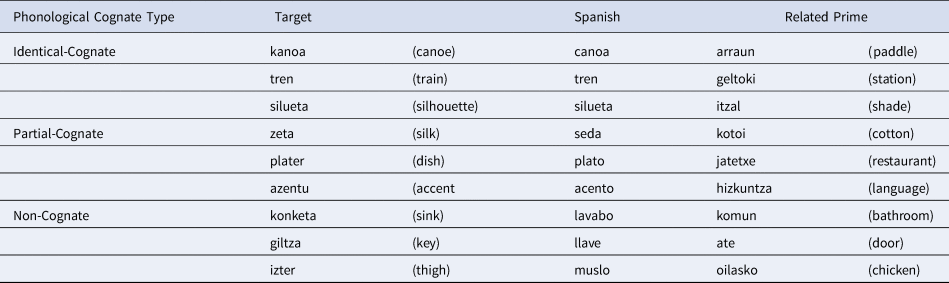
Critically, the Basque targets consisted of words that varied in the degree to which they overlapped in phonological form with their Spanish translation equivalent (words taken from BCBL database, see Duñabeitia, Casaponsa, Dimitropoulou, Martí, Larraza & Carreiras, Reference Duñabeitia, Casaponsa, Dimitropoulou, Martí, Larraza and Carreirasin preparation). A phonological cognate score was calculated using a Levenshtein distance (corrected for length) based on the number of shared phonemes between a stimulus and its translation equivalent. Phonological Cognate Targets were defined as those words that share at least 50% phonological overlap with their translation equivalentsFootnote 2. Cognates were subdivided post-hoc into two additional categories: 100% for Identical-Cognates; > 50% < 100% for Partial-Cognates. Non-Cognate Targets shared less than 50% phonological overlap with their translation equivalents.
Target word stimulus characteristics (frequency, age of acquisition, concreteness, or phonological neighborhood density (for those word targets that had measures available, > 90% of stimuli)) did not significantly differ across conditions (see Table 1 for examples and Supplementary Materials for the full set, Supplementary Materials). However, the durations of the target sound files did significantly differ between the Cognate (mean = 1065 ms, SD = 139) and the Non-Cognate (mean = 981 ms, SD = 119) conditions. Therefore, target duration was included as a covariate in the analyses.
Example Stimuli and Related Primes. For full stimulus set, see Supplementary Materials. The English translation is provided in parentheses.

Noise Mixing Method
Targets were mixed with reversed Basque 6-talker speech babbleFootnote 3 at a signal-to-noise ratio of −5dB. Unique segments of babble noise were used for each word target and each pseudoword target for a given participant, using a preceding and following linear ramp-up and ramp-down of 50 ms of noise (thus noisy target duration was 100 ms longer than clear target duration, but the word or pseudoword duration was the same).
2.2. Results
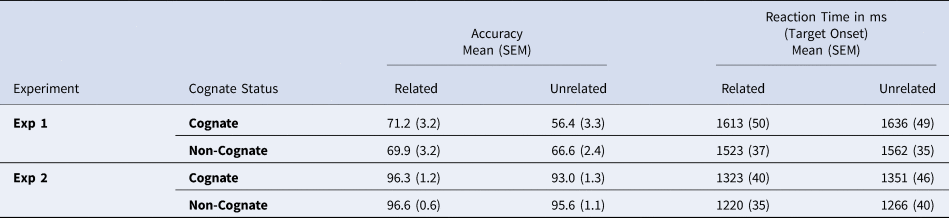
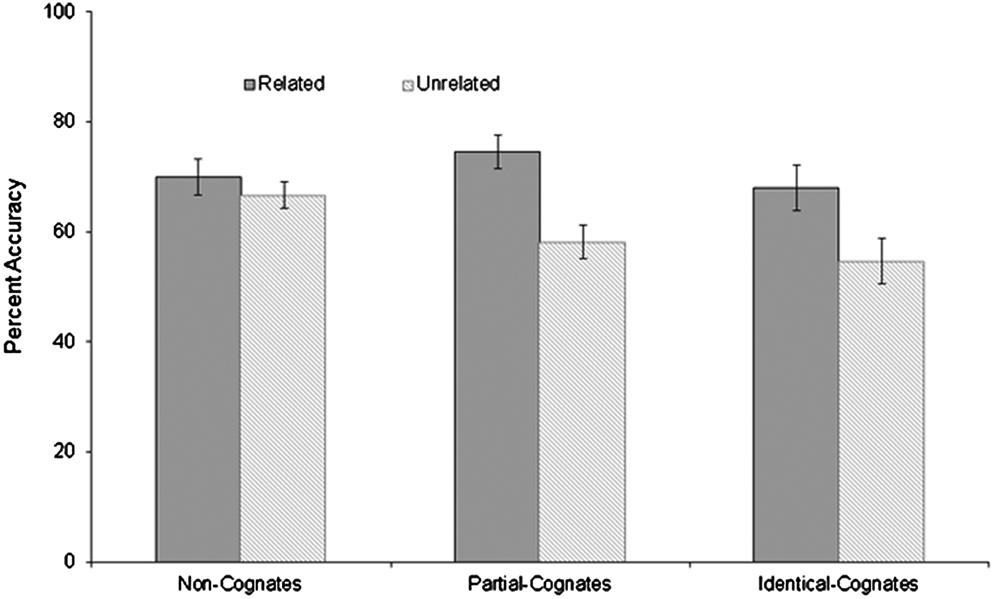
Table 2 presents the average accuracies and reaction times (RTs) for the factorial crossing of target type (i.e., Cognate Status) with prime relatedness. Outliers (RTs > 2 standard deviations from the mean, calculated for each participant individually), and trials with no response, were removed. In Experiment 1, we focus on accuracy because the babble noise brought word recognition down well below ceiling performance, as desired. Figure 1 displays the accuracy results. Performance on Cognates was worse than Non-Cognates when preceded by an Unrelated Prime but similar to Non-Cognates when preceded by a semantically Related prime. As Figure 1 shows, when the cognate stimuli are subdivided into two types (partial and identical), this pattern holds for both types.
Lexical decision word recognition average accuracy and average reaction times for correct Responses for Non-Cognate and Cognate Targets in Related and Unrelated semantic prime conditions for Experiments 1 and 2. Standard errors of the mean over subjects are in parentheses.

Percentage of correctly recognized words on lexical decision for different types of cognates in a Related (Solid Gray) compared to Unrelated (Striped Gray) semantic prime condition.

We conducted two analyses using generalized linear mixed effects models (implemented in R with glmer in the lme4 package) with accuracy (single trial data) as the dependent measure; participant and item were included as random factors. The first analysis contained a contrast effect code for Relatedness (1,−1) and Cognate Status (1, −1). Because Dijkstra and van Heuven (Reference Dijkstra and van Heuven2002) suggested potential differences between cognates with 100% lexical form overlap (identity cognates) and partial cognates, and the cognate list consisted of approximately half of each type of cognate, we conducted a second analysis in which Cognate Type was divided into two (finer-grained) contrast effect codes: Cognate Type Contrast 1 (Partial-Cognate 1, Non-Cognate −1) and Cognate Type 2 Contrast (Identical-Cognate 1, Non-Cognate −1).
When including Target Duration as a covariate in the model, the best fitting converging model justified by the data included the interaction between the two fixed effects, and the by-subject and by-item intercepts. Both analyses revealed a main effect of Relatedness, z > 5.30, p < .001, indicating that semantic priming facilitates comprehension in second language word recognition accuracy in babble noise. In the first analysis, we observed a significant effect of Cognate Status, z = −3.09, p = .002, as well as an interaction between Relatedness and Cognate status, z = 2.38, p = .02, demonstrating that semantic priming modulates crosslinguistic competition effects for cognates (see Table A in the Supplementary Materials for more details). In the finer-grained analysis, the main effect of Cognate Type for the Identical-Cognates vs. Non-Cognates contrast was significant, z = −2.39, p = .02. Including the interaction between Type Of Cognate and Relatedness significantly improved the model fit. However, the interaction of Partial-Cognates vs. Non-Cognate and Relatedness did not reach significance, z = 1.64, p = .1.
Long-term priming results
Table 3 presents the accuracy scores. The best fitting converging model using contrast effect codes for OldNew (New 1, Old −1) and for CognateStatus (Cognate 1, Non-Cognate −1) showed a significant effect of Old vs. New words, z = −3.42, p < .001, and of Cognate Status, z = −2.6, p = .01, and a significant interaction between these factors, p = .02. Thus, prior exposure increased later recognition accuracy, but only for the Cognates, p < .001.
Lexical decision word recognition average accuracy (Experiment 1) and reaction times (Target Onset) for correct Responses (Experiment 2) for New stimuli and for Old stimuli. “Related” and “Unrelated” refer to the prime that had been presented during the initial task (no primes were presented during the long term priming task). Standard errors of the mean over subjects are in parentheses.

Given the interaction between OldNew and Cognate status, separate analyses were conducted on New and Old words. For the analysis on the Old items, contrast effect codes were used for Relatedness (Related 1, Unrelated −1). For Old items, neither the main effect of Relatedness nor the interaction between Relatedness and Cognate Status reached significance p > .1, and the main effect of Cognate Status only showed a trend, z = −1.74, p = .08. For New items, the effect of Cognate Status was significant, z = −2.69, p =.007 (5.9% difference in accuracy), replicating the lower accuracy found for Cognates in the initial lexical decision task.
2.3. Experiment 1 Discussion
Experiment 1 examined the effects of semantic priming and phonological cognate status on lexical decision for L2 targets presented in babble noise. As predicted, phonological cognate status affected word recognition accuracy in noise. Notably, the effect was inhibitory. Finding a negative effect of cognate status is somewhat unusual, but not unprecedented. Temnikova and Nagel's (Reference Temnikova and Nagel2015) study of Russian–English bilinguals shares some features with our study (although items were presented in the clear) and found similar results. As in the current study, there was an inhibitory main effect of cognate status. Both studies, which used similar paradigms, suggest that auditory word recognition of L2 targets is slower (and in this case, also less accurate) when targets share phonological-lexical form with an L1 word.
As predicted, semantic priming significantly increased accuracy of second language word recognition in noise. Critically, this effect was modulated by phonological cognate status, reflected in the Relatedness × Cognate Status interaction. This finding suggests that crosslinguistic phonological-lexical “lateral” interactions and lexical-semantic “hierarchical” interactions can affect one another. This interaction is due to a relative decreased recall for phonological Cognates preceded by an unrelated prime compared to Non-Cognates. It appears that as crosslinguistic interaction increases due to increased phono-lexical overlap, so does lexical competition (perhaps due to increased language co-activation increasing the pool of potential lexical candidates that are competing with one another). However, this decreased word recognition accuracy disappears when a semantically related prime precedes the target. Overall, semantic priming seems to offer a way to overcome the word recognition costs incurred by increased competition effects with an unrelated prime due to language co-activation (induced by crosslinguistic phonological-lexical overlap), in noisy listening conditions. Speculating on this finding, semantic priming may enhance the activation of the semantic network comprising the target word. In addition, it may help facilitate the detection of errors that result from an incorrect sound to lexical mapping, helping to suppress activation of competing items, thereby improving word recognition accuracy.
The long term priming task showed that Old items were more accurately recognized than New items, replicating prior work on repetition priming effects during a lexical decision task (e.g., Bowers, Reference Bowers2000). It also provides some support for the interpretation that lexical activation may have been modulated by Cognate Status. As predicted, the Old vs. New repetition effect was modulated by phonological Cognate Status. It is also possible that prior lexical activation, more generally, provided sufficient support to overcome the negative effect of Cognate Status.
The repetition effect found for Cognates suggests that their activation may be higher due to crosslinguistic interactions during the initial lexical decision test. In contrast, New items did not show a difference between Cognates and Non-Cognate. Instead, performance was impaired as before (presumably due to lexical-lexical competition, exacerbated by the uncertainty under noisy listening conditions).
3. Experiment 2
Experiment 1 showed that under noisy listening conditions, crosslinguistic interactions can modulate semantic priming effects on word recognition accuracy. The clear listening conditions of Experiment 2 allow for accurate lexical access. Therefore, effects of crosslinguistic and semantic priming will be measured as a function of changes in processing speed rather than accuracy (which should be near ceiling in the clear).
3.1. Methods
Stimuli
Stimuli were the same as in Experiment 1, but without babble noise.
Participants
20 early proficient (L1-L2) Spanish–Basque bilinguals participated (17 female; mean age = 24.2, SD = 4.3; mean age of Basque acquisition = 2.3, SD = 0.5; mean BEST Basque picture-naming score = 53.4, SD 5.6). None had participated in Experiment 1. To better understand the profile of the bilinguals in the current study, and the potential generalizability of the results, we provide additional information about percentages of self-assessed language exposure and proficiency, taken from the BCBL database (Participa). including mean % L1 (Spanish) Exposure = 58, SD = 17, Speaking = 64, SD = 13, Hearing = 56, SD = 18, Reading = 53, SD = 24, %L2 (Basque) Exposure = 29, SD = 17, Speaking = 27, SD = 11, Hearing = 27, SD = 15, Reading = 31, SD = 24, % Bilingual Language Context = 49, SD = 24, and Interview Mark in Basque assessed by research assistant (max score 5) = 4.45, SD = 0.51.
Procedure
The procedure was the same as in Experiment 1.
3.2. Results
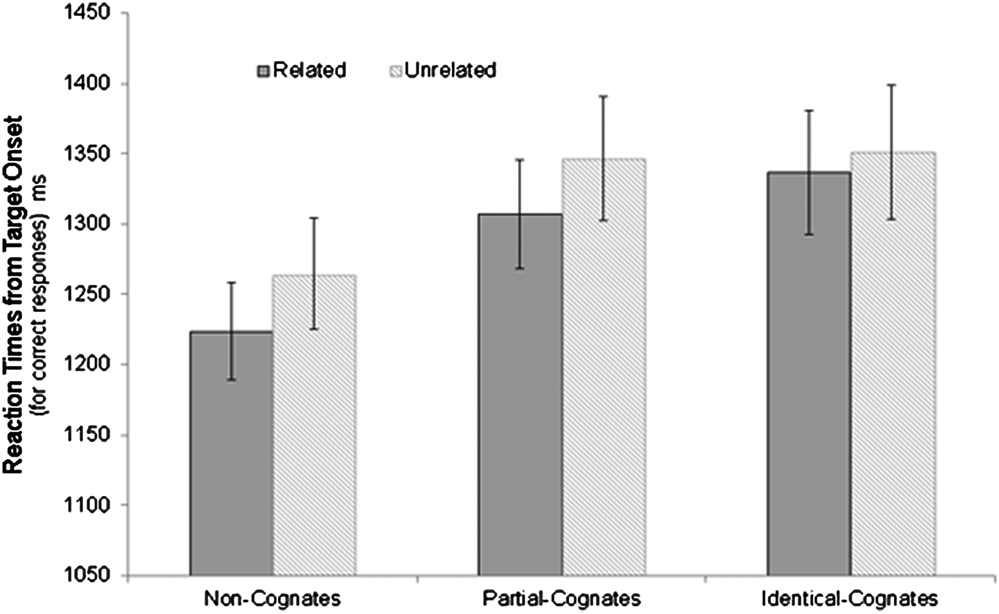
Table 2 presents the accuracy and reaction time results. As expected, accuracy was near ceiling (95% overall). Thus, as planned, we focus on processing speed. We use the same statistical procedure as in Experiment 1 but this time with reaction time (for correct responses) as the dependent measure in a linear mixed effects model (implemented in R with lmer in the lme4 package). Figure 2 shows the reaction time results, broken down by condition.
Reaction times in milliseconds (from target onset) for correct responses in the lexical decision task for different types of cognates in a Related (Solid Gray) compared to Unrelated (Striped Gray) semantic prime condition. Primes and targets were presented in the clear.

With Target Length as a covariate in the model, the best-fitting converging model justified by the data included each fixed effect (Cognate vs Non-Cognate, and Related vs Unrelated primes), by-subject random slopes of cognate status, and by-item and by-subject random intercepts (see Table B in Supplementary Materials for detailed results). There was a significant effect of Relatedness, t = −4.49, p < .001, and Cognate Status, t = 2.63, p = .01. As can be seen in Table 2, and in Figure 2, responses to Cognates were again slower than responses to Non-Cognates. This slower processing speed was not modulated by providing a within-language semantic prime. The fine-grained analyses show a main effect of Relatedness, t = - 4.52, p < .001, and of Cognate Contrast Type 2 (Identical-Cognate vs. Non-Cognate), t = 2.59, p = .02. Including the interaction between Relatedness and Cognate Type did not improve the model fit, and for the model that did include it, it was not significant, p > .1.
Long term priming test
Table 3 shows the reaction time results for the long term priming test. Reaction times were generally longer for Cognates than for Non-Cognates, and longer for New items than for Old items. The best fitting converging model revealed a significant effect of Old vs. New items, t = 10.2, p < .001, but no effect of Cognate Status, t = 0.84, p = 0.4. For New items, responses to Cognates were slower (by 53 ms) than Non-Cognates. However, the effect of Cognate status did not reach significance, (Cognate Status, t = 0.59, p = 0.55), and there were no other significant main effects (other than the target duration covariate) or interactions reaching significance. No significant effects were found in an analysis examining differences among the Old items.
3.3. Experiment 2 Discussion
Degrading the speech signal (e.g., via babble noise) challenges the perceptual system enough to reveal aspects of the underlying processes or functional organization that may normally proceed too effectively to observe an effect. In Experiment 1, this approach demonstrated effects of crosslinguistic phonological similarity, semantic priming, and their interaction, on word recognition accuracy. Perhaps surprisingly, even in the clear listening conditions of Experiment 2, we were able to observe an effect of crosslinguistic interactions and semantic priming on word recognition processing speed, consistent with the report by Temnikova and Nagel (Reference Temnikova and Nagel2015). Semantic priming shortened response times, whereas the existence of a matching crosslinguistic word (i.e., a cognate) slowed response times. Unlike the effects on accuracy observed in Experiment 1's noisy listening conditions, there was no significant interaction between semantic priming and phonological cognate status on reaction times, which is again consistent with the Temnikova and Nagel (Reference Temnikova and Nagel2015) study (that was also conducted in clear listening conditions; even in the noisy conditions of Experiment 1, the reaction time pattern was qualitatively consistent with that found here).
4. General Discussion
Spoken language comprehension involves the identification of specific sound sequences that map onto an associated meaning. Bilingualism presents a case in which two words with identical, similar, or different phonological sequences can map onto a common meaning. The current study sought to elucidate how the bilingual spoken word recognition system copes with multiple, language-specific sound-to-meaning maps, across two language systems during second language processing. In particular, we examined whether the functional organization of the second language interacted with that of the native language at the phonological and lexical-semantic levels during auditory word recognition, in a purely second language experimental context. Moreover, we were interested in whether this potential interaction had consequences for the flexible processes that allow spoken word recognition to accommodate adverse listening conditions (in this case mediated by meaning).
To gain insight into this question, we investigated how the phonological overlap of L2 words with their translation equivalents, and semantic relationships to a preceding within-language prime, affect spoken word recognition under noisy (Experiment 1) and quiet (Experiment 2) listening conditions. Collectively, the results of Experiments 1 and 2 show that these highly proficient/early (L1-Spanish, L2-Basque) bilinguals benefit from semantic priming on measures of word recognition accuracy (in noise), and on processing speed (in quiet). Both experiments also show that the presence of a phonological cognate in the native language, overall, leads to inhibitory effects on auditory word recognition performance (slower reaction time and lower accuracy), especially when preceded by an Unrelated prime. Moreover, in noisy listening conditions (Experiment 1), a significant interaction between phonological cognate status and semantic priming on accuracy was found; semantic priming was greater for Cognates compared to Non-Cognates, a large enough difference to overcome the inhibitory effect in the unrelated prime condition. This interaction was not significant on the response times in quiet listening conditions (Experiment 2).
Semantic priming
The facilitation produced by semantic priming suggests that when there is uncertainty produced by noise, second language processing by early/proficient bilinguals is flexible enough to make use of a constraining semantic context, boosting second language word recognition accuracy. This finding is consistent with other studies conducted in proficient bilingualś second language (Kousaie el al., Reference Kousaie, Baum, Phillips, Gracco, Titone, Chen, Chai and Klein2019 Temnikova & Nagel, Reference Temnikova and Nagel2015), and contrasts with the null effects of semantic priming previously found for non-proficient bilingualś second language (Golestani et al., Reference Golestani, Rosen and Scott2009) and other null effects of context (e.g., lexical context) for non-proficient compared to proficient bilinguals (Samuel & Frost, Reference Samuel and Frost2015). Thus, flexible perception may depend on the strength of the associations between L2 sounds and meaning, and/or L2 words and L1 words, which is presumed to be greater for proficient compared to non-proficient bilinguals. Recent neuroimaging work provides supporting evidence for this interpretation. Just as native listening shows better neural entrainment for more intelligible speech (Peelle, Gross, and Davis, 2013), there are also differences in neural entrainment between native and non-native listeners; specifically, poorer entrainment has been associated with the degree to which comprehension is impaired by noise in non-native listeners, at levels of processing that go beyond the syllable level (Blanco-Elorrieta, Ding, Pylkkänen & Poeppel, Reference Blanco-Elorrieta, Ding, Pylkkänen and Poeppel2019).
Phonological cognate status
The results showing effects of phonological cognate status provide good evidence for crosslinguistic phonological-lexical interactions, induced merely by overlap with native phonological-lexical forms, even when the experimental language context was carefully designed to only involve the second language. These interactions were prominent when listening conditions were challenging. Although it may seem unusual, the reduced accuracy and slowed response times associated with phonological cognate status found in the current study are not surprising when taken in the context of the broader literature on bilingualism and second language processing. Many studies have shown a reduction, elimination, or reversal of cognate facilitation with task, language, and stimulus manipulations. Dijkstra et al. (Reference Dijkstra, van Hell and Brenders2015) showed inhibitory effects of cognate status that depended on a semantic context manipulation. Specifically, they found that (1) low constraining sentences produced an inhibitory effect on L1 cognates and (2) when the sentence context was in L2, inhibitory effects were also found for high constraining sentences. As noted above, Temnikova and Nagel (Reference Temnikova and Nagel2015) showed inhibitory effects of cognate status under conditions like those tested in Experiment 2 here.
Effects of cognate status (be they inhibition or facilitation) provide evidence for the activation of the non-target language. In speech production, inhibitory effects of cognate status have also been reported when proficient bilinguals are naming pictures in L2, which have been attributed to increased competition at the lexical-semantic level (e.g., Broersma, Carter & Acheson, Reference Broersma, Carter and Acheson2016). Even in cases where cognate effects lead to facilitation of L2 production, the co-activation of a non-target native language seems to be associated with increased lexical competition. For example, Acheson, Ganushchak, Christoffels and Hagoort. (Reference Acheson, Ganushchak, Christoffels and Hagoort2012) observed evidence for greater conflict monitoring processes (a larger Event Related Negativity), despite facilitation for cognates compared to non-cognates on a naming task. This effect was attributed to increased competition from the multiple activated potential outputs of cognates compared to non-cognates and increased need for conflict monitoring. The observed interaction in the current study, between phonological cognate status and the semantic priming manipulation found in babble noise (Experiment 1), may guide the interpretation of how the co-activation of multiple representations can affect lexical dynamics, and bears on the functional organization of bilingualism and second language processing.
Semantic priming ×phonological cognate status interaction in noise
In the babble noise condition, reduced accuracy was found for phonological cognates when the target was preceded by an unrelated prime but not when it was preceded by a related prime. Because noise introduces a high degree of uncertainty in the perceptual mapping of the acoustic speech signal, alternative mappings must be considered/maintained before settling on the candidate that best fits the mutual constraints of the available information (Scharenborg & van Os, Reference Scharenborg and van Os2019). Following an unrelated prime, lexical-semantic competitors are more likely to be co-activated as the target word is presented, thereby increasing the number of potentially competing lexical candidates. If, in parallel, crosslinguistic phonological-lexical overlap promotes co-activation of the other “non-target” language network (which in this case is native and may thus dominate the target language, see Weber & Cutler, Reference Weber and Cutler2004), competition effects will be exacerbated by an even larger pool of candidates, potentially reducing the accuracy in mapping the acoustic speech signal. This interpretation is consistent with a study by Blumenfeld and Marian (Reference Blumenfeld and Marian2005), which provides evidence that cognates are more likely to co-activate competing cohort items from both languages than non-cognates. In contrast, following a related semantic prime, there should be less lexical competition. Specifically, as the perceptual mapping evolves, co-activated cognate lexical forms will not only converge onto the same meaning, but will also support (at least partially) the same perceptual mapping, which will help to suppress competitors. In addition, enhanced activation of the target's lexical form may help facilitate error detection of incorrectly activated phonological information, facilitating accurate word recognition.
Enhanced lexical activation and competitor suppression may be achieved through a number of possible mechanisms. According to some models of bilingualism (e.g., BIA+, Dijkstra & van Heuven, Reference Dijkstra and van Heuven2002), connections between orthographic, phonological, and semantic representations are interactive and bidirectional, causing similar lexical forms across two languages to resonate with one another through their shared phonology and meaning (Thomas & van Heuven, Reference Thomas and van Heuven2005; van Heuven, Reference van Heuven2005). Presumably, such resonance among different codes (processes) increases a word's level of activation. Even in other models that may not share the same structure as BIA+, enhanced levels of activation can still emerge from the learned associations across levels of processing and across languages (Hernandez, Li & MacWhinney, Reference Hernandez, Li and MacWhinney2005; Kroll et al., Reference Kroll, van Hell, Tokowicz and Green2010; Li & Farkas, Reference Li and Farkas2002; Shook & Marian, Reference Shook and Marian2013; Thomas & van Heuven, Reference Thomas and van Heuven2005; van Heuven, Reference van Heuven2005). Of course, the consequences of this semantically-mediated phonological-lexical boost will be subject to the specific functional architecture of a given model. For example, if semantic information is not shared across languages in the model, semantic priming effects cannot directly enhance activation of both lexical forms, but can do so indirectly through excitatory interactions between shared lexical forms at the lexical level. All of these factors would then interact with the bilinguaĺs level of proficiency (for a review on potential interactions between L2 proficiency and interference control, see Kim, Marton, and Obler, Reference Kim, Marton, Obler, Sekerina, Sradlin and Valina2019).
Insights from monolingual spoken word recognition
The complex cascading effects of noisy listening conditions and phonological-lexical interactions on lexical dynamics are not unique to bilingualism. A number of studies conducted with native language listeners have manipulated the phonological-lexical properties of targets under difficult listening conditions and may offer some additional insight into the interpretation of the results. For example, embedded words have been used as a within-language manipulation of phonological-lexical overlap, under better or worse listening conditions. For embedded words, the sequence of sounds that form part of the “carrier” word (e.g., “trombone”) is also consistent with a shorter word (e.g., “bone”) that maps onto a different meaning. Using either the carrier word as a prime for the embedded word or the embedded word as a prime for the carrier word, Zhang and Samuel (Reference Zhang and Samuel2015) replicated the finding that under optimal listening conditions, carrier words activate embedded words (and vice versa) and their meaning (Marslen-Wilson, Tyler, Waksler & Older, Reference Marslen-Wilson, Tyler, Waksler and Older1994; Vroomen and de Gelder, Reference Vroomen and De Gelder1997; Salverda, Dahan, and McQueen, Reference Salverda, Dahan and McQueen2003; Bowers, Davis, Mattys, Damian & Hanley, Reference Bowers, Davis, Mattys, Damian and Hanley2009). However, this priming effect was eliminated when the signal was degraded, or was presented under cognitive load. To account for the null effect under the degraded and cognitive load conditions, the authors proposed two possible mechanisms: degradation/load could either impede lexical access of the competing items, or it could tax cognitive processes needed to keep competitors active, thereby eliminating effects due to lexical competition. In a follow-up study, Zhang and Samuel (Reference Zhang and Samuel2018) manipulated different types of cognitive load to tease apart these possibilities and found that cognitive load affects lexical competition, not initial lexical access. Under difficult conditions, they suggest that listeners engage in “tunnel” listening, limiting the number of competitors kept active, consistent with models such as the Ease of Language Understanding hypothesis (Rönnberg, Lunner, Zekveld, Sörqvist, Danielsson, Lyxell, Dahlström, Signoret, Stenfelt, Pichora-Fuller & Rudner, Reference Rönnberg, Lunner, Zekveld, Sörqvist, Danielsson, Lyxell, Dahlström, Signoret, Stenfelt, Pichora-Fuller and Rudner2013).
Phonological-lexical manipulations such as phonological neighborhood density have also been examined in quiet versus noisy listening conditions. In denser phonological neighborhoods, the increased number of similar sounding words produces greater competition and greater inhibition of the target word. Noise seems to produce a larger inhibitory effect of neighborhood density, suggesting that increased uncertainty in the perceptual mapping causes greater lexical competition for larger phonological neighborhoods. However, this inhibitory effect interacts with other lexical factors; specifically, neighborhood density effects were mitigated by words of higher frequency, in noise more than in the clear (Taler, Aaron, Steinmetz & Pisoni, Reference Taler, Aaron, Steinmetz and Pisoni2010). Other studies showed similar effects of noise, with more challenging listening conditions increasing competition effects due to neighbors with phonological-orthographic overlap (Chiarello, Vaden & Eckert, Reference Chiarello, Vaden and Eckert2018). Phonological neighborhood manipulations also induce crosslinguistic effects; a word presented in the target language is sensitive to the size of the other (non-target) language's phonological neighborhood size (van Heuven, Dijkstra & Grainger, Reference van Heuven, Dijkstra and Grainger1998), providing additional evidence for phonologically-induced language co-activation of the non-target language. Taken together, the evidence indicates that competition effects during word recognition may be provoked both by crosslinguistic phonological-lexical overlap and noise. There is evidence that noise on onset (versus word-final) differentially affects recognition, suggesting that onsets may be more important (Coumans, Hout & Scharenborg, Reference Coumans, Hout and Scharenborg2014). Most of the partial cognates used in the current study overlapped in the onset consonant; it would be interesting to see if similar effects would be found for overlap in different positions.
It is important to note a key difference between cognates and the other phonological-lexical overlap manipulations: cognates map onto the same meaning, across the two languages, whereas the within-language manipulations (above) involve words that map onto different (competing) meanings. The shared meaning and phonology for cognates may automatically activate the non-target language and potentially competing lexical candidates. Thus, in the absence of a constraining context, there will be more competition for cognates compared to non-cognates as the system settles on the best mapping of the speech signal. Semantic priming may narrow the possibilities to those that are within the prime's semantic network and inhibit other phonological competitors. Consistent with this interpretation, Chen and Mirman (Reference Chen and Mirman2015) showed that even inhibitory effects due to phonological neighbor competition are reduced by semantic priming. Their interactive model predicts that effects of phonological neighbors should increase with increased activation of phonological information (in this case neighbors are inhibitory), but that the effect can be reversed when there is increased activation of semantic information, resulting in facilitation.
Perhaps, as cognitive noise/load reduces the competition effects of semantically unrelated embedded words (and frequency and semantic context reduce competition effects due to neighborhood density in noise), so can semantic priming reduce the competition effects of semantically unrelated competitors activated by crosslinguistic interactions, in noise, facilitating accurate word recognition. Accordingly, the constraints provided by semantic priming may offer a means to achieve “tunnel” listening, in noise. Reliance on context (be it lexical or semantic) increases under conditions that require flexibility (e.g., noise, cognitive load), but the ability to use such information (and perceive spoken language flexibly) is affected by the presence of other competing sources of information (e.g., semantically unrelated competitors).
Long-term priming
The long-term priming findings show the expected repetition effect of previously heard items. However, in Experiment 1, the Cognates and Non-Cognates produced somewhat different patterns. For the Non-Cognates, performance on the final lexical decision task was essentially flat across Old-Related, Old-Unrelated, and New items. For the Cognates, performance was highest for the Old-Related, followed by the Old-Unrelated, and then by the New items. Thus, the observed inhibitory effect of phonological cognate status on word recognition during the initial test is not likely due to a lack of, or weaker, lexical access/activation for cognates. Rather, it seems to reflect other processes such as lexical competition. Such competition is likely to increase following an unrelated prime due to the activation of additional lexical competitors. It might also be the case that the repetition effect associated with a previously heard word outweighs any reduced accuracy due to crosslinguistic competition. Interestingly, a recent paper shows that noise may have different effects, in different tasks; despite a disadvantage for bilinguals compared to monolinguals on word recognition in noise, none is found for word learning (Morini & Newman, Reference Morini and Newman2019). This pattern suggests that competition effects can indeed be overridden through repetition and learning.
Conclusion
Taken together, the results of Experiments 1 and 2 suggest that crosslinguistic phonological-lexical-semantic overlap promotes L1 activation, increasing lexical competition, in the presence of a semantically unrelated prime (or in isolation) and noise. However, semantic priming can compensate for the inhibitory effect of a phonological cognate when target items are presented in noise. This semantic support thus seems to reinforce the activation of a target by suppressing competition.
The long-term priming results show that phonological cognates (in languages with large phonological overlap) may have a greater repetition effect than non-cognates. This finding supports the interpretation that target items were indeed activated during the initial presentation. The observed effects are, therefore, most likely due to 1) a repetition effect that outweighs any competition effects, and/or 2) the result of prior competition induced by the crosslinguistic interaction.
In summary, the current study demonstrates that second language auditory word recognition can be modulated by crosslinguistic phonological-lexical-semantic overlap. Models of spoken word recognition suggest that correct mapping of the speech signal depends on the interplay of many factors such as signal quality, context, listenerś experiences, and more general cognitive processes. The current study suggests that the functional architecture of a model of bilingual auditory word recognition – at least, for early/proficient bilinguals – should also take the potential impact of cross-linguistic interactions on this interplay into account.
With respect to the specific results of the current study, it is important that they be interpreted within the full context of the experimental manipulations, specific language pair, bilingual population and language environment. First, the primary task in this study is a semantic priming paradigm where targets were preceded by related or unrelated primes, in the auditory modality. Second, the language pair consists of highly overlapping phonologies (perhaps more than other commonly used language pairs in previously published word recognition studies). Third, the bilingual population consists of early proficient bilinguals, who learned Basque (L2) after Spanish (L1). Fourth, the language environment where the study was conducted is an official bilingual community where listeners commonly access both languages for daily activities (i.e. both languages are used in stores, on street signs, in the media). Finally, we also note that while our sample size was sufficient to obtain a good number of statistically reliable effects, it would be interesting to see whether some effects that were not reliable here might be detectable with a larger sample.
Supplementary Material
For supplementary material accompanying this paper, visit https://doi.org/10.1017/S1366728920000164
Acknowledgements
The authors thank Angela de Bruin for helping with the PsychoPy programming, Sara Martínez Narvarte, for help with the Basque semantic-prime stimulus design, Paula Rios-López for providing the babble recording, Ainhoa Bastarrika-Iriarte for facilitating the automatization of noisy stimulus creation, Itziar Basterra, Amets Esnal, Larraitz Lopez for running participants in Basque, and Clara Martin, Sendy Caffarra, Angela de Bruin, and Effie Kapnoula for helpful discussions. In addition, we thank two anonymous reviewers for helpful comments during the revision process. This research was funded by the Spanish Ministry of Science and Innovation (Grant PSI2017-82563-P, awarded to A.G.S.), the Netherlands Organization for Scientific research (NWO Veni grant 275-89-027, awarded to M.B.), the Basque Government through the BERC 2018-2021 program, and the Spanish State Agency Severo Ochoa excellence accreditation SEV-2015-0490; Programme for Centres/Units of Excellence (awarded to the BCBL), and the European Union's Horizon 2020 research and innovation programme under the Marie Sklodowska-Curie grant agreement No. 799554.