Although words are the basic building blocks of a language, in natural conversation they are interpreted not as isolated units but in the context of utterances. For instance, when a reader encounters the word apple in the sentence She took a bite from the fresh green apple, a syntactic, a semantic, and a pragmatic structure has already been built on the basis of the preceding sentence. No wonder then that investigating how various sentence characteristics affect word recognition has been an important topic in psycholinguistics for decades.
Many researchers believe that sentence context must somehow affect the processing of subsequent words. One theoretical position can be summarized as a paraphrase of a well-known adage, “sentence context proposes, word recognition disposes”, meant to indicate that both sentence context and target word characteristics affect the lexical candidates considered during the target word's recognition, but that they do so in a different way. The sentence context would further expectations about possible continuations, which might speed up the selection of the actually upcoming word from a set of candidates (see Swinney, Reference Swinney1979; Zwitserlood, Reference Zwitserlood1989). In the case of bilinguals, a number of interesting new issues arise. What happens if a sentence context in one language precedes a target word in another language, i.e., when a language switch takes place? Is the relative effect of sentence context stronger in a native language (L1) than in a second language (L2)? How is the processing of words in sentences affected by their orthographic and semantic similarity across languages (in other words, their cognate status)? And how does it depend on the degree of semantic constraint that the sentence exerts on the words in question? For instance, what happens if a Dutch–English bilingual reading the example sentence above encounters not apple, but appel, its Dutch translation equivalent? The answer to these questions can clarify the organization of the sentence and word processing systems in monolinguals and bilinguals.
In the present study, we investigated effects of language switching, sentence language, cross-linguistic similarity, and semantic constraint in reading by asking bilingual participants to perform an L1 or L2 lexical decision task on target words embedded in sentences. The bilinguals were presented with cognate or noncognate target words following sentences from the same or a different language that provided relatively strong or weak semantic constraints (the example sentence at the beginning of the introduction is an example of a context providing a high semantic constraint). In our study, we kept the target items the same while we varied the language of the preceding sentence context. This allowed us to do a within-item analysis, rather than the between-item analysis in most other studies, where language switching was brought about by manipulating the language of the target item itself.
Before describing the experiments, we provide a review of empirical studies on the bilingual processing of words in sentences. Next, we discuss how an available model of bilingual word recognition (the BIA+ model) considers the interaction between lexical and sentence levels in bilingual processing.
Bilingual studies on word processing in sentences
Empirical research investigating how bilingual word recognition is affected by sentence context has started relatively recently. Altarriba, Kroll, Sholl and Rayner (Reference Altarriba, Kroll, Sholl and Rayner1996) examined semantic and lexical form effects of a preceding sentence context on bilingual word recognition. In their first experiment, they monitored the eye movements of Spanish–English bilinguals who were reading English (L2) sentences containing either an English (L2) or a Spanish (L1) target word. Sentences provided either high or low semantic constraints on the target words. An example sentence of the high-constraint and Spanish target condition is He wanted to deposit all his dinero at the credit union, where dinero is Spanish for money. Frequency of the target word and degree of sentence constraint were found to interact with respect to the first fixation duration for Spanish targets, but not for English targets. Specifically, when Spanish target words were of high frequency and appeared in highly constraining sentences, an interference effect arose. This finding suggests that the sentence generated both semantic and lexical features as constraints for the upcoming target words. A high-frequency Spanish word matched the generated set of semantic features, but not the expected lexical features, when it appeared following an English sentence context. The same result pattern was observed in a second experiment, in which the sentences were presented word by word using the rapid serial visual presentation (RSVP) technique and participants named the capitalized target word in each sentence. In sum, the findings of this study indicate that target word recognition can be affected by a preceding sentence context, and target and context language play an important role as well.
Elston-Güttler, Gunter and Kotz (Reference Elston-Güttler, Gunter and Kotz2005) examined how activation of the two readings of interlingual homographs was affected by local sentence context and more global discourse context. German–English bilinguals performed a semantic priming task, in which German–English homographs were presented as primes at the end of English sentences. These were then followed by English targets for lexical decision. For example, the sentence Joan used scissors to remove the . . . was followed by the test word tag (a German–English interlingual homograph, which means day in English) or a control word (e.g., label). Next, a target word (e.g., day) was presented on which an English lexical decision was made. The more global language context was manipulated by playing a twenty-minute silent movie at the beginning of the experiment, accompanied by a narrative in L1 (German) or L2 (English). Both behavioral and ERP data revealed semantic priming effects only in the first part of the experiment shortly after the bilinguals had seen the German movie. This finding suggests that (i) in the local English sentence context the non-target reading of an interlingual homograph (e.g., the German reading of tag) was suppressed or not activated, and (ii) the more global context also affected the priming effect, as reflected in a modulation of the N200 and N400 components and in the response times for the first part of the first block just after the German movie was shown.Footnote 1 Elston-Güttler et al. (Reference Elston-Güttler, Gunter and Kotz2005) argued that bilinguals who saw the German movie had to zoom in to their L2 (English) by gradually raising decision criteria in order to diminish non-target language effects of L1 (German) on the target language L2 (English). In all, the results are compatible with the more general view that sentence context can affect the activation of representations in the bilingual word identification system (Dijkstra & Van Heuven, Reference Dijkstra and Van Heuven2002).
More recent bilingual studies indicate that semantically constraining sentences can eliminate the effects of a non-target language on item processing, while such effects may remain in low-constraint and neutral sentence context (Duyck, Van Assche, Drieghe & Hartsuiker, Reference Duyck, Van Assche, Drieghe and Hartsuiker2007; Libben & Titone, Reference Libben and Titone2009; Schwartz & Kroll, Reference Schwartz and Kroll2006; Starreveld, De Groot, Rossmark & Van Hell, Reference Starreveld, De Groot, Rossmark and Van Hell2014; Titone, Libben, Mercier, Whitford & Pivneva, Reference Titone, Libben, Mercier, Whitford and Pivneva2011; Van Hell & De Groot, Reference Van Hell and De Groot2008).
Schwartz and Kroll (Reference Schwartz and Kroll2006) asked Spanish–English bilinguals to name words in English sentences that were highly or less constraining from a semantic perspective. Using an RSVP paradigm, they presented homographs and cognates in bilingual sentences such as The composer sat at the bench and began to play the piano as the lights dimmed (high-constraint sentence). The word piano appeared in red and had to be named as quickly and accurately as possible. Effects of the non-target reading persisted in low-constraint sentences. The cross-language effects in high-constraint sentences depended on the L2 comprehension performance of the bilinguals: They disappeared for good comprehenders.
Also using an RSVP technique, Duyck et al. (Reference Duyck, Van Assche, Drieghe and Hartsuiker2007) had Dutch–English bilinguals perform an English lexical decision task on form-identical and nonidentical cognates that were presented as final words in low-constraint English sentences. Cognate facilitation effects were found relative to control words for both form-identical and non-identical cognates. The observed effects were at least as large as those for the same items in isolation. An eye-tracking experiment, in which the sentences with their cognates and a continuation phrase were presented as wholes on a computer screen, replicated the cognate effects for identical cognates, but not for non-identical cognates. The effects already emerged during the first fixation on the cognate targets. The authors concluded that lexical access in bilinguals may be language independent both in isolated word recognition and in sentence embedded word recognition. Sentence context may interact with lexical characteristics of the words to be recognized, such as cross-linguistic orthographic overlap, and influence the cross-linguistic spreading of activation. In an extension of this study, Van Assche, Drieghe, Duyck, Welvaert and Hartsuiker (Reference Van Assche, Drieghe, Duyck, Welvaert and Hartsuiker2011) again obtained cognate facilitation effects for both early and late eye-movement measures in both low- and high-constraint sentences. They concluded that there is only a very limited role for semantic top–down effects on the language non-selective activation of words.
Libben and Titone (Reference Libben and Titone2009) also investigated the effects of high- and low-constraining sentence context on the processing of identical cognates and interlingual homographs in an eye-tracking study. Highly proficient French–English bilinguals saw an English (L2) target word (divorce) or its control (wedding) located somewhere in an English sentence like Because they owned a lot of property around the world, the expensive divorce was a disaster. For low-constraint sentences, all comprehension measures (varying from first fixation duration to total reading time) reflected cognate facilitation and interlingual homograph interference effects. In high-constraint sentences, only early stage comprehension measures (first fixation duration, gaze duration, and skipping) showed such effects. The authors interpreted these findings as evidence that a semantically biased sentence context exerts a constraining effect on following words (including cognates and interlingual homographs), rapidly turning language non-selective access into selective lexical activation.
In a follow-up eye-tracking study, Titone et al. (Reference Titone, Libben, Mercier, Whitford and Pivneva2011) extended this finding to L1 targets. Depending on how early in life they acquired their L2 (French), English–French bilinguals reading sentences in their native language (English) displayed a language non-selective activation of target words (cognates and interlingual homographs relative to controls). When the sentences provided a high semantic constraint, the co-activation effect for cognates was again attenuated. When L2 (French) sentences were included in the stimulus list, this led to an increase of the cross-linguistic effects, especially in later reading measures.
Interestingly, in a bilingual sentence study by Van Hell and De Groot (Reference Van Hell and De Groot2008), results were obtained that are similar in some, but not all, respects to the studies just reported. Dutch–English bilinguals performed an English lexical decision task or translated words in forward (Dutch to English) or backward (English to Dutch) direction. When items were presented following a low-constraint sentence context in the same language, cognate effects remained in all three tasks, although they were sometimes diminished in size relative to presentation in isolation. However, in high-constraint sentence context, the cognate effects disappeared in English (L2) lexical decision and were strongly decreased (but still significant) in both translation tasks. The authors concluded (in agreement with Elston-Güttler et al., Reference Elston-Güttler, Gunter and Kotz2005) that even in high-constraint sentences, non-selective activation initially occurs, followed by lexical selection. Nevertheless, semantically rich sentences were apparently able to modulate the bilingual word recognition process in at least three different tasks.
To summarize, most studies considering cognate processing in sentence context have investigated within-language effects, either in L2 (Duyck et al., Reference Duyck, Van Assche, Drieghe and Hartsuiker2007; Libben & Titone, Reference Libben and Titone2009; Schwartz & Kroll, Reference Schwartz and Kroll2006; Van Assche et al. Reference Van Assche, Drieghe, Duyck, Welvaert and Hartsuiker2011; Van Hell & De Groot, Reference Van Hell and De Groot2008), in L1 (Titone et al., Reference Titone, Libben, Mercier, Whitford and Pivneva2011; Van Assche, Duyck, Hartsuiker & Diependaele, Reference Van Assche, Duyck, Hartsuiker and Diependaele2009), or both (Starreveld et al., Reference Starreveld, De Groot, Rossmark and Van Hell2014). Using several paradigms, the available bilingual sentence studies agree that sentence context can modulate the bilingual word recognition process, but it is still unclear which factors affect the degree of modulation and how they interact. Among the obvious candidates are the experiments’ sentence materials (e.g., their semantic constraint), their word materials (e.g., cognates mixed with one-language words or not), the L1 and L2 (e.g., English, Dutch, or Spanish), and their research techniques and methodologies (e.g., RSVP with lexical decision, naming, eye-tracking, or ERPs with priming or word translation).
The BIA+ model
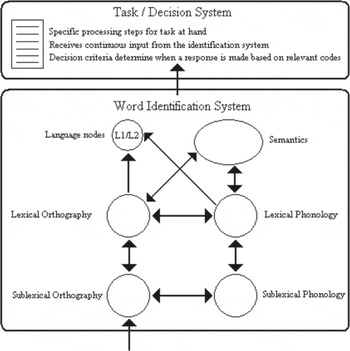
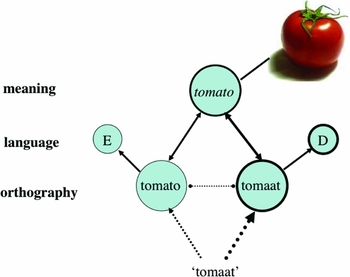
For a discussion on possible mechanisms underlying the interaction between sentence and lexical processing in bilinguals, we now turn to the Bilingual Interactive Activation Plus (BIA+) model (Dijkstra & Van Heuven, Reference Dijkstra and Van Heuven2002; see Figure 1 below). This is a partially implemented localist-connectionist model for bilingual word recognition that has been extended to provide a global account of the interaction between sentences and words. Let us once again consider the processing of the word apple in the example sentence of the introduction. According to BIA+, processing of this word in its early stages will lead to bottom–up activation of orthographic word candidates that are similar to the input (so-called neighbor words), irrespective of the language to which they belong. As a consequence of this “language non-selective lexical access”, the Dutch word appel will also become activated. Both apple and appel activate a (largely) shared semantic representation (see Figure 2, after Dijkstra, Miwa, Brummelhuis, Sappelli & Baayen, Reference Dijkstra, Miwa, Brummelhuis, Sappelli and Baayen2010). The resulting resonance between orthographic and semantic codes will lead to an increased total activation in the bilingual lexicon for apple relative to an otherwise comparable word without form overlap (e.g., bike, which is fiets in Dutch). When apple is presented in isolation, the decision that it is a word will therefore be easier and faster to make than such a decision for a control word. The faster decision for cognates than for non-cognates in isolation is called the “cognate facilitation effect” (see Dijkstra et al., Reference Dijkstra, Miwa, Brummelhuis, Sappelli and Baayen2010, and Peeters, Dijkstra & Grainger, Reference Peeters, Dijkstra and Grainger2013, for a more detailed discussion of cognate representations).
The BIA+ model for bilingual word recognition (Dijkstra & Van Heuven, Reference Dijkstra and Van Heuven2002).

Representation of cognates in the bilingual lexicon (Dijkstra et al., Reference Dijkstra, Miwa, Brummelhuis, Sappelli and Baayen2010).

The BIA+ model further assumes that the recognition of words can be affected by the syntactic and semantic aspects of the sentence they occur in. The proposed underlying bilingual mechanism is similar to the feature restriction hypothesis by Schwanenflugel and colleagues (Schwanenflugel, Reference Schwanenflugel and Schwanenflugel1991; Schwanenflugel & LaCount, Reference Schwanenflugel and LaCount1988; Schwanenflugel & Shoben, Reference Schwanenflugel and Shoben1985) and propositions by Kellas, Paul, Martin and Simpson (Reference Kellas, Paul, Martin, Simpson and Simpson1991) in the monolingual literature (also see Simpson & Krueger, Reference Simpson and Krueger1991, and Simpson, Peterson, Casteel & Burgess, Reference Simpson, Peterson, Casteel and Burgess1989). According to these views, readers use sentence context to generate semantic/pragmatic, syntactic, and lexical feature restrictions to facilitate the processing of upcoming words. These feature restrictions are compared to those of the upcoming words, allowing an easier or more difficult integration of the items in the various sentence structures. A critical prediction of this account is that plausible but unexpected words in high-constraint sentences are slowed down, whereas a broad range of words might be facilitated or at least not inhibited in a sentence context providing only a low semantic constraint. Indeed, Schwanenflugel and LaCount (Reference Schwanenflugel and LaCount1988) observed facilitation only for expected sentence completions following high-constraint sentences, whereas after low-constraint sentences, lexical decision latencies were facilitated for both expected and unexpected target words.
Because BIA+ assumes there is language non-selective access to semantic, syntactic, and lexical information sources, it predicts that sentential context can constrain the number of activated lexical competitors from both target and non-target languages. However, in the bilingual situation, at least three additional factors come into play: the language of the preceding sentence, the language of the target word, and its cognate status. This might appear to be a complicating factor in bilingual research into the relative contribution of various factors during the integration of words in a sentence context. However, the effect of certain factors can be kept constant across conditions. Notice, for instance, that following a sentence like She took a bite from the fresh green . . ., the sentence-based syntactic, semantic, and lexical expectations will stay the same for different types of added target nouns. This makes it particularly interesting to investigate the effects of preceding sentence context on translation equivalents with and without form overlap, such as non-identical cognates and matched noncognates.
The present study
We investigated three aspects of bilingual sentence processing that were earlier shown to be important: The effect of sentence language, cognate status of the target item, and semantic constraint between sentence and target word. To allow some comparability with earlier studies, we (a) used stimulus materials of Van Hell and De Groot, Reference Van Hell and De Groot2008; (b) applied an RSVP technique with lexical decision; (c) collected data for both L1 and L2 sentences and targets, thus allowing us to examine the effects of sentence language and language switching in two directions. Two experiments were conducted, involving English (L2) or Dutch (L1) lexical decisions on targets (cognates and non-cognates) in sentences. In both experiments, Dutch–English bilinguals processed these targets following Dutch or English sentences that exerted a high or low semantic constraint on the targets.
For Experiment 1, involving English lexical decision, we made the following predictions. First, we expected a general language switch effect: English target words preceded by an English sentence context should be easier to identify than when preceded by a Dutch sentence context. This should especially be the case because the Dutch sentence context, in the participants’ L1, should have a relatively strong influence on word processing. Second, similar to cognates in isolation, we expected an L2 cognate facilitation effect in low-constraint sentences of the same language (English; Duyck et al., Reference Duyck, Van Assche, Drieghe and Hartsuiker2007; Libben & Titone, Reference Libben and Titone2009). Third, we expected this cognate facilitation effect to be sensitive to semantic constraint. In a high-constraint sentence context, the cognate facilitation effect should be attenuated or disappear (Van Hell & De Groot, Reference Van Hell and De Groot2008). Fourth, we also expected this cognate facilitation effect to be sensitive to the preceding sentence language. As the dominant L1 (Dutch) is more strongly represented than the non-dominant L2 (English), the English (L2) cognate facilitation effect might be reduced or even eliminated in a Dutch (L1) relative to an English (L2) sentence context. The latter three predictions presume the presence of a cognate facilitation effect; to establish such an effect for our materials in isolation, we presented the cognates and control words in a single word lexical decision task at the end of the session. The present stimulus materials were also used in an isolation condition by Van Hell and De Groot (Reference Van Hell and De Groot2008) and, as in many other studies, the L2 cognates resulted in a cognate facilitation effect relative to matched control words.
For Experiment 2, involving Dutch (L1) targets, we made the following predictions. First, we again expected a general language switch effect: Dutch target words preceded by a Dutch sentence context should be easier to identify than when preceded by an English sentence context. However, the effect might be smaller than in Experiment 1, because English (L2) is a weaker language in these bilinguals than Dutch (L1). Second, similar to findings for cognates in isolation, we expected that an L1 cognate facilitation effect in low-constraint sentences of the same language (Dutch) would be absent or small. The implication of this prediction is that no effects of semantic constraint or preceding sentence language on the cognate effect would become visible. However, our interpretation of the findings of Titone et al. (Reference Titone, Libben, Mercier, Whitford and Pivneva2011) leads us to make a different prediction. When the list composition in their study changed from pure (one language) to mixed (two languages), this led to an increase of cross-linguistic effects. For our mixed experiment, this might imply that an English sentence context might boost the activation of the English reading of the subsequent cognate. This would result in a cognate inhibition effect for the actually presented Dutch (L1) cognate member, especially when it is positioned at the end of a high-constraining English (L2) sentence frame. As a check, we again presented the cognates in a single-word lexical decision task at the end of the session. Although the cognate facilitation effect has been found in L1 as well as L2 (Van Hell & Dijkstra, Reference Van Hell and Dijkstra2002), it is often smaller in L1 than in L2 (e.g., Brenders, Van Hell & Dijkstra Reference Brenders, Van Hell and Dijkstra2011).
Finally, a comparison of the effects of sentence language and semantic constraint in Experiment 1 (L2 targets) and Experiment 2 (L1 targets) for cognates versus one-language control words should clarify how sentence language constraint (L1 vs. L2) and lexical form-overlap (cognates vs. controls) interact during processing. If L1, the native language, exerts stronger sentence constraint effects than L2, there should be a larger reduction of the cognate facilitation effect following L1 in both experiments. In addition, reaction time differences between control words in high and low semantic constraint conditions should be larger for L1 than for L2 in both experiments.
Experiment 1: L2 (English) lexical decision
Method
Participants
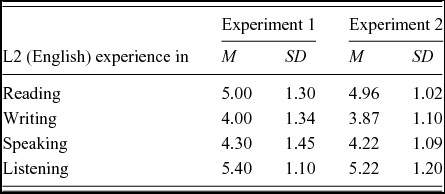
There were 33 participants, all students at Radboud University Nijmegen (M age: 22.36 years; SD = 2.46; age range = 18–32 years; 12 women). All participants were right-handed and had normal or corrected-to-normal vision. All were native speakers of Dutch without any reading disabilities and highly proficient in English. They had learned English as a foreign language at school for at least six years and used English regularly during their study. Participants received course credit or were paid for their participation. Table 1 provides an overview of the participants’ self-rated language skills.
Self-ratings with respect to English by the Dutch–English bilinguals participating in Experiment 1 and in Experiment 2

Note: Mean (M) score and standard deviation (SD) on a Likert-scale from 1 (very little) to 7 (very much).
Stimulus materials
The experiment consisted of three parts, using the same test words in sentence context (blocks 1 and 2) or in isolation (block 3). The test words consisted of words and pseudowords.
The test words were nearly identical to those used in Van Hell and De Groot (Reference Van Hell and De Groot2008). Their word stimuli consisted of English nouns derived from a set of 440 words, rated for word characteristics relevant to this study (De Groot, Dannenburg & Van Hell, Reference De Groot, Dannenburg and Van Hell1994). Each English word of this corpus (as well as its Dutch translation) had been rated in separate norming studies for a number of word characteristics, while information about several other characteristics was available from the CELEX database (Baayen, Piepenbrock & Van Rijn, Reference Baayen, Piepenbrock and Van Rijn1993). In order of relevance for the present study, these characteristics were cognate status, context availability, log word frequency, length, and concreteness (imageability) (see Van Hell & De Groot, Reference Van Hell and De Groot1998a, Reference Van Hell and De Grootb, Reference Van Hell and De Groot2008, for further information).
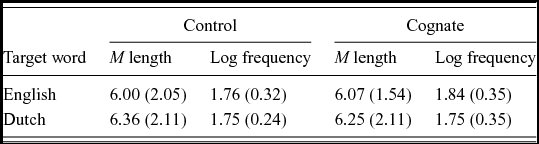
For the present study, four stimuli in the original stimulus set were removed (plan, winter, tree, and demand) and two further stimuli were replaced (property and gun were replaced by possession and rifle) to avoid any form-identical cognates and false friends (because of the language-mixed presentation in the present study), while maintaining the match between cognates and non-cognates on the above-mentioned word characteristics. This resulted in a set of 56 test words, half of which were cognates (28 words for which the English form and its Dutch translation were similar in sound and spelling), and half of which were controls (28 words for which the English–Dutch translation pairs were dissimilar in sound and spelling). This set of 56 test stimuli in English together with 56 Dutch translation equivalents (used in Experiment 2) are listed in Supplementary Materials Online. Mean values (Ms) and standard deviations (SDs) of the properties of the word set are presented in Table 2.
Mean length (in number of letters) and log frequencies (in occurrences per million) of English and Dutch cognates and controls in Experiment 1 (English targets) and Experiment 2 (Dutch targets)
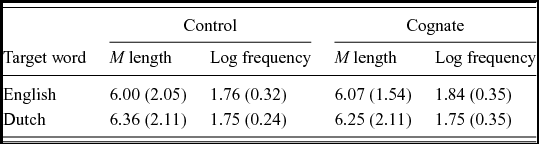
Note: Standard deviations are given in parentheses.
Furthermore, 56 pseudowords (i.e., nonwords that obey the phonological and orthographic rules of the critical language, here English) were constructed by changing one letter of newly selected English words. The pseudowords did not differ in length from the word stimuli (p > .10).
Four different sentence contexts were made for all 112 stimuli, using the pre-tested sentence materials by Van Hell and De Groot (Reference Van Hell and De Groot2008; see their Appendix A) as a basis (see our Supplementary Materials Online for an overview of all sentence materials). English and Dutch sentence contexts were constructed as straightforward translations of each other. They were matched in terms of word length. The sentence contexts were low- or high-constraint in English or Dutch, and each of these contexts were also matched in word length.
In addition, 12 other English words (six cognates and six controls) were selected to construct a practice set. Half of these were then turned into pseudowords by changing one letter. Finally, six high- and six low-constraint (English or Dutch) sentence contexts were constructed for the 12 practice stimuli. In all respects, these sentence contexts were comparable to those of the test stimuli.
Design and procedure
The experiment was divided into three parts. The first and the second part each contained 112 sentences, consisting of a low-constraint or high-constraint sentence context, followed by one of the 56 target or 56 control words in a counterbalanced design. Each part was divided into two blocks, separated by a short break. A 2 (constraint: high vs. low) × 2 (language of sentence: English vs. Dutch) × 2 (cognate status: cognate vs. control) within-subject design was used. Each participant saw a differently pseudo-randomized list with no more than three words or nonwords in a row, and no more than two sentences of the same condition. The third part consisted of the 112 isolated target and control words, pseudo-randomized and divided into two blocks. A within-subject design manipulating cognate status (cognate vs. control) was used here.
The experiment was conducted on an Apple Macintosh Power PC 8200/120. The 15″ monitor was placed at approximately 65 cm from the participants. Stimuli were presented in black lowercase Geneva 24 points at the center of the screen on a white background. Participants were tested individually. They were instructed to respond “yes” to letter strings that were English words and “no” in other cases. The “yes” responses were given with the preferred right hand.
Participants were instructed to read each sentence attentively. To keep the participants’ attention focused on sentence meaning, sometimes questions regarding the previously seen sentence appeared on the computer screen. Whenever a question could be answered positively, participants were instructed to press the right button, otherwise the left button. For example, if the sentence had been “Tall basketball players have an advantage”, the associated question might be “Are the mentioned basketball players tall?” with the answer “yes”. There were 20 questions in the two sentence parts of in total 224 trials.
The first part was preceded by 12 practice trials. Sentences in practice and critical trials were presented in RSVP mode at the center of the monitor. Each trial started with a fixation cross at screen center for 500 ms. Next, the screen was cleared and 500 ms later the first word of a sentence appeared. Each word was presented for 345 ms (word duration) followed by a blank screen for 300 ms and then the next word of the sentence (see Duyck et al., Reference Duyck, Van Assche, Drieghe and Hartsuiker2007). Sentence-final words were followed by a space and a full stop (e.g., “appel .”). The letter string disappeared after the participants responded or after a time-out of 1500 ms. The inter-trial interval was 2000 ms.
For the third part (isolated words), 12 practice trials again preceded the test trials. Words were presented at center screen following a 500 ms fixation cross. Then the screen was cleared and 500 ms later the letter string appeared. It disappeared after the participants responded or after a time-out of 1500 ms. Inter-trial interval was 2000 ms. After the experiment, participants filled in a questionnaire to assess their familiarity with the English language (see Table 1) above. An experimental session lasted about 35 minutes.
Results
Words in sentence context
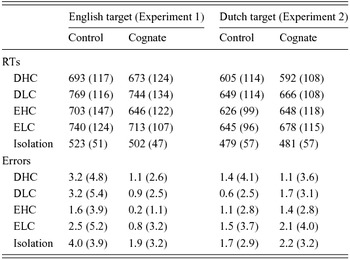
The response times (RTs) were analyzed for words in sentence context first (combining parts 1 and 2) and then for words in isolation (part 3). The data from three participants were removed from analysis, because their RTs were more than 2.5 SDs above the participants’ mean. The RTs of the remaining 30 participants for test words outside the range of 2.5 SDs from a participant's and item's mean were considered as outliers. Outliers and incorrect responses were excluded from further analysis (in total 2.8% of the data). The resulting mean RTs, SDs, and error percentages for the different word conditions are presented in Table 3 and Figures 3 and 4. Mean RTs to pseudowords were 909 ms with an error rate of 10.1%. The proportion of correct responses to the probe questions for sentences ending on English target words was .86.
Mean RTs, standard deviations, and error percentages for the conditions in Experiment 1 (English lexical decision) and Experiment 2 (Dutch lexical decision)

Sentence conditions: DHC = Dutch High Constraint, DLC = Dutch Low Constraint, EHC = English High Constraint, ELC = English Low Constraint.
Note: Standard deviations of RTs and of error percentages are given in parentheses.
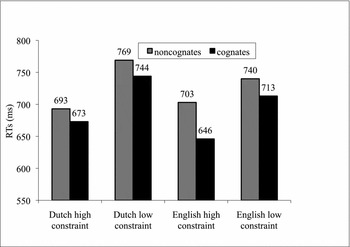
Lexical decision times for English cognates and noncognates following Dutch and English high- and low-constraint sentences in Experiment 1 (English lexical decision).

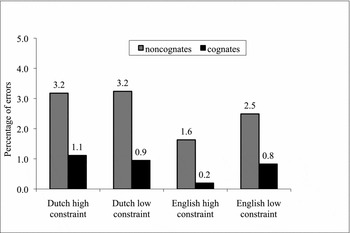
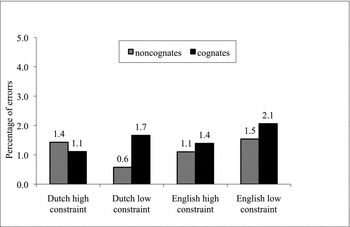
Percentage of errors for English cognates and noncognates following Dutch and English high- and low-constraint sentences in Experiment 1 (English lexical decision).

The RT data for words in sentences were subjected to within-subject analyses of variance (ANOVAs) by participants and by items with the factors Sentence Language (Dutch/English), Semantic Constraint (low constraint/high constraint), and Cognate Status (cognate/control). The analyses yielded main effects for Sentence Language (F1(1,29) = 6.019, p = .02, ηp 2 = .172; F2(1,54) = 7.412, p = .009, ηp 2 = .121), Semantic Constraint (F1(1,29) = 108.271, p < .001, ηp 2 = .789; F2(1,54) = 36.654, p < .001, ηp 2 = .404), and Cognate Status (F1(1,29) = 18.081, p < .001, ηp 2 = .384; F2(1,54) = 4.736, p = .034, ηp 2 = .081). Mean RTs for targets presented after English sentences (700 ms) were 20 ms faster than after Dutch sentences (720 ms). Mean RTs for targets presented after low-constraint sentences (741 ms) were 63 ms slower than for those presented after high-constraint sentences (678 ms). Mean latencies to cognates (694 ms) were 32 ms faster than for controls (726 ms). There were no significant interaction effects.
Next, the error data for words in sentences were subjected to analogous analyses of variance (ANOVAs) with the factors Sentence Language (Dutch/English), Semantic Constraint (low constraint/high constraint), and Cognate Status (cognate/control). The analyses yielded a main effect of Cognate Status (F1(1,29) = 11.05, p = .002, ηp 2 = .276; F2(1,54) = 4.468, p = .039, ηp 2 = .076) and a weak trend towards a main effect of Sentence Language (F1(1,29) = 2.724, p = .11, ηp 2 = .086; F2(1,54) = 3.209, p = .079, ηp 2 = .056). Mean percentages of errors for controls (2.63%) were higher than for cognates (0.77%). There were no other significant main or interaction effects.
Words in isolation
The data from the same three participants were removed. This left us with data from 30 participants. Next, all pseudowords were excluded from the analyses. The mean RT to pseudowords was 620 ms with an error rate of 15.2%. RTs for test words outside the range of 2.5 SDs from a participant's and item's mean were considered outliers. Outliers and incorrect responses were excluded from further analysis (3.9% of the data). Mean RTs, SDs, and error percentages for the different conditions are presented in Table 3 above.
The RT data were subjected to analyses of variance (ANOVAs) with the factor Cognate Status (cognate/control). The analyses yielded a main effect for cognate status (F1(1,29) = 17.43, p < .001, ηp 2 = .375; F2(1,54) = 7.877, p = .007, ηp 2 = .127). Mean RTs for cognates (502 ms) were faster than for controls (523 ms). The same analyses were performed for the error data. The analyses yielded a main effect for Cognate Status in the participant analysis only (F1(1,29) = 6.93, p = .013, ηp 2 = .193; F2(1,54) = 2.238, p = .140, ηp 2 = .04). The mean percentage of errors for cognates (1.91%) was lower than for controls (4.05%).
Discussion
The English lexical decision experiment led to some expected and some unexpected results. First, in line with our predictions, responses to English words following English sentences were 20 ms faster than following Dutch sentences. This main effect of language switching is in line with the general finding that switching from one language to the other is associated with a measurable cost (e.g., Meuter & Allport, Reference Meuter and Allport1999). Second, also in line with our predictions, we observed an L2 cognate facilitation effect in the semantically low-constraint English sentence condition.
However, in contrast to some earlier studies (Libben & Titone, Reference Libben and Titone2009; Schwartz & Kroll, Reference Schwartz and Kroll2006; Titone et al., Reference Titone, Libben, Mercier, Whitford and Pivneva2011; Van Hell & De Groot, Reference Van Hell and De Groot2008), but in line with Van Assche et al. (Reference Van Assche, Drieghe, Duyck, Welvaert and Hartsuiker2011), the cognate facilitation effect did not disappear in the high-constraint conditions. In fact, the main effect of cognate status indicates the facilitation was present across all conditions. Overall, responses to cognates in sentence context were 32 ms faster than to controls in sentence context. Furthermore, the main effect of semantic constraint indicates that the participants were sensitive to the constraining effect of the sentence on the following target word. Responses to English words (cognates and controls) following high-constraint sentences were 63 ms faster than those following low-constraint sentences.
Finally, the cognate facilitation effect persevered when the L2 items were presented for a third time in isolation (21 ms).Footnote 2 The tenacity of the cognate facilitation effect suggests that it is due to a structural property of such items, i.e., their representation is such that in spite of repetition, the advantage still arises. In terms of the cognate representation proposed by Dijkstra et al. (Reference Dijkstra, Miwa, Brummelhuis, Sappelli and Baayen2010), the facilitation is due to the semantic representation and the orthographic overlap shared by the L2 (English) and L1 (Dutch) language readings of the cognate. The lexical decision to the English reading (for instance, apple) can therefore benefit from the presence of the co-activated, strong, Dutch reading (in this case appel). We will come back to the issue of cognate representation in isolation and sentences in the General Discussion.
The cognate facilitation effects for English targets in English and Dutch low-constraint sentences were comparable in size (27 ms and 25 ms, respectively). Interestingly, the cognate effect was numerically larger for English high-constraint sentences (57 ms), and smaller for Dutch high-constraint sentences (20 ms). Statistically, however, the interactions of Semantic Constraint by Cognate Status by Sentence language, and Semantic Constraint by Cognate Status, were far from significant in both the participant and item analyses.
These results stand in some contrast to those by Van Hell and De Groot (Reference Van Hell and De Groot2008) who found cognate facilitation effects for English cognates following English sentences in an English lexical decision task performed by Dutch–English bilinguals. Their facilitation effects were statistically significant in low-constraint sentences (47 ms) and non-significant (22 ms) in high-constraint sentences. Thus, in high-constraint sentences, the cognate effect Van Hell and De Groot observed was clearly reduced.
It appears that we can discard differences in stimulus materials as the factor underlying the differences in results between the two studies, because both largely used the same materials. In addition, in both studies, bilinguals were involved with a comparable background. There were, however, also a number of differences between the studies. First, whereas the stimulus conditions in Van Hell and De Groot were blocked and non-switched (English items in only English sentences), our presentation was mixed (English and Dutch sentences) and contained language switches (in particular, English items could appear in Dutch sentence context). Either of these factors may have stimulated language non-selective processing in our study relative to theirs. Second, in Van Hell and De Groot, although there was no effect of target position, target words appeared either at the end of sentences, or in the middle of them. In our study, targets were always situated at the end of sentences. As a consequence of these or other methodological differences, somewhat different response strategies may have arisen in the two studies. We will come back to the aspect of language (inter)mixing in the General Discussion.
In Experiment 2, we will investigate what happens to the cognate facilitation effect when L1 (Dutch) targets are preceded by Dutch and English sentences. Because the cognate facilitation effect for items presented in isolation is usually much smaller for L1 than for L2, a straightforward prediction might be that no cognate effects will arise in any sentence condition. This would happen if the L2 reading of an L1 cognate is not activated in time or to an insufficient extent to affect L1 cognate processing, while sentence context cannot affect this activation process. However, this prediction can be contrasted with predictions based on the view (proposed by BIA+) that sentence context itself can pre-activate particular lexical candidates (see Altarriba et al., Reference Altarriba, Kroll, Sholl and Rayner1996; Titone et al., Reference Titone, Libben, Mercier, Whitford and Pivneva2011). In particular, an English sentence context (especially a high constraining one) might preactivate the English reading of the cognate. This might result in a larger cognate facilitation effect for the Dutch target item, because the English reading will co-activate the semantics of the Dutch reading of the cognate (see Dijkstra et al., Reference Dijkstra, Miwa, Brummelhuis, Sappelli and Baayen2010). Alternatively, cognate inhibition might arise, because of increased competition between the Dutch and English reading of the cognate. Note that either type of cognate effects should then be found in an English sentence context only.
Experiment 2: L1 (Dutch) lexical decision
Method
Participants and stimulus materials
In this experiment, 39 new Dutch–English bilinguals participated. They belonged to the same population as the participants in Experiment 1 and were recruited at Radboud University Nijmegen (M age: 22.21 years; SD = 3.56; age range = 18–32 years; 31 women). An overview of the participants’ self-ratings of L2 experience (reading, writing, speaking, listening) is given in Table 1 above.
In all but two respects, the stimulus materials were the same as in Experiment 1. First, all target words were the Dutch translation equivalents of the English words in Experiment 1. Second, for Experiment 2, 56 pseudowords were constructed by changing one letter of 28 (newly selected) abstract and 28 concrete Dutch words. The pseudowords did not differ in length from the word stimuli (p > .10). In addition, 12 hitherto unused Dutch words (6 cognates and 6 controls) were selected to construct a practice set of 6 words and 6 nonwords.
Design and procedure
The apparatus, design, and procedure of Experiment 2 were identical to those of Experiment 1. The stimulus lists used were identical in all respects, except for the target words and pseudowords. All written and oral instructions were in Dutch. The experimental session involving a Dutch lexical decision task lasted about 35 minutes.
Results
Words in sentence context
The data from five participants were removed from further analysis, because their RTs were more than 2.5 SDs above the participants’ mean. Outlier removal was identical to that in Experiment 1. Outliers and incorrect responses amounted to 1.86% of the total data. The resulting mean RTs, SDs, and error percentages for the different word conditions are presented in Table 3 and Figures 5 and 6. Mean RTs to pseudowords were 913 ms with an error rate of 2.89%. The proportion of correct responses to the probe questions for sentences ending on Dutch target words was .87.
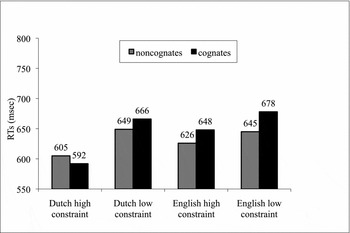
Lexical decision times for Dutch cognates and noncognates following Dutch and English high- and low-constraint sentences in Experiment 2 (Dutch lexical decision).

Percentage of errors for Dutch cognates and noncognates following Dutch and English high- and low-constraint sentences in Experiment 2 (Dutch lexical decision).

The same RT and error analyses were conducted as in Experiment 1. The analysis revealed a main effect of Sentence Language (F1(1,33) = 6.72, p = .014, η2 p = .169; F2(1,54) = 6.19, p = .016, η2 p = .103), a main effect for Semantic Constraint (F1(1,33) = 49.71, p < .001, η2 p = .601; F2(1,54) = 22.84, p < .001, η2 p = .297), and a main effect in the F1 analysis for Cognate Status (F1(1,33) = 10.24, p = .003, η2 p = .237; F2(1,54) = 2.42, p = .126, η2 p = .043). Mean RTs to target words were shorter for Dutch (628 ms) than for English (649 ms) sentence contexts. RTs to targets in high-constraint sentences (618 ms) were shorter than to those in low-constraint contexts (660 ms). Participants reacted 15 ms faster to non-cognates (631 ms) than to cognates (646 ms). There was also a significant interaction between Sentence Language and Semantic Constraint (F1(1,33) = 13.14, p = .001, η2 p = .285; F2(1,54) = 4.38, p = .041, η2 p = .075), between Sentence Language and Cognate Status (F1(1,33) = 6.28, p = .017, η2 p = .160; F2(1,54) = 2.93, p = .093, η2 p = .051), and an interaction between Semantic Constraint and Cognate Status that was significant in the F1 analysis (F1(1,33) = 4.48, p = .042, η2 p = .120; F2(1,54) = 1.12, p = .295, η2 p = .020).
Post-hoc paired samples t-tests showed that RTs to Dutch words in English and Dutch sentences did not differ significantly in the low-constraint condition (Dutch: 658 ms, English: 662 ms), but RTs for words in a Dutch high-constraint context (598 ms) were shorter (t 1(33) = 3.44, p = .002; t 2(55) = 3.35, p = .001) than for English high-constraint sentences (637 ms). There was an effect of constraint in Dutch (t 1(33) = 7.96, p = .001; t 2(55) = 4.83, p = .001) and in English sentences (t 1(33) = 3.18, p = .003; t 2(55) = 2.43, p = .018). Dutch high- constraint sentences (598 ms) were read 60 ms faster than Dutch low-constraint sentences (658 ms). English high constraint sentences (637 ms) were read 25 ms faster than English low-constraint sentences (662 ms). There was no effect of cognate status in the Dutch sentences (cognates: 629 ms, noncognates: 627 ms), but cognate (663 ms) and noncognate (635 ms) targets differed significantly after reading an English sentence context (t 1(33) = 3.52, p = .001; t 2(55) = 2.44, p = .018). In the high-constraint condition, RTs to cognates (620 ms) and noncognates (615 ms) did not differ significantly, but after reading low-constraint sentences, RTs to cognates (672 ms) were significantly slower (t 1(33) = 4.14, p < .001; t 2(55) = 1.92, p = .061) than RTs to noncognates (647 ms).
An analogous ANOVA on the error percentages with the factors Sentence Language (Dutch/English), Semantic Constraint (low/high constraint) and Cognate Status (cognate/control) did not yield any significant main effects or interactions. Error percentages were very low overall (1.4%).
Words in isolation
The data of the remaining 34 participants entered the same RT and error analyses as in Experiment 1. The mean RT to pseudowords was 558 ms with 6.3% errors. RTs for test words outside the range of 2.5 SDs from a participant's and item's mean were considered as outliers. Outliers and incorrect responses were excluded from further analysis (3.26% of the data). Mean RTs, SDs, and error percentages for the different conditions are presented in Table 3.
The RT and error data were subjected to analyses of variance (ANOVAs) with the factor Cognate Status (cognate/control). However, for these Dutch readings of the cognates, the RT and error analyses yielded no main effects for Cognate Status in the participant and item analysis. The mean RTs for cognates and controls were 481 ms and 479 ms, respectively, with mean error rates of 2.9% and 1.7%, respectively.
Discussion
As for the L2 English targets in Experiment 1, we obtained effects of language switching and sentence language, semantic constraint, and cognate status for the L1 Dutch targets in sentence context. With respect to the language switching effect in this Dutch lexical decision task, responses to Dutch words were 21 ms faster following Dutch sentences than following English sentences. With respect to semantic constraint, responses to Dutch words were 42 ms faster when these words followed high-constraint sentences compared to low-constraint sentences. There was also a significant main effect of cognate status in the participant analysis of Experiment 2, but it arose because the responses to cognates in sentence context were 15 ms slower than to controls, rather than faster, as in Experiment 1.
Importantly, the effects of cognate status were significantly modulated by sentence language and by semantic constraint, and the effect of sentence language was dependent on semantic constraint. The cognate inhibition effects were larger following English sentences than following Dutch sentences. They were also larger in the low-constraint sentences than in the high-constraint sentences. Furthermore, effects of sentence language (Dutch or English) were present in high-constraint contexts, but not in low-constraint contexts. In line with the available literature, these interactions indicate that lexical factors (like cognate status) cannot be considered separately from sentence factors (like semantic constraint and sentence language).
Finally, in the isolated word condition, no trace was observed of an L1 cognate effect. Similar RTs were obtained for Dutch cognates and control words. This result is not unexpected for Dutch L1 targets and has been found in other studies involving isolated target words (e.g., Van Hell & Dijkstra, Reference Van Hell and Dijkstra2002, for Dutch–French cognates in Dutch–English–French trilinguals with a low proficiency in their L3 French). Furthermore, we note that the L1 cognates in the isolated word condition had already been presented twice in a sentence condition.
The result pattern is in line with a view according to which bilingual readers are sensitive to aspects of the sentence context when they are processing subsequent target words. In isolation, the stronger readings of L1 cognates are activated so fast that the weaker L2 representations cannot affect their recognition. This purely L1 language situation results in a null effect. However, in a mixed sentence context, words from both languages (L1 and L2) are present and activated. This should foster a more balanced activation for the two languages. In an English (L2) sentence context, a Dutch (L1) lexical decision would then be made more difficult because the co-activation of the English cognate reading is strengthened by the sentence language.
This explanation can also be applied to the finding that in a low-constraint sentence context inhibition occurs irrespective of whether the preceding sentence is Dutch or English. As a result of the strengthened co-activation of English cognate readings in the mixed language context, a response selection problem arises and becomes visible in a cognate inhibition effect. In contrast, in Dutch high-constraint sentences, the preceding sentence in the strongest language (Dutch) facilitates a fast recognition of the Dutch target item. A post-hoc t-test on the cognates vs. non-cognates in this condition indeed reveals that the cognate inhibition effect is absent (instead, there is a non-significant facilitation effect of 13 ms, t 1(33) = 1.26, p = .218; t 2(55) = 1.224, p = .226).
General discussion
In two lexical decision experiments, English or Dutch target words (Dutch–English cognates or non-cognates) were presented following English or Dutch high- or low-constraining sentences. We manipulated the language of the sentence (switched or not switched; L1 or L2) preceding the target word, the semantic constraint exerted by this preceding sentence, and the cognate status of the target.
In L2 English lexical decision (Experiment 1), main effects of language switch, semantic constraint, and cognate status were obtained. English non-identical cognates (like English apple – Dutch appel) were facilitated relative to noncognates in both a Dutch and an English sentence context, and in both low- and high-constraint sentences. In the low-constraint sentences, stable cognate facilitation effects of on average 26 ms were obtained, while high-constraint sentences resulted in effects of about 38 ms. For comparison, at its third presentation, an English cognate in isolation still led to a facilitation effect of 21 ms relative to an English non-cognate control.
In L1 Dutch lexical decision (Experiment 2), exactly the same sentences were presented, but the target was Dutch (L1) rather than English (L2). In contrast to Experiment 1, significant cognate inhibition effects were obtained for targets in low-constraint sentences and in English sentences. In the isolated word and the high-constraint sentence conditions, however, no L1 cognate effect arose.
To account for the result patterns in both Experiments 1 and 2, we resort to the extension of the BIA+ model including a feature restriction hypothesis that was formulated in the Introduction. In the BIA+ model, L2 word representations in the bilingual lexicon on average have a lower resting level activation and thus a slower activation process than L1 word representations, because of the L2's lower subjective frequency of usage. The extended theoretical account for word recognition in sentence context makes three additional assumptions. (i) In the mixed language context of our experiments, both languages are and remain active, resulting in language non-selective lexical access and co-activation of cognate members. (ii) High or low semantic constraint provided by the sentence leads to, respectively, a more specific or a more general activation of potential target words; thus, in high-constraint conditions, activation of upcoming words that match all feature restrictions may be largely constrained to the target cognate and its translation in the other language, or to the control word. (iii) When a sentence preceding the target word consists of items from one particular language, a slightly larger activation of word candidates of that language ensues, increasing their competitiveness with the actual target word, especially in the case of the weaker L2 words. We now consider how these assumptions relate to the obtained empirical data.
With respect to language non-selective lexical access, there is strong evidence that both readings of cognates are co-activated in our mixed sentence study. In all conditions of both experiments, except in the Dutch high-constraint condition in Dutch lexical decision (Experiment 2), facilitatory or inhibitory cognate effects arose. Thus, the evidence supports the view that an initially language non-selective access process underlies word processing in our language-mixed lists of sentences and target words.
An initial co-activation of lexical candidates of both languages is also supported by the generalized effect of semantic constraint on target word processing. The RTs to target words from both languages were affected by the degree of semantic constraint provided by the preceding sentence. Faster responses were given to English and Dutch targets in high-constraint relative to low-constraint conditions. This finding confirms that the lexical decision on target words was affected by the semantic constraint provided by the sentence, implying that the lexical items were activated up to this level.
A general co-activation of cognate members is evident from the two experiments as well. The observed cognate facilitation and inhibition effects demonstrate that the recognition of target words in mixed sentence context was initially language non-selective. Importantly, the findings support the theoretical view that the facilitation effect for cognates must be accounted for in terms of their representation in the bilingual lexicon. One account (Dijkstra et al., Reference Dijkstra, Miwa, Brummelhuis, Sappelli and Baayen2010; Peeters et al., Reference Peeters, Dijkstra and Grainger2013; Van Hell & De Groot, Reference Van Hell and De Groot1998a; Voga & Grainger, Reference Voga and Grainger2007) holds that cognates (such as apple–appel) have different but co-activated orthographic representations in the two languages that largely converge on a common semantic representation (see Figure 2 above).
With respect to Experiment 1, the observed cognate facilitation effects for English targets in a (Dutch or English) low-constraint sentence context can be interpreted by assuming that in such sentences, cognates are co-activated in a similar way as in isolation. Neither the low-constraint sentence context, nor the language cue it provides, restricts the number of possible words activated by the input letter string to such an extent that the non-target member of the cognate is excluded from being activated or considered for recognition. In our Experiment 1, the facilitatory L2 cognate effect remained even in high-constraint sentences, in contrast to Van Hell and De Groot (Reference Van Hell and De Groot2008) who used practically the same sentence and word materials (but not in a language-mixed context), but in line with, for instance, Van Assche et al. (Reference Van Assche, Drieghe, Duyck, Welvaert and Hartsuiker2011).Footnote 3
With respect to Experiment 2, its mixed sentence presentation may again have led to a relatively high co-activation of both Dutch and English word candidates. In this experiment an inhibitory L1 cognate effect arose in the switch conditions (English high- and low-constraint) and in the low-constraint conditions for the English and Dutch targets. In the switch conditions, the English cognate reading was directly co-activated by the English sentence context. The observed switch costs indicate that under these circumstances the language of the preceding sentence (English) was strong enough to slow down the (fast) Dutch (L1) lexical decision in both high- and low-constraint conditions. In the Dutch low-constraint condition, no specific lexical candidate was activated on the basis of the sentence context, but the English reading of the cognate fit the semantic expectations and was therefore co-activated in parallel with the actual Dutch target reading. This resulted in a slight inhibition effect (17 ms) in this mixed language context, in comparison to the null results observed for Dutch target words presented in isolation (2 ms effect at their third presentation), where the English reading of the cognate was apparently activated too late to affect the lexical decision on the fast Dutch target. Finally, we note that a non-significant (13 ms) facilitatory effect arose in the Dutch (L1) high-constraint context. In this condition, a specific Dutch target might be expected on the basis of the preceding sentence. Thus, there was no integration problem and no significant effect of the slower English reading of the cognates.
In all, we propose the following mechanism to explain why facilitation effects arose in Experiment 1 for the English targets, but inhibition effects in Experiment 2 for the Dutch targets. Assuming that a particular language context strengthens its word representations (assumption (iii) above), in an L2 sentence context, the weaker L2 word representations become activated more quickly and strongly enough to be considered as potential targets. This leads to a delay in L1 lexical decision (Experiment 2), because the (subjectively high-frequent) L1 word representations were already activated early in target processing, but their lexical decision must await evaluation and disposal of the late incoming L2 information proposed by the sentence context. The result is inhibition of cognates relative to control words. However, for L1 sentences followed by L2 targets (Experiment 1), little is changed in terms of the targets’ processing and decision, because the L1 reading of the items was activated quickly anyway. In fact, there is time for L2 facilitation to arise for cognates relative to control words through resonance via shared semantics (see Figure 2).
In sum, the lexical decision times in our study reflect effects of the participants’ relative language proficiency (their L2 being weaker than their L1), task aspects (making a lexical decision), and item characteristics (e.g., the semantic constraint of the sentences and the items’ frequencies). A consideration of the experimental designs in the studies reviewed in the Introduction leads us to conclude that both language mixing and language switching affected the obtained result patterns. First, in our study, stimulus presentation was mixed with respect to language of the sentence context, in contrast to the blocked presentation by Van Hell and De Groot (Reference Van Hell and De Groot2008) and Schwartz and Kroll (Reference Schwartz and Kroll2006). Second, in our study target words were presented following a language switch in half of the sentences. In the other studies, it was the language of the target word that was varied, rather than the language of the preceding sentence. For instance, in Schwartz and Kroll (Reference Schwartz and Kroll2006), the preceding sentence context was always English, whereas the target words could be orthographically highly similar English–Spanish cognates or near-homographs. Thus, because our language mixing and switching involved sentence context rather than single target items, both languages should be co-activated to a larger degree. As a consequence, our procedure may have caused stronger cross-linguistic effects for words in sentences. This hypothesis extends that by Titone et al. (Reference Titone, Libben, Mercier, Whitford and Pivneva2011), based on their variation of stimulus list composition, to sentence mixing/switching vs. sentence blocking conditions.
We suggest that experimental factors that stimulate co-activation of (items of different) languages will result in persistent language non-selective effects of cognates in sentence context; factors that further a fast decision on the basis of one language (especially L1) will induce more language specific effects. As a result, a whole range of effects can be obtained, from purely language specific effects to strong co-activation effects.
There is evidence that the null results for cognates that are sometimes reported in bilingual studies (e.g., Gerard & Scarborough, Reference Gerard and Scarborough1989) may not necessarily reflect language selective access. For instance, effects may still be found in ERPs when they are absent in behavioral data (for neurophysiological studies on bilingual sentence processing and language switching, see e.g., Moreno, Federmeier & Kutas, Reference Moreno, Federmeier and Kutas2002; Proverbio, Leoni & Zani, Reference Proverbio, Leoni and Zani2004); slower participants or responses may show effects where faster participants or responses do not; and some tasks or types of presentation may show effects while others do not (also see Bultena, Dijkstra and Van Hell, Reference Bultena, Dijkstra and Van Hell2014). This confirms the adage that “the absence of evidence is not evidence of absence”.
At the same time, this position should not be taken to imply that co-activation of cognate readings is necessarily always there, irrespective of test conditions. The empirical evidence presented in this paper makes clear, for instance, that cognate effects are generally larger for L2 targets than for L1 targets, larger for L1 targets in low-constraint sentences than in high-constraint sentences, and, in comparison to other studies, larger in mixed language conditions than in pure language conditions (e.g., Van Assche, Duyck & Hartsuiker, Reference Van Assche, Duyck and Hartsuiker2012). According to the BIA+ model, the observed patterns of results follow from an interaction between sentence representations and lexical representations, rather than from an early (proactive) change in lexical processing dependent on context evaluation (as in a “language mode” approach, Grosjean, Reference Grosjean and Nicol2001).Footnote 4
Both experiments showed an effect of sentence language on target processing. Across the two experiments, the Dutch (L1) high-constraint sentence condition resulted in numerically smaller differences between cognate and non-cognate RTs than its English (L2) counterpart. Although not statistically significant in the reported interactions, it may be worthwhile to examine in future studies if Dutch (L1) high-constraint sentences can be more effective than similar English (L2) sentences in suppressing subsequent incongruent lexical activity.
Note that because the target language was different in the two experiments, the sentence condition that involved a language switch was also different: It was the Dutch sentence in Experiment 1 and the English sentence in Experiment 2 that led up to a language switch. Nevertheless, in both experiments, the language switch conditions led to RTs that were about 20 ms longer than in the non-switch conditions. In an ongoing EEG study, these switch effects between L1 sentences and L2 targets, and L2 sentences and L1 targets, are considered in detail from an electrophysiological perspective (Brenders, Dijkstra & Van Hell, Reference Brenders, Dijkstra and Van Hell2014).
Finally, although the present experiments included only nonidentical cognates, one might wonder what would be the expected results for a similar study involving form-identical cognates. First of all, the identical cognate facilitation effects in the isolated target and low-constraint sentence conditions would be expected to be larger than for nonidentical cognates (see Dijkstra et al., Reference Dijkstra, Miwa, Brummelhuis, Sappelli and Baayen2010). Furthermore, due to their cross-linguistic orthographic identity, identical cognates would not involve a clear language switch relative to a preceding sentence. For instance, in Experiment 1, the identical cognate target following a Dutch sentence could as well have been Dutch as English. According to the language non-selective activation account of BIA+, this should result in larger facilitation effects in Experiment 1, and smaller inhibition effects in Experiment 2, relative to those found for non-identical cognates. These predictions remain to be tested in future research.
To conclude, we have shown that a proper understanding of the bilingual's recognition of words in sentence context requires a theoretical view in which the complex interplay of the characteristics of lexical items and sentences is understood. There appears to be some truth in the saying that “context proposes, recognition disposes”. Indeed, the available monolingual and bilingual evidence suggests that a sentence context leads to the anticipation of particular items. When the actual target item arrives, a competitor set of lexical candidates are activated (the neighborhood or cohort). The ease of the subsequent integration of the target item in the sentence context then depends on the item's characteristics (e.g., frequency, concreteness, cognate status) in relation to this context (e.g., semantic fit, language membership). Both aspects may then contribute to the performance in a particular task, for instance, lexical decision. In all, the effect of sentence constraint on lexical access and, subsequently, on the observed language (non-)selectivity thus depends on the readers’ ability to recruit both sentence and lexical information in an efficient manner.
Supplementary material
For supplementary material accompanying this paper, visit http://dx.doi.org/10.1017/S1366728914000388