





Highlights
-
• Bilingual experience did not predict behavioral inhibitory control performance
-
• Greater social bilingual use predicted reduced N100 and N200 amplitudes
-
• Early markers of neural efficiency differences emerged despite equivalent behavioral outcomes
1. Introduction
Cognitive control is central to managing competing demands, regulating attention and flexibly shifting between goals. A growing body of research has examined how bilingual experience influences cognitive control across the adult lifespan, with findings linking bilingualism to performance on tasks measuring executive processes in both younger (e.g., Costa et al., Reference Costa, Hernández and Sebastián-Gallés2008; Luk et al., Reference Luk, Sa and Bialystok2011) and older adults (e.g., Bialystok et al., Reference Bialystok, Craik, Klein and Viswanathan2004, Reference Bialystok, Poarch, Luo and Craik2014), leading to the proposal that the constant coordination of two (or more) languages may transfer to domain-general cognitive systems (Kroll et al., Reference Kroll, Dussias, Bogulski and Kroff2012; see also Marian & Hayakawa, Reference Marian and Hayakawa2025). However, this view has been the subject of considerable discussion, with some studies and meta-analyses reporting inconsistent or null effects of bilingualism on executive function (e.g., Paap et al., Reference Paap, Johnson and Sawi2014; Paap & Greenberg, Reference Paap and Greenberg2013), while others have reported small but reliable advantages in domain-general cognitive control (e.g., Ware et al., Reference Ware, Kirkovski and Lum2020). In response, more recent theoretical perspectives have shifted from a transfer or “bilingual advantage” framework toward an adaptation account, proposing that bilingualism alters the efficiency and dynamics of control engagement rather than global performance benefits (Bialystok, Reference Bialystok2017, Reference Bialystok2024; Blanco-Elorrieta, Reference Blanco-Elorrieta2025). This perspective offers a subtle but important distinction between asking whether bilingualism enhances executive function and asking how bilingual experience reorganizes an underlying control system. As such, a key question remaining is: Under what specific contexts or conditions does bilingual experience give rise to adaptive changes in control efficiency?
To address this issue, recent work has emphasized the importance of capturing individual variation in language experience through continuous, multidimensional measures rather than categorical labels. Tools such as the Language and Social Background Questionnaire (LSBQ; Anderson et al., Reference Anderson, Mak, Keyvani Chahi and Bialystok2018b) enable researchers to capture such variation and characterize bilingualism more precisely. At the same time, innovations in task design, such as the adaptive Flanker Task (Draheim et al., Reference Draheim, Tsukahara, Martin, Mashburn and Engle2021, Reference Draheim, Tshukara and Engle2024), allow control processes to be measured with greater precision by minimizing speed-accuracy tradeoffs and capturing more informative performance metrics at the individual level. In parallel, neuroimaging methods such as electroencephalography (EEG) offer fine-grained, time-sensitive insights into the neural dynamics of cognitive control.
Building on these advances, the current study integrates EEG with an adaptive version of the classic Flanker task (i.e., a task that dynamically adjusts response demands) and continuous measures of bilingual experience to examine which specific features of the bilingual experience shape the neural dynamics of adaptive attentional control during conflict processing. Importantly, within an adaptation-based framework of bilingualism, we interpret the Flanker task not as isolating specific executive function components (e.g., inhibition), but rather as eliciting varying control demands that engage a flexible attentional control system.
1.1. Bilingual language control as an adaptive system
Because both languages are often co-activated, bilinguals must continuously select the intended language and suppress interference from the non-target one (e.g., Kroll et al., Reference Kroll, Dussias, Bogulski and Kroff2012; Kroll & Stewart, Reference Kroll and Stewart1994). These demands are thought to engage attentional control processes to monitor conflict, suppress irrelevant information and flexibly adapt to changing goals (Friedman & Miyake, Reference Friedman and Miyake2004). The IC Model provides a foundational account of bilingual language management, proposing that a supervisory control system selects the target language while suppressing interference from the non-target language (Green, Reference Green1998). This model conceptualizes language control as a domain-general mechanism whose demands vary with factors such as language dominance, proficiency and usage patterns. Extending this view, the Adaptive Control Hypothesis (ACH; Green & Abutalebi, Reference Green and Abutalebi2013) argues that bilinguals’ interactional demands, whether single-language, dual-language or dense code-switching environments, engage distinct control processes such as inhibition, goal maintenance and conflict monitoring to varying degrees. Importantly, within this framework, these processes are not treated as separable modules, but as components of a unified attentional control system that dynamically adapts to task demands. For instance, dual-language contexts, where individuals must frequently switch between languages may place strong demands on conflict monitoring and interference suppression, whereas dense code-switching may rely more on cooperative control processes to minimize inhibition of the non-target language. Together, these models emphasize that language control is not a fixed capacity, but rather an adaptive system shaped by the ecological and social demands of bilingual language use. Supporting this view, neuroimaging studies have shown that bilingual language control recruits the same fronto-parietal and cingulo-opercular networks implicated in non-linguistic IC tasks (Abutalebi et al., Reference Abutalebi, Annoni, Zimine, Pegna, Seghier, Lee-Jahnke, Lazeyras, Cappa and Khateb2008; Abutalebi & Green, Reference Abutalebi and Green2016; Anderson et al., Reference Anderson, Chung-Fat-Yim, Bellana, Luk and Bialystok2018a; Calabria et al., Reference Calabria, Costa, Green and Abutalebi2018; De Baene et al., Reference De Baene, Duyck, Brass and Carreiras2015; Green & Abutalebi, Reference Green and Abutalebi2013; Pereira Soares et al., Reference Pereira Soares, Prystauka, DeLuca and Rothman2022; Pliatsikas & Luk, Reference Pliatsikas and Luk2016), and that variation in bilingual experience predicts variability in long-term control network functional changes (DeLuca et al., Reference DeLuca, Rothman, Bialystok and Pliatsikas2020). Moreover, DeLuca et al. (Reference DeLuca, Rothman, Bialystok and Pliatsikas2020) found that bilinguals with more diverse and interactive language environments exhibit differences in white matter connectivity across control-related pathways (e.g., the superior longitudinal fasciculus), suggesting that language regulation demands may also drive plasticity in domain-general systems. Recent work further demonstrates that specific dimensions of bilingual experience, including L2 age of acquisition and engagement, for example, duration and diversity of language use, are associated with structural adaptations in domain-general cognitive control regions such as the inferior frontal gyrus and medial frontal cortex (DeLuca et al., Reference DeLuca, Voits, Ni, Carter, Rahman, Mazaheri, Krott and Segaert2024). These findings lend empirical support to the ACH, which posits that the brain adapts to the specific cognitive demands imposed by different patterns of bilingual interaction. Importantly, this relationship is not uniform, that is, different contexts of language use seem to engage distinct subcomponents of control. Therefore, individuals with distinct bilingual profiles may rely on different neural strategies to manage interference and switch between languages.
1.2. Neurophysiological markers of attentional control during conflict processing and the role of bilingualism
While fMRI research has shown that bilingual language control engages domain-general cognitive control networks (e.g., ACC, DLPFC; Abutalebi et al., Reference Abutalebi, Annoni, Zimine, Pegna, Seghier, Lee-Jahnke, Lazeyras, Cappa and Khateb2008; De Baene et al., Reference De Baene, Duyck, Brass and Carreiras2015), these findings primarily reflect where in the brain such control processes occur. However, the dynamic nature of language use and the rapid engagement of conflict monitoring and resolution during bilingual interaction also demands attention to when these control processes unfold. EEG offers a complementary window into these dynamics by capturing the timing of neural responses associated with attentional control processes during conflict. Specifically, the N100, N200 and P300 event-related potentials (ERPs) have been reliably linked to conflict monitoring and early control engagement during tasks such as the Flanker, Go/No-Go and Stroop (Folstein & Van Petten, Reference Folstein and Van Petten2008; Luck et al., Reference Luck, Woodman and Vogel2000; Polich, Reference Polich2007).
Although early components such as the N100 have been well-established as markers of early attentional orienting (Luck et al., Reference Luck, Woodman and Vogel2000; Vogel & Luck, Reference Vogel and Luck2000), evidence for bilingual modulation of this component is limited. Regardless, the N100 is important in the context of tasks that impose attentional control demands under conflict because it reflects early selective attention/filtering, that is, how effectively perceptual systems are tuned to goal-relevant features (Mangun & Hillyard, Reference Mangun and Hillyard1991; Thornton et al., Reference Thornton, Harmer and Lavoie2007; Zinchenko et al., Reference Zinchenko, Kanske, Obermeier, Schröger and Kotz2015). In this sense, the N100 provides an early neural index of attentional readiness that sets the stage for later control processes captured by the N200 and P300. Including it as a component of interest, therefore, allows us to test whether bilingual experience influences not only latter stages of control but also the initial-most stages of perceptual processing.
By contrast, the N200 and P300 have been linked to core control mechanisms and show much clearer sensitivity to bilingual language experience. The N200, typically observed over frontocentral electrodes between 200 and 350 ms, is closely associated with conflict detection and early inhibitory control, that is, early control engagement during conflict processing (Folstein & Van Petten, Reference Folstein and Van Petten2008). In paradigms using the classic Eriksen Flanker task (Eriksen & Eriksen, Reference Eriksen and Eriksen1974), incongruent trials reliably elicit larger (more negative) N200 amplitudes than congruent trials, reflecting increased engagement mechanisms that monitor and resolve response conflict (Kopp et al., Reference Kopp, Rist and Mattler1996; Yeung et al., Reference Yeung, Botvinick and Cohen2004). The P300, typically observed at parietal sites between 300 and 600 ms post-stimulus, has been shown to index attentional resource allocation and context updating in response to task-relevant stimuli (Donchin & Coles, Reference Donchin and Coles1988; Polich, Reference Polich2007). Within the Flanker paradigm, incongruent trials generally elicit delayed and sometimes reduced P300 amplitudes compared to congruent trials, reflecting the additional cognitive load associated with evaluating and resolving conflicting response information (Coles et al., Reference Coles, Gratton, Bashore, Eriksen and Donchin1985; Gratton et al., Reference Gratton, Coles, Sirevaag, Eriksen and Donchin1988; Kopp et al., Reference Kopp, Rist and Mattler1996). Importantly, both components have shown modulation as a function of bilingual experience, making them especially informative for probing potential adaptations of the control system in bilinguals. For instance, Markiewicz et al. (Reference Markiewicz, Mazaheri and Krott2023) reports that, compared to monolinguals, bilinguals showed larger N200 amplitudes (an index of enhanced conflict detection) and smaller P300 amplitudes, which reflect the allocation of attentional resources for stimulus categorization. In other words, bilinguals may maintain heightened conflict monitoring even when the task does not require it on most trials. Interestingly, bilinguals also exhibited longer reaction times, suggesting that stronger monitoring may occasionally delay response selection. In a related aging study, Kousaie and Phillips (Reference Kousaie and Phillips2017) used the Stroop, Simon and Flanker tasks to test whether bilingualism modulates domain general control processes, and whether these effects would be more apparent in neural than behavioral measures. Across all three tasks, the N200 and P300 revealed language group differences in processing dynamics, even when behavioral performance was matched. In the Flanker task specifically, bilinguals and monolinguals showed no significant differences in accuracy or reaction times, but ERP measures revealed diverging patterns in stimulus categorization indexed by P300 amplitude and latency. Additional ERP research further supports the view that bilingual experience selectively modulates early conflict-monitoring mechanisms. For example, studies using inhibitory-control paradigms such as negative priming have shown that N200 amplitude varies as a function of bilingual proficiency and stimulus type, suggesting that specific dimensions of bilingual experience shape early-stage control processes rather than producing uniform enhancements (Dash & Kar, Reference Dash and Kar2020). Collectively, these findings support the view that bilinguals may engage more proactive monitoring during cognitive conflict, potentially leading to a shift in processing emphasis, that is, increased early-stage conflict detection (N200) paired with reduced late-stage attentional engagement (P300) in order to keep up with task demands.
Further supporting evidence has also been found in EEG studies using time-frequency representations (TFRs). Carter et al. (Reference Carter, DeLuca, Segaert, Mazaheri and Krott2023) show that distinct factors of bilingual experience, for example, language switching and the intensity or diversity of bilingual language use, are associated with reduced midline-frontal theta power, suggesting more efficient top-down control, whereas longer duration of bilingual experience was related to diminished evoked P300 responses, interpreted as less effective bottom-up control. Similarly, Pereira Soares et al. (Reference Pereira Soares, Prystauka, DeLuca and Rothman2022) examined Flanker task performance among heritage speakers (HSs) and late L2 learners and found that bilingual social use modulated task-related theta and alpha power, despite no behavioral group differences. Together, these results suggest that bilingual experience likely shapes the efficiency, not the magnitude, of attentional control during conflict processing, reflected in more economical neural recruitment during conflict monitoring and resolution.
1.3. The present study
The present study builds on this foundation by utilizing a more precise adaptive version of the traditional Flanker task designed to reduce speed-accuracy trade-offs and provide psychometrically stronger individual difference estimates of attentional control under adaptive task demands (Draheim et al., Reference Draheim, Tsukahara, Martin, Mashburn and Engle2021) while examining trial-locked ERP components, namely the N100, N200 and P300 as indices of the temporal dynamics of conflict processing. Although prior work has shown that bilingual experience can modulate neural markers of attentional control during conflict processing, existing evidence remains limited in two important respects. First, few studies have examined how bilingualism influences the full sequence of early to late control processes; second, most research relies on categorical comparisons between monolinguals and bilinguals, leaving open the question of which specific dimensions of bilingual experience shape adaptive neural efficiency. The present study addresses these gaps by testing whether individual variability in bilingual experience predicts ERP indices of attentional control during conflict processing during an adaptive task optimized for individual differences.
Guided by an adaptation-based framework of bilingualism, we expect a richer bilingual experience to be associated with attenuated N100 amplitudes reflecting more efficient early filtering, reduced (less negative) N200 amplitudes indicating more efficient conflict monitoring and diminished or delayed P300 responses indexing reduced reliance on later-stage attentional resources. Because bilingual differences are often more apparent in neurophysiological than behavioral measures, we anticipate minimal behavioral differences across levels of bilingual experience, with neural dynamics providing more sensitive markers of underlying efficiency.
2. Methods
2.1. Design and protocol
This study draws on a subset of tasks from a larger 12-day pre/post longitudinal language learning study (redacted for anonymity). As part of the larger study, participants first completed a prescreening session in which they completed the LSBQ (Anderson et al., Reference Anderson, Mak, Keyvani Chahi and Bialystok2018b). If participants met prescreening procedures, they were invited to the lab to complete a pretest session. During this in-lab session, the participants completed a battery of cognitive and language tasks, including a reading span, picture naming, verbal fluency, and the adaptive Flanker task. The present analysis focuses specifically on data from the LSBQ and the Adaptive Flanker task administered during the pre-intervention session. The participants provided informed consent for both the prescreening and in-lab procedures. All study procedures and protocols were approved by the Institutional Review Board [redacted for anonymity], approval number IRB201902458.
2.2. Participants
Fifty-one undergraduate participants (M = 19.62 years, SD = 1.96) were recruited from the general student body. All participants were right-handed, reported no history of neurological or language-related disorders and had normal hearing and normal or corrected-to-normal vision. To ensure a range of language backgrounds, the sample spanned a continuum of bilingual experience, ranging from none to highly engaged bilingual language use. Participants were not excluded based on language background; instead, bilingual experience was treated as a continuous variable. Participants who reported no functional knowledge of Spanish were assigned zero values for Spanish proficiency and use measures and were not included in calculations of Spanish age, use, proficiency, etc. (see Section 2.3). Overall, monolinguals reported minimal exposure to other languages, while bilinguals self-identified either as HSs of Spanish or as L2 learners of Spanish. Heritage speakers (HSs) are defined as individuals who were exposed to and acquired Spanish in early childhood (age 0–4), typically in the home environment, but who later experienced a shift toward English dominance through schooling and broader socialization (Kupisch & Rothman, Reference Kupisch and Rothman2018; Rothman, Reference Rothman2009).
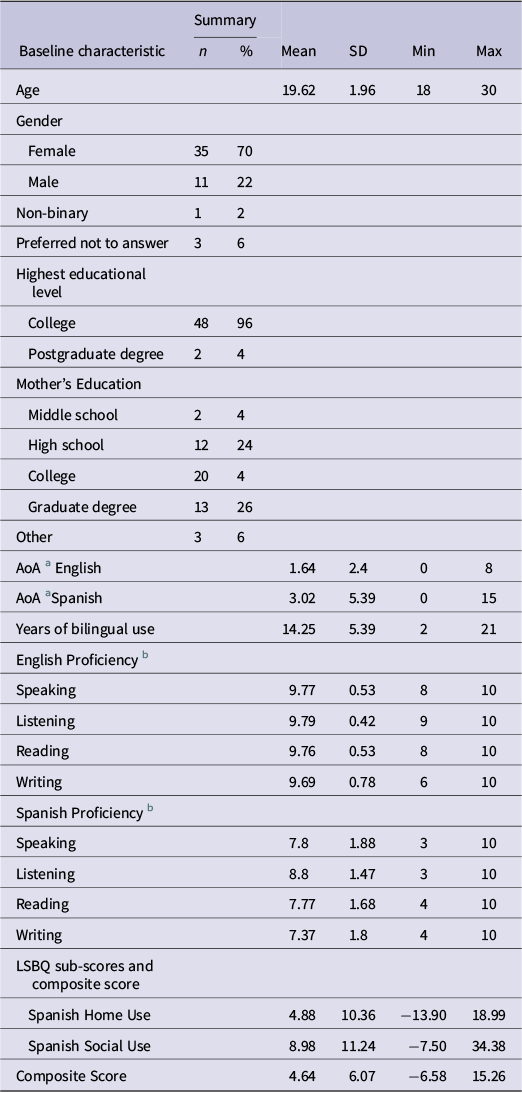
As part of behavioral data-quality procedures, participants whose overall accuracy on the Flanker task fell more than 3.5 SD below the sample mean were excluded. This criterion resulted in the removal of one participant (2% of the sample), yielding a final n = 50 participants included in all final analyses. Additional participant characteristics are provided in Table 1.
Demographic and language characteristics of participants

Table 1. Long description
A table with seven columns: Baseline characteristic, Summary n, Summary percent, Mean, S D, Min, and Max.
* Age: Mean 19.62, S D 1.96, Min 18, Max 30.
* Gender: Female (n=35, 70 percent), Male (n=11, 22 percent), Non-binary (n=1, 2 percent), Preferred not to answer (n=3, 6 percent).
* Highest educational level: College (n=48, 96 percent), Postgraduate degree (n=2, 4 percent).
* Mother’s Education: Middle school (n=2, 4 percent), High school (n=12, 24 percent), College (n=20, 40 percent), Graduate degree (n=13, 26 percent), Other (n=3, 6 percent).
* A o A English: Mean 1.64, S D 2.4, Min 0, Max 8.
* A o A Spanish: Mean 3.02, S D 5.39, Min 0, Max 15.
* Years of bilingual use: Mean 14.25, S D 5.39, Min 2, Max 21.
* English Proficiency (10-point scale): Speaking (Mean 9.77), Listening (Mean 9.79), Reading (Mean 9.76), Writing (Mean 9.69).
* Spanish Proficiency (10-point scale): Speaking (Mean 7.8), Listening (Mean 8.8), Reading (Mean 7.77), Writing (Mean 7.37).
* L S B Q sub-scores and composite score: Spanish Home Use (Mean 4.88), Spanish Social Use (Mean 8.98), Composite Score (Mean 4.64, S D 6.07, Min minus 6.58, Max 15.26).
Note: Higher LSBQ composite scores reflect greater engagement with Spanish and more balanced bilingual language use, whereas lower (negative) scores reflect greater English dominance and minimal Spanish use.
a Reflects age of acquisition.
b Reflects self-rated proficiency on a 10-point scale.
2.3. Measuring language experience: The LSBQ
Bilingual language experience was quantified using the LSBQ (Anderson et al., Reference Anderson, Mak, Keyvani Chahi and Bialystok2018b), a validated multidimensional measure designed to capture the complexity and heterogeneity of bilingual language use (Dass et al., Reference Dass, Smirnova-Godoy, McColl, Grundy, Luk and Anderson2024). The LSBQ assesses participants’ language history, proficiency and patterns of use across diverse social and environmental contexts. It includes self-report ratings for each known language on dimensions such as age of acquisition, frequency of use, proficiency in speaking, listening, reading and writing and language dominance across different settings (e.g., home, work/school, social interactions).
Responses were scored using the standardized LSBQ composite algorithm (see details in Anderson et al., Reference Anderson, Mak, Keyvani Chahi and Bialystok2018b), implemented through the publicly available scoring tool (see online resource here: https://doi.org/10.6084/m9.figshare.3972486). This composite score reflects the degree of bilingual engagement, with higher positive values indicating greater use and proficiency in a non-English language and more balanced bilingual experience and lower (or negative) scores indicating greater English dominance or minimal non-English engagement. The composite score integrates weighted contributions from all subcomponents – home and social language use, proficiency self-ratings and contextual switching – based on the validated factor structure established through principal component and confirmatory factor analyses shown in Anderson et al. (Reference Anderson, Mak, Keyvani Chahi and Bialystok2018b).
2.4. Adaptive flanker task
To address reliability concerns in measuring individual differences in executive function tasks (see discussions in Draheim et al., Reference Draheim, Mashburn, Martin and Engle2019; Hedge et al., Reference Hedge, Powell and Sumner2018), participants completed the adaptive-threshold version of the Eriksen Flanker task (Draheim et al., Reference Draheim, Tsukahara, Martin, Mashburn and Engle2021). This version modifies the classic Flanker task by implementing a trial-wise adaptive staircase that continuously adjusts the response deadline based on each participant’s performance, thereby reducing speed-accuracy strategies.
Before beginning the main portion of the task, the participants completed a calibration block (72 trials) designed to initialize each participant’s individualized response deadline. During this block, the response deadline was adjusted based on accuracy using a block-level criterion: participants who responded correctly on at least 15 of 18 trials (~83%) received a shorter response deadline for the next block, whereas those who fell below the criterion received a longer deadline. Accordingly, no participants were removed due to low accuracy during the task; instead, participants with lower accuracy were given longer response deadlines to support task engagement. This adaptive calibration ensured that all participants entered the main task with a deadline matched to their baseline performance. Following this calibration phase, participants completed 288 trials distributed across four blocks of 72 trials, with a 2:1 ratio of congruent to incongruent trials. During the main portion of the task, an adaptive staircase procedure modified the response deadline based on congruent trials only. If a response was incorrect or too slow, the deadline increased (making the next trial easier); if a response was correct and within deadline, the deadline decreased (making the next trial harder). The initial deadline was 1500 ms, with a 3:1 step-size ratio, such that increases in the deadline (after lower accuracy within a block) were three times larger than decreases (after meeting the accuracy criterion within a block). For example, failing to meet the accuracy criterion resulted in a 90 ms increase in the deadline, whereas meeting the criterion resulted in a 30 ms decrease. These adjustments were applied at the block level rather than on a trial-by-trial basis.
This adaptive procedure improves the reliability of individual-difference estimates by encouraging participants to balance speed and accuracy and by minimizing between-subject variability due to response strategy. Importantly, the adaptive timing does not alter computation of the Flanker effect itself. Because responses exceeding the adaptive deadline were treated as incorrect and did not yield valid reaction time values, traditional trimming of slow reaction time outliers was not applied. Trials with reaction times shorter than 200 ms were however excluded, and participants with mean accuracy more than 3.5 SD below the group mean were removed at the sample level (see Section 2.2), consistent with recommendations for filtering low-quality data (Draheim et al., Reference Draheim, Mashburn, Martin and Engle2019; Hedge et al., Reference Hedge, Powell and Sumner2018). High-accuracy outliers were not removed as accuracy distributions in Flanker tasks exhibit ceiling effects and extreme high performance does not reflect invalid data.
2.5. ERP recording and preprocessing
Continuous EEG was recorded using an array of 32 Ag/AgCl scalp active electrodes (BrainVision, Brain Products GmbH, Gilching, Germany), arranged according to the 10–20 system. For online referencing and later re-referencing, two electrodes were placed on the right and left mastoids, respectively. Impedance was maintained below 10 kΩ. Additionally, two sets of bipolar electrooculogram (EOG) electrodes were placed above and below the left eye and on the right and left canthi to measure vertical and horizontal eye movements, respectively. The signal was amplified using a BrainVision actiCHamp amplifier with 24-bit analog-to-digital conversion (Brain Products, München, Germany) and continuously recorded at a sampling rate of 1000 Hz without online filtering. All data were preprocessed offline using Brain Vision Analyzer (BVA) version 2.3 (Brain Products GmbH, Gilching, Germany). Raw EEG data were first band-pass filtered using a 0.1–30 Hz IIR Butterworth filter with a 12 dB/octave slope. Horizontal and vertical eye movements were detected using the automatic independent component analysis (ICA) implemented in BVA. ICA was performed on the entire dataset using 512 steps and a restricted infomax (Gradient) algorithm. To avoid violating the assumption of independence and to maximize accuracy in eye artifact detection, bipolar eye channels were excluded from ICA following recommendation by Zhang et al. (Reference Zhang, Garrett, Simmons, Kiat and Luck2023). The continuous EEG signal was then re-referenced offline to the average of the two mastoids (the original reference remained in the dataset but was not used for subsequent analyses) and segmented into epochs time-locked to the presentation of picture stimuli (−200 ms to 800 ms). The signal was baseline-corrected using the −200 ms pre-stimulus interval. Artifact rejection was performed using a semi-automatic procedure following ICA-based artifact correction. Trials were flagged for rejection based on a maximum voltage step of 50 μV/ms (gradient), a peak-to-peak amplitude difference exceeding 200 μV within 200 ms intervals and low signal activity below 0.5 μV within 100 ms intervals. These criteria were applied within a window extending 200 ms before and after stimulus onset across all included channels. Artifact rejection was minimal across participants (mean rejection rate < 1%, SD < 0.05%). Accordingly, no participants were excluded due to excessive data loss. Epochs were then averaged per condition and participant across all trial types: Congruent and Incongruent.
To examine the entire trajectory of attentional controls at the neurophysiological level, we focused on three ERP components: N100 (50–150 ms), N200 (180–320 ms) and P300 (330–600 ms). These time windows were selected a priori based on prior literature. Specifically, the N100 window was chosen to capture early attentional orienting (Luck et al., Reference Luck, Woodman and Vogel2000; Vogel & Luck, Reference Vogel and Luck2000), the N200 window to capture conflict monitoring processes reliably observed in Flanker paradigms (Folstein & Van Petten, Reference Folstein and Van Petten2008; Kopp et al., Reference Kopp, Rist and Mattler1996) and the P300 window to capture attentional resource allocation and context updating (Coles et al., Reference Coles, Gratton, Bashore, Eriksen and Donchin1985; Polich, Reference Polich2007).
2.6. Data analyses
All statistical analyses were conducted in R (V4.1.2; R Core Team 2021 ). Linear mixed-effects models (LMMs) were fit using the lmerTest package (Kuznetsova et al., Reference Kuznetsova, Brockhoff and Christensen2017) with restricted maximum likelihood (REML) estimation. The significance of fixed effects was evaluated using Satterthwaite’s approximation for degrees of freedom, as implemented in the lmerTest package, which provides p-values for fixed effects in LMMs. Continuous predictors were mean-centered and categorical predictors (e.g., congruency) were treatment-coded with congruent as the reference level.
ERP outcomes were mean amplitudes (μV) extracted from three predefined time windows: N100 (50–150 ms), N200 (180–320 ms) and P300 (330–600 ms). Amplitudes were calculated at the electrode level and then aggregated by subject, condition and region of interest (ROI). Electrodes were grouped into non-overlapping ROIs based on scalp location as follows: Left Anterior (Fp1, F7, F3, FC5, FC1 and FT9), Right Anterior (Fp2, F8, F4, FC6, FC2 and FT10), Left Posterior (T7, C3, CP5, CP1, P and P7), Right Posterior (T8, C4, CP6, CP2, P4 and P8), Posterior (O1, Oz and O2) and Central (Fz, Cz and Pz). Bipolar EOG channels were recorded to facilitate artifact rejection but were excluded from analyses.
For each time window, separate LMMs were fitted with fixed effects of Condition (Congruent versus Incongruent) and ROI and random intercepts for participants with random slopes for Condition where model convergence allowed. Only correct-response trials were included to isolate neural activity associated with successful conflict processing. The analyses proceeded in two stages. First, a baseline model (Model 1) tested the effects of Condition and ROI on ERP amplitudes. Second, to examine individual differences, we fit two sets of extended models (Models 2 and 3). Model 2 included the LSBQ composite score as an index of overall bilingual experience. The purpose of Model 2 was to capture the global association between bilingual engagement and ERP amplitudes. Model 3 included the LSBQ sub-scores (Non-English Home Use, Non-English Social Use, English Proficiency) to capture as fine-grained dimensions of bilingual experience. Composite and sub-score measures were entered in separate models to avoid redundancy and multicollinearity, as the composite score was derived from these components. The Flanker interference effect (ms difference between incongruent and congruent RTs) was included only in Model 3 as a covariate to account for individual differences in domain-general inhibitory control. This allowed us to assess whether specific dimensions of bilingual experience uniquely predict ERP amplitudes beyond the behavioral indices of inhibitory control, while Model 2 provides a more global estimate of the association between bilingual experience and neural responses.
Model selection was evaluated using Akaike information criterion (AIC) and Bayesian information criterion (BIC) comparisons. Significant interactions were probed using simple slopes analyses and Johnson–Neyman intervals using the interactions package (Long, Reference Long2019). Estimated marginal means and Tukey-adjusted pairwise comparisons were obtained using the emmeans package (Lenth & Lenth, Reference Lenth and Lenth2018) where applicable. Data exclusion followed standard procedures. For EEG, trials with uncorrected ocular or muscular artifacts were removed during preprocessing (see Section 2.3). For the Flanker task, RTs shorter than 200 ms and participants with accuracy values exceeding 3.5 SDs below the sample mean were excluded prior to computing the interference effect. To control for multiple comparisons across bilingualism-related predictors, false discovery rate (FDR) correction was applied separately within each ERP component window (N100, N200, P300) to all bilingualism terms tested across models. For all fixed effects, we report unstandardized regression coefficients (b), standard errors (SE), t-values, degrees of freedom and p values.
3. Results
3.1. Behavioral performance
During the calibration phase (see details in Section 2), participants correctly responded to an average of 15.39 trials (SD = 1.78). Based on performance, the deadline was decreased for 35 participants and increased for 14 participants, yielding an average final arrow-duration deadline of 554.08 ms (SD = 163.76). This ensured that participants who performed well were given a shorter response window in subsequent blocks, while those performing below the criterion received additional time.
On average, participants responded faster on congruent trials (M = 377.58 ms, SD = 25.81) than on incongruent trials (M = 419.62 ms, SD = 33.79). A paired-samples t-test confirmed a robust interference effect such that participants responded significantly more slowly on incongruent trials than congruent trials, t(49) = −17.49, p < .001, with a mean difference of 42.04 ms (95% CI [37.21, 46.87]).
To examine whether bilingual experience influenced Flanker performance, linear models were fit to predict (a) the interference effect and (b) overall accuracy. Although the adaptive procedure stabilizes performance by adjusting response deadlines, accuracy is not fixed and continues to vary across participants. As such, overall accuracy provides a complementary measure of performance, reflecting the ability to maintain accurate responding under adaptive task demands. The LSBQ Composite Factor Score did not significantly predict Flanker performance, that is, interference effect (b = 0.23, SE = 0.40, t(45) = 0.59, p = .56) or accuracy (b = −0.00008, SE = 0.00075, t(45) = −0.10, p = .92). When LSBQ sub-scores were examined separately, neither Non-English Home Use and Proficiency (b = 0.53, SE = 0.35, t(44) = 1.50, p = .14) nor Non-English Social Use (b = −0.35, SE = 0.33, t(44) = −1.07, p = .29) significantly predicted the interference effect. Similarly, neither sub-score predicted accuracy (both p > .48). In sum, these analyses indicate that bilingual experience, whether measured globally or separated by usage context, did not significantly modulate behavioral performance on the Flanker task.
3.2. Neurophysiological results: ERPs
3.2.1. N100 (50–150 ms)
The N100 time window was selected to capture early attentional orienting to index initial perceptual engagement with task stimuli. For this window, a series of LME models were estimated to examine condition effects and individual differences related to bilingual experience. Model 1 (baseline model) included Condition (congruent versus incongruent) and ROI as fixed effects with random intercepts for participants. No main effect of condition was observed (b = 19.89, SE = 89.25, t(87.79) = 0.22, p = .82). However, a significant Condition by ROI interaction was found, such that incongruent trials elicited less negative (smaller) N100 amplitudes compared to congruent trials; inspection of the interaction terms revealed that this effect was driven by the Left Anterior cluster (b = −145.53, SE = 65.82, t(2368) = −2.21, p = .03). This topographic distribution is in line with canonical N100 effects typically observed over frontocentral regions (Vogel & Luck, Reference Vogel and Luck2000). See Figure 1 for ERP plots.
ERP Plots: N100, N200 and P300 during Flanker Task. Note: Grand-average stimulus-locked ERPs are shown for congruent (black) and incongruent (red) trials. (A) Shows the N100 component (50–150 ms), plotted from left to right at FP1, FP2 and Fz. (B) Shows the N200 component (180–320 ms), plotted from left to right at O1, O2 and Oz. (C) Shows the P300 component (330–600 ms), plotted from left to right at Pz, Cz and Fz. Shaded gray regions demark component peaks. Scalp topographies depict mean voltage distributions (μV) across the corresponding analysis time windows for each condition, with warmer colors indicating higher voltage values and cooler colors indicating lower voltage values. Across components, incongruent trials elicit enhanced early negativities (N100, N200) and a larger P300 relative to congruent trials.

Figure 1. Long description
The figure is organized into three horizontal rows, each containing three line graphs and a set of four scalp topography maps.
Row 1 (N 100 component):
* Three line graphs show voltage in microvolts on the y-axis against time in milliseconds on the x-axis for electrodes F P 1, F P 2, and F z.
* A shaded gray region highlights the N 100 peak between 50 and 150 ms.
* Incongruent trials (red line) show a more negative peak than congruent trials (black line).
* Four scalp maps on the right show a transition from green to yellow/red at the posterior, indicating increasing voltage over time.
Row 2 (N 200 component):
* Three line graphs for electrodes O 1, O 2, and O z.
* A shaded gray region highlights the N 200 peak between 180 and 320 ms.
* Incongruent trials show a deeper negative deflection compared to congruent trials.
* Four scalp maps show intense red coloration across the central and posterior regions, indicating high mean voltage.
Row 3 (P 300 component):
* Three line graphs for electrodes P z, C z, and F z.
* A shaded gray region highlights the P 300 peak between 330 and 600 ms.
* Incongruent trials show a significantly larger positive peak (downward on these axes) than congruent trials.
* Four scalp maps show a broad distribution of deep red across the entire scalp, representing the highest voltage values in the set.
To test whether overall bilingual experience predicted variability in N100 amplitudes, the LSBQ composite factor score was added in Model 2. Although this addition improved model fit relative to the baseline (AIC ≈ −3,500), the composite score was not a significant predictor (b = 11.36, SE = 8.58, t(35) = 1.32, p = .19), nor did it interact with condition.
Next, LSBQ sub-scores were added to Model 3 to test whether specific facets of bilingual experience accounted for individual differences in the N100 amplitude. Non-English Social Use emerged as a significant predictor, with greater social use associated with smaller, that is, less negative N100 amplitudes (b = 22.19, SE = 10.59, t(28.80) = 2.10, p = .045). However, this effect did not survive FDR correction (p_FDR = .38) applied across all bilingualism-related predictors within the N100 family. Condition × ROI effects also persisted, with incongruent trials eliciting attenuated N100s at the Left Anterior (b = −153.00, SE = 73.09, t(1904) = −2.09, p = .04), Posterior (b = 176.76, SE = 84.40, t(1904) = 2.09, p = .04) and Right Posterior ROIs (b = 151.68, SE = 73.09, t(1904) = 2.08, p = .04). Model 3 provided the best overall fit (lowest AIC/BIC).
3.2.2. N200 (180–320 ms)
The N200 window was selected as it is a well-established marker of conflict detection and early inhibitory control – functions strongly implicated in the Flanker paradigm. The same series of LME models were estimated for the N200 window. Model 1 (baseline model) examined Condition and ROI effects on N200 amplitudes. No main effect of condition was observed (b = 174.39, SE = 181.63, t(71.32) = 0.96, p = .34). However, again, a significant Condition by ROI interaction was observed, indicating that the effect of condition varied across scalp regions. A follow-up inspection of the interaction terms showed that, consistent with typical scalp distribution of the N200 (Folstein & Van Petten, Reference Folstein and Van Petten2008), incongruent trials elicited more negative amplitudes than congruent trails at the Left Anterior ROI (b = −371.30, SE = 117.67, t(2368) = −3.16, p = .002). See Figure 1 for ERP plots.
Next, to test whether overall bilingual experience predicted variability in the N200 amplitude, the LSBQ composite factor score was added in Model 2. As for the N100 model, model fit improved relative to the baseline, but the composite score was not a significant predictor (b = 13.11, SE = 11.20, t(35) = 1.17, p = .25) and did not interact with condition.
Finally, LSBQ sub-scores were tested in Model 3 to examine if specific facets of bilingual experience accounted for N200 variability. Again, greater Non-English Social Use significantly predicted less negative N200 amplitudes (b = 39.61, SE = 17.62, t(28.36) = 2.25, p = .03), indicating reduced conflict-monitoring activity among individuals with greater social use of a non-English language. However, as for the N100, this effect did not survive the FDR correction applied across bilingualism-related predictors (p_FDR = .38). The Condition × ROI effect at the Left Anterior ROI remained significant (b = −325.84, SE = 130.90, t(1904) = −2.49, p = .01). And model comparison confirmed that Model 3 provided the best overall fit (lowest AIC/BIC).
3.2.3. P300 (330–680 ms)
The P300 time window was selected as an index of attentional resource allocation and context updating. In the P300 window, Model 1 (baseline model) tested the effects of Condition and ROI on P300 amplitudes. A robust main effect of condition emerged, with incongruent trials eliciting significantly larger P300 amplitudes than congruent trials (b = 1154.67, SE = 379.73, t(64.78) = 3.04, p = .003). Several Condition by ROI interactions were also significant, indicating wide spread distribution of this (in)congruency effect: Left Anterior (b = −1074.35, SE = 227.16, t(2368) = −4.73, p < .001), Posterior (b = −604.33, SE = 262.30, t(2368) = −2.30, p = .02) and Right Anterior (b = −752.38, SE = 227.16, t(2368) = −3.31, p = .001).
Next, the LSBQ composite factor score was added in Model 2 to test whether overall bilingual experience predicted variability in P300 amplitude. Although the model fit improved relative to the baseline, the composite score was again not a significant predictor (b = 7.46, SE = 25.94, t(35) = 0.29, p = .78) and did not interact with condition (b = −20.92, SE = 49.29, t(35) = −0.42, p = .68).
Finally, LSBQ sub-scores were entered in Model 3. Unlike for the N100 and N200 windows, none of the sub-scores significantly predicted P300 amplitudes (all p ≥ .18), and no significant interactions with condition were observed. Condition by ROI effects remained robust, particularly at the Left Anterior ROI (b = −943.81, SE = 249.44, t(1904) = −3.78, p < .001). Model comparison indicated that Model 3 provided the best overall fit while confirming that bilingual experience measures did not account for additional variance beyond the strong main effect of condition. See Figure 1 for ERP plots.
4. Discussion
The present study examined how individual differences in bilingual experience relate to behavioral and neurophysiological indices of Inhibitory Control (IC), as measured by an adaptive Flanker task and ERPs. At the behavioral level, participants showed the expected Flanker interference effect, responding more slowly to incongruent than congruent trials (M Flanker interference = 42.04 ms), with overall high accuracy (M = .94). The adaptive procedure effectively equated task difficulty across individuals and worked to reduce variability associated with strategy differences or speed–accuracy trade-offs. Under these conditions, bilingual experience did not predict differences in reaction time interference or accuracy, either when measured as a composite LSBQ factor or as separate home and social use sub-scores.
In contrast, ERP analyses revealed nominal neural modulations as a function of bilingual experience. Although overall bilingualism (composite LSBQ score) was not predictive, greater Non-English Social Use showed associations with attenuated N100 and N200 amplitudes, suggesting potentially reduced early sensory and conflict-monitoring responses. While these effects did not survive FDR correction, and should therefore be interpreted with caution, the direction of effects nevertheless aligns with prior work (e.g., Markiewicz et al., Reference Markiewicz, Mazaheri and Krott2023; Pereira Soares et al., Reference Pereira Soares, Prystauka, DeLuca and Rothman2022).
The present findings are also informative in relation to Carter et al. (Reference Carter, DeLuca, Segaert, Mazaheri and Krott2023), where broader measures of bilingual experience were examined using latent variables such as diversity of language use, in contrast to the LSBQ sub-scores used here. Across both studies, there is converging evidence that bilingual experience is associated with modulation of neural indices of cognitive control. However, the stage at which these effects occur differs. Carter et al. (Reference Carter, DeLuca, Segaert, Mazaheri and Krott2023) observed modulation at later processing stages such as the P300, whereas the present study observed modulation at earlier stages including the N100 and N200.
One interpretation of this pattern is that bilingual experience may shift the temporal dynamics of control, with greater experience associated with increased efficiency at earlier stages of processing, thereby reducing the need for later-stage attentional engagement. In this sense, the present findings align with broader neurocognitive models of bilingualism that emphasize experience-dependent neural efficiency, including frameworks such as the BAPSS model (Grundy et al., Reference Grundy, Anderson and Bialystok2017a), the UBET model (DeLuca et al., Reference DeLuca, Rothman, Bialystok and Pliatsikas2019), and the Dynamic Restructuring Model (Pliatsikas, Reference Pliatsikas2020). Although these models are primarily grounded in structural and large-scale neuroimaging evidence, they converge on the idea that bilingual experience leads to more efficient engagement of specific control processes. The present ERP findings extend this perspective by suggesting that such efficiency may also be reflected in the temporal dynamics of processing, particularly at early stages of attentional allocation and conflict monitoring.
However, in the present study, these effects did not survive correction for multiple comparisons and were not accompanied by modulation at later stages. Therefore, while these findings should be considered preliminary and interpreted with caution, we posit that differences across studies may reflect variation in how bilingual experience is operationalized, including the use of latent variables versus sub-scores, as well as differences in sample characteristics and statistical power.
This interpretation is consistent with a more recent distributed control account, which posits that cognitive control is task and domain specific and is implemented through functionally tuned neural systems rather than a centralized executive resource (Nozari, Reference Nozari2020; Zhu et al., Reference Zhu, Wang, Zhao, Nozari, Notebaert and Braem2025). Within this account, control arises from the coordination of representational and monitoring processes that are specialized for the cognitive domain in question. In the language domain, this includes mechanisms supporting lexical selection, error detection, and conflict resolution during production (Nozari & Novick, Reference Nozari and Novick2017). Under this view, bilingual experience may recalibrate these distributed control circuits to efficiently manage recurrent linguistic conflicts, for example, lexical competition between languages, syntactic interference, and monitoring for cross-language intrusions (Green & Abutalebi, Reference Green and Abutalebi2013), and over time, bilingual experience may confer language-specific-control neural adaptations (e.g., Abutalebi & Green, Reference Abutalebi and Green2016; Anderson et al., Reference Anderson, Mak, Keyvani Chahi and Bialystok2018b; Pliatsikas & Luk, Reference Pliatsikas and Luk2016) without necessarily generalizing to nonlinguistic control contexts, for example, visuospatial interference tasks as measured by tasks like the Flanker.
Our ERP findings suggest that the boundaries between domain-specific control systems may be more permeable than a strictly task-specific account would predict. While the theory predicts that control adaptations should be confined to their representational domain (e.g., linguistic versus nonlinguistic), the attenuated N100 and N200 amplitudes observed here suggest that experience-based efficiency in attentional allocation and conflict monitoring can extend across domains at the neural level even when behavioral outcomes remain domain specific. Rather than reflecting shared control resources, this pattern may indicate shared computational principles, such as predictive monitoring or reduced neural gain, that operate across both linguistic and nonlinguistic control systems (Kuperberg & Jaeger, Reference Kuperberg and Jaeger2016; Lupyan & Clark, Reference Lupyan and Clark2015; see also Friston, Reference Friston2012). Under predictive coding accounts, efficient control reflects reduced prediction error and optimized resource allocation rather than greater inhibitory strength per se. In this sense, bilingualism may not enhance domain-general inhibition, but it may optimize the engagement of early perceptual and monitoring processes across contexts that require selective attention or conflict detection (e.g., Chung-Fat-Yim et al., Reference Chung-Fat-Yim, Sorge and Bialystok2017; Friesen et al., Reference Friesen, Latman, Calvo and Bialystok2015; Grundy et al., Reference Grundy, Chung-Fat-Yim, Friesen, Mak and Bialystok2017b).
This interpretation is consistent with converging neuroimaging and electrophysiological evidence showing that bilingual language control draws on partially overlapping yet functionally distinct neural systems from those engaged in domain-general control. For instance, Anderson et al. (Reference Anderson, Chung-Fat-Yim, Bellana, Luk and Bialystok2018a) found that bilinguals, unlike monolinguals, recruited largely shared neural networks for both verbal and nonverbal task switching, suggesting that bilingual experience fosters a more integrated yet flexibly tuned control architecture. Similarly, Blanco-Elorrieta and Pylkkänen (Reference Blanco-Elorrieta and Pylkkänen2017) demonstrated a dissociation between comprehension and production control in highly proficient bilinguals such that language switching in production engaged domain-general dorsolateral prefrontal regions overlapping with nonlinguistic category switching, whereas switching in comprehension selectively activated the anterior cingulate cortex – indicating that even within bilingual control, neural implementation varies by linguistic domain. Complementary ERP evidence from Magezi et al. (Reference Magezi, Khateb, Mouthon, Spierer and Annoni2012) similarly revealed distinct ERP signatures for linguistic versus nonlinguistic task switching, supporting the idea of a partly independent language-control mechanism situated within, but not reducible to, the broader cognitive control network. Thus, while distributed control theories accurately predict the absence of broad behavioral generalization, the present ERP trends suggest that bilingual experience-based efficiency in early attentional and conflict-monitoring mechanisms (indexed by the N100 and N200) can generalize across task domains. In sum, this pattern points to shared computational principles of efficient resource allocation, rather than shared control resources.
A final point of discussion is the specificity of the bilingual experience effects observed. Among the LSBQ measures, only social language use, not overall bilingualism or home use, predicted modulation of early neural control ERP responses. Although the present study cannot directly determine what “social use” entailed for individual participants, this pattern converges with recent work emphasizing that interactional diversity and language entropy, that is, the variability and unpredictability of bilingual contexts, are key determinants of bilingual control adaptation (Beatty-Martínez & Titone, Reference Beatty-Martínez and Titone2021; Gullifer & Titone, Reference Gullifer and Titone2020). Within this language entropy framework, social language use is posited to capture experiences that require speakers to flexibly manage cross-language activation, track interlocutors’ language preferences, and switch dynamically between linguistic systems. In contrast, global composite scores that collapse across multiple facets of bilingual experience (e.g., proficiency, exposure, and history) may potentially dilute or obscure the specific contribution of interactional control demands (Luk & Bialystok, Reference Luk and Bialystok2013). Similarly, home use may represent more predictable, routine language contexts that rely less on online monitoring or adaptive control. In this view, the attenuated N100/N200 amplitudes associated with higher social use may reflect long-term tuning of attentional and monitoring systems to these socially embedded control environments. The current findings add to these perspectives by demonstrating that even when behavioral performance is equated through an adaptive task, neural efficiency differences emerge as a function of socially embedded language experience. In other words, bilingual engagement that is characterized by social-interactional variability may be an important predictor of neurocognitive adaptations across the bilingual experience continuum.
5. Limitations and future directions
While the adaptive Flanker task (Draheim et al., Reference Draheim, Tsukahara, Martin, Mashburn and Engle2021, Reference Draheim, Tshukara and Engle2024) offers stronger internal reliability and more optimal assessment for individual variability, it ultimately represents only one facet of attentional control during conflict processing. As such, the absence of behavioral effects should be interpreted within the limits of this particular task context. Additionally, future studies would benefit from taking a comparative approach to assess whether neural efficiency generalizes across domains, by examining language-specific control mechanisms (e.g., lexical selection, comprehension monitoring, language switching) alongside nonlinguistic control tasks. Testing across both linguistic and nonlinguistic domains will be critical for determining the extent to which bilingual experience shapes domain-general versus domain-tuned control processes.
Moreover, while the LSBQ provides a robust multidimensional assessment of bilingual experience, the measure of social language use was based on self-reported frequency rather than contextual variability which limits insights into the nuances of social use. More fine-grained measures such as language entropy or interactional diversity would allow future work to more precisely capture what social use entails.
Finally, a key limitation concerns the statistical robustness of the observed ERP effects. Although we employed correction for multiple comparisons to control for Type 1 error, the effects of bilingual experience on the N100 and N200 amplitudes did not survive. As such, these findings should be interpreted with caution. At the same time, the direction and consistency of these effects across early components suggests that they may reflect meaningful trends that were underpowered in the present sample. Future studies would benefit from larger sample sizes to determine the reliability of these effects.
6. Conclusions
In sum, the present study adds novel behavioral and electrophysiological evidence that bilingual experience, particularly greater social use of a non-English language, shapes the neural efficiency of attentional control even in the absence of overt behavioral task performance. While participants showed the expected Flanker interference effect, bilingual social engagement was associated with attenuated N100/N200 amplitudes, suggesting more efficient early attentional allocation and conflict monitoring. These findings refine current theories of cognitive control by showing that experience-dependent tuning can manifest at the neural level even when behavioral outcomes appear domain specific. Rather than supporting a single, domain-general enhancement, the results point to a selective optimization of early control processes that may generalize modestly across domains through shared computational principles of efficient resource allocation.
Supplementary material
The supplementary material for this article can be found at http://doi.org/10.1017/S136672892610176X.
Data availability statement
The data supporting the findings of this study are available from the corresponding author upon reasonable request.
Acknowledgements
This work was funded by the National Science Foundation NSF-GRFP 000108434 to Megan S. Nakamura and the by the National Institute on Aging NIH NIA T32 Grant AG049676. We thank the undergraduate research assistants at the Brain, Language, and Bilingualism Lab at the University of Florida, where the study was conducted, for their time, effort, and support. The content is solely the responsibility of the authors and does not necessarily represent the official views of the funding agencies.
Competing interests
Authors report no conflict of interest.


 Open access

