Word stimuli used in bilingualism research typically involve a maximum overlap (orthographic, phonological, morphological or semantic) between the two languages to study the activation of one language while processing the other. In the present study we investigate whether an already relatively small formal overlap – of initial syllables – would lead to activation of words from the nonpresented language. The most prominent example for the classical modus operandi is the use of cognate words sharing form and meaning across languages. Generally, cognates are recognized faster than non-cognates in isolated word recognition tasks by bilingual readers (e.g., Dijkstra, Grainger & van Heuven, Reference Dijkstra, Grainger and Van Heuven1999; Lemhöfer & Dijkstra, Reference Lemhöfer and Dijkstra2004). Note that in this effect there is an asymmetry, between L1 and L2, with L2 word processing especially benefiting from the words’ cognate status (Gollan, Forster & Frost, Reference Gollan, Forster and Frost1997). Cognate effects are less clear for L1 processing and the appearance of such effects seems to be shaped by L2 proficiency (e.g., Duñabeitia, Perea & Carreiras, Reference Duñabeitia, Perea and Carreiras2010; Van Hell & Dijkstra, Reference Van Hell and Dijkstra2002).
Reduced response latencies to cognates are generally interpreted as indicating simultaneous activation of respective words in a bilingual's two languages: This would facilitate lexical access because of converging information from the two language systems concerning both formal and semantic aspects. Such effects would be especially pronounced for L2 processing benefiting from more stable word representations in L1. But note that the locus of cognate effects is also subject to discussion: The question has been raised whether cognates possess some special status or whether the mere form overlap across the two languages was driving the effect. Voga and Grainger (Reference Voga and Grainger2007) showed that the typical cognate advantage disappears when using phonologically matched controls suggesting that form overlap was the key for the general cognate advantage (see Midgley, Holcomb & Grainger, Reference Midgley, Holcomb and Grainger2010, for similar conclusions from ERP experiments, and see Dijkstra, Miwa, Brummelhuis, Sappelli & Baayen, Reference Dijkstra, Miwa, Brummelhuis, Sappelli and Baayen2010, for a recent review).
Alternatively to cognate words, interlingual homographs, homophones or “false friends” represent a special case in the study of bilingualism, sharing formal representations, but not semantic meaning across two languages. Accordingly, less straightforward results for such words, as compared to cognates, could be expected in bilingual word processing, because activation of both formal and semantic representations in the nonpresented language would involve conflicting information with regard to representations from the presented language. Indeed, empirical results for the processing of interlingual homographs are less consistent, but often involve delayed processing of such words (Brysbaert, Reference Brysbaert1998; Reference Brysbaert, Kinoshita and Lupker2003; Dijkstra & van Heuven, Reference Dijkstra and van Heuven2002; Grainger, Reference Grainger, Schreuder and Weltens1993; Lemhöfer, Dijkstra, Schriefers, Baayen, Grainger & Zwitserlood Reference Lemhöfer, Dijkstra, Schriefers, Baayen, Grainger and Zwitserlood2008, see also van Heuven, Schriefers, Dijkstra & Hagoort, Reference Van Heuven, Schriefers, Dijkstra and Hagoort2008, for fMRI data). Furthermore, activation of word representations from the nonpresented language seems not to be restricted to the domain of orthographic processing. Very similar findings have been reported for words where the respective overlap between two languages was phonologically defined. Dijkstra et al., (Reference Dijkstra, Grainger and Van Heuven1999) found that words sharing phonological word forms in the two languages of a bilingual produced longer RTs in lexical decision than control words when bilinguals respond to them (but see Lemhöfer & Dijkstra, Reference Lemhöfer and Dijkstra2004, for a failure to replicate this result). More recent studies on cross-language homophone effects (Haigh & Jared, Reference Haigh and Jared2007; Carrasco-Ortiz, Midgley & Frenck-Mestre, Reference Carrasco-Ortiz, Midgley and Frenck-Mestre2012, for an ERP study) also report facilitation of bilingual processing of interlingual homophones.
Finally, studies manipulating cross-language orthographic neighborhood sizes represent another important line of research, because respective words would not share semantics across two languages; neither would formal overlap be 100 percent. Van Heuven, Dijkstra and Grainger (Reference Van Heuven, Dijkstra and Grainger1998) used progressive demasking and lexical decision tasks in four experiments with Dutch–English bilinguals (Dutch as L1) to study between-language orthographic neighborhood effects. They found bilingual word recognition in one language to be modulated by the number of orthographically similar words in the other language. Using progressive demasking (Experiment 1 & 2) they found inhibitory effects of the nontarget language neighborhood density for both English and Dutch target items suggesting that L2 neighbors also impaired word recognition in L1. However, this last effect was not obtained with lexical decision (Experiment 3) although the influence of English and Dutch neighbors on English target items was again observed. In summary, available studies converge on an inhibitory effect of the number of orthographic neighbors in L1 when reading L2 (see also Bijeljac-Babic, Biardeau & Grainger, Reference Bijeljac-Babic, Biardeau and Grainger1997; Beauvillain, Reference Beauvillain and Harris1992; Grainger & Dijkstra, Reference Grainger, Dijkstra and Harris1992; for ERP-studies see Midgley, Holcomb, van Heuven & Grainger, Reference Midgley, Holcomb, van Heuven and Grainger2008; Ruschemeyer, Nojack & Limbach, Reference Ruschemeyer, Nojack and Limbach2008).
Taken together, results from all these studies that had manipulated the overlap between words in bilinguals’ two languages converge on the conclusion that bilingual lexical access is not strictly selective. Rather, simultaneously activated word representations from the two languages seem to produce interference when formal identity or almost complete overlap is given for words that differ in meaning. Accordingly, authors generally favored a model of a non-selective access and an integrated lexicon with connections between the two languages. Dijkstra and colleagues (Dijkstra & van Heuven, Reference Dijkstra, van Heuven, Grainger and Jacobs1998; Dijkstra et al., Reference Dijkstra, Grainger and Van Heuven1999; Grainger & Dijkstra, Reference Grainger, Dijkstra and Harris1992; van Heuven et al., Reference Van Heuven, Dijkstra and Grainger1998) proposed an interactive activation model of bilingual word recognition comprising these features. The architecture of this model where letter representations activate representations of both L1 and L2 words also seems to offer a convenient account for the findings of orthographic neighborhood effects across L1 and L2 in much the same way as Grainger and Jacobs’ Multiple Read Out Model (Reference Grainger and Jacobs1996).
These three classes of empirical studies (cognates, homographs/homophones, orthographic neighbors) clearly show that words from bilinguals´ two languages can get simultaneously activated during visual word recognition. In the case of conflicting semantic meaning, co-activated representations from the nonpresented language interfere with target word recognition. But note that all these studies have in common that the crucial formal overlap between the two orthographic or phonological word forms was total, or of all but one segment.
It remains, therefore, not totally clear whether simultaneous activation of whole word forms as evidenced from these studies can necessarily and unambiguously be attributed to nonselective simultaneous bottom-up activation spreading already at very basic processing levels from the orthographic input to word representations in both the presented and the nonpresented language.
The activation of word forms in the nonpresented language might have been biased in these studies via tight connections at the lexical level between highly similar orthographic or phonological word form representations from the two languages without necessarily (or completely) resulting from purely nonselective bottom-up processing. As words displaying such a high amount of purely formal (but not semantic) overlap with words from other languages are rather the exception than the rule, these phenomena might be considered a special case of bilingual language processing. Or would we otherwise always have to assume bilingual language processing is going to suffer from interference coming from the nonpresented language?
As the activation of word forms that do not share meaning with the target word was shown to slow down efficient lexical access in the presented language, it seems important to establish what would be the crucial degree of formal overlap between representational units from the two languages to give rise to effects of interference at the lexical level. Would such cross-language interference be restricted to cases of high similarity (close to 100%) between respective word forms from the two languages? Or might even smaller sublexical units suffice to trigger sufficient activation at the lexical level of the two languages to provoke interference effects?
Empirical evidence from priming studies clearly supports the assumption that phonological codes of the non-target language are automatically activated by orthographic sublexical units in the presented language in a clear bottom-up fashion. Phonological priming effects appeared when bilinguals had to identify a word (both in L1 and in L2) preceded by word or non-word primes that are homophonic in the nontarget language (Brysbaert, Van Dyck & Van de Poel, Reference Brysbaert, Van Dyck and Van de Poel1999; Brysbaert & Van Wijnendaele, Reference Brysbaert and Van Wijnendaele2003; Van Wijnendaele & Brysbaert, Reference Van Wijnendaele and Brysbaert2002). In particular, the study of Brysbaert et al. (Reference Brysbaert, Van Dyck and Van de Poel1999) offers strong evidence for an automatic bottom-up activation in the nonpresented language, spreading from sublexical orthographic to phonological codes leading to the activation of phonological word forms in the non-target language. Priming effects were obtained for nonwords that were pseudohomophones to targets only if non-target language spelling to sound correspondences were used. In addition, these cross-lingual phonological priming effects seem to be independent of L2 proficiency (see Gollan et al., Reference Gollan, Forster and Frost1997; Duyck, Drieghe, Diependaele & Brysbaert, Reference Duyck, Drieghe, Diependaele and Brysbaert2004). In the same vein, other studies have found that bilinguals can simultaneously activate spelling-to-sound correspondences from both languages when reading words (Doctor & Klein, Reference Doctor, Klein and Harris1992; Lukatela, Savić, Gligorijević, Ognjenović & Turvey, Reference Lukatela, Savić, Gligorijević, Ognjenović and Turvey1978; see Jared & Kroll, Reference Jared and Kroll2001, for a review).
But at which grain size would such bottom-up activation of phonological units from the nonpresented language sufficiently activate whole word representations in the nonpresented language to interfere with lexical access to target words? We cannot infer (from priming studies or naming experiments) where converging activation from formal overlap across the two languages may facilitate responses at a prelexical processing level (see Grainger & Jacobs, Reference Grainger and Jacobs1996, for an account of why this might also apply to lexical decision responses based on global lexical activation rather than target identification. See also Jared & Kroll, Reference Jared and Kroll2001, for inhibitory effects of word body cross-language phonological inconsistency in a naming task). Note also that the priming paradigm often involves an additional bias towards activation of the nonpresented language, e.g. when stimuli are used that match lexical representations only of the nonpresented language.
In the present study we investigate how simultaneous activation of the two languages arising at a sublexical level would influence participants’ behavior in a standard lexical decision task (without primes) where activation of non-target language representations would lead to interference, because word representations from the nonpresented language need to become inhibited to give a correct response.
To further explore the nature of nonselective bottom-up activation from sublexical units to whole words in both languages, we manipulate the formal overlap between words from bilinguals’ two languages at a relatively small grain size, and clearly below the lexical level: word-initial syllables.
Investigating native Spanish language processing, Carreiras, Álvarez, and de Vega (Reference Carreiras, Álvarez and de Vega1993) reported that words composed of high-frequency syllables are recognized more slowly and with more errors than words formed by low-frequency syllables. This “inhibitory” syllable-frequency effect (henceforth SFE) is particularly strong for the first syllable (Álvarez, de Vega & Carreiras, Reference Álvarez, de Vega and Carreiras1998; Álvarez, Carreiras & de Vega, Reference Álvarez, Carreiras and de Vega2000). The theoretical account formulated by Carreiras et al. (Reference Carreiras, Álvarez and de Vega1993) posits syllables (mainly the first syllable in a word) to be processing units that activate lexical candidates competing among each other for recognition. Lateral inhibition at the lexical level of an interactive activation model, which should increase with syllable frequency (high frequency syllables activating more words than low frequency syllables), would account for the SFE (see Conrad, Tamm, Carreiras & Jacobs, Reference Conrad, Tamm, Carreiras and Jacobs2010, for a computational model). The finding that the number of syllabic neighbors with a frequency higher than the target word´s frequency is underlying the SFE corroborates this view of lexical competition leading to slowed response latencies with increasing initial syllable frequency (Álvarez, Carreiras & Taft, Reference Álvarez, Carreiras and Taft2001; Perea & Carreiras, Reference Perea and Carreiras1998, see also Conrad, Carreiras & Jacobs, Reference Conrad, Carreiras and Jacobs2008). The SFE appears to be independent from orthographic redundancy – namely the frequency of bigrams (Carreiras et al., Reference Carreiras, Álvarez and de Vega1993; Conrad et al., Reference Conrad, Carreiras, Tamm and Jacobs2009), the frequency of the BOSS or the root morpheme (Álvarez et al., Reference Álvarez, Carreiras and Taft2001) or the number and frequency of orthographic neighbors (Perea & Carreiras, Reference Perea and Carreiras1998) – suggesting that phonological syllabic representations are crucial for the activation of competing word representations (Álvarez, Carreiras & Perea, Reference Álvarez, Carreiras and Perea2004; Conrad, Grainger & Jacobs, Reference Conrad, Grainger and Jacobs2007).
Similar SFEs that provide empirical evidence for syllabic processing as a functional feature of visual word recognition have been reported for the French (e.g., Conrad, Grainger & Jacobs, Reference Conrad, Grainger and Jacobs2007; Mathey & Zagar, Reference Mathey and Zagar2002) and German language (Conrad & Jacobs, Reference Conrad and Jacobs2004; Conrad, Stenneken & Jacobs, Reference Conrad, Stenneken and Jacobs2006; Stenneken; Conrad, Hutzler, Braun & Jacobs, Reference Stenneken, Conrad, Hutzler, Braun and Jacobs2005; Stenneken, Conrad, Goldenberg & Jacobs, Reference Stenneken, Conrad, Goldenberg and Jacobs2003). The present study investigates whether syllabic units in the presented language activate word representations from bilinguals’ nonpresented language. Cross-language SFE would suggest non-selective access would arise at clearly prelexical processing stages. More concretely, a cross-language inhibitory effect (mainly from L1 syllable-frequency when reading L2-words) would be evidence for non-selective bottom-up activation spreading simultaneously across word representations of bilinguals’ two languages – triggered at the sublexical level of syllabic units.
The present study
We designed two lexical decision experiments to be presented to two groups of late Spanish–German bilinguals, one with Spanish and the other with German as L1, as well as to two control groups of German and Spanish native speakers without knowledge of the respective other language. The objective was to examine the influence of syllable-frequency from the nonpresented language on visual word recognition in bilinguals’ first and second language. Conducting separate experiments in German (Experiment 1) and Spanish (Experiment 2) allows us to investigate also whether structural differences between the two languages might modulate the spread of activation from syllabic units to whole word representations from the two languages. With regard to syllable structure, the two languages basically differ in that Spanish syllables are generally shorter than German syllables. Initial CV syllable structure is typically used in reports of SFE in native language processing. This makes initial CV syllable structure, accordingly, for our stimuli the standard pattern of Spanish, but not of German. Initial CV syllables are given for 40% of bisyllabic words in LEXESP (Sebastián at el., Reference Sebastián, Martí, Carreiras and Cuetos2000), over 90% of which comprise just two letters. However, German syllables are often more complex. Only 30% of bisyllabic words in the German CELEX (Baayen et al., Reference Baayen, Piepenbrock and Gulikers1993) have initial phonological CV structureFootnote 1 – if counting also ambisyllabic cases. Considering only words with clear syllabic boundaries the percentage of initial CV structure goes down to 20% of bisyllabic wordsFootnote 2 . Syllabic phonology of the two languages also differs importantly: The Spanish language has a limited range of vowels: Leaving apart the special case of Spanish diphtongues that never occur in Spanish CV syllables1, there are only five single vowels, A, O, E, I, and U, which are always pronounced shortly. The German language, on the other hand, features both short and long vowels, but vowels are typically long in open syllables of the CV type. Frequent exceptions are the prefixes “ge-“ and “be-“, which have short vowels and do not receive the otherwise typical word initial stress pattern of German. Note that short German vowel length in other syllables leads to a tendency to assign vowels to a consonant syllabic offset. Therefore, short vowels mainly occur in syllables of, e.g., CVC type, and consonants at syllable boundaries following short vowel CV syllables (unless these are prefixes) become slightly ambisyllabic, e.g., “Ra.dar” (radar) or “mi.schen” (to mix). But in most cases, respective single consonant phonemes following short vowels are orthographically doubled marking the ambisyllabic character at the orthographic level, and orthographic syllables are of the CVC type: e.g. initial short vowel in “Rat.te” (rat) vs. initial long vowel in “Ra.te” (rate). Furthermore, long vowel length is orthographically encoded in some cases of German CV syllables by graphemes like “IE”, “EH”, “OH”, etc. Accordingly, only 11% of bisyllabic German words start with phonological CV syllables made of just two letters. Weighted by word frequency, this represents 21% of bisyllabic words – compared to 42% of Spanish bisyllabic words starting with two letter CV syllables. The proportion of long vs. short vowel duration among German CV syllables (phonologically and orthographically) of two letters is 4:1 (most of the latter accounted for by prefixes). This finally decreases the frequency of words showing the standard pattern of Spanish syllable structure – short vowel CV initial syllable of two letters; 42% of bisyllabic Spanish words – to a frequency-weighted 5% within the German language.
Spanish syllable structure is also more transparent than German: Whereas almost no cases of ambiguous syllabification are found in Spanish words, these are not unfamiliar in German (more than 15% of bisyllabic words in the CELEX database, (Baayen et al., Reference Baayen, Piepenbrock and Gulikers1993). Furthermore, German syllabification, unlike Spanish, systematically disrupts the principles of sonority hierarchy – according to which consonants should be maximized at syllabic onsets - in cases of morphologically complex words where consonants in syllabic coda position can be followed by syllables without a consonant onset (e.g., “Ver-ein” (club) or “Haus-auf-ga-be” (homework)). All these phenomena might lead us to expect syllabic processing being more dominant in Spanish as compared to German and this factor could determine cross-language spread of syllabic activation.
Experiment 1: Spanish initial syllable-frequency (high vs. low) in German words
Method
Participants
33 bilinguals with Spanish L1 and German L2 (mean age 27, ranging from 23 to 35 years; students from different departments at the Freie Universität Berlin or their acquaintances), 33 bilinguals with German L1 and Spanish L2 (mean age 24, ranging from 22 to 28; students from different departments at the FU Berlin) and 33 German speakers without knowledge of Spanish (mean age 25, ranging from 21 to 33; students from the psychology department at the FU Berlin) were tested. All bilinguals had acquired knowledge of L2 as adults (after the age of 16 in the earliest case). All of them had at least three years of second language learning experience through academic courses and stays in the L2 country, and reported sufficient proficiency to maintain fluent L2 conversation – which was verified before testing. All participants were living and being tested in Berlin, Germany – which involves that Spanish L1 had experienced longer stays in the L2 country than German L1 bilinguals.
Material and Design
For all words used in the two experiments presented in this study, initial syllables were of the CV type and generally two letters long (except for one word in each of the two experimental conditions of Experiment 1 starting with a three letter CV syllable). Initial syllables in both experiments contained phonemes that were most similar between the two languages and that shared orthographic representations. For instance, words starting with consonant graphemes like J, C, K, LL, G (followed by E or I) or QU were not used because these graphemes have different phoneme correspondences in the two languages (the only exception was one stimulus word in the high syllable-frequency condition of Experiment 1 starting with the letter H, which would be silent in Spanish, but not in German). For the same reason, the following vowel graphemes – nonexistent in Spanish – when contained in German initial syllables were not used: Ö, Ä, Ü. Due to the specific relation between syllabic structure and German vowel length, all (but one) stimulus word had a long vowel in the first syllable, and never any displayed orthographic representations, e.g., AH, AA, UH, EH, EE, OH, OO that do not exist in Spanish. To further assure that also cross-language syllabic parsing patterns for our stimuli would be totally comparable, all subsequent second syllables had a consonant onset – meeting the classical pattern of a maximum sonority contrast at the syllable boundary. We set a minimum of word frequency for items to enter the material at 2 per 1 Million of occurrences. None of the words were cognates or homophones between the German and the Spanish languages or had obvious Latin roots, or such they would share with their Spanish translations, in Experiment 1.
42 German bisyllabic words, having between 4 and 8 letters (singular nouns and adjectives) were selected from the CELEX database (Baayen, Piepenbrock & van Rijn, Reference Baayen, Piepenbrock and Gulikers1993) according to the manipulation of the frequency of their initial orthographic syllable as occurring in Spanish words: higher than 825 vs. lower than 785 per 1 Million occurrences in the Spanish database LEXESP (Sebastián, Martí, Carreiras & Cuetos, Reference Sebastián, Martí, Carreiras and Cuetos2000). Syllable-frequency counts are always based on orthographic syllables.
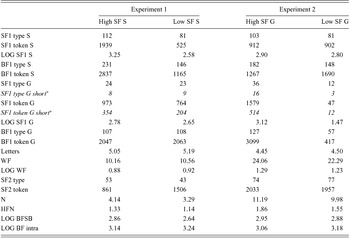
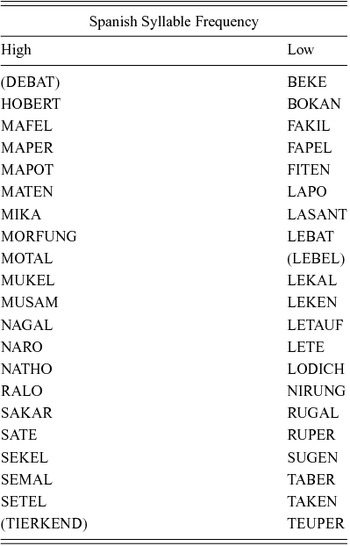
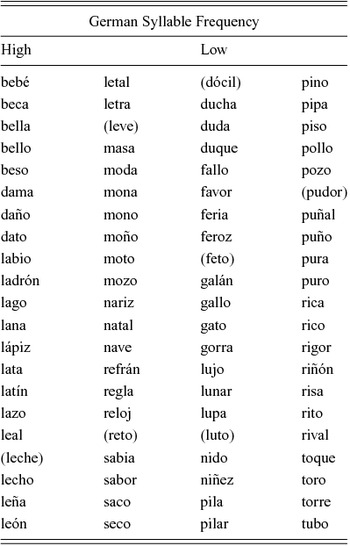
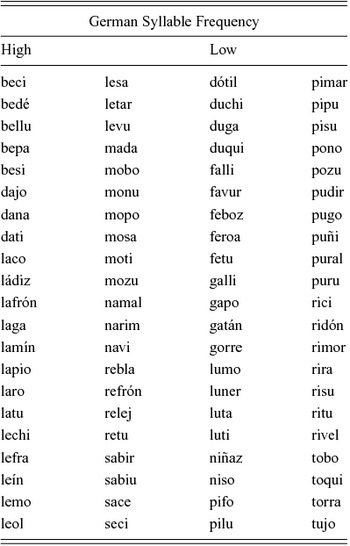
Initial orthographic syllable-frequency (type and token initial syllable-frequency and number of higher frequency syllabic neighbors) in German was closely controlled for between conditions. Words were controlled for across conditions on length, frequency, token frequency of the second syllables, global mean token bigram frequency, and orthographic neighborhood density and frequency. Characteristics for all word stimuli used in Experiments 1 and 2 are given in Table 1. All stimuli are listed in the Appendix. For the present experiments, pseudowords were constructed by combining the initial syllable of a word with a second syllable from another word in the respective language maintaining the syllabic structure of word stimuli they were derived from, without forming a new word in any of the two languages. This made sure that pseudowords in both experiments were superficially as word-like as possible. In addition, syllabic structure or specific initial syllables of words or pseudowords did not offer any cue for respective word or nonwords responses. All pseudowords were perfectly pronounceable.
Characteristics of German and Spanish word stimuli in Experiments 1 and 2. Means for manipulated (respectively controlled) Variables of initial Syllable Frequency in German (G) and Spanish (S): token and type Frequency of the initial orthographic Syllable (SF1), Logarithm (base 10) of initial Syllable Frequency (LOG SF1). Means for control variables: Letters, Word Frequency (WF) per 1 Million of occurrences, Logarithm of WF (LOG_WF), token and type Frequency of second syllables (SF2), Number of orthographic Neighbors (N), Number of higher frequency orthographic neighbors (HFN). Means for related variables: positional type and token frequencies for initial Bigrams (BF1), Logarithm (base 10) of Frequency for Bigrams straddling the Syllable Boundary (LOG BFSB) and for Mean intrasyllabic Bigram Frequencies (LOG BF intra).

*Computed only based on German words with a short vowel at first syllable position
Procedure
Participants were tested individually in a quiet room. They were instructed to decide as quickly and accurately as possible whether a string of letters (words and pseudowords) presented on the center of a computer screen corresponded to a German word or not by pressing two accordingly labeled keys on the computer keyboard. Each trial started with the presentation of a fixation point (an asterisk) in the center of the screen, which was replaced by the stimulus after 600 ms. Stimuli were presented in uppercase letters using Courier 24 type font to assure identical presentation of syllables occurring in nouns or adjectives while maintaining the orthographic cue represented by German nouns´ initial uppercase letter (see Peressotti, Cubelli & Job, Reference Peressotti, Cubelli and Job2003; Jacobs, Nuerk, Graf, Braun & Nazir, Reference Jacobs, Nuerk, Graf, Braun and Nazir2008). The stimulus remained until participants responded, followed by an inter-trial interval of one second. Ten practice trials preceded the experimental trials. Items were presented in randomized order.
Results
Possible interactions between SFEs from the nonpresented language with participant group are crucial for the present study, because only effects present in the bilingual, but not in the control participants’ data could be attributed to cross-language activation processes. Comparisons between the two bilingual groups will allow us to contrast cross-language activation effects between L1 and L2 reading. We, therefore, conducted three separate analyses of variance (ANOVAs) with the factors participant group (two levels; involving all possible comparisons between the three groups) and syllable-frequency from the nonpresented language (two levels).
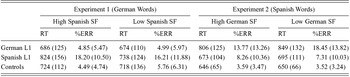
To avoid highly error prone words influencing the response latency data and to assure that always exactly the same material is analyzed for the three participant groups, items with corresponding error rates > 50% in any of the three participant groups’ data were excluded from all analyses in Experiment 1 and 2. This was the case for 4 vs. 5 words in the conditions of high and low Spanish syllable-frequency in Experiment 1. Response latencies two standard deviations above or below mean response latencies per participant and condition were treated as outliers and excluded from the analyses of Experiments 1and 2. Data from one participant in the group of Spanish–German bilinguals could not be used due to a technical problem during data acquisition. Mean correct response latencies (RT) to stimulus words and corresponding error rates were submitted to separate ANOVAs over participants and items (F1 and F2, respectively). Means of dependent variables per condition in Experiments 1 and 2 are given in Table 2.
Means and Standard Deviations for the groups of German-Spanish (German L1), Spanish-German Bilinguals (Spanish L1) and the respective Controls for dependent Variables Response Latencies (RT) and Error Rates (%Err) in Experiments 1 using German and Experiment 2 using Spanish each with a Manipulation of Syllable Frequency (SF) from the non presented Language.

SFEs from the nonpresented L1 when reading German: Comparing Spanish (L1) –German (L2) bilinguals with German controls
Bilinguals responded 60 ms slower to word stimuli than controls, F1(1,63) = 3.74, p < .06, η2 = .056; F2(1,31) = 29.79, p < .0001, η2 = .490, and this effect was mirrored by bilinguals producing more errors than controls (17.2 vs. 5.1%), F1(1,63) = 42.12, p < .0001, η2 = .401; F2(1,31) = 27.80, p < .0001, η2 = .473. There was an inhibitory RT main effect of syllable-frequency from the nonpresented language (Spanish): German words starting with syllables that were of high frequency in Spanish were responded to 46 ms slower than words with low Spanish syllable-frequency, F1(1,63) = 15.42, p < .0001, η2 = .197; F2(1,31) = 4.86, p < .04, η2 = .135. Importantly, this effect was characterized by a significant interaction with participant group, F1(1,63) = 11.71, p < .001, η2 = .157; F2(1,31) = 13.05, p < .002, η2 = .296. No syllable-frequency or interaction effects were present in the error data.
SFEs from the nonpresented L2 when reading German: Comparing German (L1) -Spanish (L2) bilinguals with German controls
No single main effect or interaction reached statistical significance either on RTs or on error rates, all Fs < 1, except for a tendency of German–Spanish bilinguals to produce 41 ms shorter response latencies than controls, significant only in the item-analysis, F1(1,64) = 2.17, p>.1, η2 = .033; F2(1,31) = 18.62, p < .0001, η2 = .375. This might reflect a generally enhanced language processing of bilinguals, but the contrast between the F1 and F2 analyses suggests the present difference to possibly be caused by some exceptionally slow participants in the control group. We, therefore, refrain from interpreting it.
L1-L2 vs. L2-L1 effects when reading German: Comparing Spanish (L1)–German (L2) bilinguals with German (L1)–Spanish (L2) bilinguals
Spanish native speakers responded 101ms slower than German native speakers, F1(1,63) = 11.67, p < .01, η2 = .156; F2(1,31) = 54.10, p < .0001, η2 = .636, and this effect was mirrored by the error data (17.2 vs. 4.9%), F1(1,63) = 143.58, p < .0001, η2 = .413; F2(1,31) = 26.18, p < .0001, η2 = .458. Again, there was an inhibitory RT main effect (49 ms) of syllable-frequency in the nonpresented language (Spanish), F1(1,63) = 15.76, p < .0001, η2 = .200; F2(1,31) = 6.94, p < .02, η2 = .183, that was characterized by a significant interaction with participant group, F1(1,63) = 8.74, p < .005, η2 = .122; F2(1,31) = 6.42, p < .02, η2 = .172. No further effects were present in the error data, Fs < 1.
To resolve the interactions between syllable-frequency and participant group effects, we analyzed the data from the three participant groups separately. These separate analyses showed a robust (86 ms) and significant inhibitory Spanish-SF effect in the group of bilinguals with Spanish L1, F1(1,31) = 18.90, p < .0001, η2 = .379; F2(1,31) = 10.12, p < .004, η2 = .246, and no significant effect in the two German groups, all Fs < 1. No SF effects on error rates were obtained in any of the three groups.
Discussion
The inhibitory effect of Spanish initial syllable-frequency when reading German words suggests activation of Spanish lexical candidates triggered by orthographic syllabic units of German. Most importantly, the effect was restricted to the group of bilinguals with Spanish L1. The absence of this effect in the “monolingual” control group shows that it should be attributed to bilingual language processing in general and to the manipulated properties of the Spanish language (Spanish syllable-frequency) in particular. The absence of the effect for German–Spanish bilinguals suggests that the specific effect is restricted to L1 influences during L2 processing.
In the following we applied the same manipulation (orthographic syllable-frequency in the nonpresented language, this time German) to a lexical decision task using Spanish words to test whether the pattern of results obtained in Experiment 1 would generalize across languages or whether, in turn, specific structural proprieties of given languages with regard to syllabic structure would modulate the way syllabic units from one language activate word representations from the other.
Experiment 2: German initial Syllable-frequency (high vs. low) in Spanish words
Method
Participants
The same two groups of each 33 bilinguals who had participated in Experiment 1 were contrasted with a control group of Spanish participants (psychology students, mean age 22, range 20–26, at the university of La Laguna, Spain, where the testing occurred) without knowledge of German. Note that bilingual participants were always presented first with their respective L2 version of the experiments, then (after a pause of half an hour) with the respective L1 part to increase the experiments’ potential to also detect L2 influences in L1 processing. German–Spanish bilinguals, therefore, performed Experiment 2 before Experiment 1.
Materials and Design
84 bisyllabic Spanish words (singular nouns and adjectives) were selected from LEXESP according to the manipulation of frequency of the initial orthographic syllable (CV type, two letters) in German words in the CELEX database (Baayen et al., Reference Baayen, Piepenbrock and Gulikers1993). A word entered the German high syllable-frequency condition when its orthographic syllable had a frequency of occurrence in the German database higher than 650, and the low syllable-frequency condition when lower than 280 per 1 Million of occurrences. Words were between 4 and 6 letters and of low to medium frequency range (4–94 per 1 Million of occurrences). Words were closely controlled for Spanish initial orthographic syllable-frequency (token frequency and number of higher frequency syllabic neighbors) as well as for length, frequency, token frequency of the second syllables, global mean token bigram frequency, and orthographic neighborhood density and frequency. None of the words were clear cognates or homophones, but some shared common roots with their German translations, e.g. “ducha (Dusche)”, “saco (Sack)”, or “feto (Fötus)”. But note also that the appearance of such words was balanced across the conditions of high (11 cases) vs. low (9 cases) syllable-frequency.
Procedure
It was the same as in Experiment 1, but Spanish stimuli were presented in lowercase letters, because unlike German, Spanish does not use noun initial uppercase, and all uppercase would impede presenting orthographic accents (syllable frequencies in both languages were computed irrespective of letter case or accent markers).
Results
Three of the words in the condition of high, and four in the condition of low German syllable-frequency were not used in the analyses due to high corresponding error rates.
SFEs from the nonpresented L1 when reading Spanish: Comparing German (L1)–Spanish (L2) bilinguals with Spanish controls
Spanish monolinguals’ responses were 60 ms faster than bilinguals’ F1(1,64) = 54.80, p < .0001, η2 = .461; F2(1,75) = 347.16, p < .0001, η2 = .822. This effect was mirrored by the error data with 3.6% vs. 16.1% of errors, F1(1,64) = 30.33, p < .0001, η2 = .321; F2(1,75) = 67.28, p < .0001, η2 = .473. ANOVAs also revealed a main effect of syllable-frequency from the nonpresented language (German) in the RT data, though significant only in the participant analysis, F1(1,64) = 12.79, p < .002, η2 = .167; F2(1,75) = 2.28, p>.1, η2 = .030. This time, Spanish words starting with high-frequency syllables in German were responded to 23 ms faster than those starting with low-frequency syllables in German. This processing advantage was mirrored by the error data with 8.7% vs. 11.0% of errors, F1(1,64) = 7.54, p < .009, η2 = .105; F2(1,75) = 1.53, p>.2, η2 = .020. The interaction between syllable-frequency and participant group effects in the RT data was significant in the participant and marginally significant in the item-analysis, F1(1,64) = 9.21, p < .004, η2 = .126; F2(1,75) = 3.29, p < .07, η2 = .042, error data representing a similar pattern, F1(1,64) = 7.99, p < .007, η2 = .111; F2(1,75) = 2.40, p>.1, η2 = .031.
SFEs from the nonpresented L2 when reading Spanish: Comparing Spanish (L1)–German (L2) bilinguals with Spanish controls
Spanish controls’ responses were 36 ms faster than bilinguals’, though significantly only in the item-analysis, F1(1,64) = 2.74, p>.1, η2 = .041; F2(1,75) = 36.50, p < .0001, η2 = .327. This pattern was mirrored by the error data with 3.6% vs. 7.8% of errors, F1(1,64) = 5.52, p < .03, η2 = .079; F2(1,75) = 30.73, p < .0001, η2 = .473. Again, there was a facilitative main RT effect that was only significant in the participant analysis, F1(1,64) = 10.19, p < .003, η2 = .137, F2(1,75) = 1.93, p>.1, η2 = .025. Spanish words with high-frequency syllables in German were responded to 13 ms faster than those with low-frequency syllables in German. The interaction between RT effects of both factors was, again, significant only in the analysis by participants, F1(1,64) = 5.37, p < .03, η2 = .077; F2(1,75) = 2.59, p>.1, η2 = .033. No further effects were present in the error data, all Fs < 1.
L1-L2 vs. L2-L1 effects when reading Spanish: Comparing Spanish (L1)–German (L2) bilinguals with German (L1)–Spanish (L2) bilinguals
Spanish native speakers’ responses were 56 ms faster than German native speakers’, F1(1,64) = 25.87, p < .0001, η2 = .288; F2(1,75) = 268.31, p < .0001, η2 = .782. This result was accompanied by an analogous effect in the error data with 7.8% vs. 16.1% of errors, F1(1,64) = 8.72, p < .005, η2 = .120; F2(1,75) = 37.81, p < .0001, η2 = .335. A main effect of German-SF in the RT data appeared significant in the participant and marginally significant in the item-analysis, F1(1,64) = 21.30, p < .0001, η2 = .250, F2(1,75) = 3.97, p < .06, η2 = .050, representing a 33 ms processing advantage of high over low syllable-frequency words. In the error data, this facilitative effect was significant over participants with 11.0% vs. 12.9% of errors, F1(1,64) = 4.60, p < .04, η2 = .067; F2(1,75)<1. The interaction between effects of both factors was not significant in the RT, F1(1,64) = 2.17, p>.1, η2 = .033; F2(1,75) = 1.01, p>.1, η2 = .014, but reached significance in the error data, F1(1,64) = 10.43, p < .003, η2 = .120; F2(1,75) = 4.36, p < .05, η2 = .055.
Separate analyses conducted for the three participant groups showed no effects for German-SF in the “monolingual” control group, all Fs < 1, but revealed a significant effect (though only marginal in the item-analysis) in the group of German–Spanish bilinguals, where response latencies were 43 ms faster to Spanish words with high than with low initial German syllable-frequency, F1(1,32) = 12.17, p < .002, η2 = .276; F2(1,75) = 3.03, p < .09, η2 = .039, and also provoked less errors (13.8% vs. 18.4% errors), F1(1,32) = 9.05, p < .006, η2 = .220; F2(1,75) = 2.05, p>1, η2 = .027. A similar facilitative effect of German syllable-frequency on response latencies (22 ms) was present in the data of Spanish–German bilinguals, F1(1,32) = 10.34, p < .004, η2 = .244; F2(1,75) = 3.72, p < .06, η2 = .047, showing no effect in the error data.
Discussion
The outcome of Experiment 2 shows that the inhibitory effect from L1 syllable-frequency when reading L2 – reflecting activation of lexical candidates in L1 triggered by L2 syllabic representations – was not replicated when Spanish was the presented language. Not only was there no inhibition, the respective effect even changed its direction: resulting in a tendency to enhance processing of Spanish words starting with high as compared to low frequency German syllables. Importantly, this effect was obtained only for the two bilingual groups and not for the control group. It might, therefore, indicate a specific prelexical bilingual processing advantage for sublexical units with high frequency of occurrence in the nonpresented language. Yet, we would like to stress that this potential facilitative effect should be interpreted with care because it was marginally significant in the item analyses.
Effects of nonpresented language syllable-frequency x test language
We conducted additional ANOVAs on the data from the two bilingual groups to test whether the apparent dissociation of nonpresented SFE (inhibitory in Experiment 1, but facilitative in Experiment 2) would result in a significant interaction of non presented language SFE (high vs. low) with test language (German vs. Spanish). For Spanish–German bilinguals, this interaction was significant in both participant and item-analyses in the RT, F1(1,32) = 21.81, p < .0001, η2 = .421; F2(1,106) = 20.34, p < .0001, η2 = .161, but not in the error data, F1(1,32) = 1.19, p>.2, η2 = .038; F2(1,106) <1. For German–Spanish bilinguals, interactions were significant over participants, but not in item-analyses for both the RT, F1(1,32) = 12.95, p < .002, η2 = .288; F2(1,106) = 2.37, p>.1, η2 = .022, and the error data, F1(1,32) = 11.99, p < .003, η2 = .272; F2(1,106) <1.
Multiple Regression Analyses on the data of Experiments 1 and 2
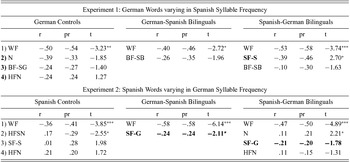
To further explore our data, and to test whether syllable-frequency in the nonpresented language would influence response latencies in a continuous way, we conducted stepwise multiple regression analyses using Log of word frequency, number of orthographic neighbors, number of higher frequency orthographic and syllabic neighbors, Log of mean frequency of all bigrams, Log of frequency of the bigram straddling the syllable boundary (all in the presented language), as well as Log of orthographic syllable-frequency in the presented and nonpresented language as predictors of mean response latencies for each participant group. Note that bigram frequencies for initial syllables could not be used as additional predictors, because they correlate above .8 with orthographic syllable-frequency. The two stimuli starting with three letter syllables from Experiment 1 were not used in these analyses to provide optimal consistency for the continuous syllable-frequency measure. Results for predictor variables are summarized in Table 3. Always the same eight predictors were used a priori, but only those explaining a minimum amount of variance – specified by a maximum p-value of .25 – entered the models and will be discussed.
Pearson Product-Moment (r), Partial Correlations (pr) and t-Values for Variables that entered as Predictors of mean Response Latencies for Words in Experiments 1 and 2 in stepwise multiple Regression Models (organized by order of entry; with probability to enter <.25).

*p < .05 **p < .01 ***p < .001
Results from multiple regression models corroborate our main findings from the factorial analyses of Experiments 1 and 2: Syllable-frequency from the nonpresented language significantly predicted L2 response latencies in the same direction of effects reported previously: The frequency of German target words´ initial syllables among Spanish words caused a slow-down of response latencies when Spanish–German bilinguals read German words, but not for any of the two control groups. Furthermore, German syllable-frequency significantly facilitated the reading of especially Spanish L2 words in a continuous way (the respective effect was only marginal in the Spanish–German bilinguals and absent in the Spanish control group).
Word-frequency was the best predictor of response latencies in all cases, and its influence was strongest for L2 processing of German or Spanish words possibly reflecting the increased difficulty of accessing low-frequency words in the non-native language. On the other hand, measures of orthographic or syllabic neighborhood within the presented language significantly influenced only native language processing response latencies: spread of activation over lexical representations in the presented language seemed more pronounced for L1 than for L2 processing. Multiple regression results also display an interesting dissociation concerning syllabic processing across Spanish and German target languages. Significant or marginally significant effects of syllabic neighborhood measures, i.e. number of higher frequency syllabic neighbors and Log of syllable-frequency were restricted to Spanish controls whereas all three participant groups showed a tendency for faster responses to German words with high frequency bigrams straddling the syllable boundary. We attribute this pattern of results to language differences in terms of transparency of syllabic structure:
The perfect transparency of Spanish syllables seems to warrant an immediate direct spread of activation over syllabic neighbors via syllabic units that can unambiguously be extracted from the orthographic input, whereas the less transparent German syllable structure seems to urge participants to rely on statistical proprieties of syllabic boundaries, e.g., bigram frequency, as a cue for syllabification. The frequency of the bigram at the syllable boundary (although computed without explicitly referring to syllabic structure of other words containing this) partly reflects how often a given bigram represents the link between two syllables. This may provide an important cue for syllabification under ambiguous conditions – partly characterizing German but not Spanish orthography. Note that our proposal of inter-syllabic bigram frequency facilitating syllabic parsing is not at odds with Seidenberg's (Reference Seidenberg and Coltheart1987, Reference Seidenberg and McClelland1989) proposal that bigram troughs (especially low frequent bigrams) at the syllable boundary would serve as an orthographic redundancy cue for syllabification. Seidenberg's proposal relates to general frequency differences between inter-syllabic and intra-syllabic bigrams, whereas ours only relates to frequency differences within the range of inter-syllabic bigrams. Although all stimuli in both languages had transparent syllabic structure, our regression analyses seem capture generalized syllabic processing differences of the two languages.
General Discussion
Unlike most previous studies investigating simultaneous activation of bilinguals´ two languages, the formal overlap between respective words from the two languages in our two experiments was minimal: initial two letter syllables of bisyllabic words. This represents a strong test for whether simultaneous activation of word representations from the two languages would arise via bottom-up processing from sublexical units to words. It offers an interesting contrast to previous studies using cognates, interlingual homographs, homophones or orthographic neighborhood manipulations across languages, where complete or almost complete formal overlap between word representations might have tapped into spread of activation between the two languages occurring rather at the lexical level.
Our results clearly support the general notion of nonselective language activation: Any empirical effect of experimental manipulations of nonpresented language characteristics obtained within a group of bilingual participants – and absent within the control group – can only be explained by the activation of representations from that nonpresented language.
In that vein, our most important result was an inhibitory SFE in Experiment 1 for words starting with orthographic syllables of high frequency within the nonpresented dominant language Spanish when Spanish–German bilinguals performed a lexical decision task with German L2 words. This effect was completely absent for both the German control and the German–Spanish bilingual group. This finding confirms previous reports that interference coming from word representations in the nonpresented language is especially strong in the case of L2 processing (e.g., Van Hell & Dijkstra, Reference Van Hell and Dijkstra2002; Gollan et al., Reference Gollan, Forster and Frost1997), because L1 representations are more stable. The novel contribution of our data is to show that words’ initial syllables when reading L2 are sufficient to trigger the activation of L1 lexical candidate representations. The inhibitory character of this Spanish SFE for Spanish–German bilinguals processing German words is well in line with studies on SFEs in native language processing. They consistently reported for the Spanish, German and French language that words starting with high frequency orthographic syllables take longer to be responded to, because an increasing cohort of co-activated syllabic neighbors’ representations interferes with the processing of the target (Carreiras et al. Reference Carreiras, Álvarez and de Vega1993; Conrad & Jacobs, Reference Conrad and Jacobs2004; Conrad et al., Reference Conrad, Carreiras, Tamm and Jacobs2009, Reference Conrad, Carreiras and Jacobs2008, Reference Conrad, Grainger and Jacobs2007; Mathey & Zagar, Reference Mathey and Zagar2002). In the present case, words from the nonpresented native language Spanish sharing a German target's initial syllable seem to inhibit L2 target identification. Our findings thus add to previous reports that L2 processing can suffer from formal overlap (without shared semantics) between words in L2 and L1, setting a new threshold for the crucial size of relevant overlap to provoke interference between lexical representations from the two languages: initial syllables.
The novel data might well be accommodated into models of bilingual word recognition featuring nonselective spread of activation across languages (Dijkstra & Van Heuven, Reference Dijkstra, van Heuven, Grainger and Jacobs1998; Dijkstra et al., Reference Dijkstra, Grainger and Van Heuven1999; Grainger & Dijkstra, Reference Grainger, Dijkstra and Harris1992; van Heuven et al., Reference Van Heuven, Dijkstra and Grainger1998) if these models were extended to include syllabic representation units. Conrad et al. (Reference Conrad, Tamm, Carreiras and Jacobs2010) showed that a computational model of the interactive activation class containing orthographic syllabic representation units can successfully simulate this SFE in visual word recognition whereas another interactive activation model variant without syllabic representation units failed to do so (Conrad et al., Reference Conrad, Carreiras, Tamm and Jacobs2009). The model accounts for inhibitory syllable frequency effects by mechanisms of lateral inhibition between syllabic neighbor representations that become activated via orthographic syllabic representation units.
But why did we fail to obtain the same inhibitory effect of L1 syllable frequency when bilinguals read Spanish L2 words in Experiment 2?
Our data reveal a dissociation of effects of cross-language syllabic processing presumably depending on structural properties of the different languages. The inhibitory nonpresented-language-SFE in L2 reading was limited to Experiment 1 using German target words. It was completely absent – and even displaying an inverse tendency – in Experiment 2 when bilinguals were processing Spanish words. Results from multiple regression analyses corroborated both types of nonpresented-language-SFEs for L2 reading – inhibition from Spanish and facilitation from German syllable-frequency – as significantly associated with increasing orthographic syllable-frequency in the nonpresented language.
At first glance, this dissociation of effects seems to contradict the homogenous pattern of evidence for syllabic processing reported in numerous studies in exactly these two languages, Spanish (Carreiras et al., Reference Carreiras, Álvarez and de Vega1993; Álvarez et al., Reference Álvarez, Carreiras and Taft2001; Conrad et al., Reference Conrad, Carreiras and Jacobs2008, Reference Conrad, Carreiras, Tamm and Jacobs2009) and German (Conrad & Jacobs, Reference Conrad and Jacobs2004; Conrad et al., Reference Conrad, Stenneken and Jacobs2006; Hutzler et al., Reference Hutzler, Conrad and Jacobs2004, Reference Hutzler, Conrad and Jacobs2005; Stenneken et al., Reference Stenneken, Conrad, Goldenberg and Jacobs2003, Reference Stenneken, Conrad, Hutzler, Braun and Jacobs2005).
On the other hand, structural differences between the two languages make it plausible that syllabic processing and the spread of activation from syllabic units to word representations might generally be more pronounced for the Spanish than for the German language. Our regression data support this view: significant indicators of spread of activation over the lexicon as determined by syllabic units were only found for native Spanish language processing (whereas processing of German but not Spanish appeared to benefit from orthographic redundancy at the syllable boundary – presumably facilitating syllabic parsing in a less transparent orthography). A somewhat attenuated activation spread from syllables to German word representations may have prevented a potential nonpresented German language SFE to arise in Experiment 2.
Note that Spanish–German syllabic structure differences also affected the strength of respective manipulations in the two experiments. Initial CV syllables are more common in Spanish than in German. In consequence, there were more and more frequent Spanish words sharing a German orthographic syllable from the high frequency condition in Experiment 1 than this was the case for German words and Spanish target syllables in Experiment 2 (see Table 1). In consequence, insufficient German word representations may have been activated by the two letter CV orthographic initial syllables – used in the present study – to interfere with the processing of Spanish targets.
We had used only CV syllables in the present experiments, because this most basic syllabic structure was consistently used in previous empirical reports for SFEs in Spanish or German. It is, thus, not clear whether comparable effects would arise in these languages for more complex syllables. One can only speculate whether an inhibitory effect for German syllable-frequency on L2 processing of Spanish words might be obtained using CVC syllables representing a more typical German syllabic structure.
Phonology offers additional arguments for the dissociation of nonpresented-language-SFEs in Experiments 1 and 2. As in the majority of studies reporting SFEs (but see Conrad et al., Reference Conrad, Grainger and Jacobs2007 for an exception) we manipulated orthographic syllable frequency. But evidence from Álvarez et al. (Reference Álvarez, Carreiras and Perea2004; see also López-Zamora, Luque, Álvarez & Cobos, Reference López-Zamora, Luque, Álvarez and Cobos2013) suggests that phonological syllables play an important role with regard to syllabic processing and that phonological rather than orthographic syllables would determine the activation of competing word representations (Conrad et al., Reference Conrad, Grainger and Jacobs2007).
Overlapping phonological codes across languages can enhance bilingual performance (Haigh & Jared, Reference Haigh and Jared2007; Carrasco-Ortizet et al., Reference Carrasco-Ortiz, Midgley and Frenck-Mestre2012). Now, Spanish vowels are always short, but German vowels can be long or short – and they were (with only one exception) always long for initial syllables used in Experiment 1. Activating phonological syllabic representations from their native language Spanish with short vowel length would impede Spanish–German bilinguals in accessing the correct phonological representations of German words and the weight of this phonological interference would increase with syllable-frequency in Spanish (see Jared & Kroll, Reference Jared and Kroll2001, for sublexical phonological interference in bilinguals). We have outlined how vowel length is distributed over German syllables. Note also that German vowel length and stress position are often encoded only at the lexical level. For example, the orthographic word form GEBET means “give!” when the first syllable receives stress and has a long vowel, but means “prayer” when the first vowel is short (and the initial syllable is, unlike in the previous example, a prefix) and stress has moved to the second syllable. Conrad et al. (Reference Conrad, Stenneken and Jacobs2006) have shown how these phenomena constrain the possibility of correctly inferring the stress pattern of a German word or the vowel length of an initial syllable via means of prelexical analysis. By contrast this information is perfectly available at the surface of the more transparent Spanish orthography.
For Spanish speakers, the variance of vowel length in German represents a particular problem. A bias towards producing short vowels is a typical feature of Spanish foreign accent in German. Because vowel length information in German might be less available to them – at least at early stages of visual word processing, native Spanish readers might – by default –assign their native language short-vowel phonological pattern to German initial orthographic syllables. Perceived “short-vowel” phonological syllables would, in consequence, activate all phonological Spanish word representations sharing German target words’ orthographic syllables regardless of actual German vowel length. This would let the inhibitory SFE in the data of Experiment 1 arise at the level of competing word representations.
But for the opposite case, when reading Spanish words, we propose that not only native speakers, but also German–Spanish bilinguals would assign short vowel length to Spanish initial orthographic syllables, because this represents the only possible phonological pattern for Spanish initial CV syllables. At the level of sublexical phonology, respective phonological German codes for some of the syllables in the high frequency condition might enhance this process, because, in particular, the syllables “be-“, “re-“, and “da-“ occurring several times among Spanish stimuli, have short vowel length in German when used as (highly frequent) prefixes. This could have contributed to the given processing advantage for nonpresented language syllable-frequency in Experiment 2 that did, apparently not perfectly generalize over the whole word material.
Concerning interference at the lexical level it may be that only those German syllabic neighbors with short vowels in the initial phonological syllable position interfered with the processing of Spanish targets. In consequence, the relevant cohort within the nonpresented German language might not have reached the critical size for an inhibitory SFE to arise in the data of Experiment 2 – given the overall 1:4 proportion of short vs. long vowels within German CV syllables (see Table 1 for respective stimulus statistics).
But we would like to present an additional argument based on orthographic processing to explain the facilitation of Spanish word processing due to orthographic syllable frequency in German obtained in Experiment 2. Theoretical accounts on syllabic processing provide a specific role for orthographic redundancy to enhance the activation of phonological syllabic representations. These seem more easily accessible when represented at the orthographic level by letter clusters of high frequency (Doignon & Zagar, Reference Doignon and Zagar2005; Conrad et al., Reference Conrad, Carreiras, Tamm and Jacobs2009). This view suggests that – much like frequencies of other sublexical units – the frequency of orthographic syllables can facilitate prelexical processing – potentially enhancing syllabic parsing of visual word forms. But note that behavioral evidence for such facilitative effects is difficult to obtain, because they tend to be overwritten at the level of response latencies by the more robust inhibitory effects of syllable frequency arising at the level of lexical competition.
Empirical support for the twofold impact of syllable frequency on the reading process comes from ERP studies: Syllable-frequency in Spanish (Barber, Vergara & Carreiras, Reference Barber, Vergara and Carreiras2004), French (Chetail, Colin & Content, Reference Chetail, Colin and Content2012) and German (Hutzler et al., Reference Hutzler, Conrad and Jacobs2004) words influenced ERP signals at two distinct time windows: A modulation of the P200 component suggests a prelexical processing advantage for orthographic high-frequency syllables, whereas larger N400 amplitudes are consistent with the activation of competing candidate representations resulting from the same manipulation. Furthermore, beginning readers, who are yet to establish optimal representations show facilitative behavioral effects of syllable-frequency (Maïonchi-Pino, Magnan & Ecalle, Reference Maïonchi-Pino, Magnan and Ecalle2010). Respective facilitative behavioral orthographic SFEs could indeed be obtained also for adults when the potential main sources driving the inhibitory SFE at the level of lexical competition had been explicitly controlled for when selecting stimuli [see Conrad et al. (Reference Conrad, Carreiras and Jacobs2008) for a facilitative type of syllable frequency effect when there is control for token syllable frequency and number of higher frequency syllabic neighbors; Conrad et al. (Reference Conrad, Carreiras, Tamm and Jacobs2009) for facilitation due to letter cluster frequency of syllabic units when syllable frequency is controlled; Mathey et al. (Reference Mathey, Zagar, Doignon and Seigneuric2006) for facilitative orthographic SFE when controlling for phonological syllable frequency].
Accordingly, we attribute the facilitative nonpresented-language-SFE in Experiment 2 to facilitation of prelexical processing of Spanish words due to German orthographic syllable frequency. Bilinguals seem to benefit from the fact that a given Spanish syllable or the letter cluster forming this syllable occurs frequently as a syllable in German words. Unlike Experiment 1, these facilitative prelexical effects were observed for the two bilingual groups in Experiment 2, because structural differences between the two languages precluded a sufficient activation of nonpresented language German syllabic neighbors’ that would – at the level of lexical competition – have overwritten prelexical facilitation effects on response latencies.
In summary, our data suggest that syllabic units play a crucial role for nonselective spread of activation across bilinguals´ two language systems at two different processing levels:
The inhibitory nonpresented-language-SFE in Experiment 1 reflects activation of word representations from the dominant language sharing initial orthographic syllables with target words in the presented language.
On the other hand, and besides such competition arising at the lexical level, familiarity with sublexical syllabic units, letter or phoneme clusters from the nonpresented language seems to enhance bilinguals’ prelexical processing of the target language, as evident from the facilitative SFE in Experiment 2. Respective facilitative influences of L1 on processing L2 appear more reliable than the inverse (see results for the multiple regression analyses), but our data also suggest that even facilitative L2 influences on L1 processing can be obtained in a context where speakers are immersed in the L2 environment.
Our inhibitory and facilitative nonpresented-language-SFEs were restricted to the specific target language and structural differences between the two languages might be responsible for this. Investigating the role of structural differences between languages for bilingual language processing seems an interesting perspective for future research.
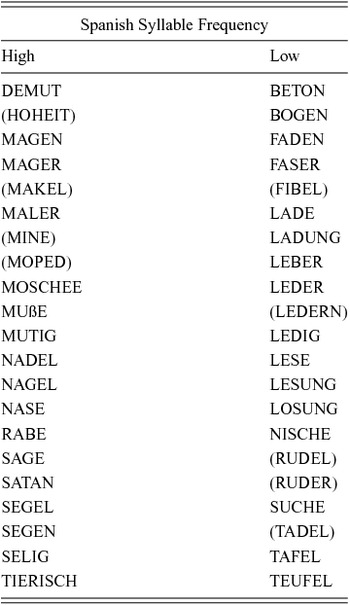
Word Stimuli of Experiment 1

Nonword Stimuli of Experiment 1

Word Stimuli of Experiment 2

Nonword Stimuli of Experiment 2