Introduction
Recent research on childhood bilingualism generally suggests that already from a very early age on, children exposed to two or more spoken languages will develop separate linguistic systems for the languages they are acquiring (De Houwer, Reference De Houwer1990; Genesee, Reference Genesee1989; Meisel, Reference Meisel1994). In spite of separate linguistic systems, intra-utterance code-mixing is a well-documented phenomenon. In code-mixing the bilingual child mixes different linguistic units originating from two participating linguistic systems within the same utterance (Genesee, Reference Genesee2001; Meisel, Reference Meisel1994; Paradis & Genesee, Reference Paradis and Genesee1996; Paradis, Nicoladis & Genesee, Reference Paradis, Nicoladis and Genesee2000). Despite the existence of different theoretical frameworks, most of the previous findings support the view that bilingual children produce code-mixed utterances in a systematic and structured way, but their use is, however, influenced by various features in children's language competence and environment (Comeau, Genesee & Lapaquette, Reference Comeau, Genesee and Lapaquette2003; Genesee & Nicoladis, Reference Genesee, Nicoladis, Hoff and Shatz2007; Genesee, Nicoladis & Paradis, Reference Genesee, Nicoladis and Paradis1995; Meisel, Reference Meisel, Cenoz and Genesee2001; Paradis et al., Reference Paradis, Nicoladis and Genesee2000). Thus, code-mixing is complex and multifaceted by nature and not yet thoroughly understood.
In this study we addressed the question of intra-utterance code-mixing by examining KODA children (Kids of DeafFootnote 1 Adults). These hearing children of Deaf parents acquire sign language and spoken language simultaneously, which means their bilingualism is bimodal. Compared with unimodal bilingual children who acquire two spoken languages, KODA children are able to produce signs and spoken words at the same time and therefore are not obliged to suppress one language during the production process of a code-mixed utterance. Emmorey, Borinstein, Thompson and Gollan (Reference Emmorey, Borinstein, Thompson and Gollan2008) termed this special type of code-mixing code-blending. In the few studies that have been published on code-mixing of bimodal bilinguals, wide use of code-blends containing semantically congruent signs and words has been reported among both children and adults (Van den Bogaerde, Reference Van den Bogaerde2000; Emmorey et al., Reference Emmorey, Borinstein, Thompson and Gollan2008; Petitto, Katerelos, Levy, Gauna, Tétreault & Ferraro, Reference Petitto, Katerelos, Levy, Gauna, Tétreault and Ferraro2001). Still, more information is needed, especially on the characteristics and use of code-blending during bimodal bilingual language acquisition. Research on children who acquire different language pairs can deepen our understanding of the characteristics of code-mixing and its role and meaning in language development.
Code-mixing in unimodal bilingual children
At the age of around two years, bilingual children have been shown to start using intra-utterance code-mixing when they learn to use two- or multiword utterances and organise their languages according to grammatical principles (Paradis et al., Reference Paradis, Nicoladis and Genesee2000). At this age children tend to code-mix words in semantically appropriate ways by inserting an element that contains relevant information from one language into a sentence in another language, making it complete (Meisel, Reference Meisel1994; Petitto et al., Reference Petitto, Katerelos, Levy, Gauna, Tétreault and Ferraro2001; Vihman, Reference Vihman1998).
Research on the grammatical properties of intra-utterance code-mixing by children acquiring different language pairs has previously shown that code-mixing used by bilingual children is systematic in nature and tends to conform to the grammatical constraints of both languages (Paradis et al., Reference Paradis, Nicoladis and Genesee2000). Grammatical constraints are restrictions that guide what elements and from which part of one language an utterance can be mixed into a sentence of another language while simultaneously obeying the grammatical rules of both languages (see, e.g., Myers-Scotton, Reference Myers-Scotton1997, Reference Myers-Scotton2002 and Poplack, Reference Poplack1980, for models of grammatical constraints). In previous studies researchers have noticed that children prefer to code-mix structures that can be used in both languages and therefore do not violate the grammatical rules of either language (Döpke, Reference Döpke2000; Meisel, Reference Meisel, Cenoz and Genesee2001; Paradis et al., Reference Paradis, Nicoladis and Genesee2000; Yip & Matthews, Reference Yip and Matthews2000). Paradis et al. (Reference Paradis, Nicoladis and Genesee2000), for instance, found that the vast majority of the code-mixed utterances produced by French–English bilingual children (N = 15) between the ages of 1;9 and 3;8 obeyed the grammatical constraints of both languages and only 18% of all the mixed utterances violated them.
Code-mixing in bimodal bilinguals
In the few studies conducted, both children and adults who are bimodal bilinguals have been reported to prefer intra-utterance code-blending (i.e., simultaneous production of signs and words) over code-switching (successive production of signs and words). They also code-blend in a highly synchronised way: the onset of their semantically equivalent signs and spoken words has been simultaneous with congruent syntactic structures (Van den Bogaerde & Baker, Reference Van den Bogaerde and Baker2005; Emmorey et al., Reference Emmorey, Borinstein, Thompson and Gollan2008; Petitto et al., Reference Petitto, Katerelos, Levy, Gauna, Tétreault and Ferraro2001).
Van den Bogaerde (Reference Van den Bogaerde2000) and Van den Bogaerde and Baker (Reference Van den Bogaerde and Baker2005, Reference Van den Bogaerde, Baker, Bishop and Hicks2008) studied code-mixing among three hearing and three deaf children of deaf parents between the ages of 1;0 and 6;0 years. To analyse the structure of code-blended utterances Van den Bogaerde and Baker (Reference Van den Bogaerde and Baker2005) adapted the concept of the Matrix Language model (see, e.g., Myers-Scotton, Reference Myers-Scotton1993, Reference Myers-Scotton1997, Reference Myers-Scotton2002) that regards one language as leading over the other language in code-mixed utterances. The leading language provides the syntactic structure and more words in the utterance than the other language. Contrary to the original model, Van den Bogaerde and Baker (Reference Van den Bogaerde and Baker2005, Reference Van den Bogaerde, Baker, Bishop and Hicks2008) based their analysis on the semantics of lexical items in the utterance instead of the structure and regarded the language that was used to produce the full proposition of the utterance as the leading language and termed it the base language. Later Emmorey et al. (Reference Emmorey, Borinstein, Thompson and Gollan2008) also reported that this original Matrix Language Model was somewhat problematic for the analysis of code-blended utterances among bimodal bilinguals; due to the simultaneous production of semantically and syntactically highly congruent signs and words it is difficult to determine the Matrix Language. Van den Bogaerde and Baker (Reference Van den Bogaerde and Baker2005, Reference Van den Bogaerde, Baker, Bishop and Hicks2008) classified the code-blended utterances into four different types. For example, the researchers (Baker & Van den Bogaerde, Reference Baker, Van den Bogaerde, Plaza-Pust and Morales-López2008, p. 15) classified the utterance where a three-year-old child said, “is geen auto maar een trein” (engl. is not car but a train) and simultaneously signed, “AUTO TREIN” (engl. CAR TRAIN) (free translation: [This] is not a car, but a train.) as a Dutch base. The KODA children they studied mostly used Dutch base code-blends or code-blends where they simultaneously produced semantically congruent signs and words (named by the researchers as Full code-blends). Van den Bogaerde and Baker (Reference Van den Bogaerde, Baker, Bishop and Hicks2008) found in their study that the MLU (Mean Length of Utterance) of code-blended utterances varied between 2 and 5 in the three KODA children studied and this was generally increasing indicating growing language competence.
Petitto and colleagues (Reference Petitto, Katerelos, Levy, Gauna, Tétreault and Ferraro2001) also analysed code-blended utterances produced by two KODA children between the ages of 2;10 and 4;0 by examining the semantic congruence of their utterances. They found that 89% of the 320 code-blended utterances the two KODA children produced contained semantically congruent signs and words. In the few semantically incongruent utterances, some of the signs and words used added different but relevant information to complete the utterance semantically. Additionally, in these incongruent utterances, simultaneously produced signs and words followed the grammar of each language separately. The researchers therefore regarded these kinds of utterances as a sign of the children having two distinct grammars.
Despite the fact that KODA children have been found to mostly produce semantically and grammatically congruent code-blended utterances, they have also been found to produce grammatically non-adult-like structures in their utterances. In these kinds of code-blended utterances the sign language, in this case ASL (American Sign Language), has been found to influence the spoken language, English. For example, the word order (preverbal object, doubled verb, post-verbal subject and WH-question word in a final position) can be totally acceptable for ASL but atypical in English (Chen Pichler, Lee & Lillo-Martin, Reference Chen Pichler, Lee, Lillo-Martin and Quinto-Pozos2014; Emmorey et al., Reference Emmorey, Borinstein, Thompson and Gollan2008; Lillo-Martin, Koulidobrova, Müller de Quadros & Chen Pichler, Reference Lillo-Martin, Koulidobrova, Müller de Quadros, Chen Pichler, Biller, Chung and Kimball2012). If the perspective of spoken language is taken, these structures in code-mixing may easily be regarded as ungrammatical language use and misinterpreted as deviant or disordered and thereby possibly lead to a diagnosis of language impairment among KODA children (see, e.g., for a review of Chen Pichler et al., Reference Chen Pichler, Lee, Lillo-Martin and Quinto-Pozos2014; and additionally, Johnson, Watkins & Rice, Reference Johnson, Watkins and Rice1992; Murphy & Slorach, Reference Murphy and Slorach1983; Schiff & Ventry, Reference Schiff and Ventry1976, representing early research).
Factors affecting code-mixing in bilingual children
Previous research has offered varying explanations for code-mixing (including code-blending) in bilingual children and indicated considerable individual differences in the amount of mixing. Below we discuss various child-specific and environmental factors that have been reported as having an effect on the use of code-mixing in bilingual children. The majority of these studies have, however, been conducted with unimodal bilinguals, so that more studies with bimodal bilinguals are needed. In addition, as more than one factor can affect code-mixing simultaneously in a specific situation or conversation, it is important to take this into account in study designs.
Child-specific factors
Factors related to linguistic competence have a strong influence on the patterns of code-mixing, especially among young bilingual children. According to previous research, children prefer to use their dominant language and code-mixing more often when speaking their non-dominant language and using words for which they do not have a translation equivalent (Genesee et al., Reference Genesee, Nicoladis and Paradis1995; Nicoladis & Secco, Reference Nicoladis and Secco2000). The concept of dominant language usually refers to the language the child is more fluent in, producing longer utterances and more different word types (Genesee, Paradis & Crago, Reference Genesee, Paradis and Crago2008, p. 80). The Gap-Filling Hypothesis refers to the phenomenon where a child usually code-mixes to compensate for gaps, e.g., in lexicon or grammar in one language by inserting structures or words from another language (Genesee, Boivin & Nicoladis, Reference Genesee, Boivin and Nicoladis1996; Montanari, Reference Montanari2009; Nicoladis & Secco, Reference Nicoladis and Secco2000; Pearson, Fernández, Lewedeg & Oller, Reference Pearson, Fernández, Lewedeg and Oller1997). However, Baker and Van den Bogaerde concluded (Reference Van den Bogaerde, Baker, Bishop and Hicks2008) that children can use code-mixing in their utterances only when they have enough proficiency and fluency in both of their languages.
Children may sometimes use code-mixing also for pragmatic reasons. In these cases one of the languages has more affective weight than the other or the child is able to express something in one of the languages in a way that is not possible for him/her with the other language, e.g., when emphasising important things or narrating events (see, e.g., Lanvers, Reference Lanvers2001).
Linguistic environment
The languages the bilingual child is exposed to influence the properties of code-mixing at the level of language structure. Through this exposure the child also learns the types of language use and code-mixing patterns. Code-mixing has been reported to be very common among sign language users (Van den Bogaerde & Baker, Reference Van den Bogaerde, Baker, Bishop and Hicks2008; Emmorey et al., Reference Emmorey, Borinstein, Thompson and Gollan2008). Consequently, KODA children raised in a community where code-mixing is widely used are socialised with the frequency and types of code-mixing through everyday interaction as described by Lillo-Martin, de Quadros, Chen Pichler and Fieldsteel (Reference Lillo-Martin, de Quadros, Chen Pichler and Fieldsteel2014). Specific norms of a community shape the use of code-mixing, and children learn when, where, how often and what kind of mixing is appropriate (see, e.g., a short discussion by Emmorey et al., Reference Emmorey, Borinstein, Thompson and Gollan2008).
Children's use of code-mixing can also be influenced by different contextual variables, including the interlocutor the child is communicating with and the situation where communication takes place. The Modeling hypothesis suggests that extensive use of code-mixing in the language addressed to the child increases the child's use of code-mixing (Comeau et al., Reference Comeau, Genesee and Lapaquette2003; Deuchar & Quay, Reference Deuchar and Quay1999; Genesee et al., Reference Genesee, Nicoladis and Paradis1995; Nicoladis & Genesee, Reference Nicoladis and Genesee1998; Petitto et al., Reference Petitto, Katerelos, Levy, Gauna, Tétreault and Ferraro2001). Baker and Van den Bogaerde (Reference Baker, Van den Bogaerde, Plaza-Pust and Morales-López2008) argued that Deaf parents’ frequency of code-mixing increased the amount of code-mixing of their hearing child compared with the use of code-mixing by bilingual children acquiring two spoken languages and by deaf children of deaf parents. In line with these findings, Comeau and colleagues (Reference Comeau, Genesee and Lapaquette2003) had found that six French–English bilingual children (mean age 2;4) accommodated their use of code-mixing depending on the frequency of code-mixing used by their interlocutors. Children's awareness of the bi- or multilingual language competence of the interlocutor(s), the way the interlocutor accepts code-mixing by the child and the family's overall patterns of language use have been found to affect the code-mixing patterns of the children (Lanza, Reference Lanza1997; Montanari, Reference Montanari2009; Quay, Reference Quay2008).
The minority or majority status and societal prestige of languages in the surrounding community may also have an influence on children's code-mixing. Children are more likely to choose to use the majority language of the surrounding community when using the minority language than switch to the minority language when using the majority language (Greene, Peña & Bedore, Reference Greene, Peña and Bedore2013; Kanto, Laakso & Huttunen, Reference Kanto, Laakso and Huttunen2015; Paradis & Nicoladis, Reference Paradis and Nicoladis2007).
As there are only a few studies published on KODA children's code-mixing (Van den Bogaerde, Reference Van den Bogaerde2000; Lillo-Martin et al., Reference Lillo-Martin, de Quadros, Chen Pichler and Fieldsteel2014; Petitto et al., Reference Petitto, Katerelos, Levy, Gauna, Tétreault and Ferraro2001), the aim of the present study was to describe the characteristics of code-blending, the unique form of code-mixing used by bimodal bilinguals. As stated, for example, in the study by Emmorey et al. (Reference Emmorey, Borinstein, Thompson and Gollan2008) the processes behind language production and code-mixing can be studied by exploring the features of code-blending. Research has identified factors affecting the use of code-mixing in unimodal and bimodal bilingual children (Van den Bogaerde & Baker, Reference Van den Bogaerde, Baker, Bishop and Hicks2008; Comeau et al., Reference Comeau, Genesee and Lapaquette2003; Montanari, Reference Montanari2009; Nicoladis & Secco, Reference Nicoladis and Secco2000). Our aim was to gain knowledge about the relationships between the use of code-mixing among KODA children, the language competence of the children and the language the children's interlocutors used. This information is expected to increase our knowledge about the typical features of KODA children's code-mixing, which is often easily thought to represent deviant structures in language acquisition. To achieve this goal we addressed the following research questions:
-
1. What are the characteristics of code-mixing among young KODA children?
-
a) What are the quantitative characteristics of code-mixing (i.e., the amount of code-switching and code-blending and the amount of different types of code-blends)?
-
b) What are the qualitative characteristics of code-mixing (i.e., the Mean Length of Utterance and the syntactic structure of code-blended utterances)?
-
-
2. Is KODA children's use of code-blends affected by
-
a) child-specific factors like children's language competence and the dominant language?
-
b) contextual variables related to the interlocutor(s) the child is communicating with and the Deaf parent's frequency of use of code-blends?
-
Method
Participants
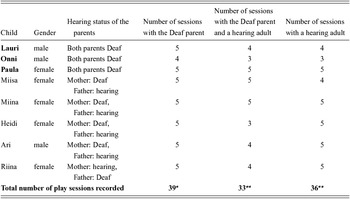
In this paper we present data on eight hearing KODA children who were followed up twice a year between the ages of 12 and 36 months (see more detailed descriptions of the participants and data collection in Table 1). Three children, Lauri, Paula and Onni (whose names are boldfaced from here on) had two parents deaf; and five children, Heidi, Miina, Miisa, Ari and Riina, had one hearing and one deaf parent. All the children were reported by their parents to be typical in their language development. However, after the data collection period, Onni was diagnosed with Specific Language Impairment, SLI. All the parents had completed a secondary level of education (either an upper secondary school or a vocational school). The Deaf parents were either native users of Finnish Sign Language (FinSL) or had started to use FinSL as a child and currently used it when communicating with other people. Of the five hearing parents only one was a fluent user of FinSL. In the other four families the parents had unique ways of communicating, with different variations and combinations of signs, gestures, spoken language and speech reading. All the children had regular and consistent exposure to both spoken Finnish and FinSL and were acquiring them simultaneously either at home, in day care outside the home (spending six to eight hours per day from three to five days per week at the day care centre) or by regularly meeting hearing and deaf close relatives.
Gender, hearing status of the parents and the number of separate play sessions with different interlocutor(s).

* Data collection for Onni started at the age of 18 months.
** Missing data were due to children's tiredness or a general non-willingness to cooperate.
Procedure
The data consisted of play sessions video-recorded at every data collection point (at the child's ages of 12, 18, 24, 30 and 36 months), of parental questionnaires, and the results of tests examining the children's mastery of Finnish language. Each of these data sources is described in detail in the following.
Video-recorded play sessions
The eight children studied were video-recorded at their home at the ages of 12, 18, 24, 30, and 36 months by the first author, a researcher who is a native user of both Finnish and FinSL. The children had never met the hearing researcher before the first home visit nor had they any contacts with her outside the data collection sessions. The children saw the researcher use FinSL with their parents, so the children were fully aware that the researcher was bilingual in Finnish and FinSL. However, when communicating with the children the researcher used only Finnish. During the play sessions, the parents were asked to play with their child as they would normally do. A standard set of books and toys suitable for the child's age was provided, but the adults and the children were not obliged to play only with these.
The children's language choice and code-mixing were examined in three different situations at each data collection point to answer research question 2b) on how the children changed their use of code-blending depending on the interlocutor(s) the child was communicating with. Hence, each home visit always contained three different sets of video-recorded play sessions. During the first play session the KODA child communicated with his or her deaf parent. The hearing researcher then joined in playing with the child and the deaf parent. The aim of this second condition was to observe the language use and communication of the child in a situation where two adults (one deaf and one hearing) were simultaneously present. During this play session, the hearing researcher used only Finnish. Finally, the child interacted alone with a hearing adult, most often the hearing researcher, who communicated with the child by using solely spoken Finnish (naturally accompanied by some gestures). The goal of this third condition was to capture the child's patterns of language use with a hearing interlocutor.
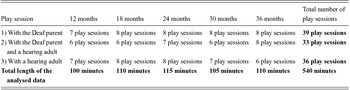
Altogether 108 play sessions were video-recorded and the size of the video-recorded data is presented in Table 2. Of the 69 sessions when a hearing person had to be present, the hearing researcher was replaced by the hearing parent of the child on five occasions (twice by a hearing father and three times by a hearing mother). This was done because the child did not cooperate with the hearing researcher. From each play session (all lasting 15 minutes) the most active five minute period was selected for the analysis. The criteria for selecting these five-minute periods were the number and length of utterances produced by the child. Thus, nine hours (540 minutes) of video-recorded data were analysed.
The number of analysed five-minute play sessions and the total duration of analysed data per time point (children's age).

Coding of video-recorded data
Each video-recorded session was transcribed, speech orthographically and signed communication by using glosses (sign-word correspondence written in capital letters), coded and analysed by the same hearing researcher who collected the data. ELAN software (see, e.g., Crasborn, Reference Crasborn, Orfanidou, Woll and Morgan2015; Lausberg & Sloetjes, Reference Lausberg and Sloetjes2009) was used in the analysis phase.
Coding of language
Language production was analysed based on utterances, which we define, as is done in many previous studies, as any sequence of speech or signs that is preceded and followed by pause, a change in an intonation pattern or a conversational turn (Van den Bogaerde & Baker, Reference Van den Bogaerde, Baker, Bishop and Hicks2008; Chen Pichler, Hochgesang, Lillo-Martin & de Quadros, Reference Chen Pichler, Hochgesang, Lillo-Martin and de Quadros2010; Petitto et al., Reference Petitto, Katerelos, Levy, Gauna, Tétreault and Ferraro2001). Since repetitions are commonly used in sign languages, and especially in child-direct signing, immediate repetitions of a single sign were included in the same utterance if they were produced within a non-stop string of production (e.g., immediate self-repetitions). Unintelligible utterances were excluded from the analyses. All communicative (intentional) words and signs produced by the children, either spontaneously or by imitation, were analysed from the video-recordings.
For attribution of lexical status our criteria were based on the principles proposed by Petitto et al. (Reference Petitto, Katerelos, Levy, Gauna, Tétreault and Ferraro2001) and Vihman and McCune (Reference Vihman and McCune1994). The children's productions were coded as containing a sign or a word if the verbal production or manual act
-
1) was used across appropriate contexts in strong relation to a referent; and
-
2) had at least one phonetic unit that resembled the adult form of that sign in FinSL (e.g., place, orientation or hand shape) or word in Finnish. Additionally,
-
3) the form had to be invariant. If the nature of the motor act was not clear, it was defined as a sign if it occurred in the parents’ motherese variant of FinSL.
Coding of code-mixing
To answer our first research question, criteria were conceived: firstly, for separating code-switches from code-blends, and, secondly, for identifying different types of code-blends. Utterances that consisted of simultaneous production of sign(s) and phonated or whispered word(s) were classified as code-blended, whereas utterances that consisted of sequential production of sign(s) and word(s) were regarded as code-switched. In this study we used criteria similar to those of, e.g., Petitto et al. (Reference Petitto, Katerelos, Levy, Gauna, Tétreault and Ferraro2001), Emmorey et al. (Reference Emmorey, Borinstein, Thompson and Gollan2008) and Lillo-Martin et al. (Reference Lillo-Martin, de Quadros, Chen Pichler and Fieldsteel2014), who regarded an utterance as code-blended if the sign was accompanied by speech that was phonated or whispered. We did not consider combinations of signed utterances and Finnish mouthing to be code-blending. This decision was made because we did not consider transcriptions of the children's productions that were only mouthed to be reliable enough.
To identify different types of code-blended utterances, we adopted the concept of Base Language, as the otherwise more-used concept of Matrix Language (Myers-Scotton, Reference Myers-Scotton1993, Reference Myers-Scotton1997, Reference Myers-Scotton2002) has been found to be somewhat problematic among bimodal bilinguals (Emmorey et al., Reference Emmorey, Borinstein, Thompson and Gollan2008; Van den Bogaerde & Baker, Reference Van den Bogaerde and Baker2005). Base language is the language that expresses the full proposition of utterances and provides more linguistic units in that particular language compared with another language used in a code-mixed utterance. The Matrix Language model utilises information on the syntactic frame (Myers-Scotton, Reference Myers-Scotton1997, Reference Myers-Scotton2002) of the utterance, whereas in our study semantic content was used to classify utterances. Previous studies on KODA children have also commonly utilised the semantic content of children's code-mixed utterances (e.g., Van den Bogaerde & Baker, Reference Van den Bogaerde and Baker2005; Petitto et al., Reference Petitto, Katerelos, Levy, Gauna, Tétreault and Ferraro2001).
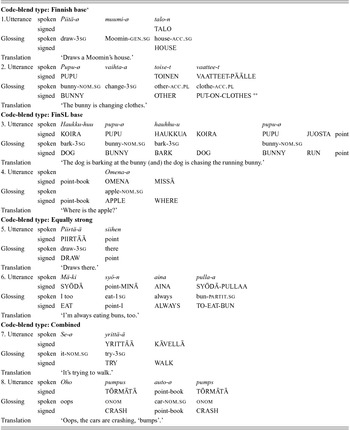
The code-blended utterances were further subcategorised following Van den Bogaerde and Baker (Reference Van den Bogaerde and Baker2005, Reference Van den Bogaerde, Baker, Bishop and Hicks2008). The utterances were divided into four different categories that are presented in Table 3. Code-blended utterances with (1) Finnish as the base language refer therefore to utterances that were expressed fully in spoken words and were accompanied by some semantically congruent FinSL sign(s) which did not bring any additional meaning into the utterance, whereas code-blended utterances with (2) FinSL as the base language refer to utterances that were produced fully in signs and were accompanied by some semantically congruent spoken words that did not carry any additional meaning. Utterances in which signs and words had equivalent semantic content were called (3) Equally strong (Finnish = FinSL). Finally, utterances where both signs and words were necessary for building up the full meaning of the utterance were referred to as (4) Combined (Finnish + FinSL). It is more difficult to determine if a point is a gesture or a sign when it accompanies only a spoken word than when it is produced with a sign/other signs. Additionally, in our earlier study (see Kanto et al., Reference Kanto, Laakso and Huttunen2015) we noticed that KODA children used gestures differently when communicating with different interlocutor(s). We discussed there that the points and other gestures might have a different role when the KODA child is communicating with the Deaf parent than with a hearing adult. On this basis we decided to exclude the combinations of speech and point and speech and interjections expressed in signs (e.g., speech with only a head nod or a point) from our analyses. This decision was also made by Lillo-Martin et al. (Reference Lillo-Martin, de Quadros, Chen Pichler and Fieldsteel2014) in their recent study.
Subcategories with some examples of code-blended utterances used in the analyses. Productions in sign language are transcribed using glosses written in capital letters. Information on Finnish and FinSL can be found in, e.g., the World Atlas of Language Structures Online (http://wals.info/).

*Used as the Base Language in this category (by supplying more words than signs to express the full proposition of an utterance).
**In the transcription, a hyphen between two signs is used to illustrate that the child produced only one sign but in the written transcription two or more words need to be used.
Five recordings from the different play sessions, one from each data collection point, were randomly selected for the reliability analysis of the code-blended utterances. Cohen's kappa was used to explore the degree of agreement between the two coders (the first and the third authors) working independently from each other. The coders’ agreement was perfect (with the kappa value of 1) when deciding on whether a child's utterance contained a code-blend or not. A kappa value of 0.656 was obtained for the inter-rater agreement in categorization of the code-blended utterances into different code-blend types. According to Landis and Koch (Reference Landis and Koch1977), the strength of agreement is considered substantial when it is over 0.61.
Coding the MLU
To evaluate the qualitative characteristics of code-mixing (research question 1b) we measured the mean length of all code-blended utterances belonging to the four previously mentioned subcategories; first the utterances as a whole and then separately for both the signs (MLU in signs) and the spoken words (MLU in words) in the same utterance. To calculate the MLU we used the same procedure and criterion as Van den Bogaerde (Reference Van den Bogaerde2000, p. 168). Thus, if the semantic content of the points, signs and words within the same utterance were the same, the combination was counted as one element. In all other cases signs and/or words were counted as separate elements of the utterance.
Evaluating language development
Children's development in both languages they were acquiring and their language dominance were evaluated to answer our research question 2a) on whether children's language competence and the dominant language are associated with the use of code-blends.
Parental questionnaires
Information about the children's productive vocabulary – separately in signs and in spoken words – was collected by using the Finnish adaptation (Lyytinen, Reference Lyytinen1999) of the MacArthur Communicative Development Inventory (MCDI, Fenson, Dale, Reznick, Thal, Bates, Hartung, Pethick & Reilly, Reference Fenson, Dale, Reznick, Thal, Bates, Hartung, Pethick and Reilly1991). The Infants version of the MCDI (designed for ages 8 to 16 months) was used at the age of 12 months and the Toddler version (designed for ages 16 to 30 months) at the ages of 18 and 24 months. The MCDI has not yet been adapted for FinSL. To gather information on the FinSL development of the children studied, a few adaptations were therefore made to the Finnish MCDI form (e.g., some signs related to the Deaf culture were added). These modifications were partly based on the changes Anderson and Reilly (Reference Anderson and Reilly2002) made when adapting the English version of the MCDI for American Sign Language (see also Woolfe, Herman, Roy & Woll, Reference Woolfe, Herman, Roy and Woll2010). Additionally, a supplementary part was added to the Toddler version to collect data on the grammar of FinSL. It was difficult to make the noun-verbal distinction; in some cases two forms on the MCDI would be realised by the same FinSL sign. For this reason it was important to discuss the child's production of these signs with the Deaf parent. Based on the discussion with the parent these signs were usually analysed as two items (e.g., both pen and write), but if the parent reported that the child only used the sign as a noun or verb, only one was counted.
To evaluate the development of syntactic complexity we analysed the language from the video-recorded play sessions in terms of the Mean Length of the Ten Longest Utterances (MLU10) for Finnish and FinSL. The MLU10 provides information on the longest structures a child is able to produce. Because the MLU10 used was based on whole words and signs, not morphemes, it could be used to obtain comparable measures of the level of language development in both FinSL and Finnish and to determine the dominant language. The MLU10 has been used by, for example, Van den Bogaerde (Reference Van den Bogaerde2000, p. 168) and Klatter-Folmer, van Hout, Kolen and Verhoeven (Reference Klatter-Folmer, van Hout, Kolen and Verhoeven2006) in studying KODA children and deaf children of deaf and hearing parents. In addition to collecting data on the child's syntactic complexity, the MLU10 data were also used together with the data on productive vocabularies in FinSL and Finnish, measured with the MCDI, to determine the child's dominant language. Accordingly, a data-based criterion was constructed: slowly developing MLU10 reaching the value of 1.8 at the highest in FinSL and a lower number of produced signs than words in MCDI were regarded as an indication of FinSL being the non-dominant language of the particular child studied (Supplementary materials).
Reynell Developmental Language Scales
When the children were 36 months old their linguistic development in spoken Finnish was tested by the first author using the Finnish version (Kortesmaa, Heimonen, Merikoski, Warma & Varpela, Reference Kortesmaa, Heimonen, Merikoski, Warma and Varpela2001) of the Reynell Developmental Language Scales III test (Edwards et al., Reference Edwards, Fletcher, Garman, Hughes, Letts and Sinka1997). The results of the Reynell test were used to check that the children's development was age-appropriate; to compare the children with each other in linguistic competence and to see how Finnish skills affected the way the children were using code-mixing.
Statistical analyses
To compare the number of code-blended utterances (total and different types) produced by each child at different ages, Related-Samples Friedman's Two-Way Analysis of Variance by Ranks and Related-Samples Wilcoxon Signed Rank Test with Holm-Bonferroni adjusted significance level were used. The child's age, language dominance, score in the Reynell test, interlocutor(s) and the frequency of using code-blends by the Deaf parent were used as the independent variables and the total number and the number of different code-blend types served as the within-subject dependent factors. Additionally, Spearman's Correlation Coefficients, and Mann-Whitney Test were used in the analyses. The standard alpha level of p < .05 was adopted.
Results
Quantitative and qualitative characteristics of code-mix utterances
The data from the children contained 393 (9%) code-blended utterances and only five (0.1%) code-switched utterances out of a total of 4509 utterances produced by the children. The Related Samples Wilcoxon Signed Rank Test showed that the difference between these utterance types was significant (Z = 2.521, p = .012).
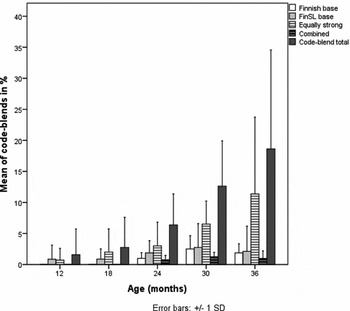
Because there were so few code-switched utterances, we will focus on analyzing the characteristics of code-blended utterances. Figure 1 shows the use of code-blended utterances with increasing age. At the age of 12 months the children used code-blending in 2% of all of the utterances in the video-recorded data, and this amount increased steadily to 18% at the last data point at 36 months. However, pairwise post-hoc testing did not show any age effects in the number of code-blends produced.
Mean proportion of code-blended utterances of all utterances produced by the children.

Although the children produced all types of code-blended utterances, the highest observed number of code-blended utterances were in the Equally strong category (simultaneous production of semantically equivalent Finnish words and FinSL signs). The children produced 223 Equally strong code-blended utterances. This type increased steadily from the first data point to 36 months, whereas the use of the other types of code-blends increased only slightly and later.
The children produced 56 utterances where Finnish was the Base Language. This code-blend type emerged in the children's productions at the age of 24 months. The children produced 84 code-blended utterances where FinSL was used as the Base Language. This type of code-blending emerged in Paula’s and Lauri’s productions already at the age of 12 and 18 months, respectively. At the age of 24 months all the children produced this type of code-blending but there were large individual differences between the children. Combined code-blended utterances, where both languages contribute to the meaning to the utterance, were used less (N = 30) by the children. This code-blend type was used from the age of 24 months onwards by all the children studied, with Paula, Lauri and Heidi having the highest numbers; they all produced six code-blends representing the Combined type.
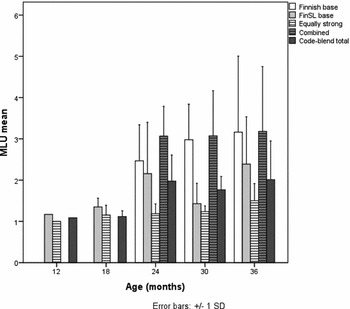
When analysing the MLU of all the code-blended utterances produced during the data collection period we noticed that the children's first code-blended utterances were short with a MLU of 1.1 at 12 months and 1.2 at 18 months of age. At the age of 24 months when the children started to use a wide variety of different code-blend types, the MLU of these utterances increased to 2. As was shown in Figure 1, the most frequent code-blend type was Equally strong. Interestingly, when the whole data collection period was inspected, the MLU of these code-blends was shorter than in other types of code-blends (F = 16.200, df = 3, p = .001; see Figure 2). On the other hand, the Combined code-blend type (where both signs and words contribute to the full meaning of the utterance) was produced the least frequently (Figure 1). Post-hoc testing showed that the MLU of the Combined type was significantly higher than the MLUs of the FinSL based (Z = 2.521, p = .012) and Equally strong (Z = 2.521, p = .012) code-blends.
Mean MLUs in different code-blend types produced by the children studied.

Next we will outline the semantic and syntactic structures of each type of code-blend separately. Examples of each code-blend type are presented in Table 3.
1. Finnish as the Base Language
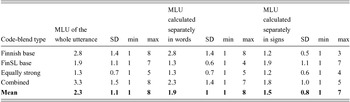
As can be seen in Table 4, the MLU was 2.8 in code-blended utterances where Finnish was used as the Base Language. When analysing the spoken and signed parts separately, the MLU in words was clearly higher than in signs (Z = 2.371, p = .018). Thus, the children usually code-blended a single sign that was semantically equivalent to a spoken word and Finnish provided the semantic frame for the utterance. The children's utterances usually followed the morphosyntactic structure of Finnish. However, utterances where the child obeyed the syntactic structure of both languages also occurred, as can be seen in example 2 presented in Table 3. The Finnish sentence has the verb ‘change’, but in FinSL the sign glossed as CLOTHES-ON functions as a verb and thus makes the signed part of the utterance grammatically well-formed.
MLUs in the code-blended utterances (N = 393) produced by the KODA children between the ages of 12 and 36 months.

2. FinSL as the Base Language
In this category the FinSL part provided the semantic frame which was then accompanied by single words. The MLU of the utterances where FinSL was the Base Language was 1.9. When the signed and the spoken parts were counted separately, the MLU in signs was higher than in words (Z = 2.032, p = .042). Utterances tended to follow the syntactic structure of FinSL related to, e.g., the Object-Verb order and WH-questions, as can be seen in examples 3 and 4 in Table 3.
3. Finnish and FinSL as Equally Strong Languages
This was the most prevalent type of code-blending used by the children studied. Utterances where both of the child's languages were Equally strong were significantly shorter than code-blended utterances in which Finnish was the base language (Z = −2.240, p = .025) or when the languages were combined (Z = −2.521, p = .012). This type of code-blend was mainly used to name objects or events, which may partly explain the shorter MLU. Most of the time the children produced utterances that conformed to the structure of both spoken Finnish and FinSL. This can be seen especially in example 6 presented in Table 3, where the spoken and signed parts have a different item order but are still grammatically well-formed.
4. Combined code-blended utterances
In this category both languages contributed their own meaning to the utterance. This type of code-blending was less used by the children studied and it did not emerge before the age of 24 months. When one takes a closer look at these utterances it can be seen how effectively the children simultaneously used their two modalities. They were able to produce their longest utterances when using this type of code-blend (F = 16.220, df = 3, p = .001). Of all the Combined type code-blended utterances produced (N = 30), 12 were used when the children wanted to describe, for example, a type of movement or shape. This is illustrated in example 8 in Table 3.
Non-adult-like structures of code-blended utterances
For the qualitative analysis of the data, we did an in-depth analysis of the syntax of code-blended utterances that contained non-adult-like Finnish structures, as we considered it clinically important. All in all, among the 393 code-blended utterances only 25 (6%) contained non-adult-like Finnish structures. It must be emphasized that the children's code-blended utterances were usually rather short, as can be seen in Figure 2, which partly explains the low number of non-adult-like structures in Finnish.
Three different kinds of non-adult-like structures were identified. The Finnish word order was incorrect in four utterances. For example in one case the Finnish word order was ungrammatical since it has an Object-Verb order (e.g., spoken: TV kattoo [translation: ‘TV watch’], signed: KATSOA [translation: ‘WATCH’]. Eight utterances were also missing syntactic structures in Finnish like a copula or conjunction word (e.g., spoken: perhonen se __ perhonen [translation: ‘butterfly that butterfly’], signed: YKSI PERHONEN [translation: ‘ONE BUTTERFLY’). Thirteen of the non-adult-like structures were caused by missing inflections in Finnish. Finnish is known for its rich morphology with many suffixes. However, the KODA children studied did not produce a single utterance with incorrect inflectional patterns. Instead, the children produced the words in their basic form and the deviant structure was that the inflections were missing (example: spoken in Finnish: paljon lahja [translation: ‘Many present’], signed: PALJON LAHJA [translation: ‘MANY PRESENT’]). This is very typical of young children acquiring Finnish. It is worth noting that these structures are grammatical in FinSL.
To summarise, KODA children clearly preferred to use code-blended rather than code-switched structures in their code-mixing. The most used type of code-blend was the Equally strong sub-category. There was clear variation in the MLU between the different code-blend types. We also found that the code-blends were semantically congruent and that 6% of code-blended utterances contained non-adult-like Finnish structure.
Factors associated with the use of code-blended utterances
In our second research question we wanted to explore if the number and type of code-blended utterances varied depending on a) the language competence and language dominance of the children and b) contextual variables like the person the child was communicating with and the Deaf parent's use of code-blends.
Language competence and the use of code-blended utterances
The MCDI, MLU10 and Reynell results that were used to assess the children's language competence are presented in the Supplementary material. As presented in Figure 1, the use of code-blended utterances generally started to increase at the age of 24 months. The results of the MLU10 showed that at that age the children also started to produce longer utterances in both FinSL and Finnish, although stringent post-hoc testing did not reveal any pairwise age effects. Additionally, according to the MCDI results, at the same age seven out of eight children had passed the first 50-word milestone in both of their languages. At this stage the children commonly started producing two-word utterances. This result therefore suggests that at this age children start to have sufficient language competence to be able to produce code-blended structures.
According to the scores in the Reynell test the eight children fell into two groups those with age-equivalent scores in Finnish language (Paula, Heidi, Miina, Miisa and Riina) and those with scores below their age-level, that is below -1 SD but within -2 SD either in the recetive, expressive or total scores of the test (Lauri, Onni and Ari). The children with age-equivalent scores in the test produced code-blends (mean N = 63) in, on average, 10% of their utterances (the mean number of utterances per child was 601). In the group within -2 SD scores in the Reynell test, code-blended utterances were produced, on average, in 5% (mean N = 26) of all the utterances produced (mean number of utterances per child was 501) during the data collection period. It has to be noted, however, that the latter group was small; only three children did not attain the age-level performance in Finnish language in the Reynell test. According to the Mann Whitney test, no statistically significant difference in the number of code-blends produced was found between these two groups.
Language dominance and use of code-blends
The other child-specific factor we were interested in was the children's language dominance. To evaluate this we used both the results of the MCDI and the MLU10. Four children (Paula, Lauri, Ari and Heidi) were found to have FinSL as their dominant language (see Supplementary material, Tables 1 and 2). They showed a clear upward trend in productive FinSL vocabulary measured with the MCDI and produced somewhat longer utterances in FinSL (MLU10) than the other four children studied. The latter group (Onni, Miina, Miisa and Riina) produced more spoken words than signs over time, as showed by the MCDI. In addition, their MLU10 in FinSL showed hardly any increase during the data collection period. The children of the latter group were judged to have Finnish as their dominant language.
The KODA children whose dominant language was FinSL used code-blended structures, on average, in 11% (N = 246) of all of their utterances (N = 2252), and the children who had Finnish as their dominant language produced code-blends, on average, in 7% (N = 147) of all of their utterances (N = 2257). However, due to the small number of children and variation in the use of code-blends within each group, the Mann-Whitney Test did not find any statistically significant difference between these groups in either the number or the different types of code-blended utterances produced.
Use of code-blends with different interlocutors
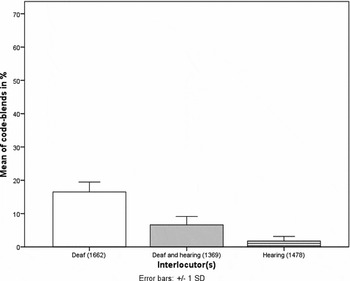
The children studied produced different number of code-blends depending on the interlocutor(s) (F = 16.000, df = 2, p = .000). They produced 68% of all of their code-blended utterances when communicating alone with their Deaf parent and only 7% when playing alone with the hearing adult. This difference was significant (Z = 2.524, p = .012). Altogether 16% (N = 267) of all of the 1662 utterances produced when playing with the Deaf parent alone were code-blended. This is illustrated in Figure 3. When communicating with the hearing adult alone, only 2% (N = 26) of altogether 1478 utterances were code-blended. During the session where both the Deaf and the hearing adult were present, 7% (N = 100) of the children's utterances were code-blended, and this also differed significantly from the number of code-blends produced when the children were communicating with the Deaf parent (Z = 2.524, p = .012) or with the hearing adult (Z = 2.524, p = .012).
Mean proportion of code-blended utterances by the children when communicating with different interlocutors. Low and high refers to frequency the parents used code-blends. The total number of all utterances produced by the children in each play session is mentioned under the bars.

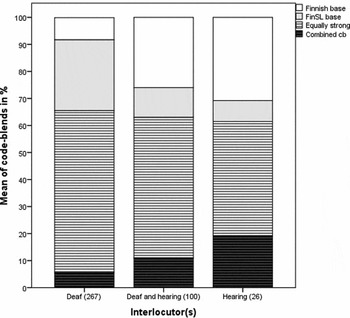
The children used almost all types of code-blends with all their interlocutor(s), but the preference to use each type of code-blends tended to be linked to the person the child was communicating with, as can be seen from Figure 4. During all three play sessions the children mostly used code-blended utterances where both of the languages were Equally strong. With the Deaf parent, however, the children also frequently used FinSL-based utterances but Finnish-based utterances were hardly ever used. When a hearing person was present in the two other play sessions the children mostly used code-blended utterances in which both of the languages were Equally strong or Finnish base code-blends. With a hearing adult the KODA children used only a few code-blends where FinSL was the base language.
Mean proportion of different types of code-blends of all the code-blended utterances produced when communicating with different interlocutors. The total number of code-blend utterances produced in each play session is mentioned under the bars.

Deaf parent's use of code-blends
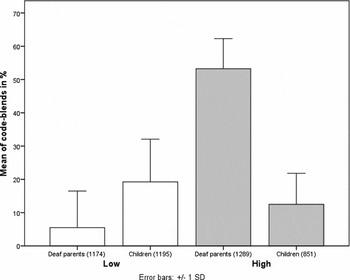
Since there were great individual differences among the Deaf parents in their use of code-blends, the Deaf parents and their children were divided into two groups depending on the number of code-blended utterances used by the parents. Four of the Deaf parents (those of Paula, Onni, Miisa and Ari) used a large number of code-blended utterances. At least 43% (the mean was 54%) of their utterances were code-blended. On the other hand, four Deaf parents (those of Lauri, Heidi, Miina and Riina) clearly preferred to use solely FinSL. In this group only one parent (that of Heidi) used code-blended utterances in 16% of the utterances, whereas the other three parents did not code-blend at all. However, when we compared the children's use of code-blended utterances between these two groups, there was no statistically significant difference in the number of code-blends the children used (see Figure 5). The children whose parents produced code-blended utterances hardly at all used quite the comparable amounts of code-blends as the children whose parents used a large number of code-blended utterances.
Mean proportion of code-blended utterances produced by the Deaf parents (low or high use) and their KODA children. The total number of utterances produced by the children and their parents is presented below each bar.

In summary, our results suggest that at a young age children need to have enough language competence in both of their languages in order to produce code-blend structures. Despite the fact that the children clearly preferred to use code-blends when communicating with their Deaf parent compared with the situation when communicating with the hearing adult, the frequency of code-blends produced by the Deaf parent was not associated with the frequency of code-blended utterances produced by their children.
Discussion and conclusions
With our longitudinal data on eight KODA children between the ages of 12 and 36 months we were interested in obtaining information about the characteristics and use of code-mixed utterances of young children. Our results showed a clear preference towards code-blended utterances, and we found only a few code-switched utterances. We therefore focused on analysing the quantitative and qualitative characteristics of different code-blend types and with the help of those analyses we were able to describe semantic and syntactic structures of different code-blended utterances. Additionally, when we examined the children's use of code-blending as a function of different variables we noticed that the use of code-blends by KODA children was associated with the interlocutor they were communicating with. With our multifaceted data we were able to bring forth several interesting findings which can fuel further research and offer new viewpoints for discussion.
Quantitative and qualitative characteristics of code-blends
The answers to our first research question were in accordance with previous studies (Van den Bogaerde & Baker, Reference Van den Bogaerde, Baker, Bishop and Hicks2008; Emmorey et al., Reference Emmorey, Borinstein, Thompson and Gollan2008; Petitto et al., Reference Petitto, Katerelos, Levy, Gauna, Tétreault and Ferraro2001), as we noticed that KODA children who do not have physical restrictions to producing both languages simultaneously preferred to produce semantically congruent signs and words at the same time. Indeed, code-blends clearly outnumbered the occurrence of code-switches. This result supports the suggestion of previous studies that both languages of a bilingual person are activated during the language production process. In addition, the language production process does not require early language selection, which means both languages can be produced simultaneously without causing an extra burden (Casey & Emmorey, Reference Casey and Emmorey2009; Emmorey et al., Reference Emmorey, Borinstein, Thompson and Gollan2008; Kroll, Bobb & Wodniecka, Reference Kroll, Bobb and Wodniecka2006; Shook & Marian, Reference Shook and Marian2012). If the selection of two linguistic representations would require more cognitive and linguistic processing than the selection of one and suppression of another language, we would see bimodal bilinguals prefer code-switching over code-blending. However, this is not the case on the basis of our study or previous studies on bimodal bilingual adults and children (Emmorey et al., Reference Emmorey, Borinstein, Thompson and Gollan2008; Lillo-Martin et al., Reference Lillo-Martin, de Quadros, Chen Pichler and Fieldsteel2014; Petitto et al., Reference Petitto, Katerelos, Levy, Gauna, Tétreault and Ferraro2001).
With regard to the qualitative characteristics of code-mixing we noticed that the MLU in different code-blend types varied greatly. However, as expected on the basis of the method used for classifying different code-blend types, the MLU of the base language was higher than that of the accompanying language, whereas in those cases where the languages were Equally strong the MLU in words and signs was almost the same. In the Combined code-blend type Finnish had a higher MLU than FinSL. Although the KODA children produced the longest and most complex utterances when using the Combined type of code-blends, they clearly preferred to use the Equally strong code-blends. This indicates that the main purpose for using code-blends might not be to take full advantage of the possibility to produce distinct information in the two languages in two modalities. Emmorey et al. (Reference Emmorey, Borinstein, Thompson and Gollan2008) have also discussed this matter. Producing distinct information with different modalities most probably requires more cognitive and linguistic processing capacity than production of semantically congruent signs and words.
The Base Language provided the syntactic frame into which signs or words from the accompanying language were then inserted. Consistent with the findings of Van den Bogaerde (Reference Van den Bogaerde2000, p. 239), we found that, regardless of the type of code-blend, already at this young age the children produced code-blend structures that mostly obeyed the grammar of both languages. The KODA children we studied were mostly within the normal range in their language development and the structures of Finnish in code-blended utterances were mostly adult-like. The few non-adult-like structures that emerged can be regarded as indications of natural interaction between the languages of a KODA child, as noticed in research literature (Döpke, Reference Döpke2000; Emmorey et al., Reference Emmorey, Borinstein, Thompson and Gollan2008; Lillo-Martin et al., Reference Lillo-Martin, Koulidobrova, Müller de Quadros, Chen Pichler, Biller, Chung and Kimball2012; Paradis et al., Reference Paradis, Nicoladis and Genesee2000). Additionally, the non-adult-like structures produced by KODA children are also a prevalent phenomenon in typically developing monolingual children under three years of age (Laalo, Reference Laalo2011).
Factors associated with KODA children's code-blending
Our results regarding our second research question were consistent with previous studies indicating that children generally start to code-mix at the stage where they have enough language competence. This usually happens at the age of 24 months (e.g., Van den Bogaerde & Baker, Reference Van den Bogaerde, Baker, Bishop and Hicks2008; Genesee et al., Reference Genesee, Nicoladis and Paradis1995, Paradis et al., Reference Paradis, Nicoladis and Genesee2000). Additionally, previous studies suggest that, for code-mixing, children have to have enough language competence in both of their languages; and, with imbalanced competence in their languages, children have been found to code-mix less than children who have more balanced competence in their languages (e.g., Van den Bogaerde & Baker, Reference Van den Bogaerde and Baker2005; Meisel, Reference Meisel1994; Reference Montanari2009; Vihman, Reference Vihman1998).
The Gap-Filling Hypothesis introduced in the studies on unimodal bilinguals (e.g., Genesee & Nicoladis, Reference Genesee, Nicoladis, Hoff and Shatz2007; Nicoladis & Secco, Reference Nicoladis and Secco2000) was not supported by our results. The KODA children we studied clearly preferred to produce semantically congruent signs and words in their code-blended utterances and did not use code-mixing to fill gaps in their language competence; the Combined type of code-blends which included semantically distinct information in signed and spoken parts of the utterance was infrequent.
In relation to the contextual factors associated with the use of code-blended utterances in KODA children, our study was in line with previous findings in that sense that the children we studied produced most of the code-blends when communicating with their Deaf parent and using the minority language of the surrounding community (Greene et al., Reference Greene, Peña and Bedore2013; Paradis & Nicoladis, Reference Paradis and Nicoladis2007). In tune with what Pizer (Reference Pizer2008) found in his research, the KODA children we studied leaned towards Finnish by using more code-blending when communicating with the Deaf parent rather than using only FinSL, and decreased the use of FinSL during the two other play sessions where the hearing person was present. Thus, we found that the use of code-mixing can be affected by the minority and majority status of the languages acquired and socialisation into the use of patterns of code-mixing. The eight KODA children we studied were more likely to use code-blends when using the minority language, FinSL, when communicating with their Deaf parent than when using the majority language, Finnish, when communicating with the hearing adult. Bilingualism and the use of code-blends are well-known features among the members of the Deaf community. Our results suggest that the acquisition of normative patterns of code-blending from their environment guided KODA children's use of code-blend structures when communicating with different interlocutors already during the early phase of their language development. This was seen in their behaviour where they clearly preferred to use code-blended utterances with their Deaf parent but avoided using code-blended utterances with the hearing adult. We therefore propose that code-mixing used by the KODA children was guided not only by grammatical but also by wider social constraints.
The processes behind the clear difference in the use of code-blended utterances between the different interlocutors call for further research. Our results agree with the asymmetric inhibition view (see e.g., Green, Reference Green1998; Costa & Santesteban, Reference Costa and Santesteban2004; Lillo-Martin et al., Reference Lillo-Martin, de Quadros, Chen Pichler and Fieldsteel2014; Meuter & Allport, Reference Meuter and Allport1999). Concordant with the findings of Lillo-Martin et al. (Reference Lillo-Martin, de Quadros, Chen Pichler and Fieldsteel2014), we hypothesise that the eight KODA children we studied avoided code-blended utterances, especially FinSL base structures, when communicating with the hearing adult by inhibiting FinSL more, compared with their inhibition of Finnish when communicating with the Deaf parent. These results also suggest that when a KODA child uses FinSL with the Deaf parent, both FinSL and Finnish become more active compared with a situation where a child is communicating with a hearing adult who uses Finnish. It has to be noted, however, that the KODA children we studied also produced some code-blend structures when they were communicating with a hearing adult. This indicates that FinSL may still remain weakly active when Finnish is used (Emmorey et al., Reference Emmorey, Borinstein, Thompson and Gollan2008; see also Casey & Emmorey, Reference Casey and Emmorey2009; Lillo-Martin et al., Reference Lillo-Martin, de Quadros, Chen Pichler and Fieldsteel2014; Shook & Marian, Reference Shook and Marian2012).
Although we did find that the frequency of code-blending varied from one family to another, we did not find any significant association between the Deaf parents’ and their children's use of code-blends. Our data do not therefore support the Modeling Hypothesis proposed in unimodal bilingual studies (see, e.g., Comeau et al., Reference Comeau, Genesee and Lapaquette2003), although the KODA children changed their use of code-blending according to their interlocutor. Thus, the children studied used code-blended utterances even if they were not directly exposed to such structures by the Deaf parent.
Bilingual and bimodal children's ability to use code-mixing in a way that does not violate the grammar of the participating languages indicates the children's capacity to actively and simultaneously process the two languages they are acquiring. They have to have enough knowledge of the grammar of both the languages and simultaneous access to these grammars so that the grammatical systems can be flawlessly synchronised in tandem within the same utterance. Our results indicated that, during the time young KODA children acquire their two languages and start to organise them according to grammatical principles, they also simultaneously learn the grammatical and pragmatic principles and normative patterns of code-mixing. Additionally, our results confirmed earlier findings that already young bilingual children are able to differentiate their languages. This was shown by the results where the children were able to modify the number and type of code-mixing according to their interlocutor(s) and were capable of taking into account different structures and meanings in both of their languages in tandem.
When code-mixing fluently and flawlessly, children are exploiting all their linguistic competence in both of their languages to express themselves as well they can. Therefore, parents of bilingual children and professionals working with them need to consider code-mixing as a natural sign of linguistic and communicative competence and they should bear in mind that contextual and environmental factors strongly guide the use of code-mixing.
Supplementary material
For supplementary material accompanying this paper, visit http://dx.doi.org/10.1017/S1366728916000560