



%20--%3e%3c!DOCTYPE%20svg%20PUBLIC%20'-//W3C//DTD%20SVG%201.0//EN'%20'http://www.w3.org/TR/2001/REC-SVG-20010904/DTD/svg10.dtd'%3e%3csvg%20version='1.0'%20id='Layer_1'%20xmlns='http://www.w3.org/2000/svg'%20xmlns:xlink='http://www.w3.org/1999/xlink'%20x='0px'%20y='0px'%20width='64px'%20height='64px'%20viewBox='5.5%20-3.5%2064%2064'%20enable-background='new%205.5%20-3.5%2064%2064'%20xml:space='preserve'%3e%3cg%3e%3ccircle%20fill='%23FFFFFF'%20fill-opacity='0'%20cx='37.785'%20cy='28.501'%20r='28.836'/%3e%3cpath%20fill='%23595959'%20d='M37.441-3.5c8.951,0,16.572,3.125,22.857,9.372c3.008,3.009,5.295,6.448,6.857,10.314%20c1.561,3.867,2.344,7.971,2.344,12.314c0,4.381-0.773,8.486-2.314,12.313c-1.543,3.828-3.82,7.21-6.828,10.143%20c-3.123,3.085-6.666,5.448-10.629,7.086c-3.961,1.638-8.057,2.457-12.285,2.457s-8.276-0.808-12.143-2.429%20c-3.866-1.618-7.333-3.961-10.4-7.027c-3.067-3.066-5.4-6.524-7-10.372S5.5,32.767,5.5,28.5c0-4.229,0.809-8.295,2.428-12.2%20c1.619-3.905,3.972-7.4,7.057-10.486C21.08-0.394,28.565-3.5,37.441-3.5z%20M37.557,2.272c-7.314,0-13.467,2.553-18.458,7.657%20c-2.515,2.553-4.448,5.419-5.8,8.6c-1.354,3.181-2.029,6.505-2.029,9.972c0,3.429,0.675,6.734,2.029,9.913%20c1.353,3.183,3.285,6.021,5.8,8.516c2.514,2.496,5.351,4.399,8.515,5.715c3.161,1.314,6.476,1.971,9.943,1.971%20c3.428,0,6.75-0.665,9.973-1.999c3.219-1.335,6.121-3.257,8.713-5.771c4.99-4.876,7.484-10.99,7.484-18.344%20c0-3.543-0.648-6.895-1.943-10.057c-1.293-3.162-3.18-5.98-5.654-8.458C50.984,4.844,44.795,2.272,37.557,2.272z%20M37.156,23.187%20l-4.287,2.229c-0.458-0.951-1.019-1.619-1.685-2c-0.667-0.38-1.286-0.571-1.858-0.571c-2.856,0-4.286,1.885-4.286,5.657%20c0,1.714,0.362,3.084,1.085,4.113c0.724,1.029,1.791,1.544,3.201,1.544c1.867,0,3.181-0.915,3.944-2.743l3.942,2%20c-0.838,1.563-2,2.791-3.486,3.686c-1.484,0.896-3.123,1.343-4.914,1.343c-2.857,0-5.163-0.875-6.915-2.629%20c-1.752-1.752-2.628-4.19-2.628-7.313c0-3.048,0.886-5.466,2.657-7.257c1.771-1.79,4.009-2.686,6.715-2.686%20C32.604,18.558,35.441,20.101,37.156,23.187z%20M55.613,23.187l-4.229,2.229c-0.457-0.951-1.02-1.619-1.686-2%20c-0.668-0.38-1.307-0.571-1.914-0.571c-2.857,0-4.287,1.885-4.287,5.657c0,1.714,0.363,3.084,1.086,4.113%20c0.723,1.029,1.789,1.544,3.201,1.544c1.865,0,3.18-0.915,3.941-2.743l4,2c-0.875,1.563-2.057,2.791-3.541,3.686%20c-1.486,0.896-3.105,1.343-4.857,1.343c-2.896,0-5.209-0.875-6.941-2.629c-1.736-1.752-2.602-4.19-2.602-7.313%20c0-3.048,0.885-5.466,2.658-7.257c1.77-1.79,4.008-2.686,6.713-2.686C51.117,18.558,53.938,20.101,55.613,23.187z'/%3e%3c/g%3e%3c/svg%3e)
%20--%3e%3c!DOCTYPE%20svg%20PUBLIC%20'-//W3C//DTD%20SVG%201.0//EN'%20'http://www.w3.org/TR/2001/REC-SVG-20010904/DTD/svg10.dtd'%3e%3csvg%20version='1.0'%20id='Layer_1'%20xmlns='http://www.w3.org/2000/svg'%20xmlns:xlink='http://www.w3.org/1999/xlink'%20x='0px'%20y='0px'%20width='64px'%20height='64px'%20viewBox='5.5%20-3.5%2064%2064'%20enable-background='new%205.5%20-3.5%2064%2064'%20xml:space='preserve'%3e%3cg%3e%3ccircle%20fill='%23FFFFFF'%20fill-opacity='0'%20cx='37.637'%20cy='28.806'%20r='28.276'/%3e%3cg%3e%3cpath%20fill='%23595959'%20d='M37.443-3.5c8.988,0,16.57,3.085,22.742,9.257C66.393,11.967,69.5,19.548,69.5,28.5c0,8.991-3.049,16.476-9.145,22.456%20C53.879,57.319,46.242,60.5,37.443,60.5c-8.649,0-16.153-3.144-22.514-9.43C8.644,44.784,5.5,37.262,5.5,28.5%20c0-8.761,3.144-16.342,9.429-22.742C21.101-0.415,28.604-3.5,37.443-3.5z%20M37.557,2.272c-7.276,0-13.428,2.553-18.457,7.657%20c-5.22,5.334-7.829,11.525-7.829,18.572c0,7.086,2.59,13.22,7.77,18.398c5.181,5.182,11.352,7.771,18.514,7.771%20c7.123,0,13.334-2.607,18.629-7.828c5.029-4.838,7.543-10.952,7.543-18.343c0-7.276-2.553-13.465-7.656-18.571%20C50.967,4.824,44.795,2.272,37.557,2.272z%20M46.129,20.557v13.085h-3.656v15.542h-9.944V33.643h-3.656V20.557%20c0-0.572,0.2-1.057,0.599-1.457c0.401-0.399,0.887-0.6,1.457-0.6h13.144c0.533,0,1.01,0.2,1.428,0.6%20C45.918,19.5,46.129,19.986,46.129,20.557z%20M33.042,12.329c0-3.008,1.485-4.514,4.458-4.514s4.457,1.504,4.457,4.514%20c0,2.971-1.486,4.457-4.457,4.457S33.042,15.3,33.042,12.329z'/%3e%3c/g%3e%3c/g%3e%3c/svg%3e)
%20--%3e%3c!DOCTYPE%20svg%20PUBLIC%20'-//W3C//DTD%20SVG%201.0//EN'%20'http://www.w3.org/TR/2001/REC-SVG-20010904/DTD/svg10.dtd'%3e%3csvg%20version='1.0'%20id='Layer_1'%20xmlns='http://www.w3.org/2000/svg'%20xmlns:xlink='http://www.w3.org/1999/xlink'%20x='0px'%20y='0px'%20width='64px'%20height='64px'%20viewBox='5.5%20-3.5%2064%2064'%20enable-background='new%205.5%20-3.5%2064%2064'%20xml:space='preserve'%3e%3cg%3e%3ccircle%20fill='%23FFFFFF'%20fill-opacity='0'%20cx='36.924'%20cy='28.403'%20r='28.895'/%3e%3cpath%20fill='%23595959'%20d='M37.442-3.5c8.99,0,16.571,3.085,22.743,9.256C66.393,11.928,69.5,19.509,69.5,28.5c0,8.992-3.048,16.476-9.145,22.458%20C53.88,57.32,46.241,60.5,37.442,60.5c-8.686,0-16.19-3.162-22.513-9.485C8.644,44.728,5.5,37.225,5.5,28.5%20c0-8.762,3.144-16.343,9.429-22.743C21.1-0.414,28.604-3.5,37.442-3.5z%20M12.7,19.872c-0.952,2.628-1.429,5.505-1.429,8.629%20c0,7.086,2.59,13.22,7.77,18.4c5.219,5.144,11.391,7.715,18.514,7.715c7.201,0,13.409-2.608,18.63-7.829%20c1.867-1.79,3.332-3.657,4.398-5.602l-12.056-5.371c-0.421,2.02-1.439,3.667-3.057,4.942c-1.622,1.276-3.535,2.011-5.744,2.2%20v4.915h-3.714v-4.915c-3.543-0.036-6.782-1.312-9.714-3.827l4.4-4.457c2.094,1.942,4.476,2.913,7.143,2.913%20c1.104,0,2.048-0.246,2.83-0.743c0.78-0.494,1.172-1.312,1.172-2.457c0-0.801-0.287-1.448-0.858-1.943l-3.085-1.315l-3.771-1.715%20l-5.086-2.229L12.7,19.872z%20M37.557,2.214c-7.276,0-13.428,2.571-18.457,7.714c-1.258,1.258-2.439,2.686-3.543,4.287L27.786,19.7%20c0.533-1.676,1.542-3.019,3.029-4.028c1.484-1.009,3.218-1.571,5.2-1.686V9.071h3.715v4.915c2.934,0.153,5.6,1.143,8,2.971%20l-4.172,4.286c-1.793-1.257-3.619-1.885-5.486-1.885c-0.991,0-1.876,0.191-2.656,0.571c-0.781,0.381-1.172,1.029-1.172,1.943%20c0,0.267,0.095,0.533,0.285,0.8l4.057,1.83l2.8,1.257l5.144,2.285l16.397,7.314c0.535-2.248,0.801-4.533,0.801-6.857%20c0-7.353-2.552-13.543-7.656-18.573C51.005,4.785,44.831,2.214,37.557,2.214z'/%3e%3c/g%3e%3c/svg%3e)
%20--%3e%3c!DOCTYPE%20svg%20PUBLIC%20'-//W3C//DTD%20SVG%201.1//EN'%20'http://www.w3.org/Graphics/SVG/1.1/DTD/svg11.dtd'%3e%3csvg%20version='1.1'%20id='Layer_1'%20xmlns='http://www.w3.org/2000/svg'%20xmlns:xlink='http://www.w3.org/1999/xlink'%20x='0px'%20y='0px'%20width='64.000977px'%20height='64px'%20viewBox='0%200%2064.000977%2064'%20enable-background='new%200%200%2064.000977%2064'%20xml:space='preserve'%3e%3cg%3e%3ccircle%20fill='%23FFFFFF'%20fill-opacity='0'%20cx='32.064453'%20cy='31.788086'%20r='29.012695'/%3e%3cg%3e%3cpath%20fill='%23595959'%20d='M31.943848,0C40.896484,0,48.476562,3.105469,54.6875,9.314453C60.894531,15.486328,64.000977,23.045898,64.000977,32%20s-3.048828,16.457031-9.145508,22.513672C48.417969,60.837891,40.779297,64,31.942871,64%20c-8.648926,0-16.152832-3.142578-22.513672-9.429688C3.144043,48.286133,0,40.761719,0,32.000977%20c0-8.723633,3.144043-16.285156,9.429199-22.68457C15.640137,3.105469,23.14502,0,31.943848,0z%20M32.060547,5.771484%20c-7.275391,0-13.429688,2.570312-18.458496,7.714844C8.381836,18.783203,5.772949,24.954102,5.772949,32%20c0,7.125,2.589844,13.256836,7.77002,18.400391c5.181152,5.181641,11.352051,7.770508,18.515625,7.770508%20c7.123047,0,13.332031-2.608398,18.626953-7.828125C55.713867,45.466797,58.228516,39.353516,58.228516,32%20c0-7.3125-2.553711-13.484375-7.65625-18.513672C45.504883,8.341797,39.333984,5.771484,32.060547,5.771484z%20M44.117188,24.456055%20v5.485352H20.859863v-5.485352H44.117188z%20M44.117188,34.743164v5.481445H20.859863v-5.481445H44.117188z'/%3e%3c/g%3e%3c/g%3e%3c/svg%3e)
Impact statement
This paper contributes to the social dimension of biodesign by offering nuanced bio-based material exploration and design provocations for diverse human experiences in intimate settings (everyday maternity care). Through this exploration, we also foreground human bodily materials as an integral part of biodesign processes and outcomes.
Introduction
Maternal care is a complex, sensitive and emotionally charged space of human experience (Yurman et al. Reference Yurman, Malpass, Balaam, Zheng, Luft, Mougenot and Lupetti2025). As Lucy Jones describes, “during pregnancy, childbirth, and early motherhood, women undergo a far-reaching physiological, psychological, and social metamorphosis” (Jones Reference Jones2023). Many experience pain and discomfort alongside feelings of frustration, isolation or anxiety triggered by bodily and everyday transformations. Using Adrienne Rich’s words: “The body has been made so problematic for women that it has often seemed easier to shrug it off and travel as a disembodied spirit” (Rich Reference Rich2021). These bodily experiences expose tensions in how maternal bodies are known and cared for. In this paper, we use “matrescence” – a term introduced by Lucy Jones in her book Matrescence: On the Metamorphosis of Pregnancy, Childbirth, and Motherhood (Jones Reference Jones2023) to describe the time of a person becoming a mother, which include time of preparing to be pregnant, pregnancy and postpartum in each individual’s subjective temporality.
While new sensing and tracking technologies promise insight into bodily processes (Costa Figueiredo et al. Reference Costa Figueiredo, Caldeira, Eikey, Mazmanian and Chen2018; Jaeger et al. Reference Jaeger, Nissen, Leutheuser, Danzberger, Titzmann, Pontones, Goossens, Ziegler, Uhrig, Haeberle, Bleher, Kast, Kornhuber, Schoeffski, Braun, Fasching, Beckmann, Eskofier and Huebner2025; Sawalha and Karnowski Reference Sawalha and Karnowski2022), they may also reinscribe medicalization of the body (Ciolfi Felice et al. Reference Ciolfi Felice, Søndergaard and Balaam2021) and reduce lived experienced into measurements and optimization. In this research, we draw on feminist reclamation of the body as lived experiences (Ciolfi Felice et al. Reference Ciolfi Felice, Søndergaard and Balaam2021; Neimanis Reference Neimanis2017) and care as materially and ecologically entangled (Puig de La Bellacasa Reference Puig de La Bellacasa2017) to resist medicalization of maternal bodies, that is reducing bodies to medical problems (Conrad and Schneider Reference Conrad and Schneider1980). Specifically, we explore how bio-based pH-sensing materials can facilitate noticing and caring for the changing bodily fluids and microbiomes during matrescence. We focus on bio-based materials made of agar, carboxymethyl cellulose (CMC) and red cabbage anthocyanins due to their safety, accessible resources, low-tech making process, expertise and experiences within our team.
We conducted iterative material exploration and design speculation involving the following steps:
-
• Three iterative material-making sessions examining agar, CMC and their combination as substrates for anthocyanin-based pH-sensing materials.
-
• A co-creation session exploring how these materials might be integrated into intimate care artifacts for matrescence (before, during and after pregnancy).
-
• Iterative design speculation grounded in lived experience, transferring insights from material exploration and co-creation into design provocations.
Gaps and contributions
Prior work has established bio-based materials as biodegradable and interactive design media and demonstrated the technical viability of various bio-based colourimetric pH-sensing materials (Bates et al. Reference Bates, Yee, Gough, Withana and Vega2026; Woytuk and Søndergaard Reference Campo Woytuk and Søndergaard2024). We explore how bio-based materials might further enable non-medicalized forms of care in everyday contexts, especially in intimate settings. We offer nuanced insights into the material qualities of agar, CMC and their combination as substrates for sensing the pH of various bodily fluids. We summarize the dimensions of the design space in which bio-based pH-sensing materials might cultivate sensibilities towards the dynamics of bodily fluids and microbiomes during matrescence. We also speculate and materialize concrete design provocations and specific scenarios based on distinctive qualities and dimensions. This work enhances the social dimension of biodesign by emphasizing the importance of diverse human experiences and highlighting humans’ bodily materials in biodesign processes and outcomes. Additionally, we explore the implications for human-microbiome sensibilities, the challenges posed to medicalized norms surrounding maternity and feminist viewpoints on self-tracking technologies.
Research positionality
This research was conducted by a multidisciplinary team with expertise in biodesign, human–computer interaction (HCI), material experimentation and microbiome research. Several team members have extensive experience in feminist HCI, soma design, care-oriented HCI and social theory, bringing critical perspectives on care labor and socio-technological criticism. Several of us have been researching and making with bio-based media, including food waste, plant-derived polymers and living microbes, for interest in cultural practice and sustainability. Several of us bring scientific rigor, designerly sensibilities and artistic expression to challenge stigma and deepen body literacy towards the human microbiome. Several of us actively engage with bodily awareness and movement through yoga and dance practices.
Our team comprises individuals who identify as women or queer women. Based in Sweden and Finland, our team reflects a wide range of socio-cultural and geographical backgrounds from East Asia, Europe, North America and South America. Five of us are mothers. Although having diverse motherhood journeys (some more painful, some felt smooth), we resonate with a desire to resist Western social norms that medicalize maternal bodies. For instance, the first author is an East Asian who has lived in Europe for more than 8 years, became pregnant and gave birth there. She was struck by the stark differences in how pregnant people and new mothers are cared for between the two countries. In her home country, society generally recognizes the postpartum period as particularly vulnerable and traditionally advocates six weeks of diligent care from the family. Yet in the birth-giving country, she felt a lack of support and attention. Her discomfort and vulnerability were often dismissed by medical workers, who usually offered a one-size-fits-all prescription to quickly “fix” the issue “on the surface.” Consequently, she developed a general distrust of doctors whenever she needed medical support. Our work aims to promote a non-medicalized approach to care during matrescence.
We wish to clarify that the design provocations presented, though informed by material exploration and medical facts, are imaginary explorations, not real products. They are intended to provoke discussion, rather than to propose deployable solutions. We also acknowledge that not everyone who gives birth to a baby will resonate with the idea of motherhood, mothering or being a mother. Therefore, the use and description of these terms do not intend to provide a neutral definition, but rather to speak from the researchers’ standpoints.
Related work
Bio-based materials in design and interaction
Biodesign is an emerging design practice that integrates biological materials and processes (Kim et al. Reference Kim, Zhou, Groutars, Karana, Lockton, Lenzi, Hekkert, Oak, Sádaba and Lloyd2022) as material substitutes (Gough et al. Reference Gough, Globa and Reinhardt2024; Karana et al. Reference Karana, Blauwhoff, Hultink and Camere2018), interactive media (Barati et al. Reference Barati, Karana, Pont and Van Dortmont2021; Kim et al. Reference Kim, Thomas, Van Dierendonck and Poslad2018; Ofer et al. Reference Ofer, Bell and Alistar2021; Zhou et al. Reference Zhou, Kim, Doubrovski, Martins, Giaccardi and Karana2023) and facilitators of critical discourse (Ginsberg et al. Reference Ginsberg, Calvert, Schyfter, Elfick and Endy2014; Myers Reference Myers2012; Williams and Collet Reference Williams and Collet2021). “Biodesign” widely engages with living materials (such as living microalgae (ecologicStudio 2021)), once-living (such as mycelium (Karana et al. Reference Karana, Blauwhoff, Hultink and Camere2018; Vasquez and Vega Reference Vasquez and Vega2019) and bacteria celluloce (Nicolae et al. Reference Nicolae, Roussel, Koelle, Huron, Steimle and Teyssier2023)) and bio-based materials (such as plant-derived polymers (Bell et al. Reference Bell, Ofer, Frier, McQuaid, Choi and Alistar2022; Guridi Reference Guridi2025). Amongst all, bio-based material exploration has gained momentum in recent years, with new material cases and recipes continuously shared by practitioners through online platforms such as Materiom (Materiom n.d.) and Material District (MaterialDistrict n.d.).
Biodesign goes beyond existing principles of biomimicry and sustainability in design by incorporating living and once-living materials not only as sustainable alternatives in technologies (Bell et al. Reference Bell, Alistar and Buechley2026) but also as active design media shaping everyday interactions and practice (Giaccardi and Karana Reference Giaccardi and Karana2015). In parallel, human-computer interaction (HCI) has incorporated bio-based materials into interactive systems. Rather than treating fragility and impermanence as problems, prior work embraces aging and transformation as intrinsic aesthetics (Rognoli and Karana Reference Rognoli, Karana, Karana, Pedgley and Rognoli2014; Rosner et al. Reference Rosner, Ikemiya, Kim and Koch2013). Bell et al. (Reference Bell, Campo Woytuk, Søndergaard and Alistar2024), for example, reframe biodegradation as a generative process that redistributes agency across humans and environments. In this work, we focus on bio-based pH-sensing materials prepared according to the recipes used by Bell et al. (Reference Bell, Ofer, Frier, McQuaid, Choi and Alistar2022) and Guridi et al. (Reference Guridi, Hokkanen, Jaiswal, Nonappa and Kääriäinen2022), incorporating a pH-sensitive ingredient, anthocyanin from red cabbage. Aligned with the above-mentioned approaches, we examine the transformation and ephemerality of bio-based materials that shape everyday human practice.
Colorimetric pH-sensing materials
Colorimetric sensing renders chemical change visible as color, which has been a crucial diagnostic tool for centuries (Jin et al. Reference Jin, Yim, Retout, Housel, Zhong, Zhou, Strano and Jokerst2024). Traditionally, color changes in urine, eyes, skin and blood can indicate various diseases, but their sensitivity is limited (Jin et al. Reference Jin, Yim, Retout, Housel, Zhong, Zhou, Strano and Jokerst2024). More advanced colorimetric sensing techniques have been developed involving sensitive colorimetric reagents, particularly in diagnostics where immediacy is valued (Jin et al. Reference Jin, Yim, Retout, Housel, Zhong, Zhou, Strano and Jokerst2024). Nowadays, colorimetric sensing tools are used in wearable sensing to monitor pH (Patra, Shunmugam, et al. Reference Patra, Basheer and Shunmugam2023) and other biomarkers, typically prioritizing accuracy and continuous tracking (e.g., Liu et al. Reference Liu, Cheng and Wang2023; Wu et al. Reference Wu, Lu, Gao, Yang, He, Miao and Xu2025). In pH sensing, plant-based indicators such as red cabbage anthocyanins have been widely used for food freshness monitoring, leveraging their non-toxicity and compatibility with bio-based carriers such as agar, starch and cellulose films (e.g., Wu et al. Reference Wu, Jiao, Li, Li, Zhang, Zhou and Yuan2022). Design and interaction projects have also incorporated colorimetric pH-sensing into everyday objects, including nail polish (Sun et al. Reference Sun, Mayfield, Ku, Yon and Vega2025), intimate textiles (Zhu et al. Reference Zhu, Winagle and Kao2024) and menstrual pads (Woytuk and Søndergaard Reference Campo Woytuk and Søndergaard2024). Using bio-based materials, project Biomenstrual explored Do-It-Yourself pH-sensing menstrual pads incorporating red cabbage pigment for noticing vaginal pH changes across the menstrual cycle (Woytuk and Søndergaard Reference Campo Woytuk and Søndergaard2024); and project pHigment explored biodegradable single-use cosmetics for on-body chemical sensing (Bates et al. Reference Bates, Yee, Gough, Withana and Vega2026). These works show the technical promise of bio-based pH indicators in health and environment monitoring, opening up for future work to iterate on. In this paper, we deepen these explorations by examining how interacting with these materials might further enable non-medicalized forms of care in everyday contexts, especially in intimate settings.
Care in biodesign
Care has become a key theme in biodesign, especially in work drawing on feminist care ethics (Puig de La Bellacasa Reference Puig de La Bellacasa2017) that emphasized the material, temporal and ecological perspectives. Researchers foreground care as an inherent practice in designing with living systems, which is central to sustaining socio-ecological relationships among humans, living materials and environments (Oktay et al. Reference Oktay, Lee, Barati and Wakkary2024; Zhou et al. Reference Zhou, Doubrovski, Giaccardi and Karana2024). Within this framing, everyday life is a crucial site of inquiry, where material transformation unfolds alongside messy and situated meaning-making. Bringing care into biodesign also makes visible the diverse actors involved: who cares for whom, how and with what tensions between humans and other species (Zhou et al. Reference Zhou, Doubrovski, Giaccardi and Karana2024). Care in biodesign is thus inherently more-than-human, yet it depends on humans who perform and seek care. In recent years, interaction design and feminist HCI scholars have drawn attention to the human microbiome at the intersection of biology, design and care (Bell et al. Reference Bell, Ramsahoye, Coffie, Tung and Alistar2023; Campo Woytuk et al. Reference Campo Woytuk, Bell, Park, Alistar and Balaam2024). Especially, Campo Woytuk et al. (Reference Campo Woytuk, Bell, Park, Alistar and Balaam2024) speculate on humans’ active engagement with the vaginal microbiome through everyday practices such as yogurt-making, providing a feminist approach to bodily care ecologies (Campo Woytuk et al. Reference Campo Woytuk, Park, Maslik, Ciolfi Felice and Balaam2023; Søndergaard and Campo Woytuk Reference Søndergaard and Campo Woytuk2023). Building on their work, we seek to explore the potential of bio-based materials to facilitate intimate care in everyday contexts by engaging with feminist and socio-ecological understandings of the body.
Feminist HCI and critique of intimate care technology
Feminist HCI (Bardzell Reference Bardzell2010) has developed a strong tradition of critique and design experimentation around how technologies configure reproductive life. A significant body of work within this field has critiqued that technological systems tend to quantify the body (Ciolfi Felice et al. Reference Ciolfi Felice, Søndergaard and Balaam2021), while overlooking the labor, emotional intensity and uneven distributions of care (D’Ignazio et al. Reference D’Ignazio, Hope, Michelson, Churchill and Zuckerman2016; Fox Reference Fox2018). Such systems often reinforce social norms including stigmas and taboos around bodily processes and substances (Helms Reference Helms2019; Salarica and Diehl Reference Salarića and Diehla2020; Tuli et al. Reference Tuli, Chopra, Kumar and Singh2018). In response to these tendencies, researchers have advocated for approaches that restore self-knowledge and sensibilities to one’s body: allowing people to decide what is sensed, how it is interpreted and what is shared (Grimme et al. Reference Grimme, Spoerl, Boll and Koelle2024). One such example is “tactful sensing” (Campo Woytuk et al. Reference Campo Woytuk, Park, Maslik, Ciolfi Felice and Balaam2023), which proposes a fingertip-worn vaginal fluid conductivity sensor designed to encourage direct, embodied engagement with bodily fluids – positioning this knowledge as complementary to, rather than reducible to, numerical data. Visibility, too, has emerged as a critical concern. Park et al. (Reference Park, Hsueh, Campo Woytuk, Huang, Ciolfi Felice and Balaam2024) critiqued that menstrual pain technologies typically frame pain as a problem to be hidden rather than a lived experience to be acknowledged and negotiated with. Similarly, certain bodily fluids have long been subject to taboo, regarded as waste and filth (Helms Reference Helms2019; Tuli et al. Reference Tuli, Chopra, Kumar and Singh2018).
Our work deliberately challenges what dominant technologies tend to suppress or distort in relation to reproductive bodies: quantification, concealment and the imposition of normative pressures. Instead, we open space for sensibilities of the body’s substances and their dynamics, visibility of embodied experiences and tabooed bodily substances and lenience of one’s lived experiences from the socially constructed normality. We choose “matrescence” – the becoming of mothers – as a design context, as it is a journey marked by bodily changes and heightened senses, along with the juggling and negotiation of embodied knowledge and social norms, as well as digital and non-digital technologies. Our work fosters a material-oriented approach that help to notice and attune to bodily fluid dynamics and situated care practices through pH-sensing, bio-degradable materials.
Methodology
First, three iterative material exploration sessions were done by three authors in material-driven design, biodesign/bio-HCI, feminist HCI and bio-based e-textiles. Drawing on material-driven design (Karana et al. Reference Karana, Barati, Rognoli and Zeeuw Van Der Laan2015) and material tinkering (Parisi et al. Reference Parisi, Rognoli and Sonneveld2017), we tested variations of agar, CMC and their combinations as pH-sensing substrates and documented the sensorial and interpretive qualities (Karana et al. Reference Karana, Barati, Rognoli and Zeeuw Van Der Laan2015) we perceived. Intermediate material samples were used for a co-creation session with design researchers.
Second, a two-hour co-creation session (Sanders and Stappers Reference Sanders and Stappers2008) was led by the first and second authors and involved three external researchers in biodesign, interaction design and feminist HCI. We touched, sketched and speculated with material samples. We developed around 20 design ideas based on our design research and personal experiences. Each sketch was displayed on a large whiteboard for collective viewing and discussion. The first and second authors analyzed the sketches and accompanying conversations, identified recurring patterns and conceptual themes.
Third, we generated three “design dimensions” with two authors in material-driven design, biodesign/bio-HCI and feminist HCI. By design dimensions, we mean qualities of design to be considered within a given design space (Halskov and Lundqvist Reference Halskov and Lundqvist2021). Previous design research has used “dimensions” to describe the material qualities of living artifacts (Zhou et al. Reference Zhou, Doubrovski, Giaccardi and Karana2024) and “axis” to position specific concepts along a spectrum, such as proximity to the body (Campo Woytuk et al. Reference Campo Woytuk, Park, Maslik, Ciolfi Felice and Balaam2023). In our work, we opted for “design dimensions” because we believe they may better describe an underexplored design space holistically – the design space in which pH-sensitive bio-based material composites facilitate intimate maternal care in everyday practice. The conceptual themes generated from the co-creation session informed the articulation of these dimensions.
Finally, all authors jointly generated design provocations based on our knowledge and lived experiences. Design provocations are common in feminist HCI to envision plausible futures (Dunne and Raby Reference Dunne and Raby2024) and spark discussion on specific topics (as in Park et al. Reference Park, Hsueh, Campo Woytuk, Huang, Ciolfi Felice and Balaam2024 and Campo Woytuk et al. Reference Campo Woytuk, Bell, Park, Alistar and Balaam2024). The first author created three initial design provocations featuring fictional characters with care artifacts, each with a distinctive bio-based pH-sensing material recipe and state. Then, all co-authors iteratively refined the provocations to enhance their scientific validity, design articulation and conceptual depth, and finally, the first and second authors materialized them through three visual digital collages. Note that we focused on specific scenarios and individuals to situate provocations in practice rather than covering a broad spectrum of individual preferences. These design provocations are meant to offer a glimpse into and materialize feminist care ethics, foster discussion and raise critical questions.
Results and findings
Material recipes, states and forms
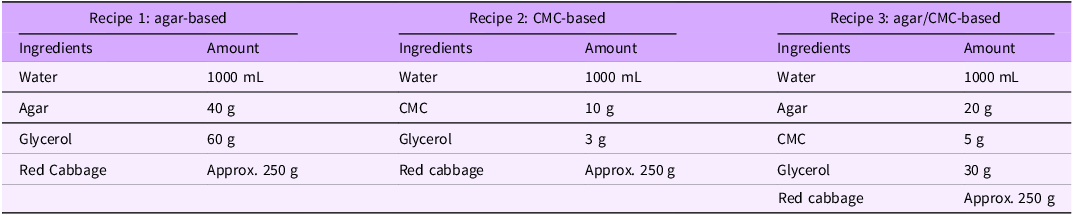
We experimented with three material recipes (Table 1). The details of these recipes and states are summarized in the tables below. The agar-based material was made by mixing agar and glycerol into boiling red cabbage juice (Bell et al. Reference Bell, Al Naimi, McQuaid and Alistar2022a). The CMC-based material was made by mixing CMC and cold red cabbage juice. The agar/CMC-based material was prepared by mixing the two materials at liquid phase at a 1:1 ratio. All materials were dried at 40 degrees in a dehydrator.
Three explored recipes

We chose casting method to make materials because of fabrication feasibility: the materials are easy to cast, patterns can be easily adapted and cut, and the casted films allow re-utilization and re-castings of leftovers. Casting resulted in material films of different thickness in various states, including hydrogel, semi-dry and dry states, depending on the water content.
Material qualities
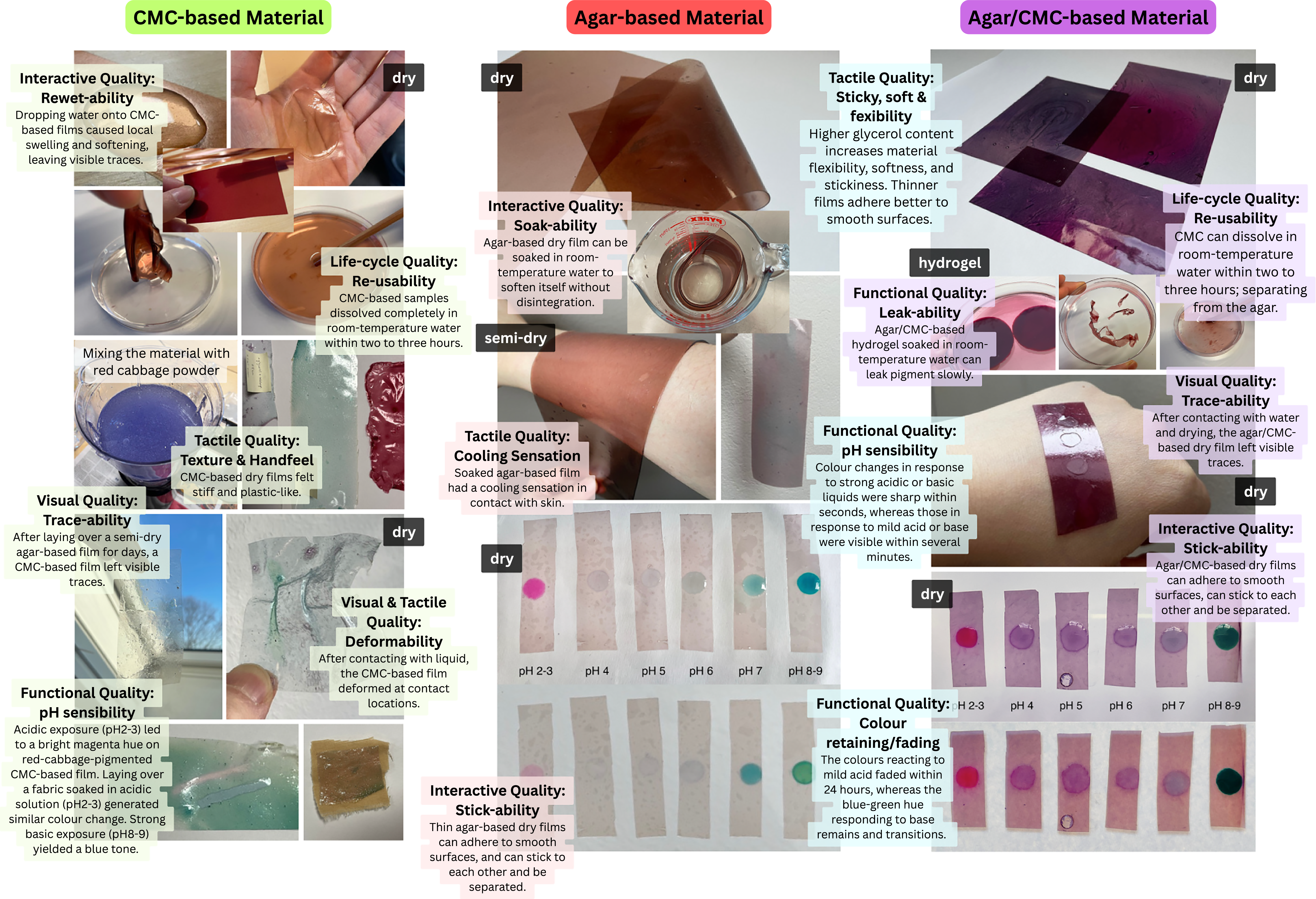
The resulting film-formed materials were assessed through direct handling and observation rather than laboratory analysis; this process was intended to inform the project’s design development stages and to highlight particular qualities (Figure 1). The materials can be generally described based on the framework of physical material properties (White Reference White2018) from the following aspects:
Overview of three explored material recipes: states and qualities of material samples including visual and tactile qualities, interactive qualities, functional qualities and life-cycle qualities.

(1) Mechanical properties: they are flexible and soft to the touch, capable of bending and pleating without fracturing; (2) Optical properties: they are translucent and can be pigmented in liquid state, resulting in an even color across the surface; (3) Thermal properties: dry films are dimensionally stable under ambient conditions; structural changes may occur near or above 100°C, primarily due to the glycerol plasticizer; CMC and glycerol dissolve readily in room-temperature water, while agar requires hot water (above 85°C) to dissolve and re-solidifies upon cooling; (4) Electrical properties: they are electrically insulating in their dry state.
In the overview (Figure 1), we selectively describe material qualities emerging from our exploration of a wide variety of material samples that are most relevant to our intended design space. These samples span material states of dry, semi-dry and hydrogel as annotated in the overview. The material qualities include visual and tactile qualities, interactive qualities, funtional qualities and life-cycle qualities. We annotated samples from each material recipe with their relevant qualities and material states.
Design dimensions
Our co-creation session developed around 20 design ideas (see appendix). The first and second authors collaboratively analyzed the sketches and accompanying conversations, identified recurring patterns and conceptual themes that informed the articulation of three design dimensions of the design space in which pH-sensitive bio-based material composites facilitate intimate maternal care in everyday practice. Below, we introduce three design dimensions emerging from mapping out the sketches: ambiguity, visibility and lenience, three distinct spectra closely linked to material qualities.
Ambiguity: from monitoring to sensitizing
Many sketches explored a continuum between monitoring and sensitizing. The materials’ vivid color changes were presented to individuals as prompts for interpretation – inviting curiosity, reflection or personal meaning-making. The monitoring aspect became more pronounced in sketches that introduced structured forms such as calendars or journals to record changes over time. Conversely, sketches that emphasized the materials’ amorphous patterns, bright hues and potential for creative engagement – such as painting directly with bodily fluids on material surfaces – tended toward sensitizing interactions. Interestingly, sketches by different co-creators concurrently envisioned “kits” for hands-on engagement. We therefore interpret acts of documenting as leaning towards monitoring, while expressive and creative engagements with the materials lean towards sensitizing.
As many cases explored in previous literature (e.g., in Sun et al. Reference Sun, Mayfield, Ku, Yon and Vega2025), monitoring requires accurate color references to provide a clear, high-contrast indication. Monitoring may be necessary when an infection is suspected or when under clinical observation. Here, the materials might need to be tuned for fast, step-wise color manifestation. Sensitizing, in contrast, emphasizes bodily awareness without alerting the individual and is used in situations where temporary pH fluctuation is acceptable. This allows the materials to be more ambiguous, slow and interpretive and fosters awareness towards bodily fluid dynamics.
Visibility: from disclosing to hidden
A second dimension is visibility. Some sketches envisioned artifacts that were intentionally visible or even decorative. For example, one sketch suggested projecting light through used materials into ambient illumination. We interpret this as emphasizing the material’s aesthetic presence, leaning toward disclosing. Other sketches imagined flushing the used material down the toilet and a locket containing a used piece, worn close to the body as a meaningful object. These ideas imply privacy and discretion.
In summary, disclosing encourages openly displaying the sensing results to oneself or others as a form of communication or expression. This dimension becomes relevant when individuals wish to share and discuss bodily states and feelings with others or when visual cues serve as reminders to support behavioral change. Disclosing might require materials to reveal and retain traces of use and meaning. Hidden refers to sensing processes that occur privately, in which information about bodily fluids is revealed only to the individual or to selected people and can be discarded immediately after use. Materials can be tuned to be soft and flexible to support discrete, near-body integration while also being ephemeral.
Lenience: from enacting to forgiving
A third dimension, lenience, describes a spectrum between enacting and forgiving. Several sketches portrayed artifacts that encourage individuals to remember results and act upon them. For instance, one design featured a documentation calendar with space for personal notes and a piece of material. We interpret this as enacting because they link material feedback to behavioral change. In contrast, some sketches envisioned flushing away, burning and burying the used materials. Some include reflective and self-acceptance moments, regardless of the results. We interpret this as forgiving. Enacting is particularly relevant when lifestyle adjustments are crucial, such as preventing complications, such as preterm birth, or supporting the management of conditions that cause discomfort. Forgiving suggests that bodily fluctuation is temporary and need not provoke self-blame. Material properties such as dissolvability and color-fading embody such forgivingness.
Design provocations
Drawing on both material qualities and design dimensions, we jointly developed three design provocations to explore how bio-based pH-sensing materials can facilitate non-medicalized forms of everyday maternal care. Each provocation is based on one material recipe and state. Each provocation senses one bodily fluid facilitated by the materiality of the materials, including the vaginal discharge, sweat and urine. In each provocation, we create a fictional character who interacts with the designed artifact and narrates in the first person. The specificity of each provocation helps to situate and materialize our discussion in practice.
Provocation 1 vaginal trace pieces
Design rationale
The vaginal microbiota plays a key role in defending against pathogens, maintaining mucosal immunity and supporting reproductive health. Dominance by Lactobacillus species, especially L. crispatus, maintains a low pH and inhibits pathogenic colonization (Wu et al. Reference Wu, Jiao, Li, Li, Zhang, Zhou and Yuan2022). Dysbiosis – defined by a loss of Lactobacilli and overgrowth of anaerobic species such as Gardnerella or Prevotella – is associated with increased risk of bacterial vaginosis (BV), preterm birth (Gudnadottir et al. Reference Gudnadottir, Debelius, Du, Hugerth, Danielsson, Schuppe-Koistinen, Fransson and Brusselaers2022), infertility (Haahr et al. Reference Haahr, Jensen, Thomsen, Duus, Rygaard and Humaidan2016), sexually transmitted infections, HPV infections and gynecological cancers (Tamarelle et al. Reference Tamarelle, Thiébaut, De Barbeyrac, Bebear, Ravel and Delarocque-Astagneau2019). Previous studies have shown that hormonal changes, menstruation and sexual intercourse can influence the composition of the vaginal microbiome (Krog et al. Reference Krog, Hugerth, Fransson, Bashir, Nyboe Andersen, Edfeldt, Engstrand, Schuppe-Koistinen and Nielsen2022).
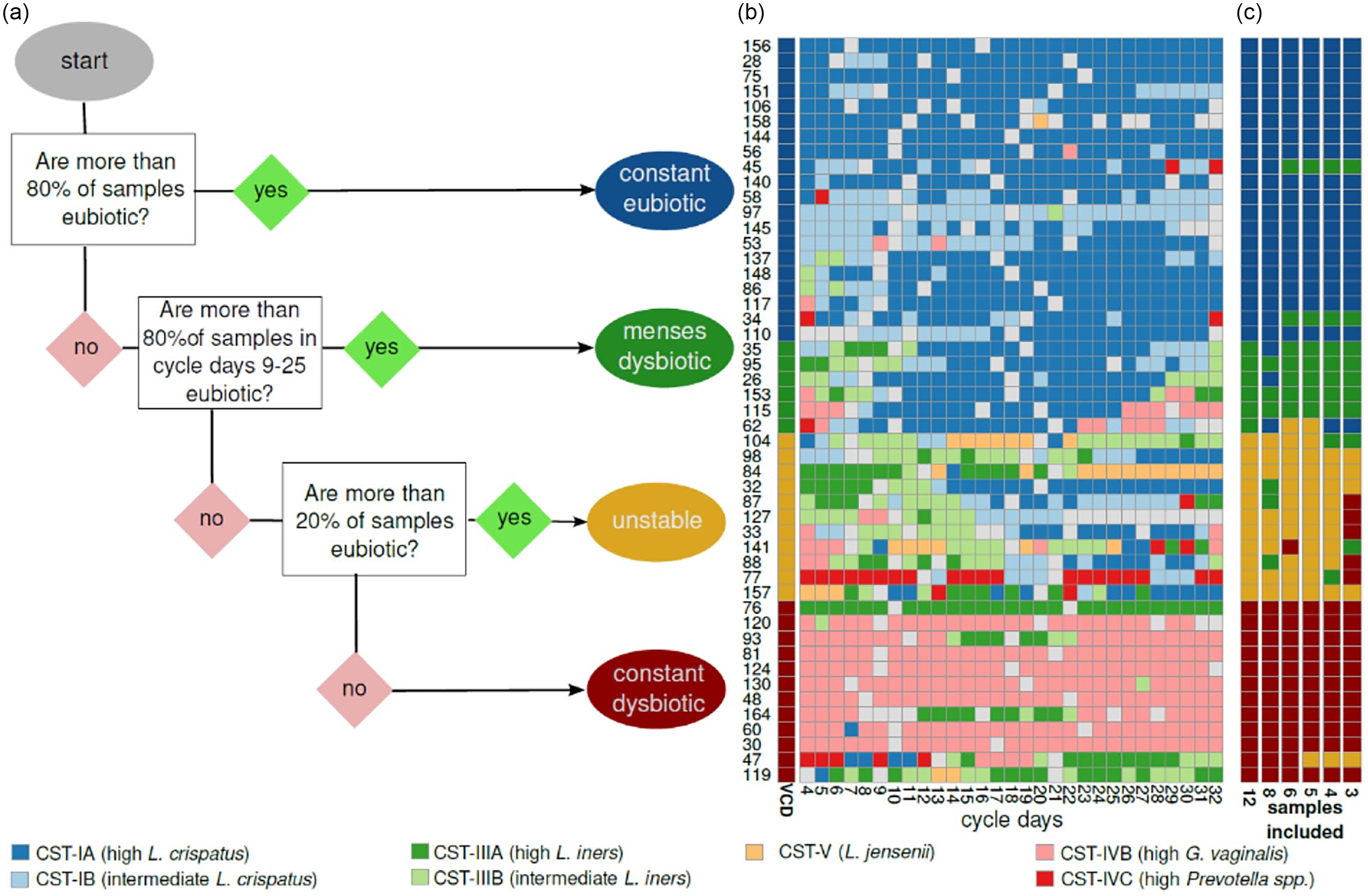
During pregnancy, an imbalance in the microbiome can lead to bacterial or yeast infections that may increase the risk of preterm birth (Gudnadottir et al. Reference Gudnadottir, Debelius, Du, Hugerth, Danielsson, Schuppe-Koistinen, Fransson and Brusselaers2022), endangering both mother and fetus. Vaginal fluid pH values can provide clues to microbial composition. In clinical standards, a pH between 3.8 and 4.5 is considered “healthy,” signaling a predominance of Lactobacillus species – though species composition varies by individual on a daily basis (Figure 3) (Hugerth et al. Reference Hugerth, Krog, Vomstein, Du, Bashir, Kaldhusdal, Fransson, Engstrand, Nielsen and Schuppe-Koistinen2024). However, values outside this range do not necessarily indicate immediate illness: even among people who think they are “healthy,” dominant species in their vaginal environments vary, with or without Lactobacillus bacteria (Hugerth et al. Reference Hugerth, Krog, Vomstein, Du, Bashir, Kaldhusdal, Fransson, Engstrand, Nielsen and Schuppe-Koistinen2024).
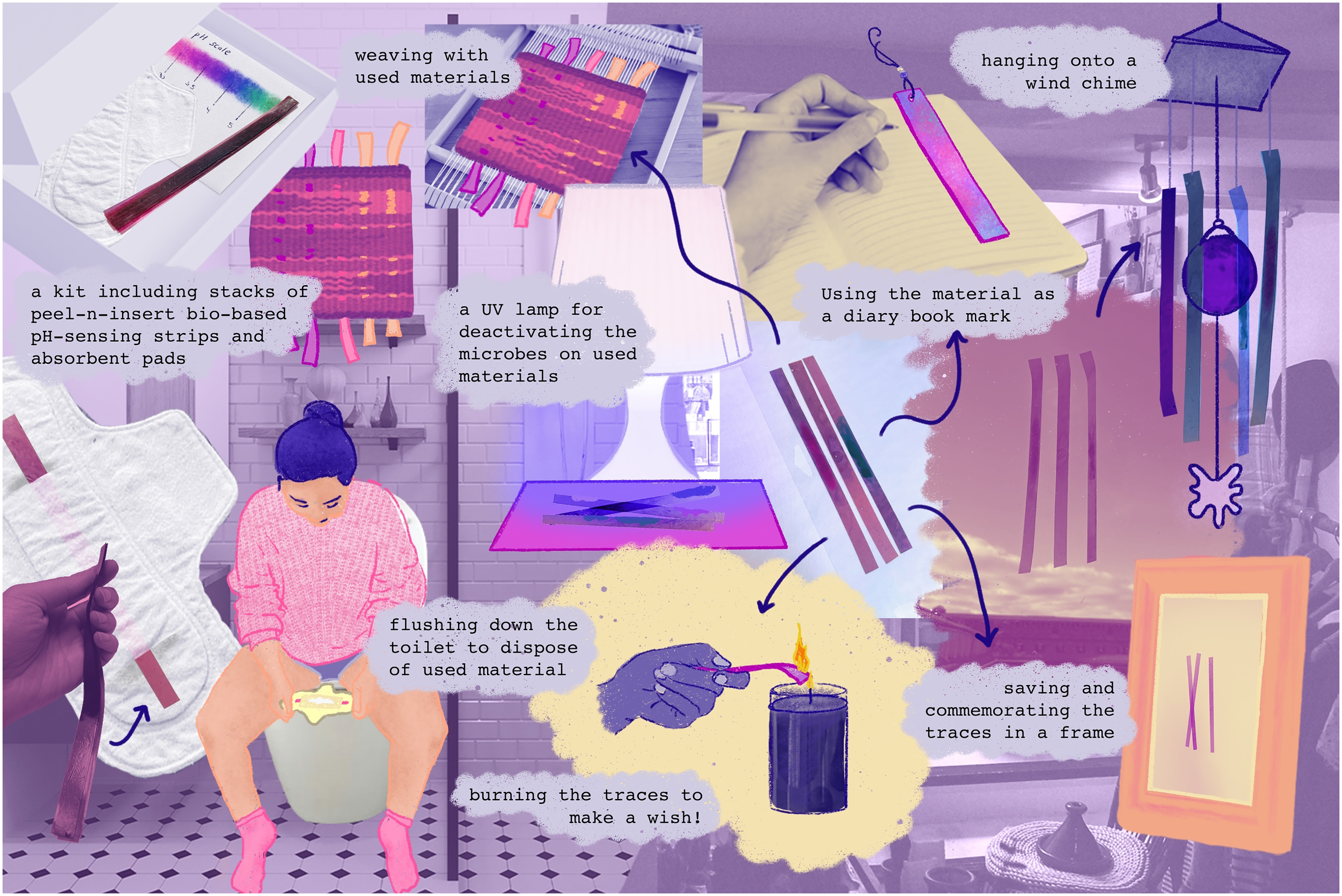
Vaginal Trace Pieces: a kit consisting of pH-sensing biomaterial strips with absorbent pads.

Figure 2. Long description
Panel A: A kit including stacks of peel-n-insert bio-based pH-sensing strips and absorbent pads. Panel B: A person sitting on a toilet, flushing down the toilet to dispose of used material. Panel C: A hand holding a strip of material over a candle flame, burning the traces to make a wish. Panel D: A framed piece of material with colorful traces, saving and commemorating the traces in a frame. Panel E: A close-up of a diary with a strip of material used as a bookmark. Panel F: A wind chime with strips of material hanging onto it. Panel G: A UV lamp used for deactivating microbes on used materials. Panel H: A person weaving with used materials to create a colorful fabric.
Vaginal community dynamics during the menstrual cycle can be classified into categories describing the stability of Lactobacillus bacteria: In healthy individuals, the vaginal microbiome can vary, with some exhibiting Lactobacillus dominance and others not (Hugerth et al., Reference Hugerth, Krog, Vomstein, Du, Bashir, Kaldhusdal, Fransson, Engstrand, Nielsen and Schuppe-Koistinen2024).

In our experiences of pregnancies, vaginal pH had never been measured, and its relevance to understanding one’s inner environment was largely unknown. Additionally, we noticed a sharply increased amount of vaginal discharge that required extra absorbent layers. The discharges had various colors and consistencies at different times. While searching online, it was fascinating to see how people shared pictures of all their mucus on forums for discussion about their meaning. The varying color, consistency and abundance of the pregnant body fluids prompted us to wonder how we could develop a better understanding of them and their unique microbial environments. Drawing on these experiences, we developed a design provocation (Figure 2) that encouraged people to “curiously” notice changes in vaginal microbiomes without diagnostic or clinical interpretation.
Material recipe, form and state
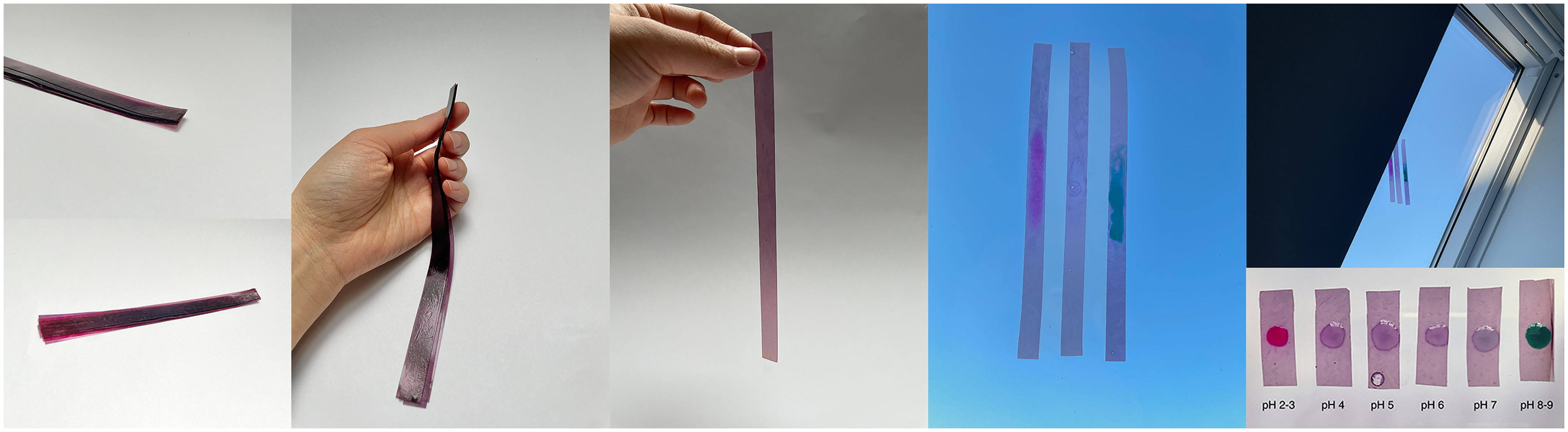
For this provocation, we used an agar/CMC-based recipe and casted into thin, dry films. We chose this material because it’s flexible, adaptable, soft, lightweight and has a skin-like feeling, making it suitable for relatively more intimate use although not directly touching the skin. Functionally, the films are semi-transparent, allowing color changes to show clearly. They also react directly to the skin/liquids, without the need for other mediating materials. Considering interactions, the strips remain stickable and stackable with one another, can be reused for crafting purposes and can be water-dissolved quickly (Figure 4).
Developed material samples for Vaginal Trace Pieces.

Account from a “curious” fictional individual
I start using the Vaginal Trace Pieces when I prepared to get pregnant. Now I am in my third trimester, and I am continuing to use them. It is a kit of “peel-and-insert” pH-sensing pieces accompanied by reusable absorbent pads where I insert the pieces. The pad can hold excess vaginal discharge while transporting a portion onto the pH-sensing piece. Each piece reacts to the pH of my vaginal discharge with a visible color change and clear traces of contact. The color reference card in the kit roughly indicates that pinkish colors indicate an acidic environment, whilst blue-greenish colors indicate a basic environment. Most of the time, my “colours” were in the pink-purple-ish range. I guess that means my vaginal environment is acidic. Once I noticed a blue-ish trace, but it reverted to purple a day or two later. Now, every time I feel those moments of “overflow,” I know a new colorful trace will be imprinted, and I am curious to see it.
I don’t use the pieces every day, especially when the discharges are constantly acidic; however, I can imagine some people prefer to use them regularly, even daily. When using the toilet, I briefly glance at the trace piece on my underwear. After that, I sometimes flush it away if nothing special or I bury it in my compost if the color looks healthy. I keep a piece from time to time to remember my microbial composition during this special time. So I tuck it under a UV sterilizing lamp to dry. When I do this, I feel a bit heartbroken for the microbes because I know they are dying under the UV light, but I also know this is a moment that I truly see and acknowledge them. While the UV light is on and the piece is drying, I reflect on the care I have taken with my body recently that may have contributed to its color change.
What I really like about the Vaginal Trace Pieces is that it does not prescribe me to do anything. The pieces appear to invite me to experiment and craft them into various objects. It’s kind of delicate, vivid and multi-situated. I have many ideas! I sometimes weave with pieces collected over a week (which encourages me to collect more pieces). I also insert pieces in my diary when something meaningful happened that day. I hang them on my wind chime if the colors look pretty against the sunlight; I frame and display them on my desk during my fragmentary time between dinner and sleep. A slightly adventurous thing I do is that I once burned a piece with a really bright pink color, which indicates my microbiome is super “healthy,” and made a wish!
By making sense of the dried pieces and taking them seriously as part of my everyday life, I care for myself with the material’s presence. Over time, my microbial traces scatter across my home, reflecting periods of heightened bodily attention and neglect. They subtly disclose my otherwise hidden bodily ecology. The pieces I weave into a coaster sit quietly on my dining table; I talk about them with my partner and explain the colors. The pieces woven into a tapestry hang above the toilet, reminding me to notice new traces. I placed some pieces in a collection box; who knows what I will do with them later.
Provocation summary
To summarize, in this provocation, care thus emerges as a situated performance shaped jointly by the material qualities and personal practices in the matrescent life. Vaginal care is reimagined as an ongoing process of joyful noticing and curiosity. While this provocation does not eliminate the potential for anxiety, misinterpretation or cultural discomfort, it makes these conditions visible rather than suppressing them. Regarding design dimensions, sensitizing is expressed through the artifact’s non-diagnostic nature, flexible frequency of use and gentle invitation to notice bodily changes without immediate judgment. Disclosing occurs through personally defined visibility within everyday domestic settings, while hidden remains easily achievable, as each piece can dissolve and biodegrade after use. Enacting is reflected in the material’s performative, multi-situated qualities, which support repurposing through mindful crafting with bodily materials.
Provocation 2: Acid mantle journal
Design rationale
Eczema (atopic dermatitis or “AD”) is the most common dermatosis of pregnancy, accounting for between a third and a half of all cases in several scientific studies (Ambros-Rudolph et al. Reference Ambros-Rudolph, Müllegger, Vaughan-Jones, Kerl and Black2006; Vaughan Jones et al. Reference Vaughan Jones, Hern, Nelson-Piercy, Seed and Black1999). It is a skin condition exacerbated by hormonal shifts that temporarily alter immune priorities, thus increasing susceptibility (Weatherhead et al. Reference Weatherhead, Robson and Reynolds2007). Research also shows that eczema sufferers tend to have a more alkaline skin environment that promotes the proliferation of flare-up-triggering microbes such as Staphylococcus aureus (Hülpüsch et al. Reference Hülpüsch, Tremmel, Hammel, Bhattacharyya, de Tomassi, Nussbaumer, Neumann, Reiger and Traidl-Hoffmann2020). Clinically, AD is difficult to treat with a short-term medical suppression (Weatherhead et al. Reference Weatherhead, Robson and Reynolds2007). It is especially difficult to treat when one is pregnant or breastfeeding due to it being an extra stressful and chaotic time and restrictions on typical medications (Weatherhead et al. Reference Weatherhead, Robson and Reynolds2007). Care requires ongoing adjustments across lifestyle, stress management, diet and hygiene practices (Lam and Agrawal Reference Lam and Agrawal2025).
One of the authors experienced severe symptoms on and around the lips, which made eating painful and created emotional strain by disrupting moments of intimacy with her baby – she described feeling “afraid” to kiss her child. It was intensely uncomfortable – the itchiness and flare-ups affect her life all around at a time when emotional stability is especially critical. Initial topical treatment failed, and the condition persisted for a year, contributing to prolonged anxiety and low self-esteem. Her body was oscillating between periods with and without flare-ups. Through carefully managing stress and diet and taking traditional eastern herbal therapy, she could finally “live with it” so that the flare-ups reduced in frequency.
Recommended by many eczema sufferer influencers, she used journaling to track associations between diet and flare-ups in a spreadsheet. She documented eczema-inducing food consumed each day and the overall severity of itchiness and oozing that day. Journaling helps to prevent certain food and provides a sense of grounding amidst anxiety and frustration.
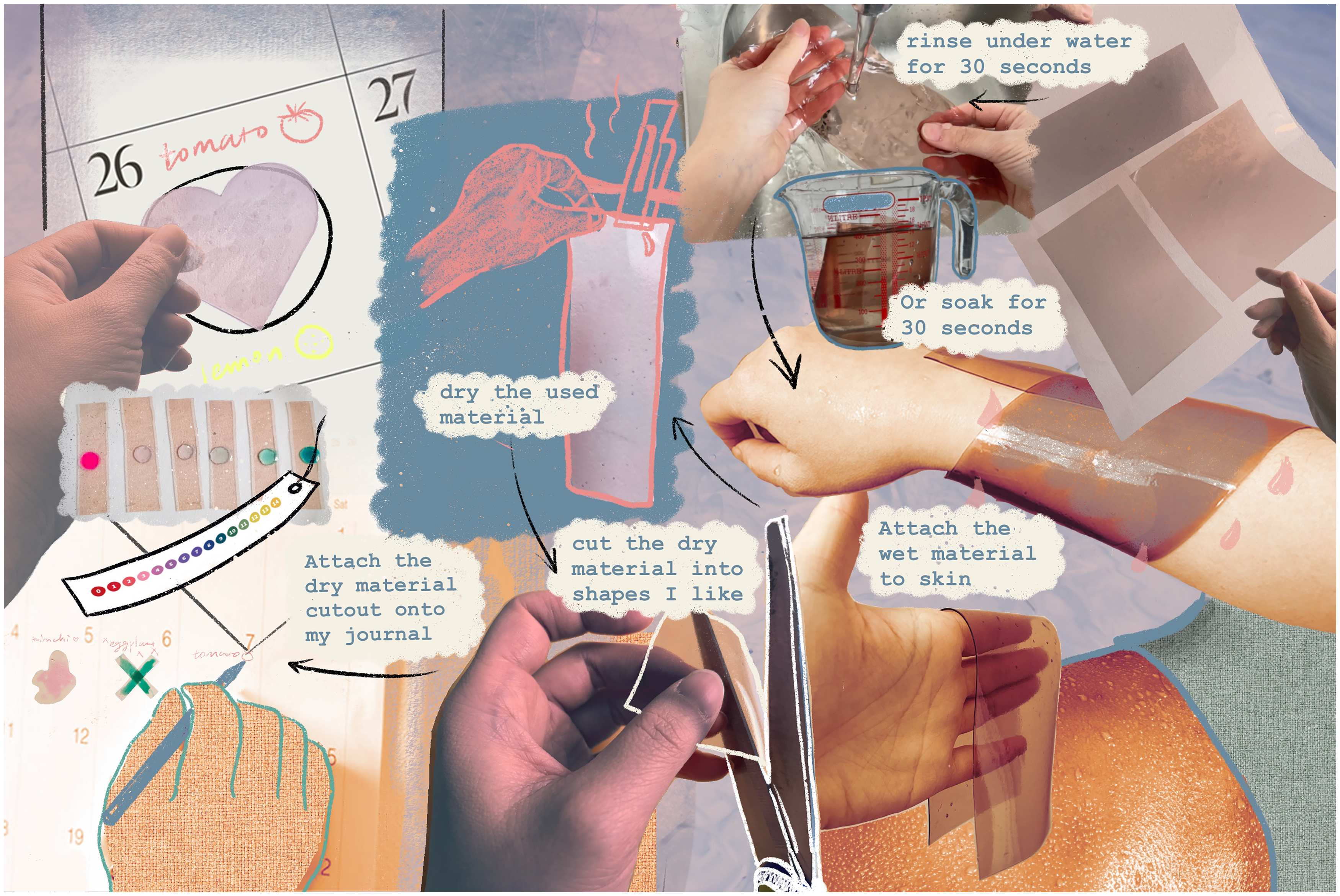
Drawing on these experiences, we developed a design provocation (Figure 5) to enhance positive experiences through regular journaling among individuals with pregnancy-induced eczema. The provocation foregrounds the “acid mantle” of human skin – the mildly acidic conditions of skin that defends against infections. In particular, skin pH maintains at 4.0–5.5, while sweat pH maintains at 5.7–6.5 (Sasaki et al. Reference Sasaki, Lyu and Minami2023). The population of bacteria (e.g., Staphylococcus aureus) and their activity increases depending on the shifts of skin pH to basic conditions (Sasaki et al. Reference Sasaki, Lyu and Minami2023). Inspired by the design of a flare-up detecting and treating on-skin living artifact (Raphael Kim et al. Reference Kim, Kim, Martins and Karana2024), this design provocation explores how bio-based pH-sensing materials can be used as wearable colorimetric biosensors (Sun et al. Reference Sun, Yetisen and Vega2024).
Acid Mantle Journal: an after-exercise skin-soothing pH-sensing patch to complement eczema journaling.

Material recipe, form and state
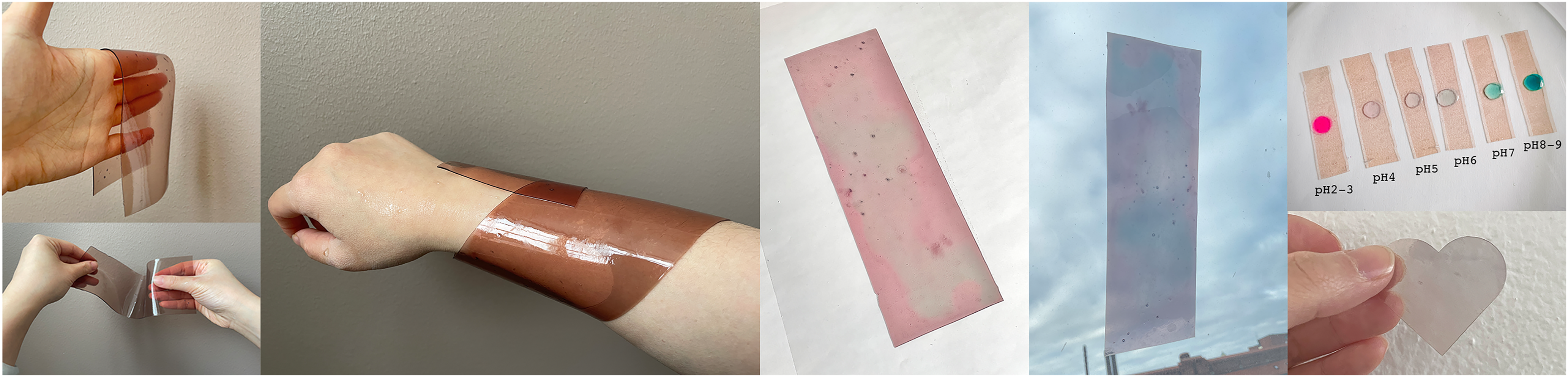
We chose agar-based recipe and casted into a dry film for this design because of it’s flexible, semi-transparent, adaptable, soft, yet with better integrity after soaking in water compared to other explored material recipes. After contacting with water for a half to a few minutes, the film swells into a semi-dry state that has good adherence to the skin. The semi-dry film also presents a cooling effect when contacting the skin that might help with soothing the sweated or flared-up skin (Figure 6). The dry film can be cut easily, allowing people to customize their own shapes to place into their journal.
Developed material samples for Acid Mantle Journal.

Account from a “diligent” fictional individual
Acid Mantle Journal complements common diet journaling with sensory and visual elements of pH-sensing patches. I use the sensing material to monitor my sweat pH every day after my exercise during the first and second trimesters and postpartum. After 30 seconds of soaking, the patches swell and become a jelly-like material. I use the soaked patches to cool and soothe my skin while sensing my sweat pH. I like to place the patches on my lower arms, back of my neck and my forehead, just like using those pimple patches.
After a few minutes on my skin, the patches gradually change color. They usually become pink-purple-ish, sometimes leaning towards light blue. Afterwards, I shower while leaving the patches to dry. I sterilize them under a UV lamp. When they are dry, I cut them into fun shapes and tape them onto the designated area in my journal. The vivid colors and the crafty journaling make the process quite enjoyable. By comparing this color to the reference bookmark, I can recognize when my skin becomes more alkaline and thus more prone to irritation. This usually won’t make me panic, though, because it helps me to identify potential factors (like food) that caused it.
I like it when I can only notice my skin’s pH when I sweat. This encourages me to exercise more when I want to monitor my skin health. I feel that through this practice, I set my body into a positive cycle that nourishes and monitors its wellbeing constantly. Journaling supports me in mindfully managing my eczema flare-ups. I know this does not treat my symptoms, but it definitely makes me feel autonomous. I feel important in this journey. I love the grounding, sensory, joyful effect this might bring, but avoid an overly positive attitude.
Provocation summary
To summarize, this provocation does not aim to diagnose and treat atopic dermatitis. Instead, it explores how bio-based sensing materials can support soothing the skin and raising embodied awareness of the vulnerable skin barrier in pregnancy-induced eczema sufferers in the extremely messy everyday life. It offers a joyful example of self-monitoring that counters negative narratives of self-surveillance and the optimization of the body. It proposes a way to bridge physical conditions with the emotional experiences in and beyond motherhood.
In terms of design dimensions in relation to material qualities, monitoring manifests as diligent, direct self-tracking, although a degree of sensitizing is evident in the qualitative nature of such tracking. Disclosing is expressed through day-to-day documentation, and the journal is open for review, revision and reflection. Enacting emerges through arranging the pieces in the journal, an essential practice in journaling that keeps journalers materially grounded.
Provocation 3: urine glance
Design rationale
Urine is a bodily fluid that reveals subtle shifts in internal balance in everyday life. As a continuously renewing “body of water” (Neimanis Reference Neimanis2017) with waste products and electrolytes, urine varies naturally in color, concentration and pH depending on diet, hydration and physiological adjustments. Clinically, urine pH typically ranges from 5.5 to 7.5, though temporary fluctuations between 4.5 and 8.0 are common and usually benign (Nall Reference Nall2024). Urine color can change between light yellow and dark amber according to hydration level (Sissons Reference Sissons2025). Before, during and after pregnancy, however, vulnerability to urinary tract infections (UTIs) increases (Matuszkiewicz-Rowińska et al. Reference Matuszkiewicz-Rowińska, Małyszko and Wieliczko2015), making these variations more consequential and therefore more meaningful to address.
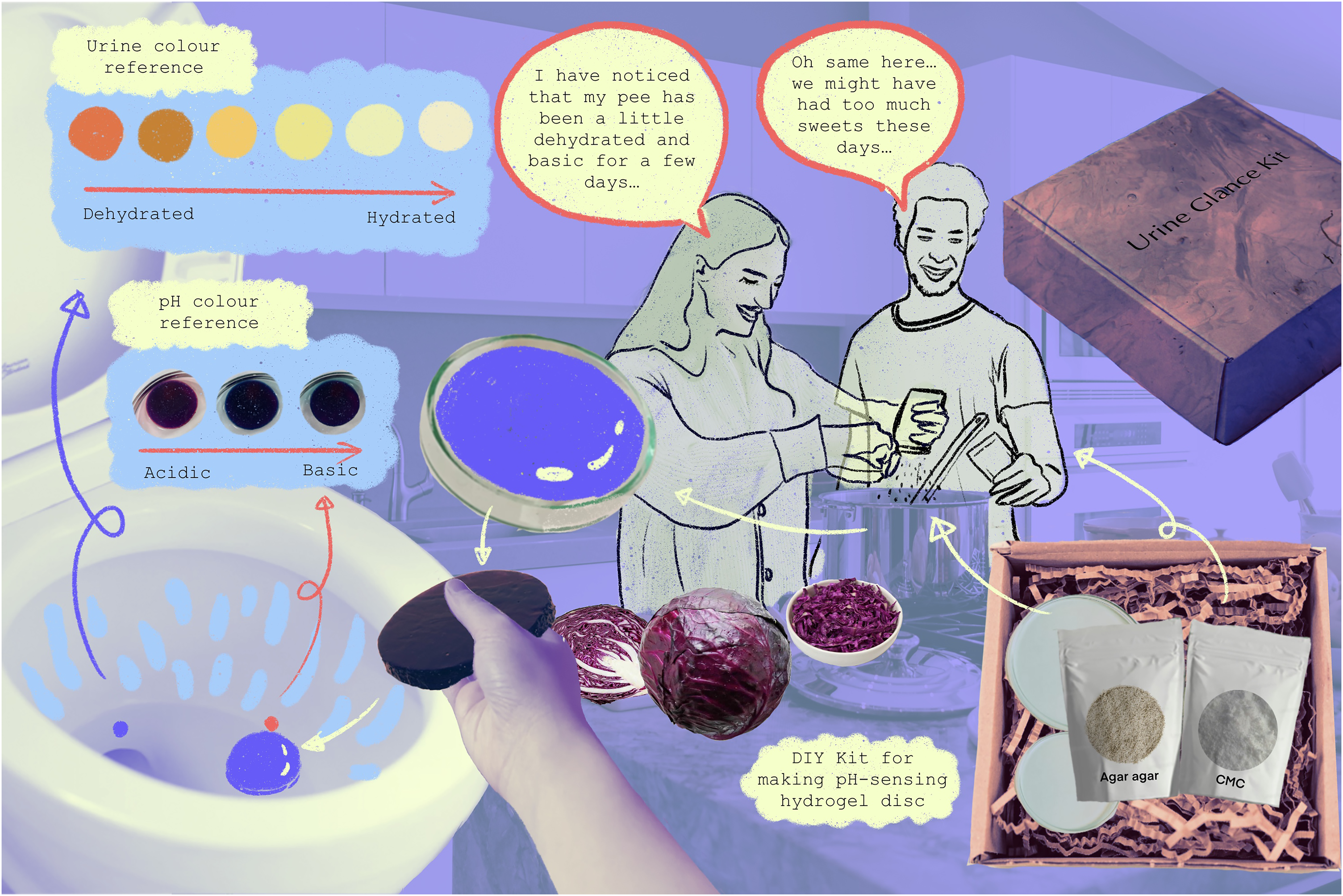
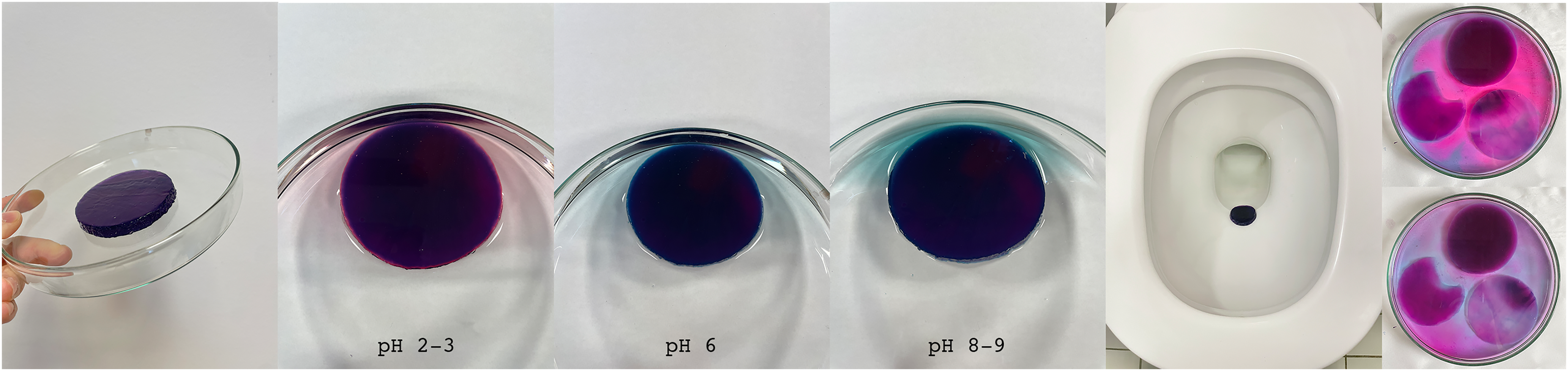
Urine Glance (Figure 7) encourages individuals to observe urine as a dynamic indicator of physiological responses to internal and external environments. First, we address the universal hydration advice for pregnant and lactating people. The authors recalled midwives’ advice to drink 2.5 liters of water during pregnancy and lactation. One of us mentioned that she felt “pressured” to drink water regardless of whether she felt thirsty. Striving to meet such a standard target despite different bodily situations created significant tension. Second, the pH value of urine may indicate UTIs, being either too acidic or too alkaline, yet no diagnosis can be made based on the pH alone (Nall Reference Nall2024). Urine Glance offers a tool for individuals to actively observe and attune to what their bodies feel and communicate from day to day.
Urine Glance: a DIY pH-sensing hydrogel attached to the inner wall of the toilet for noticing urine states.

Material recipe, form and state
The hydrogel state of agar/CMC-based material was chosen for this design because, at its hydrogel state, the material can leak pigment into water and slowly dissolves its CMC component, allowing color changes in the toilet to be visible whilst remaining a semi-stable form in water over time until fully disintegrated. The hydrogel can be also made by users through simple steps using agar, CMC, water and cabbage juice, encouraging them to reflect and engage directly with the material’s life cycle (Figure 8).
Developed material samples for Urine Glance.

Account from a “meticulous” fictional individual
Urine Glance is a kit of materials and tools with which I can make a pH-sensing hydrogel disc to attach to the inner wall of the toilet. I began observing my urine using the Urine Glance, noting both the urine’s natural color and the hydrogel’s pH response. The hydrogel shifts color from pink to light blue, indicating acidic and basic changes. Together, these cues indicate my urinary status, which is often ignored by me or associated with waste and filth.
Through Urine Glance, I realize that urine is highly dynamic. Its color and pH fluctuate multiple times a day. Sometimes it reveals things that don’t match my expectations. For example, I feel hydrated after drinking tea, yet the dark yellow color indicates otherwise, reminding me to balance caffeine with water. By glancing at and pondering upon my urine color and the hydrogel’s color shift, I learn to connect my felt senses, hydration level, with my diet and stress levels. A few days of slightly more acidic color prompt me to consider: perhaps I have been eating too many sweets? When I work too hard and forget to drink water, I immediately realize it by noticing the darker color of my urine when I go to the toilet. I know the answer is never certain, but I try to experiment with my diet and pay attention to my bodily sensations to see what my urine responds to.
I appreciate the subtle line of privacy-sharing that the design affords. My partner and I both use the hydrogel. Although the urine color is still kept to ourselves, both of us can see residual traces of the gel reacting with the other’s urine. Ultimately, it becomes a new ritual between us to discuss the colors we notice while we make new materials together. We interpret the colors we noticed, linking them to what each of us ate or how active we were that day, to make collective decisions on changing our diet habits (e.g., eating less sugar). I imagine using it in my daughter’s potty one day to help her learn about her bodily fluids. Each day, the hydrogel dissolves gradually with flushing; we then DIY a new piece. I like how much this interaction reminds me of starting a cycle anew.
Provocation summary
In summary, attending to bodily metabolism is embodied through brief, everyday glances. Urine Glance encourages learning to live with bodily fluctuations and to adjust to them actively. Sensitizing is evident as light form of noticing the qualities of urine without deliberate interpretation or judgment. Disclosing emerges through shared use and decision-making among cohabitants. Forgiving is embodied in the material’s gradual excretion and dissolution with each flush, allowing letting go of each observation and returning attention to the present.
Discussion
This work explored how bio-based materials’ transformation, degradability and feminist non-medicalization of the body intersect to reframe intimate maternal care as lived, materially and ecologically connected – with microbiome, diet, hydration and more. We have contributed nuanced exploration of material qualities, design dimensions and provocations specifically for such design context. Below, we discuss implications for the social dimension of biodesign and broader feminist design discourse.
Biodesign for diverse humans
Our perspective aligns with recent biodesign research that views materiality as transformative to everyday care practices (Helms Reference Helms2023; Lu and Lopes Reference Lu and Lopes2022; Zhou et al. Reference Zhou, Kim, Doubrovski, Martins, Giaccardi and Karana2023, Reference Zhou, Doubrovski, Giaccardi and Karana2024). Yet how this supports the life of marginalized and vulnerable groups has not been widely explored, like those with visual impairments (Kim and Zhou Reference Kim and Zhou2025). We argue that biodesign should acknowledge individual differences and the evolving needs of diverse humans, as we operationalized through diverse design dimensions. This requires designers to deliberately consider who is included and excluded from certain design decisions. In Vaginal Trace Pieces, for example, disclosing bodily fluids in shared spaces can be desirable for some; the issue of privacy nonetheless arose in our discussion when a researcher in the co-creation remarked that the flushing gesture was meaningful precisely because “the intimate data could disappear completely.” The design thus also suggests options of “slippery data,” data that slips away and not be stored (Campo Woytuk, Tuli, et al. Reference CampoWoytuk, Tuli, Park, Turmo Vidal, Tobin, Reddy, Vincenzi, Maslik, Ciolfi Felice and Balaam2025) through flushing away the used materials. This observation highlights that diversity itself can become a site of design reflection on the ethics of interaction. This consideration may also apply to other biodesign projects, urging designers to consider who will live with the design and who will be excluded from it.
Humans’ bodily materials in biodesign
Biodesign has primarily focused on the biology of nonhuman entities, whilst creative engagement with human bodily matters are mainly explored through bio-art practices (Hunter Reference Huntern.d.; Tomasello Reference Tomasellon.d.). In this work, we encourage biodesigners to also regard human bodily materials – such as fluids and microbes – not as taboo, filth, shame or waste (Helms Reference Helms2019; Tuli et al. Reference Tuli, Chopra, Kumar and Singh2018) but as active design materials that shape processes and outcomes of biodesign. By engaging with these materials, we emphasize the material and ecological entanglements of the body (Puig de La Bellacasa Reference Puig de La Bellacasa2017): our biological processes are shaped by microbial communities, diet, environments, hygiene infrastructures and cultural norms of care. Through pH-reactive, bio-based materials, microbial activity becomes perceptible without reducing it to numerical data. Participants who handled, kept or disposed of the artifacts engaged with their bodily materials (and microbes) in creative and subjective ways. In Vaginal Trace Pieces, for example, the sterilization of materials in contact with vaginal discharge becomes a moment for reflection, where the death of living matters becomes meaningful for living better. Whilst much ongoing biodesign research focuses on keeping things alive, we also invite biodesigners to reconsider acts of killing (autoclaving, disinfecting or sanitizing) and death as a generative resource for design, rather than something to avoid. This perspective complements bioethics discussions of laboratory processes, such as sterilization (Chen and Pschetz Reference Chen and Pschetz2024; Kim et al. Reference Kim, Kim, Martins and Karana2024), by embedding reflection into biolab practice. Ultimately, treating bodily materials as gestures of generosity (Helms et al. Reference Helms, Søndergaard and Campo Woytuk2021; Helms Reference Helms2024) reframes bodily overflow as a resource – nourishing both self-care and ecological cycles through ephemerality (Guridi Reference Guridi2025).
Unstable states of bio-based materials as generative resource for design
We deliberately explored various material states to generate design provocations. In addition to the commonly observed fully dried material states, in Urine Glance, we used the hydrogel form of the CMC/agar-based material composite – a relatively unstable state with higher water solubility for its specific application. We have illustrated how these materials enable noticing of ambiguous and transforming colors and traces (Rosner et al. Reference Rosner, Ikemiya, Kim and Koch2013) of bodily fluids and reveal lived experiences to prioritize sensibilities over optimization. We have seen many conventional practices in bio-based materials experimentation favor stable, defined and dried materials as “finished” outcomes. Yet in recent biodesign endeavors involving experimentation with non-living and living materials, much more attention is given to the transformation (Bell et al. Reference Bell, Campo Woytuk, Søndergaard and Alistar2024), ephemerality (Guridi Reference Guridi2025), biodegradability (Bates et al. Reference Bates, Yee, Gough, Withana and Vega2026) and co-evolution with these materials (Karana et al. Reference Karana, McQuillan, Rognoli and Giaccardi2023), typically in (semi-)wet culture and in everyday contexts. Habitats of living materials perpetuate continuous change and involve human cohabitants (Zhou et al. Reference Zhou, Barati, Giaccardi and Karana2022). Habitats are also kept more open, with ecological interactions occurring both within and outside the artifacts (Groutars et al. Reference Groutars, Kim and Karana2024; Kim et al. Reference Kim, Risseeuw, Groutars and Karana2023). Aligned with this “unfinished” and never-ending state, Urine Glance demonstrates how intermediate material states can open new technical and sensory avenues for design. Rather than being often overlooked or dismissed as temporary, we encourage designers to pay more attention to semi-finished material states to expand on diverse technical and experiential material qualities (Giaccardi and Karana Reference Giaccardi and Karana2015), especially as biodesign moves beyond industrial drop-in replacement agendas (Ginsberg and Chieza Reference Ginsberg and Chieza2018).
Enacting feminist critiques via bio-based materials
Our work examines the potential of bio-based materials for designing care artifacts for maternity, yet we go beyond offering a merely bio-based alternative to existing pH-test strips. Rather, we pursue “other biological futures” (Ginsberg and Chieza Reference Ginsberg and Chieza2018) by using these materials as vehicles to question social norms around the quantified, hidden and socially expected bodies. We see the potential of bio-based materials for enacting feminist critiques due to their unique qualities. Drawing on care as socio-ecological and unfolding in biodesign (Zhou et al. Reference Zhou, Doubrovski, Giaccardi and Karana2024) and Annemarie Mol’s The Logic of Care (Mol Reference Mol2008), care is actively enacted by people, with technologies, in practice; technologies are enacted rather than chosen.
We first call attention to designing these material towards “sensitizing” within the dimension of ambiguity. We envision that the performative qualities of the bio-based pH-sensing materials can facilitate open-ended, creative unfolding of everyday care interactions (Zhou et al. Reference Zhou, Doubrovski, Giaccardi and Karana2024) with bodily living materials rooted in highly plural matrescence experiences. The stickability, softness and flexibility of the agar/CMC-based films enable expressive, embodied, dynamic engagement with the materials that cannot be reduced to prescriptions or instructions. The dimension of visibility engages in a debate about whether care responsibilities should be shared among cohabitants rather than borne solely by maternal bodies. This point responds to feminist HCI’s demand for a return to shared and public modes of care (Park et al. Reference Park, Hsueh, Campo Woytuk, Huang, Ciolfi Felice and Balaam2024). Our design does it by encouraging conversations among partners, friends and family members about the hidden labor and taboos surrounding bodily fluids in Vaginal Trace Pieces and Urine Glance. The Urine Glance involves non-pregnant partner(s) and other cohabitants and is supposed to reduce some of the burden on the socially-expected “mother” or helps make collective health decisions, such as “let’s try to eat less sugar together.” Finally, we call attention to “forgiving” within the dimension of lenience, amid pregnancy’s self-criticism and the “perfect mother” pressures imposed by unrealistically-rendered celebrity births and social media influencers. We envision that the ephemeral qualities of the materials – bio-degradable, water-soluble and re-makable – can facilitate individuals to forget what was once sensed over time. Letting inidividuals deliberately engage with degrading, dissolving and remaking processes could convey a message that bodily fluids are always in flux and no need to stably meet clinical standards. Our proposed design dimensions for bio-based materials may extend to contexts of chronic pain, aging and disability, which might require a conscious and continuous mutual attunement with care technologies for long-term well-being (Vallgårda Reference Vallgårda2025). We call for further explorations of these three design dimensions in other contexts.
Ethical considerations of designing with bio-based materials for maternal care
Several ethical concerns emerged as we imagined bio-based materials as sensing and tracing apparatus for the human body. First, questions arose during our creative co-creation sessions about whether placing a bio-based material strip near intimate parts of the body – specifically the vagina – would be desirable. In prior design experiments on bio-based materials for sensing the pH of vaginal fluids related to project Biomenstural (Woytuk and Søndergaard Reference Campo Woytuk and Søndergaard2024), one of the authors encountered resistance from people to testing the material on the body for a prolonged time, stemming from slight mental discomfort. The slight stickiness of our developed biofilm might compound this discomfort by having possibly unwanted sensations, and the material’s potential to become jelly-like in contact with liquid introduced further discomfort and hygiene concerns. In response, to avoid direct contact, we opted to encase the material within a pad, separated from the skin by a textile layer. Second, it is important to recognize that bodily fluids harbor microbes that are highly complex, partially understood and unique to each individual. In contexts involving anyone beyond the self, bodily fluids are considered infectious materials, requiring strict microbial deactivation protocols. We therefore incorporated a deactivation step into our speculative design process, using this moment as a reflective pause on the “livingness” of bodily fluids (see Vaginal Trace Pieces provocation). We strongly urge future designers and researchers working in this space to develop a grounded scientific understanding of bodily fluids – their composition, their livingness and the risks they carry. Finally, we have actively worked against medicalization and diagnostic framings throughout our material development and design speculation, particularly by embracing ambiguous color range, normalizing dynamic changes and suggesting creative and visible mode of engaging with used materials; still, we recognize a delicate tension between resisting medicalization and ensuring that users seek timely medical help when needed. This tension operates on two levels: the design itself cannot guarantee that users will avoid diagnostic interpretations of the material’s outputs; and conversely, users may be unable to make sense of certain sensed outcomes despite having adjusted their diet, physical activity, hydration and other relevant factors. To address this, we recommend that designers provide clear, engaging use guidelines that explicitly communicate this tension – including guidance that prolonged or concerning symptoms warrant consultation with a health professional. Beyond guidelines, we also recommend to engage directly with target communities through workshops, storytelling, gatherings and similar physical formats. In our experience, this effectively brings ethical awareness and contextual knowledge among different individual experiences to be shared in more meaningful and participatory ways (Campo Woytuk et al. Reference Campo Woytuk, Gamboa, Gómez Ortega, Park, Tuli, Tobin, Bell, Ciolfi Felice and Balaam2025).
Reflection, limitation and future work
Material exploration complemented by sensibilities
Our exploration relied on the team’s long-term familiarity with bio-based materials like agar, CMC and anthocyanins from red cabbage. Our goal was to assess their potential within our design space, rather than to optimize materials or their manufacturing. Guided by material sensibilities, intuition and tacit knowledge, hands-on expertise fueled our design ideation with embodied experiences. For example, disliking the “plasticky” feel of CMC film, we mixed agar and CMC to create a softer, more flexible material. Once a 1:1 ratio created the desired flexibility, we didn’t systematically test other ratios, prioritizing provocations over formulation studies. Nonetheless, systematic testing is needed to understand these bio-based materials fully. With more time, we aim to explore more material properties, understand when and how color change occurs and investigate other pH-sensing agents. Color change doesn’t need to appear immediately. By letting biofilms absorb fluids and then spraying with red cabbage extract, further material test may allow the pH to be revealed at chosen times and places, giving users control over when and where to see the result. This is useful for private or sensitive settings. We selected red cabbage extract for its vivid color change and accessibility, making it suitable for home experiments. Future studies might test alternatives like cranberry extract or berries with different color responses.
Bias and ambiguity of colorimetric interface
Color can be an effective medium for coding, structuring and emphasizing visual information and, as such, is used in many computer applications. However, this tool is less effective or even counterproductive, for people with impaired color vision (Geddes et al. Reference Geddes, Eggertson, Sutton and Tigwell2025). Although the colors observed in our exploration largely align with those used in widely used online colorblind image tests (Bioapps n.d.; Colblis n.d.), this research does not specifically investigate whether the materials will be accessible to people with all types of colorblindness or visual impairments. Our design provocations, which center on colors, might exclude certain groups of people. We also observed that color perception is subjective among non-colorblind individuals, with reduced overall color sensitivity. For example, even when using standard litmus pH-test paper, the first author struggled to distinguish the color indicators of neighboring pH values, such as between pH 3 and pH 4. This subjectivity and ambiguity might have inherently made some parts of our tests less rigorous.
Reflections on positionality and partial speculation
The design provocations were jointly developed with six co-authors: for some of us, we have been doing scientific research and design works on the intimate body for years; for some of us, the process of initiating this research is part of healing from an intense “matrescence.” The designs are therefore embedded in our personal experiences and professional knowledge, which have influenced the designs we chose to explore. For example, the Vaginal Trace Pieces provocation conveys a curious and hands-on attitude toward bodily sensing that is rooted in a few of our personal experiences and engagement with our bodily fluids. In Acid Mantle Journal, the character diligently exercises and documents sensing results, originating from one of our personal experiences of eczema during pregnancy and postpartum and further reflecting how she envisioned care could have been back then. Although we do not claim these experiences to be universal, as designers and researchers in the field, we see our work as a way to bring attention and critically discuss the experience of motherhood and imagine how it can be framed otherwise by technologies. We argue that this partial speculation does not diminish the validity of the designs; it rather offers concrete ideas of what – and how – the design space might look like otherwise. We are grateful for being based in open and safe research environments that, with support from colleagues of all genders, enable discussions on topics that can be sensitive in many social and cultural contexts. We invite researchers and design practitioners to explore future work on broader provocations, engage with a broader range of participants through participatory design methods and deploy material prototypes in longitudinal studies to examine how people integrate them into real-life care contexts.
Conclusion
This research bridges biodesign material experimentation and feminist intimate care design. It draws on feminist understandings of the body as lived experience and on care as materially and ecologically entangled across matters and species. Working with bio-based pH-sensing materials – agar, carboxymethyl cellulose (CMC) and red cabbage anthocyanins – we explore how design can support noticing, interpreting and living with the dynamics of bodily fluids and the microbiome during matrescence. Through these materials, we articulate nuanced material qualities and states that, in turn, inform new design dimensions. We propose three speculative scenarios that integrate these materials into intimate care practice. In doing so, we challenge the universal approaches to biodesign by prioritizing the diverse needs of individuals, particularly the unique requirements experienced during the transition into motherhood. We encourage designers to incorporate body fluids into their design processes and outcomes, arguing that the biology and ecology of the human body should not be overlooked. Furthermore, this research advances material-driven approaches in biodesign by highlighting the generative exploration of often-overlooked material states, such as the hydrogel form. The broader implications include promoting design sensibilities of human-microbiome, as well as materializing feminist critiques of self-tracking and shared care responsibilities.
Data availability statement
Tangible material samples and on-paper sketches can be found at KTH Royal Institute of Technology, School of Electric Engineering and Computer Science, Department of Media Technology and Interaction Design.
Acknowledgements
We are grateful for the co-creative session contributors: Andreas Lindegren, Qiaoqiao Ren and Laura McHugh. Thanks Alejandra Gomez Ortega for joining our discussion in the session.
Author contributions
Conceptualization: all authors. Methodology: J.Z, N.CW, S.GS; Validation: J.D, I.S; Visualization: J.Z, N.CW; Resources: D.T; Writing original draft: J.Z; Writing – review and editing: N.CW, S.GS, M.B, C.R, J.D, I.S; Supervision: C.R, M.B. All authors approved the final submitted draft.
Financial support
This research was supported by grants from the Digital Futures/KTH, Sweden.
Competing interests
None.
Ethical standards
The research meets all ethical guidelines, including adherence to the legal requirements in Sweden. AI-powered writing tool (Grammarly) has been used in correcting spelling and improving grammar.

 Open access

