



%20--%3e%3c!DOCTYPE%20svg%20PUBLIC%20'-//W3C//DTD%20SVG%201.0//EN'%20'http://www.w3.org/TR/2001/REC-SVG-20010904/DTD/svg10.dtd'%3e%3csvg%20version='1.0'%20id='Layer_1'%20xmlns='http://www.w3.org/2000/svg'%20xmlns:xlink='http://www.w3.org/1999/xlink'%20x='0px'%20y='0px'%20width='64px'%20height='64px'%20viewBox='5.5%20-3.5%2064%2064'%20enable-background='new%205.5%20-3.5%2064%2064'%20xml:space='preserve'%3e%3cg%3e%3ccircle%20fill='%23FFFFFF'%20fill-opacity='0'%20cx='37.785'%20cy='28.501'%20r='28.836'/%3e%3cpath%20fill='%23595959'%20d='M37.441-3.5c8.951,0,16.572,3.125,22.857,9.372c3.008,3.009,5.295,6.448,6.857,10.314%20c1.561,3.867,2.344,7.971,2.344,12.314c0,4.381-0.773,8.486-2.314,12.313c-1.543,3.828-3.82,7.21-6.828,10.143%20c-3.123,3.085-6.666,5.448-10.629,7.086c-3.961,1.638-8.057,2.457-12.285,2.457s-8.276-0.808-12.143-2.429%20c-3.866-1.618-7.333-3.961-10.4-7.027c-3.067-3.066-5.4-6.524-7-10.372S5.5,32.767,5.5,28.5c0-4.229,0.809-8.295,2.428-12.2%20c1.619-3.905,3.972-7.4,7.057-10.486C21.08-0.394,28.565-3.5,37.441-3.5z%20M37.557,2.272c-7.314,0-13.467,2.553-18.458,7.657%20c-2.515,2.553-4.448,5.419-5.8,8.6c-1.354,3.181-2.029,6.505-2.029,9.972c0,3.429,0.675,6.734,2.029,9.913%20c1.353,3.183,3.285,6.021,5.8,8.516c2.514,2.496,5.351,4.399,8.515,5.715c3.161,1.314,6.476,1.971,9.943,1.971%20c3.428,0,6.75-0.665,9.973-1.999c3.219-1.335,6.121-3.257,8.713-5.771c4.99-4.876,7.484-10.99,7.484-18.344%20c0-3.543-0.648-6.895-1.943-10.057c-1.293-3.162-3.18-5.98-5.654-8.458C50.984,4.844,44.795,2.272,37.557,2.272z%20M37.156,23.187%20l-4.287,2.229c-0.458-0.951-1.019-1.619-1.685-2c-0.667-0.38-1.286-0.571-1.858-0.571c-2.856,0-4.286,1.885-4.286,5.657%20c0,1.714,0.362,3.084,1.085,4.113c0.724,1.029,1.791,1.544,3.201,1.544c1.867,0,3.181-0.915,3.944-2.743l3.942,2%20c-0.838,1.563-2,2.791-3.486,3.686c-1.484,0.896-3.123,1.343-4.914,1.343c-2.857,0-5.163-0.875-6.915-2.629%20c-1.752-1.752-2.628-4.19-2.628-7.313c0-3.048,0.886-5.466,2.657-7.257c1.771-1.79,4.009-2.686,6.715-2.686%20C32.604,18.558,35.441,20.101,37.156,23.187z%20M55.613,23.187l-4.229,2.229c-0.457-0.951-1.02-1.619-1.686-2%20c-0.668-0.38-1.307-0.571-1.914-0.571c-2.857,0-4.287,1.885-4.287,5.657c0,1.714,0.363,3.084,1.086,4.113%20c0.723,1.029,1.789,1.544,3.201,1.544c1.865,0,3.18-0.915,3.941-2.743l4,2c-0.875,1.563-2.057,2.791-3.541,3.686%20c-1.486,0.896-3.105,1.343-4.857,1.343c-2.896,0-5.209-0.875-6.941-2.629c-1.736-1.752-2.602-4.19-2.602-7.313%20c0-3.048,0.885-5.466,2.658-7.257c1.77-1.79,4.008-2.686,6.713-2.686C51.117,18.558,53.938,20.101,55.613,23.187z'/%3e%3c/g%3e%3c/svg%3e)
%20--%3e%3c!DOCTYPE%20svg%20PUBLIC%20'-//W3C//DTD%20SVG%201.0//EN'%20'http://www.w3.org/TR/2001/REC-SVG-20010904/DTD/svg10.dtd'%3e%3csvg%20version='1.0'%20id='Layer_1'%20xmlns='http://www.w3.org/2000/svg'%20xmlns:xlink='http://www.w3.org/1999/xlink'%20x='0px'%20y='0px'%20width='64px'%20height='64px'%20viewBox='5.5%20-3.5%2064%2064'%20enable-background='new%205.5%20-3.5%2064%2064'%20xml:space='preserve'%3e%3cg%3e%3ccircle%20fill='%23FFFFFF'%20fill-opacity='0'%20cx='37.637'%20cy='28.806'%20r='28.276'/%3e%3cg%3e%3cpath%20fill='%23595959'%20d='M37.443-3.5c8.988,0,16.57,3.085,22.742,9.257C66.393,11.967,69.5,19.548,69.5,28.5c0,8.991-3.049,16.476-9.145,22.456%20C53.879,57.319,46.242,60.5,37.443,60.5c-8.649,0-16.153-3.144-22.514-9.43C8.644,44.784,5.5,37.262,5.5,28.5%20c0-8.761,3.144-16.342,9.429-22.742C21.101-0.415,28.604-3.5,37.443-3.5z%20M37.557,2.272c-7.276,0-13.428,2.553-18.457,7.657%20c-5.22,5.334-7.829,11.525-7.829,18.572c0,7.086,2.59,13.22,7.77,18.398c5.181,5.182,11.352,7.771,18.514,7.771%20c7.123,0,13.334-2.607,18.629-7.828c5.029-4.838,7.543-10.952,7.543-18.343c0-7.276-2.553-13.465-7.656-18.571%20C50.967,4.824,44.795,2.272,37.557,2.272z%20M46.129,20.557v13.085h-3.656v15.542h-9.944V33.643h-3.656V20.557%20c0-0.572,0.2-1.057,0.599-1.457c0.401-0.399,0.887-0.6,1.457-0.6h13.144c0.533,0,1.01,0.2,1.428,0.6%20C45.918,19.5,46.129,19.986,46.129,20.557z%20M33.042,12.329c0-3.008,1.485-4.514,4.458-4.514s4.457,1.504,4.457,4.514%20c0,2.971-1.486,4.457-4.457,4.457S33.042,15.3,33.042,12.329z'/%3e%3c/g%3e%3c/g%3e%3c/svg%3e)
%20--%3e%3c!DOCTYPE%20svg%20PUBLIC%20'-//W3C//DTD%20SVG%201.0//EN'%20'http://www.w3.org/TR/2001/REC-SVG-20010904/DTD/svg10.dtd'%3e%3csvg%20version='1.0'%20id='Layer_1'%20xmlns='http://www.w3.org/2000/svg'%20xmlns:xlink='http://www.w3.org/1999/xlink'%20x='0px'%20y='0px'%20width='64px'%20height='64px'%20viewBox='5.5%20-3.5%2064%2064'%20enable-background='new%205.5%20-3.5%2064%2064'%20xml:space='preserve'%3e%3cg%3e%3ccircle%20fill='%23FFFFFF'%20fill-opacity='0'%20cx='36.924'%20cy='28.403'%20r='28.895'/%3e%3cpath%20fill='%23595959'%20d='M37.442-3.5c8.99,0,16.571,3.085,22.743,9.256C66.393,11.928,69.5,19.509,69.5,28.5c0,8.992-3.048,16.476-9.145,22.458%20C53.88,57.32,46.241,60.5,37.442,60.5c-8.686,0-16.19-3.162-22.513-9.485C8.644,44.728,5.5,37.225,5.5,28.5%20c0-8.762,3.144-16.343,9.429-22.743C21.1-0.414,28.604-3.5,37.442-3.5z%20M12.7,19.872c-0.952,2.628-1.429,5.505-1.429,8.629%20c0,7.086,2.59,13.22,7.77,18.4c5.219,5.144,11.391,7.715,18.514,7.715c7.201,0,13.409-2.608,18.63-7.829%20c1.867-1.79,3.332-3.657,4.398-5.602l-12.056-5.371c-0.421,2.02-1.439,3.667-3.057,4.942c-1.622,1.276-3.535,2.011-5.744,2.2%20v4.915h-3.714v-4.915c-3.543-0.036-6.782-1.312-9.714-3.827l4.4-4.457c2.094,1.942,4.476,2.913,7.143,2.913%20c1.104,0,2.048-0.246,2.83-0.743c0.78-0.494,1.172-1.312,1.172-2.457c0-0.801-0.287-1.448-0.858-1.943l-3.085-1.315l-3.771-1.715%20l-5.086-2.229L12.7,19.872z%20M37.557,2.214c-7.276,0-13.428,2.571-18.457,7.714c-1.258,1.258-2.439,2.686-3.543,4.287L27.786,19.7%20c0.533-1.676,1.542-3.019,3.029-4.028c1.484-1.009,3.218-1.571,5.2-1.686V9.071h3.715v4.915c2.934,0.153,5.6,1.143,8,2.971%20l-4.172,4.286c-1.793-1.257-3.619-1.885-5.486-1.885c-0.991,0-1.876,0.191-2.656,0.571c-0.781,0.381-1.172,1.029-1.172,1.943%20c0,0.267,0.095,0.533,0.285,0.8l4.057,1.83l2.8,1.257l5.144,2.285l16.397,7.314c0.535-2.248,0.801-4.533,0.801-6.857%20c0-7.353-2.552-13.543-7.656-18.573C51.005,4.785,44.831,2.214,37.557,2.214z'/%3e%3c/g%3e%3c/svg%3e)
%20--%3e%3c!DOCTYPE%20svg%20PUBLIC%20'-//W3C//DTD%20SVG%201.1//EN'%20'http://www.w3.org/Graphics/SVG/1.1/DTD/svg11.dtd'%3e%3csvg%20version='1.1'%20id='Layer_1'%20xmlns='http://www.w3.org/2000/svg'%20xmlns:xlink='http://www.w3.org/1999/xlink'%20x='0px'%20y='0px'%20width='64.000977px'%20height='64px'%20viewBox='0%200%2064.000977%2064'%20enable-background='new%200%200%2064.000977%2064'%20xml:space='preserve'%3e%3cg%3e%3ccircle%20fill='%23FFFFFF'%20fill-opacity='0'%20cx='32.064453'%20cy='31.788086'%20r='29.012695'/%3e%3cg%3e%3cpath%20fill='%23595959'%20d='M31.943848,0C40.896484,0,48.476562,3.105469,54.6875,9.314453C60.894531,15.486328,64.000977,23.045898,64.000977,32%20s-3.048828,16.457031-9.145508,22.513672C48.417969,60.837891,40.779297,64,31.942871,64%20c-8.648926,0-16.152832-3.142578-22.513672-9.429688C3.144043,48.286133,0,40.761719,0,32.000977%20c0-8.723633,3.144043-16.285156,9.429199-22.68457C15.640137,3.105469,23.14502,0,31.943848,0z%20M32.060547,5.771484%20c-7.275391,0-13.429688,2.570312-18.458496,7.714844C8.381836,18.783203,5.772949,24.954102,5.772949,32%20c0,7.125,2.589844,13.256836,7.77002,18.400391c5.181152,5.181641,11.352051,7.770508,18.515625,7.770508%20c7.123047,0,13.332031-2.608398,18.626953-7.828125C55.713867,45.466797,58.228516,39.353516,58.228516,32%20c0-7.3125-2.553711-13.484375-7.65625-18.513672C45.504883,8.341797,39.333984,5.771484,32.060547,5.771484z%20M44.117188,24.456055%20v5.485352H20.859863v-5.485352H44.117188z%20M44.117188,34.743164v5.481445H20.859863v-5.481445H44.117188z'/%3e%3c/g%3e%3c/g%3e%3c/svg%3e)
Impact statement
Presenting a set of tools and artefacts for exploring and engaging with Flavobacteria’s living colour, this demo offers the biodesign community a rare hands-on encounter with iridescent Flavobacteria and demonstrates how organism-specific design explorations can translate from laboratory work into everyday contexts.
Introduction
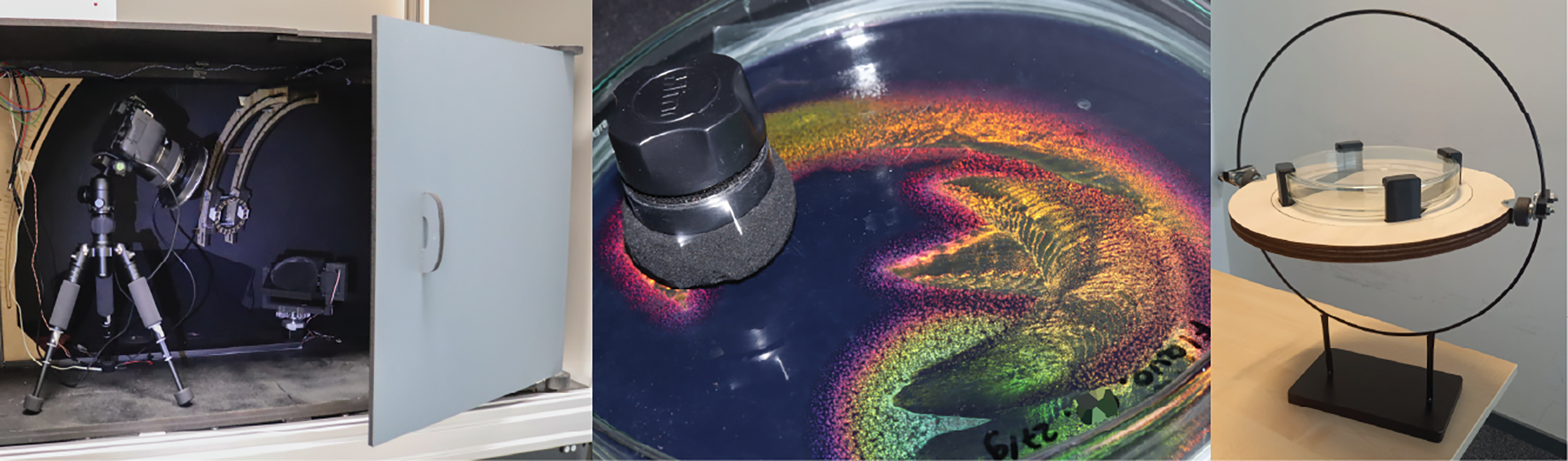
Living artefacts that incorporate microbial life introduce novel interaction possibilities in everyday contexts, opening space for human–microbe engagement. Such encounters can invite attentiveness to microbial processes and reflection on interconnectedness between microbial life, humans and their surroundings, thereby supporting more ecological ways of thinking. Seizing upon this potential, biodesign researchers increasingly engage with living microorganisms through in-depth explorations, yet examples that move from controlled laboratory studies into everyday contexts (e.g., Chen et al. Reference Chen, Seong, Ogura, Mitani, Sekiya and Moriya2021; Lu and Lopes Reference Lu and Lopes2022; Zhou et al. Reference Zhou, Doubrovski, Giaccardi and Karana2024) remain rare. Moreover, the tools, artefacts and intermediate outcomes that support such trajectories are seldom shared in material form. In response, this demo materialises the trajectory of an in-depth inquiry into the living colour of Flavobacteria (Groutars et al. Reference Groutars, Risseeuw, Ingham, Hamidjaja, Elkhuizen, Pont and Karana2022; Risseeuw Reference Risseeuw2026; Risseeuw et al. Reference Risseeuw, Mcquillan, Martins and Karana2024), tracing a progression from laboratory characterisation to a living artefact designed to support everyday human–microbe engagement (Figure 1). This development reflects a broadening of perspective: from understanding how Flavobacteria’s temporal, iridescent colourations evolve and respond to environmental conditions to lab-based explorations of direct interaction and ultimately to everyday engagement with living colour.
A selection of the tools and artefacts for exploring and engaging with Flavobacteria’s living colour within the lab and beyond.

At the centre of this work is Cellulophaga lytica, a marine flavobacterium that produces dynamic, angle-dependent structural colour (Kientz et al. Reference Kientz, Ducret, Luke, Vukusic, Mignot and Rosenfeld2012). These striking optical effects have attracted growing interest across materials science, design and human-computer interaction (HCI) (e.g., Groutars et al. Reference Groutars, Risseeuw, Ingham, Hamidjaja, Elkhuizen, Pont and Karana2022; Risseeuw et al. Reference Risseeuw, Mcquillan, Martins and Karana2024; Risseeuw et al. Reference Risseeuw, Kummetha, Ingham, Karana, Aubin-Tam and Martins2026; Sullivan et al. Reference Sullivan, Brown, Hung, Tang, DeSimone, Chen and Lloyd2023). Across the inquiry underlying this demo, these iridescence-producing microorganisms were explored for their colour-changing expressions and for the opportunity that direct interaction with these expressions affords to cultivate attentive human–microbe engagement. The demo offers a rare opportunity for attendees to directly interact with these microorganisms through carefully designed, direct yet sterile interaction techniques. In doing so, it demonstrates how biodesign practice can extend from laboratory explorations into everyday contexts and provides practical inspiration for similarly in-depth investigations.
Tools for understanding living colour
Designing engagement with Flavobacteria’s living colour required a deeper understanding of the organism’s iridescent, temporal and responsive qualities. This led to the development of two research tools designed to characterise these behaviours in a systematic and controlled manner.
Characterising temporality and iridescence
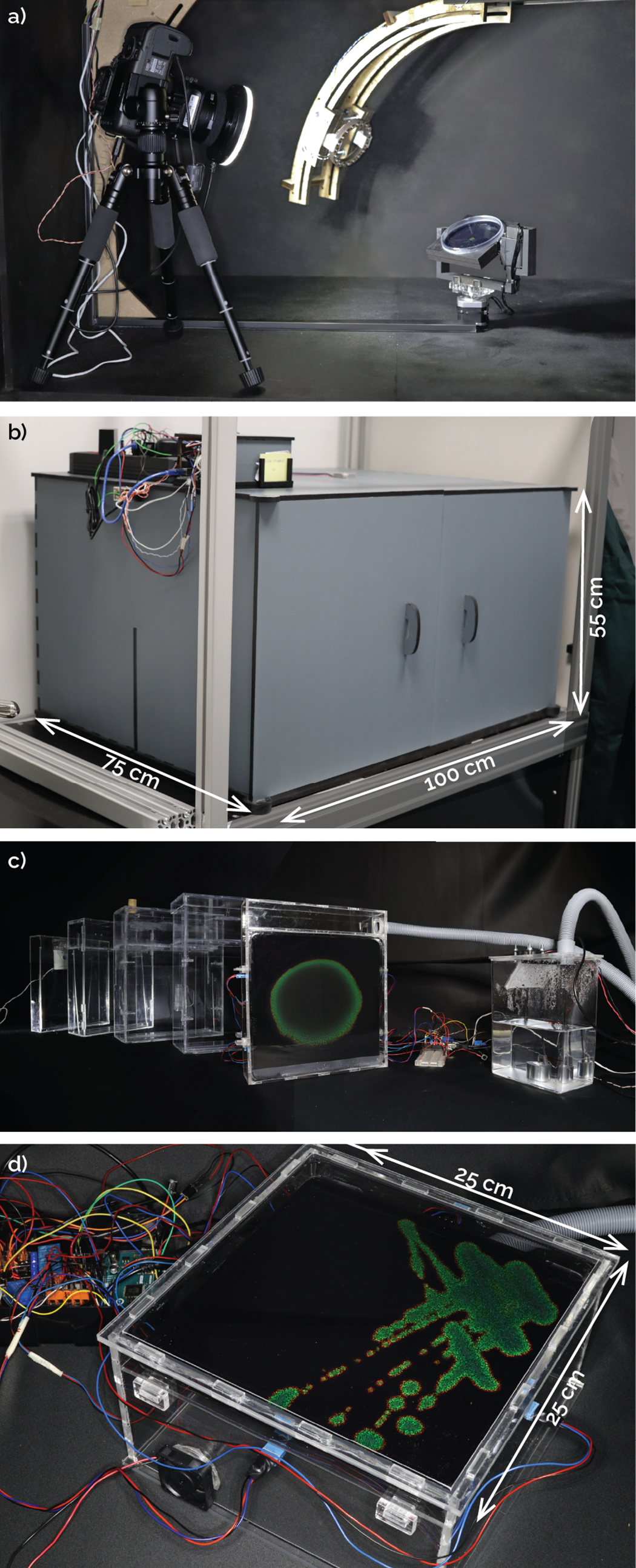
The temporal and angle-dependent colourations of Flavobacteria required a set-up capable of fast, automated, multi-angle image acquisition. To achieve this, the capture tool (Figure 2a–b) incorporates a tilting and rotating sample holder, a movable LED ring for varied illumination and Arduino-controlled automation. It enables consistent documentation of iridescent and temporal expressions, supporting systematic characterisation of living colour that informed subsequent design explorations.
Two research tools designed to characterise living colour: (a–b) the capture tool for consistent multi-angle imaging of temporal, iridescent colourations, with its enclosure coated (b) to meet biosafety requirements; (c–d) different versions of the digitally controlled Flavorium habitat, with the final version (d) positioned horizontally following insights into orientation-dependent growth variations.

Figure 2. Long description
panel b illustrates the dimensions of the capture tool: 75cm × 100cm × 55cm; panel d gives the dimensions of the custom-made habitat for longterm growth: 25cm × 25cm
Characterising long-term growth
Flavorium (Figure 2c–d) is a digitally controlled habitat that maintains optimal humidity for large-scale Petri dishes (240
 $\times$
240 mm) using an ultrasonic mist-maker, fans and relative humidity sensors, with an automated camera for documentation. It enabled insights into large-scale and long-term growth behaviours, including orientation-dependent variation in texture and expansion, which inspired tilt-based interactions with Flavobacteria.
Tools and artefacts for direct interactions
To support engagement with Flavobacteria’s living colour in everyday contexts, tools and artefacts were developed to enable direct yet sterile forms of interaction. These prototypes introduced techniques for touch- and gesture-based input and illustrate how these were refined from early laboratory set-ups into robust forms for everyday engagement.
Swiping interactions
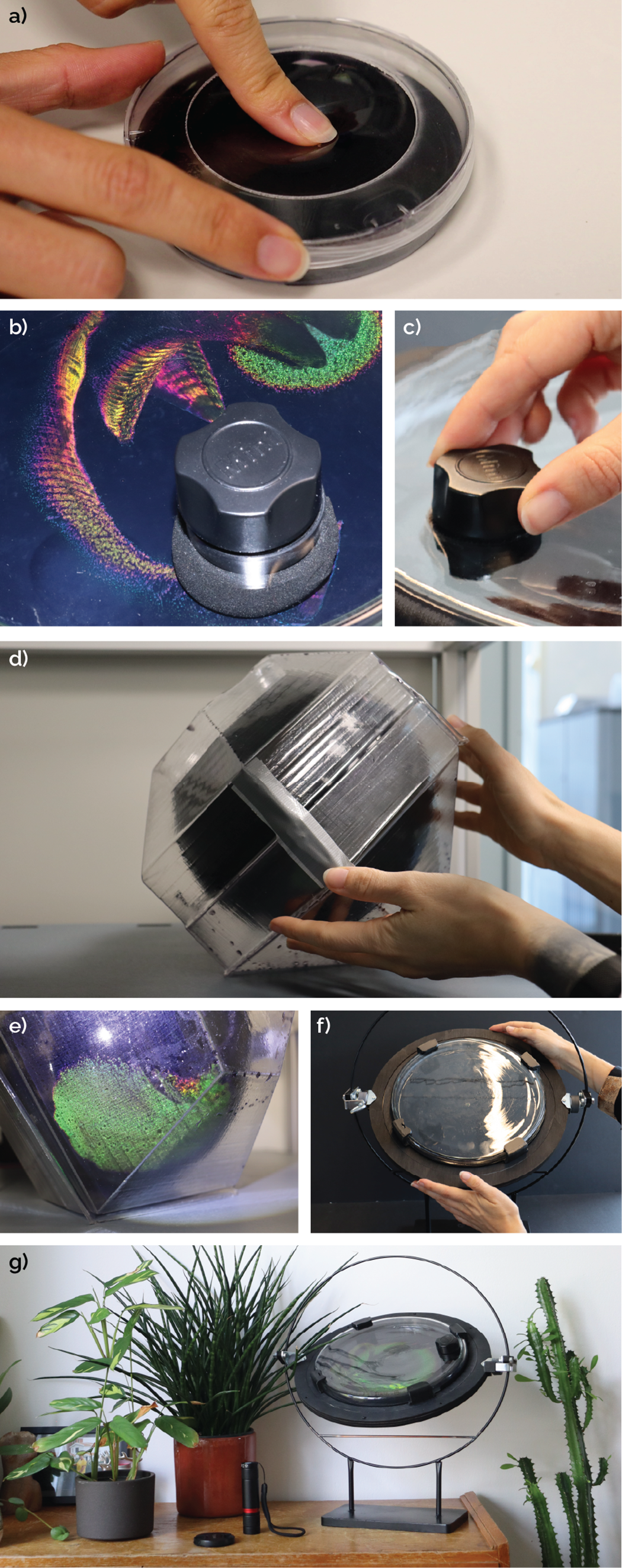
Swiping was first explored in small-scale laboratory set-ups using sterile gloves or other tools inside a laminar airflow cabinet. These early explorations informed the design of flexible lids for Petri dishes (Figure 3a) that enabled touch-based input outside sterile environments. A more robust technique was later developed using aquarium magnets with sponge-like materials as swiping tips (Figure 3b–c), refined to avoid damaging the growth medium while still effectively swiping the colourations through the habitat enclosure.
Tools and artefacts enabling direct human–Flavobacteria interactions outside sterile environments: (a) a flexible Petri dish lid for touch-based input; (b–c) repurposed aquarium magnets for swiping; (d–e) a prototype of a living artefact designed to invite tilting; (f) an oversized Petri dish in a tilting frame; and (g) the living artefact Flaviri for sustained interactions in everyday contexts.

Figure 3. Long description
panel a: a finger presses the flexible lid of the Petri dish down to “touch” the bacteria; panel b: swiping magnet on Petri dish lid and patches of Flavobacteria’s living colour next to it; panel c: a hand holding/moving the swiping magnet; panel d: two hands tilting the living artefact of plexiglass; panel e: colourful flavobacteria colony growing in the tiltable artefact of plexiglass; f: two hands tilting the large Petri dish in its frame; and panel g: the living artefact among house plants in domestic setting.
Tilting interactions
Tilting was first explored by positioning the Flavorium habitat on a 45° base, informing the development of an interactive living artefact. The first prototype featured a large sphere of growth medium (Ø210 mm) enclosed in an acrylic faceted shell designed to invite tilting (Figure 3d–e). While visually engaging, this design posed fabrication and visibility challenges, leading to a subsequent iteration that used an oversized, custom-made glass Petri dish (Ø250 mm) in a multi-directional tilting frame (Figure 3f).
The living artefact Flaviri
These explorations ultimately converged in Flaviri (Figure 3g), a living artefact designed to support long-term engagement with Flavobacteria’s living colour in everyday contexts (Risseeuw Reference Risseeuw2026). Flaviri sustained microbial viability for four weeks while enabling direct interactions through tilting and swiping – performed safely through the glass using magnets. Its design reflects the iterative refinement of these interaction techniques and the technical insights gained through both systematic characterisation and earlier interaction prototypes.
The demonstration
The demo features three living Flaviri artefacts for tilt-based interaction and three large inoculated Petri dishes for magnet-based swiping. A selection of materials – including footage of early lab-based interactions, flexible-lid habitats and an early prototype of the living artefact (non-inoculated) – illustrates how these interaction techniques were refined for sustained engagement in everyday contexts. The capture tool (shown unmotorised for safety) and the Flavorium habitat are also displayed as supporting research tools.
Interactivity
Attendees can directly engage with Flavobacteria’s living colour by tilting the Flaviri artefacts and swiping the colourations in the large Petri dishes. Handheld lights allow close inspection of the iridescence, and visitors can observe how the colonies respond and gradually diverge in response to accumulated interactions. Alongside this, attendees may examine the supporting research tools and handle the trajectory materials, including the flexible lids and the living artefact prototype.
Set-up and requirements
The demo requires two tables: one (approx. 150
 $\times$
75 cm) to host the capture tool and Flavorium habitat, with access to two power outlets, and a second table (approx. 200
 $\times$
50 cm) for displaying three Flaviri artefacts, swiping Petri dishes, trajectory materials and a desktop monitor. A 27-inch monitor is needed to show supporting footage. If available, several small desktop lights are requested to illuminate the Flavobacteria colonies. Sufficient space around the tables should be maintained to ensure safe interaction with the artefacts.
Data availability statement
This demo presents physical tools and artefacts; no new datasets or code were generated for this submission. The Arduino code supporting the research tools and the videos of early direct interaction explorations have been published in prior work.
Acknowledgements
I thank everyone who contributed to the development of these tools and artefacts, including Eduard Groutars, Willemijn Elkhuizen, Sylvia Pont, Mehmet Özdemir, Joana Martins, Holly McQuillan, and Elvin Karana.
Author contributions
The sole author carried out all aspects of the work, including conceptualisation, investigation, methodology, resources, software, visualisation and writing.
Financial support
This research was supported by grants from the Dutch Research Council (NWO) (CISC.KC.211) and Regieorgaan SIA (CIE.06.007).
Competing interests
None.
Ethical standards
The research meets all ethical guidelines, including adherence to the legal requirements of the study country.

 Open access

