



%20--%3e%3c!DOCTYPE%20svg%20PUBLIC%20'-//W3C//DTD%20SVG%201.0//EN'%20'http://www.w3.org/TR/2001/REC-SVG-20010904/DTD/svg10.dtd'%3e%3csvg%20version='1.0'%20id='Layer_1'%20xmlns='http://www.w3.org/2000/svg'%20xmlns:xlink='http://www.w3.org/1999/xlink'%20x='0px'%20y='0px'%20width='64px'%20height='64px'%20viewBox='5.5%20-3.5%2064%2064'%20enable-background='new%205.5%20-3.5%2064%2064'%20xml:space='preserve'%3e%3cg%3e%3ccircle%20fill='%23FFFFFF'%20fill-opacity='0'%20cx='37.785'%20cy='28.501'%20r='28.836'/%3e%3cpath%20fill='%23595959'%20d='M37.441-3.5c8.951,0,16.572,3.125,22.857,9.372c3.008,3.009,5.295,6.448,6.857,10.314%20c1.561,3.867,2.344,7.971,2.344,12.314c0,4.381-0.773,8.486-2.314,12.313c-1.543,3.828-3.82,7.21-6.828,10.143%20c-3.123,3.085-6.666,5.448-10.629,7.086c-3.961,1.638-8.057,2.457-12.285,2.457s-8.276-0.808-12.143-2.429%20c-3.866-1.618-7.333-3.961-10.4-7.027c-3.067-3.066-5.4-6.524-7-10.372S5.5,32.767,5.5,28.5c0-4.229,0.809-8.295,2.428-12.2%20c1.619-3.905,3.972-7.4,7.057-10.486C21.08-0.394,28.565-3.5,37.441-3.5z%20M37.557,2.272c-7.314,0-13.467,2.553-18.458,7.657%20c-2.515,2.553-4.448,5.419-5.8,8.6c-1.354,3.181-2.029,6.505-2.029,9.972c0,3.429,0.675,6.734,2.029,9.913%20c1.353,3.183,3.285,6.021,5.8,8.516c2.514,2.496,5.351,4.399,8.515,5.715c3.161,1.314,6.476,1.971,9.943,1.971%20c3.428,0,6.75-0.665,9.973-1.999c3.219-1.335,6.121-3.257,8.713-5.771c4.99-4.876,7.484-10.99,7.484-18.344%20c0-3.543-0.648-6.895-1.943-10.057c-1.293-3.162-3.18-5.98-5.654-8.458C50.984,4.844,44.795,2.272,37.557,2.272z%20M37.156,23.187%20l-4.287,2.229c-0.458-0.951-1.019-1.619-1.685-2c-0.667-0.38-1.286-0.571-1.858-0.571c-2.856,0-4.286,1.885-4.286,5.657%20c0,1.714,0.362,3.084,1.085,4.113c0.724,1.029,1.791,1.544,3.201,1.544c1.867,0,3.181-0.915,3.944-2.743l3.942,2%20c-0.838,1.563-2,2.791-3.486,3.686c-1.484,0.896-3.123,1.343-4.914,1.343c-2.857,0-5.163-0.875-6.915-2.629%20c-1.752-1.752-2.628-4.19-2.628-7.313c0-3.048,0.886-5.466,2.657-7.257c1.771-1.79,4.009-2.686,6.715-2.686%20C32.604,18.558,35.441,20.101,37.156,23.187z%20M55.613,23.187l-4.229,2.229c-0.457-0.951-1.02-1.619-1.686-2%20c-0.668-0.38-1.307-0.571-1.914-0.571c-2.857,0-4.287,1.885-4.287,5.657c0,1.714,0.363,3.084,1.086,4.113%20c0.723,1.029,1.789,1.544,3.201,1.544c1.865,0,3.18-0.915,3.941-2.743l4,2c-0.875,1.563-2.057,2.791-3.541,3.686%20c-1.486,0.896-3.105,1.343-4.857,1.343c-2.896,0-5.209-0.875-6.941-2.629c-1.736-1.752-2.602-4.19-2.602-7.313%20c0-3.048,0.885-5.466,2.658-7.257c1.77-1.79,4.008-2.686,6.713-2.686C51.117,18.558,53.938,20.101,55.613,23.187z'/%3e%3c/g%3e%3c/svg%3e)
%20--%3e%3c!DOCTYPE%20svg%20PUBLIC%20'-//W3C//DTD%20SVG%201.0//EN'%20'http://www.w3.org/TR/2001/REC-SVG-20010904/DTD/svg10.dtd'%3e%3csvg%20version='1.0'%20id='Layer_1'%20xmlns='http://www.w3.org/2000/svg'%20xmlns:xlink='http://www.w3.org/1999/xlink'%20x='0px'%20y='0px'%20width='64px'%20height='64px'%20viewBox='5.5%20-3.5%2064%2064'%20enable-background='new%205.5%20-3.5%2064%2064'%20xml:space='preserve'%3e%3cg%3e%3ccircle%20fill='%23FFFFFF'%20fill-opacity='0'%20cx='37.637'%20cy='28.806'%20r='28.276'/%3e%3cg%3e%3cpath%20fill='%23595959'%20d='M37.443-3.5c8.988,0,16.57,3.085,22.742,9.257C66.393,11.967,69.5,19.548,69.5,28.5c0,8.991-3.049,16.476-9.145,22.456%20C53.879,57.319,46.242,60.5,37.443,60.5c-8.649,0-16.153-3.144-22.514-9.43C8.644,44.784,5.5,37.262,5.5,28.5%20c0-8.761,3.144-16.342,9.429-22.742C21.101-0.415,28.604-3.5,37.443-3.5z%20M37.557,2.272c-7.276,0-13.428,2.553-18.457,7.657%20c-5.22,5.334-7.829,11.525-7.829,18.572c0,7.086,2.59,13.22,7.77,18.398c5.181,5.182,11.352,7.771,18.514,7.771%20c7.123,0,13.334-2.607,18.629-7.828c5.029-4.838,7.543-10.952,7.543-18.343c0-7.276-2.553-13.465-7.656-18.571%20C50.967,4.824,44.795,2.272,37.557,2.272z%20M46.129,20.557v13.085h-3.656v15.542h-9.944V33.643h-3.656V20.557%20c0-0.572,0.2-1.057,0.599-1.457c0.401-0.399,0.887-0.6,1.457-0.6h13.144c0.533,0,1.01,0.2,1.428,0.6%20C45.918,19.5,46.129,19.986,46.129,20.557z%20M33.042,12.329c0-3.008,1.485-4.514,4.458-4.514s4.457,1.504,4.457,4.514%20c0,2.971-1.486,4.457-4.457,4.457S33.042,15.3,33.042,12.329z'/%3e%3c/g%3e%3c/g%3e%3c/svg%3e)
Impact statement
This article aims to investigate how design know-how can support the development and application of mycelium-based materials derived from submerged liquid fermentation (SLF). This technically demanding production process remains underexplored in biodesign discourse, despite its significant potential for the development of novel mycelium-based materials. Drawing on the direct experience of the authors within an interdisciplinary research context, this article seeks to identify which design opportunities and limitations emerge when designers engage with SLF-derived mycelium biomass, contributing to a broader understanding of the role that design practice can play in advancing biotechnologies and biofabricated materials both in industrial and creative fields.
Introduction
Mycelium is the vegetative part of a fungus, consisting of a network of fine, thread-like filaments called hyphae (Kavanagh Reference Kavanagh2011). These filaments are formed by fungal cells and serve as the living, growing structures that decompose and digest organic material. Mycelium plays a crucial role in ecosystems as a natural recycler, breaking down complex organic compounds such as lignin and cellulose and returning nutrients to the soil (Majib et al. Reference Majib, Yaacob, Ting, Rohaizad and Azizul Rashidi2025).
In recent decades, mycelium has garnered significant attention across multiple fields – from biotechnology and materials science to design and architecture – due to its numerous advantages, including biodegradability, structural strength and regenerative growth. Both scientists and designers now view mycelium not just as a biological organism but also as a collaborator for exploring a wide range of applications (Camilleri et al. Reference Camilleri, Narayan, Lingam and Blundell2025).
Depending on how it is cultivated and processed, mycelium can develop distinct material properties and functionalities, enabling the creation of materials such as leather-like fabrics, foams and solid composites that can potentially serve as construction materials or replace plastics in packaging (Almpani-Lekka et al. Reference Almpani-Lekka, Pfeiffer, Schmidts and Seo2021; Crawford et al. Reference Crawford, Ruthanna Miller, Branco, Fletcher and Stefanov2024; Elsacker et al. Reference Elsacker, Vandelook, Van Wylick, Ruytinx, De Laet and Peeters2020; Rathinamoorthy et al. Reference Rathinamoorthy, Sharmila Bharathi, Snehaa and Swetha2023). The scientific community and companies are working together to transition from lab-scale to commercialisation. While some of these materials are already commercially available, their availability is still limited as some prevailing challenges remain (Wattanavichean et al. Reference Wattanavichean, Phanthuwongpakdee, Koedrith, Laoratanakul, Thaithatgoon, Somrithipol, Kwantong, Nuankaew, Pinruan, Chuaseeharonnachai and Boonyuen2025) in terms of material properties (e.g. moisture and temperature sensitivity, structural strength), production and scaling (e.g. production speed and cost) and market and regulatory hurdles (e.g. lack of standards for widespread adoption and public perception).
Biofabricated mycelium-based materials are often considered sustainable alternatives, for example, as a potential replacement for animal leather. In fact, animal leather and fossil-based synthetics both carry significant environmental and social costs (e.g. greenhouse gas emissions, deforestation, toxic chemical pollution, microplastic accumulation and non-biodegradable waste) reflecting extractive, linear production models that are incompatible with sustainability goals (Akkan Reference Akkan2024; Shi et al. Reference Shi, Huang, Zheng, Tian, Gong, Wang, Li and Gao2023; Thomasset and Benayoun Reference Thomasset and Benayoun2024). These shared shortcomings highlight the urgent need for alternative materials. In this context, mycelium-based materials have emerged as one of the most promising candidates. They offer a renewable, biodegradable and lower-impact pathway for industries such as fashion, automotive, packaging, interior design and much more (Bhatti et al. Reference Bhatti, Bhatti, Tang, Syam, Awwad, Sharaf and Ghadi2024; Hildebrandt et al. Reference Hildebrandt, Thrän and Bezama2021).
Responding to this material urgency, biodesign has progressively positioned itself as the field where scientific innovation and design practice converge to accelerate the development of living and bio-based alternatives. Since the emergence of biodesign (Myers Reference Myers2012) as a pioneering field in the early 2010s, there has been an increasing interest and ongoing collaboration between scientists and designers working together to explore new material futures for mycelium by utilising different digital and biological tools as well as methods and processes from their own disciplines (Attias et al. Reference Attias, Danai, Abitbol, Tarazi, Ezov, Pereman and Grobman2020).
Within the context of emerging material possibilities in biodesign, designers play a significant role in facilitating the development of new materialities that embody the narratives, characteristics and attributes defining novel materials. By communicating their origins, values and material qualities, these practices can enhance perception, understanding and awareness of emerging bio-based materials (Rognoli et al. Reference Rognoli, Petreca, Pollini and Saito2022). Nevertheless, the integration of design know-how and the role of designers within techno-scientific environments remains insufficiently studied, despite relevant contributions from authors such as Neri Oxman (Reference Oxman2016), Carole Collet (Reference Collet2021) and Miriam Ribul (Reference Ribul, Goldsworthy and Collet2021). Material research and development can seem rather complex for individuals from creative fields. This complexity is the result of the materials and new production techniques that rose during the Industrial Revolution, which detached design, arts and crafts from materials science and led to material worlds that are highly technical and scientific (Pouta et al. Reference Pouta, Vidgren, Vapaavuori and Mohan2022).
The intervention of designers in biological processes for material biofabrication has demonstrated that integrating design expertise can provide scientists with valuable insights into the contextual and societal implications of emerging biomaterials and technologies (Laamanen and Kääriäinen Reference Laamanen and Kääriäinen2022; Niinimäki et al. Reference Niinimäki, Groth and Kääriäinen2018). However, existing literature on mycelium-based materials in design has primarily focused on DIY processes or studio-based experimentation (Karana et al. Reference Karana, Blauwhoff, Hultink and Camere2018; Parisi et al. Reference Parisi, Ayala Garcia and Rognoli2016), as well as on the role of design in envisioning applications, sustainability implications and interdisciplinary collaboration (Barati and Karana Reference Barati and Karana2019; Karana et al. Reference Karana, Pedgley and Rognoli2015b). Comparatively limited scholarly attention has been paid to the development of design-led experimental approaches in laboratory settings that engage directly with biological production processes and techno-scientific modes of inquiry. As a result, submerged liquid fermentation (SLF) remains underexplored not only as a biofabrication method but also as a space for situated design inquiry, material experimentation and knowledge production. Addressing this gap, this study asks: How can design-led inquiry contribute to the development of biofabrication processes within techno-scientific environments? More specifically, it further asks: Which design opportunities and limitations emerge in biodesign practices when working with SLF-derived mycelium biomass?
Sections Methods for producing mycelium-based materials and SLF as a biofabrication method and a space for design inquiry and experimentation introduce the key research areas that contextualise this study and support the investigation of design-led biofabrication practices within techno-scientific environments. These sections review existing methods for producing mycelium-based materials and examine SLF in particular, as a biofabrication method and as a space for design inquiry and experimentation.
Methods for producing mycelium-based materials
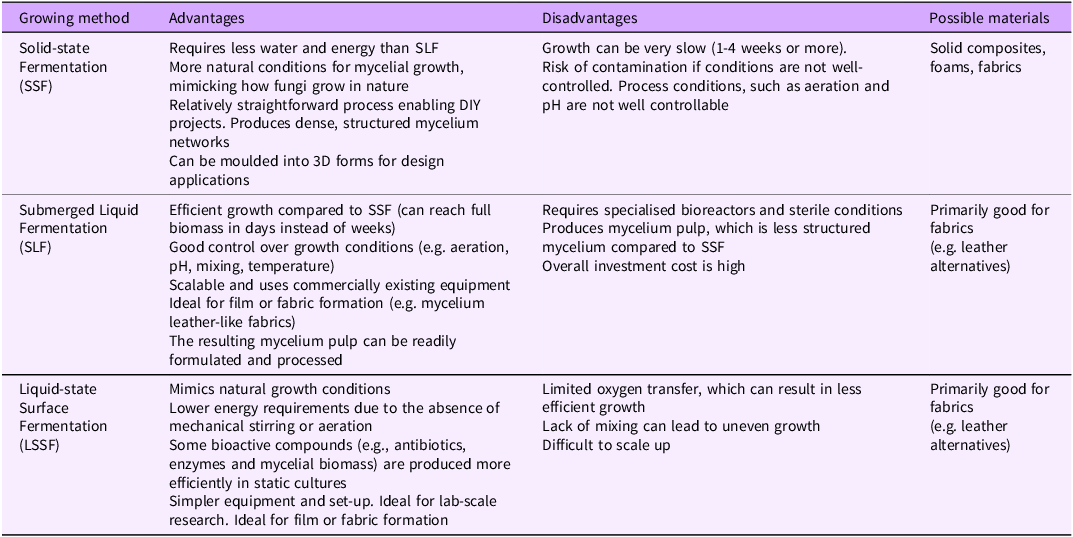
There are different types of mycelium-based materials. Their processing depends on the desired application, growth efficiency and structural properties (Nkemnaso Reference Nkemnaso2019). Three common approaches are solid-state fermentation (SSF), SLF and liquid-state surface fermentation (LSSF). From a design perspective, mycelium materials are extremely tunable, inviting the exploration of a variety of applications across these three macro-categories (Nkemnaso Reference Nkemnaso2019; Parisi et al. Reference Parisi, Ayala Garcia and Rognoli2016).
SSF is a fermentation process in which microorganisms grow on solid (or semi-solid) organic substrates. This process is often used to make mycelium-based composites that could eventually serve as building blocks or acoustic panels (Bhargav et al. Reference Bhargav, Panda, Ali and Javed2008). This process starts with the sterilisation of a substrate, such as sawdust, straw, hemp hurds or other agricultural waste. In some cases, additional nutrients such as starch can be used. The sterilised substrate is then inoculated with mycelium spawn (usually from agar cultures or grain spawn). The mixture is incubated in a controlled environment, allowing the mycelium to colonise the substrate at 20–28°C and 70–90% humidity. Growth occurs aerobically, requiring efficient gas transfer, since in this process the water content is relatively low and the microorganism is almost in contact with gaseous oxygen in the air (Gowthaman et al. Reference Gowthaman, Krishna and Moo-Young2001). Once fully colonised, the material is harvested and processed. At this stage, it can be moulded, dried or compressed depending on the desired applications. Alternatively, a foamy, pure mycelium layer growing on top of the substrate can be harvested and further processed (Elsacker et al. Reference Elsacker, Vandelook and Peeters2023).
SLF is a fermentation process in which microbes grow in a liquid nutrient medium under controlled conditions in a bioreactor. This method is particularly used for high-yield production of chemicals, enzymes, other proteins and mycelium biomass (Mascarin et al. Reference Mascarin, Golo, De Souza Ribeiro-Silva, Muniz, De Oliveira Franco, Kobori and Fernandes2024). This process starts with preparing the liquid media. This medium is usually a nutrient-rich liquid broth containing a carbon source, nitrogen source and mineral salts at a suitable pH. Complex media can include extracts from potato, malt or brewer’s spent grains, as well as lignocellulosics or molasses. More defined media typically include glucose, sucrose, lactose or glycerol as a carbon source and yeast extract, peptone or ammonium salts as a nitrogen source. Since a bioreactor is used for this method, pH, aeration and dissolved oxygen levels can be well controlled for fungal growth. First, a seed culture is prepared by inoculating the liquid medium with spores or mycelium (Gutiérrez-Correa and Villena Reference Gutiérrez-Correa and Villena2010). After sufficient growth in a small volume, the seed culture is used to inoculate a bioreactor containing the liquid media. The fermentation process starts in the bioreactor under controlled agitation and aeration. Temperatures range from 20–30° with a pH of 4.5–6.5 for optimal growth (Mascarin et al. Reference Mascarin, Golo, De Souza Ribeiro-Silva, Muniz, De Oliveira Franco, Kobori and Fernandes2024). In the course of several days (usually about 2–5 days, depending on the process and fungal strain), mycelium biomass is formed and is ready to be harvested by e.g., filtration. The mycelium pulp can then be formulated, processed and formed into materials.
LSSF is considered a variation of SLF. It is a fermentation process in which the culture medium remains undisturbed for a specific period without agitation or aeration. This method is also commonly used for growing mycelium leather-like fabrics. A sheet is usually formed at the top of the media culture after a few days (Narayanamurthy et al. Reference Narayanamurthy, Ramachandra, Rai, Ganapathy, Kavitha and Manohara2008). Similar to SLF, the process starts with preparing liquid media that, for the most part, contain glucose, malt extract, yeast extract or peptone. The media is inoculated with mycelium spores or small mycelial fragments from an agar culture in a tray. These trays must be covered with a lid while allowing sufficient oxygen availability and gas exchange. After this, the incubation period will begin and last 2 to 6 days, depending on the fungal strain used. The trays must be kept in a controlled environment that allows the mycelium to form a mat at 24–28°. Once fully grown, the mat can be lifted from the container, dried and processed accordingly.
Table 1 below summarises the three methods and the possible material outcomes, highlighting the advantages and challenges each presents for mycelium-based material production (Narayanamurthy et al. Reference Narayanamurthy, Ramachandra, Rai, Ganapathy, Kavitha and Manohara2008; Singh et al. Reference Singh, Singh, Agrawal and Kumar2025; Webb Reference Webb2017).
Comparison of mycelium production processes
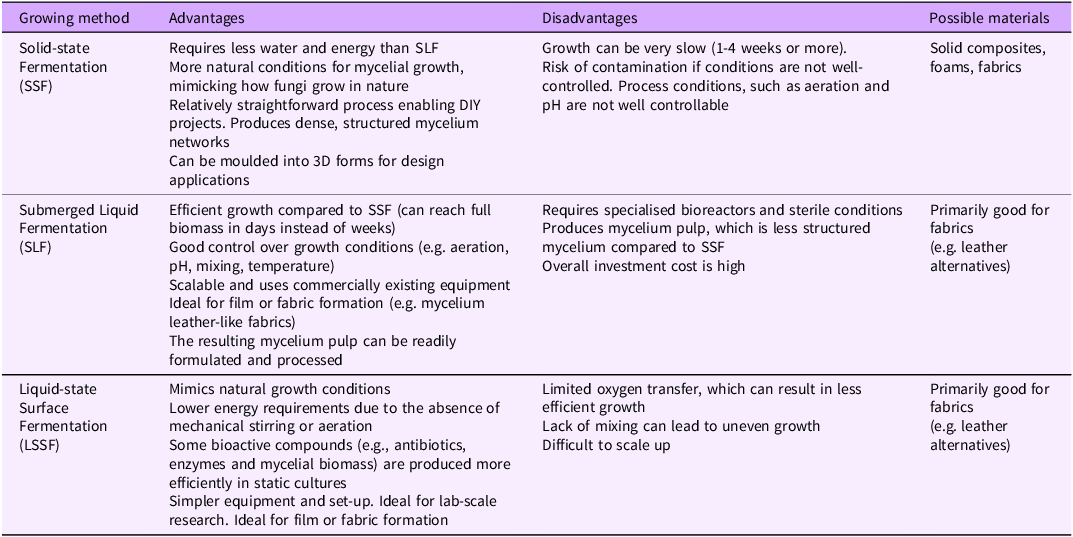
Table 1 Long description
A table comparing mycelium production processes, highlighting advantages, disadvantages, and possible materials. The table has three columns: Growing method, Advantages, Disadvantages, and Possible materials. It has three rows for each growing method: Solid-state Fermentation (SSF), Submerged Liquid Fermentation (SLF), and Liquid-state Surface Fermentation (LSSF). Row 1: Solid-state Fermentation (SSF), Requires less water and energy than SLF, More natural conditions for mycelial growth, mimicking how fungi grow in nature, Relatively straightforward process enabling DIY projects. Produces dense, structured mycelium networks, Can be moulded into 3D forms for design applications, Growth can be very slow (1-4 weeks or more). Risk of contamination if conditions are not well-controlled. Process conditions, such as aeration and pH are not well controllable, Solid composites, foams, fabrics. Row 2: Submerged Liquid Fermentation (SLF), Efficient growth compared to SSF (can reach full biomass in days instead of weeks), Good control over growth conditions (e.g. aeration, pH, mixing, temperature), Scalable and uses commercially existing equipment ideal for film or fabric formation (e.g. mycelium leather-like fabrics), The resulting mycelium pulp can be readily formulated and processed, Requires specialised bioreactors and sterile conditions, Produces mycelium pulp, which is less structured mycelium compared to SSF, Overall investment cost is high, Primarily good for fabrics (e.g. leather alternatives). Row 3: Liquid-state Surface Fermentation (LSSF), Mimics natural growth conditions, Lower energy requirements due to the absence of mechanical stirring or aeration, Some bioactive compounds (e.g., antibiotics, enzymes and mycelial biomass) are produced more efficiently in static cultures, Simpler equipment and set-up. Ideal for lab-scale research. Ideal for film or fabric formation, Limited oxygen transfer, which can result in less efficient growth, Lack of mixing can lead to uneven growth, Difficult to scale up, Primarily good for fabrics (e.g. leather alternatives).
Despite the growing interest in mycelium-based materials as sustainable alternatives, those derived through SLF remain largely underexplored in biodesign literature and material design research, a gap likely attributable to the high-tech machinery and controlled laboratory environments that SLF requires. Yet mycelium pulp produced through this process holds considerable potential for developing novel materials, and design practice stands to play a decisive role in unlocking that potential. This work addresses this gap by presenting a case study grounded in the first author’s firsthand experience as a designer engaged in the material exploration of SLF-derived mycelium within a techno-scientific laboratory setting.
SLF as a biofabrication method and a space for design inquiry and experimentation
In this work, the first author draws on his unique position as a designer embedded within a scientific laboratory to examine how designers can be meaningfully integrated into techno-scientific environments during the development of new materials. Most design practices involving mycelium to date have centred on DIY methodologies and SSF, often relying on tray-based cultivation systems to enable scalability and commercial viability. By contrast, working with SLF situates the designer within a highly controlled industrial environment, where material cultivation depends on more advanced bioprocessing infrastructures and parameters. In this context, the designer must engage with variables such as nutrient composition, oxygen transfer, agitation and growth duration. Such factors are typically outside the traditional scope of design practice and require ongoing technical collaboration and scientific expertise. As a result, the designer’s role expands beyond form-making toward systems-oriented thinking, shifting from designing in terms of units and surfaces, as is common in SSF, to understanding and operating within interconnected processes, scales and production volumes, as well as the possible roles designers can play.
In this work, SLF is studied from the perspectives of potential design opportunities in techno-scientific environments within the framework of material-driven experimental approaches, as well as the nuances of working with mycelium biomass and its outcomes, which include materials with various technical properties and sensorial and expressive qualities. This work shifts material creation from a culture of extracting and shaping matter to one of cultivating and steering it. This process is highly significant for design and technology in the creation of novel materials because it links process engineering with material performance and manufacturability. Since SLF materials are grown in a liquid medium by microorganisms such as fungi under controlled conditions (e.g., nutrient feeding, aeration, pH, temperature), designers have the opportunity to intervene early, before any form or specific application is decided upon. This concept is closely aligned with the principles of Material-Driven Design (MDD), particularly in its initial phase of material tinkering, where hands-on experimentation with materials serves to uncover emergent behaviours, sensorial qualities and potential meanings (Karana et al. Reference Karana, Barati, Rognoli and Zeeuw van der Laan2015a). Although this study does not adopt the full MDD method, its overall approach – and especially its exploratory engagement with material behaviour in the early stages – resonates strongly with MDD principles. Furthermore, the study incorporates elements of Research through Design (RtD), positioning design practice itself as a mode of inquiry and knowledge generation (Durrant et al. Reference Durrant, Vines, Wallace and Yee2017).
In this industrial context, designers operate at the intersection of materials science, microbiology and industrial production, translating biological phenomena into manufacturable, repeatable material properties. Communication across disciplines becomes a critical skill as designers collaborate with scientists and engineers to align the technical properties, functionality and performance of materials with their sensorial and expressive qualities, amid the biological constraints both designers and scientists will encounter (Rognoli Reference Rognoli2010). Rather than working solely through visual or tactile intuition, the designer engages with data, protocols and process parameters, redefining creativity as the ability to navigate and synthesise complex technical constraints.
In fact, one significant aspect of biodesign is interdisciplinary collaboration and co-creation (Pollini Reference Pollini2024). SLF requires observation, fine-tuning, waiting for the material to grow and knowing how to respond to unexpected behaviours of the living organism. This is particularly interesting for material-driven design experiments, as it challenges designers not only to give form but also to collaborate with and care for a living organism (Parisi et al. Reference Parisi, Ayala Garcia and Rognoli2016). This means that the designer develops deeper material understanding, practices tacit knowledge through hands-on experimentation and builds stronger links between technical properties, material behaviour and both sensorial and expressive qualities (Camere and Karana Reference Camere and Karana2018; Parisi et al. Reference Parisi, Rognoli and Sonneveld2017; Rognoli Reference Rognoli2010). The hybrid skills of a biodesigner, which combine design-based and scientific approaches, emerged clearly in this study and will be discussed in greater detail throughout this article.
Methods
This research employed a hybrid methodological framework that combined biological experimentation with design-led material exploration. Scientific methods were used to cultivate mycelium biomass and produce materials through SLF (Szilvay et al. Reference Szilvay, Laine, Arias-Barrantes, Suhonen, Boer and Penttilä2021; Ahokas et al. Reference Ahokas, Arias-Barrantes, Valtonen, Kärkkäinen, Kunnari, Vikman, Mattila, Penttilä and Szilvay2026). In parallel, material-driven design principles were explored through material tinkering (Parisi et al. Reference Parisi, Rognoli and Sonneveld2017) and prototyping (Ferraris et al. Reference Ferraris, Rognoli and Nimkulrat2023; Oxman Reference Oxman2015). By combining these approaches, the research enabled both a quantitative assessment of mycelium biomass production and a qualitative exploration of material properties and biodesign practices that emerged through interactions with mycelium biomass.
Scientific method for material production using SLF
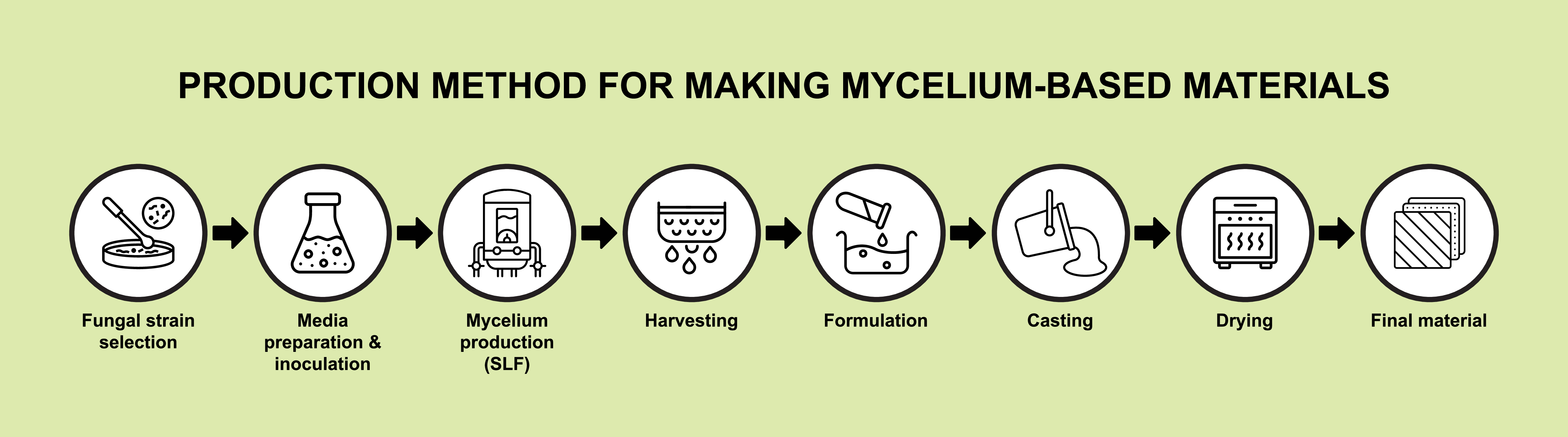
The steps involved in producing mycelium-based materials are described below and illustrated in Figure 1. Due to the interdisciplinary nature of this research, the process is presented within a scientific framework as a standard methodology for material production, beginning with fungal strain selection and culminating in the drying phase. The final materials (the last step) are considered the results of this process and are presented in Section Sensorial qualities and material expression as pathways for the emergence of material outcomes.
Production method for making mycelium-based materials via submerged liquid fermentation.
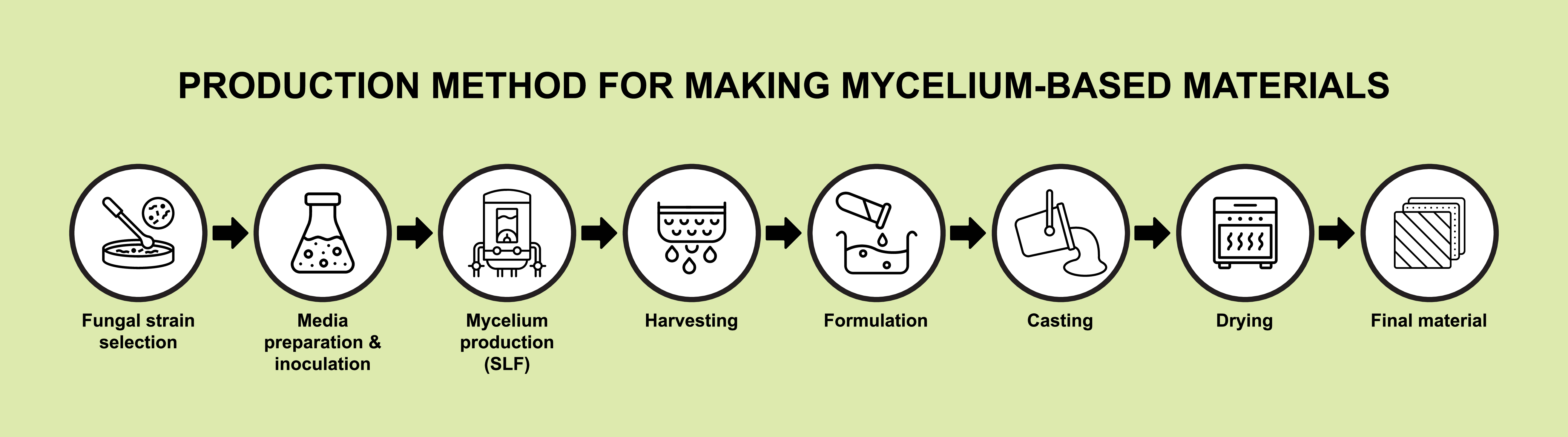
Fungal strain selection
Trichoderma reesei Rut-C30 variant strain (VTT D-86271) was tested. Important factors in selecting this strain included rapid growth, high biomass yield, a filamentous structure and specific material properties (e.g., strength, flexibility, fire resistance). T. reesei is a well-known filamentous fungus used widely in industry for its exceptional ability to efficiently produce enzymes for food, biorefinery, textile and pulp-and-paper applications (Peterson and Nevalainen Reference Peterson and Nevalainen2012).
Media preparation and inoculation
The media for pre-cultures contained 40 g/L of glucose, 20 g/L of yeast extract and 20 g/L of peptone. The pre-cultures were incubated at 28°C and aerated by agitation at 220 rpm in an orbital shaker (orbit diameter 25mm, Multitron, Infors HT) for 48 hours before being transferred to the bioreactor.
The media used in fed-batch cultivation was chosen to include glucose as the carbon source, which is known to results in a cultivation that prefers biomass formation over enzyme production and contained 20 g/L of glucose, 15 g/L of KH2PO4, 10 g/L of (NH4)2SO4, 2 g/L of peptone, 1 ml/L of trace element solution, 0.59 g/L of MgSO4, 1ml/L of Antifoam Struktol J673A and 1.6 ml/L of CaCl2. All media components were sterilised by autoclaving at 121°C for 20 minutes or sterile-filtered and added after autoclaving to prevent precipitation.
Mycelium production (SLF)
For the mycelium production, a 40 L bioreactor (New Brunswick 32L BioFlo510, Eppendorf) was used for cultivations inoculated with seed cultures. The cultures were run as fed-batch cultures with feed containing carbon (560 g/L glucose) and a nitrogen source (50 g/L (NH4)2SO4) (Papagianni Reference Papagianni2004). The culture pH was maintained at 4.8 by adding 25% NH4OH or 15% H3PO4. Temperature was maintained at 28 °C and airflow at 0.3 vvm. Pressure was increased stepwise from 0.2 bar to 0.8 bar during the cultivation. Agitation was controlled by a dissolved-oxygen cascade, starting at 100 rpm and increasing to 350 rpm. Feed was adjusted during cultivation to prevent excess glucose accumulation and glucose limitation. Antifoam was added when needed to prevent excessive foaming that would otherwise interfere with aeration, process control and sterile operation. Cultivation was observed daily to ensure the mycelium remained healthy and did not form spores, which divert growth resources from mycelium growth and result in undesirable non-filamentous morphology.
Harvesting
The average cultivation time in the bioreactor was 50 hours, resulting in 17 g/L of cell dry mass, yielding an average dry cell mass productivity of 0.3 g/L/h. This is significantly higher than what can be achieved with shake-flask cultures (which typically yield 6 g/L).
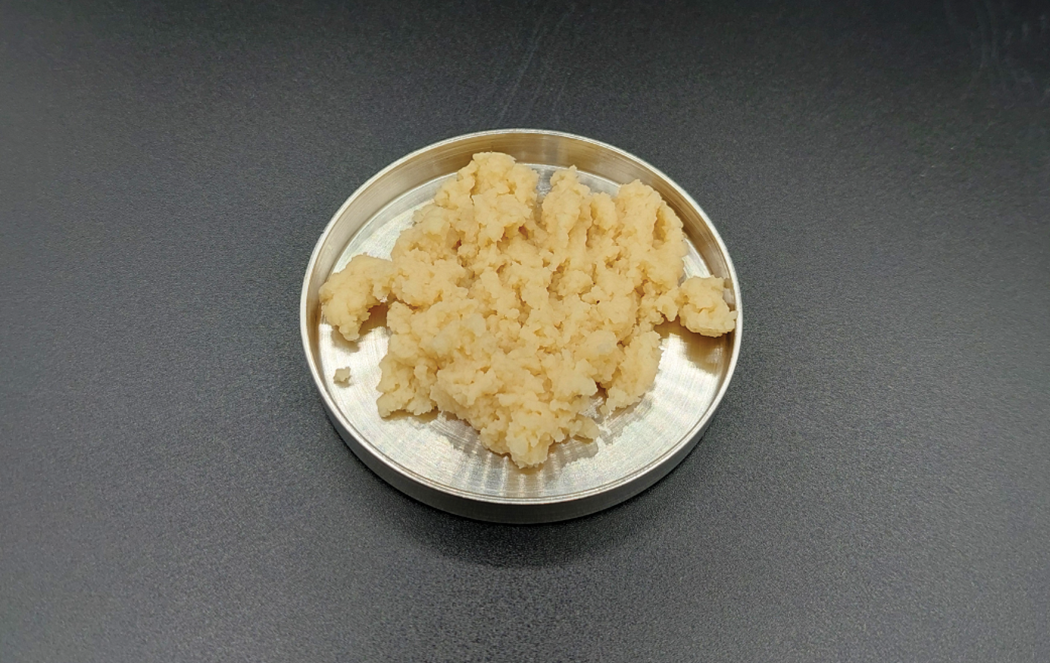
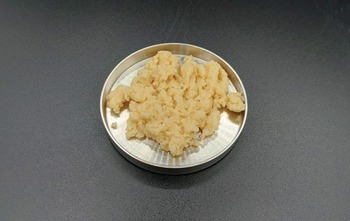
The mycelium was harvested using metal strainers or a mesh bag, both with a 250-micron mesh, followed by three washing steps with reverse osmosis water to remove all media components. The dry matter content of the washed mycelium pulp (Figure 2) was determined by the oven drying method by drying a 2–5 g wet sample overnight at 105 °C in an oven; the samples were measured in triplicate. The dry matter content was determined to allow accurate and reproducible formulation of the samples. Typical dry matter content of the washed mycelium batches was 10–15%. The washed mycelium pulp was stored at +4 °C for up to 3 weeks until formulated. Approximately 500 g of pure mycelium was obtained from one 40-litre bioreactor, an adequate quantity for extensive experimentation with material formation on both small and large scales.
Mycelium pulp, after washing steps.
Formulation
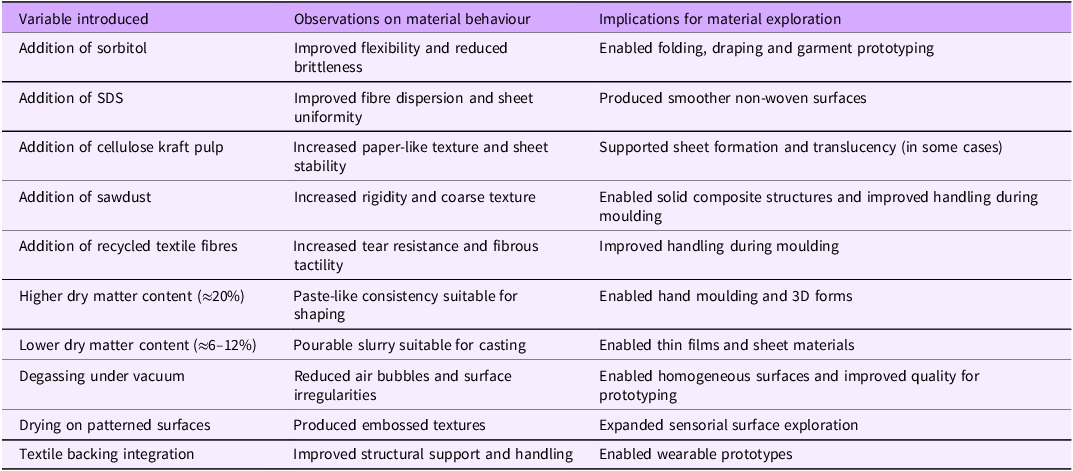
Mycelium biomass was the experimental medium during this phase, following an iterative cycle of planning, acting, observing and reflecting after each experiment. A range of additives and varying ratios were tested, with formulations continuously refined throughout the process. The formulations used for the final materials and prototypes are presented in Table 2 (Section Sensorial qualities and material expression as pathways for the emergence of material outcomes).
Observed effects of additives and process variables on material behaviour and implications for material exploration
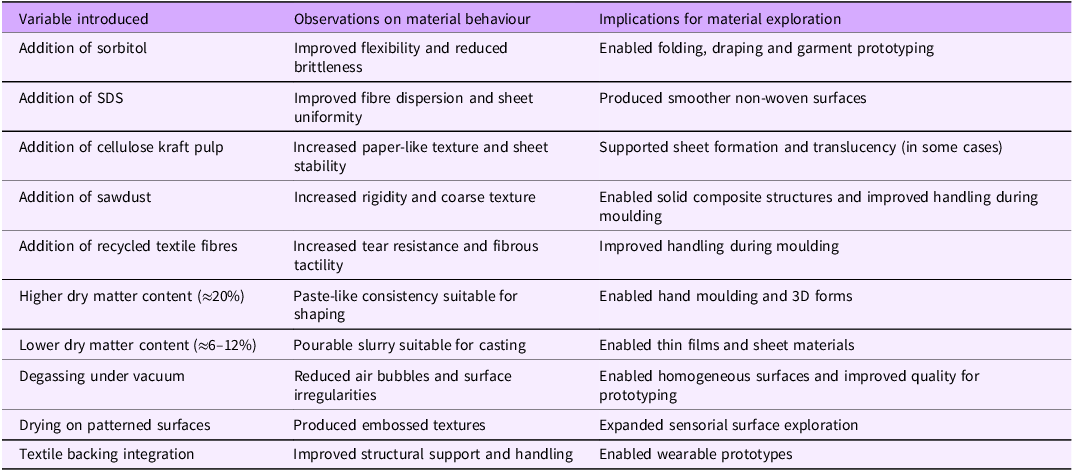
Table 2 Long description
A table with three columns and nine rows. The columns are labeled ‘Variable introduced’, ‘Observations on material behaviour’, and ‘Implications for material exploration’. Row 1: Addition of sorbitol, Improved flexibility and reduced brittleness, Enabled folding, draping and garment prototyping. Row 2: Addition of SDS, Improved fibre dispersion and sheet uniformity, Produced smoother non-woven surfaces. Row 3: Addition of cellulose kraft pulp, Increased paper-like texture and sheet stability, Supported sheet formation and translucency (in some cases). Row 4: Addition of sawdust, Increased rigidity and coarse texture, Enabled solid composite structures and improved handling during moulding. Row 5: Addition of recycled textile fibres, Increased tear resistance and fibrous tactility, Improved handling during moulding. Row 6: Higher dry matter content (≈20 percent), Paste-like consistency suitable for shaping, Enabled hand moulding and 3 D forms. Row 7: Lower dry matter content (≈6–12 percent), Pourable slurry suitable for casting, Enabled thin films and sheet materials. Row 8: Degassing under vacuum, Reduced air bubbles and surface irregularities, Enabled homogeneous surfaces and improved quality for prototyping. Row 9: Drying on patterned surfaces, Produced embossed textures, Expanded sensorial surface exploration. Row 10: Textile backing integration, Improved structural support and handling, Enabled wearable prototypes.
Glycerol, sorbitol and sodium dodecyl sulfate (SDS) were tested as plasticisers. Recycled textile fibres were obtained by shredding cotton T-shirts with a Wiley-mill – dry cutting mill (Standard Model No. 3, Arthur H. Thomas Co, US). The used sawdust was from birch procured from a local farm and milled to 0.5 mm particle size. The bleached pine kraft pulp (Metsä Fibre Oy) was re-disintegrated in water at VTT. For dyeing, plant-based carbon black, carmine red and bio-based indigo blue were used. Occasionally, air bubbles were observed in the materials; therefore, the formulations were degassed under a 0.8–1.0 bar vacuum for 30–60 min to remove trapped air and ensure uniform materials upon drying.
Casting
Trays measuring approximately 25 × 37 cm were used primarily to prepare the samples. In certain cases, trays measuring 22 × 22 cm were also used. To prevent the material from sticking to the metal, silicone sheets were used, along with release agents such as beeswax in some cases. The slurry was poured into the tray and spread evenly to control the final material’s thickness. For some mycelium-based non-woven fabrics, a cotton textile backing was placed at the bottom of the tray before casting. For those cases where the material was moulded, this step was skipped.
Drying
The samples were dried in a forced-circulation UF110 oven (Memmert, Germany) at 70% fan speed for 8-12 hours. Drying the materials slowly was important to prevent cracking or warping. An oven with a dehumidifier or a fan greatly improved the material’s drying speed and consistency.
Design methods for material exploration
This research adopted a Research through Design (RtD) approach, understood not as a formal methodological framework grounded in a singular epistemological basis, but rather as a foundational concept for conducting inquiry through the practice of design itself (Durrant et al. Reference Durrant, Vines, Wallace and Yee2017). This orientation was integrated with the principles of the MDD method (Karana et al. Reference Karana, Barati, Rognoli and Zeeuw van der Laan2015a)., as both approaches emphasise knowledge generation through active engagement with materials, iterative experimentation and reflective making processes, which were central to the material-driven experimental approaches. The methodology emphasises iterative material experimentation through material tinkering (Parisi et al. Reference Parisi, Rognoli and Sonneveld2017) and prototyping as core design methods. Through these processes, the study investigated how the material responded to different processing conditions and how its aesthetic, tactile, structural and performative qualities emerged through hands-on exploration.
Material tinkering
Material tinkering (Parisi et al. Reference Parisi, Rognoli and Sonneveld2017) constituted a central methodological approach throughout the study. Tinkering was used as an exploratory, open-ended and iterative engagement with mycelium biomass during the formulation phase, through direct manipulation and sensory observation. The process involved repeated cycles of experimenting with the mycelium biomass using varying combinations of processing techniques, moisture levels, drying conditions and structural manipulations. The purpose of tinkering was to investigate how the material responded to different conditions and how its aesthetic, tactile, structural and performative qualities emerged through hands-on exploration.
During these explorations, attention was given not only to measurable technical characteristics but also to sensorial qualities and material expression (Rognoli Reference Rognoli2010), such as texture, flexibility, translucency, fragility, softness, elasticity and surface expression. The exploratory nature of tinkering enabled unexpected material behaviours and opportunities to surface. Documentation through notes, photographs and sample archiving supported reflection and comparison across experiments.
Prototyping
Prototyping (Ferraris et al. Reference Ferraris, Rognoli and Nimkulrat2023) was used to explore the materials’ potential applications across different contexts. Prototypes were developed iteratively at multiple scales, ranging from small material samples to more spatial or application-based explorations. These prototypes were not conceived as finalised products but as investigative artefacts that enabled the evaluation of the materials’ behaviour, technical properties, sensorial qualities, material expression and affordances (Barati and Karana Reference Barati and Karana2019).
The prototyping process explored how mycelium biomass could be shaped, assembled, combined with other additives and stabilised through different fabrication techniques. Experiments included moulding, casting, layering, coating and free-form shaping. Through these processes, the research examined questions related to structural integrity, drying behaviour, dimensional stability and sensory experience.
Importantly, prototyping was also applied as a reflective dialogue between the designer and the material. Each prototype generated new insights that informed subsequent material modifications and experimental directions. The iterative process between material experimentation and prototyping allowed the research to progressively identify meaningful material characteristics and potential application areas.
Results
This research revealed how integrating design-led inquiry into SLF workflows unfolded new design opportunities across material experimentation, exploration of a material’s sensorial and expressive qualities and interdisciplinary collaboration.
Through iterative experimentation with additives, varying dry matter content, dyes and forming techniques, the research investigated how different formulations influenced material behaviour and material properties. Rather than identifying a single optimal formulation, the results demonstrate how the experimental process itself unfolded into a broader design space, where the material’s intrinsic behaviour actively informed subsequent design decisions and potential applications. In this context, design inquiry served not only as a method for evaluating outcomes but also as a generative approach that revealed alternative ways of working with mycelium biomass, expanded possibilities for material qualities and expression and fostered cross-disciplinary collaboration.
The findings are discussed through three interconnected perspectives. First, A New Space for Exploring Material Behaviour (3.1) presents how systematic variation of formulations and process variables across both wet and dry material states revealed relationships between additives, density and processing conditions, thereby enabling the development of preliminary knowledge concerning material behaviour and performance.
Second, Sensorial Qualities and Material Expression as Pathways for the Emergence of Material Outcomes (3.2), examines how the progressive understanding of material behaviour enabled more nuanced observations of tactile, visual, structural and expressive qualities across different formulations and processing conditions. The section further discusses how these evolving qualities informed the recognition of different properties, demonstrating how specific formulations and processing approaches generated differentiated material outcomes and application possibilities.
Finally, Observations on Interdisciplinary Collaboration (3.3) reflects on how the experimental process shaped the designer’s role within the techno-scientific environment.
Together, these results position SLF not only as a production method for mycelium biomass but also as a space for iterative material exploration where scientific and design experimentations collectively contributed to new mycelium-based materials, material experiences and interdisciplinary design knowledge.
A new space for exploring material behaviour
The experimental approach adopted in this study was grounded in the practice of material tinkering (Parisi et al. Reference Parisi, Rognoli and Sonneveld2017). Material exploration was conducted through iterative formulation experiments using washed T. reesei biomass obtained via SLF. Throughout the study, the research team systematically varied the type and ratio of additives, dry matter content (DMC) and forming techniques (casting vs. moulding) to examine how these parameters influenced material behaviour.
Rather than optimising toward a predefined application, the experiments mapped a design space in which material behaviour informed subsequent iterations. Observations from each formulation cycle guided decisions regarding density, flexibility, tactility, surface texture, dimensional stability and suitability for forming techniques. Table 2 summarises observed effects of additives and process variables on material behaviour.
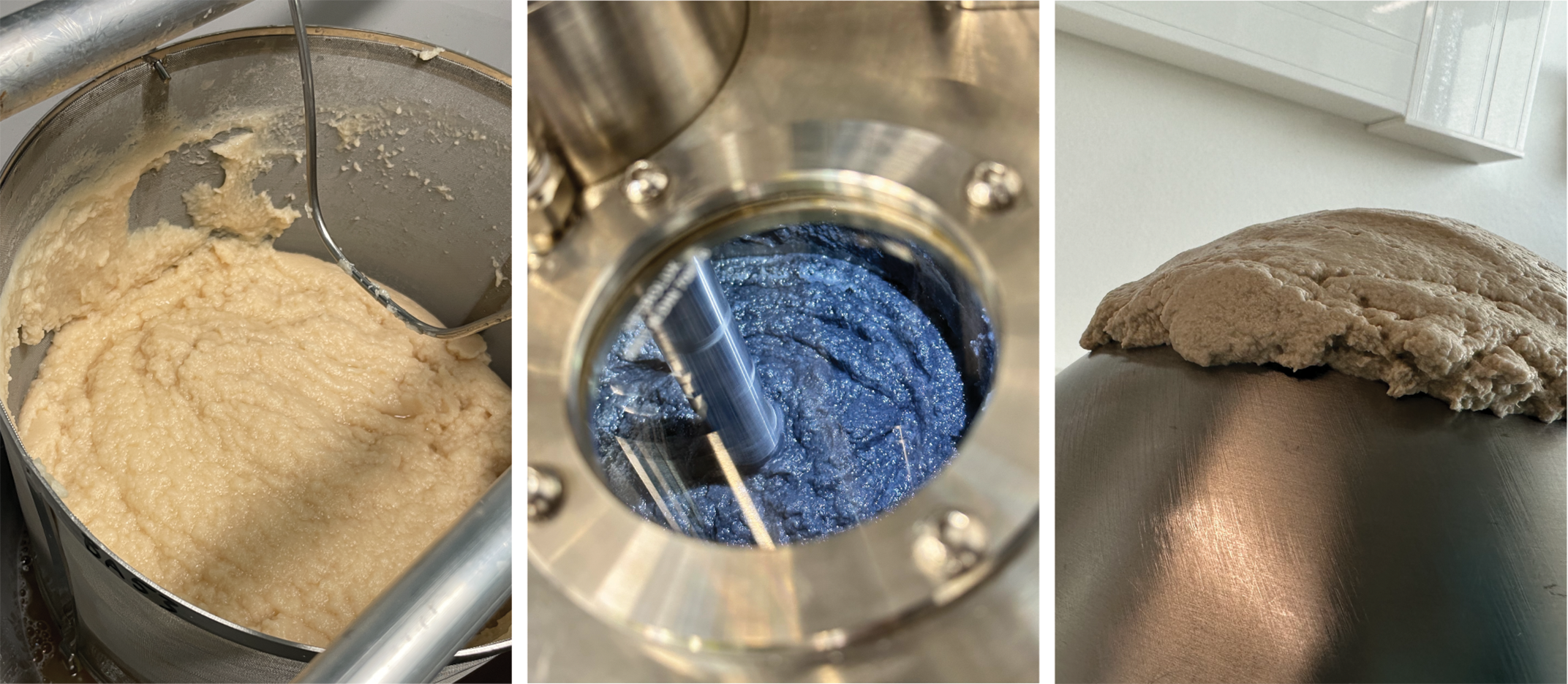
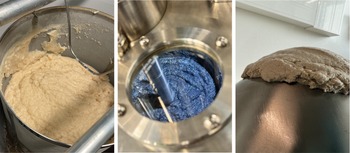
This iterative experimentation revealed that a single SLF process could support multiple material outcomes, including non-wovens, paper-like sheets and solid composites. This finding expanded the initial assumption that SLF-derived biomass was primarily suitable only for mycelium-based non-woven fabrics. Figure 3 illustrates different biomass densities and both natural and dyed states.
Mycelium biomass in natural colour (left), dyed black (middle) and as a paste for moulding (right).
Sensorial qualities and material expression as pathways for the emergence of material outcomes
Following the identification of design implications emerging from the observed material behaviours, material tinkering (Parisi et al. Reference Parisi, Rognoli and Sonneveld2017) was subsequently employed across three interconnected dimensions. First, tinkering with the material involved developing novel material systems by combining mycelium biomass with bio-based or recycled constituents. Second, tinkering with the formula involved systematically varying ingredient compositions and proportions to investigate their effects on material behaviour, structural performance, sensorial qualities and material expression. Third, tinkering with the process involved the prototyping phase, specifically the experimentation with fabrication and post-processing techniques, including moulding, joining, polishing, embossing, laser cutting, dyeing and surface treatments, to explore how processing conditions influenced sensorial qualities and material expression. Together, these three dimensions enabled a design-led inquiry into how material behaviour, formulation, fabrication and sensorial interaction contributed to the emergence of different material outcomes.
Within this study, sensorial qualities refer to the experiential properties perceived through tactile, visual and haptic interaction with the materials, including smoothness, roughness, rigidity, flexibility, translucency, density and responsiveness during handling and forming (Parisi et al. Reference Parisi, Rognoli and Sonneveld2017). Material expression is used in this context to address the performative characteristics that emerged from the interaction among composition, processing methods and form-giving techniques (Camere and Karana Reference Camere and Karana2018).
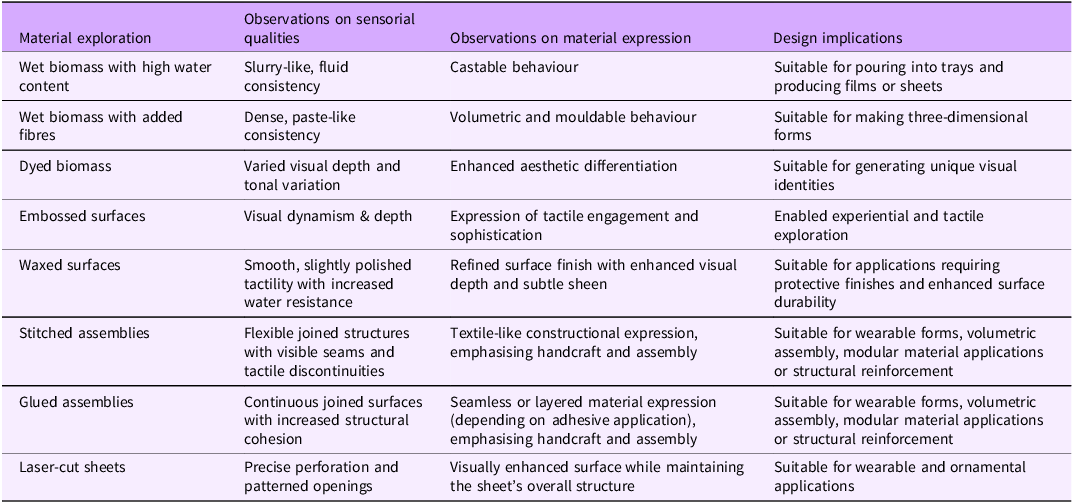
The experiments revealed that sensorial and structural behaviours were closely interconnected. Variations in water content, additive composition and fabrication methods altered not only the workability of the biomass during processing but also the tactile and visual characteristics of the resulting materials. Wet biomass with high water content behaved like a slurry, enabling pouring and casting into trays for film and sheet production. In contrast, fibre-enriched biomass developed a denser, paste-like consistency, enabling the moulding of three-dimensional forms. As dry matter content increased, the material progressively transitioned from a castable to a mouldable state suitable for volumetric shaping. These transformations influenced both fabrication possibilities and the sensorial qualities of the resulting materials.
Table 3 summarises the relationships observed between the wet and dry states of mycelium biomass, sensorial qualities, material expression and their associated design implications.
Observed material qualities and design implications during the material exploration across wet and dry states of mycelium biomass
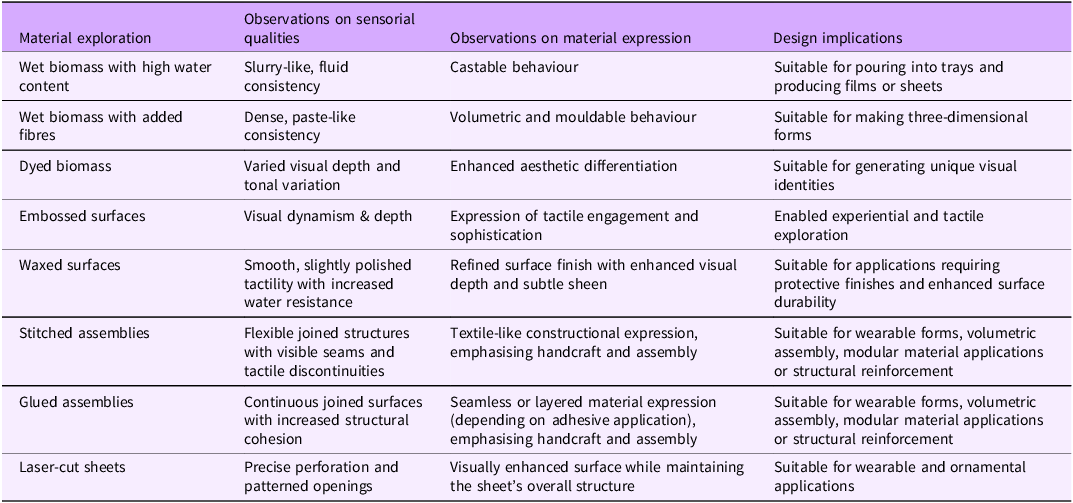
Table 3 Long description
A table with four columns and eight rows. The columns are labeled Material exploration, Observations on sensorial qualities, Observations on material expression, and Design implications. Row 1: Wet biomass with high water content, Slurry-like, fluid consistency, Castable behaviour, Suitable for pouring into trays and producing films or sheets. Row 2: Wet biomass with added fibres, Dense, paste-like consistency, Volumetric and mouldable behaviour, Suitable for making three-dimensional forms. Row 3: Dyed biomass, Varied visual depth and tonal variation, Enhanced aesthetic differentiation, Suitable for generating unique visual identities. Row 4: Embossed surfaces, Visual dynamism & depth, Expression of tactile engagement and sophistication, Enabled experiential and tactile exploration. Row 5: Waxed surfaces, Smooth, slightly polished tactility with increased water resistance, Refined surface finish with enhanced visual depth and subtle sheen, Suitable for applications requiring protective finishes and enhanced surface durability. Row 6: Stitched assemblies, Flexible joined structures with visible seams and tactile discontinuities, Textile-like constructional expression, emphasising handcraft and assembly, Suitable for wearable forms, volumetric assembly, modular material applications or structural reinforcement. Row 7: Glued assemblies, Continuous joined surfaces with increased structural cohesion, Seamless or layered material expression (depending on adhesive application), emphasising handcraft and assembly, Suitable for wearable forms, volumetric assembly, modular material applications or structural reinforcement. Row 8: Laser-cut sheets, Precise perforation and patterned openings, Visually enhanced surface while maintaining the sheet’s overall structure, Suitable for wearable and ornamental applications.
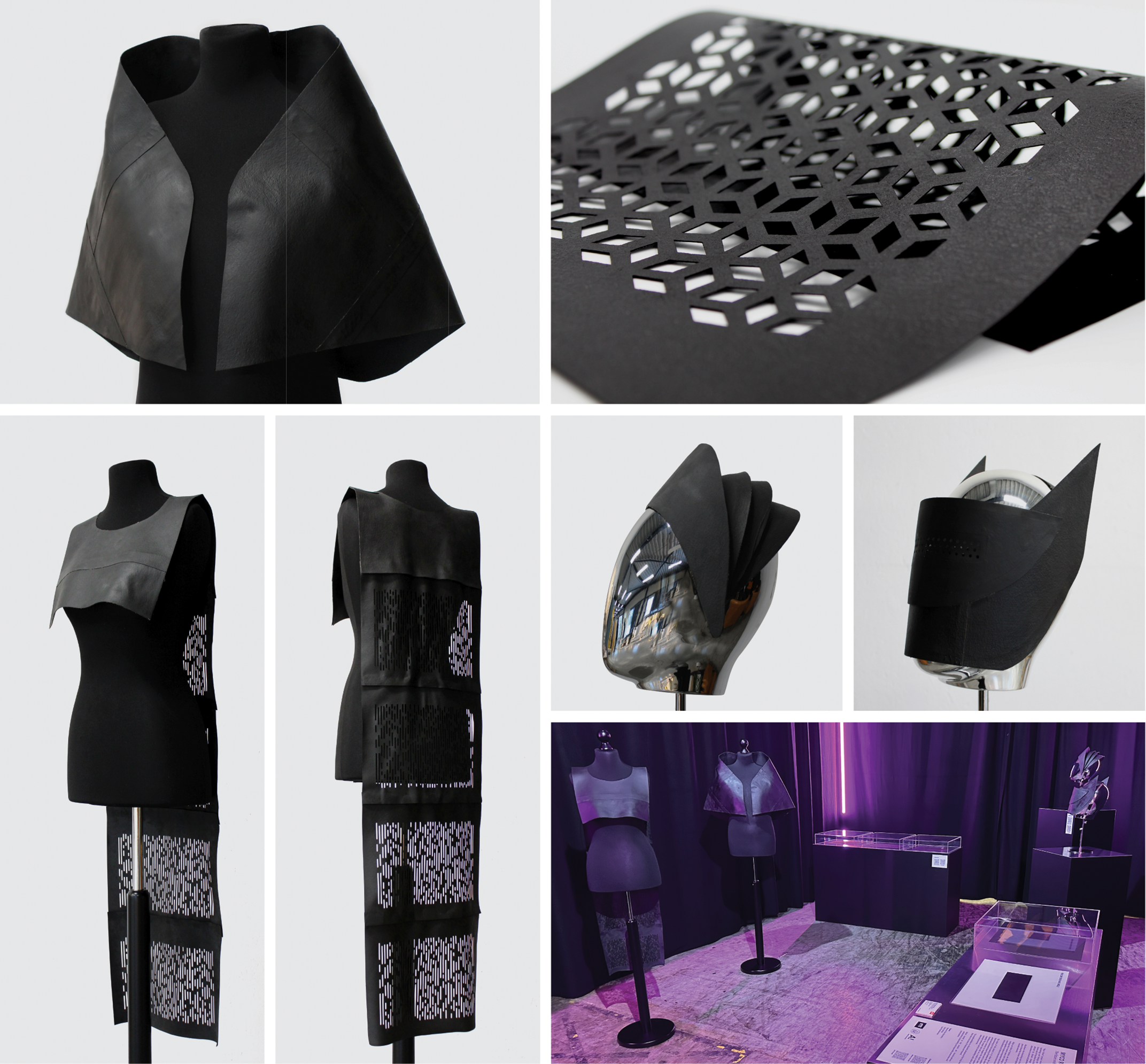
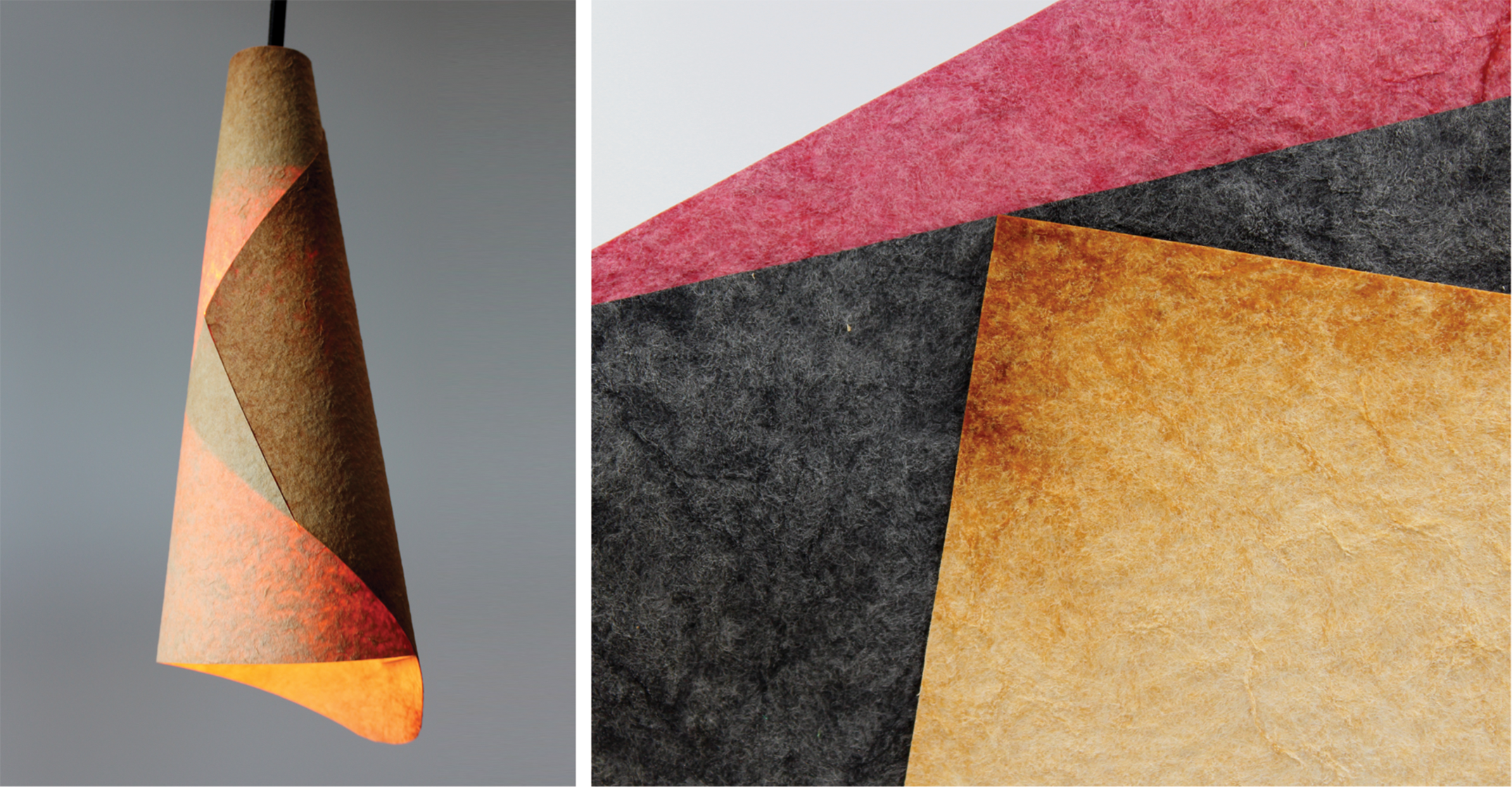
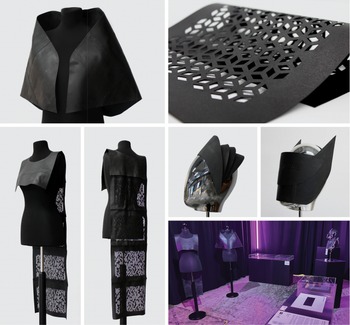
As material behaviour guided the experimentation towards the exploration of sensorial qualities and material expression, material exploration progressed through iterative engagement with the wet and dry states of the biomass, additive variations and repeated reformulation. Through this experimentation, three material outcomes were unfolded: mycelium-based non-woven fabrics (Figure 4), mycelium-based paper sheets (Figure 5) and mycelium-based composites (Figure 6). These material outcomes were not established at the outset of the study but evolved through repeated testing of biomass density, additive combinations and ratios and forming techniques. The findings suggest that these material outcomes were not determined solely by formulation composition; rather, they were co-constituted through sensorial interaction, fabrication processes and the dynamic manipulation of mycelium biomass.
Mycelium-based non-woven fabrics used for creating garments and headpieces. Prototypes and material samples part of the exhibition titled MYCO ROOM: The Future Embodiment of Mycelium, shown at Dutch Design Week 2024 from 19 to 27 October 2024 in Sectie-C (Eindhoven, The Netherlands).
Mycelium sheets used for a lampshade. Prototype and material samples part of the exhibition titled Mycelium Playground, shown at Material Matters as part of London Design Week 2024 from 18 to 21 September 2024 (London, United Kingdom).
Mycelium-based composites used for creating a lampshade and bowls. Prototypes and material samples part of the exhibition titled Mycelium Playground, shown at Material Matters as part of London Design Week 2024 from 18 to 21 September 2024 (London, United Kingdom).
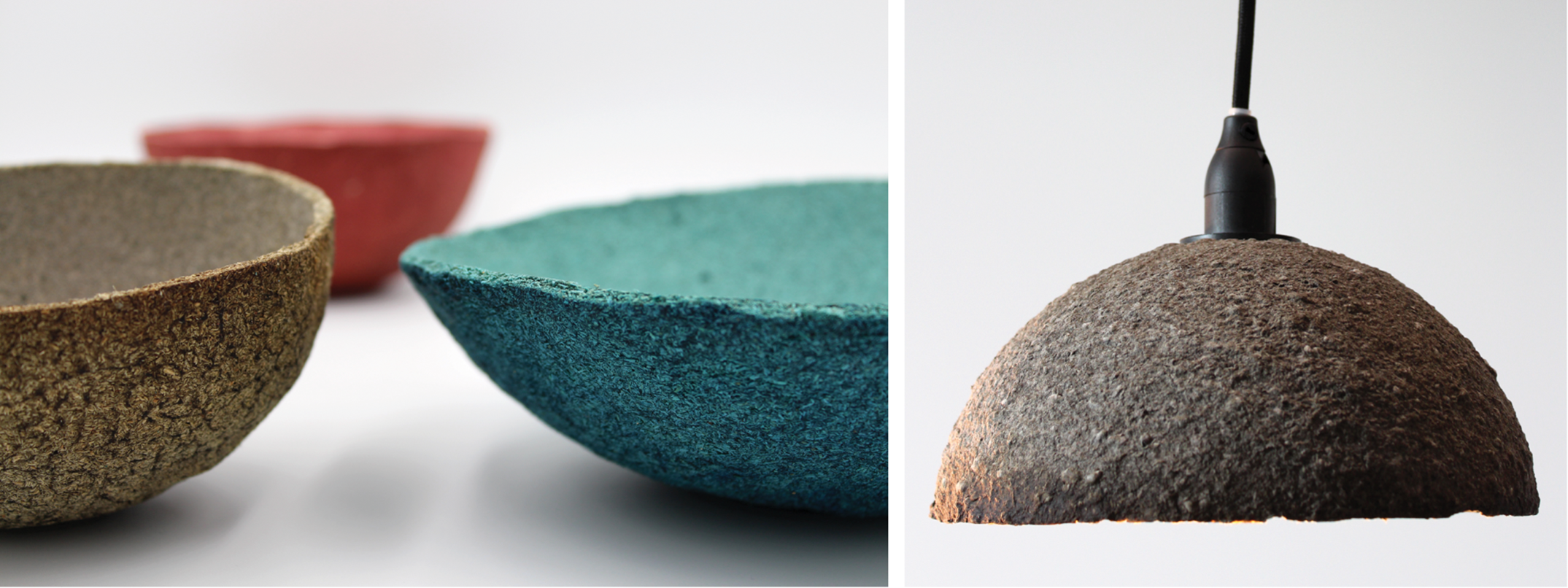
The progression towards these material outcomes involved iterative reformulation cycles rather than linear optimisation processes. Different additives contributed distinct structural and sensorial characteristics. Sawdust, for instance, increased rigidity and generated coarse, earthy tactile qualities associated with structural composites. Recycled textile fibres improved flexibility and resistance to tearing while producing softer, more fibrous surface textures. Similarly, sorbitol- and SDS-based formulations produced smooth, leather-like surfaces that enabled folding, laser cutting and wearable applications, whereas cellulose kraft pulp generated paper-like sheets characterised by semi-translucency and organic tactility.
Fabrication and post-processing techniques further contributed to the formation of material expression. Embossing enhanced tactile interaction by introducing textured surface relief, while dyeing added visual depth and differentiated aesthetic expression. Laser cutting enabled intricate perforations and patterned openings, thereby expanding decorative and wearable possibilities. Waxed surface treatments altered the sensorial character of the materials by producing smoother, more sealed tactile qualities, introducing a subtle sheen and enhancing water resistance, contributing to perceptions of refinement and durability. Stitching techniques introduced visible seams and flexible connections that emphasised handcrafted and textile-like assembly logics, whereas glueing enabled continuous joined surfaces and increased structural cohesion, supporting seamless volumetric assemblies and layered composite formations. These findings demonstrate that material outcomes emerged not only through compositional formulation but also through prototyping, particularly in interactions among processing techniques, assembly methods and sensorial perception.
Importantly, the observed expressive qualities did not arise solely after fabrication but emerged throughout the processes of formulation, manipulation and drying. Material properties changed dynamically between wet and dry states, particularly during moulding and drying phases, indicating that sensorial perception evolved continuously during fabrication. Consequently, interaction with the biomass extended beyond visual evaluation to include tactile assessment, resistance during shaping, perceived softness or rigidity and responsiveness to forming techniques.
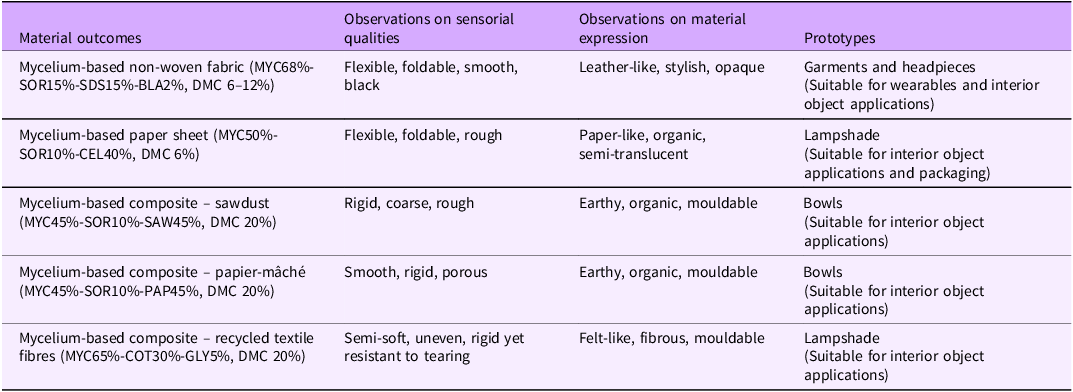
The resulting prototypes, therefore, functioned less as final product validations and more as material probes through which the affordances, limitations and expressive potentials of each material outcome could be investigated. In this sense, material behaviour itself guided the inquiry, shaping both formulation development and the identification of potential application areas. The final formulations and associated prototypes are presented in Table 4.
Final formulations, sensorial qualities, material expression and associated prototypes
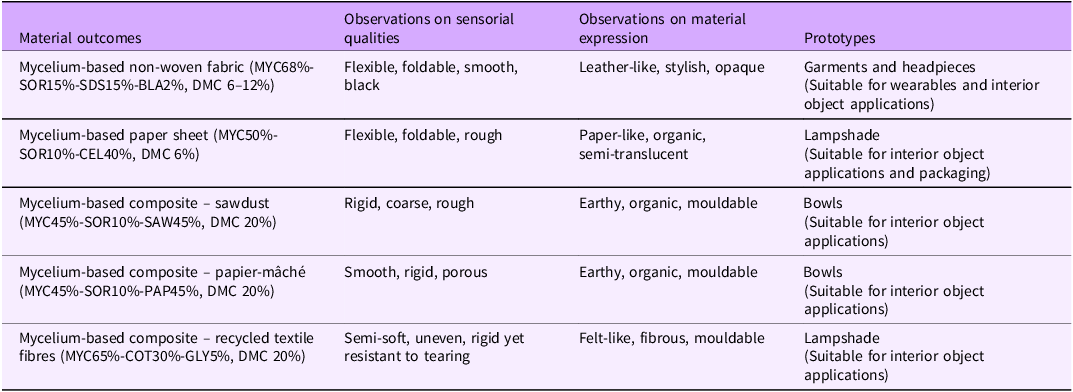
Table 4 Long description
A table with five rows and four columns. The columns are labeled Material outcomes, Observations on sensorial qualities, Observations on material expression, and Prototypes. Row 1: Mycelium-based non-woven fabric (MYC68%-SOR15%-SDS15%-BLA2%, DMC 6-12%), Flexible, foldable, smooth, black, Leather-like, stylish, opaque, Garments and headpieces (Suitable for wearables and interior object applications). Row 2: Mycelium-based paper sheet (MYC50%-SOR10%-CEL40%, DMC 6%), Flexible, foldable, rough, Paper-like, organic, semi-translucent, Lampshade (Suitable for interior object applications and packaging). Row 3: Mycelium-based composite – sawdust (MYC45%-SOR10%-SAW45%, DMC 20%), Rigid, coarse, rough, Earthy, organic, mouldable, Bowls (Suitable for interior object applications). Row 4: Mycelium-based composite – papier-mâché (MYC45%-SOR10%-PAP45%, DMC 20%), Smooth, rigid, porous, Earthy, organic, mouldable, Bowls (Suitable for interior object applications). Row 5: Mycelium-based composite – recycled textile fibres (MYC65%-COT30%-GLY5%, DMC 20%), Semi-soft, uneven, rigid yet resistant to tearing, Felt-like, fibrous, mouldable, Lampshade (Suitable for interior object applications).
Observations on interdisciplinary collaboration
The study generated observations regarding how designers positioned themselves within techno-scientific environments through laboratory participation, iterative formulation work and collaboration with scientists. Five emergent roles were identified: designer-as-pioneer, designer-as-learner, designer-as-explorer, designer-as-facilitator and designer-as-influencer. It was also observed that certain roles were confined to specific stages of the process, whereas others spanned multiple phases and were integrated throughout the workflow. Figure 7 illustrates these roles in relation to the production process, highlighting not only the various design opportunities that emerged through the interdisciplinary collaboration but also how the process was expanded to enable designers to explore sensorial qualities and forms of material expression.
Production method for making mycelium-based materials as well as potential design opportunities and possible roles for designers working with submerged liquid fermentation.
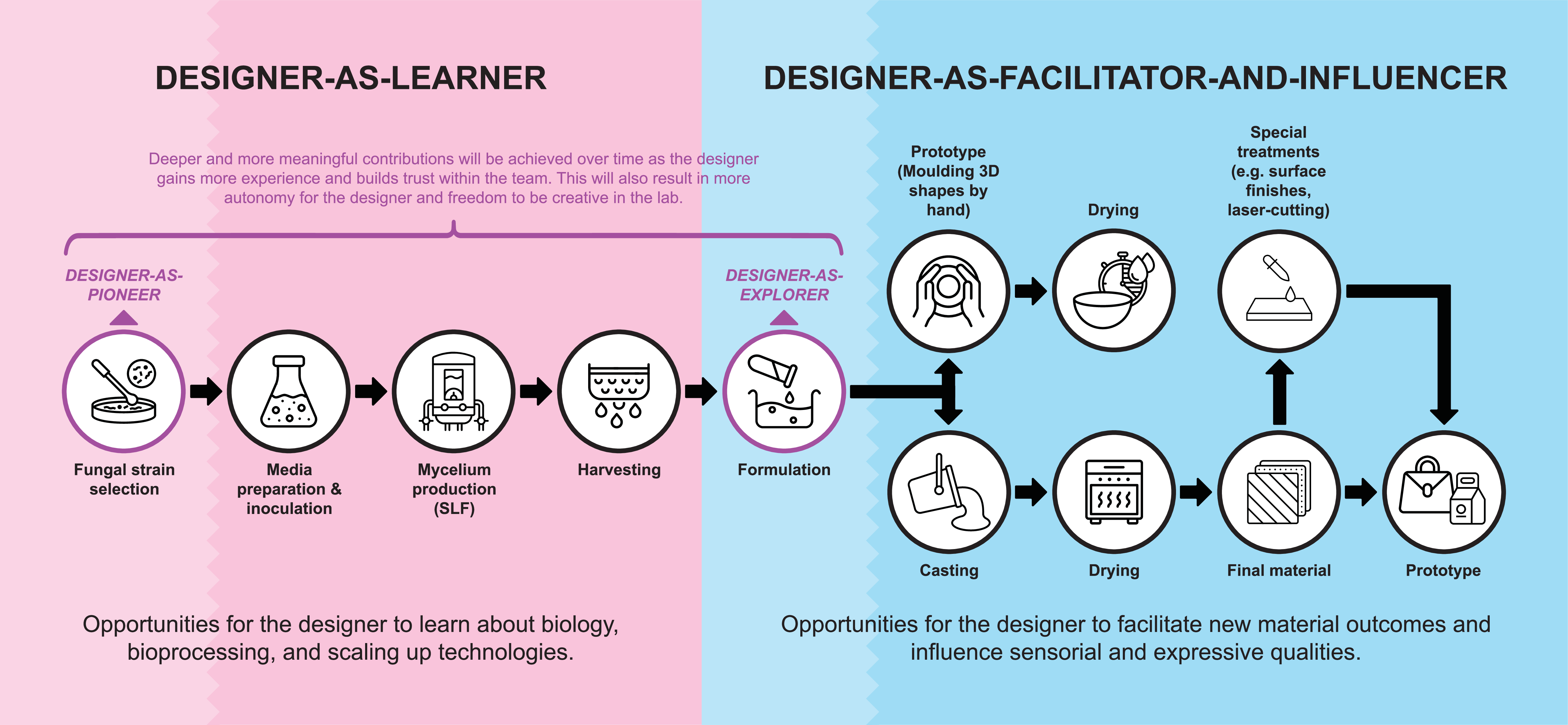
The designer-as-pioneer (Emma van der Leest in Pollini Reference Pollini2024) emerged at the earliest stages of the process through curiosity-driven inquiry, extensive literature review and the proposal of new fungal strains and material possibilities for exploration. In this role, the designer acted as a pathfinder, identifying novel research directions and expanding the scope of experimentation beyond predefined scientific objectives.
The designer-as-learner role emerged through participation in strain selection, media preparation, harvesting and bioreactor observation. Working with SLF required designers to develop bioprocess literacy and an understanding of biological growth conditions, infrastructure constraints and scaling challenges. Through iterative experimentation and collaboration with scientists, designers also developed a shared technical vocabulary and the ability to translate scientific observations into material insights.
The designer-as-explorer role became evident during hands-on formulation experiments involving additives, dyes, density variations and forming methods. Treating formulation as a space for design inquiry enabled the discovery of new material properties and applications. Exploratory material-handling practices, such as moulding and casting biomass into stable three-dimensional forms, revealed possibilities that extended beyond the initial scientific objectives.
The designer-as-facilitator role emerged with the introduction of prototyping practices, surface finishing and material-handling techniques. In this role, designers translated mycelium biomass into tangible artefacts or prototypes and facilitated communication between scientific research and potential applications. Prototypes also functioned as tools for understanding material behaviour and promoting interdisciplinary dialogue across academia and industry.
Finally, the designer-as-influencer role emerged through the prioritisation of material uniformity across samples, the recognition of sensorial and expressive qualities alongside technical performance and the integration of sustainability principles throughout material preparation and evaluation processes. In this sense, designers influenced laboratory practices, evaluation criteria and future application scenarios by advocating for considerations such as recyclability, circularity and user acceptance. These findings suggest that designers in techno-scientific environments do not merely respond to technical constraints but actively shape experimental directions, material interpretation and the societal framing of biofabrication processes.
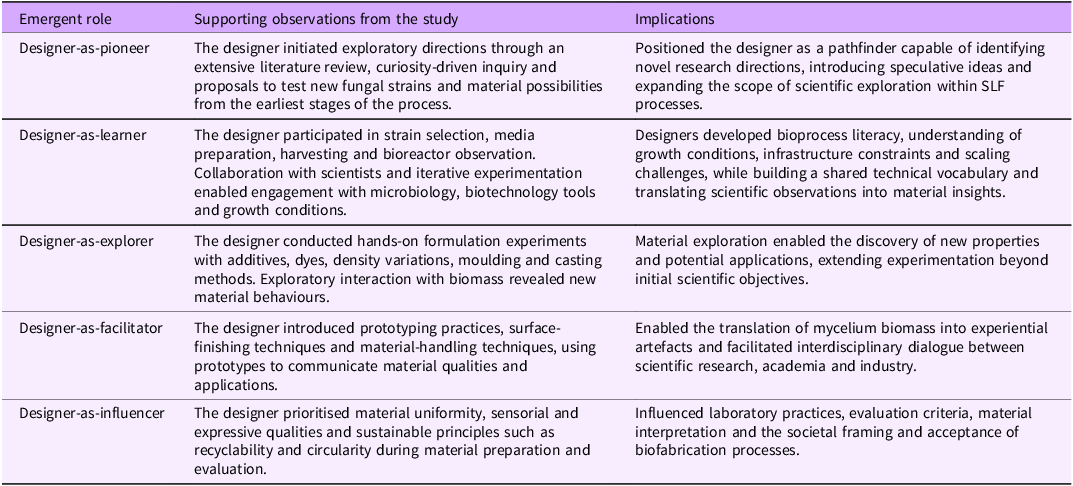
Table 5 summarises the emergent designer roles identified throughout the interdisciplinary collaboration between designers and scientists within the context of SLF. The roles emerged through active participation in laboratory workflows, iterative material experimentation and collaboration with scientists, revealing how designers contributed not only to material development but also to shaping experimental directions, material interpretation and application opportunities across different stages of the production process.
Emergent designer roles and supporting observations with their respective implications
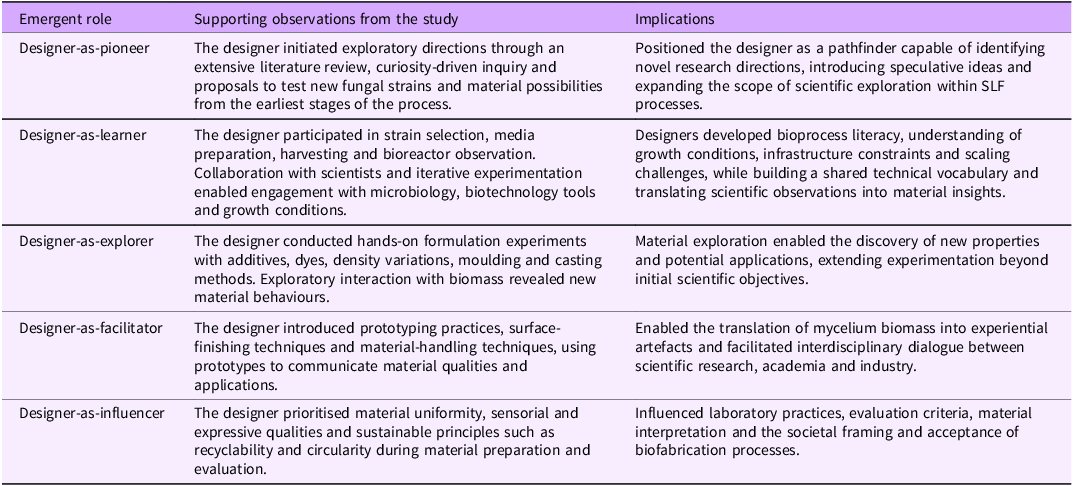
Table 5 Long description
A table with three columns and five rows. The columns are labeled ‘Emergent role’, ‘Supporting observations from the study’, and ‘Implications’. The rows are labeled with different emergent roles: Designer-as-pioneer, Designer-as-learner, Designer-as-explorer, Designer-as-facilitator, and Designer-as-influencer. Each row contains specific observations and implications related to the respective designer role. For example, the Designer-as-pioneer role involves initiating exploratory directions through literature review and proposals, with implications of identifying novel research directions and expanding scientific exploration. The Designer-as-learner role includes participation in strain selection and media preparation, leading to the development of bioprocess literacy and shared technical vocabulary. The Designer-as-explorer role involves hands-on formulation experiments, revealing new material behaviors and properties. The Designer-as-facilitator role introduces prototyping practices, enabling the translation of mycelium biomass into experiential artifacts. The Designer-as-influencer role prioritizes material uniformity and sustainable principles, influencing laboratory practices and evaluation criteria.
Discussion
The findings demonstrate that design-led inquiry can make substantial contributions to biofabrication research within techno-scientific environments by expanding understandings of bio-based materials, processes and applications. Designers actively contributed to the creation of new forms for conducting material research, interpreting processes and producing interdisciplinary knowledge. This positions designers beyond the roles of prototype makers or workshop facilitators, which have largely dominated existing literature on design participation in biofabrication research (Barati and Karana Reference Barati and Karana2019).
A key contribution of this study is the identification of design practice as a situated mode of inquiry capable of revealing material qualities and possibilities that may remain overlooked within purely scientific frameworks. Through iterative experimentation, material tinkering and prototyping, designers introduced alternative ways of evaluating SLF-derived biomass based on sensory experience, material expression and contextual usability.
Within material design research and education, the importance of sensorial and experiential qualities has grown significantly over the past two decades (Parisi et al. Reference Parisi, Rognoli and Sonneveld2017). Scholars such as Ashby and Johnson (Reference Ashby and Johnson2003), Manzini (Reference Manzini1986), Rognoli (Reference Rognoli2010) and Karana et al. (Reference Karana, Pedgley and Rognoli2015b) have highlighted a shift from understanding materials purely in terms of technical performance toward recognising their expressive, experiential and affective dimensions. Consequently, how materials look, feel, age and communicate meaning has become increasingly relevant alongside functionality and performance.
This perspective has encouraged designers to engage in hands-on material exploration in laboratory settings, often through iterative experimentation and material tinkering. In the context of SLF-derived mycelium biomass, tinkering involved manipulating fermentation outputs through blending, altering, shaping, drying or coating to explore emerging material behaviours and applications. However, while material tinkering has become central to many biodesign practices, the practical work in a techno-scientific environment conducted in this research raises the need for the integration of rigorous scientific protocols and standardised methodologies to enable systematic analysis, reproducibility and validation. Existing approaches often rely on intuition, tacit knowledge and trial-and-error experimentation, particularly within DIY and studio-based practices. As biofabrication processes become increasingly technical and biologically complex, the findings of this research underscore the need for more rigorous and systematically structured approaches to material exploration. Such approaches should incorporate scientific literacy, laboratory protocols and interdisciplinary modes of collaboration as integral components of design practice.
This study also contributes to broader discussions within biodesign concerning the evolving role of designers in techno-scientific environments. Existing literature has frequently positioned designers as facilitators of speculative futures, sustainability narratives or public engagement around biotechnology. However, the present findings suggest that designers can also operate as embedded collaborators within laboratory infrastructures, directly contributing to process development and experimental framing. Although collaborations among design, the arts, crafts and materials science have increased over the past decade (Driver et al. Reference Driver, Peralta and Moultrie2011; Karana et al. Reference Karana, Pedgley and Rognoli2015b; Pollini, Reference Pollini2024), research on material-driven design inquiry in techno-scientific contexts remains limited. Through the first author’s practical collaboration with scientists in a scientific laboratory, this study contributes to the biodesign discourse by positioning design know-how within SLF-based mycelium development – a domain that remains underexplored in the current literature. In doing so, the study also extends discussions by authors such as Neri Oxman (Reference Oxman2016), Carole Collet (Reference Collet2021) and Miriam Ribul (Reference Ribul, Goldsworthy and Collet2021) regarding the potential roles of designers within techno-scientific environments.
Importantly, the findings demonstrate that design inquiry can influence not only the outputs of biofabrication but also the direction of scientific investigation itself. By foregrounding experiential qualities and application contexts, designers shifted attention toward tactility, aesthetics, adaptability and user interaction. This suggests that design participation can diversify pathways to novel materials and support more holistic, interdisciplinary research.
At the same time, the study reveals important limitations in integrating design methodologies into highly technical systems such as SLF. The specialised infrastructure, sterile conditions and scientific expertise required for SLF limited opportunities for direct, intuitive engagement with materials. Unlike more accessible, studio-based biodesign practices, SLF constrained rapid iteration and hands-on experimentation, slowing the design process and increasing reliance on scientific workflows and bioreactor costs. In addition, differing disciplinary priorities created challenges within collaboration. Scientific research emphasised reproducibility, optimisation and control, whereas design inquiry often embraced emergence, ambiguity and variability as productive conditions. These tensions highlight the need for interdisciplinary frameworks that better support communication, shared experimentation and mutual understanding between designers and scientists.
The differing interpretations of material inconsistency observed in this study are particularly significant. From a scientific perspective, inconsistency in biomass behaviour was often understood as a technical limitation that reduced reliability and reproducibility. In contrast, designers frequently viewed these inconsistencies as sources of aesthetic richness and material potential. Within this framework, the variability of SLF-derived mycelium biomass can be understood not as a material failure but as an opportunity to challenge conventional expectations of standardisation, manufacturing consistency and material value.
The findings position SLF as more than a technical production method. The laboratory emerged as a space of negotiation between disciplines, epistemologies and material imaginaries. Design-led inquiry contributed by connecting biological experimentation with sensorial, experiential and contextual dimensions that are often absent from purely technical biofabrication research.
Overall, this study suggests that integrating design more deeply into biofabrication practices within techno-scientific environments can support the development of new materialities that are not only technically functional but also socially meaningful, experientially engaging and contextually relevant.
Conclusion
This study investigated how design know-how can contribute to the development and application of mycelium-based materials produced through SLF. By examining the direct involvement of designers in an interdisciplinary laboratory environment, the study identified both the opportunities and limitations that arise when design practice engages with technically complex biofabrication processes and SLF-derived mycelium biomass.
The findings demonstrate that design-led inquiry contributes valuable sensory, experiential and application-oriented forms of knowledge that complement scientific approaches to biomaterial development. Through embodied experimentation, prototyping and material tinkering, designers helped reveal material qualities and application possibilities that extended beyond conventional technical performance criteria. In this context, design practice functioned not only as a tool for application development but also as a situated mode of material investigation and interdisciplinary knowledge production.
The study further showed that designers can play an active role within techno-scientific environments by contributing to process interpretation, experimental framing, material translation and communication across disciplines. Importantly, the findings suggest that design inquiry can influence the direction of scientific investigation itself by foregrounding questions related to tactility, aesthetics, usability and contextual relevance alongside optimisation and scalability.
At the same time, the research exposed important limitations in integrating design methodologies into highly specialised laboratory systems such as SLF. Restricted access to biological processes, dependence on scientific infrastructure and the complexity of fermentation workflows constrained opportunities for intuitive and iterative material exploration. In addition, the study highlighted tensions between scientific priorities of standardisation and reproducibility and design approaches that often embrace emergence, ambiguity and material variability. These challenges point to the need for new interdisciplinary frameworks and methods that support more integrated collaboration between design and science.
The article also argues that while material tinkering has become central to contemporary biodesign practice, it still lacks sufficiently developed methodological frameworks for engaging with increasingly complex biological systems. As biofabrication processes continue to evolve within laboratory settings, there is a growing need for design methods that combine creative exploration with deeper scientific understanding, laboratory literacy and process awareness.
Overall, this study contributes to the biodesign discourse by addressing an underexplored area of mycelium biofabrication research and by positioning SLF not only as a technical cultivation method but also as a collaborative space for situated experimentation, interdisciplinary negotiation and material inquiry. The laboratory emerged not simply as a space of scientific production but as a space where new material imaginaries, roles and forms of knowledge can be collectively developed.
Future research could further investigate how interdisciplinary collaborations between designers and scientists may be structured to support more integrated engagement with living systems throughout biofabrication processes. In particular, there is a need for methodological frameworks that integrate design experimentation with greater scientific literacy, laboratory protocols and process awareness to navigate the complexity and variability of biological systems. Further studies could also explore the application of self-healing and regenerative behaviours in mycelium-based materials, examining how such living properties may inform adaptive material systems and alternative approaches to sustainable production.
Data availability statement
The authors confirm that the data supporting the findings of this study are available within the article.
Author contributions
M.A.: Conceptualisation; methodology; investigation; validation; writing – original draft; writing – review & editing; data visualisation; funding acquisition. L.P.: Investigation; validation; writing – review & editing. H.M.: Investigation; validation; writing – review & editing. B.P.: Conceptualisation; methodology; writing – review & editing. M.P.: Conceptualisation; funding acquisition. G.S.: Supervision; conceptualisation; methodology; writing – review & editing; funding acquisition.
Financial support
This research was supported by a grant from the Finnish Cultural Foundation (grant number 00230229) granted to Manuel Arias-Barrantes. Additional financial support was also received from Jenny and Antti Wihuri Foundation through the Centre for Young Synbio Scientists (CYSS) and VTT Technical Research Centre of Finland. This work was carried out under the Academy of Finland Center of Excellence Program (2022-2029) in Life-Inspired Hybrid Materials (LIBER), project number (346106).
Competing interests
The authors have no conflicts of interest to declare for this publication.
Ethical standards
Ethical approval and consent are not relevant to this article type.




 Open access

