





Introduction
Within contemporary design, growing attention is given to environmentally conscious futures. Among emerging paradigms, biodesign explores living organisms as collaborators in material production, while “growing design” focuses on cultivating materials through processes of crafting with organisms such as bacteria, algae, fungi and plants (Camere and Karana, Reference Camere and Karana2017; Dade-Robertson, Reference Dade-Robertson2020; Karana et al., Reference Karana, Barati and Giaccardi2020; Pollini and Rognoli, Reference Pollini and Rognoli2024). These practices show potential for multispecies interaction and regenerative material ecologies within HCI and design research (Groutars et al., Reference Groutars, Kim and Karana2024; Karana et al., Reference Karana, McQuillan, Rognoli and Giaccardi2023; Nicenboim et al., Reference Nicenboim, Karana, McQuillan, Devendorf, Kakehi, Bell, Speed, Oogjes, Yao, Søndergaard, Helms and Withers2025). Despite this, much design still follows a trajectory toward a final artifact, prioritizing outcome over process and obscuring the growing process as a design site.
To address this, we draw on more-than-human design, which foregrounds co-constituted agencies and understands knowledge as emerging through ongoing interaction with materials, organisms and environments over time (Oogjes and Wakkary, Reference Oogjes and Wakkary2022; Wakkary, Reference Wakkary2021). This is particularly relevant for biodesign, where processes such as growth, decay and adaptation are entangled with living systems.
Our research explores designing-with grass roots by focusing on moments of negotiation during growth. We treat the interplay between human intention and root behavior as coordination across multiple temporalities of growth, maintenance and intervention. Through intermediate artifacts, root behavior becomes legible. Iterative, practice-led experiments with vessels, substrates, tools and environmental conditions, documented through first-person narratives, make visible how agency is mediated and redistributed during growth.
The outcome is Rootcraft as a practice: a way of designing-with grass roots in which agency and knowing are distributed across human and nonhuman actors. Rootcraft does not aim to control growth, but to attune to its emergence through negotiation, observation and embodied engagement. It shifts attention from growth-as-execution toward growth-as-tuning, where form is co-authored in practice. From this practice, we derive a set of transferable design dimensions that articulate how such redistribution can be tuned, enabling others to adopt this approach without replicating the specific experiments.
In the following, we ground Rootcraft within biodesign, more-than-human design and practice-based ways of knowing. We then present four phases of growing and making-with grass roots, followed by a vocabulary of transferable design variables (set-up assertiveness, growth legibility, interaction repertoire, temporal alignment and root–substrate coupling) through which designers can tune more-than-human making practices.
Grounding rootcraft
Biodesign and growth paradigms
Within biodesign and growing design, living organisms such as bacteria, fungi, algae and plants are approached as collaborators whose capacities are harnessed for material production and esthetics (Camere and Karana, Reference Camere and Karana2017; Karana et al., n.d.; Karana et al., Reference Karana, Blauwhoff, Hultink and Camere2018; Pollini and Rognoli, Reference Pollini and Rognoli2024). Growing design replaces manufacturing with cultivation, shaping biological systems through craft-like processes (Dade-Robertson, Reference Dade-Robertson2020) and contributing to broader discussions on living together through a culture of life (Armstrong, Reference Armstrong2022). Grass roots remain relatively underexplored despite their adaptive, structural and sensing capacities. As living systems, roots sense, respond, bind and form complex three-dimensional structures as they grow (Tan et al., Reference Tan, Silverberg, Floss, Harrison, Henley and Cohen2015; Trewavas, Reference Trewavas2002; Zhou et al., Reference Zhou, Barati, Wu, Scherer and Karana2021).
Existing projects demonstrate both the potential and limits of root-based design. Works such as Carole Collet’s Biolace (Reference Collet2013), Diana Scherer’s root textiles (Scherer, Reference Scherern.d.), Zena Holloway’s ROOTFULL objects (Holloway, Reference Hollowayn.d.) and Jiwei Zhou’s computational molds guide growth through predefined conditions (Zhou et al., Reference Zhou, Barati, Wu, Scherer and Karana2021). While these approaches reveal the expressive and structural qualities of roots, they also highlight the tension between control and unpredictability, suggesting that agency is distributed across human, roots and material systems.
More-than-human design as site of negotiated agencies and temporality
More-than-human design reframes design as a practice in which humans are not the sole agents of change. Ron Wakkary’s notion of designing-with emphasizes distributed agency and ongoing negotiation rather than predefined outcomes (Wakkary, Reference Wakkary2021). This shift is further elaborated by Laureen Mahler and Bahareh Barati, who frame design as a space for co-existence in which making unfolds relationally and temporally (Mahler and Barati, Reference Mahler and Barati2025).
Who enacts agency, and how it is negotiated in human–nonhuman interactions, is continuously explored in MTH design research (Nicenboim et al., Reference Nicenboim, Karana, McQuillan, Devendorf, Kakehi, Bell, Speed, Oogjes, Yao, Søndergaard, Helms and Withers2025; Oktay et al., Reference Oktay, Lee, Barati and Wakkary2024; Wakkary, Reference Wakkary2021). Jihan Sherman and Michael Nitsche’s Material Correspondence Framework (MCF) (Sherman and Nitsche, Reference Sherman and Nitsche2024) provides a key lens by defining interaction as co-enacted becoming, where human and material agencies intertwine in the encounter itself. In this view, correspondence is not given but achieved through ongoing negotiation, requiring shifts, concessions and sometimes the decentering of human control.
Agency in these encounters is inherently temporal (Greenhouse, Reference Greenhouse1996). Elaine Gan’s notion of one-point temporality describes how complex, entangled temporalities are often reduced to a singular human-oriented outcome (Ballestero et al., 2021). In design, this manifests in processes that prioritize final artifacts, effectively compressing nonhuman temporalities into execution. This temporal framing directly shapes both agency and esthetics (Bell et al., Reference Bell, Ramsahoye, Coffie, Tung and Alistar2023; Ikeya et al., Reference Ikeya, Barati and Wensveen2025). Instead, to correspond with more-than-human temporalities (Kim, Reference Kim2017), we explore crafting-with roots during growth (e.g., temporality of roots) as an unfolding site of negotiation, where form emerges through repeated encounters among roots, designer, tools and environmental conditions.
Making-as-knowing and practice-led research
Practice-led research captures emergent, evolving processes where making functions as both method and site of inquiry (Mäkelä and Rourarinne, Reference Mäkelä and Rourarinne2006). Within this paradigm, knowledge is not predefined but arises through iterative engagement with materials and conditions (Mäkelä, Reference Mäkelä2007). In more-than-human design, this extends toward sustained, situated interaction with living systems, where outcomes remain open and contingent.
Work such as Oscar Tomico’s Living-with and Designing-with Plants (Tomico et al., Reference Tomico, Wakkary and Andersen2023) frames practice as relational and temporal, emphasizing co-existence rather than control. Similarly, Knitting with Unknown Trees (Oogjes et al., n.d.) foregrounds making as a slow, responsive collaboration, where care, bodily engagement and negotiation shape the process. These approaches align with Nimkulrat’s understanding of craft as “thinking through the hand” (Nimkulrat, Reference Nimkulrat2012), where material engagement produces knowledge through action.
Rather than serving predefined outcomes, craft becomes an ongoing dialog in which materials and practitioners co-evolve. Extending this perspective, Ragnar Vennatrø and Harald Bentz Høgseth argue that craft itself should be understood as more-than-human, emerging through shared material engagement rather than solely human intention (Vennatrø and Bentz Høgseth, Reference Vennatrø and Bentz Høgseth2021). This positions practice not as a human-driven activity, but as a distributed process through which both practitioners and phenomena are brought into being over time.
Methods
This pictorial investigates how growing design with grass roots can be informed by designing-with, a posthuman practice that decenters human control and follows the emergence of root and material agency.
Starting from known techniques using static molds, we conducted four iterative phases that gradually unfolded into an emerging crafting practice. Across these phases, we generated and adjusted growing vessels, substrates, tools and environmental parameters in response to root behavior. In this way, we primarily employ practice-led research (Gaver et al., Reference Gaver, Krogh, Boucher and Chatting2022; Nimkulrat, Reference Nimkulrat2012; Vennatrø and Bentz Høgseth, Reference Vennatrø and Bentz Høgseth2021), producing situated knowledge through making.
In pursuit of the question, “How can intermediate artifacts enable distributed agencies between humans and grass roots in an act of designing-with?”, each iteration phase concludes with first-person reflections (Ellis et al., Reference Ellis, Adams and Bochner2011) that hypothesize and inform the next phase. The first author (FA) lived-with(Keune, Reference Keune2021) the set-ups and grass roots in a home environment for three months (Appendix A). This proximity enabled sustained, situated engagement both practically and emotionally, entangling human and plant within the same living space. It gave roots’ agency, maintenance and growth a central role in daily life, allowing for ongoing correspondence and negotiation.
The resulting data from the practice-led research period comprises visual material (photography (Liu et al., Reference Liu, Bardzell and Bardzell2018), video footage), first-person reflections and image annotations. Data were analyzed both simultaneously during making and living-with, and retrospectively after the three-month period, through thematic analysis conducted together with the second (SA) and third author (TA), resulting in tuning dimensions applicable for posthuman practice in growing design.
The following iteration phases narrated through FA’s voice materialize the research question by showing how intermediate artifacts enable distributed agency in practice and how these conditions are tuned over time. This analysis is structured through the annotated portfolio method (Tomico et al., Reference Tomico, Wakkary and Andersen2023), which makes visible how plural agencies (i.e., human, roots, tools, environmental conditions) are mediated and redistributed across the process.
The figure below shows documentation through photography, first-person reflections, image annotations
Biology primer
The roots used in this study are the roots of wheatgrass (Triticum aestivum Linn). To grow wheatgrass, the seeds need to be soaked for 8–10 hours and are then kept in a container for 2–3 days as they spout (Zelf Tarwegras kweken, n.d.). During these days the seeds will need to be rinsed daily while developing their first roots.
From the moment a seed begins to sprout, its roots search, sense and navigate their surroundings (Charles, Reference Charles1881). They quickly orient themselves: roots grow downward with gravity, while shoots grow upward toward light (Edelmann, Reference Edelmann2018). This directional sense is guided by the root cap, a small tissue at the tip that perceives gravity and steers growth through hormonal adjustments(Iijima et al., Reference Iijima, Morita and Barlow2008). As roots develop, they do not simply grow, they move with intention (Trewavas, Reference Trewavas2002). They twist, coil and change direction when encountering barriers, adapting their path to the textures, angles and spaces they meet (Tan et al., Reference Tan, Silverberg, Floss, Harrison, Henley and Cohen2015; Zhou et al., Reference Zhou, Barati, Wu, Scherer and Karana2021).
Environmental conditions strongly influence how roots behave.
-
• Slight drought encourages roots to stretch and elongate (Brunner et al., Reference Brunner, Herzog, Dawes, Arend and Sperisen2015; Smith and De Smet, Reference Smith and De Smet2012).
-
• Too much water slows them down (Zhou et al., Reference Zhou, Barati, Wu, Scherer and Karana2021).
-
• The type of growing substrate (e.g., soil, coco coir, agar) affects texture, moisture and how roots attach or bind (Keune, n.d.; Smith and De Smet, n.d.; Zhou et al., Reference Zhou, Barati, Wu, Scherer and Karana2021).
Under correct environmental conditions, wheatgrass grows rapidly: in about two weeks, its roots can reach up to 20 cm (Reference Hollowayn.d.). In the phases below, we treat these conditions not as background variables but as design parameters that shape what kinds of encounters are possible. They make negotiation with vessels, scaffolds and tools visible at the scale of everyday intervention.
Documentation through photography, reflections and annotations.

Phase 1
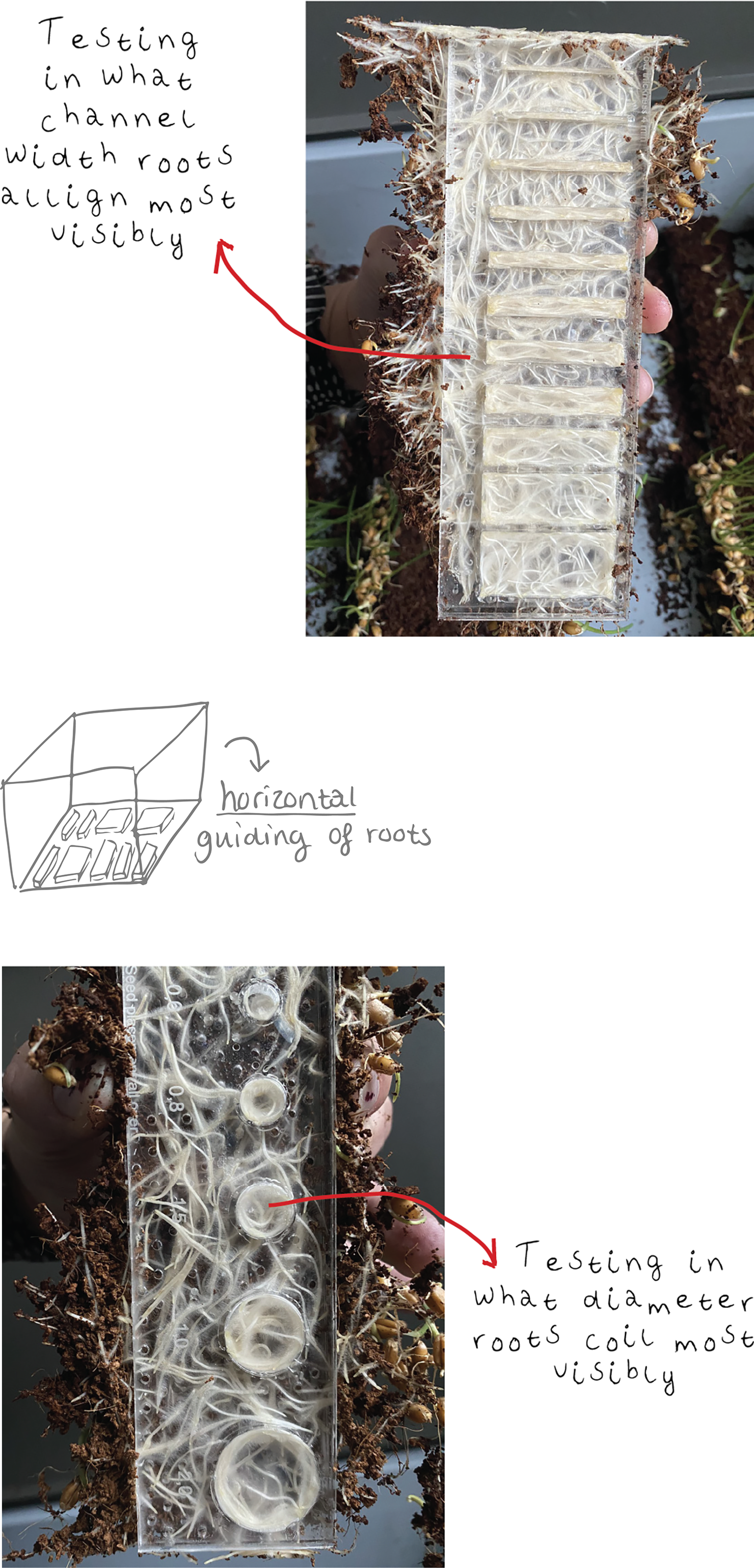
Intention: The first experiment started with a vision to investigate roots’ inherent behavior on the horizontal plane, growing an assemblage of organic shaped patterns controlled by my intention. The goal was to understand how roots collectively bundle, cluster and coil within molds, and how these behaviors could be used for anticipated emergence of material expressions.
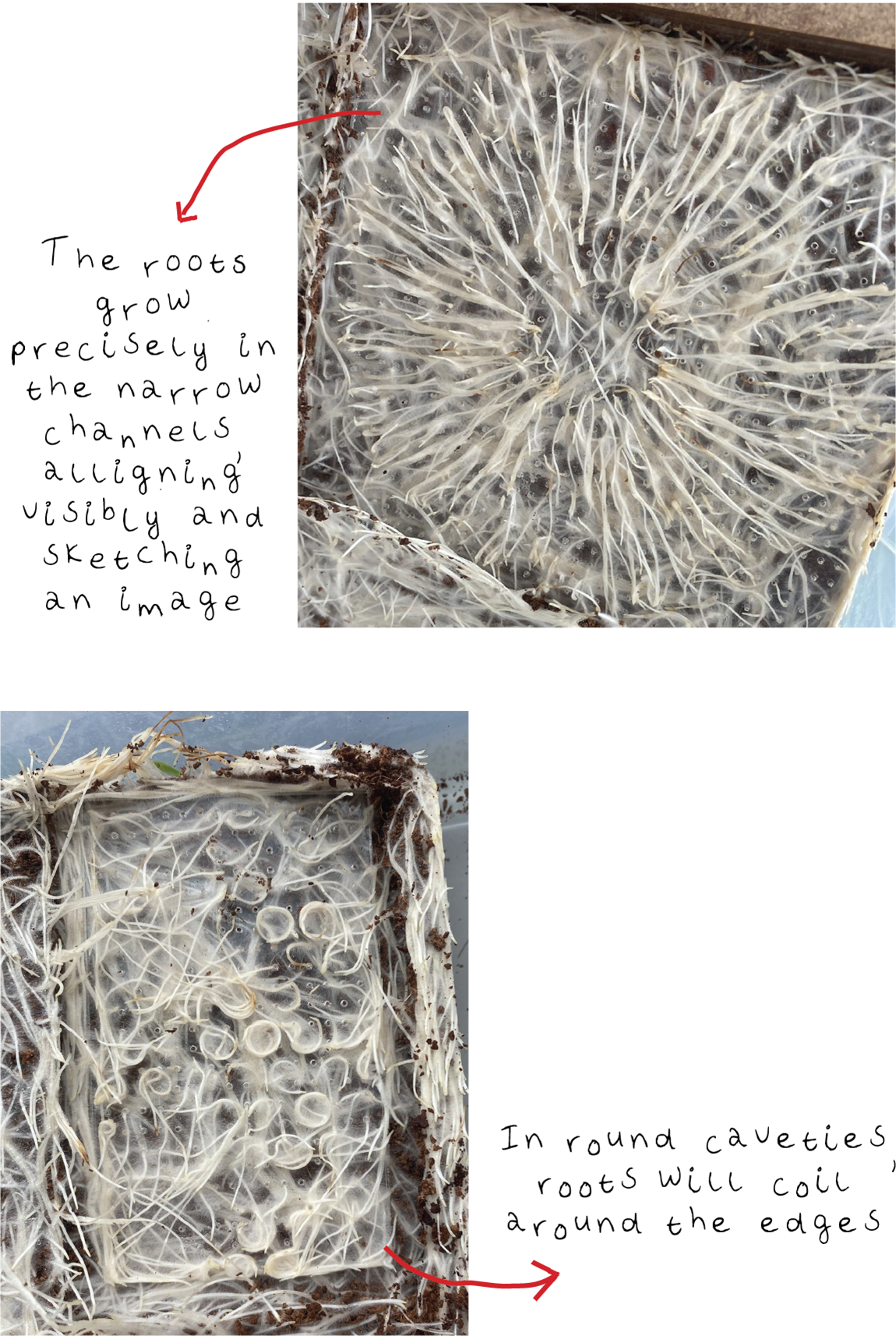
Set-up: Plexiglass growing vessels were filled with agar and separated from the growing medium, coco coir, using a plexiglass grid. Roots grew through both layers. Once every 3–4 days interaction in the shape of watering took place. The mold dimensions that produced the most prominent lines and visible coils were then implemented in more figurative growing vessels.
(a and b) Root behavior testing in plexiglass mould.

(a and b) Application of found behavioral parameters.

Key reflection 1: limited negotiation between me and roots
When grown on a horizontal, covered surface, the roots were largely hidden from view, making noticing and attuning to root growth difficult. Furthermore, due to long idle phases (waiting phases in between human-root interaction), interventions were limited, consisting merely of maintenance through watering.
Key reflection 2: limited negotiation between the growing vessel and the roots
The horizontally oriented vessels allowed the roots to grow predictably by following gravity. However, this set-up left little room for negotiation between the roots and the vessel, revealing that a horizontal surface did not support the kind of dialog envisioned.
Phase 2
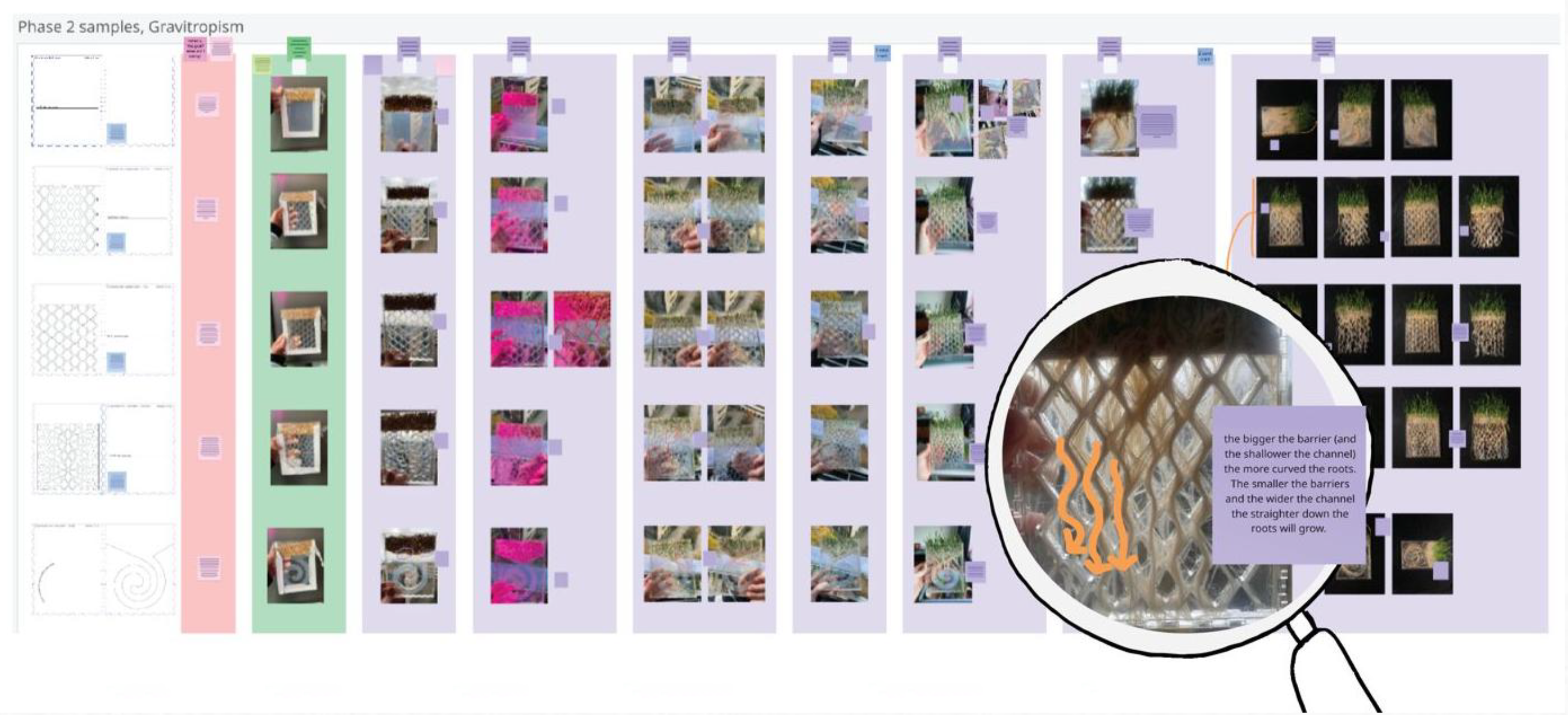
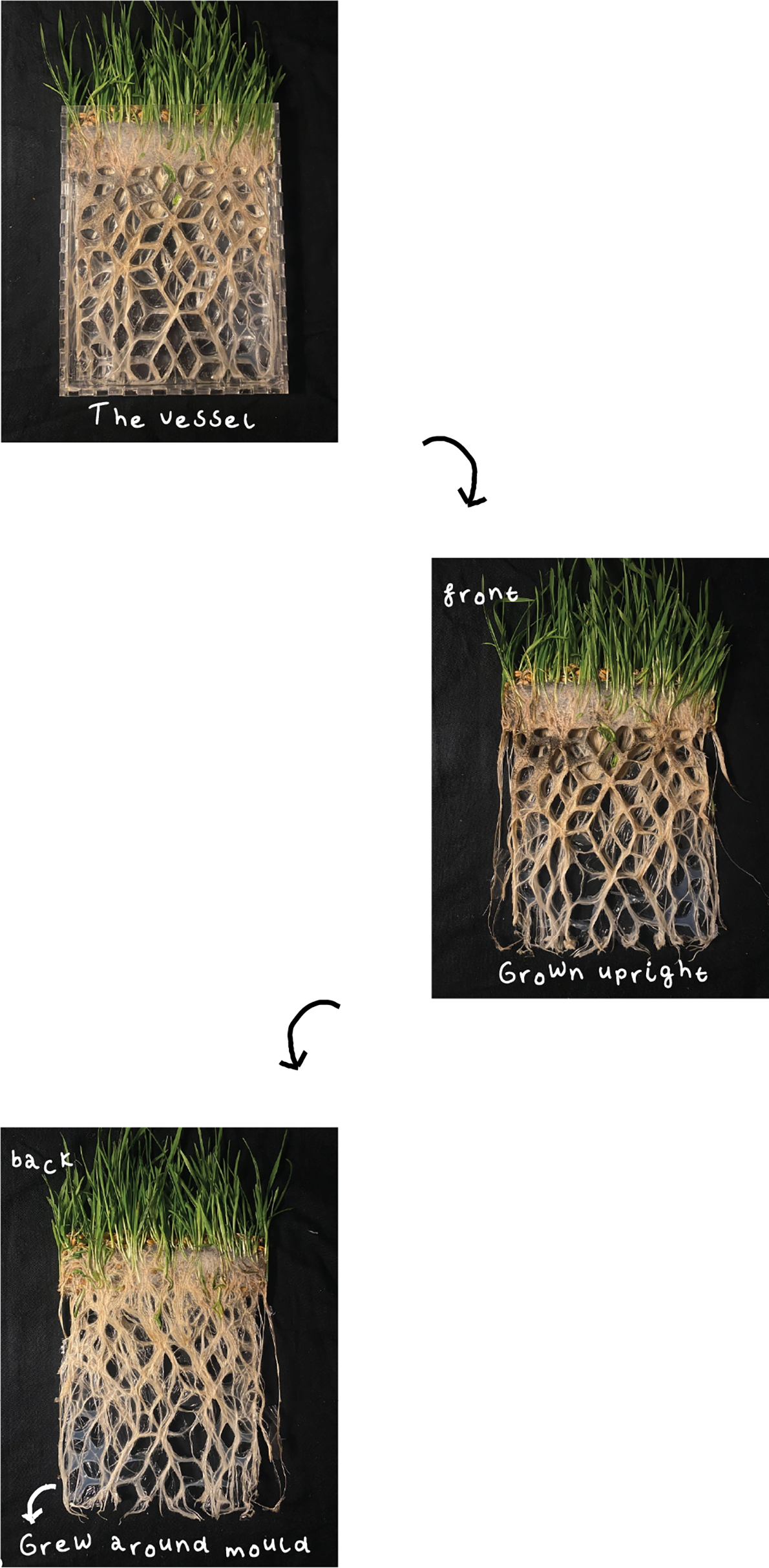
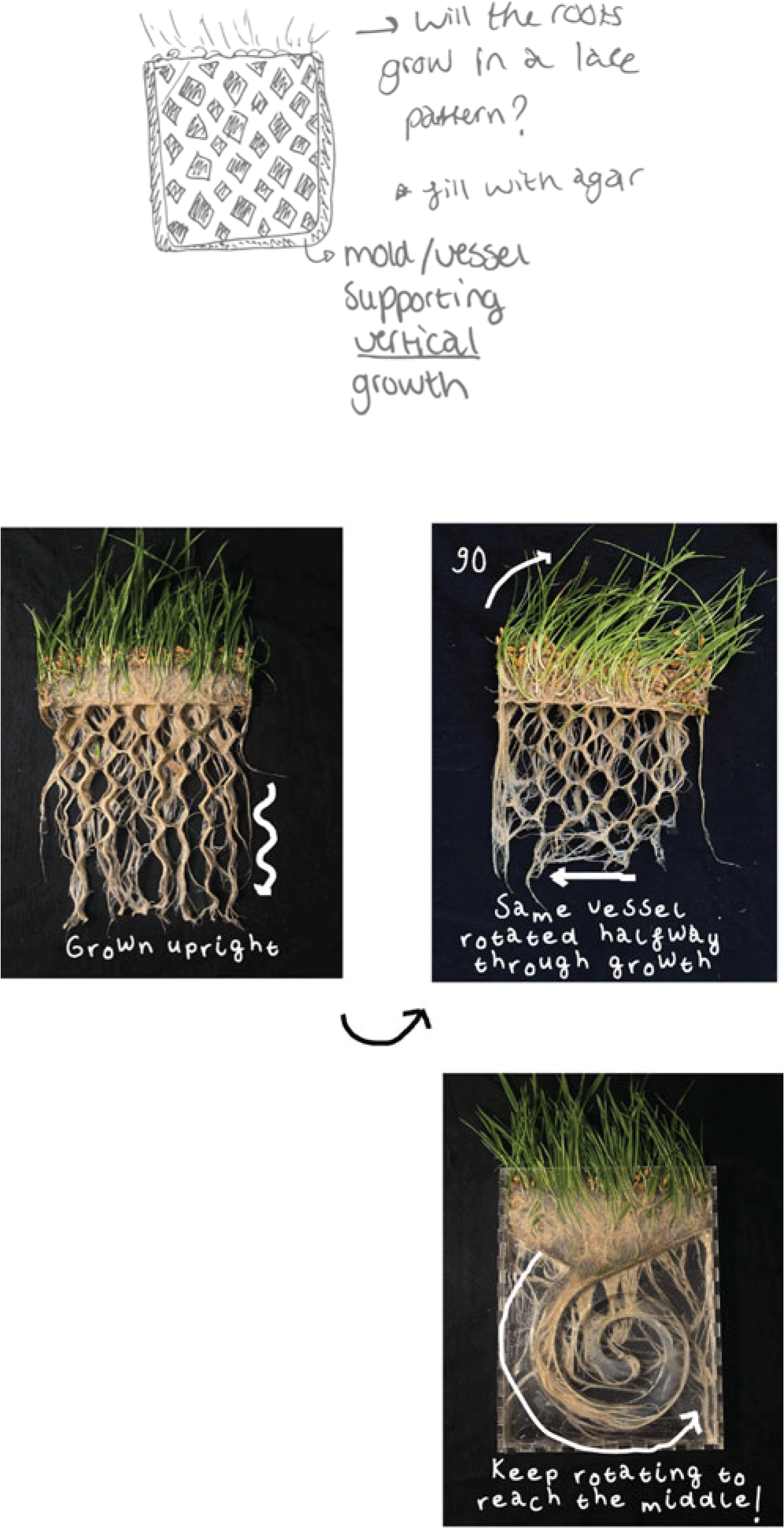
Intention: To make root-vessel negotiation visible as well as affording human-root negotiation, the vessels were turned upright. Gravity, together with the plexiglass barriers, guided the roots downward, making their choices clearly traceable. By rotating the vessels during growth, I was able to interact with the growing direction of the roots as they responded to a new direction of gravitational pull and the plexiglass structure.
Set-up: The growing vessels consisted of thin plexiglass boxes with a removable side and an internal barrier structure. Agar was used as the growing substrate to keep the roots visible and nourished throughout the process.
(a, b and c) Different sides of the same sample.

(a, b and c) Different samples showing the effect of changing gravitropism during growth.

Key reflection 3: unexpected agency
In line with my intentions, the roots did not treat the plexiglass mold as a strict blueprint but as a scaffold, leaving some spaces unfilled. However, quite unexpectedly, they also grew behind or around barriers that weren’t glued to the side panel. This behavior revealed the roots’ capacity to negotiate their environment and choose alternative paths outside my intentions.
Key reflection 4: limited mediation through gravity shifting
Although this mold allowed the roots to deviate freely, my interaction remained limited. I could only mediate growth through the predefined mold geometry, care or by shifting the direction of gravity which happened in between idle phases of 3–4 days.
Phase 3
Intention: Having observed how scaffolding allows for roots increased agentic capacity and negotiation with the vessel, this phase dedicated itself to exploring negotiation with soft and adjustable scaffolding. The set-up aimed to afford hands-on mediation as well as increased emergence.
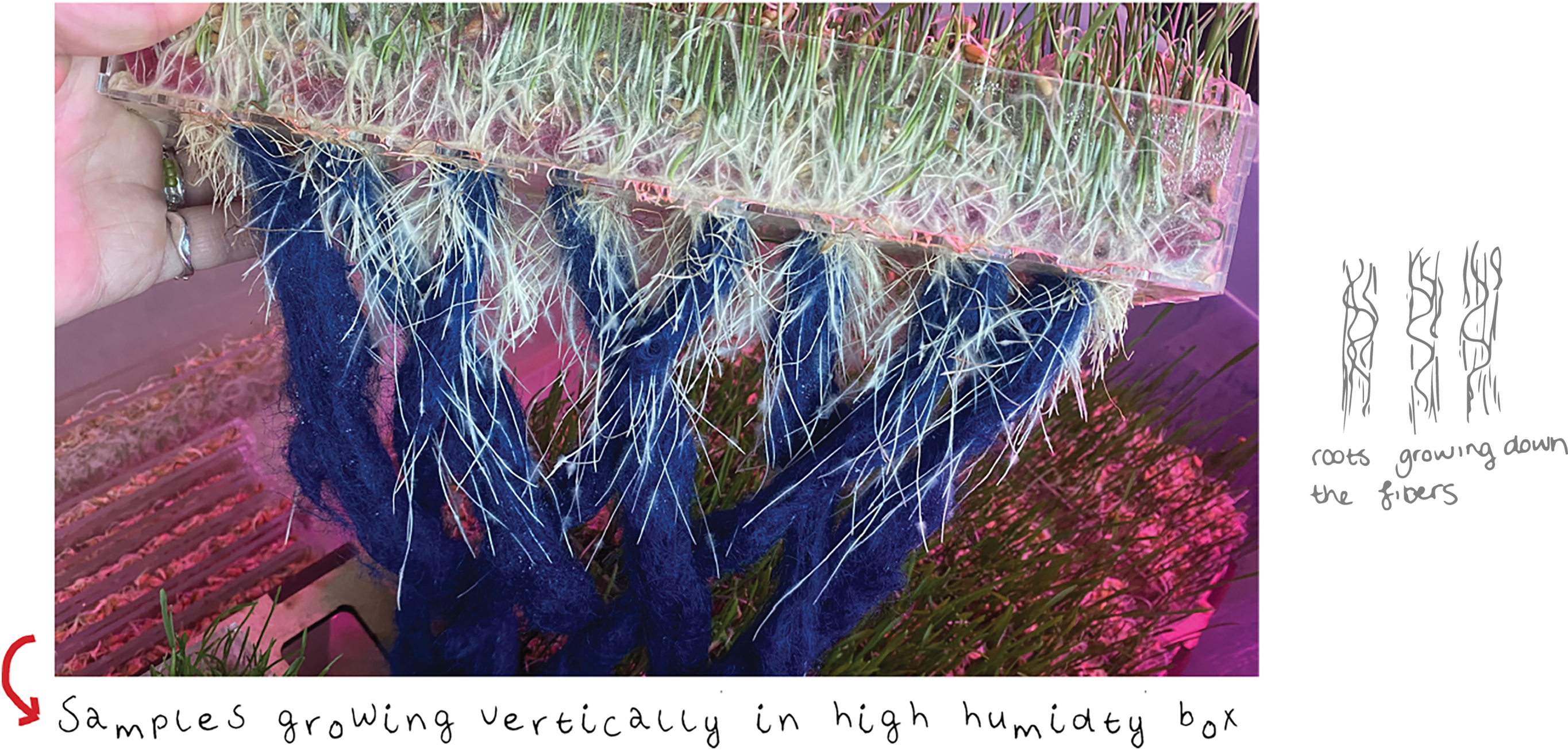
Set-up: Based on a preliminary exploration (key reflection 5), the roots proved to be able to grow in an open, high humidity environment without being enclosed in a growing medium like coco coir or agar. Growing substrate (i.e., wool and viscose) was introduced as scaffolding, each in 3 different states (i.e., unwoven, pre-woven or actively woven during growth). Plexiglass boxes containing the seeds and holding the substrates were placed in a rack, which then was placed inside an enclosed box to maintain high humidity.
Sample box with root growth.

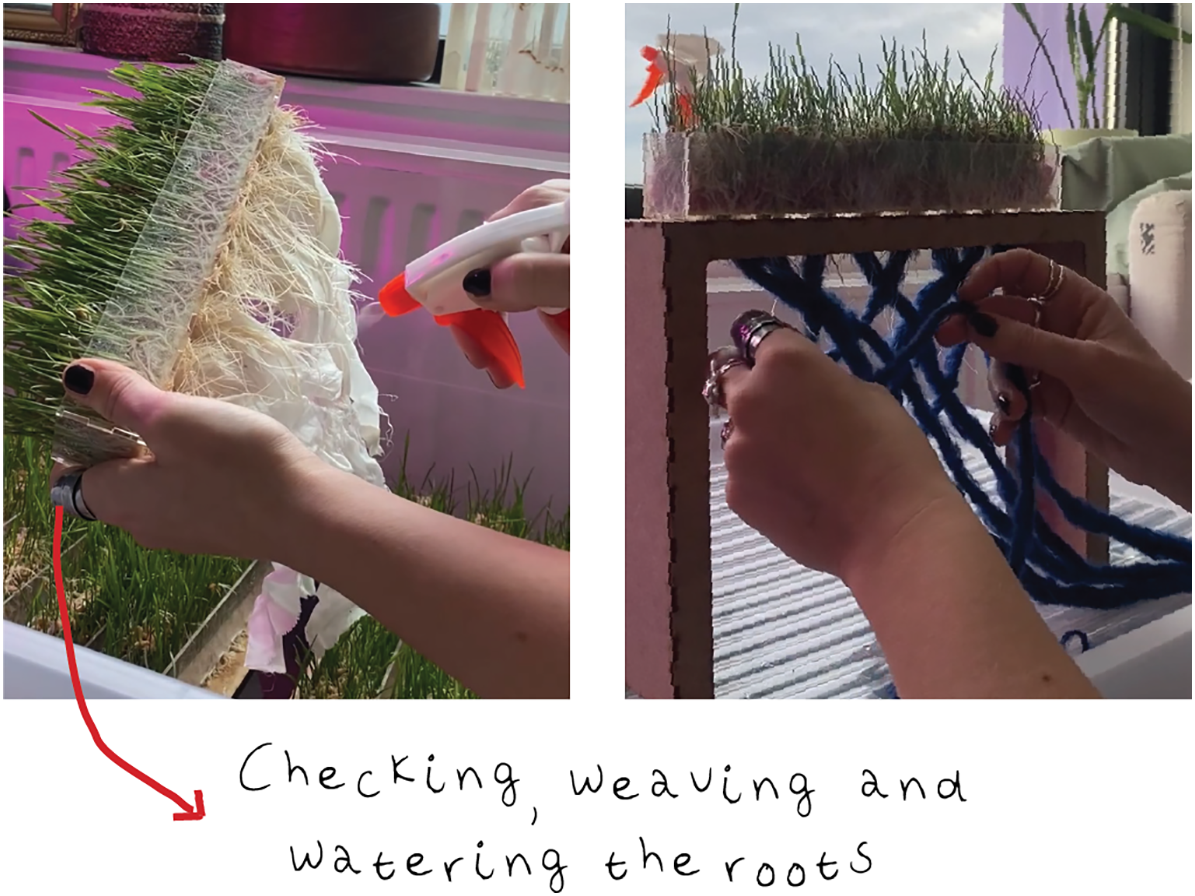
(a and b) Root maintenance and interaction.

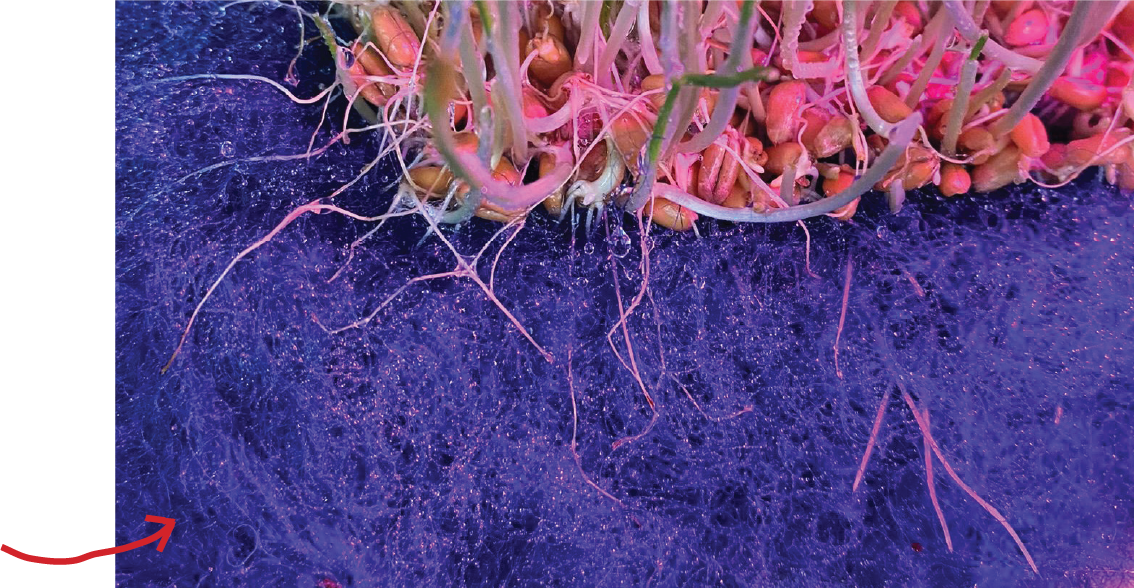
Roots growing across wool following condensation.

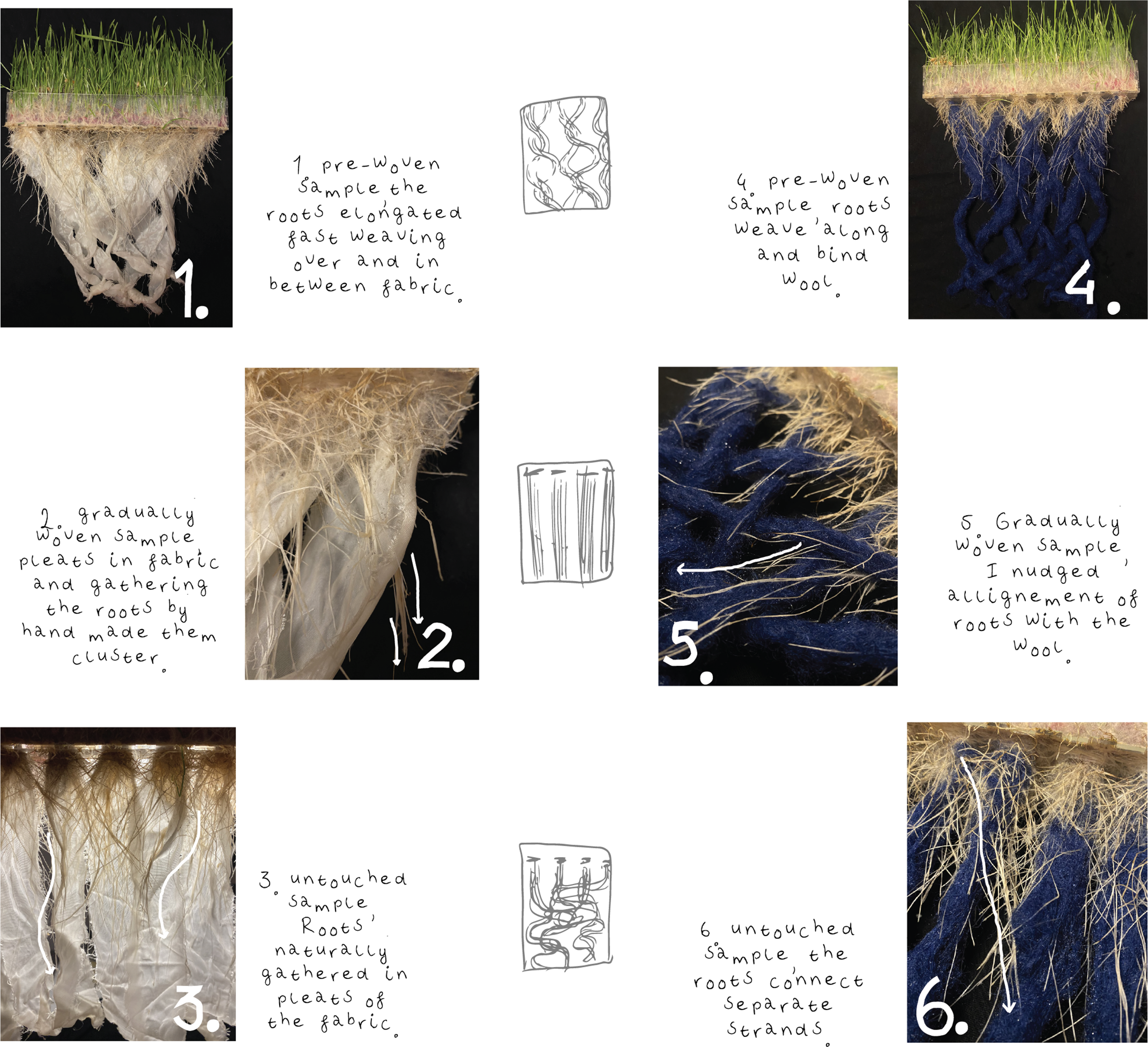
(a–f) Annotated details of 6 different samples.

Figure 9. Long description
Panel 1: A sample of grass roots elongating and weaving over and in between a piece of fabric. Panel 2: A sample of grass roots gradually pleating the fabric and gathering by hand. Panel 3: An untouched sample where the roots naturally gather in pleats of the fabric. Panel 4: A pre-woven sample where the roots weave along and bind wool. Panel 5: A gradually woven sample where the alignment of roots with the wool is nudged. Panel 6: An untouched sample where the roots connect separate strands of wool.
Key reflection 5 (external): humidity as sufficient growing condition
An observation made during previous experimentation proved that roots were able to grow uncovered by soil, depending on high humidity. Samples sprouting on wool, had stayed enclosed in a box over multiple days which prevented moisture from escaping. The roots, unexpectedly, had started to grow horizontally along the fabric, following the formed moisture droplets rather than gravity.
Key reflection 6: substrate scaffolding enables an assemblage of weaving
Felted wool and pleated viscose both functioned as soft, porous scaffolds that allowed roots to grow through, along and between fibers. In wool, roots intertwined with the strands and bound the structure together. In viscose, side roots penetrated the fabric and clustered inside pleats, forming self-supporting bundles. In both cases, the substrate became an active scaffold that enabled a shared weaving process and significantly reduced idle phases by allowing continuous, hands-on interaction.
Key reflection 7: from scripted molds to propositional infrastructures
Opening up the set-up, depending on high humidity and soft scaffolding, transformed the structure from a controlling mold into a propositional infrastructure. Growth trajectories became traceable, unexpected and relational, emerging through ongoing interaction between roots, scaffolds, tools and maintenance.
Phase 4
Intention: I aimed to amplify the behaviors displayed in phase 3 by creating two clear weaving practices. The set-up allowed intentional and streamlined interactions guided by tools. Next to allowing for unexpected, emergent behavior through an open structure, this set-up anticipated rhythm and repeated, small interactions that would enable a literal back-and-forth between roots and human aiming for short idle phase.
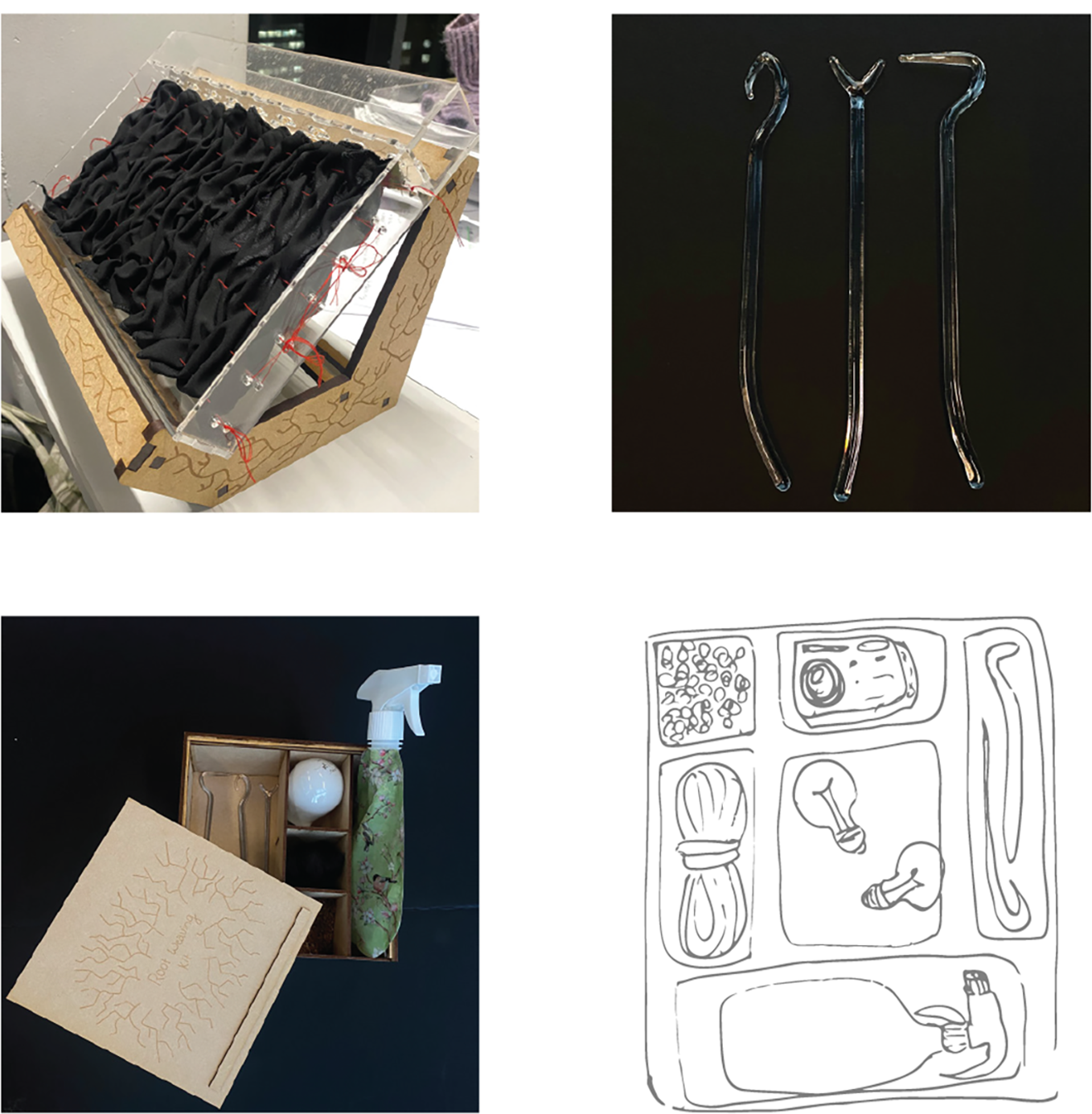
Set-up 4.1: This set-up allowed roots to grow over and through a pleated fabric inviting structure to emerge through root clustering. It allowed me to mediate structure by adjusting the pleats along the horizontal threads holding the pleats together, using glass tools and the loom-like holder.
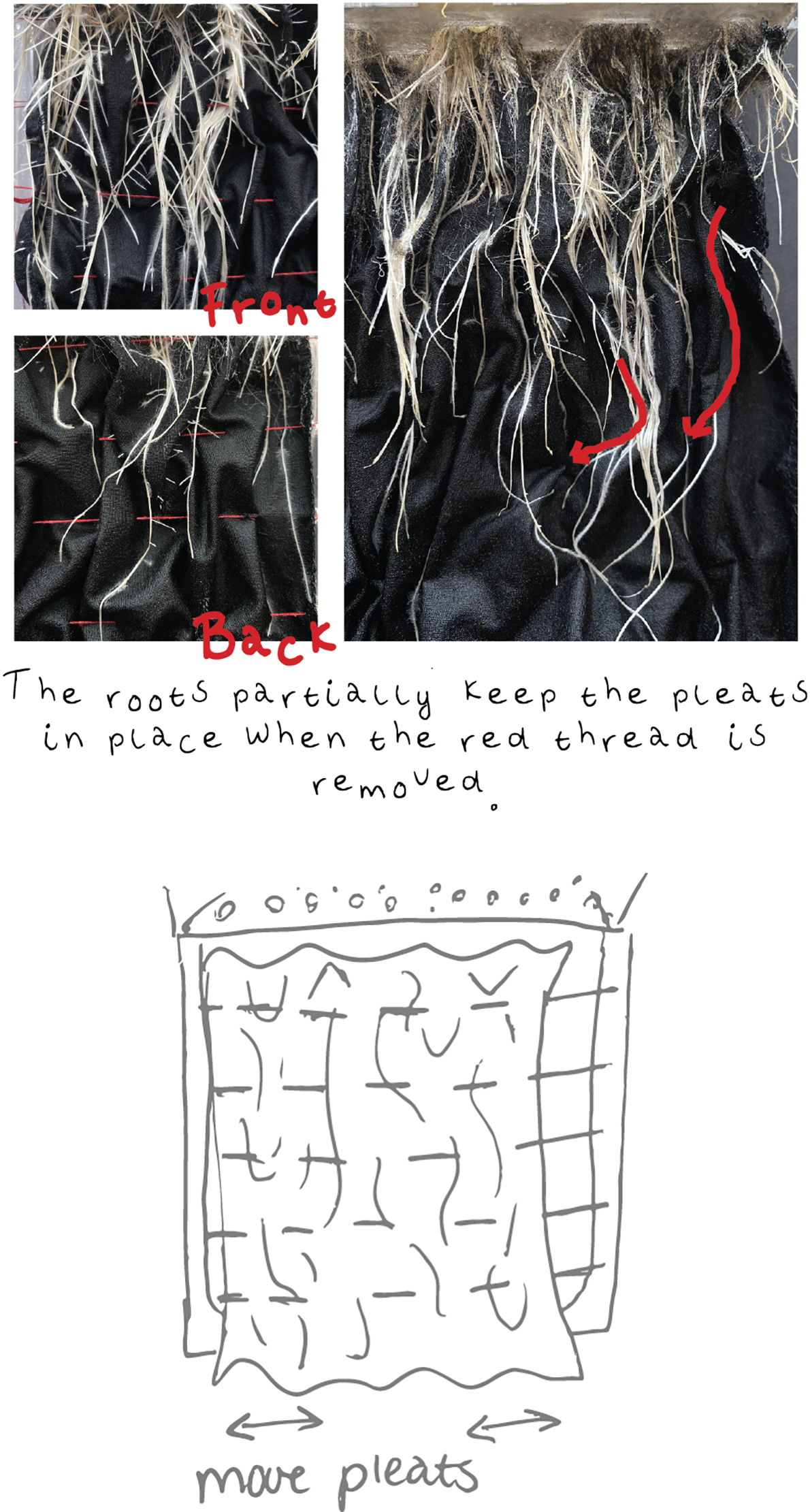
(a, b and c) Pleated viscose samples details.

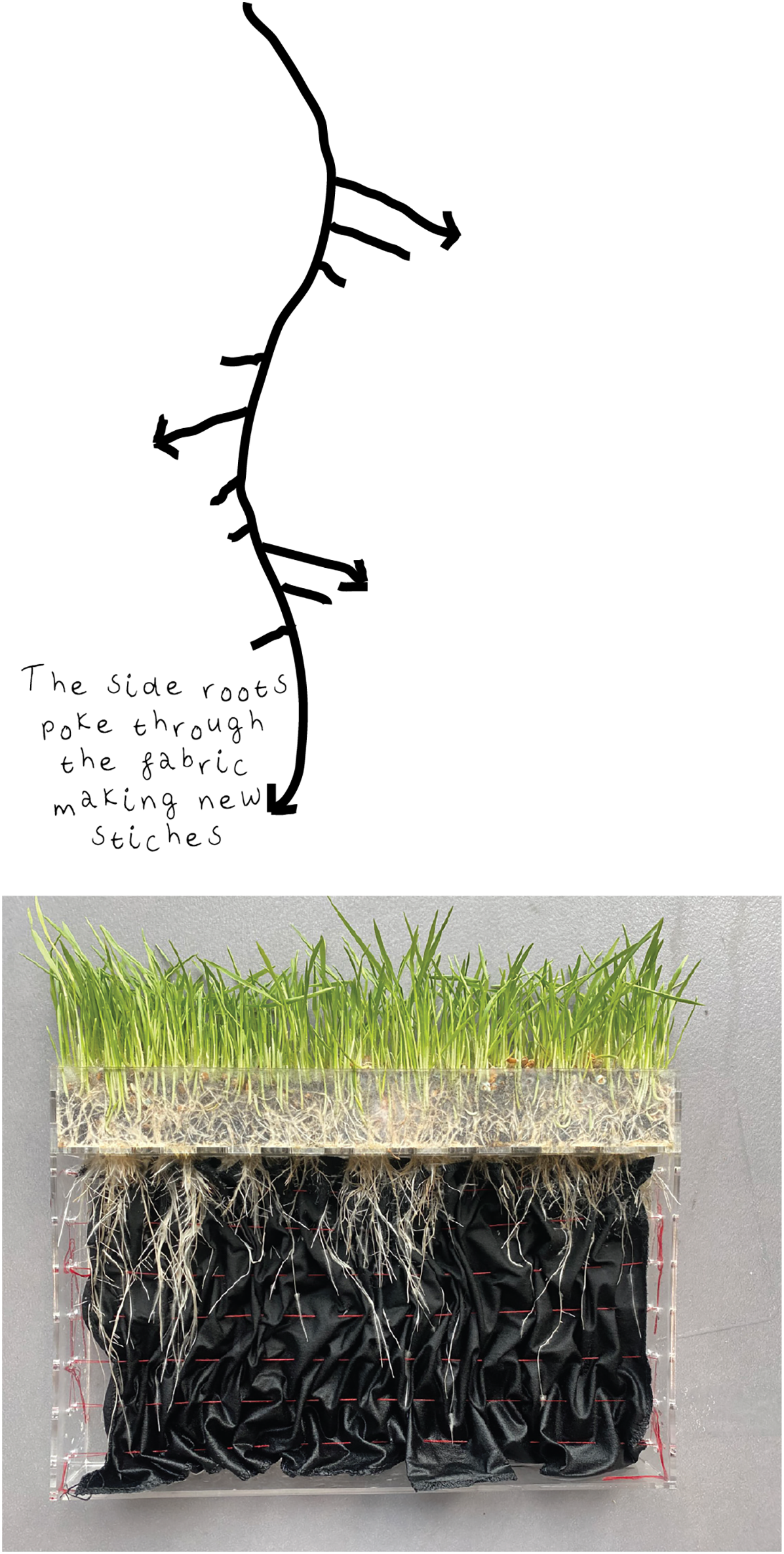
Pleated viscose sample overview.

Key reflection 8: root-led structuring in pliable textile guide
An unexpectedly high number of side roots transformed the viscose fabric into a self-supporting structure. As the roots punctured the textile and clustered inside the pleats, they gradually took over the role of shaping the form. Upon removing the thread that originally created the pleats, the root network maintained the structure on its own, revealing how material and organism could co-produce and mediate form.
At the same time, my range of interaction and mediation was significantly reduced compared to Phase 3. My role shifted from active weaving to subtle guidance. As a result, the idle phases became longer, highlighting a redistribution of agency in which the roots increasingly determined the outcome.
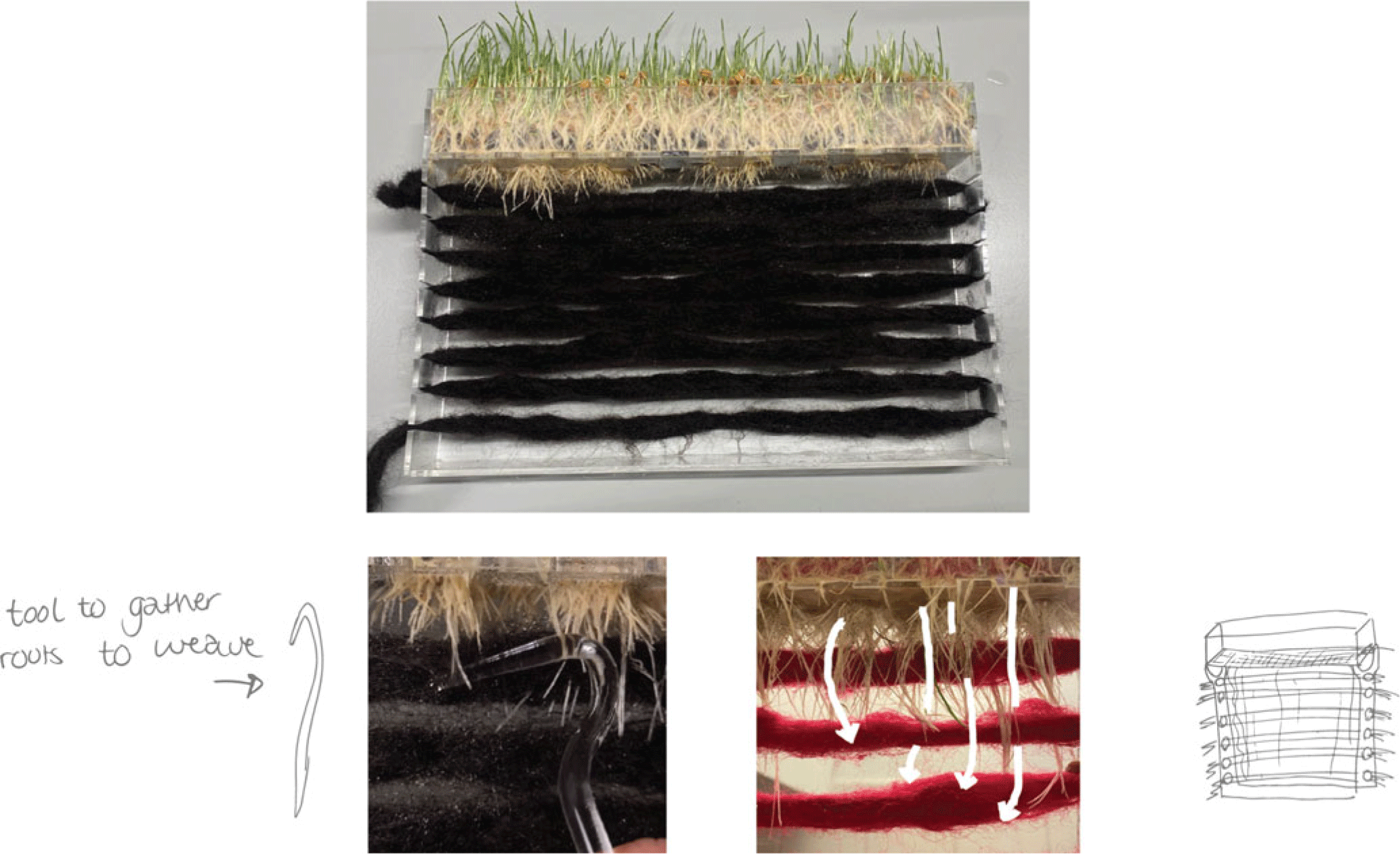
Set-up 4.2: This set-up held a horizontal wool warp. As the roots grew I would weave and guide the roots over and behind the wool warp, again using the glass tools and holder with their designated functions.
(a, b and c) Wool loom and weaving details.

(a, b and c) Overview of emerging tools.

Key reflection 9: the breaking of attunement
As temperatures dropped, the wool samples entered dormancy. I initially blamed seed quality but later realized that the growing conditions were incompatible. I only recognized this after physically working from home in the same cold space the roots had been living. Maintaining a climate suitable for the roots however made the room uncomfortable for me, causing delayed maintenance and eventually leading to frustration, a feeling of failure and avoidance of my practice. This disrupted early detection of dormancy, dying roots and mold. The experience showed that attunement is, besides sensory and environmental, also emotional, and that its absence can interrupt collaboration as much as technical failure.
Tools section
Because the Phase 4 set-ups invited more planned, craft-like interactions, custom tools were designed to support this infrastructure and enhance legibility. Handmade glass tools combined the form of crochet hooks and laboratory glass rods: their smooth, sterile surfaces allowed me to gather, guide, inspect and subtly align roots without introducing contamination or physical damage.
These tools replaced direct touch, which was found to be too imprecise and biologically risky for the fragile roots. Alongside them, a loom-like holder and a small craft box to organize and stage the practice was designed.
The tools streamlined interaction but also constrained it. Each tool enabled specific gestures while excluding others, shaping what kinds of mediation were possible. In this way, the tools became extensions of the body and active participants in the dialog. They emerged together with the practice and evolved as part of Rootcraft, rather than functioning as neutral instruments.
Rootcraft as practice: redistributing agency through craft
In order to answer the question: “How can intermediate artifacts enable distributed agencies between humans and grass roots in an act of designing-with?”, Rootcraft provides a twofold response. First, it reframes intermediate artifacts from fabrication support into active mediators of negotiation, putting the redistribution of agency in the design process into practice.
Across four phases, the role of intermediate artifacts shifts from directive molds toward propositional infrastructures. Early enclosed plexiglass set-ups front-load agency into the configuration, leaving limited room for unexpected agencies. Later, scaffold-based systems redistribute agencies by allowing continuous redirection, embodied engagement and environmental adjustment. Growth thus becomes a phase of negotiation rather than an idle period awaiting completion.
This openness to emergence and iteration is enabled by approaching molds, scaffolds, substrates and tools as elements within a practice-led inquiry, where making functions as a mode of knowing (Mäkelä, Reference Mäkelä2007; Nimkulrat, Reference Nimkulrat2012; Vennatrø and Bentz Høgseth, Reference Vennatrø and Bentz Høgseth2021). Rootcraft therefore operates as both a situated practice and a conceptual framing: a process of shaping conditions rather than executing form. In this sense, it aligns with designing-with (Wakkary, Reference Wakkary2021), where agency emerges through sustained correspondence rather than control.
Second, Rootcraft extends beyond the specific case of roots to growing design more broadly, proposing a designing-with practice applicable to other living materials. To support this, it introduces five tuning dimensions that describe how set-ups enable and structure negotiation during growth.
The tuning dimensions of rootcraft
These dimensions do not prescribe methods; they describe how intermediate artifacts shape relational dynamics in more-than-human making. They describe the design space that other designers can utilize to cultivate sensibilities toward more-than-human agency.
Set-up assertiveness
Set-up assertiveness describes the degree to which a configuration prescribes growth trajectories in advance through physical constraints and environmental stabilization.
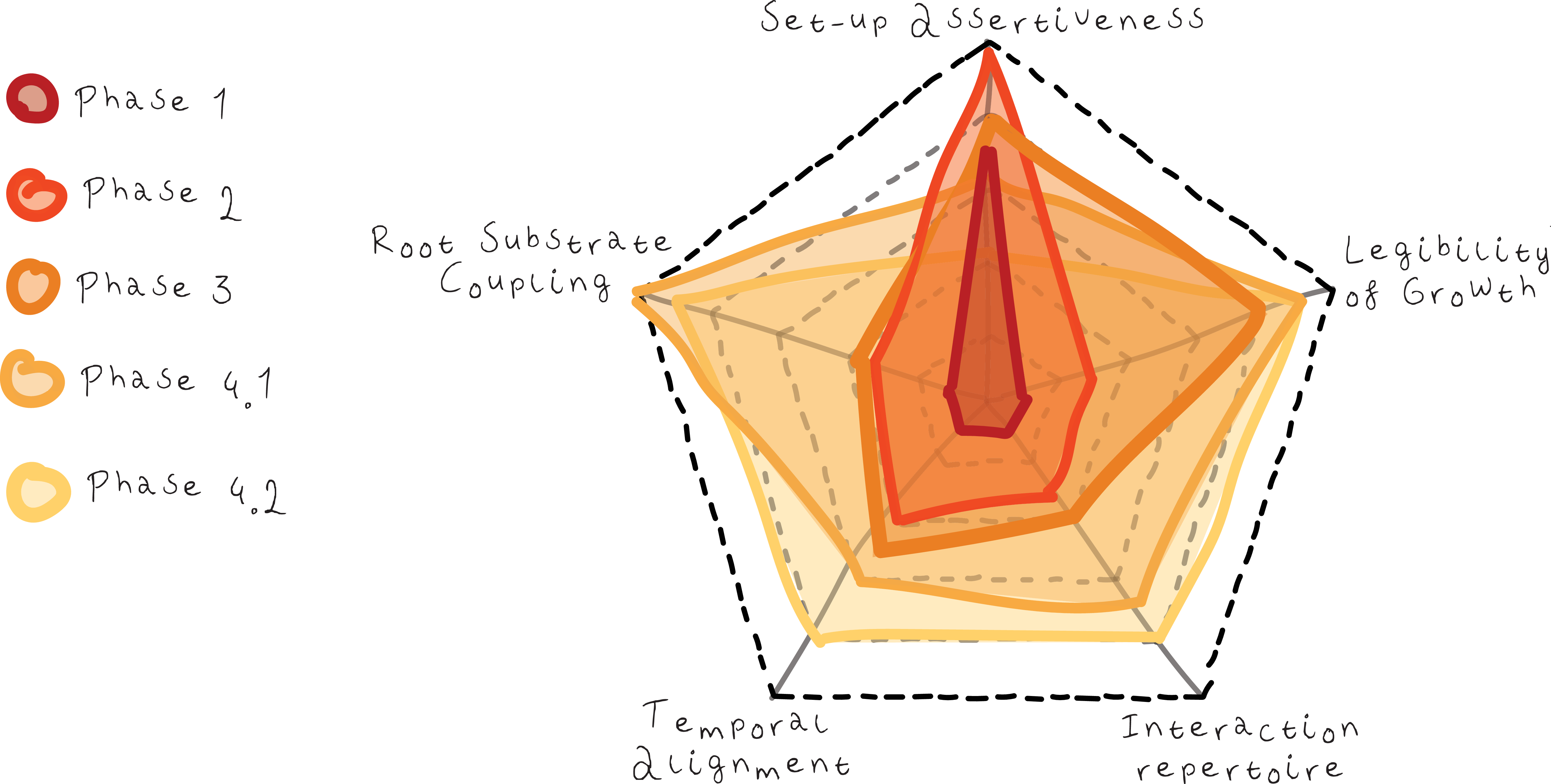
In Phases 1 and 2, plexiglass molds and semi-solid substrates strongly directed root behavior. Agency was largely front-loaded into the set-up, and growth unfolded primarily as execution within predefined patterns. In Phase 3, soft scaffolds and high humidity reduced prescription. Rather than determining form, the infrastructure suggested possibilities, inviting deviation and response.
Lowering assertiveness does not simply “free” agency, it redistributes responsibility. As prescription decreases, continuous sensing and adjustment become necessary.
Tuning range: Directive → Propositional.
Interaction repertoire
Interaction repertoire describes the range, granularity and frequency of meaningful interventions the set-up enables during growth. This includes for instance what kinds of gestures and how readily they can be performed as roots develop.
In the early phases, the repertoire was narrow: interaction occurred only through infrequent acts of maintenance and coarse mediation (e.g., watering, rotating vessels), separated by long idle periods. In Phase 3, soft scaffolds and open access enabled frequent, embodied gestures such as nudging, weaving, redirecting. Roots, substrate and human entered into continuous correspondence.
In Phase 4, custom tools further shaped the repertoire through precise inspection and subtle guidance, buffering direct touch and improvisational gestures. Correspondence increased not through singular decisive acts, but through the availability of many small negotiations. Rootcraft therefore values infrastructures that enable sustained finer-grained engagement over isolated control.
Tuning range: Narrow repertoire → Rich repertoire
Legibility of growth
Legibility of growth describes how perceptible, traceable and interpretable root behavior is within a set-up. Legibility was instrumental for attunement: what cannot be read cannot be responded to.
In Phase 1, roots were hidden within enclosed, horizontally oriented vessels. Using agar (instead of coco coir) and plexiglass increased translucency and partial visibility. Flipping vessels upright made trajectories more traceable, as root oriented along gravity. In Phases 3 and 4, roots were no longer enclosed and could be visually followed, touched and redirected directly or with tools (e.g., glass rods). Tools further enhanced legibility by enabling close inspection and subtle nudging.
Tuning range: Opaque → Exposed/traceable.
Temporal alignment
Temporal alignment describes how a set-up synchronizes (or misaligns) the temporalities of roots, maintenance, adjustment and intervention. It can be operationalized as idle time between encounters.
In Phases 1 and 2, long idle periods (e.g., multiple day gaps between watering) limited attunement and constrained interaction to episodic engagement. By the time an intervention occurred, trajectories were often already established, making negotiation largely retrospective. In Phase 3, shortened idle time enabled closer alignment, allowing responses while growth was still ongoing and before trajectories became fixed. Phase 4 further showed that alignment is not only technical but situated: environmental discomfort, avoidance and instability can reintroduce delay and disrupt the rhythm of care, undermining collaboration even when the set-up invites frequent intervention
Treating temporal alignment as a design parameter afforded by the set-up, enables temporal structuring: deciding when negotiation can occur, how often correspondence is possible and what kind of responses can be sustained, Designing-with living systems therefore requires designing time as intentionally as form.
Tuning range: Episodic → Continuous
Root–substrate coupling
Root-medium coupling describes how strongly the growth substrate materially anchors or resists root movement and redirection and how reversible negotiation remains once roots begin to attach, bind and permeate a medium.
Across Phases 3 and 4, textile scaffolds produced distinct coupling modes. In felted wool, roots tended to grow through and along fibers, intertwining and lightly binding the scaffold while still permitting careful rerouting and repositioning (moderate coupling). In pleated viscose, lateral roots frequently punctured the textile and clustered within folds, forming bundled networks that increasingly anchored themselves and reduced the reversibility of redirection (high coupling, most evident in Phase 4.1).
Tuning dimensions in radar chart.

Figure 14. Long description
A radar chart illustrating the progression of tuning dimensions across five phases. The chart has five axes labeled Set-up Assertiveness, Legibility of Growth, Interaction Repertoire, Temporal Alignment, and Root Substrate Coupling. Each phase is represented by a different shade of orange, ranging from dark red for Phase 1 to light yellow for Phase 4.2. The chart shows how each dimension evolves and expands as the phases progress, with Phase 1 being the most constrained and Phase 4.2 being the most expansive.
Root–substrate coupling thus does not merely host interaction; it materially mediates it by determining whether encounters remain provisional or become locked-in. Designing set-ups involves tuning substrates not only for viability, but for how they enable sliding, snagging, binding, puncturing and release over time.
Tuning range: Slip/slide → Anchor/bind/puncture.
Environmental conditions operate as boundary conditions across all five dimensions. As shown in Phase 4.2, instability (e.g., temperature drops, mold) can override both human and root agency, collapsing negotiation by shifting the practice from crafting toward maintenance and recovery. (see Appendix B).
Together, these dimensions articulate Rootcraft as a relational designing-with practice in which agency is structured, redistributed and made negotiable through material configuration, temporal structuring and situated interaction.
Discussion
Rootcraft contributes to growing design and more-than-human design not only by redistributing agency, but by reframing esthetics. In much root-based growing design, form remains the primary site of esthetic evaluation (e.g., molded textiles, computational templates (Zhou et al., Reference Zhou, Barati, Wu, Scherer and Karana2021)). Rootcraft instead foregrounds processual esthetics: esthetic experience lies not only in the final artifact, but in the unfolding negotiation through which form emerges.
This resonates with critical perspectives on living esthetics (Bell et al., Reference Bell, Ramsahoye, Coffie, Tung and Alistar2023; Ikeya et al., n.d.) and Ikeya et al.’s account of relational human–nonhuman engagement, where esthetics and knowledge emerge through situated encounters in “contact zones” rather than stable outcomes alone (Ikeya et al., n.d.). In their review, relational approaches include attuning to nonhuman temporalities, bodily engagement, tracing interaction and iterative habitat design; practices that resist treating nonhumans as passive material (Ikeya et al., n.d.). Rootcraft extends this account by showing how intermediate artifacts stage such engagement: growth becomes a means of tracing interaction, making signals such as directionality, clustering and dormancy readable and actionable, while temporal alignment and interaction repertoire specify how correspondence is enabled or disrupted over time. Rootcraft also echoes Ikeya et al.’s observation that relational approaches surface questions of power (who controls, when not to intervene and how embodied experience shapes relation), most clearly demonstrated in our Phase 4 breakdown (Ikeya et al., n.d.).
Rootcraft therefore proposes legibility of growth as a condition for relational esthetics. Building on the MCF (Sherman and Nitsche, Reference Sherman and Nitsche2024), correspondence requires actors to perceive and respond to one another’s actions. When roots remain hidden beneath opaque substrates, interaction risks becoming one-sided. When growth is exposed and traceable, signals such as growth rate, directional choices, clustering or dormancy become readable. Legibility therefore becomes more than a technical feature; it enables co-authorship. Designing-for-legibility surfaces the livingness of roots (Kim et al., Reference Kim, Risseeuw, Groutars and Karana2023), allowing their signals to enter esthetic dialog. Form is no longer the sole communicative output: readability of nonhuman signals becomes an expressive dimension enabling attunement and response. In this sense, designing-for-legibility is also ethical, making space for the other’s agency to be seen and considered in ongoing form-making.
However, designing-for-legibility also surfaces tensions in human intention. Roots naturally exhibit negative phototropism, growing away from light (Edelmann, Reference Edelmann2018). In our process, the tension of making roots visible despite this tendency was not fully resolved, but remained open to negotiation. Exposure was minimized through indirect lighting while vessels enabled momentary interaction. We therefore retain a reflexive stance, continuing to ask to what extent, and for whose interest, nonhuman agency is made legible. Designing-for-legibility thus remains not a final goal, but an ongoing compromise and exercise in designerly reflexivity.
Finally, Rootcraft demonstrates that agency and time are not neutral parameters. Temporal alignment determines when negotiation can occur, and environmental stability determines whether it can be sustained. Rather than proposing harmony, Rootcraft frames growing design as a fragile alignment requiring ongoing attunement. In this way, Rootcraft shifts attention from producing form toward sustaining correspondence.
Conclusion
Rootcraft demonstrates how designing-with living materials can shift from controlling growth to engaging with it as an unfolding practice of shared making. Across four iterative phases, we show how intermediate artifacts, such as vessels, scaffolds, substrates and tools, do not merely support growth but actively shape how agency is distributed by configuring when, how and by whom interaction can occur.
In response to our research question, we argue that intermediate artifacts operate as propositional infrastructures: they tune the conditions under which correspondence with roots becomes possible during growth. The resulting vocabulary, namely, set-up assertiveness, growth legibility, interaction repertoire, temporal alignment and root–substrate coupling, offers transferable parameters for more-than-human making practices beyond front-loaded scripting and toward ongoing responsiveness.
Rootcraft contributes to biodesign and more-than-human design by foregrounding the growing phase as a site of situated engagement, where form develops through iterative tuning to living temporalities. It reframes growth set-ups as habitabilities that host and mediate co-action, rather than containers that simply dictate outcomes. At the same time, Rootcraft underscores that decentering human control increases responsibility: maintenance, attunement and emotional labor become explicit conditions of practice, and collaboration remains fragile under environmental instability. By documenting these dynamics through intermediate artifacts and phases, Rootcraft positions designing-with as an embodied, temporal and accountable mode of making.
Data availability statement
The authors confirm that the data supporting the findings of this study are available within the article and its supplementary materials.
AI acknowledgments
Artificial intelligence (AI) tools were used during manuscript preparation for language refinement, restructuring of text and editorial support. Specifically, OpenAI’s ChatGPT (GPT-5.5, accessed via ChatGPT, 2025–2026) was used to assist in rephrasing sections, improving clarity and flow and condensing text to meet formatting constraints. All intellectual contributions, conceptual framing, analysis, interpretation and final editorial decisions were made by the authors, who reviewed and revised all AI-assisted outputs.
Author contributions
Margot Beekhuizen conceived and conducted the practice-led research, designed and carried out the iterative growing experiments, collected and analysed the empirical material, developed the visual documentation and led the writing of the manuscript. Gizem Oktay contributed to the conceptual framing, methodological development, thematic analysis and critical revision of the manuscript. Bahareh Barati contributed to conceptual development, interpretation of findings and critical revision of the manuscript. All authors contributed to discussion of the results, approved the final version of the manuscript and agree to be accountable for all aspects of the work.
Financial support
This research received no specific grant from any funding agency, commercial or not-for-profit sectors.
Competing interests
None.
Ethical standards
This research involved practice-led design research conducted by the first author in a home environment and did not involve human participants, human subject recruitment or animal experimentation requiring formal ethical approval. First-person reflections were generated by the first author as part of the research process. All authors adhered to institutional and disciplinary ethical standards throughout the study.
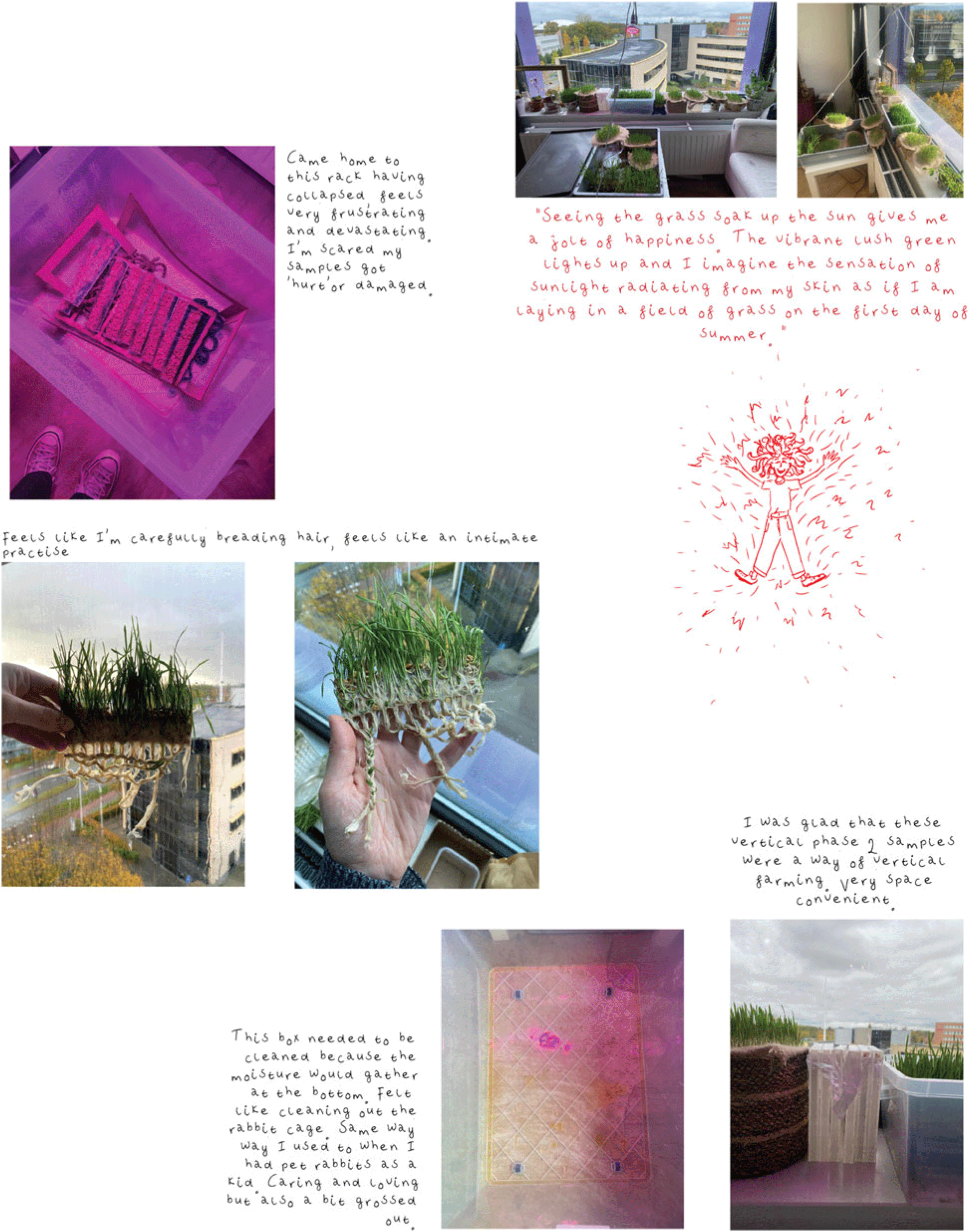
Appendix A
Living-with wheatgrass
Living together with the samples was a very intimate and emotional way of engaging with a project. The following annotated pictures, drawings and writings reflect on this experience.
Growing set-up in FA’s Livingroom.

Appendix B
Reflections on mold, maintenance and preservation
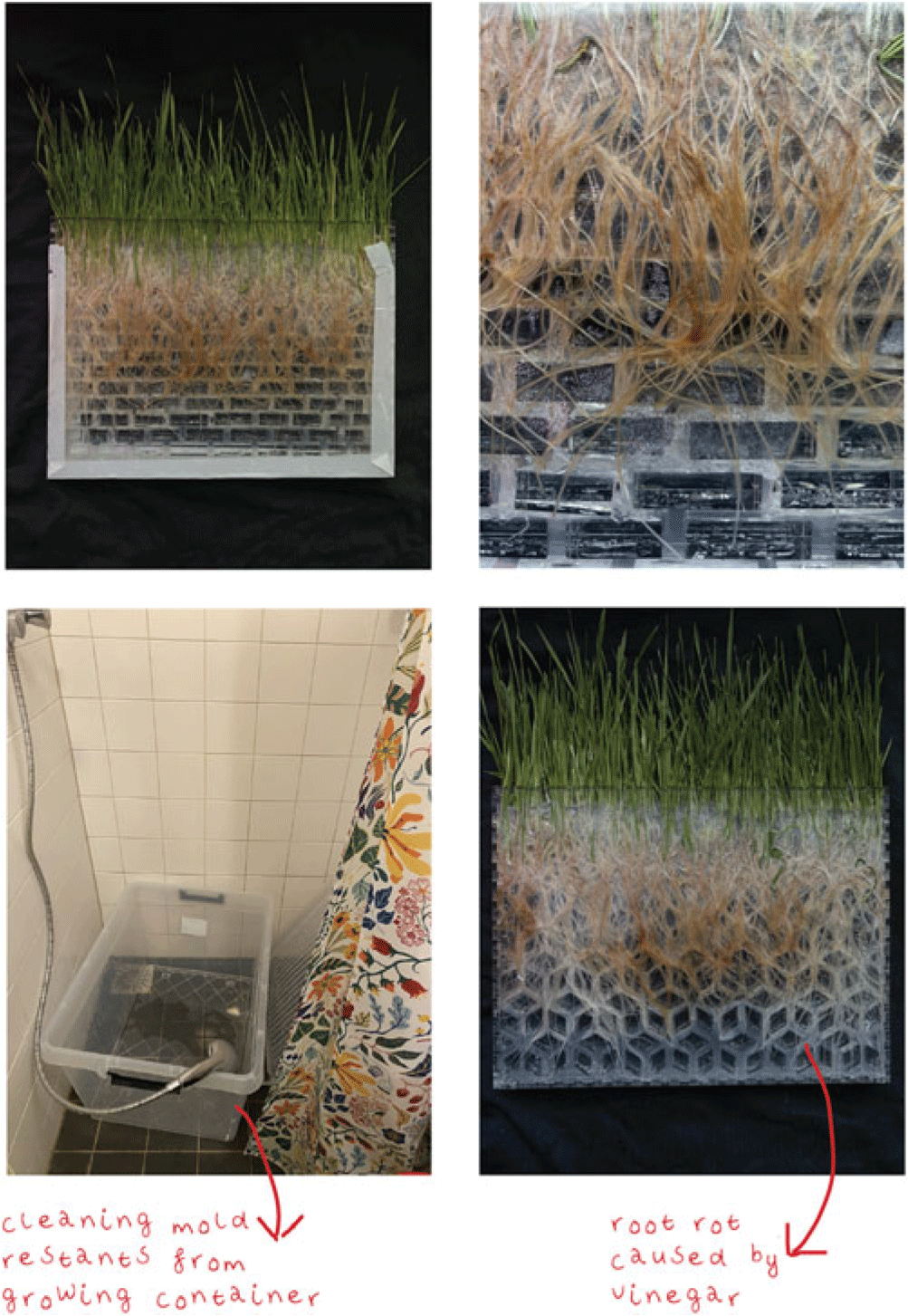
After repeatedly encountering mold in the samples, I decided to intervene by adding vinegar. Based on prior experience working with mycelium and informal sources suggesting vinegar could inhibit unwanted molds, I acted on intuition rather than further research. I sprayed a 30% vinegar solution on samples from Phase 4 and on regrowing samples from Phase 2, including newly sprouted seeds.
Within days, it became clear that this intervention had failed. Seeds did not sprout, mold increased and the Phase 2 samples showed brown discoloration on the roots, indicating early rot. The vinegar proved far too aggressive. This was emotionally devastating: despite careful intentions, I was actively harming the roots. I rinsed several samples in an attempt to recover them; most survived, though some showed lasting damage.
This moment reframed my understanding of agency within the process. Mold revealed itself not as a disturbance to be eliminated, but as another active agent within the system. Either I had created the conditions that allowed it to flourish, or I needed to accept its presence as part of the making process.
My attempt to force the growth back toward my expectations caused the process to collapse rather than comply. Mold appeared on nearly all samples after approximately two weeks, particularly in Phases 2–4. While the exact cause remains uncertain, restricted ventilation caused by the vessels and insufficient removal of previous mold traces may have contributed to its recurrence.
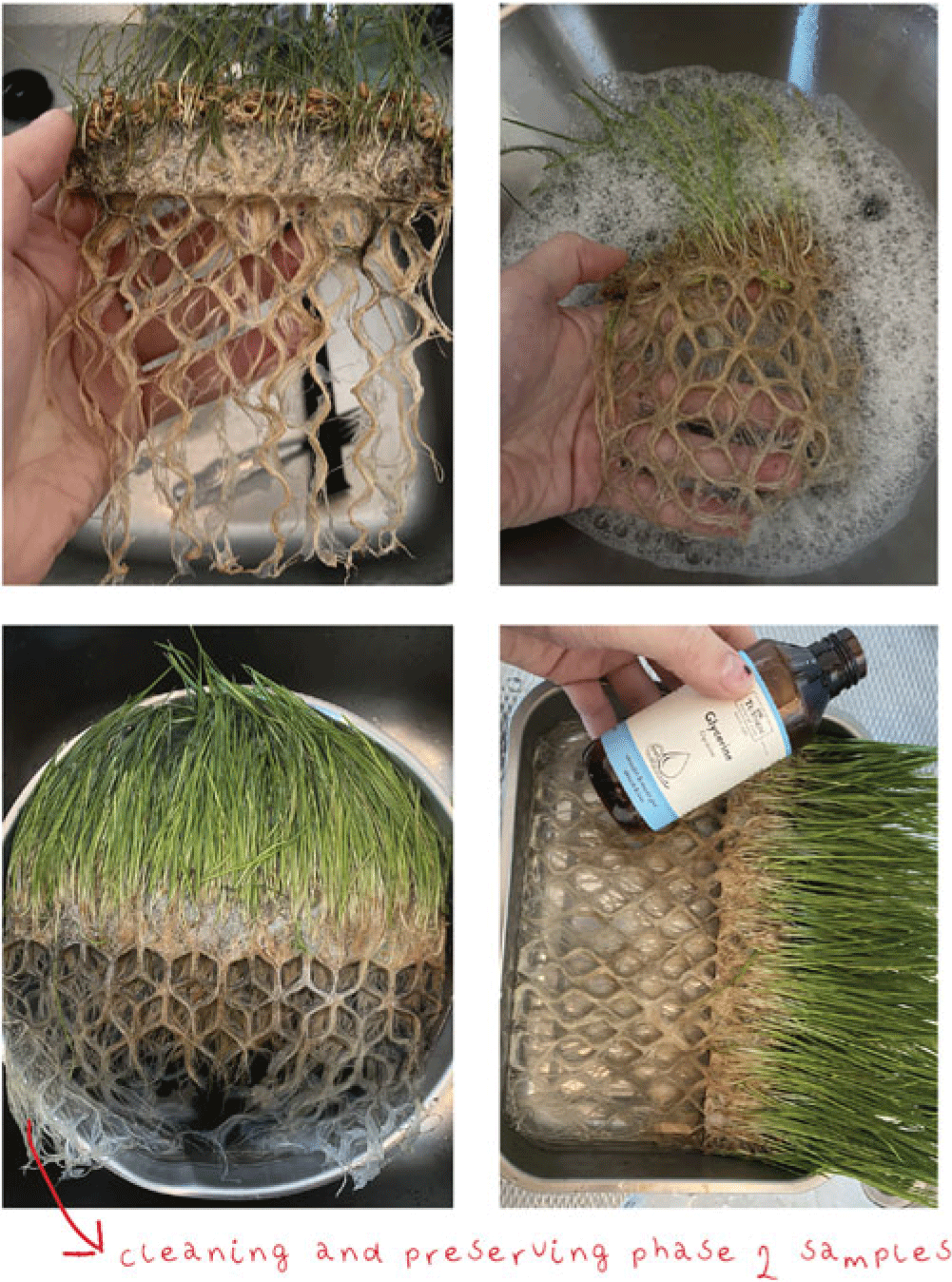
Using dish soap and lukewarm water, I was able to remove mold from dried Phase 2 samples. To test preservation methods, these samples were then submerged in a bath of lukewarm water and glycerine. This technique, commonly used to preserve autumn leaves by replacing residual moisture with glycerine, proved effective. Untreated samples became brittle when dried, whereas glycerine-treated samples remained supple and leathery.
Additionally, the agar substrate used in Phase 2 dried into a thin, bioplastic-like film that coated the samples, further contributing to their material qualities.
Cleaning the mold off of the grassroot samples using soap.

Overuse of vinegar causing root rot.


 Open access

