





Functional neurological disorder (FND) describes distressing neurological symptoms characterised by involuntary loss of bodily control. Common presenting symptoms are functional (non-epileptic) seizures and functional motor disorder (characterised by walking difficulties, weakness or tremor). Patients with FND can also experience cognitive difficulties, dizziness and numbness or tingling. Reference Perez, Edwards, Nielsen, Kozlowska, Hallett and Curt Lafrance1,Reference Hallett, Aybek, Dworetzky, McWhirter, Staab and Stone2 FND is a common diagnosis in neurology clinics, with a recent systematic review estimating a minimum point prevalence between 80 and 140/100 000; and is associated with high healthcare costs and difficulty accessing treatments. Reference Finkelstein, Diamond, Carson and Stone3–Reference Carson, Stone, Hibberd, Murray, Duncan and Coleman7 Treatments for FND are still in their infancy, but there is evidence of benefit for physiotherapy, cognitive–behavioural therapy and multidisciplinary interventions. Reference Nielsen, Stone, Lee, Goldstein, Marston and Hunter8–Reference McCormack, Moriarty, Mellers, Shotbolt, Pastena and Landes13 FND is associated with experiencing more adverse events in childhood and adulthood compared with healthy controls, and can be triggered by adverse life events, including illnesses or injury. Reference Ludwig, Pasman, Nicholson, Aybek, David and Tuck14–Reference Pareés, Kojovic, Pires, Rubio-Agusti, Saifee and Sadnicka16
Eye movement desensitisation and reprocessing (EMDR) therapy is an evidence-based treatment for post-traumatic stress disorder, but there is also evidence it can be helpful for other presentations, including chronic pain and depression. Reference Shapiro17–Reference Carletto, Malandrone, Berchialla, Oliva, Colombi and Hase23 We conducted a randomised feasibility study examining EMDR as a treatment for FND (MODIFI). Reference Cope, Smith, El-Leithy, Vanzan, Pentland and Pick24,Reference Cope, Smith, El-Leithy, Vanzan, Hogwood and Golder25 The MODIFI trial found that it is acceptable, feasible and safe to offer EMDR therapy tailored for FND, as well as providing preliminary evidence that FND-focused EMDR could have a positive impact on FND symptoms, mental health, ability to function and healthcare use. Reference Cope, Smith, El-Leithy, Vanzan, Hogwood and Golder25
Previous qualitative accounts of FND patients’ experiences of healthcare and healthcare professionals’ views of FND have highlighted low confidence and unclear treatment pathways that can result in healthcare professionals discharging patients without giving them a clear explanation for their symptoms or offering treatment. Reference Barnett, Davis, Mitchell and Tyson26,Reference Bailey, Tamasauskas, Bradley-Westguard, Gilli, Poole and Edwards27 Patients’ experiences of psychological therapies for FND have been explored within the CODES trial, Reference Read, Jordan, Perdue, Purnell, Murray and Chalder28 and within a psychological therapy service, Reference Staton, Dawson, Merdian, Tickle and Walker29 but there have been no published qualitative papers on patients’ experiences of EMDR for FND. Two systematic reviews, reporting on patients’ experiences of EMDR more broadly, underline that EMDR can be a powerful intervention, influenced by therapist factors, that patients can be unclear regarding how it works and negative effects can occur. Reference Whitehouse30,Reference Shipley, Wilde and Hudson31 This supports the need for specific information on experiences of EMDR for people with FND. Here, we report on participants’ experiences of EMDR therapy within the MODIFI trial. Reference Cope, Smith, El-Leithy, Vanzan, Hogwood and Golder25 A separate qualitative paper from the trial exploring participants’ experiences of FND and diagnosis has been published. Reference Pritomanova, Cope, James, Edwards, Smith and El-Leithy32
Method
MODIFI trial
MODIFI was a single-blind, randomised, controlled feasibility trial with two arms: EMDR plus standard neuropsychiatric care and standard neuropsychiatric care only. Fifty adult patients with a diagnosis of FND were recruited from a neuropsychiatry service in the UK. The MODIFI trial ran from 1 June 2022 to 30 May 2025. Reference Cope, Smith, El-Leithy, Vanzan, Hogwood and Golder25 Interviews were carried out between 1 December 2023 and 30 July 2024.
Sampling
Participants in the trial who had completed EMDR therapy were invited to take part in an interview by email and text message. Participants received £20 following participation. Of the 25 participants randomised to the EMDR plus standard neuropsychiatric care arm, 22 reached the end of the trial and were invited to take part in an interview. Out of these, 11 consented to take part and were interviewed between December 2023 and July 2024.
Interviews
Participants were invited to take part in semi-structured interviews after they had completed their 9-month trial period. Following verbal and written consent, interviews were conducted and recorded by the MODIFI research assistant either online through Microsoft Teams for Windows or at the hospital base. The interview guide was developed in collaboration with the trial’s Patient and Public Involvement representatives (see Supplementary Material). Interviews lasted on average 55 min (range 25–90 min), with two carried out in person and nine carried out online.
Data analysis
Interviews were transcribed verbatim with the Microsoft Teams transcription function and corrected before analysis. Participant pseudo-anonymity was ensured by using participant identifiers and removing any potentially identifying information. Interviews were analysed with a reflexive thematic analysis approach as outlined by Braun and Clarke, Reference Braun and Clarke33,Reference Braun and Clarke34 and coding was facilitated with NVivo 14 for Windows (Lumivero, Denver, Colorado, USA; https://community.lumivero.com/s/article/TRC-Standard-installation-NVivo-14-Windows?language=en_US). Each transcript was coded by author B.J. in both a deductive way, in line with the aims of the study, and an inductive way, coding the transcripts more broadly, with the codes and a selection of transcripts reviewed by J.B. and S.R.C. and the wider research team, which included lived experience researchers. The codes were then organised into themes through connections and similarities, and organised hierarchically. The themes were discussed and refined by the research team. See Supplementary Material for additional analysis detail and the reflexivity statement.
Ethics
The authors assert that all procedures contributing to this work comply with the ethical standards of the relevant national and institutional committees on human experimentation and with the Helsinki Declaration of 1975, as revised in 2013. All procedures were approved by the West Midlands Edgbaston Research Ethics Committee (reference: 22/WM/0178). This trial was registered with ClinicalTrials.gov under the identifier NCT05455450.
Results
Participants
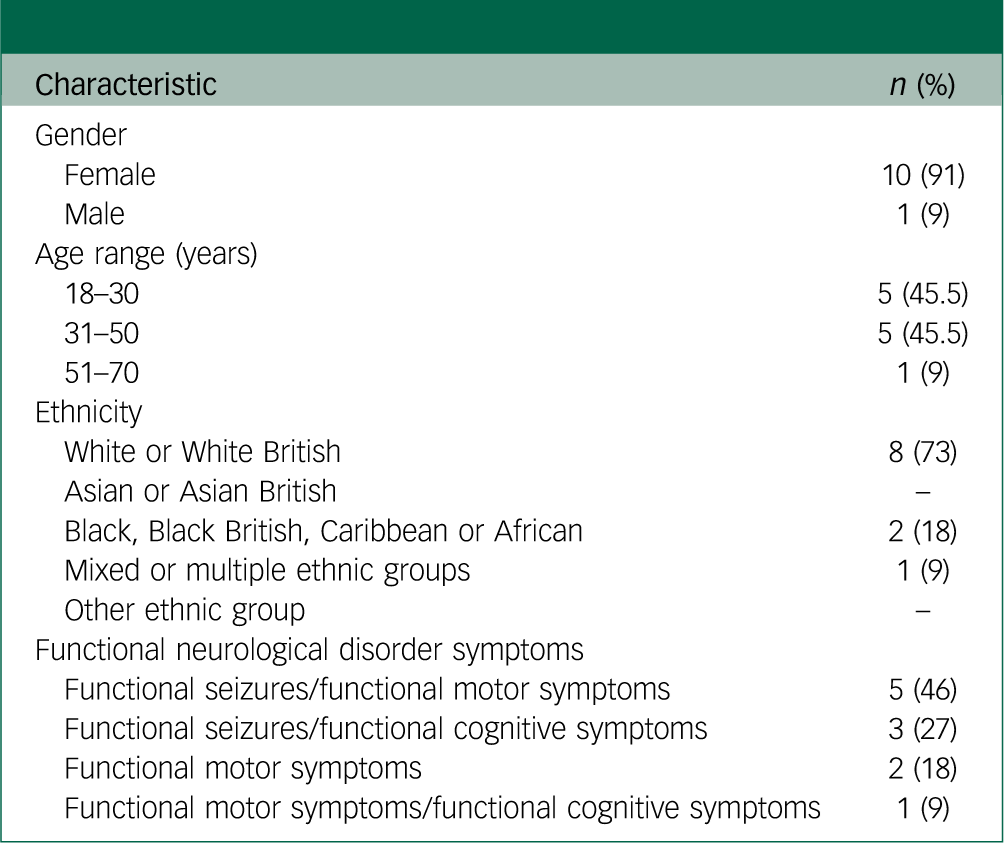
Participants were a mean age of 31.6 years (range: 19.3–66.6). They had experienced FND symptoms for a mean of 3.6 years (range: 1–12), and were diagnosed a mean of 1.36 years previous (range: 0–6). All experienced functional seizures and/or functional motor symptoms, with some participants also choosing functional cognitive symptoms as one of their two main symptoms (see Table 1).
Demographic characteristics of interviewees

Table 1 Long description
A table showing demographic characteristics of interviewees. The table has 8 rows and 2 columns. The columns are labeled ‘Characteristic’ and ‘n (%)’. The rows are grouped under different headings: Gender, Age range (years), Ethnicity, and Functional neurological disorder symptoms. Row 1: Gender, Female, 10 (91 percent). Row 2: Gender, Male, 1 (9 percent). Row 3: Age range (years), 18-30, 5 (45.5 percent). Row 4: Age range (years), 31-50, 5 (45.5 percent). Row 5: Age range (years), 51-70, 1 (9 percent). Row 6: Ethnicity, White or White British, 8 (73 percent). Row 7: Ethnicity, Black, Black British, Caribbean or African, 2 (18 percent). Row 8: Ethnicity, Mixed or multiple ethnic groups, 1 (9 percent). Row 9: Functional neurological disorder symptoms, Functional seizures/functional motor symptoms, 5 (46 percent). Row 10: Functional neurological disorder symptoms, Functional seizures/functional cognitive symptoms, 3 (27 percent). Row 11: Functional neurological disorder symptoms, Functional motor symptoms, 2 (18 percent). Row 12: Functional neurological disorder symptoms, Functional motor symptoms/functional cognitive symptoms, 1 (9 percent).
Main themes and subthemes
We identified four main domains: domain 1, expectations before the trial; domain 2, preparedness for EMDR; domain 3, mysterious but unique journey; and domain 4, It was hard, but worth it – ‘A rewarding challenge’. Within these domains, ten themes were identified and are presented visually in a thematic map (see Fig. 1). See Supplementary Material for a thematic table with further illustrative quotes.
Thematic map. EMDR, eye movement desensitisation and reprocessing; FND, functional neurological disorder.

Domain 1: Expectations before the trial
Participants expressed uncertainty about what to expect from the trial and EMDR. There was a palpable sense of hope that the trial could offer support for their FND symptoms, but previous negative healthcare experiences of seemed to leave participants hesitant. Nonetheless, because of the rarity of the opportunity, participants indicated a strong motivation to participate and receive any available support for their FND symptoms, despite their reservations.
Theme 1.1: Muted expectations
Participants revealed muted expectations before starting the trial, feeling uncertain about the outcome and restrained in their hopes. Participants noted that they were willing to try anything because of the absence of treatment options for FND:
‘I was desperate to try everything like there wasn’t a single thing I was gonna turn down because … I wanted to get better’ (M1021)
‘But I just thought that I’ve got nothing to lose if I don’t, if I do it. So I thought I’d give it a try’ (M1017)
Participants noted having open expectations about the trial and to receiving any potential support in the hope that it could be beneficial. However, because of limited prior experience with research, many participants were unclear about what to expect:
‘I guess I went into it with very open expectations, so didn’t really know what to expect’ (M1001)
‘But, yeah, I guess I just kind of went into it with an open mind, in the sense of, you know, if it helps then fantastic. But you know if it doesn’t, then I guess we’ll try and find something else that helps’ (M1032)
Theme 1.2: Glimmer of hope
Participants expressed hope that the trial could provide treatment for their symptoms, despite limited understanding of EMDR at the outset. Participants revealed a desperation to receive an intervention because nothing else was being offered or feeling like they had exhausted all available options. Some participants shared past experiences of not receiving effective treatment, and as a result, were eager to try something different:
‘…terrified that if it doesn’t work then there is no other treatment plan here … So MODIFI had to work, like this trial had to work’ (M1002)
‘I think for me it was very much like make or break like if I can’t have this trial, then you know what else is there? … I was so nervous because I thought … this is kind of one chance of, you know, of getting kind of my life back’ (M1035)
For this reason, once allocated, participants shared feeling compelled to commit to the intervention:
‘So when I was selected, I just thought, oh, OK, we’ll get, I’ve got to sort myself out and whatever and commit to this’ (M1014)
There was a sense of hope that EMDR would help with FND symptoms, noting a wish for control over, or a reduction in, symptoms to reduce the burden on their day-to-day lives:
‘Yes, so it just felt incredible, yeah, to have this kind of opportunity and, you know, have the possibility of getting better or at least having some sort of control over my symptoms’ (M1035)
‘So I think hopeful but like terrified of that hope at the same time because you want it to work. You are so desperately want it to work, whatever it is, don’t even fully understand what EMDR for FND is supposed to be at this point’ (M1002)
Domain 2: Preparedness for EMDR
Participants recalled feeling adequately informed when first enrolled in the trial, but were still lacking an understanding about how EMDR works, with most participants having never heard of EMDR previously.
Theme 2.1: Lack of understanding as to what EMDR for FND is
The interviews illustrated that despite feeling informed, participants were unclear on the rationale of EMDR for FND, noting that EMDR therapy was an unusual concept to grasp:
‘That’s a really difficult one, to be honest, because I still remain slightly confused as to how it works, not just as a general principle, but how it works with me’ (M1011)
‘It felt too hard, I didn’t understand what it was … I just called him a wizard cause it really, it really felt weird’ (M1002)
One participant made sense of the intervention themselves by believing that because they experience eye twitches during a seizure that EMDR was the right treatment for them:
‘We got the EMDR, which I was very happy about cause of the eye movement twitching … like I’ve collapsed, and my mum noticed it, …. my eyes are still kind of fluttering or looking not in the right direction and I didn’t notice that’ (M1029)
Theme 2.2: Lack of preparedness for EMDR
Across the interviews, there was a general sense that participants were not ready for the emotional and physical impact of EMDR. This created a contrast between the participants’ hopefulness about the potential outcomes of the intervention versus the reality of doing EMDR. Some participants noted feeling daunted by the prospect of looking at past memories, feeling uncertain about how they might react revisiting them:
‘I was daunted by the fact that I would have to go back into kind of the past and to go through it’ (M1001)
‘Nah, let’s not talk about that, why we talking about the worst time in my life? Why we doing it? I don’t wanna do it and I had so much pushback, I was like, no, don’t wanna do it. Why is this, it’s got nothing to do with FND. I was just like, no, I don’t wanna do it’ (M1014)
Many participants were unaware of the potential costs of EMDR, noting that after starting the processing sessions, they unexpectedly felt exhausted and tearful, not realising how much the sessions would affect them. However, for most, the effects were transient, lessening over time:
‘I think something I wasn’t necessarily aware of was kind of like most likely the side effects of it’ (M1001)
‘Umm, like the first few sessions I was just crying all the time and then by, like throughout the journey I was getting, like I was, I was crying less, so I could feel that I was more comfortable and that I was making progress’ (M1021)
Nonetheless, some considered pulling out of EMDR, as they underestimated the difficulty of sessions:
‘Whenever the first actual EMDR session was, which I think was like the second session or the third, I was ready to quit … I’ve never wanted to bash my laptop in more and like not come back’ (M1002)
Domain 3: Mysterious but unique journey of EMDR therapy
Participants described undergoing EMDR therapy as ‘like a journey’. Although initially feeling unprepared for EMDR, they found the experience safe and secure, even when the processing sessions proved challenging. Participants described EMDR as a unique experience, unlike anything they had encountered before. They also expressed feeling a sense of control over the process, which stood in contrast to the lack of control they felt after being diagnosed and experiencing the absence of a clear treatment pathway for FND.
Theme 3.1: Autonomy and choice
One key element highlighted by participants was the value of flexibility and location of sessions. For some, online sessions helped with the challenges of travelling, accommodating FND symptoms, whereas for others, in-person sessions helped separate home and medical appointments, increasing accessibility to treatment:
‘Having the option of it being online was a massive help. Because I wouldn’t have been able to take myself into [hospital] every week. I would have had to book the entire day off in order to attend the sessions, and my husband probably would have had to as well because he probably would have had to drive me in’ (M1032)
‘I think I don’t do very well on Teams and I get distracted and also like separating things medical from my safe place at home and also yeah, I was just like it means I can get out of the house’ (M1029)
Participants reported having freedom of choice and retaining control throughout the trial. They mentioned that they did not feel pushed into participating and felt empowered to change the plan for the session and discuss their most pressing concerns, helping with the engagement and retention of participants throughout therapy:
‘I felt like I wasn’t pressured into being part of anything. It was very much kind of I was in control of the process as well’ (M1001)
‘I liked that we had a plan in place, but at the same time, there was the flexibility to sort of pivot and switch it up a bit’ (M1040)
Theme 3.2: Safety and predictability of sessions
Participants shared that despite the disconcerting nature of taking part in an intervention they understood little about, they felt secure in continuing EMDR. Participants explained that regularity and predictability of sessions helped alleviate uncertainty and helped cope with the challenging nature of EMDR therapy:
‘He explained to me how this all like, the sessions, would work and what we would do throughout each session. And at the end of the session, you say what we will try to do the next week, which I liked, so I would sort of in a way be prepared’ (M1017)
For some participants this process took some time, noting that they were initially wary but through building trust, the process became easier:
‘I think after a couple, I’d been there like one to two sessions and it’s like anything building that trust with someone, I felt much more comfortable to be much more open to be very much more, this is how I feel … I was a bit wary about it, I think, just because my past experiences haven’t been great’ (M1029)
Theme 3.3: Challenge of choosing target memories
Participants’ choices of target memories were influenced by various factors. Some participants said they knew from the outset what target memory they were going to pick, whereas others were unsure and expressed uncertainty and difficulty in choosing. Many expressed apprehensions about selecting the ‘right’ memory and facing the distress it might bring. Additionally, some participants were uncertain about whether the memory should be related to FND:
‘That one was a difficult one because when you have to focus on the worst of the worst moments, you’re like, oh, I’ve got quite a few. But then having to pinpoint the worst and focus on it and think about it’ (M1014)
Participants questioned whether their target memory was traumatic enough versus being too traumatising. There was a reluctance amongst some participants to view their own trauma experiences as sufficiently serious to warrant EMDR:
‘I started feeling like maybe my traumas weren’t bad enough to be doing EMDR…So when I kind of started listing them, I was like are these just kind of normal things that other people are gonna have, like, way worse traumas and have more kind of reason to be doing this’ (M1001)
For others, there was a belief that their memories were too traumatic to process in the trial:
‘Yeah, that was not an easy task… because obviously I was just like nah, that’s that’s too traumatising. Let’s go somewhere else. So my mind automatically, so my body just automatically went somewhere else completely and it was just like, no, you can’t deal with this’ (M1014)
In retrospect, most participants were content with their choices:
‘No, I think the one that we chose and processed made sense’ (M1001)
‘I think definitely the right memory cause now I don’t feel like I can’t, I I feel like I can talk about him and that’s nice’ (M1029)
Explicitly stating the number of sessions agreed upon for the EMDR therapy was felt to be productive for some participants, as the limited number of sessions focused target memories. Despite session numbers being limited by the trial context, participants reflected that toward the end of the therapy, they felt that they had received the right number of sessions for the memories they were working on:
‘If it was a situation where they’re like, OK, you’re going to have EMDR for the rest of your life, like once a week for the rest of your life, there is like a lot of things I could have covered. But knowing that there was only a certain amount of sessions like there were just key things I had to address, and I think that was, that was good’ (M1021)
Theme 3.4: Distinctiveness of EMDR
Most participants distinguished the EMDR process from other therapies in its emotional and physical demands, which some attributed to the trauma-processing element inherent in EMDR, confronting and working through distressing memories more directly than in other therapeutic approaches. The unique demands of EMDR therapy were perceived to set it apart which may contribute to its effectiveness, but also distinct difficulty:
‘Particularly the EMDR, I think (a) it was more physical, so you’re actually moving, and (b) it was processing trauma and all that kind of thing. It had like a physical effect, so sometimes I would feel a bit shaky or like just generally like unwell for a bit. I think I’ve never experienced, it wasn’t like emotional fatigue, it was physical fatigue’ (M1001)
Some also differentiated the conduct of EMDR therapy from other talking therapies, noting that it is different to anything experienced previously. Participants shared feeling surprised at the limited talking in EMDR and the unusual experience of processing memories:
‘So yeah, at the beginning I just thought, what on earth, why? Because it was from a different angle, complete different angle. So for me, I was just like what? Because I’m used to like, obviously I’m used to all the other ways of all the other therapies’ (M1014)
Domain 4: It was hard, but worth it – ‘A rewarding challenge’
The participants acknowledged that participating in the trial was hard and processing traumatic memories challenging. However, there was a consensus among participants that it felt worthwhile:
‘So, yeah, it was, sometimes it was quite difficult, but overall it was certainly worth it in the long run’ (M1040)
Theme 4.1: EMDR was hard
There was consensus that reliving memories was difficult. Many participants shared that they often tried to ignore or forget, so being asked to repeatedly think about ‘the worst moments’ was tough:
‘Constantly, whenever we went back into processing, I was like, this is awful and I hate you [laughing]. Like it was so dramatic, but it is awful. You’re sat there like being projected back into some of the worst moments of your life and then occasionally you lose the tether and you’re trying to find your way back to a video call’ (M1002)
‘It wasn’t something I wanted to repeat and him telling me that I would have to relive that image again and again wasn’t ideal. I remember that, but then again, it was just, yeah, the fact that I had to relive that image, it was hard’ (M1003)
Because of the demanding nature of EMDR therapy, participants reported often needing to do something afterwards to manage the emotions that came up after reliving and processing memories:
‘So afterwards I always kind of have to do this decompression, like I have to sit there in silence for a while and just kind of like, not meditate, but just kind of just sit in quietness and just have a moment before talking to anyone, before watching anything or playing any music’ (M1014)
Participants expressed pride in having completed the hard challenge of trauma processing and thereby having contributed to their own recovery:
‘I was very proud of myself for completing it’ (M1003)
‘So yeah, it was kind of like one of those ones where, like, it’s stubborn and then at the end of it, you go, uh, do you know what actually, that’s actually quite good that I actually managed to go through the process without me having a seizure, without me, you know, going crazy and whatever. So yeah, it was, it was a challenge, but a rewarding challenge’ (M1014)
Theme 4.2: Benefits of EMDR despite the costs
Participants noted numerous positive aspects of EMDR therapy, despite finding the process challenging and not fully comprehending the rationale. Many participants discussed successfully processing past experiences and being able to move forward with their lives:
‘I was genuinely being able to process all of those memories and come to terms with them and cut through that tornado of negative thoughts above your head, really helpful’ (M1002)
‘I think because I was quite aware of kind of what my trauma was and what I think was kind of triggering my, you know, my seizures and the paralysis and things like that. I think that that’s kind of what I needed. I needed to process, you know, all them thoughts and feelings’ (M1035)
Participants revealed that throughout the sessions and after completion of EMDR, they noticed FND symptom improvement. Participants shared feeling more in control of their FND symptoms and gaining a sense of normality back in their day-to-day life, with some sharing that they could do more than they thought would be possible:
‘I think generally it was more over time, noticing that my seizures were getting less severe and things like that. So I think it wasn’t just after the whole therapy, it was during that I started noticing improvements’ (M1001)
‘I’d had a really traumatic experience just pretty much before the trial started. And I just thought, you know, I couldn’t ever imagine sort of getting back to normal. But you know, during the treatment, I could definitely see things improving. And it does appear to have made a big difference’ (M1040)
Finally, participants indicated that because of EMDR therapy, they have gained a better understanding of themselves and FND, enabling them to better manage their FND symptoms:
‘The therapy taught me understanding, not necessarily understanding of the chemistry, if you like, of what’s happened with the sort of disconnect, but understanding that, umm, I’m not wonky, there is something actually going on and and it’s not something I’m imagining. So it’s that it, it’s it helped me improve my understanding but more importantly my acceptance of it and therefore my control over it’ (M1011)
‘I can, you can feel the sense, like you have a better perception of the sensations of when like FND is coming and I don’t think I would have had that without the trial’ (M1002)
Discussion
Eleven interviews with participants who had completed FND-focused EMDR within the MODIFI trial revealed ten themes, grouped within four domains. In the first domain (‘Expectations before the trial’), ‘muted expectations’ showed that participants were motivated to take part as they had been offered no other or limited treatment, and retained a ‘glimmer of hope’, in that participants reported hopefulness regarding the intervention. This is similar to participants’ reported experiences in the CODES trial, which evaluated cognitive–behavioural therapy as a treatment for functional (dissociative) seizures, whereby participants took part as it was the ‘only thing out there’. Reference Read, Jordan, Perdue, Purnell, Murray and Chalder28 The strong motivation to take part in MODIFI, combined with our reasonable participant recruitment rate within the trial, Reference Cope, Smith, El-Leithy, Vanzan, Hogwood and Golder25 indicates that there should be a strong uptake for participation if a larger trial evaluating EMDR for FND is carried out. Interestingly, participants did not report a dislike or hesitancy regarding being offered a psychological intervention, as has been reported in a previous qualitative study exploring individuals’ experiences of psychological services for FND that highlighted the impact of self-stigma as a barrier to accessing therapy; and that psychological explanations for FND symptoms can be experienced as blaming. Reference Staton, Dawson, Merdian, Tickle and Walker29 This is likely because of our sample representing a proportion of patients with FND who acknowledge that psychological factors are relevant in the development and maintenance of their FND.
The second domain, ‘Preparedness for EMDR’, revealed two themes: a lack of understanding and a lack of preparation for undertaking EMDR. Participants were given information on EMDR in the participant information sheet, and in EMDR sessions, supported by handouts. Despite this, participants reported limited understanding regarding how EMDR worked. Nevertheless, this did not appear to adversely affect participants’ experiences of the therapy. This is similar to findings reported by Shipley et al, Reference Shipley, Wilde and Hudson31 who found that patients reported positive effects of EMDR, but poor understanding of how such benefits occurred. Reference Solomon and Shapiro35 This is perhaps reflected in the wider literature of EMDR, where there are theories regarding the mechanisms of change involved in EMDR, but not a definitive account. Reference Solomon and Shapiro35 In terms of preparation for EMDR, participants spoke about not feeling ready for the impact of EMDR therapy, both physically and mentally, and some participants reported anticipatory anxiety regarding approaching distressing memories. Participants were warned that EMDR processing sessions could have an emotional and physical impact, but it still caught participants off guard. It is difficult to mitigate this in future studies, as although participants need to be warned about potential side-effects, it can create expectation effects or put patients off participating if this aspect is over-emphasised. Participants did report these effects lessening over time, so if a larger trial is carried out, this information could be shared.
Despite the limited understanding, and possibly daunting nature of the therapy, the third domain, ‘Mysterious but unique journey of EMDR therapy’, demonstrated that participants found the therapy safe and reported a sense of control and security within the sessions. The theme ‘Autonomy and choice’ demonstrated that participants valued the option of attending therapy online or in person. Most participants in MODIFI chose to attend sessions online, Reference Cope, Smith, El-Leithy, Vanzan, Hogwood and Golder25 but it appears it was helpful to include an in-person option. Participants reported a sense of control and flexibility within the sessions, and not feeling pushed to follow the therapist’s agenda. The theme ‘Safety and predictability of sessions’ showed the importance of regular and predictable sessions, which helped to reduce any uncertainty felt in relation to EMDR therapy. The importance of felt safeness was also reported in a systematic review of EMDR experiences. Reference Whitehouse30 Although some participants knew from the beginning which traumatic memory they were going to focus on, many reported choosing a memory difficult and reported apprehension about selecting the ‘right’ memory, as well as anxiety about anticipated distress. This theme ‘Challenge of choosing target memories’ also demonstrated that some participants wondered whether their chosen memory was ‘traumatic enough’ or whether it would be too hard to face. Participants found having a limited number of sessions (maximum 16) helped them to focus on what was important and this aided decision-making. The difficulty in choosing a memory/memories to focus on in the therapy is unsurprising given the heterogenous nature of FND presentations, where traumatic experiences may or may not be relevant in the development of FND symptoms. Taking a broad view of what constitutes a ‘traumatic’ experience, and focusing on subjective distress associated with memories of past events (or current symptoms), aids FND formulation and can open possibilities in terms of therapy targets. The final theme within the third domain emphasises the ‘Distinctiveness of EMDR’, with participants noting the emotional and physical demands of the processing sessions and differentiating it from other psychological therapies previously experienced.
The fourth and final domain, ‘It was hard, but worth it: A rewarding challenge’, underlines that although ‘EMDR was hard’ there were ‘Benefits of EMDR, despite the costs’. Previous systematic reviews of EMDR experiences (not specific to FND) have found that people say they experience EMDR in this way. Reference Whitehouse30,Reference Shipley, Wilde and Hudson31 Participants reported finding the therapy process difficult, but nevertheless identified a number of positive effects, including coming to terms with memories of difficult events, understanding triggers of their FND symptoms, improvement in their FND symptoms and, generally, an improved understanding of themselves and their FND that has enabled them to manage their symptoms better.
Strengths and limitations
This study is the first to our knowledge exploring the EMDR experiences of people with FND, and was conducted by an experienced research team, including lived experience researchers. The study demonstrates that a broad trauma conceptualisation, as in EMDR, can be beneficial and relevant for patients with FND, as well as emphasising that traumatic experiences (including those in relation to FND onset) should be considered in treatment planning. It shows that trauma-focused therapy is acceptable and helpful to some patients with FND. The interviews were carried out by a research assistant who was not a qualified therapist and had little knowledge of EMDR, and therefore this limited preconceived ideas in the interviews and analysis.
However, 50% of those approached chose not to take part in interviews, and although the demographics of our sample are similar to the demographics found in the total EMDR plus standard neuropsychiatric care group in terms of mean age, gender, ethnicity and FND symptoms, Reference Cope, Smith, El-Leithy, Vanzan, Hogwood and Golder25 we cannot exclude that those who did not agree to be interviewed would have expressed differing views from those we interviewed, which may limit transferability. It is not known why some participants in the EMDR plus standard neuropsychiatric care group chose not to be interviewed. It could be lack of time, or it could be that they did not want to revisit their therapy experiences. The payment of £20 for participation may have induced positive responding. Future studies could include interviewing participants who withdraw from the trial, as part of the study design.
Overall, participants reported positive benefits from the therapy, and that any costs were worth the experienced gains. These results, in addition to our quantitative results, suggest services and policies should consider including EMDR, and potentially trauma-focused therapies generally, as a treatment option; and that a full-scale trial evaluating FND-focused EMDR is warranted.
Supplementary material
The supplementary material is available online at https://doi.org/10.1192/bjo.2026.12060
Data availability
The data that support the findings of this study are available on request from the first author (S.R.C.). The data are not publicly available as the containing information could compromise the privacy of research participants.
Acknowledgements
We thank the participants, who kindly agreed to be interviewed for the study; and Caitlin Pentland, who carried out some of the interviews.
Author contributions
S.R.C. led the study at all stages and drafted the manuscript. J.G.S., S.E.-L. and M.J.E. contributed to the study design and were involved at all stages. P.H., D.G., K.J.T., J.B., S.V. and B.J. refined the interview schedule. P.H., D.G. and K.J.T. provided lived experience input. B.J. carried out the analysis, with supervision from J.B., and B.J. drafted an initial Method and Results. All authors helped interpret the analyses and critically reviewed and revised the report for intellectual content and approved the final version.
Funding
This project was funded by the National Institute for Health and Care Research (NIHR) under its Research for Patient Benefit Programme (grant reference number 202277). The views expressed are those of the author(s) and not necessarily those of the NIHR or the Department of Health and Social Care.
Declaration of interest
M.J.E. does medical expert reporting in personal injury and clinical negligence cases; has shares in Brain & Mind, which provides neuropsychiatric and neurological rehabilitation in the independent medical sector; has received financial support for lectures from the International Parkinson’s and Movement Disorders Society and the FND Society; receives royalties from Oxford University Press for his book, The Oxford Specialist Handbook of Parkinson’s Disease and Other Movement Disorder; has received honoraria for medical advice to Teva Pharmaceuticals and educational events; receives grant funding from the National Institute for Health and Care Research; is the Deputy Editor of the European Journal of Neurology and is on the medical advisory boards of the charities FND Hope and the British Association of Performing Arts Medicine. All other authors declare that they have no conflicts of interest.


 Open access


eLetters
No eLetters have been published for this article.