





Prenatal depression affects nearly two in five pregnancies in the USA and, when untreated, is associated with reduced engagement in prenatal care, preterm birth, postpartum depression and impaired child neurodevelopment. Reference Field1–Reference Jang, Ramaiyer, Olson, Voegtline and Esguerra3 Perinatal depression is a leading contributor of maternal mortality, with death by suicide accounting for up to 20% of postpartum deaths. Reference Lindahl, Pearson and Colpe4,Reference Lommerse, Mérelle, Rietveld, Berkelmans and Van Den Akker5 Because most mental health symptoms during pregnancy are first identified in obstetric settings, prenatal depression screening is an important pathway to further assessment, follow-up and referral for psychiatric evaluation and treatment. Reference Byatt, Xu, Levin and Moore Simas6,Reference Cox, Sowa, Meltzer-Brody and Gaynes7 The American College of Obstetricians and Gynecologists first recommended universal prenatal depression screening in 2015, and reaffirmed this in 2018. 8,9 In 2019, the National Committee for Quality Assurance added prenatal depression screening and follow-up as a quality measure. 10 As systems expand screening through standardised workflows and performance measurement, equitable delivery is essential to avoid systematic underidentification of prenatal depression in groups facing barriers to care. Language is a known barrier to prenatal depression screening. Reference Eakley and Lyndon11 This study evaluated the relationship between language preference and uptake of prenatal depression screening within a large, diverse USA healthcare system.
Method
The retrospective study of electronic health record (EHR) data was conducted within a large, vertically integrated healthcare system in the USA Midwest. The cohort comprised pregnancies resulting in births at or beyond 20 weeks gestation between 1 July 2019 and 30 June 2024, with prenatal care initiation in the first or second trimester. Pregnancy outcomes before 20 weeks are not classified as births and are therefore inconsistently captured in the EHR. However, we did not condition on fetal viability or outcomes after 20 weeks, because very preterm birth or stillbirth is associated with elevated postpartum depression risk, warranting their inclusion in prenatal screening samples. Reference Pace, Spittle, Molesworth, Lee, Northam and Cheong12,Reference Lewkowitz, Rosenbloom, Keller, López, Macones and Olsen13 We excluded pregnancies with missing variables of interest by using listwise deletion (<5% of the sample). We reported findings following the Strengthening the Reporting of Observational Studies in Epidemiology (STROBE) guidelines. Reference von Elm, Altman, Egger, Pocock, Gøtzsche and Vandenbroucke14
Prenatal depression screening was determined by presence of a partial or completed depression screening instrument in the EHR during the prenatal period, most commonly the Patient Health Questionnaire-9. We used logistic generalised estimating equations clustered by patient to account for individuals contributing multiple pregnancies. Using an interaction term, we evaluated whether the association between language and screening varied by delivery year, adjusting for maternal age, race/ethnicity, insurance, parity, gestational age, singleton/multiple gestation and the state in which prenatal care occurred. We calculated and graphed marginal probabilities of receiving prenatal depression screening across years for each language group. All analyses were conducted using StataNow/MP for Windows (Stata Corp., College Staton, Texas, USA; www.stata.com).
The authors assert that all procedures contributing to this work comply with the ethical standards of the relevant national and institutional committees on human experimentation and with the Helsinki Declaration of 1975, as revised in 2013. All procedures involving human patients were approved by The Wake Forest School of Medicine Institutional Review Board (identifier IRB00129720), with a waiver of informed consent because of the retrospective method of the study.
Results
Between 2019 and 2024, 92 063 eligible pregnancies among 77 828 individuals resulted in a delivery in this healthcare system (for sample characteristics, see Supplementary Table 1). Pregnant people reported 74 preferred languages (Supplementary Table 2); because most languages had small counts, we report language preference as English (94%), Spanish (3%) and another language (3%), to ensure stable estimation.
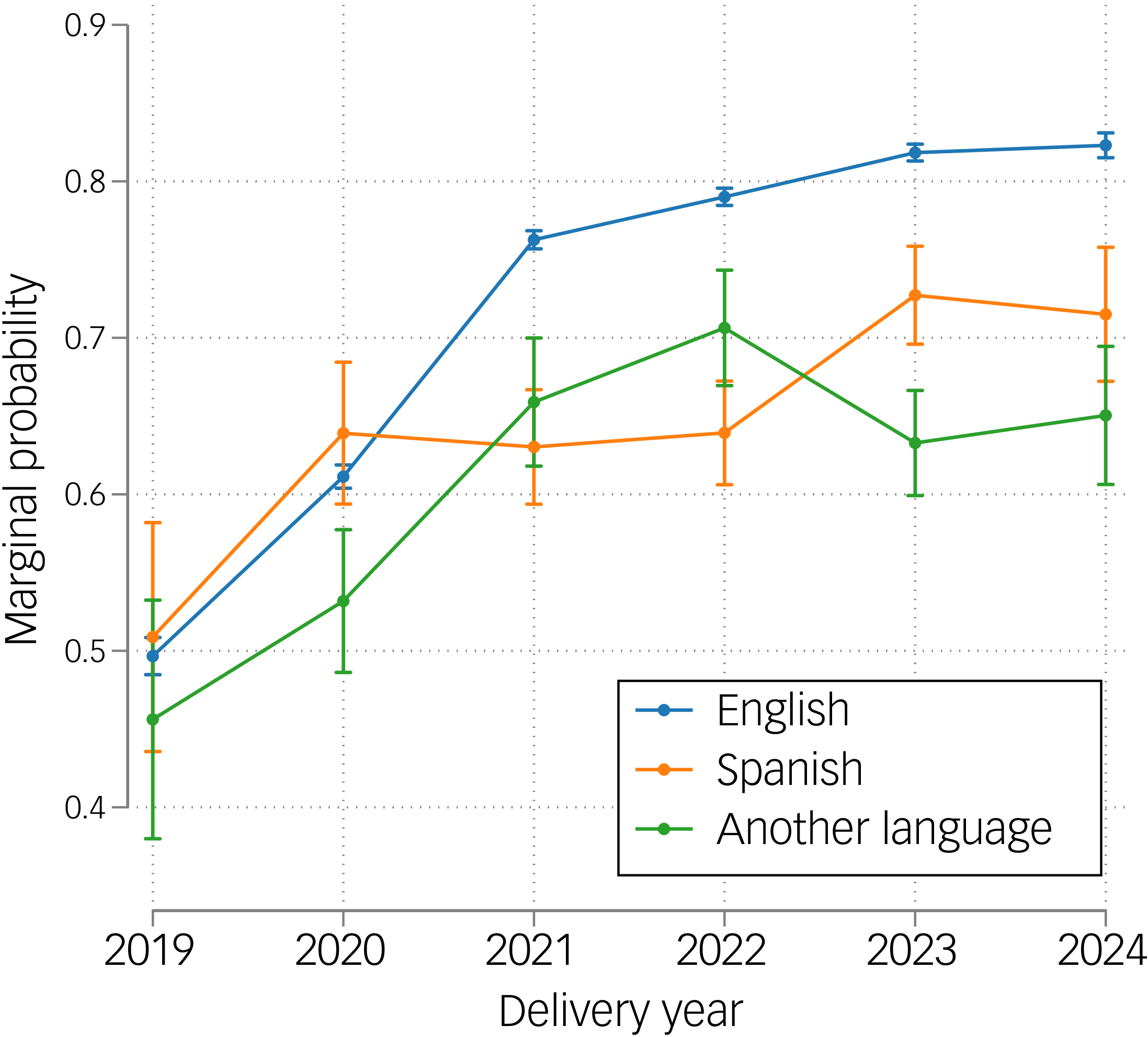
In the model estimating odds of prenatal depression screening, the interaction between language and year was statistically significant (p < 0.001). In 2019, marginal probabilities of prenatal depression screening were similar across groups: 0.50 (95% CI 0.48–0.51) for English, 0.51 (95% CI 0.44–0.58) for Spanish and 0.46 (95% CI, 0.38–0.53) for another language. Probabilities diverged over time (Fig. 1). By 2024, the probability of screening increased to 0.82 (95% CI 0.82–0.83) for English-language preference, 0.72 (95% CI 0.67–0.76) for Spanish-language preference and 0.65 (95% CI 0.61–0.69) for another language preference.
Marginal probabilities of prenatal depression screening by preferred language and delivery year, 2019–2024.

Discussion
Prenatal depression screening increased from 2019 to 2024, but improvements were unequal across language groups, resulting in larger screening gaps by 2024 for individuals with non-English-language preference. Screening probabilities were similar across language groups early in the evaluation period, indicating that disparities emerged as screening expanded rather than reflecting persistent baseline differences. Prenatal depression screening is typically conducted in obstetric care as a primary pathway for identifying perinatal depression and connecting patients to mental health services. Reference Byatt, Xu, Levin and Moore Simas6 From a health-systems perspective, screening gaps represent missed opportunities for earlier intervention, including evidence-based psychotherapy and/or pharmacotherapy, care management and collaborative care. If screening is less consistently completed for people with non-English-language preference, fewer patients may be identified during routine prenatal care, potentially leading to these patients presenting with higher-acuity mental health conditions.
That disparities emerged as screening expanded suggests that implementation improved overall completion without fully addressing language access. Incorporation of screening into performance metrics may increase uptake, but without routine stratification by language preference, aggregate reporting can obscure widening inequities. Screening programmes often use standardised workflows, which may be built primarily for English-preference patients. When interpreter support or translated tools are needed, screening can require additional steps, such as locating validated translations and different documentation processes, increasing the burden for patients and clinicians. The presence of many preferred languages with small counts highlights a structural challenge to equitable screening, as validated instruments may be unavailable for some language groups. The Patient Health Questionnaire-9, the most commonly used depression screening tool, has official translations in over 50 languages, but not all have been validated. 15 Additionally, depression screening is often administered through the patient portal in our system, which was available only in English until Spanish was added in 2023. Finally, small numbers across many languages can limit health system attention to any single group, even when the patient population with non-English-language preference is substantial.
Strengths of this study include the large cohort across multiple years within a diverse health system, and use of EHR-derived measures to evaluate real-world screening implementation. The analytic approach accounted for individuals contributing multiple pregnancies and examined whether the association between language and screening changed over time, which directly addresses how inequities may emerge during programme expansion. A limitation to this research is that screening was identified based on documentation of a screening instrument in the EHR; this may not fully capture whether screening was completed as intended, understood by the patient or administered with interpreter support when needed. Second, language preference recorded in the EHR may not perfectly reflect language proficiency, literacy or need for language support services, and the ‘another language’ category necessarily aggregates heterogeneous language groups. Third, this analysis evaluated receipt of screening rather than downstream steps such as severity of symptoms, follow-up, referral completion or treatment initiation; therefore, we cannot directly quantify how screening gaps translated into differences in mental health service access or outcomes. Finally, results reflect a single health system and may not generalise to settings with different screening workflows or language-access resources.
In summary, prenatal depression screening increased substantially from 2019 to 2024, yet language-related inequities widened as screening expanded. Given that mental health-related morbidity is a substantial contributor to maternal morbidity and that screening is a key entry point to mental health services, equitable screening implementation should be a priority for health systems and psychiatric care. Reference Jang, Ramaiyer, Olson, Voegtline and Esguerra3,Reference Lommerse, Mérelle, Rietveld, Berkelmans and Van Den Akker5 Stratifying quality metrics by language preference and designing multilingual screening workflows may help ensure equitable screening expansion, promoting access to essential perinatal mental healthcare.
Supplementary material
The supplementary material is available online at https://doi.org/10.1192/bjo.2026.12074
Data availability
The data that support the findings of this study are available upon reasonable request from the corresponding author, A.L., subject to institutional data sharing procedures. The data are not publicly available to protect patient privacy. These results have been previously posted as a preprint on MedRxiv.Reference Luff, Rivelli, Akaninyene, Malloy, Mishra and Fitzpatrick16
Author contributions
A.L. contributed to the study conceptualisation and formal analysis, and wrote the original draft of the manuscript. A.R. contributed to study conceptualisation, funding acquisition and supervision, and wrote the original draft of the manuscript. A.N. contributed to data curation and reviewed and edited the manuscript. E.M. and R.M. contributed to study conceptualisation and reviewed and edited the manuscript. V.F. contributed to study supervision and wrote the original draft of the manuscript.
Funding
This research was supported by a Live Well Intramural Pilot Grant from the Advocate Aurora Research Institute (principal investigator, A.R.).
Declaration of interest
None.


 Open access


eLetters
No eLetters have been published for this article.