Introduction
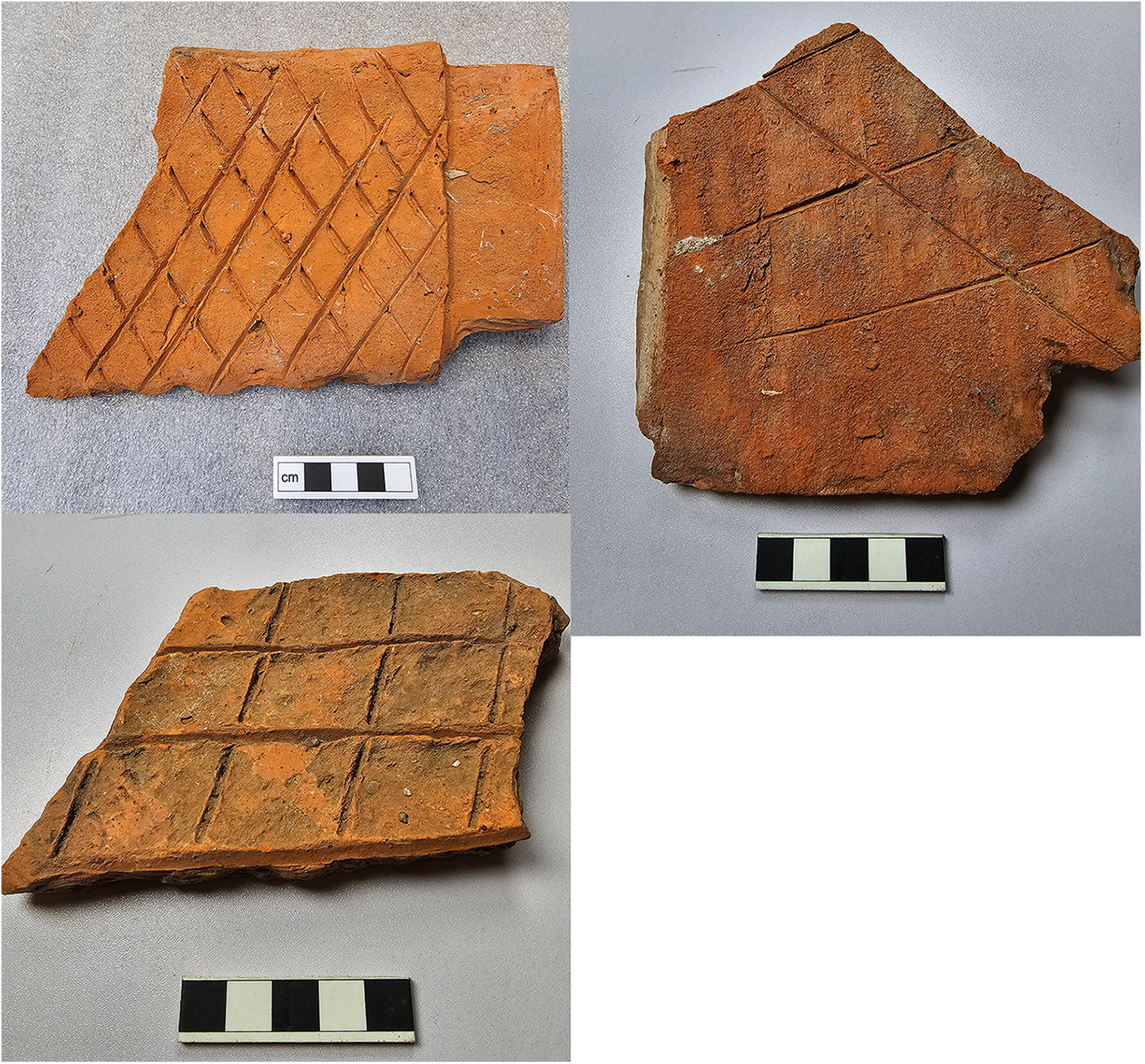
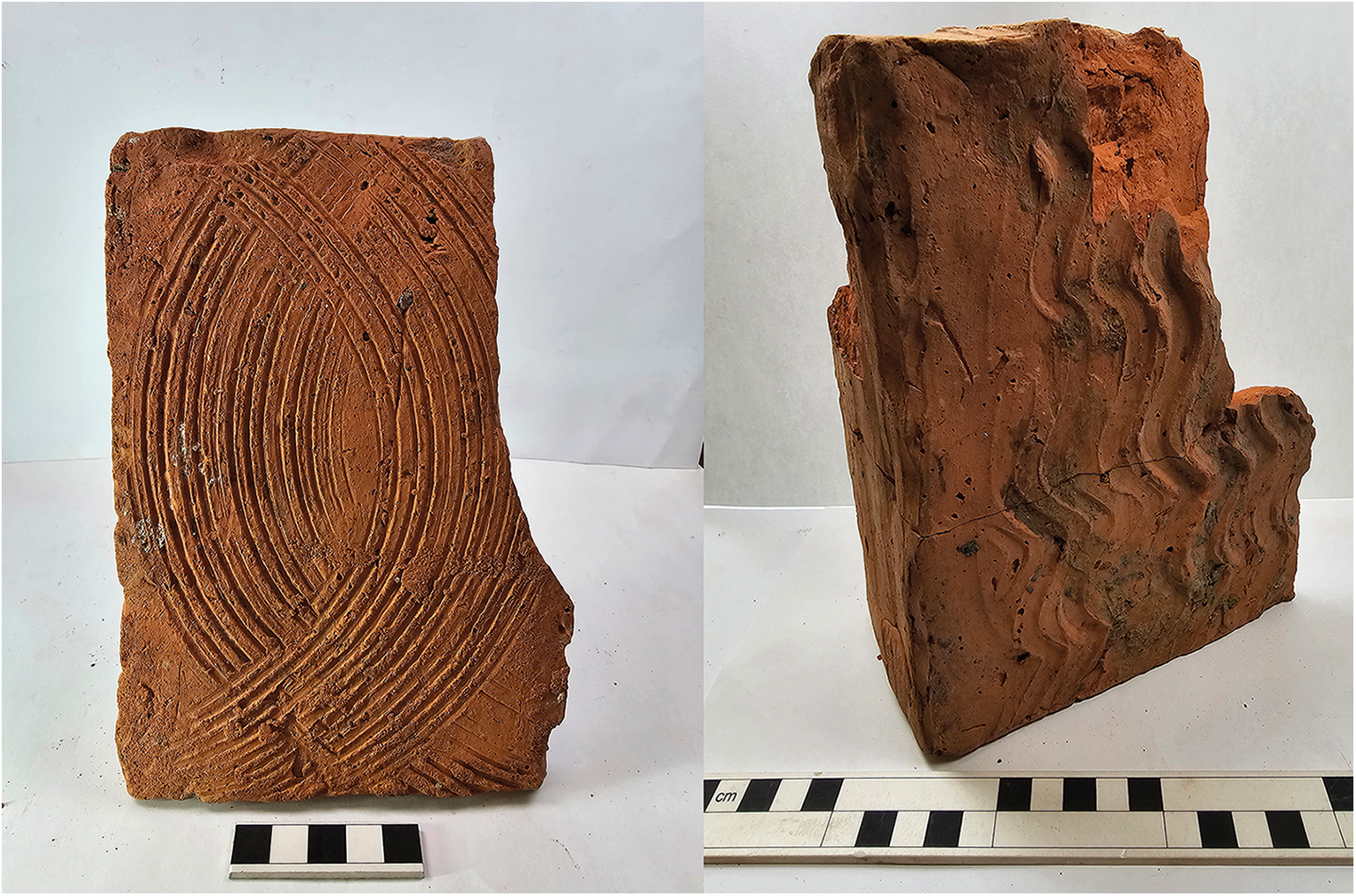
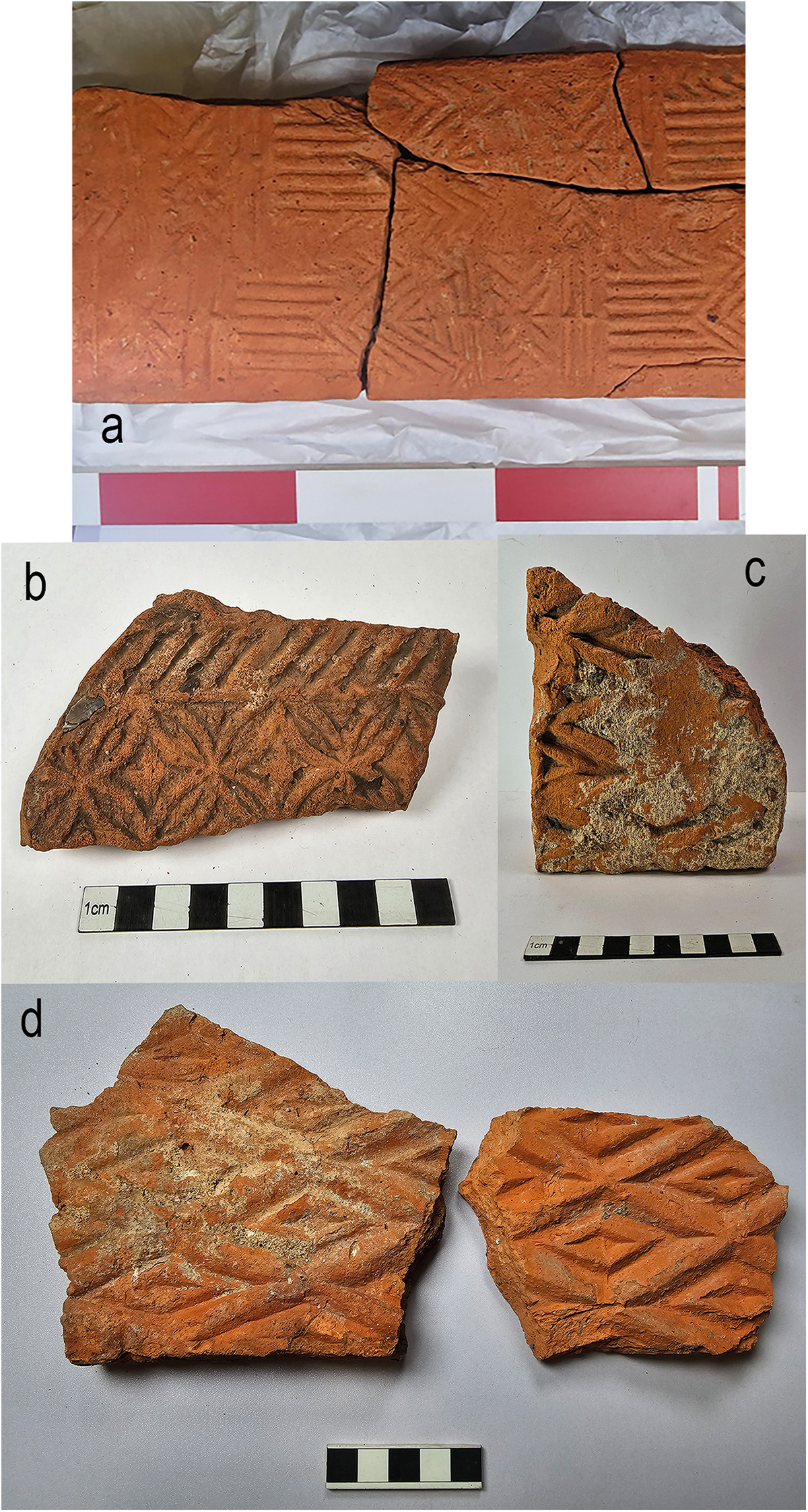
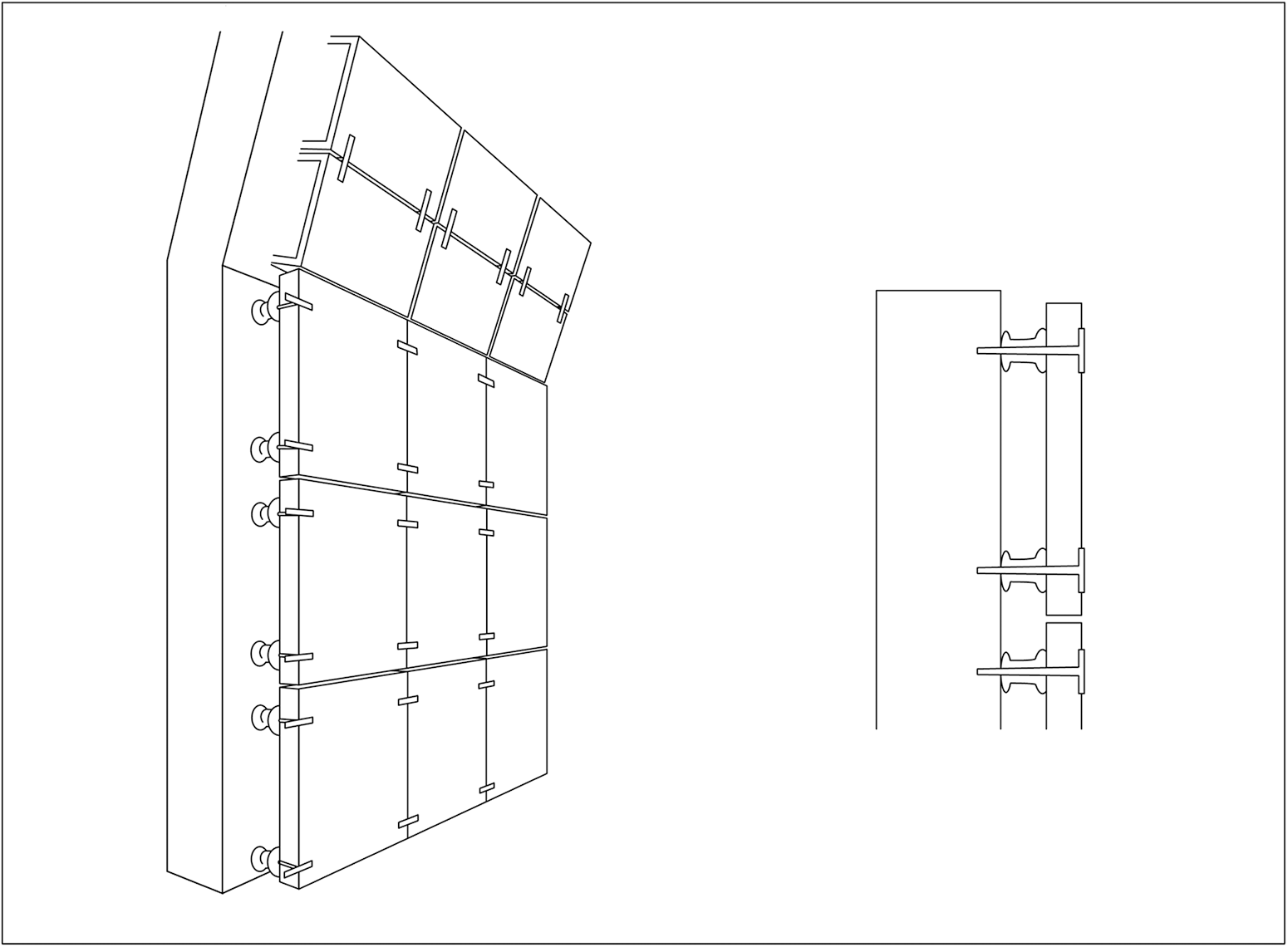
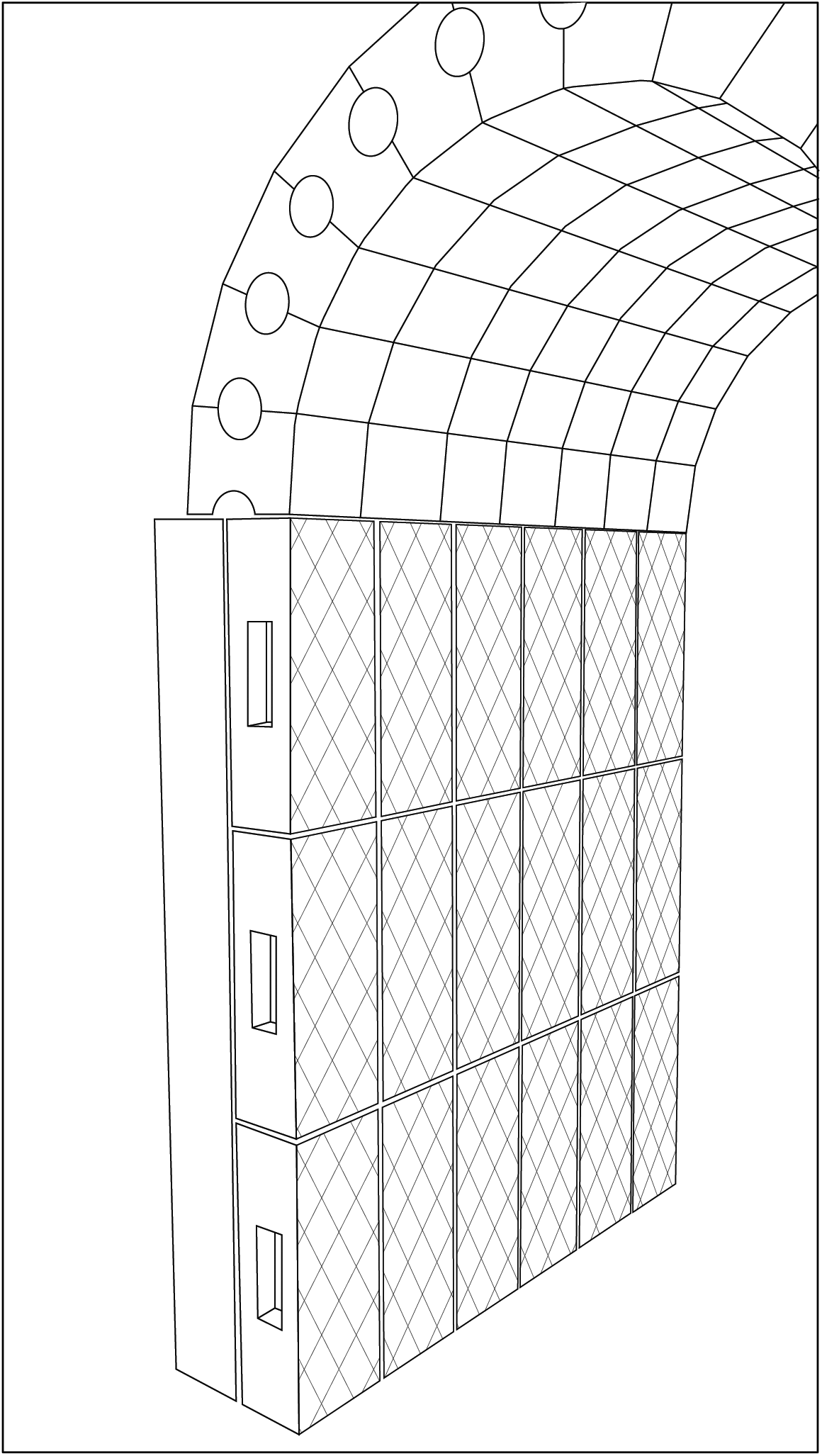
Roman box-flue tiles represented a revolutionary method of carrying hot air from an underfloor hypocaust heating system up the walls of masonry buildings. If the structure was a bathhouse, the tiles often met hollow voussoirs that allowed the heat to be carried over vaulted roof arches. At the time of the Claudian invasion of Britain, box-flues were a relatively new technology and it seems likely that hollow voussoirs were first developed in Britannia itself, perhaps as an adaptation to the province’s climate.Footnote 1 In fact, the installation of box-flue tiles seems not to have been finished in the Central Baths in Pompeii at the time of the eruption of a.d. 79, indicating that they were still a new method at this point.Footnote 2 However, the use of these novel techniques for creating cavity walls seems to have overlapped, at least in part, with older techniques, already well known in the Mediterranean during the Republican era. These include the scored early thin box-flues catalogued in London by Susan Pringle, as well as flat wall-tiles (parietalis or a variant of tegula mammata in the traditional Continental classification) and half box-flues which required ceramic spacer bobbins and iron clamps to mount. The development of cavity tiles from flat wall-tiles and half box-flues to box-flues and hollow voussoirs in Britain (Figs 1–5) will be addressed in detail below.
Examples of scored tiles, including a thin socketed box-flue tile (bottom left).

Examples of fine-toothed and wide combed box-flues.

Examples of relief-patterned tiles right to left, top: (a) Die 4; (b) Die 11; (c); Die 60; bottom: (d) Die 40.

Wall-tiles mounted with spacer bobbins with half box-flues. (Jemima Dunnett after Lancaster Reference Lancaster2012).

Box-flues used with hollow voussoirs (Jemima Dunnett).

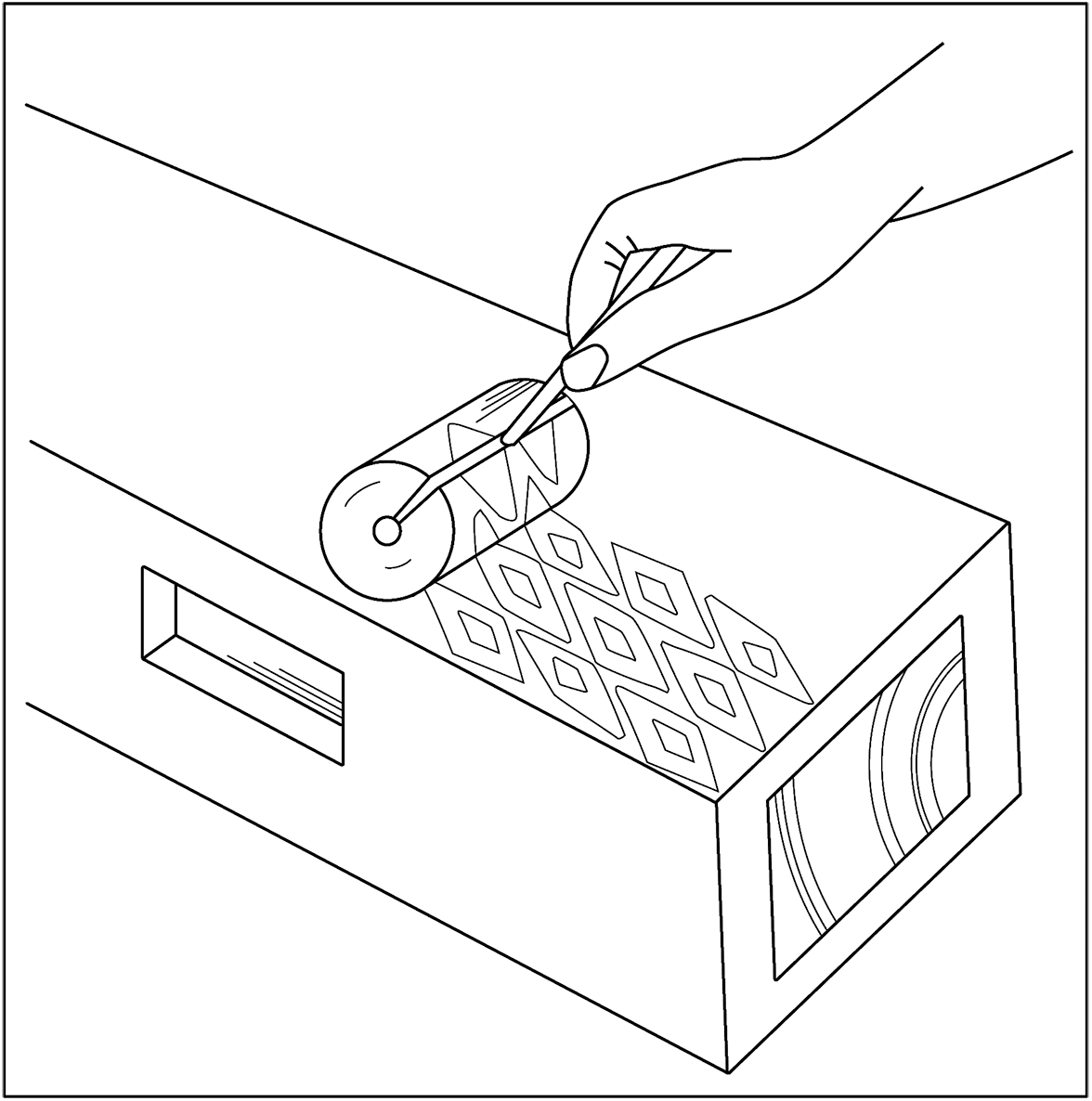
The surface of these tiles could be keyed in various ways: scoring single lines with a sharp tool (often in a lattice pattern); combing parallel lines; and using a wooden roller die with an incuse design to apply a diamond lattice, chevrons or more complex relief patterns (Figs 1–6). Keying allowed mortar to bond effectively to the tile and, despite the rather decorative nature of some of these designs, these keyed surfaces would have been hidden within the mortared and plastered wall, invisible to those who enjoyed the heated rooms. This seems to be unique to cavity tiles of the north-western provinces, as nearly all box-flues observed by the author and members of the BAlnea and THermae research groupFootnote 3 in the Roman heartland, such as central Italy, were without keying. This may be the result of weaker mortar utilised in areas like Roman Britain, compared to the more effective bonding mixtures used in the Mediterranean.
Method of applying relief-patterned keying to a tile using a roller die. (Jemima Dunnett, inspired by Lowther 1948 in Betts et al. Reference Betts, Black and Gower1997).

In London, the thin box-flues are scored and the flat wall-tile and half box-flue tiles are recorded in MOLA’s London data as generally scored and very occasionally combed. Ian Betts stated that he has only recorded scored wall-tiles and half-box-flues during his 40-year tenure as building material specialist at MOLA. Some box-flues are not keyed,Footnote 4 but these are very rare and are only found in early Roman deposits in London.Footnote 5 A second-century box-flue tile from Bar Hill, Scotland, seems to be scored on one side,Footnote 6 and this suggests that the keying on some tiles was meant for the backing for plaster only as the tiles themselves would be held in place with T clamps.
Previous studies of the chronology and significance of wall cavity tiles, in London and beyond
As Britannia’s largest urban centre, Roman London has been a major focus of research on specialist wall cavity tiles. Hundreds of assemblages have been studied, contributing to site-by-site publications and underpinning a number of synthetic publications on related topics, including Susan Pringle’s survey of potentially early wall cavity tiles across London.Footnote 7 Pringle’s survey included especially wall tiles, half box-flues and smaller thin-walled box-flues.Footnote 8 Both Susan Pringle and Ernest Black catalogued thin box-flues as among the earliest tiles to be used with hypocausts in Britain, with Pringle suggesting an early military connection to their production in pre-Flavian London.Footnote 9 The thin box-flues are often found with other forms of early tiles in both Italy and Britain and likely worked in tandem with wall-tiles and/or half box-flues.Footnote 10 Some variants of these early thin box-flues have cut-out vents on the front keyed surface of the tiles and may have been used as recessed chimney flues and/or as horizontal channels on the top of wall cavities which allowed the air to escape through the chimney.Footnote 11
The corpus of relief-patterned tiles compiled by Ian Betts, Ernest Black and John Gower remains the most complete survey of wall cavity tiles keyed with roller-stamps in England.Footnote 12 This work analysed all roller dies known at the time, the fabrics in which the tiles were produced and potential production sites in eight counties and explored the geographical and chronological distribution of relief-patterned tiles across southern Britain.Footnote 13 London finds accounted for the majority of relief-patterned tiles recovered, with 132 sites yielding these tiles from central London alone.Footnote 14 The bathhouses at Huggin Hill, Cheapside, Cannon Street and Southwark therefore played a massive role in the development of typologies and dating frameworks. Summarising the evidence, they concluded:
In London, Colchester and St Albans rollers were used to key daub walls before the Boudican revolt of a.d. 60/61. On all these sites roller-keying of fired ceramic tile only occurs after the Boudican fire. When fired ceramic tiles were first keyed by rollers is still uncertain. Certainly, it is no earlier than the late first century. The only exception may be die 54 which is associated with pottery dated a.d. 65–85. In London the keying of clay-walled buildings with rollers continued after the Hadrianic fire of a.d. 120/125, but had apparently ceased by the late second/early third century. The keying of fired ceramic tile using rollers seems to have ceased around the same time.Footnote 15
An updated distribution of roller dies has been complied by the author with data from the MOLA database that builds on the corpus by Betts et al. Reference Betts, Black and Gower1997. Supplementary Material Appendix 2 shows the up-to-date list of dies in London.
Keyed daub
Work regarding relief-patterned daub by authors such as Miles RussellFootnote 16 and Ian Betts has identified roller-stamped daub, a feature that allowed clay walls to bond better with the mortar backing of wall plaster, as a pre-relief-patterned tile phenomenon. This type of keyed daub has been discovered among the Boudican destruction remains in Colchester,Footnote 17 St Albans and London.Footnote 18 This method seems to have carried on into the second century, with fragments recovered in London from the Hadrianic fire-related contexts.Footnote 19 Roller-stamped daub was also recovered from post-Hadrianic fire deposits,Footnote 20 and deposits dating to after the post-a.d. 140s.Footnote 21 Furthermore, evidence of roller-stamped daub has been recovered from second-century contexts in France.Footnote 22
There has been speculation that roller-stamped daub was invented in Roman Britain,Footnote 23 although this is debatable due to evidence of chevron-patterned keyed (likely scored) daub from other Roman buildings, as in Cologne, Germany, which dates to the Augustan period,Footnote 24 and the evidence of keyed mortar over masonry walls such as in the House of the Messii, Vaison-la-Romaine, France.Footnote 25 It is not impossible that a tradition of keying through scoring could give rise to roller-stamping in other areas of the north-western provinces.
The new debate
A very different perspective on these relief-patterned tiles has arisen from recent work in Hampshire, in particular Sara Machin’s doctoral study of the ceramic building material from Silchester and excavations led by Michael Fulford at the site of Little London, Pamber, with one of the kiln-sites identified as probably producing relief-patterned tiles.Footnote 26 The production of relief-patterned box-flue tiles using ‘diamond lattice’ dies 38, 39, 54 and 68 has been confirmed in a range of distinctive Little London fabrics. Relief-patterned tiles in these fabrics have a wide distribution in central southern and south-western England, from Gloucestershire to West Sussex.Footnote 27 This industry also produced a range of other specialist brick and tile forms, including tiles with imperial stamps of Nero. These stamped tiles provide important dating evidence for the Little London industry, which Fulford and Machin have used to argue for a short, predominantly pre-Flavian chronology for tile production at the site. Further evidence includes Claudio-Neronian pottery produced in adjacent kilns, the stratigraphic distribution of Little London fabrics at nearby Silchester, the scientific dating of the kilns, and the emerging dominance of the more ubiquitous local London clay fabric in Flavian Silchester that hinted at a decline in the Little London tile industry.Footnote 28
Based on these data, Fulford and Machin radically challenged the previously proposed chronology of relief-pattern tiles of c. a.d. 70–160.Footnote 29 Their pre-Flavian date for the Little London tilery was complemented by a proposed parallel redating of the less well understood kilns producing relief-patterned tile at Minety, Gloucestershire, where some of the same dies were used. This, too, was based upon revised dating of pottery and the presence of some Minety fabric tiles in early contexts at Silchester.Footnote 30 They argued that the shared use of diamond lattice die designs in these tileries, and more broadly across southern England, implies some overarching organisation, and inferred the existence of similar early tileries producing relief-patterned tiles in south-east England. In this model, the fact that Little London products hardly penetrated the south-east perhaps indicated the region was already served by other producers.
Fulford and Machin’s proposed redating of all relief-patterned tiles to roughly the pre-Flavian period, not just those produced at Little London, and their use of these tiles as proxy for the distribution of the wider suite of ceramic building material (hereafter CBM) produced at Little London, led them to argue for a rapid spread of ‘Roman’-style masonry buildings across southern Britain, much earlier than had normally been accepted. They related the production of these tiles to state building projects and to loans provided by the provincial government and other lenders to support the building of ‘Roman’ masonry buildings, such as bathhouses, by the local population during the early post-invasion era.Footnote 31
This reading has understandably attracted considerable interest because of its far-reaching and potentially exciting implications. Simply put, the newly proposed chronology for relief-patterned tiles has begun to impact new post-excavation analysis and the author is aware of several archaeologists working in southern Britain who have adopted the pre-Flavian chronology or are exploring its dating implications for their sites. However, other specialists are more cautious and further work is necessary before one can accept Fulford and Machin’s conclusions in full.
The early production hypothesis challenged
The swift publication of the Little London kilns in 2022 allows for a closer examination of the primary evidence and alters the picture presented in the 2021 Britannia paper in some small but significant ways. Machin, with Fulford, still argues that the evidence ‘makes it clear that relief-patterned and scored flue-tile were made side-by-side in the pre-Flavian period’ and that this necessitates ‘bringing forward the date for the start of the production of relief-patterned tiles from c. a.d. 75 by between 15 years (production from c. a.d. 60) and 25 years (production from c. a.d. 50)’.Footnote 32 However, the overall dating evidence presented is less precise and has a slightly later emphasis than previously argued, suggesting that the Little London kiln site may have had a somewhat longer chronology.Footnote 33 Indeed, Fulford concludes that ‘while there can be no doubt of Claudian/Neronian–early Flavian production of ceramic building material, there remains the possibility that the production of the commoner forms, which account for two thirds of the wasters, could have continued for longer’.Footnote 34 The reason why this possible longer chronology only applies to certain types of Little London tiles is not explained.
Fulford and Machin suggested in 2021 that relief-patterned tiles started in the a.d. 50s–60s and ended abruptly in the late a.d. 60s or early 70s.Footnote 35 However, Fulford’s 2022 publication on the Little London kilns states that the ‘brick and tile production at Little London appears to have been limited to a short span of some 30 or 40 years, c. a.d. 50/60–c. a.d. 80/90.’Footnote 36
This is well within the traditional date range for the appearance of relief-patterned tiles in London, suggested by Betts et al. Reference Betts, Black and Gower1997. Yet even this early start date and short lifespan requires further examination. Apart from the Neronian stamps, Fulford states that the chronology is based on pottery typology, datable pottery, radiocarbon dating and archaeomagnetic dating.Footnote 37 However, none of the four methods produced solid evidence for a short-lived industry but instead carry the local CBM production date towards the late first and/or early second centuries, a production period that overlaps with a.d. 70 and within the traditional date of the local relief-patterned tile industries.
Archaeomagnetic dating was undertaken for CBM kiln 1, but this yielded a medieval date and was likely contaminated at a much later time.Footnote 38 However, Bayesian modelling of the radiocarbon dates, in which only a few were taken directly from the kilns, yielded results that contradict the early and short-term CBM production:
• Activity began in cal. a.d. 1–125 (95% probability);
• Activity began in cal. a.d. 55–120 (68% probability);
• Activity ended in cal. a.d. 80–225 (95% probability); and
• Activity ended in cal. a.d. 85–150 (68% probability).Footnote 39
These results suggest that CBM production, including relief-patterned tiles, falls within the traditional Flavian to second-century date range.
The pottery assemblages recovered from Little London offer the strongest support for the short lifespan thesis, yet even these results seem to contradict each other. The pottery produced at Little London, described as Claudio-Neronian in 2021, was given a Neronian to early Flavian date in the monograph. Yet the datable pottery included a small amount of Trajanic pot sherds from Trench 2, evidence of continued activity on site well into the very late first and early second century, although these may not be associated with the local kilns.Footnote 40 The overlapping of pottery and CBM production need not be precisely contemporaneous. Pankhurst et al. note this: ‘Judging by the scarcity of pottery finds in its fill, it is just possible that Kilns 1 and 2 were abandoned either before pottery-making began, or continued after it had ceased, the latter more likely.’Footnote 41
Fulford states that while Little London pottery has a Neronian to Flavian lifespan, radiocarbon dating suggests CBM production may have continued into the end of the first century.Footnote 42 This again brings the end date firmly within the traditional London relief-patterned tile chronology.
The pottery typology also focused on the production of early Roman ring-necked flagons, which Fulford suggests ceased ‘no later than the Flavian period’.Footnote 43 The making of these vessels does not establish a strong enough link to the CBM production at Little London. Timby notes the scarcity of Little London fabric pottery in Silchester;Footnote 44 this particular type of vessel is rare at both SilchesterFootnote 45 and Little London. The evidence at the Little London kilns included small quantities recovered from Ditch 2101, slot [2022] and is only associated with Kiln 3 and 4.Footnote 46 It is possible that ring-necked flagons were produced only in small quantities at Little London and its short lifespan may indicate low consumption of the product. This makes the cessation of production of the vessels remote from the production dates of relief-patterned tiles at Little London.
Early start date and Neronian stamps
The Neronian stamps were identified on tegula tiles from Little London.Footnote 47 No relief-patterned tiles or wall cavity tiles of any kind were found to have been stamped and it is possible that there was a delay between the production of tegulae and the production of relief-patterned tiles. This phenomenon is apparent in London, where early local brick and tile fabrics entered the stratigraphy decades before the appearance of relief-patterned tiles.
In relation to scored box flues, as the data below will show, these have an early inception but are hardly restricted to the pre-Flavian period as they are produced contemporaneously with other forms of keyed flue tiles.
Little London fabrics
Fulford’s suggested a.d. 80/90 terminus ante quem aligns with the radiocarbon chronology and is likely to be justified by the early Flavian termination of pottery production, although as mentioned previously, the CBM and pottery production need not be contemporary. Fulford and Machin originally suggested that CBM production at Little London ‘does not appear to have continued beyond the early Flavian period, when brick and tile in a distinctive “London Clay Formation” fabric came to dominate the Silchester assemblage’.Footnote 48 Machin and Fulford further explored the supposed short lifespan of the local fabric in Silchester Insula IX and concluded that:
Of the relatively small number of pieces of CBM retained from Claudio-Neronian (Period 1) contexts at Insula IX, half by count, 28 per cent by weight, is in Fabric Groups 3 and 4 (Machin Reference Machin2020). Representation of retained Little London fabric groups in Insula IX decreases in the following period, c. a.d. 85–125/50, to 36 per cent by count (Machin Reference Machin2018, 203) and, if not already residual by the end of the first century, its occurrence is certainly residual thereafter.Footnote 49
I would question the validity of the phasing of Little London fabrics based on the evidence presented by the Silchester CBM fabrics. Machin stated that groups of SILCBM3/4 were Little London products during her 2018 analysis of the Little London fabrics.Footnote 50 This is augmented by the recent investigation which concludes that SILCBM5 is in fact also a Little London fabric, albeit a mixture of Windlesham Formation and London Clay Formation sources.Footnote 51 The SILCBM5 data are not accounted for in Machin and Fulford’s later figures. This raises the percentage of Little London fabrics in Insula IX period 2 from 36% to 46%, compared to the 37% of London Clay Formation products. The percentage of Little London fabric groups SILCBM3/4 and SILCBM5 peak in Period 1, a.d. 44–80, of Insula IX at 61% of the total fabric count.Footnote 52 A drop to 46% during Period 2, a.d. 80–125/50, does not necessarily suggest a cessation of production of local material but rather shows the growing popularity of London Clay Formation products in Silchester’s building works.
Additionally, as percentages are influenced by the composition of the total assemblage of CBM fabrics a decrease of local fabrics to 46% will not reflect the total amount of fragments of Little London material in any given period. The quantity of all three Little London CBM fabrics from Insula IX increases between Period 1 (64 of 105 fragments) and Period 2 (69 of 150 fragments).Footnote 53 This puts a higher Little London CBM fabric count in Period 2 compared to Period 1, before a clear reduction occurring after a.d. 125.Footnote 54 This then directly contradicts the early and short CBM production argument. Therefore, without additional quantified datasets, the current Silchester Insula IX data do not conclusively demonstrate that supply from Little London ceased in the early Flavian period.
Fulford’s slightly revised conclusion argues that CBM production at Little London took place over a period of ‘some 30 or 40 years, c. a.d. 50/60 – c. a.d. 80/90’.Footnote 55 This date, even if accepted, is starting to overlap with the conventional date range of relief-patterned tile production and deposition from elsewhere, as shown below. Therefore, although it is possible that the relief-patterned tiles from Little London may have been part of the same production phase as the stamped Neronian tiles, there is no specific evidence that supports this conclusion. This assumption should therefore be treated with caution until further archaeological evidence from other sites is collected to strengthen this hypothesis.
Relief-patterned tiles made at Little London and overall dating of such keyed tiles elsewhere
The Little London kilns sit towards the western edge of the overall distribution of relief-patterned tiles. Work by Machin and Fulford has helped clarify the distribution of tiles made in Little London fabrics. What is interesting is that the associated roller dies (38, 39, 54 and 68) have limited overlap with the range of fabrics and dies found in London and many other parts of south-east and central England. While ideas and even tile makers may have moved between workshops, this suggests that the ceramic building material industry was polycentric. It is not clear why one must assume that all workshops followed exactly the same chronological trajectories in their use of different keying techniques. Indeed, it should be stressed that roller dies were not a uniform feature of an earlier homogenous Roman industry introduced after the Claudian invasion and may even have developed and then spread within Britain.
A major problem for this hypothesis, acknowledged by Fulford, is the lack of good evidence for the early use of relief-patterned tiles in London despite the scale of excavation and the very considerable quantity of Roman CBM known from the city. This, he suggests, might be due to the impact of circular dating in which previously proposed late dating for relief-patterned tiles had possibly disguised early contexts.Footnote 56 This paper will return to this matter at length below, but it is worth underlining just how widespread relief-patterned tiles are in London, where they have been found at over 300 sites and are associated with some important buildings.
Reviewing the overall distribution of these tiles and the dating evidence, which is often based on ex situ residual finds, Fulford and Machin argued that there was a lack of good evidence for the use of relief-patterned tiles beyond the late 60s or 70s A.D. and suggested that this keying technique had been lost or abandoned because of a massive disruption of the CBM industry during the Neronian or early Flavian period. To explain the rapid abandonment of roller dies, Fulford and Machin invoked widespread disruption of the industry caused by mismanagement of local finances, the Boudican revolt and the civil wars that followed the end of the Julio-Claudian dynasty. There can be little doubt that these events will have had profound effects on Roman Britain, but it seems unlikely that relief-patterned tile production ended abruptly and contemporaneously at all sites across Britain during this period of crisis, or that the skill of making roller dies had simply been forgotten after the dust had settled. Indeed, the survival of this roller die technology, or at least the capacity for it to be reinvented or reintroduced, is demonstrated by its continued use in other contexts (see below).
Analysis of Roman London’s data
One of the key aims of this article is to explore the relief-patterned tile dating issue by revisiting the data from Roman London. This represents the most important subset of the large body of unconsolidated and unsynthesised CBM data collected by both research and large-scale developer-funded excavations in England, especially since the mid-1980s. This evidence holds the potential to test the chronology of the relief-patterned tiles, the production and use of other wall cavity tiles and to explore the way that the industry was organised. In London, the analysis and publication of large sites and the growing mass of digitally accessible data allows for a review of the dating proposed by Betts et al. and Fulford and Machin. Below, this paper shall try and answer the following questions:
• Is there any evidence for the use of relief-patterned tiles in Claudio-Neronian London?
• Has the dating of relief-patterned tiles been influenced by circular logic as Fulford suggested?
• What is the end date of relief-patterned tile production and use?
• Is it legitimate to treat the distribution of relief-patterned tiles as a proxy for the full range of wall cavity types, or is their variable occurrence in assemblages related to architectural traditions, different building types or technological change?
• Does reassessment of wall cavity tile data from London support or challenge established chronologies for the use of wall cavity tiles in London?
Analysis of the chronology of wall cavity tile deposition in London using the MOLA database
The archaeology of Roman London presents significant challenges and opportunities for the would-be synthesiser, many of them associated with taphonomy and with the scale, complexity and fragmentation of the archaeological record. Some of these issues will be discussed in more detail in a forthcoming publication,Footnote 57 but some key points will be addressed here for context.
There is no single comprehensive accessible database of all ceramic building material from London. However, the MOLA post-excavation database represents an extremely large and valuable research resource. This includes records of all ceramic building material from the Roman town excavated or analysed by MOLA and its predecessor organisations since the early 1990s, produced using standardised methodologies for recording CBM fabrics and forms. As of July 2024, this comprises 4,082 records for wall cavity tiles (6,684 fragments; 1,230.734 kg), associated with 3,658 archaeological contexts across 253 separate excavation archives. Most of these sites were excavated after the early 1990s, but eight of the excavation archives also appear in the corpus of relief-patterned tiles previous analysed by Betts et al. Reference Betts, Black and Gower1997, contributing 55 records to the present dataset.Footnote 58 Form and fabric data are available for all 4,082 records, but 625 lack reliable records about the types of keying present due to either the degree of abrasion or ambiguities in the digital records. Because the London Museum Stores were closed at the time of writing, it was not possible to return to the original recording sheets or physical archive to resolve these ambiguities; around 85% of the available digital records have details of keying type and, while not truly comprehensive, this represents by far the largest dataset of its kind ever to be analysed from Roman Britain.
There are some general methodological issues to address before analysing these data, some of which have previously been surveyed by Betts et al. Reference Betts, Black and Gower1997 and by Fulford and Machin.Footnote 59 To date the primary use of wall cavity tiles, one would ideally encounter them in situ within well-dated buildings, or at least within debris that can be confidently associated with a specific building.Footnote 60 Unfortunately, such contexts are quite rare. Much building material occurs residually or is redeposited away from the location of its initial use. Even where tiles are associated with a building there sometimes remains the possibility that they have been recycled from an earlier structure or introduced as part of a later stage of construction, repair or modification.
Many box-flue tiles are thinner and more prone to breakage than other more commonly reused tiles, such as tegulae which often appear in floors and walls. They might still have been reused as heating tiles if recovered unbroken, although effective recycling may have been complicated by the way these tiles functioned as sets; vertical stacks of cavity tiles needed to have similarly sized cross-sections and aligned vents to allow movement of hot air between them. For example, in situ relief-patterned box-flue tiles from Lullingstone villa’s baths, built prior to the late second century,Footnote 61 or c. a.d. 180 according to Mackenzie,Footnote 62 and at Billingsgate baths, London, dated to the late second to third century, have previously been regarded as evidence for re-use as both are from contexts beyond the traditional a.d. 160 end date of the use of such tiles.
First, I will undertake a broad-brush analysis of the wall cavity tile data recorded in MOLA’s database. The scale of the data and the complexity of the many different archaeological sequences preclude a comprehensive contextual analysis of every fragment. I accept that a substantial portion of these tiles may either be reused or may be ex situ and potentially redeposited or residual in later deposits. As such these data should not be used uncritically to date the production or primary use of these tiles. However, in many instances they may be deposited relatively soon after they were removed from their primary context, or if residual might still be associated with contemporary material that has followed a similar taphonomic pathway. Moreover, other scholars have proposed that it should be possible to recognise residual material amongst sufficiently large inventories of context dates, based on a fall-off in the numbers deposited after new material ceases to enter the system.Footnote 63 In fact, some of the results below reveal striking differences between the chronological distribution of different tile types and show potential to explore broad differences in the use and deposition of ceramic building materials.
The analysis uses two approaches to the contextual dating of wall cavity tile types and keying methods from London. A large-scale aoristic dating synthesis uses 3,109 records from 2,772 contexts across 214 sites which have associated dated pottery assemblages. This analysis compares the date of Roman pottery assemblages found in association with various types of wall cavity tiles and different keying methods. A comprehensive stratigraphic analysis of all 3,658 contexts in our dataset is not feasible; instead eight large sites (grouped into four case studies) were chosen for the size of their assemblages and the reliability and resolution of their phasing. Together these four case studies account for 1,120 wall cavity tile records (27.4% of the total MOLA dataset). These case studies allow us to consider context dates and types together, explore different site formation processes that influenced the deposition of wall cavity tiles and also to look for evidence for geographical variation across the city.
Approach to aoristic analysis of context pottery dates
with Michael Marshall (see Supplementary Material Appendix 1 for methodological considerations for the analysis of the tile dating deposition using the MOLA database)
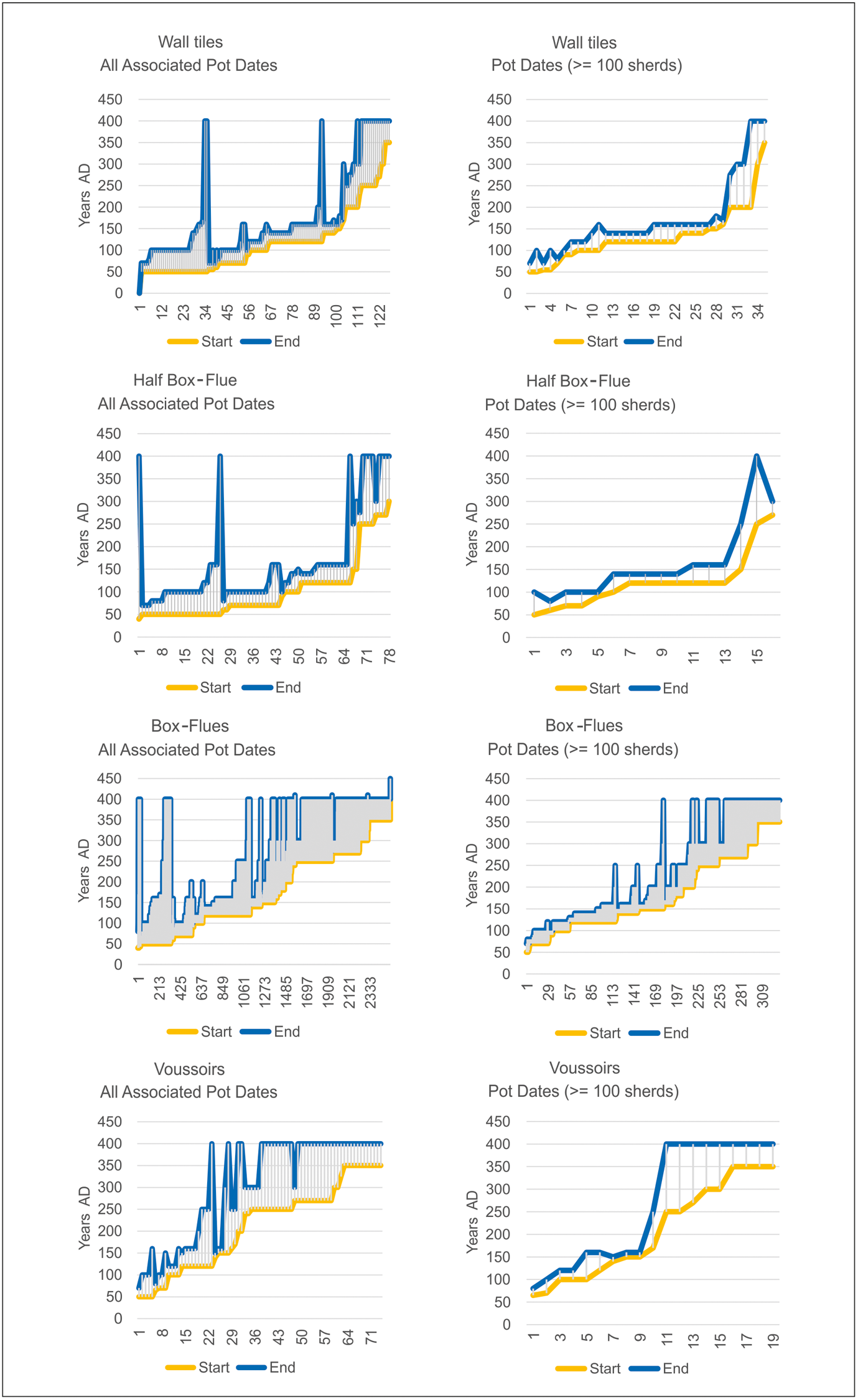
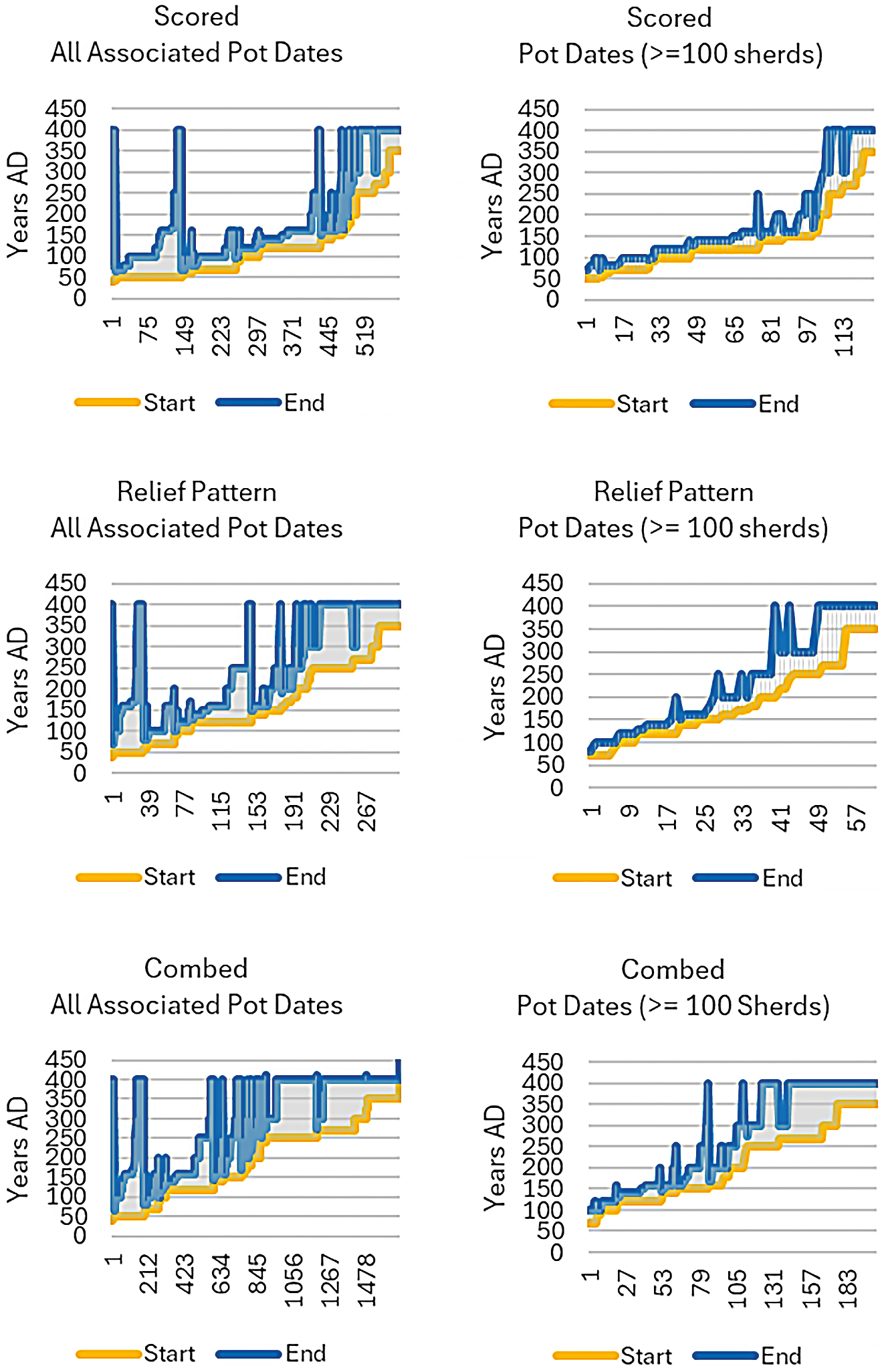
All available Roman pottery dates for contexts producing wall cavity tiles have been ordered chronologically and plotted graphically for each different kind of wall cavity tile (Fig. 7) and each different keying technique (Fig. 8). Similar approaches to visualising inventories of chronological data are very common,Footnote 64 and in this instance, where the data for each are drawn from the same underlying sample of archaeological site archives, major differences in the distribution of dates on the resulting graph should reflect real chronological variations. Separate charts plot all associated Roman pottery context dates and a subset of dates based only on large or very large assemblages (100+ sherds). Focusing on these larger assemblages reduces the amount of data but also results in fewer broad dates, often assigned to smaller assemblages of pottery sherds, and reduces the number of contexts with potentially intrusive or residual pottery included in the analysis.
Summary visualisation of Roman pottery context dates associated with different kinds of wall cavity tiles (all contexts with pottery dates; only contexts dated based on 100+ sherds).

Summary visualisation of Roman pottery context dates associated with different kinds of wall cavity tile keying (all contexts with pottery dates; only contexts dated based on 100+ sherds).

Comparisons between sets of dates can be facilitated by aoristically combining these pottery spot date datasets and representing each as a simplified probabilistic frequency density curve. Similar techniques have been quite widely used, including in other work on London.Footnote 65 This approach divides the value of each context with pottery spot dates over chronological bins of equal length that fall within its date range. Standard bin sizes of five years were selected because the different dates proposed for the start of relief-patterned tiles are relatively close together and because intensive research on London’s early pottery has allowed for relatively tight chronological resolution, usually expressed to the nearest five years.Footnote 66 To work through an example, a context spot-dated to a.d. 50–70, spanning 20 years, would be divided over four five-year bins (50–, 55–, 60–, 65–) contributing a probability mass of 0.25 to each because of the c. 25% chance that the true date of the context lies within that range. After assigning the values of all context pottery dates the cumulative totals for each of these bins are plotted, visualising the probability density distribution of dates from all context pottery assemblages associated with the different kinds of wall cavity tiles.
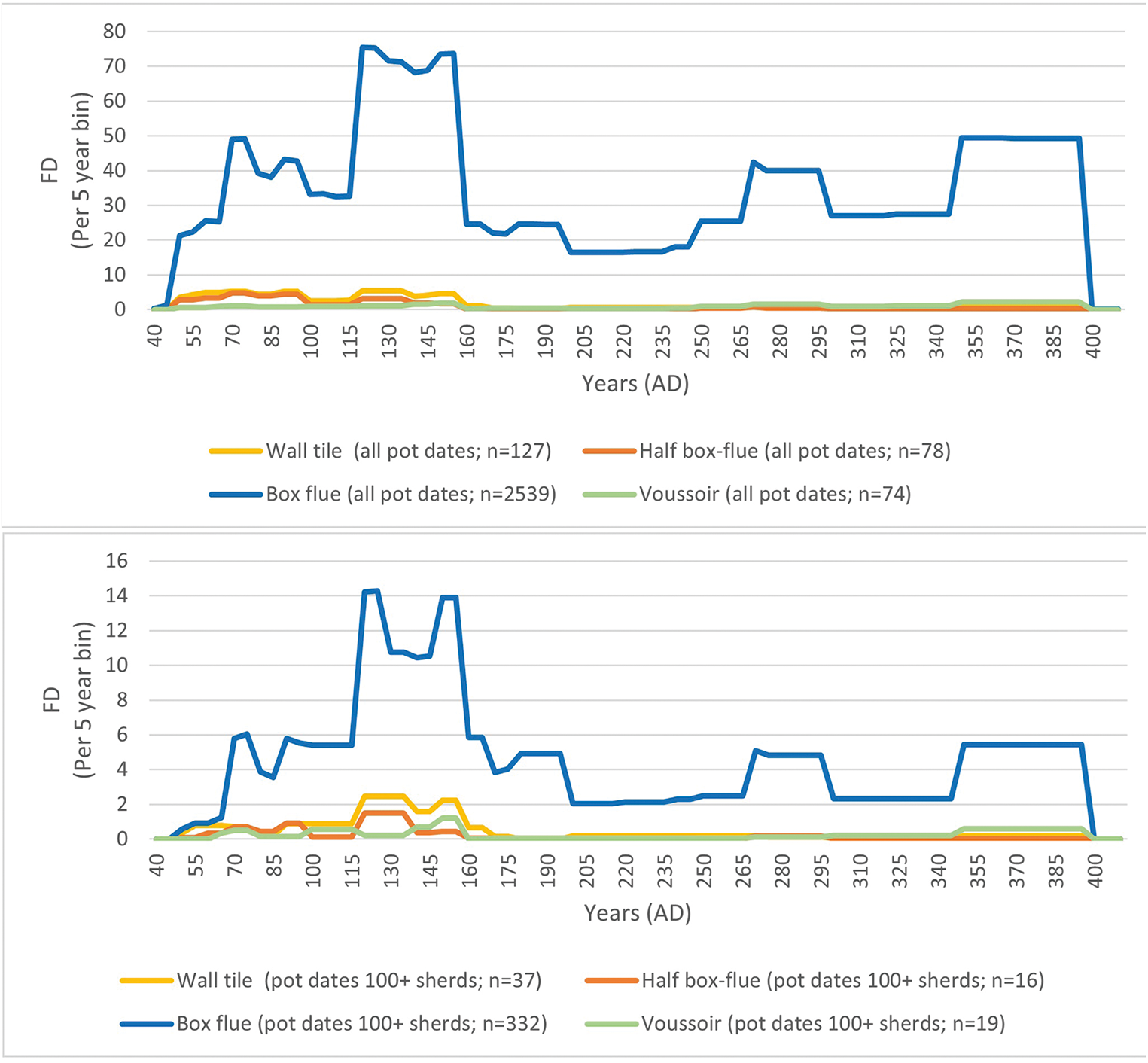
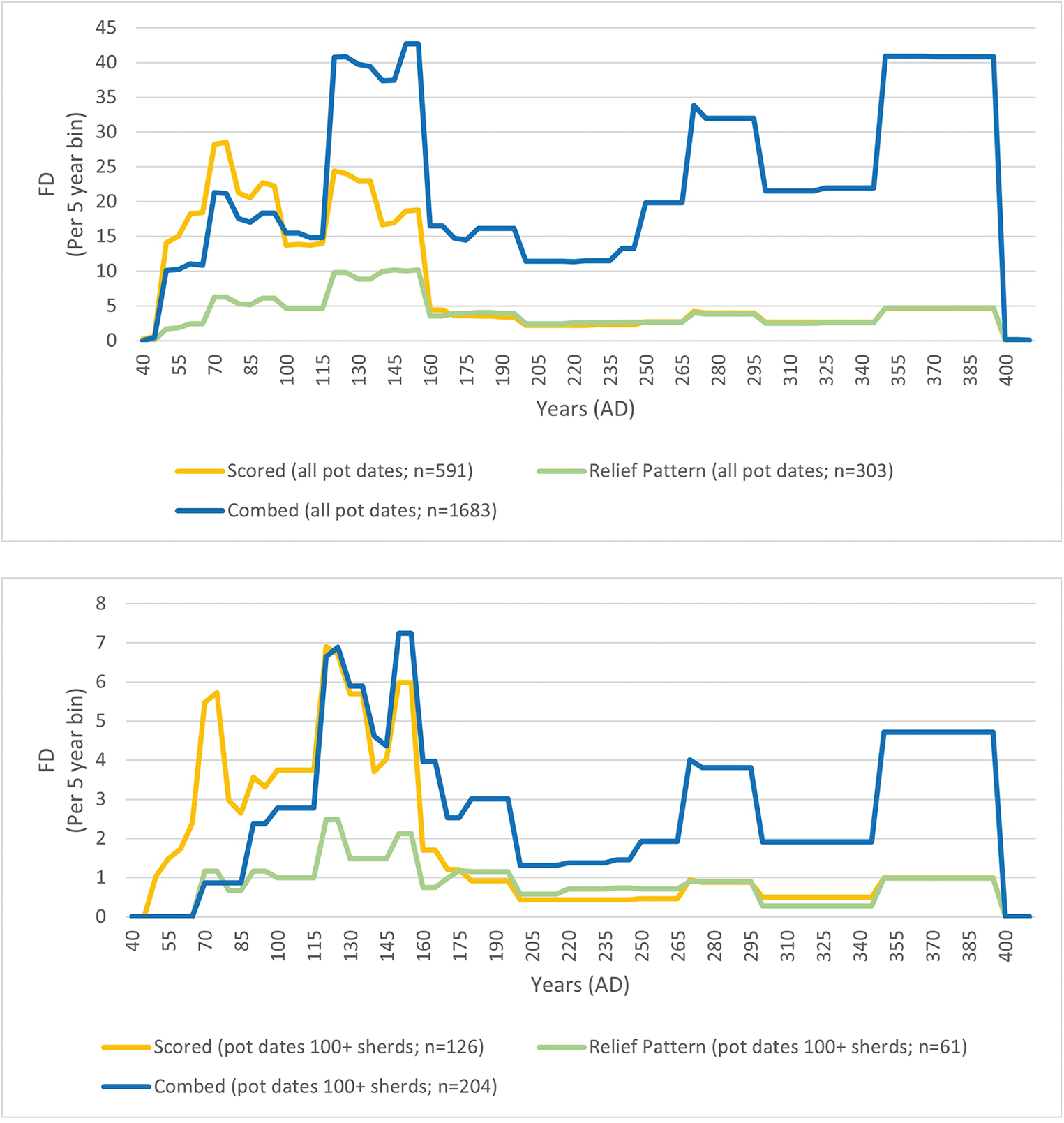
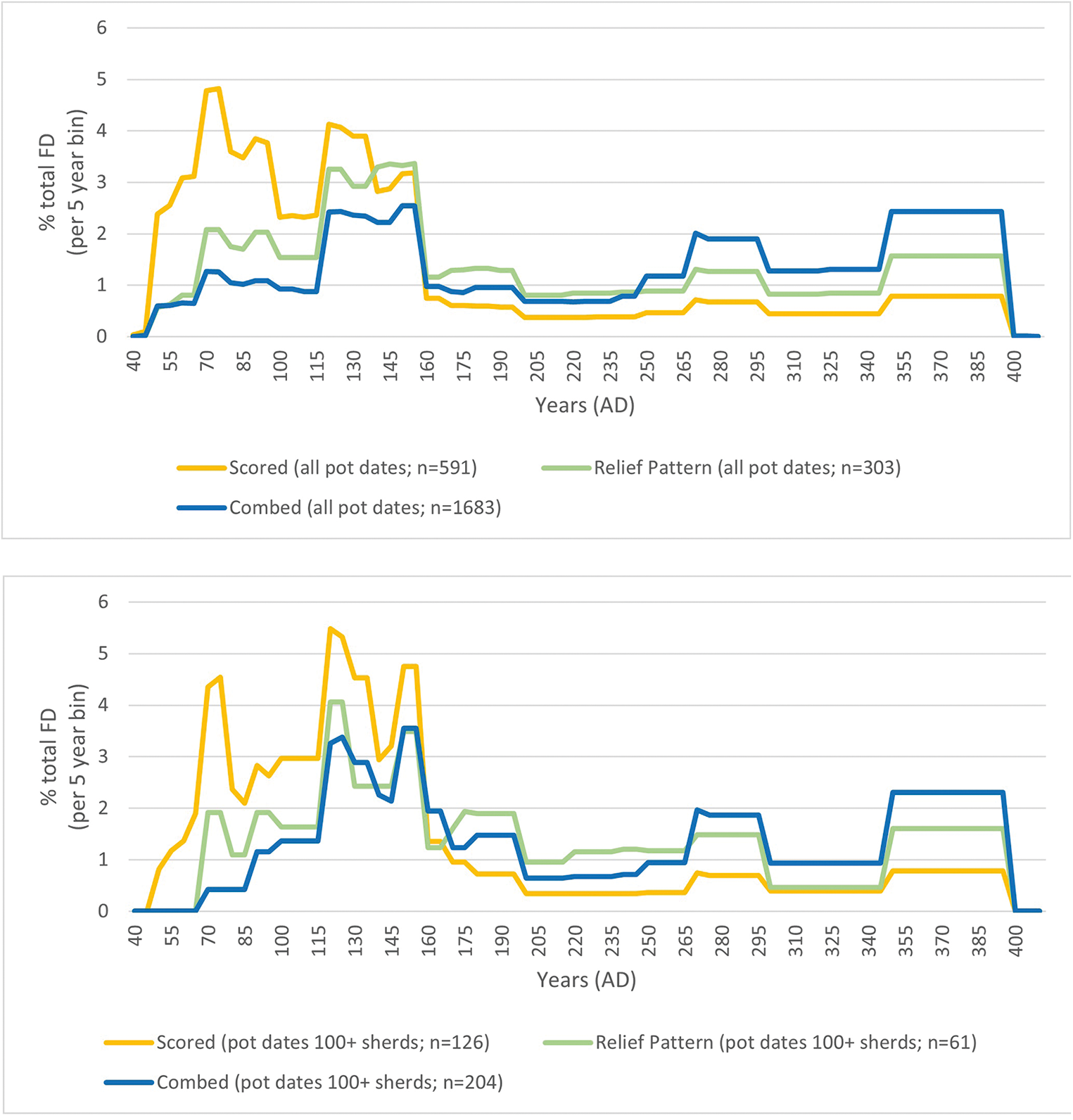
This paper presents and compares these probabilistic curves in several different ways. The first shows the total frequency density per five-year bin for each type of tile (Fig. 9) and keying (Fig. 12). This clearly presents the data to display the differences in the relative number of dated contexts that have produced them. Two versions are again calculated, the first based on all available pottery context dating and the second only for those contexts which produced more reliable large or very large pottery assemblages.
Simplified chronological summaries of frequency density distributions for context pottery dates associated with different kinds of ceramic tiles calculated using aoristic analysis. Based on MOLA data outlined in Fig. 7: (above) using context dates based on all Roman pottery assemblages associated with flue tiles; (below) using only dates derived from large and very large pottery assemblages (100+ sherds).

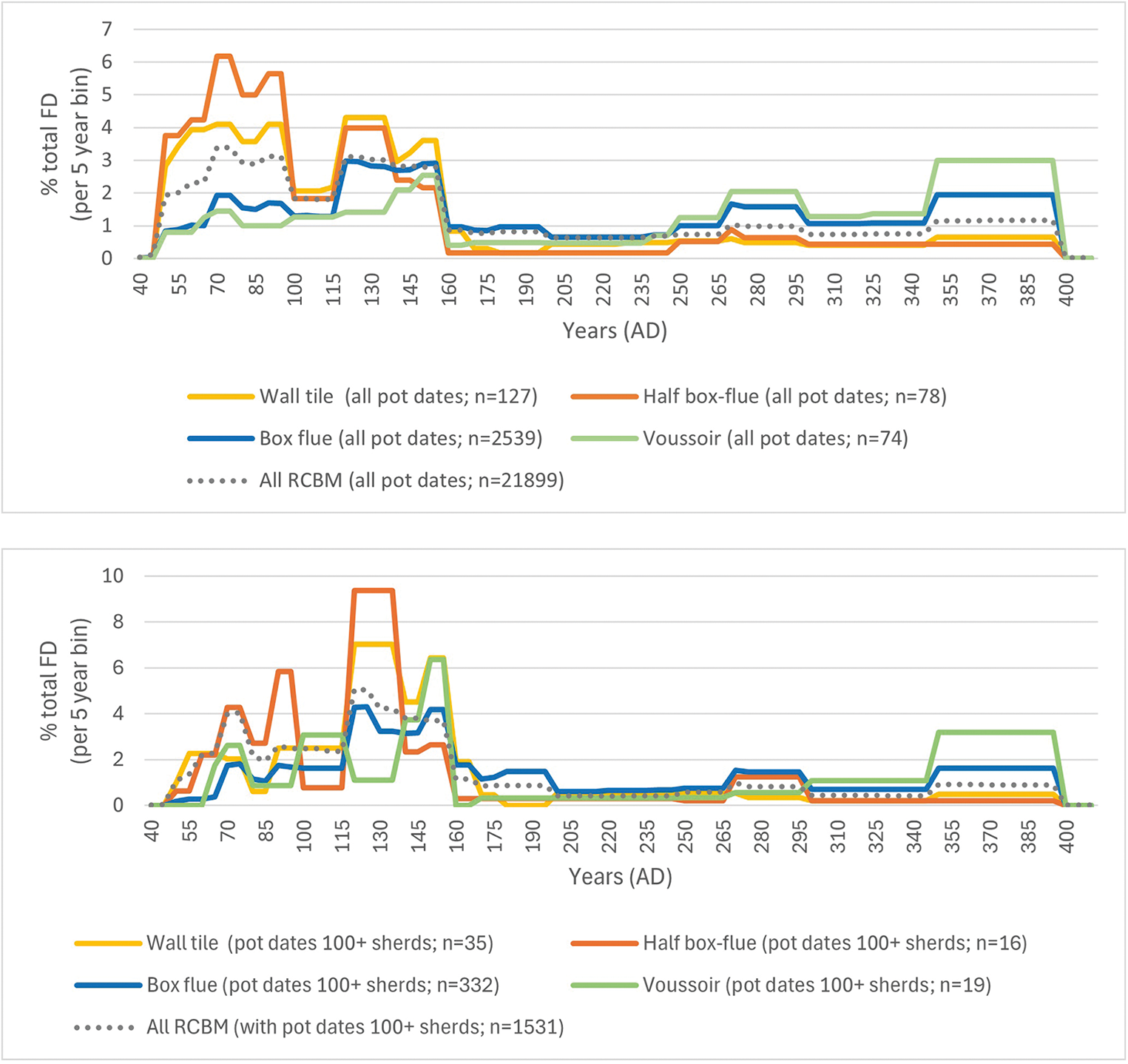
Differences in quantities/sample sizes, particularly the dominance of box-flues and combed keying, make it more difficult to compare the chronological trajectories of different types visually. To assist with this, these same datasets are expressed as percentages of the total frequency density of each tile and keying type per five-year bin (Figs 10 and 13). This has the effect of ‘normalising’ the data so they display at a similar scale, and allows for easier comparison of the shape of the curves. Two datasets representing the summary of these percentages generated with all associated pottery assemblage sizes contrasted with those comprised of contexts with 100 sherds or more are again presented.
Simplified chronological summaries of frequency density distributions for context pottery dates associated with different kinds of ceramic tiles (see Fig. 5) expressed as a percentage of the total frequency density associated with that type of Roman CBM. Based on MOLA data outlined in Fig. 7 and compared with all MOLA Roman CBM data as of July 2024. (Above) using dates based on all Roman pottery assemblages; (below), using only dates derived from large and very large pottery assemblages (100+ sherds).

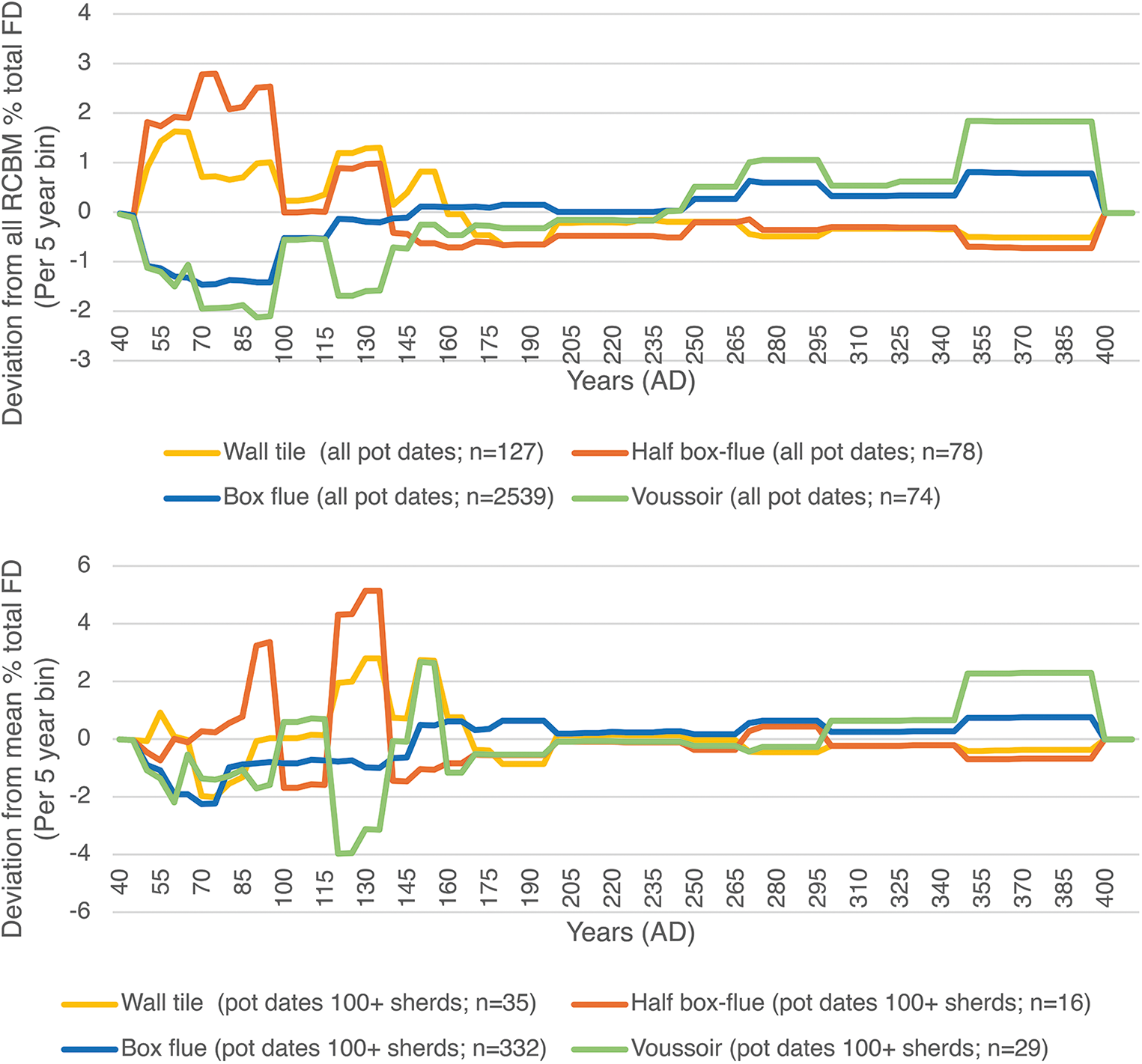
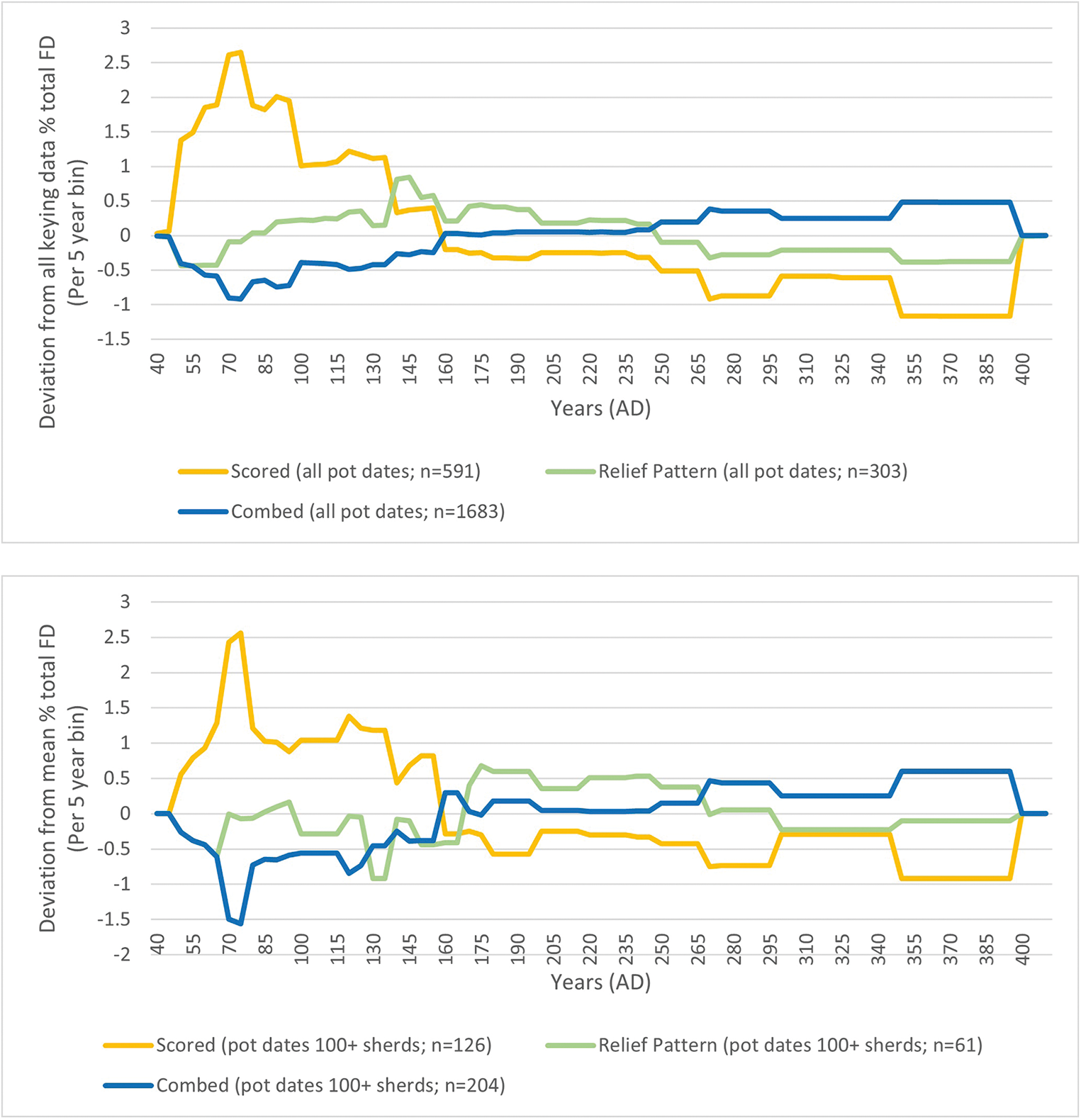
It should be noted that the shape of all these curves also reveal (and are influenced by) more general temporal rhythms in site formation and urban development that apply to Roman London as a whole, and to the dataset recorded within the MOLA database (see Supplementary Material Appendix 1). For this reason, we also chose to express the distribution curves for the different types of wall cavity tile (Fig. 11) and keying (Fig. 14) as deviations from the total samples of Roman CBM and flue tile keying data on the MOLA database. This emphasises the unique/distinctive features of the pottery dating associated with each separate tile or keying type, effectively cancelling out the underlining structural factors that impact the entire dataset equally.
Deviation of chronological frequency density distributions associated with different kinds of ceramic tiles, calculated from associated pottery context assemblages, from a similar distribution representing all Roman ceramic building material. Based on MOLA data summarised in Fig. 10. (Above) using dates based on all Roman pottery assemblages; (below) using only dates derived from large and very large pottery assemblages (100+ sherds).

Context pottery dating for different wall cavity tile forms
Differences in the chronological distribution of the dating evidence are evident from the aoristic analysis. The ubiquity of box-flue tiles in all periods is clear, with wall-tiles and particularly half box-flues representing much smaller components of the overall assemblage (Fig. 9) and showing a more markedly early Roman dating emphasis. These early forms were most popular in the first century, seemingly falling largely out of use by the late second century, presumably as a result of the increasingly popularity and ubiquity of box-flue tiles (Figs 9 and 10). Wall-tiles were likely used in combination with half box-flues, which were fixed on the vaulted ceiling and allowed the hot air from the wall-tiles to circulate. This combination is represented quite clearly (Figs 10 and 11) as both types of tiles follow similar patterns. Meanwhile, hollow voussoir tiles were usually used in conjunction with box-flues to produce heated roof vaults. They are represented in quite modest numbers compared to box-flues (Fig. 9) but their use follows a rather similar relative trajectory, perhaps reflecting their association with the same building tradition (Figs 10 and 11).
Context pottery dating for different wall cavity tile keying methods
The same analysis was applied to the different methods of keying on wall cavity tiles where this was available, again using data generated from all Roman pottery context dates and those exclusively from large assemblages (see Fig. 8). Scoring was undoubtedly in use during the second half of the first century and was very much the dominant keying method, remaining moderately well represented during the early to mid-second century but seemingly declining rapidly thereafter and falling into third place in the terms of total frequency density and below the mean for all keying types by around a.d. 150/60. The results generated from contexts with more substantial pottery assemblages (Figs 13 and 14) suggest a resurgence in the early second century. This may evidence the contemporaneous usage of scored cavity tiles with those keyed by combing and roller-dies in the early second century.Footnote 67 It may also be evidence, at least in part, of early material entering later contexts through residuality and/or reuse. Nevertheless, this result accords well with previous observations that have noted popularity of this form of keying on early cavity tiles, particularly the predominantly early wall-tiles (152 scored versus 10 combed) and half box-flue forms (88 scored, 3 combed).Footnote 68
The decline in the popularity of scoring can probably be linked to both a decline in the popularity of these early tiles (Figs 9–11), which were largely scored, and also the rising popularity of other keying methods over the course of the late first and mid-second century (Figs 12–14). Scoring and combing follow near-opposite trajectories, possibly suggesting that combing was regarded as an equivalent technique which eventually supplanted scoring. The appearance of combing on a few examples of the early cavity tile types may support this suggestion, although as mentioned above, Ian Betts wonders if these were in fact later tiles mistaken for early wall-tiles and half box-flues due to their fragmented nature. Nevertheless, the data show that combing rises in popularity in the late first century and seems to have become the dominant keying technique during the second century, continuing to hold this position in London CBM assemblages thereafter.
Simplified chronological summaries of frequency density distributions for context pottery dates associated with different kinds of ceramic tile keying technique calculated using aoristic analysis. Based on MOLA data outlined in Fig. 8. (Above) using context dates based on all Roman pottery assemblages associated with flue tiles; (below) using only dates derived from large and very large pottery assemblages (100+ sherds).

Simplified chronological summaries of frequency density distributions for context pottery dates associated with different kinds of ceramic tiles (see Fig. 12) expressed as a percentage of the total frequency density associated with that type of Roman CBM. Based on MOLA data outlined in Fig. 8 and compared with all MOLA Roman CBM data as of July 2024. (Above) using dates based on all Roman pottery assemblages; (below) using only dates derived from large and very large pottery assemblages (100+ sherds).

Deviation of chronological frequency density distributions associated with different kinds of ceramic tiles, calculated from associated pottery context assemblages, from a similar distribution representing all Roman ceramic building material. Based on MOLA data summarised in Fig. 13. (Above) using dates based on all Roman pottery assemblages; (below) using only dates derived from large and very large pottery assemblages (100+ sherds).

Relief-patterned tiles are less common than either scored or combed tiles. London has produced more of these tiles than any other site in the Roman world,Footnote 69 but there is no evidence to suggest that this keying technique ever became the dominant style overall on building material used in the city.
Relief-pattern keying is also noticeably absent on early wall tiles and half box-flues in London, potentially complementing a later chronological emphasis in the city. The context spot dates provide very little support for the use of relief-patterned tiles in London during the Claudio-Neronian period. The overall trend for pot-dated contexts with relief-patterned tiles is a steady increase after c. a.d. 70, only reaching a peak around the middle of the second century. These trends are even more sharply defined in the more reliable data generated with larger Roman pottery sherd counts which show a complete absence of relief-patterned tiles before a.d. 70.
Out of 303 pottery dated contexts with relief-patterned tiles, it is striking that there are no tight pre-Flavian dates, and only five associated pottery assemblages have been dated either to the pre-Flavian or pre-Flavian to early Flavian period. Because of the importance of these examples, their stratigraphic context was also checked where possible and none could be shown to derive from a firm pre-Flavian context. The most compelling early context is a hearth containing four fragments associated with a post-Boudican first-century building at Borough High Street, Southwark.Footnote 70 The context contained a small assemblage of pottery dated a.d. 55–85. A single fragment from a published excavation at the Guildhall Roman AmphitheatreFootnote 71 (GYE92) comes from a late Roman surface area (period 9; Open Area 110) that also contained a small residual pottery assemblage dated a.d. 43/50–70. The other three finds are as yet unpublished: single fragments of relief-patterned tile were associated with medium-sized pottery assemblages, dated a.d. 60–80 in an early Roman ditch context at Blossoms Inn,Footnote 72 and residual in a second-century cut feature at Bloomberg.Footnote 73 Another small piece associated with early Flavian pottery came from Flavian to early Hadrianic building make-up at the Walbrook Building site.Footnote 74
All types of wall cavity tiles and all associated keying techniques fall in absolute numbers around a.d. 160. Broader change in London’s archaeology around this time (see above) probably underpins the proposed end date of a.d. 160, suggested in some earlier studies. However, relief-pattern box-flue tiles do not see quite as sharp a decline as some of the other tile forms and keying techniques and the aoristic distribution might even suggest that these tiles were being deposited later into the second century a.d. than might previously have been expected, or even beyond (Figs 13 and 14). The evidence does not clearly suggest an alternative end date, but there are some subtle changes in the trajectory of deposition relative to the other keying types around the end of the second century and the first half of the third century. Some other limited evidence for continued production and/or use/re-use of relief-patterned tiles is discussed below.
Stratified site assemblages case studies
Below are four tables in which the concentration of different forms of wall cavity tiles are shown through a timeline created by site stratigraphy instead of the dates generated by Roman pottery. This prevents an overreliance on the aoristic data provided by pottery context dates alone in the analysis of wall cavity tile chronology in London. A different and more comprehensive approach, chronostratigraphy, utilises the cumulative interpretation of all available dating evidence and stratigraphic relationships from the analysed sites. This is aided by well-documented events represented across multiple sites such as the Boudican destruction layer and the Hadrianic fire. The results are interesting as the impacts of construction and demolition are put into chronological perspective with the aid of destruction layers that seal earlier phases of stratigraphy. In particular, the sites included in the tables below either have significant Boudican destruction layers or dendrochronology dates for buildings that help sub-divide the first-century sequence more precisely.
Each of the four stratigraphy tables shows data associated with an excavation or a group of adjacent excavations with compatible or similar phasing sequences. The cavity tile assemblages recovered from each stratigraphic phase are characterised and arranged chronologically, showing the number of records for different types of wall cavity tiles and for different keying methods in any given period. The average weight by fragments and years has also been calculated and is shown alongside the total number of fragments recovered to give a clearer impression of the scale and pace of deposition. The sites with high averages of fragment count or weight have been highlighted in grey to denote periods of increased assemblages of tiles recovered from the sites. High weight averages due to the heavy weight of one complete or near-complete tile have not been highlighted.
A key general result is that while some early wall cavity tiles are present in pre-Boudican fire contexts, relief-patterned tiles remain absent in the archaeological record at this early date. In fact, they do not appear until phases dated to the late Neronian to Flavian or Flavian period. None are from phases assigned to secure pre-Flavian deposits. The common occurrence of relief-patterned tiles in London from the Flavian period onwards and into the second-century stratigraphy is again evident, complementing the previous findings of Betts et al. Reference Betts, Black and Gower1997 and the results of the aoristic analysis above.
Furthermore, the pre-Flavian period in the selected sites shows a lack of masonry buildings, which are essential for the installation of the type of wall cavity tiles under discussion. The presence of wall cavity tiles in the archaeological record are the results of reuse, scatter or intrusion from the limited number of heated masonry buildings, such as the Cheapside or possible Fenchurch bathhouse constructed during this time. The second to third century is marked by the peak of masonry building construction on these sites and is also the period in which the highest averages of wall cavity tiles appear in the archaeological record. The fourth century onwards saw phases of large-scale demolition of earlier buildings followed by pitting. With very few new structures constructed during this period, the appearance of most of the wall cavity tiles including relief-patterned tiles are likely the result of residuality. This trend continues well beyond the Roman period.
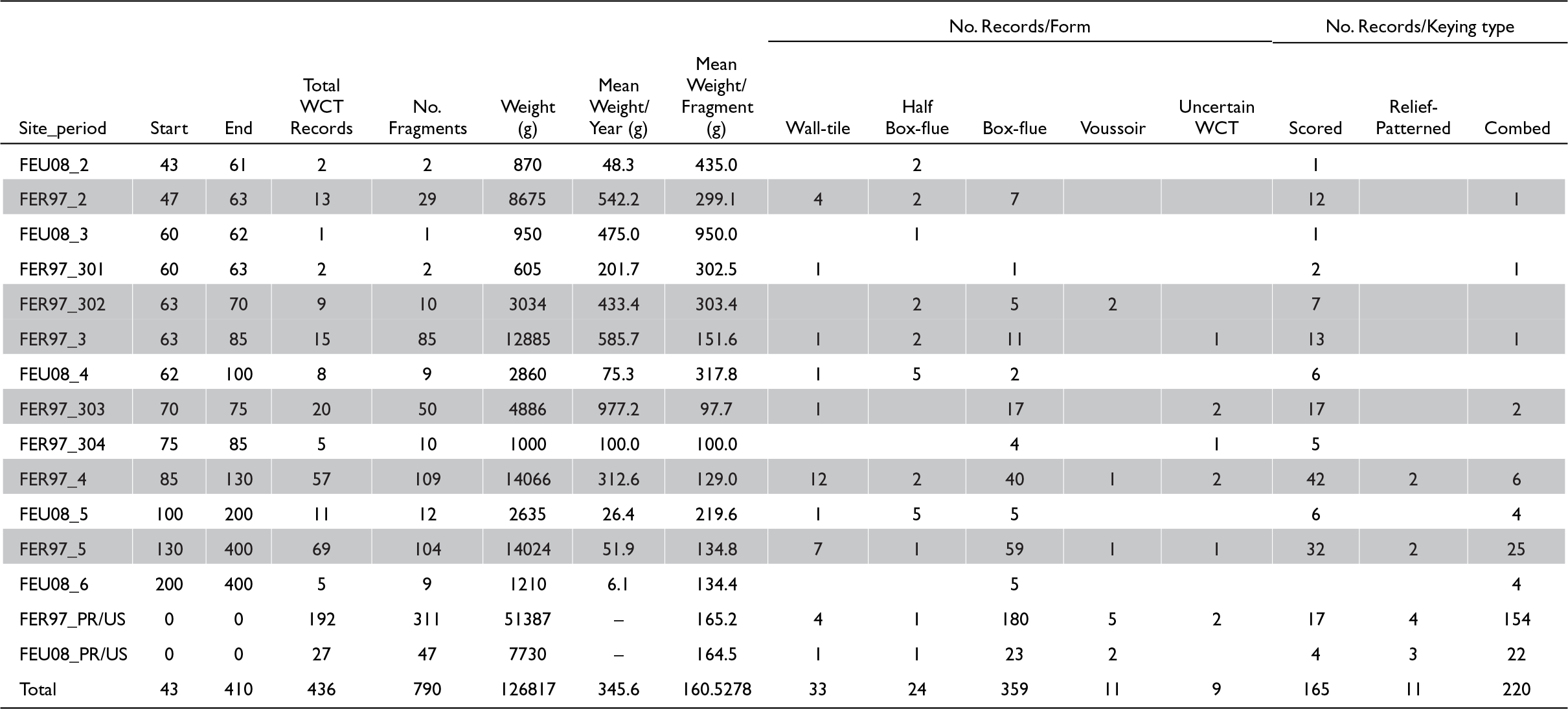
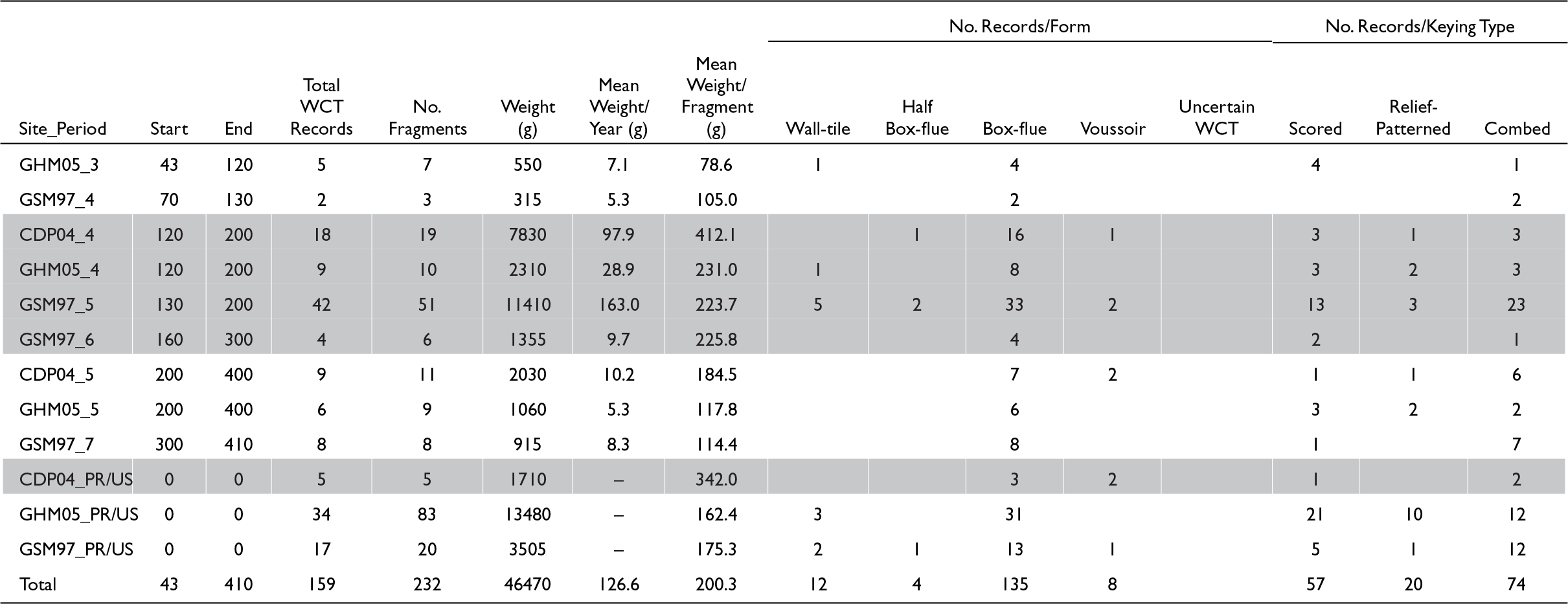
East of the Walbrook in the Fenchurch Street Area (FER97; FEU08) (Table 1)Footnote 75
As can be seen in Table 1, the majority of box-flues were recovered during the Flavian–Antonine periods. The pre-Boudican layers yielded a diverse group of wall cavities, including assemblages of wall-tiles and half box-flues, lacking evidence of relief-patterned tile usage. These early cavity tiles might be related to a possible early bathhouse in the local area,Footnote 76 where relief-patterned tiles were not used. Indeed, an early Eccles fabric half box-flue tile was recovered alongside opus spicatum paving bricks in pre-Boudican contexts. The spicatum paving bricks can perhaps be associated with bathhouses, as evidenced in London by examples from the Cheapside baths, likely due to their waterproofing quality when mixed with thick lime mortar.Footnote 77 The presence of 11 fragments of hollow voussoirs reflects the location of the nearby bathhouses. There are notably few relief-patterned tiles from this whole area and the first examples date to a.d. 85–130, which supports the traditional later production date. This is contrasted with a much higher presence of scored and combed wall cavity tiles, possibly associated with these early bathhouses.
Selected sites east of Walbrook around Fenchurch Street and Plantation Place (FEU08; FER97). Sites with high averages of fragment count or weight have been highlighted.

The area of Plantation Place (FER97) continued to be dominated by clay-walled buildings, where no hypocausts could have been installed, until the Hadrianic fire. The lack of relief-patterned tiles in this early period further casts doubts on an early production date. The large masonry building at Plantation Place, B31, in which relief-patterned tile was recovered, underwent major reconstruction during the third century and may be evidence of post-second-century use of such tiles. Demolition of the large masonry building constructed at 20 Fenchurch Street (period 6) c. a.d. 200 onwards, took place during the late fourth century and likely resulted in the appearance of cavity tiles in later Roman contexts.
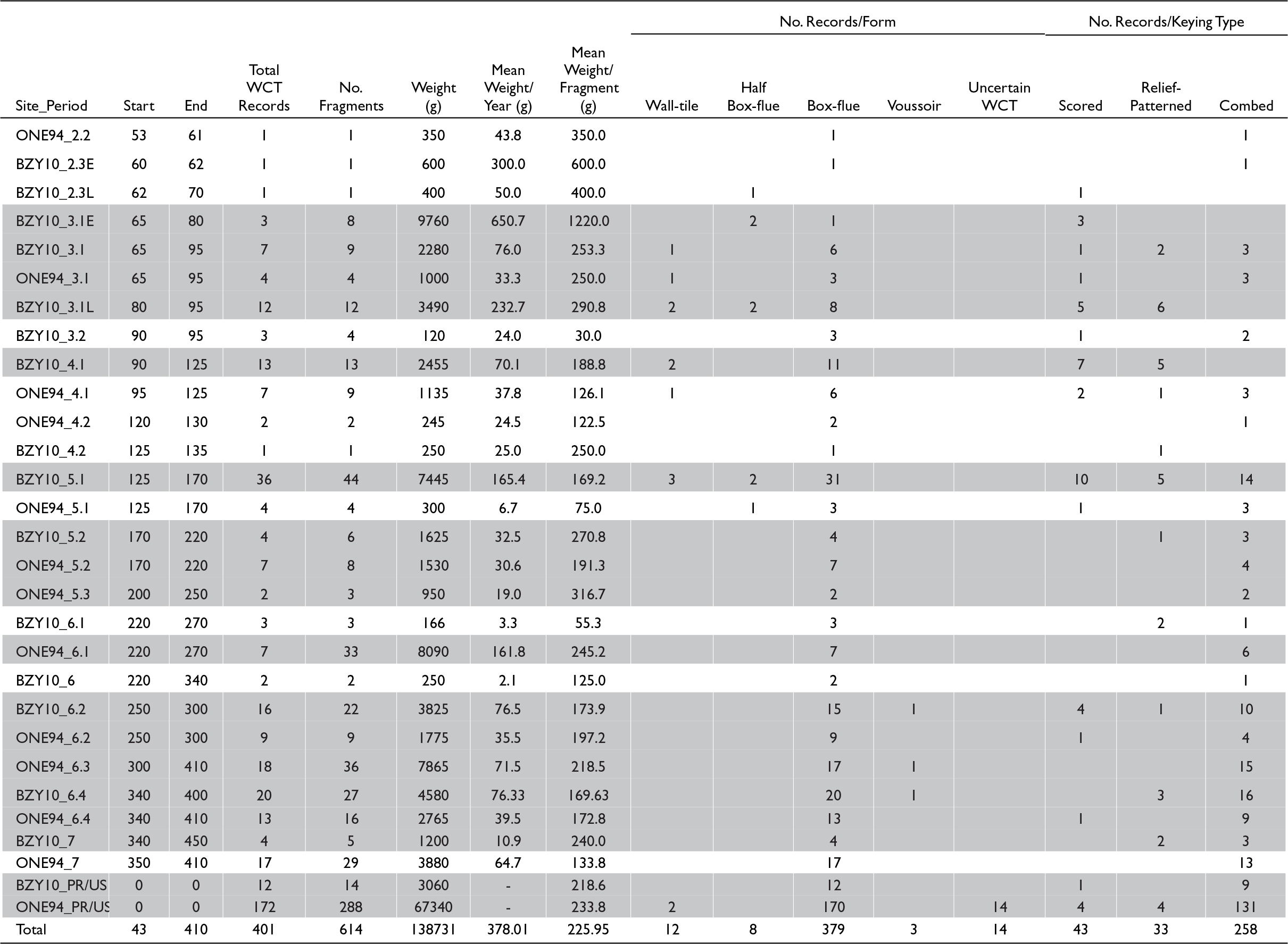
Middle Walbrook Area (ONE94; BZY10) (Table 2)
1 Poultry (ONE94)Footnote 78
Two combed tiles can be attributed to the pre-Flavian period, which provides ineffective support for early relief-patterned tile use in the area. The pre-Boudican fire features comprise road construction around the vicinity of 1 Poultry, post-holes, clay and timber buildings and the rare example of relief-patterned daub on the wall of Building 23. The first masonry buildings from 1 Poultry date from c. a.d. 65–95 and are followed by a Flavian-era fire that destroyed numerous buildings and created new open areas. Relief-patterned tile of the double-box Sussex type was found in the make-up layer of period 4, c. a.d. 95–125.
Selected sites in the Middle Walbrook valley at 1 Poultry and Bloomberg (ONE94; BZY10). Sites with high averages of fragment count or weight have been highlighted.

The Hadrianic fire layer is visible as fire debris horizons in open areas. A large proportion of relief-patterned tiles were recovered from late first- and second-century contexts. This may be explained by the masonry building construction in period 5, a.d. 125–200, in which the rubble of multiple masonry buildings was identified. A large building, Building 64, which included a hypocaust, was discovered and dated to c. a.d. 220–70. This period saw a peak in wall cavity tiles in the archaeological record which coincides with the construction of masonry buildings in the area. It should be noted that a large masonry building with a hypocaust dated c. a.d. 125–220 was uncovered at DLR Lothbury site B (LHY88). This building was subsequently enlarged during the late third century.
The period from a.d. 300 onwards includes disuse of buildings, demolitions, the construction of a brick culvert and the formation of dark earth in open areas. These actions would explain the appearance of residual cavity tiles in fourth-century contexts.
Bloomberg (BZY10)Footnote 79 and adjacent sites
There were no masonry structures during the pre-Boudican period, with only two combed box-flues recovered from the site. The amount of dumping, levelling and landscaping that took place during the late Neronian to early Flavian period is notable. This is likely the reason for the presence of early scored tiles, wall-tiles and half box-flues appearing in the archaeological stratigraphy, with a lack of relief-patterned tiles in the assemblage.
The majority of the relief-patterned tiles found at the Bloomberg site were recovered from late first- to second-century contexts, which again offers stratigraphic evidence for the traditional production date suggested by Betts et al. Reference Betts, Black and Gower1997. The first masonry building on the site was constructed during period 4 (c. a.d. 90/5–125). Higher-status buildings with a possible hypocaust were constructed c. a.d. 125/35–170. The small number of hollow voussoir tiles is notable and is likely due to the absence of a bathhouse in the area. The demolition of old buildings and the construction of new structures is evident throughout the second century. This includes the demolition of buildings during c. a.d. 120–140, and the destruction by fire of Buildings 42 and 46.
A new masonry building was constructed c. a.d. 220–300 with the fourth century being characterised by a period of disuse and demolition, probably resulting in the residual presence of cavity tiles.
West of the Walbrook around Gresham Street (GSM97; GHM05 and CPD04) (Table 3)Footnote 80 , Footnote 81
No masonry buildings were discovered at the sites during the pre-Boudican phase and no wall cavity tiles can be dated to this period. Period 4, c. a.d. 70–130, at GSM97 includes rubble deposits that suggests multiple masonry buildings on site. This again sheds doubt on the pre-Flavian usage of relief-patterned tiles in London. A large masonry building was constructed c. a.d. 90–100 at GHM05 and likely burned down during the Hadrianic fire. This may have caused the increase in deposition of flue tiles during this period.
Selected sites west of Walbrook, around Gresham Street (GSM97; GHM05; CDP04). Sites with high averages of fragment count or weight have been highlighted.

Cavity tiles dated to c. a.d. 120–200 are associated with the dismantling of the nearby Cheapside baths, which occurred during the early second century. It is during this period that the local concentration of relief-patterned tiles is focused. This suggests a preference for roller-stamped box-flues as there is no visible evidence of wall-tiles and half box-flues from the end of the second century. There was also a drop in scored tiles during and after this period, although box-flues continue to be visible in the archaeological record, with combed tiles becoming increasingly dominant.
Numerous masonry buildings were built at GSM97 in period 5 (c. a.d. 130–160/200) and period 6 (c. a.d. 160–200/300). This construction phase saw a consistently high proportion of wall cavity tiles in the archaeological record. Activity following this period largely comprised dumping and pitting.
Well infill of Blossoms Inn, GHT00Footnote 82
Separately, some relief-patterned tiles potentially associated with Cheapside baths are also worthy of mention. Dendrochronology on the well’s timbers showed that the structure was built shortly after the Boudican revolt. The infill of the hydraulic well yielded a large number of partially complete relief-patterned box-flues. These tiles were recovered along with tegulae, of which three fragments are lettered with procuratorial stamps, a phenomenon of the Flavian and later periods.Footnote 83 Some of the box-flue tiles are of the same fabric variant as those from the Flavian Cheapside baths.Footnote 84 Due to the close proximity of the well to the bathhouse, it is likely that these tiles were demolished material from the bath dumped into the well. This would suggest that these relief-patterned tiles were produced during the Flavian period for the initial bath construction.
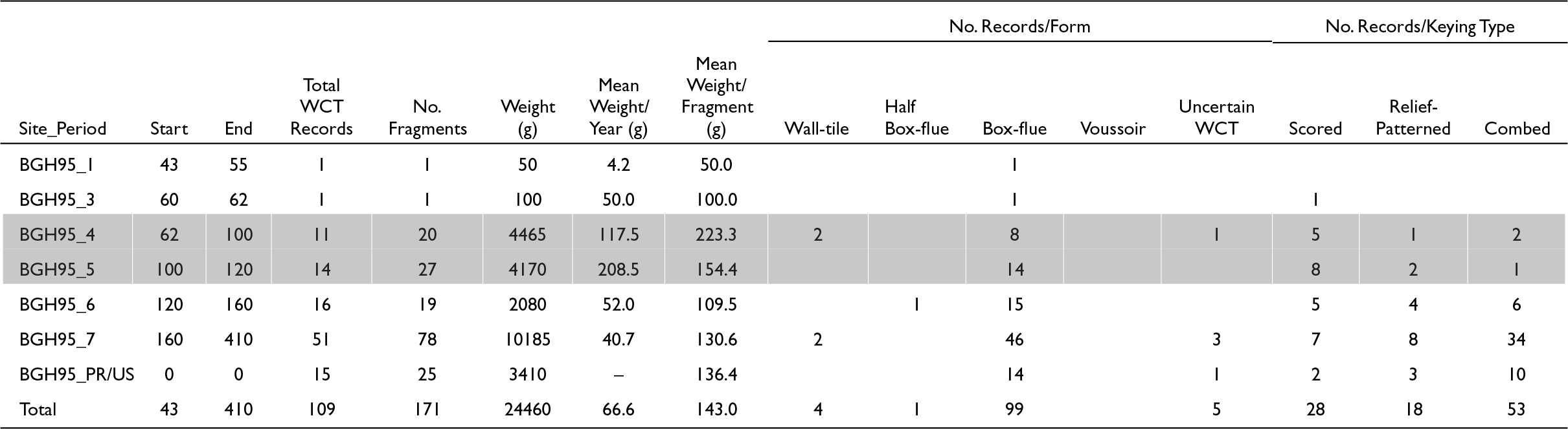
South of the Thames in northern Southwark around Borough High Street (BGH95) Footnote 85 (Table 4)
In this area, timber-framed buildings dominated the landscape before the Boudican revolt. A single scored cavity tile was recovered from the destruction layer and likely came from a heated building nearby, but does not suggest a landscape where relief-patterned tiles were utilised.
Borough High Street, Roman Southwark (BGH95). Sites with high averages of fragment count or weight have been highlighted.

The first masonry buildings appeared a.d. 70–100 and wall cavity tiles, including relief-patterned tiles, are associated with them. The early second century saw reclamation of marginal land, while masonry buildings, including high-status ones, date to the mid-second century. Further reclamation of land, which included dumping of CBM, occurs during the late second and early third century. The fourth century is associated with demolition of buildings as the area to the west became a burial ground. This would have spread building material around the area and allowed the residual earlier box-flues to enter later contexts.
Dated buildings elsewhere with associated relief-patterned tiles
The number of relief-patterned tiles and the quality of dating from the sites shown in Tables 1 to 5 vary greatly. While well-known sites such as 15–23 Southwark Street (CB80), New Fresh Wharf (NFW74) and Pudding Lane (PDN81) all present evidence of relief-patterned tiles in post-Flavian buildings,Footnote 86 certain well-recorded but less well-known examples of large excavations in London also highlight relief-patterned tiles in post-Flavian contexts. Sites with building remains and occupational layers in which relief-patterned tiles are associated offer strong evidence that can only be supplemented by the discovery of dated kilns with keyed wasters.
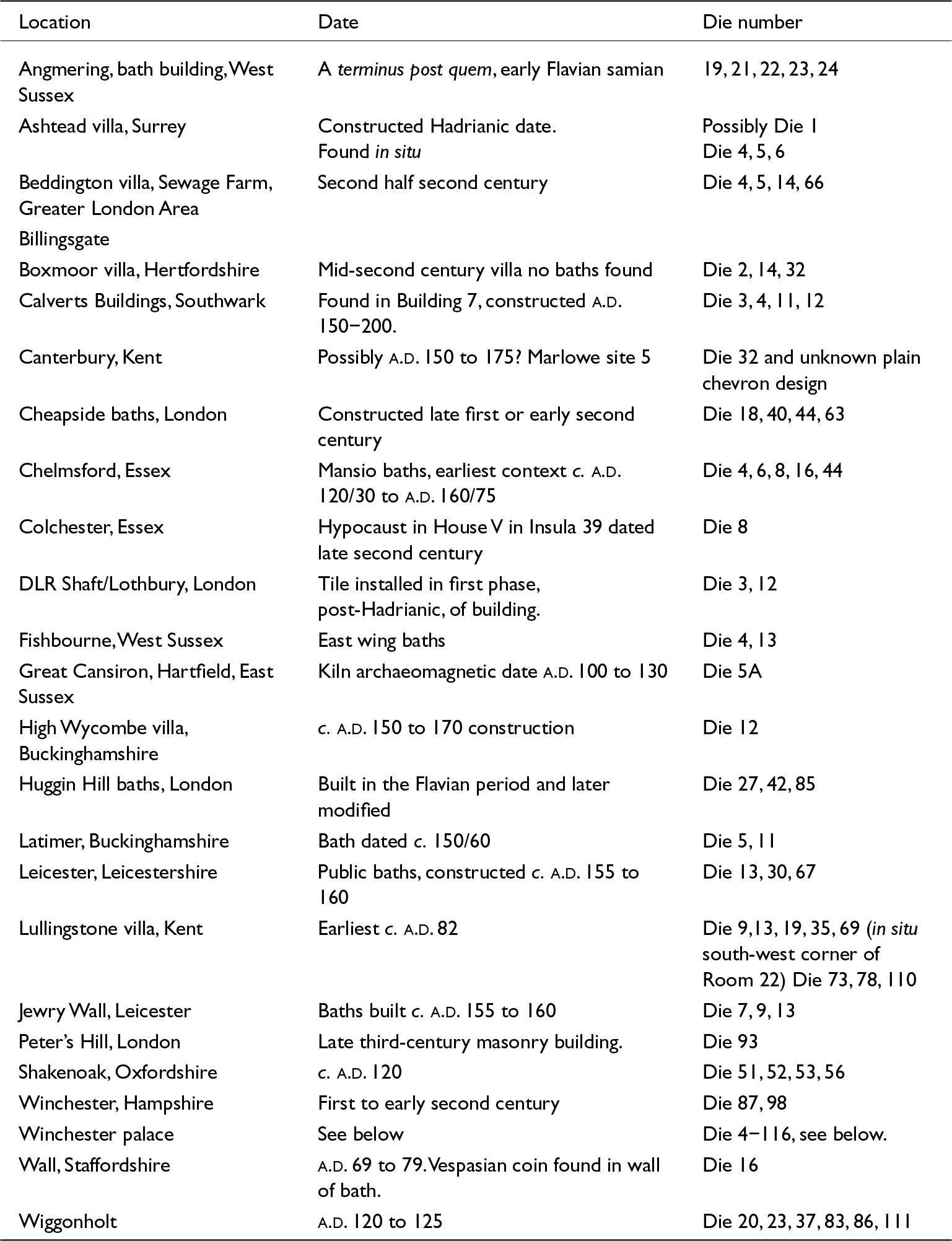
Good examples of relief-patterned tiles from Betts et al. Reference Betts, Black and Gower1997 in which the tiles are associated with buildings dated from a.d. 70 to the second century.

There are many contextual dates, in which tiles were directly dated from an archaeological context. There are also association dates, where different die patterns were found on the same site, in different contexts, but the dies are dated in association with each other. Table 5 presents the most obvious circumstantially dated sites, where relief-patterned tiles were associated with dated hypocaust structures, noted by Betts et al. Reference Betts, Black and Gower1997. Some of the better-documented examples are listed in Table 5.
Winchester Palace, London
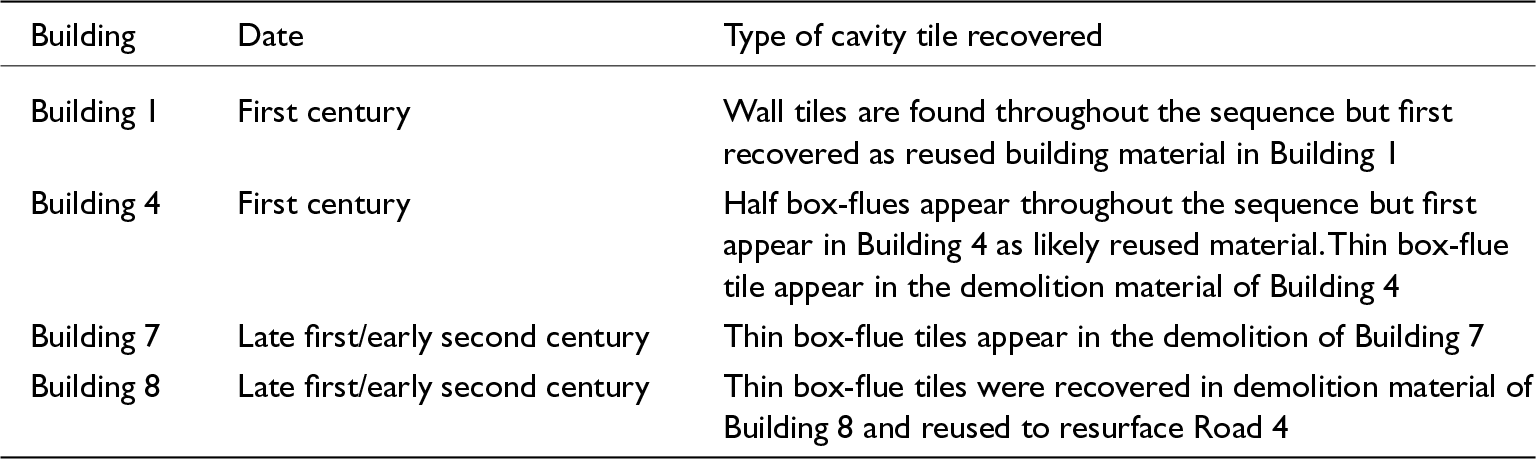
The Roman buildings located on the site of Winchester Palace, London (WP84) offered both a large relief-patterned tile assemblage and detailed phasing of contexts related to building remains. Relief-patterned tiles were absent from the box-flue tiles recovered from the early first-century buildings, while wall-tiles and half box-flue tiles, usually associated with early heating tiles and wall cavities,Footnote 87 were recovered (Table 6).
The late first-century buildings on the site of Winchester Palace, London, in which no relief-patterned box-flue tiles were recovered. The data were extracted from Yule Reference Yule2005.

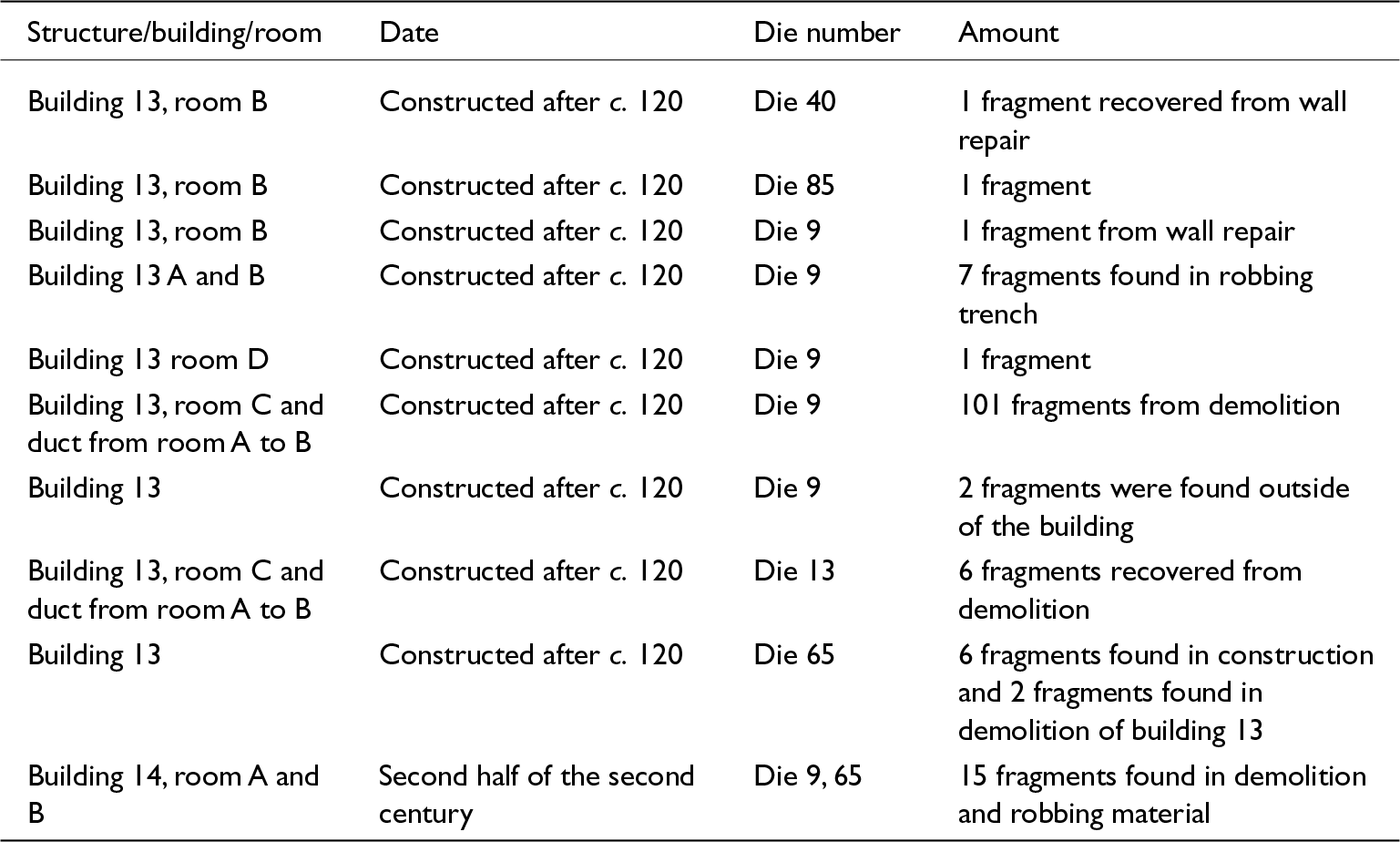
These early wall-tile and half box-flue tile heating systems were replaced by ordinary box-flue tiles which were quicker and easier to install. In London, half box-flues probably fell out of use by the late first century, with wall-tiles following in the early second century.Footnote 88 On the Winchester Palace site, a large assemblage of box-flue tiles was recovered from the second century or later phases in which a large quantity of relief-patterned tiles were present (Table 7). A total of 125 fragments of relief-patterned tiles were recovered from Building 13 and Building 14, in which Room C of Building 13 yielded 101 fragments of die 9. Building 14’s demolition layer dating from the third to early fourth century also yielded one fragment each of die 4 and die 58.
Rooms of Buildings 13 and 14 on the site of Winchester Palace, London where relief patterned box-flues were found. The data for Fig. 8 were extracted from Yule Reference Yule2005 and Betts et al. Reference Betts, Black and Gower1997.

Die 9, the most numerous of the dies recovered from Winchester Palace, has the largest distribution area from Scampton, Lincolnshire in the north to Richborough, Kent in the south.Footnote 89 The mansio with multiple heated rooms,Footnote 90 at Calvert’s Building, near Winchester Palace and likely constructed a.d. 150–200, also yielded examples of dies 3, 4, 11, 12Footnote 91 and 58.Footnote 92 It is possible that this building also contained a bathhouse.
This site provides a good example of relief-patterned tiles associated with a building, and strongly supports the traditional production date of relief-patterned tiles suggested by Betts et al. Reference Betts, Black and Gower1997. It also offers good evidence of the preference for early cavity tiles and their eventual replacement during the second century.
Fabrics and distribution
Although no London tile kilns have been found, with the exception of wasters from areas such as Paternoster Square and 120 Cheapside,Footnote 93 it is likely that local kilns producing the ubiquitous MOLA 2815 fabric began in earnest during the post a.d. 70 building boom. Building projects like Huggin Hill baths, the forum-basilica and the ‘Governor’s Palace’Footnote 94 may signify the start of the dominant period of production for these tiles, a phenomenon dating firmly after the Neronian period.
The London data outlined above suggest that relief-patterned tiles do not appear in the local 2815 fabric or regionally imported fabrics within and around the city before the Flavian period. This is in direct contrast to early wall cavity tiles and keying methods found in pre-Boudican layers such as the half box-flues imported from Eccles, north Kent (MOLA fabric 2454) and the cavity tiles of local London production keyed using other methods. No procuratorial stamps, which first appear in London during the Flavian period, are found on products made from one of the earliest local London fabrics, MOLA fabric 3070, which included early thin box-flues and wall-tiles.Footnote 95 As mentioned above, a military connection was suggested by Pringle for the production of wall-tiles and thin-box-flues of this type. In contrast, relief-patterned tiles are found in the late fabric, MOLA 2459B, likely made in modern-day north-west London, around the Essex border near Epping. This fabric, with its unique fine moulding sand, is dated to c. a.d. 125–250 and was likely produced to help reconstruct London after the Hadrianic fire.Footnote 96 This in turn provides evidence for post-Neronian relief-patterned tile production for use in London.
London’s relationship with regionally imported material is also one that seems to change during and after the Flavian period. Recent evidence of this trend is provided by re-analysis of the Rosehill kiln, which suggests that die 4 and 5 relief-patterned tiles in Surrey may pre-date the Flavian period. A box-flue drain was discovered which was comprised of combed tiles and relief-patterned tiles of die 4, which showed evidence of wear,Footnote 97 and die 5. It was suggested in the report that they fell out of use before the kilns stopped production.Footnote 98 The last firing of the kiln was initially dated to a.d. 90–120 by Geoquest Associates at 68% probability.Footnote 99 Historic England’s Paul Linford reassessed the date ‘against the most recent calibration curve for archaeomagnetic dates’ as a.d. 40–101 at 90% probability.Footnote 100 Yet these Surrey tiles were being produced in a fabric, MOLA 3050, which does not appear in London until the mid-second century. This trend is similar to other regionally imported fabrics, including the relief-patterned tiles with the Sussex group fabric (fabric 3054), such as those found in and around 23 Fenchurch Street (FER97), Leadenhall (LED13), 1 Poultry (ONE94), Cotton’s Wharf, Tooley Street (CW83), and the Radlett fabrics (MOLA fabric 3023 and 3090), found in Borough High Street (BGH95), that only begin to appear in London during the Flavian period.Footnote 101
Discussion
The data presented above challenge the short production period suggested by Fulford and Machin. The data also provide evidence for London’s technological transition from earlier scored keying techniques, wall-tiles and half box-flues to regular-sized box-flues, hollow voussoirs and a broad range of keying methods that include relief-patterns. A later termination date than a.d. 160 for relief-patterned tiles does not argue against this thesis.
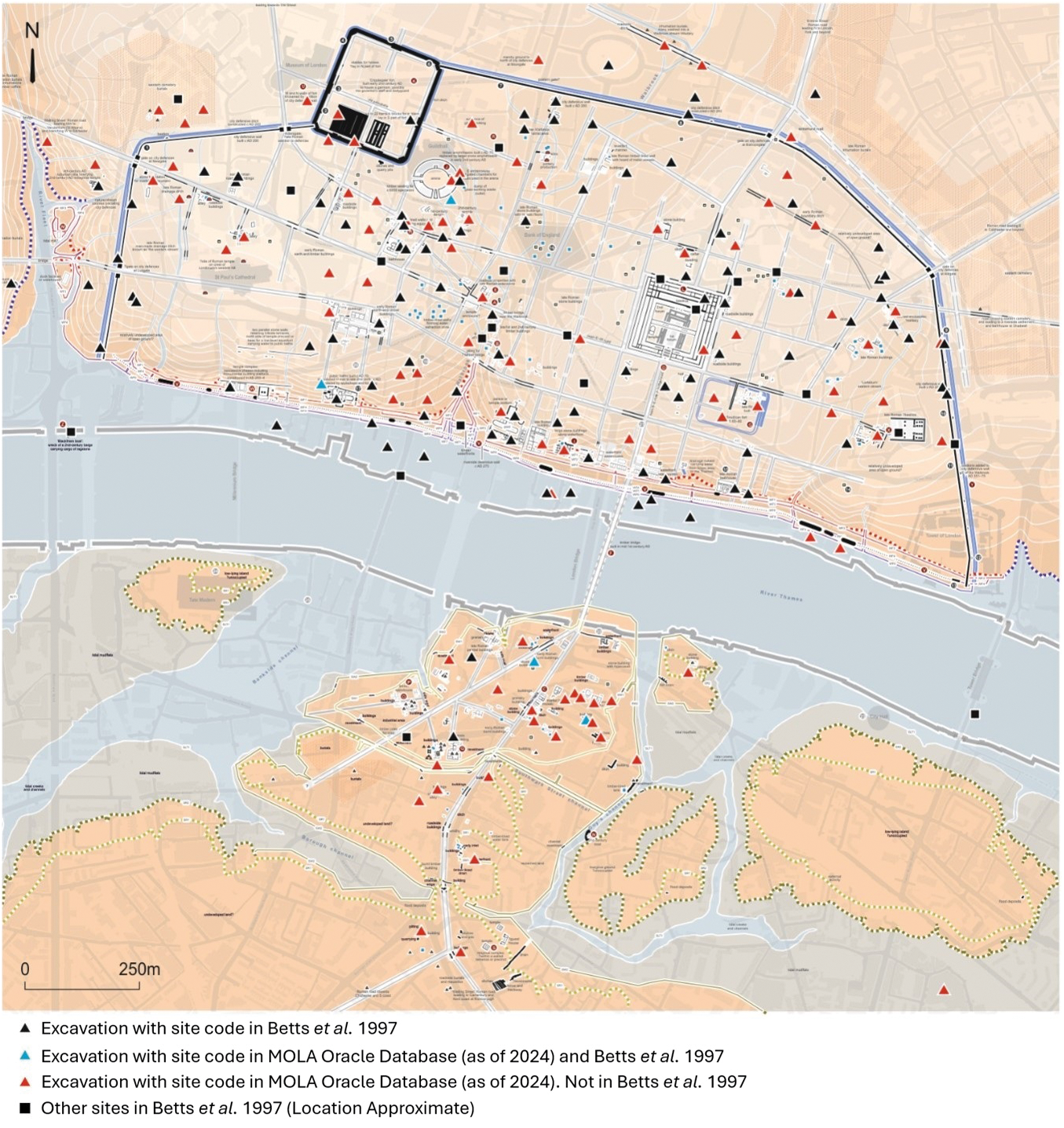
Given the large number of regional sites listed above, where relief-patterned tiles were recovered in relation to Flavian and later buildings, and the overwhelming body of data accumulated through spot-dating, circumstantial and contextual dating, the evidence indicates the use of relief-patterned tiles extending well beyond the a.d. 60s. In fact, there is no good evidence for relief-patterned tiles in London from contexts earlier than a.d. 70. Although the data presented above are not without their limitations, most of which plague the dating of the majority of excavated assemblages, it is impossible to overlook the positive representation of the Flavian and post-Flavian periods and the wide geographic distribution of these tiles across London (Fig. 15). Furthermore, when assessing the end date of relief-patterned tile production, one cannot ignore the strong contextual, circumstantial and archaeomagnetic evidenceFootnote 102 such as the kiln in Great Cansiron Farm, Hartfield, East Sussex with its last firing dated to a.d. 100–130 (68% probability),Footnote 103 as well as the uncalibrated 14C dating of charcoal from the main flue of the kiln: HAR-6389 age bp (years) 1830±70 or a.d. 120.Footnote 104
Distribution of sites that have produced Roman relief-patterned tiles in the City of London and Southwark (after Betts et al. Reference Betts, Black and Gower1997, with additions).

If there might be early production of relief-patterned tiles elsewhere, the question is why did Londinium not utilise relief-patterned flue tiles until the Flavian period? With the exceptions of Huggin Hill baths, possibly Cheapside baths and the large masonry building at Cannon Street, all of which have assumed Flavian dates,Footnote 105 London’s early bathing facilities are difficult to identify. This may represent the hypothesis suggested by Susan Pringle that London lacked centralised control until the Flavian period.Footnote 106 Pringle suggested the possibility of two pre-Flavian bathhouses in the vicinity of FER97, Fenchurch Street and WP84, Winchester Palace. It seems that early thin-box-flues were used alongside half box-flues at Fenchurch Street, whilst small box-flues and wall-tiles were recovered together in north-west Southwark: two early bathhouses with two different bespoke techniques.Footnote 107 It may also be that Londinium’s population of merchants lacked the governmental directive and initiative to erect public buildings during the a.d 50s and early 60s, a stark contrast to large regional settlements, represented, for example, by the Silchester Baths,Footnote 108 and Colchester. It may also be that Londinium, as a possible conventus civium Romanorum (a citizen-led settlement),Footnote 109 was populated by migrants, the buildings adhering to a more traditional and ‘continental’ method of constructing wall cavities, such as the simple flat wall-tiles and half box-flues. The wall tiles were difficult to install compared to standard box-flues as they required the extra step of spacer-bobbin installation. The lack of spacer-bobbins found in London cannot confirm the width of the gap created by the bobbins, although some alleged finds from Brockley Hill had a length of only 55 cm.Footnote 110 It was possible that this method had a narrower wall cavity and allowed less hot air to flow than a standard-sized box-flue. It is probable that supposed pre-Flavian bathhouses and heated rooms utilised these methods of constructing a wall cavity.
The early wall heating methods identified in London, included small thin box-flues,Footnote 111 flat wall-tiles and half flues,Footnote 112 usually keyed via scoring and combing. Tegula mammatae remain the oldest form of heat-carrying wall cavity in the Roman bathing world,Footnote 113 and flat wall-tiles and half box-flues are likely to be a variant of this traditional method. Yegul states that the flat tiles, which includes tegula mammatae, where the tiles’ nipples were fixed to a wall, and the ‘simpler system’ of flat wall-tiles fixed using a metal stud, are cavity techniques likely predating box-flue tiles.Footnote 114 Wall cavities with half box-flues and wall-tiles have been attested in first-century military sites such as Corbridge, Exeter and Caerleon. Although the tegulae mammatae in London have short nibs and were unlikely used for wall cavities, the flat wall-tiles seem to have been popular in London during the pre-Flavian period, as shown above in Figs 9–11. This hypothesis is supported by Lancaster’s analysis of earlier cavity systems in Roman bathhouses of Pompeii and Herculaneum, in which an illustration seems to show flat tiles nailed to walls that transition into half box-flues that carry the heat over the vaulted ceiling.Footnote 115 The method for using these tiles together in Roman Britain remains conjectural, and it may be that the heavier half box-flues were used on the walls and the lighter wall-tiles created the cavity on the vaulted ceiling.
Whether or not they were less effective than standard box-flues, wall-tiles and half box-flues continued to be utilised in heated buildings through the rest of the Roman world. In fact, wall-tiles remained popular in the eastern part of the Empire, even after the invention of box-flue tiles,Footnote 116 but they would likely have provided inadequate hot-air flow for colder climates. The popularity of the simple flat wall-tile is also echoed in Germany, where wall-tiles, both relief-patterned and combed, were used well into the latter half of the second century.Footnote 117 Half box-flues, which have also been termed tegulae mammatae in the past,Footnote 118 are found in early London spot-dated contexts and remain common on the Continent from Italy to Germany.Footnote 119
As stated above, the earliest wall cavity tiles in London are mainly keyed by scoring, usually with a knife or a sharp pointed tool. Both scored flat wall-tiles and half box-flues are simple heating methods and their usage in Britain likely predates the regular box-flue and definitely predates relief-patterned heating tiles. London initially seems to follow a traditional or Continental culture of constructing wall cavities. In contrast, the encouragement of regional settlements in south-east England, which had no previous bathing culture,Footnote 120 and which led to the large construction projects mentioned by Fulford and Machin, probably generated many innovations, not least the poorly conceived fishtail box-flue, early socketed box-fluesFootnote 121 and probably the groundbreaking hollow voussoir.Footnote 122 These innovations would have been introduced by bathhouse builders who needed to overcome the cold and damp climate of Britain and balance fuel consumption costs.Footnote 123 It is possible that these innovative builders would have embraced relief-patterned tiles more readily than Londinium’s more traditional builders during the pre-Flavian period.
It is unlikely that relief-patterned tile production ended abruptly in the years after Nero, with future generations of tilers losing the knowledge to recreate the roller dies, as suggested by Machin and Fulford. Relief-patterned daub and clay walls continued in the Roman world long after this period. Similar observations also apply to pottery as there are examples of later roller-die decoration on Roman vessels. The unguentaria recovered from St Paul’s Cathedral Choir School, London, were decorated with roller stamp dies. Vessels in these fabrics are found well into the third century.Footnote 124 Furthermore, products of similar fabrics were associated with the 20–28 Moorgate kiln producing oxidised ware c. a.d. 110–70.Footnote 125 It is worth noting that pottery with roller stamp decorations is also found on the Continent in GermanyFootnote 126 and FranceFootnote 127 during the Merovingian period. In addition, relief-patterned tiles are recorded in Germany during the late second century. The patterns, part of the ‘diamond lattice’ group, appear in Dieburg and villas in Haselberg, in South Hessan, western Germany.Footnote 128 Moreover, a second-century brick production site in Dieburg, Darmstadt, is likely to have specialised in the production of relief-patterned tiles.Footnote 129 It seems unlikely that tilers in Germany would possess keying techniques in the later second century that were lost a century before in Britain.
The increased use of relief-patterned tiles in Roman London is likely due to large-scale building projects and high competition among tilers during the multiple rebuilding phases of the city. It has been suggested by tile specialists such as Ernest Black that relief-patterned keying may be a method of advertisement for a tiler’s products.Footnote 130 A city with the construction of numerous new masonry buildings would serve as the perfect environment for competition between tile makers. This may explain why the letters exist on dies such as 6 and why some products such as the Sussex fabric tiles are combed on one side while decorated in relief-pattern on the other. It is possible that the combed side served a more functional purpose while the relief-patterns were added to promote the tilers’ products. A similar hypothesis could apply to painters’ signatures on Roman painted wall plaster.Footnote 131 This could explain the increased presence of relief-patterned tiles during the periods of large-scale building in Roman London and the preference for more simply keyed cavity tiles found in areas where product advertisement was not needed, such as military garrisons. As mentioned above, thin-box-flues, wall-tiles and half box-flues were recovered from first-century forts, during a time when relief-patterned box-flues were already being produced and introduced into Silchester’s buildings. The fact that wall-tiles and scored thin box-flues are found in the second century in Scotland, with scored box-flue found in Mumrills and Bar Hill during the Roman army’s short occupation on the Antonine Wall,Footnote 132 attests to the preference of functionality and simplicity over the highly decorative and likely commercially driven production of relief-patterned box-flues and voussoirs.
It is more difficult to identify an accurate end date for relief-patterned tile production. The production date, disuse and reuse date could be separated by a long period of time. This is made more complicated as the lifespan of buildings is measured in decades. The in situ relief-patterned tiles in Billingsgate Baths are examples of the installation of these box-flues in buildings constructed after a.d. 160. The relief-patterned box-flue tiles recovered from buildings dating to the third century, such as those in north-west CambridgeFootnote 133 and Billingsgate, combined with the late second-century examples such as Lullingstone, Kent, create a great deal of confusion for the end date of relief-patterned tile production. This is without considering the huge quantities found in and beyond fourth-century contexts in London alone.
Conclusion
What is clear is that relief-patterned tiles were certainly not a phenomenon of a ten-year period, but rather that they developed and were produced until the middle of the second century, with some evidence that production may have continued past the a.d. 160s. The quantity of these tiles, their geographic distribution and association with Flavian and later structures demonstrate a much longer period of production throughout much of central and southern England. The evidence from London not only shows the absence of relief-patterned tiles before the Flavian period, but also suggests a partial shift from more traditional methods of wall cavity to relief-patterned box-flues and voussoirs. Roman London, a well-excavated and documented area, initially seems more conservative than other regional settlement areas in terms of the patronage and innovation that likely went with bathhouse construction. However, its fortunes quickly shifted after the Neronian period, when it finally gained investment from imperial authorities. This marked the start of widespread use of relief-patterned tiles in Roman London.
Acknowledgements
I am very grateful to Ian Betts, Lousie Fowler and Fiona Seeley for providing feedback on this paper. I am also grateful to Dr David Rudling and the Cambridge Archaeological Unit for providing their data. Special thanks to Jemima Dunnet for the illustrations and Diego Rodrigo Maganto for aiding with the mapping analytics. Lastly, I am especially grateful to Michael Marshall for helping to query, interpret and revise the MOLA London pottery and contextual data.
Supplementary material
The supplementary material for this article can be found at https://doi.org/10.1017/S0068113X25100494.