





Introduction
Academic motivation in general education, as well as in the field of music education, has received a lot of attention. Previous literature showed that students’ motivational beliefs toward general education (Sloboda, Reference SLOBODA2001; Wigfield & Wagner, Reference WIGFIELD, WAGNER, Elliot and Dweck2005) as well as in music education (Marshall & Hargreaves, Reference MARSHALL and HARGREAVES2007; McEwan, Reference MCEWAN2013) often demonstrate a decline. Previous research in the music context has proposed that school music lacks relevance (Bray, Reference BRAY2000; Green, Reference GREEN2008; Harland et al., Reference HARLAND, KINDER, LORD, STOTT, SCHAGEN, HAYNES, CUSWORTH, WHITE and PAOLA2000; Jeanneret, Reference JEANNERET2010). In relation to this, research has also pointed out that inappropriate instructional practices such as irrelevant topics and materials often lead to students’ negative attitudes toward education (Wigfield & Wagner, Reference WIGFIELD, WAGNER, Elliot and Dweck2005). Music was found to be the most problematic art form regarding sustaining student motivation (Harland et al., Reference HARLAND, KINDER, LORD, STOTT, SCHAGEN, HAYNES, CUSWORTH, WHITE and PAOLA2000), and low levels of enrollment are noted (McQueen & Hallam, Reference MCQUEEN and HALLAM2010). Contrary to instructional practices that may lead to the creation of negative emotions, differentiated instruction (DI), which takes into account students’ readiness, learning profiles and interests (Valiandes, Reference VALIANDES2010, Reference VALIANDES2015; Tomlinson, Reference TOMLINSON2014), can shape positive attitudes and motivations for engagement in the learning process.
Motivation
Previous research outlined the complex framework that shapes student motivation and learning (Cogdill, Reference COGDILL2014). There are many theoretical perspectives that can explain music motivation (Evans, Reference EVANS2015). This study explored motivation through the lens of cognitive and humanistic perspectives that have been linked with engagement in music education. The questionnaire included the sub-scales of Self-Efficacy, Enjoyment, Flow, and Musical Goals (see Appendix A). While in Hadjikou (Reference HADJIKOU2021b) an extended explanation of these sub-scales can be found, here we provide a short description of each theoretical perspective.
Self-efficacy refers to how people judge their capabilities before a task (Bong & Skaalvik, Reference BONG and SKAALVIK2003; Pintrich & Schunk, Reference PINTRICH and SCHUNK2002). In the music context, self-efficacy beliefs are crucial; for instance, research suggests that high levels of self-efficacy serve as a primary predictor of actual musical performance. Furthermore, pedagogical factors such as verbal encouragement and support from teachers have been found to significantly strengthen students’ self-efficacy beliefs (Bandura, Reference BANDURA1997). Research also showed that prior music experience was the strongest predictor of self-efficacy (Bandura, Reference BANDURA1997). In relation to self-efficacy, the Expectancy-Value theory defines motivation in terms of competence beliefs and also considers the value that students place on a task (Eccles et al., Reference ECCLES, ADLER, FUTTERMAN, GOFF, KACZALA, MEECE, MIDGLEY and Spence1983). Enjoyment is considered to be an important aspect of musicians’ motivation (Hallam et al., Reference HALLAM, CREECH and MCQUEEN2011; Koops & Keubel, Reference KOOPS and KUEBEL2018). Music-making and students’ autonomy are the two factors that are related to enjoyment (Green, Reference GREEN2008). Students favored instrument playing, composing music and connecting with professional musicians. Flow is used to characterize an optimal experience which occurs when a challenge can be reached (Csikszentmihalyi, Reference CSIKZENTMIHALYI1990; Elliott & Silverman Reference ELLIOTT and SILVERMAN2015). Research on flow showed that flow existed when students felt confident and controlled their own learning. Musical Goals relate to the need for competence, belongingness and autonomy, which are concepts found in self-determination theory (Deci et al., 1981; Ryan & Deci, Reference RYAN and DECI2000) and Dweck’s (Reference DWECK2006) ‘Mindset’ theory, which explains how goals shape students’ reactions to success and failure. Specifically, Dweck distinguishes between performance goals, where students seek to validate their ability, and learning goals, where the objective is to develop competence. Performance goals often stem from a ‘fixed mindset’, the belief that musical ability is an innate, unchangeable trait. Consequently, when faced with challenges, students may view difficulties as a lack of talent, leading to diminished confidence and withdrawal (Haimovitz & Dweck, Reference HAIMOVITZ and DWECK2017). In contrast, learning goals are rooted in a ‘growth mindset’, encouraging students to view effort as the path to mastery and to perceive setbacks as informative feedback rather than personal failure (Dweck & Yeager, Reference DWECK and YEAGER2019). Anderman & Anderman (Reference ANDERMAN and ANDERMAN1999) showed that classroom goal structures influenced the motivation of school-aged students, pointing out the significance of teachers’ goal orientations in fostering environments that prioritize growth over social comparison.
DI framework in mixed-ability classrooms
Differentiation in education has its roots in the idea that learning should be structured in such a way as to respond to students’ individual needs rather than trying to adapt students to fit the curriculum (Tomlinson, Reference TOMLINSON2000). Several researchers agree that through differentiation, students’ needs are being met (Valiandes, Reference VALIANDES2015; Maeng & Bell, Reference MAENG and BELL2015). When the process or the content of the activities is modified for different learners working at their own pace and abilities, all students may access meaningful learning experiences (Hillier, Reference HILLIER2011).
Differentiation is founded on the recognition of students’ differences that are inherent in all classroom settings, whether mixed-ability or streamed. It is generally accepted that all classes include students with significant variations in factors such as readiness level, learning preferences, interests, prior knowledge, experiences, socioeconomic status, personality and social skills. Consequently, teaching ‘to the middle’ to accommodate the diverse needs and strengths of every student is inadequate (Haager & Klingner, Reference HAAGER and KLINGNER2005, p. 19; Koutselini & Agathangelou, Reference KOUTSELINI and AGATHANGELOU2009). Recognizing the necessity of mediation to manage students’ differences effectively, DI is considered the pedagogical approach that ‘emphasizes the modification of teaching procedures by taking into account the different learning modalities, interests, pace, skills, knowledge, and attitudes of diverse students’ (Koutselini, Reference KOUTSELINI2008, p. 2). In this context, DI promotes equality of condition by addressing not only the educational needs of students but also their holistic needs (Valiandes, Reference VALIANDES2010).
By differentiating instruction according to students’ levels of readiness, interests and learning preferences, teachers can maximize their students’ opportunities for learning and personal growth. Within the framework of DI, equity is achieved by ensuring that all students in a mixed-ability classroom have the opportunity to fulfill the curriculum’s goals to the maximum extent, according to their individual abilities and competencies, thus guaranteeing equal access to knowledge for all.
Differentiation can support effective teaching and learning for all students (e.g., Valiandes, Reference VALIANDES2015; Hattie, Reference HATTIE2009, Reference HATTIE, Mashek and Hammer2011). Research on effective teaching has shown that differentiation is a fundamental dimension of effective instruction (Creemers & Kyriakides, Reference CREEMERS and KYRIAKIDES2010). Specifically, a close relationship has been observed between DI and students’ academic performance (Aliakbari & Haghighi, Reference ALIAKBARI and HAGHIGHI2014; Valiandes, Reference VALIANDES2015; Good & Brophy, Reference GOOD and BROPHY2003; Karst et al., Reference KARST, BONEFELD, DOTZEL, FEHRINGER and STEINWASCHER2022), offering learning advantages to all students, including gifted students (Robinson et al., Reference ROBINSON, DAILEY, HUGHES and COTABISH2014).
Mitsi’s (Reference MITSI2017) findings are also significant, demonstrating that, in addition to maximizing the academic performance of all students in mixed-ability classrooms, differentiation has the potential to engage students’ interest and enhance their cognitive and metacognitive skills. Students’ interests are related to cognitive abilities and the positive attitudes formed through students’ positive psychological experiences in a lesson (Hidi et al., Reference HIDI, RENNINGER, KRAPP, Dai and Sternberg2004). Moreover, they are one of the most important types of intrinsic motivation, enhancing the desire to achieve the goal (Ryan & Deci, Reference RYAN and DECI2000). These forms of motivation are key elements for students’ success in performing difficult tasks in both working and learning (Jovanovic & Matejevic, Reference JOVANOVIC and MATEJEVIC2014). Consequently, teaching within the framework of DI can lead to the maximization of learning outcomes, as it responds to students’ interests, thereby triggering intrinsic motivation and curiosity. Interest in a lesson is a crucial element that should be nurtured in students during the learning process, as it is associated with a clear readiness to acquire new knowledge (Pohan et al. Reference POHAN, MAULINA, HASANAH and HARDIANTI2020).
Links between differentiation and motivation
Various researchers have discussed the link between differentiation and enhanced motivation (Chamberlin & Powers, Reference CHAMBERLIN and POWERS2010; Subban, Reference SUBBAN2006), emphasizing its potential to engage students. Tomlinson et al. (Reference TOMLINSON, BRIGHTON, HERTBERG, CALLAHAN, MOON, BRIMIJOIN, CONOVER and REYNOLDS2003) further explored how interest-based differentiation can effectively motivate learners, tailoring educational approaches to individual student interests. In the context of music, Hillier (Reference HILLIER2011) proposed that the practice of differentiation increases students’ engagement and passion for making music. For example, students’ motivation can increase when lessons respond to individual preferences for particular styles of music (Standerfer, Reference STANDERFER2011). In relation to this, research in the field of music education showed that by putting students at the center of music teaching and learning through listening to them and taking into consideration their preferences, teachers can make music lessons relevant and interesting (Burnard & Bjork, Reference BURNARD, BJÖRK, FINNEY and HARRISON2010; Economidou Stavrou, Reference ECONOMIDOU STAVROU2020). In this vein, recent research stressed that more choice in selecting repertoire was found vital for students’ motivation (Hadjikou, Reference HADJIKOU2021a; Economidou Stavrou & Papageorgi, Reference ECONOMIDOU STAVROU and PAPAGEORGI2021).
Research conducted by Bernard & Cayari (Reference BERNARD and CAYARI2020) examined differentiation through participatory music making (PMM), suggesting that PMM can effectively address differentiation in educational contexts. Turino (Reference TURINO2009) further supported this, stating that PMM promotes interactions that balance individual challenges with skills. This balance is central to achieving an ‘optimal experience’ or flow, where the difficulty of the musical task is precisely calibrated to the student’s current proficiency level, preventing both boredom and anxiety. In a PMM framework, this is achieved through flexible pedagogical structures that allow for multiple levels of participation simultaneously. PMM incorporates various musical elements, such as improvisation and collective creation, within a social musical environment, enhancing engagement and addressing diverse learning needs by allowing students to contribute at their own pace while still being part of a cohesive ensemble.
Students’ autonomy and social interaction are central to PMM. Many researchers have linked these characteristics to student-centered and autonomous learning (Green, Reference GREEN2008; O’Neill & McPherson, Reference O’NEILL, MCPHERSON and Parncutt2002), as well as collaborative and creative group work (Creech & Hallam, Reference CREECH and HALLAM2017; Davis, Reference DAVIS2011). Within a PMM framework, autonomy serves as a critical bridge to DI, as it shifts the locus of control from the teacher to the learner, allowing for individualized pathways of musical exploration. Although music participation typically involves active engagement, prior research has noted that music leaders often employ teacher-directed approaches, such as extensive teacher talk, which can stifle this developmental process (Creech, Reference CREECH2012). To counteract this, the provision of choice – a fundamental pillar of differentiation – is essential. By offering students options in musical roles, repertoire or expressive outcomes, educators can better address diverse learning profiles and readiness levels (Scarparolo & Mackinnon, Reference SCARPAROLO and MACKINNON2022). This expansion of student autonomy does not merely facilitate participation but significantly enhances intrinsic motivation (Ryan & Deci, Reference RYAN and DECI2017; Economidou Stavrou & Papageorgi, Reference ECONOMIDOU STAVROU2020). For instance, when given flexibility and the agency to make meaningful decisions, students exhibit higher levels of engagement compared to those in more controlling, ‘one-size-fits-all’ environments (Evans et al., Reference EVANS, MCPHERSON and DAVIDSON2012; Scarparolo & Mackinnon, Reference SCARPAROLO and MACKINNON2022). Thus, differentiation in music education is most effective when it empowers students to navigate their own learning through autonomous, socially situated musical experiences. Group work through flexible grouping, both in mixed-ability and homogeneous groups, constitutes one of the main instructional practices of differentiation (Creech & Hallam, Reference CREECH and HALLAM2017; Pozas & Schneider, Reference POZAS and SCHNEIDER2019). The researchers suggest the intentional composition of student working groups, as students perform better when collaborating in thoughtfully arranged teams (Hallam et al., Reference HALLAM, CREECH and MCQUEEN2011). In this vein, cooperative work has been emphasized in the new music curriculum as a key instructional practice. Simultaneously, working in groups provides excellent opportunities for peer tutoring between capable and less capable students, thereby strengthening student relationships and creating a positive learning climate (Valiandes, Reference VALIANDES2010, Reference VALIANDES2015; Pozas & Schneider, Reference POZAS and SCHNEIDER2019).
Building on this foundation, Jordan (Reference JORDAN2022) demonstrates that flexible grouping significantly enhances collaborative learning by fostering an environment where students actively engage with one another’s diverse perspectives and skills. By utilizing flexible grouping within the general music lesson, students learn to appreciate and incorporate different musical styles and techniques during varied pedagogical tasks, such as group compositions and informal ensemble performances. This strategy allows music educators to tailor the membership of these small groups based on individual strengths and learning needs, promoting both individual mastery and collective creativity. Additionally, Pozas & Schneider (Reference POZAS and SCHNEIDER2019) highlight that intentional group formation not only improves academic outcomes but also boosts students’ social and emotional skills, which are crucial for effective collaboration regardless of whether the task involves creative song-writing or collaborative performance. By integrating these strategies, music teachers can create a more inclusive and dynamic classroom environment that supports diverse learning preferences and fosters a lifelong appreciation for music.
Context
In the Cypriot context, a few studies have looked at the motivation of students in the music classroom. Music was found to be the least favorite school subject (Economidou Stavrou, Reference ECONOMIDOU STAVROU2006), and consequently negative attitudes toward secondary school music have been found (Economidou Stavrou, Reference ECONOMIDOU STAVROU2006; Teklos, Reference TEKLOS2011). Research showed that there was no alignment between what was taught in the music classroom and students’ preferences (Economidou, Reference ECONOMIDOU STAVROU2006; Teklos, Reference TEKLOS2011). Economidou Stavrou, (Reference ECONOMIDOU STAVROU2006), through investigating primary school music lessons, revealed that while the most frequent activities being taught were practicing the recorder and rehearsing for concerts, the musical activities preferred by students related to popular music. A lack of diversity in musical genres and an emphasis on Western classical music were found (Economidou Stavrou, Reference ECONOMIDOU STAVROU2006). Teklos (Reference TEKLOS2011) examined the perceptions of secondary school pupils regarding their music lessons and revealed that pupils were unenthusiastic and had unfavorable responses toward the subject of music. The above studies took place before the change of the music curriculum, which was part of a wide educational reform for all school subjects (Ministry of Education and Culture [MoEC], 2010, 2016). This reform aimed to transform the educational system into a ‘humane’ and democratic one, focusing on a student-centered environment that respects individual needs and promotes emotional well-being, while developing individuals with critical thinking, cooperative and interpersonal abilities, thus encouraging them to become active and democratic citizens. However, it is important to note that while these goals were formally established in the curriculum, there is limited evidence regarding the extent to which this reform has been widely and effectively implemented in the daily practice of Cypriot state schools.
Previous research suggested that looking at music teaching and learning through students’ eyes can be crucial in improving the music learning environment, thus promoting motivation (Economidou & Papageorgi, Reference ECONOMIDOU STAVROU and PAPAGEORGI2021). Building upon this premise, the current study investigated possible links between pedagogy and motivation from the students’ perspective. This research serves as a focused extension of a larger-scale longitudinal study (Hadjikou, Reference HADJIKOU2021b) which investigated student motivation at the beginning of the introduction of the new music curriculum (MoEC, 2010, 2016). While the primary study established a broader trend by tracking student motivation over one academic year and showing that students’ motivation declined by the end of their first year at secondary school, the present paper specifically examines the instructional factors contributing to these trends. The aim of this study was to investigate which specific differentiated teaching practices, such as tiered assignments, flexible grouping and choice of musical content, are related to the motivation of students in the music lesson.
DI constitutes one of the foundational pillars of the current Cypriot National Curriculum (MoEC, 2010, 2016). Within this framework, which the authors firmly support as a transformative pedagogical philosophy, educators are called to implement differentiated teaching to provide all students with opportunities for active engagement. As argued by Valiandes & Koutselini (Reference VALIANDES and KOUTSELINI2009), DI is not merely a set of tools but a systematic teaching approach that ensures educational quality and equity by responding to student diversity. Furthermore, empirical evidence in the Cypriot context highlights that DI has a direct impact on academic outcomes; Valiandes & Neophytou (Reference VALIANDES and NEOPHYTOU2018) demonstrated that when teachers participate in systematic professional development for DI, there is a significant positive impact not only on their professional learning but also on student achievement in mixed-ability classrooms. In a study on the effectiveness of differentiation in Cypriot classrooms, Valiandes (Reference VALIANDES2015) demonstrated that DI enables active engagement and fosters positive attitudes toward learning by tailoring instruction to students’ readiness levels, interests and learning profiles. However, it must be noted that while DI is central to the official curriculum, its implementation in the actual secondary music classroom remains inconsistent. Research by Hadjikou & Creech (Reference HADJIKOU and CREECH2023) highlights a gap between the intended and the enacted curriculum in Cyprus, suggesting that the reform’s principles are not yet widely integrated into daily teaching practices.
Main research question
The research question which guided this study was:
To what extent do students’ perceptions of motivating instructional practices relate to the implementation of differentiated instruction and student learning in the music classroom?
Method
The sample consisted of 170 Year 7 students from eight different government schools. Class sizes ranged from 19 to 24 students. These students were beginning secondary school and encountering the new music curriculum for the first time.
Quantitative methods, which are effective for measuring and explaining phenomena (Muijs, Reference MUIJS2010), provided a framework for addressing questions regarding the relationship between pedagogy and motivation. For the purpose of this research, a specific questionnaire for students was created based on all the literature review in order to investigate students’ perceptions of the teacher’s differentiated teaching approaches. The statements were related to the pedagogical principles found in the new music curriculum (MoEC, 2010, 2016) which are related to differentiation. The questionnaire was structured based on motivation theories identified as relevant to our research, and it explored students’ perceptions of pedagogy in the classroom with the aim of potentially identifying links between these perceptions and levels of student motivation.
The questionnaire included 16 pedagogy statements related to DI practices that can be linked to students’ motivation (see Appendix B). These questions were specifically designed to capture students’ perceptions of their teachers’ practices and their attitudes toward classroom music. Statements regarding perceptions of pedagogy were based on the findings of previous studies in both general education (e.g., Midgley et al., Reference MIDGLEY, MAEHR, HRUDA, ANDERMAN, ANDERMAN, FREEMAN, GHEEN, KAPLAN, KUMAR, MIDDLETON, NELSON, ROESER and URDAN2000; Patrick et al., Reference PATRICK, KAPLAN and RYAN2007) and music education (e.g., Hallam et al., Reference HALLAM, CREECH and MCQUEEN2016; Papageorgi et al., Reference PAPAGEORGI, HADDON, CREECH, MORTON, DE BEZENAC, HIMONIDES, POTTER and WELCH2010). These studies emphasize how students’ views on teacher support, classroom goal structures and the quality of instructional interactions shape their academic engagement. Statements regarding differentiation derived from literature on differentiation (Tomlinson, Reference TOMLINSON2000) and focused on teaching aspects that promote differentiation, such as PMM in a social environment with opportunities for choice (Bernard & Cayari, Reference BERNARD and CAYARI2020).
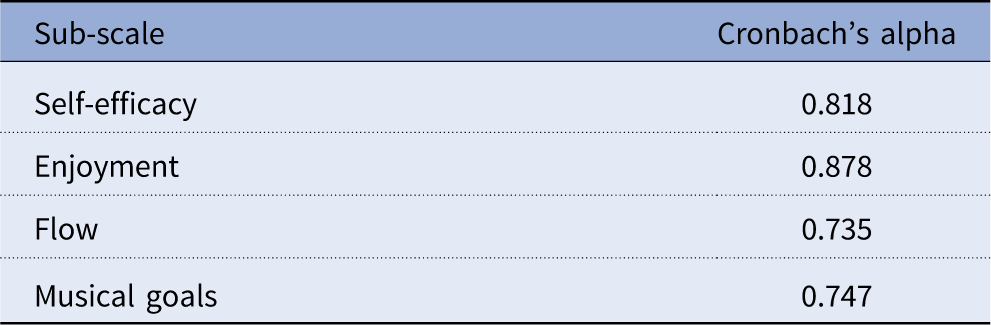
The overall motivation score was examined through statements based on the four sub-scales: self-efficacy (Bong & Skaalvik, Reference BONG and SKAALVIK2003; Pintrich & Schunk, Reference PINTRICH and SCHUNK2002), which refers to individuals’ judgments of their capabilities; enjoyment, a key aspect of motivation and learning in music (Green, Reference GREEN2008; Hallam et al., Reference HALLAM, CREECH and MCQUEEN2011); flow (Csikszentmihalyi, Reference CSIKZENTMIHALYI1990; Elliott, Reference ELLIOTT1995), used to characterize optimal experiences; and musical goals (Ryan & Deci, Reference RYAN and DECI2000), which relate to self-determination theory concepts such as the need for competence, belongingness and autonomy, as well as the fulfillment of one’s potential. Content validity was ensured through alignment with theoretical constructs, and internal consistency reliability was tested using Cronbach’s alpha (Cronbach, Reference CRONBACH1951); unreliable items were removed or reconceptualized, resulting in acceptable reliability for the final sub-scales. Reliability was high since for each of the sub-scales the Cronbach alpha coefficient exceeded 0.7. (Table 1). Notably, in calculating the flow sub-scale score, the score for the indicator ‘Music is a hard subject’ was reversed. Within the framework of Flow Theory (Csikszentmihalyi, Reference CSIKZENTMIHALYI1990), an experience of flow requires a balance between challenge and skill; therefore, perceiving a subject as excessively ‘hard’ can act as a barrier to this state, representing an experience of ‘anti-flow’ or a lack of the necessary competence beliefs. To ensure internal consistency within the sub-scale, this item was treated as a reverse-coded indicator, meaning that higher scores on this specific item would normally contradict the presence of a flow state.
Reliability for sub-scales of the motivation measure

Table 1. Long description
A table titled ‘Reliability for sub-scales of the motivation measure’ with two columns: Sub-scale and Cronbach’s alpha. The table has four rows and two columns. Row 1: Sub-scale, Self-efficacy; Cronbach’s alpha, 0.818. Row 2: Sub-scale, Enjoyment; Cronbach’s alpha, 0.878. Row 3: Sub-scale, Flow; Cronbach’s alpha, 0.735. Row 4: Sub-scale, Musical goals; Cronbach’s alpha, 0.747.
Research sample
The sample consisted of the classes taught by the first eight teachers who agreed to participate in the study following a telephone conversation. Written parental consent was obtained prior to involving students in the research. Only students whose parents returned the completed consent form participated in the questionnaire. The questionnaire was administered during the students’ music lessons in a supervised and distraction-free environment, ensuring they had adequate time to complete it thoroughly and thoughtfully. Before completing the questionnaire, the purpose of the research was explained to the students in age-appropriate language, and they were assured that their responses would remain anonymous and confidential. Additionally, students were informed that participation was voluntary, and they could choose to withdraw at any time without any negative consequences. Any questions or clarifications needed by the students were addressed by the supervising teacher or researcher during the session. Ethical approval was granted from the ethics committee of the Faculty of Policy and Society, Institute of Education, University of London as well as the Pedagogical Institute of Cyprus.
Data analysis
A multiple regression analysis was conducted in order to examine whether the quantitative indicators of perceptions of pedagogy accounted for variability in the students’ overall motivation scores. The method employed is what Field (Reference FIELD2013, p. 322) refers to as ‘forced entry’ and Pallant (Reference PALLANT2010, p. 149) refers to as ‘standard multiple regression’. In this approach, all predictors are forced into the model simultaneously. ‘Overall motivation’ was used as the dependent (outcome) variable, while all statements concerned with differentiation were treated as the independent variables (the predictors). R values showed the multiple correlation coefficients between the independent variables and the dependent variable, and R squared values showed how much of the variability in the dependent (outcome) variable was explained by the independent (predictor) variables. Beta coefficients indicate the relationship between the independent and the dependent variable. If significant (p < 0.05), then the independent variable may be interpreted as a predictor of the dependent variable.
In order to determine whether the data were appropriate for multiple regression, the assumptions of multicollinearity were checked. Multicollinearity exists when independent variables are highly correlated, specifically when the Tolerance value is very small (less than 0.10) and VIF values are above 10. Furthermore, checks for outliers, normality, linearity, homoscedasticity and independence of residuals were performed as mentioned by Pallant (2010). The results of these assessments indicated that the data were suitable for multiple regression analysis.
The data were transferred to SPSS, a statistical data-analysis software package used in educational research (Muijs, 2010). Initially, a preliminary analysis was conducted, checking for the reliability of the sub-scales for motivation. A multiple regression analysis was conducted in order to check whether the perceptions of pedagogy quantitative variables could account for variability in motivation scores.
Limitations
Several limitations should be acknowledged. First, the data rely exclusively on student self-reports, which reflect perceived rather than objectively observed classroom practices. Second, the use of positively framed Likert items may have encouraged acquiescence bias. Third, while statistical analyses identify patterns across variables, they do not capture the full qualitative complexity of students’ reasoning. To mitigate these limitations, items were theoretically grounded, reliability testing was conducted and interpretations were confined to reported perceptions rather than inferred intentions or causal mechanisms.
Results
The multiple regression analysis revealed that together the perceptions of pedagogy variables produced a multiple correlation of R = 0.930 and accounted for 86.4% of the variance in overall motivation (R 2 = 0.864). Table 2 shows the model summary.
Model summary

Table 2. Long description
A table with one row and four columns summarizing the statistics of a regression model. The columns are labeled Model, R, R square, and Sig. The row provides the following data: Model 1, R 0.930, R square 0.864, and Sig 0.001.
Three of the statements relating to perceptions of pedagogy were found to have a statistically significant unique contribution to the prediction of overall motivation at Time 2, with significant value less than 0.05 (Table 3). These included the statement ‘The teacher values the music I am interested in’ (B = 0.350, p = 0.005), the statement ‘I think music is an important school subject’ (B = 0.452, p = 0.001) and the statement ‘The teacher emphasizes that we should understand the material, rather than simply memorizing it’ (B = −0.216, p = 0.047). The negative beta value found in the statement concerned with students’ understanding instead of memorization may be explained by the fact that many statements were forced in this model. In order to check whether the relationship of this statement with overall motivation was positive or negative, we performed a simple regression analysis with this variable and overall motivation, which indicated a positive relationship.
Factors as predictors of overall motivation

Table 3. Long description
A table titled Factors as predictors of overall motivation. The table has 15 rows and 4 columns. The columns are labeled Standardized coefficients beta, t, and Sig. Each row represents a different statement about teaching methods and their impact on student motivation. The statements include various aspects of teaching such as valuing students’ music interests, allowing choice in music learning, one-to-one work, considering improvement in grading, accounting for effort, appreciating progress, views on mistakes, emphasizing understanding over memorization, respecting and supporting students, using good students as examples, group work, using own ideas, importance of music as a subject, learning from the teacher, and inspiration to continue music outside school. The table lists the standardized coefficients beta, t-values, and significance levels for each statement. Notable significant values with p < 0.05 are highlighted in bold.
Discussion
The results of this study showed that students’ perceptions regarding DI practices can be considered as a significant factor for increasing their motivation. By aligning instructional methods with students’ needs and preferences, DI helps to create a more engaging and motivating learning environment (Tomlinson, Reference TOMLINSON2017). This suggests that students respond positively to teaching approaches that recognize their individual learning preferences, interests and abilities, which can, in turn, enhance their overall motivation in educational settings (Hattie, Reference HATTIE2009). However, in the specific context of Cypriot music education, these results transcend mere theoretical alignment; they reflect a pressing need for a pedagogical shift. While the Cypriot National Curriculum (MoEC, 2010, 2016) officially promotes DI as a pillar of the ‘humane school’, the reality in secondary classrooms often remains teacher-centered. This study’s findings highlight that when DI moves from a ‘top-down’ policy to an enacted classroom reality, it directly addresses the chronic issue of student disengagement in music during the transition to secondary education.
Three of the statements that showed significant difference in data analysis were as follows: ‘The teacher values the music I am interested in’, ‘I think music is an important school subject’ and ‘The teacher emphasizes that we should understand the material, rather than simply memorizing it’. These statements highlight key aspects of DI. Valuing students’ musical interests connects to interest-based differentiation (Tomlinson et al., Reference TOMLINSON, BRIGHTON, HERTBERG, CALLAHAN, MOON, BRIMIJOIN, CONOVER and REYNOLDS2003), which personalizes learning to students’ preferences, increasing motivation. In Cyprus, this is particularly relevant as there is often a cultural gap between the formal music taught in schools and the informal musical worlds of students. Our results suggest that bridging this gap is not just a matter of ‘variety’ but a fundamental tool for reversing the perceived marginalization of music as a ‘secondary’ subject. The emphasis on music as an important subject supports relevance-based differentiation, engaging students by linking content to their values (Chamberlin & Powers, Reference CHAMBERLIN and POWERS2010). In the highly academic and exam-oriented culture of Cyprus, making music relevant to students’ lives is crucial for elevating its status within the curriculum. Finally, the focus on understanding rather than memorization relates to cognitive-based differentiation, which encourages deeper learning through varied instructional strategies that align with students’ cognitive processes (Subban, Reference SUBBAN2006).
Interestingly, these results align with research highlighting the importance of a differentiated music learning environment. For example, Ismail, Chiat & Anuar (Reference ISMAIL, CHIAT and ANUAR2021) outlined the significance of an encouraging and supportive environment. In the same vein, Jones et al. (Reference JONES, LI and CRUZ2017) contend that educators play a pivotal role in providing a meaningful environment by fostering positive relationships with students, ensuring they feel supported and come to appreciate the inherent values of music. In the Cypriot context, where rote learning often dominates due to systemic pressures, this finding advocates for a ‘mastery over performance’ orientation. This exposes the ‘hidden curriculum’ of the school, which still rewards memorization over creative exploration.
Recent studies in the Cypriot context revealed the importance of listening to students’ preferences (Hadjikou, Reference HADJIKOU2021a; Hadjikou & Creech, Reference HADJIKOU and CREECH2023). Hadjikou & Creech (Reference HADJIKOU and CREECH2023) showed that Cypriot teachers believed that choosing repertoire based on students’ preferences would enhance their interest, while Hadjikou (Reference HADJIKOU2021a) found that students preferred to choose the music they learned. These findings align with broader literature on the role of autonomy in motivating students (Elliott & Silverman, Reference ELLIOTT and SILVERMAN2015; Green, Reference GREEN2008; Hallam et al., Reference HALLAM, CREECH and MCQUEEN2011) and support the implementation of differentiated teaching (MoEC, 2010, 2016). However, our research moves a step further by bridging the gap between teacher beliefs and student motivation, proving that student voice is not a luxury but a functional requirement for DI to be successful in local secondary schools.
Valuing students’ musical interests consists of a key component of DI. Teachers who integrate students’ preferences into the curriculum can better engage them by making learning more relevant (Tomlinson, Reference TOMLINSON2014). This strategy not only boosts motivation but also validates students’ musical identities, fostering an environment where diverse backgrounds and personal tastes are explicitly respected (Burnard & Murphy, Reference BURNARD and MURPHY2013). In Cyprus, where the student population is increasingly diverse, DI serves as a vehicle for culturally responsive teaching. DI is vital for enhancing students’ value beliefs toward music, a subject often undervalued and declining across grade levels (Jacobs et al., Reference JACOBS, LANZA, OSGOOD, ECCLES and WIGFIELD2002; McPherson & O’Neill, Reference MCPHERSON and O’NEILL2010; Wigfield et al., Reference WIGFIELD, ECCLES and REUMAN1997).
Recent studies underscore the role of DI in increasing motivation and engagement. Incorporating student voice and using flexible grouping and mastery learning facilitate personalized skill development, improving academic performance and intrinsic motivation (Pozas & Schneider, Reference POZAS and SCHNEIDER2019; Scarparolo & MacKinnon, Reference SCARPAROLO and MACKINNON2022). Additionally, PMM and community collaborations promote enjoyment and meaningful connections (Giebelhausen & Kruse, Reference GIEBELHAUSEN and KRUSE2018). This study contributes to the collective efforts for improvement by providing empirical evidence that in Cyprus, lower secondary music education suffers from controlling teaching styles (Hadjikou & Creech, Reference HADJIKOU and CREECH2023).
Shifting the focus from memorization to understanding relates to DI. Teachers who aim for deep comprehension through diverse instructional strategies better address varied learning needs (Sousa & Tomlinson, Reference SOUSA and TOMLINSON2011), using a combination of visual, auditory and kinaesthetic activities (Heacox, Reference HEACOX2012). These practices encourage critical thinking (Anderson, Reference ANDERSON2007). In Cyprus, where musical talent is often seen as an ‘innate gift’, promoting a growth mindset (Dweck, Reference DWECK2006) through DI is a radical philosophical shift. It ensures that students without private conservatory training (ωδϵία) feel they have an equal chance to succeed.
A key finding from the study reveals that students’ motivation is strongly linked to the value they attach to music as a school subject. Enhancing the perceived value of music lessons may lead to higher motivation levels (Arostegui, Reference AROSTEGUI2016; Economidou Stavrou, Reference ECONOMIDOU STAVROU2006). In music education, when the curriculum reflects students’ values, it boosts engagement (Economidou Stavrou & Papageorgi, Reference ECONOMIDOU STAVROU and PAPAGEORGI2021; Kokotsaki, Reference KOKOTSAKI2016). Ultimately, this study provides a roadmap for moving beyond the ‘intended curriculum’ toward an ‘enacted curriculum’. By addressing both cognitive and affective aspects, DI creates a classroom environment that aligns with the main principles of the new music curriculum (MoEC, 2010, 2016), promoting continuous improvement and deeper engagement in the Cypriot learning process.
Conclusion and recommendations
This study highlights the importance of DI in fostering student motivation and engagement by addressing individual learning needs, preferences and values. It shows that students respond positively when their interests are valued and when teachers prioritize understanding over memorization. In the specific context of Cyprus, this finding is a direct critique of the traditional ‘culture of memorization’ that persists despite decade-long efforts for educational reform. While the revised curricula theoretically emphasize competence-based learning, the systemic pressure for curriculum coverage often leads to a superficial, rote-learning approach. The detrimental impact of this emphasis on memorization over deep understanding is a major concern; it fosters a ‘fixed mindset’ where music is seen as a set of facts to be recalled rather than a creative language to be explored.
DI practices, such as mastery learning and goal orientation, allow students to work at their own pace, promoting deeper comprehension and resilience. By incorporating strategies that cater to diverse learning preferences, teachers can create a learning environment that encourages exploration, autonomy and intellectual growth. This holistic approach not only enhances student motivation but also supports academic achievement and lifelong learning by cultivating a growth mindset. The findings suggest that for Cypriot music education to evolve, it must move beyond the ‘intended’ curriculum and focus on ‘enacted’ classroom differentiation that rewards critical thinking and application over passive recall.
Based on these conclusions, in order to improve music education in Cyprus, Targeted Teacher Training: Professional development for Cypriot music educators should move beyond general pedagogical theory. There is a need for subject-specific workshops on how to implement differentiation within the constraints of the Cypriot secondary school schedule, focusing on managing mixed-ability groups and using technology to support individualized learning pathways.
Ultimately, this study contributes to the collective efforts for improving music education by providing empirical evidence that differentiation is the primary vehicle for achieving the ‘humane and democratic school’ envisioned by the Cypriot reform. By prioritizing understanding and student agency, educators can transform music from a marginalized subject into a vital, inclusive and motivating experience for all learners. Future research could adopt qualitative methodologies − such as classroom observations, interviews and reflective dialogs − to examine more closely how differentiation and motivational strategies are pedagogically enacted, negotiated and experienced within the dynamic context of music classrooms.
Acknowledgments
The authors would like to thank Dr Andrea Creech for the help and guidance throughout this research.
Funding statement
The author(s) received no financial support for the research, authorship and/or publication of this article.
Competing interests
The author(s) declare none.
Appendix A: Sub-scales of the motivation measure

Appendix B: Pedagogy statements




 Open access

