Introduction
On Sunday morning, the local primary school becomes Violet. Anybody visiting Violet's Sunday rehearsals is immediately confronted by music. It fills every available space, seeps through the hallways and gracefully infiltrates the sacred silences of an early Sunday morning. Music made by the older Violet members filters through the sliding doors and surrounds the younger orchestras’ rehearsal spaces. Unconsciously, the young ones hear where they are going to as Violet members, the music they will soon be able to play, and the orchestra they will soon join. Unknowingly, they are surrounded by sounds that inspire.
Even when orchestra members take their break, the music continues. The youngest members gather, listening attentively to an older orchestra's ongoing rehearsal. Other members assemble in small spontaneous groups to help each other with difficult passages, jam on a favorite tune, or improvise on some melody they already know. Still others interact, make social plans for the coming week, or talk about school matters. These are lasting friendships formed around a mutual interest: Violet.
Violet's rehearsal space embodies a tangible energy not only streaming from the directors onto the orchestras, but also from the orchestras back to each director. Producing this energy together brings a sense of pride, an addiction, which motivates the children to return next Sunday for more. This unique energy transforms strangers into acquaintances, and acquaintances into friends.
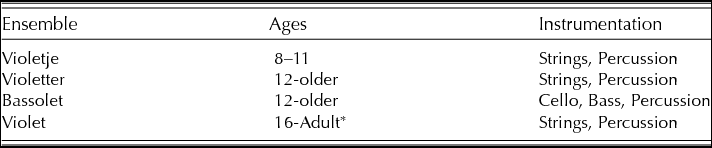
Violet is a non-profit youth string orchestra programme serving communities in the Belgian municipalities of Leuven, Heverlee, and Oud-Herverlee. The orchestra programme comprises of four ensembles, which range in age and musical ability and meet once weekly for a two to three-hour rehearsal session. Their philosophy is as follows: ‘Violet is like scouts, but with violins. It is an initiative for the young, focused on the social; thus, interacting and learning from and with others in an informal, relaxed environment; all of this with violin in hand’ (Greet, personal communication, April 11, 2012). Social interaction, therefore, is as important to the Violets as the music-making process.
Researchers suggest it is commonplace for youth ensemble members to appreciate the benefits of social interaction and informality within music ensemble environments. Bartolome (Reference BARTOLOME2013), for example, identified young Seattle choristers’ appreciation of the musical, personal, social, and external benefits of choral ensemble membership. Lucy Green (Reference GREEN2008) identified young band members’ appreciation of music-learning practices that are more informal and geared toward peer-learning opportunities. Using Violet as a case, and drawing from the work Bartolome (Reference BARTOLOME2013) and Green (Reference GREEN2008), this study explores the interaction between youth string orchestra members within an instrumental ensemble environment. The purpose of this study was to examine Violet Youth Orchestra as a musical environment that promotes a blend of both informal and formal learning practicesFootnote 1. In what follows, we argue that such environments facilitate musical, social, and personal development.
The Benefits of Ensemble Participation
Music participation cultivates social bonding, promotes a sense of security, and facilitates individual wellbeing (Bailey & Davidson Reference BAILEY and DAVIDSON2005; Hallam et al., Reference HALLAM, CREECH, VARVARGIGOU and McQUEEN2012; Higgins, Reference HIGGINS2012; Pitts, Reference PITTS2005; Turino, Reference TURINO2008). Scholars have documented how young people, in particular, appreciate ensemble participation for its musical, academic, psychological, and social benefits (Adderley, Kennedy & Berz, Reference ADDERLEY, KENNEDY and BERZ2003; Bartolome, Reference BARTOLOME2013; Campbell, Connell & Beegle, Reference CAMPBELL, CONNELL and BEEGLE2007; Hewitt & Allan, Reference HEWITT and ALLAN2012; Kennedy, Reference KENNEDY2009; Kokotsaki & Hallam, Reference KOKOTSAKI and HALLAM2011). Drawing on decades of research and her ethnographic exposure to a Seattle girls’ choir, Bartolome (Reference BARTOLOME2013) suggests musicians derive personal, social, musical, and external benefits from youth choral ensemble participation. Personal benefits included feelings of accomplishment, self-confidence, and empowerment. Members appreciated the collective experience, interpreted choir as ‘special,’ compared choir to school, and valued the commitment and emotional outlet choir provided. Social benefits covered interpersonal development, a place of belonging, exposure to a diverse environment, and choir as a constant. Musical benefits included musical development within a quality, formal music-education setting. External benefits denoted ways the choir actively contributed to their external communities’ social fabric, including notions of ambassadorship and advocacy. Although Bartolome provides sound evidence for the benefits of youth ensemble participation, her findings are restricted to formal learning practices and do not address music settings that implement more informal learning practices. In fact, as she mentions, her participants joined their respective choirs specifically to gain access to formal music education practices (Bartolome, Reference BARTOLOME2013, pp. 402, 405).
Eclectic Strings: Bridging the Informal and Formal Divide
Music students benefit from informal music-learning practices (Jaffurs, Reference JAFFURS2004; Lonie & Dickens, Reference LONIE and DICKENS2016; Virkkula, Reference VIRKKULA2016; Woody & Lehmann, Reference WOODY and LEHMANN2010). When discussing informal learning, researchers often compare such practices with formal music-learning contexts (Finney & Philpott Reference FINNEY and PHILPOTT2010), subsequently constructing a dichotomous relationship between informal and formal music practices. Lucy Green (Reference GREEN2008), for example, contrasts informal and formal music learning to characterize informal learning practices. She identifies five characteristics of informal music learning: 1) repertoire chosen by students and not teachers; 2) emphasis on aural learning rather than notation; 3) exhibition of peer group-learning and management instead of a teacher-student relationship; 4) inclusion of unorganized holistic learning as opposed to formally planned learning sequences; and 5) integration of listening, performing, improvising, and composing rather than formal learning's separation of skills (p. 11). Similarly, Folkestad (Reference FOLKESTAD2006) recognizes four criteria that separate informal and formal learning situations: 1) the situation, or where learning takes place; 2) learning style, differentiating between written notation and informal aural learning; 3) ownership over the decision-making process; and 4) intentionality, asking whether learning is understood as how to play, rather than just to play (p. 141).
Both Green and Folkestad's criteria of informal learning differ substantially from that of Bartolome's youth choir. For example, the youth choir was in large part, driven by conductor-made decisions and was celebrated for providing a high-quality music education that resembled more ‘formal school institutions’ like sight-reading, music theory, and voice instruction (Bartolome, Reference BARTOLOME2013, p. 405). Conversely, Folkestad and Green emphasis a more unorganized, holistic student-driven experience. Such experiences engage students in aurally-driven musical learning experiences that facilitate student-driven decision-making processes and peer teaching opportunities, which subsequently steer the learning experience.
Even through Folkestad and Green's classifications appear helpful in recognizing a particular learning style, both researchers take issue with an exclusive approach. This, they suggest, results in prejudices, such as ‘the implicitly normative value judgments . . . where informal is equal to good, true or authentic, while formal is equal to artificial, boring and bad’ (Folkestad, Reference FOLKESTAD2006, p. 143). Secondly, dichotomous understandings fuel misperceptions, such as the disconnect between a school's music spaces and students’ ‘hidden and private musical world’ (Allsup, Reference ALLSUP2003, p. 23), the idea that formal practices are primarily Western based (Folkestad, Reference FOLKESTAD2006), and that informal learning is an ‘anything goes’ approach (Green, Reference GREEN2010). Third, thinking about an exclusive approach becomes unproductive, since teaching is formal by nature. Even when using informal learning strategies, music educators still lead instruction to provide sufficient pedagogical structure (Folkestad, Reference FOLKESTAD2006).
To overcome such misperceptions, Folkestad (Reference FOLKESTAD2006) calls for a dialectic understanding of the informal and formal music-learning debate, especially since most learning situations constantly ‘flip and slide’ between informal and formal styles (Finney & Philpott, Reference FINNEY and PHILPOTT2010). Likewise, Green (Reference GREEN2010) calls on researchers to look at the interaction between informality and education. In this sense, informality moves beyond merely informal learning, denoting pedagogy that reflects real-world learning practices of musicians. Jenkins (Reference JENKINS2011) views the informal and formal divide not as two opposing sides, but rather as a continuum. On one end, learning is indistinguishable from play. On the other, strict predetermined goals guide the learning process. He advises teachers to find a middle ground, or a ‘best blend’ of informal and formal practices that fits their context, as well as students’ interests, time, and resources (p. 193).
Folkestad's ‘dialectic understanding’ and Jenkins’ ‘best blend’ has manifested globally in a variety of ways, such as England's Musical Futures project (Green, Reference GREEN2008), and the American String Teachers Association's Eclectic Styles campaign, which seeks to implement more informal music learning practices into American school string ensembles (Fortune, Reference FORTUNE2014; Lieberman, Reference LIEBERMAN2004; Lindamood, Reference LINDAMOOD2011). We chose to adopt the term eclectic because it more accurately describes the amalgamation of group informal and formal music learning as described in this report (Fortune, Reference FORTUNE2014).
The inclusion of eclectic styles in music learning spaces has increased substantially over the years due to increased media presence, resources, and professional development opportunities (Lindamood, Reference LINDAMOOD2011). Subsequently, researchers have identified a series of accompanying benefits and challenges. Benefits include increased cultural responsiveness among teachers toward their constituent populations (Abril, Reference ABRIL2009), increased social interaction, musical understanding, and enjoyment among students (Green, Reference GREEN2008; Oare, Reference OARE2008). Teachers also perceived eclectic styles repertoire as pedagogically valuable, in that repertoire can develop technical, musical, and artistic ability from multiple areas within the music education curriculum (Lieberman, Reference LIEBERMAN2004; Oare, Reference OARE2008). These abilities include listening and rhythmic acuity (i.e., groove), as well as melodic and harmonic structural understanding (Green, Reference GREEN2008; Lieberman, Reference LIEBERMAN2004). With regards to the challenges of implementing eclectic styles, instrumental music educators may not be adequately trained to teach an eclectic style or be considered ‘outsiders’ to a particular style (Abril, Reference ABRIL2009; Lindamood, Reference LINDAMOOD2011; Springer, Reference SPRINGER2015). Teachers may also appear insecure when implementing a specific style, which enables students and community members to doubt the groups’ authenticity and quality (Abril, Reference ABRIL2009).
To expound on these and other studies, Lindamood (Reference LINDAMOOD2011) calls for further qualitative research to elaborate on the nature of eclectic string ensembles and the perceptions of their teachers and members. A need also exists to support and extend prior research describing the benefits of ensemble participation to ensembles which adhere to a more dialectic approach, that is, ensembles combining both formal and informal styles (Bartolome, Reference BARTOLOME2013; Green, Reference GREEN2008). Using the term eclectic to label amalgamated informal and formal learning practices, the purpose of this qualitative study was to examine the Violet Youth Orchestra as a musical environment that promotes a blend of both informal and formal learning practices. In doing so, we sought to identity the qualities that constitute an eclectic music ensemble space, and how members benefit from participating in such spaces.
Methodology
Ethnography is a qualitative mode of research that ‘entails the deep immersion into the life of a people’ (Robben & Sluka, Reference ROBBEN and SLUKA2007, p. 8). Researchers conducting ethnographies construct a detailed description of a particular social setting and its accompanying social interactions by immersing themselves in that setting. In music, Titon (Reference TITON, Barz and Cooley2008, p. 30) asserts that such ethnographic immersions are paramount when seeking to understand the lived experiences of people making music. The researchers from the present study immersed themselves in the Violet youth orchestra setting twice over the course of three years. During the first immersion, the second researcher spent six months with Violet, participating in orchestra activities, observing rehearsals, and attending community concerts. During the second immersion in August 2015, both researchers attended Violet's annual 14-day music camp. Data were collected during both immersions using the classic ethnographic methods of participant observation and semi-structured interviews (Bernard, Reference BERNARD2002).
The first six-month exposure provided the second researcher with an in-depth ethnographic understanding of how the Violet structure works, the group's role within members’ lives, and its impact on the broader community. These ethnographic data were captured through detailed field notes (Emerson, Fretz & Shaw Reference EMERSON, FRETZ and SHAW2011). The second two-week immersion enabled the researchers to confirm Violet's longevity and organisational consistency, thereby ensuring diachronic reliability (Kirk & Miller Reference KIRK and MILLER1986). It also allowed them to capture additional ethnographic data. Similar to the first immersion, the researchers observed and participated in ensemble activities, while also socially engaging with students, directors, and staff. Each experience was captured in detailed field notes. The researchers also initiated semi-structured responsive interviews with all four directors and 20 youth members (ages 12–18 years) to capture members’ first-person experiences and perceptions (Rubin & Rubin, Reference RUBIN and RUBIN2012). Nine youth played in Violet, seven in Violetter, and four in Bassolet. 11 youth were violinists, two were violists, five were cellists, and two were bassists. Violetjes (ages 8–11; n = 19) were excluded from the study because initial informal conversations revealed they had difficulties addressing the interview questions in a useful manner. Both experiences were granted approval by the host university's Internal Review Board.
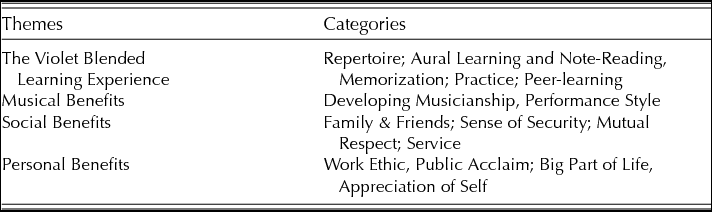
The researchers transcribed each interview verbatim replacing the names of youth members with pseudonyms; directors’ names were used with their consent. Interview data were then triangulated with observations and field notes (Creswell, Reference CRESWELL2014, p. 201). The researchers analysed the complete data set using a dual-stage coding process (Miles, Huberman & Saldaña, Reference MILES, HUBERMAN and SALDAÑA2014). During the first stage, they compiled a list of In Vivo, descriptive, and value codes identifying emerging patterns within the transcribed interviews and field notes. During the second coding process, the researchers collapsed these codes into overarching categories that aligned with their research questions and theoretical frameworks. These categories alluded to four different themes, capturing Violet's learning practices and describing the benefits of Violet membership (see Table 1).
Themes and categories

Violet Ensembles

* approximately 10–15% of members are between 19 and 26 years of age
The Violet Experience – A Blend of Informal and Formal Learning
Violet's Background
Belgian violin teachers, Aag Dereymaeker and Greet Verhulst, founded Violet to realize two objectives. First, they sought to create an ensemble space for their respective studios’ youngest string players too young to engage in Belgium's formal music education systemFootnote 2. Second, they wanted to encourage community building, social awareness, and community service among their students. Because of their shared background in community music-making and engaged-musicianship, they viewed ensemble music as natural means of service. This included fundraising for less fortunate music groups, which has since become their ensemble's primary objective.
With these objectives in mind, Aag and Greet launched Violet in April 2002. The Violet ensemble originally consisted of individuals 12 years and older, while Violetje catered to beginning-level string students younger than 12 years. To be a member, individuals had to take a year of theory and instrumental lessons at the local music academy or one year of private instruction with Violet's directors. The founders prioritized work ethic and responsibility over ability level. Thus, engaged students with less ability have a better chance at obtaining membership than those with more ability who were less engaged. No other formal entry audition or examination was required.
In 2006, the founders established Violet as a non-profit organisation and assembled a board comprised of community members, selected parents, and ex-orchestra members. The board oversees Violet's logistical matters, parental communication, public relations, informal social gatherings, and the organisation of performances. Each member, including the directors, works as an unpaid volunteer and maintains separate full-time employment. As of 2016, Violet consists of 126 members and four respective orchestrasFootnote 3, each differing in ability and educational function.
Results/Discussion
The Violet Learning Experience
The Violet Repertoire: Directors are fascinated, almost obsessed, with learning music from other societies. At the heart of this intrigue lies folk music, which, according to the directors, provides a unique vitality and dynamic to Violet, as well as substantial pedagogical value. According to Greet, ‘I think all folk music is very good for violin technique, because it is so natural to the violin.’ Aag states, ‘With folk music, there is a freedom. The fact that it is danceable, that is important. In folk music, you can also hear the chords and use your violin as an accompaniment and melody . . . even as a bass. You can choose.’
Violet performs a variety of folk music, including Flemish, African, Irish, Scottish, English, Scandinavian, Balkan, and Klezmer styles. To establish authenticity, the directors study the styles themselves, or rely on members to travel abroad, learn a specific folk style, and teach the other Violets upon their return. Additionally, Violet travels to various countries, as is the case with South Africa. Violet's relationship with their South African sister orchestra, the Mangaung String Programme (Brenner, Reference BRENNER2011; Cloete, Reference CLOETE2006; Cloete & Erasmus, Reference CLOETE and ERASMUS2012), has facilitated several face-to-face interactions, enabling a sharing of authentic folk music between the two countries.
Although Violet tends to focus on folk music, Aag and Greet are classically trained violinists who also value the pedagogical aspects of Western-Art instructional methods. The directors therefore supplement folk repertoire with Western- music styles, such as classical chamber music, popular music, film or movie music, as well as educational arrangements and compositions. All choices reflect each respective orchestra's pedagogical needs and musical tastes.
Be it folk or classical, the repertoire choices also predetermine directors’ mode of instruction. For example, during camp, the Violets learned a Flemish folk song that required singing and dancing, as well as an improvised harmonic and rhythmic accompaniment. To teach this piece, the directors use rote-instruction and improvisational techniques. The Violets also learned movements from Warlock's Capriol Suite, a Western-Art composition, which the director conducted as members read from sheet music.
Aural Learning & Note Reading: The Violets implement a blend of aural learning and note reading throughout the curriculum. Emphasis, however, is given to aural learning, especially during initial instruction with the Violetjes. During rehearsals, the Violetjes stand in a circle to facilitate movement and interaction with peers and the director. Simple folk melodies are helpful, as singing is an integral part of Violet's learning sequence. Most children also recognize the melodies, providing them with a sense of familiarity and ensuing security (Higgins, Reference HIGGINS2012). If no lyrics exist, the Violetjes sing using solfege. Instruction through written notation, however, is kept to the bare minimum. When considering her teaching objectives in Violetje, Aag noted, ‘we teach them the tools to create something rather than just to play something.’ Aag and Greet rely on rote instruction, rhythmic acuity, harmonic and rhythmic improvisation to enable such creativity. Additionally, singing and dancing support their teaching objectives, thereby contributing to Violet's creative and free-learning environment.
As students move onto Violetter and Bassolet, aural modes of instruction make way for more visual modes (i.e., note-reading), which include music stands, sheet music, and traditional styles of conducting. Sheet music consists of transcribed music repertoire, ranging from pop tunes to Western Art pieces. During camp, Violetter performed arrangements from ‘Game of Thrones,’ the Adagietto from Beethoven's Seventh Symphony, and a ‘Lady Gaga’-inspired Baroque Fugue. Similarly, Bassolet performed a series of folk and Western Art arrangements for cello choir. According to Albert (age 14), a member of Violetter, ‘The pieces are nice. Last year it was more like film music. Now it is a lot of music from all styles.’ The use of written notation provides students with the vital learning experience of learning to sight-read more effectively while learning music they recognize and enjoy. Both founding members value sight-reading's importance and agree that sheet music and stands have a functional place in Violetter. That being said, Violetter members are still exposed to aural techniques when participating in mass orchestra initiatives where rote learning and improvisation are the main forms of instruction.
Violet, the senior orchestra, is an amalgamation of aural-learning processes and note reading. The choice of learning mode depends primarily on the music style being undertaken. Typically, the directors use aural-learning approaches to teach folk music and note reading approaches to teach Western-Art pieces. The former allows for impromptu improvisation moments, as the second violin and viola sections are encouraged to develop their own harmonic and rhythmic accompaniment. In Violet, you therefore see a confluence of each orchestras’ learning processes.
Memorization (Playing-by-Heart): All performers and directors are expected to play from memory at the concert, regardless of level or complexity. Members referred to this process as ‘playing-by-heart.’ Directors insist on memorization, believing that it adds to the quality and nature of Violet's performances. Violetter's director, Geert Adriaenssens, stated, ‘We put away the score as soon as possible . . . I want them to see each other and know what the others are playing . . . Take each other's energy when they are playing.’ This energy becomes evident during Violet's public performances. With no stands or chairs in the performance space, the Violets interact with each other through better eye contact and movement, a finding that aligns well with prior literature (Davidson, Reference DAVIDSON1994; Williamon, Reference WILLIAMON1999). They also project their energy into the audience through dancing and movement. According to members, Violet's chair-less and stand-less performance space differentiates them from other orchestras. Edda (age 14) noted, ‘big orchestras all sit very formally on little chairs and play, but with us it's different. We move and dance when we play.’
Practice: Obtaining a quality musical product is essential for Violet's directors. For members, this translates to attending rehearsals and home practice. Edda (age 14) noted that even though Violet is a relaxed learning space, she feels compelled to learn her parts at home. Members who do not attend rehearsals or practice their parts frustrate others. Susanna (age 18) agreed, ‘It's irritating if someone just ruins it for everybody because they didn't rehearse [practice] . . . you need that commitment.’ Susanna acknowledges here that quality is an expectation of membership in Violet. If you're committed to the group, you practice.
Peer learning: Practicing is not the only way to overcome difficult techniques or passages. Violet has also cultivated a culture of peer learning that is often associated with informal learning spaces (Green, Reference GREEN2008). Instead of sitting around and catching up on the latest group gossip, rehearsal breaks often turn into peer-learning and teaching sessions. Peer learning also extends beyond the respective orchestras, when older members teach younger ones. Teaching the young ones poses little to no challenge since older members played most of the melodies in Violetje's repertoire when they were younger and are thus familiar with the melodies and playing style. In doing so, they provide directors with additional assistance and strengthen the group's overall performance. Taken together, these findings suggest that Violet combines elements of informal music learning with more formal styles of music learning. In doing so, they present another model of eclectic ensemble to be considered alongside that of Green (Reference GREEN2008) and other scholars.
The Benefits of Ensemble Participation
Musical Benefits
Developing Musicianship: Bartolome (Reference BARTOLOME2013) suggests that participation in ensembles is musically beneficial in that students who develop musical ability participate in quality, formal music-educational settings. The same could be said of participating in Violet; as members rehearse with their ensembles and practice at home, they develop the skills essential to playing string instruments. More importantly, Violet members believe that participating in their respective ensembles helps them become better musicians and ensemble performers. Jennifer (age 12) mentioned, ‘If I wasn't part of Violet I would probably not play at the same standard as I currently play . . . As a musician, I feel I became better.’ Sophie (age 16) added, ‘Now I know how to play in group. A lot of people in the academy don't know how to do it; so, it's something you have to learn, and it's also a great feeling.’
Performance Style: Members felt that participation in Violet yielded a ‘different,’ more informal musical experience than their other more formal orchestral activities, especially in terms of performance style. Members mentioned that traditional orchestras sit when they perform, a practice that left them rather unimpressed. Ria (age 16) stated, ‘Some orchestras are very boring; they just sit still and do nothing.’ To Ria, movement seemed an invigorating facet of Violet's performance style. Edda (age 14) agreed, suggesting that standing allowed her to move and increased her ability to interact with her peers. ‘Big orchestras all sit very formally on little chairs and play, but with us it's different. We move and dance when we play, and we have the little ones [from Violetje] between us, also playing with us. Our orchestra is just different to the bigger formal ones.’ These findings augment those of Green (Reference GREEN2008), who found similar responses from participant involved in the Musical Futures program.
Personal Benefits
Alongside musical benefits, members also made reference to the personal benefits of participating in Violet (Adderley et al., Reference ADDERLEY, KENNEDY and BERZ2003; Bartolome, Reference BARTOLOME2013; Pitts, Reference PITTS2005). Such benefits include increased work ethic, self-confidence derived from public acclaim, and self-respect of one's abilities.
The Violet Work Ethic: When we asked members what they gained from the Violet experience, some mentioned discipline and responsibility. According to Anke (age 18), ‘I've learned to have discipline . . . if you say, ‘Yeah I'm going to do that’ you have to do that.’ Abbey (age 17) enjoyed the way she felt after working hard: ‘You have to work hard and it's a good thing. The final product is so ‘wow,’ you know your work has paid off.’ Violet members, overall, seemed to value the strong work ethic they gained from Violet membership and, in turn, recognized their increased benefits. These findings correlate with those of Bartolome (Reference BARTOLOME2013), whose interviewees also commented that choral participation helped develop a sense of discipline. Thus, it could be argued that when members invest themselves or feel responsible for an ensemble, music participation may cultivate discipline and enhance work ethic.
Violet's Public Acclaim: One benefit of working hard was the affirmation members received from the public and family members. Ingrid (age 14) said, ‘We are a little famous. If you say ‘I'm from Violet’ they know about the group.’ Kate (age 18) noted, ‘It's nice to make something you can show to [our] parents.’ Receiving such praise nurtured within members’ feelings of accomplishment and pride, which then validated their commitment to Violet. As Jules (age 14) mentioned: ‘People always say after concerts how good it was, so I'm happy to be part of Violet because everybody is so proud of us.’ It also made members for confident in themselves. Performing for public audiences made Kate (age 18) ‘more confident doing something [she] would normally be afraid of’ and encouraged Sabine (age 17) to challenge herself. As she stated: ‘The improvisation we did this morning - if you asked me three years ago, I would not do it.’ These finding align with those of other scholars (Adderley et al., Reference ADDERLEY, KENNEDY and BERZ2003; Bartolome, Reference BARTOLOME2013), who also found that participating in ensembles instilled members with a sense of accomplishment, pride, and, self-confidence.
Self-Respect: Alongside being proud of their hard work, members also had to believe in themselves. The directors realize that children sometimes find it difficult to recognize and accept their individual music ability; therefore, they make every effort to teach members to be honest with themselves about their personal ability. Greet explains: ‘Not all apples on the tree are ripe at the same time . . . If you as a child know what you are capable of, and are honest about it, you are as much a member of Violet as is the child that can play everything. This we communicate to our orchestra members.’ Violet therefore upholds the philosophy that those with lesser skills should not be deprived from a vibrant learning and social space, but rather encouraged to do their utmost to achieve a personal best. This philosophy of acceptance and self-respect has syphoned through its membership, promoting honest awareness of individual abilities. According to Kate (age 18) ‘it's fun when you can get better, but it is also ok if there are people better than you. It's impossible to be perfect and it's also a good thing to be imperfect.’ Similarly, Sabine (age 17) noted that ‘[directors] say its ok to fail, you just have to admit it and say I cannot play this.’
Social Benefits
Violet members are chosen based on their commitment to the group rather than individual ability. To this, Greet states:
Ability is not as important as [members’] sense of responsibility and motivation to work; the overall investment in our group is . . . Members who do not show commitment, tend to leave the group . . . Fortunately, this doesn't happen often, thanks to the social interaction between members. They remind each other of their commitments.
Thus, the Violet experience pertains to more than just music - ‘more than just us playing songs’ (Henri, age 17). Rabinowich, Cross and Burnard (Reference RABINOWITCH, CROSS and BURNARD2012, p. 484) echo this sentiment, valuing music as ‘a powerful medium for social interaction.’ Being part of Violet therefore expands beyond the boundaries of music learning to also include social experiences and their ensuing benefits. These pertain to friendships and a sense of family, feelings of security, the Violet mentality, and service.
Friends and Family: Music participation provides young people with ‘a means of meeting new people and making new friends’ (Campbell et al., Reference CAMPBELL, CONNELL and BEEGLE2007, p. 230). Kokotsaki and Hallam's (Reference KOKOTSAKI and HALLAM2011) participants stated that music ensembles gave them a chance to meet and make music with ‘like-minded people’ (p. 155). Equally so, Violet members see their ensemble as a friendship building space. Susanna (age 18) explained that ‘when you first get into Violet, you're like, ‘Okay these people are cool, let's be friends.’’ A common denominator aiding such friendships is members’ shared musical interests. As Anke (age 18) stated: ‘We have so many friends here and you can just play music all the time . . . everyone gets why you like the music, and we are all a little bit the same in that.’ These friendships eventually develop into long-lasting relationships, extending beyond the Violet environment. Suzanne (age 18) shared that Violet friends ‘don't only meet when you go to orchestra, but [we] see a lot each other often to just have a drink and some barbeques over this summer . . . ’
Not everyone in the group can be friends. Some members, like Elizabeth (age 17), preferred instead to use the term ‘family’ when thinking about Violet: ‘We are not all friends, but you know we are family. We love each other.’ This sense of family stays with members throughout their Violet tenure. Members attributed the sense of family to extra-musical activities. As Sabine (age 17) stated: ‘The fact that we do things that are not related to the music is maybe the reason that we are such a tight group and why we feel like a family.’ Members’ therefore interpreted Violet in terms of long-lasting connections, a fictive kinship extending beyond orchestra rehearsals. These feelings cement a familial allegiance to Violet. As Abbey (age 17) confirms: ‘I don't think I will ever have the courage to leave Violet. It is my family.’ These members’ friendships and familial affiliations correlate with Higgins (Reference HIGGINS2012) reference to the bonding abilities of music participation, and also agree with Turino's (Reference TURINO2008) assertion that participatory music establishes deep-rooted social connections.
A Sense of Security: Music participation nurtures feelings of security. This ranges from an ontological security that confirms one's place in the world to security that comes with membership to a particular social group (Higgins, Reference HIGGINS2012, p. 147). Campbell et al. (Reference CAMPBELL, CONNELL and BEEGLE2007), Kokasaki and Hallam (Reference KOKOTSAKI and HALLAM2011), and Bartolome (Reference BARTOLOME2013) recognized similar feelings among their respective studies’ participants. Adderley et al. (Reference ADDERLEY, KENNEDY and BERZ2003) identified participants’ appreciation of ensembles as ‘a home away from home’ (p. 204), and that they appreciated that they ‘feel part of something,’ (p. 195) when participating in their ensembles. Similar sentiments were also prominent among Violet members. Henri (age 17) noted that ‘Violet is something I can rely on. Violet is always going to be there. There is always going to be a place for me in Violet. Yes, a feeling of security.’ Similarly, Elizabeth (age 17) regarded Violet as a central part of her life, making it difficult to think ‘what I would have done without.’
Among choristers, Bartolome (Reference BARTOLOME2013) found a relationship between feelings of belonging and acceptance. Similarly, Violet members emphasized acceptance as a key tenant of the Violet experience. As Sophie (age 15) explained:
Everyone accepts everyone here and so it's not like in schools where you have different groups. You can just jump in and it's fine. No one judges, and everyone accepts you. In primary school, I had some trouble with kids in school, and it wasn't a good time for me. So, I was very shy when I came here. And then here it was like ‘Whoa!’ I like that.
Contrary to school, Sophia feels accepted in Violet, subsequently enjoying a sense of security. No longer the shy outsider, Sophie gained membership to a group that accepts her for what she is.
Mutual Respect: Members identified mutual respect as a core value of Violet, believing that it guides their behaviour within the group. For example, Susanna (age 18) regarded mutual respect as ‘some sort of way we think people should behave. You have respect for everybody . . . it's something you learn to [do] as a person. It's some sort of education. Being all the time with people, how do you behave in that?’ Members also indicated that respect enables better social interaction by helping them identify similarities and respect differences among members. Ria (age 16) noted that she ‘learned to respect people more, because there are so many different people in Violet. You see that they are nice too, and that it's so much fun to play with people other than you.’ These findings correlate with previous research, recognizing respect as an added benefit of music participation (Adderley et al., Reference ADDERLEY, KENNEDY and BERZ2003; Bartolome, Reference BARTOLOME2013).
Violet Service: Service dictates a big part of Violet's operations. Soon after the group's inception, Violet established ties with a South African string project, known as the Manguang String Program, which teaches music to historically disadvantaged South African youth (Cloete, Reference CLOETE2006; Cloete & Erasmus, Reference CLOETE and ERASMUS2012). The project has since become Violet's sister orchestra. Consequently, this international connection has allowed for exciting cultural and social exchanges between both groups. This includes several visits between the two groups, allowing for invaluable cross-cultural learning. For some, Violet's relationship with the Manguang String Programme epitomizes the Violet experience. ‘It [Fundraising for the Mangaung String Programme] makes it all very special. It's not just the music . . . ’ said Abbey (age 17). Similarly, Edda (age 14) regarded raising money for their South Africa counterpart as central to the Violet experience. Since the group's inception, helping their sister orchestra has remained the management team and directors’ primary objective. Members also embrace this objective.
Conclusion
This study's purpose was to examine Violet Youth Orchestra as a musical environment that promotes a blend of informal and formal learning practices. Following Green (Reference GREEN2008) and Folkestad's (Reference FOLKESTAD2006) description of informal and formal learning styles, we assert that Violet represents a blended or ‘eclectic’ music learning space. Subsequently, youth members shared with us how they benefited musically, socially and personally from participating in this eclectic space. These findings correlate with Bartolome's (Reference BARTOLOME2013) findings, which can now be extended beyond choir to eclectic instrumental ensembles. Our ethnographic data suggests that eclectic ensemble contexts similar to Violet, may provide:
1. A music space that allows for continuous interaction between formal and informal methods, and repertoire. Combined methods allow teachers to add new modes of learning to their pedagogical ‘tool belts,’ and to pay closer attention to students’ instructional needs and preferences. A varied repertoire, on the other hand, produces a unique energy within the group, facilitating movement, singing, harmonic and rhythmic improvisation, memorization, and other non-traditional elements. In support of Green (Reference GREEN2008), these skills not only contribute to a more comprehensive music educational process, they also illustrate that music supersedes the boundaries imposed by Western-Art ensemble traditions, and that every student regardless of ability or achievement level has a place in music.
2. A personal space that nurtures self-respect. Members are encouraged to acknowledge and respect their abilities and limits. Through this respect, they establish a work ethic that correlates well with their abilities allowing them to make a unique impact that they can feel proud of. This belief may stem from a self-perpetuated sense of self-efficacy resulting from positive experiences, or may be instilled in them through peer, parental, or public recognition, both of which were found in the present study. These findings also correlate well with Bartolome's (Reference BARTOLOME2013) notion of personal benefits to choral music education, in that choral activities acts as a source of accomplishment, self-confidence, and empowerment for youth members.
3. A social space that promotes social interaction and mutual respect between members. Learning styles inherent to eclectic music ensembles require a higher degree of social interaction among members (Bartolome, Reference BARTOLOME2013; Green, Reference GREEN2008; Oare, Reference OARE2008). Such interaction requires members to embrace perceived differences amongst peers, as well as develop long-standing friendships and a sense of family within the group. This, then, enables the ensemble to become a safe space where students can develop their personal and social identities. Bartolome's (Reference BARTOLOME2013) identified similar characteristics within formal choral music education spaces, such as the promotion of interpersonal development, a place to belong, and a diverse environment among members.
4. A socio-music space that cultivates peer-learning. Eclectic ensembles break away from teacher-centred approaches to learning, offering students educational and musical autonomy (Green, Reference GREEN2008). Violet takes pride in its multigenerational enrolment, which brings together members between eight to 26 years of age. Using their prior musical, social, and personal experiences, older students believe they should mentor the younger generations. This offers yet another way to establish group unity and to promote safe social interaction. Peer-learning, while prominent in informal learning literature (Folkestad, Reference FOLKESTAD2006; Green, Reference GREEN2008), is not addressed in Bartolome's findings, yet presents itself here perhaps as a unique aspect of eclectic music learning spaces, such as that found in Violet.
5. A social space that demonstrates music's capacity for social engagement. Members are taught to work towards the betterment of the group in their own unique way. Moreover, they are instilled with a sense of commitment to make a change in society at large, done through outreach projects and fundraising performances. When members work together, they also contribute to the ensembles’ overarching service mandate. To this end, music becomes a tool to achieve a much grander, and nobler cause, instilling in members a sense of social consciousness. Violet's use of eclectic repertoire is central to these engagement efforts, as these musical forms are easily accessible to all audiences, regardless of age or social standing. Wanting to move away from the elitist stigma often attached to Western Art Music, this was a conscious choice among directors. For this reason, this study expands on the work of Green (Reference GREEN2008) and Bartolome (Reference BARTOLOME2013), illustrating the strength of eclectic styles in particular and reconnecting audiences with the music they know and love as performed by youth musicians. It is also worth noting that Bartolome (Reference BARTOLOME2013) categorizes community service as an external benefit of a choral music education space. We, however, chose to categorize community service as part of Violet's social space, given that the Violets view community service as a primary objective rather than as something external to the program.
Given the broad nature of our study, we assert that these spaces could be used by any ensemble genre (e.g., band, chorus). Thus, teachers from all areas of music education might consider endorsing a more integrated formal and informal music learning approach that promotes social engagement and self-appreciation among members when planning and implementing their own eclectic music ensemble. Be that as it may, our findings were derived from a qualitative case study and cannot be generalized upon a broader population. Additionally, members did not explicitly acknowledge teachers, directors, volunteers, or parents as contributing actors in the Violet space, despite being acknowledged in Bartolome (Reference BARTOLOME2013). Further research should consider investigating the role of these actors, as well as the voices of the Violetjes (ages 8–12 years) and Violet alumni.