The relationship between trade and conflict is the subject of an extensive theoretical and empirical literature, according to which trade reduces the probability of conflict between states because the resulting trade disruption would impose real income losses on the belligerent states. A rise in the cost of conflict reduces the chances that it will occur. Empirical studies generally find that the evidence is consistent with liberal peace theory: that states engage each other in militarized disputes less often as their trade increases.
The liberal peace argument assumes that war ruptures trade. Indeed, it seems patently obvious that militarized conflicts, especially large-scale wars, will wreak havoc on the trade of the states they engage. Very few studies, however, examine whether the evidence conforms to this assumption. In this article, we use a new dataset to analyze the effects on trade of World War I. The Great War plays a paradigmatic role in existing debates about the deterrent power of trade because its belligerents had been each other’s major trading partners ex ante.Footnote 1 Indeed, it has long been regarded as an egregious exception to the idea that commerce deters conflict.Footnote 2 Yet, as in the larger literature about the effects of war on trade, systematic empirical studies of its impact are rare.Footnote 3
The logic of the argument that links alliances and trade implies that the trade-related costs of war will not be distributed uniformly across states.Footnote 4 Accordingly, we disaggregate wartime trade flows across allies, adversaries and neutrals. We find that the Great War triggered substitution processes that vary with the status of the belligerents. Trade rises sharply between wartime allies and drops dramatically across enemy lines relative to the trade of each belligerent with states in the base group. It also increases between the northern neutral countries and the Central Powers, consistent with the idea that their gains from trade pose no security threat to the states involved. Rather than resulting in a wholesale breakdown of trade, the war rerouted it along the fault lines it created.
These results imply that the processes of substitution across trading partners that conflict can engender can reduce the deterrent power of trade.Footnote 5 Belligerents have strong incentives to seek alternatives to their pre-war trading partners. This applies not only to the Great War but to other conflicts as well, although both the demand for substitutes and their supply can shift across countries and conflicts and over time. Because substitution creates efficiency losses relative to the first-best alternative, war still inflicts trade-related costs. They are small, however, relative not only to the costs that war otherwise imposes on states but also relative to the costs a complete rupture of trade would induce. An accurate measure of the extent to which trade deters conflict requires taking into account not only pre-war trade patterns but also wartime trade flows.
Perhaps somewhat counterintuitively, our results help unravel the long-standing conundrum that the Great War poses for liberal peace theory. The shifts of trade we demonstrate here make clear that it is not the exception that the liberal peace literature has long assumed it to be. It did pit states against each other that had been each other’s major trading partners ex ante. But it occurred in an era in which homogenous products dominated trade, making the exports and imports of the major trading nations it engaged more fungible than they would become later become. That attempts to embargo shipments of goods proved less than watertight facilitated the belligerents’ ability to shift their channels of trade even as aggregate wartime trade declined. World War I, therefore, is not the ‘Achilles’ heel’ of liberal peace theory it is often argued to be, because of the opportunities for substitution it created.
We begin by explaining the mechanism that translates trade costs into behavior in liberal peace theory. Then we briefly review the abundant empirical literature. Next we describe our dataset, comparing it to existing data about trade during the period we examine. Then we turn to the empirical analysis. In doing so, we introduce into the literature about both the commercial peace and alliance–trade linkages the model that has become the industry standard among economists in trade analyses.Footnote 6 Finally, we report our results and discuss their implications.
The Liberal Peace: Mechanisms
Students of international politics assume that trade and conflict are linked because of the welfare gains that accrue to states engaged in exchange. In standard trade theory, cross-border trade raises national income because it allows states to specialize in the production of goods in which they have a comparative advantage. In exchange for exporting these goods, a nation can import a larger quantity of another good than it previously produced at home. When conflict short circuits commerce, states forgo these gains from trade. All else equal, then, trading partners incur higher costs when they engage each other in conflict than do other states, raising the chances that they will settle disputes between them without recourse to war.
The logic of the liberal peace rests on a bargaining model of war in which the range of mutually acceptable peaceful settlements expands with the cost of conflict, raising the probability of reaching a peaceful resolution for any dispute.Footnote 7 States may be viewed as welfare-maximizing agents that internalize the trade-related costs of war and adjust their calculations accordingly. Their assessments can reflect the costs that leaders incur as a result of the political opposition to war that arises because domestic groups have a stake in existing trade flows.Footnote 8 As ex ante trade between prospective belligerents rises, then, the probability of war declines. It is precisely because World War I engaged states that had been each other’s largest trading partners on opposite sides that it is seen as a challenge to liberal peace theory.
The trade-related costs that states incur in the event of war are not necessarily uniformly distributed, however. All else equal, they vary with the ability of prospective belligerents to find substitutes for their ex ante trading partners. The literature linking alliances and trade argues that the substitutability of trading partners depends on the political ties between them. It does so because trade produces security externalities – that is, the real income gains that accrue to states as a consequence of commerce also increase their power.Footnote 9 This implies that allies are more likely to trade with each other than are adversaries in times of both peace and war. Neutral states, however, need not worry about the implications for their security of trading with each other. Indeed, neutrals have strong incentives to engage in wartime trade because of the opportunities for rent extraction it creates.
An actual outbreak of war is not necessary to induce states to take into account the likely availability of substitutes. Rather, this is an integral element of their strategic planning even when peace prevails.Footnote 10 The formation of the Reichsmark bloc is a case in point. Germany’s interest in it arose largely because it believed its members could supply it with a secure source of raw materials in the event of war. Lambert observes that protecting ‘the global trading system from serious disruption in time of war was a perennial headache for Britain’s naval leadership’.Footnote 11 Long before World War I erupted, London examined its ability to access foodstuffs from nations other than its traditional trading partners in the event of war. A Royal Commission reported in 1905 that ‘any interference with our supplies from any given source’ in the event of war would divert to Britain ‘a considerable share of the grain’ that other producers currently shipped elsewhere.Footnote 12 Access to world markets did indeed facilitate the ability of the British to feed ‘themselves to standards little short of peacetime’ in both world wars.Footnote 13
Also mitigating the effects of trade on the bargaining range is states’ ability to reallocate their domestic resources to produce previously imported goods at home. Larger and more economically diversified states can accomplish this more easily and at lower cost than can their smaller counterparts. Britain, for example, used labor that had previously been unemployed and land that had lain fallow to bring back into production sufficient arable land to increase its supply of agricultural goods. Between 1913 and 1918, British domestic production of wheat increased from 1.57 million tons to 2.58 million tons; the corresponding statistics for oats were 2.93 million and 4.41 million.Footnote 14 It also raised the production of goods for which demand increased. In 1914, British industry produced 500,000 shells. Two years later, the Ministry of Munitions produced in just three weeks the eighteen-pound shells that it had earlier taken an entire year to produce.Footnote 15
The costs of rerouting trade also depend on its composition. Efficiency losses tend to be smaller when homogenous goods dominate global commerce, because importers can shift sources of supply relatively easily. In the years leading up to the Great War, a large share of the goods that entered world markets originated in ‘primary producing activities’.Footnote 16 In this era, global trade flowed primarily between North and South, ‘with the rich and industrialized North exporting industrial goods in return for the primary exports of the poor and agricultural South’.Footnote 17 This implies that alternative sources of similar goods – both industrial and agricultural – were relatively abundant in the years before the outbreak of World War I. The rise in ‘global value chains’ – that is, the spread of production networks across states – would lower the fungibility of trading partners over time because the impact of a marginal increase in the costs of trade rises when production is dispersed across national borders.Footnote 18
Estimates of the wartime changes in imports as a share of GDPFootnote 19 are consistent with a rerouting of trade among the major trading states. Even as trade across enemy lines fell sharply, British import shares fell ‘only marginally during the war […] from 25.9% during 1910–13 to 23.5 percent during 1914–1918’. France experienced a ‘substantial rise’ in imports shares, and Russian imports also rose. While continental exports fell, the share in GDP of exports rose in the United States, Canada and the neutral European states.
Available estimates of the gains that accrue to countries from trade also suggest that the losses associated with changes in wartime commerce are likely to be small relative to the other costs war imposes. Several studies have examined the effects of more extreme shifts in trade – that is, between autarky and free trade, costs likely to be an order of magnitude higher than those that result from shifting trade partners. According to Irwin, the United States incurred costs equal to about 5 per cent of its GDP when it closed its market during the Napoleonic Wars.Footnote 20 Bernhofen and Brown estimate the gains from trade that accrued to Japan as a result of its coerced shift in the other direction in 1859 as ‘most likely no larger than 8 or 9 percent’ of its GDP.Footnote 21
To estimate the welfare costs of wartime substitution, we use the gains-from-trade measure that Arkolakis, Costinot and Rodriguez-Clare developed. They measure ‘the absolute value of the percentage change in real income’ that occurs with a movement from the ‘observed equilibrium to autarky’.Footnote 22 They calculate this as the percentage change in the share of a country’s consumption of domestically produced goods raised to a power equal to the inverse of the elasticity of substitution between foreign and domestic goods. Thus, higher elasticities are associated with lower gains from trade: the more readily foreign goods can be substituted for domestic goods and vice versa, the less that commerce increases welfare.
Anderson and van Wincoop note that higher elasticities of substitution are associated with more homogenous goods, suggesting that World War I elasticities are likely to be relatively high.Footnote 23 They report that most estimated elasticities are ‘in the range of 5 to 10’.Footnote 24 In their study of trade between 1870 and 2000, Jacks, Meissner and Novy use ‘roughly the midpoint’ elasticity of eight.Footnote 25 To generate estimates of the losses associated with shifting trade partners during World War I, we use an elasticity of five here, but we also include calculations based on a range of elasticities that we report in Table 4 in Appendix A.
Because World War I induced shifts in – rather than a wholesale breakdown of – trade, we compare trade during it to trade in 1913 in order to generate a rough sense of the magnitude of the trade-related costs states incurred. We explain the measure in detail in Appendix A and report here only the estimated welfare changes. We estimate that Britain lost a maximum of about 0.8 per cent of its real income as a result of wartime substitution. In subsequent war years, its losses dropped to between 0.2 and 0.6 per cent. The corresponding statistic for Germany is about 0.2 per cent in 1914 and 0.6 per cent as of 1918. The United States experienced a positive but small shift in welfare when it entered the war in 1917 – about 0.2 per cent of GDP. Even at an elasticity of 3, Britain loses about 1.4 per cent of its GDP in 1914 and Germany about 0.4 per cent, while the United States gains increase to about 0.4 per cent in 1917.
These costs are small relative to the total costs of the war to its participants. Most states on the European continent, for example, incurred wartime declines in national output of ‘up to 25 percent relative to prewar levels’.Footnote 26 This implies that the deterrent power of trade – that is, the expansion of the bargaining range due to trade costs – was relatively small even in one of the largest and deadliest wars the world has ever witnessed.
Existing Literature
Almost all empirical studies of the impact of ex ante bilateral trade flows on the probability of conflict use data from the Cold War era. They tend to concur that trade does indeed deter conflict. As McDonald and Sweeney note, a ‘vast’ quantity of evidence and different ‘research designs and estimating techniques’ is consistent with the existence of an inverse relationship between commerce and conflict.Footnote 27 This is so whether the dependent variable is based on events data or on the incidence of MIDs – that is, government-sanctioned threats to use force, displays and uses of force, and war. The finding is also robust across trade measures, including aggregate dyadic flows,Footnote 28 dyadic trade in goods lacking close substitutesFootnote 29 and trade asymmetries.Footnote 30
A small number of studies depart from the consensus. Some find that trade does not exert any significant effect on conflict.Footnote 31 Others support Waltz’s long-standing claim that interdependence only degrades peace as close contact ‘raises the prospect of occasional conflict’.Footnote 32 Barbieri attributes to a very similar dynamic the positive association she finds between trade and conflict.Footnote 33 Bonfatti and O’Rourke analyze a game-theoretic model in which a state can have an incentive to launch a pre-emptive war if a more powerful nation controls its access to critical imports.Footnote 34 Of particular interest in the context of this article is a study by Martin, Mayer and Thoenig.Footnote 35 Examining Cold War conflicts, they find that the impact of ex ante trade on conflict varies: higher existing levels of bilateral trade reduce the probability of conflict between country-pair members; higher levels of multilateral trade increase it.
Although liberal peace theory assumes that war induces a wholesale breakdown of trade, whether it does so is ‘an empirical question that has yet to be answered’.Footnote 36 Few studies address this question, and they use only a small number of cases. Barbieri and Levy, for example, examine seven dyads for which they have data ten years before and after the Seven Years’ War, the War of 1812 and the Crimean War.Footnote 37 Examining only trade between adversaries, they report that conflict does not have a significant effect on commerce. In their analysis of twenty-seven cases of trade between adversaries, in contrast, Anderton and Carter find evidence of significant decreases in their trade, particularly in the case of long wars.Footnote 38
To our knowledge, only one large-N study exists of the impact of the Great War on trade.Footnote 39 It relies largely on Barbieri’s dataset, supplemented by the statistics Brian R. Mitchell collected in his International Historical Statistics volumes. Glick and Taylor base their findings on forty-seven observations of trade between enemies and 335 observations of trade involving neutral states.Footnote 40 Their analyses include either dyadic or country fixed effects, but they omit country-year fixed effects, described further below, because ‘serious data limitations, including a severely unbalanced data set over more than a century, preclude the inclusion of a full set of time-varying multilateral resistance terms’.Footnote 41
They report a drop of about 96 per cent in trade across enemy lines and about a 42 per cent fall in trade between belligerents and neutrals. They do not examine the impact of the war on trade between allies despite a large empirical literature that shows, albeit only in peacetime, that allies do indeed trade significantly more with each other than do other states.Footnote 42 In addition, because they assume that war ‘likely affects imports and exports equally’,Footnote 43 they measure its impact on average bilateral imports. Symmetry, however, is an untenable assumption because, for example, belligerent imports from neutrals far exceeded their exports to them. Using average dyadic trade, therefore, likely understates wartime shifts in trade.
Changes in Trade: 1914–18
The Great War disrupted trade partly as an unintended consequence of the large shifts the belligerents made in their domestic resource allocations in order to secure ‘abundant supplies of industrial raw materials, finished military goods, and food’.Footnote 44 War-related industries doubled their pre-war share of manufacturing output in Austria-Hungary, for example.Footnote 45 Government spending also rose sharply. Rarely more than 15 per cent of GDP on average before 1914,Footnote 46 British government spending grew to about 40 per cent of GDP during the war. The corresponding German statistic was 60 per cent.Footnote 47
Deliberate efforts to disrupt trade also occurred. As in other wars, the prospective belligerents were well aware ex ante that new trade channels might open to supply their enemies with goods in part because the inelastic demand of would-be importers created opportunities for rent extraction. They were also aware of efforts during the Napoleonic Wars to cut off enemy trade to induce scarce supplies of ‘precious metals’.Footnote 48 Indeed, London had drawn up blueprints to disrupt German trade long before 1914. It intended to deny the northern neutrals opportunities to transship goods.Footnote 49 Berlin’s awareness of these plans was one of several reasons that it hoped for a short war.
In the event, London deployed the Royal Navy to blockade neutral trade with the Central Powers. Its lack of access to the Baltic Sea, however, left intact the major trade artery connecting the Scandinavian nations to Germany.Footnote 50 In addition, the Foreign Office rarely detained ships the navy brought into port because it feared that doing so would risk British imports of Swedish iron ore, steel and ball bearings; Russian access to goods shipped via the neutrals; and British relations with the United States, a major supplier of its munitions and the most vocal ‘of all champions of neutrality’.Footnote 51 London walked a fine line between enforcement and ‘throwing the neutrals into the arms of Germany’ or provoking a German attack on them.Footnote 52
The Central Powers also tried to impede their enemies’ access to imports. Berlin dispatched its U-boats to intercept the flow of British imports and mined the North Sea. It initially inflicted heavy losses on goods in transit.Footnote 53 The rate of ship production among the Entente Powers accelerated over time,Footnote 54 however, and Britain began a naval and air convoy of merchant ships in 1917. Of the thousands of ships escorted, U-boats destroyed only five.Footnote 55 British air patrols also decreased the German success rate: identifying unmoored explosives, they allowed British minesweepers to clear the mine fields that lay beneath them. Economic historians concur that blockades were ‘easily vitiated by direct countermeasures as well as economic mobilization and substitution’.Footnote 56
Germany’s inception of its unrestricted U-boat campaign in 1917 triggered US entry into the war. While the campaign has been labeled ‘a spectacular failure’ precisely for this reason,Footnote 57 Berlin gambled that it would produce a ‘sufficient’ peace before the United States intervened.Footnote 58 Reputedly, US assumption of belligerent status eviscerated neutral shipments to Berlin: historians claim that they made the blockade a ‘devastatingly’ effective weapon against the Central Powers.Footnote 59 As we show below, however, the change in US status did not actually lead to a decline in aggregate trade between the neutrals and the belligerents.
The war also witnessed the emergence of the United States as the world’s major industrial, financial and trading power. Because of the similarity between its relative factor endowments and those of both Britain and Germany, its products were good substitutes for those of their pre-war trading partners.Footnote 60 Its economy was also flexible enough to adjust to the demand for goods necessary to prosecute the war. For the United States, as well as for the neutrals, wartime substitution resulted in trade-related gains rather than losses. Yet existing arguments about the deterrent power of trade do not consider the possibility that war can increase the gains from trade that accrue to some belligerents.
In sum, the Great War led to opportunities for substitution that mitigated its effects on trade. While the aggregate level of trade fell during the war, its belligerents had very strong incentives to seek out new trading partners. This applies both to instances in which states sought replacements for their pre-war trading partners and to cases in which a boom in demand for imports arose because of increased government spending on essential war-related goods.Footnote 61 States’ ability to replace their trading partners reduced the magnitude of the costs of trade disruption that the war is typically assumed to have imposed. We now discuss our data, estimation and results.
Analysis
Data
Our dataset includes about 38,000 observations of the annual imports of each country from the other in a dyad between 1900 and 1929. Of these, about 4,800 record wartime trade flows. Among them are 242 observations of trade across enemy lines and 1,340 observations of belligerent–non-participant trade. During the war or part of it, Entente Powers are Britain, its dominions, Brazil, China, Finland, France, Greece, India, Italy, Japan, the Philippines, Portugal, Russia, Spain, Thailand and the United States. The Central Powers are Austria-Hungary, Bulgaria, Germany and the Ottoman Empire. While our data allow us to track aggregate shifts in wartime trade across belligerent and neutral countries, they do not provide the detailed information about commodity-level trade that would enable us to estimate changes in the demand for (and supply of) particular commodities.
The dataset begins in 1900 because relatively little trade information exists before then. It ends in 1929, as we want to estimate the effects of the war independent of the fall in trade that the Great Depression induced. National trade yearbooks, which record bilateral trade flows, are the source of most of our data.Footnote 62 When no trade annual exists, we use the data in national statistical yearbooks. Absent either, we rely on League of Nations data. The League collected information about annual bilateral trade flows for ‘all the most important countries of the world’ between 1913 and 1919 and monthly data thereafter.Footnote 63 To fill in pre-1914 gaps, we use records of the annual trade of each country with its principal trading partners in the Statesman’s Yearbook. Published privately beginning in 1864, the volumes were subtitled ‘a Statistical, Mercantile, and Historical Account of the States and Sovereigns of the Civilized World’.
The value added of our dataset stems primarily from the use of national trade records. Barbieri uses the Statesman’s Yearbooks for the years 1870–1912 and League of Nations publications for the years after 1912. Her dataset contains fifty-nine observations of trade during the Great War. She includes only independent countries, omitting major traders such as India, Indonesia and Canada. Glick and Taylor supplement Barbieri’s data with data from Mitchell.Footnote 64 Their dataset includes 691 observations of annual wartime trade between states in a given dyad, almost half of which involve either the United States or the United Kingdom.Footnote 65 These countries account for about 18 per cent of our data. Jacks, Meissner and Novy have collected information about trade flows between 1870 and 2000 for a total of fifty-one dyads, but they omit the World War I years.Footnote 66
Some data remain spare, nonetheless. For example, three belligerents – Germany, Belgium and the Ottoman Empire – do not report wartime trade. To fill these gaps, we record as country A’s imports from B the exports that B reports sending to A. As is the industry standard, we multiply exports by 1.1 to take into account the 10 per cent gap between recorded imports and exports that exists because import statistics reflect the added costs of insurance and freight. We reverse the data only after we compare the non-missing import data with the reversed export data. If the ratio of imports to reversed exports was between 0.85 and 1.15 for the years around missing import values, we used the reversed export values to fill in the missing import values. This enabled us to fill in 1,214 observations before 1930, including 346 between 1914 and 1919.
As is standard, we use the Global Financial Database to convert trade reported in national currencies into US dollars. It records daily or monthly information about exchange rates for most states as early as the 1800s. We obtain average annual data by selecting the annual option and period average. If an inconsistency exists between Global Financial Database and other exchange rate sources, we substitute data from the latter as they conform more closely to trends.Footnote 67
Before we turn to the results of the estimations, we present three plots that display the trade of different groups expressed in constant US dollars. Several aspects merit attention. First, their range varies. Secondly, there is no one-to-one correspondence between the figures and the regression results we report subsequently, as the coefficients the regressions produce measure the changes in wartime trade between different pairs of states during the war relative to the changes in trade between each member of a given pair and other states. The regressions also, obviously, control for a number of other covariates. Finally, we do not graph all relationships of interest in order to conserve space.
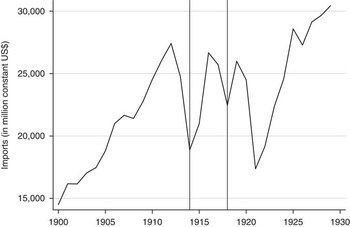
Figure 1 plots the sum of world imports in constant dollars. The decline in 1913 reflects a drop in the number of dyads for which we have trade data, depressing the sum of imports for that year. Because countries released their trade publications a year or two after the calendar year, some countries affected by the war are missing data for 1913.Footnote 68 The figure shows that trade fell in 1914 and then rose sharply before dropping off somewhat in the last year of the war.Footnote 69 It also suggests that wartime trade peaked at about the same level, as did both pre-war and immediate post-war trade.
Sum of world imports, 1900–29

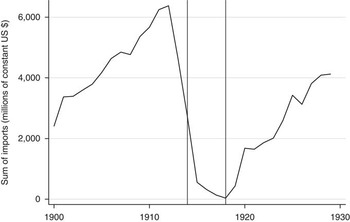
Next, we plot trade across enemy lines. As expected, Figure 2 shows that trade between adversaries falls off sharply during the war and recovers only slowly after it.Footnote 70
Trading with the enemy

The next graph (Figure 3) displays trade between Entente members. Their wartime trade rose sharply as they became each other’s principal substitutes for their pre-war trading partners. The United States, for example, supplied Britain with more than half of its bread and flour and about 80 per cent of its meats and fats in 1917 and 1918.Footnote 71 These plots suggest that wartime trade patterns conform to the predictions of the theory linking alliances to trade, helping to explain the observation of Findlay and O’Rourke that the aggregate effects of the war on trade ‘mask a large range of individual country experiences’.Footnote 72
Trade between Entente members

Estimation
Fortuitously for social science, the early twentieth century witnesses a relatively large number of entries into and exits from conflict. This allows us to use a panel-data approach that controls for unobserved heterogeneity in lieu of the time-series cross-sectional analyses that dominate the literature. To the best of our knowledge, this is the first analysis of the impact of conflict on commerce or of the impact of alliances on trade to include the three sets of fixed effects that the theoretical literature about empirical trade models dictates.Footnote 73
Including directed-dyad fixed effects allows us to control for the constant unmeasured country-pair attributes that can affect the propensity of particular nations to engage each other in trade.Footnote 74 Since dyadic variables that are constant over time – for example, distance, language, colonial ties – drop out of the analysis, the tables do not report estimates of them. In all estimations, we cluster the standard errors at the directed-dyad level to correct for heteroskedasticity.
Our dataset includes the balanced panels that allow for the inclusion of the importer-year and exporter-year dummy variables that are standard in recent empirical models of bilateral trade flows but have not to date been included in any large-N analysis of commerce and conflict. They control for time-varying state-level factors that affect national trade.Footnote 75 These ‘multilateral-resistance’ terms proxy for country-level factors in a given year that can affect a state’s trade with other countries but cannot be easily measured.Footnote 76 Because trade flows vary with both bilateral trade costs and the costs of trading with other states, omitting controls for multilateral resistance can bias the coefficients on the included variables.
The country-year fixed effects also control for annual changes in standard gravity-model variables (for example, GDP, population), as well as for exchange rate changes and inflation. Thus the effects will pick up the effects of US price inflation during the war. Also worth noting, given the emphasis on tariff levels in the McDonald and Sweeney study of the Great War, is that they control for annual changes in each country’s tariffs.Footnote 77 They also take into account the dispersion of trade across dyads before the outbreak of the war, the substitution measure that Kleinberg, Robinson and French use.Footnote 78 As in the case of dyad fixed effects, variables that are perfectly collinear with the country-year effects are not estimated separately.
The specification we use here produces estimates of the wartime change in the trade of a dyad relative to the concurrent change in the trade of each of its members with other countries. For example, the coefficient on trade across enemy lines measures the change in trade between adversaries relative to the change in trade between each country in these dyads and all other states in the base group during World War I.Footnote 79 The same interpretation applies to the parameter estimates on all variables unless otherwise specified immediately below.
We examine wartime trade between four different sets of country pairs in accord with the logic of the literature linking alliances and trade. We ask whether trade rises between countries fighting on the same side of the war. We construct two variables to measure intra-coalition trade. The first takes on a value of 1 between 1914 and 1918 when a country pair includes two members of the Entente engaged in prosecuting the war; it is 0 otherwise. Entente dyads involving the United States, for example, are coded as 1 only in 1917 and 1918. The second dummy variable assumes a value of 1 during the war when a dyad includes two Central Powers. It is, of course, possible to just measure the difference in wartime alliance trade aggregated over both alliances, but, as we show below, significant differences exist between them.
Next, we ask whether trade across enemy lines declines. To do so, we create a variable that assumes a value of 1 when a wartime country pair consists of an Entente member and a Central Power, which we label ‘cross-coalition dyads’.Footnote 80 We also examine trade between the northern neutrals and the Central Powers, given the role the neutrals played in transshipping goods that bans on trading with the enemy prohibited shipping directly.Footnote 81 The variable Neutral-Central Power takes on a value of 1 when dyads include a Triple-Alliance member and either Denmark, Norway, Sweden or the Netherlands. As in other cases, the dummy variable takes on a value of 1 only during the Great War. As the Mediterranean remained a distinctly second-order theater of war,Footnote 82 we do not include the Southern European neutrals as a separate group in the baseline analysis; we later report the effect of doing so.
As is standard in the literature on trade and conflict and in studies of alliances and trade, we also control for whether states are members of a common alliance between 1900 and 1929 exclusive of the wartime coalitions. The dataset that Brett Ashley Leeds and others constructed provides the data that we use to identify alliances. It defines them as accords between two or more independent states that pledge them ‘to aid a partner in the event of military conflict, to remain neutral in the event of conflict, to refrain from military conflict with one another, or to consult/cooperate in the event of international crises that create a potential for military conflict’.Footnote 83 We create a dummy variable that assumes a value of 1 when an alliance other than the World War I coalitions exists between states. The coefficient on this variable picks up the impact on trade of changes in alliance ties over the entire period 1900–1929 rather than during the Great War.
Results
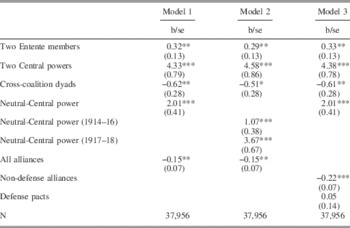
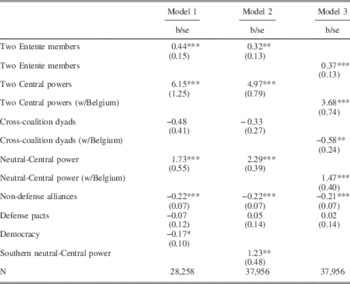
The first column in Table 1 makes clear that large and significant changes occur in the trade of belligerents during the Great War. It also shows that, as predicted, wartime trade varies with the political links between states. A marked fall occurs in trade across enemy lines: it drops by half relative to trade between adversaries and other states. Trade between members of the same coalition also shifts, but in the opposite direction: trade between Entente members increases by about 40 per cent; trade between the Central Powers increases by a factor of seventy-six, both relative to their trade with other states.Footnote 84 The size of the coefficient on Central Power trade reflects the very sharp fall in their trade with states in the base group.
Effects of World War I on Trade, 1900–29

Note: all models include dyadic fixed effects and importer-year and exporter-year fixed effects (not shown). Standard errors are clustered on directed dyads. ***p≤0.01; **p≤0.05; *p≤0.10.
It is important to make clear that the observed changes are not due solely (or even largely) to shipments of war materiel. US supplies of munitions and explosives to Britain, for example, peaked in 1917 at a maximum of 20 per cent of their bilateral trade. France, which relocated its industrial production outside the war zone, produced enough weapons and munitions to supply both its own forces and the 2 million US troops that landed in the country with ‘little more than the uniforms on their backs’.Footnote 85
Because the designation of World War I as the Achilles heel of liberal peace theory rests largely on the fact that its principal combatants had been each other’s major trading partners ex ante, we also analyzed the wartime shifts in trade that occurred between just the major-power members of the Entente. Measuring trade between all members of the coalition may understate the shifts in trade that occurred between its major-power members and between these states and those that used the heavily trafficked transatlantic trade routes. In a separate analysis that we do not include here to conserve space, we disaggregate the Entente to measure trade between the United States, Canada, Britain, France and Russia. Wartime trade between them increases by almost 125 per cent relative to their trade with other states, a change that is more than three times as large as the shift in trade between all Entente members.Footnote 86
The results in Table 1 also measure the impact of the war on substitution in the form of transshipments across the neutral countries. Bans on trading across enemy lines and the paralysis of the German merchant shipping fleet reduced Berlin’s direct access to its pre-war import sources, forcing it to rely heavily on imports transshipped via the northern neutrals. The results in Column 1 of the table show that they experienced large shifts in their trade. Trade between 1914 and 1918 rose by more than sixfold between the Central Powers and Denmark, the Netherlands, Norway and Sweden relative to the trade of each state with others in the base group.
We also examine whether US entry into the war, as long reputed, adversely affected trade flows between these states. The reports in the second column of Table 1 replace the indicator of Neutral-Central Power trade with two variables. The first codes these pairs as 1 during the first two years of the war and as 0 otherwise; the second codes them as 1 during the last two years of the Great War, when the United States entered the war. The results show that the coefficients on these two variables do indeed differ. In striking contrast to conventional wisdom, however, the difference between trade between the neutrals and the Central Powers and their trade with base-group states is significantly larger in the second half than in the first half of the war relative to their trade with other states.Footnote 87
Although these changes are consistent with historical accounts that denigrate the efficacy of the British blockade early in the war, they are inconsistent with the conventional wisdom about the devastating impact that US entry exerted on neutral-Central Power trade. In practice, the United States seems to have walked the same line between Scylla and Charybdis that Britain had traversed since 1914: while lax enforcement allowed goods to reach the Central Powers, it also kept the neutrals out of German hands and secured Russian access to critical imports. In addition, efforts to create joint US-UK administrative machinery proved futile until March 1918, when the Allied Blockade Committee became effective.Footnote 88
The results in the first column of Table 1 also show that intra-alliance trade exclusive of the wartime coalitions dropped significantly relative to both the base group and other countries between 1900 and 1929. Existing theory assumes that power aggregation motivates alliance formation, endowing its members with stakes in each other’s welfare. But alliances vary in the commitments they embody. Because only defense and offense pacts pledge their signatories to defend each other in the event of war, it is only in these cases that states should derive a positive security externality from the real income gains that accrue to them when they trade with an ally. Long, for example, finds that only defense pacts raise major-power trade between 1885 and 1990.Footnote 89 For this reason, we break down peacetime alliances accordingly in the analysis that produces the results in the third column of Table 1.
We create a dummy variable that is coded 1 if non-aggression, neutrality or consultative agreements link states and 0 otherwise, including when states belong to a common defense or offense pact. A second variable assumes a value of 1 when a defense or offense pact links countries in a dyad and 0 otherwise. Defense pact signatories pledge to provide ‘active military support in the event of attack on the sovereignty or territorial integrity’ of an ally.Footnote 90 An offense pact promises ‘active military support in any circumstances not precipitated by an attack’ on an ally.Footnote 91
The results in Column 3 of Table 1 show that alliance types do matter: between 1900 and 1929, low-level alliances depressed trade by about 20 per cent; defense and/or offensive alliances raised it by about 5 per cent.Footnote 92 Although the latter coefficient is not itself significant, there is a significant difference between the effects of different alliance types. The results show that not all intra-alliance trade is especially valuable to states. Indeed, some early twentieth-century allies seem to regard trade between them as welfare decreasing, consistent with the idea that the motivation of some pacts is to deter their members from attacking each other.
Because the specifications we use to produce the results in Table 1 estimate the change in trade between states in a group of wartime dyads relative to their trade with states in the base group, it does not show the magnitude of these changes relative to the pre- and post-war trade of dyad members. It is not possible to estimate these changes using the empirical model that has become the industry standard. The only way to do so is to estimate a model without country-year fixed effects. The results should be interpreted very cautiously, because if the values of these variables change during wartime, the estimates will be misleading. Caution is also needed because estimating this model radically affects the size of our sample. Including GDP as an independent variable shrinks the sample size by 50 per cent, reflecting the widespread lack of wartime data on national output. The estimates therefore indicate the direction, but not the magnitude, of trade.
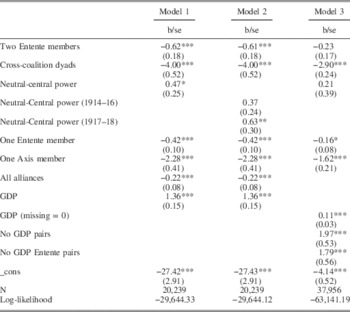
Table 2 shows the results of dyad and year fixed-effects models. These models also include variables for one Entente member and one Central Power member in order to provide a better basis of comparison for each bloc. The one-member variables show the change in trade when only one country in the dyad is in the bloc. The results are similar to those in Table 1. Relative to pre- and post-war trade, trade across enemy lines drops sharply. Trade rises between the Axis Powers and the Scandinavian neutrals. As Column 2 shows, the increase remains larger during the second half of the war. Although there is no significant difference between Entente-Entente and Entente-other trade, an analysis that includes a dummy variable for dyads with missing GDP data suggests that this is due to the sharp drop in the size of the sample. Interacting dyads without GDP with Entente dyads shows that their trade increased during the war.
Effects of World War I on Trade, 1900–29: Dyad and Year Fixed Effects

Note: All models include dyadic fixed effects and importer-year and exporter-year fixed effects (not shown). Standard errors are clustered on directed dyads. ***p≤0.01; **p≤0.05; *p≤0.10.
Robustness Checks
Finally, we subject our results to a series of robustness tests. First, because many scholars believe that democracies trade more with each other than do other states, we add to the analysis a variable that indicates dyads in which both members have a Polity 2 score of six or higher. The widely used Polity database records the regime type of each country for each year beginning in 1800.Footnote 93 As in the case of GDP, including joint democracy excludes a large number of dyads from the sample because of missing Polity data. Next we add all European neutrals. Finally, as Germany occupied Belgium for most of World War I, we recode Belgium as a Central Power.
As the first column in Table 3 shows, joint democracy exerts a negative, but only marginally significant, effect on trade between 1900 and 1929. The only change that occurs when we add democracy to the analysis is that the coefficient on trade across enemy lines loses its significance. This is likely a consequence of the fact that almost one-third of cross-coalition observations are dropped from the estimation due to missing democracy data. As the second column of Table 3 shows, no coefficients change sign when we add neutral countries other than the Scandinavian states (Albania, Spain and Switzerland) to the neutral-Central Power category. Trade rises by a factor of about nine between these three states and the Central Powers. The same is true when we recode Belgium as a Central Power in Column 3 of Table 3.
Robustness Checks

Note: all models include dyadic fixed effects and importer-year and exporter-year fixed effects (not shown). Standard errors are clustered on directed dyads. ***p≤0.01; **p≤0.05; *p≤0.10.
Recent studies that examine post-1945 trade often adjust for zero trade flows. The zero-trade issue arises because falling trade costs can make it profitable for some firms to invest in the dedicated assets that are necessary in order to export differentiated products. The era we study, however, is one in which Heckscher-Ohlin type trade – that is, trade generated by differences in relative factor endowments across countries – dominates world exchange, and trade costs are not falling. Moreover, studies that do control for zero-trade flows use data recorded by the International Monetary Fund, permitting the inference that missing trade flows are actually small or zero.
In a non-trivial number of cases in the period we examine, however, states report either the aggregate value of their trade with a group of other countries (for example, Australasia) or only their trade with major trading partners. Moreover, we know that in at least some cases, the value of the missing trade data during the war reflects not the absence of trade, but merely the absence of reported data. As such, inferring the value of the trade of specific dyads is not possible. Economists warn that techniques that ‘incorporate zeroes may generate biased estimates if some trade flows are incorrectly reported as zeroes’.Footnote 94 As we cannot tell if unrecorded trade flows are actually zeroes, we do not estimate whether our results are robust to including observations of zero trade.
Finally, it is theoretically possible that alliances are endogenous to pre-existing trade flows. There is no way to systematically test whether states select into alliances on the basis of pre-existing trade between them, because there is no variable that satisfies the exclusion restriction – that is, anything that explains trade also explains alliances. Nor does any viable instrumental variable exist. History, however, implies that security creates trade, rather than vice versa. The World War I de facto alliance between Britain, France, the United States and, for a time, Russia was a product of the common threat to them that Germany created; it did not exist ex ante. It is also crystal clear that in the post-1945 era, for example, the United States encouraged trade flows within and between its European allies to solidify the peace between them. It conditioned Marshall Plan aid on increasing intra-European trade. US efforts to increase intra-European trade make sense only as a means of stabilizing Western Europe and deterring a Soviet incursion. The European Economic Community served to decrease the market power of the United States and its ability to extract rents from its members. Ex ante trade flows clearly did not motivate the creation of the North Atlantic Treaty Organization.
Is the Great War Unique?
The findings we report show that the Great War led to a rerouting, rather than a wholesale breakdown, of trade. This did not come as a surprise to states: the historical record shows that states anticipated wartime shifts in their trade channels. Most belligerents nonetheless incurred efficiency losses as a consequence of the shifts, but the losses pale in light of the aggregate costs the war imposed on them. These findings suggest that neglecting wartime trade channels can overstate the deterrent power of ex ante trade.
It is reasonable to question the extent to which wartime trade can, in general, substitute for its ex ante counterpart. This depends, as we noted above, on the composition of trade. The dominance of homogenous products in trade at the time of World War I made substitution a feasible option. For the same reason, other wars that occurred during the first half of the twentieth century seem likely to have precipitated the same trade dynamics as did the Great War. Preliminary empirical analyses are consistent with this argument.Footnote 95
After World War II, however, intra-industry trade – that is, trade in differentiated products between countries with similar factor endowments – came to account for a much larger share of commerce. Krugman notes, for example, that intra-industry rose from about 22 per cent of trade between the industrialized countries in 1962 to about 50 per cent in 2006.Footnote 96 This trade tends to involve ‘highly specialized imported varieties for which domestic imports are hard to find’,Footnote 97 raising the estimated gains from trade that accrue to countries shifting from autarky to free trade. Trade in these products can magnify wartime trade costs to the extent that trade across enemy lines engages imports that cannot easily be obtained from other trading partners. Production networks also spread more widely across countries over time. This implies that conflicts in the more recent past might indeed have wreaked havoc on trade, raising the deterrent power of ex ante trade.
But the composition of conflicts also shifted over time. After 1945, no war would ever again split the major trading states. As we noted above, the advent of the Cold War transformed them into each other’s sturdiest allies. Because the advanced industrialized countries account for a large share of intra-industry trade, post-World War II conflicts did not endanger the exchange of differentiated products. The same is true of foreign direct investment: for most of the twentieth century, it was largely the major developed country trading partners that were both its home and host countries.Footnote 98 The changing composition of warring dyads after World War II may help explain the findings in the empirical literature on this period that conflict and ex ante trade are inversely related. The effects of conflicts on wartime commerce in this period have yet to be examined, however.
Conclusion
That the First World War unleashed tremendous destruction is indisputable. It marked the inception of what has been described as the long European civil war. It resulted in sixteen million deaths and twenty million wounded and destroyed large amounts of physical capital.Footnote 99 In its wake, the great powers never established anything remotely similar to the Concert of Europe that succeeded the Napoleonic Wars. Their best efforts produced a League of Nations that was unable to resolve the conflicts of interest that stymied co-operation among them. They could agree neither on the enforcement of the Versailles Treaty nor on a collective response to the Great Depression, which set the stage for the outbreak of the Second World War.
The Great War also reputedly destroyed the large trade flows that existed during the first golden age of globalization. For this reason, it has become central to debates about the liberal peace. Its outbreak seemed to destroy any hope that leaders had internalized the idea that war had become a ‘great illusion’, more likely to impose costs than benefits because of the concomitant destruction of the trade that had become integral to the growth of national power.Footnote 100 Because its belligerents had been each other’s major trading partners ex ante, the Great War seemed to destroy hopes that economic linkages would secure peace.
Yet, the evidence we present here suggests that one of the largest wars in history did not induce a breakdown of trade. Instead, large shifts occurred in interstate commerce, privileging trade between allies, penalizing commerce between adversaries and increasing trade with neutrals. The composition of early twentieth-century trade helped to mitigate the welfare losses these shifts imposed, as it enabled states to switch trading partners and transit routes more easily than might seem possible later in the twentieth century. Because ex ante commerce between belligerents is not necessarily a good indicator of their ex post trade, estimates of the deterrent power of trade need to take both into account.
Supplementary Material
To view supplementary material for this article, please visit http://dx.doi.org/10.1017/S0007123415000289