[…] ‘the fact is governing together in the public interest carries a cost. Making compromises; doing things you find uncomfortable; challenging some of your traditional support – these are the dilemmas the Conservatives are coming to terms with, just as my party has had to’ (Nick Clegg, Deputy Prime Minister of the United Kingdom, 2013).
Multiparty governance requires compromise; however, parties enter coalitions with differing bases of support demanding distinct policies. The tensions created by the competing pressures of pleasing supporters and addressing the political realities of coalition have inspired a vibrant literature on the making and breaking of governments and cabinet policy making. Yet there has been almost no research investigating how voters perceive coalition policy making and how these perceptions impact electoral outcomes. In other words, the study of coalition governance has been predominantly one-sided, favoring the parliament and cabinet over the electorate. Given the primacy of policy-making institutions to modern comparative behavioral research,Footnote 1 the lack of research investigating voter reactions to coalition policy making is puzzling – especially considering that multiparty government is the norm in the majority of the world’s advanced democracies.
This study shifts the focus toward the electorate to address this opportunity in the literature and ask: how do voters respond to coalition policy-making processes, and what are the electoral ramifications of these responses? I build on recent research demonstrating that, while voters may have an abstract preference for bipartisanship or co-operation, they also have a thirst for partisan victories that often outweigh the desire for compromise,Footnote 2 as well as research on the importance of brand maintenance (or brand purity) to preserving traditional support.Footnote 3 In short, I argue that voters expect parties to pursue certain policies – the agenda promised over the course of the campaign – and equate political compromise with representational failure or a lack of credibility. In other words, a compromising party is one that is not vigorously pursuing the policies it has promised its supporters, has abandoned its core positions or is simply incompetent. As a result, voters are less likely to support parties they perceive as compromising.
To test these claims, I examine data from panel surveys conducted in Denmark, Germany, the Netherlands, New Zealand, Norway and Sweden and assess the effects of perceived compromise on voting behavior. The main analysis suggests that voters who perceive higher levels of compromise within the cabinet are, ceteris paribus, less likely to support the incumbent in the next election. A second-level investigation suggests that this relationship is stronger among those who supported the incumbent in the previous contest and those who are less politically sophisticated.
The arguments and findings presented in this article make three contributions to the literature. First, the article improves our understanding of how voters perceive and react to multiparty governance and coalition policy making. Secondly, a foundational assumption of the literature on parliamentary behavior in coalition policy making is that compromise can be costly to coalition participants.Footnote 4 This assumption, heretofore untested, is confirmed by the analysis below. Finally, the findings shed light on one of the most salient, yet understudied, empirical regularities in comparative politics, the so-called cost of ruling – the observation that incumbent parties regularly suffer losses, and tend to lose votes more often than the economy falters. This is a regularity we have come to understand quite well in the context of single-party government and presidentialism, but cannot explain in the context of multiparty parliamentary government.
The article proceeds as follows. I first discuss compromise and coalition policy making to better motivate the research. Building on the extant literature on voter behavior and coalition policy making, I then argue that voters should react negatively to compromise in coalition policy making, even though compromise is simply a political reality of multiparty governance, and derive testable hypotheses from this discussion. I then present the data, execute the empirical analysis and discuss the findings – which are salient to both comparative behaviorists and scholars of legislative institutions and organization – in the context of previous work and close with suggestions for future research.
COMPROMISE AND COALITION POLICY MAKING
Compromise, in the abstract, is an attractive practice. The willingness and ability of parties with dissimilar policy preferences to compromise is a necessary condition for policy change in divided and multiparty government, and is critical to addressing new hurdles. Indeed, in many cases, compromise may be necessary to simply maintain the function of the state.Footnote 5 More to the point, voters overwhelmingly report that they favor compromise in the policy-making process over divisive, contentious partisan conflict.Footnote 6 However, there is a discordance between voters’ views of compromise in the abstract and their reactions to compromises made by the parties or representatives they have supported.Footnote 7 More specifically, voters seem to view compromise at the institutional level as favorable, but tend to view concessions made by a particular party as a sign of weakness (or worse). For example, Hibbing and Theiss-Morse find that a majority of American voters believe ‘compromise [is] the equivalent of selling out on principles’.Footnote 8
Although nearly all of the extant research on voter reaction to compromise is focused on the American case, the basic intuition remains. Policy making in the United States under divided government is similar to coalition governance in that multiple parties must reach a common ground. Thus it is clear that compromises must be made: they are simply a political reality. As such, it is, on the one hand, unreasonable for all voters to expect that the party they supported will be able to avoid making any compromises at all. On the other hand, however, it is not unreasonable for voters to hope that their party will be able to avoid making concessions or to be disappointed if they perceive the party as making too many compromises. It is only natural to want as many ‘wins’ as possible in any competition, and multiparty policy making is, in many respects, a competition over a finite pool of influence.
In this sense, winning concessions from, or granting concessions to, one’s partners in governance is a demonstration of competence. The more concessions won, the more competent the party as a representative of its supporters or steward of its platform. This underlies the dilemma of coalition governance – that parties with dissimilar policy preferences must reach joint policy decisions while simultaneously competing for votes – which is the principle motivation of the literature on cabinet formation, legislative organization and party behavior in coalitional democracies. How can parties coexist in government when their motivations for smooth governance or extracting the benefits of office push them toward co-operation, but their electoral motivations push them toward intransigence?Footnote 9 The canonical model of cabinet formationFootnote 10 argues that a division of jurisdictions with complete discretion can resolve these conflicts and allow parties to credibly commit to a policy compromise in advance of the cabinet’s formation. In this case the compromise is a division of ministerial portfolios in which all parties act as dictator within their own jurisdictions – the ‘ministerial dominance’ model of coalition policy making.
More recent work either views this solution as suboptimal (as the gains from delegation in one policy area may be too small to counterbalance the losses in another) or argues that coalition parties are simply averse to ceding complete influence in any jurisdiction. Such work theorizes that a comprehensive compromise may be reached (that is, where the coalition parties reach a common policy goal in each jurisdiction) and that institutions such as detailed coalition agreements with procedural enforcements,Footnote 11 junior ministersFootnote 12 or legislative committeesFootnote 13 may be utilized to mitigate ‘ministerial drift’. That is, even when the coalition agrees to a common policy, an individual party may choose to flout this compromise and instead propose a policy closer to its ideal point in order to demonstrate its competence. This work has found, empirically, that such monitoring institutions can be used successfully to mitigate ministerial drift. This means that even when parties consciously seek conflict or to abandon a compromise, policy outcomes, as well as processes, are unlikely to reflect this: compromise by force is compromise nonetheless. Further, subsequent research has provided empirical evidence that this ‘coalition compromise’ model of multiparty policy making better explains the actual behaviors and outcomes we observe than the two competing modelsFootnote 14 (the ‘legislative median’Footnote 15 and ministerial dominance models).Footnote 16
These findings are significant because they imply that voters are very likely to observe or infer compromise, and there is research to support this implication. Fortunato and Stevenson argue that the compromise necessary to make coalition governance work will lead voters to view the coalition partners as moderating ideologically (toward each other) and find empirical evidence to support this argument, while Duch, May and Armstrong provide evidence that voters perceive coalition policy outcomes as a weighted average of partner preferences.Footnote 17 Thus we know that compromise is essential to coalition governance, and that many voters perceive this compromise, yet we do not know how voters respond to it.
COMPROMISE AND VOTERS: COMPETENCE AND CREDIBILITY
Given the pervasiveness of compromise in coalition policy making and the evidence that voters perceive this compromise, the question becomes, ‘how do voters react to compromise?’ For simplicity, assume that all coalition policy-making behavior falls somewhere on the spectrum between compromise and conflict. A party that is perfectly compromising concedes all contested policy points to its coalition partner. A party that is perfectly conflictual will refuse to cede any policy points to its partners, even if that results in stalemate. It is possible that voters would value compromising behavior for its utility in moving policy forward. Similarly, it is possible that voters could punish conflict for its obstructionism and the stagnation of government.
These reactions, however, seem unlikely. As noted above, compromise is simply a political reality in coalition governance as it is in the American case when the executive and legislature are controlled by different parties or when Congress is divided against itself. But voters do not have to like compromise. Indeed, if they view policy bargaining (as political scientists tend to) as a series of competitions for limited policy influence, an easy compromise or an accommodative bargaining process may be viewed as a concession rather than a pragmatic decision made in the interest of progress. Harbridge and Malhotra suggest that, as the policy-making process and political outcomes are inseparable, ‘[compromising] processes may produce outputs that are more akin to losses than wins for a particular party, especially if the alternative is standing firm’.Footnote 18
A core assumption of nearly all research on voting in comparative politics is that voters choose among party alternatives based on the policies that those parties advocate. But simply advocating is insufficient; parties must vigorously pursue their platform in order to affect real change. As Powell argues, voters understand that entry into coalition government assures parties the opportunity to bargain for the policies for which they campaigned.Footnote 19 Thus the separation between winners and losers, within a coalition, is a function of parties’ ability to win those bargaining rounds – to avoid compromise. By standing firm in the negotiation process, parties may be able to extract additional concessions from their partners and therefore deliver on the policy promises they made to their supporters during the campaign. In short, the quality of representation a cabinet party delivers to its supporters – its ability to honor its end of the implicit (sometimes explicit) agreement it has with its supporters that, in exchange for votes, certain policies will be pursued – is defined, at least in part, by its bargaining ability. If this is the case, then voters should, on average, associate compromise with poor representation.Footnote 20
But there is more to avoiding compromise than providing high-quality representation to supporters; there is also the competence signal. Martin and Vanberg argue that one of a party’s primary motivations to eschew compromise is to signal competence.Footnote 21 The intuition that voters associate antagonistic policy-making behaviors with competence, or at least have a preference for it, is supported in the American literature.Footnote 22 Going a step further, the idea that there is (a typically psychological) value to ‘winning’, or causing the other side to lose, beyond the actual outcome of a negotiation is fairly commonplace in the social science literature writ large. For example, Loewenstein, Thompson and Bazerman find that a player’s evaluations of her bargaining outcomes are conditioned by the relative difference between her yields and her partner’s in addition to the cardinal value of her yields.Footnote 23 Building on this contribution, Thompson, Valley and Kramer find that the utility of winning at the expense of an opponent is increased when the opponent is a member of an out-group – a finding that speaks directly to the discussion here.Footnote 24 These studies imply that policy outcomes may be viewed more favorably when they are won through hard bargaining or represent a ‘loss’ to the other side.
Just as bargaining wins can bring rewards, losses can, of course, entail costs. I noted above that Hibbing and Theiss-Morse find that a large majority of Americans equate compromise with ‘selling out’.Footnote 25 This implies that there are potential dangers to compromise beyond the effect on policy outcomes, just as there are additional potential rewards associated with avoiding compromise. In short, a party that is quick to compromise may be considered unattractive because it lacks principles, is undisciplined, weak, etc. We can see this type of desertion of compromising parties in the aggregate by observing parties that are primarily focused on principled stands, for example niche parties. Theoretical and empirical research on niche parties has found that they are most successful when they present themselves in sharp contrast to the parties that typically dominate government.Footnote 26 In their analysis of the electoral fortunes of niche parties, Adams et al. write that, ‘niche parties’ activists are strongly policy oriented and are therefore highly resistant to ideological “compromises” in their party’s policies … [that] may tarnish the party’s standing along such “valence” dimensions of voter evaluation as competence and reliability’.Footnote 27 Adams et al. find that, as a result, niche parties are punished for ideological moderation of their platform: the study does not take into account actual legislative behaviors. Therefore their study finds that niche party voters do not punish their parties for poor representation; they punish compromise in the abstract.
Finally, compromise may also influence voters’ perceptions of party credibility. During campaigns, parties make promises to their potential supporters, which may be viewed as more or less credible given the previous behaviors of parties in coalition. Parties that are viewed as dominating the policy process in the previous legislative period may be perceived as more credible than those seen as too compromising or overly accommodative of their partners. This notion of credibility or discounting the promises or policy statements of parties is not new to the comparative literature. Building on Grofman’sFootnote 28 discounting model, Bawn and Somer-Topcu argue that voters are likely to discount the policy statements of the incumbent cabinet, because, ‘[p]articipating in government routinely requires parties to make compromises, to accept ideologically uncomfortable necessities, to deliver less than they promised, less than voters hoped for’.Footnote 29 Note that this is a cost not suffered by opposition parties: their exclusion from the policy-making process precludes them from such compromise.
Related research by Lupu presents a similar model of discounting, albeit one that is focused on partisan attachments in the Americas.Footnote 30 Here, voter perceptions of party brand or ideological position, where voters hold pre-existing beliefs regarding the location of parties, are updated with new information as the parties are observed. Lupu’s concern is brand dilution – how much new information that is discordant with voters’ prior beliefs will erode the party’s brand. He finds that information that reinforces a party’s position reinforces voter identification with that party, but that information discordant with expectations or prior beliefs of erodes identification with the party.
Though partisanship is substantially weaker in Europe than in the Americas,Footnote 31 Lupu’s underlying logic is salient here. If a party promises some policy x to its supporters, but its inability to successfully bargain for x, or merely the political realities of multiparty governance conspire to produce some policy y ≠ x, it is reasonable that that party’s policy statements be discounted in the future, just as Bawn and Somer-Topcu argued. This corresponds to concerns Martin and Vanberg raised over the potential costs of compromise in the research on legislative behavior in the coalition policy-making process: ‘compromise obscures the relationship between the policies a party supports as a member of the government and its ‘pure’ policy commitments. As a result, participation in coalition has the potential to undermine a party’s carefully established profile’.Footnote 32
In sum, compromise could prove costly for a cabinet party on two distinct levels: first, voters may associate compromise or concession with a party’s inability to win policy concessions from its partners in cabinet – a competence penalty. Secondly, voters may conclude that a compromising party has changed its policy preferences or perhaps misrepresented its preferences during the previous campaign – a credibility penalty. In the next section, I explain the vote choice and derive hypotheses that are tested with data from nine panel surveys administered in six parliamentary countries.
INCORPORATING COALITION COMPROMISE INTO VOTE CHOICE: HYPOTHESES
Voters are assumed to prefer parties that are defined by competence and proximity. As in typical selection models,Footnote 33 voters may learn about the competence of the incumbent party by observing the quality of its performance. The wrinkle here is that competence refers not only to outcomes (summarized as economic growth in the empirical model below), but also to the policy-making process, meaning that voters take into account the outcome and how it was produced. That is, voters may punish incumbent coalition members for being too compromising in the policy-making process – for appearing incompetent in policy negotiations or failing to vigorously pursue their platform and thus failing to adequately represent their supporters – and these punishments may manifest even when overall cabinet performance (for example, economic growth) is positive. Indeed, when parties are perceived as being too compromising, they can be easily scuttled into a ‘no-win’ situation in regards to policy outcomes: when performance is good, they are unable to claim responsibility for those outcomes, as they have been bullied in policy negotiations; when performance is poor, they may be blamed for not stopping the passage of bad policies.
Compromise tendencies also factor into proximity considerations by influencing parties’ perceived credibility. As discussed above, compromise can obscure a party’s ideological position or discredit its pronouncements. A party that is quick to compromise clouds its policy image, and voters may become less certain about what type of policies the party actually desires, or question its desire to deliver them. Thus voters may discount the policy pronouncements of members of the incumbent coalition if they are perceived to have been too compromising in the previous legislative period.Footnote 34 As in the competence component, voters only have information about incumbent coalition members’ propensity for compromise. Therefore, utility over opposition parties is determined solely by their proximity to voters.
We can derive three hypotheses from this discussion: a generalized compromise hypothesis that ignores distinctions between competence and credibility, and a pair parsing the two.
General compromise hypothesis: voters are less likely to support incumbent parties they view as compromising.
Competence hypothesis: voters will discount the performance of incumbent parties they view as compromising.
Credibility hypothesis: voters will discount the policy positions of incumbent parties they view as compromising.
DATA AND MEASUREMENT
Testing these hypotheses requires a measure of how compromising voters believe the members of the incumbent cabinet have been over the last legislative term. Since no electoral survey that I have been able to find has asked about voter perceptions of compromise in the policy-making process,Footnote 35 a proxy must be developed. Fortunately there is extant research that can be built upon. Fortunato and Stevenson argue that voters, in response to the compromise of coalition governance, update their perceptions of coalition partners as being more ideologically similar than pairs of parties that are not coalesced.Footnote 36 Perceptions of compromise manifest spatially for four main reasons. First, compromise signals an ideological flexibility that obscures a party’s ‘pure’ position on the issues.Footnote 37 Secondly, compromise presents new information that voters may use to update their perceptions of where parties stand, and this new information can often be at odds with previous perceptions.Footnote 38 Thirdly, the compromise and co-operation necessary for coalition governance may, in some cases, motivate coalition partners to converge on their policy preferences.Footnote 39 Finally, recent research suggests that outcomes will most often reflect coalition compromise, rather than the preferences of any individual party.Footnote 40 Thus to the extent that voters monitor outcomes to infer the preferences of coalition parties, the typical voter is likely to perceive coalition partners as moderating toward one another.
Fortunato and Stevenson find robust evidence that the perceptions of cabinet parties are influenced by coalition policy making and that voters are likely to perceive compromising parties as becoming more similar spatially.Footnote 41 This finding has recently been reconfirmed by Adams, Ezrow and Wlezien and Falco-Gimeno and Fernandez-Vazquez.Footnote 42 Thus both the literatures on coalition policy making and voter behavior suggest that voters’ spatial placement of parties may be leveraged to construct a measure of perceived compromise – that parties that are perceived as ceding concessions to their partners in the policy-making process will be ‘pushed’ toward those partners in the policy space or that parties that are perceived as intransigent in the policy-making process will be ‘pulled’ away from their partners. Therefore, if we are able to track how individual voters have changed their perceptions of the ideological position of a cabinet party in reference to its partner(s) during their time in government together, we can proxy for how compromising the voter believes the party has been over the legislative period.Footnote 43
Panel data are required to assess voter perceptions of parties’ ideological positions in two consecutive elections in order to measure perceived compromise. I have been able to locate nine parliamentary election panel surveys, conducted in six countries with similar policy-making institutions and intracabinet norms,Footnote 44 which provide the required data: Denmark (2001–05), Germany (2002–05; 2005–09), the Netherlands (1982–86; 1986–89; 1989–94), New Zealand (2005–08), Norway (2001–05) and Sweden (1991–94).Footnote 45 Each survey administered its first component in the days immediately prior to or following a parliamentary election and its second component about the subsequent election. Thus I am able to assess voter perceptions of the cabinet parties at the time a cabinet is formed and after it has served its term. These values (left–right placements of the cabinet parties) are used to construct a measure called Perceived Compromise. This measure quantifies the degree to which a voter perceives that one coalition partner has ceded compromises to another by capturing how far the voter has ‘pushed’ the policy position of the focal party toward the partner party over the course of their time in cabinet together.
Consider a two-party cabinet composed of Party A and Party B. For Party A, I compare (1) how far a voter perceives the position of Party A to be from the position of Party B at the time the cabinet forms
 $(\left| {Party\,A_{\bf 1} {\minus}Party\,B_{\bf 1} } \right|)$
with (2) how far the voter perceives the position of Party A to be from Party B’s original position after the cabinet has served its term
 $(\left| {Party\,A_{\bf 2} {\minus}Party\,B_{\bf 1} } \right|)$
. I compare the two perceptions of Party A (A
1
and A
2
) to Party B’s original position (B
1
) to account for the possibility that voter perceptions update jointly. That is, a voter may push Party A toward Party B’s original position and vice versa if they perceive both parties conceding policy points to each other. Choosing the original position for each party to serve as a reference point accounts for this tendency.
The measure, then, takes the following form for Party A:
 $\left| {Party\,A_{\bf 1} {\minus}Party\,B_{\bf 1} } \right|{\minus}$
 $\left| {Party\,A_{\bf 2} {\minus}Party\,B_{\bf 1} } \right|$
: the absolute difference between Party A at election one and Party B at election one less the absolute difference between Party A at election two and Party B at election one. Thus positive values indicate perceived compromise and negative values indicate the opposite (differentiation via intransigence), as positive values denote that the voter has pushed Party A toward Party B over the cabinet’s tenure. When there are more than two parties in a coalition, perceptions of Party B are replaced by the mean perception of all of Party A’s coalition partners. While there is insufficient space here to explore the predictors of Perceived Compromise, a rudimentary analysis, presented in the online appendix, suggests that voters tend to perceive junior partners as more compromising, on average, than prime ministers, and that perceptions of compromise across all parties tend to grow over time. This largely comports with recent research on how perceptions of cabinet parties change as a function of coalition participation.Footnote
46
However, because there are only a handful of cabinets in the sample, these findings should be taken with a grain of salt.
These data also allow me to measure voters’ perceptions of economic growth (Economy, where higher values indicate better performance), which acts as a summary measure of the perceived quality of incumbent performance, and how close the voters perceive themselves to each of the parties spatially (Distance).Footnote 47 Thus I can test the Competence hypothesis by interacting Perceived Compromise with Economy and test the Credibility hypothesis by interacting Perceived Compromise with Distance. If the data have a shortcoming, it is that there are (as in all electoral surveys) several missing values among the responses. These missing values are imputed.Footnote 48 As such, the parameter estimates, standard errors and predicted values I present below are not the product of a single estimation, but of the aggregation of ten (one model for each imputation), representing confidence in the relationships analyzed as well as the imputations.Footnote 49
Descriptive statistics are displayed in Table 1. Note that these variables are measured at different levels. Incumbent party status is measured at the choice-alternative level, thus the table tells us that about 26 per cent of the parties voters may choose are members of the incumbent cabinet. Distance is measured at the same level. Perceived Compromise is only measured for incumbent parties, thus the descriptive statistics omit all of the 0 values that are observed for opposition parties. Finally, Economy is measured at the level of the respondent, or choice, but enters the model as an implied interaction with incumbent party status – meaning it can only take on a value greater than 0 for incumbent alternatives. Perceived Compromise also enters the model as an implied interaction with incumbency.
Descriptive Statistics

Note: Distance and Economy are standardized and then moved to have minimum 0 to aid maximization and interpretation of interactions.
MODEL ESTIMATION AND RESULTS
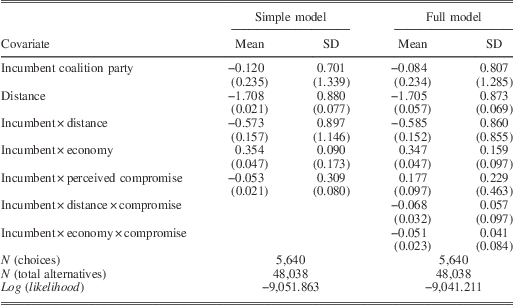
As the voters in my sample have several alternatives to choose from, a conditional choice model is most appropriate. I estimate two mixed logit models:Footnote 50 a simple model including only Perceived Comprise and controls, and a fully interacted model. The models regress a respondent’s vote choice (in which the choice set is all parties included in the survey) on a vector of covariates that varies by individuals and alternatives, allowing for random coefficients on each covariate at the level of the choice. The random coefficients allow the weight that any one voter places on any given parameter to vary from the mean. Further, this model accounts for unmeasured factors at both the individual and contextual levels, which are subsumed by individual-level effects. That is, allowing random coefficients to be estimated at the individual level accounts for potential error from unmeasured variables at higher levels – cabinet, election and country.Footnote 51 The simple model includes the covariates discussed above: Perceived Compromise, Economy, Distance, an indicator of incumbent coalition status, and interactions of incumbent status and Distance to account for the possibility that incumbents are simply less credible as a function of their time in cabinet, regardless of their tendency to compromise, as Bawn and Somer-Topcu suggest.Footnote 52
The full model contains each of those covariates as well as interactions of Perceived Compromise with Economy and Distance to parse the effects of competence and credibility. Recall that the expectation is that Perceived Compromise will be negative in the simple model and that Perceived Compromise and its interactions with Economy and Distance will be negative in the full model. More specifically, the Competence hypothesis is supported if the interaction of Perceived Compromise and Economy negatively influences the probability of choosing a member of the incumbent cabinet, indicating that voters discount the performance of compromising parties, and the Credibility hypothesis is supported if the interaction of Perceived Compromise and Distance negatively influences the probability of choosing a member of the incumbent cabinet, indicating that voters discount the policy pronouncements of compromising parties.
The results from the iterated estimations (one for each of the ten missing data imputations) are aggregated as suggested by King et al.Footnote 53 and RubinFootnote 54 and presented in Table 2. The ‘Mean’ columns are the mean parameter estimates (with standard errors below in parentheses) from the mixed logit models and may be interpreted as one would interpret typical conditional logit estimates. The ‘SD’ columns summarize the variation in the random intercepts estimated across choices (again, with error estimates below in parentheses). At a glance, the simple model seems to support the General Compromise hypothesis. The parameter on Perceived Compromise is in the predicted direction, statistically robust and substantively large. The log-odds change in the likelihood of supporting an incumbent party when Perceived Compromise swings from one standard deviation below the mean (−1.934), to one above (1.518) is about −0.183, though the standard deviation of the random coefficients suggests that there is quite a bit of variation across voters in their reactions to coalition compromise.Footnote 55 Over the sample, holding all covariates constant at their true values, and varying only Perceived Compromise by the same one-standard-deviation swing from its true value for each observation, the probability of incumbent support falls by approximately −0.026.
Main Models: Effects of Perceived Compromise on Incumbent Support

Just looking at the simple model, however, does not tell the whole story because it does not allow us to determine the source of penalty. Are voters simply averse to compromise in general, are they discounting the policy accomplishments of compromising parties or are they viewing their policy pronouncements as incredible? The results of the interacted model allow us to parse these effects. These results suggest that there is no direct punishment for compromise; rather, compromise exacts its costs by moving voters to discount the policy accomplishments or policy promises of incumbent cabinet members.
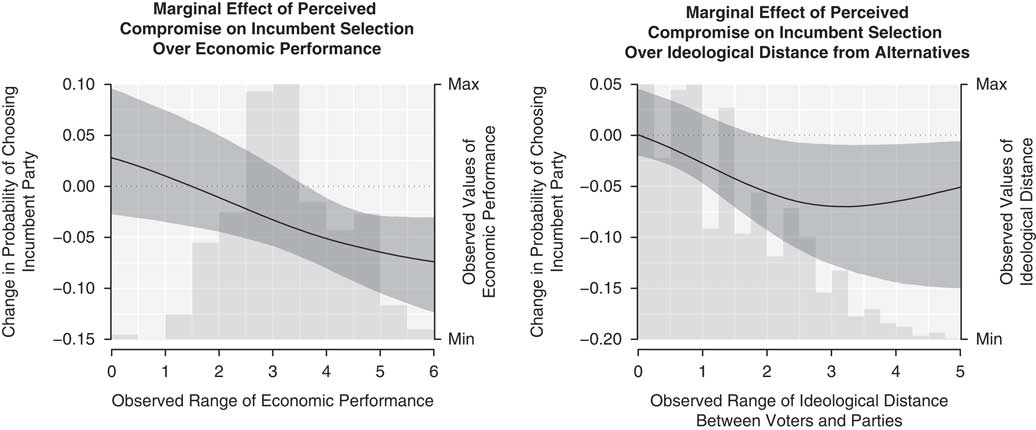
While the full model does not support the General Compromise hypothesis, it does support the Competence and Credibility hypotheses. Both interactions with Perceived Compromise are negative and statistically robust and, as Figure 1 shows, have a substantively significant impact on the probability of supporting an incumbent party for a broad segment of the electorate. This figure was made by sampling from the posterior for each of the iterated mixed-logit models, as suggested by King, Tomz and Wittenberg.Footnote 56 For each model, a multivariate normal distribution was specified with means equivalent to the mean coefficient estimates and variance equivalent to the information matrix. From each distribution, I took 1,000 draws of the parameter values, resulting in a total of 10,000 posterior draws. These distributions of coefficient estimates were then used to calculate the change in the probability of selecting the incumbent over a challenger in a stylized two-party context, given a change in Perceived Compromise, over the ranges of economic performance and ideological distance.Footnote 57 For the left pane, ideological distance was held at the sample mean for both the incumbent and opposition alternative, and Perceived Compromise was shifted from one standard deviation below the mean to one above. The resulting change in probability was calculated for each value of Economy in the sample. The right pane was constructed using the same procedure, holding Economy constant at its sample mean and varying Distance for the two parties. The lighter band represents the 0.025 through 0.975 quantiles, and the darker line shows the mean change in the probability of incumbent support given the swing in Perceived Compromise. The distribution of the covariate of interest is displayed in the background histogram of each pane.
Exploring the competence and credibility hypotheses Note: the plot shows the marginal effect of a one-standard-deviation swing in Perceived Compromise on incumbent support over the range of economic performance and ideological distance between voters and parties. The case is a two-party contest pitting one incumbent party against one opposition party. In the left pane ideological proximity is held constant at the sample mean and economic performance is varied; in the right pane economic performance is held constant at the sample mean and ideological distance is varied. The observed values of economic performance and distance are given by the background histogram.

The shift in probabilities displayed in Figure 1 supports both the Competence and Credibility hypotheses. There is no point at which the shift in Perceived Compromise significantly increases the probability of choosing the incumbent party, and the change has a robust negative effect for nearly half of the range of Economy and approximately two-thirds of the range of Distance. This corresponds to nearly half of the sample in both cases. That is, nearly half of the sample reported values of Economy and Distance that were great enough to cause a robust reduction in the probability of supporting the incumbent given the shift in Perceived Compromise. In sum, the data strongly support the Competence and Credibility hypotheses, but provide inconsistent support for the General Compromise hypothesis. This means that while voters’ distaste for compromise may not be strong enough to directly penalize an incumbent, compromise does change how voters view the performance and policy promises of incumbent parties. More substantively, parties that are viewed as compromising, and unable to plausibly claim credit for the policies that encouraged growth, are rewarded significantly less for positive economic outcomes, but are still punished for poor outcomes. Similarly, compromising parties are also punished more robustly for ideological dissimilarity: voters become increasingly uncertain about precisely what each party stands for when they have appeared to be too willing to compromise on their positions over the legislative term and are thus increasingly averse to ideologically distant alternatives.Footnote 58 Given these findings, the natural follow-up question is, just how large are the costs suffered by incumbent cabinets due to compromise?
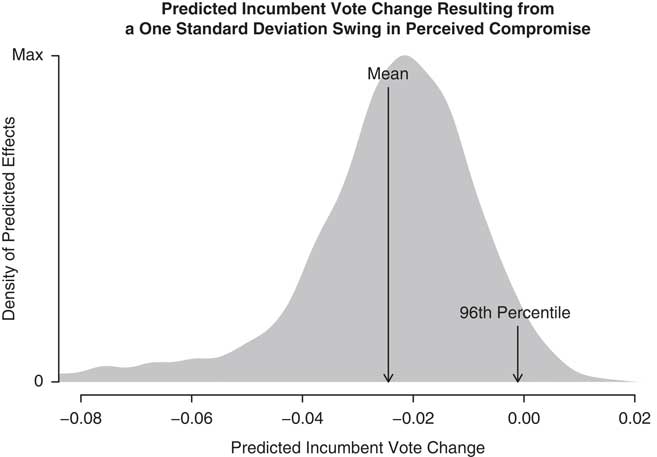
To answer this question, I have simulated several thousand ‘elections’ to evaluate how many votes an increase in Perceived Compromise can cost the incumbent cabinet, using the distributions of parameter estimates described above. For each parameter draw, I select one of the ten data imputations at random and generate two sets of predicated probabilities. The first predicts the probability that each respondent will support a member of the incumbent cabinet by using the true values for each covariate, save Perceived Compromise, which is held at its true value less one standard deviation. The second set predicts these probabilities after increasing each respondent’s Perceived Compromise by one standard deviation from its true value. I then compare the number of predicted incumbent coalition votes for each set. This yields a total of 10,000 (1,000 posterior draws for ten imputations) predicted incumbent coalition vote changes resulting from the swing in Perceived Compromise.Footnote 59 This distribution of changes is plotted in Figure 2. Note that, because the surveys are designed to be representative of the voting population at the time of administration, and I have imputed the surveys to correct for missingness, this exercise generates predicted changes that should be representative of the nine populations I am analyzing.Footnote 60
The predicted change in incumbent vote share resulting from a one-standard-deviation swing in Perceived Compromise

Figure 2 shows that the predicted electoral loss for the incumbent cabinet given an increase in Perceived Compromise is high. Over 96 per cent of the simulated elections result in a net loss for the incumbent and the mean prediction is a loss of over 2 per cent of the incumbent’s voteshare – a total greater than the plurality winner’s margin of victory in about half of the parliamentary elections in Europe in recent years.Footnote 61 To put this predicted loss in a more familiar context, it is roughly twice the loss we would expect from a 1 per cent reduction in real GDP growth.Footnote 62 That being said, given the necessity to evaluate a proxy for perceptions of compromise, rather than direct measures, it would be prudent to de-emphasize the cardinality of the results – it is possible that a direct measure would produce different effects. Nonetheless, the evidence is robust and suggests that incumbent coalitions can easily lose their ability to reform due to perceived compromise.
Who Punishes Compromise?
There is reason to believe that some factors may make voters more or less likely to punish incumbent cabinet parties for appearing too compromising, and this potential variation deserves exploration. In particular, it is likely that previous supporters of the incumbent cabinet, as they have entered into a type of agreement with it – that is, votes given in good faith in exchange for the pursuit of certain policies – may be less tolerant of compromise than voters who did not previously support the cabinet. Indeed, a careful reading of the social-psychological literature discussed above suggests that penalties should be larger among the ‘in-group’ – voters who previously supported a party that is now failing to win policy negotiations or properly represent their interests. This is echoed in the policy-making research by, for example, Martin and Vanberg, who write that parties’ legislative behavior is motivated by the demands of supporters in particular.Footnote 63 Likewise, there is also likely to be variation among voters according to their level of political interest or sophistication. Compromise is, after all, the nature of coalition governance: it is an unavoidable political reality. It is likely that this concept is better understood by more politically interested voters, who have been exposed not only to coalition compromise, but also to a more fine-grained narrative surrounding the compromise. Further, it is possible that parties may prime the electorate for compromise by forming pre-electoral pacts, therefore signaling their intention to make particular compromises in advance of forming a government – and indeed, in advance of the election itself. These potential variations are substantively interesting and can improve our understanding of the electoral repercussions of coalition policy making as well as inform future behavioral research.
I unpack this variation within voters’ reactions to compromise by leveraging the random coefficients estimated in the main models above. As noted, each model allows for random coefficients on each parameter at the level of choice or voter. I am therefore able to calculate the change in the probability of supporting an incumbent cabinet member, given the same swing in Perceived Compromise used for the figures above, for each voter in my sample using their individual-level parameter estimates. This estimated probability change can then be regressed on a vector of the individual-level covariates to better understand how reactions to compromise vary within the electorate. This process is iterated ten times, once for each imputation, and the parameter and error estimates are aggregated as above.Footnote 64
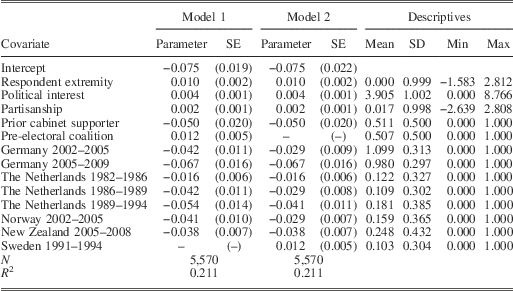
The results of this process are displayed in Table 3. The estimates are derived from a series of linear models that regress the change in the predicted probability of supporting an incumbent cabinet party on the voters’ level of ideological extremity (the absolute distance from the median of the voters’ self-placement on the left–right scale), political interest, partisanship (the strength with which the voter identifies with any party at the time of the first panel module), and whether or not that voter supported an incumbent cabinet party in the previous election. The models also include (1) a binary variable coded as 1 if the cabinet parties announced a pre-electoral coalition pact before the election that brought them into office and (2) fixed effects for the survey, in which the 2001–05 Danish survey serves as the baseline category. Note that negative parameters indicate features that make voters more likely to punish the cabinet for compromise, while positive parameters denote features that make voters more accepting of compromise.
Unpacking the predicted effects of Perceived Compromise

Note: linear models regressing the predicted change in the probability of incumbent support on individual-level factors with survey-level fixed effects. Negative estimates indicate greater punishment for compromise. Including the pre-electoral coalition indicator creates collinearities in survey fixed effects, dropping the Sweden indicator. Baseline Survey is Denmark 2001–2005.
The models’ results in Table 3 conform to the expectations discussed above, and the results on the undiscussed variables are fairly intuitive. At the contextual level, the estimate on the pre-electoral coalition indicator is positive and robust, though its influence is smaller than several individual-level covariates. Nonetheless, the direction of the effect is intuitive and interesting: the data suggest that cabinet parties may mitigate their expected punishment for compromise by priming voters to expect it with the formation of pre-electoral pacts. As for the individual-level covariates, the largest difference by far is the variation between those who supported the incumbent previously and those who did not. Indeed, the average penalty among previous cabinet supporters is about 150 per cent of the penalty levied by those who did not support the incumbent in the last election. Political interest also exerts the predicted effects, though they are by no means as strong. Respondents who report higher levels of political interest are significantly more accepting of compromise than the disinterested, suggesting that more politically interested voters have a more nuanced understanding of coalition policy making that makes them more tolerant of compromise.
The remaining individual-level variables exert intuitive effects. A respondent’s level of ideological extremity makes him or her less likely to punish the incumbent cabinet, and those who have stronger, rather than weaker, partisan identifications (nebulous though that concept may be in multiparty parliamentary systems) are similarly less likely to punish the incumbent for compromising. These results make sense for two reasons. First, there is a well-documented relationship between ideological extremity and partisanship and political sophistication,Footnote 65 and these factors may be tapping into knowledge effects not subsumed by the political interest measure. Secondly, very extreme voters are relatively unlikely to consider supporting incumbent cabinet parties, regardless of their propensity to compromise, simply due to their typical ideological distance or preference for less mainstream alternatives. Further, extreme voters and those with stronger levels of partisanship are the most likely to have stable, reliable, choice propensities;Footnote 66 thus their overall propensity to punish should be mitigated by the stability of their voting patterns.
DISCUSSION
David Cameron’s Conservatives and Nick Clegg’s Liberal Democrats announced the formation of their coalition cabinet on 12 May 2010 (Britain’s first governing coalition since World War II) and in the months following experienced a precipitous joint decline in popularity from 59 per cent in May to 44 per cent in February.Footnote 67 At first these losses had a more pronounced effect on the Liberal Democrats, who were forced to compromise on several issues they had clearly staked out in their electoral platform in order to secure a referendum on the electoral system that they believed would benefit them in the long term.Footnote 68 This very public concession caused dismay among the electorate, prompting The Economist to note that, ‘[the Liberal Democrats] have a wholly new problem now. Lots of voters hate them, and think they have sold out for a perch in a ministerial Jaguar’.Footnote 69
The Conservatives felt the pains of compromise quickly thereafter. Indeed, less than one year after the government was formed, a journalist noted that ‘the Coalition had worked so well that there were fears in both parties that Mr. Cameron and Mr. Clegg were a bit too close for their parties’ own good’.Footnote 70 Even in a country new to coalition governance, the threat of perceived compromise fast became clear. Voters expect parties to demonstrate competence, reliability and loyalty to their supporters by fighting for their core policies and resisting compromise.
The example of the Cameron cabinet is instructive because it allows us to observe parties with no coalition experience learning in real time. But this story is not unique: similar anecdotes are pervasive among multiparty governments. Take, for example, the Free Democratic Party’s sharp decline in popularity in 2010 following its high-profile defeat in negotiations over tax reductions with the Christian Democrats in Merkel’s second cabinet,Footnote 71 or the abrupt loss of popular support for Denmark’s Socialist People’s Party during Helle Thorning-Schmidt’s first cabinet after it was unable to deliver the new road toll (meant to reduce traffic and emissions around Copenhagen) it had promised its supporters.Footnote 72
Indeed, in countries with a long history of experience with multiparty government, party leaders even try to temper their supporters’ expectations in advance of forming a government. For example, at the onset of coalition bargaining in the days following the 2012 Dutch parliamentary elections, The Economist reported ‘Both [Liberal leader] Mr Rutte and Diederik Samsom, Labour’s new leader, have tried to prepare voters for compromise, pointing out that in a coalition country such as the Netherlands it is hard for parties to stick to all their election promises.’Footnote 73
Parties spend the campaign season laying out their plans for new policies to improve the country in general and the lives of their supporters in particular. They present their platforms and promise potential supporters that if they receive enough votes, they will implement these policies (or do everything in their power to try). Voters expect these promises to be kept and, as Cameron and Clegg have learned and Rutte and Samson already knew, are quite upset when they believe the promises have been broken. But as discussed in detail above, coalition governance, by its very nature, makes it extraordinarily difficult for parties to deliver on their entire platforms or even convince their supporters that they are making their best effort. Thus incumbents are likely to lose support even if the economy does not falter.
The evidence above supports this proposition. Analyzing panel data from six parliamentary democracies, I found that voters punish compromising incumbent parties by discounting both their economic performance and their policy pronouncements. In other words, voters who perceive a party as compromising cease to believe its campaign promises and do not credit it for cabinet accomplishments such as promoting economic growth. Subsequent analysis reveals that these losses may be mitigated (but by no means eliminated) by precisely the type of signaling that Rutte and Samson were attempting in the Netherlands – at least when parties are willing to formalize their intentions by forming a pre-electoral coalition pact. The analysis also suggests that punishment is more pronounced among previous supporters of the incumbent coalition, who have a different relationship with the cabinet than those who did not support it previously, and those who are less interested in politics and therefore likely to have a less nuanced understanding of coalition policy making.
This discovery is salient for several reasons. First, it advances our understanding of voter behavior by examining how voters respond to multiparty governance, in particular the coalition policy-making process, while confirming, in a new context, the findings of previous research.Footnote 74 Secondly, the results illuminate one of the most salient, yet understudied, observations in comparative politics – the ‘cost of ruling’. The empirical regularity that executive incumbent parties lose legislative seats more often than not (and more often than the economy falters) has been well known for several decades, and yet we still lack an explanation for it in parliamentary democracies where coalition governance is the norm.Footnote 75 This is all the more frustrating given how well we have come to understand this process in majoritarian and presidential contexts, particularly the United States.Footnote 76
The results here suggest a potential explanation of the cost of ruling in coalition democracies, one that harkens back to Mueller’s ‘coalition of minorities’ explanation.Footnote 77 In sum, Mueller theorized that winning elections meant making promises to potentially disparate groups of voters, but governing often meant making tough decisions that may alienate these groups, gradually building opposition within the electorate. The process described above is similar, though it does not rely on parties assembling heterogeneous support coalitions. Parties make promises to their supporters during campaigns, but the political realities of multiparty governance make it difficult for cabinet parties to honor these promises or demonstrate that they are making their best effort to represent their supporters’ policy preferences. Thus coalition parties become more likely to lose support as perceptions of their tendency to compromise increase.
Because these perceptions can levy significant electoral losses, it seems possible that the nature of coalition policy making itself may be to blame for the cost of ruling for coalition cabinets. This reinforces the underlying logic of canonical work in comparative politics by highlighting the tensions parties face in balancing the rewards of extracting the benefits of office and pursuing policy goals, while simultaneously trying to safeguard electoral support.Footnote 78 Parties cannot have it all: they must make difficult decisions between governing in the common good, extracting the benefits of office and pleasing their core supporters.
The analysis also suggests that parties have a substantial motivation to differentiate themselves from their partners in government and avoid high-profile compromise. Indeed, the evidence provides an empirical confirmation of a foundational assumption of the canonical model of cabinet formationFootnote 79 and perhaps the most important assumption of the new institutional literature on coalition policy making:Footnote 80 there are precious few benefits of ‘playing nice’ in coalition when electoral goods are zero sum. Therefore each party has a substantial motivation to signal its competence by flouting compromise in favor of antagonistic behaviors that are more favorable to its supporters.
While the extant research has focused on the electoral benefits of sending these competency signals via confrontational policy proposals, the evidence presented here implies that conflictual behavior is not merely a strategy for increasing vote share, but a requirement for preventing losses. That is, all else equal, a seemingly co-operative coalition is one that is living on borrowed time. Therefore, uncooperative behaviors may not be driven solely by dissimilar policy preferences, but by the desire to control one’s policy image and to appear to one’s supporters as a tireless and competent advocate of their interests. Thus coalition parties may have incentives to squabble over policy, even when there are no real differences in policy preferences. Given that previous research has modeled legislative behavior exclusively as a function of party preferences in the coalition context, this may have powerful implications for our models of coalition policy making and parliamentary procedure as well as our understanding of efficiency in governance.
These relationships and implications reinforce the complementary nature of mass behavioral and legislative research. Since legislative behaviors are driven by electoral goals, shifts in the preferences and perceptions of voters should be expected to impact the policy-making process. These are the workings of a functional democracy, but these connections tend to be neglected in large swaths of both the behavioral and legislative research – especially when the focus is on coalitional systems. While behaviorists often reference lawmaking and legislative scholars often reference voters, it is rare for behavioral theories to be truly embraced in legislative research or for theories of lawmaking and legislative organization to be supported in behavioral research. Moving forward, behaviorists and legislative scholars would likely find it fruitful to learn from (and incorporate the findings of) their counterparts more often.
Finally, this article suggests several interesting opportunities for future research. Though a rudimentary comparison of the punishment for compromise doled out to prime ministerial and junior partner parties (available in the online appendix) reveals no differences, it is possible that with better data we may be able to detect differences across parties within cabinets according to, for example, portfolio allocation and legislative activity. Further, we do not know whether and how the electoral effects of compromise may vary contextually. It is possible that policy-making institutions that extend the influence of the opposition may mitigate or exacerbate the electoral costs of compromise. Variation in electoral institutions may also influence these effects; for example, the analysis above suggests that the formation of pre-electoral coalition pacts sends a strong signal to voters that compromise will be necessary and should be expected – a signal that could be boosted by the merging of party lists or the publication of a joint platform. Do these costs affect smaller, two-party coalitions more or less than larger coalitions? Can voters become desensitized to compromise over time? Can parties mitigate electoral losses by signaling to supporters their true intentions through legislative speech and review, as previous legislative research suggests? These questions are important to answer, as the more time parties spend worrying about whether voters will punish them for co-operating with their partners, the less time they have to govern.