


Hostname: page-component-7b7567c8c-tnkh4 Total loading time: 0 Render date: 2026-11-17T18:07:29.150Z Has data issue: false hasContentIssue false

SETS WITH ALMOST COINCIDING REPRESENTATION FUNCTIONS

Published online by Cambridge University Press:  28 June 2013

SÁNDOR Z. KISS*
Affiliation:
Institute of Mathematics, Budapest University of Technology and Economics, H-1529 Budapest, PO Box 91, Hungary email reszti@math.bme.hucsandor@math.bme.huComputer and Automation Research Institute of the Hungarian Academy of Sciences, Lágymányosi utca 11, H-1111 Budapest, Hungary
ESZTER ROZGONYI
Affiliation:
Institute of Mathematics, Budapest University of Technology and Economics, H-1529 Budapest, PO Box 91, Hungary email reszti@math.bme.hucsandor@math.bme.hu
CSABA SÁNDOR
Affiliation:
Institute of Mathematics, Budapest University of Technology and Economics, H-1529 Budapest, PO Box 91, Hungary email reszti@math.bme.hucsandor@math.bme.hu
Rights & Permissions [Opens in a new window]

Abstract

Core share and HTML view are not available for this content. However, as you have access to this content, a full PDF is available via the 'Save PDF' action button.

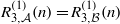
For a given integer $n$ and a set $ \mathcal{S} \subseteq \mathbb{N} $, denote by ${ R}_{h, \mathcal{S} }^{(1)} (n)$ the number of solutions of the equation $n= {s}_{{i}_{1} } + \cdots + {s}_{{i}_{h} } $, ${s}_{{i}_{j} } \in \mathcal{S} $, $j= 1, \ldots , h$. In this paper we determine all pairs $( \mathcal{A} , \mathcal{B} )$, $ \mathcal{A} , \mathcal{B} \subseteq \mathbb{N} $, for which ${ R}_{3, \mathcal{A} }^{(1)} (n)= { R}_{3, \mathcal{B} }^{(1)} (n)$ from a certain point on. We discuss some related problems.

MSC classification

Information

Type
Research Article
Copyright
Copyright ©2013 Australian Mathematical Publishing Association Inc.