The origins and development of capitalism have fueled a centuries-old debate, reinvigorated in recent scholarship, and currently described as “one of the most flourishing.”Footnote 1 Marx famously traced capitalism’s roots to the enclosures, yet subsequent scholars have pushed its beginnings further back. For instance, Pirenne and de Roover tied it to the medieval “commercial revolution,” while others propose even earlier origins, ranging from the fourth century BCE for Sussman to “since the caves” for McCloskey.Footnote 2 A dedicated sub-question discusses whether pre-modern investors could assess returns as capitalists, particularly through practices like double-entry bookkeeping.Footnote 3 Increasingly, rather than pinpointing a single starting point, scholars have shifted toward recognizing diverse forms of capitalism across time and space.Footnote 4 These variations are observed in modern economies and are evident historically.Footnote 5 Such multiplicity is frequently understood as a gradual diffusion from early commercial cradles in select Italian cities across broader regions and economic sectors, accompanied by institutional shifts in business organizations—from family-based firms to complex, non-kin structures like the limited partnership.Footnote 6
As Fredona and Reinert emphasize, understanding capitalism’s origins ultimately aims to uncover the drivers of modern economic growth, linking directly to a second major focus for economists: the role of institutions in development.Footnote 7 Building on New Institutional Economics, a rich literature highlights how weak institutions perpetuate economic stagnation, while institutional improvement serves as a critical catalyst for growth.Footnote 8 Douglass North identifies as key institutions the “business organizations that spread risk through portfolio diversification or structures enabling numerous investors to undertake risky ventures.” He traces their development from the ancient commenda “through its evolution at the hands of Italians to the English regulated company and finally the joint stock company.”Footnote 9 The Glorious Revolution in England, Dutch independence from Spain, and the expansion of Atlantic trade are often credited with ushering in pro-business institutions, creating an environment conducive to this progression and driving economic growth. Accordingly, scholars argue that modern business forms—most notably early joint-stock companies like the East India Company (EIC) and the Dutch East India Company (VOC)—emerged in northwest Europe only after these transformative events.Footnote 10
The very existence of joint-stock company-like entities in medieval times, such as the fourteenth-century Toulouse mill companies, challenges, to some extent, the framework of debates. The existence of large-scale, non-familial, for-profit business enterprises with complex governance structures rooted in a region culturally proximate to, yet distinct from, Italy does not fit neatly into a diffusionist explanation for the origin of the corporate form and more broadly the understanding of capitalism development. By the same token, their centuries-long continuity also undermines the coherence of institutionalist approaches. This suggests a political and legal institutional context akin to that identified by institutionalists as a crucial element that created the modern economy. Yet, despite these ostensibly favorable conditions, no early transition to a modern economy occurred locally, suggesting that organizational sophistication can precede—and remain partly decoupled from—aggregate growth accelerations. In short, the case of the fourteenth-century Toulouse mill companies and their close resemblance to modern corporations does not fit neatly into current narratives. As such, we argue that these firms should be studied more closely to understand the mechanisms of their formation and continuity.
The English publication of The Origins of Corporations: The Mills of Toulouse in the Middle Ages, translating Germain Sicard’s 1953 legal history dissertation, rekindled an old interest in these entities.Footnote 11 This renewed attention translates into an analysis of the development of mills’ corporate governance, econometric evidence of consistency between their stock prices and future dividends across centuries, and the proposal of a framework wherein joint-stock companies emerged multiple times as responses to similar environments, reflecting convergent evolution, rather than originating only once and then diffusing.Footnote 12 Yet, despite this renewed interest, some scholars have challenged the evidence that the Toulouse mill companies, and similar organizations in the pre-1600 period, functioned similarly to modern joint-stock companies, and that their institutional structure and social role of risk and profit-sharing were present in the context of southern Europe well before the Dutch and English East India companies.Footnote 13
To address these doubts about whether the Toulouse mills functioned as joint-stock corporations, we focus on a broader question central to the evolution of business organizations: how does innovation arise within existing institutional frameworks? If institutions represent the rules of play, strategic innovation occurs when economic actors mobilize those rules to craft novel arrangements rather than merely reproducing the status quo. Only a close-grained case study can reveal these trial-and-error dynamics and the nonlinear trajectories of corporate development.
We are fortunate that archival evidence documents one such moment of innovation in the Toulouse mills. The episode lets us observe innovation from within: not the creation of a corporation by statute, but the reinvention of an existing one through negotiated contracting among owners. Confronted with a coordination problem, shareholders mobilized existing legal tools to redesign finance and governance through private contracting. Because the firm had to reinvent itself under constraint, it produced rich and explicit records, allowing this paper to rely on direct provisions about the organization rather than inferences drawn from indirect evidence. We show that this innovation was driven by profit-seeking shareholders, managing risk and agency issues, and seeking to preserve the firm.
We do not claim that our episode is representative or typical but document that this corporate novelty was feasible. Even if our evidence comes from a single documented episode, it should not be treated as an isolated anomaly: it points to a broader institutional capacity. Our private agreements were registered by the Toulouse Parliament, giving them enforceability and visibility. Beyond this, important cases registered by the Parliament were circulated in printed case-law compilations.Footnote 14 More broadly, Toulouse was home to a major European university, with mobile scholars who facilitated the diffusion of legal and financial analysis. Finally, these solutions operated within the widely shared Roman-law framework that structured contracting across a large part of early modern Europe. Taken together, these features point to a shared institutional context that likely made such arrangements replicable and suggest plausibly that the Toulouse episode was one instance among other contractual experiments rather than a unique outlier.
The problem began in 1641 when a flood on the Garonne River severely damaged dams, waterways, and mill stations of the Castel Mills (Moulins du Chateau Narbonnais or Molis del Castel Narbones in Occitan). The very occurrence of this episode demonstrates that these mills required mechanisms to spread inherently high risks stemming from potential destruction in addition to the risks induced by the instability of the volumes milled and the grain price volatility. These risks are reflected in the volatility of the price of the shares.Footnote 15 Three years later, the infrastructure remained unrepaired and the mills idle.
The obstacle was not technical. It was a coordination failure in the firm’s traditional mechanism for raising capital from shareholders, a capital call termed the taille. Enough shareholders refused or hesitated to contribute that others would not commit either. The deadlock could not be broken by the firm’s standard procedures which allowed refusers simply to surrender their shares, which were then auctioned by the firm. The problem was an important one for the city as its economy depended heavily on its milling operations. Yet, the solution was not the result of public intervention, or implicit social pressure.
Faced with a stalled enterprise and divergent investor interests, the shareholders designed an agreement that created three distinct equity positions along with a massive capital call. Both the final agreement and an initial proposal are highly detailed. These documents were registered with the Parlement of Toulouse, ensuring legal enforceability. The initial proposal was circulated to all investors through a printed placard posted publicly, illustrating a structured and transparent route toward collective consent. In practice, three general meetings were required to reach a settlement that differed strongly from the initial proposal. This process illustrates how complex organizational innovation can emerge through formal deliberation, documentation, and enforceable contracting.
Shareholders who refused to pay the new capital call, the refusans, had their shares purchased by a subgroup of shareholders, the financier-shareholders, but they retained what we would today term a call option: the right to repurchase their shares at the original call price plus 6.25% annual interest during the repair period, exercisable after six years of resumed milling operations. The financier-shareholders constituted an implicit organization in which each contributed equally to the capital calls on refusans’ shares and received the dividends accordingly. A third group, the contributing shareholders, paid the taille in the normal way. Moreover, only part of the shareholders contributed to a previous (useless) capital call, creating inequalities regarding the respective capital contributions. The same agreement solved this issue by offering, in addition to the standard dividend, a 6.25% interest for six years to those who did participate in the previous call and constraining others to contribute after the six-year period. This tailored structuring of risk–return profiles, together with the explicit invocation of “the profit of the house” and the “universal interest of all shareholders” in the documents, testifies that an investor-return logic motivated this innovation.
The 1644 agreement also details how specific agency problems were managed. The financier-shareholders and contributing shareholders secured the explicit right to nominate the board and restricted refusans’ access to accounting information.Footnote 16 The new scheme, however, allowed the refusans to appoint a “blind” board member to represent them. In this delicate maneuver, refusans temporarily had to surrender their voting rights in general assembly meetings to the financier-shareholders. This explicit reference to information flows, and the underlying potential agency issues, demonstrates that such dimensions were crucial and well understood in the Toulouse mills. Supporting the notion that these firms exhibit continuity since their formation at the end of the fourteenth century, our findings show that the recapitalization agreement neither disrupted the perpetual nature of the firm nor altered the permanence of its capital.Footnote 17 To maintain property rights and finally revert to a single type of shareholder was an affirmed goal in the agreement.
The episode we analyze in this paper speaks to several debates. It dispels lingering doubts about the corporate nature of the Toulouse mills and thus challenges teleological narratives that link the emergence of the corporation to seventeenth-century northwest Europe, thereby enriching the debates already introduced above on capitalism’s history and the institutional foundations of modern economic growth. This case also illustrates how business organizations can adapt to constraints and opportunities through contractual innovations. This episode offers a rare view of institutional evolution in action: investors recombined familiar legal tools to solve a novel problem. Processes of this kind can generate similar solutions along different historical paths, consistent with Le Bris et al.’s idea of convergent evolution.Footnote 18
Regarding the mechanisms and the framework of organizational innovation, this case downplays the explanatory role of the state and state-granted charters by highlighting the flexibility of a “corporation by contract” model that, in this instance, enabled a joint-stock form to be revived through private agreement.Footnote 19 Besides, the fact that this flexibility operated within a civil-law framework runs against a central claim of the law-and-finance literature.Footnote 20 Finally, this case sheds light on how individuals cooperated to solve a collective-action problem. In line with Greif and Tabellini, it shows non-kin cooperation being organized through deliberation, documentation, and enforceable contracting rather than informal trust alone.Footnote 21
The remainder of the paper is organized as follows. First, we describe the sources we use. Second, we outline the context of the issuance of this complex contract, highlighting the risk faced by shareholders. Third, we analyze the structure of the agreement and explain why alternative recapitalization mechanisms were unsuitable given the firm’s risk profile, situating the chosen solution in a more general context. Fourth, we present the arguments demonstrating that these shareholders were profit-seeking investors who managed the firm accordingly. Fifth, we analyze the organized information flow implemented by these shareholders and the governance mechanisms adopted in consequence. Sixth, we provide evidence that this capital injection did not compromise the continuity of the firm. Finally, we conclude by tracing the implications of these findings for several ongoing debates.
Sources
Two main documents are central to this study: they are transcribed in the Appendix. The first document is a printed version of a pre-agreement signed on December 12, 1643 (Appendix A). It is a large single-page paper document (a placard) to be readable if placarded on a wall. This pre-agreement was not crafted by the governing body of the milling company but instead by a group of shareholders proposing a way to repair the mills. Preserved in an archival box, this agreement is known only from a single version.Footnote 22 It consists of articles defining new rules that this group intended to follow and impose on the firm and other shareholders, compelling them to provide the necessary capital.
The second document is the final agreement ratified in the General Meeting on January 6, 1644, known through a six-page pamphlet printed on paper. We also have the initial report written in the company register.Footnote 23 This document is structured in three parts: a summary of the situation is followed by articles outlining a capital call on all shares and by specific provisions about how the financier-shareholders will be involved.
Parts of the two documents are difficult to read (indicated by […] in the documents reproduced in Appendix) and require occasional interpretations of missing words. The two contracts were registered by the Parlement of Toulouse, the local supreme court, which granted them legal validity concerning any later legal challenge. The specifics outlined in these agreements are comprehensive enough to refute the notion that the Toulouse milling companies relied solely on social norms to address agency and incentive compatibility issues.
To gain a broader understanding of the mill’s context, in the next section, we draw on existing literature, particularly works by Sicard, Mot, and Le Bris et al., as well as other documents from the Castel Mills archives.Footnote 24
Navigating Turbulent Waters: Disaster, Debates, and Innovation in Capital Structure
The Working of a Joint-Stock Company from Medieval Times
The Castel Mills, established as a form of joint-stock company in 1373, resulted from the merger of several pre-existing independent mills that operated under a shared contract initially signed in 1183 with the Count of Toulouse, who held feudal ownership of the land and river rights. The Castel Mills relied on a set of dams and waterways linking small islands in the flow of the Garonne River. A detailed 1687 map of Castel’s hydrological infrastructure illustrates the inherent risk borne by the firm. A major flood had the potential to inundate the low-lying islands, sweep away their dams and mills, and create a destructive cascade.Footnote 25 This contrasted with the downstream rival company, the Bazacle Mills, which used a single dam to direct the Garonne’s flow to the mill station.
Shares of the Castel Mills company were owned by approximately 100 individual and institutional investors (religious institutions, university colleges) that could freely sell them.Footnote 26 The governance of the Castel Mills included annual shareholder meetings and a board of directors. The Mills’ revenue derived from the fact that a fixed proportion of 1/16th of the grain milled for their clients was retained as a fee; this fee was fixed as a maximum by a municipal regulation in 1152. Shareholders received dividends in the form of grain whenever the granary was full, a process known as a partison. At a partison, the grain could be converted into money through sales. Indeed, being at the heart of a large plain conducive to wheat cultivation, Toulouse was a major grain-trading center with a wholesale market three times a week from at least 1204.Footnote 27 To cover operational expenses, apart from a few additional resources, the firm annually required shareholders to contribute by providing capital to the firm. This contribution, termed a taille (reminiscent of taxation) or coecation, functioned as a capital call from a financial standpoint.
Dividend amounts received by shareholders were inherently uncertain, contingent on various factors, including the quantity of grain milled, the prevailing grain market price when the partison occurred, and the firm’s operational expenses, especially maintenance of dams and watercourses. The volume of grain milled fluctuated based on economic conditions, competition from other mills in the area, and weather patterns; for instance, a dry summer could attract grain from distant countryside regions because mills on smaller rivers lacked sufficient water supply. Moreover, the market price of grain exhibited substantial volatility both within each year and over extended periods, as evidenced by historical data. Observing the wheat price each month during the seventeenth century, the average value of one setier was 5.65 livres tournois without any clear trend with a standard deviation of 2.24 livres (see the figure in Appendix C); in other words, the standard deviation represented around 40% of the mean, a coefficient of variation indicating considerable year-to-year uncertainty in the monetary value of dividends.Footnote 28 Additionally, the firm faced unpredictable costs, especially in the event of infrastructure destruction. The Garonne River, collecting water from the Pyrenees, experiences significant variations in water level. Occasionally, these variations led to catastrophic outcomes; the most severe documented flood occurred in 1875, resulting in a water flow 35 times greater than the average. It was precisely such a calamity that served as the catalyst for the episode we recount here.
After the Flood: From Capital Calls to Coordination Failure
In April 1641, the devastating flood obliterated several dams, creating an urgent need for substantial investment to enable the Castel Mills to recover. The traditional method employed by the mills to raise additional capital involved reaching out to existing shareholders asking them to contribute the required amount per share as a capital call. Shareholders who were either unable or unwilling to provide the necessary funds had the option to sell a portion of their (divisible) shares to meet the cash requirement. The shareholders also had the option to surrender their shares to the company in a form of limited liability. Surrendered shares were seized and auctioned by the firm to collect the requested taille (as outlined in Article 4 of the 1418 statutes of the Castel Mills).Footnote 29
Importantly, in the study period, the seized shareholder retained the option to repurchase the seized share at the auctioned price. This buyback option allowed the surrendering shareholders to potentially recover their property rights, softening the harshness of expropriation. Note that adding a buyback to the auction after seizure did not affect the number nor the diversity of potential shareholders. This provision was not mentioned in the firm’s 1418 statutes and is therefore presumed to be an institutional innovation adopted later. We only know of a Toulouse Parliament record from 1597 allowing such a seizure accompanied by a right to repurchase.Footnote 30 This option to repurchase played a key role in the 1644 issue.
A sale with a right to buy back was a common tool in local asset management frequently observed in real estate transactions at the time and at least since the Middle Ages.Footnote 31 Later, we observe sales with repurchase options on shares of mills.Footnote 32 Such a provision existed in Roman law as Pactum de retro vendendo; the Roman law (Corpus Iuris Civilis) written under Justinian in the sixth century was enforced in southern France up to 1789.Footnote 33 This provision could be used to secure a loan (the loan would be made in the form of a sale with an option to buy back) but that was not its main purpose as other instruments existed, especially the vif-gage (living-pledge) in which the lender enjoyed the revenues of the pledged asset as opposed to the famous mort-gage (dead-pledge). Moreover, interest-bearing loans were legally and socially accepted at that time.
In the context of the mills, adding such an option could prevent any investor from buying an auctioned share as they would bear the risk of the new investment but, in case of positive outcomes, the previous shareholder could repurchase the share for the auctioned price. To mitigate this risk, a vesting period was imposed during which the option to repurchase was rendered impossible. This strategic addition aimed to strike a balance between safeguarding the interests of non-paying shareholders who saw their property seized and attracting new investors essential for the mills’ financing.
The seizure and auction of shares, with an option to repurchase after several years, provided an efficient solution for addressing individual non-payments. However, when a substantial amount had to be collected, this mechanism of raising capital could become less efficient. Indeed, a coordination problem emerged as each shareholder would want to be sure that the others would contribute before pledging their contribution, and without the total expense being pledged, the repairs would not be completed. It is such a situation that the Castel Mills experienced: the 1641 destruction required a large capital contribution with considerable uncertainty regarding the ability to repair the mills and resume production.
Moreover, our episode occurred after difficult times for the Castel Mills. A few years before, in 1636, a previous destruction already required an important contribution of 1,000 livres per share. At that time, coordination issues already arose as shown by the arrangement found: the Castel Mills company decided to pay its shareholders a fixed interest of 6.25% or denier 16 (at this time, rates were expressed in this way, e.g., 5% was called denier 20) between the time the 1,000 livres were paid and the restart of the mill (and thus the restart of the dividend payment through partisons). Assuming the mill would resume operations, such a provision mitigated the incentive for shareholders to delay their contributions until others had committed theirs. Additionally, a shareholder could ask the Mills to find debt resources to provide the 1,000 livres per share, as such a sum could occasion liquidity constraints. These provisions proved to be effective enough, as the mill soon restarted its activity.
Following the 1641 destruction, a capital call of 300 livres per share was initiated. The shareholders who decided to answer the capital call positively were thereafter referred to as creditor-shareholders (“créanciers”) of the Castel Mills company because they were recognized as having provided more capital to the Mills than other shareholders. Indeed, several individual shareholders failed to provide the required funds. This could reflect the inherent risk of the investment, the cumulative burden of successive large capital calls, or a pure coordination problem in which each shareholder waited to see whether others would commit. Moreover, wheat had stagnated at low levels since 1638 (below 4 livres the setier), making the grain dividend less attractive than a couple of years before. As a result, after 1636 but before the 1641 destruction, the share price remained around 1,000 livres, which was the precise amount of the last sizable capital call. This may have dissuaded many shareholders from further investment in the company.
Several shares were thus seized and auctioned. To incentivize new investments, a 12-year vesting period during which the option to repurchase was unavailable was granted to the auction buyers. Despite this provision, the venture appeared unattractive. At various auctions, 11 shares were sold at the floor price of 300 livres, the amount of the capital call itself. This means that the existing assets were priced at zero value. As a comparison, transactions before the destruction occurred at more than 1,000 livres per share and even at 2,000 livres 20 years earlier. Two years after the 1641 destruction, several seized shares remained unpurchased at the auctions. By 1644, a total of 39.25 shares out of 109.25 were “orphans”; the fractional figures reflecting the longstanding practice of dividing shares among heirs or selling fractions of shares.
This situation raised a significant coordination problem. In the pre-agreement, this problem was called a mes-intelligence (mis-intelligence). Prospective investors hesitated to purchase shares and pay the 300 livres if they believed that not all shareholders would contribute. The auction mechanism, while effective when there were only a few non-contributing shareholders (for individual reasons), proved ineffective in resolving this (collective) problem due to coordination failure. Furthermore, the non-contributing shares not only indicated a failure to meet the required total amount but also worsened the required repairs. Unrepaired breaches in a dam could exacerbate the problem due to erosion caused by the water flow, potentially leading to more expensive damage. This predicament underscored the delicate balance that early joint-stock companies had to strike between attracting new investment, securing the rights of existing shareholders, and managing the inherent risks associated with such ventures.
Reaching a Solution
With the Mills dormant for nearly three years, a turning point emerged on December 16, 1643, when a coalition of 16 determined shareholders (as evidenced by the document in Appendix A) took matters into their own hands. After several meetings, this group voluntarily committed to providing the necessary funds for the repairs in exchange for specific rights that would reserve all the revenue for those volunteering to pay for shareholders who refused to do so. The situation became more complex when a major institutional shareholder, St Etienne Cathedral, declined to endorse this agreement. Instead, it demanded a general meeting involving all shareholders to deliberate not only on this particular proposal but also on alternative potential agreements that could garner a broader consensus (“according to the good will & contentment of all” in the text “au gré & contentement de tous”). The path to unity was arduous, requiring a series of three general meetings held on December 21 and 28, 1643, and on January 3, 1644. The registers record only very formal information about these meetings, including that “each of the attendees said what seemed right to them.”Footnote 34 This arduous process suggests that the eventual settlement was not simply the replication of a well-known model; rather, the package of provisions it assembled, especially the mobilization of a buyback option, was likely innovative, even if we cannot rule out that similar arrangements were already familiar to contemporaries.
An agreement was finally reached during a general assembly on January 6, 1644 (Appendix B, online supplement); the so-called “orphan shares,” i.e., those shares that nobody was willing to purchase, became the property of the firm and consequently reduced the number of shares to 70. However, this consolidation resulted in an increased contribution requirement for each remaining share. According to this agreement, a staggering sum of 50,000 livres tournois was needed for the repairs (at the time, 1 livre tournois equated to 0.619 grams of gold, totaling 30.95 kg of gold), amounting to 714.29 livres per remaining “active” share (50,000/70).
This final agreement, which we examine in more detail in the next section, marked a crucial juncture in the history of the Castel Mills company. The intricate negotiations, the clash of perspectives, and the eventual consensus achieved during the general meetings leading to the agreement provide a compelling window into the challenges and complexities faced by early joint-stock companies. Moreover, this historical episode serves as a testament to the determination of shareholders and the innovative financial mechanisms they employed to navigate adversity and lay the foundation for the Mills’ resurgence.
Corporate Recapitalization in the Grand Siècle
The Content of the 1644 Agreement
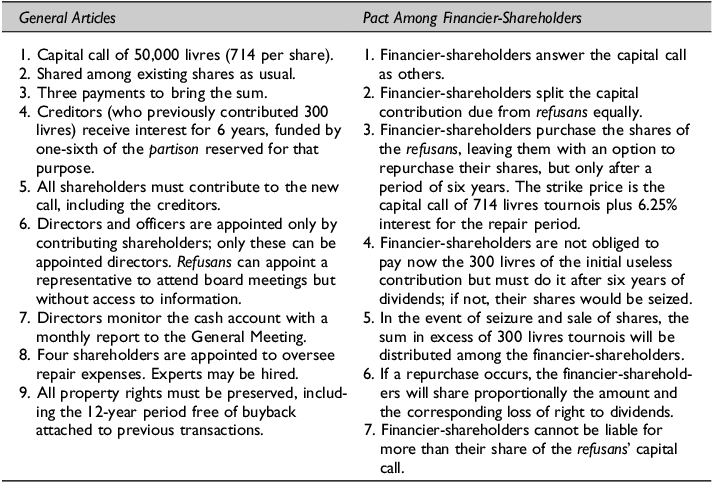
Signed on January 6, 1644, the Castel agreement aimed to restart a firm that had been dormant for nearly three years. It addressed three practical problems at once: raising a large sum for reconstruction, organizing decision-making during a high-stakes repair project, and preventing holdouts from blocking the investment. The solution took the form of a recapitalization agreement consisting of two parts that is summarized in Table 1. The first part (nine articles) organized a standard capital call apportioned across shares and reaffirmed continuity in the company’s customary financing practice. It also regularized earlier unequal contributions: shareholders who had paid the previous (“unproductive”) 300 livres call were granted a defined interest service funded from a dedicated one-sixth of each partison, while those who had not contributed were required to do so after six years of resumed operations. At the same time, a temporary governance regime was introduced in which control followed payment: contributing shareholders elected the officers and directors, while non-contributing shareholders were temporarily excluded from deliberation. Oversight mechanisms were specified, including monthly reporting and a small ad hoc group to supervise major repair expenditures. Refusans were not entirely excluded, however: they could appoint a representative to attend, albeit without access to revenue information. The text also explicitly affirms the preservation of all forms of property rights.
Summary of the 1644 Agreement

Table 1 Long description
The table compares general articles and the pact among financier-shareholders. It has two columns: General Articles and Pact Among Financier-Shareholders. The General Articles column lists nine points about capital calls, shareholder contributions, director appointments, and oversight mechanisms. The Pact Among Financier-Shareholders column details seven points about financier-shareholders’ obligations, rights, and the handling of refusans. Each row corresponds to specific clauses and conditions agreed upon in the 1644 Castel agreement.
Source: Appendix B (online supplement).
Note: Terms such as “call option” and “strike price” are modern financial equivalents used here to clarify the economic function of provisions expressed in seventeenth-century legal language.
The second part (seven “pactes” rather than articles to probably express that all shareholders were not involved) set out how a subset of shareholders would advance funds on behalf of refusans. Their intervention was structured as a purchase of the refusans’ shares coupled with a right of repurchase granted to the refusans. Repurchase was barred until six “useful” years of effective operation had elapsed, and the repurchase price was set at the amount of the refused contribution plus interest accruing over the repair period. The financier-shareholders committed to sharing equally both the sums advanced for refusans and the proceeds (or reversals) associated with any repurchase, effectively coordinating their exposure as a group. At the same time, they remained subject to the ordinary rules on their own holdings, including seizure in case of non-payment. Their liability, finally, was expressly limited to their individual share of the amounts undertaken under the pact.
Other Early Methods of Recapitalization
To modern readers, the solution looks unfamiliar; to seventeenth-century investors, it was probably a pragmatic recombination of known legal tools. But what about the forms of capital inflows in contemporaneous comparable business organizations? As for the Mills, issuing new shares to raise additional equity (as it is practiced today) was uncommon in the early cases of joint-stock companies.Footnote 35 Early English proto-companies, such as Mines Royal, the Mineral and Battery Works, and the Company of Cathay, followed a similar approach, relying on capital calls on existing shareholders, which often led to tensions when shareholders were reluctant to contribute.Footnote 36 In German mining companies, a separate enterprise was created for each pit, and shareholders who failed to meet their financial obligations had their Kuxen (shares) seized and resold, similar to the practice for mill shares.Footnote 37
The commercial success of the early East India companies reduced the urgency of raising fresh equity but, when capital was needed, the process was also complex. The EIC operated without a permanent joint stock before 1657, using temporary stocks for each successive voyage. The notion of “increasing a common stock” was thus largely irrelevant. After the creation of the “New General Stock” in 1657, the company relied mainly on retained profits and borrowing. Although there was recurring pressure to issue new shares to admit outsiders, including an advanced plan to let existing proprietors subscribe “at par,” these proposals were not pursued.Footnote 38 Only in 1693, under a new charter, did the EIC open a public subscription.Footnote 39 Subsequent larger capital operations, in 1698 with the formation of the New Company and in the 1708–1709 unification, were likewise bound up with legislation and public finance rather than a purely market-driven process.
The VOC also generated substantial profits that directors could retain at their discretion, but its cash flows were highly volatile, hardly ideal for attracting outside capital. As in our Toulouse case, the VOC crafted an ad-hoc fix by hybridizing existing legal-financial tools: in 1613, it arranged a revenue-insurance contract (rather than an option-style buyback as in our case) to smooth inflows tied to uncertain return cargoes. Coupled with a subsequent mutual guarantee by the 60 directors, this mechanism enabled the VOC to mobilize roughly eight million guilders between 1616 and 1623 to sustain investment.Footnote 40 Notably, as in the 1644 Castel Mills operation, the solution came primarily from incumbent investors, VOC shareholders underwriting in Amsterdam and financier-shareholders advancing funds in Toulouse, while other shareholders remained only ordinarily exposed. This highlights heterogeneity in risk tolerance and liquidity across investors, and how contractual design channeled those differences into firm-preserving finance.
In seventeenth-century Toulouse, an insurance-style solution was not well suited to the Castel Mills company’s problem. The company had long understood risk-sharing principles: as early as 1194, before unification, the independent mills that later formed the Castel company adopted a mutual-aid pledge to rebuild any mill that was destroyed, essentially a rudimentary mutual-insurance scheme.Footnote 41 In addition, a bourse was officially created in Toulouse in 1549 that explicitly mentioned trading “asseurances” though we lack evidence on its actual operations. However, unlike the VOC’s 1613 revenue-insurance contract, little about the Castel case was cleanly insurable. There was no discrete, verifiable event within a fixed horizon (such as the safe arrival of return cargoes) and no deep market to price the risk. The project faced open-ended repair horizons, coordination and governance hazards, and the possibility of repeated flood damage, none of which matches standard indemnity triggers. In this setting, insurance would likely have been prohibitively costly or ill-defined; an equity-like, contract-based recapitalization, allocating upside and downside through contingent claims, was more appropriate.
Finally, although the Mills could and did borrow, debt was a poor fit for this project’s risk profile, much as in modern finance.Footnote 42 The assets in place had little value as collateral (several shares recently auctioned at the amount of the capital call or even unauctioned implying a null value for the existing assets), cash flow had been zero for three years, and the probability of repair failure was high. In such a setting, lenders would bear most of the downside while having no claim on the upside, making debt either prohibitively expensive or more likely simply unavailable. What was needed was equity-like capital, i.e., claims that shared in both risk and prospective profit. That is precisely what the 1644 solution supplied: differentiated forms of equity claims, as detailed below.
Profit-Seeking and the Logic of the Agreement
Understanding the Redistribution of Claims
An important question is whether the Toulouse milling companies operated as for-profit enterprises. The mills provided an essential public good by milling grain for the entire community, but many modern companies, such as utilities, also clearly serve the public while being for-profit companies. The capital restructuring agreement of 1644 provides us with decisive elements to answer this question.Footnote 43 Moreover, because it was negotiated under the pressure of a stalled enterprise and divergent investor positions, the 1644 agreement makes the underlying financial logic unusually visible.
All the shareholders involved were explicitly motivated by profit as stated in the agreement: “for the honor and the profit of the house” and for the “universal interest of all shareholders.”Footnote 44 The initiators—16 shareholders who first proposed a solution—also make clear that they will proceed only under “reasonable conditions,” signaling that the decision was framed as a calculation about terms, incentives, and expected payoffs rather than as a civic duty. By contrast, the notion of “services to the community,” highlighted by Harris, is present in the agreement only in the way it would be for any company serving paying clients; it does not appear as a motivation for the recapitalization itself.Footnote 45
What the agreement regulates, clause after clause, are questions of cash flows and governance: who pays, who receives, and, as explored in the next section, who controls decisions based on what information. Instead of a single, uniform claim, the settlement specifies a structured set of cash flow and control rights across several shareholder categories. Yet, it is explicitly stated that, after the six-year period, everyone would “get one’s due” (“rentrer dans son droit”).Footnote 46 It is clear that the interest of all the investors involved had to be preserved to avoid a blockage. We expose the logic of the agreement to show how this “menu” of claims was assembled.
A first tension lay between shareholders who had paid the previous call for 300 livres (the “creditor-shareholders”) and those who had not. Although these earlier payments had not been sufficient to repair the mill, the creditor-shareholders insisted that their contribution be recognized. Yet, exempting them from the new assessment by the same amount would have jeopardized the raising of 50,000 livres in fresh capital. A compromise was therefore reached. They were granted an annual interest of 6.25% on that 300 livres, running from the date of payment until six years after the mill resumes operations. At the end of this six-year period, shareholders who had not paid the initial 300 livres were required to do so. This solution both compensated early contributors and aligned financial contributions: after the six-year window, everyone will have borne comparable capital burdens, either by paying earlier and receiving interest, or by paying later. It also permits the shares of all the refusans (those that have paid the previous taille of 300 and those that have not) to be equally attractive.
The same 6.25% rate had already been used in 1636 to overcome the reluctance of some shareholders to contribute first. This suggests that Castel shareholders relied on an informal convention for compensating immobilized capital, an element of institutional memory that the 1644 negotiators could draw on directly. More cautiously, the same 6.25% rate also appears in the VOC’s 1613 revenue-insurance contract, where underwriters received interest on reimbursements for goods that arrived after they had covered a shortfall.Footnote 47 While this parallel does not establish direct transfer, it suggests that similar valuation conventions may have circulated in different business settings.
To be acceptable to the creditor-shareholders, the promised interest needed to be secured by a reliable payment mechanism. The cash flows necessary to pay the interest were secured by reserving one-sixth of the grain that would normally have been distributed to shareholders as dividends at each partison; this reserved portion was sold, and the proceeds transferred to a specific treasurer responsible for paying the creditor-shareholders. The text even anticipates deviations: if, at the end of a year, this sixth share proved insufficient, the remaining annual interest would be paid using the first general revenues of the following year. Conversely, if the sixth share generated surplus revenue beyond the interest owed, the excess amount would be deducted from the subsequent interests due to the creditor-shareholders. Here, in addition to the technical risks associated with the feasibility of the repairs, a focus on financial risk becomes apparent. The mill generated revenue in the form of grain but was obliged to pay interest in currency. It was anticipated that one-sixth of the grain would suffice to cover the interest payments. However, the risk was substantial given that the price of wheat exhibited high volatility over the seventeenth century, as mentioned previously (see Appendix C).
Among the shareholders who had paid the initial 300-livre call, a subset faced a specific contractual provision: they had purchased their shares at auction enjoying a clause prohibiting rebuy for 12 years; the former owners retained an option to repurchase once that period elapsed. Under the final agreement, the 12-year non-repurchase period, and the corresponding right of repurchase, was preserved, but the 12-year period would begin only after the 6-year period ended. This clause preserved the advantage granted to the shareholders who had agreed to purchase these shares. The strike price for those stocks to be repurchased is set at 1,030 livres, close to the capital contributions made (comprising the 300 initial taille and the 714 taille set in the final agreement).
The most serious deadlock pitted shareholders who refused to contribute to the 50,000 livres but did not want to forfeit their property rights against those willing to advance the funds on their behalf but only in exchange for compensation. A compromise was eventually reached. A standard taille of 714 livres on each share was agreed, in the knowledge that some shareholders (the refusans) would refuse to contribute. The payment by the financier-shareholders was made through the purchase of the refusans shares from the Mills, adding a guarantee of non-repurchase for six years following the resumption of milling operations. After these six years, the strike price to repurchase would be the refused taille of 714 livres plus annual interest of 6.25% for the period between the repurchase and the restart of the mills (i.e., during the repairs). This demonstrates that the opportunity cost of capital during the repair period was taken into account. It also clarifies what financier-shareholders stand to gain. In the event that the refusans repurchased their shares (which was expected if the operation succeeded), the financier-shareholders would earn a higher revenue than a standard shareholder, as, in addition to the standard partison, they would receive a reimbursement of 714 livres plus a 6.25% interest during the period of the repairs. In the event that they were not rebought, the financier-shareholders would keep the shares that they had purchased for 714 livres per share.
The financier-shareholders thus entered into a complex hybrid contract combining the purchase of a share and the sale of a call option on this share with a vesting period of six years starting at the resumption of the mills’ operations and a fixed strike price that would be known only later; indeed, the strike would be equal to 714 augmented by a 6.25% annual interest rate during an unknown repair period. Besides, financier-shareholders had concerns regarding their liquidity. The final agreement reveals that out of the 714 livres required, only 300 livres had to be paid immediately (within eight days), with the assumption that the remaining amount would be gradually paid as the repairs progressed. Thus, on these terms, the coordination problem at the financing stage was solved and the resumption of the mills could be expected.
To summarize, after the 1644 operation three equity positions coexisted for six years. Contributing shareholders (those who pay the new call of 714 livres) receive the standard partisons, reduced insofar as one-sixth is reserved to service the interest due to those who previously paid the 300-livre call. Refusans (those who refuse to pay the 714 livres) see their shares transferred to financier-shareholders; they receive nothing for six years after the mill resumes operations but retain a right to repurchase at the end of that period. The strike price is 714 livres plus interest at 6.25% per annum accruing over the repair interval. Financier-shareholders (those who advance funds on behalf of refusans) acquire the shares and enjoy dividends during the six-year enjoyment period; they bear the risk that refusans repurchase (they have sold a call) but are compensated by the interest embedded in the repurchase price. If repurchase occurs, they earn more than a standard shareholder because they receive principal plus interest on top of interim dividends; if it does not, they remain owners of the shares purchased at 714 livres.
In addition, shares also differ regarding the payment of the previous 300-livre taille. Those who paid, the creditor-shareholders, will receive 6.25% interest on the 300 livres between the time they paid and six years after the mill resumes operation. Those who didn’t pay will have to pay it after the six-year period. Finally, some shares were also bought through an auction at 300 livres (thus this contribution has been paid) and would enjoy a 12-year additional vesting period starting after the initial 6-year vesting period. The strike price after the repair period plus 6 plus 12 years is set at 1,030 livres (about 300 + 714).
A Window Into the Bargaining Process
These provisions were not imposed by any higher authority. Rather, they emerged from bargaining across three general assemblies, as shareholders worked toward a consensual solution to a coordination problem. The final arrangement was thus the product of interactions among heterogeneous investors who shared a common interest in restoring the mill’s operations. Although the minutes do not preserve the details of these discussions, the episode still allows us to trace how the positions of the financier-shareholders evolved by comparing the pre-agreement with the final agreement.
This comparison suggests that the refusans secured several changes in their favor. The final agreement pledges a larger amount (50,000 livres rather than 30,000), and it does so without extending the vesting period, while the pre-agreement mentioned a pro-rata extension of this period if additional funds were needed and another extension in case of future destruction leading the mills to stop again. It also granted refusans the right to appoint a “blind” representative on the board (discussed in next section). Crucially, the repurchase right granted to the refusans was also an addition. The requirement of interest to be paid to creditor-shareholders, as well as the right of the shareholders seized in 1641 to keep a call option to rebuy, were also absent from the pre-agreement, showing that these different categories of shareholders also expressed their concerns during the negotiation process.
More broadly, it is also explicitly stated, in the final agreement, that the financier-shareholders would not enjoy additional advantages. A specific clause stipulated that they were still obliged to pay the standard taille, just like all other shareholders, without the possibility of compensation. Should they refuse payment, their shares would be seized following the standard procedure. This provision demonstrated the importance of claiming adherence to the principle of equal contribution per share, albeit with a provision for the rule to be delayed regarding the previous 300-livre taille and the menu of three claims.
Taken together, the 1644 arrangement lays out in unusually concrete terms how shareholders used differentiated equity positions (staged payments, interest-bearing compensation, delayed obligations, and conditional repurchase rights) to restart a stalled enterprise while keeping prior claims legible and enforceable. In other words, they found a careful balance between preserving existing investors’ interests, encouraging new investments, and ensuring equitable treatment. Financial risks and the potential for future floods that added complexity to the already challenging task of repairing the mills also demonstrated the boldness of the shareholders involved. The agreement’s attention to cash-flow allocation, incentives, and enforceable obligations is precisely what makes it a pivotal source for assessing how these investors conceived the firm and their participation in it. This financial arrangement underscores the intricate financial contracting and risk management strategies feasible under the extant company framework.
Beyond a Single Class of Shares: Offering a Menu of Claims
These three shareholder categories may seem unusual from a modern-finance perspective, but they are consistent with longstanding historical practices. First, shares were often more complex than in the standard case. For instance, to ensure access to funds in periods of stress, especially for banks and insurers, firms long issued stock with only partly paid capital; the unpaid part could be called when needed. For British insurers, such arrangements persisted until the growing scale of firms reduced idiosyncratic risk through diversification.Footnote 48 In nineteenth-century France, insurance shareholders commonly paid only one-fifth of par, and in some cases nothing at issue, while depositing a certain amount of government bonds for each stock owned as security with the insurer.Footnote 49
Second, multiple share classes with distinct rights frequently coexisted within the same firm. Today, the only form of such differentiation that remains common is preferred stock, which typically offers a higher dividend but carries no (or reduced) voting rights. In the past, however, financial creativity in share design was far more developed. For instance, in nineteenth-century French concessionary companies (railways, utilities, etc.), paid-in capital was progressively amortized according to a predetermined schedule that reduced it to zero upon the expiry of the concession. As a result, two types of shares typically traded on the Paris bourse: ordinary shares (with unredeemed nominal capital) and jouissance shares (whose nominal capital had already been fully repaid through amortization). The former usually received a fixed base dividend (e.g., 5% of par) plus a variable, profit-linked supplement; the latter no longer had a claim on the repaid capital and therefore received only the profit-linked supplement. This structure was used not only by very large issuers—for instance, the Suez Canal Company listed four distinct classes (ordinary shares, jouissance shares, founders’ parts, and société civile claims), each with significant market capitalization—but also by many much smaller firms.
As a revealing nod to Toulouse’s long corporate tradition, a striking illustration of complex equity claims, even in a relatively small firm, comes from the other Toulouse milling company: the Bazacle Mills company. After its shares were admitted to trading on the Paris bourse in 1910, the firm had four kinds of shares listed, each with intricate, differentiated cash-flow rights. As reported in the Journal des finances (May 18, 1923): profits were applied first to a 5.5% (of par value) dividend on A preferred shares, then 5% on B preferred shares, then 5% on ordinary shares; from the surplus, 100,000 francs were allocated to parts bénéficiaires; of any remaining balance, 10% went to the board, and the rest was split 10% to A preferred, 60% to B preferred, and 30% to ordinary shares.
These diverse equity instruments reflected each company’s circumstances. Modern finance shows that firms issue preferred-type claims not only to mitigate agency costs of debt and preserve control under asymmetric information, but also to satisfy clientele constraints. In our historical setting, the most salient motive, as the process of the 1644 solution testifies, is accommodating heterogeneous investor clienteles with sharply different preferences, especially for risk, horizon, liquidity and, probably, divergence regarding expectations about the success of the repairs. For instance, some shareholders were religious or charitable institutions with quasi-perpetual horizons and few liquidity constraints. Those differences plausibly account for the sophisticated choices embedded in the 1644 agreement, which offered three distinct shareholder positions, allowing investors to select the claim that best matched their situation. The 1644 “menu of claims” is thus consistent with serving these clienteles efficiently. The restructuring also points out the contractual flexibility enjoyed by this early corporate structure. Because the firm operated without a standard “state-designed” charter specifying the form of equity share ownership, it could redefine its ownership and governance structure without risk of losing the permission of the local government to operate under the new structure. In our case, it succeeded in raising capital by mobilizing an existing practice, a sale with right to rebuy, to solve coordination problems. To secure their financial cash flows, shareholders also had to solve potential agency problems.
Agency Problems and Information Flow Management
The 1644 agreement organized more than payouts: it also conditioned voice. By tying control rights to payment status and by specifying who may access accounts and sit in deliberations, the agreement embeds an explicit approach to governance and information management. This is typical of modern corporations: the separation of ownership and control gives rise to agency problems where the management of information flows becomes paramount. The 1644 agreement illustrates that the parties involved in the Toulouse milling companies fully recognized agency problems.Footnote 50
The final recapitalization agreement specifies different rights and responsibilities, as well as incentives, for the various types of shareholders. Paying shareholders—both contributing shareholders and financier-shareholders—retained the bulk of governance authority, since they constituted the General Meeting. This included the right to demand payment of the remaining 414 livres (the paid-up capital being gradually collected after a first payment of 300 on the 714 taille). However, even among the paying shareholders, the less-involved ones could fear that certain parties might capture the enterprise for their own benefit. To mitigate this risk, the board was obligated to report monthly on the business situation to a general assembly. This arrangement ensured that the most involved shareholders, likely the group of 16, who composed the future board and who controlled the information flow, provided regular updates to all shareholders. As a result of the agreement, effective control of the firm rested with the contributing shareholders and financier-shareholders: the refusans could not participate in corporate decisions. This is broadly consistent with the modern principle that separating economic interest from control rights can be a deliberate governance tool, as is the case with preferred and dual-class stocks.
The paying shareholders sought to ensure that board representatives were drawn from individuals in the same financial situation as themselves, and to prevent refusans from remaining in office via the standard appointment process.Footnote 51 In this process, each board member serving a one-year term proposed several candidates from among all shareholders before a general meeting vote to choose their successor. Yet, according to the 1644 agreement, all board members were to be selected by and from contributing shareholders and financier-shareholders; the same kind of provision was already stated in the pre-agreement, testifying to the importance of board control in the minds of the group of shareholders at the origin of this operation. Clearly, the group of 16 at the origin of the new scheme insisted on gaining significant control and nominating the board members, thereby depriving previous board members of some of their power. Moreover, the specific voting procedure used to select these board members remains unclear, but it was stipulated that only those shareholders who paid the 714 livres taille would participate in the deliberations. This deprived the refusans of a say in board members’ appointment.
In this configuration, refusans faced the risk of complete marginalization, and even of ceasing to exist as a coherent interest group. As a counterbalance to the significant power vested in the contributing and financier shareholders, refusans retained the right to appoint an intendant. In the Mills’ standard governance, the intendant was a board role designed to ensure continuity between successive administrations: two board members are elected by their peers to serve an additional year beyond their normal term, providing an overlap that preserved institutional knowledge during transitions. The use of the term here is telling: it signals that refusans’ representative was conceived not as an active participant in governance but as a presence designed to maintain the refusans’ connection to the firm during their period of exclusion. Crucially, this connection was deliberately limited in scope. The intendant appointed by the refusans was explicitly denied access to the company’s accounting records: only the board chosen by contributing and financier shareholders would have, in the agreement’s own words, “knowledge of the produce, emoluments, and revenues of the said Mill.” The refusans thus retained an institutional presence in the firm’s governance, but a blind one: visible enough to preserve their status as a coherent group, yet systematically excluded from the financial information that would have given that presence any real power.
Another agency problem emerged due to the intricate nature of the repairs. A specific board comprising four shareholders was appointed to oversee the crucial repairs. Their approval was required for any expenditure exceeding 300 livres. Additionally, an experienced individual or group of experts could be hired to oversee the actual progress of the work (“to keep an eye on the task”), ensuring its quality. Interestingly, nothing prevented a refusan from being a member of the ad-hoc repair board of four. This likely reflected two converging interests: the company did not want to forgo the potential technical expertise of shareholders who happened to be refusans, and the refusans themselves had a direct incentive to see the repairs completed quickly, since every additional month of delay increased the interest component of the strike price they would eventually have to pay to repurchase their shares.
Finally, a separated accounting system was established to help shareholders control their investments. An ad hoc treasurer was chosen among shareholders to manage the expenses of the repairs. A specific treasurer was appointed to collect the sums agreed upon by the contributing and financier-shareholders by creating two different sets of accounts: the ordinary and the extraordinary. Such a distinction was common to allow shareholders to keep track of all the expenses by distinguishing standard and repair-related expenses. Indeed, the accounting of the Mills was designed to help this monitoring as the first line was always the taille corresponding to the normal working of the Mills. Any increase in expenditure would thus appear easily.Footnote 52
In essence, the meticulous design of this system ensured a delicate balance of power and information among the stakeholders involved. The strategic allocation of roles, access, and reporting mechanisms not only managed agency problems effectively but also established a unique framework where financial decisions were made with transparency and accountability. Finally, the text insists that these measures were provisional and should not be read as altering underlying property rights. Precisely because this negotiated equilibrium underpinned the firm’s survival, the next section analyses it more closely.
The Continuity of the Firm was Preserved
Seeking to preserve the firm’s continuity appears to have played a central role in reaching an agreement. Although the recapitalization operation created three types of shareholders, with some enjoying more rights than others, it allowed for the continuity of the firm rather than a liquidation or reorganization, despite the inability to pursue income-generating activity over several years. Even if the value of the existing asset was probably low, the recapitalization was managed without expropriating the refusans’ shareholder rights but by granting them a call option. Moreover, even if held by shareholders with various interests, the capital remained permanent, preserving this fundamental characteristic of a joint-stock company. Finally, the existence of different types of shareholders was meant to be temporary: either the refusans would repurchase their shares (and thus pay for the requested capital calls), or they would abandon their shares to financier-shareholders. At the end of the recapitalization operations, all shareholders would have made the same requested capital contributions and would all again have a similar voice in the governance of the company.
The financier-shareholders had distinct interests to defend but did not establish a separate formal institution. To make the capital contribution in lieu of the refusans (whose number remained unknown until they eventually refused to bring capital), these financier-shareholders formed only an implicit secondary organization. Their involvement is outlined in the second part of the final agreement as distinct “pactes”; they signed “pactes” and not “articles.” They would pay for the refusans in equal parts (and not in proportion to their existing shareholdings) and would enjoy at least six years of dividend payments before the repurchase option they sold to the refusans could be exercised. Limited liability is explicitly stated in this implicit organization (“Agreement that each of the aforementioned gentlemen shall be responsible only for their share, specifically regarding the contribution they undertake to provide for the refusans”).
A fundamental characteristic of a joint-stock company, that all shareholders are equal, was broadly preserved. First, because it emerged from a voluntary decision taken in general meetings that included even the future refusans. The group of 16 shareholders who initiated the recapitalization consistently asserted that this operation was for the “universal interest of all shareholders” and not solely for their interest. These shareholders stated that they would abandon their project if it was not agreed upon by the entire company. Three general meetings were necessary to reach an agreement, with the project finally being approved during the third.
Moreover, the option to participate in the recapitalization as financier-shareholder was open to any existing shareholder, a point emphasized repeatedly. In particular, absent shareholders had to choose whether they wanted to contribute or to be bought out as refusans (“It would be necessary to inform those absent, whom among them would like to bind themselves for their share, and whom would like to enter into the agreement”).
This scheme proved successful in allowing the necessary repairs to be completed, enabling the mills to resume some operations as soon as 1644. The cost of the repairs was finally higher than planned, requiring 7,000 additional livres to be collected in 1645, but this amount was raised through the traditional capital-calls process. In the subsequent years, other substantial calls became necessary to maintain the equipment, but they were easier to obtain with a functioning mill. The stock price, which exhibited a low value of 300 livres during auctions after the destruction in 1641, surged to 3,000 livres just three years later. In 1662, a new investment was funded by debt for 6,000 livres from individual lenders.Footnote 53 The number of shares, reduced during the recapitalization of 1644, remained at 70, although as indicated above, trading fractional shares was not uncommon. The firm continued to operate in this fashion until the nineteenth century. The number of shares was increased to 146 only in 1795, but the company was still functioning according to the ancient traditions and operating up to 1910.Footnote 54
The willingness to preserve existing property rights while creating temporary differentiation across investor classes suggests that continuity was not merely a background condition but an explicit contractual objective, one the shareholders pursued with the same deliberateness they brought to the allocation of cash flows and control rights.
Conclusion
The 1644 recapitalization of the Castel Mills offers an unusually well-documented instance of corporate self-renewal under financial stress. Shareholders could not agree on a uniform, yet crucial, capital call, creating a coordination problem that prevented the firm from resuming operations for nearly three years. Through three general meetings, they devised a multilateral contract that accommodated their heterogeneous constraints. Shareholders engineered a menu of claims open to existing shareholders on a voluntary basis. This menu offered differentiated equity positions displaying distinct risk–return profiles, staged payments, conditional repurchase rights, and targeted governance adaptations, allowing investors with sharply different preferences to participate on terms suited to their situation. Not only did the firm resume operations, but its stock price, which had fallen to 300 livres during post-flood auctions, recovered to 3,000 livres within three years of the agreement, providing the clearest ex-post validation that the solution worked.
This case shows how business organizations can evolve through innovations from the bottom up, shaped by owners’ incentives and constraints rather than by an externally imposed legal framework. The engine of this evolution was shareholder profit-seeking, coupled with close attention to agency problems and a sustained effort to preserve the firm’s continuity. This organizational innovation is a case study of “evolution in action.” The same creativity was observed in the VOC’s formative years, where organizational and financial solutions were repeatedly crafted to manage risk and sustain investment.Footnote 55 Similar adaptive problem-solving appears later as well, for example, in nineteenth-century France and even among listed firms such as British insurance companies.Footnote 56 Through such innovations, similar contractual technologies can emerge along distinct historical paths in response to comparable environments, a phenomenon Le Bris et al. describe as convergent evolution.Footnote 57 Moreover, this episode shows that the Toulouse mills were not merely a surviving institutional relic of a primitive form of joint-stock company: to endure, it could actively reinvent itself, suggesting that the forces that had sustained its emergence in the medieval period remained operative in the seventeenth century.
Our contribution enriches discussions on the history and nature of capitalism by dispelling any remaining doubt regarding the true nature of this enterprise. The Castel Mills company displayed all the characteristics of a joint-stock company: permanent capital, transferability of shares, juridical personality, limited liability, and a sophisticated governance structure.Footnote 58 The 1644 episode demonstrates that the firm used formal governance processes and explicit contractual arrangements to operate in shareholders’ financial interests while addressing agency problems, significant risks, and informational challenges. Shareholders of the firm were fully capable of calculating ex-post returns and estimating ex-ante returns. It was thus a form of joint-stock company that flourished in a non-commercial sector, uniting numerous non-kin investors in southwest France early on. This evidence calls for a reassessment of prevailing understandings of the broader evolution of capitalist systems.Footnote 59
Besides, the early presence of joint-stock companies in southern Europe complicates conventional institutionalist claims that attribute economic development primarily to institutional factors.Footnote 60 Although the region appears to have offered institutions supportive enough for joint-stock companies to prosper early, it did not experience modern growth. Our case shows that pro-business institutions, organizational sophistication, and flexible “corporate” contracting can precede (and at times remain decoupled from) aggregate growth accelerations, pointing to a comparative agenda attentive to mechanisms and complementarities rather than monocausal sequences.
On the law-and-finance debate, the 1644 episode demonstrates that the civil-law framework of southern France was flexible enough to support a sophisticated agreement that conditionally reconfigured both financial and governance rights. The Roman-law pactum de retro vendendo provided a fully enforceable mechanism for the repurchase option at the heart of the solution. This contradicts the notion that civil law imposed a rigid contracting framework or a poor institutional foundation for the preservation of investor rights.Footnote 61 This echoes the capacity of the notarized loan market to meet a range of financial needs.Footnote 62
On the corporation-by-contract issue, the episode illustrates that joint-stock features could arise through private agreement rather than by top-down design such as a state-granted charter.Footnote 63 Moreover, it shows how that process worked in practice. Once the agreement was reached among shareholders, the Toulouse Parliament, akin to a local supreme court, registered both the preliminary agreement and the final one. These very quick registrations (respectively, one and five days after the meetings) ensured that these agreements would be enforced by a court if needed, since what was registered there was automatically applied in lower courts. Unlike the case of the EIC, the Parlement played only a passive role, providing the legal framework for the management of rights and a formal venue for contract registration.
Finally, our study also reveals how individuals collaborated to address a collective challenge. Although the Castel Mills shareholders operated in the same city and may well have been neighbors, shared social context proved insufficient to resolve the coordination failure on its own. A printed proposal circulated by public placard, followed by three general assemblies, was required to reach a balanced agreement. Once reached, the agreements were registered with the Parlement, ensuring legal enforceability. Such a process suggests that these investors were accustomed to cooperating within large-scale, non-kinship-based entities. This is consistent with Greif and Tabellini’s account of how individuals from non-communitarian family systems build large, impersonal organizations through explicit rules.Footnote 64 The Toulouse evidence does not displace social norms; instead, it shows how cooperation was realized through socially recognized procedures. Notably, these documents frequently employ the idea of “making articles” to signify the formal recording of agreements, reflecting that documenting specific rules was a key step in collective decision-making. The linguistic shortcut of using “articles” as a metonymy—saying “we make articles” instead of “we reached an agreement”—reveals a common, accepted practice.Footnote 65
Certainly, this kind of business contracting was uncommon, but it remains unclear whether comparable episodes occurred in other areas of early modern Europe; the Toulouse episode we describe may reflect archival survival (the firm and its archives survived into the twentieth century) as much as organizational distinctiveness. Whether the contractual innovations documented here diffused is likewise unclear and deserves investigation. More broadly, shifting debates on corporate origins from a single path to a comparative, mechanism-based history calls for a renewed business history focus on the premodern period, anchored in case studies. This call aligns with recent appeals by Gelderblom and Trivellato to re-center premodern Europe in business history.Footnote 66 Such work can recover a longer and richer history of business organizations than is often assumed.
Supplementary material
The supplementary material for this article can be found at https://doi.org/10.1017/S0007680526102049
Acknowledgments
We are deeply grateful to the editor and the anonymous reviewers of Business History Review, whose insightful comments and suggestions have greatly improved this article. We also wish to thank Géraud de Lavedan of the Archives Municipales de Toulouse for his precious support. Sebastien Pouget gratefully acknowledges funding from the French National Research Agency (ANR) under the Investments for the Future (Investissements d’Avenir) program, grant ANR-17-EURE-0010.
Author biographies
David Le Bris is Associate Professor of Finance at TBS Education in Toulouse. He studies economic and financial history.
William Goetzmann is Edwin J. Beinecke Professor of Finance and Management Studies at Yale School of Management. He published numerous books and articles in finance and financial history.
Sébastien Pouget is Professor of Finance at Toulouse School of Economics and Toulouse School of Management, University of Toulouse Capitole. His research studies corporate governance and financial markets.