


Iron shipbuilding on the River Tyne emerged in the 1840s as one of that micro-region’s most dynamic and transformative industries, rivaling, even at times surpassing, similar developments on the Clyde, Mersey, and Lagan.Footnote 1 A distinctive feature of this process was its lack of organic continuity with wooden shipbuilding, contrasting sharply with neighboring Sunderland and many other sites. Instead, Tyneside iron shipbuilding was shaped from the outset by a new cohort of industrial actors - most notably, three Aberdonian engineers, John Coutts, Charles Mitchell, and Andrew Leslie. It is fair to note that local entrepreneurs such as Charles and George Palmer, John Wigham Richardson, and William Armstrong would later follow their lead and develop even larger shipbuilding firms.Footnote 2 Nevertheless, the migration of what we will depict as the “Aberdeen Troika” in the mid-nineteenth century laid the foundations of a transformative episode in the development of Tyneside as a major hub of maritime innovation and production.Footnote 3 What motivated these Aberdonians to move to the Tyne? How successful were they in converting their aspirations and expertise into commercial viability? To what extent does the empirical evidence reveal key insights into the nature of entrepreneurial agency in newly industrializing contexts?
In tackling these research questions, we will examine the key stages in a comprehensive entrepreneurship literature, including the contributions of various business historians in focusing on temporal and processual issues.Footnote 4 Most recently, by combining key elements of this literature, Jeffery S. McMullen, Katrina M. Brownell, and Joel Adams have offered what they call a “unified theory of entrepreneurship,” emphasizing in particular the role of entrepreneurial agency as a transformative experience.Footnote 5 This framework will provide a conceptual toolkit to analyze the historical evidence, demonstrating that one needs to differentiate between the ability to find an opportunity and then to convert it successfully, given the contextual and processual factors prevalent at that time.
Of particular note when analyzing the careers of Coutts, Mitchell, and Leslie is that while the latter two established highly successful and sustainable businesses, the former was twice bankrupted and ended his life in desperate circumstances. This highlights the need to explain the differential rates of success achieved by the Aberdeen Troika, bearing in mind both their access to key assets and business acumen. The focus of such studies normally highlight access to financial resources, market demand, and technological capability, an issue that will be considered when we analyze the emergence of iron shipbuilding.Footnote 6 On the other hand, as McMullen, Brownell, and Adams stress, such factors, while necessary, are insufficient to explain why some entrepreneurs thrive and others fail.Footnote 7 Above all, it is essential to consider the ways in which opportunities were converted into commercial success in a highly challenging business environment.
In pursuing these issues, a major handicap has been the nature of the primary evidence left by the Troika. For example, Coutts left no corporate archival footprint, forcing us to rely on some letters written at the end of his career, triangulated with a variety of primary and secondary sources.Footnote 8 Mitchell and Leslie, on the other hand, have left some business records and personal material that provide important insights into their business acumen.Footnote 9 In addition, a corporate history has been written about Hawthorn, Leslie and Co., and Mitchell’s career has been narrated by various historians.Footnote 10
The article will begin by providing a review of entrepreneurship scholarship, and especially the increased emphasis on the expertise required to convert an opportunity into commercial viability. This will be followed by a brief overview of the industrial context, and specifically why the Tyne proved to be so conducive to the emergence of iron shipbuilding. It will also be necessary to consider the capital requirements of iron shipbuilding, noting especially how production and design issues combined to make this a riskier business than its wooden counterpart. Studies of Coutts, Mitchell, and Leslie will then be provided, assessing the extent to which they exploited first-mover advantages and established sustainable businesses. The discussion section draws the comparisons together and applies the McMullen, Brownell, and Adams framework to explain the different degrees of success achieved across the Troika, focusing on the “conversion” skillset as the key explanatory factor.
Entrepreneurship: From Judgement and Information to Transformative Agency
While a comprehensive review of the entrepreneurship literature would occupy too much space, one can chart the fascinating ways in which emphases have switched from Schumpeter’s focus on the entrepreneur and “creative destruction” to the more recent concerns with information, judgement and agency.Footnote 11 Mark Casson was the first to propose this reorientation, explaining that far from destabilising markets through radical innovation, entrepreneurs achieved success as a result of exercising effective judgment in asymmetrical conditions.Footnote 12 By moving the emphasis to judgment-based coordination under uncertainty, this redefined the entrepreneur as an expert decision-maker whose social value lies in superior information processing, rather than radical novelty. Casson had consequently switched the emphasis from heroic biography to include imitative and incremental actors in systematic studies of firms, industries, and historical contexts.
Following Casson’s innovative work, Scott Shane and Sriram Venkataraman moved the focus to opportunity recognition.Footnote 13 One should stress that while this opportunity-based view would become highly influential in the entrepreneurship literature, it is less easily historicized because opportunities are often inferred retrospectively. Moreover, the framework offers limited tools for embedding entrepreneurial action in institutional, cultural, and temporal contexts. Similarly, it is important to add that while failure is typically attributed to processual issues such as missed recognition, insufficient resources, or exogenous constraints, process dynamics are mostly ignored in this framework. Aligning their work with that of Andrew Popp and Robin Holt, Dan Wadhwani and Christina Lubinski stress that it is vital to understand the processual and historical dimensions when analyzing entrepreneurship.Footnote 14 As Popp and Holt note: “What we argue is not simply that entrepreneurial processes exist in interplay with historical contexts but that we need to see them in relation to the unfolding of time as a making present.”Footnote 15 Wadhwani and Lubinski add that “understanding [entrepreneurial] agency hinges on examining the processes by which they envision and pursue possible futures beyond the constraints of their present context.”Footnote 16 Above all, these scholars stress that entrepreneurship unfolds as a historically contingent process, shaped by evolving social norms, organizational forms, and market structures, rather than isolated acts of discovery.
Building on this innovative scholarship, McMullen, Brownell, and Adams have developed what they claim to be a “unified theory of entrepreneurship” based on an ability-motivation-opportunity-institution-process (AMOIP) framework.Footnote 17 Crucially, they argue that by applying this framework to the work of entrepreneurs, one can detect the extent to which entrepreneurial agency has been achieved. As agency is regarded as the extent to which actors are able both to make and enact choices through their leadership of an industry, this highlights the need to consider both the environment in which the “Troika” operated and the distinctive characteristics of these entrepreneurs as they strived to transform Tyneside shipbuilding. Above all, McMullen, Brownell, and Adams stress how entrepreneurial agency focuses on “the power of transformative capacity, which we define as the capability to intervene in worldly events to produce definite outcomes by getting circumstances and others to comply with one’s wants.”Footnote 18
What is most notable about this work is how McMullen, Brownell, and Adams build on both Casson’s conception of entrepreneurship as judgment under uncertainty and Shane and Venkataman’s opportunity-based framework. In addition, not only is self-efficacy embedded in this framework (“motivation”), but they also accommodate the institutional and temporal context in their analysis, providing an effective toolkit to examine fledgling industries. Their central argument is that structural change occurs only when opportunities, judgment, institutional conditions, and process skills align to enable sustained action under uncertainty. In simple terms, it is not enough for an entrepreneur to seek and exploit an opportunity; rather, it is essential to “identify process along with the dynamic skills needed to manage it.”Footnote 19 This view has also been endorsed by Nicolai Foss, who notes that “there is clearly much more to entrepreneurship than the discovery of opportunities, namely the exploitation of those opportunities through assembling and deploying a bundle of relevant resources, such as complementary assets related to production, sales and marketing.”Footnote 20
The McMullen, Brownell, and Adams framework provides historians with a highly effective means of not only analyzing entrepreneurial action but also understanding why some fail and others succeed. The next section will be concerned with opportunity, scoping out the environment in which the pioneers of iron shipbuilding were operating. This will demonstrate that in emerging fields, where institutional rules were fluid and legitimacy contested, it is clear that conversion was the operational heart of entrepreneurial agency; without conversion, agency remains latent.
Tyneside and the Emergence of Iron Shipbuilding
It is clear from the previous section that entrepreneurial behavior cannot be understood in isolation from the institutional and economic settings in which it occurs. In addition, one must examine the nature of iron shipbuilding and how this aligned with the specific requirements of key interests on the Tyne. This will highlight the catalytic role of coal, because as Milne has emphasized, by the late eighteenth century, “the [North East] coalfield was at the heart of an integrated industrial complex, involving railways, ports, ships, ironworks and much else.”Footnote 21 This also generated considerable wealth for the region’s entrepreneurs, money that was invested in new industries and financial institutions.Footnote 22 Moreover, as with most industrial-urban elites, this ecosystem was built on extensive endogamous marital alliances that bound the business community together, creating multi-generational family dynasties which controlled coal, banking, and manufacturing.Footnote 23 Daniel Riddell has also demonstrated through a detailed analysis of foreign merchants operating on Newcastle’s Quayside that the business community was built on high levels of trust, benefitting substantially from the financial, human, and social capital that it generated.Footnote 24
Coal mining continued to expand from the late eighteenth century, with total shipments from North East ports rising from 3.4 million tons in 1825 to 8.4 million tons in 1850.Footnote 25 Crucially, the multiplier effects of this expansion included the extensive use of iron and steam engines as a result of sinking deeper pits. It has been estimated that by 1800 there were 304 steam engines operating across Northumberland and Durham, considerably more than in other industrial regions.Footnote 26 Moreover, it was also in this region that steam-powered railways were pioneered, stimulating even further expansion of the engineering and iron industries in an ecosystem that was extensively interconnected.Footnote 27 In addition, key institutions were formed to support industrial and commercial activity, confirming the views of those scholars who regard this as essential to the development of a vibrant industrial system.Footnote 28
While the region’s financial and civic elites had been enriched by earlier waves of industrialization, iron shipbuilding would not emerge automatically; it required the intervention of individuals who could recognize and exploit a structural opening in the market.Footnote 29 The key factor on Tyneside was the economics of moving a bulky commodity like coal. One can even argue that North East entrepreneurs could have been victims of their own success; having demonstrated the economic value of steam railways, other regions were investing heavily in this form of transport. In particular, although by the early nineteenth century the North East still dominated the lucrative London coal market, coal from the East Midlands was by the early 1840s being transported by rail to the London market in competition with the coal being moved by wooden colliers from the North East.Footnote 30
Crucially, the wooden sailing colliers conveying coal from the North East to London (or other European markets) suffered from two principal disadvantages: they were dependent on wind for power, as well as the requirement to take on board ballast (usually in the form of sand or chalk) in order to balance the vessel on its return journey. As the loading and unloading of this ballast was both time-consuming and labor-intensive, it significantly affected the turnaround times for each ship. On the other hand, not only would steam power eliminate the dependence on weather conditions, but also iron ships could be equipped with tanks to take on water as ballast, thereby significantly speeding up the transport of coal by sea. While a return journey from Newcastle to the capital took just four days in an iron ship, for a wooden vessel it could take three, or even four, weeks.Footnote 31 Although the 1809 Coal Turn Act would initially limit the turnaround advantages by specifying that all ships could only join the queue to load coal when the ship was within two miles of Tynemouth Bar, this legislation would become moribund once the majority of colliers were made of iron, and it was repealed in 1856.Footnote 32
Given this scenario, while it is clear that some Tyneside entrepreneurs were beginning to consider how best to cope with the competition from other regions in London, one should stress that the transition from wood to iron ship construction was a slow, overlapping process that required both builders and shipowners to adapt their perspectives. The narrative and analysis are provided in a range of authoritative studies that reveal how the pressures imposed by rapidly expanding global trade resulted in a demand for larger, faster ships capable of carrying bigger loads.Footnote 33 It was also clear that by the mid-nineteenth century wood was incapable of meeting all of these requirements, resulting in extensive experimentation with iron.Footnote 34 At the same time, one must also add that the majority of sea-going iron ships built up to the 1860s were powered by sail, rather than by steam engines, largely because of the expense associated with carrying coal, the lack of fueling stations, and concerns over the vulnerability of boilers. In 1870, steam power still only constituted just 1.1 million tons of the 5.7 million tons registered in the British merchant fleet. It was not until the 1880s, with the introduction of triple-expansion steam engines, that sail began to dwindle significantly as the motive power behind British shipping.Footnote 35
Having noted this slow transition, one must remember that steam engines had been used to power river boats since this mode was pioneered on the Clyde in 1811.Footnote 36 Contemporaries across the UK copied this model for tugs and passenger ferries, because it obviated the reliance on wind. By the 1860s, there were 250 steam-powered boats on the Tyne.Footnote 37 On the other hand, one should stress that while in 1850 there were thirty shipbuilding yards on the Tyne producing a wide range of vessels for commercial and military use, almost all of them used wood.Footnote 38 Indeed, it was a local engineering firm that responded earliest to this opportunity, when in 1839 T.D. Marshall launched the Star, which served as a passenger ferry between South Shields and Newcastle.Footnote 39 In 1842, Marshall also built the iron barque Bedlington for the Bedlington Coal Co., incorporating the highly novel use of iron tanks to take on water ballast.Footnote 40 It is important to note, however, that the Bedlington merely conveyed coal wagons from the collieries in Blyth to the Tyne staithes, a feature that limited its impact on later designs of iron colliers.Footnote 41 Moreover, due to regular breakdowns and high maintenance costs, the Bedlington only remained in service for three years. It is also clear that while Marshall continued to build iron ships, securing in the 1840s a further sixteen orders for tugs and small cargo ships,Footnote 42 he failed to attract the interest of coalmine owners to invest in this technology.
While it is impossible to be precise about whether Marshall was the first to use water ballast tanks, contemporaries were clearly aware of its possibilities.Footnote 43 As we shall see in the next section, a year earlier in May 1841 John Coutts had explained this technique to a leading coalmine owner, prompting the possibility that Marshall copied the idea from the Aberdonian. Above all, though, as the Bedlington case demonstrated, the transition to iron (and steam-powered) shipbuilding was replete with challenges. In particular, metal hulls required completely different production skills when compared to the carpentry involved in wooden shipbuilding, placing a premium on the skilled labor required to mold iron and rivet the sheets together. Incorporating steam engines and boilers into the propulsion system was also challenging, especially when screw propulsion replaced the early dominance of paddle steamers. Nevertheless, between the 1840s and 1860s, Tyneside underwent a major reconfiguration as the growing demand for iron-hulled, steam-powered vessels introduced a new industrial logic - one that privileged engineering knowledge, organizational scale, and financial innovation over artisanal skill and inherited status.
Apart from coping with these design and production challenges, iron shipbuilding required greater capital investment than wood shipbuilders. Even though they shared the basic requirement of river-fronted land for a slipway, iron pioneers also needed an engine house and workshops for the shearing, drilling, and punching equipment, as well as appropriate riveting machinery. In addition to these fixed capital requirements, adequate working capital was required to purchase iron plates and associated tools and fittings, as well as pay the wages of highly skilled workers who initially proved to be a scarce commodity. This demonstrates how the fixed and working capital demands associated with iron shipbuilding would prove to be highly challenging, obliging firms to employ cost accounting techniques in order to convert the emerging demand into commercial success.
It was into this environment that Coutts, Mitchell, and Leslie were to embark on the risky journey to convert their engineering expertise into viable iron shipbuilding yards on the Tyne. Given the technological, organizational, and financial challenges just outlined, it is essential to consider the early careers of each of our Aberdonian Troika in order to understand how, or whether, they converted opportunity into commercial success.
John Coutts
John Henry Sangster Coutts (1810–1862) was the first of the Troika to establish a business on the River Tyne. Born in Aberdeen of a farming family, at the age of fifteen he moved to London, where he undertook a seven-year apprenticeship at the leading engineering firm of Maudsley, Son & Field.Footnote 44 Returning to Aberdeen in 1836 as an architectural draughtsman, he joined Wm Simpson and Co., where he would also mentor Charles Mitchell.Footnote 45 He later partnered with John Ronalds, playing a key role in designing the first iron sailing ship built in Aberdeen, the 555-ton John Garrow, which was launched in March 1840. It was later in that year when Coutts and his wife moved to Newcastle, a decision that was probably based on a recognition that the coal trade would provide a better market for iron shipbuilding. Within a few weeks he had formed what was known as the Tyne Iron Shipbuilding Works, after leasing four acres of river-fronted land in Low Walker, two miles to the east of Newcastle.Footnote 46 As it was a former wooden shipbuilding yard owned by William Reay, the site was ideally located near deep water and the ironworks of Losh, Wilson and Bell.Footnote 47
Delving further into the reasons why Coutts had made this move south, strong inferences can be drawn from the letter book of an important Newcastle figure, John Buddle. A prominent self-made mining engineer and entrepreneur, Buddle was known as ‘the king of the coal trade’, given his role as a coalmine owner, shipowner, and the catalyst behind the construction of both Seaham harbour and the Tyne dock at South Shields.Footnote 48 According to his letter book and diaries that meticulously recorded his activities, on May 17, 1841, he was on a train from York to London. His companions were:
Mr R H Brandling, Thomas Hall, Mr Grainger the Barrister and Mr. Coutts the iron shipbuilder, who built the Garrow, the Vulcan and several other iron ships. The latter is a very intelligent person … [from whom he gleaned] a great deal of information … on the subject of iron ships - particularly as to the ballasting of them with water.Footnote 49
As Buddle well understood that a ship’s turnaround rate was directly linked to profitability, he was impressed with Coutts. This resulted in a close, albeit brief, relationship, because Buddle’s diary reveals that not only did he visit the Low Walker yard on several occasions but also regularly invited the shipbuilder and his wife to dinner.Footnote 50
One of the reasons why Buddle visited Coutts’ yard was their collaboration on a plan to submit a tender to both British and French governments for a mail ship. This tender is preserved in Buddle’s “Scientific Notes” for November 1841, revealing that Coutts had designed an 840-ton steam-powered liner measuring 215 feet long.Footnote 51 Apart from emphasizing how much more robust iron was compared to wood, Coutts also estimated that it would cost £20,980 to build, saving £9000 on an equivalent wooden vessel. However, even though a military version “of any Dimensions required” was added, no orders materialized for this ship. This highlights the challenges that a pioneer like Coutts faced in convincing influential contemporaries that iron shipbuilding was the future. Indeed, over the following two years Coutts would only build two iron ships, neither of which were for his erstwhile collaborator, John Buddle.Footnote 52
Undeterred by these events, Coutts persevered with his mission to establish iron shipbuilding on the Tyne. It is also known that he became a member of the Newcastle Masonic Lodge, inveigling his way into the thriving Newcastle business community. Nevertheless, it was 1844 before Coutts was able to persuade a shipowner to back his ideas. This sale was indicative of contemporary shipping transactions, in that typically ownership was broken into sixty-fourths in order to spread the risks associated with sea-going transport.Footnote 53 Coutts was clearly taking a big risk in building a ship that would reflect his radical design ideas, because initially he took all sixty-four shares. Within a few months, however, Coutts was able to sell sixty shares to a shipping magnate, Henry Corles Bingham.Footnote 54
The relationship between Coutts and Bingham had clearly been developing since the former’s arrival on the Tyne, because the shipbuilder’s first child (born in September 1841) was named Henry Corles Bingham Coutts. Although this ploy did not seem to work initially, by January 1844 the shipowner had agreed to take the majority share in what was the appropriately named QED (in Latin, “quod erat demonstrandum,” or “that which was to be demonstrated”). The three key features of this ship were the incorporation of double-bottomed water ballast tanks, the installation of a 20 hp Hawthorn steam engine to power a screw propulsion system, and a rear mast that doubled as a chimney. One should also stress, though, that like almost all of the twenty-two ships built by Coutts between 1842 and 1848, it was rigged as a sailing barque, with the engine used only to guide the ship into and out of port.Footnote 55 This was standard practice at that time, as the engineering challenge of developing screw propulsion had yet to be perfected.Footnote 56 Above all, though, QED established the viability of Coutts’ ideas on the construction and powering of ships, leading the Illustrated London News to predict that he had provided a template others should replicate.Footnote 57 This prediction would also be borne out when the Palmer brothers established their shipbuilding yard in 1852, because they replicated Coutts’ design and sold twenty-four ships in two years.Footnote 58
Having at last made a breakthrough with the QED, this provided Coutts with a regular series of orders. The QED was operated on behalf of Bingham by the shipping firm of T.C. Gibson & Co., mainly transporting up to 500 tons of coal per journey on the Newcastle-Rouen route. As the owner of the Hartlepool Coal and Coke Company, Gibson purchased eleven iron barques from the Low Walker yard in 1845 and 1846. Local newspaper reports on the launch of Coutts’ ships also generated widespread admiration for the innovatory nature of these vessels.Footnote 59
At the same time, and in spite of securing orders for eighteen ships between 1844 and 1848, it is clear that the Low Walker yard struggled as a commercial venture. The lack of archival evidence limits our full understanding of Coutts’ business challenges, but as the iron founders Losh, Wilson and Bell were appointed as assignees of the eventual sale of the shipyard, it is clear that liquidity was a major issue.Footnote 60 This was confirmed in the official announcement of his bankruptcy by the London Gazette: “The debts and liabilities are understood to be considerable and the prospects of the creditors are not good.”Footnote 61 While Coutts had clearly made every effort to engage with the Tyneside business community, generating considerable social capital through his links with Buddle, Bingham, and Gibson, the failure to pay debts fatally undermined the trust he had accumulated. Although the bankruptcy was in 1849 annulled when Bingham and his partners purchased the Rifleman from Coutts, the Low Walker yard was closed and all the equipment sold to pay off his debts.
In attempting to understand why Coutts was unable to develop a sustainable business, one can only speculate that in spite of securing a consistent stream of commissions, pioneering the new technology of iron shipbuilding proved to be too much of a challenge. Of course, one might argue that as a first-mover in iron shipbuilding, he was faced with significant challenges. In the first place, he needed sufficient skilled engineers, the solution to which was a recruitment drive in his native Aberdeen and the construction of what would come to be known as “Scotch Row” in Walker. This example of chain migration was typical of the nineteenth century, whereby immigrants from a particular area followed neighbors to a specific destination.Footnote 62
While this solved one problem, it is clear from the London Gazette report on his bankruptcy that cashflow management would appear to have been more challenging. Moreover, because he was not connected by marriage to other Tyneside business interests, there was no relative available to bail him out. It is also clear that Coutts preferred to design and build ships that were on the frontiers of technological knowledge, ignoring the need to control cashflow. As he later admitted to one correspondent, “no expense was spared with best workmanship” when constructing his first ship, the Prince Albert.Footnote 63 With regard to a schooner launched in 1843, Flash, Coutts also stated that: “No expense has been spared to make the vessel complete.”Footnote 64 In addition, each launch was accompanied by lavish entertainment for a “numerous and respectable company,” adding further to the costs incurred for each order.Footnote 65 While one should add that this was typical of all shipbuilders, and the publicity generated in local newspapers was crucial in extending Coutts’ reputation, his bankruptcy was a warning to others about pioneering a new technology.
We shall return in the final section to an analysis of Coutts’ business acumen, balancing out the challenges of being a first-mover in iron shipbuilding and the need to curb creative instincts. One must stress that the QED had been a technological success, providing Palmers with a design that laid the foundations for what would be a flourishing shipbuilding yard at Jarrow.Footnote 66 It is also important to add that Palmers benefited considerably from their extensive prior links with coal mining and shipping, because this provided a ready market for their colliers. As Coutts was clearly dependent on securing orders from skeptical shipowners, this limited his market potential considerably.
Above all, though, he remained confident about the future of iron shipbuilding, because in 1849 Coutts was to start again. Having learned lessons from his first venture, this time he went into partnership with a local coal merchant, William Parkinson, who agreed to finance a new venture further down the Tyne on land owned by the Town Council at Willington Quay.Footnote 67 Parkinson also had some experience of Coutts’ work, having in 1847 purchased a half-share in one of his ships, the GFD. This persuaded him to provide the £2,000 required by the Town Council as an investment in a slipway and associated equipment.Footnote 68 The site was also expanded in 1852, when Coutts took a further two acres of land from the Town Council to accommodate a series of orders for some of the largest iron ships built at that time.Footnote 69
Nevertheless, even though Coutts’ reputation as a leading iron ship designer and builder was sustained in the 1850s and Parkinson provided the start-up capital, the business clearly struggled to generate adequate profitability. In mitigation, one should note a series of external events: the 1851 strike by engineers; Parkinson’s premature death in 1852; and the repercussions experienced as a result of one order, the W.S. Lindsay. While most engineering firms suffered from the lengthy 1851 dispute with the Amalgamated Society of Engineers, the loss of Parkinson’s financial resources and costs arising from the W.S. Lindsay contract significantly affected his business.Footnote 70
The W.S. Lindsay contract had been placed by a prominent London shipbroker (and from 1854 MP for Tynemouth), W. S. Lindsay, originally for a clipper to service the London-China trade. At a late stage in the construction, however, Lindsay insisted on the installation of a third spar deck, with the aim of using the ship to carry up to 300 emigrants to Australia. This caused serious problems, because on the ship’s first sailing from London it almost capsized and had to be towed back to port at a cost of £3000 in salvage and modifications. Lindsay wrote to The Times blaming Coutts for the problem.Footnote 71 The shipbuilder responded by explaining that it was the shipowner who had altered the design “[w]hen the vessel was far advanced.”Footnote 72 While this settled the issue, and in 1854 Lindsay placed another order with Coutts, the shipbuilder’s reputation had been tarnished and the embarrassing return to port adversely affected his cashflow.
Even though orders did continue to be placed with Coutts, cashflow proved to be his major issue. A key factor in this scenario was Coutts’ decision to seek orders for what at that time were very large iron ships exceeding 1,000 tons. While up to 1848 the average ship constructed by Coutts and Marshall had been well under 300 tons, in the 1850s Coutts built nine ships exceeding 500 tons, five of which were well over 1,000 tons.Footnote 73 As we shall note later when assessing the strategies enacted by other shipbuilders at that time, Coutts’ approach was much more ambitious, challenging the conventions of the time. While each ship generated considerable publicity for the Willington yard,and customers seemed to be satisfied with their vessels, there is little doubt that by 1854 the business was struggling.Footnote 74
Another factor to consider in this context was how Coutts would appear to have enjoyed a lavish lifestyle, accumulating substantial debts to local food and drink merchants.Footnote 75 His family commitments had expanded considerably by that time, in that by 1853 he was supporting seven children and two of his wife’s sisters in Picton Place, an affluent part of Newcastle. In 1851, he also moved his family to Willington Lodge, a substantial house close to his second yard. Apart from the expensive ship launches noted earlier, Coutts also upheld the Scottish tradition of celebrating New Year at considerable expense, inviting large numbers of his peers and workers to annual parties.Footnote 76 More importantly, Coutts ran up a substantial debt with a local firm of iron merchants, Mounsey and I’Anson, which by 1856 he was unable to service. This resulted in a brief spell in Newcastle County Gaol for failing to pay these debts and allegedly planning to flee the country.Footnote 77 While Coutts was incarcerated, Mounsey and I’Anson seized the Willington yard and sold off all the equipment, terminating Coutts’ shipbuilding activities for the second and decisive time.
Although it is clear that he was correct in foreseeing a market opportunity in iron shipbuilding and his pioneering innovations would also directly influence major Tyneside figures such as Charles Mitchell, Andrew Leslie and the Palmer brothers, clearly his management skills were lacking. In mitigation, one might very well excuse his commercial failings in the 1840s when the industry was only just emerging. On the other hand, by the 1850s iron shipbuilding was being developed profitably by several entrepreneurs on Tyneside and elsewhere. Crucially, Coutts would commit the ultimate mistake of alienating his iron suppliers for a second time, resulting not only in a brief spell in jail, but also the termination of what had been a pioneering career. It was an ignominious end to what had been a significant career replete with technological successes, albeit one that reflected badly on Coutts’ business acumen. Although he continued to be active as an innovator, taking out two patents covering hull protection materials, by 1862 he had died of “Disease of the Liver” and haematemesis in what would appear to have been abject poverty.Footnote 78
Charles Mitchell
Charles Mitchell (1820–1895) was a towering figure in nineteenth century shipbuilding, contributing extensively to shaping the industrial and maritime legacy of the River Tyne and beyond. Even though he came from a relatively humble family background, he would benefit from an extensive range of education, because after joining Wm Simpson & Co as an apprentice (where Coutts trained him as a draughtsman), he attended evening classes in chemistry and physics at Marischal College (which in 1860 became Aberdeen University).Footnote 79 Although there is no documentary evidence to support the claim that Mitchell was persuaded by Coutts to move south to the Tyne, in 1842 he joined his mentor’s Low Walker yard. In 1844, though, Mitchell went to London to work with the same firm that his employer had joined in 1825, Maudsley, Sons and Field. As he boarded there with a French family, he would also become bilingual, an asset that proved highly beneficial in his career.
After eight years in London, Mitchell returned to Tyneside in 1852 and established his own yard at Low Walker, close to Coutts’ former site and the village’s iron works. He was also able to recruit more skilled workers from Aberdeen, using “Scotch Row” to house them. Crucially, a local coalmine owner and banker, Matthew R. Bigge, was persuaded to provide the start-up capital.Footnote 80 This provided the foundations for what would become a flourishing business that over the course of the following thirty years launched 450 ships.Footnote 81 As we shall see in the final section, the yard was also managed in what would appear to have been a reasonably efficient manner, indicating how Mitchell was always careful with cashflow, keeping stocks at a modest level and costing every contract to a high degree of accuracy.
Apart from being a proven site for shipbuilding, Low Walker would also offer Mitchell an opportunity to mix with the local business community. One of his closest neighbors was the prominent merchant and shipowner, William Swan, with whom Mitchell struck up a close friendship. He would eventually marry Swan’s daughter, Anne, in 1854, facilitating access to what we noted earlier was a business community built on marital alliances. Although there is no evidence that Swan invested in Mitchell’s business, by 1858 William’s sons, Henry (1842-1908) and Charles (1831-1879), had been apprenticed to Mitchell, laying solid foundations for careers that would have a significant impact on the industry.
To demonstrate this point, when in 1862 Mitchell was looking for somebody to run a Russian shipyard, he chose Henry Swan. While this might seem nepotistic, even at the age of twenty Swan was demonstrating considerable skill in the construction of iron steamers. The Russian contract had arisen directly as a result of that country’s defeat in the Crimean War, when British naval supremacy revealed serious deficiencies.Footnote 82 Mitchell was already well placed in that market, having supplied ten paddle steamers for the Russian Steam Navigation & Trading Co. between 1857 and 1859, a government-owned enterprise that cultivated the interest in iron shipbuilding. Arising from this contact, he was invited by the Russian government to St Petersburg, with a view to converting naval shipbuilding at Gallenii Island to iron.
Although Mitchell had not yet built any warships, he oversaw the construction of five at Gallenii Island. He was paid £598,814 8s. 7d. for this work, providing a solid cashflow that Mitchell used to expand the Low Walker yard.Footnote 83 Instead of running the yard himself, he deputed the role of general manager to Henry Swan, largely because the Low Walker yard was experiencing a slump in orders. While in the period 1855-59 Mitchell had launched an average of fifteen ships per year, in the following five-year period this figure was less than nine and in 1862 just five slipped into the Tyne.Footnote 84 This prompted him to concentrate on rebuilding his British business, with Henry Swan seconded to Gallenii Island. More importantly, though, the experience in building warships would result in the development of an enormous opportunity on the Tyne, because by 1867 Mitchell and Co. had signed a major deal with W.G. Armstrong and Co.
As a leading armaments firm, Armstrong’s was well placed to divert lucrative warship contracts to Mitchell, given the limited capacity of his Elswick factory located two miles upstream from the old Tyne Bridge.Footnote 85 Indeed, the relationship was working so well that in 1882 the two companies merged, to form Sir W.G. Armstrong, Mitchell and Co. with the substantial capital of £2 million.Footnote 86 This merger epitomizes the status Mitchell had achieved by the 1880s, with one of the world’s major engineering firms moving to enhance its competitive advantage by absorbing the firm’s dynamic capabilities. It also proved to be a lucrative deal for Mitchell, because in his account book it is recorded that he was paid £205,980 for the Low Walker yard.Footnote 87 In addition, Armstrong, Mitchell generated significant profitability over the following twenty-five years, with the return on ordinary capital frequently exceeding 10%.Footnote 88 The Low Walker yard would also continue to provide innovatory designs that impacted widely on the industry. In 1873, this yard built the world’s first purpose-built cable-laying ship, while in 1886 they launched the world’s first purpose-built oil tanker, the Gluckhauf. These were followed by the world’s first train ferry (Baikal, 1898) and the world’s first oil-burning vessel (the Silverlip, 1902).Footnote 89
Beyond Low Walker, Mitchell was also directly responsible for launching other key ventures such as Swan Hunter (1879), which would become a dominant force in shipbuilding well into the twentieth century. In addition, he had established the Wallsend Slipway Co in 1871, which by 1874 had added marine engineering to its ship repair business.Footnote 90 Though he avoided politics, Mitchell was a notable philanthropist, spending some of his wealth on community activities such as the construction of St George’s church in Jesmond (at a cost of £30,000). He also donated £15,500 to Aberdeen University. While this would have generated some social capital, above all Mitchell’s achievements stemmed from his commitment to innovation and the adoption of a business model that ensured careful control over cashflow and stock levels. This highlights the importance of effectively converting opportunities and explains why Mitchell was able to succeed in developing a viable business, contrasting sharply with his mentor, John Coutts.
Andrew Leslie
Andrew Leslie (1819-1894) was born into a crofting family on the west coast of Shetland. His first few years of life would prove to be extremely traumatic. Firstly, the family was ejected from their croft when Andrew was just a few weeks old, as part of what are known as the Highland Clearances.Footnote 91 The family chose to move to Aberdeen, where they had some relatives, but the boat carrying them capsized and his mother was obliged to swim ashore grasping her baby. Although the father was able to find employment on coastal traders owned by a distant cousin, George Leslie,in 1824 he drowned in a shipwreck.Footnote 92 One can only surmise that George Leslie supported the family, providing the fee for Andrew when he started an apprenticeship at Bowman and Vernon, an Aberdeen engineering and shipbuilding firm. Leslie would be trained initially as a rivet catcher and eventually as a boiler maker. As we noted earlier, he was also being given technical drawing lessons in the evening by Charles Mitchell, establishing a strong relationship between the two engineers that would last for many years.
Such was Leslie’s ability that he was promoted to foreman, while by 1843 he had taken over Vernon’s business on the founder’s death. Like several other Aberdonian shipbuilders, however, it was clear that their ambitions would never be fulfilled if they stayed in their hometown, given the limited demand for fishing vessels or coastal traders.Footnote 93 Leslie was clearly just as ambitious, because by the early 1850s, he was looking at various sites in Glasgow, Liverpool, and Newcastle to expand his iron shipbuilding interests.Footnote 94
While there is no evidence to support the claim, one could infer from their earlier connection that Mitchell was a major influence on Leslie’s final decision, because in 1853, the younger man chose to establish a business on the south bank of the Tyne at Hebburn. Even though he only possessed the paltry capital sum of £198, he was able to lease four acres from a local landowner and purchased the equipment required to build iron ships. Much of the skilled labor was recruited from Aberdeen, providing further evidence of the chain migration that Coutts had initiated. It is noticeable, however, that up to 1856 Leslie had only secured orders for two ships, indicating that the venture was struggling. Moreover, his first ship launched in 1855 was hit by a gale on its maiden voyage and severely damaged.Footnote 95 Leslie refused to take any money from the London merchants who had commissioned the ship until it had been repaired, establishing a reputation as a trustworthy businessman yet stretching his meager financial resources to breaking point.Footnote 96
These difficult first few years would appear to have been overcome by the acquisition in 1857 of a contract to supply five iron tugs, five iron cargo ships, and five barges for the Russian Steam Navigation & Trading Co. As we noted earlier, this operation was the Russian government’s response to the relative weakness of its naval resources, providing in this case a major boost to Leslie’s yard. This proved decisive, because by honing his production skills to demonstrate greater reliability, over the following three years Leslie was able to secure further orders for a total of thirty-two ships. In 1863, Leslie also started supplying ships to the Liverpool mercantile firm of Holt and Lamport, establishing a commercial relationship that resulted in contracts for sixty cargo ships over the following twenty-two years.
Such was the surge in Leslie’s order book that by 1863 he was searching for a partner who would contribute both engineering and financial resources. The solution was Arthur Coote, who apart from having served an apprenticeship at the Clyde shipbuilding firm of Denny & Co., he was the son of a prosperous coal merchant, Thomas Coote. After some discussions, Coote Senior agreed to provide £20,000 in return for one-third of A. Leslie and Co.Footnote 97 In 1867, Arthur would also marry Leslie’s adopted daughter, Jane MacIntosh, cementing a partnership that would prove to be a mainstay of the firm until Leslie retired in 1885. By that time, the Hebburn yard had launched 260 vessels and the labor force had grown to just over 2,000 mostly skilled workers.
In addition to his industrial endeavors, Leslie was also a major force in developing Hebburn as a community, accumulating considerable social capital as a result of his philanthropy. For example, when faced with a local labor shortage, Leslie embarked on a recruitment campaign in Aberdeen, persuading what would eventually amount to several hundred engineers to move their families to Hebburn. This resulted in the formation of a community that was known as “Little Aberdeen” which by the 1880s comprised 400 houses built by Leslie next to the yard. Leslie also donated £7,500 towards the construction of a Presbyterian church, St Andrew’s, with his workforce contributing a further £2,500 through a mortgage. Adjoining this impressive building was a workmen’s institute and school that was similarly funded by a partnership between Leslie and his workers.
Other examples of his philanthropy included a loan of £2,500 to Hebburn council for the construction of an infirmary, a debt he wrote off on his retirement. As he lived between 1859 and 1880 in Wallsend (in the house formerly occupied by John Buddle), Leslie also played an important role in that township’s affairs, joining the Wallsend school board and local board of health in 1867. In addition, he served as a Tyne Improvement Commissioner (1869-1878) and Justice of the Peace for Northumberland and Durham. The Shields Daily News announced his death in 1894 with the headline “Hebburn loses great benefactor,” highlighting the contribution Leslie had made to building a flourishing community.Footnote 98
Leslie’s rise had clearly involved the accumulation of both engineering skills and considerable social capital, assets which he had used to secure sufficient finance from both customers and business partners at crucial times in the firm’s evolution. After retiring in 1885 his business partner and son-in-law, Arthur Coote, merged A. Leslie and Co. with the Hawthorn engineering business, forming what continued to be a major force in the industry for many decades, Hawthorn, Leslie and Co.Footnote 99 This new enterprise had a capital of £650,000, compared to the £198 that Leslie had brought to Hebburn in 1853, graphically illustrating the founder’s success in converting opportunity into a flourishing venture.
Discussion and Conclusions
In returning to the research questions posed in the first section, it is clear from the case-studies of Coutts, Mitchell, and Leslie that one can detect some deep insights into the nature of entrepreneurial agency in newly industrializing contexts. This section will attempt to draw these out by applying the AMIOP (ability-motivation-opportunity-institution-process) framework offered by McMullen, Brownell, and Adams. In particular, we will be concerned with what was noted earlier in relation to the conversion of opportunities (or, latent agency) into commercially viable and sustainable businesses.
The most obvious conclusion arising from our case-studies is that Coutts failed to effect the required degree of conversion. While one cannot criticize him for moving to the Tyne, given its industrial base and the latent demand for iron ships, he was obliged to contend with the engineering and organizational challenges associated with instigating iron shipbuilding in the 1840s. On the other hand, however, his second business (1848-1856) was operating at the same time that others – Mitchell, Leslie, Marshall, and Palmer’s - were establishing commercially viable yards. In spite of Coutts’ technological achievements, it is clear that his business model lacked credibility.
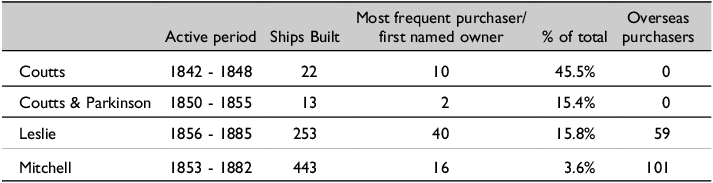
Developing this point further, Table 1 has been compiled to highlight the different approaches to the market for iron ships. While initially Coutts was able to use his reputation to capture repeat business through his connection with T. Gibson and Co., on the other hand he failed completely to sell any ships outside the confines of the North East of England. This significantly limited his market prospects, while on the other hand Mitchell sold 46.5% of his ships overseas, and Leslie’s exports amounted to 25.7% of output. Another factor was the kind of ships being built, because Mitchell and Leslie concentrated on the rapidly expanding market for passenger and cargo ships, with this category accounting for, respectively, 57% and 60.4% of their outputs. In addition, Mitchell was able to diversify into the military market, both in the UK through his connection with Armstrong and by establishing a strong relationship with customers in Russia and other countries. Coutts, on the other hand, went for the prestige market, building ever larger ships that tested the limits of contemporary construction techniques. As we noted earlier, by the 1850s Coutts was building ships of well over 1,000 tons, compared to his rivals who focused on what would appear to be the contemporary standard size of a cargo ship of between 300 and 500 tons. Indeed, Leslie and Mitchell only started building ships of over 1,000 tons in the mid-1860s. One should also note that Leslie was able to supply over thirty similar-sized ships to Holt and Lamport, the Liverpool merchants, providing the opportunity to standardize designs and achieve considerable economies of scale at the production phase.
Ships Built and Key Purchasers, 1842-1885

Table 1. Long description
A table comparing shipbuilding data from 1842 to 1885. The table has five rows and six columns. The columns are labeled Active period, Ships Built, Most frequent purchaser/first named owner, % of total, and Overseas purchasers. The rows are labeled Coutts, Coutts & Parkinson, Leslie, and Mitchell. Row 1: Coutts, 1842 - 1848, 22, 10, 45.5 percent, 0. Row 2: Coutts & Parkinson, 1850 - 1855, 13, 2, 15.4 percent, 0. Row 3: Leslie, 1856 - 1885, 253, 40, 15.8 percent, 59. Row 4: Mitchell, 1853 - 1882, 443, 16, 3.6 percent, 101.
Source: Tyne Built Ships database, https://www.tynebuiltships.co.uk/index.html.
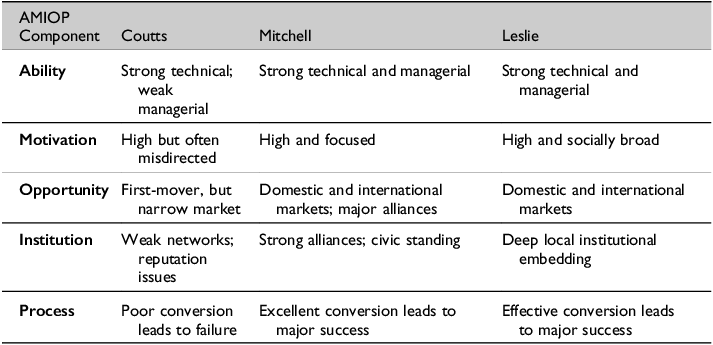
Having noted these important contrasts in the ways each member of the Troika approached the market, it is also useful to be reminded of the similarities and how these align with the AMIOP framework. As Table 2 illustrates, it is firstly clear that in sharing a belief in the commercial prospects of establishing iron shipbuilding on the Tyne, they moved to a location that would prove to be highly conducive to this kind of vessel. Similarly, there is no evidence to criticize them for their respective engineering ability; while Coutts suffered some embarrassment over the W.S. Lindsay contract, all of his other ships were widely praised for their design. Indeed, the pioneering work of Coutts, Mitchell and Leslie provided a clear demonstration that this new industry possessed considerable potential. By the early 1860s, there were ten iron shipbuilders on the Tyne, while later Armstrong entered the industry and Mitchell fostered the creation of important firms such as Swan Hunter and the Wallsend Slipway Co.Footnote 100 In this sense, one can credit Coutts with some success, because as he noted in 1856: “In short, I attempted to accomplish, and did accomplish, making the Tyne an iron shipbuilding port.”Footnote 101
Performance of the Aberdeen Troika against the AMOIP framework

Table 2. Long description
A table comparing the performance of three components, Coutts, Mitchell, and Leslie, against the AMIOP framework. The table has five rows and four columns. The columns are labeled AMIOP Component, Coutts, Mitchell, and Leslie. The rows are labeled Ability, Motivation, Opportunity, Institution, and Process. Row 1: Ability, Coutts, Strong technical; weak managerial, Mitchell, Strong technical and managerial, Leslie, Strong technical and managerial. Row 2: Motivation, Coutts, High but often misdirected, Mitchell, High and focused, Leslie, High and socially broad. Row 3: Opportunity, Coutts, First-mover, but narrow market, Mitchell, Domestic and international markets; major alliances, Leslie, Domestic and international markets. Row 4: Institution, Coutts, Weak networks; reputation issues, Mitchell, Strong alliances; civic standing, Leslie, Deep local institutional embedding. Row 5: Process, Coutts, Poor conversion leads to failure, Mitchell, Excellent conversion leads to major success, Leslie, Effective conversion leads to major success.
These commonalities are important, in that as Table 2 reveals, each member of the Aberdeen Troika clearly shared a vision and the market opportunity certainly justified risk-taking. Moreover, as Mitchell and Leslie discovered, the institutional environment proved conducive, in that capital could be secured to build their businesses. In this sense, of course, Coutts suffered the bad luck of losing his partner in 1852. On the other hand, it is notable that in 1856 nobody was willing to step in and bail him out of a second bankruptcy, having failed to pay both his business and personal debts. This once again indicates that the principal difference between the Troika was in terms of “process”; as Table 2 indicates, while in terms of ability and motivation there are strong commonalities, there would appear to be significant differences in the other three rows. Above all, as the final row demonstrates, it is clear that Coutts’ business model proved to be inappropriate.
While the lack of archival data for Coutts is problematic when forensically analyzing this conclusion, one can infer from what we have related earlier that his approaches to cash flow and organizational efficiency were not as effective as those of his Aberdonian counterparts. For example, the Estimates Ledger and Journal of A. Leslie and Co reflect a meticulous approach to the control of costs.Footnote 102 This ensured that customers knew exactly what they were paying for, including a line-by-line breakdown of costs that was presented alongside the design of the ship. A highly detailed Wages Book was also kept, indicating the hours worked by each employee.Footnote 103 This demonstrated a strong focus on effective cost and management control at the Leslie shipyard. Although Mitchell’s corporate archive does not contain as much detailed material as Leslie’s, there does exist a series of contracts between Mitchell and both marine engine builders and other shipbuilders. These are highly detailed documents, including the frequent use of standardized forms, indicating how consistency was achieved in his business dealings. In contrast, Coutts would appear not only to have indulged his creative instincts by building ever larger ships, but he also antagonized his suppliers by failing to pay mounting bills.
Of course, by focusing solely on “process,” or the conversion of market opportunities into commercial success, it is possible that our analysis would be biased against Coutts; as one of the first-movers in iron shipbuilding he was faced with all the challenges of both persuading shipowners to convert from wood to iron, as well as developing viable production methods. Moreover, given the limited application of steam power at that time, he was obliged to focus on sailing vessels, a constraint that did not affect Mitchell and Leslie. On the other hand, the crucial distinguishing factors would appear to have been a combination of ineffective management and organizational routines and Coutts’ desire to build ever larger ships, irrespective of the costs involved. In a business environment based on trust and personal reputation, Coutts would appear to have lost the goodwill he had built as an innovator, resulting in his failure to secure further support after 1856.
Looking more broadly at the variation in performance and the nature of entrepreneurial agency in these cases, this illustrates a key insight: in emergent industrial settings, entrepreneurial success is contingent upon relational positioning as much as individual expertise or investment. Those who could mobilize multidimensional assets - and convert them effectively - were able to navigate uncertainty and secure legitimacy in a competitive, formative marketplace. Crucially, the embryonic context magnified the importance of networking and building trust. Unlike older industrial centers where reputational hierarchies were entrenched, the Tyne offered a more open, yet socially complex, environment. It rewarded those who could gain trust, forge alliances, and embed themselves in regional civic and business life.Footnote 104 For entrepreneurs like Mitchell and Leslie, this meant leveraging connections and status as much as technology or finance, achievements that Coutts palpably failed to implement.
In sum, entrepreneurial success in iron shipbuilding was not simply a function of resources, but of conversion: the capacity to rearticulate opportunities and personal assets into sustainable economic outcomes. This explains why one can regard Mitchell and Leslie as high-agency entrepreneurs who successfully aligned ability, motivation, opportunity, institutional support, and process skill. Coutts, on the other hand, despite being a pioneer and possessing strong technical ability, could not convert opportunity into sustainable entrepreneurial agency because he lacked the managerial skills to convert opportunity into commercial success. This provides an interpretive model applicable to other emergent industries, especially where capital markets are thin and institutional legitimacy must be actively constructed.
We call for further multidisciplinary research into shipbuilding clusters, contrasting the Tyneside experience with that of both close neighbors, such as Sunderland, and other major centers in Glasgow, Merseyside, and Belfast. By applying the AMIOP framework to these clusters, this will provide even deeper insights into the nature of entrepreneurial agency, revealing how individuals coped with the organizational, technological, and institutional challenges faced when establishing a new industry. Although the lack of archival resources will no doubt restrict the scope of this exercise, by triangulating across multiple types of records it will be possible to extend our understanding of this fascinating subject.

 Open access

