


Business history puts the enterprise at center stage, stressing how enterprises form and address challenges as they seek to grow and prosper. Economic history also often studies firms, although in a different way, more often viewing them as anonymous collections of producing units. Together these two sub-disciplines have taught us a great deal about these crucial actors in market and other economies. Much of that research appears in the pages of the Business History Review.
Scholars from both groups have largely ignored one important feature of the business enterprise, however: its legal form. These literatures and related work devote considerable attention to the development of the corporation and its role in the economy, but show less interest in alternative organizational forms.Footnote 1 Neglecting alternatives to the corporation has led to misunderstanding. The corporation was uncommon in the past. Throughout the British Industrial Revolution, to take an important example, few corporations existed, and they played little role in industrial activity. Some scholars see the corporation as an obviously superior enterprise form critical to economic development. Since such claims rarely consider the alternatives, this view amounts to an implicit comparison lacking a comparator. Until the mid-nineteenth century, most countries strictly limited access to the corporate form. However, even when legal systems offered unfettered access to the corporate form, most enterprises organized as partnerships or something else.
This article has two related goals. First, I argue that legal forms matter, and that thinking harder about the corporation’s precise role can pay important dividends. This effort requires surveying a recent literature stressing the alternatives to the corporation and addressing important questions about those alternatives. Second, I detail an alternative that today dominates the ranks of businesses in many developed economies: the private limited-liability company (PLLC). The PLLC form allows entrepreneurs limited liability and other advantages of the corporate form in return for eschewing listing equities on public exchanges. Most notably, PLLC owners can craft governance, profit-allocation, and other matters largely as they see fit. In this respect, they more nearly resemble partnerships. The PLLC takes many forms in different countries, and emerged in different ways in response to different national concerns.
This discussion requires summarizing my own research and that done with co-authors and by students.Footnote 2 Others preceded our work and have continued since. I begin by demonstrating the prevalence of enterprise forms other than the corporation. Then I turn to the full menu of enterprise forms, stressing the features that make the corporation relatively more or less attractive to businesses. The remainder of the article focuses on the PLLC. I first describe the PLLC, focusing on the ways it differs from both the corporation and the partnership. I then turn to the implications of our research for a famous project on the implications of legal origins for financial institutions today. After discussing two smaller, related issues, the article wraps up with remarks concerning the broader implications of the legal form of enterprise.
The Corporation in Its Place
Alfred Chandler’s research on the rise of large enterprises in the United States, and his later extension of these ideas to the United Kingdom, Germany, and other countries, shaped large swathes of business and economic history.Footnote 3 I do not doubt his core insight: that in the United States the combination of a vast internal market and a new transport technology in the form of the railroad offered enterprises the chance to achieve enormous economies in production and distribution. Chandler articulated three investments that firms needed to achieve those economies: in large-scale production, in distribution networks, and in managerial expertise capable of directing enormous, complicated enterprises. Both Chandler’s work and the later discussions focus on the internal organization and management of these very large enterprises.
Chandler himself did not stress the issue of legal form. He compiled lists of the largest enterprises by assets for both The Visible Hand (on the United States) and Scale and Scope (on the United States, Britain, and Germany). While one can infer legal form from the names of most of these enterprises, Chandler does not remark on the issue. It would be fair to say that Chandler assumed all large firms were corporations, but he does not say so. Most of the enterprises he discussed were corporations, as corporations could most easily achieve the scale he thought necessary to take advantage of the opportunities implicit in large markets.Footnote 4 Some economists explicitly argue that the corporation amounts to an organizational innovation key to economic growth. Some economists actually use the term “corporation” as a synonym for “firm.”Footnote 5
Some scholars following in Chandler’s footsteps focused deliberately on public corporations or read into his argument the corporate form. For example, Michael S. Smith’s later account of the largest French firms focuses exclusively on public corporations without remarking on what that might leave out.Footnote 6 German evidence suggests this focus leaves out a great deal. Kocka and Siegrist compile a list of the 100 largest industrial enterprises in Germany in the late nineteenth and early twentieth century, considering all enterprise forms. In 1887, 79 of those 100 largest firms were corporations (Aktiengesellschaften). Another six were mining corporations (bergrechtliche Gewerkschaften). But 15 of these enterprises were either sole-owner firms or partnerships. In 1907, the largest firms included five of the new Gesellschaft mit beschränkter Haftung (the German PLLC enacted in 1892, hereafter GmbH), but seven other firms were partnerships or sole proprietorships.Footnote 7
Efforts to temper this emphasis on the corporation stress two issues. First, while corporations have advantages for many firms, these advantages do not matter for all businesses, and the corporation comes with built-in limitations that make it unsuitable for many firms. Second, some discussions of the corporation and its emergence imply a story in which lawgivers and entrepreneurs gradually recognized the best way to do things. This would imply near-universal incorporation. Instead, even when the corporate form was freely available, as it was in most of Western Europe and North America by 1900, most firms chose alternatives.
Until the nineteenth century, governments required a specific charter or “concession” to create a corporation. While the formal approach differed across time and space, these systems required that entrepreneurs obtain state permission for each individual firm. After that, many countries imposed publicity and governance rules on corporations that made the form unsuitable for small or medium-sized enterprises. Cross-national differences in corporation law make generalizations hazardous. Germany’s corporation law (especially after 1884) imposed significant organizational and governance rules that had a fixed-cost character. Incorporation thus made most sense for the largest firms. U.S. states typically inserted many specific requirements into their corporate law and tolerated no deviations from those requirements. British law, on the other hand, was extremely flexible, with a wide variety of issues left up to the firm. Spanish corporate law was similarly flexible, and courts tolerated deviations from what seemed, on the surface, hard rules.Footnote 8
Documenting the relative prevalence of enterprise forms encounters the usual challenges of historical sources. The registration systems for Germany, France, and Spain yield counts of the number of new firms registered, by legal form, for this period. Prior to the PLLC, partnerships dominated the ranks of new multi-owner enterprises in each of those countries. The corporation never accounted for even 10% of new firms in Prussia in the period 1872–1887, when firms no longer needed concessions to incorporate. A slightly higher proportion of new French enterprises chose the corporation form in this same period. The Spanish experience differed, with the corporation rising from less than 10% of new firm registrations to 30–40% in the first part of the twentieth century. In all three of these cases, the ordinary partnership accounted for most of the remaining multi-owner firms until the PLLC’s introduction.Footnote 9
Both the United Kingdom and the United States lacked registration systems for partnerships, so the data for those countries serve less well. Contemporary assessments for the United Kingdom suggest that partnerships accounted for 90% to 95% of multi-owner firms overall as late as the 1870s. By the early twentieth century, they had become less important, particularly in industrial sectors.Footnote 10 The U.S. census of manufactures for 1900 reports that 60% of multi-owner firms were partnerships. This figure drops to about 40% by 1920. The Internal Revenue Service reported that as late as 1947, corporations accounted for only 40% of multi-owner firms.Footnote 11
The incidence of corporations also varied widely across countries, as shown by Leslie Hannah’s global corporate census. This careful accounting, based on published sources, tallies the number of corporations (and PLLCs) in many countries around 1910. The number of such firms per million people varied widely. The United States had 2,913 corporations and PLLCs per million people, and the United Kingdom, 1,241 per million. Those two countries enjoyed similar levels of GDP per capita. Norway had 2,117 corporations and PLLCs per million people.Footnote 12 The corporate form’s popularity reflects both detailed rules for that form and the alternatives available, as well as the nature of local business and how the corporate form suited their organizational needs.Footnote 13
The Menu of Enterprise Forms
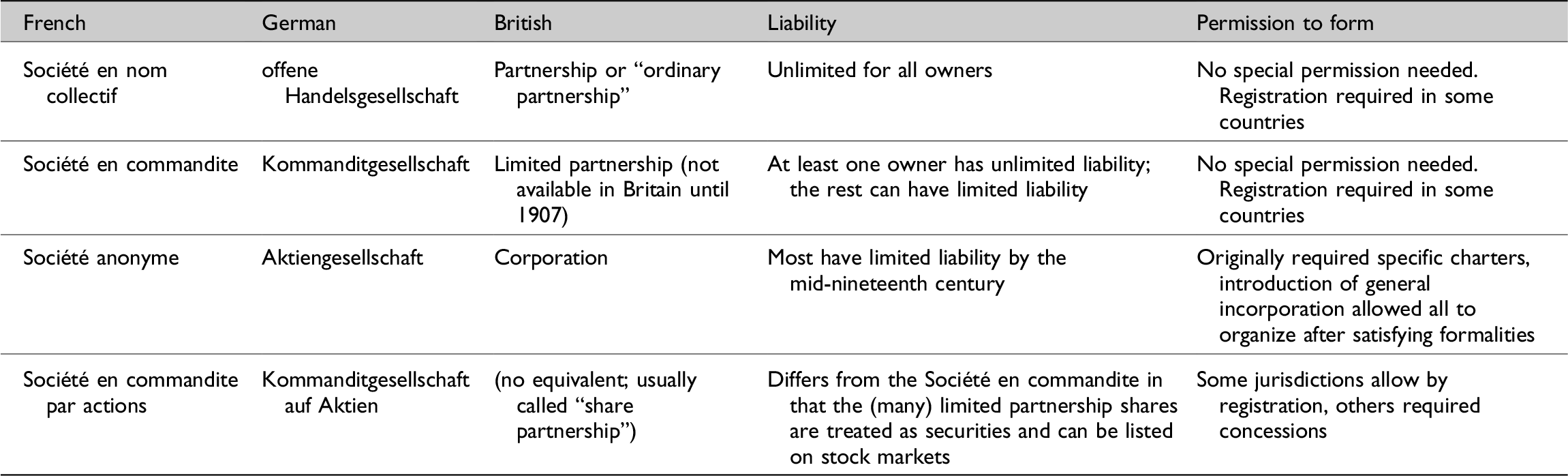
Throughout this article, I focus on the primary multi-owner enterprise forms in leading industrial countries from the mid-nineteenth through mid-twentieth centuries. Most businesses in the past had a sole owner. While those firms play little role in the following discussion, we should bear in mind that every entrepreneur had, at least theoretically, the option to go it alone.Footnote 14 Table 1 provides key terms. (The table omits the PLLC form, to which I turn below.) The partnership (or “ordinary partnership”) requires all owners to assume unlimited liability. Entrepreneurs did not need special permission to create firms of this type. The limited partnership had at least one owner with unlimited liability; other owners could not lose more than their investment.Footnote 15 Corporations have already been defined. The share partnership combines elements of the limited partnership and the corporation. This form’s limited partnership shares could be traded on public markets. In some jurisdictions, share partnerships did not require a concession and thus offered a concession-free alternative to the corporation.Footnote 16 French commercial law’s central role (especially as codified in the Napoleonic reforms) shows up in both the terminology and the countries French law influenced, including Germany.Footnote 17 The countries listed stem, in part, from the four-author project discussed below. I include Spain because it provides a perspective on several questions central to these discussions. Table 1 excludes lesser-used forms at the time as well as more recent innovations. The enterprise forms available in the early nineteenth century have their own fascinating history, but to maintain focus, I mostly set aside earlier developments.Footnote 18 A focus on the legal form of enterprise alone involves abstraction: firms and their owners deal with other features of commercial law as well as civil-law rules that govern property, inheritance, and related matters that affect how firms operate.
The pre-PLLC menu of enterprise forms

Table 1. Long description
A table comparing enterprise forms across French, German, and British legal systems, detailing liability and permission to form. The table has five rows and five columns. The columns are labeled French, German, British, Liability, and Permission to form. Row 1: Société en nom collectif, offene Handelsgesellschaft, Partnership or ordinary partnership, Unlimited for all owners, No special permission needed. Registration required in some countries. Row 2: Société en commandite, Kommanditgesellschaft, (no equivalent; usually called share partnership), Limited partnership (not available in Britain until 1907), Differs from the Société en commandite in that the (many) limited partnership shares are treated as securities and can be listed on stock markets. Row 3: At least one owner has unlimited liability; the rest can have limited liability, No special permission needed. Registration required in some countries. Row 4: Société anonyme, Aktiengesellschaft, Corporation, Most have limited liability by the mid-nineteenth century, Originally required specific charters, introduction of general incorporation allowed all to organize after satisfying formalities. Row 5: Société en commandite par Actions, Kommanditgesellschaft auf Aktien, Some jurisdictions allow by registration, others required concessions.
Note: This table does not include enterprise forms allowed under the civil law, and excludes some other forms such as mining corporations or cooperatives.
France, Germany, and most other Continental countries offered the four choices listed in Table 1 throughout the nineteenth and twentieth centuries, sometimes with restrictions described below. Firms in Britain and the United States faced a more restricted menu. Britain had no limited partnership form until 1907, and judges opposed efforts to create a limited partnership by contract. The United States had a more complicated experience with limited partnerships. New York State authorized the limited partnership in 1822, and by 1886, all but three of the states and territories then in existence had followed suit. Worried about fraud, the enacting states imposed strict registration requirements. Any firm that failed to meet all these requirements faced the real danger that it would be stripped of its special status and its limited partners subjected to unlimited liability.Footnote 19
Partnerships (as well as sole proprietorships) typically required no specific permission to form. In many jurisdictions, partnerships registered after meeting modest legal formalities. In countries such as Britain and the United States, ordinary partnerships did not even have to register or have a contract. Corporations, on the other hand, usually required a concession until the mid-nineteenth century or even later. A concession in this context permitted specific people to form a specific firm. Eventually, many jurisdictions shifted to “general” or “normative” incorporation, systems in which any entrepreneur satisfying certain requirements could create a corporation. The United Kingdom first dropped concession requirements for most corporations in 1844, and in 1855 gave all such corporations limited liability. France, like most of the Continent, lagged behind. Starting in 1863, new French corporations did not require a concession if they had less than 20 million francs capital. An 1867 Act dropped this size limitation. While several smaller German states had less restrictive laws earlier, the first all-German general incorporation rules date to 1870.Footnote 20 By contrast, general incorporation came earlier to the United States. New York temporarily adopted general incorporation for manufacturing firms in 1811, as a wartime measure. Three other states followed suit but then repealed their laws. A second wave of general incorporation began in 1836, and by 1860, about 90% of the U.S. population lived in such a state. These statutes all allowed free incorporation for manufacturing firms, but in some cases still required concessions to incorporate in other sectors.Footnote 21
Concession systems could involve explicit quid pro quos: a concession might include the condition that a railroad company build a line that served the government’s interest, for example. The system also led to corruption, with officials in charge of concessions who had financial interests in either the new corporations or incumbent firms that would be challenged by new concessions to others.Footnote 22 In any case, most governments agreed to corporate formations only after negotiations over the new enterprise’s capitalization, governance, and scope of business. The process could take years, and in some cases, interested investors melted away, lured by other, more immediate opportunities. Concessions thus added to the difficulty of organizing corporations and accounted in part for the form’s relative rarity before the advent of general incorporation laws.Footnote 23 Because it was costly, the concession requirement implied that only the most productive firms incorporated. The benefits of incorporation further benefited the grantees. Gregg’s study of incorporation in Russia in the late nineteenth and early twentieth century shows that incorporation raised labor productivity because the new corporations had more and better machinery. This suggests that incorporation improved access to capital markets.Footnote 24
Asset Partitioning and Limited Liability, Legal Personality, and Capital Lock-In
Three other features of the different enterprise forms affect their usefulness to firms. The literature usually stresses the role of limited liability, the rule that means no owner can lose more than their investment; the firm’s creditors cannot recover the firm’s debts from the owners’ personal assets. Hansmann et al. have advanced a more general theory of “asset partitioning.” Asset partitioning divides the firm’s and owner’s assets into distinct pools that allow each to pledge assets to distinct creditors. Limited liability is the type of asset partitioning that protects the owners’ assets from claims against the firm. Entity shielding, on the other hand, protects the firm’s assets from claims arising from the owners’ personal creditors. Without entity shielding, an owner’s creditors could break up a firm by demanding the owner’s share of the firm’s assets. Hansmann et al. traced the development of this “entity shielding” in the centuries preceding the nineteenth, arguing that multi-owner firms would be unworkable without entity shielding. In the period I discuss, corporations had clear entity shielding, and by the mid-nineteenth century most had limited liability. Partnership law displayed more heterogeneity on this issue. Some jurisdictions built partial entity shielding into the law, and partnership agreements could include provisions that enhanced entity shielding.Footnote 25
One aspect of limited liability may confuse modern readers. Ordinarily, a nineteenth-century corporation issued shares by “subscription.” Each share had a set nominal value (say, £20). The original owner usually did not pay in the full £20. Suppose he or she paid in £10, leaving £10 unpaid. The firm could always “call in” additional sums up to the full £20; subscribing entailed a legal obligation to pay in the rest, if demanded. The unpaid capital functioned as a reservoir for corporations to acquire additional investment funds without issuing new shares. Creditors could also access the firm’s unpaid capital in bankruptcy proceedings, so the unpaid portion of shares allowed the corporation to borrow more. Limited liability with less than fully-paid shares meant that if the firm failed, the shareholders could be required to pay in the rest of their subscription, but never more than the sum necessary to reach the total value of their shares (in my example, £20). Legislation sought to ensure that outsiders had some idea of the minimum total paid-in capital for a firm with a stated nominal capital.Footnote 26
Second, corporations in the period under discussion had legal personality, a slightly vague term implying that the firm itself (rather than its owners) could own property, make contracts, and sue and be sued. A partnership, on the other hand, consists of agreements among specific people and had no legal existence distinct from its owners. The lack of legal personality posed a serious handicap in some circumstances. Countries such as Germany developed systems that allowed registered partnerships to act for some purposes as if they were legal persons. In Britain, the United States, and other countries, partnerships lacked legal personhood, and there was no analogous registry. To act as a body, partnerships in these systems needed additional internal agreements that assigned authority to one or more partners. Whether these internal agreements have any force with respect to outsiders remained a complex issue.
Capital lock-in refers to a third issue. Because partnerships amount to agreements among specific people, the death, bankruptcy, or withdrawal of any partner threatens the firm’s existence. Partnerships lack capital lock-in and thus face the problem of “untimely dissolution.” Even if the firm survives, parts of a partnership’s capital can disappear in unexpected ways. Death is one. Partners can also threaten to withdraw for strategic reasons. Such strategic threats arise out of hold-up problems. Suppose investors have made some investment they cannot fully recover, and the firm cannot proceed without the continuing contributions of one or more partners. Those partners can threaten to leave unless promised better terms than they originally agreed. Some legal rules attempted to mitigate the untimely dissolution problem. Partnership agreements can stipulate automatic succession in the case of a partner’s death. Some legal systems allowed partnerships to have a stated contractual period during which the firm had more permanence.Footnote 27 Partnership agreements could not fully overcome a core problem: transferring partnership shares is difficult, so disagreements among partners could make the enterprise unworkable. Thus, whatever the law may state, partnerships are in practice “at will.”
Corporations, on the other hand, enjoy capital lock-in. An owner who wants to exit the firm can sell his or her shares to someone else, ordinarily, but cannot demand his or her capital back and thus cannot threaten the firm’s demise by withdrawing.Footnote 28 This transferability of shares reflects the entity shielding discussed above. Partnerships cannot be indifferent to the identity of their owners; a corporation, on the other hand, has little reason to care about its owners’ finances.Footnote 29 Locking in capital in this way required an important innovation in organizational law. Starting with the Dutch East India Company (VOC) in 1602, governments overrode earlier organizational law to allow the enterprise to refuse to return capital to the owners. This allowed the VOC to invest in fixed assets such as ships, trading stations, and forts that gave it commercial advantages over rivals such as the English East India Company.Footnote 30 Capital lock-in required the ability to transfer shares, since otherwise owners would have to commit to an illiquid investment.
Capital lock-in creates its own problems for the corporation. Since disgruntled owners cannot break up the firm, shareholder power depends entirely on voting rules and configurations of owners. Minority shareholders can find themselves at the mercy of majorities that shape the firm’s policies to their own ends. The right to sell shares (which was not absolute in many cases) implied that abused minority shareholders could exit the firm, but their share values might be depressed by the majority’s actions. The problem of “minority oppression” comes with capital lock-in and accounts for why minority investors may prefer the partnership. Minority oppression is one reason law devotes so much attention to corporate governance in general and shareholder interests in particular.
Other Organizational Forms
Table 1 includes only the most common enterprise forms falling under the business law. Some jurisdictions had special forms for mines, for shipping concerns, and other specialized operations. More generally, even in countries that required business organizations (such as those listed in Table 1) to register formally, smaller enterprises could often operate relying on the less stringent stipulations of the civil law.Footnote 31
In some countries, many enterprises take the form of a cooperative. Cooperatives play a small role in the United States, which may account for their neglect by business and economic historians. Another reason for neglect may be the idea that cooperatives exist as part of an ideological commitment to resist the encroachment of the market economy or to bolster specific sectors such as artisans or agriculture. Cooperative movements indeed often have (and had) ideological motivations, but the cooperative itself is just another legal form. Cooperative law varies across countries, but there are two basic approaches. The United Kingdom and Germany both created special bodies of law that applied to cooperatives only.Footnote 32 Other countries treated cooperatives as a special type of corporation. Regardless of approach, cooperatives resemble business corporations: the owners typically enjoy limited liability and earn dividends on their capital, while the cooperatives have legal personality and other corporation-like traits. The core difference lies in member motives. The cooperative’s members see in the cooperative a way to advance goals specific to their business or private ends. Members of agricultural cooperatives tend to be farmers who seek better input and output prices. Consumer cooperatives’ members want better food and other goods at lower prices. This feature sets cooperatives apart from for-profit corporations; investors in General Motors typically own its shares as part of an investment portfolio, not because of any attempt to obtain cheaper or better cars.Footnote 33 Given these motives and a different kind of ownership, cooperatives typically have rules (often imposed by law) governing voting rights, share ownership, and governance.
The cooperative form can be a close substitute for the enterprise forms listed in Table 1. Cooperative entities sometimes use a business-law form and business actors sometimes used the cooperative form. For example, late nineteenth-century German retail establishments (not cooperatives) banded together to create wholesalers to help compete with chain retailers. Sometimes these wholesalers organized as cooperatives, even though the retailers had little to do with the cooperative movement at large. Conversely, some entities within the German cooperative movement organized as corporations before the law allowed limited-liability cooperatives. Others used the GmbH (after 1892) form to lock-in capital when that was especially important.Footnote 34
The PLLC: A New Kind of Enterprise
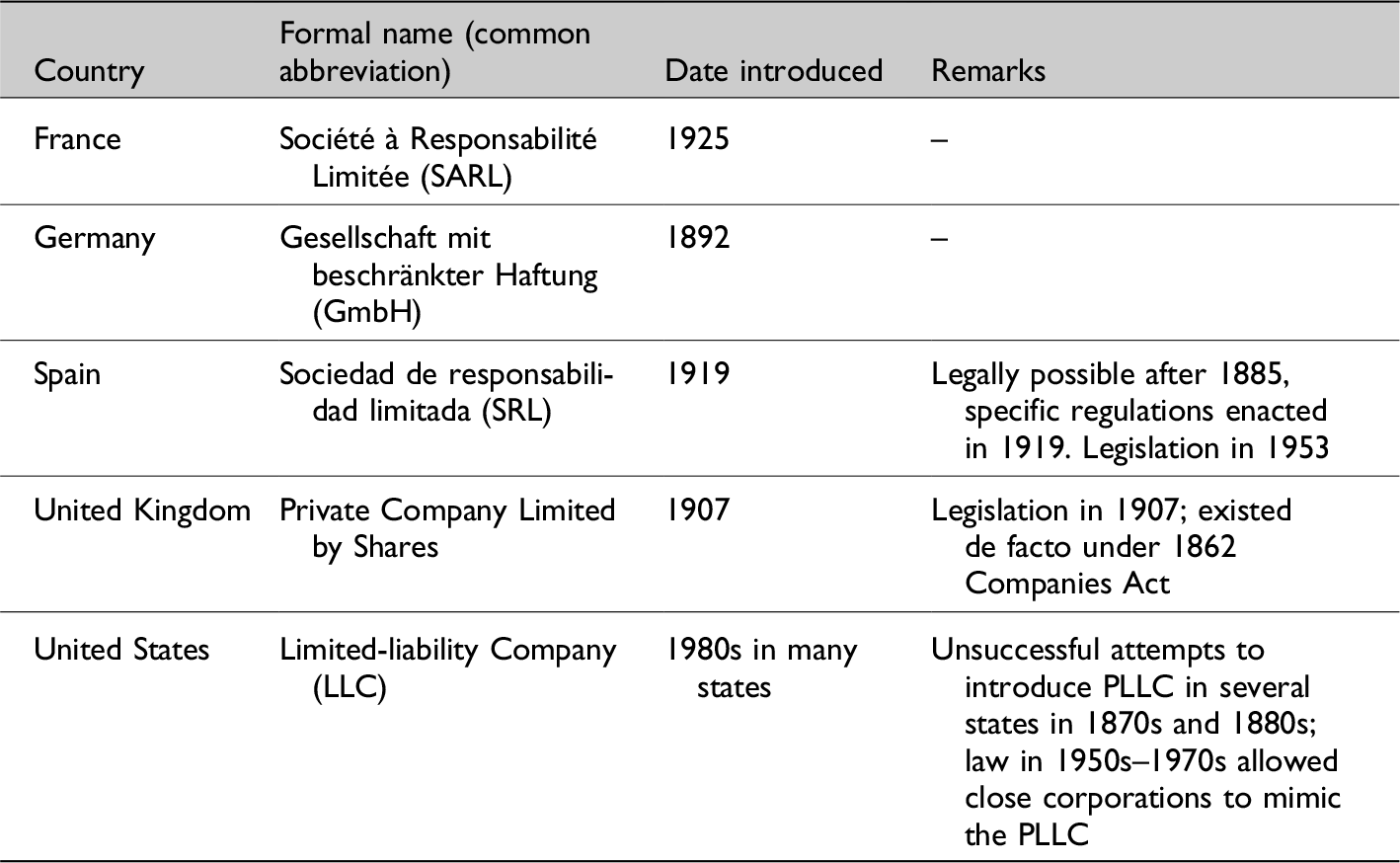
Table 2 documents the introduction of a new enterprise form in the four countries discussed below, as well as Spain. PLLCs differ in detail across jurisdictions, but always have limited liability, legal personhood, and locked-in capital, like corporations. PLLCs enjoy more contractual flexibility than corporations, and thus share some features of the partnership forms. PLLCs usually do not face the reporting and other requirements intended to protect the corporation’s stockholders, as they cannot list equity on public markets.Footnote 35 These features make them more suitable for smaller enterprises, even when the law does not restrict the form’s use to smaller firms.
The PLLC in five countries

Table 2. Long description
A table comparing the formal names, dates introduced, and remarks of enterprise forms in five countries. The table has five rows and four columns. The columns are labeled Country, Formal name (common abbreviation), Date introduced, and Remarks. Row 1: France, Société à Responsabilité Limitée (SARL), 1925, and no remarks. Row 2: Germany, Gesellschaft mit beschränkter Haftung (GmbH), 1892, and no remarks. Row 3: Spain, Sociedad de responsabilidad limitada (SRL), 1919, Legally possible after 1885, specific regulations enacted in 1919. Legislation in 1953. Row 4: United Kingdom, Private Company Limited by Shares, 1907, Legislation in 1907; existed de facto under 1862 Companies Act. Row 5: United States, Limited-liability Company (LLC), 1980s in many states, Unsuccessful attempts to introduce PLLC in several states in 1870s and 1880s; law in 1950s-1970s allowed close corporations to mimic.
Note: Many countries later adopted a PLLC following on one or more of the models noted here. See text.
The PLLC arose in several places. The German and French variants required specific legislation; partnership and corporate law did not permit entrepreneurs to create this new form on their own. Britain’s variant on the PLLC (the “Private company limited by shares” or just “private company”) emerged formally in 1907, when Parliament created a special class of enterprises freed from some requirements that henceforth only applied to what were intended to be public corporations. British entrepreneurs had been using the 1862 Act to create de facto PLLCs for some time before 1907, however. Many firms organized under this Act were small and did not list their shares on markets.Footnote 36 The new law merely recognized what lawyers and their clients had already created. Spanish entrepreneurs created their PLLC without legislation at all, taking advantage of the considerable flexibility in that country’s commercial law.
My work on the PLLC started as part of a collaboration with Ron Harris, Naomi Lamoreaux, and Jean-Laurent Rosenthal (henceforth GHLR; the name order in our articles reflects the economics convention that lists authors alphabetically). We focus on four countries that were wealthy in the late nineteenth century and remain so today: France, Germany, the United Kingdom, and the United States. These choices reflect, in part, a desire to engage with the “Law and Finance” literature discussed below. Our expertise spanned the four countries on which the project focused.Footnote 37 My research on the German cooperative movement introduced me to the importance of legal forms and the sense that focus on the largest enterprises had not served the cause of understanding historical economic development.Footnote 38
The project also had several offshoots. I had been working with Susana Martínez Rodríguez on questions related to Spanish cooperatives when we realized that Spain offered a chance to address questions about enterprise form in ways not possible elsewhere. This opportunity reflects both Spain’s unusual legal rules and the availability of sources not found in the four GHLR countries. Martínez Rodríguez also wrote several related articles alone.Footnote 39 Other project offshoots benefited from the quality of Yale’s graduate students. Lamoreaux and I served as advisors for several students whose dissertations dealt in one way or another with matters related to legal form. Francesca Trivellato, also then at Yale, made significant contributions to training these students.Footnote 40
The PLLC presents an additional challenge to the idea that most firms prefer to be corporations. We cannot really know how many UK companies were PLLCs prior to the 1907 legislation, but in the years after, there were few registrations of public companies. Germany’s GmbH saw something different. For the first decade after its 1892 introduction, the new form had only modest use. But GmbH formations exploded in the early twentieth century. By 1914, the new form accounted for about 35% of new registrations and became more popular than the ordinary partnership after World War I. The French SARL saw an even more dramatic start; within five years, the new form had almost eliminated the limited partnership and reduced the ordinary partnership to about 10% of new registrations. The SARL had less effect on the corporation. Spain’s SRL also mostly displaced the partnership forms, accounting for nearly half of all new firms by 1936.Footnote 41
The available evidence shows that corporations remained uncommon, even when the only alternative was either a sole proprietorship or a partnership. The PLLC’s introduction affected the corporation in different ways, depending on the corporation’s characteristics. In most cases, the PLLC eroded the corporation’s use. The PLLC’s creation thus challenges the Chandlerian focus on the largest enterprises. It also raises questions about another important agenda, the “Law and Finance” project associated with Rafael La Porta, Florencio Lopez-de-Silanes, and Andrei Shleifer.
The PLLC and the “Law and Finance” Project
The GHLR research also spoke to a famous project on “law and finance.” (I refer to this project as “LLSV,” for its four authors: Rafael La Porta, Florencio Lopez-de-Silanes, Andrei Shleifer, and Robert W. Vishny.) LLSV divide countries into two basic groups: “common law” and “civil law.”Footnote 42 (A third group, “socialist law” exists outside this binary divide but has more in common with civil than common law.) The terminology can be confusing, and legal historians sometimes disagree with the basic division and the assignment of countries to groups.Footnote 43
The common-law countries consist of England and its former colonies. Their core approach to law-making bears strong similarities to England’s. Common-law countries rely relatively more on precedent (that is, judge-made law) and relatively less on statutes. Judges try to use statute and precedent to decide specific cases, but when those approaches fail, common-law jurists use general ideas to make a decision that will serve as a new precedent. Those decisions enjoy the force of law until overturned by higher courts or abrogated by the parliament. The United States has common-law roots but also has considerable statutory law for company and financial issues. The United States also has legal pluralism: both federal and state law, and, in principle, 50 different state bodies of laws, although for many purposes, most or all states have signed on to “Uniform Law” that makes a particular body of rules identical in every state.Footnote 44 Competition among U.S. states for tax revenue also means that while every state has, for example, corporate law, some states host far more corporations than others.
Civil-law countries, on the other hand, bear a stronger imprint of Roman legal traditions. The family resemblance evident today also shows French influence on European legal thinking in the early-modern and modern period. Civil-law countries include all of Western Europe other than England, as well as the former colonies of France, the Netherlands, Portugal, and Spain. Civil-law judges focus more narrowly on interpreting the law as enacted by the parliament. Their training emphasizes deference to statute and code. Legal change in civil-law countries typically requires revisions enacted by parliament.Footnote 45
LLSV argue that the core approach to law in these two systems both reflects and affects a variety of matters that bear on financial markets and economic growth.Footnote 46 We focused on two LLSV claims: that the common-law system provides more legal flexibility, and that common-law countries provide better investor protection. LLSV draw on a long intellectual tradition that views the common law as better able to make rules that promote economic efficiency. This literature makes three claims. First, precedent-setting implies that new rules arise out of concrete cases stemming from actual problems. Critics of civil law view codification and the like as giving too much authority to impractical people who stress the law’s theoretical coherence over its ability to provide an efficient structure. Second, the common-law system in theory allows more rapid legal change: a judge can create new precedent in reaction to a new question, while a parliament might take years to update a statute and even longer to revise or construct a new code. Finally, the common law supposedly has a bias toward efficient rules. Precedent evolves out of concrete cases, and concrete cases keep arising until a rule has been established that is so workable, parties no longer see any point in challenging it.Footnote 47
Flexibility and the Legal Form of Enterprise
LLSV do not stress the legal form question and, in fact, most of their discussion pertains to public corporations alone. Considering the legal form of enterprise casts serious doubt on the idea that common-law systems were more flexible. In their comparison of France and the United States, Lamoreaux and Rosenthal demonstrate that French entrepreneurs enjoyed the larger menu of enterprise forms. The limited partnership, in particular, offered French firms a way to gather capital from limited-liability investors without using the corporation. Some U.S. states had limited partnerships, as noted above, but rigid application of common-law principles meant that American judges made the form hard to use. More generally, even within a given legal form, French courts tended to allow entrepreneurs more organizational leeway than did their U.S. counterparts.Footnote 48
Harris and Lamoreaux addressed the flexibility issue in a different way, by comparing the evolution of the corporation in two common-law countries, the United Kingdom and the United States. The two countries took strikingly different approaches to corporations in the later nineteenth century. The 1862 Companies Act gave British companies enormous flexibility, while most U.S. states insisted on specific provisions for a wide range of organizational and governance questions. In this respect, the United States, a common-law country, more nearly fits LLSV’s ideas of civil-law regimes. Through the early twentieth century, UK judges showed corporations considerable leniency while U.S. judges insisted on close adherence to narrow interpretations of relevant state statutes.Footnote 49 This discussion suggests that for some purposes, the common law/civil law distinction LLSV stress does not capture important variations in national law.
The PLLC’s very creation poses a fundamental challenge to the idea that the common law was more flexible. Germany introduced the GmbH in 1892 in response to dissatisfaction with the then-current menu of enterprise forms. Some German lawyers objected to the GmbH’s enactment on the grounds that it was an invention (Schöpfung); the idea being that business law should codify practice rather than make things up. Thus, the GmbH shows, among other things, the legislator’s willingness to ignore legal tradition.Footnote 50 Opposition grew as the GmbH became more popular. But this civil-law country was able to make an important legal change when a need arose. The French SARL demonstrates the possibility of even more rapid change in a civil-law system. Germany took from France the territories it called Alsace and Lorraine after the 1870 war between France and Prussia. France reacquired the region in 1919, after World War I. The GmbH had proven especially popular in that province. After 1919, many entrepreneurs there faced the awkward problem of converting their firm to an enterprise form allowed under French law, namely, the partnerships and the corporation. The French government solved this problem when it created the SARL in 1925.Footnote 51
Spain’s PLLC poses an even greater challenge to the image of civil-law rigidity. Spain shared the basic menu of enterprise forms found in France and Germany. But Spanish company law differed in an important way: the 1885 Commercial Code lacks numerus clausus. In this context, numerus clausus means firms can only organize using the legal forms enumerated in the commercial code.Footnote 52 Spanish law, on the contrary, allowed companies to choose from the menu or make up their own form, so long as nothing in the new form contradicted other aspects of Spanish law. This feature enabled the creation of Spain’s PLLC form (the Sociedad de responsabilidad limitada (SRL)) in a completely different way. In the early twentieth century, Spanish entrepreneurs (mostly in Catalonia) started organizing small enterprises that resembled PLLCs in other countries. This practice led to conflict with the local business registries, which tended to be skeptical of the innovation. In 1919, the national authority in charge of the registries ruled that because the code lacked numerus clausus, the new SRL was in fact perfectly legal. Only in 1953 did the Spanish parliament create law for the SRL.Footnote 53
Three civil-law countries thus introduced a PLLC form that became widely used by the mid-twentieth century. In contrast, the most direct equivalent to a European PLLC in the United States, the Limited-Liability Company (LLC), did not appear until the 1980s. This late appearance does not demonstrate a lack of interest earlier; rather, it illustrates the ways common-law rule-making can frustrate legal innovation. Several state legislatures enacted “Partnership Associations” starting with Pennsylvania in 1874. These entities resembled ordinary partnerships in which all owners had limited liability. This PLLC, however, never enjoyed much use. Only a handful of states followed Pennsylvania’s lead, and even in those states, only a small number of partnership associations came into being. The common law’s conservative bias made this new form a risky way to achieve limited liability. Pennsylvania judges ruled that even minor defects in the firm’s registration documents made the company invalid. Lack of use both reflected and created a vicious circle. Without case law, entrepreneurs had little confidence in how judges would rule for the new form, but without many firms, there were few cases. Federalism exacerbated the problem. Companies deal across state borders. Sometimes a Partnership Association’s home state would construe the enabling act as written, while a judge in a different state would construe it differently. The nightmare scenario arose from instances such as a Massachusetts case where a judge held that a Pennsylvania partnership association was an ordinary partnership, with unlimited liability.Footnote 54
Protecting Investors
The GHLR project also demonstrated weaknesses in the LLSV claim that common-law countries provide superior protection for investors. The UK’s 1862 Companies Act was quite flexible, as LLSV would stress. The law imposed some requirements on new companies’ articles of association, but also allowed them to craft many governance and reporting matters as they see fit. The Act’s Table A provides model language (or default rules) organized into 97 clauses. They could, alternatively, modify one or more clauses as they see fit. Modifications could go so far as to negate the rule suggested in Table A. Studies of corporate governance often take default rules such as those enumerated in Table A as mandates, but they are not. To understand how British companies used this flexibility, we drew samples of the articles of association for companies formed in 1892, 1907, and 1925 (henceforth “registration samples”). The firms in the 1892 registration sample spanned a range of sizes (measured by nominal capital), but none had traded securities. To study traded firms, we drew a second 1892 sample from firms listed in Burdette’s Stock Exchange Official Intelligence. About half of this 1892 Burdette’s sample had traded securities.
We examined each sample firm’s articles of association, determining whether they accepted or modified each of the Table A provisions, and, most importantly, how they modified articles. About half of the 1892 registration firms rejected Table A entirely, as did all of the Burdette’s firms. Most modifications enhanced the power of directors at the expense of the firm’s owners; LLSV erred in thinking that British companies adhered to what was considered good practice at the time. Several specific practices stand out. Table A stipulates fixed terms for directors, with re-election necessary to serve second and later terms. Many firms instead appointed directors for long terms, placing them beyond the discipline of disgruntled owners. Some firms even appointed “managing directors” who enjoyed their position for life. Table A forbade self-dealing by directors; some companies waived those provisions. Firms also changed voting and quorum rules to reduce shareholder ability to question major decisions or to inquire into financial reports. Larger firms more consistently rejected Table A’s provisions to adopt director-friendly rules.
A company that adhered to Table A would, as LLSV claim, be adhering to contemporary ideas about what investor protection meant. But most British firms did not adhere to Table A. Our findings raise two general questions about how the LLSV and related projects think about corporate governance. The deviations from the norms of good corporate governance we document did not harm a company’s ability to attract capital. The British investing public seemed happy to earn the returns companies could offer (which were generally higher than those available from government issues), even if earning those returns meant putting up with bad behavior by management. And investors probably interpreted some “best practices” in ways that undermine the indices LLSV use. For example, entrenching a key person as “managing director” may assure investors that the firm will remain under the control of founders and others responsible for its success.
Our article also makes two methodological points. First, studies of corporate governance often construct additive indices by considering the number of legal provisions they think indicate good governance. This approach does not appreciate the way distinct rules can interact; taken in isolation, a specific provision might look good, but when considered in context, it may allow directors to abuse owners. A second methodological point is not new to us but warrants stressing. The 1862 Act’s Table A consists of default rules alone. Table A (and its later revision) can instruct the historian on what Parliament thought were good practices, but a list of default rules says little about what firms actually did.Footnote 55
This article focuses on Britain alone and thus speaks to investor protection in a common-law country. Artunç noticed that Egypt in the period 1887–1914 offers the chance for tight comparison of governance rules adopted by companies organized under common-law and civil-law codes. Egyptian law at the time was a French transplant, but entrepreneurs (both Egyptian and others) could choose to organize firms under any European law. Some Egyptian companies formed using British law. Comparison of these common-law corporations to those organized using French law shows weaker protection for investors. The common-law firms had less protection for minority shareholders, and the owners had less control over director rotation and borrowing power. The differences mattered: corporations with weaker investor protection had higher failure risk and lower firm value.Footnote 56
Choosing a Legal Form
Most of the work I have discussed uses empirical aggregates to infer the choices entrepreneurs made about the best legal form for their enterprise. The aggregate data reveal important patterns, but such data cannot tell us what kinds of firms preferred the new form and what kinds of firms stuck with one of the older enterprise forms. A small literature relies on firm-level data to estimate the determinants of enterprise-form choice. Two contributions pre-date the GHLR project. Gómez-Galvarriato and Musacchio studied the choice of enterprise form for a large sample of Mexico City firms in the late nineteenth and early twentieth centuries. Gómez-Galvarriato and Musacchio note that most enterprises were either ordinary partnerships or corporations, but foreign enterprises tended to favor limited partnerships. Ran Abramitzky, Zephyr Frank, and Aprajit Mahajan focused on the choice between limited and general partnerships in Rio de Janeiro in the late nineteenth century. This latter article focuses on the terms agreed by partners in the two different partnership forms, and thus deals with the enterprise’s internal arrangements. Limited partners tended to put in more capital and receive smaller payouts than similar investors in ordinary partnerships, highlighting the trade-off required for limited liability.Footnote 57 Detailed econometric analysis of enterprise form choice requires firm-level data across the full menu of forms, which is why these two studies deal with civil-law countries that had business registries.Footnote 58
Rich Spanish data allowed us to dig more deeply into the PLLC’s impact in that country. Drawing on both archival and published sources, Martínez Rodríguez compiled firm-level databases that track the creation of new firms in the years 1885–1936, a period that straddles Spain’s introduction of its SRL. We estimated nested logit models for the choice of enterprise form.Footnote 59 The data allowed us to assess the impact of size, sector, and other factors. We find that the SRL displaced both partnerships and corporations, substituting for the larger of the former and the smaller of the latter. We also find that firms in sectors where hold-up would be a problem tended to prefer the SRL to the partnerships. Spanish firms apparently valued the SRL’s capital lock-in as a way to avoid these problems.
Another finding resonates with a strong theme in business history. SRL owners were less likely to be related to other owners than was true in the partnership forms, even when we focus on enterprises of the same size. The literature has stressed that family ties can create incentives for proper conduct that are both stronger and more easily enforced than legal rules. The SRL form allowed broader groups of entrepreneurs to form enterprises; limited liability and capital lock-in meant the SRL could substitute law for the governance implicit in family bonds.Footnote 60 These Spanish results depend on context in the form of the alternatives to the PLLC. Spain’s corporation offered so much flexibility that it constituted a closer substitute for the PLLC than would be the case with Germany’s GmbH and corporation, for example.Footnote 61
The research I have described thus far contemplates a group of entrepreneurs organizing a new firm. The business-history literature, of course, often takes a different perspective, studying a business firm over its entire lifetime. That lifetime may involve several changes of ownership and legal form. A common change in form occurs when a partnership becomes a corporation. Most discussions of these changes see this as “going public,” an effort to tap larger capital markets. Cihan Artunç took a different perspective on these transitions, one that takes a novel view of the partnership’s lack of capital lock-in and the corporation’s typically higher formation costs. What if the partnership’s members saw the firm as trial arrangements, a vehicle to explore partner fit and business opportunities before incurring the higher costs of establishing a corporation? That is, partnership may be its own suitable legal form, but for some firms, it might also represent a form of “courtship” before the “marriage” of incorporation. With this perspective, the partnership’s relative informality and at-will character might be advantages in some circumstances. Using a remarkable dataset he collected for enterprises in Egypt 1910–1949, he and I asked whether the organizers of Egyptian corporations had prior experience with the same owners. Because the source names all partnership owners, we could track individuals across different firm registrations. We asked whether corporations lasted longer if their owners’ prior history suggests a better match: whether the owners had been in business together before, for example. They did.Footnote 62
Taxation and the Choice of Enterprise Form
Some tax regimes treat the profits earned by the various enterprise forms differently. The popularity of some new forms in the United States today, for example, stems from an Internal Revenue Service decision to treat the LLC and “S Corporations” as partnerships for tax purposes. These forms thus do not pay a tax on their income; the income “passes through” to owners, who pay personal income tax on their earnings from the firm. This treatment avoids the infamous “double taxation” of income derived from corporate profits. Pass-through tax rules generally apply to partnerships, a feature of their lack of legal personality. Some scholars assert that choice of legal form turns on tax treatment and nothing else. This view is both U.S.-centric and anachronistic. Tax regimes elsewhere usually treat PLLCs as corporations and tax them as such; tax rules provide no reason to opt for a PLLC over a corporation, or vice versa. In addition, choice of legal form matters most for tax purposes when rates for corporate and personal income differ greatly. The U.S. LLC came into being when corporate rates greatly exceeded personal income tax rates, but that experience has not been universal across space or throughout history.
Conclusions and an Agenda
Paying more attention to the legal form of enterprise pays two kinds of dividends. One simply corrects erroneous views in the historical literature. Chandler’s followers might want to reconsider their tendency to equate firms with corporations. To take another important example, an evergreen approach to big questions in economic history compares two regions and asks why they ended up so differently. Timur Kuran’s analysis of the Middle East compares it to Europe, stressing the deleterious impact of Islamic law on Middle Eastern economic development. Among other defects, in his view, Islamic law offers only a weak form of the partnership, weak, that is, in contrast to European law. Kuran also notes that Islamic law is hostile to legal persons. The only tolerable corporation-like entity, the Waqf, cannot serve business ends.
Kuran’s project has a broad scope that stimulated considerable new research. He deserves thanks for breaking fresh ground both directly and indirectly. But he finds the Middle East wanting when measured against a “Europe” that never existed. The Islamic partnership law Kuran describes sounds much like partnership law as it operated in Europe in the nineteenth and early twentieth centuries. It is difficult to understand what he thinks Europeans had that people living under Islamic law lacked.Footnote 63 The same can be said for his image of corporations in Europe. General incorporation came to the United Kingdom in the mid-nineteenth century, and to France and Germany in the 1870s. Prior to that, neither country had many corporations. Corporations played almost no role in the early part of Britain’s industrial revolution. Differences in access to the corporation cannot explain Middle Eastern economic stagnation.Footnote 64
Most of the literature I have discussed relies on quantitative material, even econometric models. Most business history, on the other hand, relies on case studies or groups of case studies. The two approaches can draw on one another’s strengths in understanding how enterprises develop. My own understanding of the choice of legal form has benefited from reading scattered archival references to motivations in adopting, for example, the GmbH in preference to the corporation. And historians immersed in case studies might profit from taking more seriously what changes in a business firm’s legal form can say about its goals and perceived challenges.
Taking enterprise form seriously can also provide perspective on current developments. For the past four decades or so, many countries, both wealthy and not so wealthy, have adopted new or revised enterprise forms. In the United States alone, the recent introductions include the Limited Liability Company, the Limited Liability Partnership, and the Limited Liability Limited Partnership. Sometimes this effort reflects tax law, as in the United States; in other cases, such as in Europe, policymakers introduce new forms or revise old ones to bolster entrepreneurship, to more nearly harmonize domestic law with EU law. As scholars grapple with these new forms, two general lessons emerge. The first is comparative: the U.S. LLC is not a GmbH, a SARL, or a British private company, but the challenges of adapting the corporate form to a smaller and less formal entity involve some general problems. Discussions of the United States that focus exclusively on U.S. legal developments shut themselves off from useful international perspective.Footnote 65 The second lesson is historical: getting the history right supports more careful understanding of the way these forms emerge and perform. To understand both the individual enterprise forms and the way they fit into a national pattern, we need to understand how and why they emerged.
Research on the legal form of enterprise has only begun to explore the questions I discuss in this paper. Studies of wealthy countries make a strong implicit case that we need more research on other countries. Even some wealthy countries (such as Canada) have yet to receive the attention this issue deserves. And while lack of sources will restrict such research, we also need to know much about the micro-level determinants of the choice of legal form. Finally, I see great scope for combining two intellectual traditions. Scholars could combine the business historian’s long-term views of how businesses grow and develop with more careful attention to the way changes in legal form affect their strategies.
This research (and especially questions concerning the PLLC) goes to the heart of some contemporary debates about economic growth and development. One issue echoes historical debates about the introduction of PLLCs. The German GmbH’s creators worried that the 1884 Corporations Act had left middle-sized firms without a suitable enterprise form. Economists today debate whether developing-country firm sizes display a “missing middle”: that is, do developing countries typically have only a small number of huge enterprises and a huge number of small enterprises? While economists are perhaps skeptical that there is a missing-middle problem, few doubt the need for fostering the growth of new, formal firms in developing countries.
The PLLC also supports a different way of managing enterprises. To oversimplify a bit, the public corporation relies on detailed rules and formal hierarchies backed by law. PLLCs, on the other hand, tend to inhabit a less formal world where internal governance and relations with other enterprises reflect long-term and repeated interactions. This “relational contracting” approach permits PLLCs to adapt quickly to new circumstances, but also risks bad behavior stemming from the lack of formal oversight.Footnote 66
The PLLC has also changed the way even Chandlerian firms operate. Recent discussion about the growth of private equity sometimes conveys the sense that such firms represent something new. They do not. The huge GmbH that Siemens and Schuckert created in 1903 was larger by capitalization than most corporations at the time. The motivation for choosing the PLLC in this case included freedom from the short-term concerns of stockholders and the necessity of publicly reporting financial results, reasons familiar to the world of private equity today. More novel in the early twentieth century was a rapid growth in the practice of using firms organized as PLLCs to structure joint ventures between two or more corporations. Similarly, the PLLC made it easier for corporations to acquire or create wholly-owned subsidiaries that retained a distinct legal identity even when functionally integrated into a Chandlerian firm’s business operations. We see further development of this approach in contemporary enterprises such as Alphabet Inc, a public corporation that owns multiple subsidiaries organized as PLLCs. While one could imagine those subsidiaries set up as corporations (or even partnerships), the fact that Alphabet and similar firms rely so heavily on the PLLC signals that understanding legal form is important to understanding how contemporary businesses operate.
Acknowledgment
This survey was written at the invitation of the Business History Review. The references only partially acknowledge my intellectual debt to co-authors, students, and others. For comments I thank Cihan Artunç, Colleen Dunlavy, Walter Friedman, Eric Hilt, Naomi Lamoreaux, Tom Nicholas, Susana Martínez Rodríguez, Jean-Laurent Rosenthal, Francesca Trivellato, and an anonymous reviewer.
Author biography
Timothy W. Guinnane is the Philip Golden Bartlett Professor of Economics, Emeritus, in the Department of Economics at Yale University.

 Open access

