Introduction
Stone artefacts are a remarkable record of hominin behaviour. Stone-flaking technology began by 3.3 million years ago (Harmand et al. Reference Harmand, Lewis and Feibel2015), and well-dated stone artefacts assemblages are found across the major periods of hominin evolution identified in the fossil record (Ambrose Reference Ambrose2001). Homo sapiens practised exceptionally elaborate stone artefact manufacturing methods in the remote past, and complex stone flaking continued through the historical period to today, where the practice is part of a vibrant and growing hobby (Whittaker Reference Whittaker2004). Stone flaking involves the strategic reduction of a rock into a tool, which is a very different process from additive technologies like pottery making and most other design-based practices (van der Leeuw Reference van der Leeuw, Anderson and Murray2000). Stone reduction conforms to the mechanical laws dictating fracture in brittle solids, and these laws tightly constrain the boundaries of ‘design space’ negotiated by hominin knappers throughout prehistory (Moore Reference Moore, Nowell and Davidson2010). Stone tools are ubiquitous and persistent, their manufacture is technically constrained, and modern flint-knappers now practise the craft at the highest levels of expertise; for these reasons, stone technology has become a key source of information for inferring aspects of hominin cognition (Nowell & Davidson Reference Nowell and Davidson2010; Overmann & Coolidge Reference Overmann and Coolidge2019; Roux & Bril Reference Roux and Bril2005).
At the foundation of cognitive research are assumptions about stone tool ‘types’. Tool types have been used by archaeologists for over 150 years to describe changes in technology through prehistory. Cognitive archaeologists invariably build their research around tool types such as Oldowan choppers and handaxes, and often apply psychological models to their morphology or manufacturing process (Coolidge & Wynn Reference Coolidge and Wynn2005; Wynn Reference Wynn1989; Reference Wynn1995; Reference Wynn2002; Wynn & Coolidge Reference Wynn and Coolidge2010). But do archaeologists make valid assumptions about the design inherent in tool types? This review will begin with the philosopher Daniel Dennett's conception of ‘bottom-up’ and ‘top-down’ design (1995; 2017). I will show how Dennett's division is relevant to design in stone flaking. Next I will review psychological approaches to cognition and stone tools. I will then turn to the nature of stone flaking, how the ‘spandrels experiments’ (Moore & Perston Reference Moore and Perston2016) explore its design space, and the way that the experimental findings undermine common assumptions. I will conclude by proposing a model of hominin cognition that integrates the experimental results with the enhanced working memory model.
Bottom-up and top-down design
Daniel Dennett (Reference Dennett1995; 2017) argues that the biosphere was saturated with complex design from the very start and, until humans evolved, all of it arose from a ‘bottom-up’ design process. In bottom-up design, complex structures are the outcome of a simple algorithm—natural selection—acting within a design space constrained by physical laws, or what Dennett calls ‘local rules’. Despite the regularity of objects that can be produced by bottom-up design, they are all the outcome of a ‘non-intelligent’ process, reflecting ‘competence without comprehension’ (Dennett Reference Dennett2017, 59).
In ‘top-down’ design, unique to modern humans, a designer creates complex structures through deliberation, planning and working towards a goal. Dennett (Reference Dennett2017) makes a comparison between the top-down design of the architect Antoni Gaudí, who integrated organic shapes into the design of the cathedral spires of the Sagrada Família, and the bottom-up design of termite-mound spires like those in northern Australia (Fig. 1). Understanding the transition from bottom-up design to top-down design is a key problem in evolutionary biology: ‘What has to be explained is how, in one species, we've gone from termite-style building to Gaudí-style building’ (Dennett in Ananthaswamy Reference Ananthaswamy2017). But Dennett warns us that, since we humans routinely use top-down strategies in our daily lives, our intuition is that complex objects are the work of an intelligent designer. We are falsely disposed to identify competent top-down design everywhere, assigning forethought and planning to all of it (Dawkins Reference Dawkins1986; Shermer Reference Shermer2006; Young & Edis Reference Young and Edis2004).
Examples of ‘bottom-up’ and ‘top-down’ design. Bottom-up design is demonstrated by a termite mound ‘cathedral’ in northern Australia (left) and top-down design is demonstrated by the Sagrada Família in Spain (right). (Dennett in Ananthaswamy Reference Ananthaswamy2017.)

Local rules of stone flaking
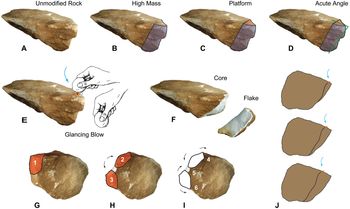
Archaeologists are uniquely placed to take on Dennett's challenge. Top-down design dominates stone working in later prehistory and is universal among modern flint-knappers, but it is not obviously present in the earliest stone tools (Harmand et al. Reference Harmand, Lewis and Feibel2015). So how and when did top-down design emerge? To understand this, it is necessary to have some basic knowledge of the tightly constrained ‘local rules’ of fracture mechanics. Controlled stone flaking can only occur within these physical constraints (Fig. 2).
The ‘local rules’ of stone flaking. Controlled stone flaking is tightly constrained by the mechanics of fracture in brittle solids (Cotterell & Kamminga Reference Cotterell and Kamminga1987). The first step in striking a flake is to find a stone that is relatively siliceous and free of cracks or ‘grain’ (A). Next, the stoneworker must identify a ridge or zone of high mass on one face (B). This zone of high mass must be adjacent to a second face that can serve as a striking platform (C). Crucially, these surfaces must be oriented at an acute angle to one another, that is, less than 90° (D). This ‘acute angle rule’ is counterintuitive to novice stoneworkers, and the discovery of this rule is the breakthrough that led to controlled stone flaking. Once those conditions are met, the platform is struck with a glancing blow (E), creating a flake and a core (F). Both the flake and the core can be used as tools. The flake undercuts the high mass, and flake making is essentially the repeated removal of these high-mass zones (Moore Reference Moore, Nowell and Davidson2010). Removal of the first flake from a core (G: 1, showing the ‘knapper's-eye-view’, looking down onto the platform surface) offsets the high mass to either side of the flake (H: 2 & 3). Removal of these new zones of high mass again offsets the high mass (I: 4, 5 & 6). The way mass is redistributed by flake removal is predictable, and it drives the developing morphology of the core. The distance a blow is struck from the edge (the platform depth) influences the size of the flake (Dibble & Whittaker Reference Dibble and Whittaker1981), and this distance can be adjusted relative to the size of the high mass (J, schematic side view of core). Removing a flake redistributes the mass on the core face by removing the high mass relative to the platform depth.

The mathematical regularities of fracture mechanics demonstrate that the local rules of stone flaking are uniform and constant, and the stone worker's actions—and the results from these actions—have always been tightly constrained by those rules. The process of stone flaking looks simple enough when done by an experienced stone worker. However, the mental evaluations and gestures used to successfully remove a flake are non-intuitive and difficult to learn, even for modern humans like us (Moore Reference Moore, Overmann and Coolidge2019). But because the changes in geometry caused by flake removal are constrained by the local rules of fracture mechanics, those changes are predictable. It was the predictability that allowed stone workers in later prehistory to make exceptionally complex stone tools through top-down design.
The emergence of top-down design in flaking: the ‘standard story’
Oldowan stone flaking:
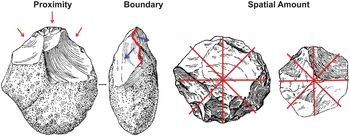
Current evidence indicates that controlled stone flaking arose among hominins in the Rift Valley of Africa. The 3.3-million-year-old stone tools from Lomekwi 3 are technically simple—somewhere between percussive technology (de Beaune Reference de Beaune2004) and fully controlled stone flaking (Harmand et al. Reference Harmand, Lewis and Feibel2015)—but the sample of in situ artefacts there is small. Controlled stone flaking is present in the succeeding Oldowan period at Bokol Dora 1 by 2.58 million years ago (Braun et al. Reference Braun, Aldeias and Archer2019). The Bokol Dora 1 hominins, probably from the genus Homo (Braun et al. Reference Braun, Aldeias and Archer2019), were in full control of the flake-removal process. Wynn (Reference Wynn2002) suggested that Oldowan cores demonstrate geometrical awareness beyond the abilities of living apes (Fig. 3) and inferred that natural selection was already at work for enhanced spatial cognition.
Oldowan stone tools and spatial cognition. Wynn (Reference Wynn1981; Reference Wynn1985) applied Piagetian analysis (otherwise applied to the ontogenetic development of children) to Oldowan stone tools and concluded that early hominins possessed highly developed geometrical awareness. ‘Proximity’ refers to an ability to strike blows close to each other in the spatial field. Cores with flaking concentrated at one end show an ability to sense proximity and to act on it. ‘Boundary’ refers to the ability to divide up the spatial field. Boundary awareness is suggested by bifacial flaking, where flakes are removed to opposite faces of the core, which requires flipping from one face to the other. The spatial field is divided into two parts along the boundary defined by the bifacially flaked edge. A notion of ‘spatial amount’ is implied because the stoneworkers sometimes flaked stones until the diameters more or less matched. (Drawings after Leakey Reference Leakey1971. Not to scale.)

Acheulean stone-flaking:
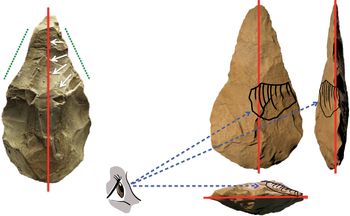
Bifacial handaxes emerge in the Acheulean. The Acheulean is said to begin about 1.76 million years ago (Beyene et al. Reference Beyene, Katoh and WoldeGabriel2013), but objects called handaxes or ‘proto-bifaces’ precociously occur in the preceding Oldowan (Semaw et al. Reference Semaw, Rogers, Stout, Camps and Chauhan2009). The earliest handaxes are relatively crude objects that are elongated examples of the bifacial cobble cores seen in earlier assemblages (Isaac Reference Isaac1977). Significantly, archaeologists see clear evidence for the imposition of symmetry in the manufacture of handaxes (Hodgson Reference Hodgson2015; Wynn Reference Wynn2002). The Acheulean is seen as a long period of development in this cognitive skill, from early developments in coordinating spatial abilities with shape recognition to the imposition of congruent symmetries by c. 500,000 years ago (Sahnouni et al. Reference Sahnouni, Semaw, Rogers, Mitchell and Lane2013; White & Foulds Reference White and Foulds2018), itself suggesting the emergence of mental rotation and a Euclidean sense of space (Fig. 4). Mental rotation and congruency in Late Acheulean handaxes suggests that they had become a ‘category’ in the minds of these hominin stone workers. This is believed by some cognitive archaeologists to be clear evidence for full-blown top-down design because Late Acheulean handaxes imply a form of ‘declarative’ memory, which is responsible for storing these language-mediated concepts.
Symmetry in Acheulean handaxes. Wynn (Reference Wynn2002) argued that an important cognitive breakthrough occurred when advanced spatial abilities were applied to impose bilateral symmetry onto stones, first seen in the handaxes of the Early Acheulean. This was done by trimming to match one side of the developing core to the other side. The edge attrition caused by flaking itself demonstrates boundary, proximity, and spatial amount (see Figure 3). In the example (left), trimming (white arrows) matched the handaxe's right edge to the unmodified left edge (dotted lines). The flaking created mirror symmetry along the vertical line. Shape matching like this requires the ability to see past the constraints offered by what the hominins have in front of them. This ability is called ‘frame independence’, and is accomplishing through the coordination of spatial abilities with a separate cognitive system concerned with shape recognition. In the Late Acheulean, handaxes show relatively precise reflectional symmetry in three dimensions: plan view, side view and end view. In addition to frame independence, this requires mental rotation: the ability to hold in the mind viewpoints that are not all visible at the same time. The stoneworkers must be able to imagine visual perspectives not centred on themselves; that is, to place themselves outside the visual field. This is known as ‘allocentric perception’, or ‘Euclidean spatial thinking’. For instance, when a flake is struck to remove a lump and improve the end-view symmetry in the example (right), the stoneworker must also anticipate how the attrition caused by removing the flake will simultaneously change the object's side-view and plan-view symmetries. Some argue that without this anticipation—based on mental rotation—it would not be possible to produce handaxes consistently with these symmetries. (Not to scale.)

Declarative knowledge is passed between generations through teaching, and teaching of handaxe manufacture is viewed as evidence of a Theory of Mind among Late Acheulean hominins (Shipton Reference Shipton2010). Theory of Mind is the ability to imagine what another individual understands: a sort of ‘mind reading’. Successful teaching requires that the teacher must simultaneously hold two or perhaps three very different understandings in their mind. First, the teacher must understand his or her own knowledge. Second, the teacher must understand the novice's understanding. And arguably, the teacher must understand the novice's understanding of the teacher's knowledge (Wynn & Coolidge Reference Wynn and Coolidge2016, 208). This is known as ‘third-order intentionality’. Although modern humans routinely work with four or five orders of intentionality, chimpanzees have a hard time with one or two (Dunbar Reference Dunbar2008, table 2).
The Levallois Method and working memory:
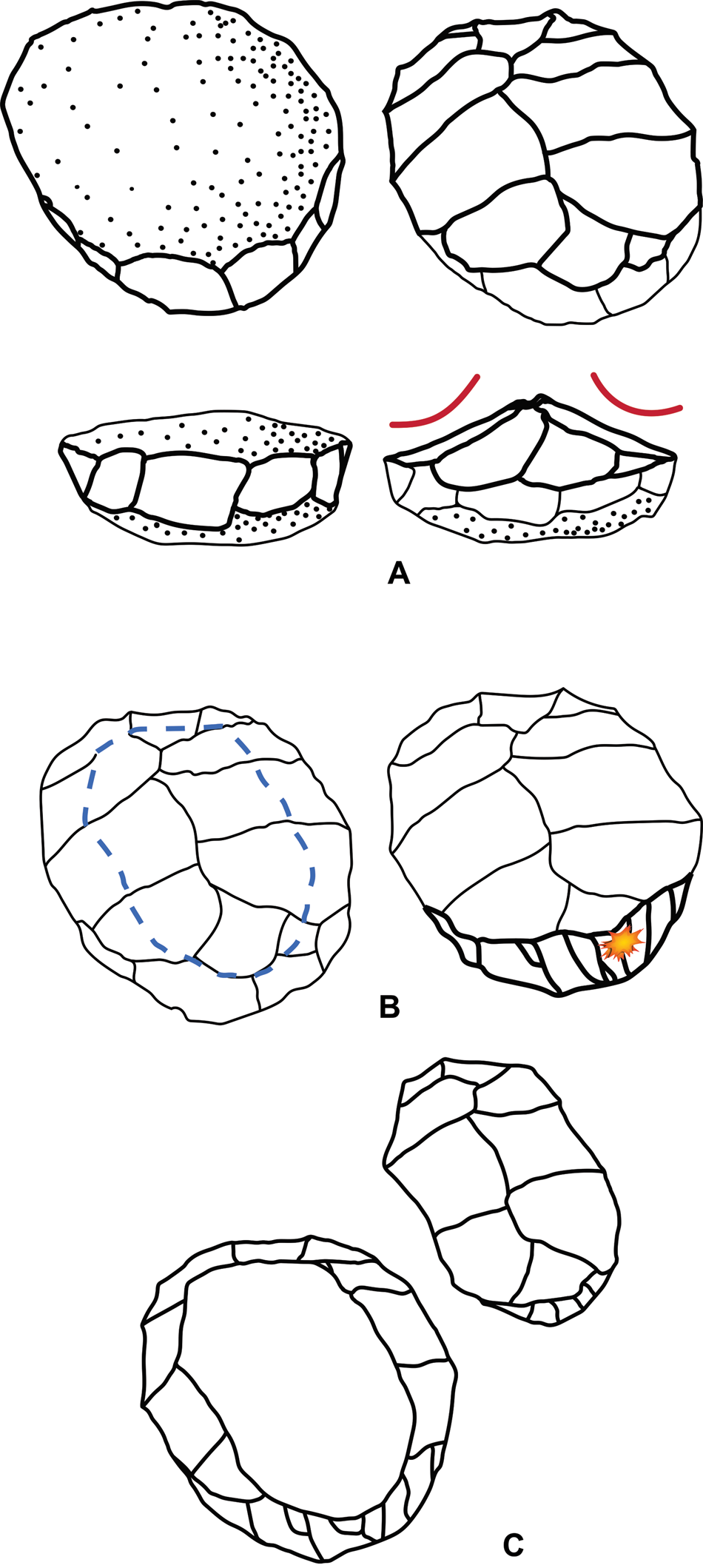
The Levallois Method emerged in its most complex form in Africa around 300,000 years ago, but similar approaches to working stone occur earlier, in the Acheulean (Kuman Reference Kuman2001; Sharon & Beaumont Reference Sharon, Beaumont, Goren-Inbar and Sharon2006) and Oldowan (de la Torre et al. Reference de la Torre, Mora, Domíngez-Rodrigo, de Luque and Alcalá2003). The Levallois Method represents a very different approach to stone working. In its iconic form (Boëda Reference Boëda1994; Reference Boëda, Dibble and Bar-Yosef1995)—Levallois ‘sensu stricto’—the stone core itself was not flaked into a tool, but instead was worked in a complex way so that a flake of predetermined shape could be struck from it. The flake was then retouched or used as a tool, and the core was discarded or reworked for the production of more Levallois flakes (Fig. 5).
Levallois Method and ‘predetermination’. The Levallois Method sensu stricto involves flaking the core in such a way that it ‘predetermines’ the shape of the flake struck from it (Boëda Reference Boëda1994; Reference Boëda, Dibble and Bar-Yosef1995). One face of the core is flaked to provide platform surfaces to strike different sorts of flakes from the opposite face. This creates a zone of high mass of specific shape, often a dome. A platform is then prepared and struck at the end of the dome, which is removed as the intended Levallois flake. For the success of the method, the stoneworker maintains what is known as a ‘hierarchy of surfaces’ (A). Relatively steep, short flakes are struck from one surface (A, left) to provide a continuous platform for shaping a dome on the opposite surface (A, right). The dome is shaped by striking flakes in such a way that they created ‘convexities’ on both lateral sides as well as at the core's distal end (shown by lines). The shape and location of the convexities control the path the flake takes through the dome, anticipating the flake's ‘rupture point’ (van Peer Reference van Peer1992) (B, left, dotted line) as it detaches from the core. The platform surface is carefully prepared to match the intended rupture point on the core face (B, right). The Levallois flake is then struck (C).

The Levallois Method sensu stricto requires highly complex spatial recognitions and ‘planning ahead’ to achieve the goal of a Levallois flake. The stone worker must be able to visualize the morphology of the developing core many steps into the future, and to organize the flaking now, for tactical goals, while holding in mind the strategic goal of removing the Levallois flake (Schlanger Reference Schlanger1996). Without the tactical goals, it is impossible to reach the strategic goal (Pelegrin Reference Pelegrin, Berthelet and Chavaillon1993; Reference Pelegrin, Roux and Bril2005). According to one view, the hierarchical, stage-based conceptual aspects of the Levallois Method must have been held in declarative memory by these stone workers. But drilling down through this strategic thinking, what can we learn about the motor actions necessary to enact it?
To understand this, we need to look at the ‘working memory’ model of human cognition (Coolidge & Wynn Reference Coolidge and Wynn2004; Reference Coolidge and Wynn2005; Wynn & Coolidge Reference Wynn and Coolidge2004). All healthy modern humans have advanced working-memory abilities, although some are better than others and these abilities are highly heritable, and therefore a target of natural selection. Working memory consists of aspects of short-term memory storage and a ‘central executive’ that controls your attention to task, stops impulsive actions and keeps you on track to your goal. Two key sub-systems in working memory relate to language and motor actions, but we must assume that early hominins initially lacked the language sub-system. ’Classic’ working memory fades rapidly. However, memory-fade is not true of experts processing information in their area of expertise, because they have what Coolidge and Wynn (Reference Coolidge and Wynn2005) call ‘enhanced working memory’. When experts are distracted, they can return the task to mind with almost no loss of information, because the actions necessary to complete the task are stored as ‘chunks’ in long-term memory. This is not a general memory ability, but a very specialized one, linked to the area of expertise. But how is this information chunked into long-term memory so it does not fade? Or put another way, how does expert performance differ from most working-memory tasks? The key is the way that the information is encoded into memory and retrieved from it, involving an aspect of cognition referred to as ‘procedural memory’. Three elements are involved: 1) memory cues; 2) retrieval structures (called memory ‘scaffolds’); and 3) motor-action algorithms (Fig. 6). Together, these are the ingredients of a memory chunk.
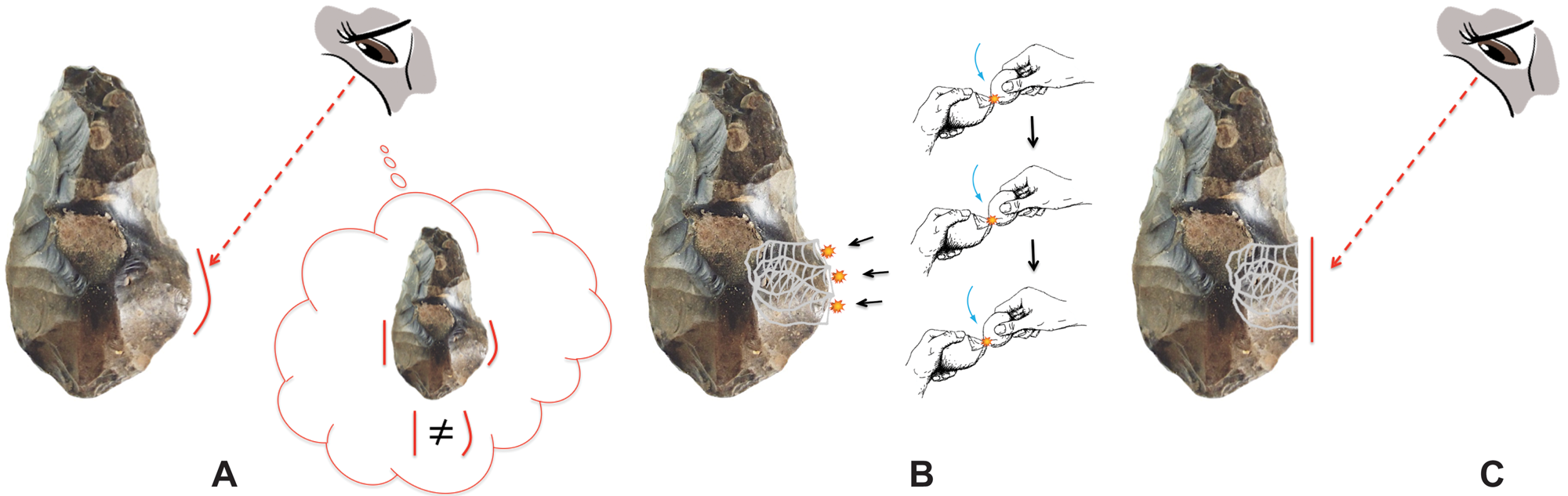
Chunking in long-term memory. Enhanced working memory allows expert performance in motor-action skills like stone working because of the way actions are ‘chunked’ in long-term memory. A chunk refers to the way that the information is encoded into memory and retrieved from it, involving an aspect of cognition referred to as ‘procedural memory’. Memory chunks are composed of memory cues, retrieval structures (called memory ‘scaffolds’) and motor-action algorithms. A ‘cue’ is an aspect of the physical world that brings to mind the scaffold. In the hypothetical example (A), the cue is an excurvate edge on the developing core. Observing the cue invokes quick access to a generalized memory scaffold—the scaffold is tethered to it—that perceives the mismatch in core symmetry (see Figure 4). The scaffold then triggers the flake-removal algorithm (B), a unit of action-based knowledge that can be applied without conscious attention (Moore Reference Moore, Nowell and Davidson2010). Application of the algorithm (in this example, three times) removes the cue (C), in this case enhancing the symmetry of the core. The cue fades rapidly from working memory but the scaffold is stored until invoked by a new cue. In expert performance, memory chunks are the key to enhanced working memory because they ensure that technical information does not fade. (Not to scale.)

Algorithms can become ‘muscle memories’ applied without conscious direction, and these are automatic, given enough repetitions. But expertise is not easily acquired: one review suggested 10 years or 10,000 repetitions as necessary for the development of automaticity and complex expert performance linked to long-term memory (Wynn & Coolidge Reference Wynn and Coolidge2010, 204). In fact, expert procedural knowledge is very difficult to describe verbally because it is inherently non-verbal, and the reason the knowledge does not fade is because of the way that long-term memory is chunked around scaffolds linked to cues. When someone says ‘you can't learn this from books’, they are saying that working memory is non-verbal and it will take hands-on experience to build those long-term memory chunks. Note that driving a vehicle involves a virtuoso motor-action performance, yet we often arrive at the destination without really remembering any of it. This is because the environmental cues and motor-action algorithms—and the scaffolds for them—are beneath conscious attention. In fact, one important effect of this is to free our attention capacity to innovate and plan ahead, and this allows and supports even more complex behaviours.
Returning to the Levallois Method, this is seen by many archaeologists as the first evidence for enhanced working memory in early hominins, although some researchers believe that aspects of handaxe manufacture hint at this ability (Coolidge & Wynn Reference Wynn and Coolidge2016). In the Levallois Method sensu stricto, a variety of preparation flakes were struck by different algorithms prompted by scaffolds retrieved in response to cues on the developing core. The stone worker moved from one stage to another, in response to changes in cues and scaffolds, applying different automatized stone-flaking algorithms. The hierarchical, stage-based strategic organization uniting these scaffolds and algorithms must have been guided by central executive control over long-term declarative and procedural memory, including the knapping inhibitions necessary to ensure the process stayed on-target (Wynn & Coolidge Reference Wynn and Coolidge2004).
The complexities of the feedback between declarative and procedural memory prompted Coolidge and Wynn (Reference Coolidge and Wynn2005, 13) to suggest the abilities ‘may have been exapted from language’. In other words, without evolved cognitive structures for language, this level of working-memory complexity may not have been possible. They also contend that once this enhanced form of working memory was achieved, ‘no more complex form of stone knapping ever appears’ (Coolidge & Wynn Reference Coolidge and Wynn2005, 16, emphasis in original). If they are right, these Levallois Method stone workers had the cognitive abilities to make any of the complex tools that emerged in later prehistory.
That is about as far as cognitive archaeologists have pushed the record of stone artefacts. According to this view, enhanced working memory in tool manufacture—and therefore top-down design—emerged between 300,000 and 500,000 years ago. However, working memory is a capacity, and it may have continued to increase, allowing symbolic communication by 75,000 years ago (Wynn & Coolidge Reference Wynn and Coolidge2016) and the colonization of Australia (Davidson Reference Davidson2010) by 65,000 years ago.
Warranting arguments and modern flint knapping
But what is the warranting argument that lends credibility to these cognitive interpretations? If you unpack the epistemology of these studies, they all lead back to modern flint knappers and what they say about the process, either explicitly or implicitly: ‘But are the cognitive underpinnings the same? … We can only answer these questions by using modern knappers as surrogates’ (Wynn & Coolidge Reference Wynn and Coolidge2004, 474).
When a modern flint knapper is asked to replicate an Oldowan core, Acheulean handaxe, or Levallois flake, the type becomes the strategic goal. Types are idealized categories defined by archaeologists and agreed upon by convention, and they reside in the modern flint knapper's language-mediated declarative memory. During the replication process, the flint knapper marshalls their human expertise to reach this goal ‘held in the mind’. Further, they also apply their enhanced working-memory abilities that form the cognitive basis for their expert performance; modern flint knappers cannot help but do so, because, among modern humans, enhanced working memory is ‘the style of thinking that is most commonly used in everyday tasks’ (Wynn & Coolidge Reference Wynn and Coolidge2004, 473). Explanations by flint knappers about how they go about replicating early hominin stone tools are rife with discussions of stone-working intentions and strategic goals, because this is the way that a human thinks through problems: modern flint knappers always apply top-down design when they mimic ancient stone tools. They cannot do it any other way.
This is not problematic when studying more recent Homo sapiens stone working because of a uniformitarian principle: recent stone workers had the same cognition as we do today. But it is unwarranted to uncritically infer the intentions and goals of non-modern early hominins from our modern ways of working through technical problems. This is particularly true in using modern stone knapping as a source of information about the evolution of cognition. Invoking Dennett's caution, archaeologists who rely on intuitions of modern flint knappers are predisposed to see intentional design where there was none (Davidson Reference Davidson and Wray2002).
Bottom-up design in stone flaking
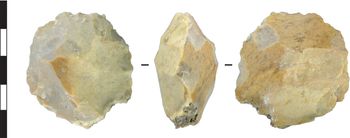
So is bottom-up design possible in stone flaking? There are three reasons to think that yes, it is. First, as we have seen, the stone-flaking process is tightly constrained by the ‘local rules’ of fracture mechanics (Fig. 2). Controlled stone flaking can only occur within these narrow physical constraints. Second, the stone-flaking process is punctuated: each blow is an isolated event that removes another piece of the core. The process can be stopped at any point, and picked up again in future. For instance, Figure 7 illustrates a core where the reduction process was delayed for thousands of years between flint knappers. Few other technologies share this punctuated structure. And third, removing a flake inevitably and irreversibly changes the morphology of the core. When the knapper picked up an old core and lined up that first blow, they had to contend with the flake scars created by the knapper's flaking from thousands of years earlier. The earlier knapper's intentions were irrelevant to the knapper that came later; core reduction could proceed nevertheless, and if we wanted to, we could restart the process again today. Forward thinking did not link the flaking events on this core, and it is not necessary to assume that forward thinking connected any of the scars on an early hominin core either.
Recycled chert core and ‘forward thinking’. The light-coloured, ‘fresh’ scars on this core from southern Arabia were created by a Late Bronze Age stoneworker, 1750–1300 cal bc (Weeks et al. Reference Weeks, Cable and Franke2018). They intrude into dark patinated flake scars created by a much earlier stoneworker, possibly during the Neolithic. The intentions of the earlier knapper were irrelevant to the Bronze Age knapper—reduction could continue regardless. This shows that forward thinking is not necessary for successful flake making. (Scale bar 50 mm.)

In other words, it is possible to remove flakes from a stone mindlessly, without forward thinking, and this simple ‘remove flake’ algorithm (Moore Reference Moore, Nowell and Davidson2010) will inevitably produce a core. And further, we can anticipate on theoretical grounds that repetition in core shapes will arise in bottom-up design because of the local rules of fracture mechanics (Moore Reference Moore2011). The ‘remove flake’ algorithm will be explored in more detail below, but next we will review experiments that attempt to mimic bottom-up design in stone flaking.
Spandrels experiments
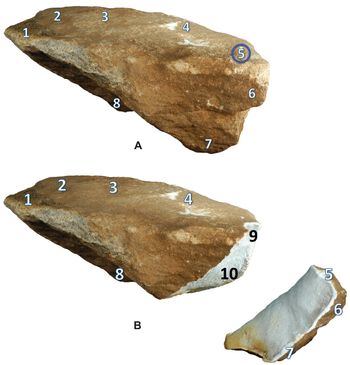
To break out of the epistemological conundrum caused by unreflective flint knapping that attempts to produce archaeological types, we designed an experiment that mimicked something like bottom-up design by disrupting a modern knapper's ability to apply their enhanced working memory (Moore & Perston Reference Moore and Perston2016). This was done by preventing the knapper from acting beyond the removal of a single flake, thus severing the ‘cognitive link’ between flake removals (Fig. 8). First, the flint knapper identified all viable platforms on the stone according to the ‘maximization protocol’: he spaced the platforms to remove as large a flake as possible from each one. The flint knapper identified the platforms according to his knowledge of the local rules of stone flaking and the goal of removing that one large flake. The knowledge necessary to remove a flake was considered an experimental ‘black box’, and the flint knapper was unimpeded in removing flakes individually. Next, a random number generator was used to select one of the platforms and the flake was removed. The reconfigured core was re-evaluated and new platforms identified. The next step involved randomly selecting the next platform from this new configuration and removing it. This procedure was repeated until the core size dropped below an arbitrary size threshold. Because flake selection was randomized, the flint knapper could not plan ahead, and top-down design was prevented. The cores were created by a bottom-up design process.
Protocols of the spandrels experiments. The ‘spandrels experiments’ mimicked bottom-up design in stone flaking (Moore & Perston Reference Moore and Perston2016). All viable platforms were identified on the stone according to the ‘maximization protocol’ (A) and a random number generator was used to select one of the platforms—Platform 5 (circled) in the hypothetical example. The flake was removed (B) and the reconfigured core was re-evaluated, with new platforms identified. In the example, the flake took away three platforms—5, 6, and 7—and created two new platforms—9 and 10. The next platform was randomly chosen from this new configuration, and the flake was removed (not shown). The experimental procedure was repeated until the core size dropped below an arbitrary size threshold.

The experiments began with 29 large cobbles (avg. 7877 g) and 30 flake blanks (avg. 367 g) of Australian silcrete and mudstone, and the experimental procedure was repeated until the size of the core dropped below 400 g for cobbles and 25 g for flake blanks. After the experiments, the flakes were fitted back onto the cores. Each core was measured and classified typologically after the addition of each flake, working backwards towards the initial starting cobble or flake blank. This typological data was then compared to the ‘standard story’ of technological evolution (Moore & Perston Reference Moore and Perston2016).
So what do the cores look like in this experimental version of unguided bottom-up design? Among the strongest forces unleashed by this ‘mindless’ flaking was the creation of bifacial edges—within about six blows of starting. This was because removing a flake from one face of a core usually creates one or more viable platforms to strike a flake from the opposite face. Eventually one of these is randomly selected, and bifacial flaking is the result, without a goal-directed intention to do so. All of the experiments created bifacial cores (Moore & Perston Reference Moore and Perston2016). These unplanned examples of types and attributes I refer to as ‘spandrels’ (Moore Reference Moore2011) and the research is known as the ‘spandrels experiments’.
Bifacial cores trended towards a disc shape as reduction proceeded, with one slightly longer axis. The degree of elongation waxed and waned through reduction, but pronounced elongation was relatively rare because the ends of cores were eventually lopped off. Nevertheless, 56 bifacial cores became sufficiently elongated (width/length <0.76) and flattened (thickness/width <0.67) to be classified as ‘handaxes’ in Isaac's (1977) typology. The maximization protocol prevented the fine flaking seen on later Acheulean handaxes, but the experimental cores are typologically similar to objects classified by archaeologists as proto-bifaces or Early Acheulean handaxes (Moore & Perston Reference Moore and Perston2016).
Many of the bifacial cores developed a centripetal arrangement of flake scars with core mass concentrated in a dome in the centre of the face. Sometimes a platform was fortuitously oriented so that removing most of the dome was feasible. Usually these platforms were not selected by the random number generator, but when they were, a Levallois-like flake was produced. The shapes of the Levallois-like flakes were predetermined by the creation of convexities by prior flaking, although there was no intention to create these convexities. The spandrels cores and flakes do not fit archaeological definitions of the Levallois Method sensu stricto (Boëda Reference Boëda1994; Reference Boëda, Dibble and Bar-Yosef1995) because, by experimental design, the core volumes were not arranged hiearchically and platform preparation was not allowed (Moore & Perston Reference Moore and Perston2016).
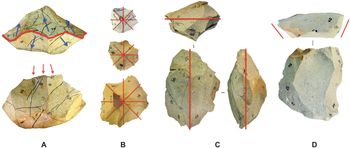
Bottom-up design, then, can produce artefact forms and attributes that are remarkably similar to those traditionally thought to be the elements of top-down design, including bifacial flaking, handaxes and Levallois-like flakes (Fig. 9). Note, however, that the goal of the experiments was to prevent modern flint knappers’ propensity to top-down design, which is different from an attempt to replicate early hominin assemblages. The experiments mimicked a cognitive state to see what would be produced, rather than attempting to make objects ‘held in the mind’. The fact that these bottom-up experiments produced aspects of technologies from throughout early human evolution is significant. It shows that the simple algorithm of removing flakes randomly following the local rules of fracture mechanics can steer reduction towards apparent complexity, without top-down goal direction (Rogers et al. Reference Rogers, Killcross and Curnoe2016).
Results of the spandrels experiments. The spandrels experiments mimicked bottom-up design in stone tool manufacture by eliminating complex intentions from the process (Moore & Perston Reference Moore and Perston2016), but produced cores that seem to show elements of top-down design. For instance, without an intention to do so, the experiments produced objects that demonstrate boundary (A, top), proximity (A, bottom), and spatial amount (B) (see Figure 3). Bilateral symmetries developed similar to those seen on Early Acheulean handaxes (C) which ostensibly require frame independence, hidden perspective and a Euclidean sense of space (see Figure 4). The experiments produced objects classifiable as ‘handaxes’ (C) without ‘holding them in the mind’ during the knapping process—this was not required and it suggests that handaxes can be reproduced without teaching and therefore without an advanced ‘theory of mind’. The experiments created domed core faces through convexity control (C, right; D, top) (see Figure 5), as well as Levallois-like cores (D) and flakes, without an intention to do so. This shows that not all aspects of the Levallois Method sensu stricto require complex intentions, challenging the links between the enhanced working memory model and the archaeological record, as currently formulated. (Not to scale.)

Significantly, the experiments did not produce attributes like the congruent symmetries of handaxes seen in the Late Acheulean, or the Levallois Method sensu stricto, as found in later hominin assemblages. I will return to this below, but does this mean that bottom-up design can account for assemblages prior to the emergence of these more complex technologies; that is, prior to the Late Acheulean? Invoking Wynn and Coolidge's axiom, we should entertain the possibility that yes, it can:
If the archaeological traces could have been generated by simpler actions, or if the actions could have been organized by a simpler cognitive system, then the simpler explanation must be favoured. (Wynn & Coolidge Reference Wynn and Coolidge2010, S12)
The flake unit ‘black box’
Before exploring the implications in more detail, we should first consider whether the ‘black box’ of the simple flake-removal algorithm is itself an aspect of top-down design. This possibility is crucial to interpreting the first emergence of controlled stone flaking.
Bottom-up design in stone flaking was at the heart of the ‘eolith’ controversy of the nineteenth and twentieth centuries, when archaeologists vociferously debated whether flaked stone objects recovered from very old gravels were, in fact, made by early humans (O'Connor Reference O'Connor2003; Spencer Reference Spencer and Stocking1988). To demonstrate that eoliths were not artefacts, experiments were done to induce stone flaking through natural processes (e.g. Haward Reference Haward1914; Warren Reference Warren1914). The experiments demonstrated that patterned flaking can occur naturally; it is not the exclusive province of hominins, nor any life-form at all. This century-old debate confirms Dennett's caution that we humans tend to intuit design everywhere.
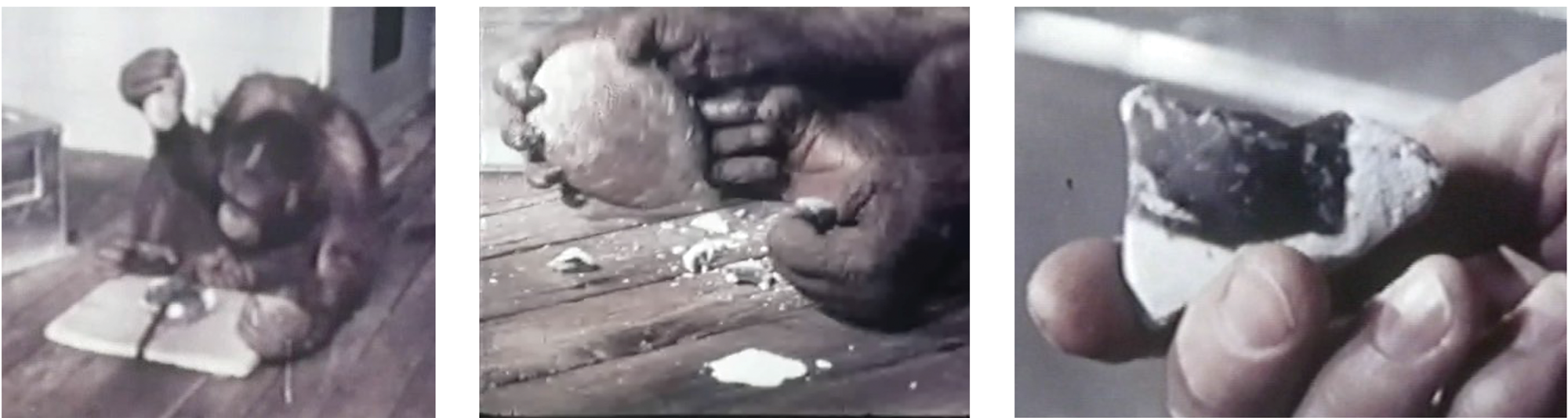
More recently, captive apes, wild chimpanzees and monkeys have been observed using and breaking stones. These assemblages are also products of bottom-up design—the production of sharp objects as a by-product of some other stone-using activity, such as cracking nuts (Gumert et al. Reference Gumert, Kluck and Malaivijitnond2009; Visalberghi et al. Reference Visalberghi, Fragaszy, Ottoni, Izar, de Oliveira and Andrade2007; Wynn et al. Reference Wynn, Hernandez-Aguilar, Marchant and McGrew2011) or producing powder to ingest (Mannu & Ottoni Reference Mannu and Ottoni2009; Proffitt et al. Reference Proffitt, Luncz, Falótico, Ottoni, de la Torre and Haslam2016), or in stimulus-response to cut strings to retrieve a food reward (Toth et al. Reference Toth, Schick, Savage-Rumbaugh, Sevcik and Rumbaugh1993; Wright Reference Wright, Washburn and McCown1978). String-cutting captive apes seem capable of organizing their actions around a simple goal—to break a rock—in the context of experimental laboratory protocols explicitly designed to produce this outcome (Fig. 10). Yet captive ape experiments, and observations of wild primates, have yet to document clear examples of controlled stone flaking. Artefacts from the earliest stone flaking are very different from captive ape tools because the scars on prehistoric cores indicate mastery over platform angles and the importance of striking behind high mass (Braun et al. Reference Braun, Aldeias and Archer2019; Delanges & Roche Reference Delanges and Roche2005)—the two elements that, when repeated, indicate controlled flaking. Repetition of these attributes is absent from eoliths and modern primate stone assemblages (Toth et al. Reference Toth, Schick, Semaw S., Toth and Schick2006), and it is this repetition that is the best evidence we have for early hominin intentions.
Abang, a captive orangutan, smashing a rock in a flake-making experiment (stills from a film of the process). Although Abang was successful in fracturing the flint to produce sharp tools for procuring food (Wright Reference Wright, Washburn and McCown1978), he did not demonstrate abilities at controlled stone flaking.

The appearance of controlled flaking represents an important breakthrough in cognitive evolution (Moore Reference Moore, Overmann and Coolidge2019). Not only is this the earliest archaeological evidence we have of an intention to create objects (flakes), but mastery of the essential elements for striking a single flake implies some of the cognitive attributes reviewed above and described in Figures 2 & 3. For instance, the acute-angle rule is evidence for boundary—the ability to divide the spatial field into parts. In this case, the boundary is between the core face and platform surface (Fig. 1, B–D). Flake size is controlled by how far back on the platform a blow is struck, which illustrates a concept of spatial amount (Fig. 1, J). The visual search to identify a suitable platform surface and core face (see Moore Reference Moore, Overmann and Coolidge2019, 183–6) requires the ability to see past the constraints of the visual array because one face is hidden; this is a form of ‘frame independence’. The process of finding that configuration, and rotating the core to strike the flake—hiding one face from view (Fig. 1, G)—entails visualizing the stone from a ‘hidden perspective’, thus demonstrating a Euclidean sense of space. And controlled flaking was so common in these early assemblages (Davidson & McGrew Reference Davidson and McGrew2005) that we might infer that the motor actions were automatic, with the gestures and geometric observations organized as an simple ‘remove flake’ algorithm in procedural memory—the essential element of automaticity necessary for expert performance.
Controlled flaking is not itself evidence of fully developed top-down design, however, because there is little clear evidence that these hominins were thinking beyond the removal of individual flakes (Toth Reference Toth1985). Nevertheless, the necessary cognitive abilities for top-down design—the tactical and strategic removal of flakes to achieve a complex goal—may have been there right from the start of controlled stone flaking. Bootstrapping those abilities into enhanced working memory was a long evolutionary process, and I will turn to this now.
Cues, scaffolds, algorithms and cognitive evolution
To this point, we have seen that modern flint knappers’ cognition is not a suitable surrogate for non-modern hominin cognition. Further, we have seen experimental evidence that the ‘types’ at the centre of our search for top-down design—or the attributes of those types said to reflect advances in cognition—can be explained by bottom-up design processes. Finally, we have seen that essential cognitive abilities necessary for complex tool manufacture are inherent in the evaluations and skills necessary for the controlled removal of a single flake. Next I propose an alternative model of hominin cognitive evolution that invokes Wynn and Coolidge's (Reference Wynn and Coolidge2004; Coolidge & Wynn Reference Coolidge and Wynn2004; Reference Coolidge and Wynn2005) model of enhanced working memory. In this alternative, it was the development of the cues, scaffolds and algorithms, and the building of ever more complex memory chunks in procedural memory, that explains the early archaeological record—not developments in goal direction or intentions to make objects.
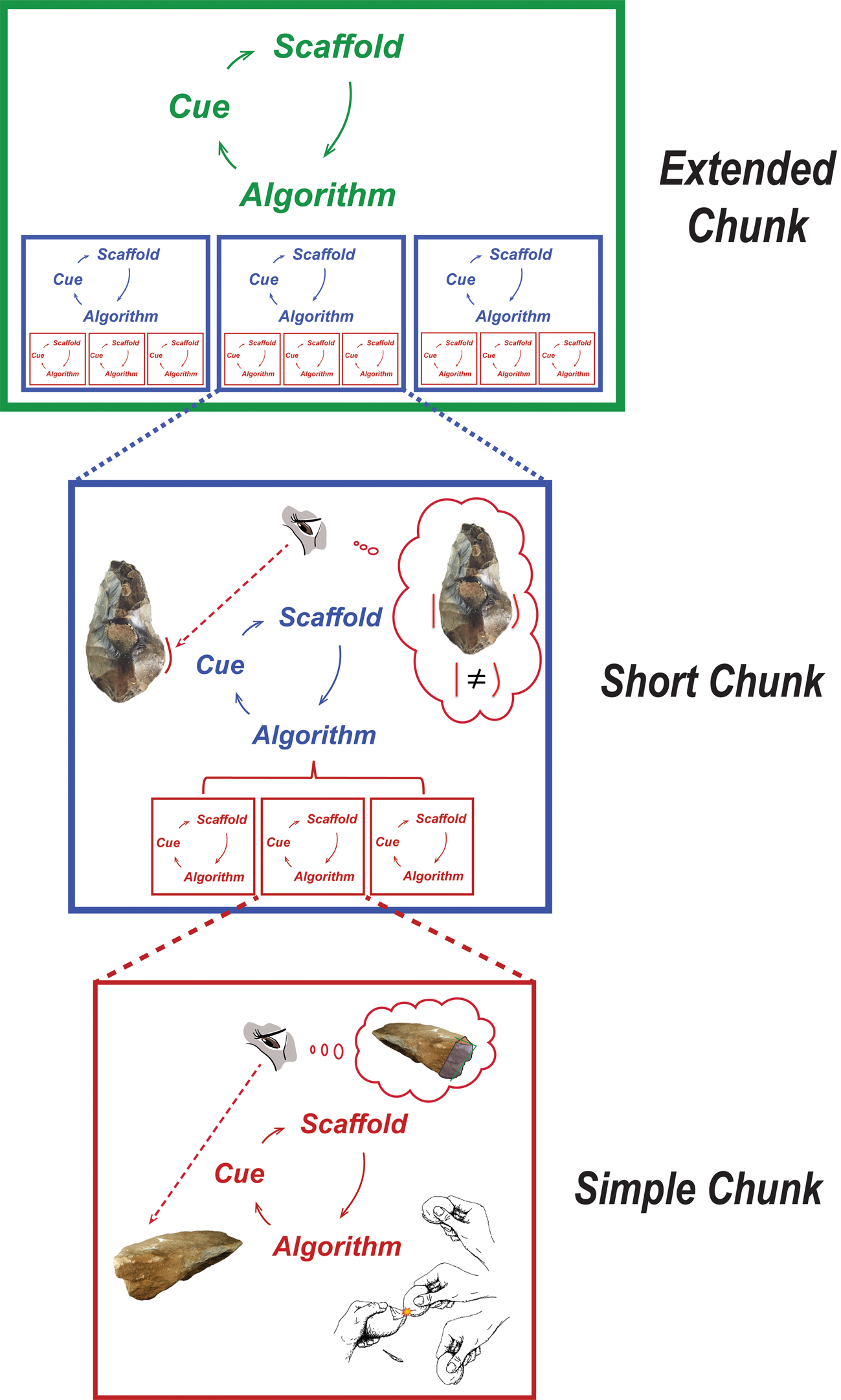
When controlled stone working first emerged, by at least the Oldowan period c. 2.6 million years ago, scaffolds and algorithms were organized to remove individual flakes. The retrieval structure scaffold was prompted by cues in the morphology of the stone, as dictated by the local rules of fracture mechanics (Fig. 1), which set in train the motor action algorithm. This set of cues, scaffold and algorithm form the simple working-memory chunk, or ‘simple chunk’, that underpins all stone working that has occurred ever since (Fig. 11). The spandrels experiments demonstrate that unguided application of the simple chunk can produce bifacial cores, occasional handaxes and Levallois-like flakes, without an intention to do so (Fig. 9). These unintended consequences (i.e. spandrels) also occurred when early hominins knapped stone, as documented in Oldowan assemblages with precocious examples of technologies that became more prevalent later in hominin evolution, such as handaxes and Levallois-like technology (e.g. Semaw et al. Reference Semaw, Rogers, Stout, Camps and Chauhan2009; de la Torre et al. Reference de la Torre, Mora, Domíngez-Rodrigo, de Luque and Alcalá2003). Indeed, archaeologists have long recognized the problem of these precocious technologies and ‘created increasingly convoluted frameworks’ to accommodate them (Monnier Reference Monnier2006, 711).
A model of increasing stone-flaking complexity based on elaborations in procedural memory. In this schematic model, procedural memory ‘chunks’ of increasing complexity are nested inside each other, showing how recursion is a fundamental property of stone flaking. The simple memory chunk (bottom) drives the removal of a single flake through cues and scaffolds described in Figure 1. The simple chunk is automatized within the ‘short chunk’ (middle). In this hypothetical example, described in Figure 6, three flakes are removed in response to a geometrical cue on a spandrel. The short chunk, in turn, is automatized with the ‘extended chunk’ (top). Technical procedures like striking flakes from prepared platforms are automatized by modern knappers within extended chunks. In this schematic model, three short chunks are automatized within the extended chunk, which in turn required nine simple chunks; in practice, many more flake removals are possible within automatized memory chunks. Recursion cannot proceed indefinitely, and staged-based sequencing—and therefore top-down design—may have emerged after recursive flaking within chunks reached its cognitive limit. Bottom-up design is demonstrated by unguided application of simple chunks, which produces spandrels (Moore & Perston Reference Moore and Perston2016), and, in theory, unguided application of simple and extended chunks may increase the frequency of those spandrels. Although an increase in spandrels may appear to reflect intentional, top-down design, it might instead be explained by the application of rules governing bottom-up design to memory chunks of greater complexity.

Flake removal was repeated frequently—well attested in the archaeological record—and this resulted in the automatization of the simple chunk in procedural memory, in turn freeing-up cognitive capacity for combining the simple chunks in repetitive sequences. By about 1.75 million years ago (Beyene et al. Reference Beyene, Katoh and WoldeGabriel2013), handaxes and Levallois-like spandrels (e.g. Semaw et al. Reference Semaw, Rogers, Stout, Camps and Chauhan2009; de la Torre et al. Reference de la Torre, Mora, Domíngez-Rodrigo, de Luque and Alcalá2003) became more common in the archaeological record than can be explained by the spandrels experiments; I hypothesize that this was because cues on the spandrels themselves sometimes drove the stone reduction process. During this period, cues elaborated beyond the core morphology necessary to remove individual flakes to include attributes observed on the spandrels that inevitably occurred from removing those flakes individually (e.g. Fig. 9). Through this process, we see the emergence of what I call the ‘short chunk’. The hypothetical example in Figure 6 shows a curved edge as an elaborated cue which triggers the removal of multiple flakes by applying simple chunks in a short series to match the shape of one side of the core to the other (as suggested by Wynn Reference Wynn2002). Note that the simple chunk is embedded within the short chunk to remove that series of (in the Figure 6 example) three flakes (Fig. 11). The short chunk itself—and the repetitive sequence of simple chunks within it, based on simple cues—in turn became automatized through repetition.
The freed-up attention capacity hypothetically allowed for a still more complex set of chunking, what I call the ‘extended chunk’ (Fig. 11). The simple chunk is embedded within the short chunk, which is in turn embedded within the extended chunk. Extended chunks are applied by modern human knappers when they prepare platforms on one face of the core to remove a flake from the opposite face (Moore Reference Moore, Nowell and Davidson2010)—a process that appears to arise in the Late Acheulean (Sharon & Goren-Inbar Reference Sharon and Goren-Inbar1999; Stout et al. Reference Stout, Apel, Commander and Roberts2014)—but more research is needed to see if complex flaking is impossible without extended chunks, or is simply facilitated by them.
This nesting of chunks within chunks is known as ‘recursion’ (Corballis Reference Corballis2011). Recursion occurs when one step of a procedure is the procedure itself. Linguists have used this concept to explain the complexity of grammatical sentences (Hauser et al. Reference Hauser, Chomsky and Fitch2002). Recursion distinguishes human language from the way animals communicate, and recursion is what allows a Theory of Mind. Our ability to think recursively is said by Corballis (Reference Corballis2011, 1) to be ‘the primary characteristic that distinguishes the human mind from that of other animals’, and our ability to think recursively is due to the structure of working memory.
But note that although the progressive recursion of chunks in human evolution possibly resulted in more complex stone tools, this may have continued to be a bottom-up process. In much the same way that relatively complex forms were produced in the spandrels experiments by ‘mindless’ application of the simple chunk, it is possibly in theory that mindless application of short chunks, or extended chunks, could also produce complex forms without an intention to do so. In this case, hominins focused on certain features of spandrels as cues, and the overall shape of the core hitchhiked on the back of those features. The objects were unplanned. As with the experiments, core shape was not a ‘goal’ in the mind of these stone workers, but was rather an outgrowth of the local rules of fracture mechanics. The hominin stone workers’ thinking was focused on cues and scaffolds, not goals, and the by-products were created by Pavlovian-like responses to cues as they arose inevitably during reduction.
But layers of recursion cannot be added indefinitely; even the enhanced working memory of modern humans cannot carry long sequences of recursion (Dunbar Reference Dunbar, Kenna, MacCarron and MacCarron2017). Instead, for further complexity to develop, chunks must eventually be arranged hierarchically, rather than embedded within each other, and this transition marks the origin of top-down design. In a hierarchical arrangement, one chunk is done first, triggering the next chunk, and so on. The complex cues and scaffolds that hold this hiearchical arrangement together become abstract and anticipated, under the control of executive functions and declarative memory, rather than existing in the moment. In other words, they have become goals, and the chunks have become sequential stages or steps triggered by those goals, both tactical and strategic. This, finally, is true top-down design.
When did this occur in hominin evolution? Perhaps the symmetrically congruent handaxes of the latest Acheulean are evidence for top-down design, but even these tools can be explained, at least theoretically, by elaborations internal to memory chunks. Top-down design is most clearly manifest in the fully realized Levallois Method, after about 300,000 years ago. We can see this in the shift from producing a shaped core to a flake struck from a shaped core, and the shaping of that flake into a tool for hafting (Brooks et al. Reference Brooks, Nevell, Yellen, Hartman, Hovers and Kuhn2006).
But why did hominins develop cues and scaffolds around the attributes that led to handaxes and Levallois-like flakes? That is, what were the complex cues triggering memory chunks, and why those particular cues? Enhanced tool function (Finkel & Barkai Reference Finkel and Barkai2018; Gowlett Reference Gowlett, Goren-Inbar and Sharon2006) or social performance (Cole Reference Cole2012; Gowlett et al. Reference Gowlett, Gable and Dunbar2012; cf. Byers Reference Byers1999) are two possible explanations, within a selective environment that enhanced the production of complex cues. Another explanation is that cues and scaffolds became shared as a spin-off from the complications of passing technical knowledge between generations (Henrich & McElreath Reference Henrich, McElreath, Dunbar and Barrett2006; Morgan et al. Reference Morgan, Uomini and Rendell2015; Tostevin Reference Tostevin, Love and Wimsatt2019). Novice hominin stone workers emulated then imitated the memory chunks of more experienced stone workers by learning the relevant cues and scaffolds. As complex chunks were triggered by cues on spandrels, the social transmission process caused those spandrels to be produced with greater regularity. Archaeologist's types were an unintended consequence of that process.
Conclusion
This model, grounded empirically in the spandrels experiments, explains three important aspects of the early archaeological record. First, it explains the precocious appearance of ‘advanced’ stone tools amid much simpler technologies: the early examples are really spandrels, spun-off by simple memory chunking. Second, it explains the gradual increase in these elements: the later examples were created by short and perhaps extended chunking scaffolded around the more complex cues specific to spandrels. And this model explains the refinements seen from about 300,000 years ago, culminating in top-down design and fully modern levels of complexity: the sophisticated examples are goals, created by the hierarchical arrangement of memory chunks. The key breakthrough occurred with controlled stone flaking by at least 2.6 million years ago, which provided the foundation for continuing evolutionary developments through the Pleistocene to the emergence of enhanced working memory among early modern humans.
The spandrels experiments are a new way of conducting cognitive archaeology because they start with cognitive constraints and work forward experimentally, rather than working backwards from the intuitions of modern flint knappers. The proposed evolutionary model can be tested empirically by organizing the experimental protocols around cues, scaffolds and algorithms—and the social transmission of this technical knowledge—rather than archaeological ‘types’. By doing so, we can begin to meet Dennett's challenge by providing a solid understanding on how we went from termite-style building to Gaudí-style building, and managed to sustain it across thousands of generations.
Acknowledgements
The experimental work was funded by a grant to MWM from the Australian Research Council (DP1096558).